스캔 원본
100%
p.301
p.302
p.303
p.304
p.305
p.306
p.307
p.308
p.309
p.310
p.311
p.312
p.313
p.314
정보참모부 주간요약보고
보고 기간: 1948년 4월 30일~1948년 5월 7일
주한미육군사령부
서울, 조선
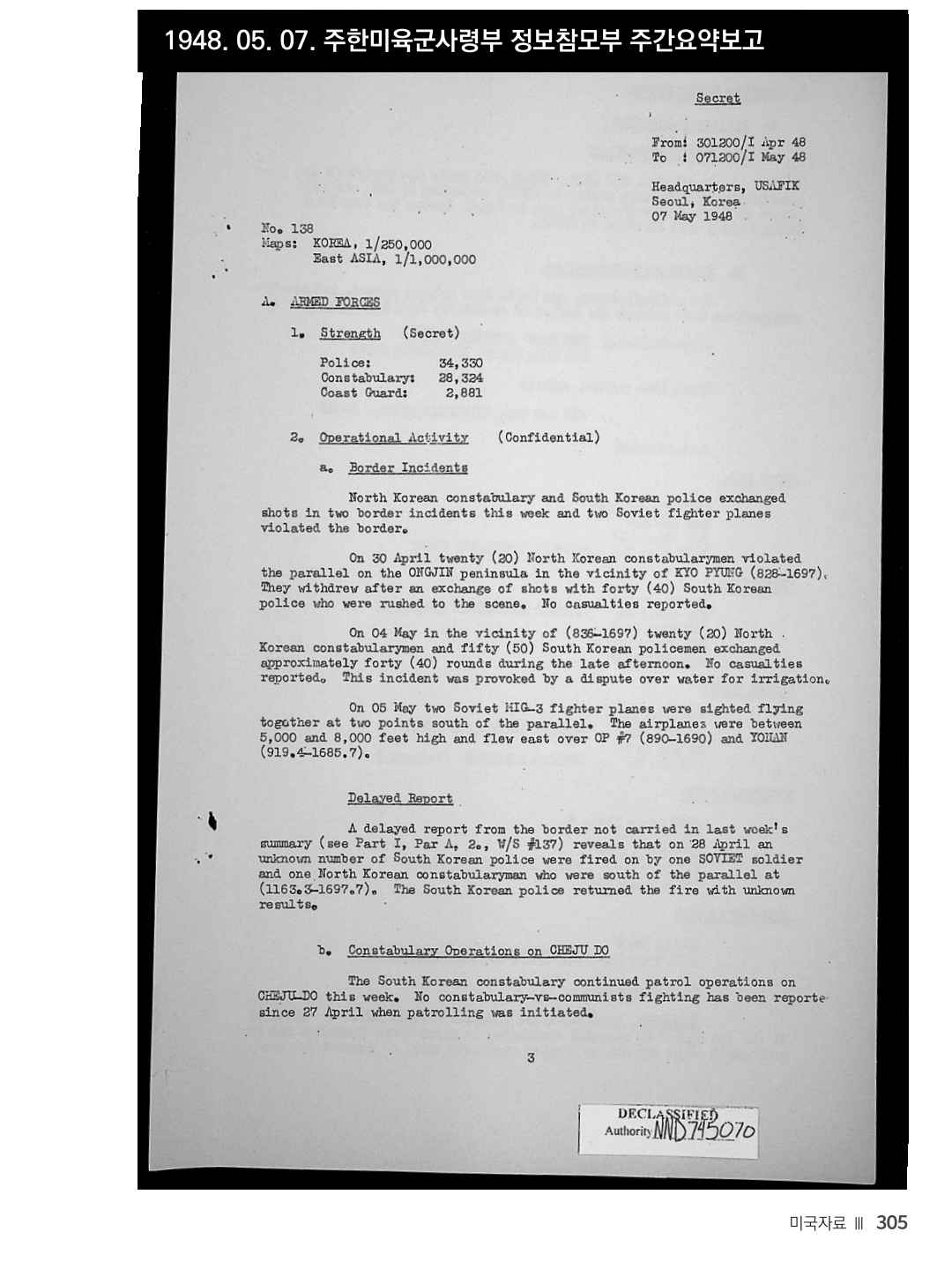
1948년 5월 7일 제138호
A. 군대
1. 병력 (2급 비밀)
경찰: 34,330명
경비대: 28,324명
해안경비대: 2,881명
2. 작전 활동 (3급 비밀)
b. 제주도에서의 경비대 작전 국방경비대는 이번 주에도 제주도에서 정찰 활동을 계속했다. 정찰 활동이 시작된 4월 27일 이후 경비대와 공산주의자 사이의 전투는 보고되지 않았다.
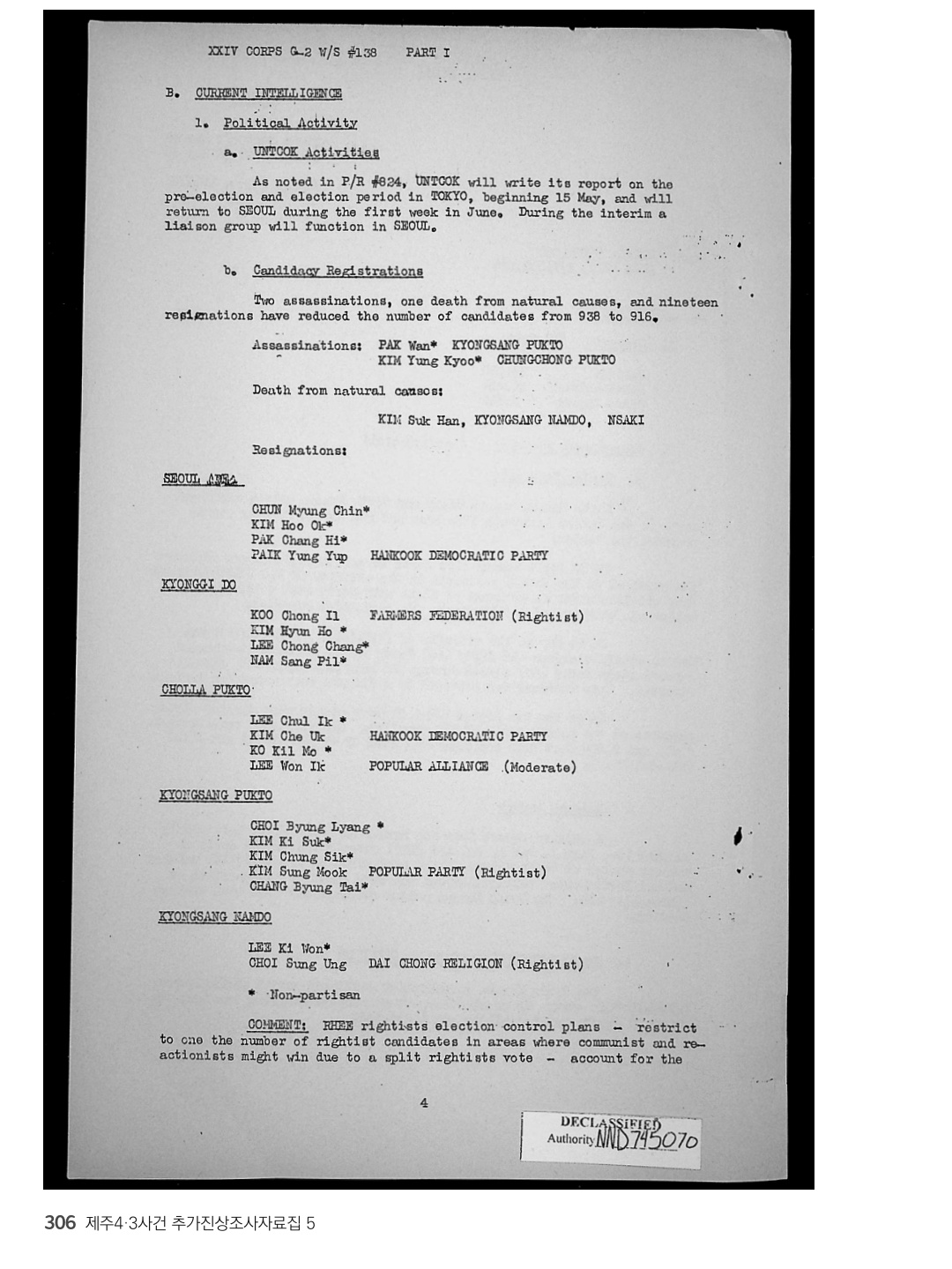
B. 현용 정보
2. 민간인 소요
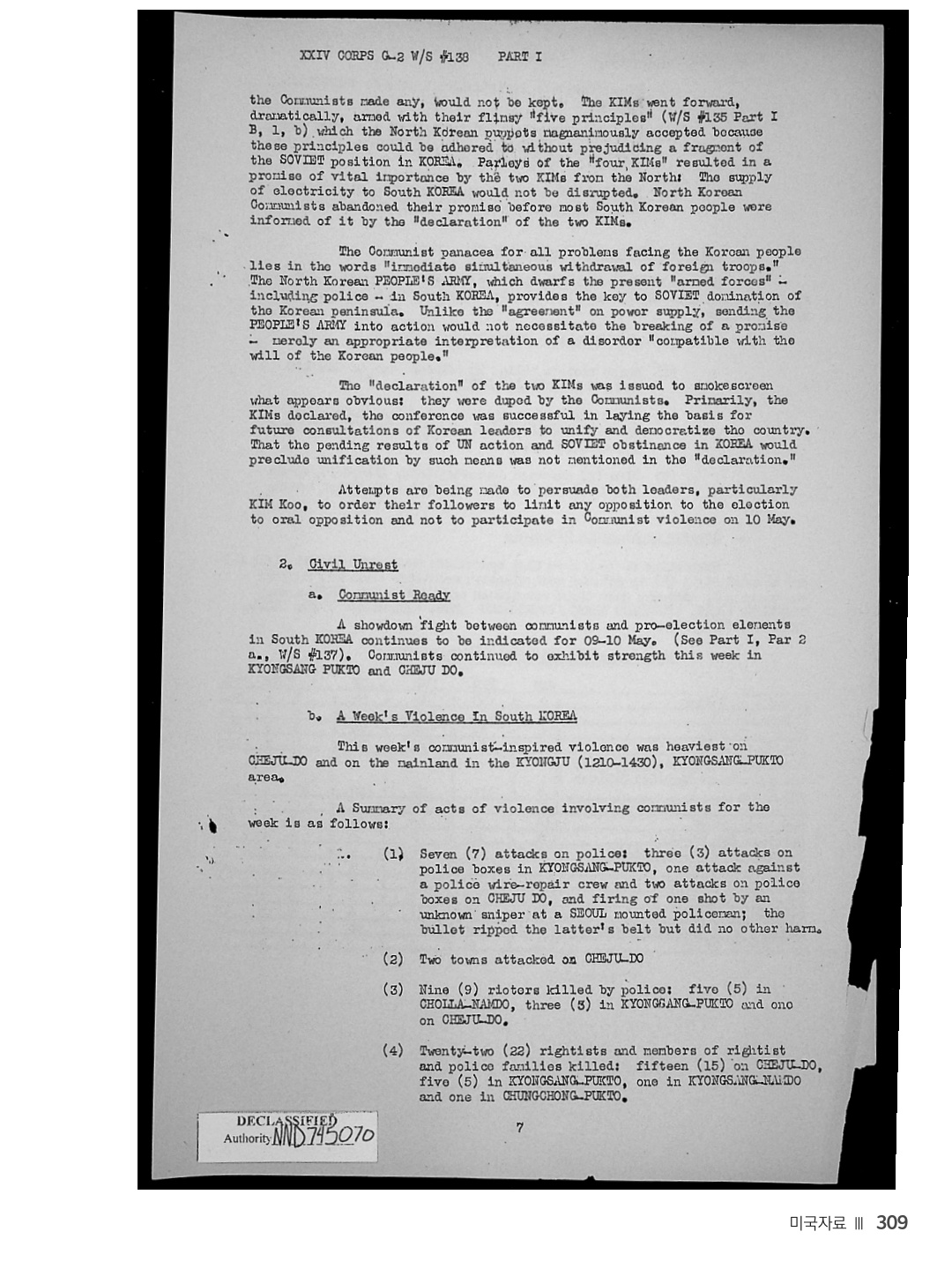
a. 공산주의자들의 선거 대비 공산주의자들과 선거 참여 인사들 간의 막판 대결이 5월 9~10일에 있을 것으로 전망된다. (주간요약보고 제137호 제1부 2, a항 참고) 공산주의자들은 이번주 경상북도와 제주도에서 계속해서 자신들의 세력을 과시했다.
b. 남조선에서의 일주일간 폭력 이번 주 공산주의자들이 선동한 폭력 사태는 제주도와 경상북도 경주지역에서가장 심하게 발생했다.
이번 주 공산주의자들이 연루된 폭력행위의 요약은 다음과 같다.
(1) 경찰에 대한 공격 7건: 경상북도에서 경찰지서 공격 3건, 제주도에서 경찰 통신선 수리팀 공격 1건, 제주도에서 경찰지서 공격 2건, 서울에서 저격수에 의 한 기마 경찰 공격 1건. 탄환이 벨트에 적중했으나 다른 부상은 없었다.
(2) 제주도에서 마을 공격 2건.
(3) 경찰에 의한 폭도 사망 9건: 전라남도 5건, 경상북도 3건, 제주도 1건.
(4) 우파, 우파단체 단원, 경찰 가족 사망 22건: 제주도 15건, 경상북도 5건, 경 상남도 1건, 충청북도 1건.
(5) 충청남도에서 선거등록사무소 공격 5건
(6) 대구(1150-1430)와 부산(1200-1340)에서 동맹휴교. 두 도시의 거의 모든 대학교와 중학교가 연루됐다.
(7) 잡다 시위, 소요, 방화, 우파 사무실, 우파 자택 공격 5건.
c. 지난주에 대한 추가보고 4월 16일에 마감한 주간에 발생했으나 지난주 요약보고1(주간요약보고 제137 호 제1부 2c 참고)에 실리지 않은 사건들에 관한 추가보고는 다음과 같다.
(1) 제주도에서 경찰지서 공격 2건.
(2) 경찰에 의한 폭도 사망 3건: 제주도 2건, 전라남도 1건.
(3) 공산주의자 공격으로 인한 우파 사망 3건: 경상북도 1건, 경상남도 1건, 제 주도 1건.
(4) 잡다 시위, 소요, 방화, 우파 사무실 공격, 우파 자택 공격 5건.
d. 선거관리위원에 대한 공격 현재까지의 통계는 공산주의자들이 선거관리위원장, 선거관리위원, 관련인사를 공격하는 과정에서 8명을 암살하고 8명에게 부상을 입혔다는 사실을 보여준
1) [역주] 원문에 4월 16일로 표기 되어 있으나 문서 번호 등으로 미루어 4월 30일 주간요약보고를 의 미하는 것으로 보임
다. 이와 같은 공격은 서울 지역, 경상북도, 경상남도, 충청북도, 충청남도, 전라남도, 제주도에서 발생했다.
1948년 남조선에서의 공산주의자 활동
C. 개전 가능성
1. 남조선 경제
b. 물가
미곡 가격 요약
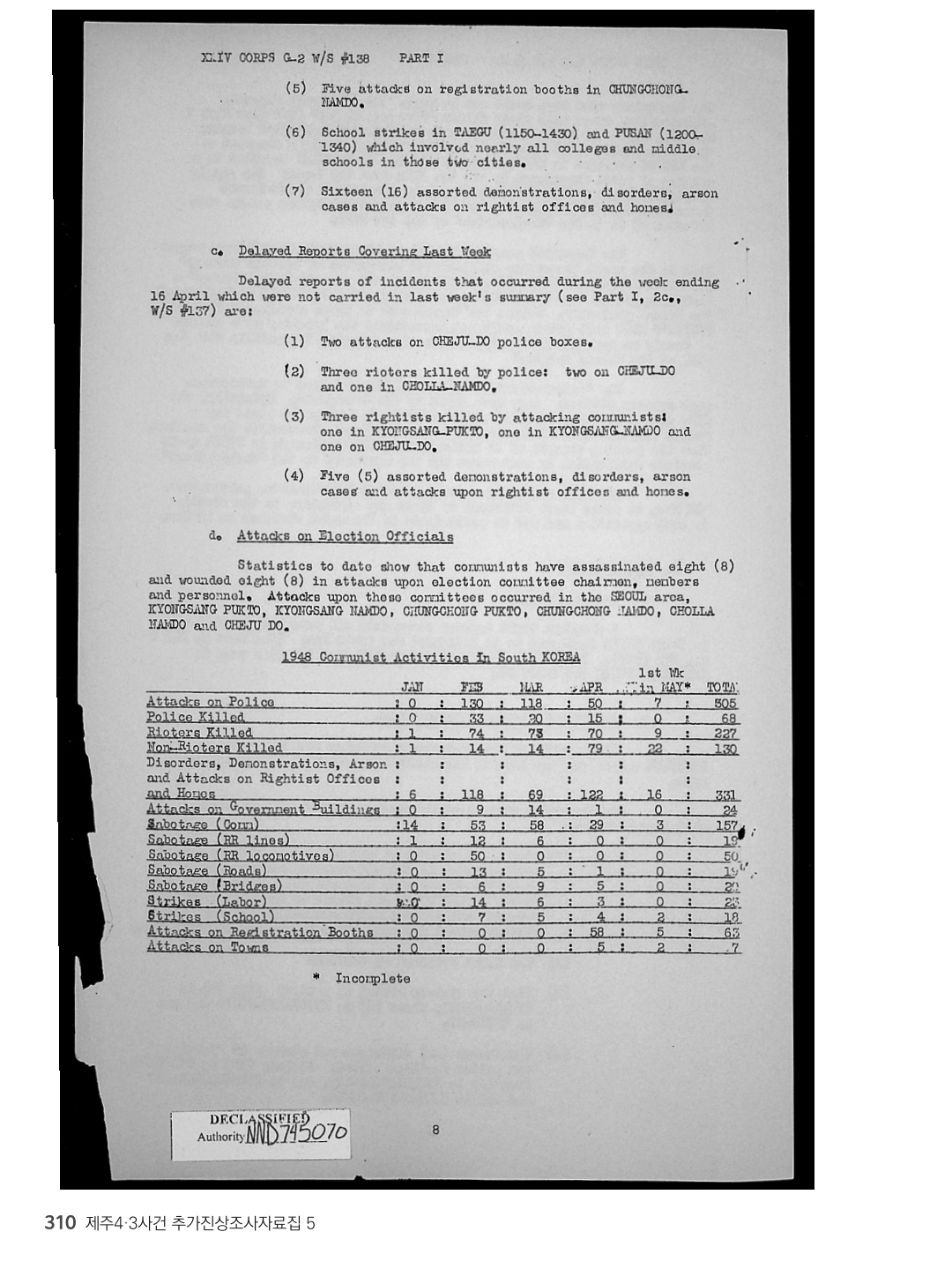
| | 1월 | 2월 | 3월 | 4월 | 5월* 1주 | 총계 | |---|---|---|---|---|---|---| | 경찰에 대한 공격 | 0 | 130 | 118 | 50 | 7 | 305 | | 경찰 사망 | 0 | 33 | 20 | 15 | 0 | 68 | | 폭도 사망 | 1 | 74 | 73 | 70 | 9 | 227 | | 비폭도 사망 | 1 | 14 | 14 | 79 | 22 | 130 | | 소요, 시위, 방화, 우파 사무실·자택 공격 | 6 | 118 | 69 | 122 | 16 | 331 | | 관공서 공격 | 0 | 9 | 14 | 1 | 0 | 24 | | 사보타주(통신) | 14 | 53 | 58 | 29 | 3 | 157 | | 사보타주(철로) | 1 | 12 | 6 | 0 | 0 | 19 | | 사보타주(기관차) | 0 | 50 | 0 | 0 | 0 | 50 | | 사보타주(도로) | 0 | 13 | 5 | 1 | 0 | 19 | | 사보타주(교량) | 0 | 6 | 9 | 5 | 0 | 20 | | 노동자 파업 | 0 | 14 | 6 | 3 | 0 | 23 | | 동맹휴교 | 0 | 7 | 5 | 4 | 2 | 18 | | 선거등록사무소 공격 | 0 | 0 | 0 | 58 | 5 | 63 | | 마을 공격 | 0 | 0 | 0 | 5 | 2 | 7 |
| 지역 | 1월 | 2월 | 3월 | 4월 | 5월 7일 | |---|---|---|---|---|---| | 서울 | 743 | 746 | 707 | 660 | 670 | | 강원 | 791 | 860 | 772 | * | |
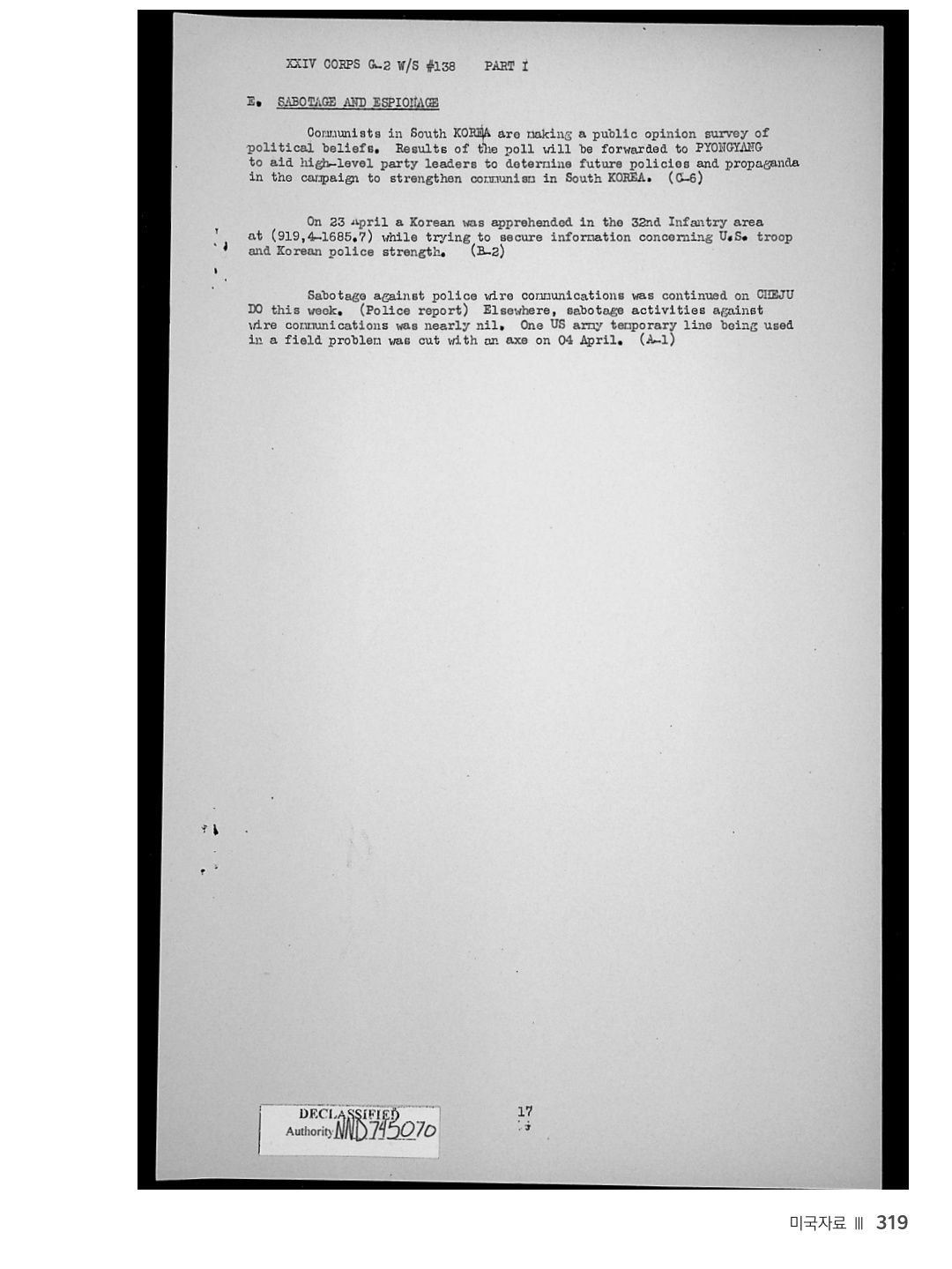
E. 사보타주 및 간첩 제주도에서 경찰 전화선 파괴가 이번 주에도 계속됐다. (경찰보고) 그 밖의 지역에서는 전화선 파괴 활동이 거의 없었다. 4월 4일 미군의 작전용 임시 전화선이 도끼로 절단됐다. (A-1)
공시(公示)가격 - 140원 출처 - 남조선과도정부 중앙물가행정처
지역 | 1월 | 2월 | 3월 | 4월 | 5월 7일 충북 | 586 | 657 | 654 | 600 | 충남 | 630 | 662 | 613 | 576 | 경북 | 541 | 550 | 502 | * | 경남 | 650 | 707 | 650 | * | 전북 | 608 | 608 | 550 | * | 전남 | 558 | 575 | 508 | 541 | 제주 | 733 | 680 | 617 | * | 평균 | 648 | 676 | 619 | * |
* 데이터 없음
Secret
From: 301200/I Apr 48
To : 071200/I May 48
Headquarters, USAFIK
Seoul, Korea
07 May 1948
No. 138
Maps: KOREA, 1/250,000
East ASIA, 1/1,000,000
A. ARMED FORCES
1. Strength (Secret)
Police: 34,330
Constabulary: 28,324
Coast Guard: 2,881
2. Operational Activity (Confidential)
a. Border Incidents
North Korean constabulary and South Korean police exchanged shots in two border incidents this week and two Soviet fighter planes violated the border.
On 30 April twenty (20) North Korean constabularymen violated the parallel on the ONGJIN peninsula in the vicinity of KYO PYUNG (828-1697).
They withdrew after an exchange of shots with forty (40) South Korean police who were rushed to the scene. No casualties reported.
On 04 May in the vicinity of (835-1697) twenty (20) North
Korean constabularymen and fifty (50) South Korean policemen exchanged approximately forty (40) rounds during the late afternoon. No casualties reported. This incident was provoked by a dispute over water for irrigation.
On 05 May two Soviet MIG-3 fighter planes were sighted flying together at two points south of the parallel. The airplanes were between
5,000 and 8,000 feet high and flew east over OP #7 (890-1690) and YOIJN
(919.4-1685.7).
Delayed Report
A delayed report from the border not carried in last week's summary (see Part I, Par A, 2a, W/S #137) reveals that on 28 April an unknown number of South Korean police were fired on by one SOVIET soldier and one North Korean constabularyman who were south of the parallel at
(1163.3-1697.7). The South Korean police returned the fire with unknown results.
b. Constabulary Operations on CHEJU DO
The South Korean constabulary continued patrol operations on
CHEJU DO this week. No constabulary-vs-communists fighting has been reported since 27 April when patrolling was initiated.
3
DECLASSIFIED
Authority NND 745070
XXIV CORPS G-2 W/S #138 PART I
B. CURRENT INTELLIGENCE
1. Political Activity
a. UNTCOK Activities
As noted in P/R #824, UNTCOK will write its report on the pre-election and election period in TOKYO, beginning 15 May, and will return to SEOUL during the first week in June. During the interim a liaison group will function in SEOUL.
b. Candidacy Registrations
Two assassinations, one death from natural causes, and nineteen resignations have reduced the number of candidates from 938 to 916.
Assassinations: PAK Wan* KYONGSANG PUKTO
KIM Yung Kyoo* CHUNGCHONG PUKTO
Death from natural causes:
KIM Suk Han, KYONGSANG NAMDO, NSAKI
Resignations:
SEOUL AREA
CHUN Myung Chin*
KIM Hoo Ok*
PAK Chang Hi*
PAIK Yung Yup HANKOOK DEMOCRATIC PARTY
KYONGGI DO
KOO Chong Il FARMERS FEDERATION (Rightist)
KIM Hyun Ho *
LEE Chong Chang*
NAM Sang Pil*
CHOLLA PUKTO
LEE Chul Ik *
KIM Che Uk HANKOOK DEMOCRATIC PARTY
KO Kil Mo *
LEE Won Ik POPULAR ALLIANCE (Moderate)
KYONGSANG PUKTO
CHOI Byung Lyang *
KIM Ki Suk*
KIM Chung Sik*
KIM Sung Mook POPULAR PARTY (Rightist)
CHANG Byung Tai*
KYONGSANG NAMDO
LEE Ki Won*
CHOI Sung Ung DAI CHONG RELIGION (Rightist)
* Non-partisan
COMMENT: RHEE rightists election control plans — restrict to one the number of rightist candidates in areas where communist and re-actionists might win due to a split rightists vote — account for the
4
DECLASSIFIED
Authority NND 745070
XXIV CORPS G-2 W/S #138 PART I
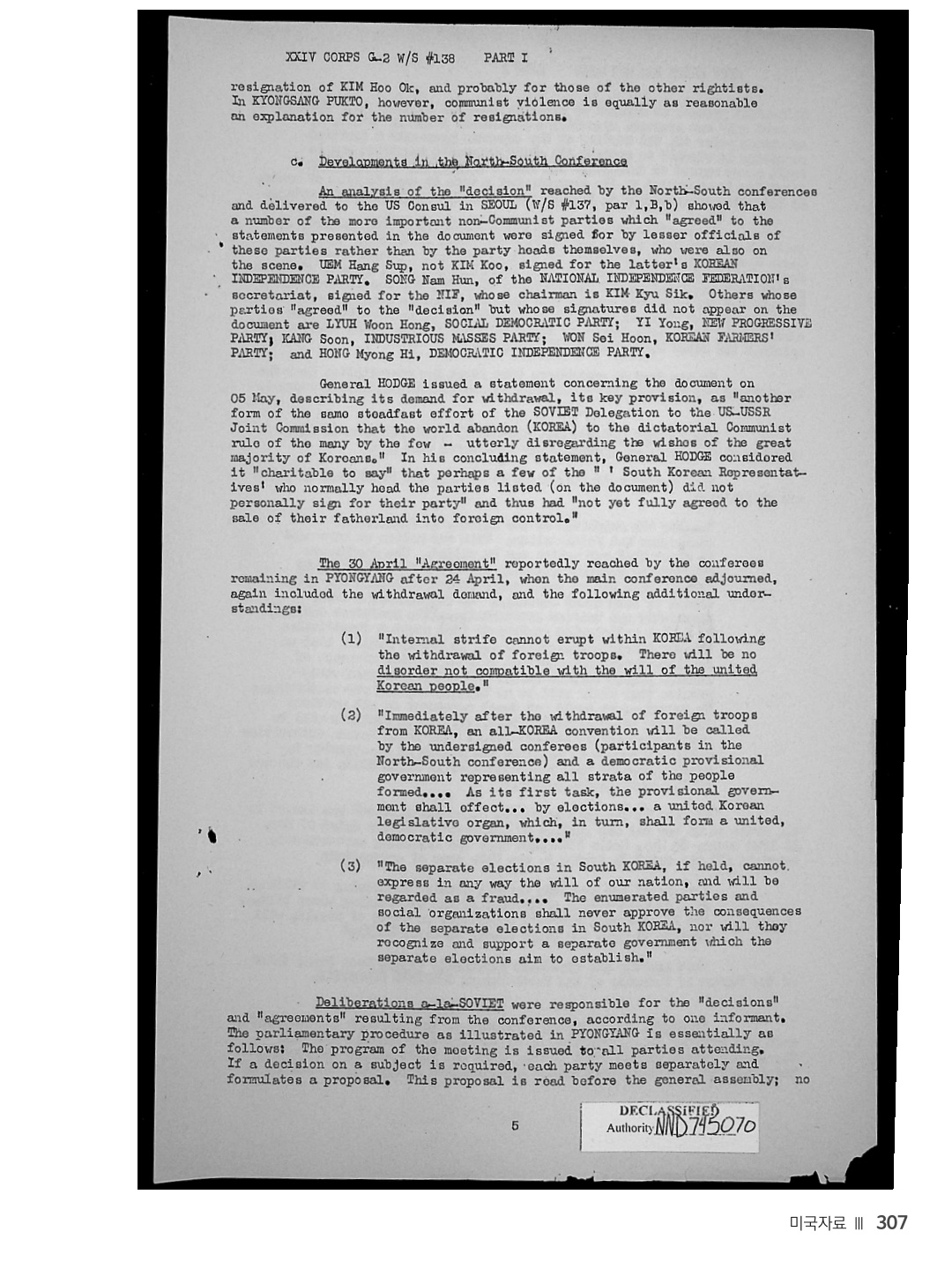
resignation of KIM Hoo Ok, and probably for those of the other rightists.
In KYONGSANG PUKTO, however, communist violence is equally as reasonable an explanation for the number of resignations.
c. Developments in the North-South Conference
An analysis of the "decision" reached by the North-South conferences and delivered to the US Consul in SEOUL (W/S #137, par 1,B,b) showed that a number of the more important non-Communist parties which "agreed" to the statements presented in the document were signed for by lesser officials of these parties rather than by the party heads themselves, who were also on the scene. UEM Hang Sup, not KIM Koo, signed for the latter's KOREAN
INDEPENDENCE PARTY. SONG Nam Hun, of the NATIONAL INDEPENDENCE FEDERATION's secretariat, signed for the NIF, whose chairman is KIM Kyu Sik. Others whose parties "agreed" to the "decision" but whose signatures did not appear on the document are LYUH Woon Hong, SOCIAL DEMOCRATIC PARTY; YI Yong, NEW PROGRESSIVE
PARTY; KANG Soon, INDUSTRIOUS MASSES PARTY; WON Sei Hoon, KOREAN FARMERS'
PARTY; and HONG Myong Hi, DEMOCRATIC INDEPENDENCE PARTY.
General HODGE issued a statement concerning the document on
05 May, describing its demand for withdrawal, its key provision, as "another form of the same steadfast effort of the SOVIET Delegation to the US-USSR
Joint Commission that the world abandon (KOREA) to the dictatorial Communist rule of the many by the few -- utterly disregarding the wishes of the great majority of Koreans." In his concluding statement, General HODGE considered it "charitable to say" that perhaps a few of the " ' South Korean Representatives' who normally head the parties listed (on the document) did not personally sign for their party" and thus had "not yet fully agreed to the sale of their fatherland into foreign control."
The 30 April "Agreement" reportedly reached by the conferees remaining in PYONGYANG after 24 April, when the main conference adjourned, again included the withdrawal demand, and the following additional under-
standings:
(1) "Internal strife cannot erupt within KOREA following
the withdrawal of foreign troops. There will be no disorder not compatible with the will of the united
Korean people."
(2) "Immediately after the withdrawal of foreign troops from KOREA, an all-KOREA convention will be called by the undersigned conferees (participants in the
North-South conference) and a democratic provisional government representing all strata of the people formed.... As its first task, the provisional government shall effect... by elections... a united Korean legislative organ, which, in turn, shall form a united, democratic government...."
(3) "The separate elections in South KOREA, if held, cannot express in any way the will of our nation, and will be regarded as a fraud.... The enumerated parties and social organizations shall never approve the consequences of the separate elections in South KOREA, nor will they recognize and support a separate government which the separate elections aim to establish."
Deliberations a-la-SOVIET were responsible for the "decisions"
and "agreements" resulting from the conference, according to one informant.
The parliamentary procedure as illustrated in PYONGYANG is essentially as
follows: The program of the meeting is issued to all parties attending.
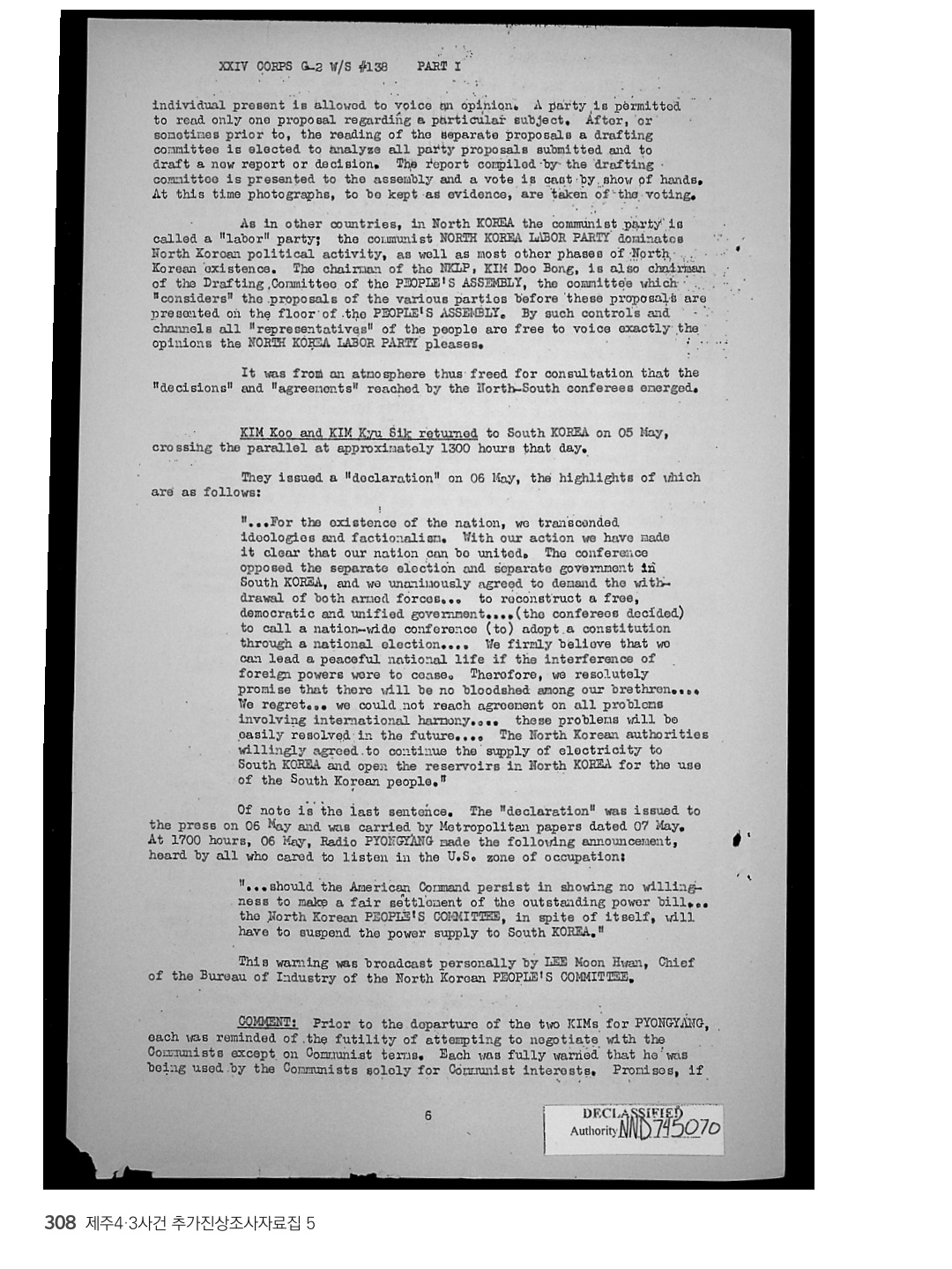
If a decision on a subject is required, each party meets separately and formulates a proposal. This proposal is read before the general assembly; no
5
DECLASSIFIED
Authority NND 745070
XXIV CORPS G-2 W/S #138 PART I
individual present is allowed to voice an opinion. A party is permitted to read only one proposal regarding a particular subject. After, or sometimes prior to, the reading of the separate proposals a drafting committee is elected to analyze all party proposals submitted and to draft a new report or decision. The report compiled by the drafting committee is presented to the assembly and a vote is cast by show of hands.
At this time photographs, to be kept as evidence, are taken of the voting.
As in other countries, in North KOREA the communist party is called a "labor" party; the communist NORTH KOREA LABOR PARTY dominates
North Korean political activity, as well as most other phases of North
Korean existence. The chairman of the NKLP, KIM Doo Bong, is also chairman of the Drafting Committee of the PEOPLE'S ASSEMBLY, the committee which
"considers" the proposals of the various parties before these proposals are presented on the floor of the PEOPLE'S ASSEMBLY. By such controls and channels all "representatives" of the people are free to voice exactly the opinions the NORTH KOREA LABOR PARTY pleases.
It was from an atmosphere thus freed for consultation that the
"decisions" and "agreements" reached by the North-South conferees emerged.
KIM Koo and KIM Kyu Sik returned to South KOREA on 05 May, crossing the parallel at approximately 1300 hours that day.
They issued a "declaration" on 06 May, the highlights of which are as follows:
"...For the existence of the nation, we transcended ideologies and factionalism. With our action we have made it clear that our nation can be united. The conference opposed the separate election and separate government in
South KOREA, and we unanimously agreed to demand the withdrawal of both armed forces... to reconstruct a free, democratic and unified government....(the conferees decided)
to call a nation-wide conference (to) adopt a constitution through a national election.... We firmly believe that we can lead a peaceful national life if the interference of foreign powers were to cease. Therefore, we resolutely promise that there will be no bloodshed among our brethren....
We regret... we could not reach agreement on all problems involving international harmony.... these problems will be easily resolved in the future.... The North Korean authorities willingly agreed to continue the supply of electricity to
South KOREA and open the reservoirs in North KOREA for the use of the South Korean people."
Of note is the last sentence. The "declaration" was issued to the press on 06 May and was carried by Metropolitan papers dated 07 May.
At 1700 hours, 06 May, Radio PYONGYANG made the following announcement, heard by all who cared to listen in the U.S. zone of occupation:
"...should the American Command persist in showing no willingness to make a fair settlement of the outstanding power bill...
the North Korean PEOPLE'S COMMITTEE, in spite of itself, will have to suspend the power supply to South KOREA."
This warning was broadcast personally by LEE Moon Hwan, Chief of the Bureau of Industry of the North Korean PEOPLE'S COMMITTEE.
COMMENT: Prior to the departure of the two KIMs for PYONGYANG, each was reminded of the futility of attempting to negotiate with the
Communists except on Communist terms. Each was fully warned that he was being used by the Communists solely for Communist interests. Promises, if
6
DECLASSIFIED
Authority NND 745070
XXIV CORPS G-2 W/S #138 PART I
the Communists made any, would not be kept. The KIMs went forward, dramatically, armed with their flimsy "five principles" (W/S #135 Part I
B, 1, b) which the North Korean puppets magnanimously accepted because these principles could be adhered to without prejudicing a fragment of the SOVIET position in KOREA. Parleys of the "four KIMs" resulted in a promise of vital importance by the two KIMs from the North: The supply of electricity to South KOREA would not be disrupted. North Korean
Communists abandoned their promise before most South Korean people were informed of it by the "declaration" of the two KIMs.
The Communist panacea for all problems facing the Korean people lies in the words "immediate simultaneous withdrawal of foreign troops."
The North Korean PEOPLE'S ARMY, which dwarfs the present "armed forces" -including police -- in South KOREA, provides the key to SOVIET domination of the Korean peninsula. Unlike the "agreement" on power supply, sending the
PEOPLE'S ARMY into action would not necessitate the breaking of a promise
-- merely an appropriate interpretation of a disorder "compatible with the will of the Korean people."
The "declaration" of the two KIMs was issued to smokescreen what appears obvious: they were duped by the Communists. Primarily, the
KIMs declared, the conference was successful in laying the basis for future consultations of Korean leaders to unify and democratize the country.
That the pending results of UN action and SOVIET obstinance in KOREA would preclude unification by such means was not mentioned in the "declaration."
Attempts are being made to persuade both leaders, particularly
KIM Koo, to order their followers to limit any opposition to the election to oral opposition and not to participate in Communist violence on 10 May.
2. Civil Unrest
a. Communist Ready
A showdown fight between communists and pro-election elements in South KOREA continues to be indicated for 09-10 May. (See Part I, Par 2 a., W/S #137). Communists continued to exhibit strength this week in
KYONGSANG PUKTO and CHEJU DO.
b. A Week's Violence in South KOREA
This week's communist-inspired violence was heaviest on
CHEJU-DO and on the mainland in the KYONGJU (1210-1430), KYONGSANG-PUKTO area.
A Summary of acts of violence involving communists for the week is as follows:
(1) Seven (7) attacks on police: three (3) attacks on police boxes in KYONGSANG-PUKTO, one attack against a police wire-repair crew and two attacks on police boxes on CHEJU DO, and firing of one shot by an unknown sniper at a SEOUL mounted policeman; the bullet ripped the latter's belt but did no other harm.
(2) Two towns attacked on CHEJU-DO
(3) Nine (9) rioters killed by police: five (5) in
CHOLLA-NAMDO, three (3) in KYONGSANG-PUKTO and one on CHEJU-DO.
(4) Twenty-two (22) rightists and members of rightist and police families killed: fifteen (15) on CHEJU-DO, five (5) in KYONGSANG-PUKTO, one in KYONGSANG-NAMDO and one in CHUNGCHONG-PUKTO.
DECLASSIFIED
Authority NND 745070
7
XLIV CORPS G-2 W/S #138 PART I
(5) Five attacks on registration booths in CHUNGCHONGNAMDO.
(6) School strikes in TAEGU (1150-1430) and PUSAN (1200-
1340) which involved nearly all colleges and middle schools in those two cities.
(7) Sixteen (16) assorted demonstrations, disorders, arson cases and attacks on rightist offices and homes.
c. Delayed Reports Covering Last Week
Delayed reports of incidents that occurred during the week ending
16 April which were not carried in last week's summary (see Part I, 2c., W/S #137) are:
(1) Two attacks on CHEJU-DO police boxes.
(2) Three rioters killed by police: two on CHEJU-DO and one in CHOLLA-NAMDO.
(3) Three rightists killed by attacking communists:
one in KYONGSANG-PUKTO, one in KYONGSANG-NAMDO and one on CHEJU-DO.
(4) Five (5) assorted demonstrations, disorders, arson cases and attacks upon rightist offices and homes.
d. Attacks on Election Officials
Statistics to date show that communists have assassinated eight (8)
and wounded eight (8) in attacks upon election committee chairmen, members and personnel. Attacks upon these committees occurred in the SEOUL area, KYONGSANG PUKTO, KYONGSANG NAMDO, CHUNGCHONG PUKTO, CHUNGCHONG NAMDO, CHOLLA
NAMDO and CHEJU DO.
1948 Communist Activities In South KOREA
1st Wk
JAN FEB MAR APR in MAY* TOTAL
Attacks on Police : 0 : 130 : 118 : 50 : 7 : 305
Police Killed : 0 : 33 : 20 : 15 : 0 : 68
Rioters Killed : 1 : 74 : 75 : 70 : 9 : 227
Non-Rioters Killed : 1 : 14 : 14 : 79 : 22 : 130
Disorders, Demonstrations, Arson :
and Attacks on Rightist Offices :
and Homes : 6 : 118 : 69 : 122 : 16 : 331
Attacks on Government Buildings: 0 : 9 : 14 : 1 : 0 : 24
Sabotage (Comm) : 14 : 53 : 58 : 29 : 3 : 157
Sabotage (RR lines) : 1 : 12 : 6 : 0 : 0 : 19
Sabotage (RR locomotives) : 0 : 50 : 0 : 0 : 0 : 50
Sabotage (Roads) : 0 : 13 : 5 : 1 : 0 : 19
Sabotage (Bridges) : 0 : 6 : 9 : 5 : 0 : 20
Strikes (Labor) : 0 : 14 : 6 : 3 : 0 : 23
Strikes (School) : 0 : 7 : 5 : 4 : 2 : 18
Attacks on Registration Booths: 0 : 0 : 0 : 58 : 5 : 63
Attacks on Towns : 0 : 0 : 0 : 5 : 2 : 7
* Incomplete
DECLASSIFIED
Authority NND 745070
8
XXIV CORPS G-2 W/S #138 PART I
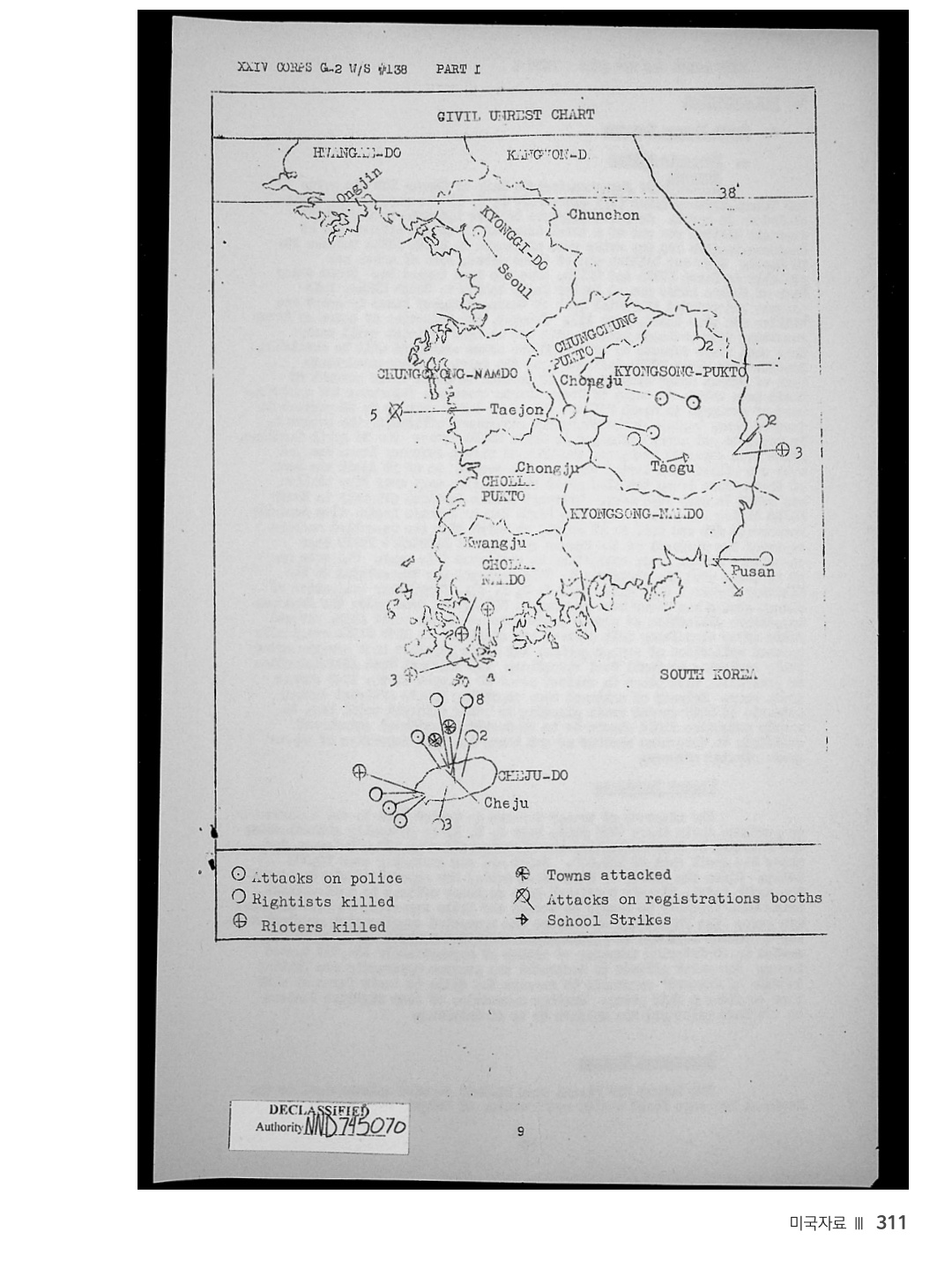
CIVIL UNREST CHART
HWANGHEI-DO KANGWON-DO
38°
KYONGGI-DO •Chunchon
Seoul
CHUNGCHUNG
CHUNGCHONG-NAMDO PUKTO KYONGSONG-PUKTO
•Taejon Chongju ○ ○
5 ✗ •Chongju Taegu ⊕ 3
CHOLLPUKTO KYONGSONG-NAMDO
Kwangju
CHOLLANAMDO •Pusan
3 ⊕
○ ○8
○⊕ ○2
⊕ CHEJU-DO
○ Cheju
○
↳3
SOUTH KOREA
⊙ Attacks on police ⊕ Towns attacked
○ Rightists killed ✗ Attacks on registrations booths
⊕ Rioters killed → School Strikes
DECLASSIFIED
Authority NND 745070
9
XXIV CORPS G-2 W/S #138 PART I
C. WAR POTENTIAL
1. South Korean Economy
a. Economic Review
General
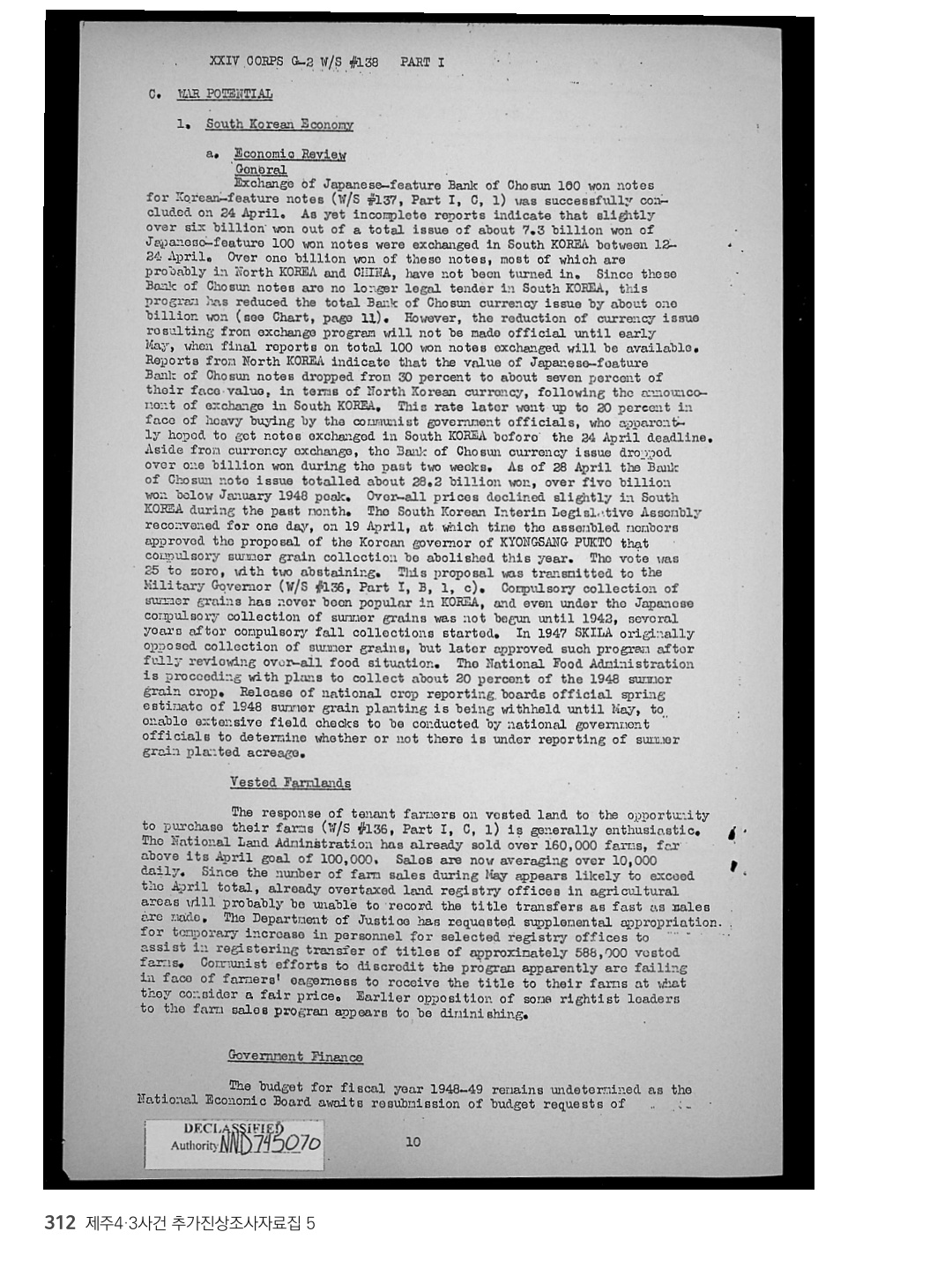
Exchange of Japanese-feature Bank of Chosun 100 won notes for Korean-feature notes (W/S #137, Part I, C, 1) was successfully concluded on 24 April. As yet incomplete reports indicate that slightly over six billion won out of a total issue of about 7.3 billion won of
Japanese-feature 100 won notes were exchanged in South KOREA between 12-
24 April. Over one billion won of these notes, most of which are probably in North KOREA and CHINA, have not been turned in. Since these
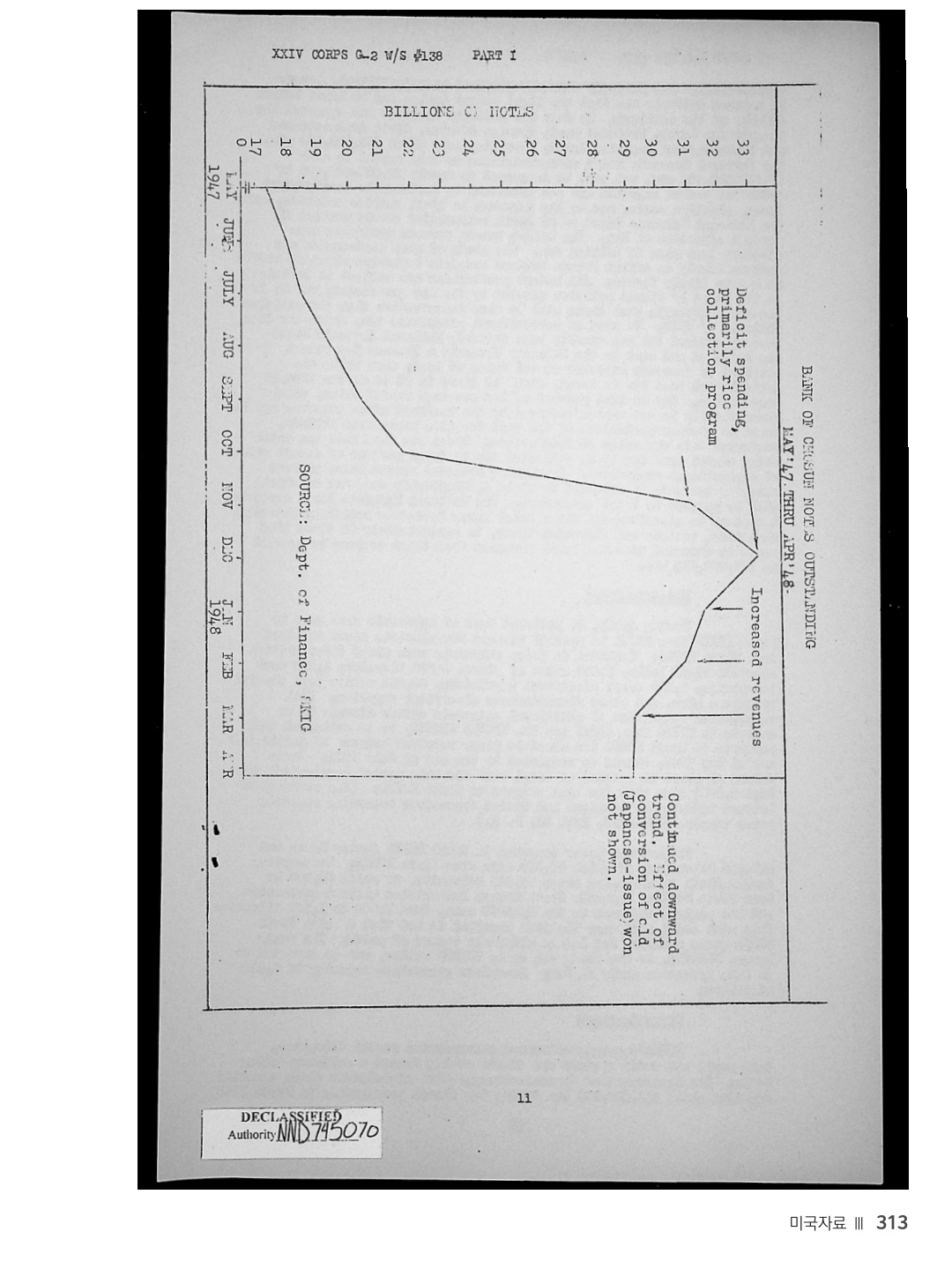
Bank of Chosun notes are no longer legal tender in South KOREA, this program has reduced the total Bank of Chosun currency issue by about one billion won (see Chart, page 11). However, the reduction of currency issue resulting from exchange program will not be made official until early
May, when final reports on total 100 won notes exchanged will be available.
Reports from North KOREA indicate that the value of Japanese-feature
Bank of Chosun notes dropped from 30 percent to about seven percent of their face value, in terms of North Korean currency, following the announcement of exchange in South KOREA. This rate later went up to 20 percent in face of heavy buying by the communist government officials, who apparently hoped to get notes exchanged in South KOREA before the 24 April deadline.
Aside from currency exchange, the Bank of Chosun currency issue dropped over one billion won during the past two weeks. As of 28 April the Bank of Chosun note issue totalled about 28.2 billion won, over five billion won below January 1948 peak. Over-all prices declined slightly in South
KOREA during the past month. The South Korean Interim Legislative Assembly reconvened for one day, on 19 April, at which time the assembled members approved the proposal of the Korean governor of KYONGSANG PUKTO that compulsory summer grain collection be abolished this year. The vote was
25 to zero, with two abstaining. This proposal was transmitted to the
Military Governor (W/S #136, Part I, B, 1, c). Compulsory collection of summer grains has never been popular in KOREA, and even under the Japanese compulsory collection of summer grains was not begun until 1942, several years after compulsory fall collections started. In 1947 SKILA originally opposed collection of summer grains, but later approved such program after fully reviewing over-all food situation. The National Food Administration is proceeding with plans to collect about 20 percent of the 1948 summer grain crop. Release of national crop reporting boards official spring estimate of 1948 summer grain planting is being withheld until May, to enable extensive field checks to be conducted by national government officials to determine whether or not there is under reporting of summer grain planted acreage.
Vested Farmlands
The response of tenant farmers on vested land to the opportunity to purchase their farms (W/S #136, Part I, C, 1) is generally enthusiastic.
The National Land Administration has already sold over 160,000 farms, far above its April goal of 100,000. Sales are now averaging over 10,000 daily. Since the number of farm sales during May appears likely to exceed the April total, already overtaxed land registry offices in agricultural areas will probably be unable to record the title transfers as fast as sales are made. The Department of Justice has requested supplemental appropriation for temporary increase in personnel for selected registry offices to assist in registering transfer of titles of approximately 588,000 vested farms. Communist efforts to discredit the program apparently are failing in face of farmers' eagerness to receive the title to their farms at what they consider a fair price. Earlier opposition of some rightist leaders to the farm sales program appears to be diminishing.
Government Finance
The budget for fiscal year 1948-49 remains undetermined as the
National Economic Board awaits resubmission of budget requests of [illegible]
DECLASSIFIED
Authority NND 745070 10
XXIV CORPS G-2 W/S #138 PART I
BILLIONS OF NOTES
17 18 19 20 21 22 23 24 25 26 27 28 29 30 31 32 33
1947
MAY
JUN.
JULY
AUG S.PT OCT NOV DEC
1948
JAN FEB MAR APR
BANK OF CHOSEN HOT'S OUTSTANDING
MAY'47 THRU APR'48.
Deficit spending, primarily nloc collection program
Increased revenues
Continued downward trend. Effect of
Japanese-Issue won conversion of old not shown.
SOURCE: Dept. of Finance, NKIG
11
DECLASSIFIED
Authority NND 745070
미국자료 III 313
XXIV CORPS G-2 W/S #138 PART I
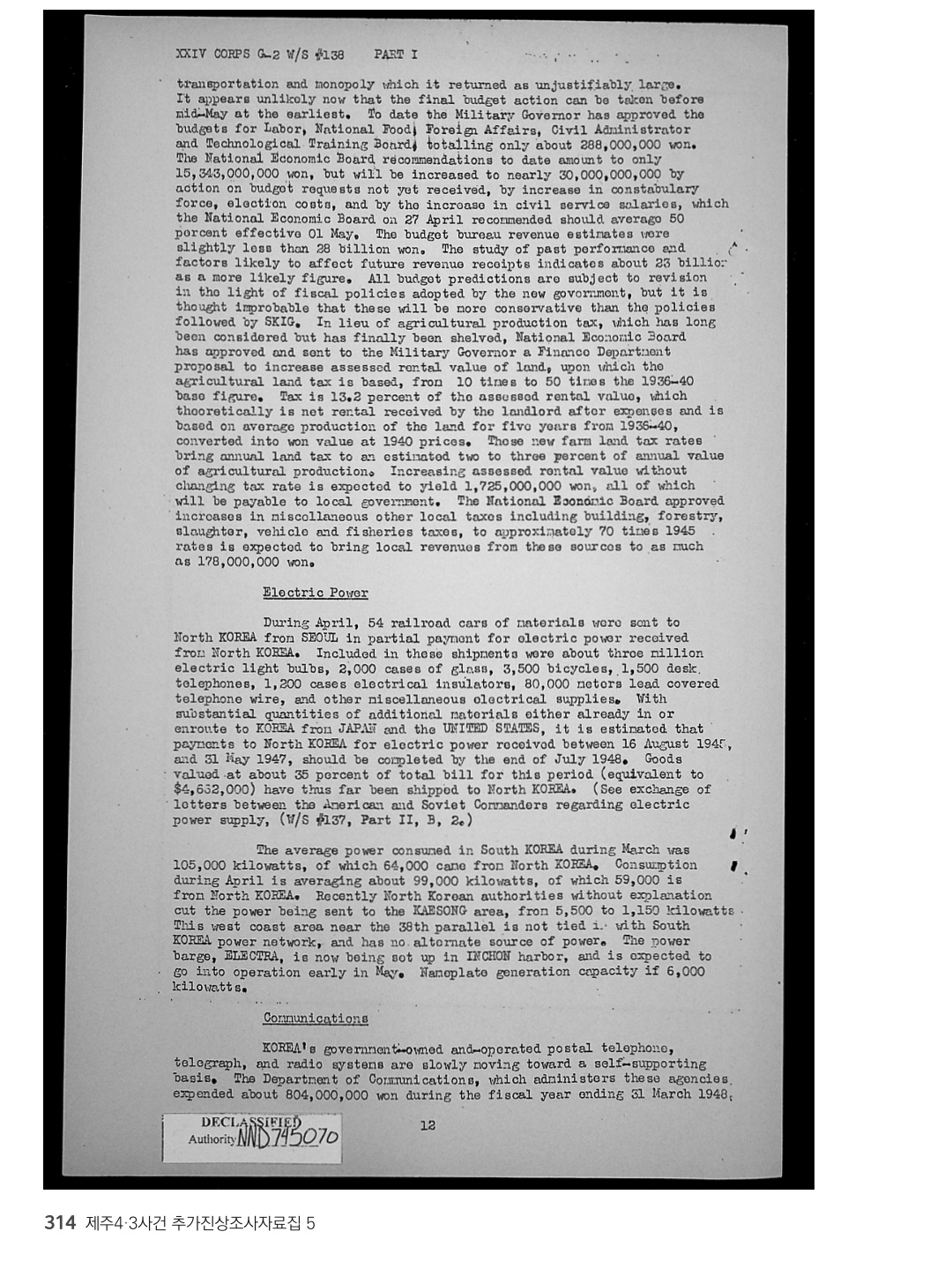
transportation and monopoly which it returned as unjustifiably large.
It appears unlikely now that the final budget action can be taken before mid-May at the earliest. To date the Military Governor has approved the budgets for Labor, National Food, Foreign Affairs, Civil Administrator and Technological Training Board, totalling only about 288,000,000 won.
The National Economic Board recommendations to date amount to only
15,343,000,000 won, but will be increased to nearly 30,000,000,000 by action on budget requests not yet received, by increase in constabulary force, election costs, and by the increase in civil service salaries, which the National Economic Board on 27 April recommended should average 50 percent effective 01 May. The budget bureau revenue estimates were slightly less than 28 billion won. The study of past performance and factors likely to affect future revenue receipts indicates about 23 billion as a more likely figure. All budget predictions are subject to revision in the light of fiscal policies adopted by the new government, but it is thought improbable that these will be more conservative than the policies followed by SKIG. In lieu of agricultural production tax, which has long been considered but has finally been shelved, National Economic Board has approved and sent to the Military Governor a Finance Department proposal to increase assessed rental value of land, upon which the agricultural land tax is based, from 10 times to 50 times the 1935-40 base figure. Tax is 13.2 percent of the assessed rental value, which theoretically is net rental received by the landlord after expenses and is based on average production of the land for five years from 1935-40, converted into won value at 1940 prices. These new farm land tax rates bring annual land tax to an estimated two to three percent of annual value of agricultural production. Increasing assessed rental value without changing tax rate is expected to yield 1,725,000,000 won, all of which will be payable to local government. The National Economic Board approved increases in miscellaneous other local taxes including building, forestry, slaughter, vehicle and fisheries taxes, to approximately 70 times 1945 rates is expected to bring local revenues from these sources to as much as 178,000,000 won.
Electric Power
During April, 54 railroad cars of materials were sent to
North KOREA from SEOUL in partial payment for electric power received from North KOREA. Included in these shipments were about three million electric light bulbs, 2,000 cases of glass, 3,500 bicycles, 1,500 desk telephones, 1,200 cases electrical insulators, 80,000 meters lead covered telephone wire, and other miscellaneous electrical supplies. With substantial quantities of additional materials either already in or enroute to KOREA from JAPAN and the UNITED STATES, it is estimated that payments to North KOREA for electric power received between 16 August 1945, and 31 May 1947, should be completed by the end of July 1947. Goods valued at about 35 percent of total bill for this period (equivalent to
$4,632,000) have thus far been shipped to North KOREA. (See exchange of letters between the American and Soviet Commanders regarding electric power supply, (W/S #137, Part II, B, 2.)
The average power consumed in South KOREA during March was
105,000 kilowatts, of which 64,000 came from North KOREA. Consumption during April is averaging about 99,000 kilowatts, of which 59,000 is from North KOREA. Recently North Korean authorities without explanation cut the power being sent to the KAESONG area, from 5,500 to 1,150 kilowatts.
This west coast area near the 38th parallel is not tied in with South
KOREA power network, and has no alternate source of power. The power barge, ELECTRA, is now being set up in INCHON harbor, and is expected to go into operation early in May. Nameplate generation capacity if 6,000 kilowatts.
Communications
KOREA's government-owned and-operated postal telephone, telegraph, and radio systems are slowly moving toward a self-supporting basis. The Department of Communications, which administers these agencies, expended about 804,000,000 won during the fiscal year ending 31 March 1948.
DECLASSIFIED
Authority NND 745070
12
XXIV CORPS G-2 W/S #138 PART I
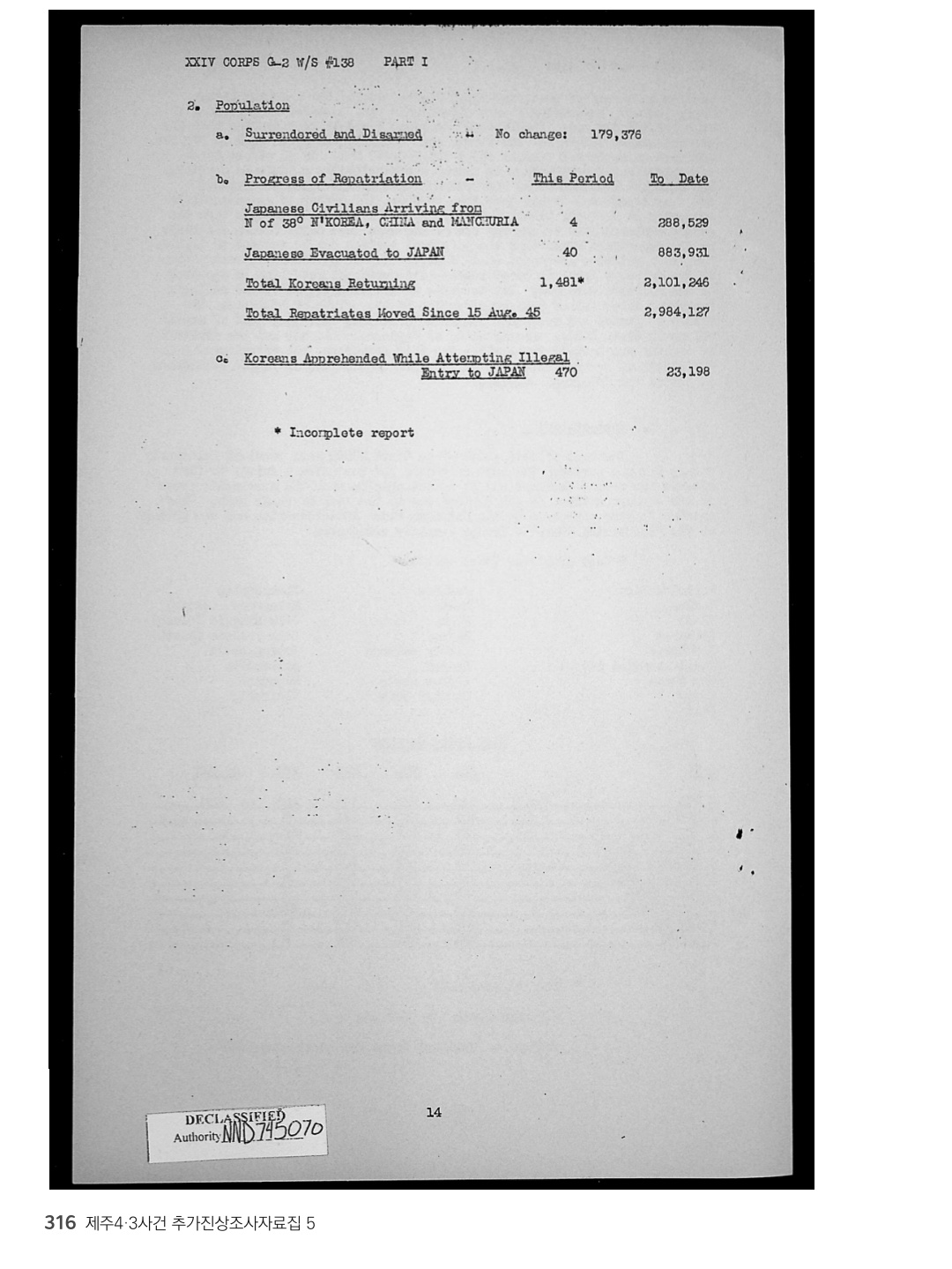
2. Population
a. Surrendered and Disarmed No change: 179,376
b. Progress of Repatriation — This Period To Date
Japanese Civilians Arriving from
N of 38° N'KOREA, CHINA and MANCHURIA 4 288,529
Japanese Evacuated to JAPAN 40 883,931
Total Koreans Returning 1,481* 2,101,246
Total Repatriates Moved Since 15 Aug. 45 2,984,127
c. Koreans Apprehended While Attempting Illegal
Entry to JAPAN 470 23,198
* Incomplete report
DECLASSIFIED
Authority NND 745070
14
XXIV CORPS G-2 W/S #138 PART I
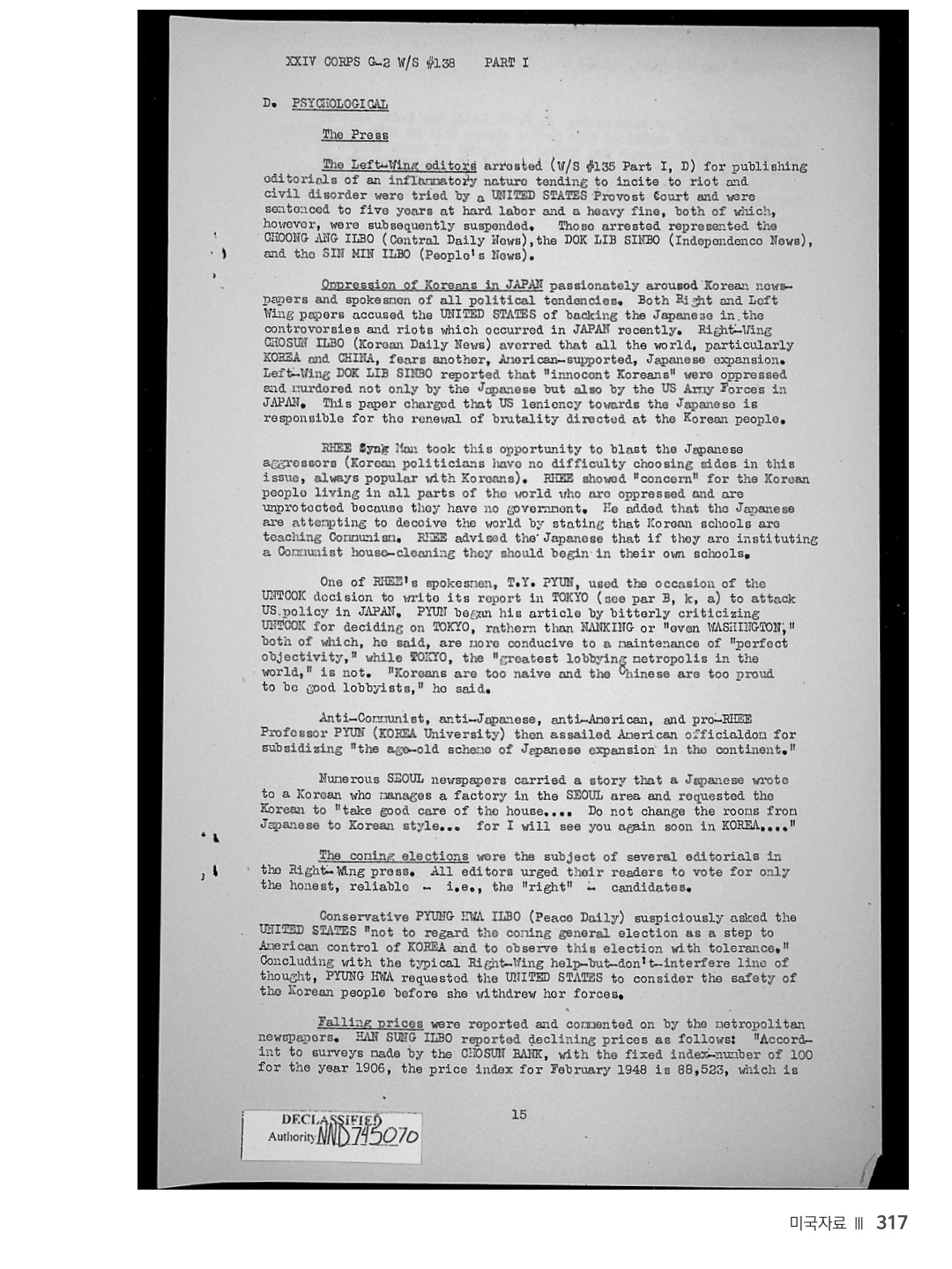
D. PSYCHOLOGICAL
The Press
The Left-Wing editors arrested (W/S #135 Part I, D) for publishing editorials of an inflammatory nature tending to incite to riot and civil disorder were tried by a UNITED STATES Provost Court and were sentenced to five years at hard labor and a heavy fine, both of which, however, were subsequently suspended. Those arrested represented the CHOONG ANG ILBO (Central Daily News), the DOK LIB SINBO (Independence News), and the SIN MIN ILBO (People's News).
Oppression of Koreans in JAPAN passionately aroused Korean newspapers and spokesmen of all political tendencies. Both Right and Left Wing papers accused the UNITED STATES of backing the Japanese in the controversies and riots which occurred in JAPAN recently. Right-Wing CHOSUN ILBO (Korean Daily News) averred that all the world, particularly KOREA and CHINA, fears another, American-supported, Japanese expansion. Left-Wing DOK LIB SINBO reported that "innocent Koreans" were oppressed and murdered not only by the Japanese but also by the US Army forces in JAPAN. This paper charged that US leniency towards the Japanese is responsible for the renewal of brutality directed at the Korean people.
RHEE Syng Man took this opportunity to blast the Japanese aggressors (Korean politicians have no difficulty choosing sides in this issue, always popular with Koreans). RHEE showed "concern" for the Korean people living in all parts of the world who are oppressed and are unprotected because they have no government. He added that the Japanese are attempting to deceive the world by stating that Korean schools are teaching Communism. RHEE advised the Japanese that if they are instituting a Communist house-cleaning they should begin in their own schools.
One of RHEE's spokesmen, T.Y. PYUN, used the occasion of the UNTCOK decision to write its report in TOKYO (see par B, k, a) to attack US policy in JAPAN. PYUN began his article by bitterly criticizing UNTCOK for deciding on TOKYO, rathem than NANKING or "even WASHINGTON," both of which, he said, are more conducive to a maintenance of "perfect objectivity," while TOKYO, the "greatest lobbying metropolis in the world," is not. "Koreans are too naive and the Chinese are too proud to be good lobbyists," he said.
Anti-Communist, anti-Japanese, anti-American, and pro-RHEE Professor PYUN (KOREA University) then assailed American officialdom for subsidizing "the age-old scheme of Japanese expansion in the continent."
Numerous SEOUL newspapers carried a story that a Japanese wrote to a Korean who manages a factory in the SEOUL area and requested the Korean to "take good care of the house.... Do not change the rooms from Japanese to Korean style... for I will see you again soon in KOREA...."
The coming elections were the subject of several editorials in the Right-Wing press. All editors urged their readers to vote for only the honest, reliable — i.e., the "right" — candidates.
Conservative PYUNG HWA ILBO (Peace Daily) suspiciously asked the UNITED STATES "not to regard the coming general election as a step to American control of KOREA and to observe this election with tolerance." Concluding with the typical Right-Wing help-but-don't-interfere line of thought, PYUNG HWA requested the UNITED STATES to consider the safety of the Korean people before she withdrew her forces.
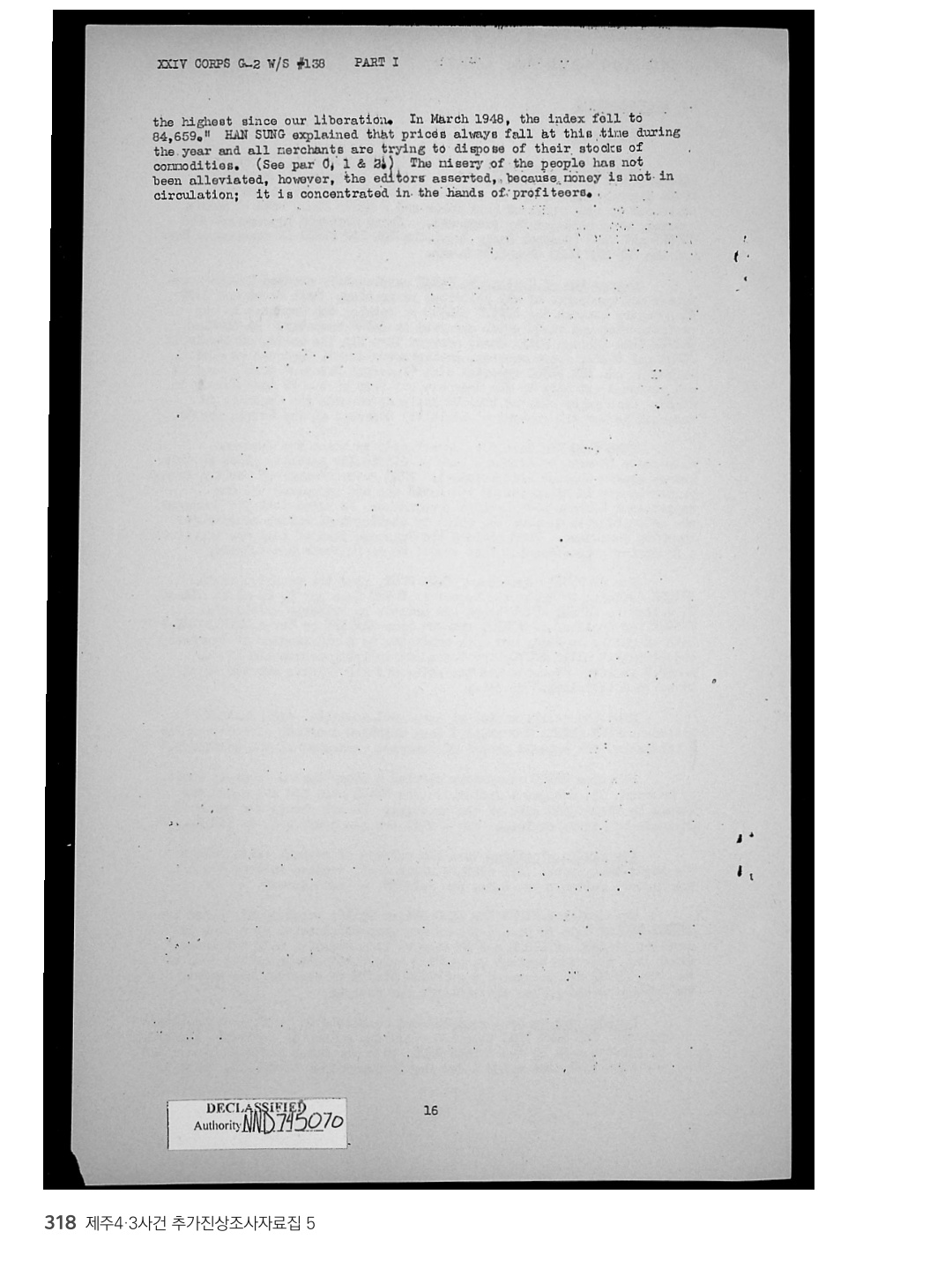
Falling prices were reported and commented on by the metropolitan newspapers. HAN SUNG ILBO reported declining prices as follows: "According to surveys made by the CHOSUN BANK, with the fixed index-number of 100 for the year 1906, the price index for February 1948 is 88,523, which is
DECLASSIFIED
Authority NND 745070
15
XXIV CORPS G-2 W/S #138 PART I
the highest since our liberation. In March 1948, the index fell to
84,659." HAN SUNG explained that prices always fall at this time during the year and all merchants are trying to dispose of their stocks of commodities. (See par 0, 1 & 2a.) The misery of the people has not been alleviated, however, the editors asserted, because money is not in circulation; it is concentrated in the hands of profiteers.
DECLASSIFIED
Authority NND 745070
16
XXIV CORPS G-2 W/S #138 PART I
E. SABOTAGE AND ESPIONAGE
Communists in South KOREA are making a public opinion survey of political beliefs. Results of the poll will be forwarded to PYONGYANG to aid high-level party leaders to determine future policies and propaganda in the campaign to strengthen communism in South KOREA. (C-6)
On 23 April a Korean was apprehended in the 32nd Infantry area at (919,4-1685.7) while trying to secure information concerning U.S. troop and Korean police strength. (B-2)
Sabotage against police wire communications was continued on CHEJU
DO this week. (Police report) Elsewhere, sabotage activities against wire communications was nearly nil. One US army temporary line being used in a field problem was cut with an axe on 04 April. (A-1)
DECLASSIFIED
Authority NND 745070
17
3
출처:
제주4·3평화재단 편,
『추가진상조사자료집-미국자료3』,
p. 301–314.
— NARA (RG 554, Entry 1256, Box 59)
×
![]()