소련의 조선 내 정치 전략 1947년 4월 15일
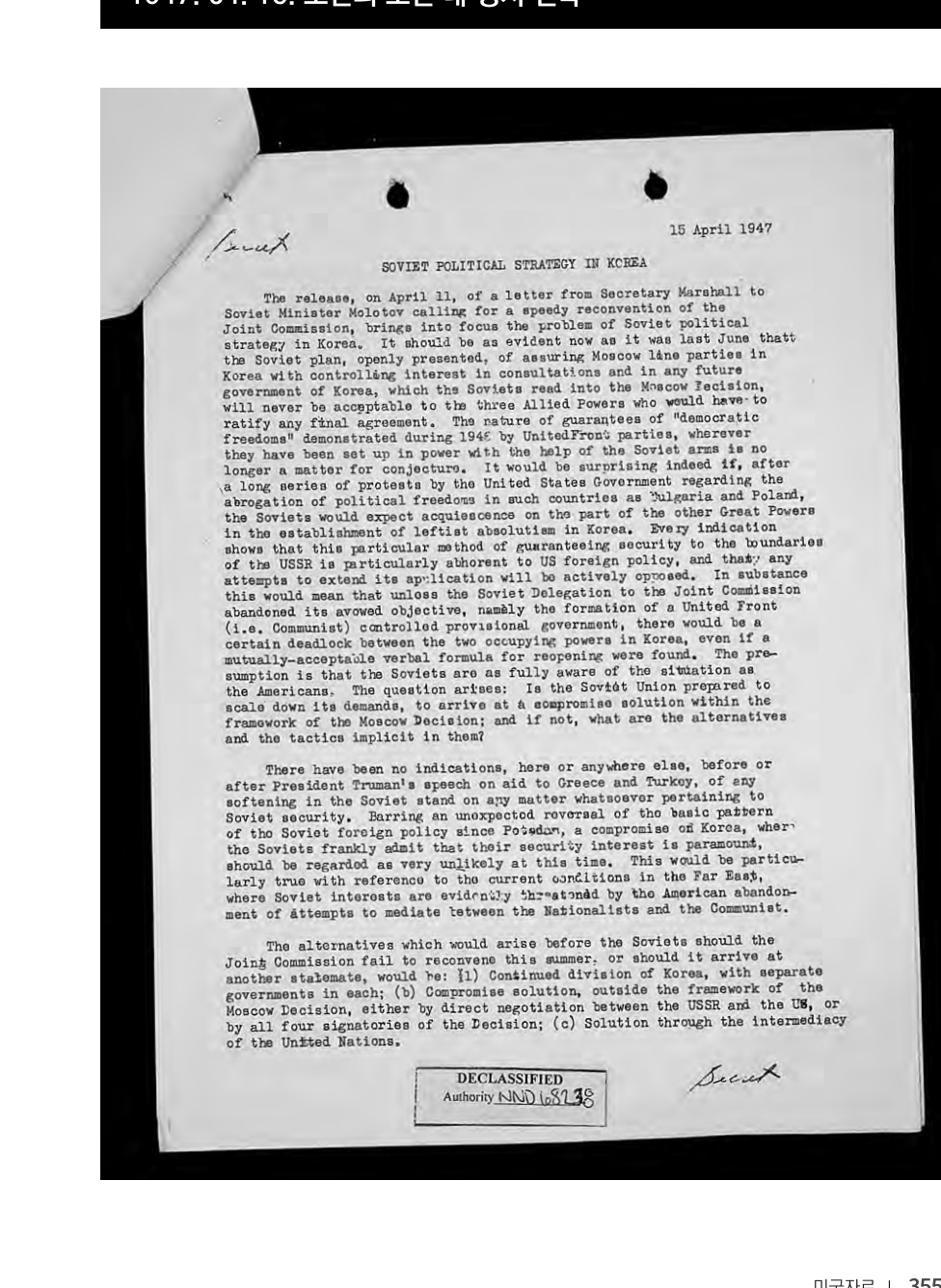
4월 11일 미국 국무장관 마셜이 소련 외무상 몰로토프에게 미소공동위원회의 신속한 재개를 촉구하며 보낸 서한이 공개되면서 소련의 조선 내 정치 전략이라는 문제가 관심을 받고 있다. 소련은 조선 내 모스크바 계열 정당들이 협상과 장차 설립될 조선 정부에서 지배력을 행사할 수 있도록 보증하려는 계획을 공개적으로 표명했는데, 이것이 모스크바협정에 대한 소련의 해석이었다. 최종적인 합의를 비준해야 하는 연합국 3국이 그런 계획을 절대 수용하지 않으리라는 점은 지난 6월에 그랬던 것처럼 이제 명백하다. 1946년 소련군의 도움으로 통일전선 계열 정당들이 권력을 잡았던 곳이라면 어디에서든지 증명됐던, "민주적 자유" 보장의 본질은 더는 추측의 문제가 아니다. 불가리아나 폴란드와 같은 국가들에서 정치적 자유가 폐지되는 것에 대해 미국 정부의 연이은 반대가 있었던 상황에서, 조선 내 좌파 절대주의의 확립을 다른 열강들이 묵인하리라 소련이 기대한다면 이는 실로 놀라운 일일 것이다. 어느 모로 보든지 소련의 국경 안보를 보장하려는 이 특정한 방법은 미국 대외정책에 특히 상반되며, 그 적용 범위를 확대하려는 모든 노력은 큰 반대에 부딪히게 될 것이다. 사실상 이는 미소공동위원회 소련 대표단이 공언한 목표, 즉 통일전선(즉 공산주의)이 지배하는 임시정부의 설립이라는 목표를 포기하지 않는다면 재개최에 대한 상호 수락 가능한 구두 합의가 있다 하더라도 조선의 두 점령국 간에 교착상태가 지속되리라는 것을 의미한다. 소련은 미국만큼이나 상황을 완전히 인지하고 있는 듯하다. 여기서 의문이 대두된다. 소련은 모스크바 결정의 틀 안에서 타협안을 도출하기 위해 자신의 요구를 축소할 준비가 되었는가? 만약 그렇지 않다면, 그 안에 내포된 대안과 전술은 무엇인가?
대 그리스 및 터키 원조에 관한 트루먼의 연설 이전이나 이후, 소련이 자국 안보에 관한 입장을 굽힐 조짐은 그 어디에서도 보이지 않는다. 소련이 포츠담 이후의 대외정책 기본 패턴을 갑자기 뒤집지 않는 한, 자국의 안보 이익에 매우 중요한 곳이라고 솔직하게 인정한 조선에 관해 타협하는 것은 현재로서는 거의 가능성이 없다고 봐야 한다. 이는 미국이 국민당과 공산당을 중재하려는 시도를 포기해 소련의 이익이 명백히 위협을 받은 극동의 현 상황에서 특히 그렇다.
올여름 미소공동위원회가 재개되지 않거나 또 다른 교착상태에 빠질 경우 소련 앞에 대두될 대안으로는 (1) 조선의 분단 지속 및 남북 분리 정부 수립, (b) 미소 간 직접 협상 또는 모스크바 결정을 조인(調印)한 4개국의 협상을 통해 모스크바 결정 체계 밖에서 해결책을 타협, (c) 유엔의 중재를 통해 해결책을 도출 등이 있다.
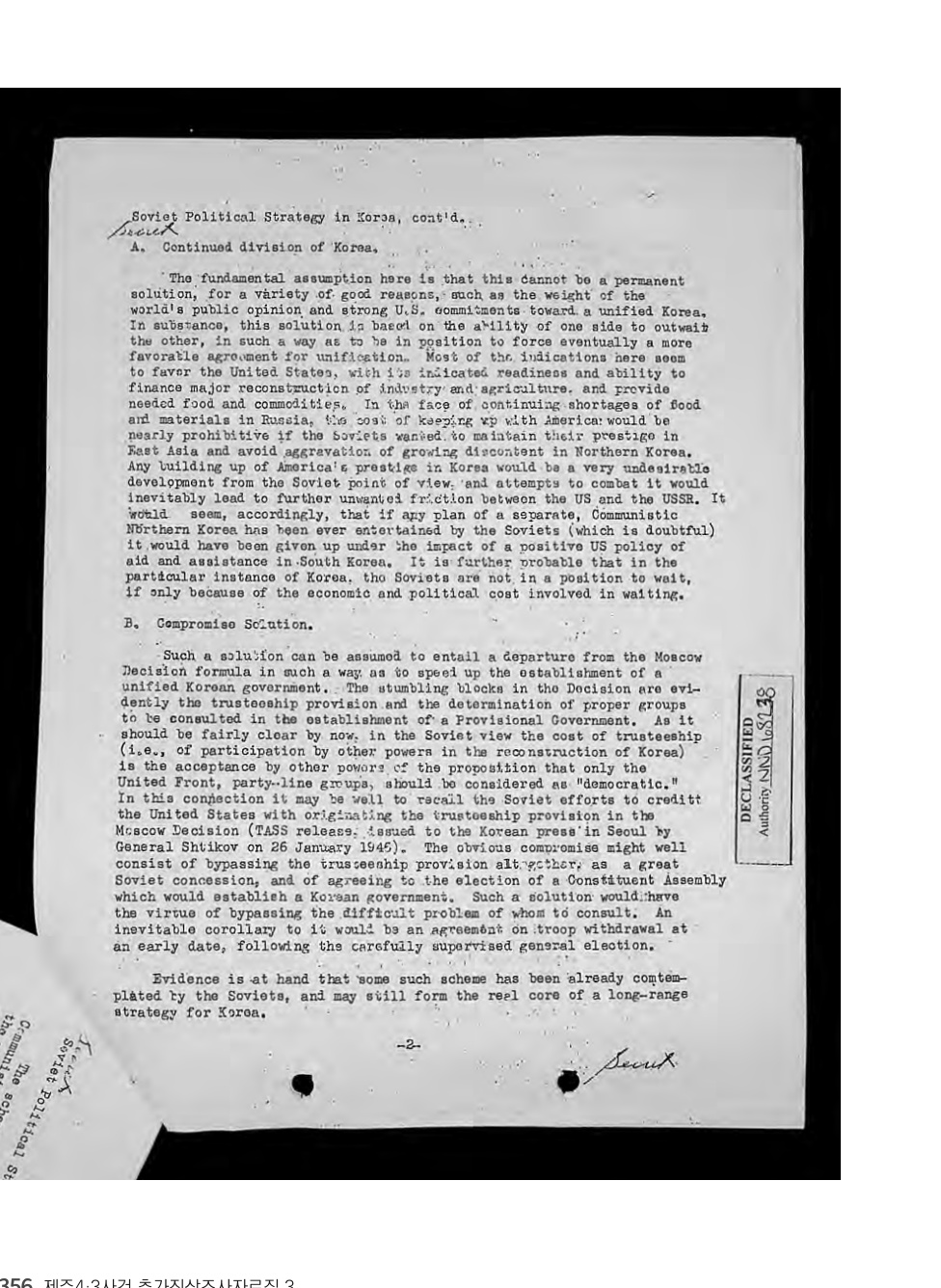
A. 조선의 분단 지속 여기에서 기본적인 전제는 조선의 통일을 향한 세계 여론의 무게와 미국의 강력한 공약 등 여러 가지 이유로 이 분단이 영구적인 해결책이 될 수 없다는 것이다. 사실 이 해결방안은 한 쪽이 좀 더 유리한 통일 협상을 강제할 수 있는 위치를 점하기 위해 다른 쪽보다 오래 기다릴 수 있는 능력에 기반을 둔다. 대부분의 정황은 미국에 유리한 것으로 보인다. 미국은 산업 및 농업 재건에 자금을 조달하고 필요한 식량과 물자를 제공할 준비와 능력을 갖췄기 때문이다. 러시아에서 식량 및 물자 부족이 계속되고 있는 상황에서 소련이 동아시아 내 자신들의 위신을 유지하고 북조선 내 불만의 악화를 피하려 한다면, 소련이 미국에 처지지 않는 데 들여야 하는 비용은 엄두도 못 낼 만큼 높아질 것이다. 조선에서 미국의 권위가 높아지는 것은 소련의 입장에서는 매우 달갑지 않은 일일 것이며 이를 타파하려는 시도는 불가피하게 미국과 소련 간의 원치 않는 마찰로 이어질 것이다. 따라서 소련이 독립적인 공산주의 북조선이라는 계획을 품은 적이 있다면(그랬을지 의심스럽지만), 그런 계획은 미국의 적극적인 대남조선 원조 및 지원 정책의 영향으로 좌절되었을 것으로 보인다. 기다리는 데 소요되는 정치적, 경제적 비용 때문만이라도, 소련은 조선이라는 특정 사례에 대해 기다릴 처지가 아닐 가능성이 높다.
B. 해결책 타협
이런 해결책은 통일 조선 정부의 수립을 앞당기기 위해 모스크바 결정의 처방에서 이탈하는 것을 수반하는 것으로 간주할 수 있다. 모스크바 결정에서 장애물이 되는 것은 당연히 신탁통치 조항과 임시정부 수립에 관련해 적절한 협상 대상을 선정하는 것이다. 이와 관련하여 모스크바 결정의 신탁통치 조항의 고안을 미국의 탓으로 돌리려 했던 소련의 노력을 상기하는 것이 좋을 것이다 (타스 보도, 1945년 1월 26일 스티코프 장군에 의해 서울의 조선 언론에 배부됨). 이 해결책의 필연적 귀결은 세밀하게 감독된 총선 이후 조속하게 군대 철수에 합의하는 것이 될 것이다.
이런 계획이 이미 소련에 의해 숙고된 바 있으며 또한 여전히 대조선 장기 전략의 핵심을 이룬다는 증거가 있다.
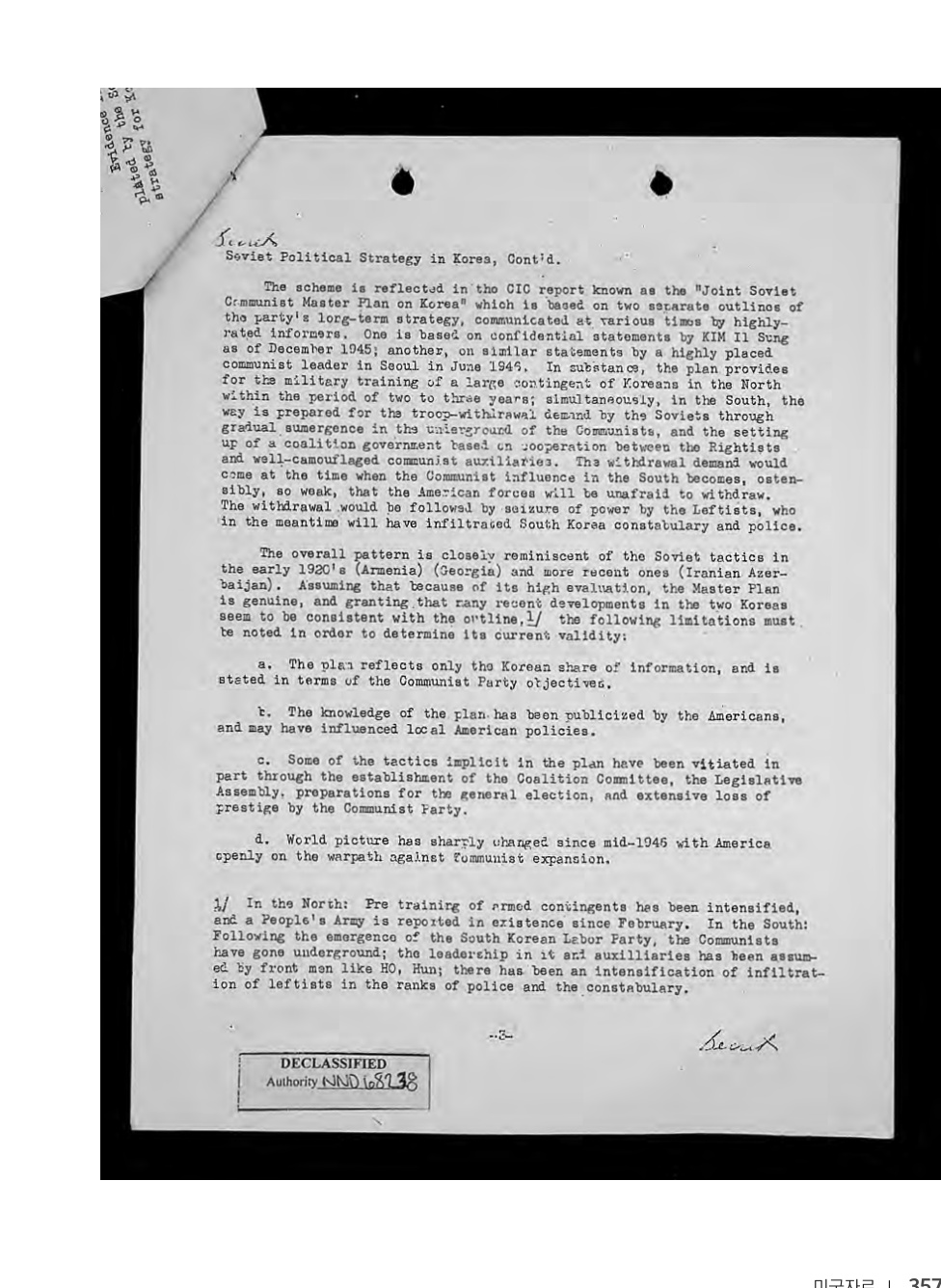
소련의 계획은 "조선에 과한 소련 공산주의 합동 마스터플랜"으로 알려진 방첩대 보고서에 반영돼 있고, 이 마스터플랜은 높은 등급의 정보원들에 의해 여러 차례 전해진, 공산당 장기 전략의 두 가지 주요 내용에 기반을 두고 있다. 그중 하나는 1945년 12월 김일성의 비밀 진술에, 다른 하나는 1945년 6월 서울의 고위급 공산당 지도자의 유사한 진술에 입각해 있다. 본질적으로 그 계획은 북조선에서 대규모 조선인 파견대를 대상으로 2~3년의 기간 동안 군사 훈련을 실시하는 것을 준비한다. 또한 동시에 남조선에서는 군대 철수 요구를 위한 방안이 소련에 의해 준비돼 있다. 소련은 공산주의자들의 지하 활동에 점진적으로 숨어듦으로써, 그리고 우파와 잘 위장된 공산주의 지원군 간의 협조에 기반을 둔 연립 정부를 수립함으로써 군대 철수 요구를 위한 방안을 마련할 것이다. 군대 철수 요구는 남조선에서 공산당의 영향력이 표면적으로 매우 약해져 미군이 철수를 두려워하지 않게 되는 시점에 나올 것이다. 군대가 철수한 후에는 그 동안 남조선의 경비대와 경찰에 침투한 좌파가 권력을 탈취할 것이다.
전반적인 패턴을 보면 1920년 초반의 (아르메니아), (그루지야)와 보다 최근에 있었던 사례들(이란령 아제르바이잔)에서의 소련 전술이 연상된다. 높은 등급 평가를 받고 있는바 이 마스터플랜이 진짜라고 가정하고 양 조선에서의 최근 전개가 그 계획과 일치해 보인다는 것을 인정하더라도17 마스터플랜의 타당성이 지금도 유효한지 판단하려면 다음과 같은 한계들이 고려돼야 한다.
a. 마스터플랜은 조선에 관한 정보만을 반영하고 있으며, 공산당의 목표를 염두에 두고 기술돼 있다.
b. 마스터플랜에 관한 정보는 미국에 의해 공표됐으며, 미국의 현지 정책에 영향을 미쳤을 수 있다.
c. 마스터플랜에 함축된 전술의 일부는 합작위원회 및 입법의회의 창설, 총선의 준비, 공산당의 대규모 세력 상실 등을 통해 부분적으로 그 가치가 떨어졌다.
d. 미국이 공산주의의 확대를 공개적으로 저지하고 나선 1946년 중반부터 세계정세가 급격하게 바뀌었다.
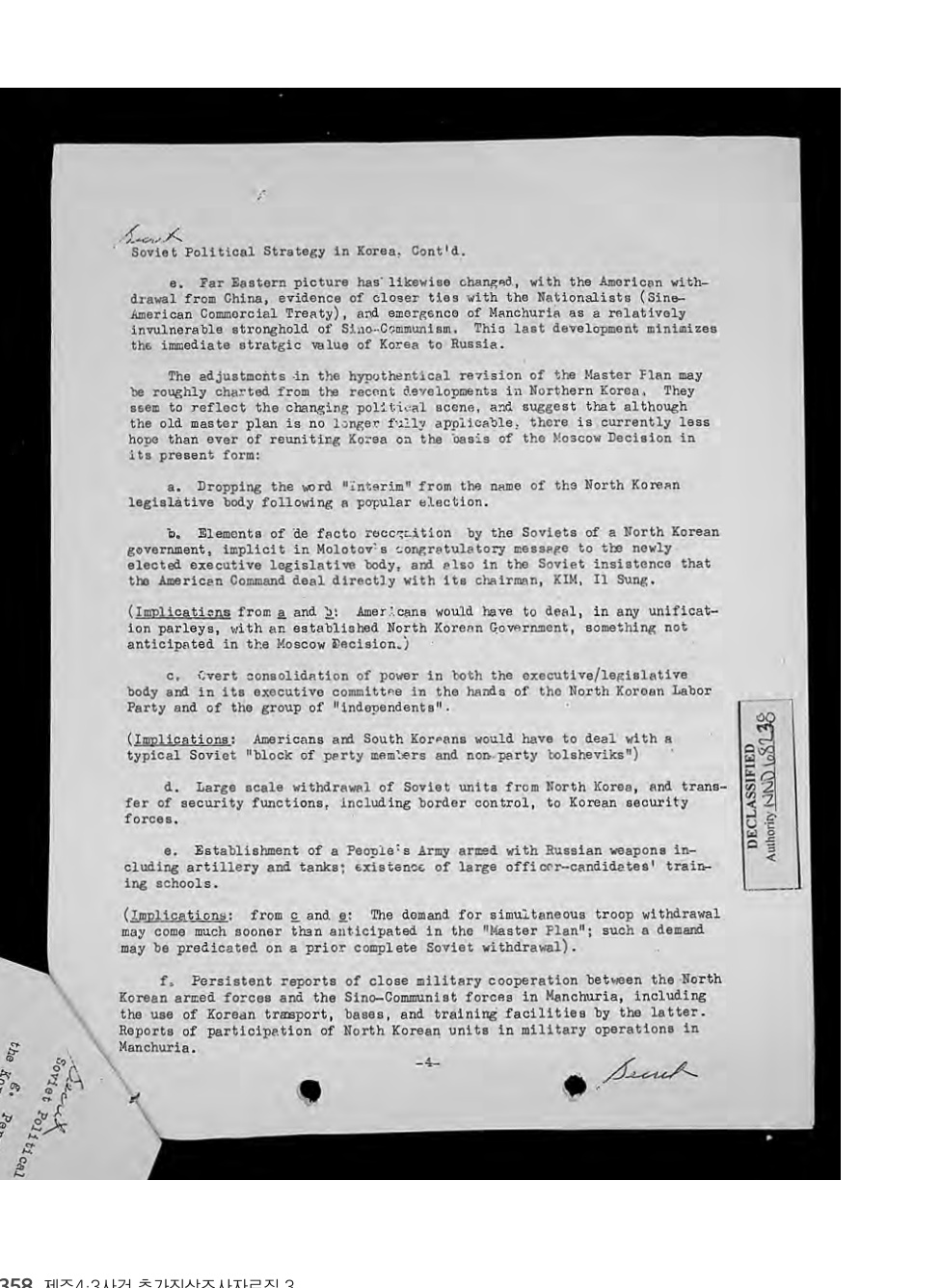
e. 중국으로부터 미국의 철수, 국민당과의 긴밀한 연대의 증거(중미통상조약), 중국 공산주의의 비교적 안전한 거점으로서 만주의 등장 등으로 말미암아 극동의 정세도 바뀌었다. 최근의 이런 전개 때문에 러시아에 대한 조선의 즉각적인 전략적 가치는 최소화됐다.
최근 북조선의 상황 전개를 통해 마스터플랜의 수정(추정)에 의한 조정을 개략적으로 그려볼 수 있다. 이 조정은 정치적 상황의 변화를 반영하는 것으로 보이며, 설사 수정 이전의 마스터플랜이 완전히 적용할 수 없다 할지라도 조선이 모스크바 결정의 현 방식에 입각하여 통일될 가능성은 그 어느 때보다도 낮다는 것을 시사한다.
a. 보통 선거 후 북조선 입법부의 명칭에서 "과도"라는 용어가 빠짐.
b. 소련의 북조선 정부에 대한 사실상의 승인을 보여주는 요소들. 이는 새로 선출된 정부에 대한 것.
17) 북조선에서: 무장 파견대에 대한 사전 훈련이 강화됐으며, 2월부터 인민군의 존재가 보고되고 있다. 남조선에서: 남조선노동당의 출현 이후 공산주의자들이 지하로 사라졌다. 남조선노동당과 그 지원군은 허훈 같은 당수가 이끌었다. 경찰과 경비대의 고위직에 좌파들의 침투가 강화됐다.
된 행정입법기관에 몰로토프가 보낸 축하 메시지와 미군 사령부가 북조선인민위원회 위원장 김일성과 직접 상대해야 한다는 소련의 주장에서 은연중에 드러난다.
(a와 b의 함의: 모든 통일 교섭에서 미국은 북조선에 수립된 정부를 상대해야 하며, 이는 모스크바 결정에서 예상하지 못했던 일이다.)
c. 북조선노동당과 "독립파" 세력의 수중에 있는 행정/입법기관과 집행위원회의 공공연한 권력 강화.
(함의: 미국과 남조선은 소련의 전형적인 "당원 및 볼셰비키 비당원 집단"을 상대해야 할 것이다.)
d. 북조선에서 소련군의 대규모 철수 및 출입국관리를 비롯한 안보 업무가 조선 군대로 이전.
e. 대포 및 전차를 포함한 러시아 무기로 무장한 인민군의 창설 - 대규모 장교 후보 훈련 학교의 존재.
(c와 e의 함의: 동시 철수 요구가 마스터플랜에서 예상한 것보다 훨씬 더 빨리 나올 수 있다. 이 같은 요구는 소련의 완전한 사전 철수에 근거를 둘 수 있다.)
f. 만주 지역 내 북조선 군대와 중국 공산군 간의 밀접한 군사 협력(중국 공산군의 조선 교통수단, 기지, 및 훈련시설 사용 등)에 대한 지속적인 보고. 만주 지역의 여러 군사 작전에 북조선군이 참여한다는 보고.
g. 만주 간도 지방의 조선인이 사는 국경 지역에서 북조선의 권한이 확대되고 있다는 지속적인 보고.
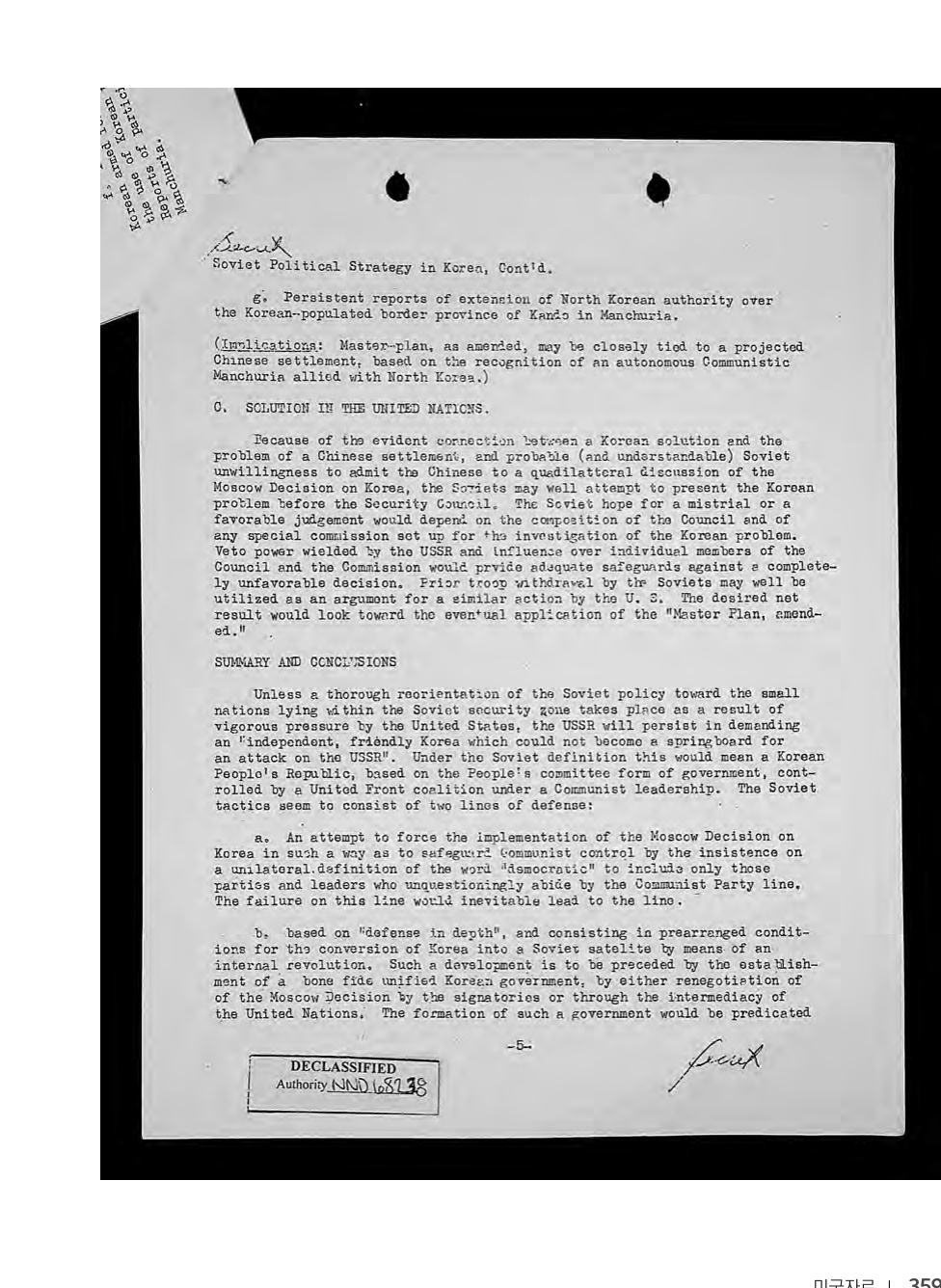
(함의: 수정된 마스터플랜은 북조선과 동맹 관계에 있는 자치적인 공산주의 만주
에 대한 인정이라는 기반 위에서 중국 문제 해결 계획과 긴밀하게 결부될 수 있다.
C. 유엔에 의한 해결 조선에 관한 해결책과 중국 문제 해결의 명확한 연계성 그리고 모스크바 결정 4개국 협의에 중국을 들이는 것에 대해 있을 법한 (그리고 이해할 만한) 주저 때문에, 소련은 조선 문제를 유엔안전보장이사회에 회부할지도 모른다. 무효 또는 유리한 판결을 바라는 소련의 바람은 안전보장이사회의 구성과 조선 문제의 조사를 위해 설치도리 특별구성위원회의 구성에 의해 좌우될 것이다. 소련이 휘두를 수 있는 거부권과 소련이 이사회 개별 회원국과 위원회에 대해 갖는 영향력은 (역자: 소련에) 완전히 불리한 결정이 나오는 것을 방지해줄 충분한 보호장치를 제공할 것이다. 소련군의 사전 철수는 미국에 그와 유사한 조치를 요구하는 근거로 활용될 수 있다. 소련이 바라는 최종결과는 "마스터플랜 수정안"이 결국에 가서 적용되는 방향일 것이다.
요약 및 결론
미국의 집요한 압박으로 인해 소련이 자국의 안전보장 지역에 위치한 작은 국가들에 대해 정책 방향을 완전히 전환하지 않는 한, 소련은 "조선이 소련을 공격하기 위한 발판이 될 수 없도록 독립적이고 우호적인 조선"을 계속 고집할 것이다. 소련의 의중에 따르면 이는 인민위원회 형태의 정부에 기반을 둔 인민공화국을 의미할 것이다. 그리고 이는 공산주의의 지도하에 통일전선 연합에 의해 통제되는 공화국일 것이다. 소련의 전술은 두 개의 방어선으로 구성되는 듯하다.
a. "민주적"이라는 단어가 공산당 노선을 무조건적으로 따르는 정당과 지도자만을 포함하도록 일방적인 정의를 주장, 이를 통해 공산주의자들의 지배를 보장하는 방식으로 조선에 관한 모스크바 결정의 시행을 강제하려는 시도. 이 노선의 실패는 필연적으로 아래의 노선으로 이어지게 될 것이다.
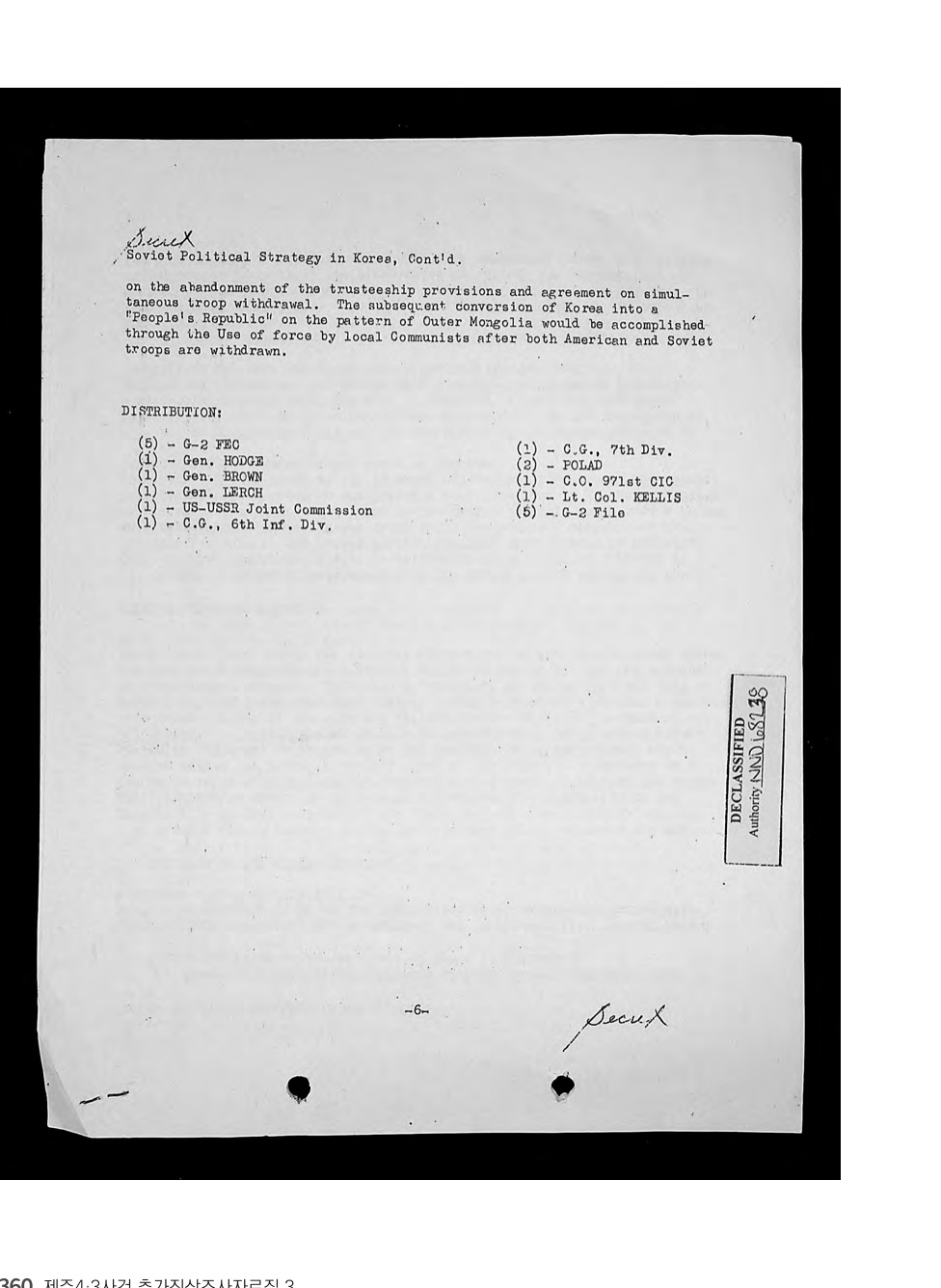
b. 내부 혁명이라는 수단을 통해 조선을 소련의 위성국으로 전환하기 위한 조건들을 사전에 마련하는, "종심방어"에 기반을 둔 노선. 이런 전개를 위해서는 모스크바 결정에 대한 조인국들의 재협상을 통해서든 유엔의 중재를 통해서든 진정한 통일 조선 정부의 수립이 선행돼야 할 것이다. 이와 같은 정부의 수립은 신탁통치 조항의 폐기와 군대의 동시 철수에 입각하게 될 것이다. 이후 외몽고와 같은양상으로 조선을 '인민공화국'으로 전환하는 일은 미국과 소련군이 모두 철수한후 현지 공산당의 무력을 사용함으로써 달성될 것이다.
배포:
(5) - 극동사령부 정보참모부
(1) - 제7사단 사령관
(1) - 하지 장군
(2) - 미군정 정치고문
(1) - 브라운 장군
(1) - 971방첩대 지휘관
(1) - 러치 장군
(1) - 켈리스 중령
(1) - 미소공동위원회
(5) - 정보참모부 파일
(1) - 제6보병사단 사령관
Secret
15 April 1947
SOVIET POLITICAL STRATEGY IN KOREA
The release, on April 11, of a letter from Secretary Marshall to
Soviet Minister Molotov calling for a speedy reconvention of the
Joint Commission, brings into focus the problem of Soviet political strategy in Korea. It should be as evident now as it was last June that the Soviet plan, openly presented, of assuring Moscow line parties in
Korea with controlling interest in consultations and in any future government of Korea, which the Soviets read into the Moscow Decision, will never be acceptable to the three Allied Powers who would have to ratify any final agreement. The nature of guarantees of "democratic freedoms" demonstrated during 1946 by United Front parties, wherever they have been set up in power with the help of the Soviet arms is no longer a matter for conjecture. It would be surprising indeed if, after a long series of protests by the United States Government regarding the abrogation of political freedoms in such countries as Bulgaria and Poland, the Soviets would expect acquiescence on the part of the other Great Powers in the establishment of leftist absolutism in Korea. Every indication shows that this particular method of guaranteeing security to the boundaries of the USSR is particularly abhorent to US foreign policy, and that any attempts to extend its application will be actively opposed. In substance this would mean that unless the Soviet Delegation to the Joint Commission abandoned its avowed objective, namely the formation of a United Front
(i.e. Communist) controlled provisional government, there would be a certain deadlock between the two occupying powers in Korea, even if a mutually-acceptable verbal formula for reopening were found. The presumption is that the Soviets are as fully aware of the situation as the Americans. The question arises: Is the Soviet Union prepared to scale down its demands, to arrive at a compromise solution within the framework of the Moscow Decision; and if not, what are the alternatives and the tactics implicit in them?
There have been no indications, here or anywhere else, before or after President Truman's speech on aid to Greece and Turkey, of any softening in the Soviet stand on any matter whatsoever pertaining to
Soviet security. Barring an unexpected reversal of the basic pattern of the Soviet foreign policy since Potsdam, a compromise on Korea, where the Soviets frankly admit that their security interest is paramount, should be regarded as very unlikely at this time. This would be particularly true with reference to the current conditions in the Far East, where Soviet interests are evidently threatened by the American abandonment of attempts to mediate between the Nationalists and the Communist.
The alternatives which would arise before the Soviets should the
Joint Commission fail to reconvene this summer, or should it arrive at another stalemate, would be: (1) Continued division of Korea, with separate governments in each; (b) Compromise solution, outside the framework of the
Moscow Decision, either by direct negotiation between the USSR and the US, or by all four signatories of the Decision; (c) Solution through the intermediacy of the United Nations.
DECLASSIFIED
Authority NND 68138
Secret
Soviet Political Strategy in Korea, cont'd.
Secret
A. Continued division of Korea.
The fundamental assumption here is that this cannot be a permanent solution, for a variety of good reasons, such as the weight of the world's public opinion and strong U.S. commitments toward a unified Korea.
In substance, this solution is based on the ability of one side to outwait the other, in such a way as to be in position to force eventually a more favorable agreement for unification. Most of the indications here seem to favor the United States, with its indicated readiness and ability to finance major reconstruction of industry and agriculture, and provide needed food and commodities. In the face of continuing shortages of food and materials in Russia, the cost of keeping up with America would be nearly prohibitive if the Soviets wanted to maintain their prestige in
East Asia and avoid aggravation of growing discontent in Northern Korea.
Any building up of America's prestige in Korea would be a very undesirable development from the Soviet point of view, and attempts to combat it would inevitably lead to further unwanted friction between the US and the USSR. It would seem, accordingly, that if any plan of a separate, Communistic
Northern Korea has been ever entertained by the Soviets (which is doubtful)
it would have been given up under the impact of a positive US policy of aid and assistance in South Korea. It is further probable that in the particular instance of Korea, the Soviets are not in a position to wait, if only because of the economic and political cost involved in waiting.
B. Compromise Solution.
Such a solution can be assumed to entail a departure from the Moscow
Decision formula in such a way as to speed up the establishment of a unified Korean government. The stumbling blocks in the Decision are evidently the trusteeship provision and the determination of proper groups to be consulted in the establishment of a Provisional Government. As it should be fairly clear by now, in the Soviet view the cost of trusteeship
(i.e., of participation by other powers in the reconstruction of Korea)
is the acceptance by other powers of the proposition that only the
United Front, party-line groups, should be considered as "democratic."
In this connection it may be well to recall the Soviet efforts to credit the United States with originating the trusteeship provision in the
Moscow Decision (TASS release, issued to the Korean press in Seoul by
General Shtikov on 26 January 1945). The obvious compromise might well consist of bypassing the trusteeship provision altogether, as a great
Soviet concession, and of agreeing to the election of a Constituent Assembly which would establish a Korean government. Such a solution would have the virtue of bypassing the difficult problem of whom to consult. An inevitable corollary to it would be an agreement on troop withdrawal at an early date, following the carefully supervised general election.
Evidence is at hand that some such scheme has been already contemplated by the Soviets, and may still form the real core of a long-range strategy for Korea.
-2-
Secret
DECLASSIFIED
Authority NND [illegible]
356 제주4·3사건 추가진상조사자료집 3
Secret
Soviet Political Strategy in Korea, Cont'd.
The scheme is reflected in the CIC report known as the "Joint Soviet
Communist Master Plan on Korea" which is based on two separate outlines of the party's long-term strategy, communicated at various times by highlyrated informers. One is based on confidential statements by KIM Il Sung as of December 1945; another, on similar statements by a highly placed communist leader in Seoul in June 1946. In substance, the plan provides for the military training of a large contingent of Koreans in the North within the period of two to three years; simultaneously, in the South, the way is prepared for the troop-withdrawal demand by the Soviets through gradual submergence in the underground of the Communists, and the setting up of a coalition government based on cooperation between the Rightists and well-camouflaged communist auxiliaries. The withdrawal demand would come at the time when the Communist influence in the South becomes, ostensibly, so weak, that the American forces will be unafraid to withdraw.
The withdrawal would be followed by seizure of power by the Leftists, who in the meantime will have infiltrated South Korea constabulary and police.
The overall pattern is closely reminiscent of the Soviet tactics in the early 1920's (Armenia) (Georgia) and more recent ones (Iranian Azerbaijan). Assuming that because of its high evaluation, the Master Plan is genuine, and granting that many recent developments in the two Koreas seem to be consistent with the outline, 1/ the following limitations must be noted in order to determine its current validity:
a. The plan reflects only the Korean share of information, and is stated in terms of the Communist Party objectives.
b. The knowledge of the plan has been publicized by the Americans, and may have influenced local American policies.
c. Some of the tactics implicit in the plan have been vitiated in part through the establishment of the Coalition Committee, the Legislative
Assembly, preparations for the general election, and extensive loss of prestige by the Communist Party.
d. World picture has sharply changed since mid-1946 with America openly on the warpath against Communist expansion.
1/ In the North: Pre training of armed contingents has been intensified, and a People's Army is reported in existence since February. In the South:
Following the emergence of the South Korean Labor Party, the Communists have gone underground; the leadership in it and auxiliaries has been assumed by front men like HO, Hun; there has been an intensification of infiltration of leftists in the ranks of police and the constabulary.
-3-
Secret
DECLASSIFIED
Authority NND 68138
[illegible]
Soviet Political Strategy in Korea, Cont'd.
e. Far Eastern picture has likewise changed, with the American withdrawal from China, evidence of closer ties with the Nationalists (SinoAmerican Commercial Treaty), and emergence of Manchuria as a relatively invulnerable stronghold of Sino-Communism. This last development minimizes the immediate stratgic value of Korea to Russia.
The adjustments in the hypothetical revision of the Master Plan may be roughly charted from the recent developments in Northern Korea. They seem to reflect the changing political scene, and suggest that although the old master plan is no longer fully applicable, there is currently less hope than ever of reuniting Korea on the basis of the Moscow Decision in its present form:
a. Dropping the word "interim" from the name of the North Korean legislative body following a popular election.
b. Elements of de facto recognition by the Soviets of a North Korean government, implicit in Molotov's congratulatory message to the newly elected executive legislative body, and also in the Soviet insistence that the American Command deal directly with its chairman, KIM, Il Sung.
(Implications from a and b: Americans would have to deal, in any unification parleys, with an established North Korean Government, something not anticipated in the Moscow Decision.)
c. Overt consolidation of power in both the executive/legislative body and in its executive committee in the hands of the North Korean Labor
Party and of the group of "independents".
(Implications: Americans and South Koreans would have to deal with a typical Soviet "block of party members and non-party bolsheviks")
d. Large scale withdrawal of Soviet units from North Korea, and transfer of security functions, including border control, to Korean security forces.
e. Establishment of a People's Army armed with Russian weapons including artillery and tanks; existence of large officer-candidates' training schools.
(Implications: from c and e: The demand for simultaneous troop withdrawal may come much sooner than anticipated in the "Master Plan"; such a demand may be predicated on a prior complete Soviet withdrawal).
f. Persistent reports of close military cooperation between the North
Korean armed forces and the Sino-Communist forces in Manchuria, including the use of Korean transport, bases, and training facilities by the latter.
Reports of participation of North Korean units in military operations in
Manchuria.
-4-
Secret
DECLASSIFIED
Authority NND 745148
Secret
Soviet Political Strategy in Korea, Cont'd.
g. Persistent reports of extension of North Korean authority over the Korean-populated border province of Kando in Manchuria.
(Implications: Master-plan, as amended, may be closely tied to a projected
Chinese settlement, based on the recognition of an autonomous Communistic
Manchuria allied with North Korea.)
O. SOLUTION IN THE UNITED NATIONS.
Because of the evident connection between a Korean solution and the problem of a Chinese settlement, and probable (and understandable) Soviet unwillingness to admit to a quadilatteral discussion of the
Moscow Decision on Korea, the Soviets may well attempt to present the Korean problem before the Security Council. The Soviet hope for a mistrial or a favorable judgement would depend on the composition of the Council and of any special commission set up for the investigation of the Korean problem.
Veto power wielded by the USSR and influence over individual members of the
Council and the Commission would provide adequate safeguards against a completely unfavorable decision. Prior troop withdrawal by the Soviets may well be utilized as an argument for a similar action by the U. S. The desired net result would look toward the eventual application of the "Master Plan, amended."
SUMMARY AND CONCLUSIONS
Unless a thorough reorientation of the Soviet policy toward the small nations lying within the Soviet security zone takes place as a result of vigorous pressure by the United States, the USSR will persist in demanding an "independent, friendly Korea which could not become a springboard for an attack on the USSR". Under the Soviet definition this would mean a Korean
People's Republic, based on the People's committee form of government, controlled by a United Front coalition under a Communist leadership. The Soviet tactics seem to consist of two lines of defense:
a. An attempt to force the implementation of the Moscow Decision on
Korea in such a way as to safeguard Communist control by the insistence on a unilateral definition of the word "democratic" to include only those parties and leaders who unquestioningly abide by the Communist Party line.
The failure on this line would inevitably lead to the line.
b. based on "defense in depth", and consisting in prearranged conditions for the conversion of Korea into a Soviet satelite by means of an internal revolution. Such a development is to be preceded by the estab lishment of a bona fide unified Korean government, by either renegotiation of the Moscow Decision by the signatories or through the intermediacy of the United Nations. The formation of such a government would be predicated
-5-
Secret
DECLASSIFIED
Authority NND 868738
Secret
Soviet Political Strategy in Korea, Cont'd.
on the abandonment of the trusteeship provisions and agreement on simultaneous troop withdrawal. The subsequent conversion of Korea into a
"People's Republic" on the pattern of Outer Mongolia would be accomplished through the use of force by local Communists after both American and Soviet troops are withdrawn.
DISTRIBUTION:
(5) - G-2 FEC
(1) - Gen. HODGE
(1) - Gen. BROWN
(1) - Gen. LERCH
(1) - US-USSR Joint Commission
(1) - C.G., 6th Inf. Div.
(1) - C.G., 7th Div.
(2) - POLAD
(1) - C.O. 971st CIC
(1) - Lt. Col. KELLIS
(5) - G-2 File
-6-
Secret
DECLASSIFIED
Authority NND [illegible]
출처:
제주4·3평화재단 편,
『추가진상조사자료집-미국자료1』,
p. 355–360.
— NARA (RG 554, Entry 21(A1), Box 6)
×
![]()