제주4·3사건 추가진상조사자료집 4 정보참모부 주간요약보고
기간: 1948년 3월 12일~1948년 3월 19일
주한미육군사령부
서울, 조선
1948년 3월 19일 제131호
B. 현용 정보
1. 정치활동
f. 공산주의자 활동
3월 12일부터 정오부터 19일 정오까지 남조선 공산주의자의 활동
남조선에 대한 국제적 관심
압수한 공산주의 지령에서 남조선의 공산주의 활동이 증가할 조짐이 보인다. 미국은 유럽에서 극동으로 관심을 돌려야 한다.
남조선노동당의 활동을 조사하던 중 발견된 "국제 상황"이라는 문서와 "선전과 선동의 근본 요소"라는 문서는 전 세계 공산주의 활동의 감독과 격려가 어떻게 집중화돼 있는지 공산주의자의 관점과 언어를 통해 명백히 드러낸다. 번역 사본이 만들어졌고 사령부를 통해 광범위하게 배부됐다.
공산주의자의 선거 반대 입장 강화
이번 주 남조선에서는 공산주의 세력이 유럽에서 수립된 정책을 따라 총선거를 거부할 뿐만 아니라 선거 반대 전선에 있는 비공산주의 분파들을 격려할 것이라는 점이 더욱 명백해졌다. 유엔임시위원단의 정책적 분열은 공산주의 입장에 힘을 더했다. 서구가 "권력과 위신"이라 부르고 동양에서 "체면"이라 부르는 것을 유엔이 잃어가는 동안, 형세를 관망하던 사람들은 좌파로 쏠려 갔다. 보고 기간 끝날 무렵, 공산주의자들은 강력한 우익 정당 2개, 청교도 교회 분파들, 모든 비공산주의 좌파, 거의 모든 중도파, 나아가 선거일인 5월 9일에 일식을 일으킬 것
으로 예상되는 태양계까지 선거 반대론의 지지자로 지목할 수 있었다(제1부 B절, 1/e/(2)항 참고).
외부의 선거 반대 지원 남조선 공산주의자들에 대한 지원의 일환으로 소련 최고 소비에트는 언론 및 라디오를 통해 광범위한 반(反)선거 논평을 쏟아냈다. 이는 다가오는 남조선의 선거에 대한 소련의 증대된 우려를 보여준 것이었다. 모스크바 발 통신 선전활동은 남조선의 공산계열 언론에 인용 보도된 스탈린의 '민주노선'을 최대한 활용했다. 이 노선은 소련의 지배하에 계획된 남북통일에 대한 유엔임시위원단의 준비를 저해하려는 노력을 재차 강조한 것이었다.
평양 라디오는 단독 선거를 반대하는 대중집회에 관한 장황한 프로그램과 성명을 통해 남조선 공산주의자들의 주장에 대한 지지를 이어갔다. 방송 사이에 삽입된 광고 같은 선전의 내용은 다음과 같았다. "동포들이여! 미국인들은 남조선에서 단독 정부를 만들려 계획하고 있다. 미국인들은 조선인을 다시 노예로 삼으려 한다. 우리의 조국을 분단하려는 미국인들의 극악무도한 음모를 분쇄하자!"
지난주 평양 라디오에서 남조선 공산주의자들에 대한 북조선의 금전적 지원이 북조선 관리에 의해 처음으로 시인됐다. 공산주의자 연사는 "… 북조선의 모든 지역에서 북조선 인민위원회로 보내진 성금은 남조선 인민에 대한 북조선 인민의 피가 끓는 형제적 지지를 증명한다…"고 말했다. (제2부 북조선, D 항목 3항 참고).
C. 개전 가능성
1. 경제
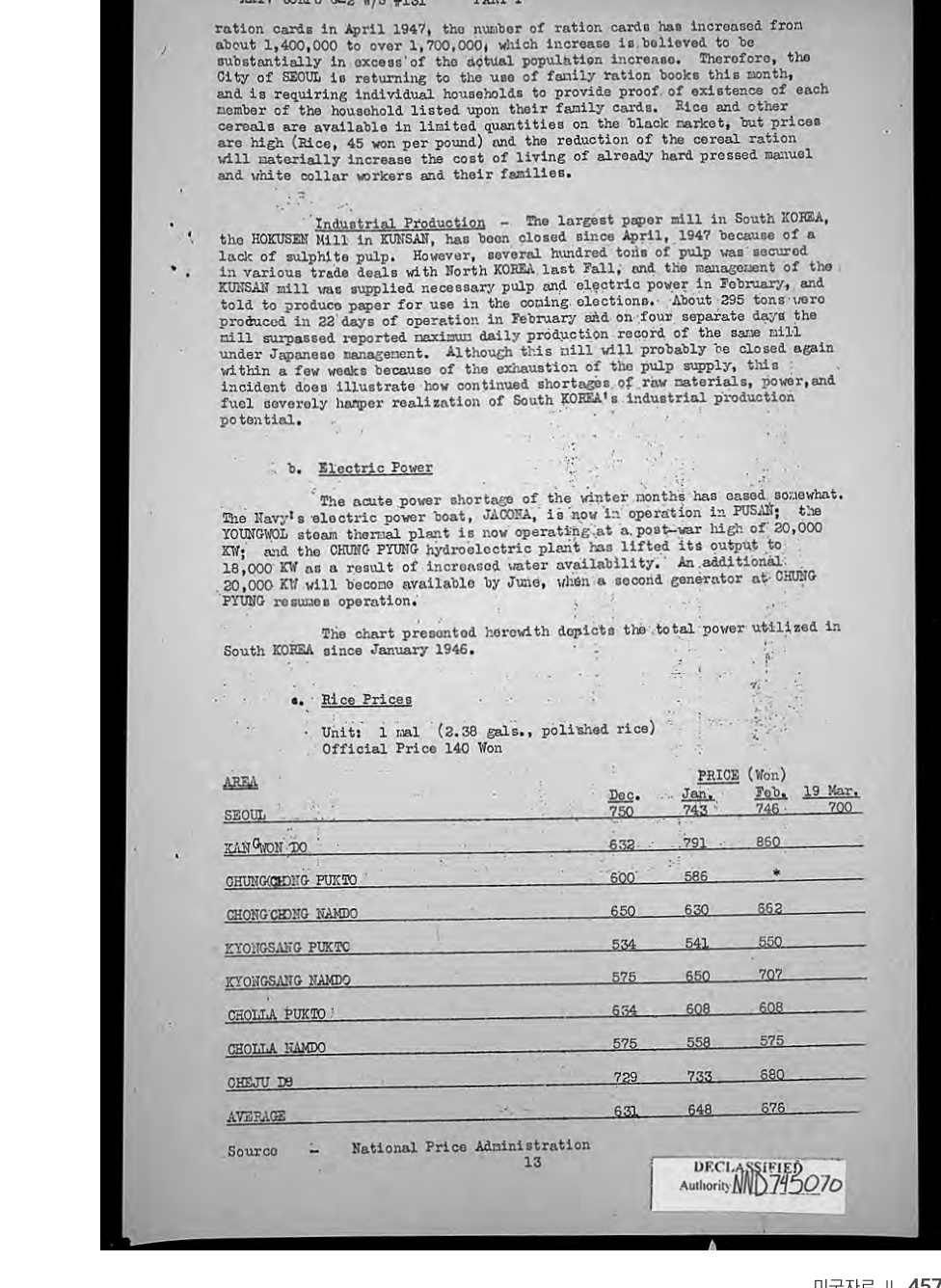
c. 미곡 가격
단위: 1말 (도정미 2.38갤런)
공정가격: 140원
지역 | 12월 | 1월 | 2월 | 3월 19일 서울 | 750 | 743 | 746 | 700 강원도 | 632 | 791 | 860 |
출처 - 중앙물가행정처
지역 가격(원)
12월
1월
2월
3월 19일
충청북도
600
586
*
충청남도
650
630
662
경상북도
534
541
550
경상남도
575
650
707
전라북도
634
608
608
전라남도
575
558
575
제주도
729
733
680
평균
631
648
676
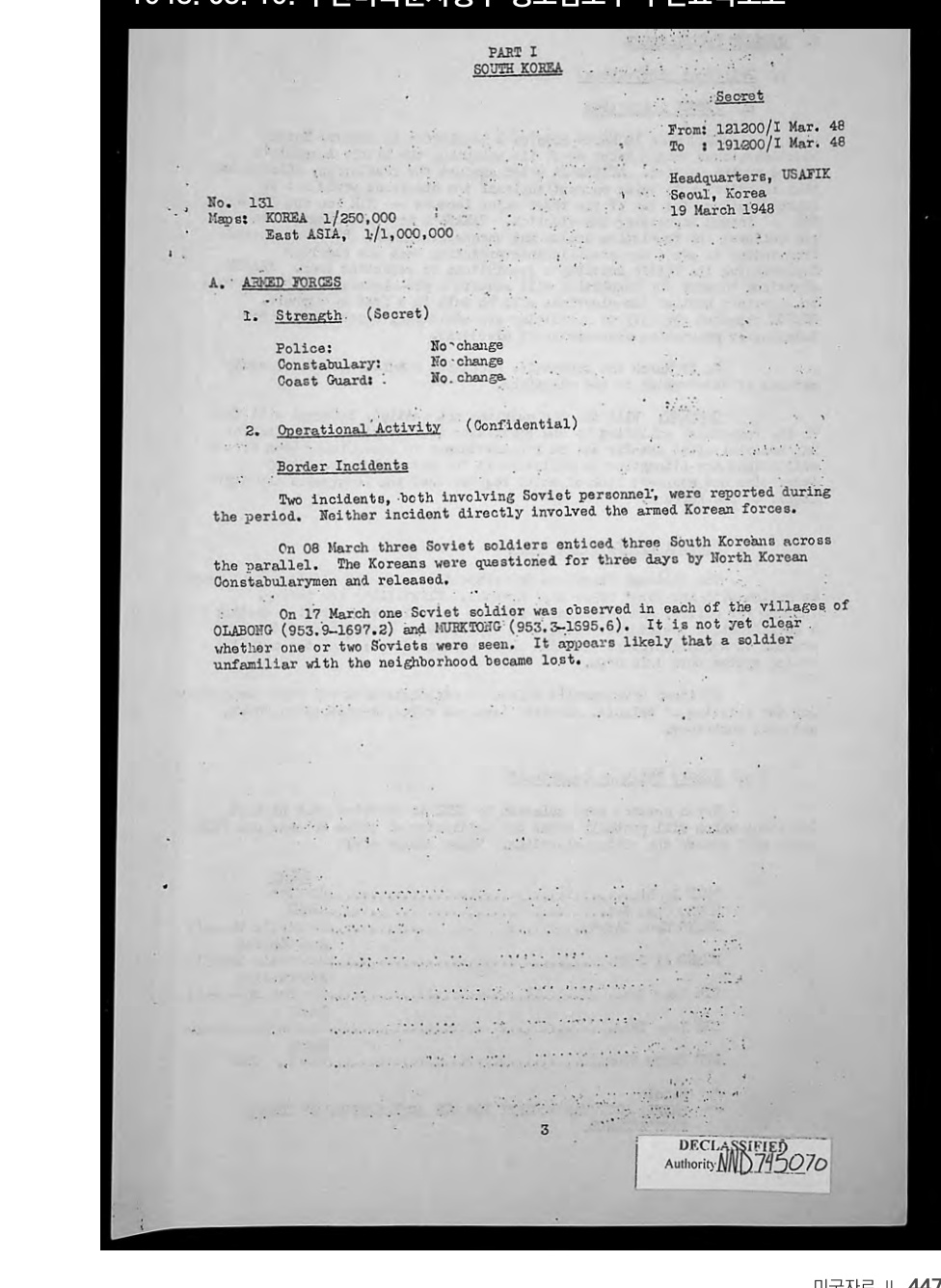
PART I
SOUTH KOREA
Secret
From: 121200/I Mar. 48
To : 191200/I Mar. 48
Headquarters, USAFIK
Seoul, Korea
19 March 1948
No. 131
Maps: KOREA 1/250,000
East ASIA, 1/1,000,000
A. ARMED FORCES
1. Strength (Secret)
Police: No change
Constabulary: No change
Coast Guard: No change
2. Operational Activity (Confidential)
Border Incidents
Two incidents, both involving Soviet personnel, were reported during the period. Neither incident directly involved the armed Korean forces.
On 08 March three Soviet soldiers enticed three South Koreans across the parallel. The Koreans were questioned for three days by North Korean
Constabularyman and released.
On 17 March one Soviet soldier was observed in each of the villages of
OLABONG (953.9-1697.2) and MURKTONG (953.3-1895.6). It is not yet clear whether one or two Soviets were seen. It appears likely that a soldier unfamiliar with the neighborhood became lost.
3
DECLASSIFIED
Authority NND 745070
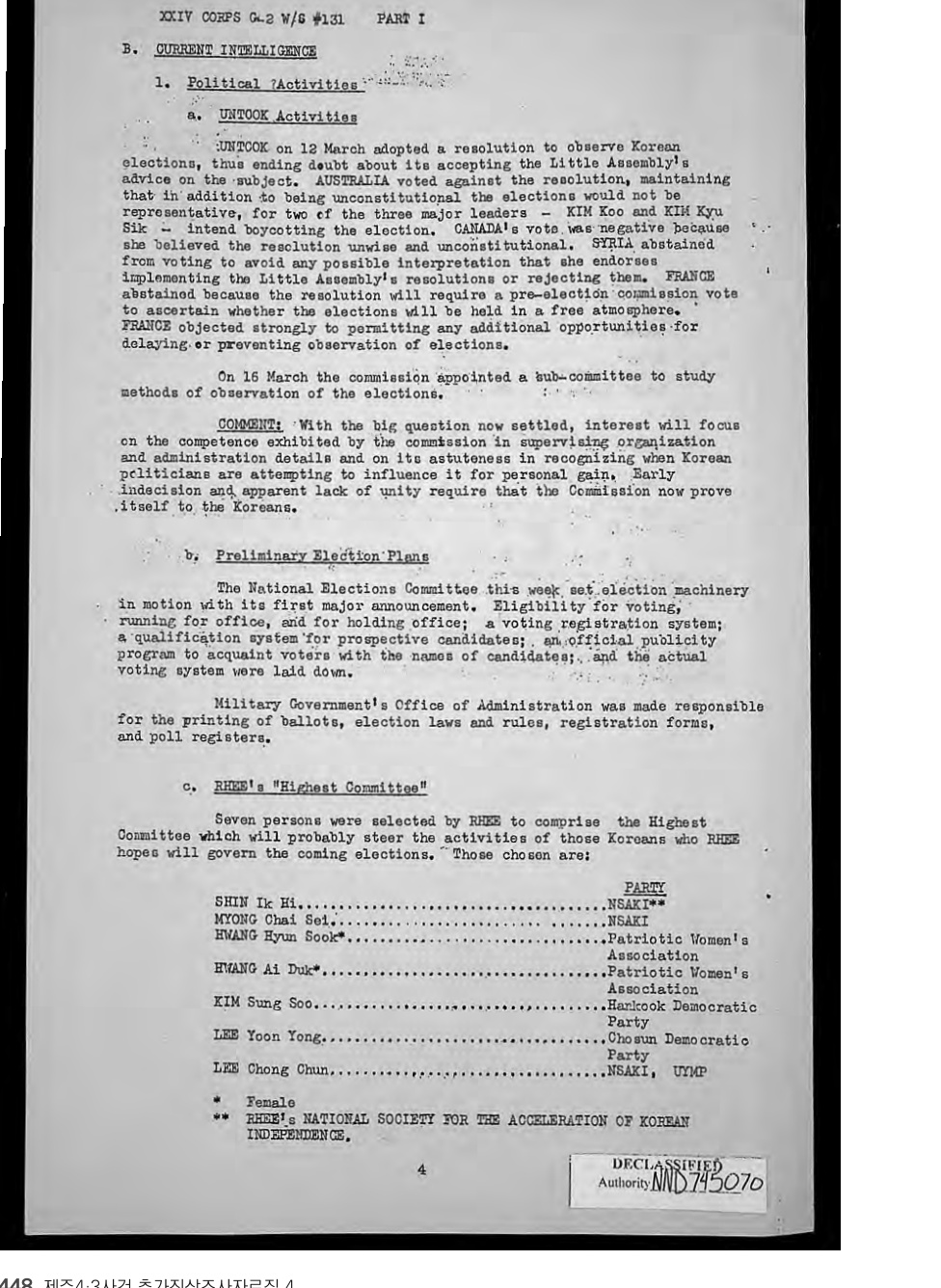
XXIV CORPS G-2 W/S #131 PART I
B. CURRENT INTELLIGENCE
1. Political Activities
a. UNTCOK Activities
UNTCOK on 12 March adopted a resolution to observe Korean elections, thus ending doubt about its accepting the Little Assembly's advice on the subject. AUSTRALIA voted against the resolution, maintaining that in addition to being unconstitutional the elections would not be representative, for two of the three major leaders -- KIM Koo and KIM Kyu Sik -- intend boycotting the election. CANADA's vote was negative because she believed the resolution unwise and unconstitutional. SYRIA abstained from voting to avoid any possible interpretation that she endorses implementing the Little Assembly's resolutions or rejecting them. FRANCE abstained because the resolution will require a pre-election commission vote to ascertain whether the elections will be held in a free atmosphere. FRANCE objected strongly to permitting any additional opportunities for delaying or preventing observation of elections.
On 15 March the commission appointed a sub-committee to study methods of observation of the elections.
COMMENT: With the big question now settled, interest will focus on the competence exhibited by the commission in supervising organization and administration details and on its astuteness in recognizing when Korean politicians are attempting to influence it for personal gain. Early indecision and apparent lack of unity require that the Commission now prove itself to the Koreans.
b. Preliminary Election Plans
The National Elections Committee this week set election machinery in motion with its first major announcement. Eligibility for voting, running for office, and for holding office; a voting registration system; a qualification system for prospective candidates; an official publicity program to acquaint voters with the names of candidates; and the actual voting system were laid down.
Military Government's Office of Administration was made responsible for the printing of ballots, election laws and rules, registration forms, and poll registers.
c. RHEE's "Highest Committee"
Seven persons were selected by RHEE to comprise the Highest Committee which will probably steer the activities of those Koreans who RHEE hopes will govern the coming elections. Those chosen are:
PARTY
SHIN Ik Hi................................NSAKI**
MYONG Chai Sei.......................... ......NSAKI
HWANG Ryun Sook*...........................Patriotic Women's
Association
HWANG Ai Duk*..............................Patriotic Women's
Association
KIM Sung Soo...............................Hankook Democratic
Party
LEE Yoon Yong..............................Chosun Democratic
Party
LEE Chong Chun.............................NSAKI, UYMP
* Female
** RHEE's NATIONAL SOCIETY FOR THE ACCELERATION OF KOREAN
INDEPENDENCE.
4
DECLASSIFIED
Authority NND 745070
XXIV CORPS G-2 W/S #131 PART I
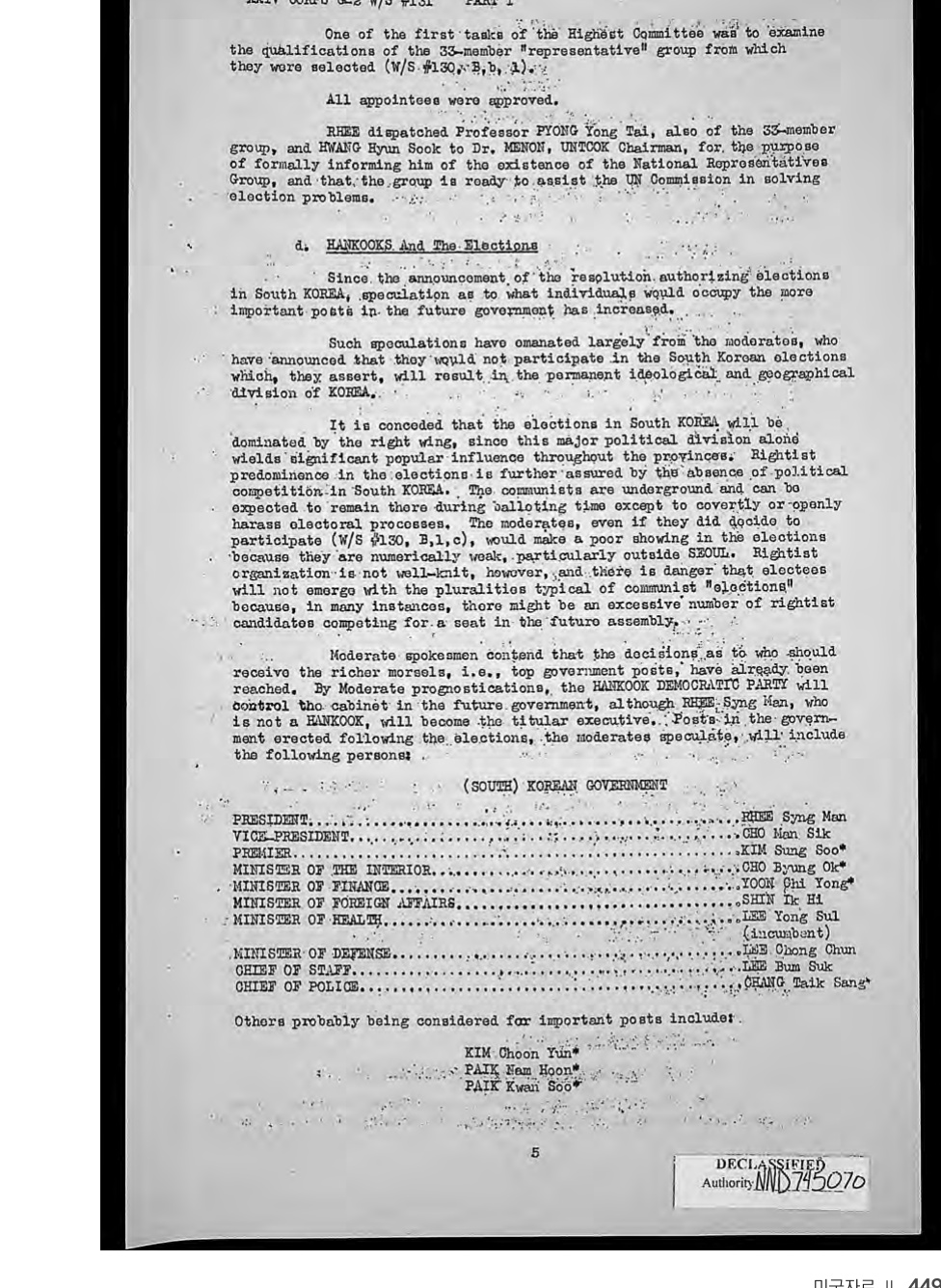
One of the first tasks of the Highest Committee was to examine the qualifications of the 33-member "representative" group from which they were selected (W/S #130, B,b, 1).
All appointees were approved.
RHEE dispatched Professor PYONG Yong Tai, also of the 33-member group, and HWANG Hyun Sook to Dr. MENON, UNTCOK Chairman, for the purpose of formally informing him of the existence of the National Representatives Group, and that the group is ready to assist the UN Commission in solving election problems.
d. HANKOOKS And The Elections
Since the announcement of the resolution authorizing elections in South KOREA, speculation as to what individuals would occupy the more important posts in the future government has increased.
Such speculations have emanated largely from the moderates, who have announced that they would not participate in the South Korean elections which, they assert, will result in the permanent ideological and geographical division of KOREA.
It is conceded that the elections in South KOREA will be dominated by the right wing, since this major political division alone wields significant popular influence throughout the provinces. Rightist predominance in the elections is further assured by the absence of political competition in South KOREA. The communists are underground and can be expected to remain there during balloting time except to covertly or openly harass electoral processes. The moderates, even if they did decide to participate (W/S #130, B,1,c), would make a poor showing in the elections because they are numerically weak, particularly outside SEOUL. Rightist organization is not well-knit, however, and there is danger that electees will not emerge with the pluralities typical of communist "elections" because, in many instances, there might be an excessive number of rightist candidates competing for a seat in the future assembly.
Moderate spokesmen contend that the decisions as to who should receive the richer morsels, i.e., top government posts, have already been reached. By Moderate prognostications, the HANKOOK DEMOCRATIC PARTY will control the cabinet in the future government, although RHEE Syng Man, who is not a HANKOOK, will become the titular executive. Posts in the government erected following the elections, the moderates speculate, will include the following persons:
(SOUTH) KOREAN GOVERNMENT
PRESIDENT..................................................RHEE Syng Man
VICE-PRESIDENT.............................................CHO Man Sik
PREMIER....................................................KIM Sung Soo*
MINISTER OF THE INTERIOR...................................CHO Byung Ok*
MINISTER OF FINANCE........................................YOON Chi Yong*
MINISTER OF FOREIGN AFFAIRS................................SHIN Ik Hi
MINISTER OF HEALTH.........................................LEE Yong Sul
(incumbent)
MINISTER OF DEFENSE........................................LEE Chong Chun
CHIEF OF STAFF.............................................LEE Bum Suk
CHIEF OF POLICE............................................CHANG Taik Sang*
Others probably being considered for important posts include:
KIM Choon Yun*
PAIK Nam Hoon*
PAIK Kwan Soo*
5
DECLASSIFIED
Authority NND 745070
XXIV CORPS G-2 W/S #131 PART I
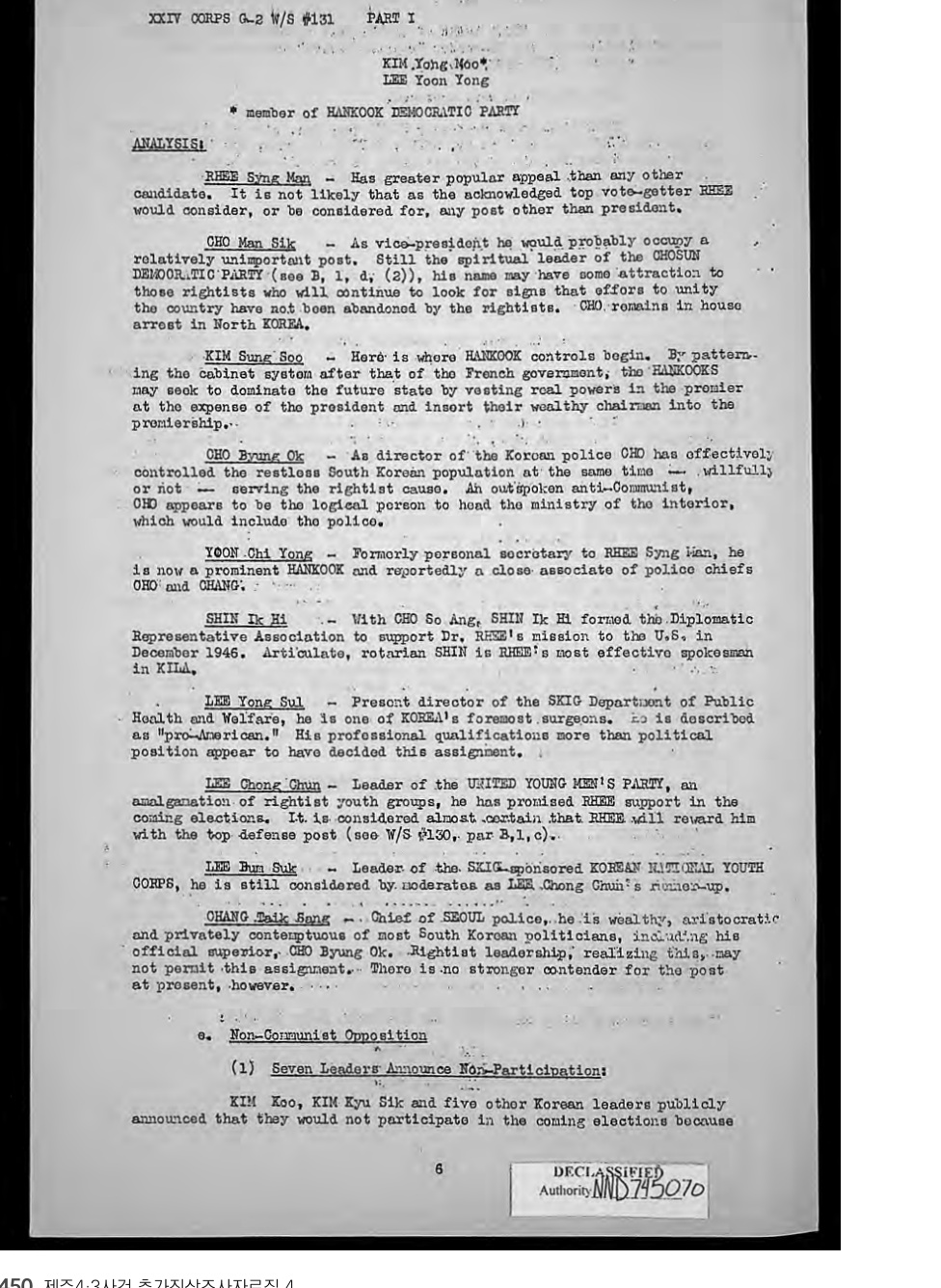
KIM Yong Moo*
LEE Yoon Yong
* member of HANKOOK DEMOCRATIC PARTY
ANALYSIS:
RHEE Syng Man -- Has greater popular appeal than any other candidate. It is not likely that as the acknowledged top vote-getter RHEE would consider, or be considered for, any post other than president.
CHO Man Sik -- As vice-president he would probably occupy a relatively unimportant post. Still the spiritual leader of the CHOSUN DEMOCRATIC PARTY (see B, 1, d, (2)), his name may have some attraction to those rightists who will continue to look for signs that efforts to unity the country have not been abandoned by the rightists. CHO remains in house arrest in North KOREA.
KIM Sung Soo -- Here is where HANKOOK controls begin. By patterning the cabinet system after that of the French government, the HANKOOKS may seek to dominate the future state by vesting real powers in the premier at the expense of the president and insert their wealthy chairman into the premiership.
CHO Byung Ok -- As director of the Korean police CHO has effectively controlled the restless South Korean population at the same time -- willfully or not -- serving the rightist cause. An outspoken anti-Communist, CHO appears to be the logical person to head the ministry of the interior, which would include the police.
YOON Chi Yong -- Formerly personal secretary to RHEE Syng Man, he is now a prominent HANKOOK and reportedly a close associate of police chiefs CHO and CHANG.
SHIN Ik Hi -- With CHO So Ang, SHIN Ik Hi formed the Diplomatic Representative Association to support Dr. RHEE's mission to the U.S. in December 1946. Articulate, rotarian SHIN is RHEE's most effective spokesman in KILA.
LEE Yong Sul -- Present director of the SKIG Department of Public Health and Welfare, he is one of KOREA's foremost surgeons. He is described as "pro-American." His professional qualifications more than political position appear to have decided this assignment.
LEE Chong Chun -- Leader of the UNITED YOUNG MEN'S PARTY, an amalgamation of rightist youth groups, he has promised RHEE support in the coming elections. It is considered almost certain that RHEE will reward him with the top defense post (see W/S #130, par B,1,c).
LEE Bun Suk -- Leader of the SKIG-sponsored KOREAN NATIONAL YOUTH CORPS, he is still considered by moderates as LEE Chong Chun's runner-up.
CHANG Taik Sang -- Chief of SEOUL police, he is wealthy, aristocratic and privately contemptuous of most South Korean politicians, including his official superior, CHO Byung Ok. Rightist leadership, realizing this, may not permit this assignment. There is no stronger contender for the post at present, however.
e. Non-Communist Opposition
(1) Seven Leaders Announce Non-Participation:
KIM Koo, KIM Kyu Sik and five other Korean leaders publicly announced that they would not participate in the coming elections because
6
DECLASSIFIED
Authority NND 745070
XXIV CORPS G-2 W/S #131 PART I
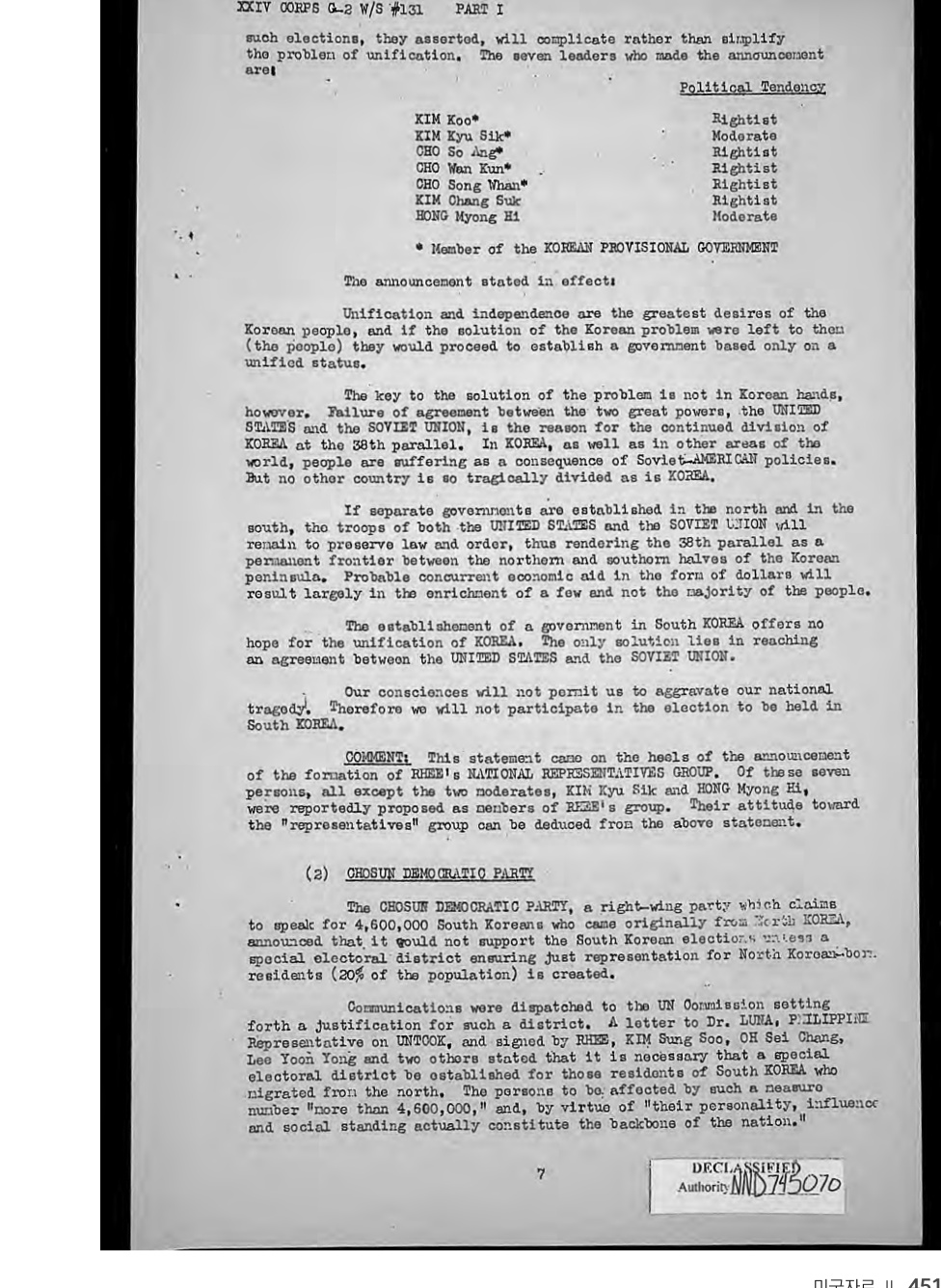
such elections, they asserted, will complicate rather than simplify the problem of unification. The seven leaders who made the announcement
are:
Political Tendency
KIM Koo* Rightist
KIM Kyu Sik* Moderate
CHO So Ang* Rightist
CHO Wan Kun* Rightist
CHO Song Whan* Rightist
KIM Chang Suk Rightist
HONG Myong Hi Moderate
* Member of the KOREAN PROVISIONAL GOVERNMENT
The announcement stated in effect:
Unification and independence are the greatest desires of the
Korean people, and if the solution of the Korean problem were left to them
(the people) they would proceed to establish a government based only on a unified status.
The key to the solution of the problem is not in Korean hands, however. Failure of agreement between the two great powers, the UNITED
STATES and the SOVIET UNION, is the reason for the continued division of
KOREA at the 38th parallel. In KOREA, as well as in other areas of the world, people are suffering as a consequence of Soviet-AMERICAN policies.
But no other country is so tragically divided as is KOREA.
If separate governments are established in the north and in the south, the troops of both the UNITED STATES and the SOVIET UNION will remain to preserve law and order, thus rendering the 38th parallel as a permanent frontier between the northern and southern halves of the Korean peninsula. Probable concurrent economic aid in the form of dollars will result largely in the enrichment of a few and not the majority of the people.
The establishment of a government in South KOREA offers no hope for the unification of KOREA. The only solution lies in reaching an agreement between the UNITED STATES and the SOVIET UNION.
Our consciences will not permit us to aggravate our national tragedy. Therefore we will not participate in the election to be held in
South KOREA.
COMMENT: This statement came on the heels of the announcement of the formation of RHEE's NATIONAL REPRESENTATIVES GROUP. Of these seven persons, all except the two moderates, KIM Kyu Sik and HONG Myong Hi, were reportedly proposed as members of RHEE's group. Their attitude toward the "representatives" group can be deduced from the above statement.
(2) CHOSUN DEMOCRATIC PARTY
The CHOSUN DEMOCRATIC PARTY, a right-wing party which claims to speak for 4,600,000 South Koreans who came originally from North KOREA, announced that it would not support the South Korean elections unless a special electoral district ensuring just representation for North Korean-born residents (20% of the population) is created.
Communications were dispatched to the UN Commission setting forth a justification for such a district. A letter to Dr. LUNA, PHILIPPINE
Representative on UNTCOK, and signed by RHEE, KIM Sung Soo, OH Sei Chang, Lee Yoon Yong and two others stated that it is necessary that a special electoral district be established for those residents of South KOREA who migrated from the north. The persons to be affected by such a measure number "more than 4,600,000," and, by virtue of "their personality, influence and social standing actually constitute the backbone of the nation."
7
DECLASSIFIED
Authority NND 745070
XXIV CORPS G-2 W/S #131 PART I
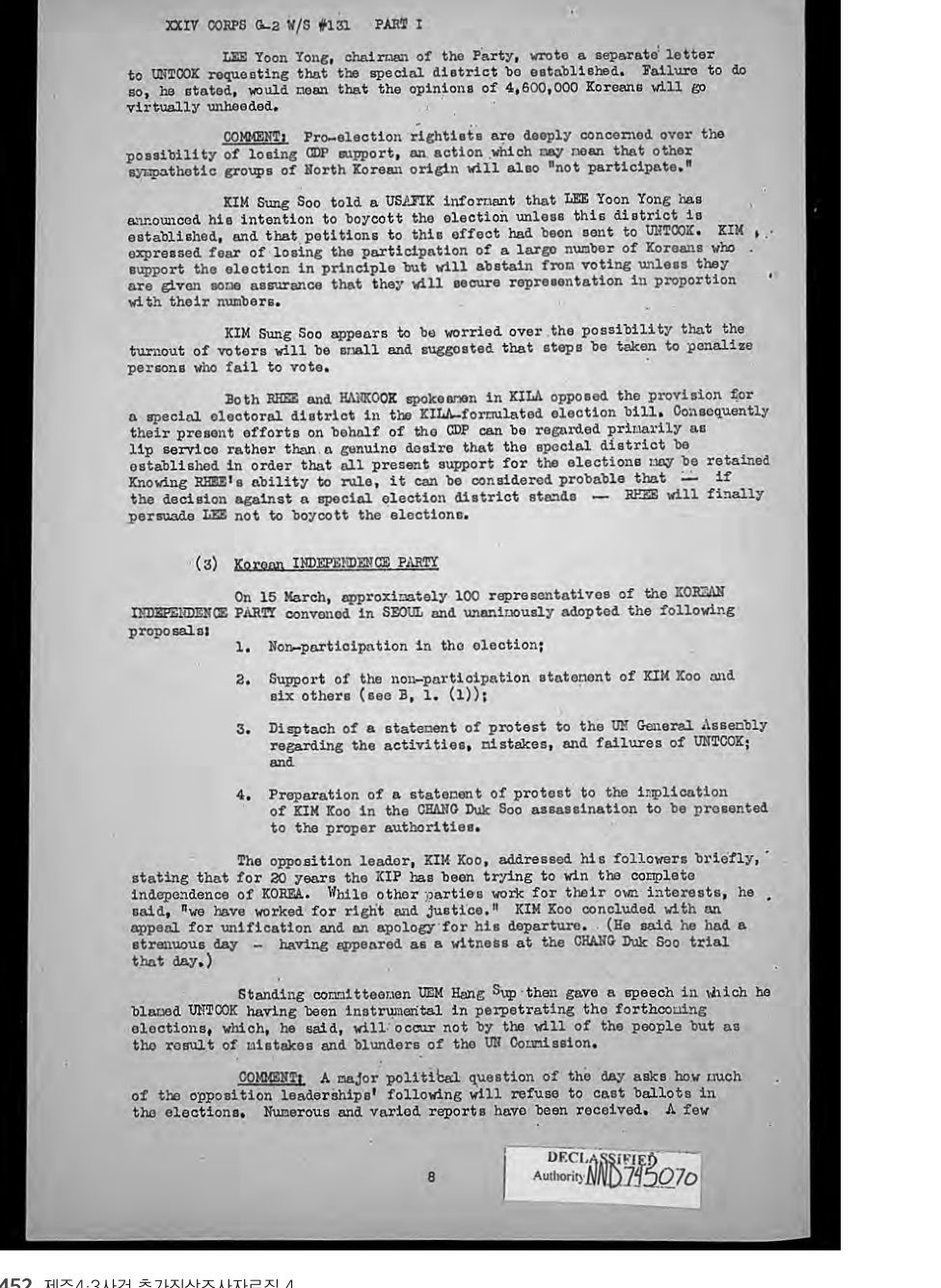
LEE Yoon Yong, chairman of the Party, wrote a separate letter to UNTCOK requesting that the special district be established. Failure to do so, he stated, would mean that the opinions of 4,600,000 Koreans will go virtually unheeded.
COMMENT: Pro-election rightists are deeply concerned over the possibility of losing CDP support, an action which may mean that other sympathetic groups of North Korean origin will also "not participate."
KIM Sung Soo told a USAFIK informant that LEE Yoon Yong has announced his intention to boycott the election unless this district is established, and that petitions to this effect had been sent to UNTCOK. KIM expressed fear of losing the participation of a large number of Koreans who support the election in principle but will abstain from voting unless they are given some assurance that they will secure representation in proportion with their numbers.
KIM Sung Soo appears to be worried over the possibility that the turnout of voters will be small and suggested that steps be taken to penalize persons who fail to vote.
Both RHEE and HANKOOK spokesmen in KILA opposed the provision for a special electoral district in the KILA-formulated election bill. Consequently their present efforts on behalf of the CDP can be regarded primarily as lip service rather than a genuine desire that the special district be established in order that all present support for the elections may be retained Knowing RHEE's ability to rule, it can be considered probable that — if the decision against a special election district stands — RHEE will finally persuade LEE not to boycott the elections.
(3) Korean INDEPENDENCE PARTY
On 15 March, approximately 100 representatives of the KOREAN INDEPENDENCE PARTY convened in SEOUL and unanimously adopted the following proposals:
1. Non-participation in the election;
2. Support of the non-participation statement of KIM Koo and six others (see B, 1. (1));
3. Dispatch of a statement of protest to the UN General Assembly regarding the activities, mistakes, and failures of UNTCOK; and
4. Preparation of a statement of protest to the implication of KIM Koo in the CHANG Duk Soo assassination to be presented to the proper authorities.
The opposition leader, KIM Koo, addressed his followers briefly, stating that for 20 years the KIP has been trying to win the complete independence of KOREA. While other parties work for their own interests, he said, "we have worked for right and justice." KIM Koo concluded with an appeal for unification and an apology for his departure. (He said he had a strenuous day — having appeared as a witness at the CHANG Duk Soo trial that day.)
Standing committeemen UEM Hang Sup then gave a speech in which he blamed UNTCOK having been instrumental in perpetrating the forthcoming elections, which, he said, will occur not by the will of the people but as the result of mistakes and blunders of the UN Commission.
COMMENT: A major political question of the day asks how much of the opposition leaderships' following will refuse to cast ballots in the elections. Numerous and varied reports have been received. A few
8
DECLASSIFIED
Authority NND 745070
XXIV CORPS G-2 W/S #131 PART I
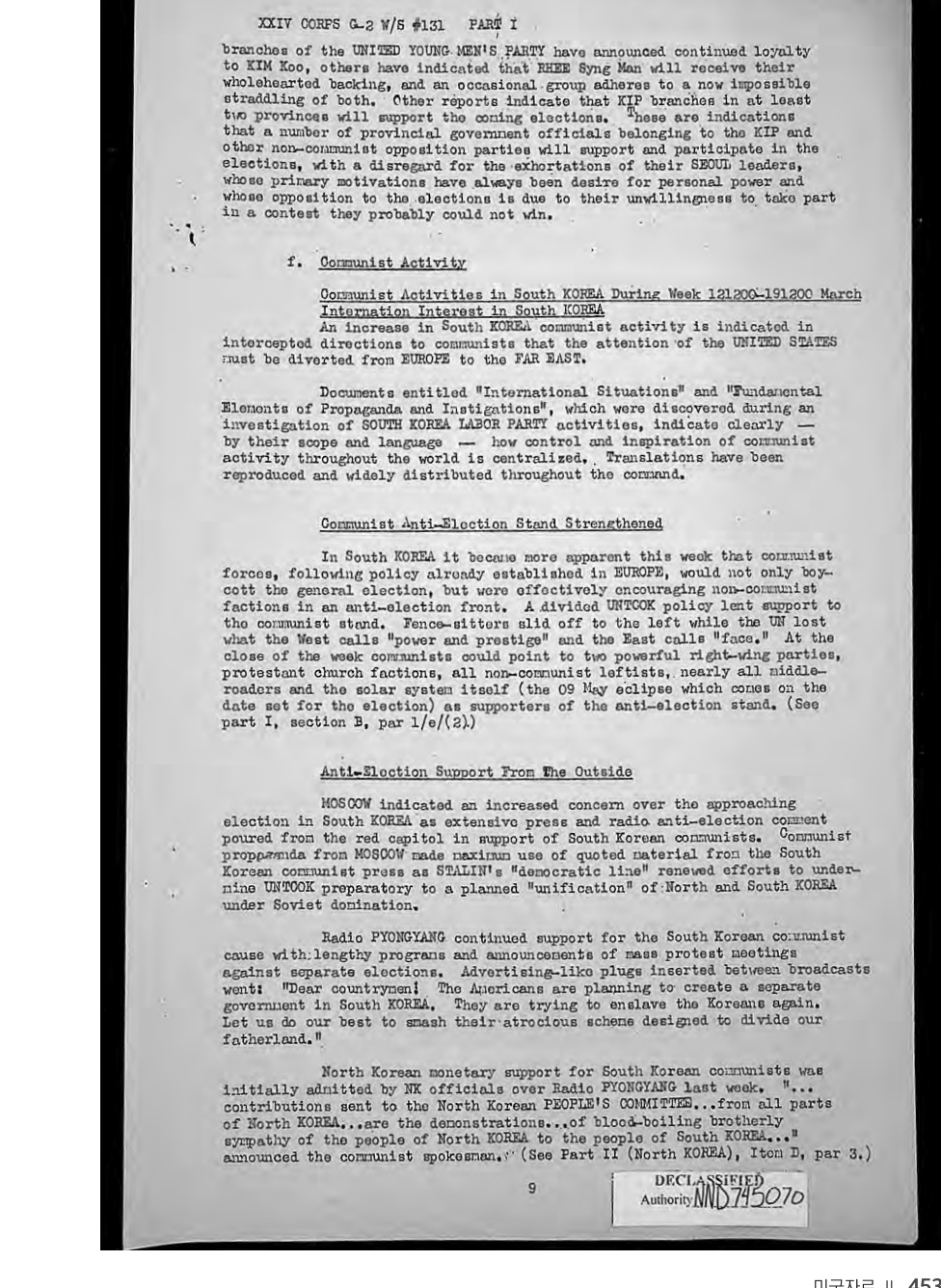
branches of the UNITED YOUNG MEN'S PARTY have announced continued loyalty to KIM Koo, others have indicated that RHEE Syng Man will receive their wholehearted backing, and an occasional group adheres to a now impossible straddling of both. Other reports indicate that KIP branches in at least two provinces will support the coming elections. These are indications that a number of provincial government officials belonging to the KIP and other non-communist opposition parties will support and participate in the elections, with a disregard for the exhortations of their SEOUL leaders, whose primary motivations have always been desire for personal power and whose opposition to the elections is due to their unwillingness to take part in a contest they probably could not win.
f. Communist Activity
Communist Activities in South KOREA During Week 121200-191200 March
Internation Interest in South KOREA
An increase in South KOREA communist activity is indicated in intercepted directions to communists that the attention of the UNITED STATES must be diverted from EUROPE to the FAR EAST.
Documents entitled "International Situations" and "Fundamental
Elements of Propaganda and Instigations", which were discovered during an investigation of SOUTH KOREA LABOR PARTY activities, indicate clearly — by their scope and language — how control and inspiration of communist activity throughout the world is centralized. Translations have been reproduced and widely distributed throughout the command.
Communist Anti-Election Stand Strengthened
In South KOREA it became more apparent this week that communist forces, following policy already established in EUROPE, would not only boycott the general election, but were effectively encouraging non-communist factions in an anti-election front. A divided UNTCOK policy lent support to the communist stand. Fence-sitters slid off to the left while the UN lost what the West calls "power and prestige" and the East calls "face." At the close of the week communists could point to two powerful right-wing parties, protestant church factions, all non-communist leftists, nearly all middleroaders and the solar system itself (the 09 May eclipse which comes on the date set for the election) as supporters of the anti-election stand. (See part I, section B, par 1/e/(2).)
Anti-Election Support From The Outside
MOSCOW indicated an increased concern over the approaching election in South KOREA as extensive press and radio anti-election comment poured from the red capitol in support of South Korean communists. Communist propaganda from MOSCOW made maximum use of quoted material from the South
Korean communist press as STALIN's "democratic line" renewed efforts to undermine UNTCOK preparatory to a planned "unification" of North and South KOREA under Soviet domination.
Radio PYONGYANG continued support for the South Korean communist cause with lengthy programs and announcements of mass protest meetings against separate elections. Advertising-like plugs inserted between broadcasts
went: "Dear countrymen! The Americans are planning to create a separate
government in South KOREA. They are trying to enslave the Koreans again.
Let us do our best to smash their atrocious scheme designed to divide our fatherland."
North Korean monetary support for South Korean communists was initially admitted by NK officials over Radio PYONGYANG last week. "...
contributions sent to the North Korean PEOPLE'S COMMITTEE...from all parts of North KOREA...are the demonstrations...of blood-boiling brotherly sympathy of the people of North KOREA to the people of South KOREA..."
announced the communist spokesman." (See Part II (North KOREA), Item D, par 3.)
9
DECLASSIFIED
Authority NND 745070
XXIV CORPS G/2 W/S #131 PART I
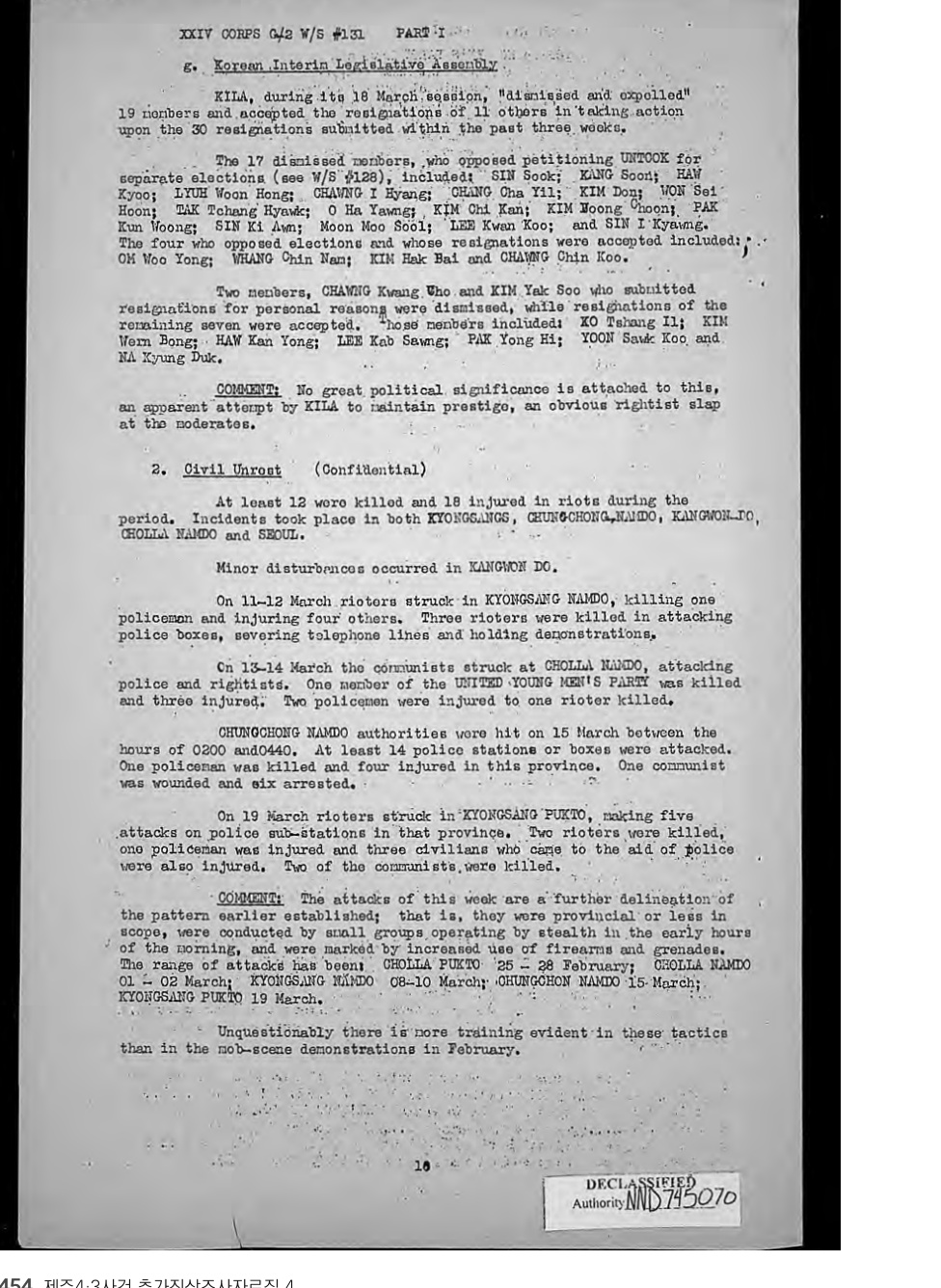
g. Korean Interim Legislative Assembly
KILA, during its 18 March session, "dismissed and expelled" 19 members and accepted the resignations of 11 others in taking action upon the 30 resignations submitted within the past three weeks.
The 17 dismissed members, who opposed petitioning UNTOOK for separate elections (see W/S #128), included: SIN Sook; KANG Soon; HAW Kyoo; LYUH Moon Hong; CHANG I Hyang; CHANG Cha Yil; KIM Don; WON Sei Hoon; TAK Tchang Hyawk; O Ha Yawng; KIM Chi Kan; KIM Noong Choon; PAK Kun Woong; SIN Ki Awn; Moon Moo Sool; LEE Kwan Koo; and SIN I Kyawng. The four who opposed elections and whose resignations were accepted included: OM Woo Yong; WHANG Chin Nam; KIM Hak Bai and CHANG Chin Koo.
Two members, CHAWNG Kwang Who and KIM Yak Soo who submitted resignations for personal reasons were dismissed, while resignations of the remaining seven were accepted. Those members included: KO Tshang Il; KIM Wern Bong; HAW Kan Yong; LEE Kab Sawng; PAK Yong Hi; YOON Sawk Koo and NA Kyung Duk.
COMMENT: No great political significance is attached to this, an apparent attempt by KILA to maintain prestige, an obvious rightist slap at the moderates.
2. Civil Unrest (Confidential)
At least 12 were killed and 18 injured in riots during the period. Incidents took place in both KYONGSANGS, CHUNGCHONG NAMDO, KANGWON DO, CHOLLA NAMDO and SEOUL.
Minor disturbances occurred in KANGWON DO.
On 11-12 March rioters struck in KYONGSANG NAMDO, killing one policeman and injuring four others. Three rioters were killed in attacking police boxes, severing telephone lines and holding demonstrations.
On 13-14 March the communists struck at CHOLLA NAMDO, attacking police and rightists. One member of the UNITED YOUNG MEN'S PARTY was killed and three injured. Two policemen were injured to one rioter killed.
CHUNGCHONG NAMDO authorities were hit on 15 March between the hours of 0200 and 0440. At least 14 police stations or boxes were attacked. One policeman was killed and four injured in this province. One communist was wounded and six arrested.
On 19 March rioters struck in KYONGSANG PUKTO, making five attacks on police sub-stations in that province. Two rioters were killed, one policeman was injured and three civilians who came to the aid of police were also injured. Two of the communists were killed.
COMMENT: The attacks of this week are a further delineation of the pattern earlier established; that is, they were provincial or less in scope, were conducted by small groups operating by stealth in the early hours of the morning, and were marked by increased use of firearms and grenades. The range of attacks has been: CHOLLA PUKTO 25 - 28 February; CHOLLA NAMDO 01 - 02 March; KYONGSANG NAMDO 08-10 March; CHUNGCHON NAMDO 15 March; KYONGSANG PUKTO 19 March.
Unquestionably there is more training evident in these tactics than in the mob-scene demonstrations in February.
10
DECLASSIFIED
Authority NND 745070
XXIV CORPS G-2 W/S #131 PART I
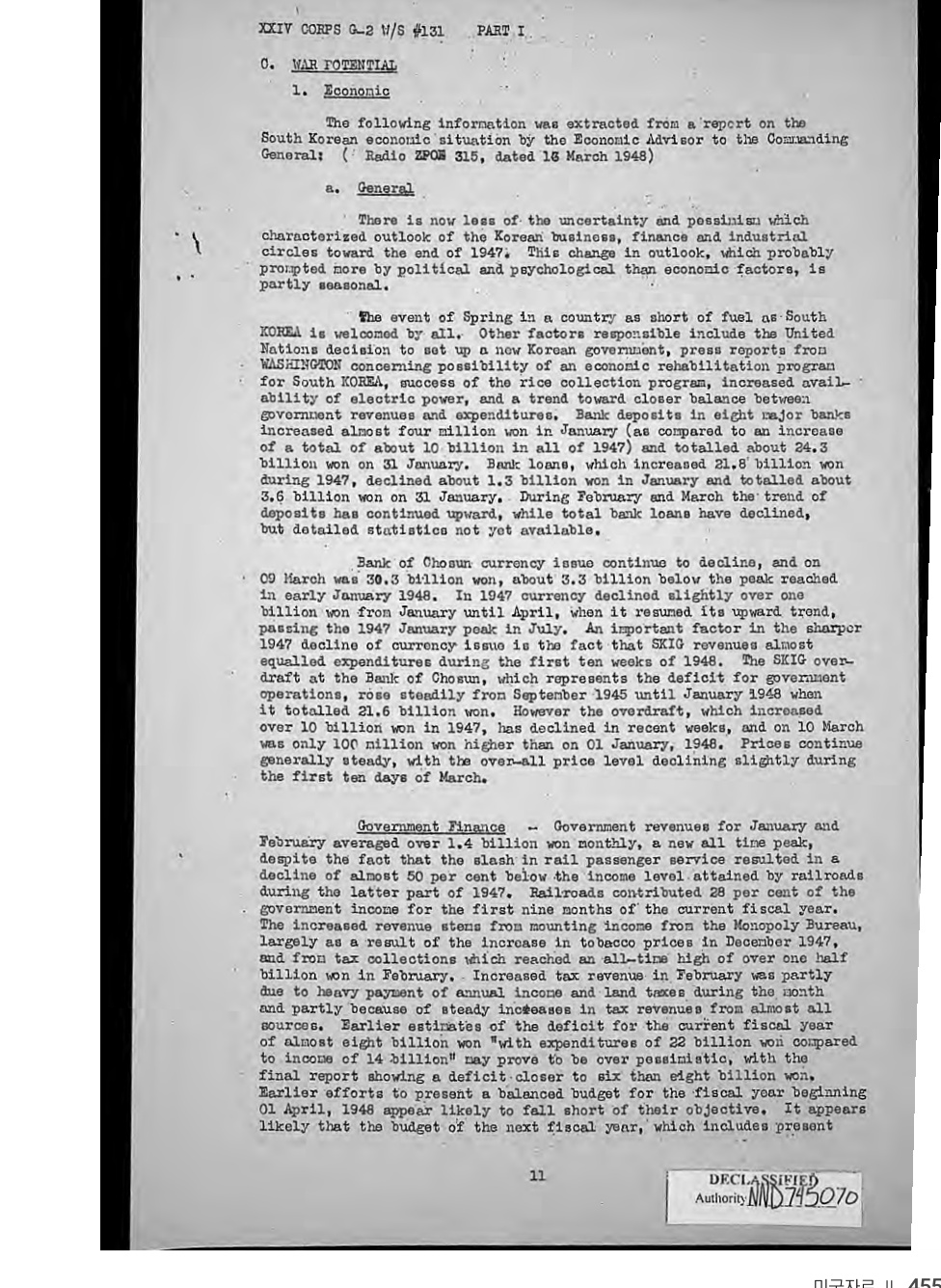
C. WAR POTENTIAL
1. Economic
The following information was extracted from a report on the
South Korean economic situation by the Economic Advisor to the Commanding
General: ( Radio ZFQE 315, dated 16 March 1948)
a. General
There is now less of the uncertainty and pessimism which
characterized outlook of the Korean business, finance and industrial circles toward the end of 1947. This change in outlook, which probably prompted more by political and psychological than economic factors, is partly seasonal.
The event of Spring in a country as short of fuel as South
KOREA is welcomed by all. Other factors responsible include the United
Nations decision to set up a new Korean government, press reports from
WASHINGTON concerning possibility of an economic rehabilitation program for South KOREA, success of the rice collection program, increased availability of electric power, and a trend toward closer balance between government revenues and expenditures. Bank deposits in eight major banks increased almost four million won in January (as compared to an increase of a total of about 10 billion in all of 1947) and totalled about 24.3 billion won on 31 January. Bank loans, which increased 21.8 billion won during 1947, declined about 1.3 billion won in January and totalled about
3.6 billion won on 31 January. During February and March the trend of deposits has continued upward, while total bank loans have declined, but detailed statistics not yet available.
Bank of Chosun currency issue continue to decline, and on
09 March was 30.3 billion won, about 3.3 billion below the peak reached in early January 1948. In 1947 currency declined slightly over one billion won from January until April, when it resumed its upward trend, passing the 1947 January peak in July. An important factor in the sharper
1947 decline of currency issue is the fact that SKIG revenues almost equalled expenditures during the first ten weeks of 1948. The SKIG overdraft at the Bank of Chosun, which represents the deficit for government operations, rose steadily from September 1945 until January 1948 when it totalled 21.6 billion won. However the overdraft, which increased over 10 billion won in 1947, has declined in recent weeks, and on 10 March was only 100 million won higher than on 01 January, 1948. Prices continue generally steady, with the over-all price level declining slightly during the first ten days of March.
Government Finance -- Government revenues for January and
February averaged over 1.4 billion won monthly, a new all time peak, despite the fact that the slash in rail passenger service resulted in a decline of almost 50 per cent below the income level attained by railroads during the latter part of 1947. Railroads contributed 28 per cent of the government income for the first nine months of the current fiscal year.
The increased revenue stems from mounting income from the Monopoly Bureau, largely as a result of the increase in tobacco prices in December 1947, and from tax collections which reached an all-time high of over one half billion won in February. Increased tax revenue in February was partly due to heavy payment of annual income and land taxes during the month and partly because of steady increases in tax revenues from almost all sources. Earlier estimates of the deficit for the current fiscal year of almost eight billion won "with expenditures of 22 billion won compared to income of 14 billion" may prove to be over pessimistic, with the final report showing a deficit closer to six than eight billion won.
Earlier efforts to present a balanced budget for the fiscal year beginning
01 April, 1948 appear likely to fall short of their objective. It appears likely that the budget of the next fiscal year, which includes present
11
DECLASSIFIED
Authority NND 745070
XXIV CORPS G-2 W/S #131 PART I
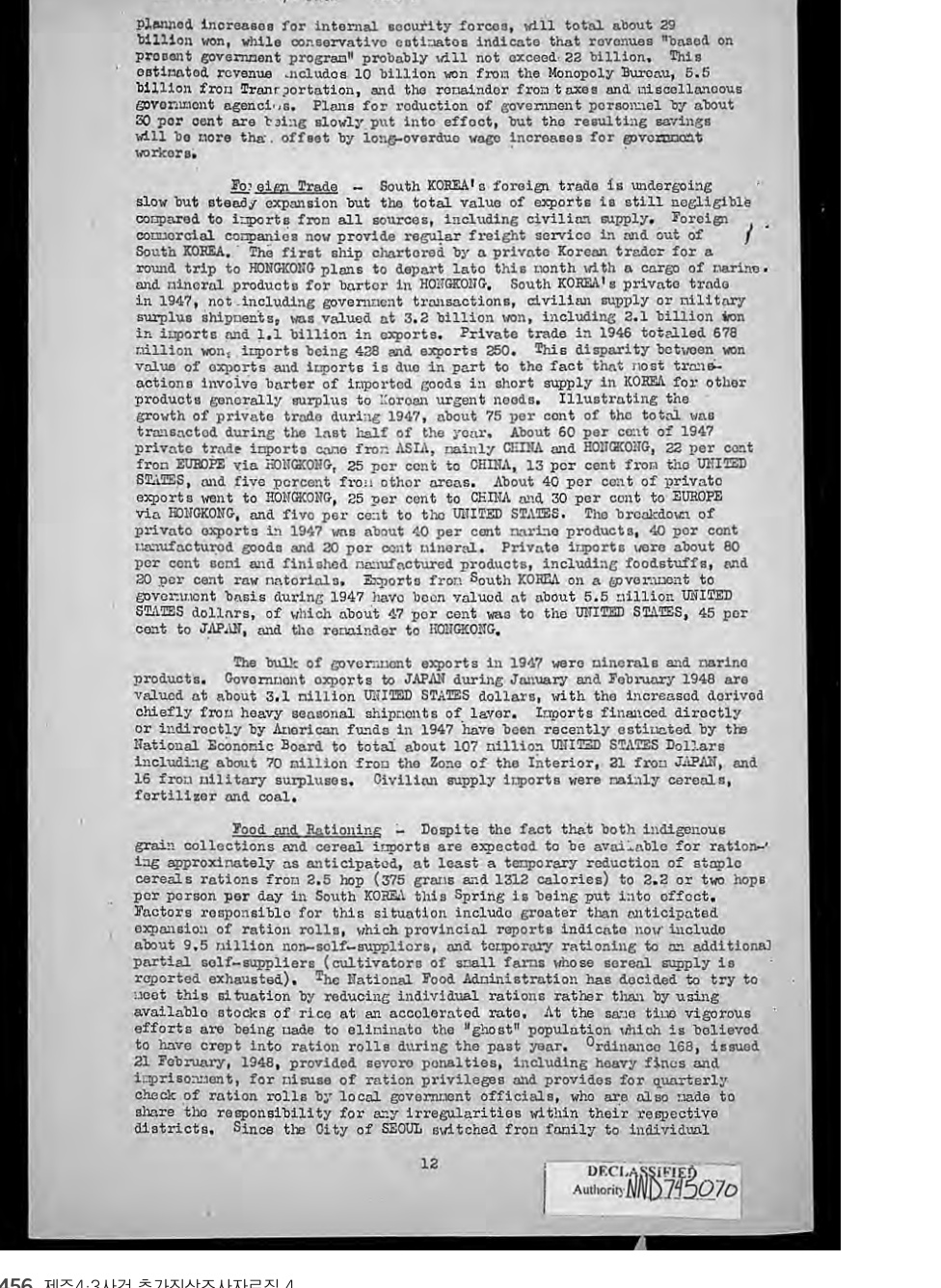
planned increases for internal security forces, will total about 29 billion won, while conservative estimates indicate that revenues "based on present government program" probably will not exceed 22 billion. This estimated revenue includes 10 billion won from the Monopoly Bureau, 5.5 billion from Transportation, and the remainder from taxes and miscellaneous government agencies. Plans for reduction of government personnel by about
30 per cent are being slowly put into effect, but the resulting savings will be more than offset by long-overdue wage increases for government workers.
Foreign Trade -- South KOREA's foreign trade is undergoing slow but steady expansion but the total value of exports is still negligible compared to imports from all sources, including civilian supply. Foreign commercial companies now provide regular freight service in and out of
South KOREA. The first ship chartered by a private Korean trader for a round trip to HONGKONG plans to depart late this month with a cargo of marine and mineral products for barter in HONGKONG. South KOREA's private trade in 1947, not including government transactions, civilian supply or military surplus shipments, was valued at 3.2 billion won, including 2.1 billion won in imports and 1.1 billion in exports. Private trade in 1946 totalled 678 million won, imports being 428 and exports 250. This disparity between won value of exports and imports is due in part to the fact that most transactions involve barter of imported goods in short supply in KOREA for other products generally surplus to Korean urgent needs. Illustrating the growth of private trade during 1947, about 75 per cent of the total was transacted during the last half of the year. About 60 per cent of 1947 private trade imports came from ASIA, mainly CHINA and HONGKONG, 22 per cent from EUROPE via HONGKONG, 25 per cent to CHINA, 13 per cent from the UNITED
STATES, and five percent from other areas. About 40 per cent of private exports went to HONGKONG, 25 per cent to CHINA and 30 per cent to EUROPE via HONGKONG, and five per cent to the UNITED STATES. The breakdown of private exports in 1947 was about 40 per cent marine products, 40 per cent manufactured goods and 20 per cent mineral. Private imports were about 80 per cent semi and finished manufactured products, including foodstuffs, and
20 per cent raw materials. Exports from South KOREA on a government to government basis during 1947 have been valued at about 5.5 million UNITED
STATES dollars, of which about 47 per cent was to the UNITED STATES, 45 per cent to JAPAN, and the remainder to HONGKONG.
The bulk of government exports in 1947 were minerals and marine products. Government exports to JAPAN during January and February 1948 are valued at about 3.1 million UNITED STATES dollars, with the increased derived chiefly from heavy seasonal shipments of layer. Imports financed directly or indirectly by American funds in 1947 have been recently estimated by the
National Economic Board to total about 107 million UNITED STATES Dollars including about 70 million from the Zone of the Interior, 21 from JAPAN, and
16 from military surpluses. Civilian supply imports were mainly cereals, fertilizer and coal.
Food and Rationing -- Despite the fact that both indigenous grain collections and cereal imports are expected to be available for rationing approximately as anticipated, at least a temporary reduction of staple cereals rations from 2.5 hop (375 grams and 1312 calories) to 2.2 or two hops per person per day in South KOREA this Spring is being put into effect.
Factors responsible for this situation include greater than anticipated expansion of ration rolls, which provincial reports indicate now include about 9.5 million non-self-suppliers, and temporary rationing to an additional partial self-suppliers (cultivators of small farms whose cereal supply is reported exhausted). The National Food Administration has decided to try to meet this situation by reducing individual rations rather than by using available stocks of rice at an accelerated rate. At the same time vigorous efforts are being made to eliminate the "ghost" population which is believed to have crept into ration rolls during the past year. Ordinance 168, issued
21 February, 1948, provided severe penalties, including heavy fines and imprisonment, for misuse of ration privileges and provides for quarterly check of ration rolls by local government officials, who are also made to share the responsibility for any irregularities within their respective districts. Since the City of SEOUL switched from family to individual
12
DECLASSIFIED
Authority NND 745070
XXIV CORPS G-2 W/S #131 PART I
ration cards in April 1947, the number of ration cards has increased from about 1,400,000 to over 1,700,000, which increase is believed to be substantially in excess of the actual population increase. Therefore, the
City of SEOUL is returning to the use of family ration books this month, and is requiring individual households to provide proof of existence of each member of the household listed upon their family cards. Rice and other cereals are available in limited quantities on the black market, but prices are high (Rice, 45 won per pound) and the reduction of the cereal ration will materially increase the cost of living of already hard pressed manuel and white collar workers and their families.
Industrial Production - The largest paper mill in South KOREA, the HOKUSEN Mill in KUNSAN, has been closed since April, 1947 because of a lack of sulphite pulp. However, several hundred tons of pulp was secured in various trade deals with North KOREA last Fall, and the management of the
KUNSAN mill was supplied necessary pulp and electric power in February, and told to produce paper for use in the coming elections. About 295 tons were produced in 22 days of operation in February and on four separate days the mill surpassed reported maximum daily production record of the same mill under Japanese management. Although this mill will probably be closed again within a few weeks because of the exhaustion of the pulp supply, this incident does illustrate how continued shortages of raw materials, power, and fuel severely hamper realization of South KOREA's industrial production potential.
b. Electric Power
The acute power shortage of the winter months has eased somewhat.
The Navy's electric power boat, JACONA, is now in operation in PUSAN; the
YOUNGWOL steam thermal plant is now operating at a post-war high of 20,000
KW; and the CHUNG PYUNG hydroelectric plant has lifted its output to
18,000 KW as a result of increased water availability. An additional
20,000 KW will become available by June, when a second generator at CHUNG
PYUNG resumes operation.
The chart presented herewith depicts the total power utilized in
South KOREA since January 1946.
c. Rice Prices
Unit: 1 mal (2.38 gals., polished rice)
Official Price 140 Won
PRICE (Won)
AREA Dec. Jan. Feb. 19 Mar.
SEOUL 750 743 746 700
KANGWON DO 632 791 850
CHUNGCHONG PUKTO 600 586 *
CHONGCHONG NAMDO 650 630 662
KYONGSANG PUKTO 534 541 550
KYONGSANG NAMDO 575 650 707
CHOLLA PUKTO 634 608 608
CHOLLA NAMDO 575 558 575
CHEJU DO 729 733 680
AVERAGE 631 648 676
Source - National Price Administration
13
DECLASSIFIED
Authority NND 745070
출처:
제주4·3평화재단 편,
『추가진상조사자료집-미국자료2』,
p. 447–457.
— NARA (RG 554, Entry 1256, Box 59)
×
![]()