유엔조선임시위원단
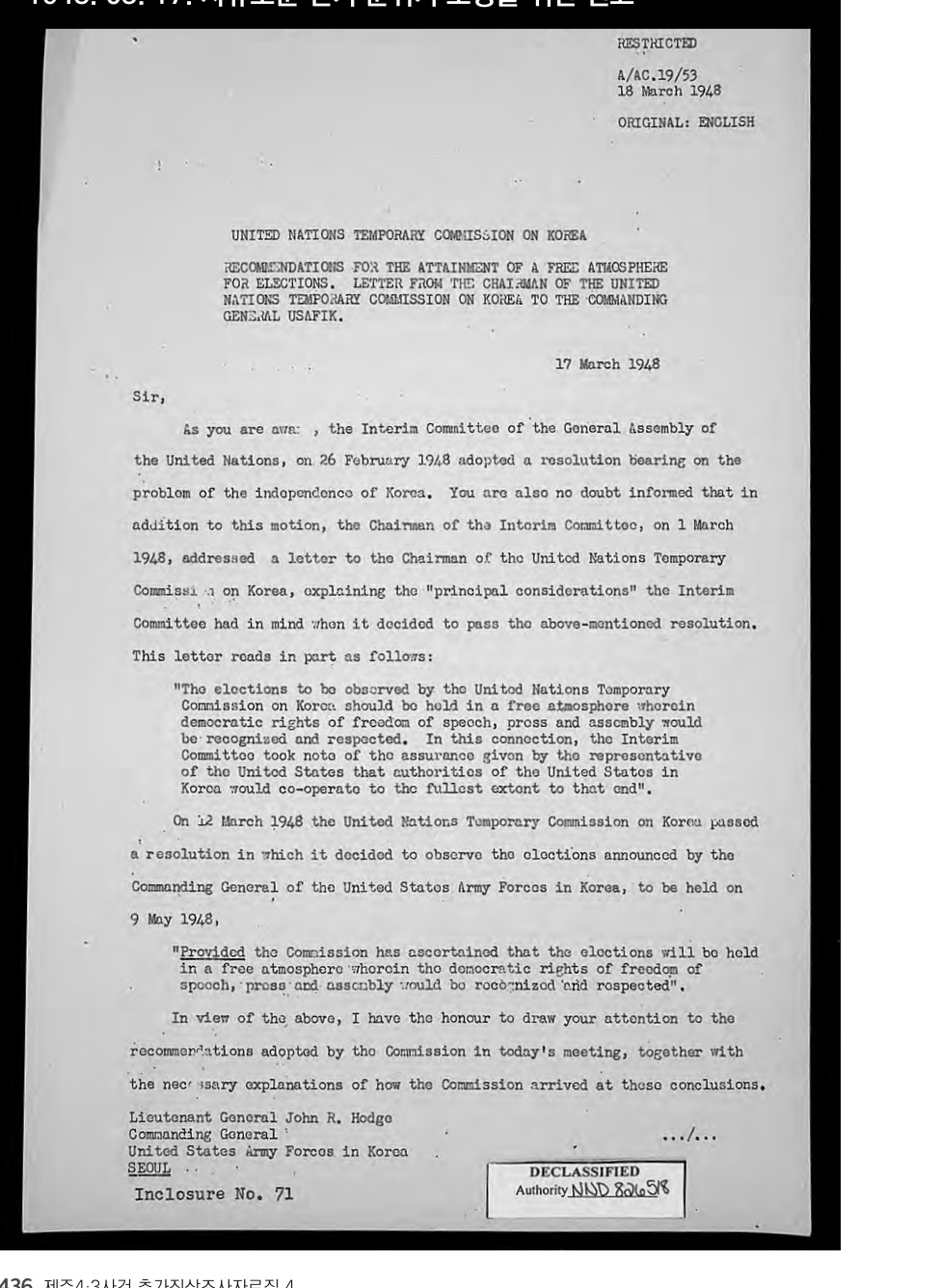
자유로운 선거 분위기 조성을 위한 권고.
유엔조선임시위원단 의장이 주한미육군 총사령관에게 보내는 서한 1948년 3월 17일 폴-봉쿠 씨께, 당신도 알다시피, 유엔 총회의 임시위원회가 1948년 2월 26일 조선의 독립 문제와 관련한 결의를 채택했습니다. 당신은 이와 더불어, 1948년 3월 1일 임시위원회 위원장이 위원회가 앞서 언급한 결의를 통과시키기로 결정할 때 염두에 두었던 "주요 고려사항"을 설명하는 편지를 유엔조선임시위원단 의장에게 보낸 사실을 분명히 알고 있을 것입니다. 다음은 그 편지 내용 중 일부분입니다.
"유엔조선임시위원단이 참관할 선거는 언론, 출판, 집회의 자유라는 민주적 권리가 인정되고 존중되는 곳에서 자유로운 분위기 속에서 개최되어야 한다. 이와 관련해, 임시위원단은 미국 대표로부터 그 목적을 위해 조선에 있는 미국 당국이 최대한 협조하겠다는 확약을 받았다."
1948년 3월 12일 유엔조선임시위원단은 주한미육군총사령관이 공표한 1948년 5월 9일 선거를 참관하기로 결의를 통과시켰습니다.
"선거가 언론, 출판, 집회의 자유라는 민주적 권리가 인정되고 존중되는 곳에서 자유로운 분위기 속에서 열린다는 전제하에"
위와 같은 관점에서, 나는 위원단이 오늘 회의에서 채택한 권고와 위원단이 어떻게 이런 결론에 이르게 됐는지에 대한 설명을 드리겠습니다.
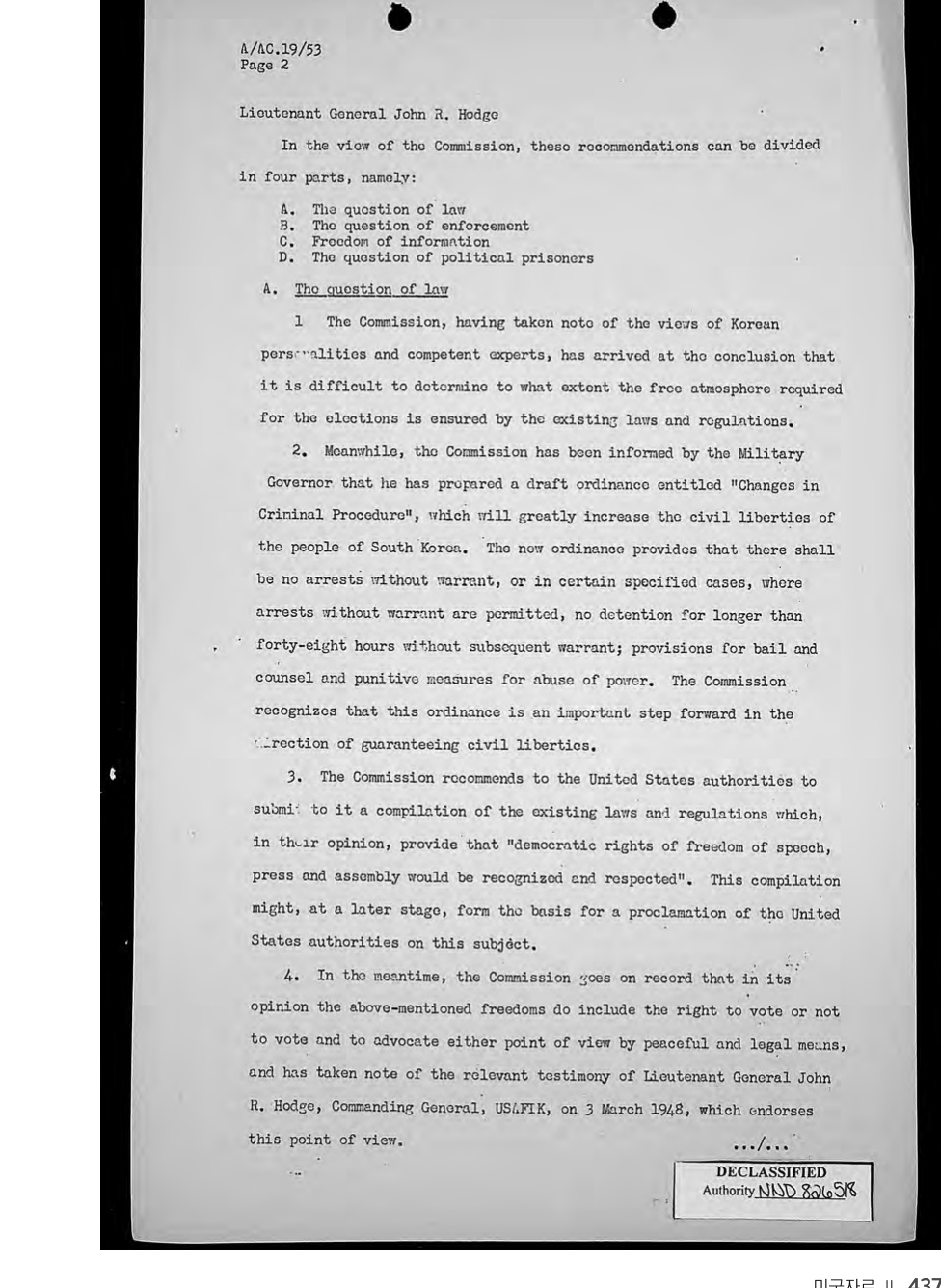
위원단의 관점에서, 이 권고안은 4개 부분으로 나뉠 수 있습니다.
A. 법률 문제
B. 집행 문제
C. 정보의 자유
D. 정치범 문제
A. 법률 문제
1. 위원단은, 조선의 특성과 유능한 전문가의 견해를 주목하면서, 기존의 법규로는 선거에 필요한 자유로운 분위기가 어느 정도까지 보장될지 판단하기 어렵다는 결론에 이르렀습니다.
2. 반면, 위원단은 군정장관으로부터 남조선 인민의 시민적 자유를 크게 증진할 "형사소송 절차의 개정"이라는 제목의 법령 초안을 준비하고 있다는 소식을 들었습니다. 새 법령은 영장 없는 체포는 허용되지 않으며, 영장 없이 체포할 수 있다고 명시된 경우에도 사후 영장이 없는 경우 48시간 이상 구금할 수 없다는 내용과, 보석과 변호 그리고 권력 남용에 대한 징벌적 조치에 관한 규정을 담고 있습니다. 위원단은 이 법령이 시민의 자유를 보장하는 중요한 진전이라고 인식하고 있습니다.
3. 위원단은 미국 당국에 "언론, 출판, 집회의 자유라는 민주적 권리가 인정되고 존중된다"고 규정한 법령집을 제출하라고 권고했습니다. 이 법령집은 추후 이 문제에 대한 미국 당국 포고문의 기초가 될 것입니다.
4. 위원단은 위에서 언급한 자유에, 투표를 하거나 하지 않을 권리, 또 평화적이고 합법적인 방법으로 어느 한쪽의 견해를 지지할 수 있는 권리가 분명하게 포함된다는 것을 기록으로 남길 것이며, 이런 견해를 지지한 주한미육군총사령관 하지 중장의 1948년 3월 2일 발언에 주목하고 있습니다.
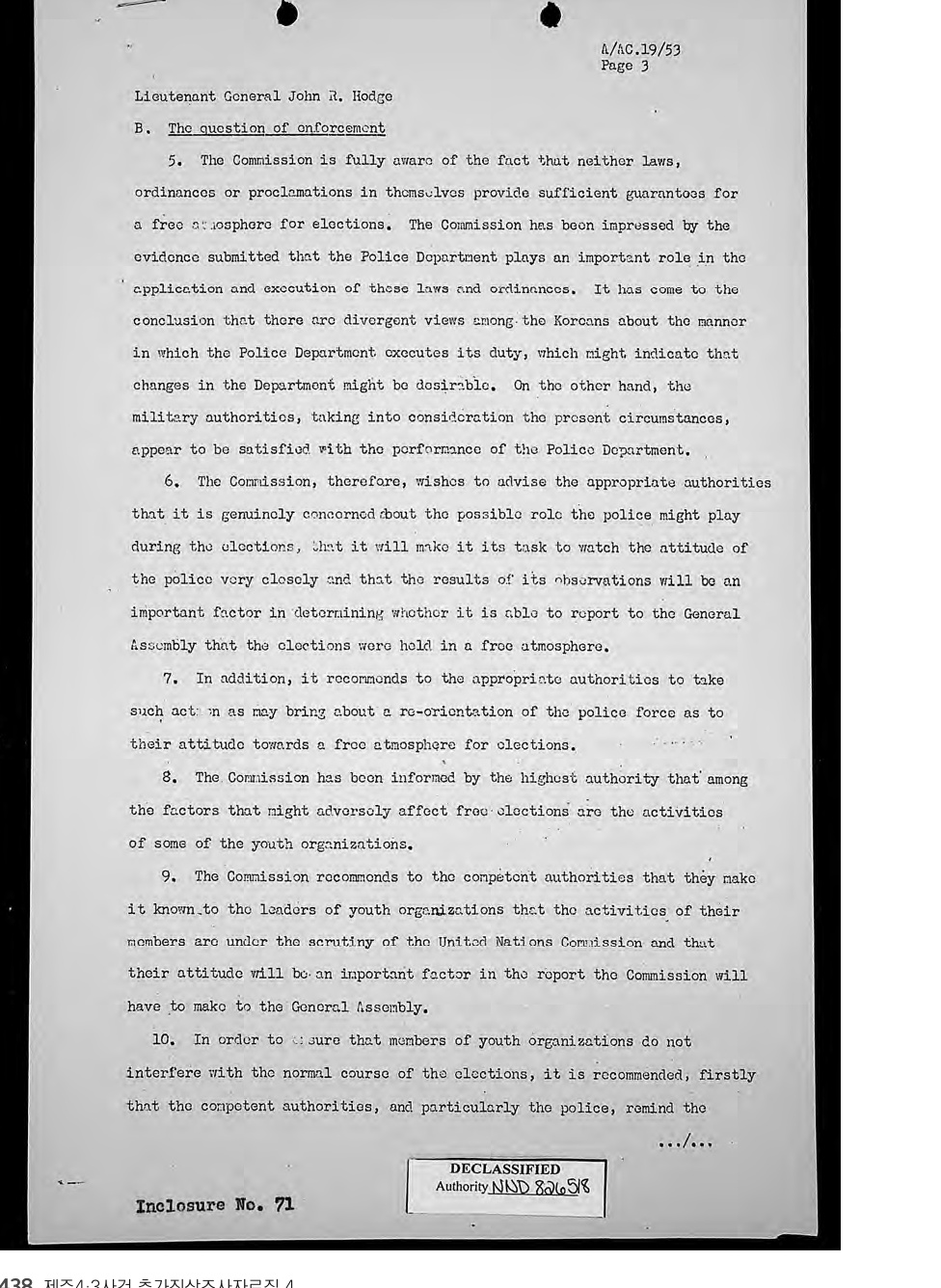
B. 집행 문제
5. 위원단은 법률, 법령, 혹은 포고가 자유로운 선거 분위기를 충분히 보장하지 않는다는 사실을 잘 알고 있습니다. 위원단은 이런 법률과 법령을 적용하고 집행하는 데 있어 경무부가 중요한 역할을 하고 있다는 증거에 강한 인상을 받았습니다. 조선인 사이에 경무부의 업무수행 방법에 대해 다양한 견해가 있고, 이는 경무부에 변화가 필요하다는 걸 의미할 수 있다는 결론에 이르렀습니다. 반면에 군 당국은 현 상황을 고려하면서, 경무부의 업무수행에 만족감을 나타내고 있습니다.
6. 위원단은 선거기간 동안 경찰이 할 역할에 대해 진심으로 우려하고 있습니다. 따라서 경찰의 태도를 주의 깊게 관찰하는 것이 위원단의 과업이 될 것이며, 그 관찰 결과가 자유로운 분위기 속에서 선거가 치러졌다고 총회에 보고할 지 여부를 결정하는데 중요한 요소가 될 것이라는 점을 관계기관에 조언하고 싶습니다.
7. 또 위원단은 자유로운 선거 분위기에 대한 경찰의 태도와 관련해, 경찰에 방향전환을 가져올 그런 조치를 할 것을 관할 당국에 권고합니다.
8. 위원단은 자유로운 선거에 악영향을 미칠 요인 중 하나가 일부 청년단체의 활동이라는 것을 최고 당국으로부터 들었습니다.
9. 위원단은 청년단체 구성원들의 행동이 위원단의 철저한 감시를 받게 될 것이며, 그들의 활동은 총회에 제출할 위원단 보고서에서 중요한 요소가 될 것이라는 점을 청년단체 지도자들에게 알릴 것을 관할 당국에 권고합니다.
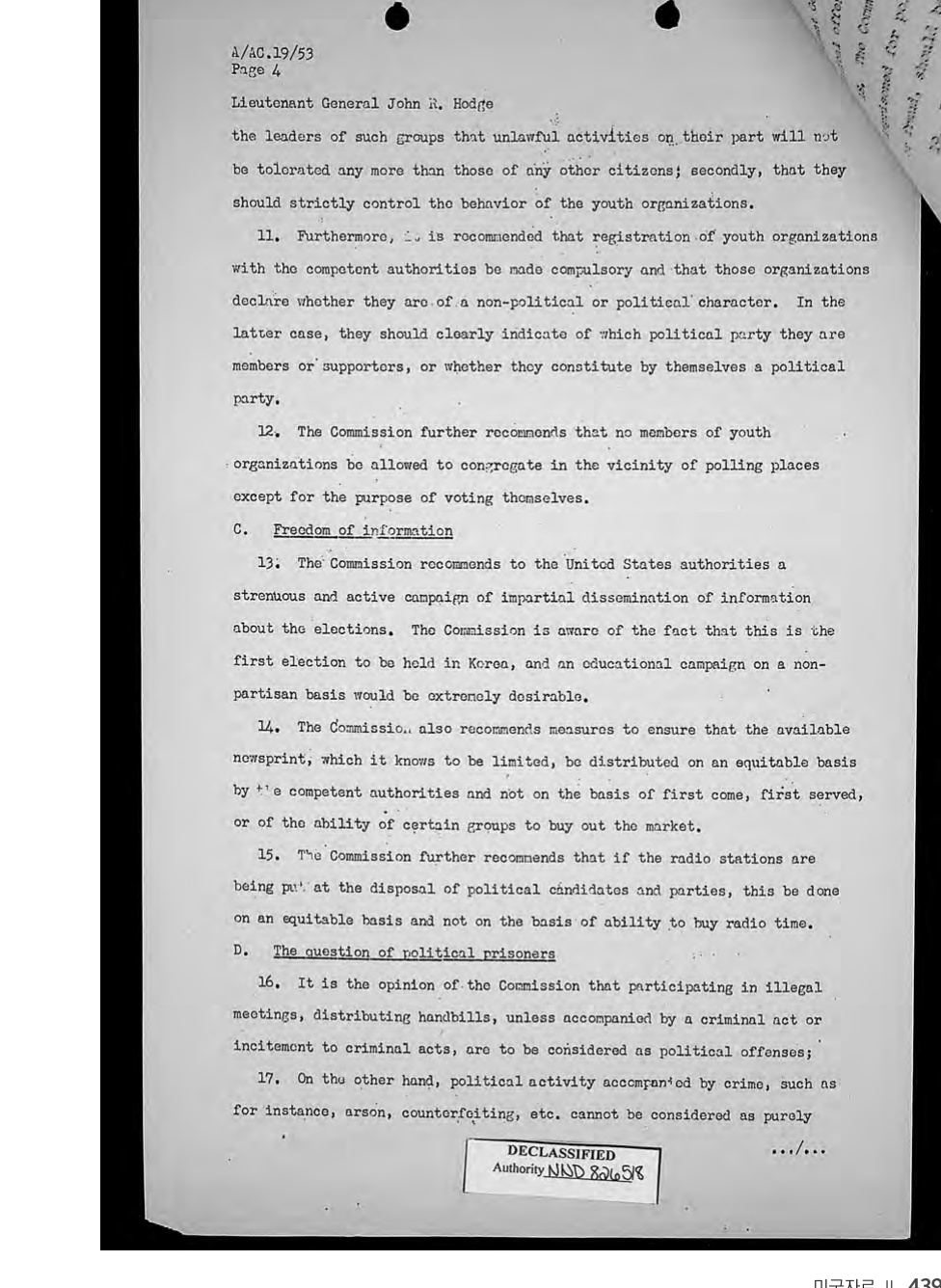
10. 청년단체 구성원들이 선거 과정에 간섭하지 못하게 첫째, 관할 당국, 특히 경찰은 그런 단체의 지도자들에게 그들의 불법 행위는 어떤 다른 시민들의 불법 행위보다 더 용납되지 않을 것이며 둘째, 단체의 활동을 엄격하게 통제해야 한다는 점을 상기시켜 줄 것을 권고합니다.
11. 청년단체들은 관할 당국에 의무적으로 등록을 해야 하며, 정치적 단체인지 아닌지를 분명히 밝힐 것을 권고합니다. 정치적 단체인 경우, 어느 정당의 구성원 혹은 지지자인지, 그들 스스로 정당을 설립했는지 여부를 명확하게 밝혀야 합니다.
12. 위원단은 청년단체 구성원들이 자신이 투표를 하는 경우를 제외하고는 투표소 인근에 집결하지 말 것을 권고합니다.
C. 정보의 자유
13. 위원단은 미국 당국에 선거 정보가 공평하게 배포되도록 강력하고 적극적인 캠페인을 펼칠 것을 권고합니다. 위원단은 이번 선거가 조선에서는 처음이다보니 비당파적인 기반에서 실시되는 교육 캠페인이 매우 바람직하다는 사실을 알고 있습니다.
14. 위원단은 신문용지가, 한계가 있겠지만, 선착순이나 특정 집단의 매수 능력에 의해서가 아니라 관할 당국에 의해 공평하게 배분될 수 있도록 조치할 것을 권고합니다.
15. 위원단은 라디오방송국을 후보자들과 정당들이 이용할 수 있어야 하며, 방송시간대를 살 수 있는 능력이 아닌 공평한 기반에서 이뤄져야 한다고 권고합니다.
D. 정치범 문제
16. 불법 집회, 삐라 살포가 범죄행위를 동반하거나 이를 조장하지 않는다면, 정치적 범죄로 고려되어야 한다는 것이 위원단의 생각입니다.
17. 반면에 방화, 화폐위조 등과 같은 범죄와 동반된 정치적 행위는 순수한 정치적 범죄로 고려될 수 없습니다.
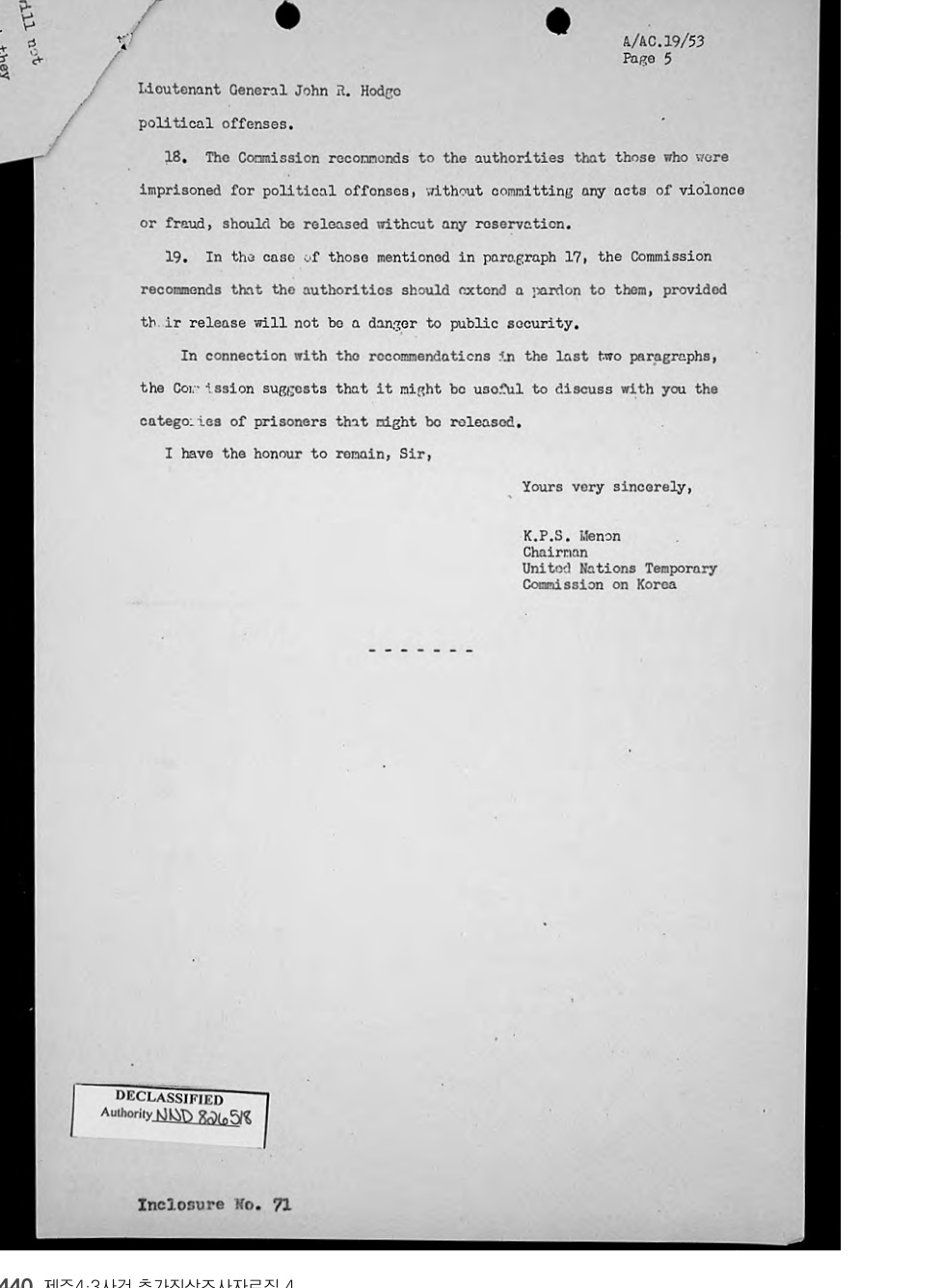
18. 위원단은 정치적 범죄로 수감된 사람들은 폭력, 사기 등을 저지르지 않았다면 즉각 석방할 것을 권고합니다.
19. 위 17항에서 언급된 사안의 경우, 공공의 안전에 위험이 되지 않는다는 전제하에 위원단은 당국이 그들에게 사면을 베풀 것을 권고합니다.
마지막 2개의 권고사항과 관련해, 위원단은 석방할 범죄자들의 범주에 대해 당신들과 논의하는 것이 유용할 수 있어 이를 제안합니다.
K.P.S.메논(K.P.S. Menon)
유엔조선임시위원회 의장
RESTRICTED
A/AC.19/53
18 March 1948
ORIGINAL: ENGLISH
UNITED NATIONS TEMPORARY COMMISSION ON KOREA
RECOMMENDATIONS FOR THE ATTAINMENT OF A FREE ATMOSPHERE
FOR ELECTIONS. LETTER FROM THE CHAIRMAN OF THE UNITED
NATIONS TEMPORARY COMMISSION ON KOREA TO THE COMMANDING
GENERAL USAFIK.
17 March 1948
Sir,
As you are awa: , the Interim Committee of the General Assembly of the United Nations, on 26 February 1948 adopted a resolution bearing on the problem of the independence of Korea. You are also no doubt informed that in addition to this motion, the Chairman of the Interim Committee, on 1 March
1948, addressed a letter to the Chairman of the United Nations Temporary
Commissi n on Korea, explaining the "principal considerations" the Interim
Committee had in mind when it decided to pass the above-mentioned resolution.
This letter reads in part as follows:
"The elections to be observed by the United Nations Temporary
Commission on Korea should be held in a free atmosphere wherein democratic rights of freedom of speech, press and assembly would be recognized and respected. In this connection, the Interim
Committee took note of the assurance given by the representative of the United States that authorities of the United States in
Korea would co-operate to the fullest extent to that end".
On 12 March 1948 the United Nations Temporary Commission on Korea passed a resolution in which it decided to observe the elections announced by the
Commanding General of the United States Army Forces in Korea, to be held on
9 May 1948,
"Provided the Commission has ascertained that the elections will be held in a free atmosphere wherein the democratic rights of freedom of speech, press and assembly would be recognized and respected".
In view of the above, I have the honour to draw your attention to the recommendations adopted by the Commission in today's meeting, together with the nec ssary explanations of how the Commission arrived at these conclusions.
Lieutenant General John R. Hodge
Commanding General
United States Army Forces in Korea
SEOUL
Inclosure No. 71 DECLASSIFIED
Authority NND 82[illegible]98
.../...
A/AC.19/53
Page 2
Lieutenant General John R. Hodge
In the view of the Commission, these recommendations can be divided in four parts, namely:
A. The question of law
B. The question of enforcement
C. Freedom of information
D. The question of political prisoners
A. The question of law
1 The Commission, having taken note of the views of Korean personalities and competent experts, has arrived at the conclusion that it is difficult to determine to what extent the free atmosphere required for the elections is ensured by the existing laws and regulations.
2. Meanwhile, the Commission has been informed by the Military
Governor that he has prepared a draft ordinance entitled "Changes in
Criminal Procedure", which will greatly increase the civil liberties of the people of South Korea. The new ordinance provides that there shall be no arrests without warrant, or in certain specified cases, where arrests without warrant are permitted, no detention for longer than forty-eight hours without subsequent warrant; provisions for bail and counsel and punitive measures for abuse of power. The Commission recognizes that this ordinance is an important step forward in the direction of guaranteeing civil liberties.
3. The Commission recommends to the United States authorities to submit to it a compilation of the existing laws and regulations which, in their opinion, provide that "democratic rights of freedom of speech, press and assembly would be recognized and respected". This compilation might, at a later stage, form the basis for a proclamation of the United
States authorities on this subject.
4. In the meantime, the Commission goes on record that in its opinion the above-mentioned freedoms do include the right to vote or not to vote and to advocate either point of view by peaceful and legal means, and has taken note of the relevant testimony of Lieutenant General John
R. Hodge, Commanding General, USAFIK, on 3 March 1948, which endorses this point of view.
.../...
DECLASSIFIED
Authority NND 826658
A/AC.19/53
Page 3
Lieutenant General John R. Hodge
B. The question of enforcement
5. The Commission is fully aware of the fact that neither laws, ordinances or proclamations in themselves provide sufficient guarantees for a free atmosphere for elections. The Commission has been impressed by the evidence submitted that the Police Department plays an important role in the application and execution of these laws and ordinances. It has come to the conclusion that there are divergent views among the Koreans about the manner in which the Police Department executes its duty, which might indicate that changes in the Department might be desirable. On the other hand, the military authorities, taking into consideration the present circumstances, appear to be satisfied with the performance of the Police Department.
6. The Commission, therefore, wishes to advise the appropriate authorities that it is genuinely concerned about the possible role the police might play during the elections, that it will make it its task to watch the attitude of the police very closely and that the results of its observations will be an important factor in determining whether it is able to report to the General
Assembly that the elections were held in a free atmosphere.
7. In addition, it recommends to the appropriate authorities to take such action as may bring about a re-orientation of the police force as to their attitude towards a free atmosphere for elections.
8. The Commission has been informed by the highest authority that among the factors that might adversely affect free elections are the activities of some of the youth organizations.
9. The Commission recommends to the competent authorities that they make it known to the leaders of youth organizations that the activities of their members are under the scrutiny of the United Nations Commission and that their attitude will be an important factor in the report the Commission will have to make to the General Assembly.
10. In order to ensure that members of youth organizations do not interfere with the normal course of the elections, it is recommended, firstly that the competent authorities, and particularly the police, remind the
.../...
DECLASSIFIED
Authority NND 83[illegible]518
Inclosure No. 71
A/AC.19/53
Page 4
Lieutenant General John R. Hodge
the leaders of such groups that unlawful activities on their part will not be tolerated any more than those of any other citizens; secondly, that they should strictly control the behavior of the youth organizations.
11. Furthermore, it is recommended that registration of youth organizations with the competent authorities be made compulsory and that those organizations declare whether they are of a non-political or political character. In the latter case, they should clearly indicate of which political party they are members or supporters, or whether they constitute by themselves a political party.
12. The Commission further recommends that no members of youth organizations be allowed to congregate in the vicinity of polling places except for the purpose of voting themselves.
C. Freedom of information
13. The Commission recommends to the United States authorities a strenuous and active campaign of impartial dissemination of information about the elections. The Commission is aware of the fact that this is the first election to be held in Korea, and an educational campaign on a nonpartisan basis would be extremely desirable.
14. The Commission also recommends measures to ensure that the available newsprint, which it knows to be limited, be distributed on an equitable basis by the competent authorities and not on the basis of first come, first served, or of the ability of certain groups to buy out the market.
15. The Commission further recommends that if the radio stations are being put at the disposal of political candidates and parties, this be done on an equitable basis and not on the basis of ability to buy radio time.
D. The question of political prisoners
16. It is the opinion of the Commission that participating in illegal meetings, distributing handbills, unless accompanied by a criminal act or incitement to criminal acts, are to be considered as political offenses;
17. On the other hand, political activity accompanied by crime, such as for instance, arson, counterfeiting, etc. cannot be considered as purely
DECLASSIFIED
Authority NND 832658
.../...
A/AC.19/53
Page 5
Lieutenant General John R. Hodge political offenses.
18. The Commission recommends to the authorities that those who were imprisoned for political offenses, without committing any acts of violence or fraud, should be released without any reservation.
19. In the case of those mentioned in paragraph 17, the Commission recommends that the authorities should extend a pardon to them, provided their release will not be a danger to public security.
In connection with the recommendations in the last two paragraphs, the Commission suggests that it might be useful to discuss with you the categories of prisoners that might be released.
I have the honour to remain, Sir,
Yours very sincerely,
K.P.S. Menon
Chairman
United Nations Temporary
Commission on Korea
- - - - - - -
DECLASSIFIED
Authority NND 836518
Inclosure No. 71
출처:
제주4·3평화재단 편,
『추가진상조사자료집-미국자료2』,
p. 436–440.
— NARA (RG 554, Entry 1400, Box 298)
×
![]()