스캔 원본
100%
p.34
p.35
p.36
p.37
p.38
p.39
p.40
p.41
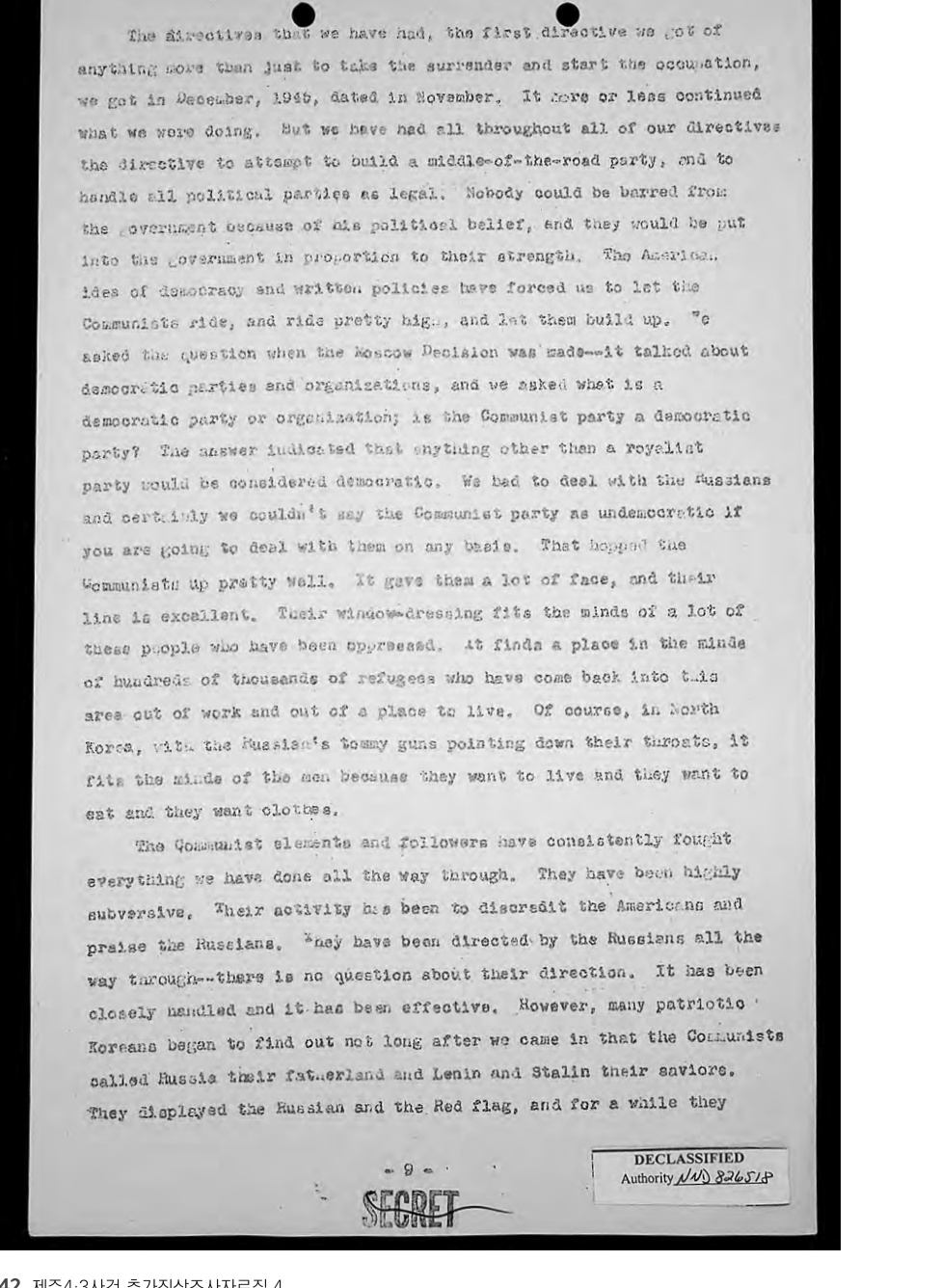
p.42
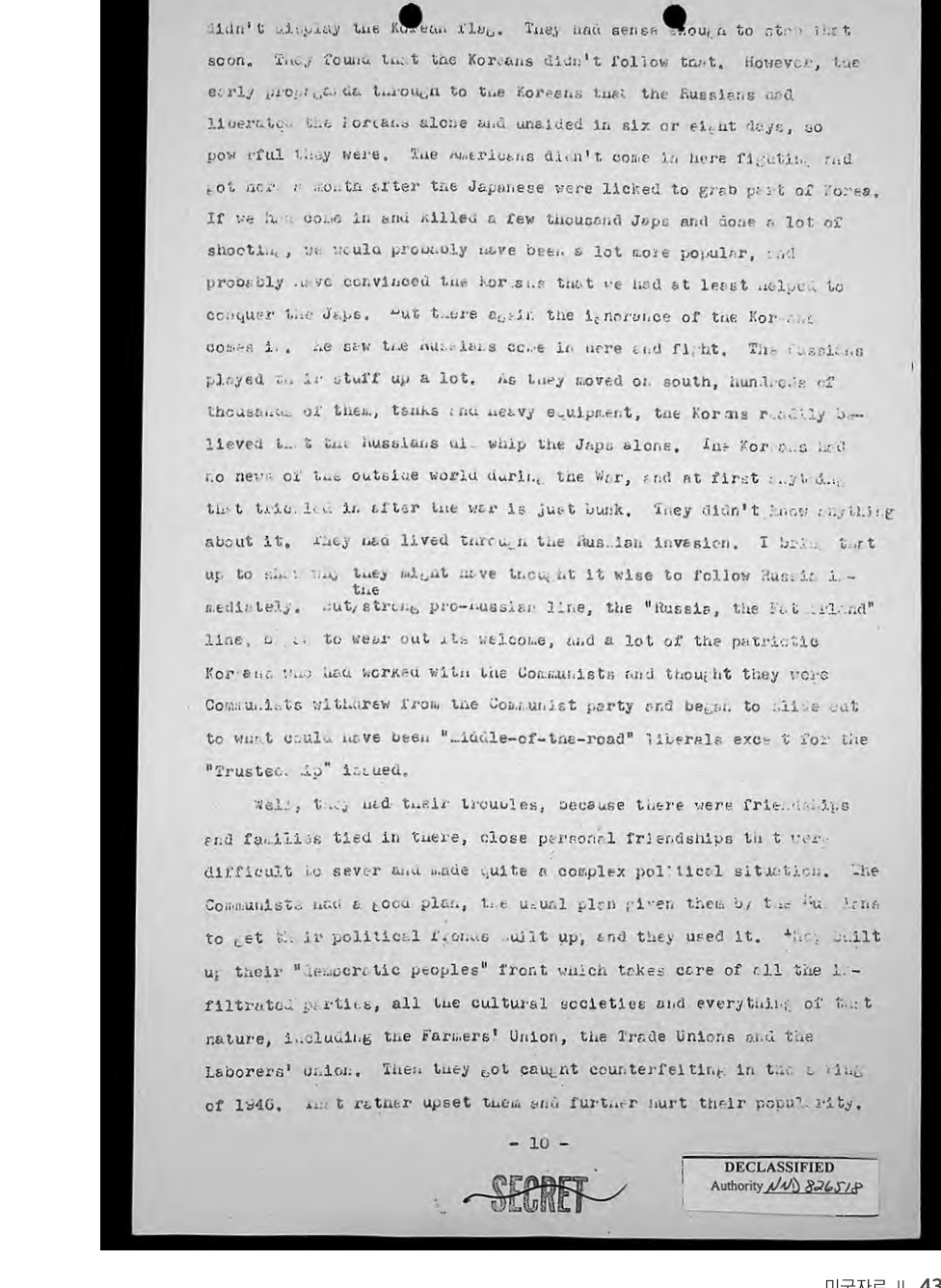
p.43
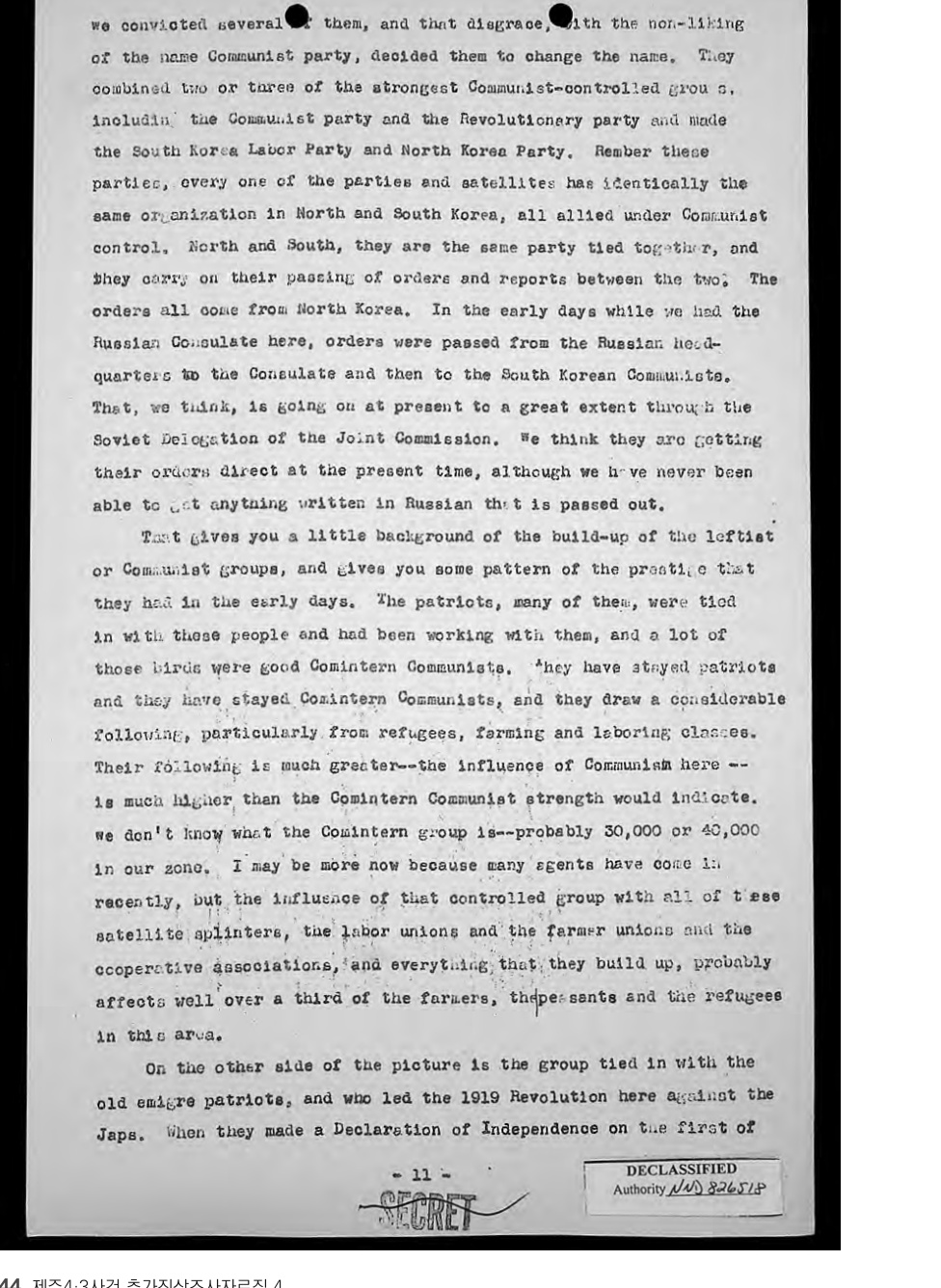
p.44
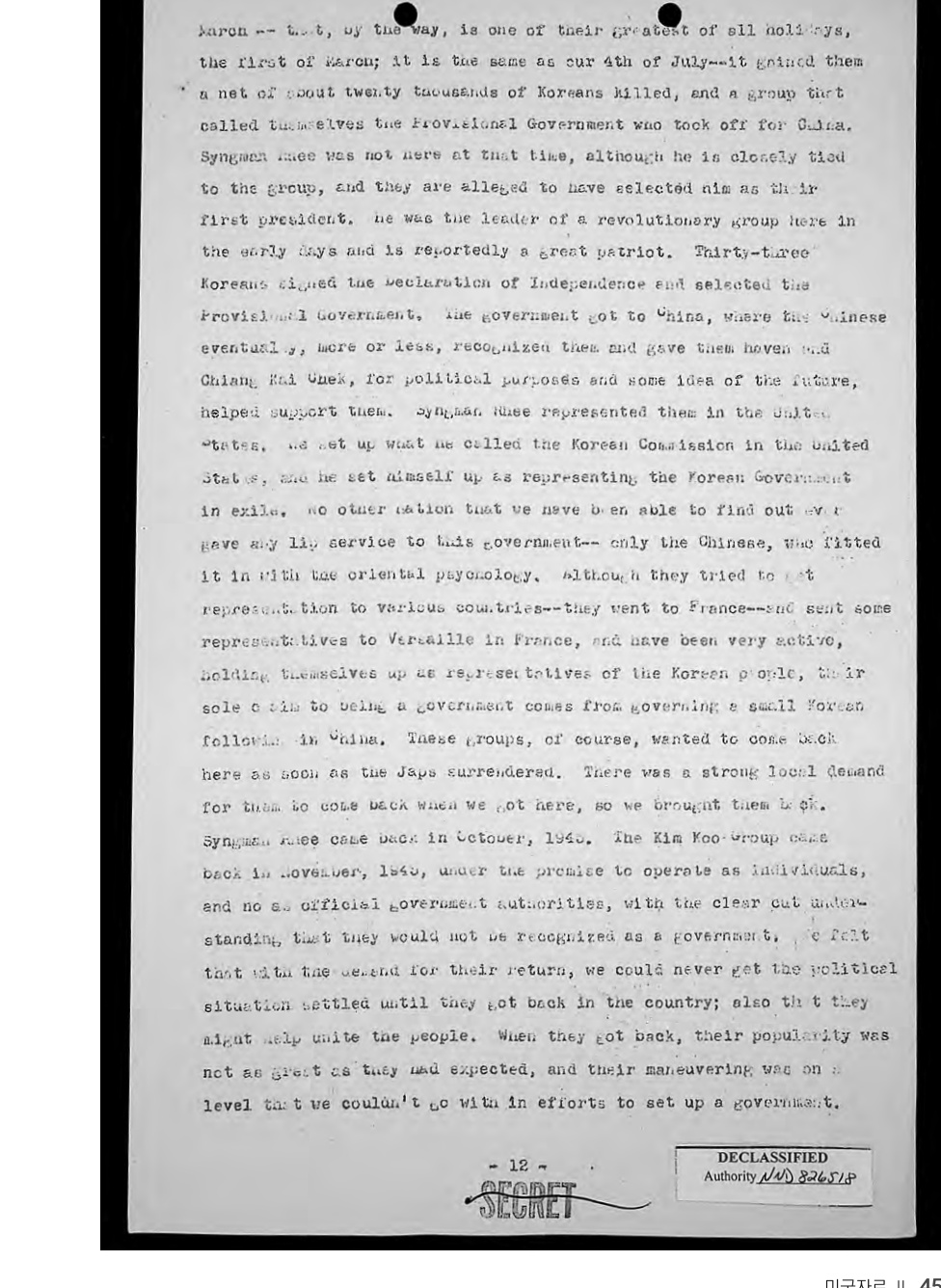
p.45
p.46
p.47
p.48
p.49
p.50
p.51
p.52
p.53
p.54
p.55
p.56
p.57
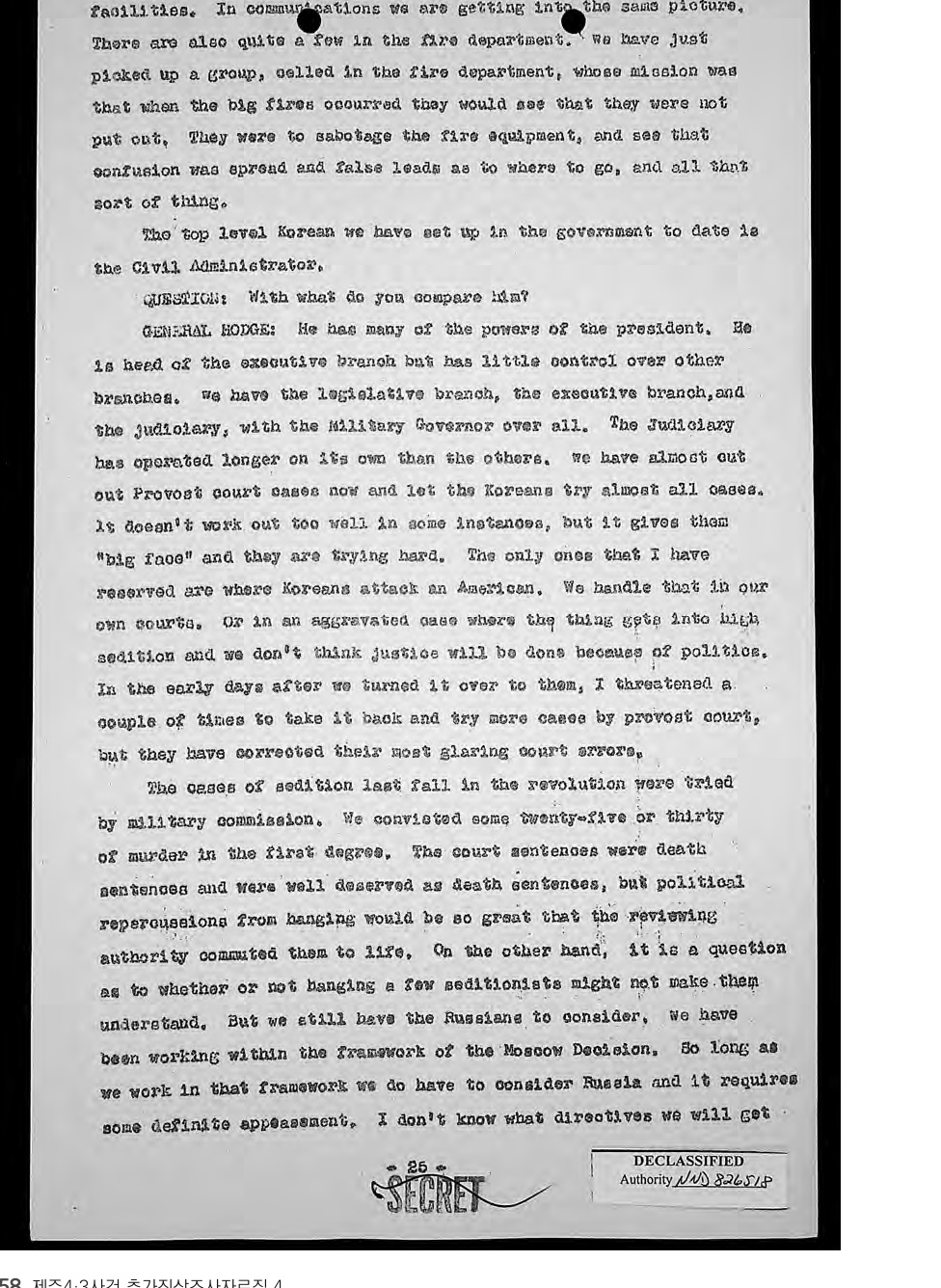
p.58
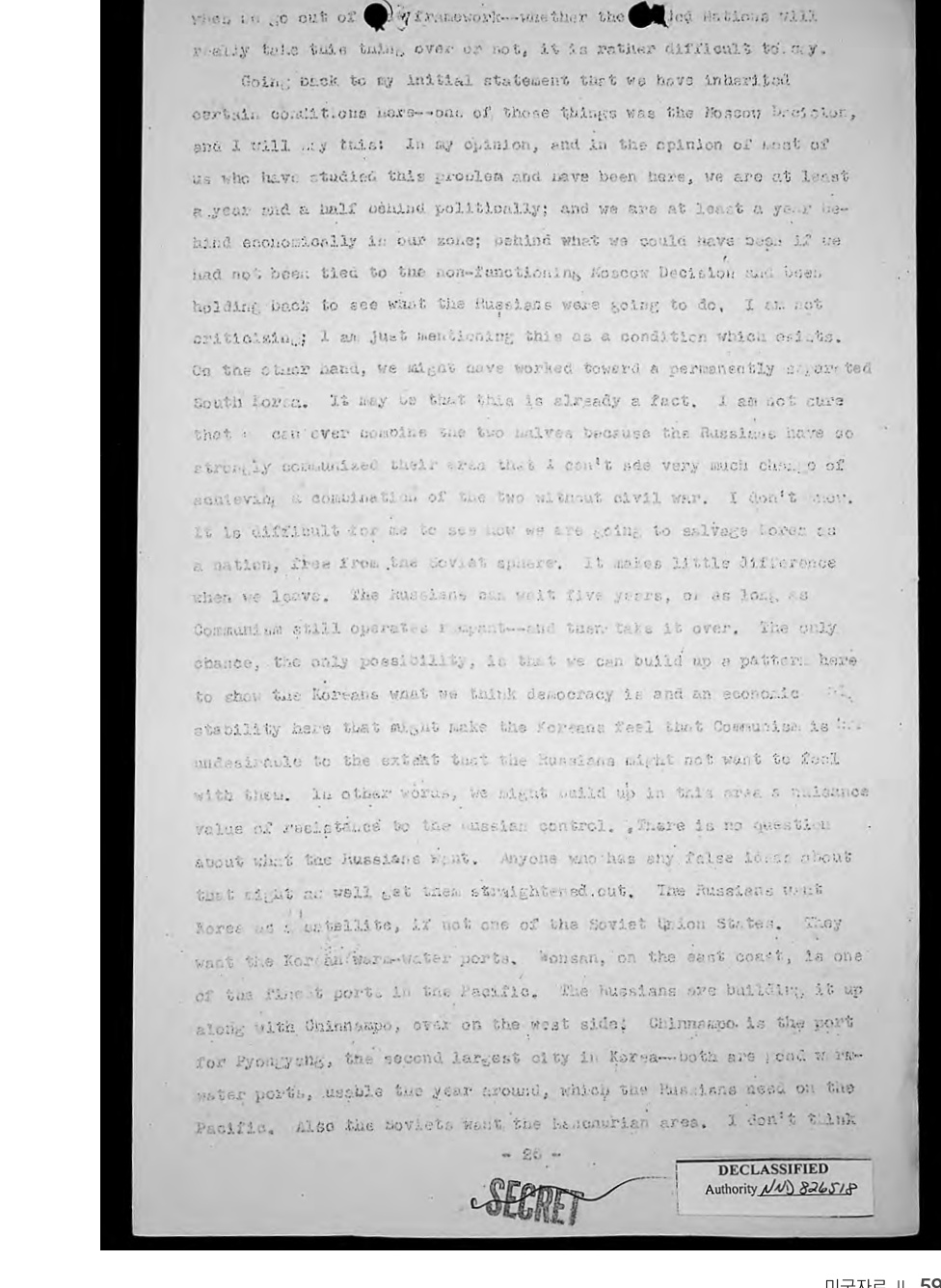
p.59
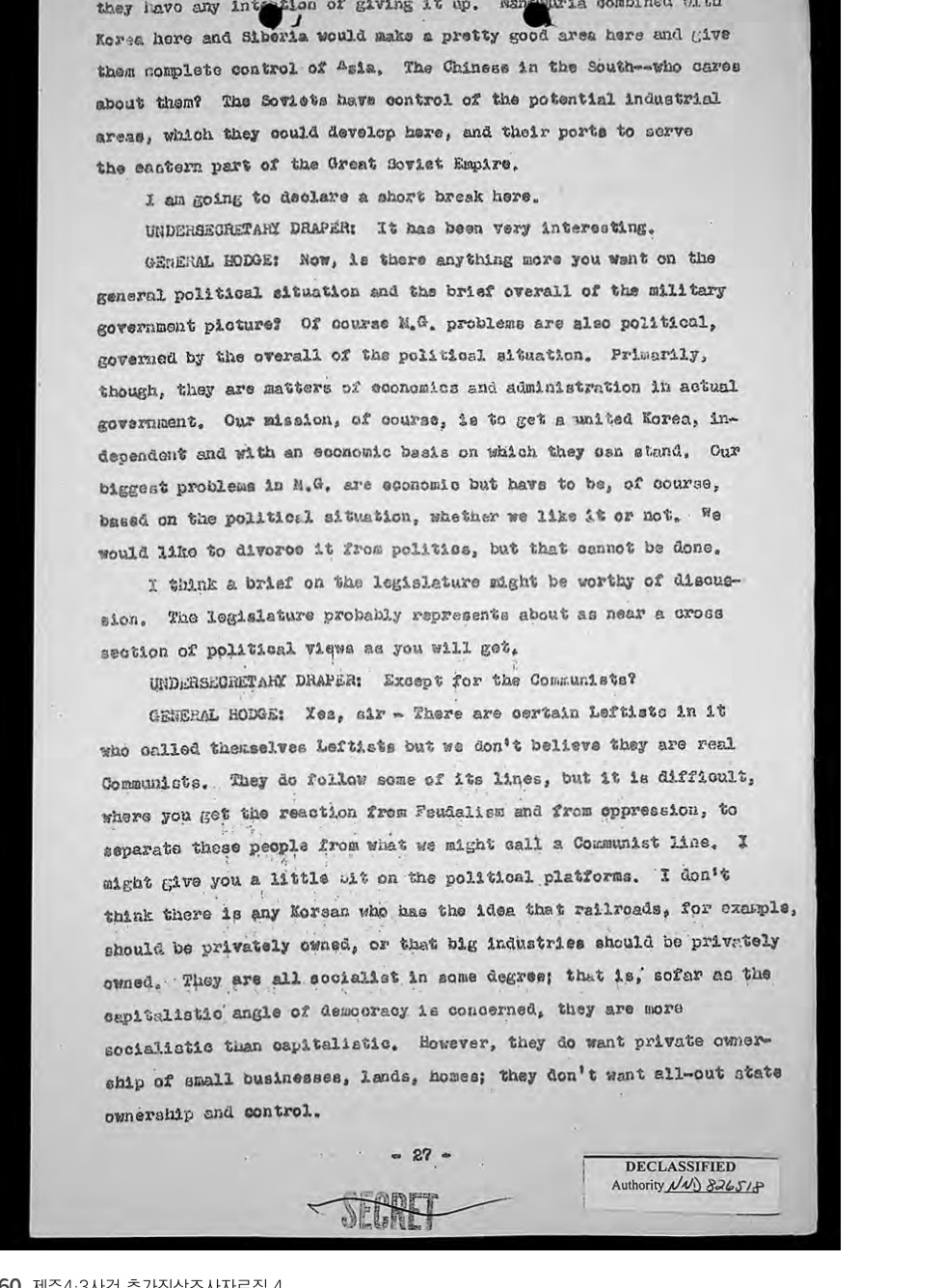
p.60
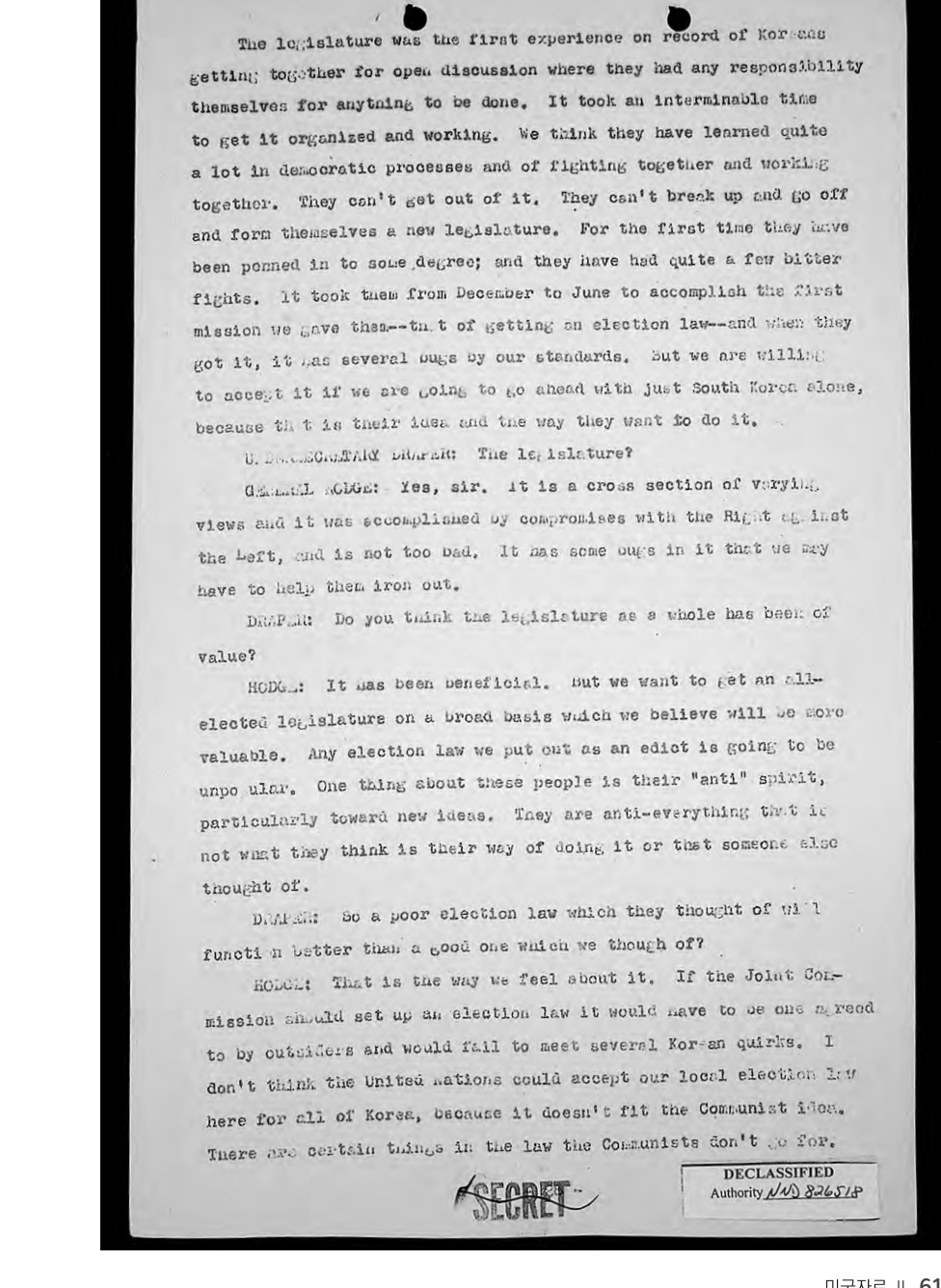
p.61
p.62
p.63
p.64
p.65
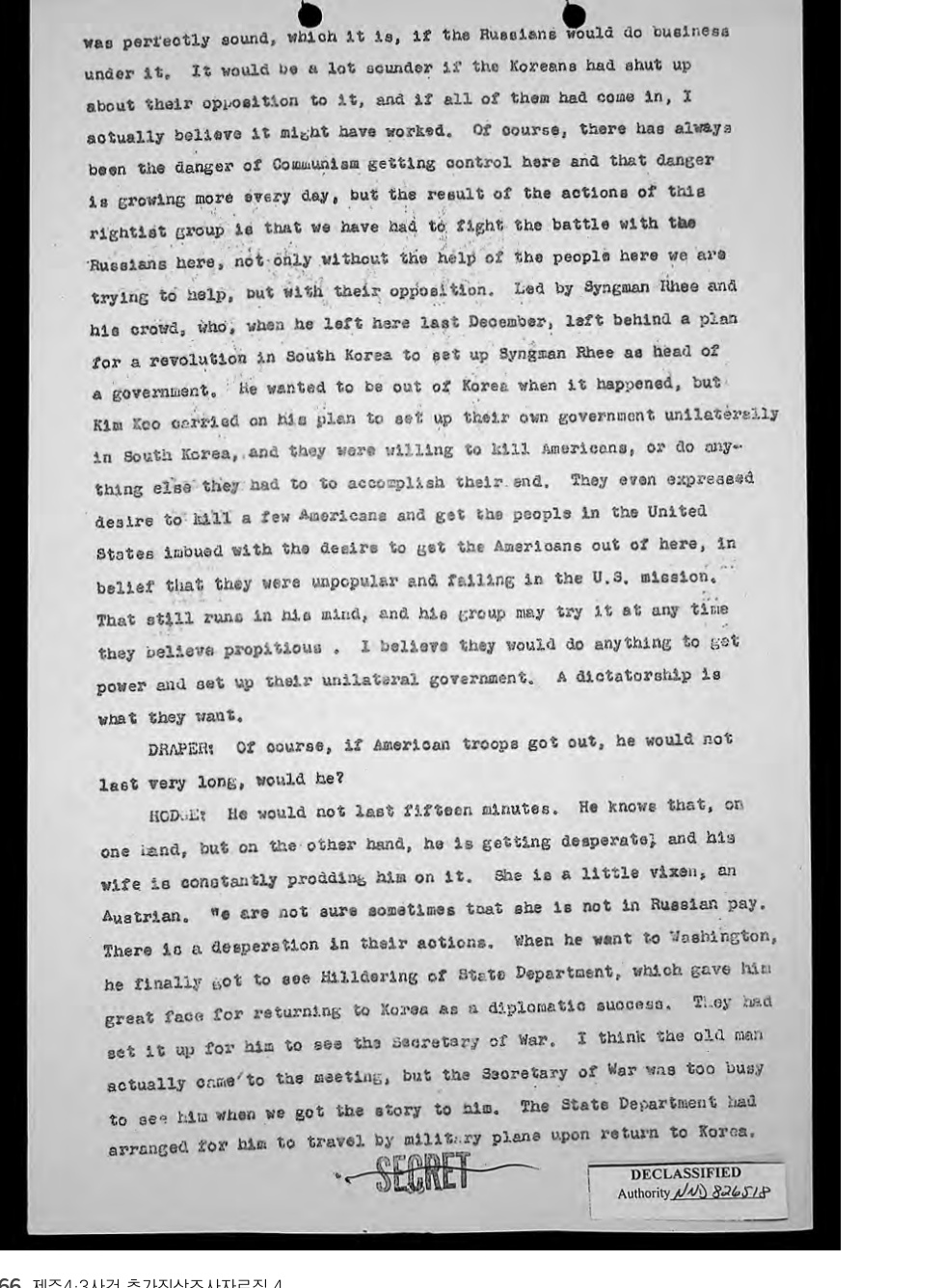
p.66
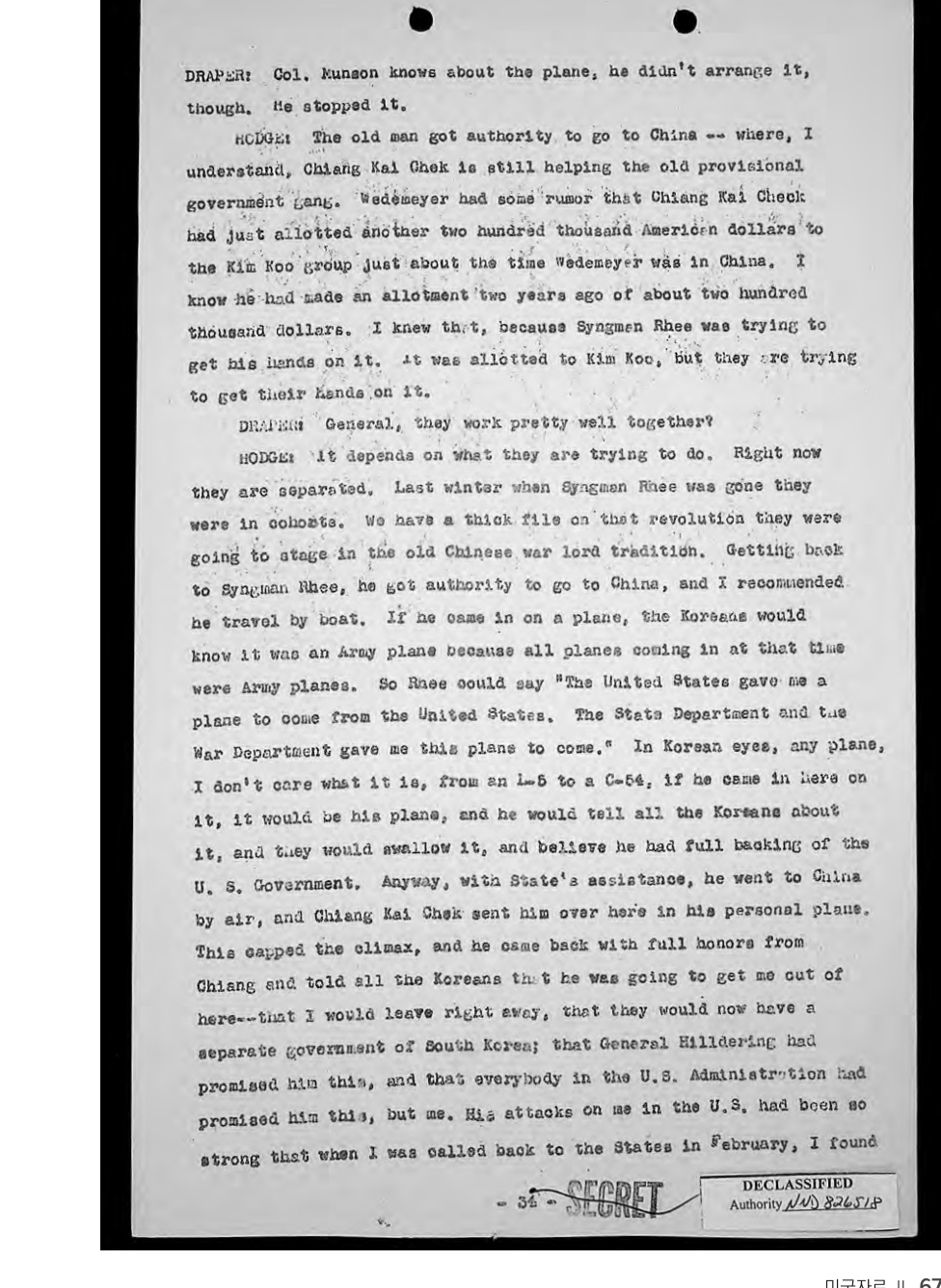
p.67
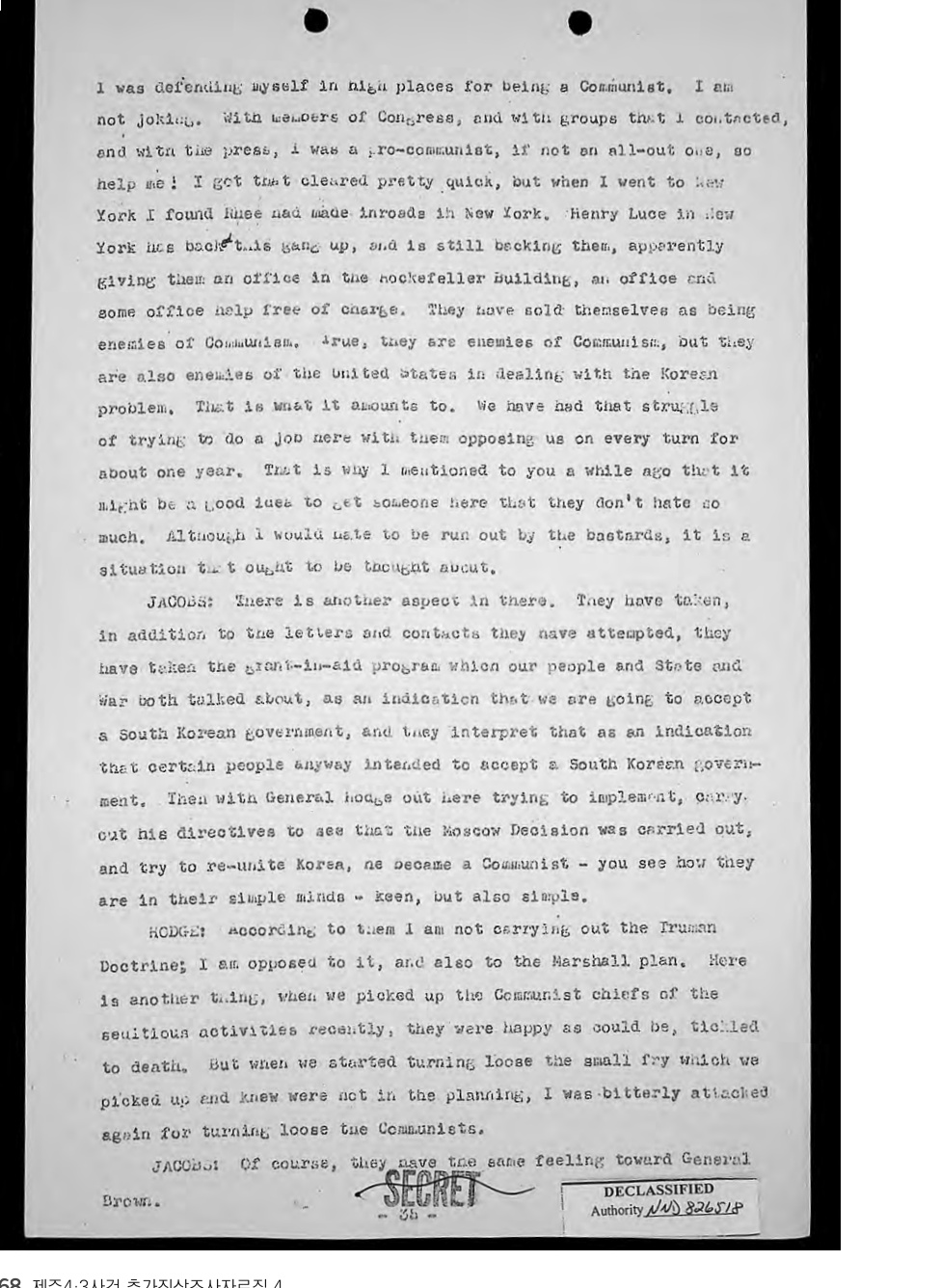
p.68
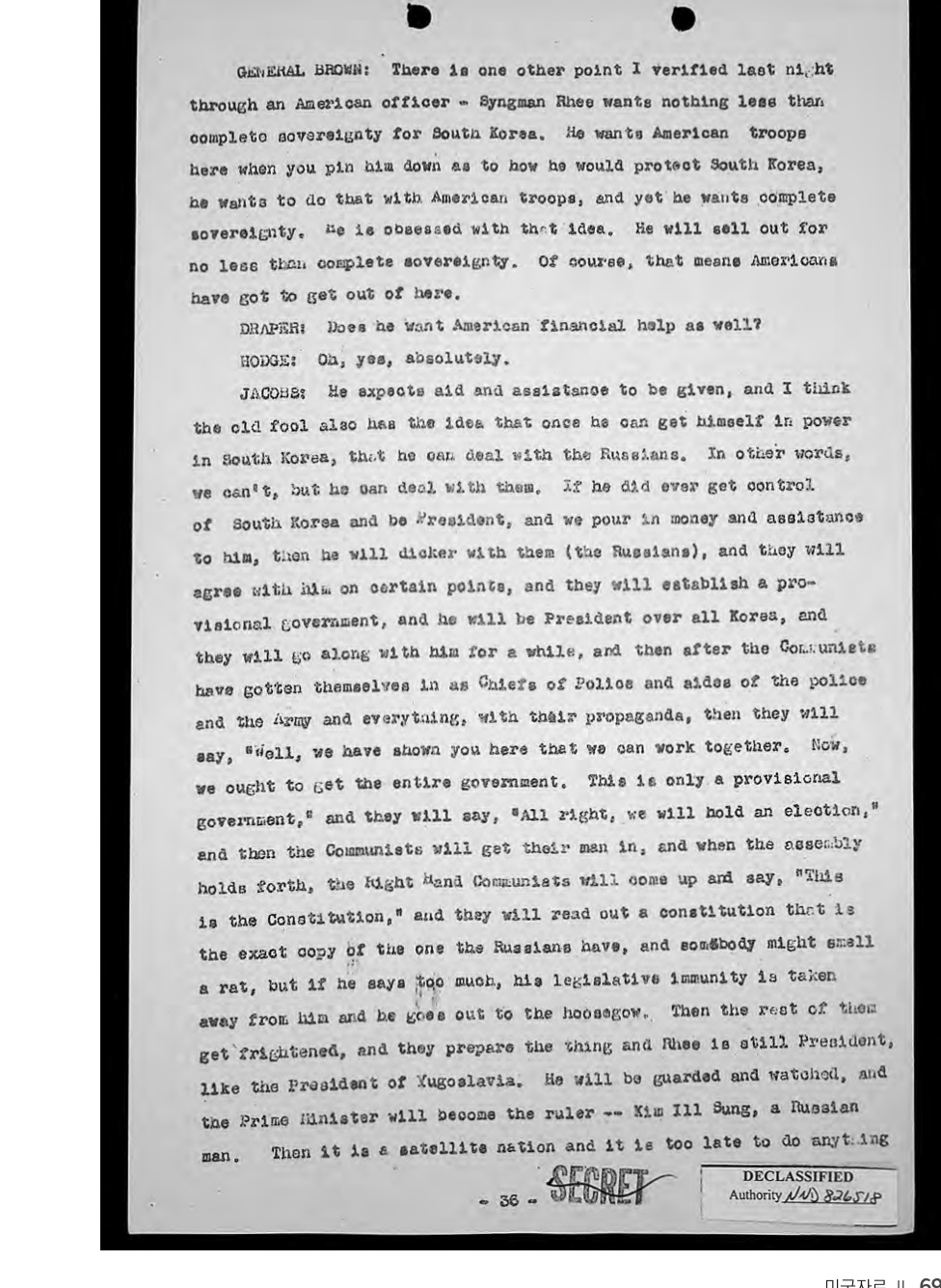
p.69
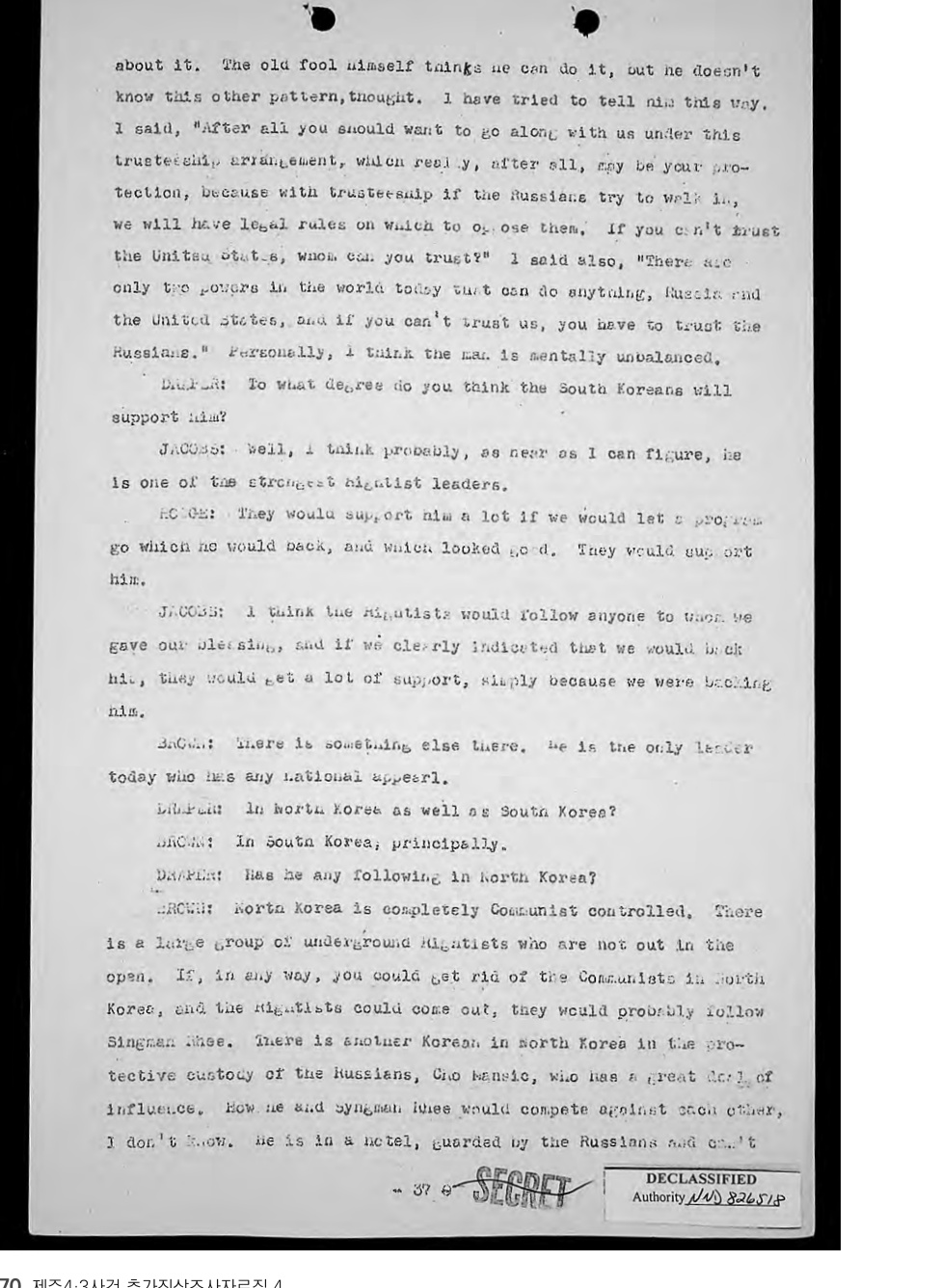
p.70
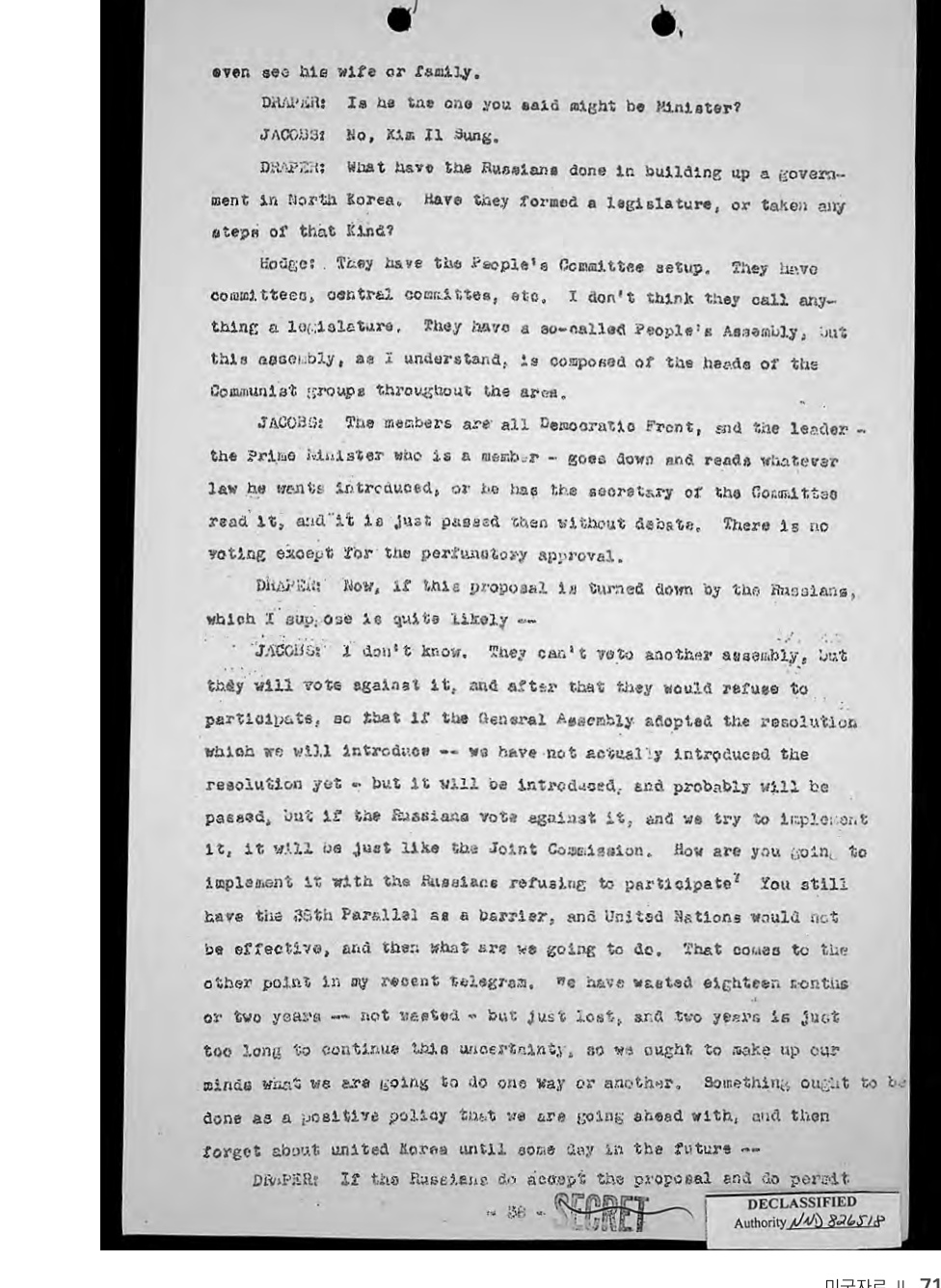
p.71
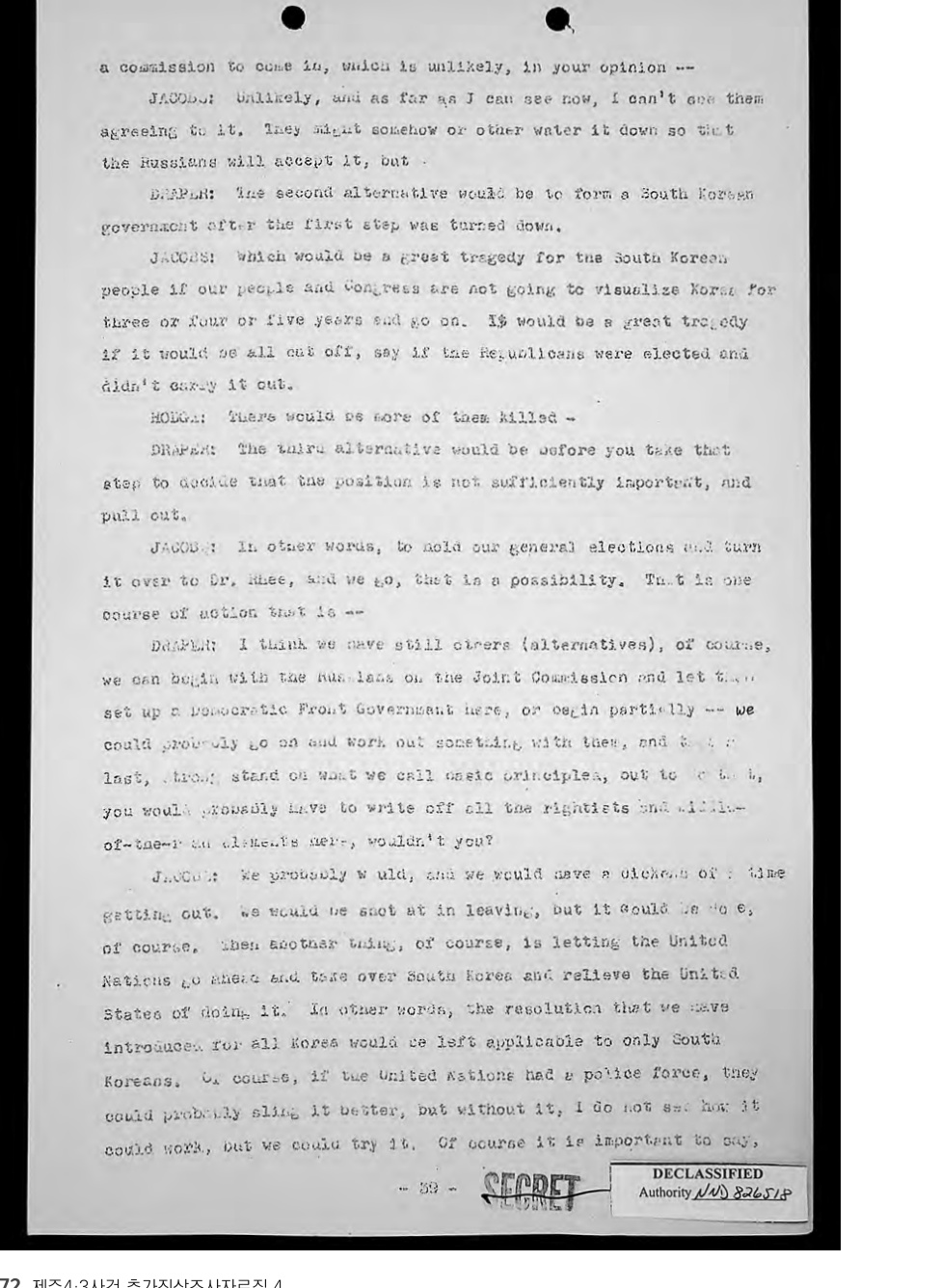
p.72
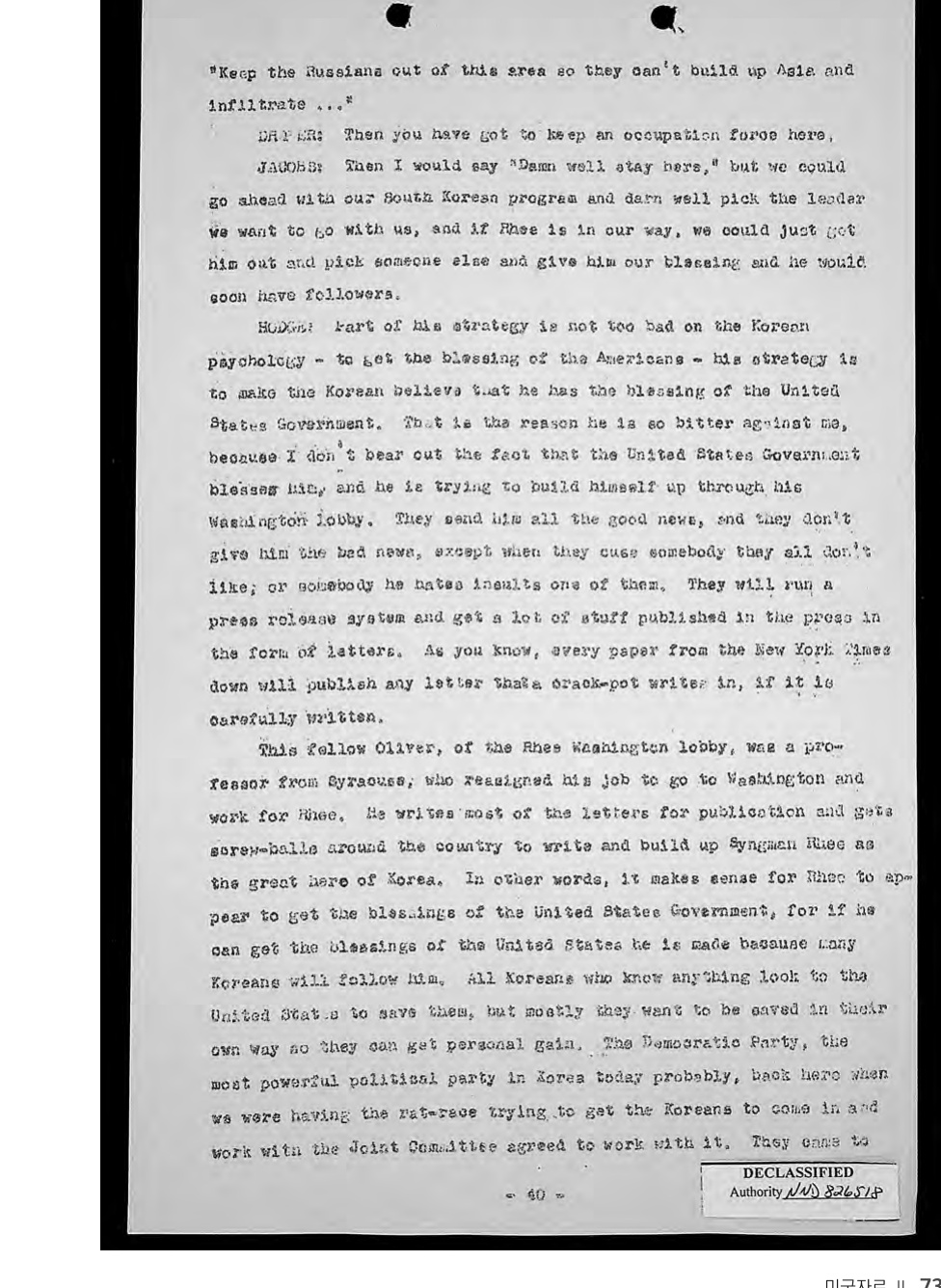
p.73
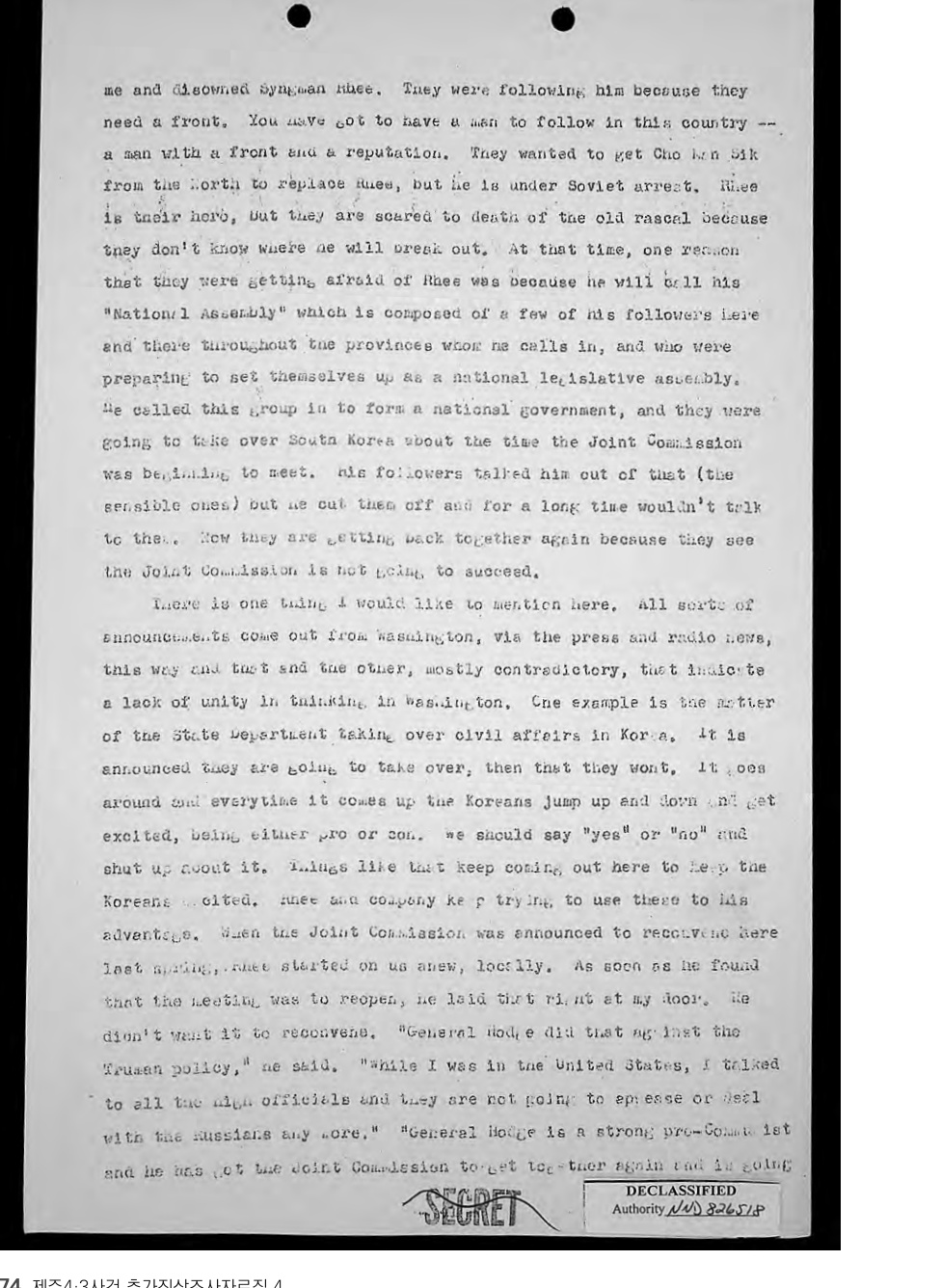
p.74
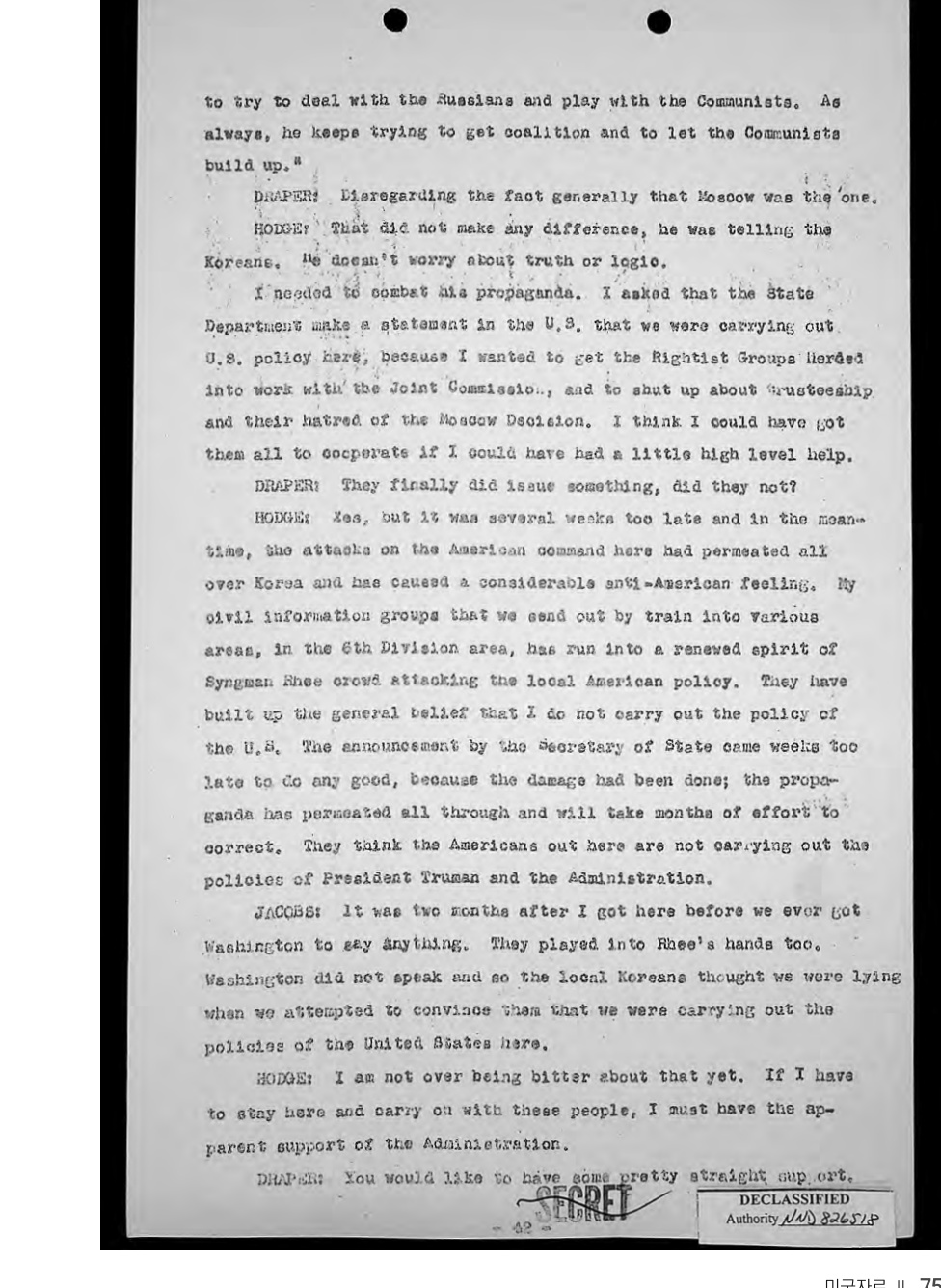
p.75
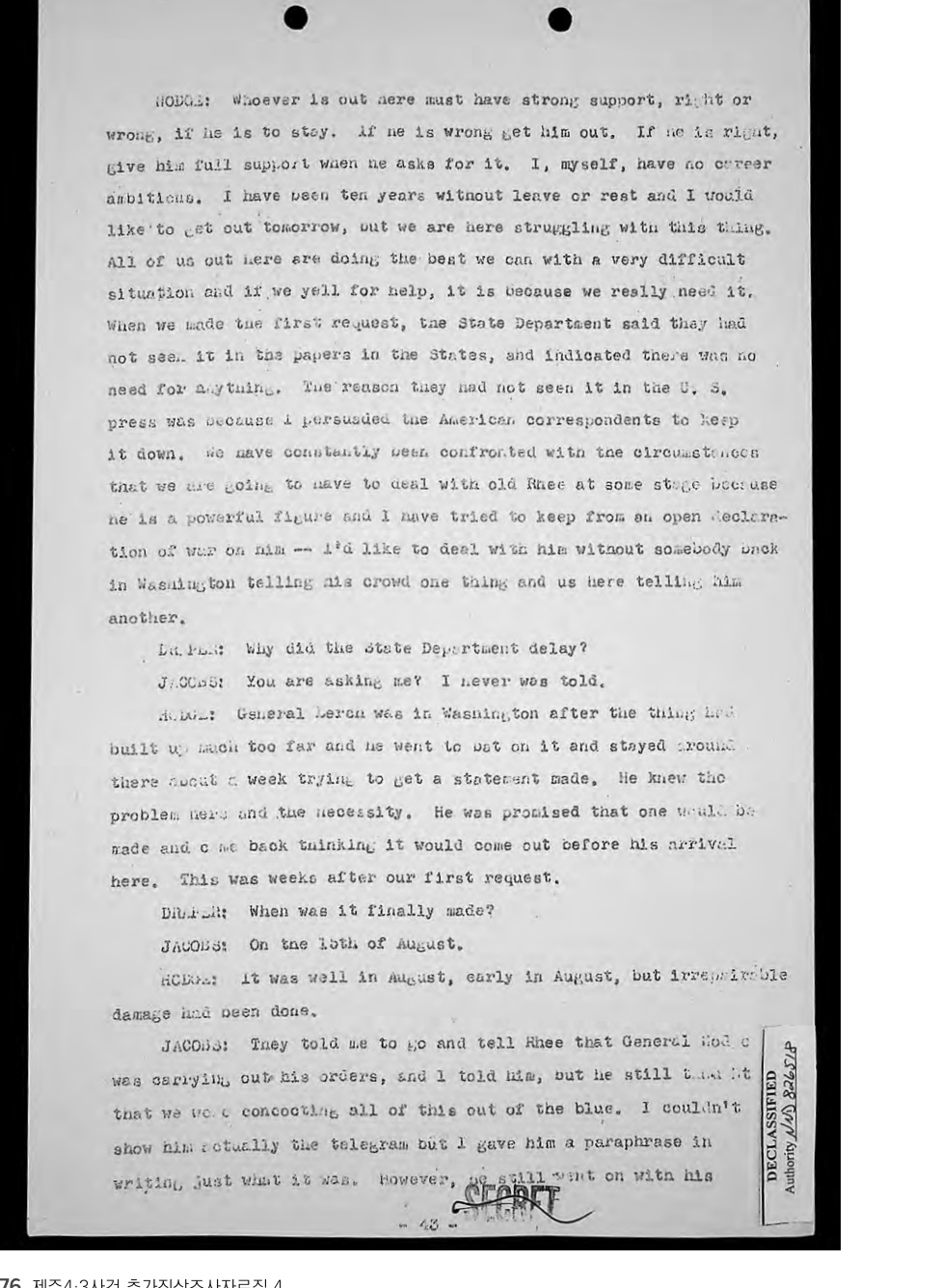
p.76
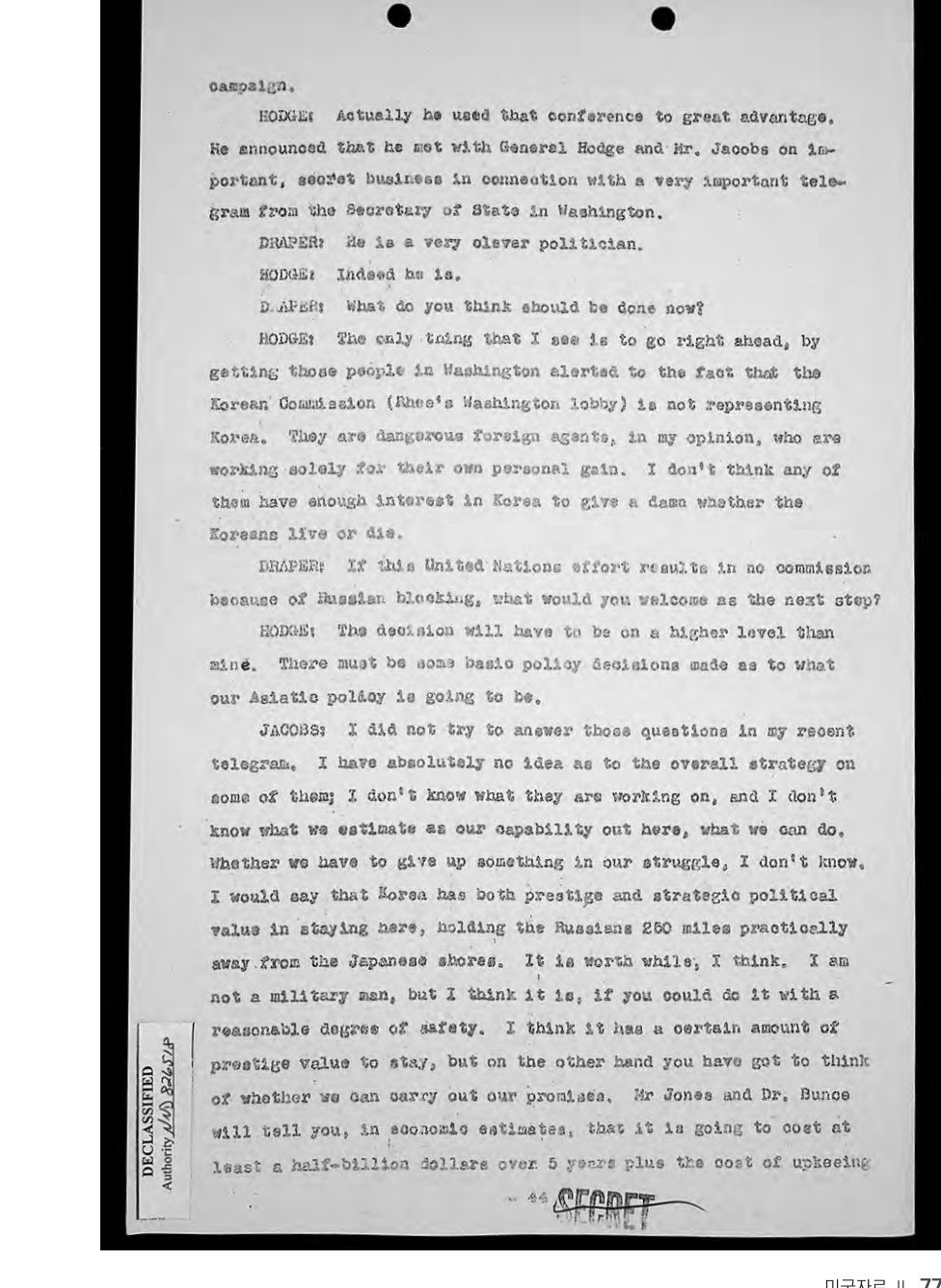
p.77
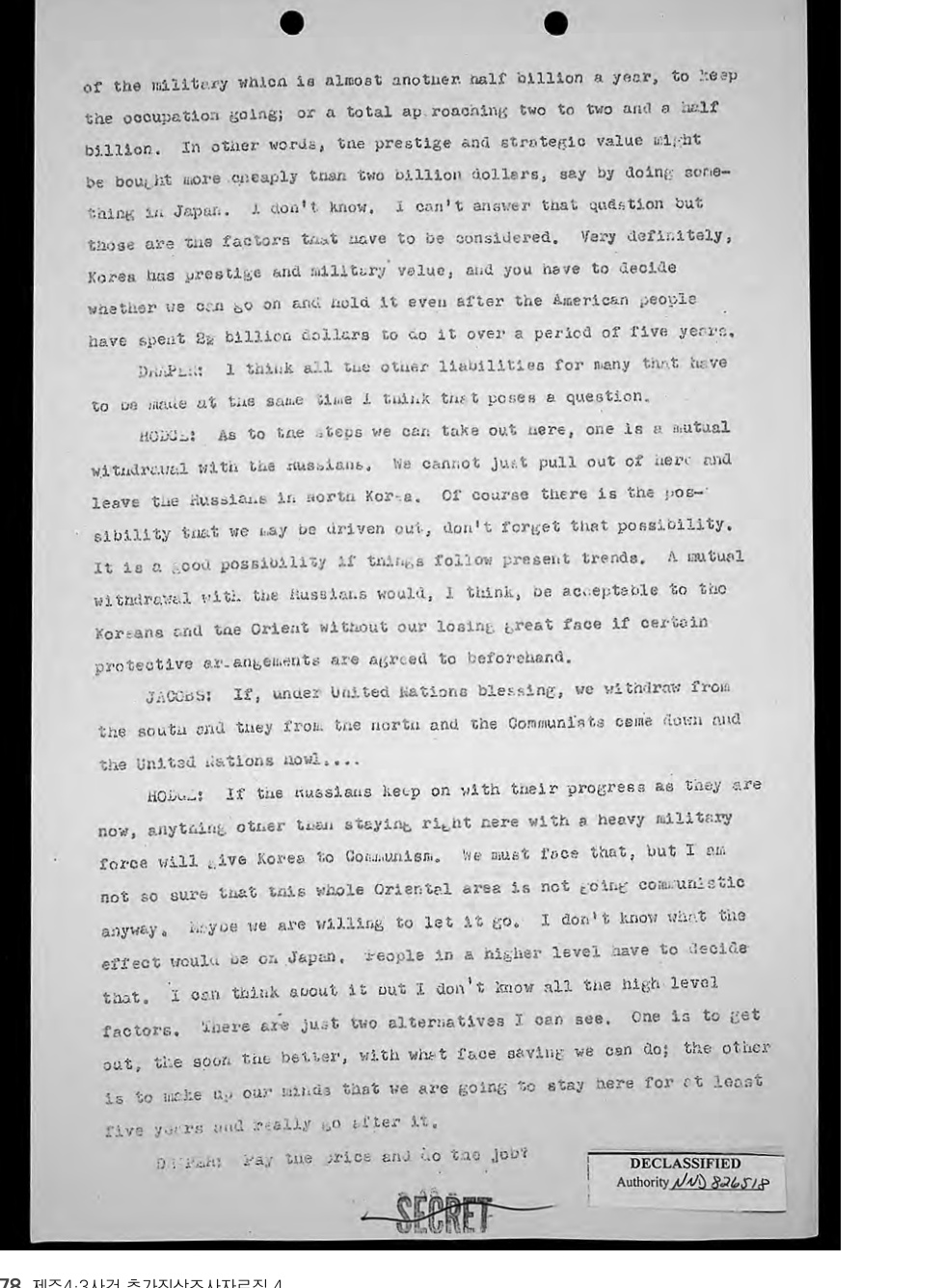
p.78
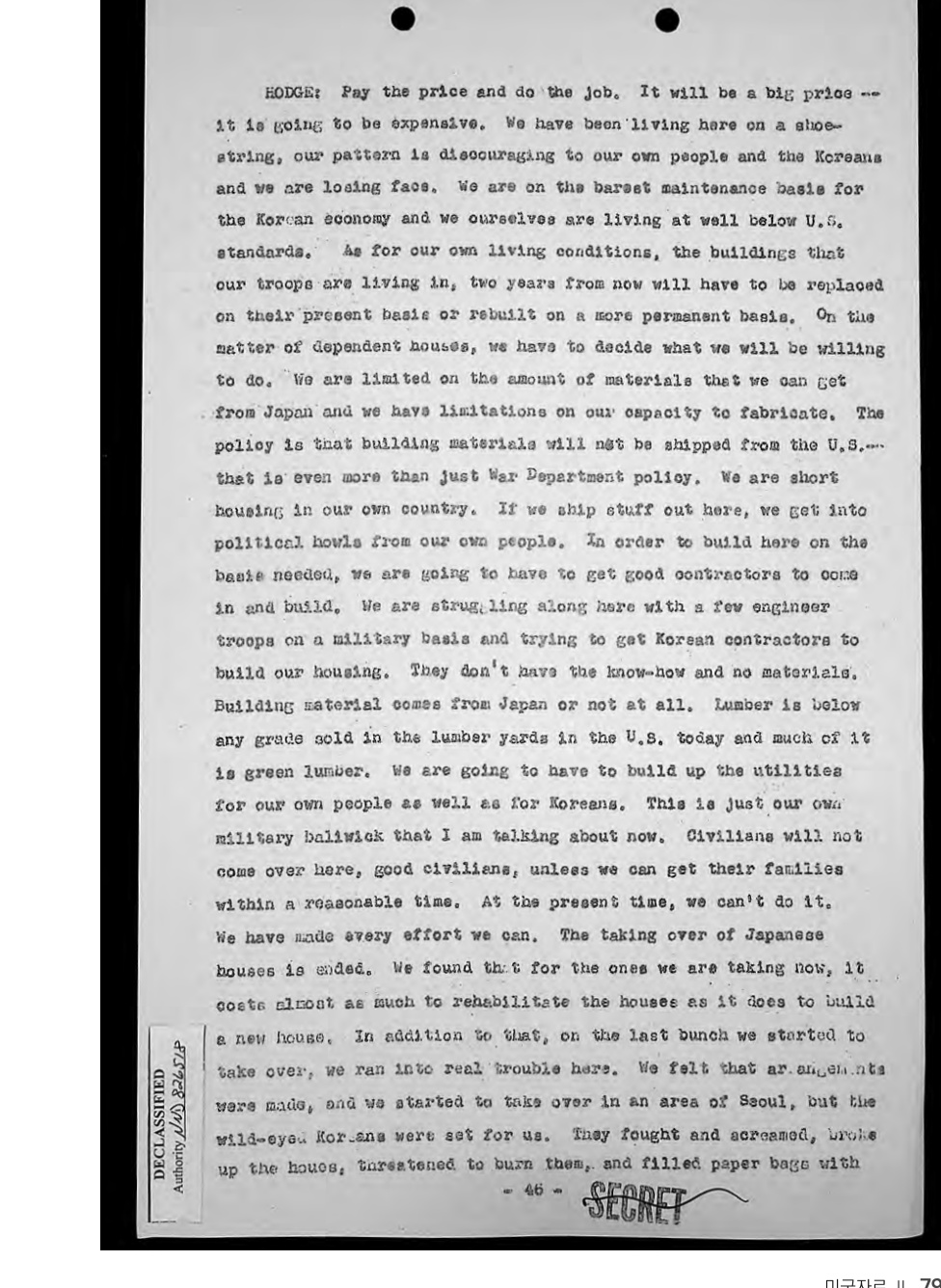
p.79
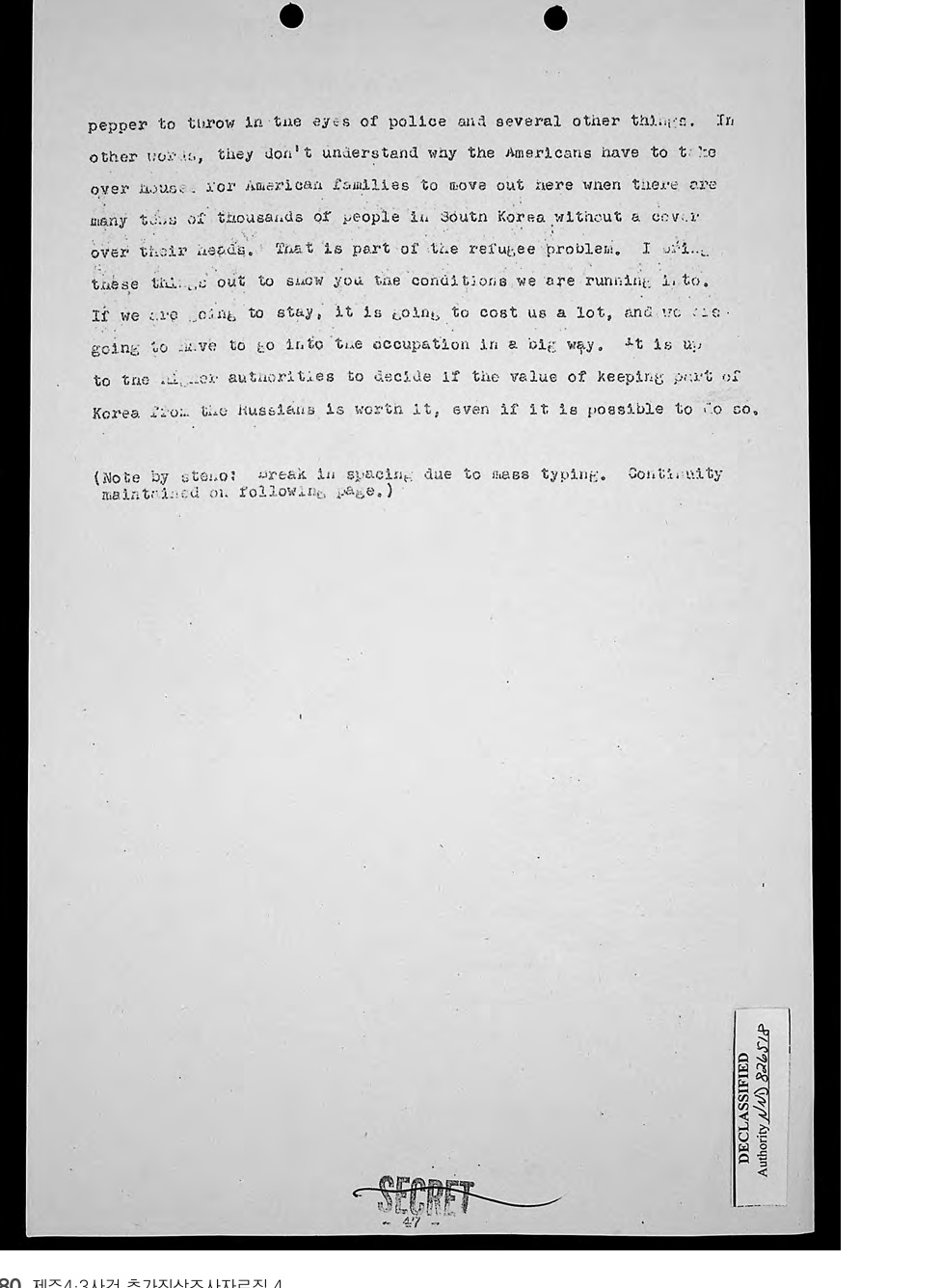
p.80
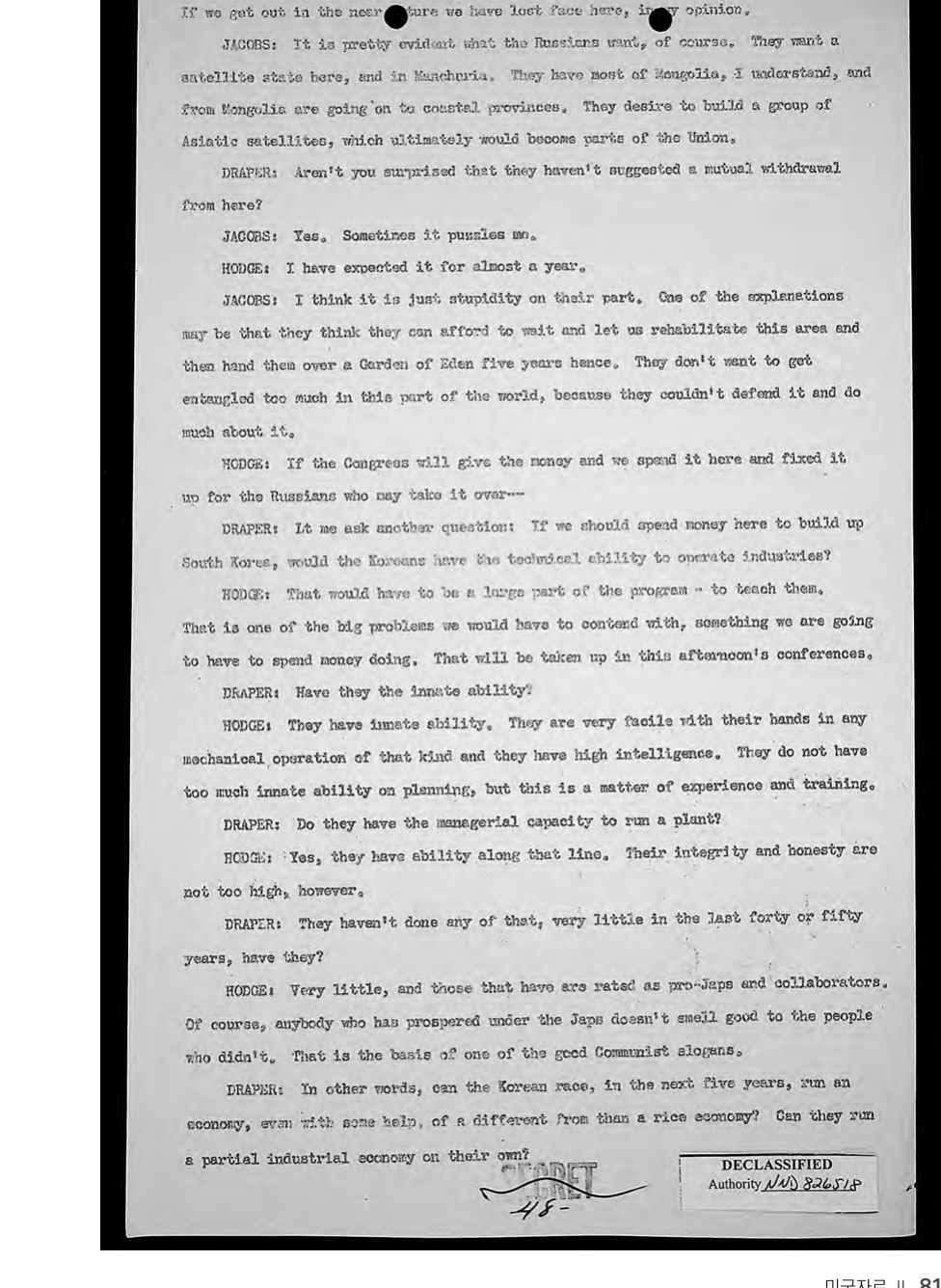
p.81
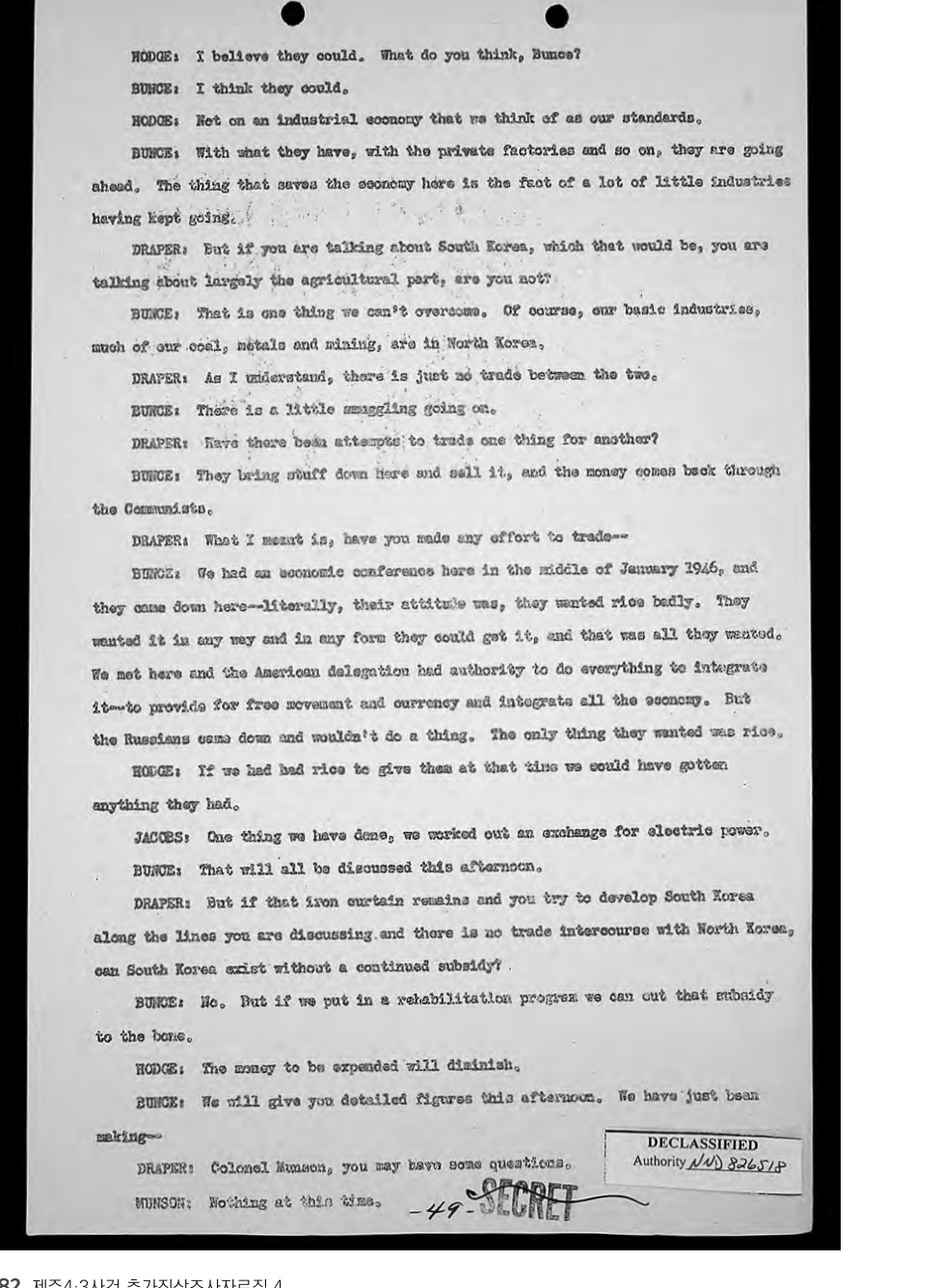
p.82
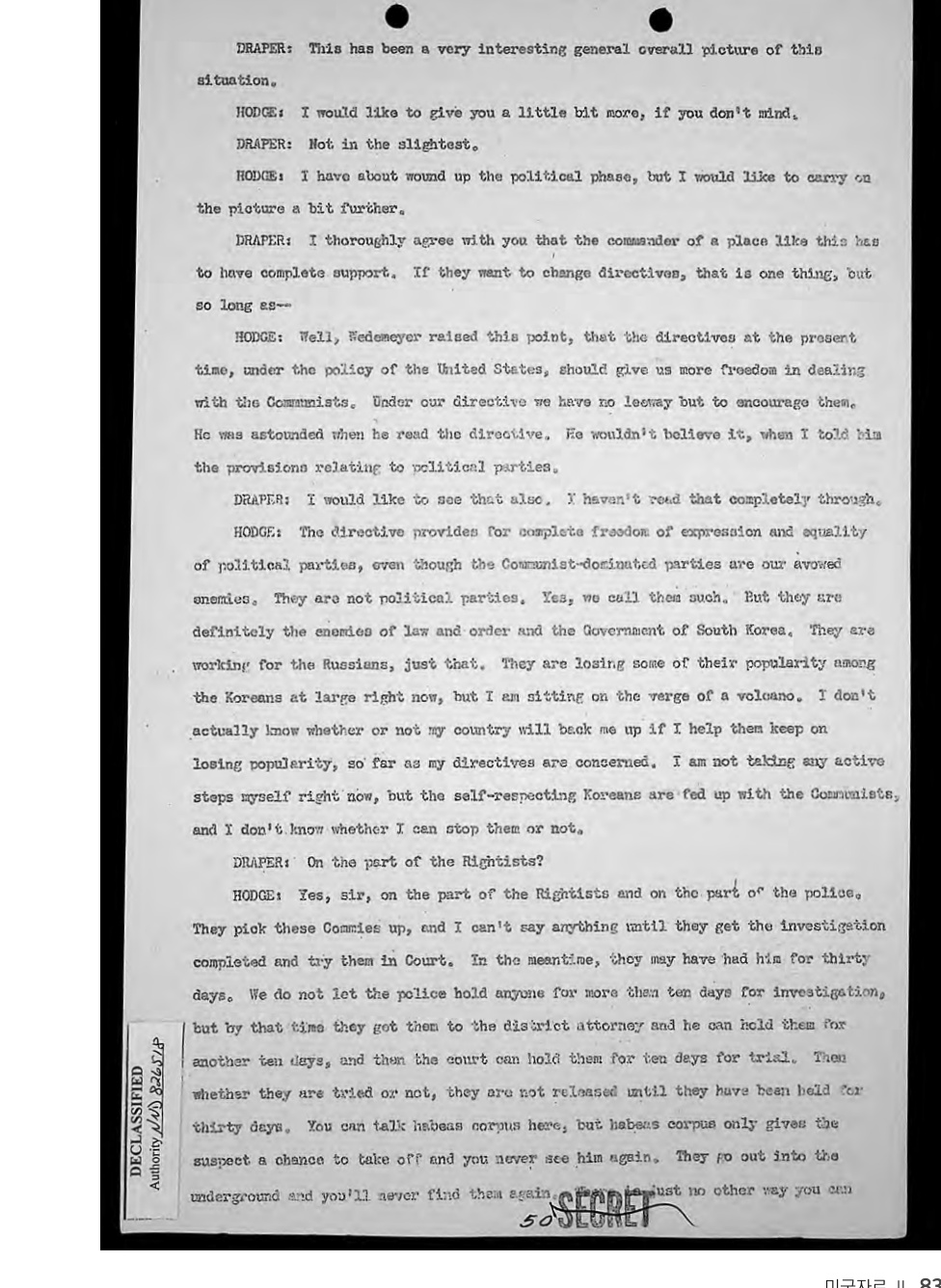
p.83
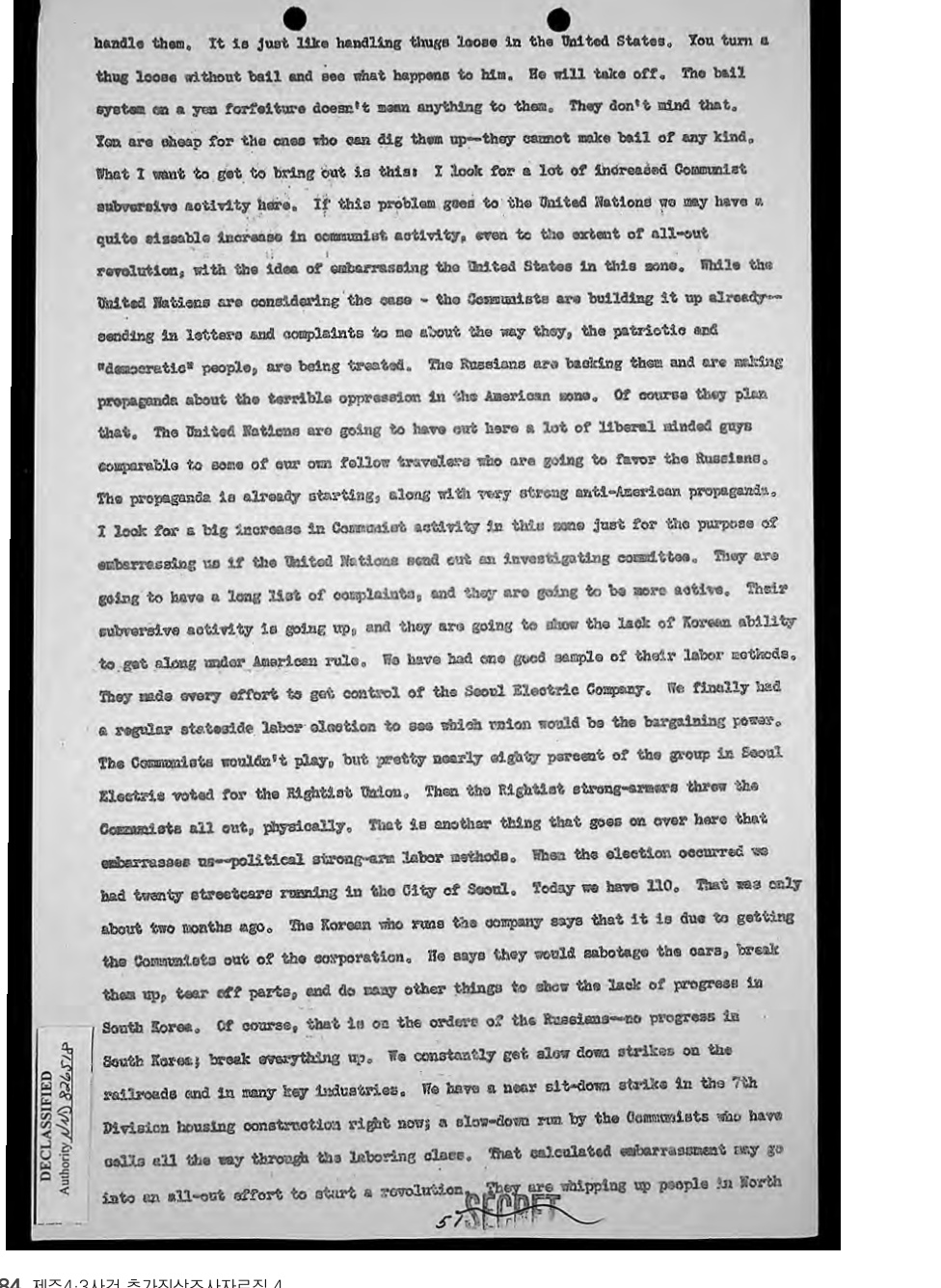
p.84
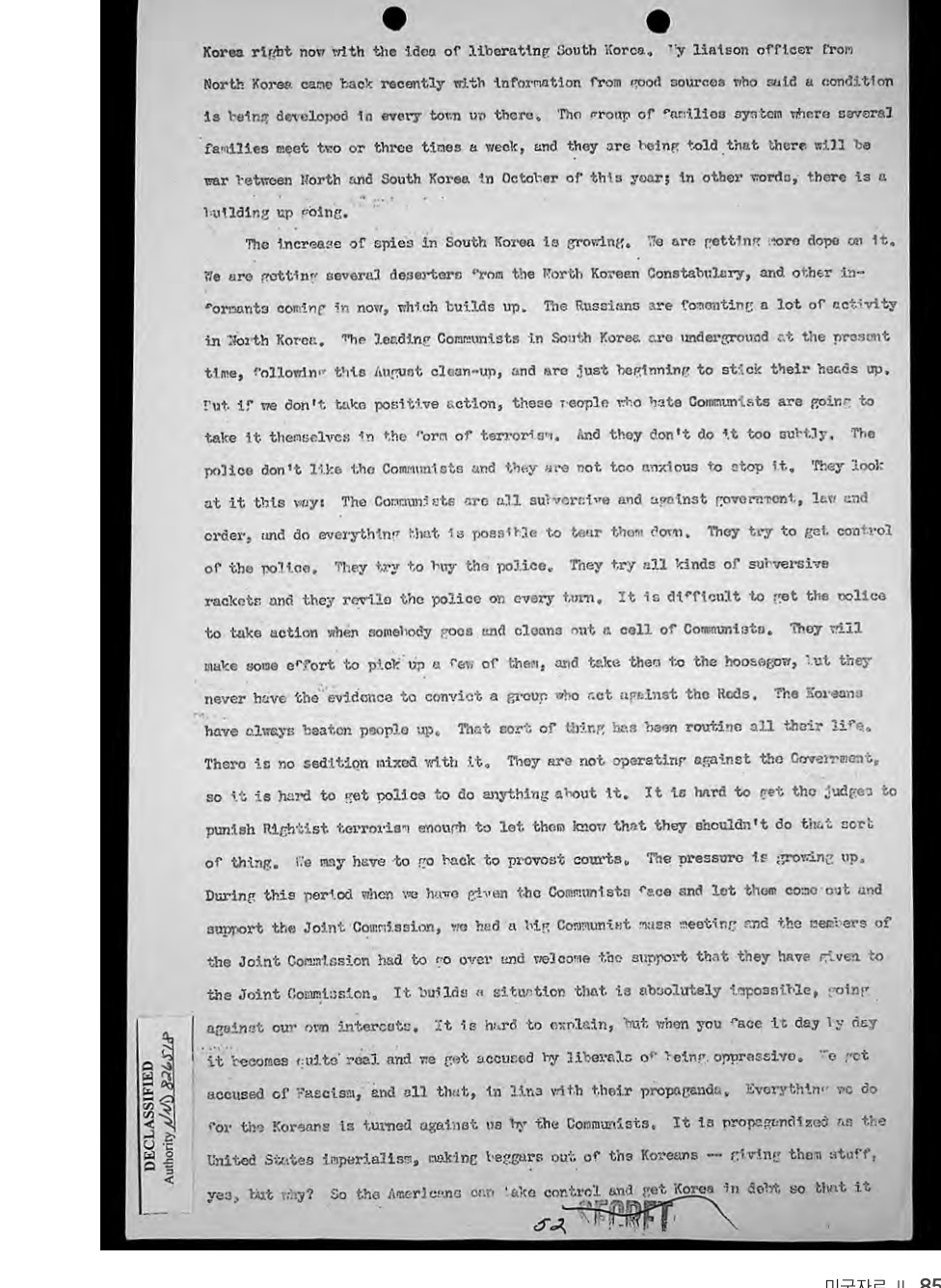
p.85
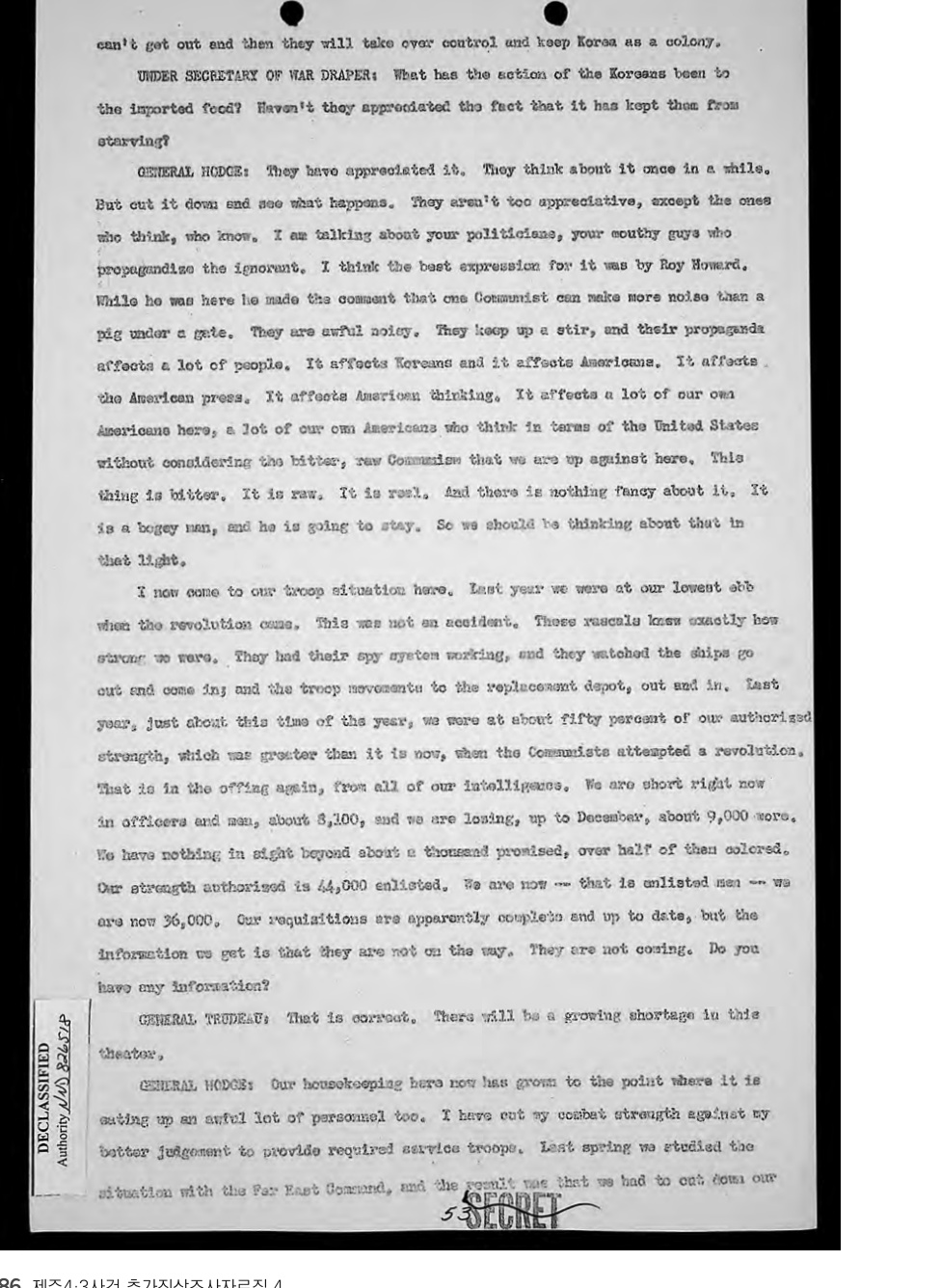
p.86
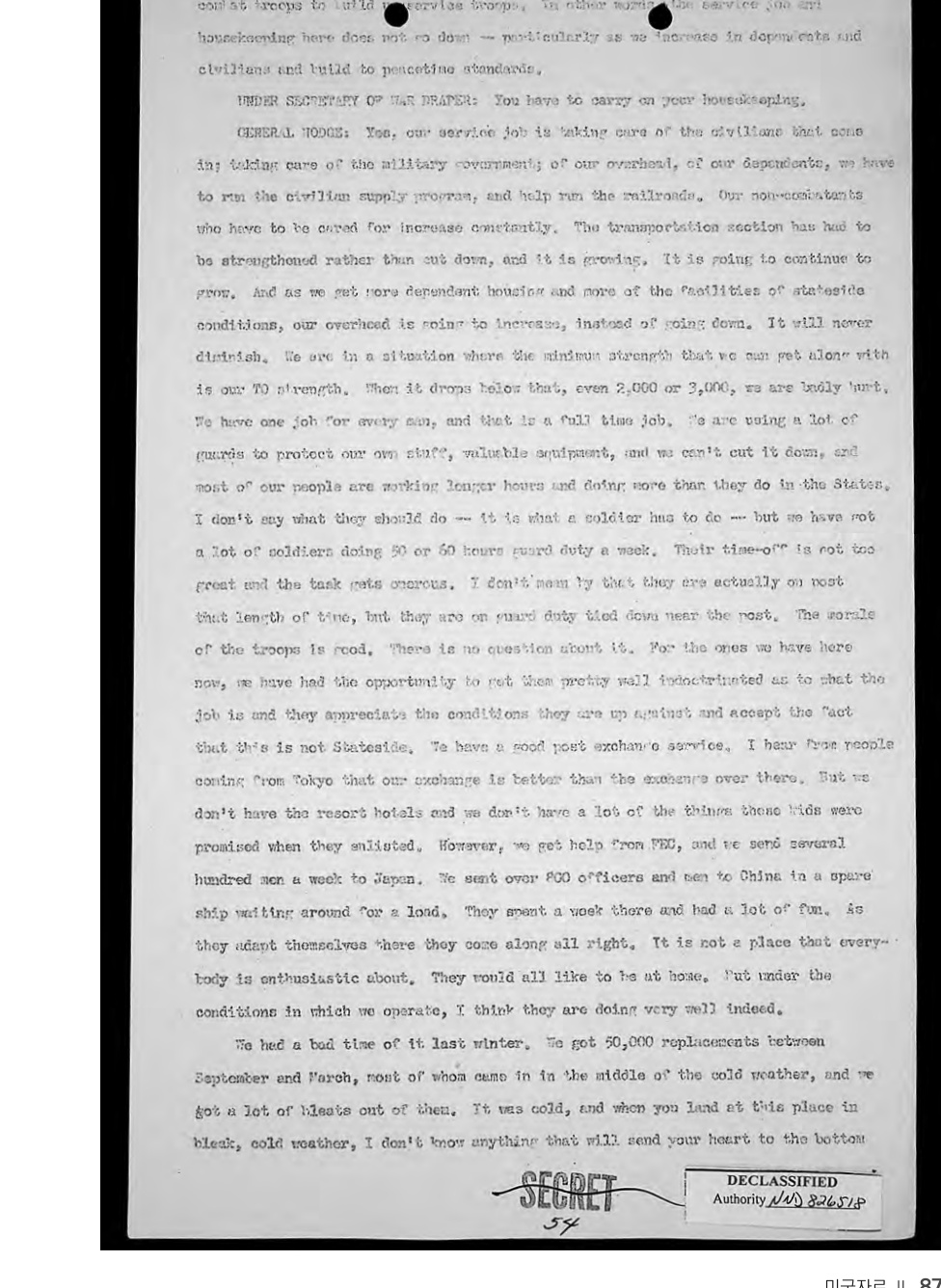
p.87
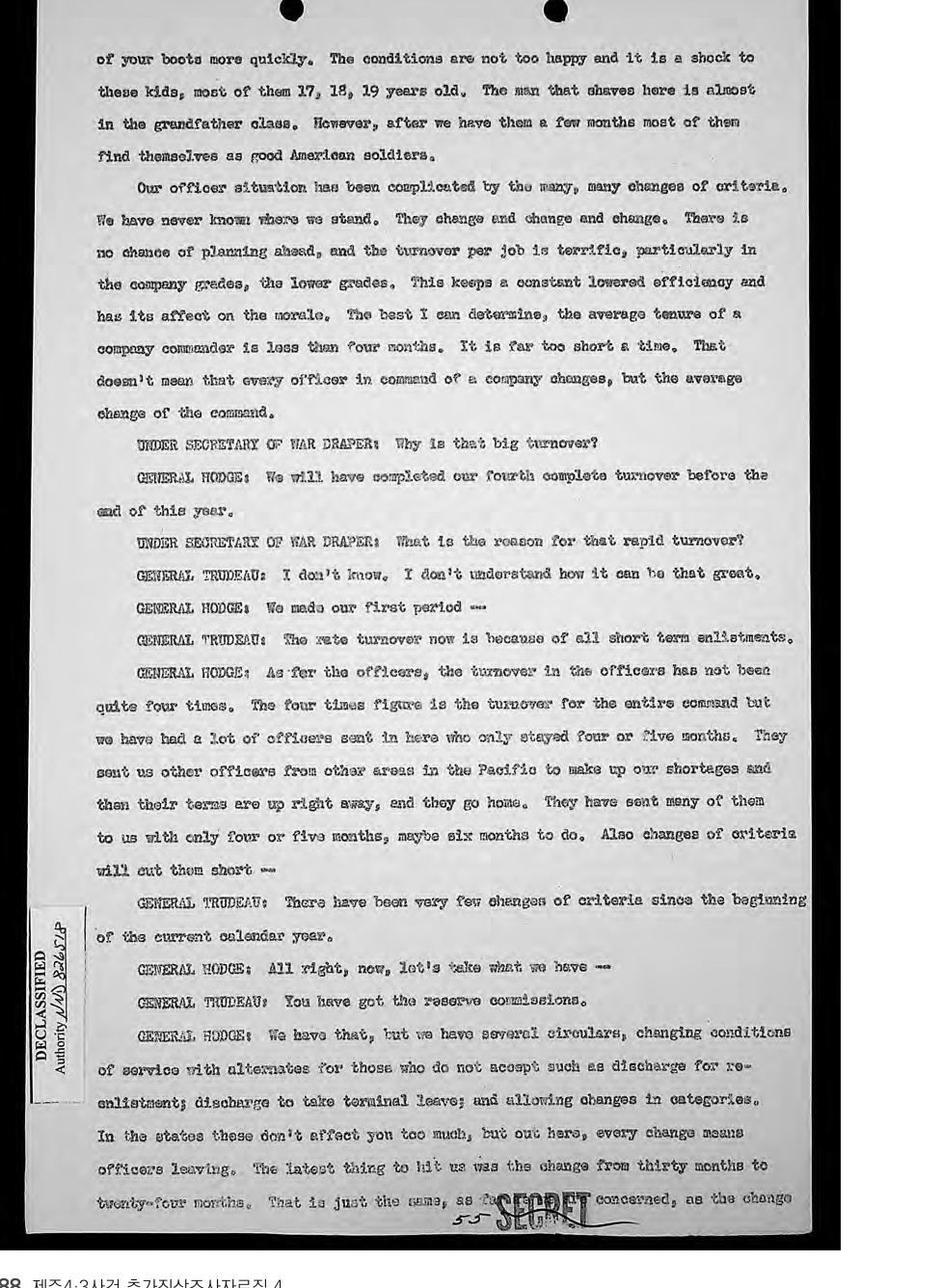
p.88
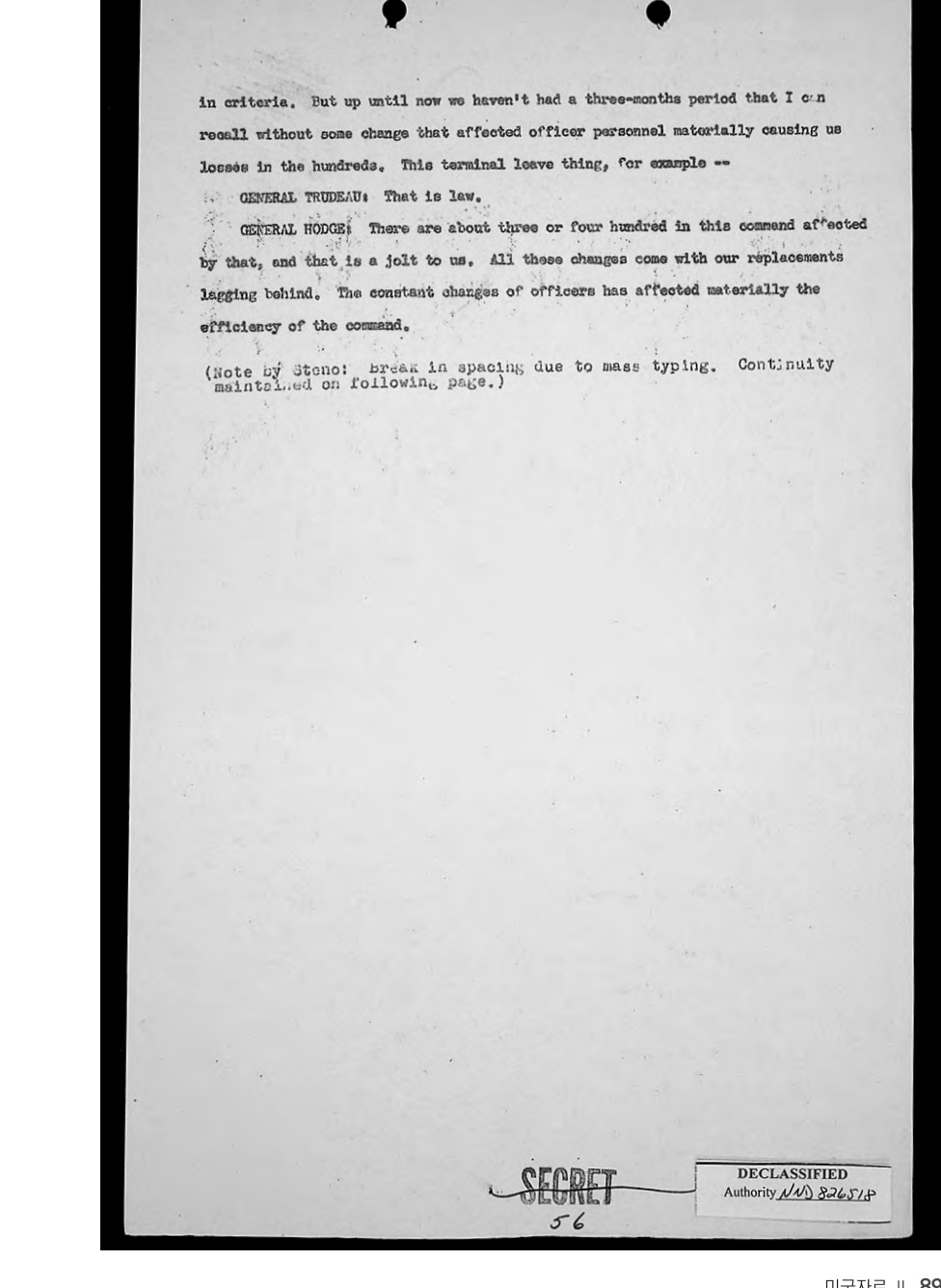
p.89
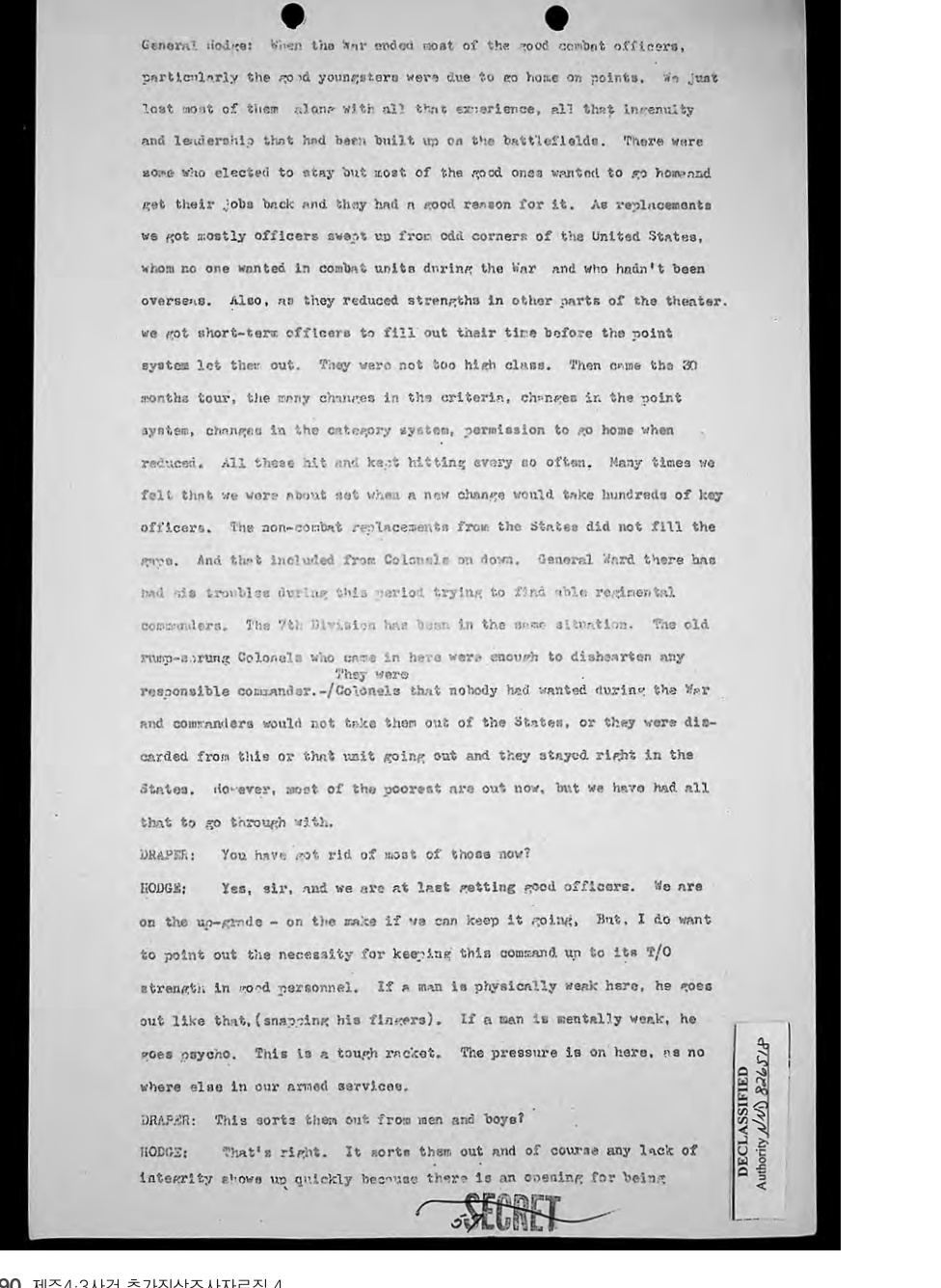
p.90
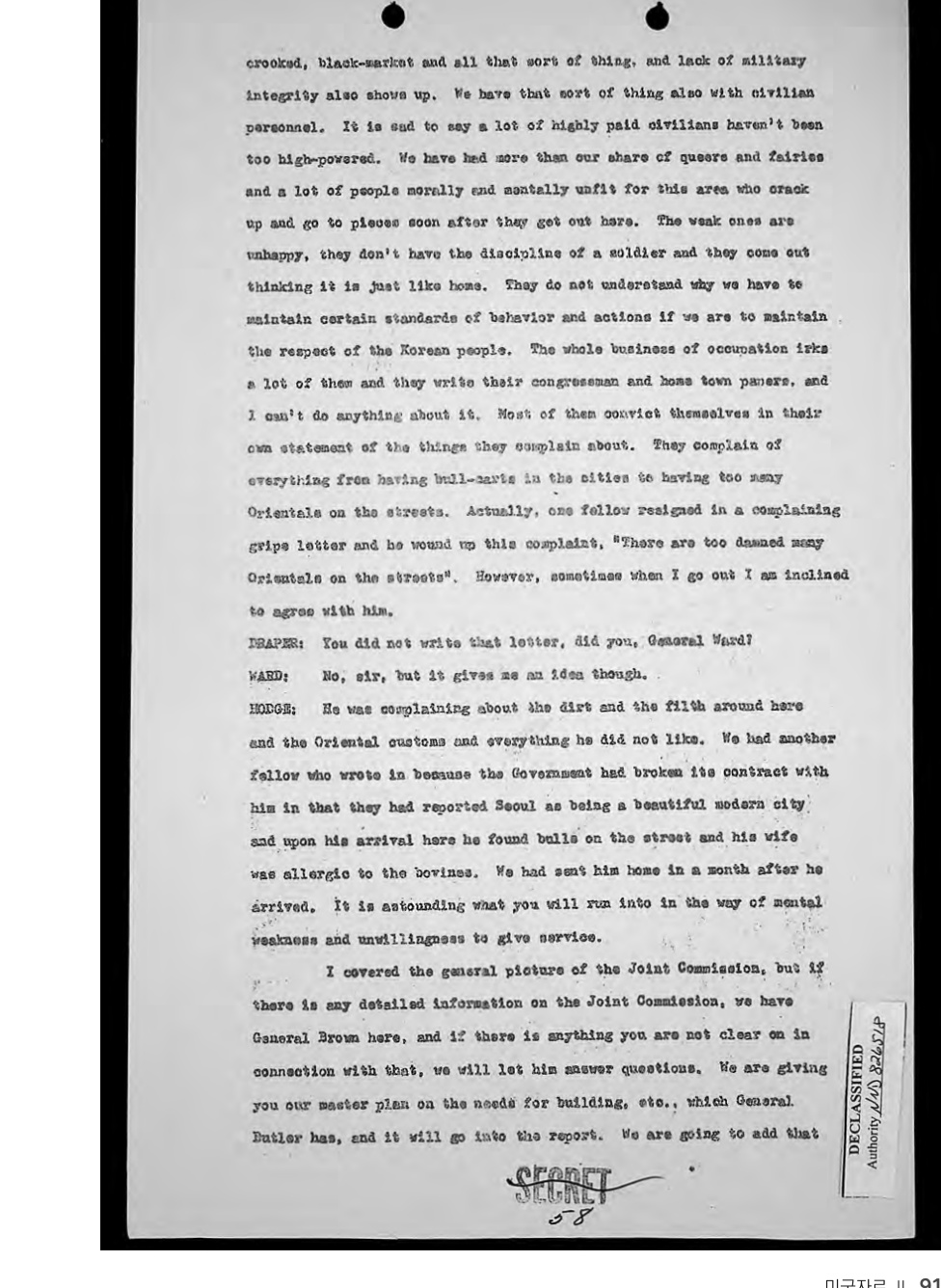
p.91
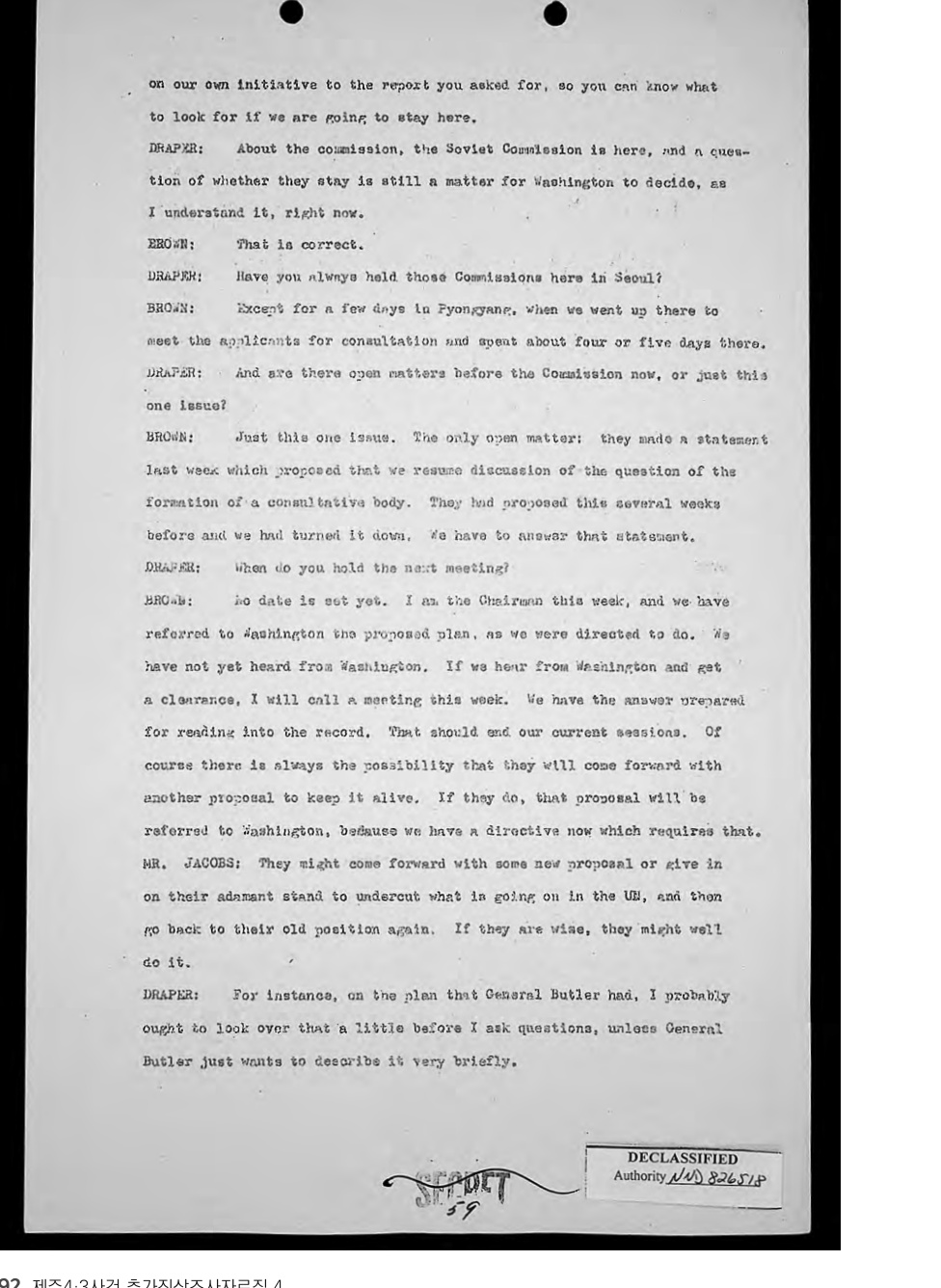
p.92
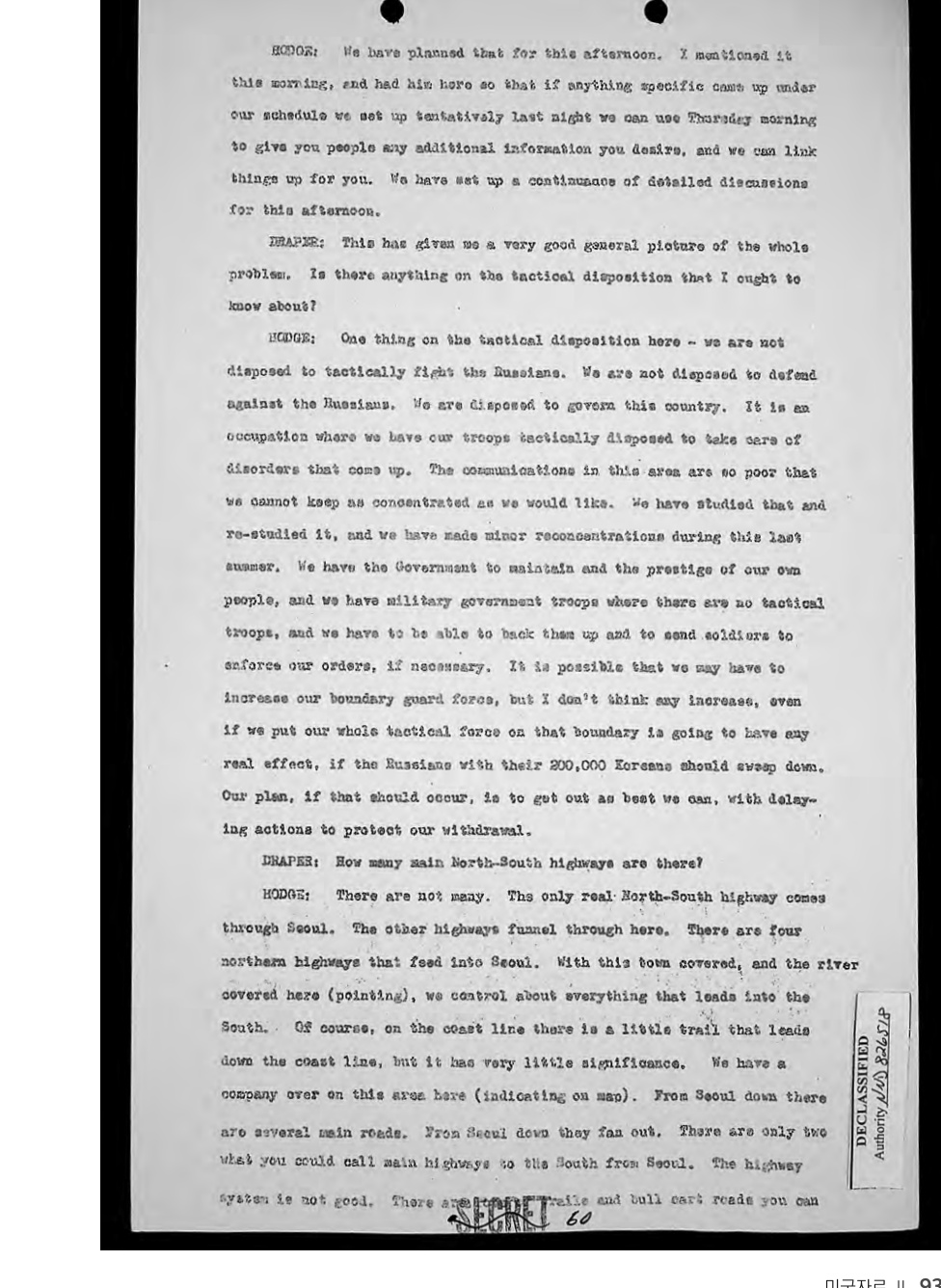
p.93
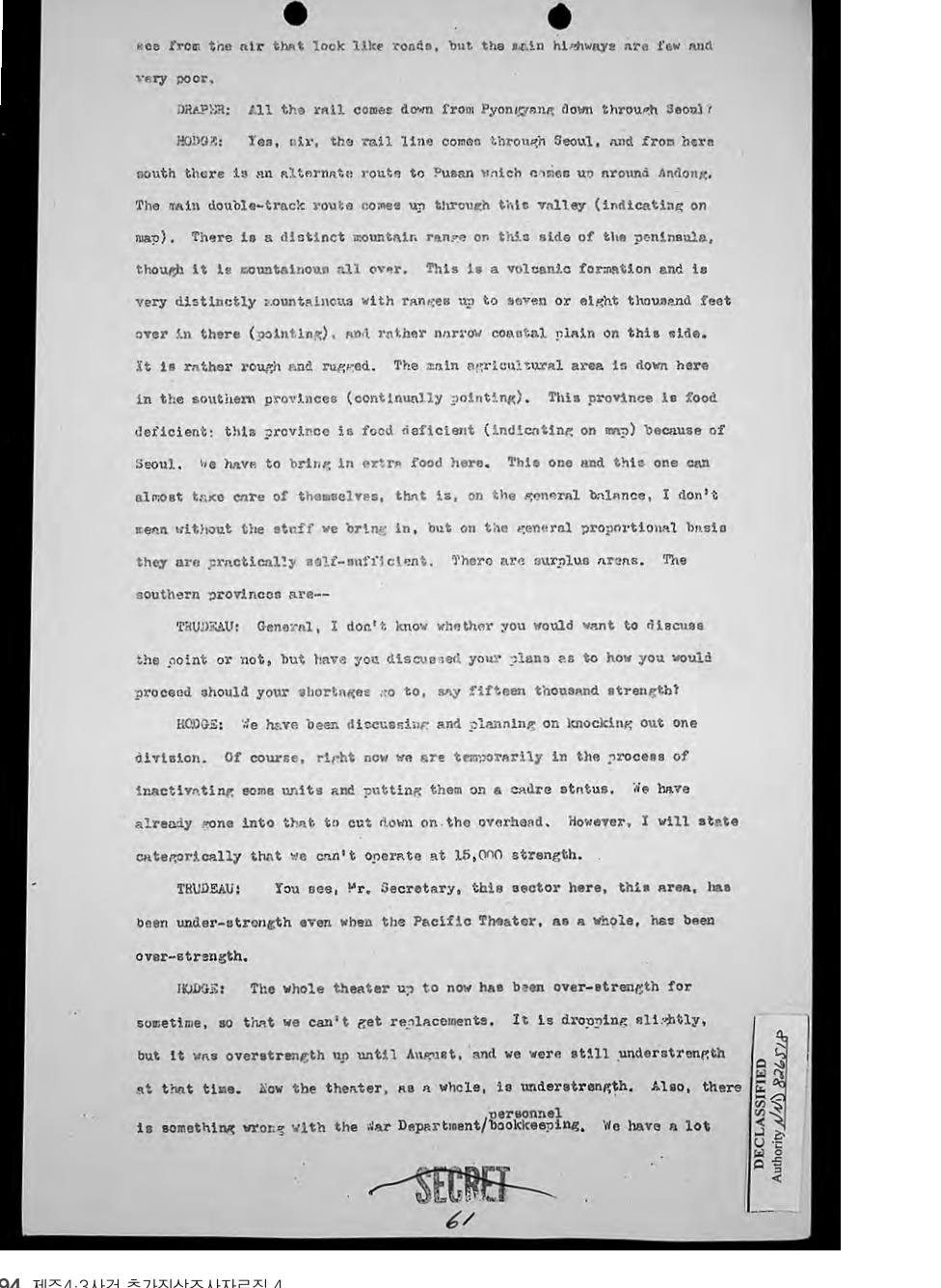
p.94
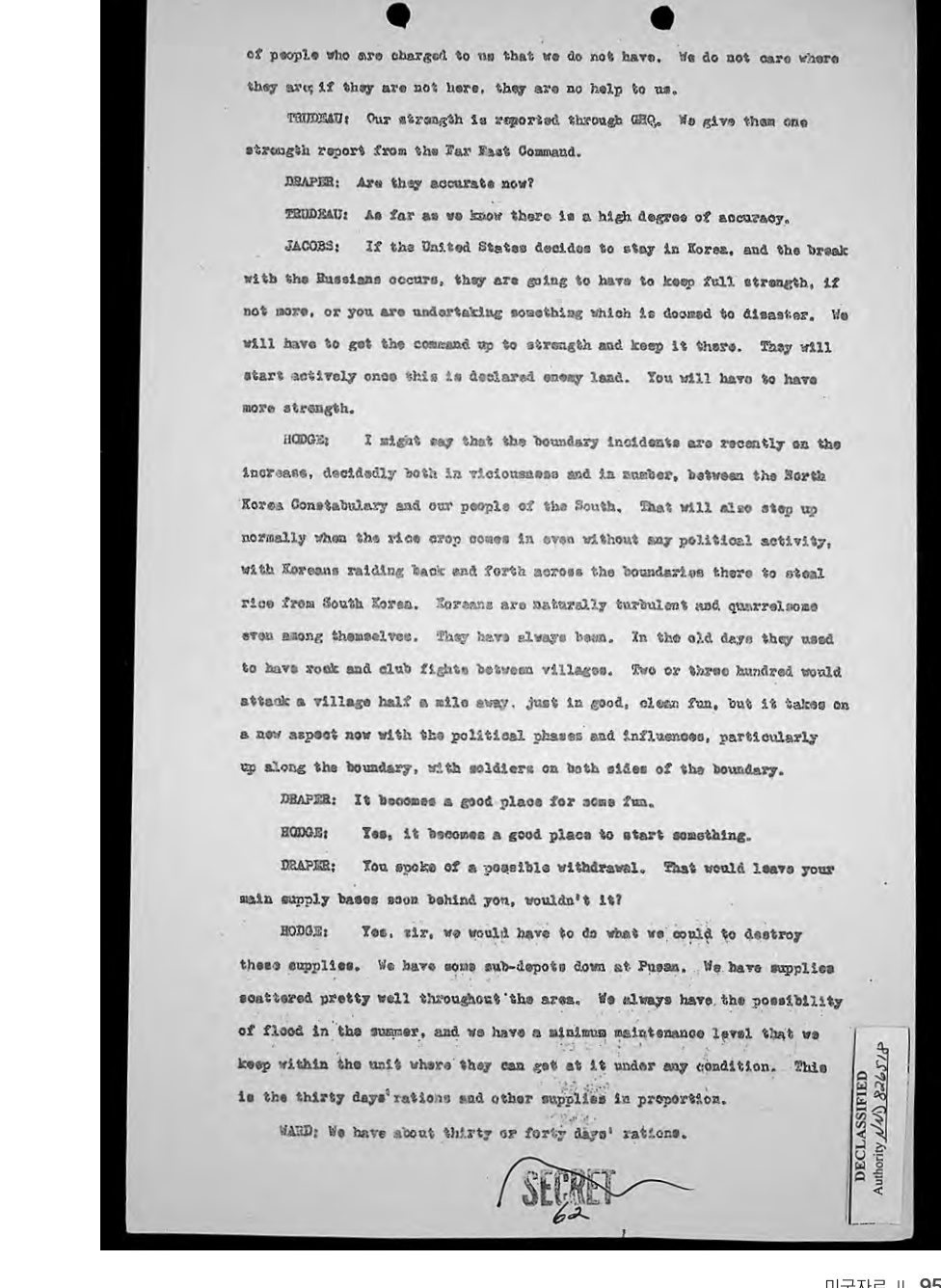
p.95
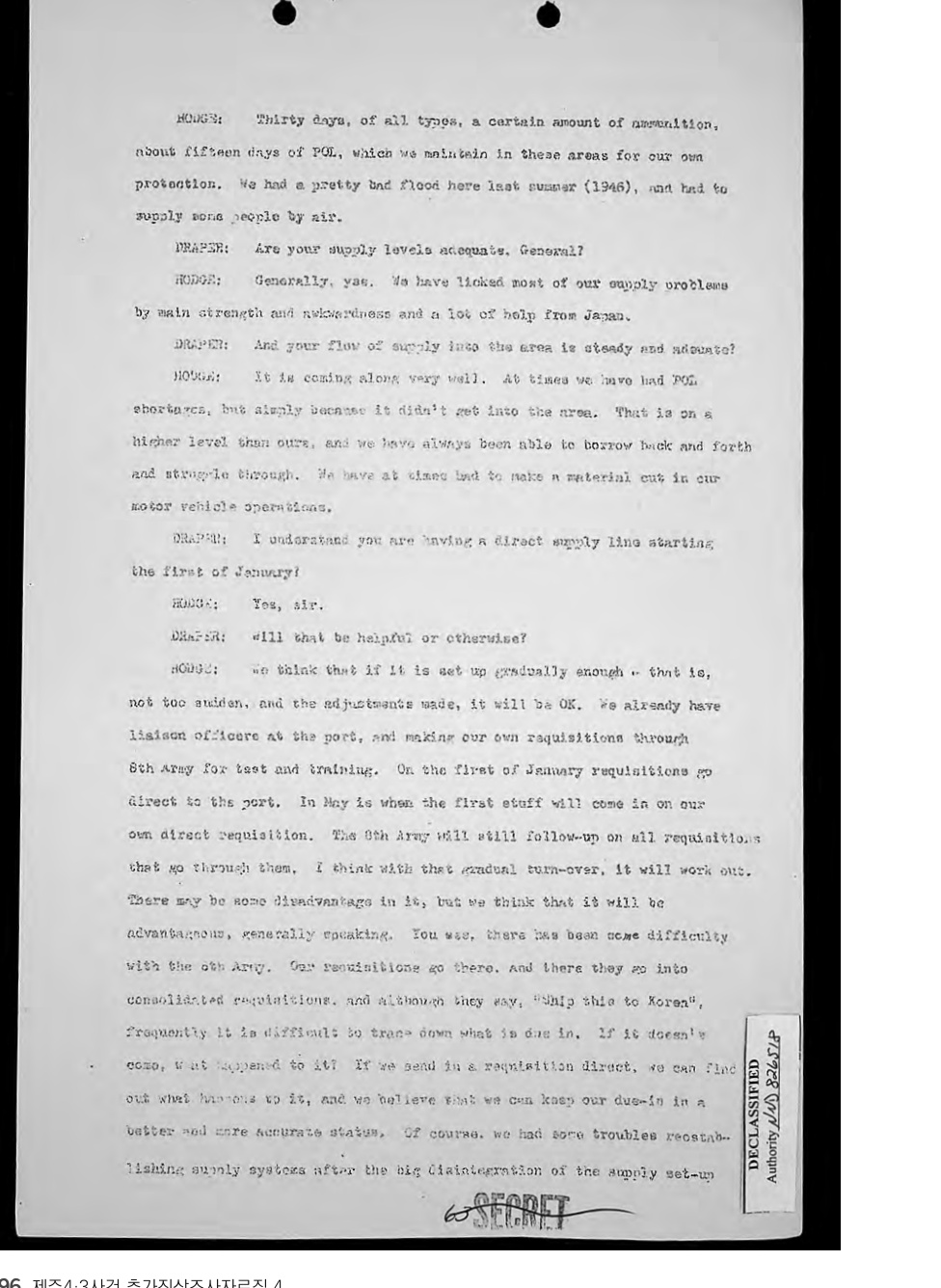
p.96
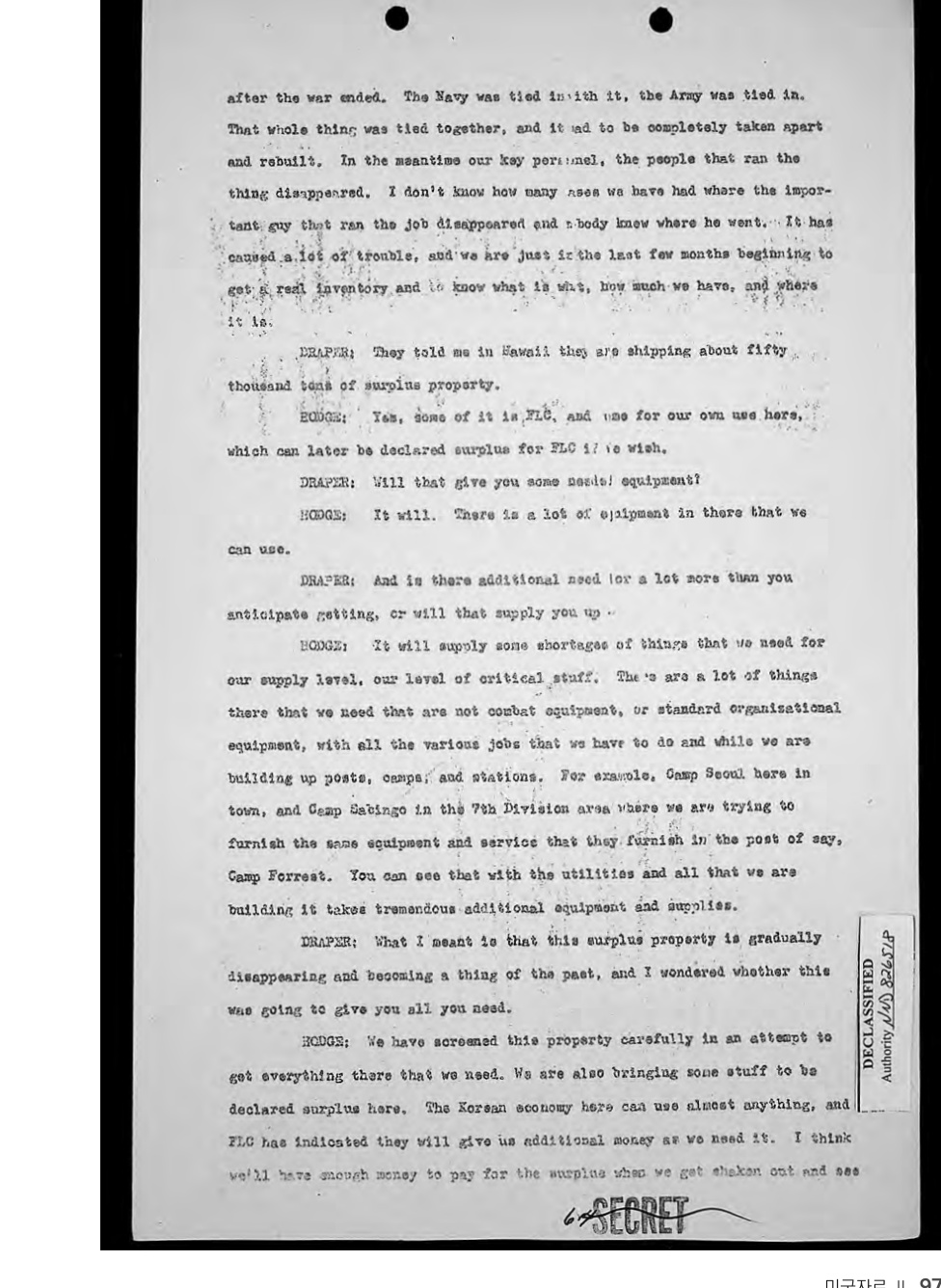
p.97
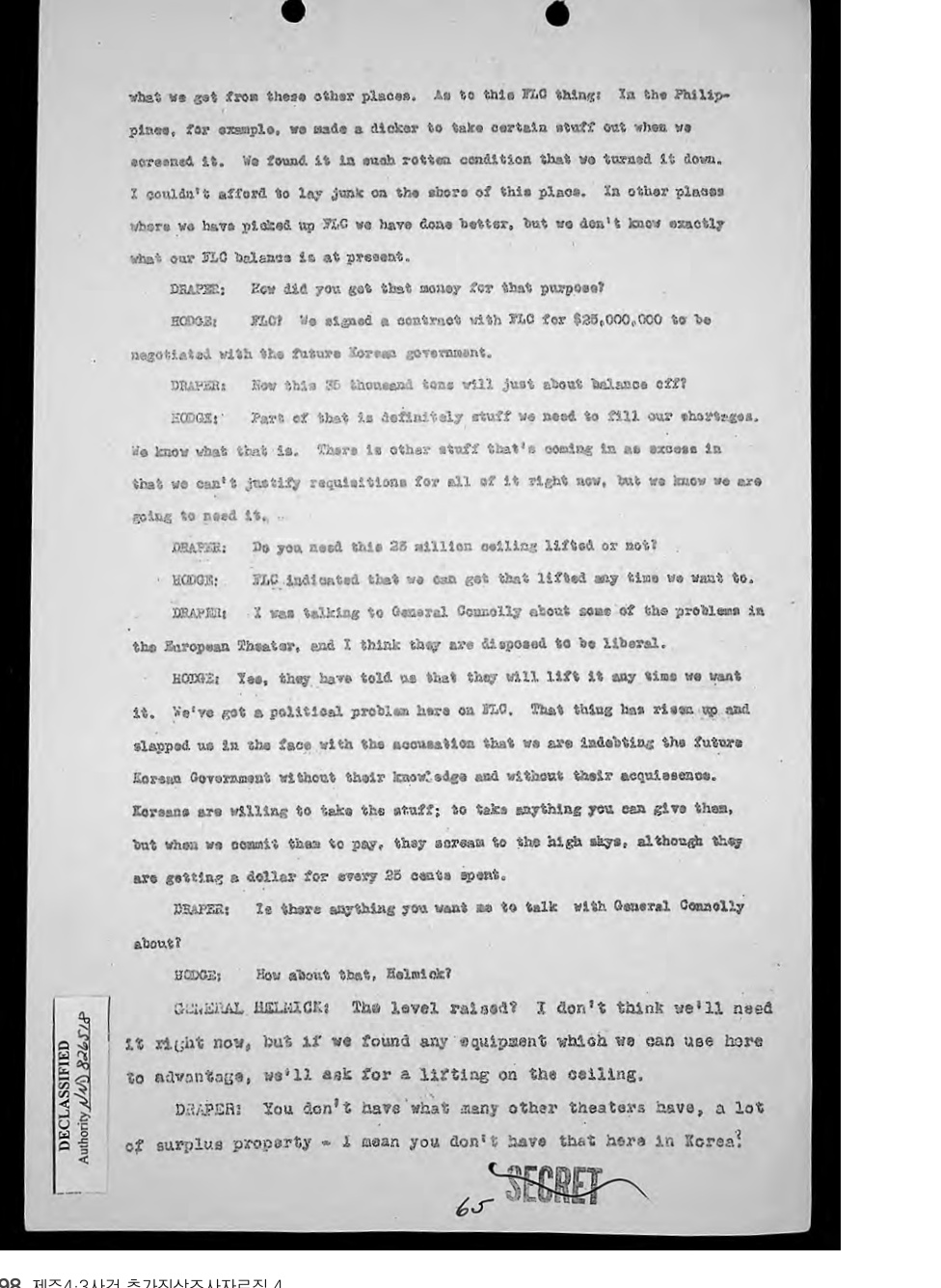
p.98
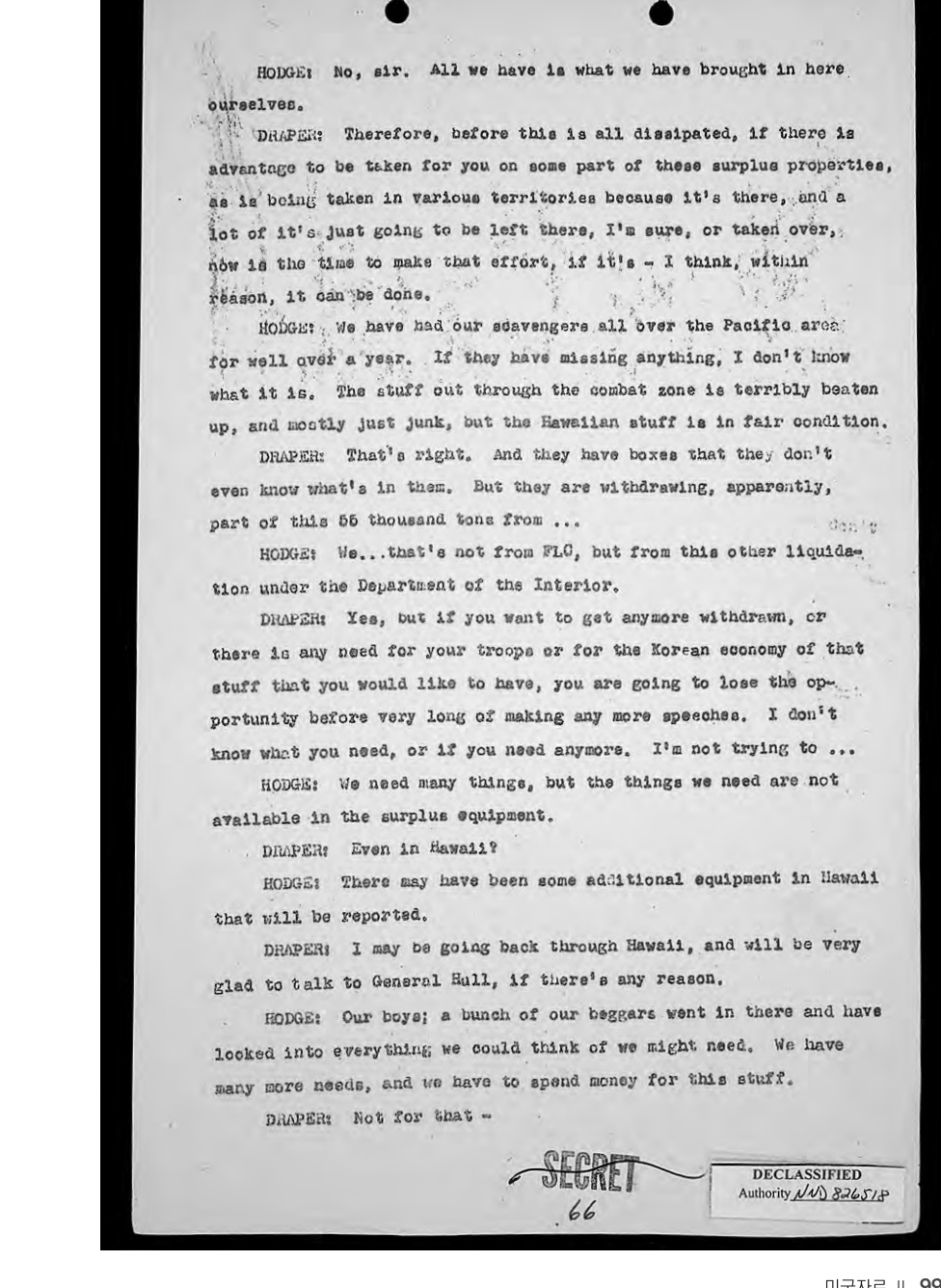
p.99
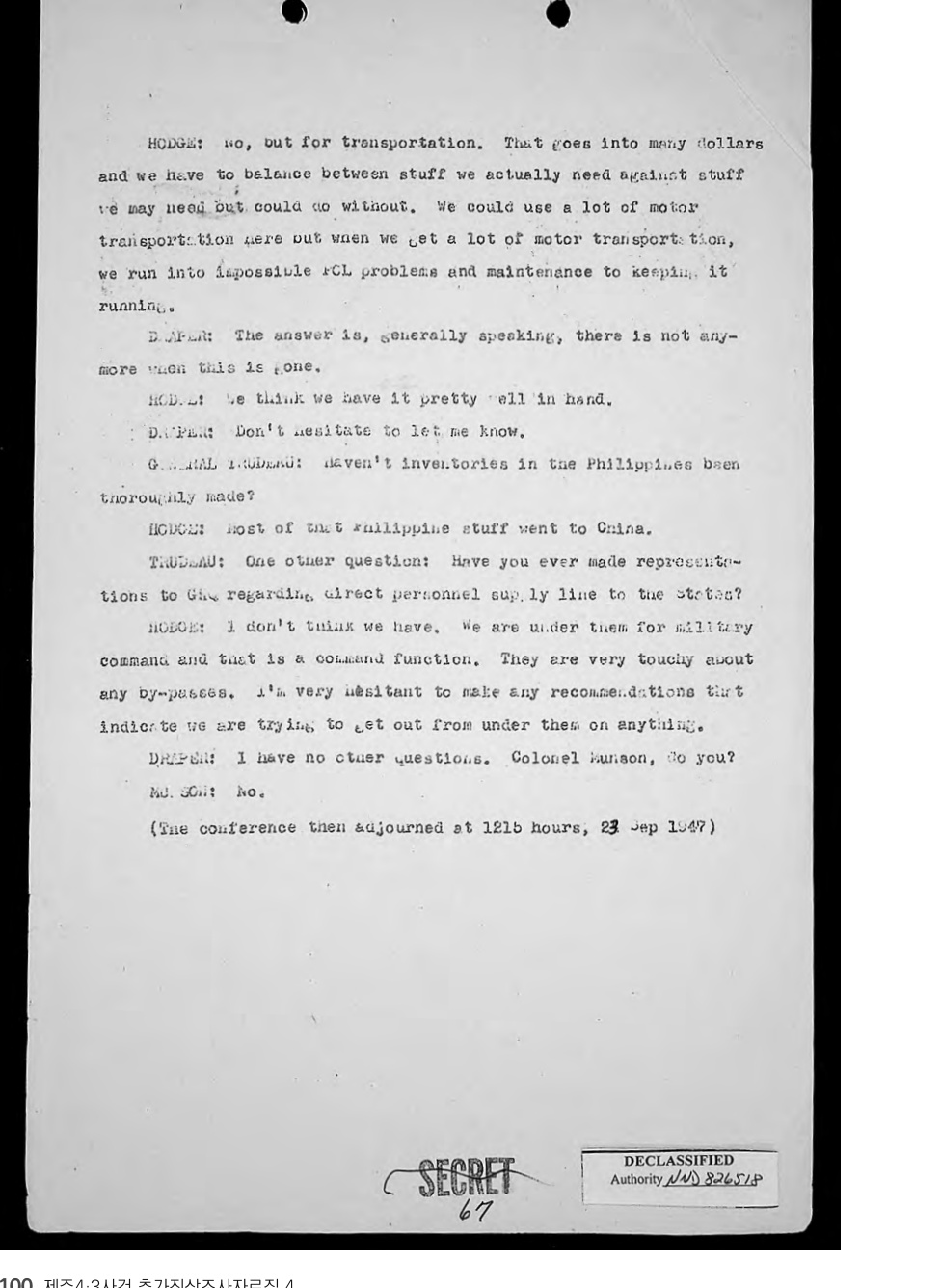
p.100
2급비밀
육군성차관 드래퍼(Draper) 일행을 위한 오리엔테이션
발표자: 하지(Hodge) 사령관
1947년 9월 23일 오전 9시
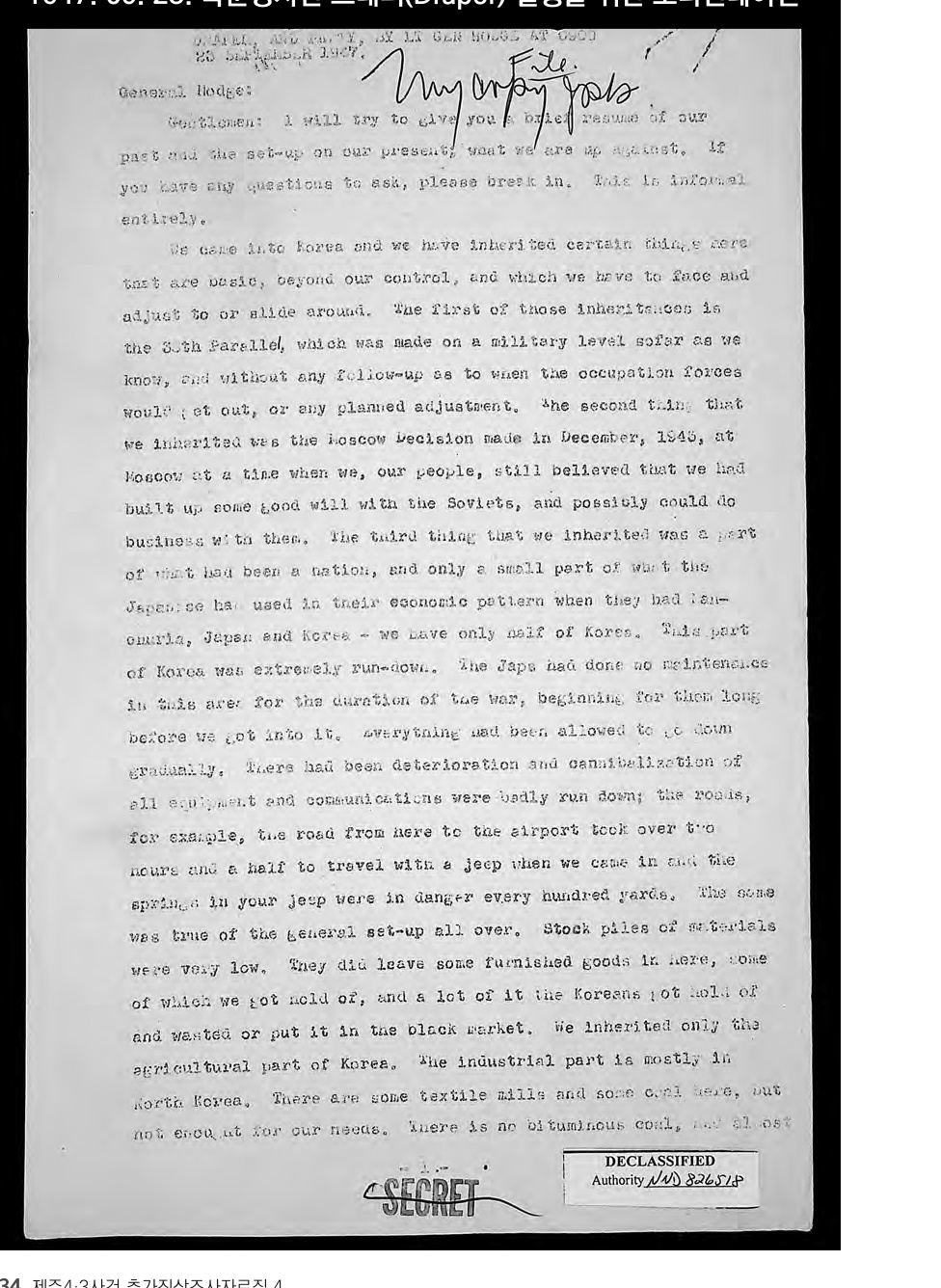
하지 사령관: 여러분, 우리가 과거와 현재 어떤 문제에 봉착했는지 간단히 설명 드리겠습니다. 질문이 있으시면 얘기 중이라도 좋으니, 언제든 말씀해주시기 바 랍니다. 격식 없이 편안하게 진행하겠습니다.
조선에 와서 인계받은 일 중 어떤 것들은 기본적인 것이었으나, 우리의 통제 밖에 있는 일들은 맞닥뜨려 조정하거나 그냥 넘어가야 했습니다. 그렇게 이어받은 일 가운데 첫번째는 38도선입니다. 38도선은 군사적 차원에서 정해졌고 점령군이 빠져나갔을 때의 후속 조치나 어떠한 조정 계획도 정해진 바가 없는 것으로 알 고 있습니다. 두 번째 인계 사안은 모스크바 결정으로, 이는 우리가 아직 소련과 친선 관계에 있으면서 협력의 가능성을 믿었던 1945년 12월에 체결된 것입니다.
세 번째로 이어받은 것은 한때 한 국가였던 지역의 일부로, 일본이 만주와 일본 그리고 조선을 가지고 있을 당시 경제 방식에 사용했던 것의 작은 부분에 불과했 습니다. 우리는 조선의 절반만 갖고 있습니다. 남조선은 완전히 황폐한 상태였습 니다. 일본은 전쟁 시작 때부터 우리가 들어오기 전까지 긴 전쟁 기간 동안 이 지 역을 관리하지 않았습니다. 모든 것은 무너지기 일보 직전이었습니다. 황폐화가 진행 중이었고 모든 장비에서 사용 가능한 부품을 떼어내 재사용하고 있었습니 다. 통신 상태도 심각했습니다. 예를 들어, 우리가 처음 들어왔을 때는 이곳에서 공항까지 지프로 두 시간 반이 걸렸고 지프의 스프링이 91m(100야드)마다 문제를 일으켰습니다. 이 같은 상황은 전국에서 흔했습니다. 자재 비축량도 매우 적었 습니다. 일부 남겨진 비치품이 있었는데, 일부는 우리가 갖고 나머지는 조선인들이 갖다 쓰거나 암시장에 내다 팔았습니다. 우리는 조선의 농업 부분만 인계 받았 습니다. 산업 부문은 대부분 북조선에 있습니다. 이곳에는 소수의 직물 공장과 석 탄 광산이 있지만 필요한 양에 비해 그 수가 충분하지 않습니다. 역청탄도 없고
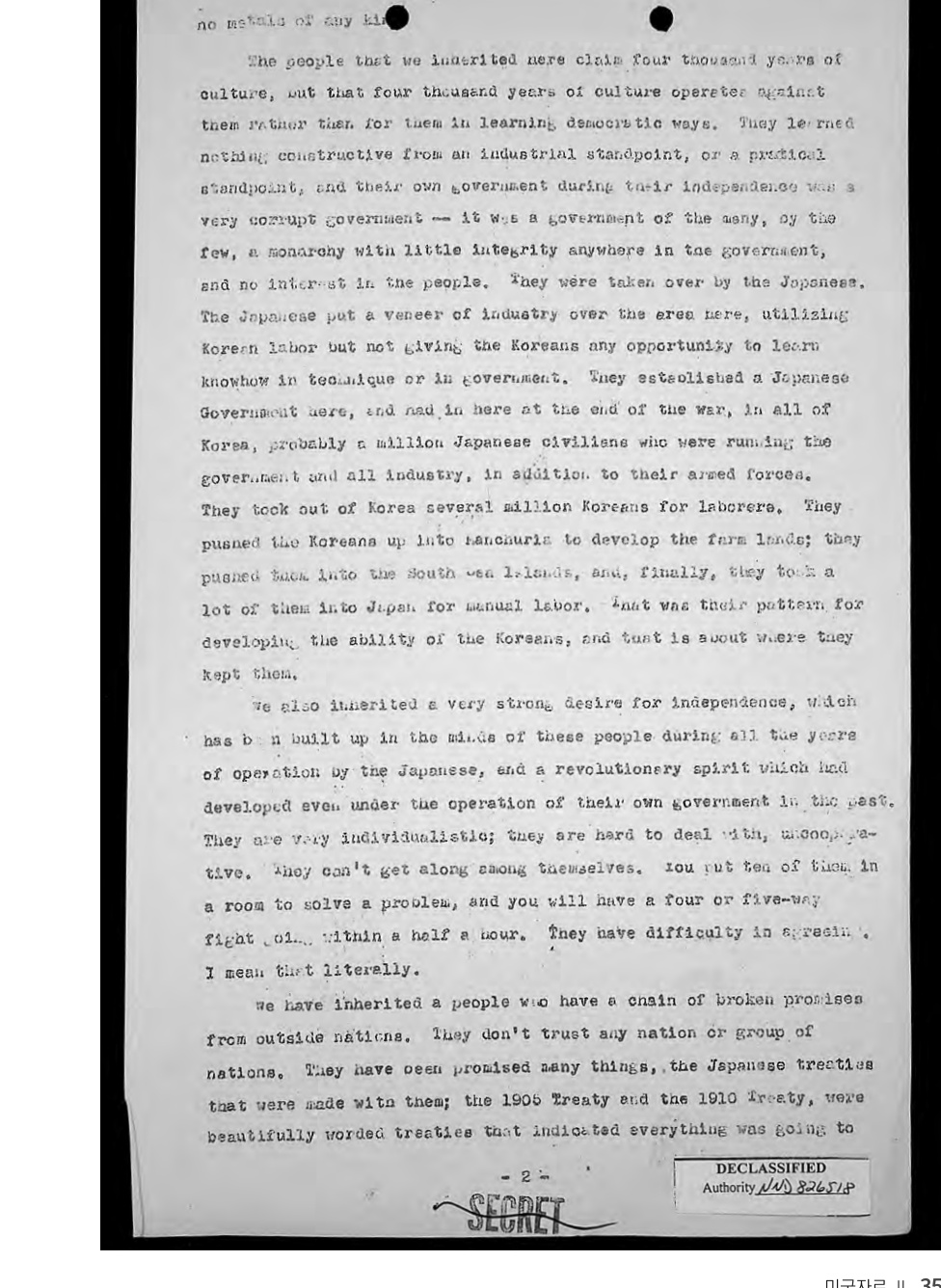
금속은 거의 모든 종류가 없습니다.
이곳 사람들은 자신들에게는 4,000년의 문화가 있다고 말하지만, 그 4,000년의 문화가 조선인들이 민주적인 방식을 습득하는 데 있어 긍정적인 일 보다는 다소 부정적으로 작용하고 있습니다. 산업적 또는 실용적인 견지에서 봤을 때 이곳 사 람들은 건설적인 것을 배우지 못했으며 독립 후 조선 정부는 매우 부패한 상태였 습니다. 조선 정부는 소수가 통치하는 다수의 정부로서, 정부 어디에서도 청렴함은 찾아볼 수 없고 인민에게 관심이라곤 전혀 없는 군주제였습니다. 조선은 일본의 식민지였습니다. 일본은 이 지역에 산업이라는 겉치레를 갖다 붙이고 조선의 노동력을 이용하면서도 조선인들에게 기술이나 정부에 관한 노하우를 배울 기회는 주지 않았습니다. 일본은 이곳에 일본 정부를 세웠으며, 전쟁이 끝났을 당시에도 조선 전역에는 군대 외에도 100만여 명의 일본 민간인이 정부와 각종 산업을 운영하고 있었습니다.
일본은 수백만 조선인들의 노동력을 갈취했습니다. 조선인들을 만주로 강제 이 주시켜 농장을 개발하게 했고 남양군도로 강제 동원했으며, 그리고 마침내 그중 다수는 일본으로 끌고 가 육체노동에 투입시켰습니다. 이것이 일본인들이 조선인의 능력을 개발하는 방식이었고 일본인들은 조선인들을 그런 곳으로 보냈습니다.
우리가 인계받은 또 하나는, 독립에 대한 조선인들의 강한 열망입니다. 그것은 일제 치하에 있는 기간 내내 이들의 마음속에 자리 잡은 것으로, 과거 조선 정부 치하에 있을 때에도 발전되어 왔던 혁명 정신입니다. 조선인들은 매우 개인주의 적이고 다루기 어려우며 비협조적입니다. 서로 어울리며 잘 지내지 못합니다. 이 들을 한 방에 넣고 문제를 풀라고 하면 30분 동안 네댓 가지 방식으로 싸울 것입 니다. 합의를 도출하는 데도 어려움을 겪습니다. 말 그대로입니다.
우리에게 인계된 사람들은 다른 나라들로부터 연쇄적으로 약속을 배신당한 경 험을 갖고 있습니다. 그래서 어떤 나라도, 집단도 믿지 않습니다. 그들에게 많은 약속을 했습니다. 일본과 맺은 조약뿐 아니라 1905년 조약, 1910년 조약 내용은
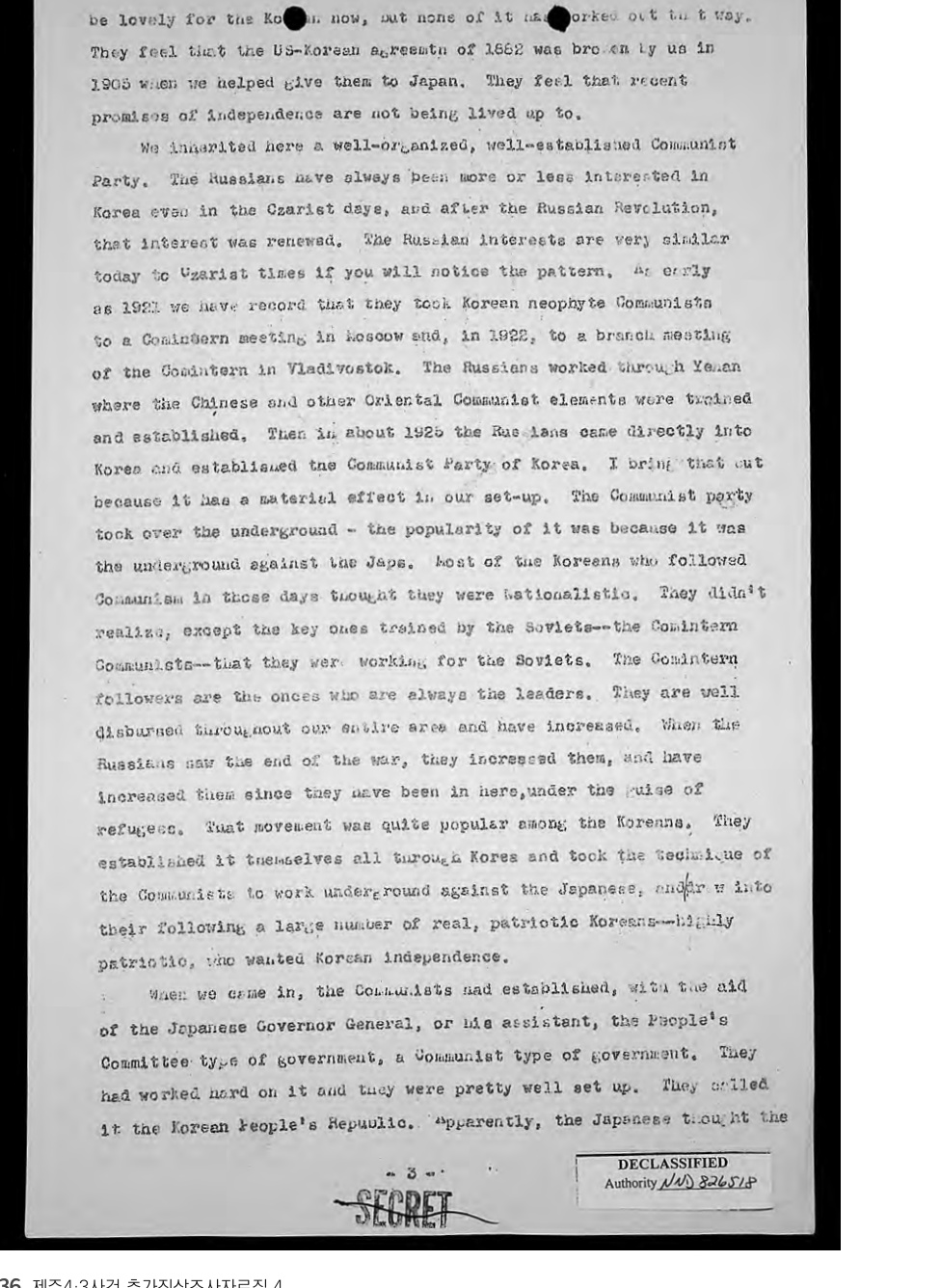
모두 조선인에게 이로울 것이라는 희망을 내비치는 보기 좋은 문구로 되어 있었지만, 그중 어떤 조항도 말 그대로 이루어지지 않았습니다. 조선인들은 1882년 조미조약을 우리 측이 깼다고 생각합니다. 1905년 조선이 일본으로 넘어가는 것을 우리가 도왔다고 보기 때문입니다. 또한 조선인들은 최근의 독립 약속이 기대에 부응하지 않고 있다고 여깁니다.
우리는 이곳에서 조직이 탄탄하고 체계적으로 수립된 공산당을 넘겨받았습니다. 러시아는 전제 군주제 시절이나 러시아 혁명 이후에도 늘 조선에 어느 정도의 관심을 갖고 있었는데, 그 관심이 다시 시작되었습니다. 여러분이 그 패턴을 알아차리셨다면 러시아의 관심은 전제 군주제 시절과 현재 매우 유사하다는 것을 아실 겁니다. 1921년 우리 측 기록에 따르면 러시아는 새로운 조선인 공산주의자들을 모스크바에서 열린 코민테른 회의에 데려갔고, 1922년에는 블라디보스토크에서 열린 코민테른 지부 회의에도 데려갔습니다. 러시아는 옌안 전역에서 활동하며 중국인과 기타 동양인 공산 분자들을 훈련하고 조직했습니다. 그 후 1925년경 러시아는 조선으로 바로 들어와 조선공산당을 창당했습니다. 이 사건은 우리 계획에 중요한 영향을 미치기 때문에 말씀드리는 것입니다. 공산당은 지하세력을 장악했습니다. 공산당이 인기를 얻은 이유는 일본에 대항하는 지하세력이었기 때문입니다. 이 시기에 공산주의를 추종한 조선인 대부분은 국수주의자였습니다. 소련에서 훈련을 받은 주요 인사들(코민테른 공산주의자)을 제외하고, 그 추종자들은 자신이 소련을 위해 일하고 있다는 사실을 알지 못했습니다. 코민테른 추종자들은 언제나 리더입니다. 그들은 남조선 전역에 고루 흩어져 있으며 그 수 또한 증가했습니다. 전쟁이 끝나자 러시아는 코민테른 추종자를 늘렸고, 여기 남조선에 그들이 생긴 후로는 피난민을 구실로 그 수를 확대해 갔습니다. 이 움직임은 조선인들 사이에서 큰 인기가 있었습니다. 러시아인들은 조선 전역에서 조직을 구축했고 공산주의자들이 일제에 저항하는 지하세력으로 활동할 수 있도록 기술을 전수했으며, 조선의 독립을 원하는 애국심이 투철한 진정한 조선인 애국자다수를 추종자로 끌어들였습니다.
우리가 남조선에 들어왔을 때 공산주의자들은 일제 총독 또는 그 보좌관의 도
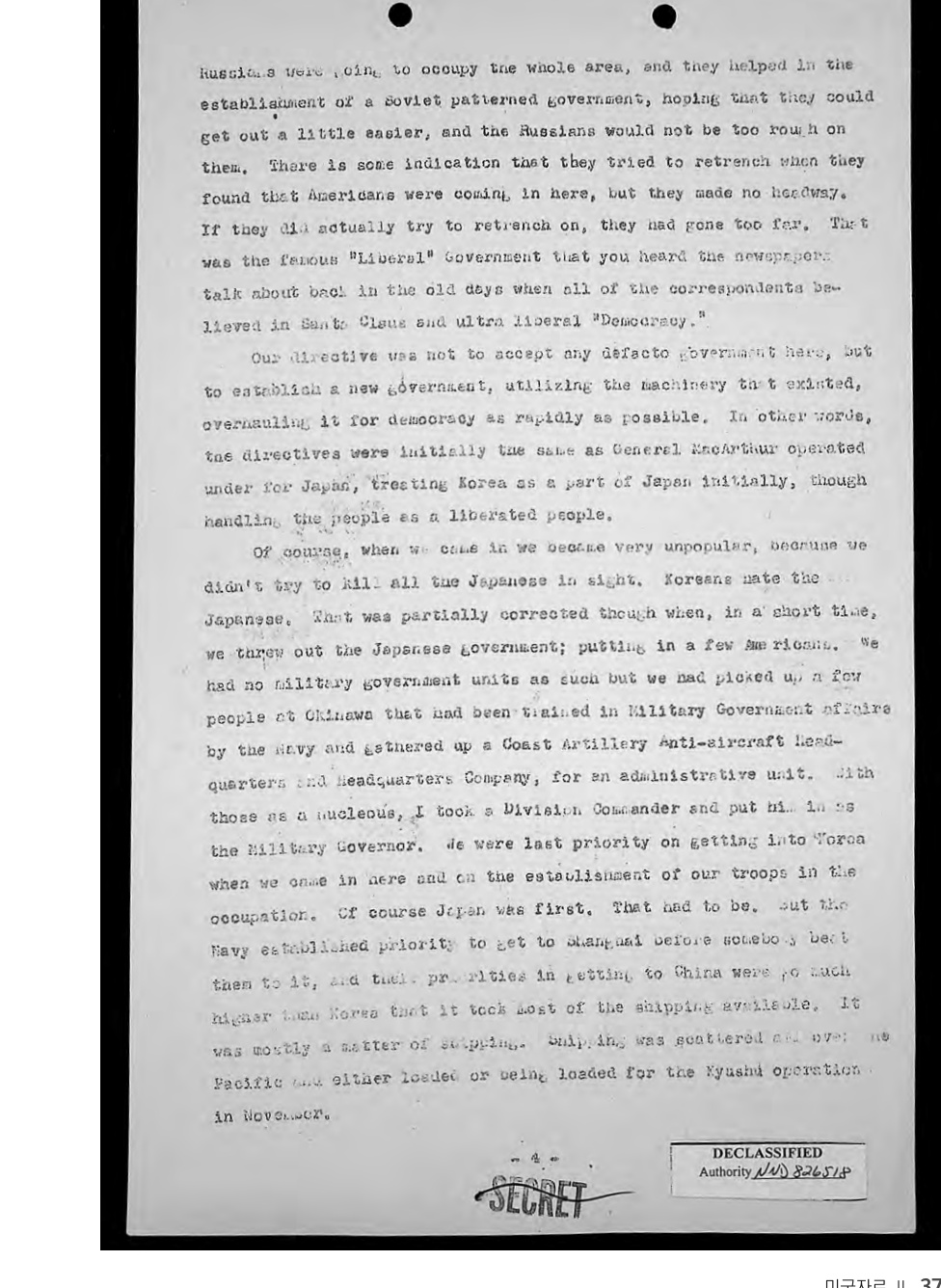
움으로 인민위원회 형식의 정부, 공산주의자 형식의 정부를 수립했습니다. 그들은 열심히 일했고 꽤 탄탄한 정부를 조직했습니다. 그들은 이 정부를 조선인민공화국이라고 불렀습니다. 일본은 러시아가 조선 전체를 점령할 것이라 생각했으며, 좀 더 쉽게 떠날 수 있고 러시아가 자신들을 너무 거칠게 대하지 않기를 바라며 소련식 정부 수립을 지원했다고 전해집니다. 남조선에 미국이 들어온다는 사실을 알았을 때 일본은 자신들의 규모를 줄이려 했지만 아무런 진전도 없었다는 암시가 몇 가지 있습니다. 일본이 실제 그러한 긴축을 시도했다면 그건 도가 지나친 것입니다. 그것은 모든 특파원들이 산타클로스나 급진적 자유 "민주주의"를 믿었던 그 옛날 시대에 대해 말하는 신문 사설에서나 보이는 유명한 "자유주의" 정부였습니다.
우리의 기조는 이곳의 실재 정부는 수용하지 않으면서 현존하는 조직을 활용하여 이들을 가능한 한 신속하게 민주주의에 맞게 조정하여 새로운 정부를 수립하는 것입니다. 즉, 처음 맥아더 원수가 일본에 시행한 것처럼 조선인을 해방된 국가의 인민으로 대우하되 일본의 일부로 여기는 것입니다.
물론 우리가 처음 들어왔을 때는 바로 눈 앞에서 일본인을 모두 죽이지 않았기 때문에 우리는 인기가 아주 없었습니다. 조선인들은 일본인을 싫어합니다. 이 문제는 우리가 일본 정부를 없애고 미국인을 몇 명 앉히는 짧은 시간 동안 약간 고쳐졌습니다. 우리에게는 통상 군정 부대라는 것이 없었지만 해군에서 군정 업무훈련을 받은 인력을 오키나와에서 몇 명 선발하였고, 연안포병대 대공본부와 본부중대의 인력을 모아 행정부대를 창설했습니다. 이 인력을 주축으로 사단장 한명을 데려와 그를 군정장관에 앉힐 수 있었습니다. 이곳에 왔을 때, 우리가 조선에 들어가고 또 군대를 조직하는 것은 우선순위에서 마지막이었습니다. 당연히 일본이 1순위였습니다. 그래야만 했습니다. 하지만 해군은 공격받기 전 상하이에도착하는 것을 우선으로 정했고 중국 도착이라는 그 우선순위는 가능한 해상 운송 수단의 대부분을 써야 하는 조선보다 훨씬 높았습니다. 대부분이 운송 문제였습니다. 운송 수단은 태평양 전역에 흩어져 있었고 11월 규슈 작전을 위해 적재를 마쳤거나 적재가 진행 중이었습니다.
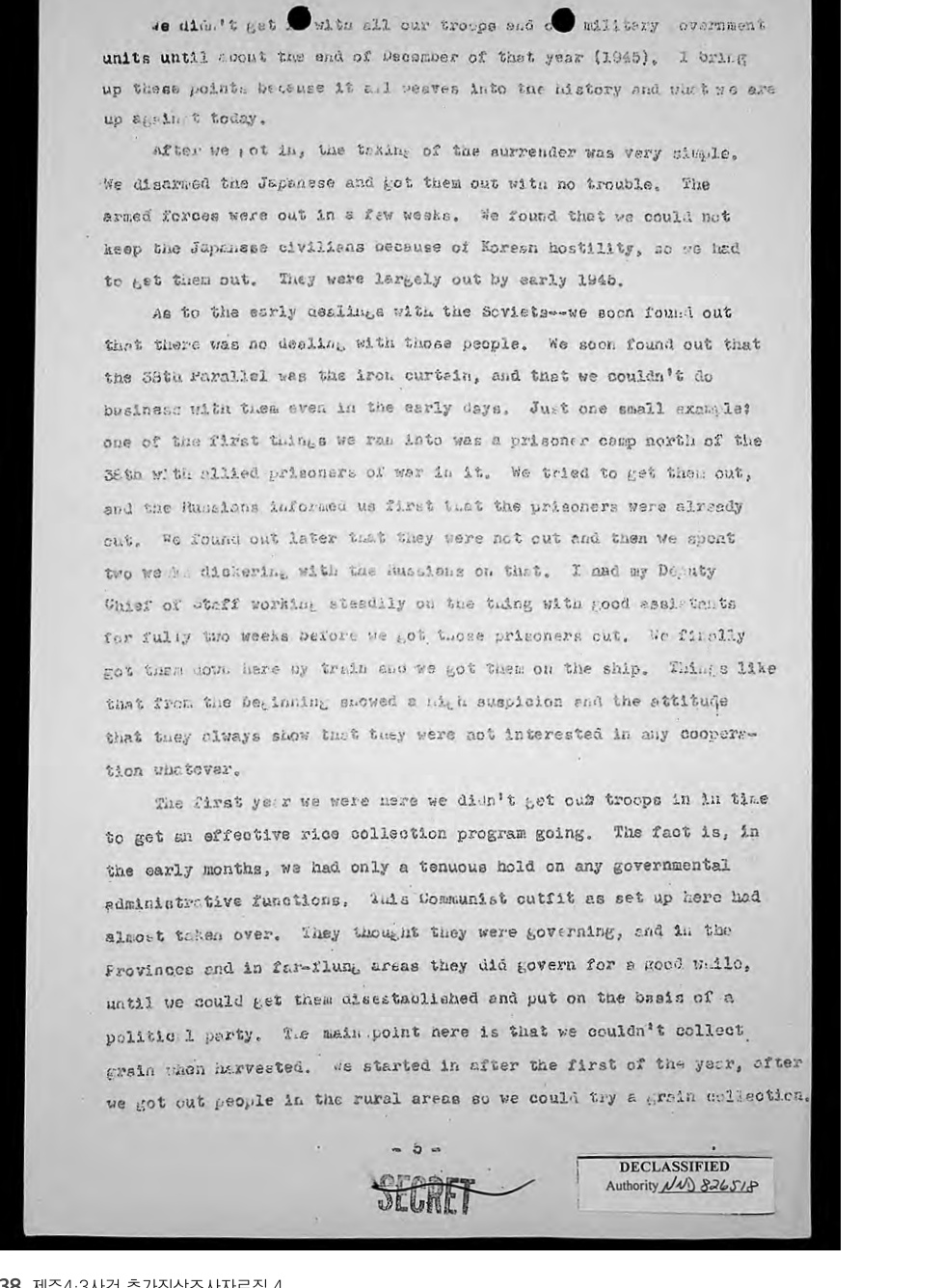
우리는 부대 전원을 데리고 들어온 것이 아니었으며, 우리 군정부대는 그해(1945년) 12월 말 께까지 들어오지 않았습니다. 제가 이것을 말씀드리는 이유는 이 모든 것이 과거, 그리고 현재 우리가 처한 상황과 이어지기 때문입니다.
여기 들어와 일본으로부터 항복을 받아내는 일은 꽤 간단했습니다. 일본을 무장해제시킨 뒤 문제없이 내보냈습니다. 일본군은 몇 주 후 빠져나갔습니다. 조선인들의 적대심 때문에 일본 민간인들 역시 조선에 머무르게 할 수 없다는 것을 깨닫고 그들도 내보내야 했습니다. 추방은 대부분 1946년 초에 이루어졌습니다.
처음에는 소련인들을 다루는 문제와 관련해, 그런 사례가 없다는 것을 알게 됐습니다. 우리는 38도선은 철의 장막이며 초기에도 소련과 공조할 수 없다는 사실을 곧 깨달았습니다. 한 가지 사소한 예를 들어보겠습니다. 우리가 맡게 된 첫 번째 업무 중 하나는 연합군 전쟁 포로가 수용된 38도선 이북의 포로수용소 문제였습니다. 우리는 포로 석방을 시도했고 러시아는 포로들이 이미 석방되었다고 먼저 알려왔습니다. 우리는 포로들이 석방되지 않았다는 사실을 나중에야 알았고 이후 러시아와 그 문제를 흥정하는 데 2주를 썼습니다. 저는 저를 잘 보좌해준 제부참모장과 함께 포로들을 석방하기까지 꼬박 2주 동안 꾸준히 작업했습니다. 그리고 마침내 포로들을 기차와 선박으로 이곳에 데려왔습니다. 이런 일들은 처음부터 강한 의구심을 들게 했습니다. 그들은 협조에 있어서는 어떤 것이든 전혀 흥미가 없다는 듯한 태도를 취했습니다.
조선에 온 첫해에는 미곡수집령을 효과적으로 시행할 부대가 제때 들어오지 않았습니다. 사실 초반 몇 개월 동안은 정부의 행정 기능을 겨우 유지하는 정도였습니다. 이곳은 이미 자리를 잡은 공산주의 조직이 거의 장악한 상태였습니다. 이들은 자신들이 통치를 하고 있다고 여기며 지방과 오지에서 우리가 공산주의 조직들을 해체하고 정당의 기초를 놓기 까지 꽤 오랫 동안 실제 통치를 하기도 했습니다. 여기서 핵심은 수확 시기에 곡물을 수집하지 못했다는 것입니다. 연초 이후에나 사람들을 지방으로 보내 곡물 수집을 하려 해보았습니다.
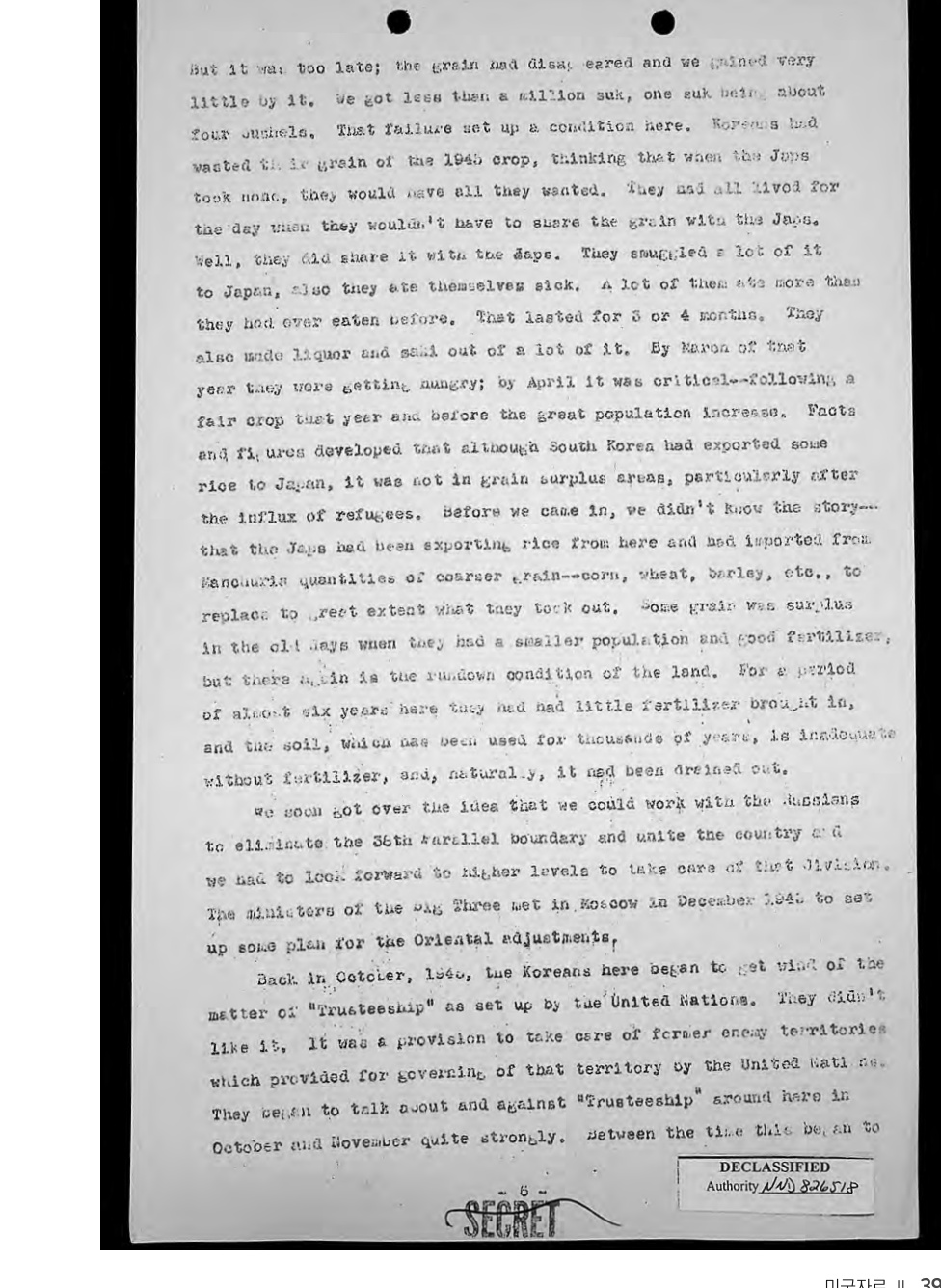
하지만 너무 늦었습니다. 곡물은 사라졌고 소득은 거의 없었습니다. 우리가 걷은 양은 100만 석 미만이었습니다. 한 석은 4부셸2 정도입니다. 그때의 실패가 지금의 상황으로 이어졌습니다. 조선인들은 일본이 아무것도 가져가지 않을 때 원하는 것을 모두 가질 수 있다고 생각하여 1945년 수확한 곡물을 낭비했습니다. 일본과 곡식을 나눌 필요가 없게 되자 모두 오늘만을 위해 사는 것처럼 지냈습니다. 사실은 일본과 나누었으면서 말이죠. 많은 양을 일본으로 밀수하기도 하고 과식으로 병이 나기도 했습니다. 많은 사람이 전보다 많이 먹었습니다. 그런 생활이 3~4개월 지속되었습니다. 조선인들은 술과 사케를 만들어 많은 양을 반출했습니다. 그해 3월이 되자 사람들은 배가 고파졌고 4월에는 상황이 더 심각해졌습니다. 그해에는 평작이 이어졌고 인구도 늘어났습니다. 남조선이 일본으로 쌀을 수출하기는 하지만 남조선은 곡물이 남는 지역이 아니며, 특히 피난민이 유입된 후에는 더욱 그렇다는 것이 수치로 증명되었습니다. 이곳에 들어오기 전 우리는 일본이 이곳에서 쌀을 수출하고 만주에서 옥수수, 밀, 보리 등 상당량의 미정제 곡물을 수입하여 자신들이 가져간 엄청난 양을 대체하고 있다는 사실은 몰랐습니다. 인구가 적고 좋은 비료가 있었던 과거에는 일부 곡식이 남았지만 이제는 토지도 황폐화되었습니다. 6년가량 이곳에 머물면서 일본은 비료는 거의 들여오지 않았고 수천 년간 사용해온 토지는 비료 없이는 비옥하지 않으므로 자연스럽게 소진되었습니다.
곧 우리는 러시아와 협력하여 38선 경계를 없애고 나라를 통일시키자는 생각을 하게 되었고, 고위층에서 이 분단 문제를 신경 써 주기를 고대했습니다. 3대국정상들은 1945년 12월에 모스크바에서 만나 동양 재편을 위한 몇 가지 계획을 세웠습니다.
1945년 10월로 돌아가 이곳의 조선인들은 유엔에서 정한 "신탁통치" 문제에 대해 듣게 되었습니다. 조선인들은 좋아하지 않았습니다. 이는 과거 적대국의 영토를 처리하기 위한 것으로서 유엔이 그 영토를 통치하기 위해 정해진 조항이었습니다.
2) [역주] 부셸(bushel) - 곡물이나 과일의 중량 단위로 8갤런에 해당하는 양.
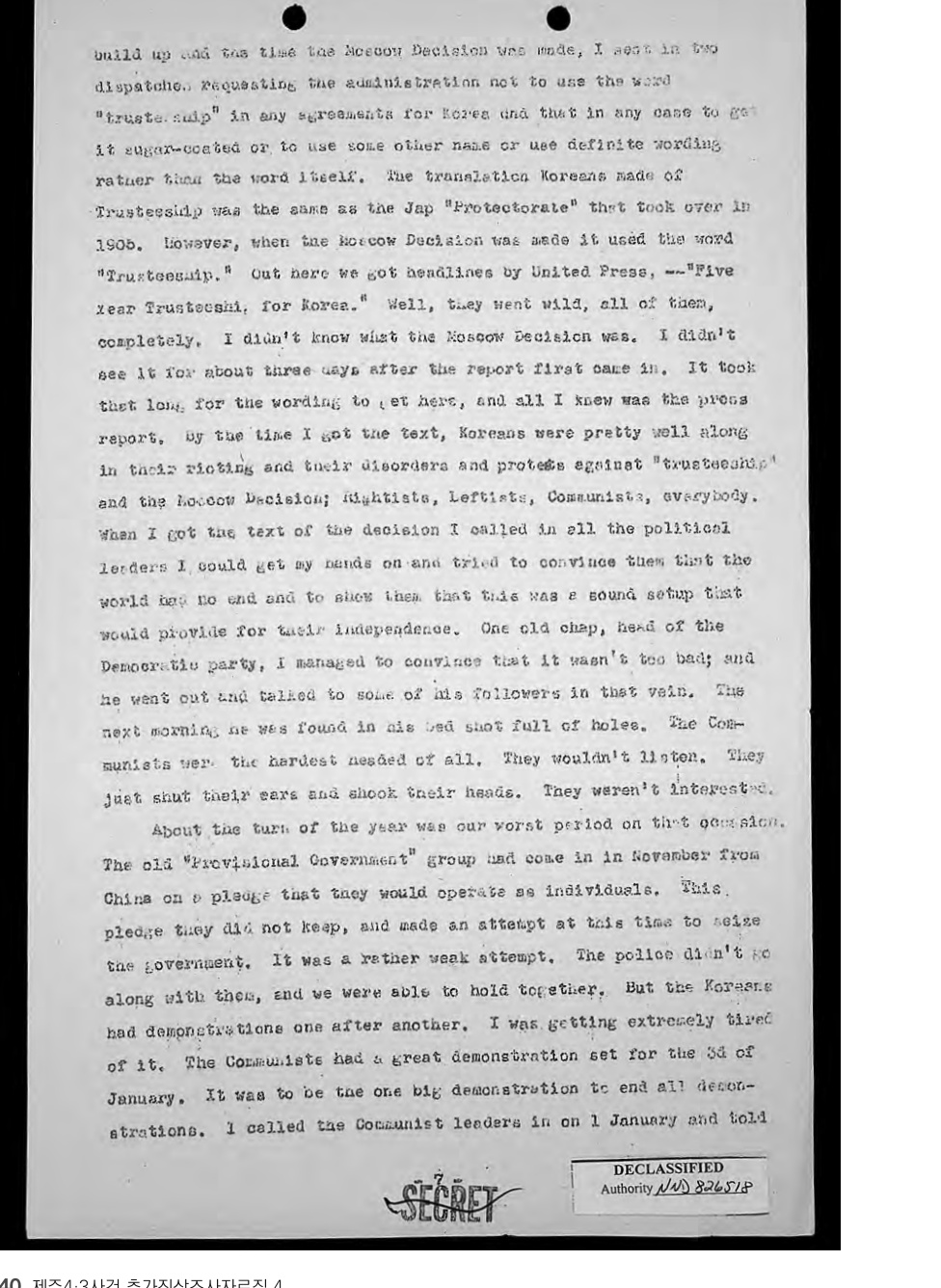
니다. 조선인들은 10월과 11월 조선 내 '신탁통치'에 대해 토론하기 시작하면서 이에 꽤 강력하게 반대했습니다. 이 조항이 확립된 시기부터 모스크바 결정이 내 려진 시간 사이 저는 조선에 관한 모든 합의문에 '신탁통치'라는 용어를 사용하지 말고 어떤 경우든 완곡한 표현을 사용하거나 다른 명칭 또는 어떤 단어 자체보다는 애매한 문구를 사용할 것을 요청하는 두 개의 전문을 행정부에 보냈습니다. 조 선인들은 신탁통치를 1905년 점령했던 일본의 '보호국'과 같은 의미로 해석합니 다. 하지만 모스크바 결정 합의문에는 '신탁통치'라는 단어가 사용되었습니다. 이 곳에는 '조선 5년간의 신탁통치'라는 UP통신의 헤드라인이 전해졌습니다. 조선인 들은 격노했습니다. 모든 조선인이 말이죠. 저는 모스크바 결정이 무엇인지 몰랐 습니다. 저는 보고서가 처음 나오고 3일 동안은 그것을 보지 못했습니다. 해당 문 구를 말하기까지 오랜 시간이 걸렸고, 제가 아는 내용은 모두 언론이 보도한 내용 이었습니다. 제가 본문 내용을 받을 때까지 조선인들은 상당히 순조롭게 폭동과 항의시위를 이어가고 있었고, 우파, 좌파, 공산주의자 모두 '신탁통치'와 모스크바 결정 반대 시위를 진행했습니다. 결정문을 받은 후 저는 제가 모을 수 있는 정치 지도자를 모두 소집하여 세상이 끝나지 않았다고 설득하고, 조선인들에게 이 결 정은 독립을 선사하기 위한 건전한 조항이라는 것을 설명하려 노력했습니다. 민 주당 원로 당수에게도 그렇게 나쁜 것이 아니라고 설명하자 그는 밖으로 나가 일 부 추종자들과 대화를 나누었습니다. 다음 날 그는 침대에서 온몸에 총을 맞은 채 발견되었습니다. 공산주의자들은 누구보다 고지식합니다. 그들은 다른 사람들의 말을 듣지 않습니다. 귀를 막고 고개를 저으며 관심이 없습니다.
해가 바뀔 무렵이 최악의 시기였습니다. 과거 '임시정부'파는 개인 활동을 맹세 하며 11월 중국에서 들어왔습니다. 하지만 그 맹세를 지키는 대신 그 시기에 정권을 잡으려 했습니다. 다소 약한 시도이긴 했습니다. 경찰이 그들에게 협조하지 않 았으므로 우리는 단결할 수 있었습니다. 하지만 조선인들은 잇따라 시위를 했습 니다. 저도 정말 지쳐가고 있었습니다. 공산주의자들은 1월 3일 대규모 시위를 계 획했습니다. 모든 시위를 끝내는 큰 시위가 될 것이었습니다. 저는 1월 1일 공산
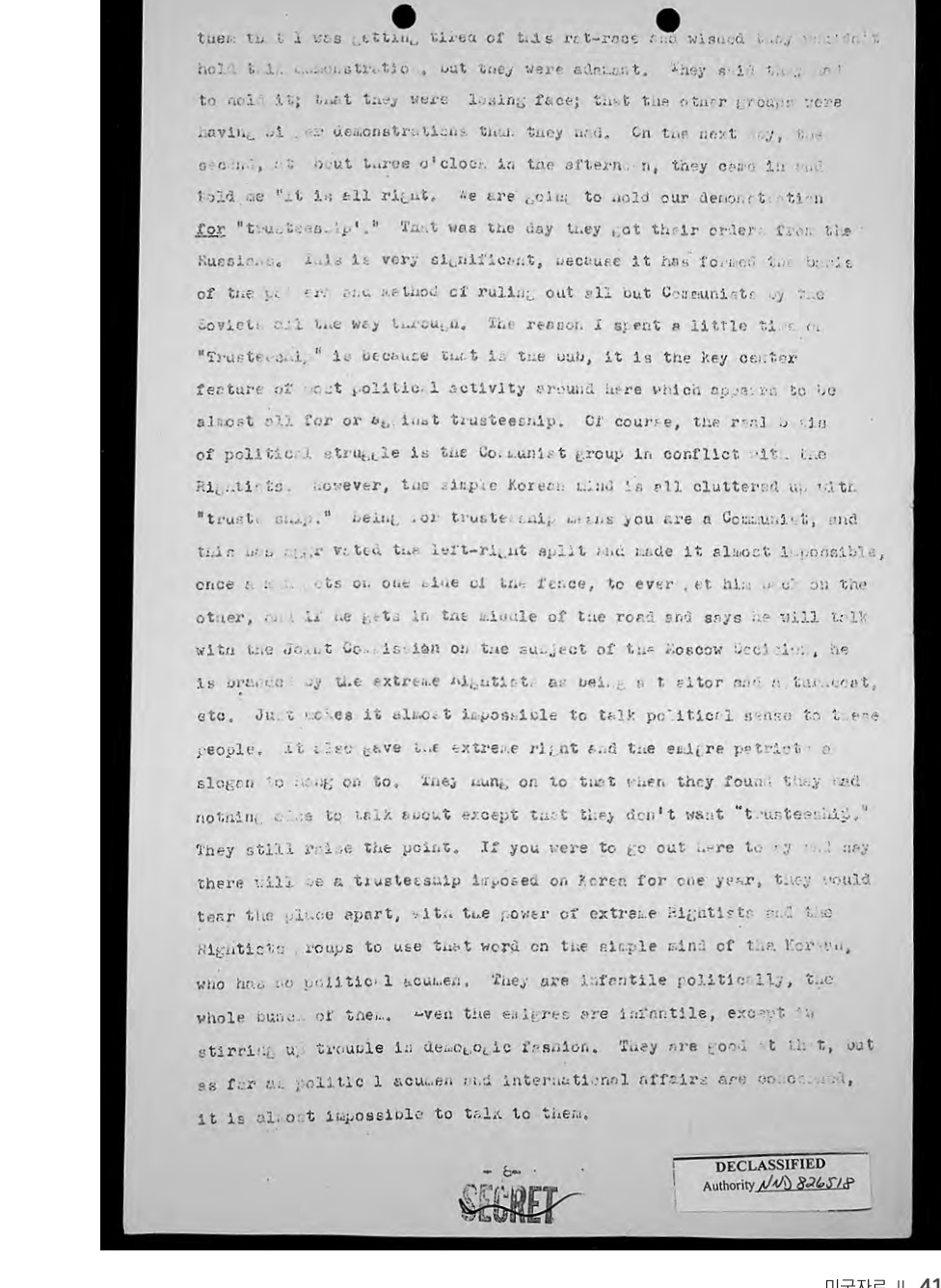
주의 지도자들을 소집하여 이 치열한 경쟁에 지쳐가고 있으며 이번 시위를 하지 말아 달라고 말했지만 그들은 단호했습니다. 자신들은 반드시 시위를 진행해야 하 며 만약 시위를 하지 않는다면 체면을 잃을 것이고, 다른 단체들이 자신들보다 큰 시위를 하고 있다고 말했습니다. 다음 날 오후 3시쯤 그들은 다시 찾아와 "좋습니 다. 신탁통치 찬성 시위를 하겠습니다"라고 말했습니다. 그날은 그들이 러시아에서 지령을 받은 날이었습니다. 이것이 중요한 이유는, 그것이 소련이 공산주의자를 제외한 모두를 일관되게 배제하는 방식과 수단의 토대가 되기 때문입니다.
제가 '신탁통치'에 시간을 좀 쓰는 이유는 그것이 핵심이기 때문입니다. 그것은 이곳에서 벌어지는 대부분의 정치 활동, 즉 신탁통치에 거의 모두가 찬성하거나 반대하는 활동에 핵심으로 작용하고 있습니다. 물론, 정치적 투쟁의 실질적 토대는 우파와 대립 관계에 있는 공산주의 집단입니다. 하지만 단순한 조선인들의 마 음은 모두 '신탁통치'로 어수선합니다. 신탁통치를 찬성하는 사람은 공산주의자라는 뜻입니다. 좌우 분할을 악화시켜 양자택일을 한 후에는 절대 반대쪽으로 돌아 갈 수 없습니다. 누군가 중도 노선을 취하고 모스크바 결정에 대해 미소공동위원 회와 대화를 하겠다고 말한다면, 그 사람은 극우파로 분류되어 배신자, 변절자 등으로 낙인이 찍힙니다. 이런 사람들에게 정치적 관점을 말하기란 거의 불가능합 니다. 또한 이로 인해 극우파와 망명한 애국지사들은 구호를 갖게 되었습니다. 이 들은 '신탁통치'를 원치 않는 것 말고는 할 말이 없을 때 이 구호에 집착했습니다.
그들은 여전히 그 점을 제기합니다. 여러분이 오늘 밖으로 나가 1년간 조선에서 신탁통치를 시행한다고 말한다면 극우파와 우파들은 정치적 통찰력이 없는 조선 인들의 소박한 마음에 그 단어를 사용하면서 현재 계신 곳을 초토화시켜 놓을 것 입니다. 그들은 모두 정치적으로 유아 수준입니다. 선동적인 방식으로 문제를 일 으키는 경우를 제외하고는 망명자들조차 유아 수준입니다. 무엇을 부수는 일에는 능숙하지만 정치적 통찰력과 국제 정세에 관해서는 대화가 거의 불가능합니다.
우리 훈령의 첫 번째 임무는 단순히 항복을 받아내 점령을 시작하는 것 이상을 얻는 것이며, 우리는 11월 날짜로 된 이 훈령을 1945년 12월에 지시했습니다. 이 것으로 우리는 시행 중인 업무를 그럭저럭 해 나갈 수 있었습니다. 하지만 모든
훈령에 우리는 중도 노선 정당을 구축하고 모든 정당을 합법적으로 대우한다는 지침을 적용하고 있습니다. 누구도 정치적 신념 때문에 정부에서 제외될 수 없으 며 자신의 능력에 비례하여 정부에 투입됩니다. 미국의 민주주의 사상과 정책서에 따라 우리는 어쩔 수 없이 공산주의자들이 상당히 높은 자리까지 오르고 그 자 리에 앉을 때까지 그저 내버려 두어야 합니다. 모스크바 결정이 내려졌을 때 우리는 질문을 던졌습니다. 이 결정에서는 민주적인 정당과 조직이 언급되는데 이에 우리는 "민주적인 정당과 조직은 무엇이며 공산당은 민주적인 정당인가?"라고 물 었습니다. 그에 대한 답은 왕당파가 아닌 모든 정당은 민주적인 것으로 간주된다는 것이었습니다. 우리는 러시아인을 상대해야 했습니다. 어떤 기준에서든 상대 할 것이었기에 공산당을 비민주적이라고 말할 수 없었습니다. 그래서 공산주의자 들은 꽤 고양되었습니다. 공산주의자들의 체면이 많이 세워지고 그들의 말 또한 훌륭했습니다. 그들의 겉치레는 억압을 받아온 많은 이들의 공감을 얻었습니다.
직장과 살 곳을 잃고 이곳으로 돌아온 수십만 난민들의 공감을 얻었습니다. 물론 러시아의 기관단총이 목 아래를 겨누고 있는 북조선에서는 의식주를 원하기 때문에 사람들 마음에 와 닿았던 것이기도 합니다.
공산분자들과 추종자들은 시종일관 우리가 하는 모든 것에 시비를 걸고 계속 싸움을 걸어왔습니다. 그들은 매우 체제전복적이었습니다. 그들의 활동은 미국의 평판을 떨어뜨리고 러시아를 칭송했습니다. 매일 같이 러시아의 지령을 받고 그 지시에 대해서는 단 하나의 의심도 갖지 않았습니다. 이는 긴밀하게 다루어졌고 효과는 있었습니다. 하지만 애국심이 강한 많은 조선인이 조선으로 들어온 후 오 래지 않아 공산주의자들이 러시아를 조국이라고 부르고 레닌과 스탈린을 구원자 라고 부른다는 사실을 알게 되었습니다. 공산주의자들은 러시아 국기와 붉은 깃 발을 걸었고 잠시동안 조선 국기는 걸지 않았습니다. 그들은 그런 행동을 금방 멈 출 만큼의 지각은 있었습니다. 조선인들이 따르지 않는다는 것을 깨달았으니까 요. 하지만 조선인들을 대상으로 한 초반의 선전에서 러시아는 외부의 도움 없이 독자적으로 6~8일 이내에 해방시킬 만큼 강력하다고 설파했습니다. 미국은 이곳에 싸움 도중에 들어온 것이 아니라 일본이 조선 점령이라는 어려운 문제를 푼 지 한 달 뒤에 들어왔습니다. 우리가 들어와 일본인 수천 명을 죽이고 그들에게 총을
많이 쏘아댔다면 우리는 인기가 훨씬 더 많았을 것이고, 적어도 일본 정복을 도왔다고 조선인들을 납득시켰을 것입니다. 하지만 조선인들의 무지함을 잊어서는 안 됩니다. 그들은 러시아가 이곳으로 들어와 싸우는 것을 봤습니다. 러시아는 자신들이 가진 것을 많이 이용했습니다. 러시아인은 수십만 명이 남하하면서 전차, 중장비를 가지고 왔고 조선인들은 러시아가 실제 단독으로 일본을 제거했다고 믿었습니다. 전쟁 중 조선에는 국제 뉴스가 전해지지 않았고 전쟁 이후 처음 들려오는 소식들은 모두 터무니없는 것들이었습니다. 조선인들은 이에 대해 전혀 알지 못했습니다. 이들은 러시아의 침략에서 살아남았습니다. 제가 이 이야기를 언급하는 이유는 조선인들이 왜 즉시 러시아를 따르는 게 현명하다고 생각했는지 그 이유를 설명하기 위해서입니다. 하지만 강경 친러시아파인 "조국 러시아"파는 미움을 사기 시작했고, 공산주의자들에게 협조하며 자신들을 공산주의자라고 생각했던 애국심이 강한 조선인 다수가 공산당을 탈퇴하고 "신탁통치"가 발효된 것을 제외하면 "중도" 자유주의자가 될 수도 있었던 존재로 밀려 나가기 시작했습니다.
글쎄요, 그들에게는 그들만의 문제가 있었습니다. 그들 사이에는 끈끈한 우정과 가족, 끊기 어려운 밀접한 개인적 친분이 있었기 때문에 이는 복잡한 정치 상황을 야기했습니다. 공산주의자들에게는 좋은 계획이 있었습니다. 이는 러시아가 세우는 것과 같은 계획으로, 바로 정치적 친구를 만들고 이를 이용하는 것이죠. 그들은 침투된 모든 정당, 모든 문화 집단 및 농민조합과 노동조합 등 그러한 성격의 모든 조직을 관리하는 "민주주의민족전선"을 구축했습니다. 이후 1946년 봄에는 화폐를 위조했다가 걸렸습니다.4 그 일로 그들은 다소 위축되었고 인지도에 타격을 받았습니다.
우리는 그들 일부에게 유죄를 선고했고 이것은 그들에게 불명예가 되었습니다. 이 일로 공산당이라는 이름을 싫어하게 되면서 그들은 당명을 바꾸기로 결심합니다. 공산당, 혁명당을 비롯한 공산주의자들이 지배하는 두세 개의 가장 강력한 집단을 조합하여 남조선노동당과 북조선노동당을 만들었습니다. 이 정당들을 기억
4) [역주]: 1946년 5월 서울에서 일어난 정판사(精版社) 위조지폐 사건.
하시기 바랍니다. 이들 정당과 위성 정당의 모든 구성원은 남북에서 전적으로 동일한 기관으로 공산당의 지배하에 모두 연합하고 있습니다. 북조선노동당과 남조선노동당은 함께 연결된 동일한 정당으로, 서로 명령과 보고서를 계속 주고받고 있습니다. 모든 명령은 북조선에서 내려옵니다. 이곳에 러시아 영사관이 있던 초기에는, 명령은 러시아의 본부에서 영사관으로 전달된 후 남조선 공산주의자들에게 전달되었습니다. 아무래도 이런 관행은 현재까지도 미소공동위원회의 소련 대표단을 통해 상당 부분 유지되고 있는 것으로 생각됩니다. 그들에게 전달된 러시아어로 쓰여진 문서는 한 번도 입수한 적은 없지만 현재는 명령을 직접 받는 것 같습니다.
이것은 좌파나 공산진영이 발전에 대한 약간의 배경설명입니다. 이것을 보면 그들이 초창기에 수행했던 행동 패턴을 알 수 있습니다. 그들 중 대다수인 애국지사들은 그 사람들과 어우러져 서로 공조했으며, 그중 많은 이가 훌륭한 코민테른 공산주의자들이었습니다. 이들은 애국지사로 남았고 코민테른 공산주의자로 남았으며, 특히 피난민, 농민, 노동 계층에서 상당수의 추종자를 끌어모았습니다. 추종자는 훨씬 더 많아졌습니다. 이곳의 공산주의의 영향력은 코민테른 공산주의자들의 힘이 암시하는 것보다 훨씬 더 큽니다. 코민테른 집단이 어느 정도인지는 잘 모르지만 아마 우리 구역에만 해도 3만~4만 명 정도가 될 것입니다. 최근 에이전트(요원)들이 많이 들어왔기 때문에 현재는 그 수가 더 많습니다. 이러한 위성 정당을 모두 합한 공산당이 지휘하는 집단의 영향력은 뿔뿔이 흩어졌으며 노동조합, 농민조합, 협동조합, 코민테른이 구축한 모든 집단은 이 지역의 농민, 소작농, 피난민의 3분의 1을 족히 넘는 사람들에게 영향을 미칠 것입니다.
반면 1919년에 일본을 상대로 이곳에서 혁명을 주도하고 과거에 망명한 애국지사들과 연대한 집단도 있습니다. 그들은 3월 1일에 독립선언서를 작성했습니다. 이날은 조선인의 중요한 국경일 중 하나인 3·1절로 우리의 7월 4일 독립기념일과 같은 날입니다. 이날 2만 명 정도의 조선인이 살해당했으며 스스로를 임시정부로 부르는 집단이 중국으로 떠났습니다. 이승만은 이 집단과 밀접하게 연결되어 있었지만 당시 조선에 없었고 그들은 이승만을 초대 대통령으로 선출했다고 주
장했습니다. 이승만은 초창기 이곳 혁명 단체의 수장이자 위대한 애국지사라 전 해집니다. 33명의 조선인들이 독립선언서에 서명하고 임시정부를 선택했습니다.
그 정부는 중국으로 가 결국 중국인들의 인정을 받아 안식처를 제공 받았습니다.
장개석은 정치적 목적과 몇 가지 미래를 염두에 두고 그 정부 인사들을 지원했습 니다. 이승만은 미국에서 이 정부 인사들을 대표했습니다. 이승만은 미국에 구미 위원부(歐美委員部)라는 것을 설립하고 스스로를 망명 조선 정부의 대표라고 주장 했습니다. 우리는 이 정부에 입에 발린 말을 하는 국가는 보지 못했습니다. 오직 중국만이 동양의 정서로 그들과 어울렸습니다. 임시정부는 여러 국가에 대표를 보 내려 노력했습니다. 프랑스 베르사유에 대표단을 보내 자신들이 조선 인민의 대 표라고 주장하며 매우 적극적으로 활동했습니다. 자신들이 정부라는 유일한 주장은 중국에 있는 소수의 조선인 추종자들을 지배하는 것에서 비롯된 것이었습니다.
이 집단은 물론 일본이 항복하자마자 여기 조선으로 돌아오길 원했습니다. 우리가 조선에 들어왔을 때 지역 단위로 이들에 대한 강한 요구가 있었기 때문에 그들을 데리고 들어왔습니다. 이승만은 1945년 10월에 귀국했습니다. 김구파는 공식 적인 정부 당국이 아닌 개인으로 활동하겠다는 약속하에 자신들이 정부로 인정되 지 않을 것이라는 점을 확실히 이해한 상태에서 1945년 11월에 귀국했습니다. 우 리는 그들의 귀국을 요구하는 정도를 봤을 때 그들이 귀국하기 전까지는 정치적 상황이 결코 안정되지 않을 것이고 그들이 사람들을 결집시키는 데 도움이 될 것이라 생각했습니다. 귀국 후 그들의 인기는 기대만큼 대단하지 않았고 그들의 묘 책은 정부를 세우려는 노력에서 우리가 받아들일 수 없는 수준이었습니다.
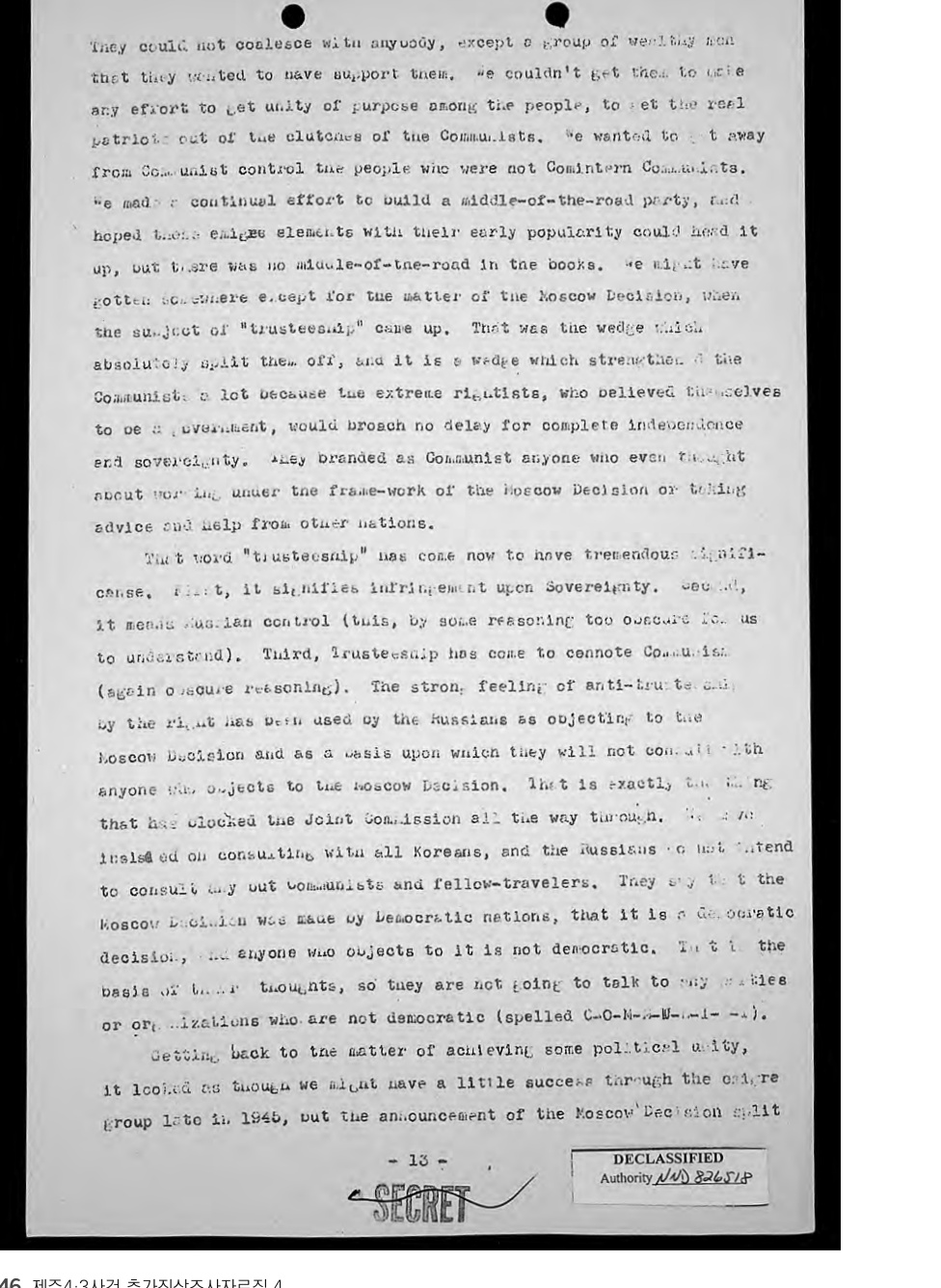
그들은 지원을 받고 싶은 부유층을 제외하고는 누구와도 연합할 수 없었습니 다. 우리는 사람들을 단결시키고 진정한 애국주의자들을 공산주의의 손아귀에서 벗어나게 하는 데 이들을 이용할 수 없었습니다. 우리는 코민테른 공산주의자가 아닌 사람들을 공산주의의 지배에서 벗어나게 하고 싶었습니다. 우리는 중도 노 선의 정당을 건설하기 위해 계속 애썼고 초반에 인기가 있었던 망명파가 이에 앞 장서길 바랐지만 명부에 기록된 중도 정당에는 없었습니다. 모스크바 결정 문제를 제외하고는 약간 진전을 보이는 것 같았지만 모스크바 결정 때 "신탁통치" 문 제가 생겼습니다. 이 문제는 사람들을 완전히 분열시켰고 스스로 정부가 될 것이
라 여겼던 극우파가 완전한 독립과 주권에 지체란 없다고 주장하자 이는 공산주의자들을 훨씬 더 강력하게 만드는 촉진제로 작용했습니다. 사람들은 모스크바 결정의 틀 안에서 일하거나 다른 나라의 조언이나 도움을 받을 생각만 해도 공산주의자로 낙인찍혔습니다.
'신탁통치'라는 단어는 이제 굉장히 의미심장한 단어가 되었습니다. 첫째, 이 단어는 주권 침해를 의미합니다. 둘째, (우리가 이해하기에는 너무 애매한 몇 가지 추론에 의해) 이 단어는 러시아의 지배를 의미합니다. 셋째, 신탁통치는 공산주의를 함축하는 개념이 되었습니다(이 역시 애매한 추론). 러시아는 우파의 강력한 반탁정서를 모스크바 결정의 반대 양상으로 이용했고 모스크바 결정에 반대하는 사람들과 협의를 하지 않는 근거로 삼았습니다. 이것이 바로 시종일관 미소공동위원회를 막고 있는 것입니다. 우리는 모든 조선인들과 협의할 것을 주장하는 한편 러시아는 공산주의자나 지지자 이외에는 그 누구와도 협의할 의향이 없습니다. 러시아는 모스크바 결정은 민주 국가들에 의해 내려진 민주적인 결정이며 이에 반대하는 사람들은 모두 민주적인 것이 아니라고 말합니다. 이것이 그들의 사고 기반이기 때문에 그들은 민주적이지 않은 정당이나 조직(공-산-주-의-자)과는 대화를 하지 않을 것입니다.
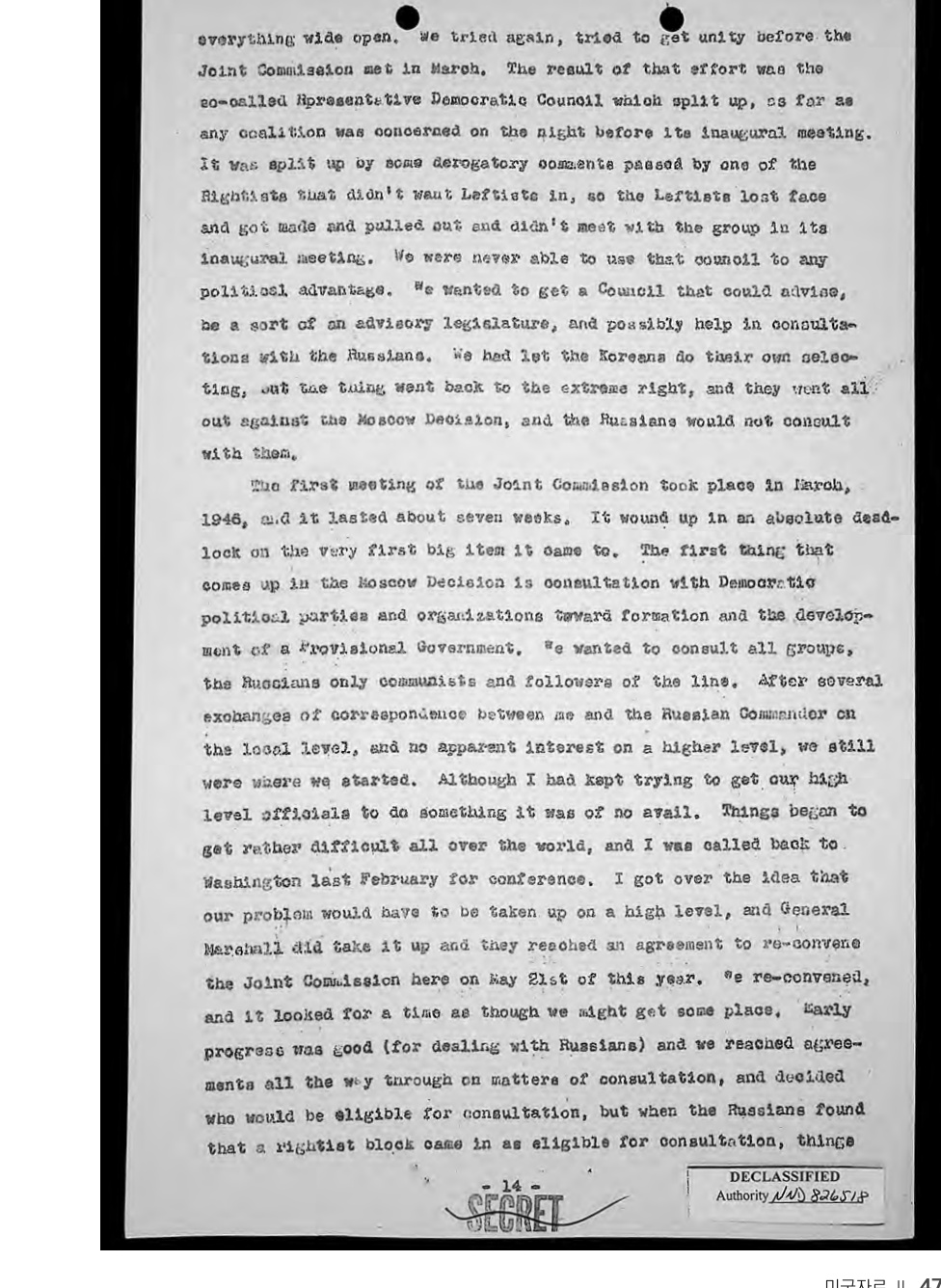
정치적 단결을 달성하는 문제로 돌아가서, 1945년 후반 망명파를 통해 약간의 성공을 거둔 것처럼 보였지만 모스크바 결정이 발표되자 모든 곳에서 분열이 일었습니다. 우리는 다시 시도했습니다. 미소공동위원회가 3월에 재개되기 전 결집을 시도했습니다. 그 노력의 결실은 남조선대한민국대표민주의원(민주의원)이었지만 이는 창립총회 전날 밤 합작이 고려되면서 분열을 맞았습니다. 분열은 좌파가 들어오는 것을 원치 않았던 우파 한 명이 전달한 경멸 섞인 의견에서 비롯되었으며, 좌파는 체면을 잃고 민주의원에서 떨어져 나와 창립총회에는 참석하지 않았습니다. 우리는 민주의원을 정치적으로 이용하지 못했습니다. 우리는 일종의 자문 입법기관으로서 조언을 하고 러시아와 합의하여 도움을 줄 수 있는 의회를 구성하길 원했습니다. 우리는 조선인들이 자체적으로 선택하도록 했지만 의회는 다시 극우파에게 돌아갔습니다. 그들은 모스크바 결정에 모두 반대했으므로 러시
아는 그들과 협의하지 않을 것이었습니다.
미소공동위원회 1차 회의는 1946년 3월 개최되었고 약 7주간 진행되었습니다.
회의는 첫 번째 큰 주제부터 완전한 교착 상태에 빠졌습니다. 모스크바 결정에서 제기된 첫 번째 사안은 임시정부의 구성과 발전에 관한 민주적 정당 및 조직과의 협의입니다. 우리는 모든 집단과 협의하고 싶었고 러시아는 공산주의자나 그 노 선의 추종자들과만 협의하길 바랐습니다. 지역 수준에서 저와 러시아 사령관이 몇 번의 서신을 교환한 후에도 상부에서 분명한 관심을 보이지 않아 우리는 여전 히 시작 단계에 머물러 있습니다. 우리 측 고위 관료에게 뭔가 해 줄 것을 계속 요 청했지만 소용없었습니다. 전 세계적으로 상황은 더 어려워지기 시작했고, 저는 지난 2월 회의에 참석하라는 호출을 받고 워싱턴으로 돌아갔습니다. 저는 우리의 문제를 상부에 올려야 한다는 생각을 피력했고, 마셜(Marshall) 사령관이 보고를 올려 올해 5월 21일 이곳에서 미소공동위원회를 다시 개최하기로 합의했습니다.
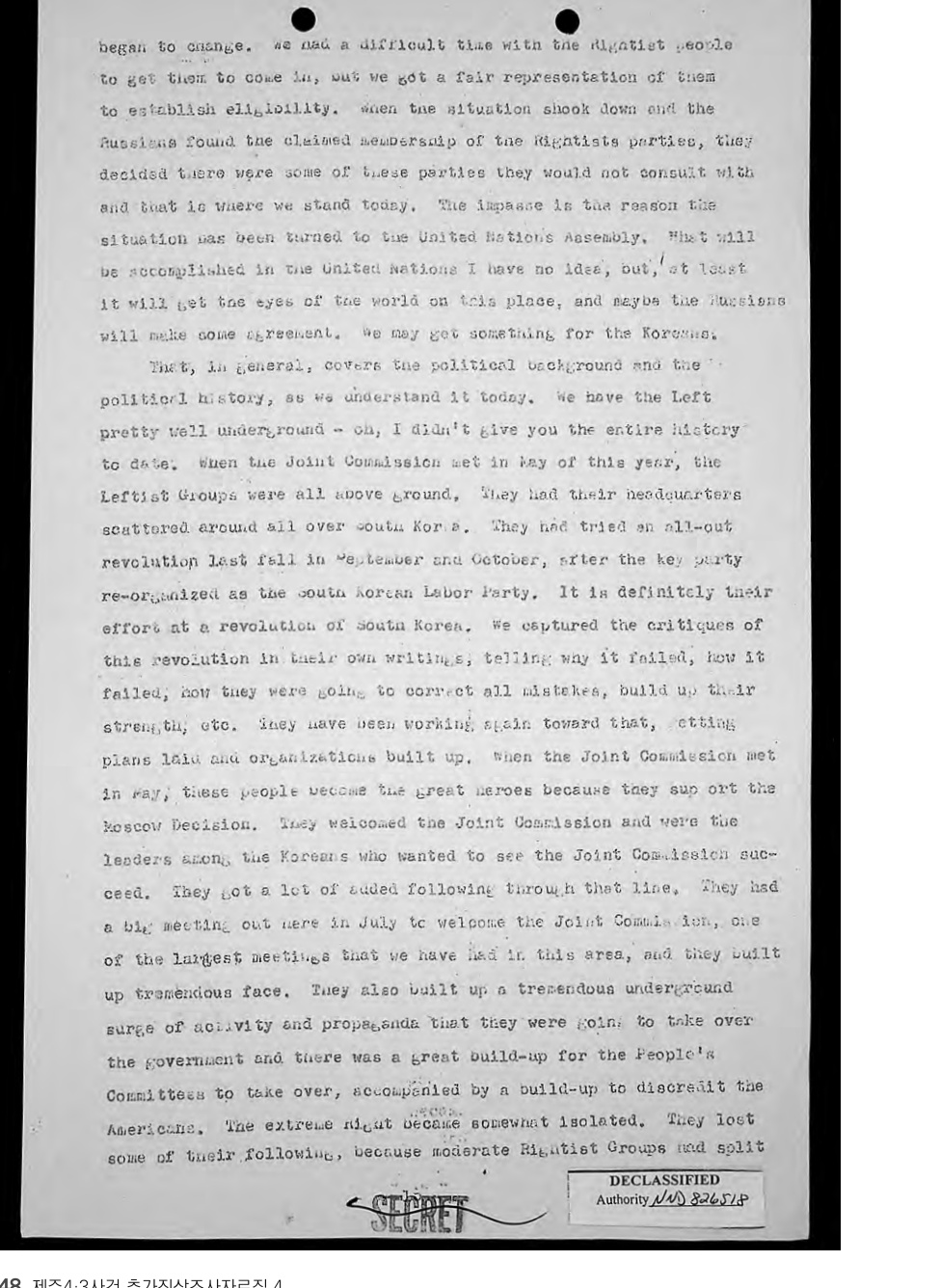
우리는 위원회를 다시 개최했고 장소를 정하고 시간을 맞췄습니다. 초반 진행 상 황은 (러시아인들에게는) 좋았습니다. 자문 문제에 관한 합의를 끝까지 도출했고 자문 자격을 누구에게 부여할 것인지도 결정했습니다. 하지만 우파가 자문 자격을 갖추고 참여한다는 사실을 러시아가 알게 되면서 상황은 변하기 시작했습니 다. 우리는 우파의 참여 문제로 러시아와 힘든 시간을 보냈지만 자격을 갖추기 위 해 우파에서 공정한 대표를 받았습니다. 상황이 안정될 무렵 러시아가 우파 정당의 구성원이라는 주장을 알게 되자 자신들은 이들 정당과 협의하지 않겠다는 결 정을 내렸다고 했으며 이것이 오늘 우리가 처한 상황입니다. 이러한 교착 상태 때 문에 상황은 유엔 총회로 넘어갔습니다. 유엔에서 어떤 성과가 있을지는 잘 모르 겠지만 최소한 전 세계의 이목이 집중될 것이고 러시아는 몇 가지에 동의하게 될 것입니다. 우리는 조선인들을 위해 몇 가지를 얻을 수도 있습니다.
대체로 정치적 배경과 정치 역사에 관한 것일 겁니다. 조선에는 지하에서 꽤 활 발히 활동하는 좌파가 있습니다. 참, 지금까지의 전체 역사를 설명하지 않았군요.
올해 5월 미소공동위원회가 처음 개최되었을 때 좌파 집단은 모두 지상에 나와 있었습니다. 그들의 본부는 남조선 지역에 흩어져 있었습니다. 주요 정당이 남조 선 지역에 위치해 있었습니다.
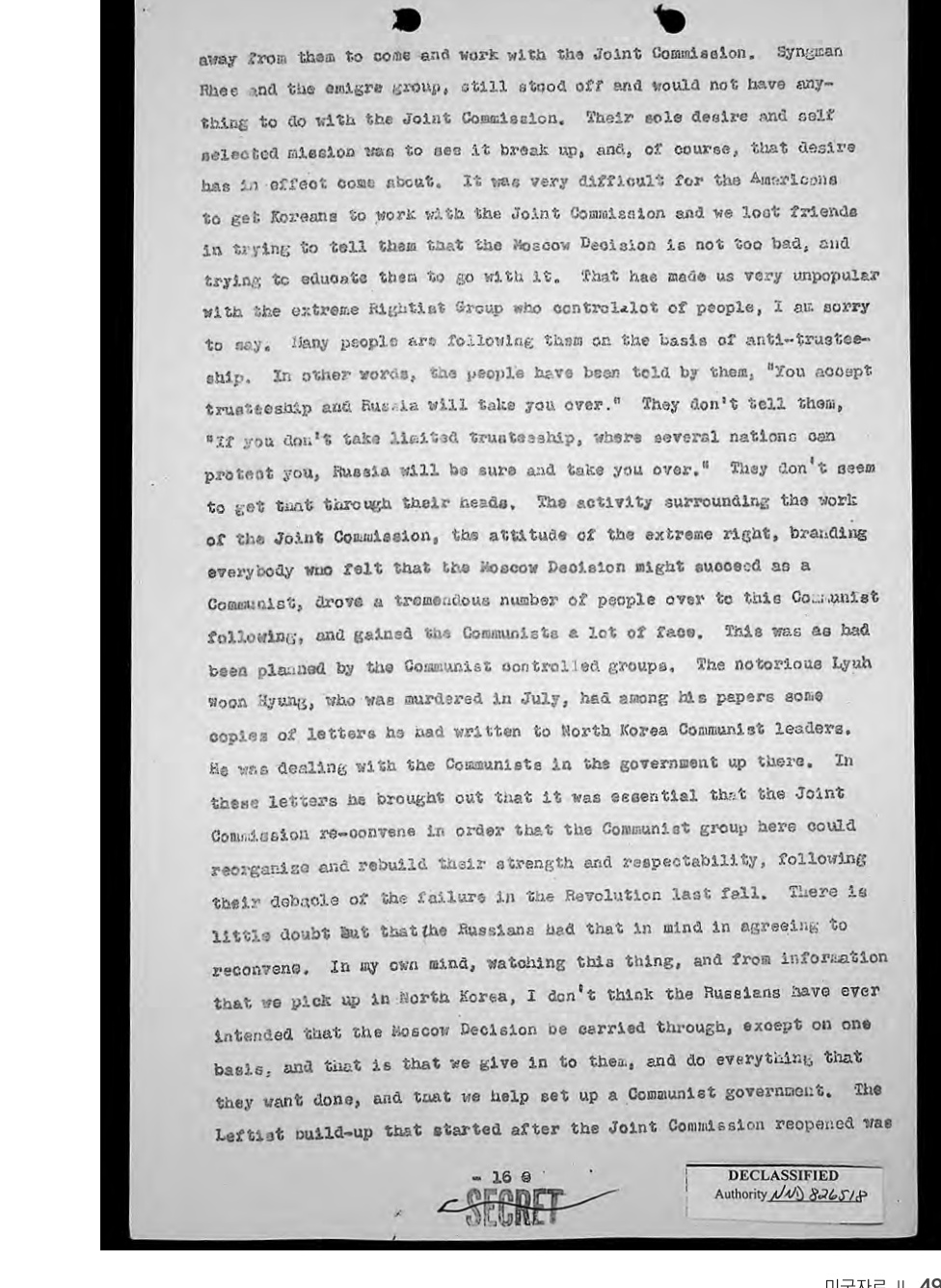
선노동당으로 재편된 후 지난 9월과 10월에 그들은 전면적인 혁명을 시도했습니다. 남조선의 혁명은 전적으로 그들이 이끈 것입니다. 우리는 혁명이 실패한 이유와 실패한 방법, 모든 실수를 시정하기 위해 그들이 할 일이나 힘을 키울 방법 등을 논한 그들의 보고서에서 혁명에 대한 비평을 읽었습니다. 그들은 계획을 세우고 조직을 구축하는 등 그 목표를 이루기 위한 일을 다시 시작했습니다. 5월 미소공동위원회가 개최되었을 때 좌파는 모스크바 결정을 지지했기 때문에 위대한 영웅이 되었습니다. 그들은 미소공동위원회를 환영했고 미소공동위원회의 성공을 바라는 조선인들의 지도자가 되었습니다. 그들은 그런 노선을 통해 많은 추종자를 얻었습니다. 그들은 미소공동위원회를 환영하는 큰 회의를 이곳에서 개최했습니다. 그 회의는 이 지역에서 열린 가장 큰 회의 중 하나였고 그들은 제대로 체면치레했습니다. 또한 지하 활동을 엄청나게 늘렸고, 자신들이 정부를 장악할 것이며 미국의 신임을 떨어뜨리는 동시에 인민위원회를 조직했다는 선전을 마구 퍼트렸습니다. 극우파는 다소 소외되었습니다. 중도 우파가 극우파에서 떨어져 나가 미소공동위원회에 합류하면서 극우파는 추종자를 일부 잃었습니다. 이승만과 망명파는 여전히 거리를 유지한 채 미소공동위원회와 어떤 일도 하지 않았습니다. 그들의 유일한 바람과 자체적으로 선택한 임무는 미소공동위원회가 결렬되는 것이었는데 이 바람은 사실상 이루어졌습니다. 미국 입장에서 조선을 미소공동위원회에 협조하도록 하는 것은 굉장히 어려웠습니다. 우리는 모스크바 결정이 그렇게 나쁜 것이 아니라고 설득하고 그들에게 모스크바 결정을 수용하도록 교육시키는 과정에서 친구들을 잃었습니다. 유감스럽게도 그 일로 많은 사람들을 지배하는 극우파에게서 우리의 인기가 없어졌습니다. 많은 사람들이 반탁에 기초하여 그들을 따르고 있습니다. 그들은 사람들에게 "신탁통치를 받아들이면 러시아가 우리를 탈취할 것"이라고 말합니다. "일부 국가가 우리를 보호할 수 있는 제한적 신탁통치를 받아들이지 않으면 러시아가 분명 우리를 탈취할 것"이라고는 말하지 않습니다. 그들은 이 점을 이해하지 못한 것 같습니다. 미소공동위원회의 업무를 둘러싼 활동과 모스크바 결정이 공산주의 세계에서 성공할지도 모른다고 생각하는 모든 이들에게 낙인을 찍는 극우파의 태도는 많은 이들을 공산당 추종자로 만들었고 이로 인해 공산주의자들은 체면이 좀 서게 되었습니다. 이는 공산당이 지배하는 집단에서 계획한 그대로입니다. 7월에 암살된 악명 높은 여운형은 북조
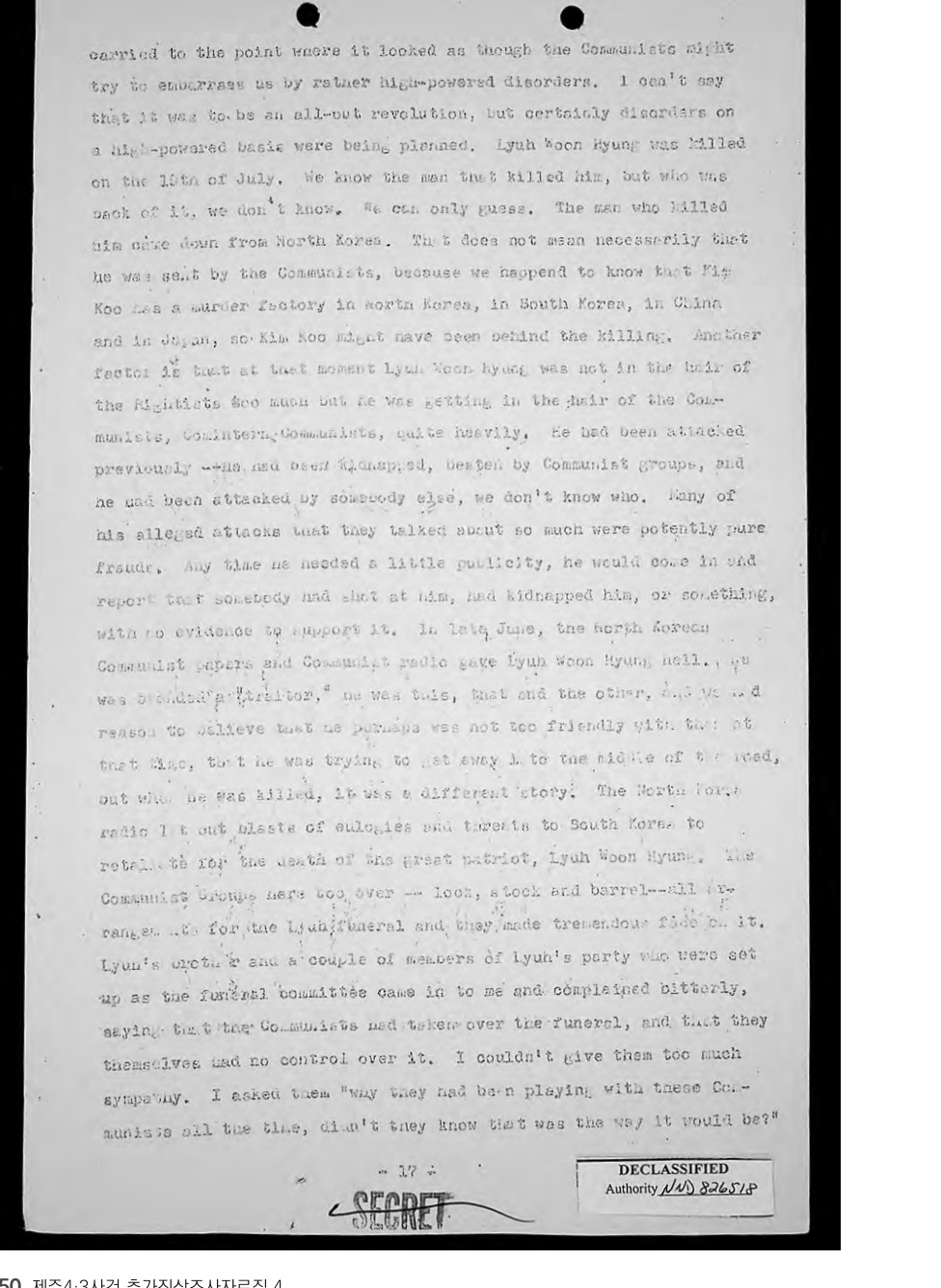
선 공산당 지도자에게 몇 통의 편지를 남겼습니다. 여운형은 북조선 정부에 있는 공산주의자들을 상대하고 있었습니다. 편지에서 여운형은 남조선에서 공산주의 조직을 다시 만들고 지난 가을 실패한 혁명 이후 상실한 권력과 권위를 다시 구축 하기 위해서는 미소공동위원회를 다시 개최해야 한다는 의견을 제기했습니다. 러 시아도 그와 같은 생각으로 재개최에 동의했다는 데에는 의심의 여지가 거의 없 습니다. 목격한 이런 일들과 북조선에서 입수한 정보를 보았을 때 우리가 공산주 의자들에게 굴복하고 그들이 원하는 모든 것을 해주며, 공산 정부 수립을 돕는 경 우를 제외하면 제 생각에 러시아는 모스크바 결정을 이행할 의향이 있다고 보이 진 않습니다. 미소공동위원회 재개 이후 시작된 좌파의 세력은 공산주의자들의 강력한 난동으로 우리가 난처해지는 지경까지 확대되었습니다. 이것이 전면적인 혁명이었다고 말할 수는 없지만 분명 강력한 난동은 계획되고 있었습니다. 여운 형은 7월 19일 암살되었습니다. 우리는 여운형을 죽인 범인을 알고 있지만 배후에 누가 있는지는 모릅니다. 추측만 할 뿐입니다. 여운형을 죽인 자는 북조선에서 내려왔습니다. 그렇다고 반드시 북조선에서 보냈다고 말할 수는 없습니다. 김구 역시 남조선, 북조선, 중국, 일본에 암살단을 갖고 있다는 사실을 우연히 알았기 때문입니다. 따라서 김구도 그 살인의 배후일 수 있습니다. 또한 당시 여운형은 우파에게는 크게 성가신 존재는 아니었지만 공산주의자나 코민테른 공산주의자 들을 꽤나 성가시게 했다는 점을 들 수 있습니다. 그는 전에도 공격을 당한 적이 있었습니다. 납치를 당해 공산주의 집단에게 구타를 당하고 우리가 모르는 누군 가에게도 공격을 당했었습니다. 여운형이 공격을 당했다고 전해지는 주장 중 다 수는 순전히 지어낸 이야기일 수도 있습니다. 세간의 관심이 약간 필요할 때마다 여운형은 귀국하여 누군가 자신을 쏘았다는 둥 납치했다는 둥 신고를 했지만 이를 입증할 만한 증거는 없었습니다. 6월 후반 북조선의 공산당 기관지와 공산당 라디오에서는 여운형을 호되게 비판했습니다. 여운형은 '배신자'로 낙인찍혔습니 다. 그를 두고 이러쿵저러쿵 많은 말들이 생겨났습니다. 우리는 여운형이 당시 공 산주의자들에게 그리 우호적이지 않았고 중도 노선으로 피하려 했다는 믿을 만한 근거를 가지고 있었지만 그가 죽자 얘기는 달라졌습니다. 북조선 라디오에서는 여운형을 칭송하는 찬사와 위대한 애국지사인 여운형의 죽음에 대해 남조선에 보 복하겠다는 협박이 쏟아졌습니다. 남조선의 공산주의 집단은 모조리 여운형의 장
례식을 위한 모든 준비에 굉장히 열을 올렸고 여기서 또한 상당한 체면치레를 했습니다. 여운형의 남동생과 장례 위원회로 임명된 여운형 정당의 당원 몇 명은 저를 찾아와 공산주의자들이 장례식을 장악하여 자신들이 통제를 할 수 없다고 격렬히 항의했습니다. 저는 그들의 말에 크게 공감할 수 없었습니다. "여운형파는 왜 항상 공산주의자들과 어울렸을까요? 이런 일이 생기리란 걸 정말 몰랐을 까요?"라고 그들에게 물었습니다.
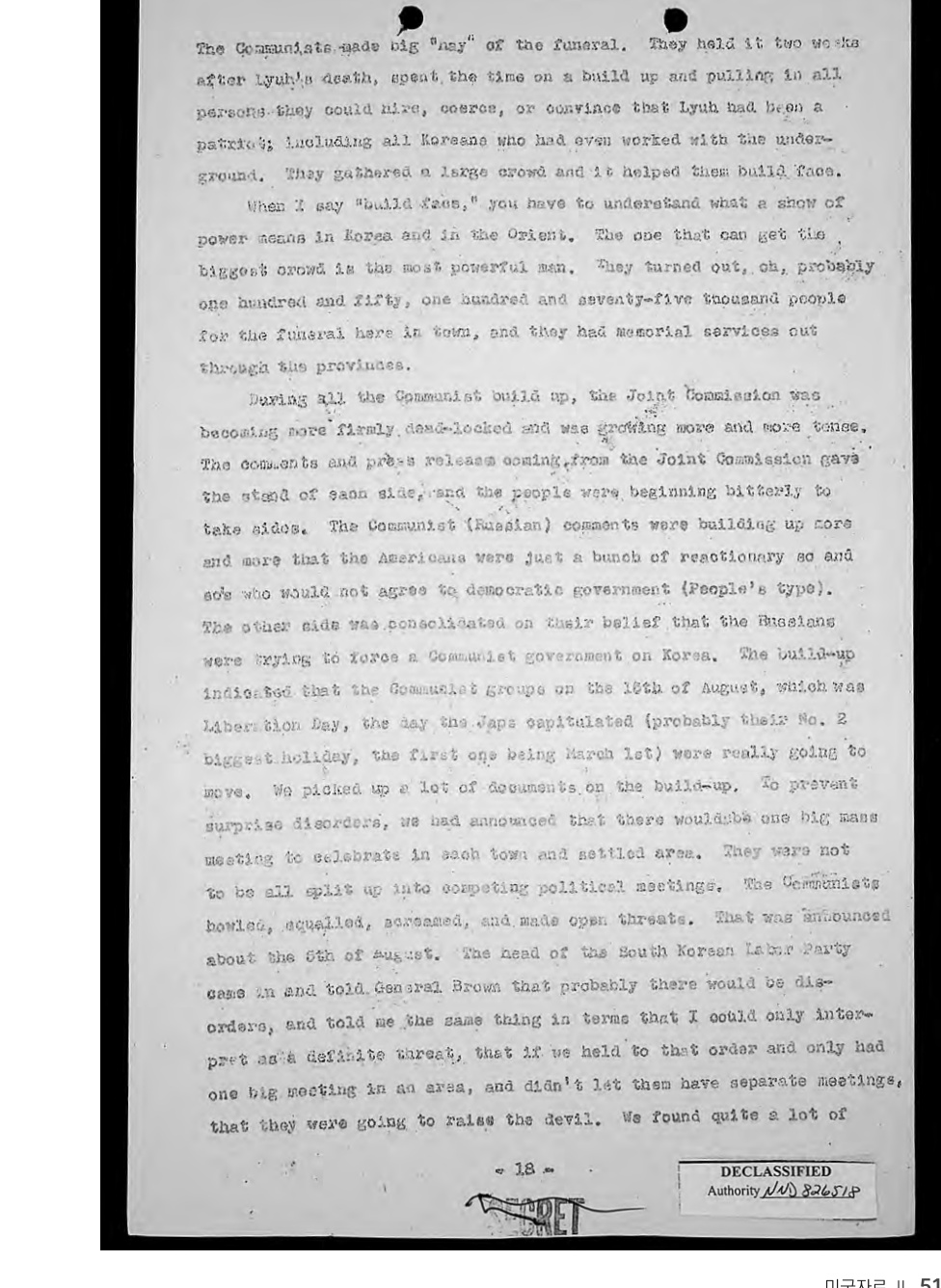
공산주의자들은 장례식을 최대한 '이용'했습니다. 여운형이 죽고 2주 후에 장례식을 열어 세력 증강에 시간을 쏟고, 지하세력과 함께 활동하는 조선인 등 고용 가능한 모든 인원을 동원하여 강압적인 모습을 보이며 여운형이 애국지사였다고 설득했습니다. 장례식에 군중을 잔뜩 모아 인지도를 쌓는 데 이용했습니다.
"인지도를 쌓는다"고 말할 때 조선 등 동양에서 권력을 보여주는 것이 어떤 의미인지 이해하셔야 합니다. 가장 많은 군중을 모을 수 있는 사람이 가장 강한 사람입니다. 공산주의자들은 이 도시에서 약 15만~17만 5,000명의 군중을 장례식에 끌어들였고, 지방을 순회하며 추도식을 열었습니다.
모든 공산주의자들이 세력을 다지는 동안 미소공동위원회는 더 확실한 교착 상태에 빠지게 되어 상황은 더욱 긴박해져 갔습니다. 미소공동위원회에서 나온 논평과 보도자료는 양측의 입장을 대변해주었고 사람들은 격렬하게 편을 가르기 시작했습니다. 미국은 민주 정부(인민형)에 동의하지 않을 다수의 반동분자 떼거리일 뿐이라는 공산주의자(러시아)의 논평은 점점 더 강해졌습니다. 반대편은 러시아가 조선에 공산 정권을 세우려고 한다는 믿음을 공고히 했습니다. 세력 증강은 곧 일본이 항복한 날이자 광복절인 8월 15일(조선에서 3·1절다음 두 번째로 큰 기념일)에 공산주의 집단이 실제로 움직이려 한다는 의미였습니다. 우리는 세력 증강에 관한 다수의 문서를 입수했습니다. 갑작스런 소요사태를 방지하기 위해 우리는 이날을 기념할 수 있도록 각 도시와 정착지별로 대규모 대중 집회가 한 차례만 열릴 것이라고 발표했습니다. 이는 여러 개 정치 회합으로 나뉘지 않도록 하기 위함이었습니다. 공산주의자들은 악을 쓰고 소리 지르며 공개적인 협박을 했습니다. 발표는 8월 5일쯤에 했습니다. 남조선노동당의 당수가 찾아와 브라운 장
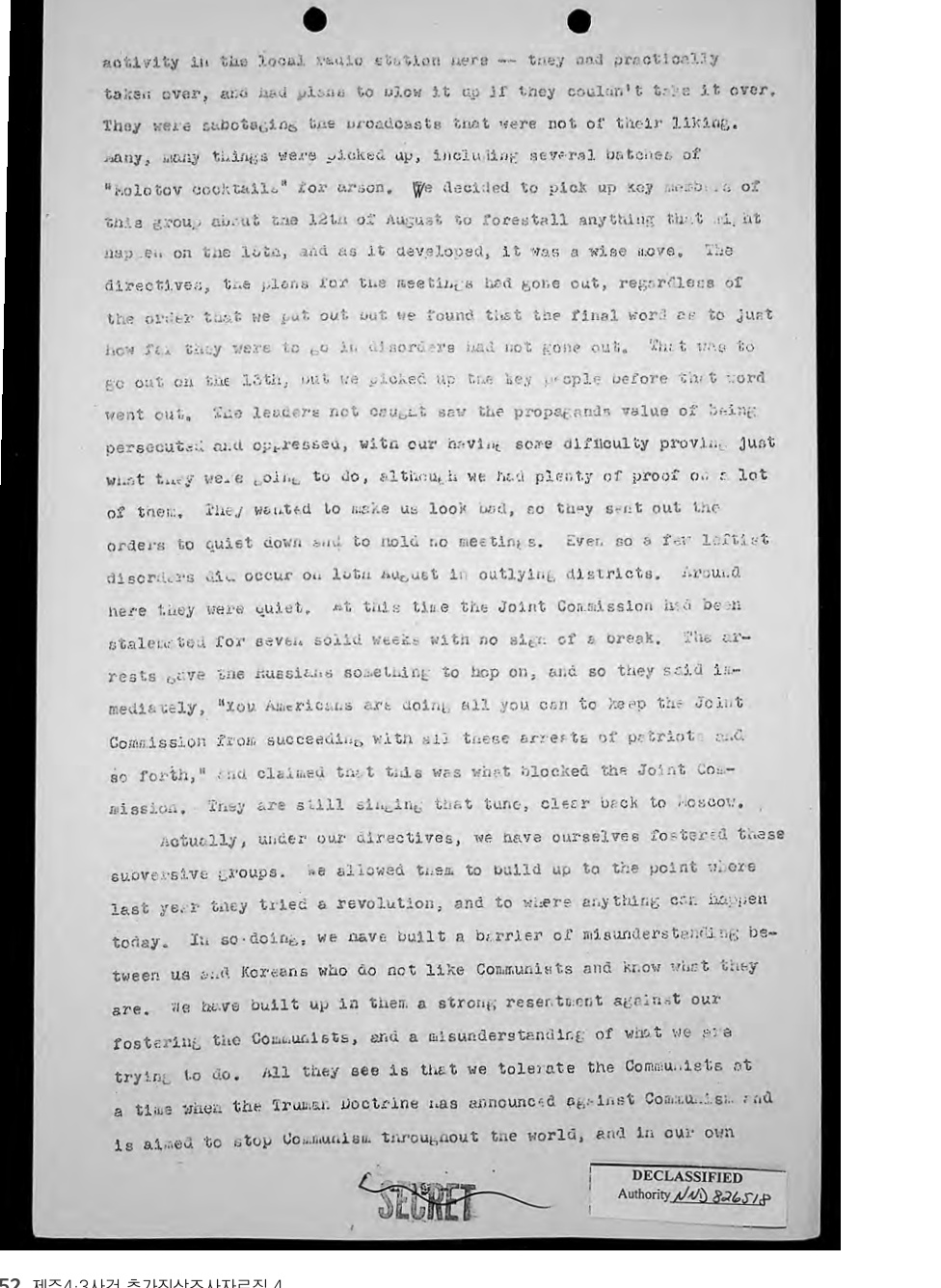
군에게 소요사태가 있을 것이라고 말했습니다. 협박으로 밖에 들리지 않는 용어들을 써가며 제게도 같은 이야기를 했습니다. 명령대로 한 지역에 단 한 번의 대규모 집회만을 개최하고 자신들의 개별 집회를 허용하지 않는다면 큰 난동이 있을 것이라고 했습니다. 이곳의 지역 라디오 방송에서는 많은 활동이 이루어지고 있었습니다. 사실상 공산주의자들이 장악을 한 상태였고 아직 장악하지 못했다면 폭파할 예정이었습니다. 저들은 자신들의 입맛에 맞지 않는 방송국은 무너뜨리고 있었습니다. 방화를 일으키기 위한 화염병 등 아주 많은 도구들이 사용되고 있었습니다. 우리는 8월 12일경에 이 집단의 핵심 구성원들을 골라 15일에 생길 수 있는 일들을 미연에 방지하기로 했습니다. 이는 훌륭한 조치였습니다. 우리의 명령에 관계없이 회합 계획이 알려졌지만 그들이 시위에서 행동을 어느 정도까지 할지에 대한 최종 결정은 아직 내려지지 않았습니다. 이는 13일에 알려져야 했지만 우리는 발표 전에 먼저 핵심 인물들을 체포했습니다. 잡히지 않은 주동자들은 박해나 탄압을 받는다는 선전 가치를 얻었고, 우리는 그들 다수에 대한 증거가 충분히 있었음에도 불구하고 그들이 무엇을 할 것인지만 겨우 알아내는 것에 그치는 등 어려움을 겪었습니다. 공산주의자들은 우리가 나쁘게 보이길 바랐기 때문에 진정하고 회합을 열지 말라는 명령을 보내왔습니다. 그럼에도 불구하고 8월 15일 외곽 지역에서 좌파들이 몇 건의 소요사태를 일으켰습니다. 이 근방은 조용했습니다. 현재 미소공동위원회는 결렬 조짐 없이 7주간 교착 상태에 빠져 있습니다. 체포 소식은 러시아가 호통칠 수 있는 빌미가 됐습니다. 러시아는 즉시 "미국은 미소공동위원회의 성공을 가로막기 위해 애국지사를 체포하는 등 온갖 짓을 하고 있다"고 논평하며 이는 미소공동위원회에 장애가 된다고 주장했습니다. 그들은 모스크바에 돌아가서도 여전히 같은 논조를 유지했습니다.
사실상 우리의 훈령하에서, 우리 스스로 이런 체제전복적인 집단을 육성한 것입니다. 우리는 그들이 작년에 혁명을 시도한 이래 현재 이 모든 일이 발생하는 지경이 되기까지 그들이 세력을 키우도록 방치했습니다. 그렇게 함으로써 우리는 공산주의자를 싫어하고 그들이 어떤 집단인지 알고 있는 조선인들과 우리 사이에 오해의 장벽을 쌓았습니다. 공산주의자들을 육성한 것에 대해 우리는 조선인들의 강한 원한을 샀고, 우리가 하려는 일에 대해 오해받았습니다. 공산주의를 반대하
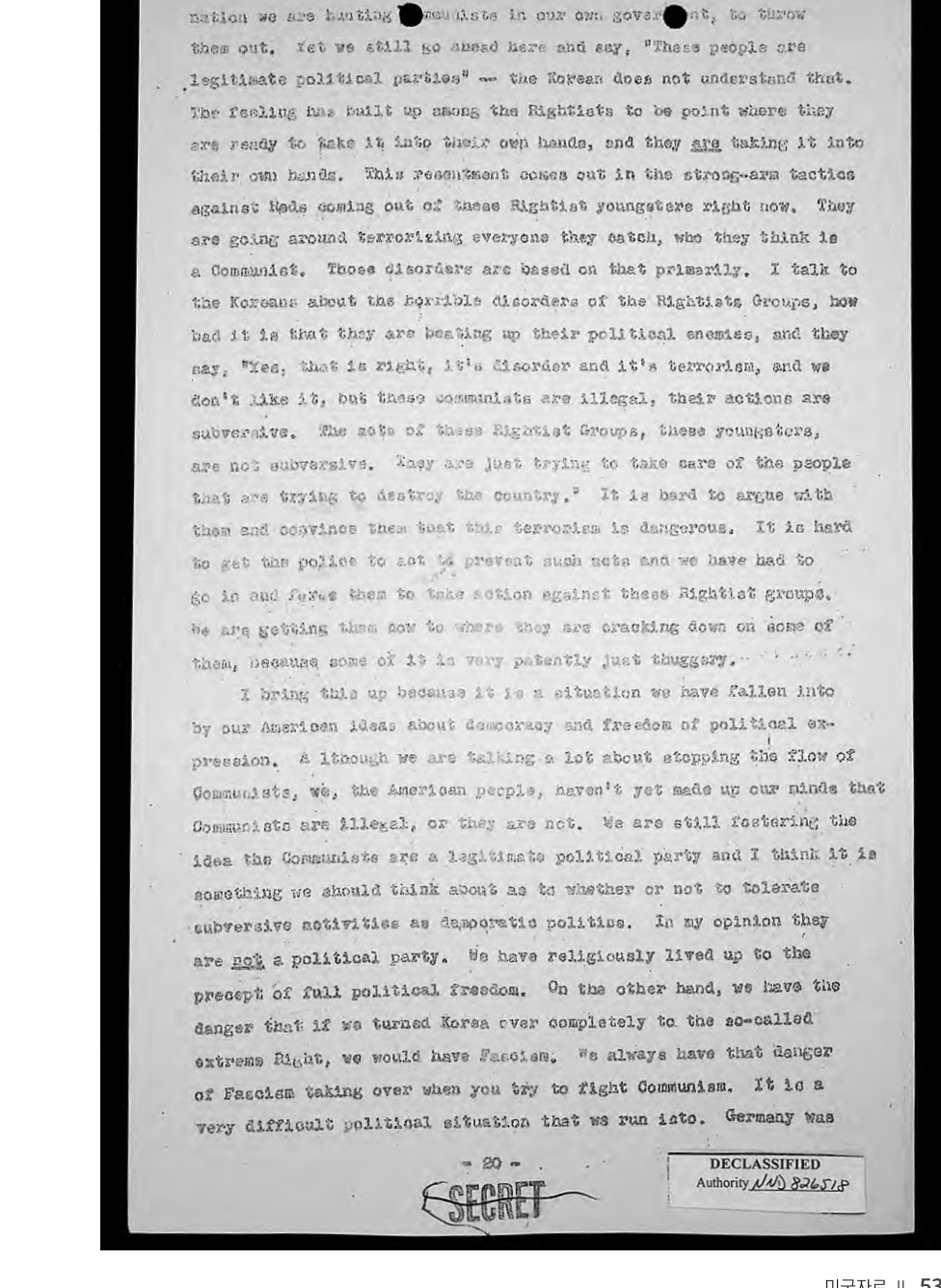
는 트루먼 독트린(Truman Doctrine)이 발표되면서 전 세계 공산주의 확대 저지를 목표로 삼았을 때, 미국 정부가 공산주의자들을 잡아 쫓아낼 때 본 것이라고는 우리가 공산주의자들을 용인하는 모습뿐이었습니다. 하지만 우리는 여전히 "이들은 합법적 정당"이라고 말하고 있습니다. 조선인들은 그 점을 이해하지 못합니다. 민중의 이러한 감정은 우파가 직접 공산주의를 처리할 준비를 갖출 수 있는지점까지 발전하여 현재는 자기들 손으로 직접 처리하고 있습니다. 이러한 원한은 현재 우파 청년들에게서 비롯된 빨갱이에 대한 강압적인 전술에서 나타납니다. 그들은 돌아다니며 자신들 생각에 공산주의자 같은 이들은 모두 붙잡아 위협을 일삼고 있습니다. 이러한 난동은 주로 이 같은 상황에 기초합니다. 조선인들에게 우파들의 끔찍한 난동에 대해 말하며, 정적(政敵)을 구타하는 것이 얼마나 나쁜 일인지 설명하면 조선인들은 "네, 맞습니다. 난동이나 테러는 저희도 좋아하지는 않습니다. 하지만 공산주의자들은 불법이고 그들의 행동은 곧 반역입니다. 이우파 집단 젊은이들은 체제 불온적이지 않습니다. 이들은 그저 나라를 파괴하려는 자들을 처리하려는 것뿐입니다"라고 말합니다. 조선인들과 논쟁을 벌이며 테러는 위험하다고 설득하기란 힘듭니다. 경찰을 투입하여 그런 행동을 예방하기도 힘들므로 우리가 직접 개입하여 이런 우파 집단에 강제 조치를 취해야 합니다. 그중 일부는 매우 명백한 폭력배이기 때문에 엄중 단속하고 있습니다.
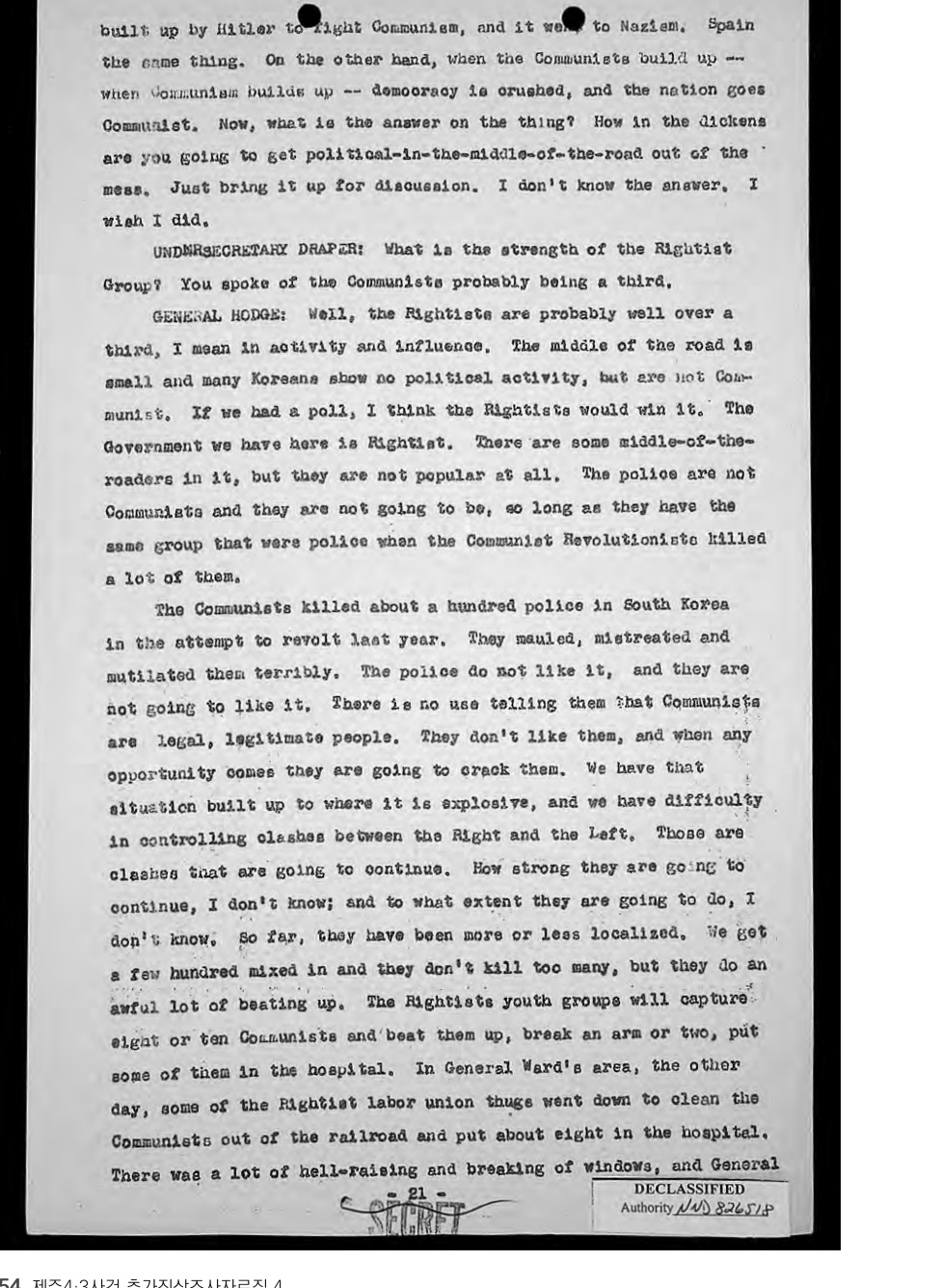
이런 말씀을 드리는 이유는 바로 민주주의와 정치적 표현의 자유에 관한 미국의사상 때문에 우리가 이 같은 상황에 빠졌기 때문입니다. 공산세력의 확산을 차단하는 문제에 대해 수없이 말했지만 우리 미국인들은 아직 공산주의자가 불법인지 아닌지에 대해 마음을 정하지 못했습니다. 우리는 여전히 공산당이 합법적 정당이라는 사상을 조성하고 있고, 체제전복적인 활동들을 민주 정치로 용인할 것인지 아닌지에 관해 고민해봐야 한다고 생각합니다. 저는 공산당은 정당이 아니라고 생각합니다. 우리는 완전한 정치적 자유라는 계율에 어김없이 부응해 왔습니다. 한편 조선을 극우로 완전히 돌린다면 파시즘이 될 위험도 있습니다. 공산주의와 싸울 때 파시즘이 장악할 위험은 늘 있습니다. 이것은 감당하기 매우 힘든 정치적 상황입니다. 독일은 히틀러가 등장하면서 세력을 키워 공산주의와 싸워 나치정권이 되었습니다. 스페인도 같은 일을 겪었습니다. 한편 공산주의가 세력을 증
강하면 민주주의는 망가지고 그 나라는 공산화가 됩니다. 그렇다면 해답은 무엇일까요? 어떻게 해야 대중들에게서 정치적 중도 노선을 끌어낼 수 있을까요? 이 문제를 논의 주제로 꺼내 봤습니다. 저는 그 답을 모르겠습니다. 제가 알고 있다면 좋겠습니다.
드래퍼 차관: 우파 진영의 강점은 무엇입니까? 장군께서는 공산주의자들이 3분의 1 정도일 것이라고 말씀하셨습니다.
하지 사령관: 우파는 3분의 1을 훌쩍 뛰어넘을 것입니다. 활동이나 영향력 면에서요. 중도노선은 소규모이고 대다수의 조선인들은 정치적 활동을 하지 않지만 공산주의자는 아닙니다. 투표를 하면 우파가 이길 것입니다. 이곳에 수립된 정부는 우파입니다. 그 안에 중도파도 일부 있지만 인기가 전혀 없습니다. 경찰은 공산주의자가 아니며 되지도 않을 것입니다. 공산주의 혁명당원들이 많은 경찰을 사살할 당시 경찰이었던 사람들이 지금도 여전히 같은 경찰로 남아 있는 한은 말입니다.
공산주의자들은 작년에 봉기를 시도하면서 남조선에서 100여 명의 경찰을 살해했습니다. 그들은 경찰을 때리고 학대하고 사지를 절단했습니다. 경찰이 이를 좋아할 리 없고 앞으로도 없을 것입니다. 공산주의자는 합법적이고 적법한 사람들이라고 말해도 소용없습니다. 사람들은 공산주의자들을 좋아하지 않고 기회만 된다면 그들을 없애려 할 것입니다. 우리는 상황을 일촉즉발 상태까지 키웠고 이제 우파와 좌파 사이의 충돌을 조절하기가 어렵습니다. 이러한 충돌은 계속될 것입니다. 이들이 얼마나 언제까지 강경한 태도를 취할지는 알 수 없습니다. 지금까지 그들은 대체로 국지적으로 활동했습니다. 우리에게 수백 건의 조사 결과가 있는데 살인 건수는 많지 않지만 구타가 너무 많습니다. 우파 젊은이들은 8~10명 정도의 공산주의자들을 붙잡아 구타하고 팔을 부러뜨려 그중 누군가는 입원을 하게 될 것입니다. 지난번 워드(Ward) 장군의 지역에서는 우파 노동조합 폭력배 몇 명이 철도에서 공산주의자들을 몰아냈는데 그 결과 8명 정도가 병원에 입원했습니다. 유리창들이 깨지는 등 엄청난 소란이 일었고 감당할 수 없는 지경이 되자
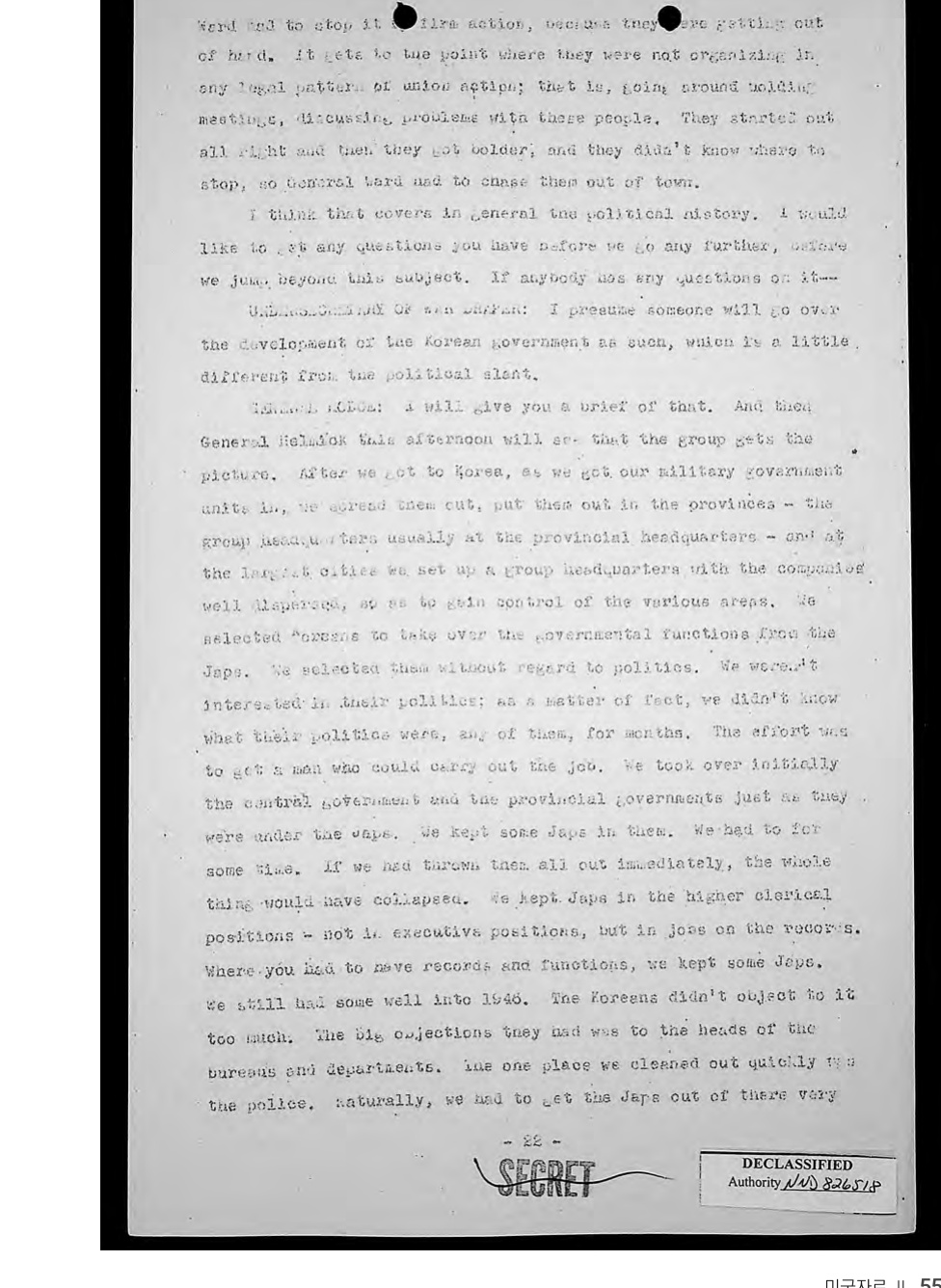
워드 장군은 단호한 조치를 취해 이를 중단시켰습니다. 그러다 보니 우파들은 합법적인 단체 행동을 조직하지 않는 지경에 이르렀습니다. 다시 말해, 돌아다니며 회의를 열고 사람들과 문제를 논의하는 형태를 취하고 있습니다. 처음에는 무난하게 활동하다 차츰 대담해져 멈플 줄을 몰랐습니다. 그래서 워드 장군은 이들을 마을 밖으로 쫓아낼 수 밖에 없었습니다.
정치사는 이 정도면 된 것 같습니다. 다음으로 넘어가기 전에 질문을 받겠습니다. 질문 있으십니까?
육군성차관 드래퍼: 누군가는 정치적 편향과는 약간 다른 이 같은 조선 정부의 발전을 조사할 것으로 보입니다.
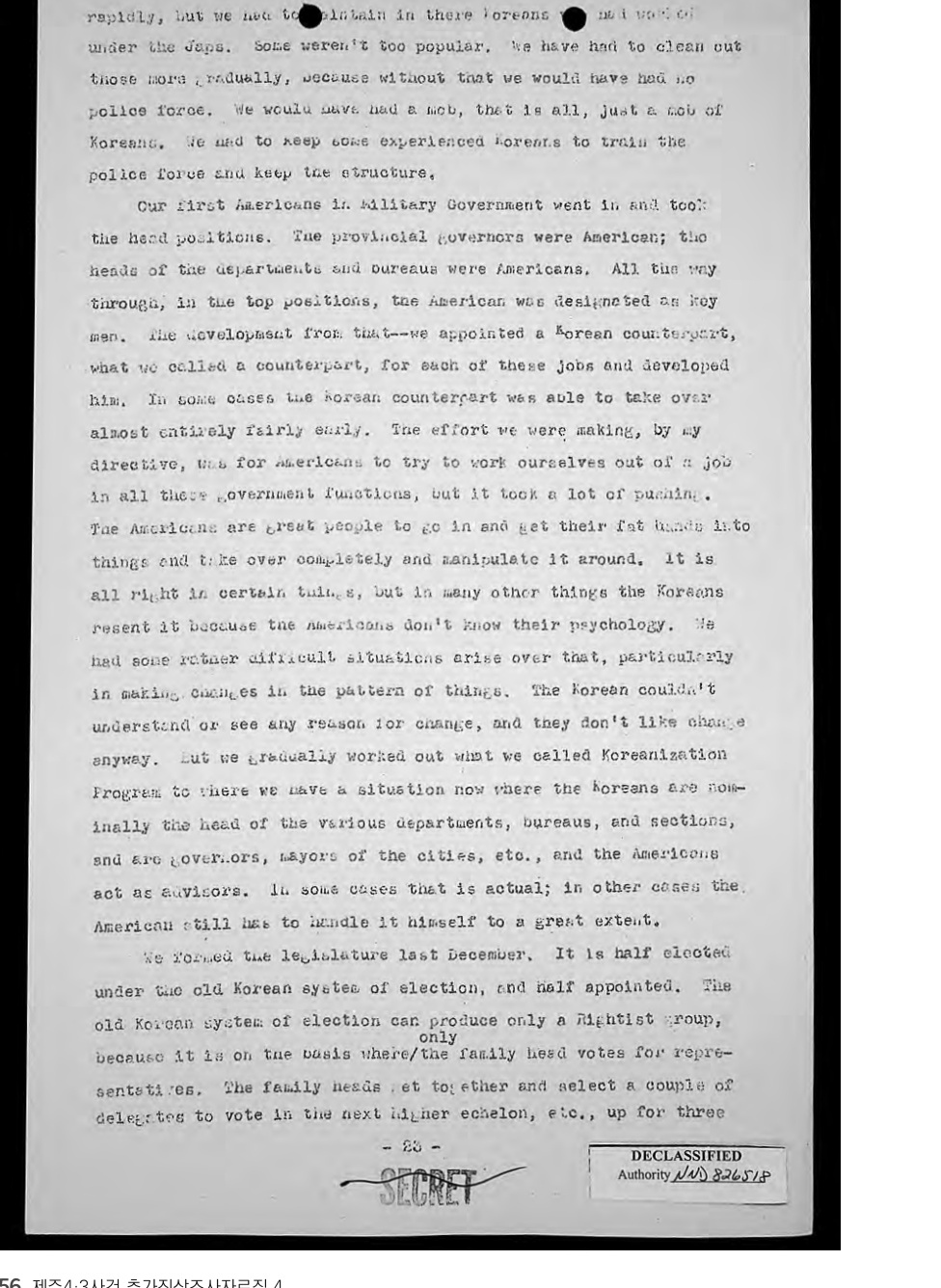
하지 사령관: 그에 대해 간단히 말씀드리겠습니다. 더불어 오늘 오후에는 헬믹(Helmick) 장군이 그 집단에 대한 설명을 드릴 것입니다. 조선에 들어와 군정부대를 설립한 후 이들을 분산시켜 지방 곳곳에 배치했습니다. 부대 본부는 일반적으로 지방 본부에 있었고 대도시의 경우에는 부대 본부를 만들고 중대를 잘 분산시켜 여러 지역을 통제했습니다. 우리는 일본으로부터 정부 기능을 인계받을 조선인들을 골랐습니다. 선발 과정에서 정치적 성향은 배제했습니다. 우리는 정치적 성향에는 관심이 없었습니다. 사실, 그들 중 누구의 정치적 성향도 수 개월간 몰랐습니다. 업무를 수행할 사람을 뽑는 것이 중요했습니다. 처음에는 일본 지배를 받을 때와 동일한 중앙 정부와 지방 정부를 그대로 인계받았습니다. 일본인들도 몇 명 남아 있었습니다. 한동안은 그래야 했습니다. 바로 일본인들을 다 쫓아냈다면 모든 것이 붕괴됐을 것입니다. 일본인들은 고위 사무직에 남겨두었습니다. 간부직은 아니고 기록에 관련된 업무였습니다. 기록이나 행정 기능이 필요한 곳에는 일부 일본인들이 남아 있었습니다. 1946년이 시작되고 한참 동안은 여전히 일본인이 남아 있었습니다. 조선인들은 이에 크게 반대하지 않았습니다. 그러나 국장이나 부장에 임명될 경우에는 큰 반대에 부딪쳤습니다. 재빨리 일본인을 끌어낸 유일한 기관은 경찰이었습니다. 자연스럽게 일본 경찰들을 매우 신속하게 끌어 내렸지만 일제하에 근무했던 조선인들은 그대로 남겨둬야 했습니다. 일부는
너무 인기가 없었습니다. 우리는 점차 정리해 나가기로 했습니다. 그렇게 하지 않으면 경찰을 아예 조직할 수 없었습니다. 우리에게는 군중들만 남았을 것입니다. 조선인으로만 된 순수 군중들 말입니다. 우린 경찰을 훈련시키고 조직을 유지하기 위해 경험이 있는 조선인들을 일부 유지해야 했습니다.
군정의 우수한 미국인이 들어가 기관장을 맡았습니다. 군수와 각 행정부서의 국장 및 부장도 미국인이 맡았습니다. 전반적으로 최고위직에는 미국인들이 핵심인물로 지명되었습니다. 거기에서 나아가 우리는 각 업무에 맞는 조선인을 임명해 훈련시켰습니다. 조선인이 상당히 빨리 거의 모든 업무를 인계받을 수 있게 된 경우도 있었습니다. 제 훈령에 따라 모든 미국인을 정부 기능 업무에서 나오게 하기 위해 노력했지만 밀어붙여야 하는 것들이 많았습니다. 미국인들은 타국 정세에 관여하는 데는 항상 뛰어납니다. 남의 일에 관여해 상황을 통제하고 자신의 이익을 위해 다른 나라를 조종합니다. 특정한 일은 괜찮지만 그 외 다수에서는 조선인들을 되돌려 보냈습니다. 미국인들이 조선인의 심리를 몰랐기 때문입니다. 이와 관련하여 다소 어려운 상황이 발생했습니다. 특히 생활 양식을 바꾸는 데 어려움이 많았습니다. 조선인들은 변화의 이유를 이해하거나 인식하지 못했고 변화를 좋아하지 않았습니다. 하지만 우리가 조선화 프로그램이라는 것을 서서히 진행시킨 결과, 이제는 조선인들이 명목상 다양한 부서, 국, 과의 수장이 되고 도지사, 시장 등으로 취임하였으며 미국인들은 고문 역할을 하게 되었습니다. 그러나 나머지 경우에는 미국인들이 아직 대부분의 일을 처리합니다.
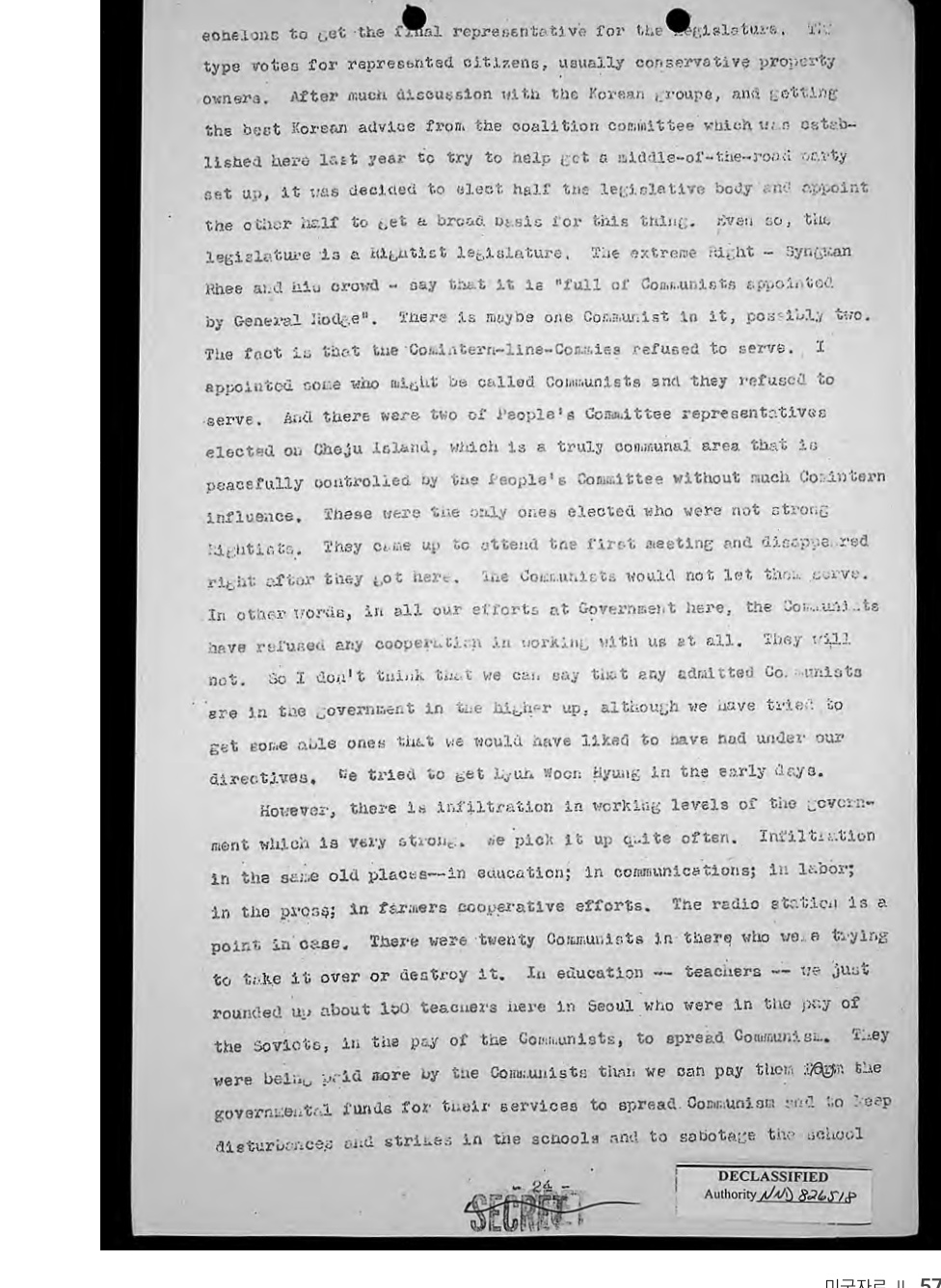
지난 12월에는 의회를 구성했습니다. 절반은 조선의 기존 선거 제도를 통해 선출했고, 나머지 절반은 임명했습니다. 조선의 기존 선거 제도에서는 가장이 대표로 투표하는 방식이었기 때문에 우파 집단만 양산할 수 있었습니다. 가장들이 모여 최대 세 명의 차상급 인사를 선출할 두세 명의 대표를 뽑아 최종 의회 대표를 선출합니다. 이 가장들은 일반적으로 보수적인 지주 출신의 대표 시민에게 투표합니다. 조선인들과 많은 논의를 하고 중도 노선 정당 창설을 목적으로 작년에 설립된 좌우합작위원회의 훌륭한 조선인 고문에게 자문을 한 뒤 의회의 절반은 선출하고 나머지 절반은 임명하여 폭넓게 인재를 등용하기로 결정했습니다. 그렇다
해도 의회는 우파 의회입니다. 극우파인 이승만과 그 일당은 의회가 "하지 사령관이 임명한 공산주의자들로 가득하다"고 말합니다. 의회에는 한두 명 정도의 공산주의자가 있을 것입니다. 사실 코민테른 계열 공산주의자들은 그 자리를 거부했습니다. 제가 공산주의자라고 불리는 사람들을 몇 명 임명했지만 그들은 거부했습니다. 한편 제주도에서 인민위원회 대표 두 명이 선출되었습니다. 제주도는 코민테른의 영향력이 크지 않고 인민위원회가 평화롭게 관리하는 공동 구역입니다. 이들은 강경 우파가 아닌 인사들 중에서 유일하게 선출된 인물들입니다. 하지만 그들은 첫 번째 회의에 출석하고 이곳에 온 직후 사라졌습니다. 공산주의자들은 그들이 의회에서 일하도록 가만히 놔두지 않았을 것입니다. 다시 말해 공산주의자들은 이곳 정부에서 우리가 하는 모든 일에서 우리와 협력하기를 전부 거부했습니다. 앞으로도 협조하지 않을 것입니다. 그래서 우리의 훈령에 따라 임명하고 싶었던 일부 유능한 인재를 영입하려고 노력은 했지만 공산주의자가 정식으로 현정부 고위직에 있다고는 말할 수 없을 것 같습니다. 초반에는 여운형을 영입하려고 노력했습니다.
하지만 정부 실무자 중에 매우 강력한 잠입 세력이 있습니다. 그런 자들을 꽤 자주 골라냈습니다. 잠입 세력은 교육, 통신, 노동, 언론, 농업협동조합 등 늘 같은 곳에 있습니다. 라디오 방송국도 좋은 예입니다. 그곳에도 라디오 방송국을 장악하거나 파괴하려 하던 20명의 공산주의자들이 있었습니다. 교육계에서는 이곳 서울에서 소련과 공산주의자들을 위해 일하며 공산주의 사상을 퍼트리던 150명 가량의 교사들을 체포했습니다. 그들은 공산주의 사상을 퍼트리고 학교에서의 소요와 파업을 지속하며, 학교 시설 파괴에 우리가 정부 자금으로 지불하는 월급보다 많은 금액을 공산주의자들로부터 받고 있었습니다. 통신계에서도 상황은 마찬가지입니다. 소방국에도 상당수가 있습니다. 소방국에서는 한 무리를 체포하여 감옥으로 보냈는데, 그들의 임무는 큰 화재가 났을 때 불을 끄지 않는 것이었습니다. 대신 소방 장비를 파괴하고 혼란과 거짓 선례 등이 확산되도록 했습니다.
현재까지 우리가 정부에 앉힌 최고위급 조선인은 민정장관입니다.
질문: 그는 어디에 비견됩니까?
하지 사령관: 대통령의 권한을 다수 보유하고 있습니다. 행정부의 수반이지만
그 밖의 부서에서는 권한이 거의 없습니다. 여기에는 입법부, 행정부, 사법부와 군정장관이 있습니다. 사법부는 다른 부서에 비해 오랫동안 장기적으로 운영되고 있습니다. 현재 군사재판소 소송은 거의 없앴으며, 조선인들이 거의 모든 소송을 담당하도록 하고 있습니다. 생각처럼 운영이 잘 안 될 때도 있지만 "커다란 명분"
을 얻게 된 그들은 열심히 맡아서 하고 있습니다. 제가 유일하게 남겨둔 것은 조 선인들이 미국인을 공격했을 때입니다. 그 문제는 우리 법정에서 처리합니다. 또는 상황이 높은 수준의 난동교사로 번져 정치적인 문제 때문에 사법부가 제대로 기능하지 못할 심각해진 경우도 이에 해당합니다. 사법권을 넘기고 초반에는 사 법권을 다시 가져와 군사 법정에서 더 많은 사건을 처리하려고 몇차례 위협을 했 으나 저들은 가장 확연한 법정 문제들을 시정했습니다.
지난 가을 혁명 당시의 난동교사 사건은 군사 위원회에서 심리했습니다. 우리는 25~30명에게 1급 살인죄 판결을 내렸고 법원에서는 이들에게 사형을 선고했 습니다. 사형이 마땅하긴 했지만 교수형으로 인한 정치적 후폭풍이 너무 커 심리 권을 행사해 종신형으로 감형했습니다. 반면, 소수의 난동교사범들을 교수형에 처할지 말지가 문제입니다. 이 부분은 사람들이 이해하지 못할 수 있습니다. 하지만 우리에게는 아직 고려해야 할 러시아인들이 있습니다. 우리는 모스크바 결정의 틀 안에서 일하고 있었습니다. 그 틀 안에서 일하는 한 우리는 러시아인들을 염두에 두어야 하고 이를 위해서는 확실한 회유가 필요합니다. 그 틀에서 벗어날 경우 우리가 어떤 훈령을 내릴지는 모르겠습니다. 유엔이 이 문제를 정말 인계 받 을지 여부는 말하기 어렵습니다.
이곳에서 우리가 인계받은 것들 중 제가 처음에 말씀드린 내용으로 돌아가겠습 니다.
그중 하나가 모스크바 결정이었는데 이에 대해 말씀드리겠습니다. 저를 비롯해이 문제를 연구하고 이곳에 머물고 있는 우리 대부분의 생각에는, 우리는 적어도도 1년 반 정도는 정치적으로 뒤처져 있습니다. 경제 측면에서는 1년 이상 뒤처 져 있습니다. 유명무실한 모스크바 결정에 묶이지 않았더라면 달성할 수 있었던
것에서 뒤처져 있고, 러시아가 계획했던 것보다도 뒤떨어져 있습니다. 저는 비판을 하고 있는 것이 아닙니다. 다만 이것이 현 상황이라는 점을 언급하고 있는 것뿐입니다. 반면 우리는 남조선의 영구적인 분할을 지향하고 있습니다. 이는 이미 기정사실입니다. 러시아가 자신들의 지역을 너무 강력하게 공산화했기 때문에 남북을 통합할 수 있을지 잘 모르겠습니다. 내전 없는 남북 통일의 기회는 그리 많아 보이지 않습니다. 잘 모르겠습니다. 어떻게 조선을 소련으로부터 해방시켜 하나의 국가로 구조해낼 것인지 그 방법을 알아내는 것은 제게 어려운 문제입니다. 우리가 떠나더라도 큰 차이는 없을 것입니다. 러시아는 5년을 기다릴 수 있습니다. 그때에도 공산주의가 여전히 맹위를 떨친다면 조선을 장악할 수 있을 것입니다. 유일한 기회이자 유일한 가능성이라면 조선인들에게 민주주의와 경제적 안정이 무엇인지 보여줄 수 있는 방식들을 이곳에 건설하여 러시아에게 우롱당하지 않을 만큼 조선인들이 공산주의를 바람직하지 않은 것으로 여기도록 만드는 것입니다. 다시 말해 이곳에 러시아 지배에 대한 저항이라는 방해 효과를 구축하는 것입니다. 러시아가 무엇을 원하는 지에 대해서는 의심의 여지가 없습니다. 그에 대해 잘못된 생각을 가지고 있는 사람이 바로잡을 책임도 있습니다. 러시아는 조선을 위성국가로 만들고 싶어합니다. 그렇게 못 한다면 소련연방 국가 중 하나로라도 만들길 원합니다. 그들은 조선의 부동항을 원하고 있습니다. 동해안의 원산은 태평양에서 가장 훌륭한 항구 중 하나입니다. 러시아는 서쪽에서는 진남포를 따라 세력을 키우고 있습니다. 진남포는 조선에서 두 번째로 큰 도시인 평양에 있는 항구로서, 둘 다 우수한 부동항이며, 연중 내내 이용이 가능합니다. 바로 러시아가 태평양에서 필요한 항구인 것입니다. 소련은 만주 지역도 원하고 있습니다. 저들은 절대 포기할 의사가 없어 보입니다. 이곳 조선과 시베리아와 만주를 통합한다면 여기는 꽤나 좋은 지역이 될 것이고, 이곳을 장악한다면 러시아는 아시아 전체를 지배하게 될 것입니다. 남쪽에 있는 중국인을 누가 신경 쓸까요? 소련은 이곳에 개발할 수 있는 잠재적 산업 지역과 대소련제국의 동쪽을 담당할 항구를 지배하고 있습니다.
이쯤에서 잠시 쉬어가겠습니다.
드래퍼 차관: 대단히 흥미로웠습니다.
하지 사령관: 전반적인 정치 상황이나 군정 업무에 대한 간략한 설명에 대해 더
알고 싶은 내용이 있으십니까? 물론 군정 문제 역시 정치적이며 전반적인 정치 상황의 지배를 받기는 합니다. 하지만 그것들은 실제 정부에서는 주로 경제와 행 정 문제입니다. 우리의 임무는 당연히 조선의 통일과 독립이고 그들이 자립할 수 있는 경제적 기초를 다지는 것입니다. 군정의 가장 큰 문제는 경제 문제이지만 좋 든 싫든 무조건 정치적 상황에 기초해야 합니다. 경제와 정치를 구분하고 싶지만 그럴 수가 없습니다.
의회에 대해 간단히 논의하면 좋겠습니다. 의회가 여러 정치 견해를 가장 잘 보 여주는 단면일 것입니다.
드래퍼 차관: 공산주의자들을 제외하고 말입니까?
하지 사령관: 네, 그렇습니다. 의회에는 자칭 좌파들이 몇 명 있긴 하지만 진짜
공산주의자라고 생각하지는 않습니다. 그들은 공산주의의 몇 가지 노선을 따르기는 하지만 봉건제도나 억압으로부터 반발이 있는 곳에서는 그들을 공산주의 노선이라 불리는 대상과 구별하기란 어려운 일입니다. 정치적 문맥에서 조금 설명 드 리겠습니다. 예를 들어, 철도가 개인 소유여야 한다고 생각하거나 대기업이 개인 소유여야 한다고 생각하는 조선인은 없을 것입니다. 조선인들은 모두 어느 정도 사회주의자입니다. 민주주의의 자본주의적 시각으로 봤을 때 그들은 자본주의보 다 사회주의에 가깝습니다. 하지만 그들은 작은 사업체, 토지, 집은 개인 소유화 하고 싶어합니다. 전면적인 국유화와 통제는 원치 않습니다.
의회는 조선인들이 스스로의 책임하에 모여 공개적으로 해야 할 일에 대해 토 론한 최초의 경험이었습니다. 의회를 조직하여 작동시키기까지 지칠 만큼 시간이 걸렸습니다. 우리는 조선인들이 민주 절차와 서로 싸우고 협력하는 방식에 대해 매우 많이 배웠으리라 생각합니다. 거기서 벗어나지는 못할 것입니다. 의회를 해 산하고 떠나 스스로 새로운 의회는 구성하지 못할 것입니다. 처음으로 꼼짝달싹 못해 힘들어하고 있습니다. 선거법 제정이라는 우리의 첫 번째 임무를 완수하는 데 12월부터 6월까지라는 시간이 걸렸고 조선인들이 제정한 선거법에는 우리 기
준으로 몇 가지 오류가 있었습니다. 하지만 그것이 그들의 생각이고 그들이 원하는 방향이었기 때문에 남조선 단독정부를 수립한다면 이를 수용할 의사가 있었습니다.
드래퍼 차관: 의회 말입니까?
하지 사령관: 네, 그렇습니다. 여러 견해의 단면이고 우파와 좌파가 타협하여 얻은 결과물로 그리 나쁜 선택지가 아닙니다. 그 안에는 우리가 해결해야 할 몇 가지 오류가 있기는 합니다.
드래퍼: 의회는 전반적으로 가치가 있다고 생각하십니까?
하지: 유용합니다. 하지만 가치를 높이기 위해 전반적으로 모든 의원을 선출직으로 채우고 싶습니다. 포고령으로 발표한 선거법의 인기는 떨어질 것입니다. 조선인들은 특히 새로운 것에 대해 "반감"이 있습니다. 자신들의 방식이 아니라고 생각하는 모든 것이나 누군가가 그렇다고 생각하는 모든 것을 거부합니다.
드래퍼: 그래서 그들이 고안한 형편없는 선거법이 우리가 고안한 양질의 선거법보다 더 잘 기능할 것이라는 얘기입니까?
하지: 저희는 그렇게 생각합니다. 미소공동위원회가 선거법을 제정한다면 그것은 외부 세력에 의해 합의된 것일 뿐 일부 유별난 조선인들은 만족하지 않을 것입니다. 남북조선 모두에 적용되는 이곳의 지방선거법은 공산주의자들의 생각에 맞지 않기 때문에 유엔에서 수용하지 못할 것입니다. 공산주의자들이 찬성하지 않는 일부 조항들이 법에 포함되어 있습니다.
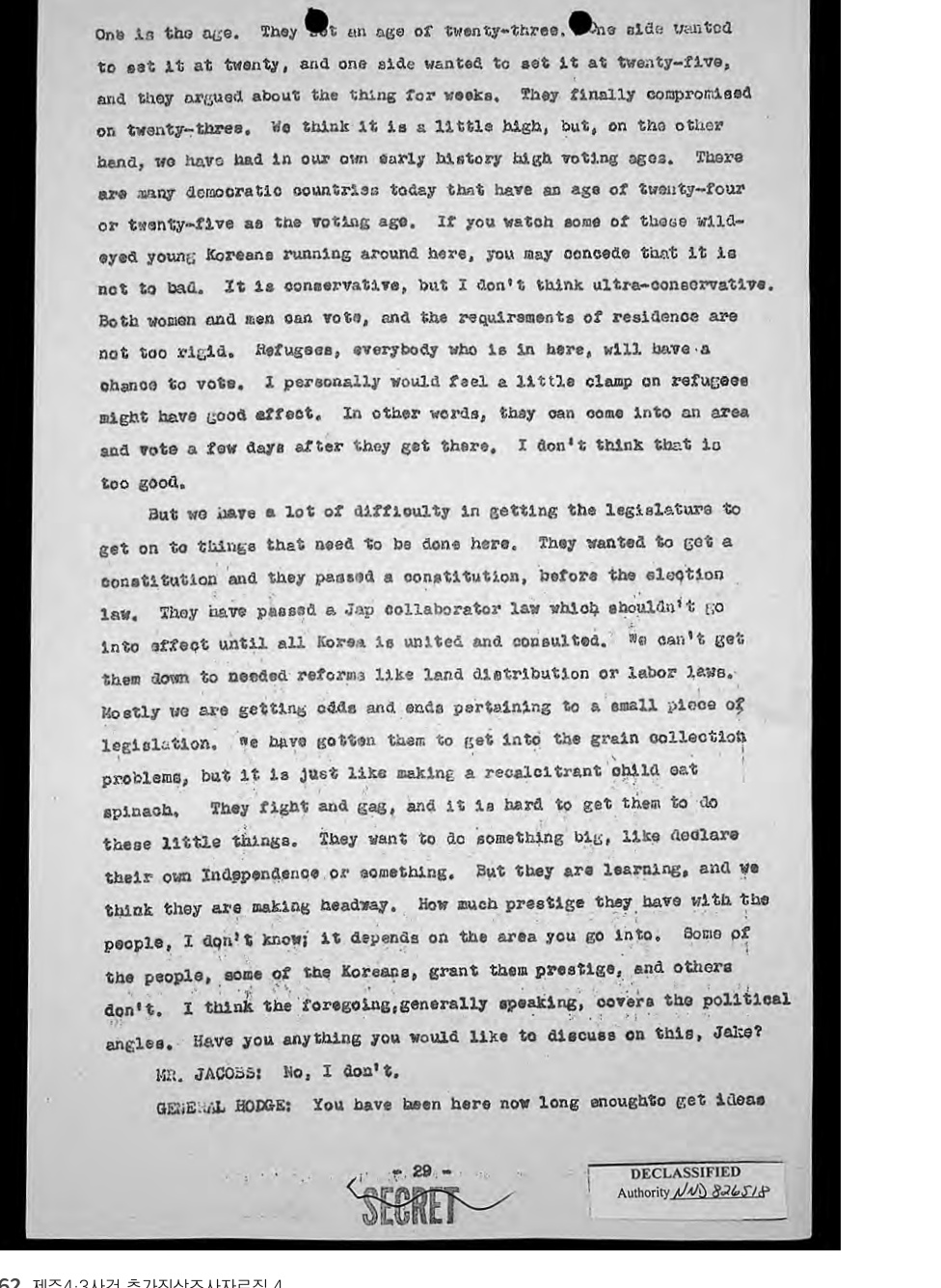
그중 하나가 나이입니다. 법에서는 선거 연령을 23세로 정하고 있습니다. 한쪽은 20세로 정하길 원하고 다른 한쪽은 25세를 원해서 이 일로만 몇 주의 논쟁을 벌였습니다. 결국 23세로 타협했습니다. 우리 생각으로는 다소 높은 연령이지만
생각해 보면 미국의 초기 역사에서도 선거 연령은 높았습니다. 현재 선거 연령을 24세나 25세로 정한 민주국가들도 많습니다. 여기서 설치고 다니는 어리고 몽상에 가득 찬 조선 청년들을 보면 그리 나쁘지 않다고 인정하실 것입니다. 보수적이 지만 극단적으로 보수적이진 않다고 생각합니다. 여성과 남성 모두 투표할 수 있 고 체류 조건도 그리 엄격하지 않습니다. 여기 사람들은 피난민을 포함하여 모두 투표할 수 있습니다. 개인적으로 피난민은 어느 정도 단속을 하는 것이 효과가 좋을 것이라고 생각합니다. 그러니까 피난민들은 어떤 지역이든 들어온지 며칠 만에 투표할 수 있습니다. 이것은 그다지 바람직한 것 같지 않습니다.
한편 여기서 수행해야 하는 많은 일을 꾸려나갈 의회를 구성하는 데에는 많은 어려움이 있습니다. 조선인들은 헌법을 제정하여 선거법 전에 헌법을 통과시키고 싶어 했습니다. 그들은 부역협력자법(Jap collaboratior law)을 통과시켰는데, 이는 조선이 통일을 하고 협의가 될 때까지 발효해서는 안 되는 법입니다. 우리는 그들에게 토지분배나 노동법 같은 필요한 개혁을 맡길 수가 없습니다. 주로 우리가 의회의 작은 일 같은 자질구레한 일을 맡아 하고 있습니다. 그들에게 곡물수집 문제를 들이밀어 보았지만 마치 아이에게 쓴 약을 먹이려 하는 것 같았습니다. 그 들은 싸우고 말문을 막아 버립니다. 그들에게 사소한 일을 맡기기는 어렵습니다.
그들은 독립 선언 같이 거창한 일을 하고 싶어 합니다. 하지만 그들은 배우는 단 계이기 때문에 앞으로 진전이 있을 것이라 생각합니다. 여기 사람들에게 명성이 얼만큼 중요한지 저는 잘 모르겠습니다. 분야에 따라 다를 것입니다. 조선인 일부는 명성을 부여하고 나머지는 아닙니다. 일반적으로 앞서 말한 내용은 정치적 측 면에 해당됩니다. 이에 대해 하실 말씀이 있으신가요, 제이크?
제이콥스(Jacobs): 없습니다.
하지 사령관: 오늘 여러분은 자신의 생각을 정리할 시간을 충분히 가졌으니 저
도 여러분의 생각을 들어보고 싶습니다.
제이콥스가 드래퍼에게: 제가 보낸 전보를 읽으셨죠? 그것이 제 생각의 요점입
니다.
드래퍼가 제이콥스에게: 두세 페이지로 압축하셨더군요. 그래도 아주 훌륭했습
니다.
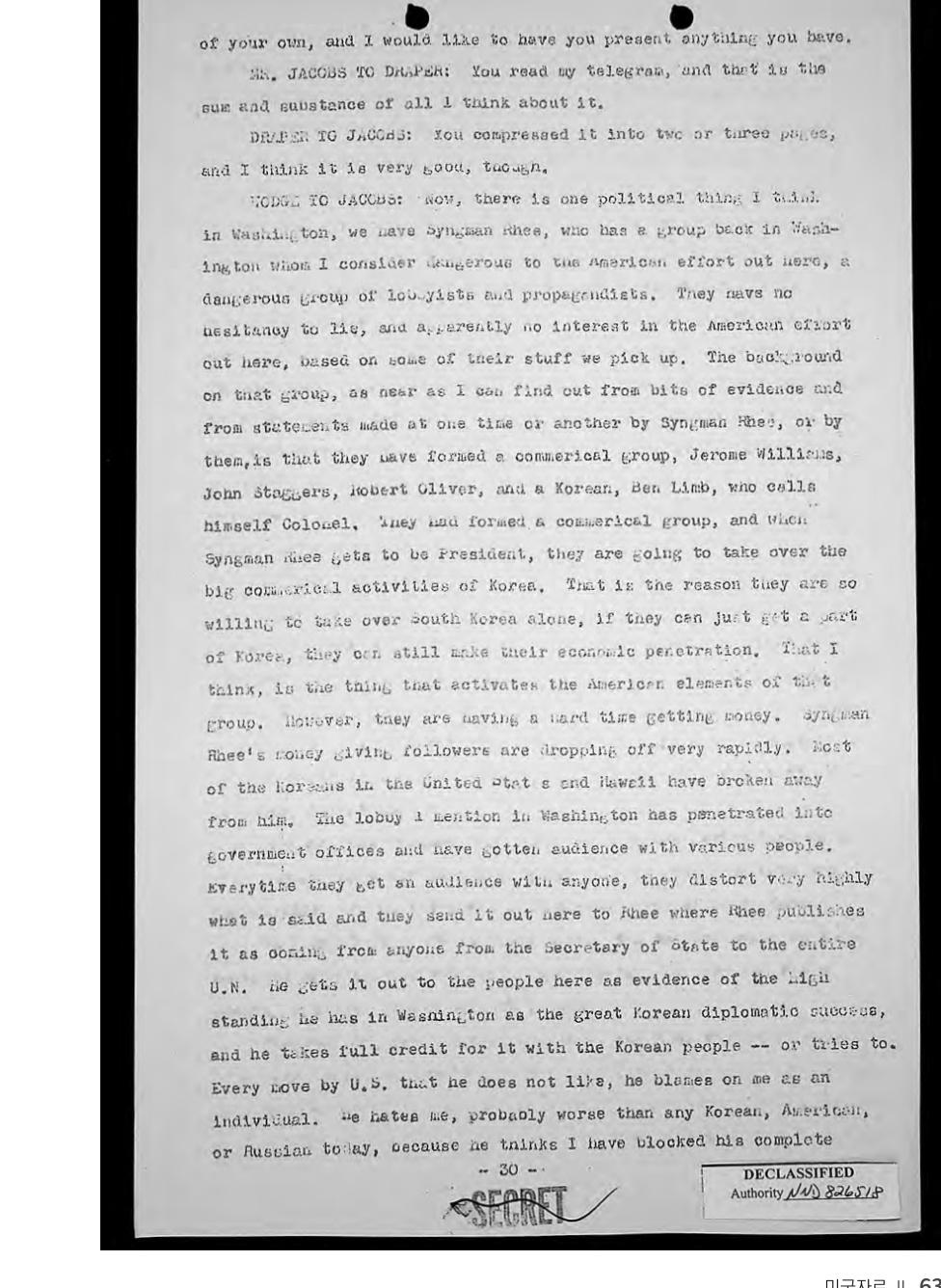
하지가 제이콥스에게: 현재, 워싱턴에는 정치적인 사안이 하나 있습니다. 우리
에겐 워싱턴에 배후세력을 둔 이승만이란 존재가 있습니다. 저는 이승만이 이곳에서 미국의 노력을 방해하는 위험한 존재이고 위험한 로비스트이자 선동가라고 생각합니다. 우리가 체포한 이승만의 측근들은 주저 없이 거짓말을 하고 이곳에서 미국이 쏟는 노력에 전혀 관심이 없습니다. 갖가지 증거와 이승만이나 그 패거 리가 한 번쯤 언급한 진술들에서 파악한 그들의 배경을 보면, 그들은 제롬 윌리엄 스(Jerome Williams), 존 스태거스(John Staggers), 로버트 클리버(Robert Cliver), 자칭 대령인 조선인 임병직(영어 이름: Ben Limb)으로 구성된 상업 조 직을 구성했습니다. 이 같은 상업 조직을 구성하여 이승만이 대통령이 되면 조선의 대규모 상업 활동을 장악할 계획이었습니다. 이것이 바로 그들이 남조선 단독 정부를 세우려는 의도이며, 그들은 조선의 일부만 취하게 되더라도 경제적인 침 투를 할 것입니다. 조직 안에 미국인을 편성한 것도 그 이유라고 생각합니다. 하 지만 이들은 자금을 모으느라 힘든 시간을 보내고 있습니다. 지지자들이 이승만 에게 보내는 자금은 매우 빠르게 소진되고 있습니다. 미국과 하와이의 조선인 대 다수가 그에게서 벗어났습니다. 제가 말씀드렸던 워싱턴 로비는 정부 관청까지 침투했고 다양한 사람들을 대상으로 삼고 있습니다. 그들은 누구를 만날 때마다 사실을 굉장히 왜곡해 이곳에 있는 이승만에게 전달합니다. 그러면 이승만은 그 이야기가 미국 국무부나 유엔 관계자로부터 나온 이야기라고 발표합니다. 이승만은 그 내용을 자신이 워싱턴에서 고귀한 신분으로서 위대한 조선의 외교적 성공을 거둔 증거로 포장하여 발표해 조선인들로부터 완전한 신임을 얻고 있습니다.
최소한 그러려고 애쓰고 있습니다. 이승만은 자신이 싫어하는 미국의 모든 움직 임을 두고 개인인 저를 비판합니다. 조선인, 미국인, 러시아인 그 누구보다 저를 싫어합니다. 제가 자신이 남조선이나 조선 전체의 정부 수장이 되는 것을 가로막 는다고 생각하기 때문입니다. 그런 상황이 존재하기 때문에 그 점을 말씀드린 것
입니다.
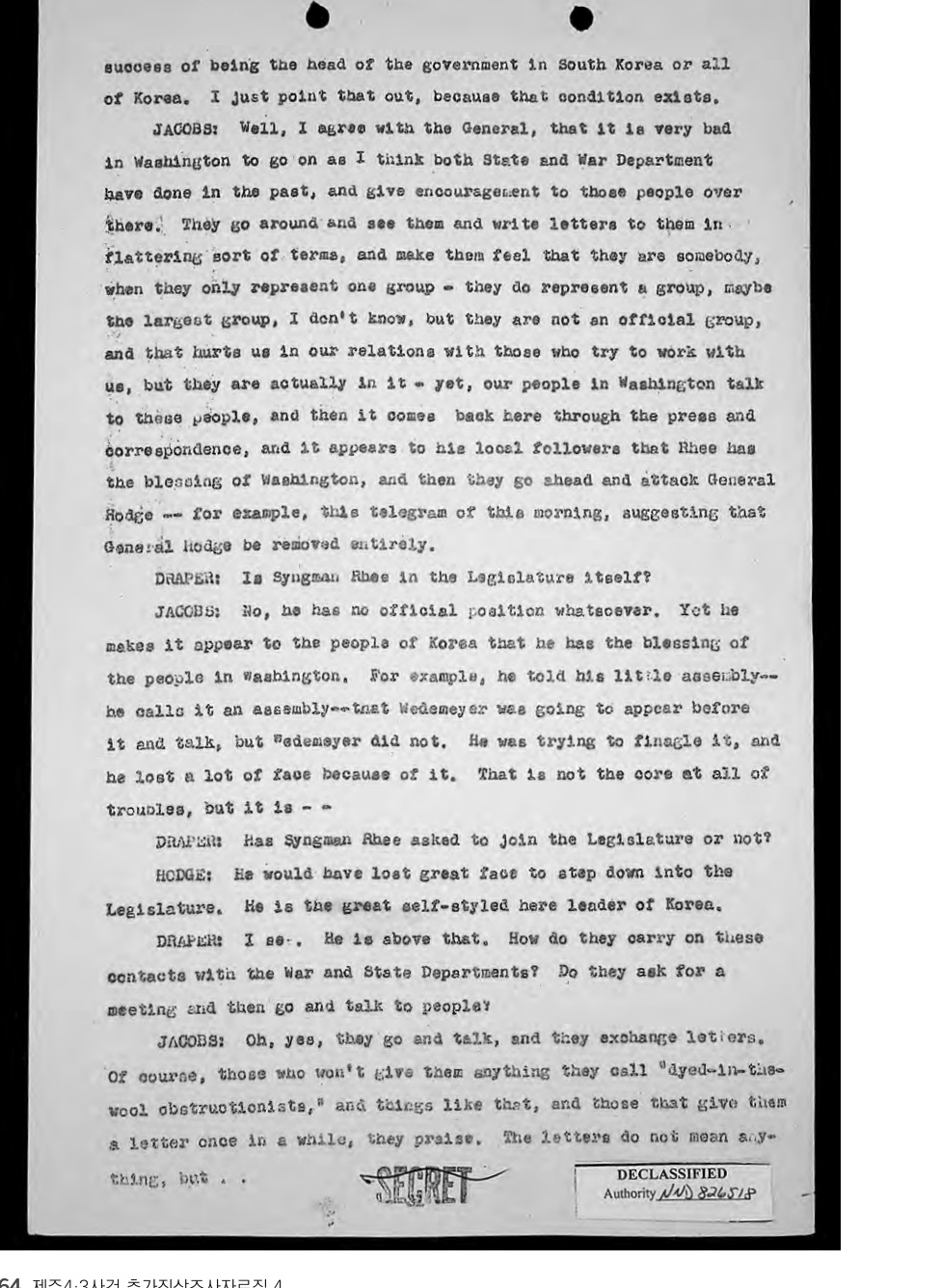
제이콥스: 저도 워싱턴의 국무부와 전쟁부가 과거에 했던 것을 계속함으로써
그 곳 사람들을 격려하는 일은 매우 나쁘다고 생각하기 때문에 장군의 말씀에 동 의합니다. 저들은 돌아다니면서 이런저런 상황들을 보고 아첨하는 말들로 편지를 보내며 그들이 한 집단을 대표할 때(실제로 한 집단을 대표합니다. 큰 집단인 것 같은데 저는 잘 모릅니다.) 자신들이 뭐라도 된 양 느끼고 있습니다. 하지만 그들은 공식 집단이 아니므로 이것은 우리와 협력하려는 사람들과 그 관계에 해가 됩 니다. 그렇지만 실제로 저들은 그 안에 있습니다. 워싱턴에 있는 우리 측근들이 이들과 대화를 나누고 나면 언론이나 특파원을 통해 그 내용이 들려오고, 현지 추 종자들 눈에는 이승만이 워싱턴의 은총을 입은 것처럼 보이게 되고, 그러면 그들은 앞서서 하지 장군을 공격하는 것입니다. 오늘 아침 이 전보만 봐도 하지 장군이 완전히 해임되었다고 전하고 있습니다.
드래퍼: 이승만도 의회에 있습니까?
제이콥스: 아니요. 이승만은 관직 같은 것을 맡지 않았습니다. 대신 자신이 워
싱턴의 은총을 입은 것처럼 사람들을 현혹시키고 있습니다. 자신의 소위원회에 대해 언급하며(그는 이것을 의회라고 부릅니다) 웨드마이어 중장이 소위원회에 출석할 것이라고 말했지만, 실제로 웨드마이어 중장은 나타나지 않았습니다. 그는 이에 대해 뭔가 속임수를 쓰려고 했지만 체면만 많이 구겨졌을 뿐입니다. 이것이 모든 문제의 핵심은 아닙니다.
드래퍼: 이승만은 의회 가입을 요청했습니까 안 했습니까?
하지: 의회에 들어갔다면 이승만은 엄청나게 체면을 구겼을 것입니다. 이승만
은 자칭 조선의 위대한 지도자입니다.
드래퍼: 알겠습니다. 그럴 위인이 아니군요. 그들은 전쟁부 그리고 국무부와 어
떻게 연락을 취하고 있습니까? 면담을 신청하고 가서 대화하는 방식입니까?
제이콥스: 네, 찾아가서 대화를 나누고 서한도 교환합니다. 물론 요청하는 것을
하나도 들어주지 않는 '골수 의사방해자'나 어쩌다 한 번 서한을 보내는 사람들도 있습니다. 그들은 그런 서한을 좋아합니다. 하지만 그 편지들은 아무 의미도 없습 니다..
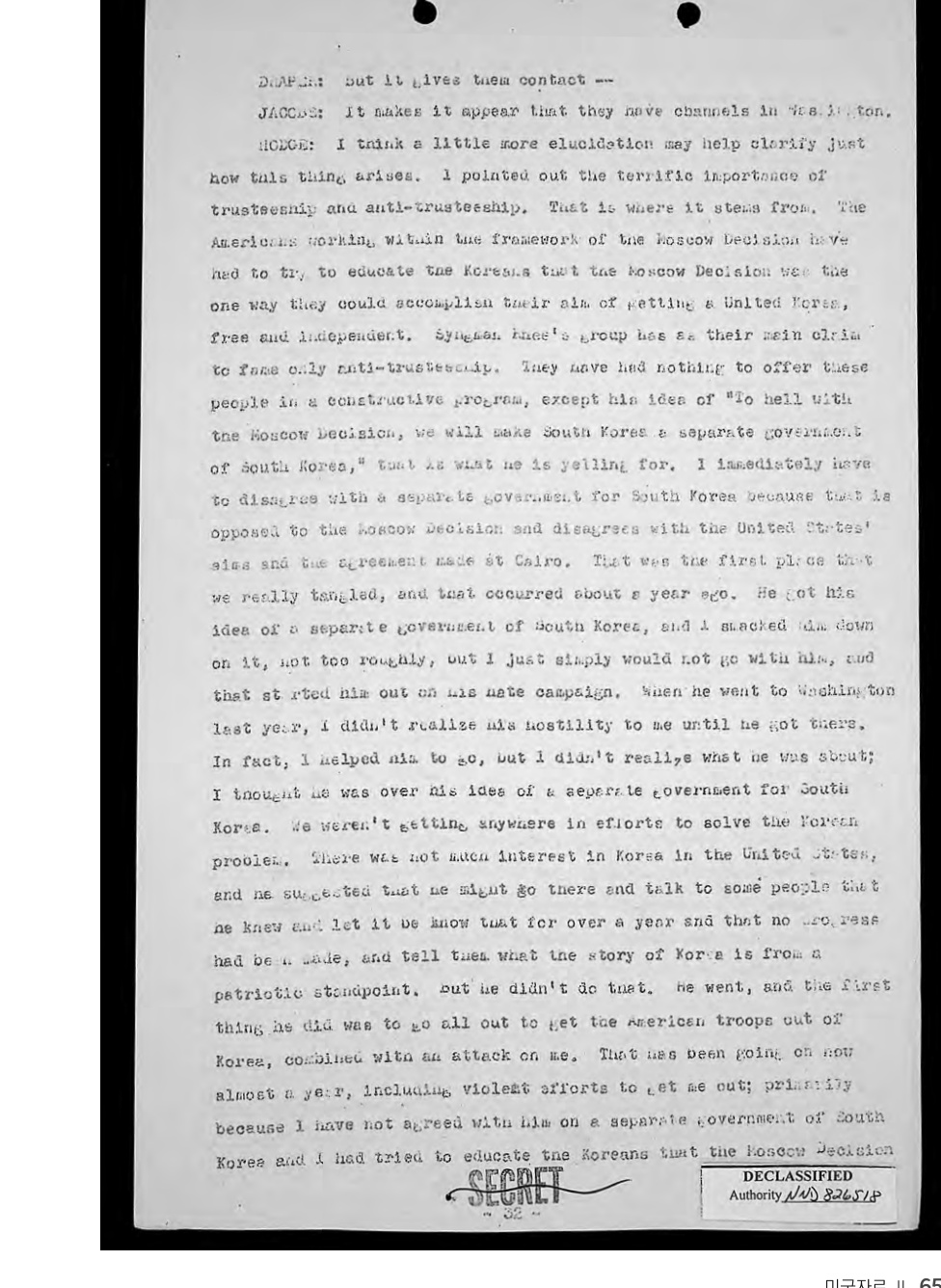
드래퍼: 하지만 연락은 되는 군요.
제이콥스: 이런 것들 때문에 그들이 워싱턴에 측근이 있는 것처럼 보인다는 것
입니다.
하지: 조금 더 설명을 하면 이런 일들이 어떻게 일어나는지 분명하게 알 수 있
을 것 같습니다. 저는 신탁과 반탁의 중요성에 대해 지적했습니다. 모든 것은 거 기에서 비롯됩니다. 모스크바 결정 체제 안에서 일하는 미국인들은 조선인들에게 모스크바 결정은 조선의 통일과 해방, 독립이라는 목표를 달성할 한 가지 방법이 라는 점을 교육하도록 노력해야 했습니다. 이승만파가 유명해진 주된 이유는 오 직 반탁뿐입니다. "모스크바 결정이 어찌 됐든 우리는 조선에 남조선 단독 정부를 세울 것이다"라고 이승만이 목놓아 외치고 있는 생각을 제외하면 어떠한 건설적 인 계획도 제시되지 않고 있습니다. 남조선 단독정부 수립은 모스크바 결정에 위 배되고 유엔의 목표와 카이로 협정에도 반하기 때문에 저는 즉각적으로 반대해야 했습니다. 그것이 실제로 상황이 엉키게 된 첫 번째 사건으로 일 년 전쯤에 생긴 일입니다. 이승만은 남조선 단독 정부라는 생각을 가지고 있었고, 저는 그의 생각을 질책했습니다. 그렇게 험한 질책은 아니고 그저 저는 그와 함께할 수 없다고만 말했는데 그때부터 그의 증오가 시작되었습니다. 작년 이승만이 워싱턴에 갔을 때만 해도 그가 저에 대한 적개심을 품고 있는지는 몰랐습니다. 그의 미국행을 도 운 것도 저지만 그의 의도는 눈치채지 못했습니다. 저는 그가 남조선 단독정부라는 생각을 버린 줄만 알았습니다. 우리는 조선 문제 해결에 있어 그 어떤 성과도 내지 못했습니다. 미국은 조선에 큰 관심이 없었습니다. 이승만은 자신이 미국으
로 가 지인들과 대화하며 일 년 넘게 그 내용을 알리겠다고 했지만 아무런 진전도 없었으며, 애국지사의 관점에서 조선의 이야기를 하겠다고 제안했습니다. 하지만 이승만은 약속을 지키지 않았습니다. 이승만이 떠나서 가장 먼저 한 일은 미군을 조선에서 축출하고 저를 공격하는 데 총력을 다한 것이었습니다. 그런 행동은 지금까지 거의 일 년 동안 진행 중이며, 저를 쫓아내기 위한 폭력적인 활동도 있었습니다. 주된 이유는 제가 남조선 단독 정부에 동의하지 않았고, 러시아가 그에 따라 일을 처리한다면 모스크바 결정은 완전히 이로운 것이라고 조선인들에게 교육했기 때문입니다. 조선인들이 반대하는 것을 중단하고 모두가 받아들인다면 훨씬 이로울 것이고, 분명 효과가 있을 것이라고 저는 실제로 믿고 있습니다. 물론 공산주의가 이곳을 지배하게 될 위험은 언제나 존재하고, 그러한 위험은 매일 커지고 있습니다. 하지만 우파가 이런 식으로 행동한다면 우리가 도우려는 사람들의 도움은커녕 그들의 반대에 부딪히며 러시아와 싸워야 할 것입니다. 이승만과 작년 12월 이승만이 떠났을 때 남겨진 그의 무리들은 남조선에 이승만을 정부 수장으로 만들자는 혁명 계획을 주도했습니다. 혁명이 발생했을 때 이승만은 조선을 뜨고 싶어 했지만 김구는 남조선에 단독으로 자체 정부를 세우겠다는 계획을 시행했고, 자신들의 목표 달성을 위해서라면 미국인들을 죽이는 등 그 밖의 일도 할 의향이 있었습니다. 심지어 미국인 몇 명을 죽이고 싶다는 의사까지 표시했으며, 미국 시민들이 주한미군은 인기가 없고 미국의 임무도 실패했다는 믿음으로 이곳을 떠나야 한다는 바람을 자연스럽게 갖도록 만들었습니다. 그런 생각을 여전히 마음속에 품고 있는 이승만파는 적절하다 싶을 때 언제든지 시도할 것입니다. 저들은 권력을 얻고 자신들만의 단독 정부를 세우기 위해 무엇이든 할 것입니다. 그들이 원하는 것은 독재 정부입니다.
드래퍼: 물론 미군이 철수한다면 이승만이 그렇게 오래 머물지는 않겠죠?
하지: 15분도 채 머물지 않을 것입니다. 한편으로 이승만은 점점 자포자기 상태가 돼 가고 있으며 부인 역시 끊임없이 재촉하고 있습니다. 부인은 다소 기가 센 호주인입니다. 그녀가 러시아의 사주를 받고 있지 않다는 것이 확실한지 가끔은 확신할 수가 없습니다. 그들의 행동에는 필사적인 측면이 있습니다. 이승만이 워
싱턴으로 갔을 때 그는 국무부의 힐더링(Hilldering)을 만나, 이 일을 계기로 외교적으로 성공하여 귀국했다는 커다란 명분을 얻었습니다. 이승만은 육군장관과 만날 자리도 마련돼 있었습니다. 저는 이승만은 실제 그 자리에 나갔으리라 생각하지만 육군장관은 너무 바빠 이승만을 만나지 못했다고 전해 들었습니다. 국무부는 이승만이 군용 항공기로 귀국할 수 있도록 항공기를 주선해 주었습니다.
드래퍼: 먼슨(Munson) 대령이 항공기 얘기를 전해 들었지만 제공하지는 않았습니다. 그 계획을 중단시켰죠.
하지: 이승만은 중국 입국 허가를 받았습니다. 제가 알기로 중국에서는 아직도 장개석이 이 늙은 임시정부 패거리를 돕고 있습니다. 웨드마이어 중장은 자신이 중국에 들어갈 때쯤 장개석이 김구파에게 20만 달러를 추가로 책정했다는 소문을 들었습니다. 2년 전에도 20만 달러를 책정했던 것으로 알고 있습니다. 당시 이승만이 그 돈에 손을 대려고 했기 때문에 알고 있습니다. 그 자금은 김구에게 할당되었지만 이승만파가 그 돈에 손을 대려 한 것입니다.
드래퍼: 그들은 서로 힘을 잘 합칩니까?
하지: 무엇을 추구하느냐에 따라 다릅니다. 현재는 갈라선 상태입니다. 작년 겨울 이승만이 떠났을 때에는 한패였습니다. 오래된 중국 군벌의 전통에 따라 저들이 시행하려고 했던 혁명에 대한 두꺼운 기록 파일이 있습니다. 이승만으로 돌아가, 이승만은 중국 입국 허가를 받았고 저는 그에게 배로 이동할 것을 권했습니다. 당시 들어오는 모든 항공기는 육군 비행기였기 때문에 조선인들도 그것이 육군 비행기라는 사실을 알 것이었습니다. 이승만이 비행기로 들어온다면 그는 "미국이 내게 귀국편으로 비행기를 제공했다. 국무부와 전쟁부가 내게 이 비행기를 보내줬다"라고 말할 수도 있는 것입니다. 저는 신경 쓰지 않습니다만 조선인들 눈에는 L-6에서 C-54까지의 모든 비행기는 이승만이 타고 들어온다면 이승만의 비행기처럼 보일 것이고, 이승만은 모든 조선인들에게 그것이 사실인냥 알릴 것이며 조선인들은 그 말을 곧이곧대로 믿으며 그가 미국 정부의 완전한 지지를 받
고 있다고 생각할 것이었습니다. 결국 미국의 도움으로 이승만은 항공편으로 중국에 들어갔고 장개석은 전용기로 이승만을 이곳으로 보냈습니다. 이 사건은 예상 외의 효과를 거두었고, 이승만은 장개석의 든든한 배려를 받으며 금의환향하여 모든 조선인들에게 자신이 저를 내쫓을 것이고 제가 곧 떠날 것이며, 이제 남조선 단독정부를 세울 것이라고 말했습니다. 나아가 힐더링 장군이 자신에게 이를 약속했고 저를 제외한 미국 행정부의 전원이 그에게 이를 약속했다고 말했습니다. 이승만이 미국에 있는 동안 저에 대해 너무 심하게 공격을 해놓은 바람에 2월 미국으로 소환되었을 때 저는 공산주의자들에게 높은 자리를 내주었다는 모함에 자기변호를 해야 했습니다. 농담이 아닙니다. 국회의원들과 제가 만난 모든 기관, 언론에서 저는 용공분자 아니면 완전한 공산주의자가 되어 있었습니다. 그러니 도와주십시오. 제가 뉴욕에 갔을 때는 이미 이승만이 뉴욕에 진출해 있는 상태였습니다. 뉴욕의 헨리 루스(Henry Luce)가 그 패거리에 합류했고 아직도 그 무리를 지원하며 록펠러 건물에 무료로 사무실을 제공하고 있다고 합니다. 그들은 자신들이 공산주의의 적이라고 홍보하고 있습니다. 사실입니다. 그들은 공산주의의 적이지만 조선 문제 해결에서는 미국의 적이기도 합니다. 그것과 마찬가지인 셈입니다. 우리는 약 일 년간 무슨 일을 할 때마다 우리에게 반대하려는 사람들과 싸워왔습니다. 그것이 바로 좀 전에 그들이 많이 싫어하지 않는 사람들을 사귀는 것이 좋을 것이라고 말한 이유입니다. 그 놈들 때문에 쫓겨나고 싶지는 않지만 우리가 생각해봐야 할 상황입니다.
제이콥스: 거기에는 또 다른 측면이 있습니다. 그들은 서신을 받고 접촉을 시도한 것 외에도 우리가 남조선 정부를 수용할 것이라는 표시로 우리 국민들과 국무부 및 전쟁부에서 모두 언급한 보조금 프로그램을 받았습니다. 일부 사람들은 이것을 남조선 정부를 수용할 의사가 있다는 표시로 해석했습니다. 그다음 하지 사령관이 여기서 모스크바 결정을 수행한다는 훈령을 시행하고 조선을 통일시키려 하자 이승만은 공산주의자가 되었습니다. 그들이 얼마나 단순한지 아시겠습니까? 열정적이지만 단순합니다.
하지: 그들은 제가 트루먼 독트린을 수행하지 않고 있다고 합니다. 트루먼 독트
린은 물론 마셜 플랜에도 반대하고 있다고 말합니다. 또 다른 문제가 있습니다.
최근 불온한 활동을 벌인 공산당 간부들을 체포했을 때 사람들은 크게 기뻐했습 니다. 하지만 수사 결과 계획에 가담하지 않은 것으로 밝혀진 조무래기들을 풀어 주기 시작하자 공산주의자들을 풀어주었다고 저를 심하게 공격했습니다.
제이콥스: 그들은 브라운 장군에 대해서도 당연히 같은 감정을 가지고 있습니다.
브라운 장군: 어젯밤 한 미국인 장교로부터 또 한 가지를 확인했는데, 이승만은
그야말로 남조선의 완전한 주권을 원하고 있다는 점입니다. 이승만은 남조선 보 호 방식을 두고 결단을 내려야 했을 때 미군 주둔을 원했고 미군과 함께 하길 원 했음에도 완전한 주권을 원하고 있습니다. 이승만은 그 개념에 집착하고 있습니 다. 완전한 주권을 팔아먹을 것입니다. 그가 말하는 주권은 당연히 미국이 이곳에서 나가는 것을 의미합니다.
드래퍼: 이승만은 미국의 재정적 원조도 원하고 있습니까?
하지: 물론입니다.
제이콥스: 이승만은 원조와 지원을 받길 바라고 있습니다. 이 어리석은 노인은
자신이 남조선에서 권력을 잡기만 하면 러시아도 상대할 수 있다고 생각하는 것 같습니다. 즉, 우리는 못하지만 자신은 상대할 수 있다고 말합니다. 만약 이승만이 남조선을 장악하여 대통령이 되고 우리가 그에게 자금과 지원을 쏟아붓는다면 그는 러시아와 흥정을 할 것이고, 그러면 러시아도 특정 사항들을 합의하고 임시 정부를 세울 것입니다. 그러면 이승만은 한반도의 대통령이 될 것입니다. 러시아도 잠시 동안은 이승만에게 동조하다가 공산주의자들이 자신들을 선전하는 경찰 국장이나 경찰 조력자, 육군참모총장 등에 취임하면 "자, 우리는 너희와 함께 일 할 수 있다는 것을 보여주었다. 이제 우리는 완전한 정부를 세워야 한다. 이것은 임시정부일 뿐이다"라고 말하면 공산주의자들은 "좋다. 선거를 실시하겠다"라고 말하고 자기네 사람을 앉힐 것입니다. 그런 다음 의회에서 의견을 내놓으면 공산
당 심복이 나와 "이것은 헌법이다"라고 말하며 러시아 헌법을 그대로 베낀 헌법을 읽을 것입니다. 누군가 이상한 낌새를 알아챌 수도 있지만 지나치게 말이 많으면 국회의원으로서의 면책 특권이 박탈되어 교도소로 방출될 것입니다. 나머지가 겁을 먹고 선거를 준비하게 되면 유고슬라비아 대통령과 마찬가지로 이승만이 대통령이 되는 것입니다. 이승만은 보호와 감시를 받게 될 것이고 수상이 실질적인 통치자가 될 것입니다. 친러파 김일성말입니다. 그러면 조선은 위성국가가 되는 것이고 그때 가서는 어떻게 해보려 해도 너무 늦은 일이 돼 버립니다. 그 어리석은 늙은이는 자신이 할 수 있다고 생각하지만 그는 다른 패턴을 모릅니다. 저는 이런 식으로 설명해 보려고 해봤습니다. "어쨌든 당신은 지금의 신탁통치 체제하에서 우리에게 동조해야 하고 신탁통치에서 러시아가 들어오려고 한다면 우리가 그들을 반대하는 법규칙을 제정할 것이기 때문에 결국 당신을 보호하게 될 것이다. 당신이 미국을 신뢰할 수 없다면 누구를 신뢰할 수 있겠는가?"라고 말했습니다. 또 "현재 전 세계에서 무슨 일이든 할 수 있는 나라는 러시아와 미국밖에 없다. 당신이 우리를 신뢰할 수 없다면 러시아를 신뢰해야 한다"라고 설명했습니다. 개인적인 생각입니다만 이승만의 정신은 온전치 않아 보입니다.
드래퍼: 남조선이 이승만을 어느 정도로 지지할 것이라고 생각하십니까?
제이콥스: 이승만은 가장 강력한 우파 지도자 중 하나인 듯 합니다.
하지: 이승만이 지지하고 그럴싸한 프로그램을 시행하게 둔다면 그는 많은 지지를 얻을 것입니다. 남조선은 이승만을 지지할 것입니다.
제이콥스: 우파는 우리가 승인하는 사람이라면 누구나 추종할 것입니다. 우리가 이승만을 지지한다는 점을 명확하게 표시하면 우리가 그의 뒤에 있다는 이유만으로 전폭적인 지지를 얻을 것입니다.
브라운: 여기에는 다른 무언가가 있습니다. 이승만은 현재 전국적으로 인지도가 높은 유일한 지도자입니다.
드래퍼: 남조선만큼이나 북조선에서도 인지도가 있습니까?
브라운: 주로 남조선에서 있습니다.
드래퍼: 북조선에서도 추종자가 있습니까?
브라운: 북조선은 완전히 공산당의 지배를 받고 있습니다. 밖으로 드러나지 않은 대규모의 지하 우파세력이 있기는 합니다. 우리가 북조선에서 공산당을 제거하고 우파가 밖으로 나올 수 있다면 이승만을 따를 것입니다. 러시아의 비호를 받는 또 다른 조선인이 있습니다. 조만식이라는 인물인데 큰 영향력을 지니고 있습니다. 조만식과 이승만이 서로 어떻게 경쟁할지는 잘 모르겠습니다. 조만식은 러시아의 호위하에 호텔에 머물고 있으며 부인이나 가족도 그를 만날 수 없습니다.
드래퍼: 장군께서 수상이 될 것이라고 말한 인물이 조만식입니까?
제이콥스: 아닙니다. 그 사람은 김일성입니다.
드래퍼: 북조선 정부를 세우는 데 러시아는 어떤 일을 했습니까? 의회를 구성하거나 뭐 그러한 조치를 취했습니까?
하지: 인민위원회를 구성했습니다. 위원회, 중앙 위원회 등을 창설했습니다. 저들이 의회라고 부르는 것은 하나도 없을 것입니다. 인민회의라는 것이 있긴 한데 제가 알기로는 전 지역 공산당 대표들로 구성되어 있는 회의입니다.
제이콥스: 그 구성원은 모두 민주전선 출신입니다. 그중 하나인 수상이 인민회의 의장인데 도입하고 싶은 법이 있으면 앞으로 나가 발제하거나 위원회 서기에게 읽힙니다. 그러면 논의 없이 바로 통과됩니다. 형식적인 승인을 제외하고 표결은 없습니다.
드래퍼: 그럼 이 제안을 러시아가 거절할 경우엔 어떻게 되죠? 그럴 가능성이
클 것 같은데요.
제이콥스: 모르겠습니다. 또 다른 의회를 거부할 수는 없지만 반대 투표를 할
것이고 그 후에는 참여를 거부할 것입니다. 만약 우리가 발의하는 결의안을 총회가 채택한다면(실제로는 아직 결의안을 발의하지 않았습니다) 그 결의안은 도입 되고 아마 통과될 것입니다. 하지만 러시아가 이에 반대하고 우리는 이를 시행하 려 한다면 미소공동위원회처럼 되고 말 것입니다. 러시아가 참여를 거부하는데 어떻게 시행을 한다는 것이죠? 여전히 38도선이 경계로 남아 있고 유엔은 유명 무실인데 우리는 무엇을 해야 하겠습니까? 최근 제가 보낸 전보에는 또 다른 점을 지적하고 있습니다. 우리는 18개월~2년 가까이를 허송세월했습니다. 꼭 허송 세월이라고 할 수는 없지만 그 정도의 시간을 잃었습니다. 이렇게 불확실한 상황을 유지하는 데 2년은 너무 깁니다. 이제는 한두 가지 방법으로 무엇을 할지 결정 해야 합니다. 적극적인 정책을 추진하고 미래의 어느 시점까지는 조선의 통일은 잊어야 합니다.
드래퍼: 러시아가 제안을 수용하고 위원단가 들어오는 것을 허용하는 것, 이 가
능성은 없다고 보시는 겁니까?
제이콥스: 가능성은 없습니다. 지금으로선 의회에서 동의할 것이라고 생각하지
않습니다. 어떻게 해서든 희석시키려 할 것입니다. 그래서 러시아가 수용하더라도 말입니다.
드래퍼: 두 번째 대안은 1단계가 거부된 후 남조선 정부를 구성하는 것입니다.
제이콥스: 조선의 3, 4 혹은 5년 그리고 그 이후를 우리 국민과 의회가 그려내
지 못한다면 남조선 사람들에게 커다란 비극이 될 것입니다. 모든 것이 차단되고 공화당원들이 당선되어 이 문제를 다루지 않는다면 커다란 비극이 될 것입니다.
하지: 더 많은 이들이 죽을 것입니다.
드래퍼: 세 번째 대안은 그 단계를 취하기 전에 그 상태가 충분히 중요하지 않다고 판단하고 손을 떼는 것입니다.
제이콥스: 다시 말해 우리끼리 총선을 치르고 이승만 박사에게 맡기고 우리는 떠나는 것입니다. 가능성이 있습니다. 그것이 또 다른 방법입니다.
드래퍼: 물론 미소공동위원회 틀 안에서 러시아와 함께 시작할 수 있는 다른 대안도 있습니다. 러시아가 이곳에 민주전선 정부를 창설하거나 부분적으로 시작하게 할 수 있습니다. 우리가 러시아와 함께 계속 뭔가를 진행하거나 마지막으로 우리가 기본 원칙이라고 부르는 것을 강하게 주장할 수도 있습니다. 하지만 그렇게 하면 이곳의 우파와 중도파를 모두 단념해야 할 수도 있습니다. 안 그렇습니까?
제이콥스: 그럴 것입니다. 그리고 우리가 나가기까지 시간이 많이 걸릴 것입니다. 떠날 때 총살 당할 수도 있습니다. 물론 그럴 수 있습니다. 또 다른 대안은 유엔이 계획을 추진하고 남조선을 장악하여 미국의 짐을 덜어주는 것입니다. 다시 말해, 우리가 조선 전체에 도입한 결의안을 남조선에만 적용하게끔 내버려 두는 것이죠. 물론 유엔에 경찰력이 있다면 좀 더 강하게 밀어붙일 수 있겠지만, 없다면 어떻게 작용할 지는 모르겠습니다. 하지만 시도는 해 볼 수 있습니다. 물론 "이 지역에 러시아가 들어와 아시아에서 세력을 키우고 침투할 수 없도록 하십시오"라고 말해두는 것이 중요합니다.
드래퍼: 그러면 여기에 점령군을 주둔시켜야 하겠군요.
제이콥스: '주둔한다'고 말하겠지만 우리는 우리의 남조선 프로그램을 추진하고 우리가 함께 일하고 싶은 지도자를 뽑을 수 있을 것입니다. 이승만이 거치적거린다면 이승만을 제거하고 다른 사람을 골라 지지해주면 곧 추종자가 생길 것입니다.
하지: 이승만 전략 중 일부는 조선인들의 정서상 그리 나쁘지 않습니다. 바로 미국의 지지를 받는 것입니다. 그의 전략은 조선인들이 미국 정부의 지지를 받고 있다고 믿게 만드는 것입니다. 그래서 이승만이 제게 그토록 매섭게 구는 것입니다. 미국 정부가 자신을 지원한다는 사실을 제가 지지하지 않기 때문이지요. 이승만은 워싱턴 로비를 통해 스스로의 기반을 다지려 하고 있습니다. 워싱턴 로비스트들은 이승만에게 좋은 소식만 전하고 자신들이 좋아하지 않는 사람을 기소하거나 이승만이 싫어하는 사람이 그들 중 하나를 모욕한 경우를 제외하고는 나쁜 뉴스는 전하지 않습니다. 그들은 언론보도 시스템을 운영하고 서신의 형태로 많은 내용을 언론에 기재할 것입니다. 아시다시피 뉴욕타임즈를 비롯한 모든 신문은 주의 깊게 쓰여진 글이라면 별난 사람이 투고한 서신이라도 모두 발행할 것입니다. 이승만의 워싱턴 로비스트인 이 올리버(Oliver)라는 지지자는 시라큐스의 교수였는데 교수직을 사임하고 워싱턴으로 가서 이승만을 위해 일하고 있습니다. 올리버는 언론이 보도한 대부분의 서신을 작성하고 미국 전역의 괴짜들을 모아 서신을 쓰게 하면서 이승만을 조선의 대영웅으로 만들고 있습니다. 즉, 이승만에게는 미국 정부의 지지를 받고 있는 것처럼 보이게 하는 것이 타당한 일이고, 이승만이 미국의 지지를 받는다면 그건 그를 추종하는 조선인이 많을 것이기 때문입니다. 뭔가를 알고 있는 조선인들은 미국이 자신들을 구하길 기대하지만 대부분은 자신들만의 방식으로 구원을 받아 개인적인 이익을 취하고 싶어 합니다. 현재 조선에서 가장 강력한 정당인 민주당은 우리가 조선인들을 끌어들여 미소공동위원회 참여에 동의하도록 만들며 고군분투하고 있을 때 돌아왔습니다. 그들은 저를 찾아왔고 이승만과는 의절했습니다. 그들은 간판이 필요해 이승만을 따르고 있었던 것입니다. 이 나라에서는 추종할 사람이 필요합니다. 간판과 명성이 있는 사람 말입니다. 그들은 북조선에서 조만식을 데려와 이승만을 대체하고 싶어했지만 조만식은 소련에 체포된 상태였습니다. 이승만은 조선인들의 영웅입니다. 하지만 민주당은 이승만이 언제 터질지 몰라 이 불한당을 극도로 두려워하고 있습니다. 당시 그들이 이승만을 무서워한 이유는 그가 "국민회의"를 소집할 것이기 때문이었습니다. 이 회의는 이승만이 전국 방방 곳곳에서 불러 들인 그의 일부 추종자들로 구성된 기구로 이들은 전국 입법기구 창설을 준비 중이었습니다. 이승만
은 중앙 정부를 구성하기 위해 이 집단을 소집했는데 그들의 계획은 미소공동위원회 회담이 시작할 때쯤 남조선을 장악하는 것이었습니다. 이승만 추종자들은 이승만을 만류하며 설득했지만(민감한 일입니다) 이승만은 그들과 인연을 끊고 오랫동안 대화하지 않을 생각이었습니다. 하지만 미소공동위원회가 성공하지 못할 것 같기 때문에 이들은 다시 모이고 있는 것입니다.
여기서 언급하고 싶은 게 한 가지 있습니다. 신문과 라디오 뉴스에서 보도되는 모든 워싱턴발 발표를 들어보면 거의 다 모순이 있고 워싱턴에서 의견이 통일되지 않았다는 점을 알 수 있습니다. 국무부의 조선 민사 업무 인수 관련 사안이 한 예입니다. 뉴스에서는 국무부가 인수한다고 발표했다가 다시 번복했습니다. 이런 식으로 돌아가니까 뉴스가 나올 때마다 조선인들은 펄쩍펄쩍 뛰고 흥분하며 친미와 반미를 오갑니다. 우리는 "예", "아니요"라고 분명하게 말하든지 입을 다물어야 합니다. 그런 기사가 계속 나올수록 조선인들은 계속 흥분합니다. 이승만 일당은 이런 상황을 자신들에게 유리하게 이용하려고 합니다. 지난 봄 이곳에서 미소공동위원회 재개가 발표되었을 때 이승만은 다시 우리를 공격하기 시작했습니다. 회의가 다시 열린다는 사실을 알자마자 이승만은 그것을 바로 제 탓으로 돌렸습니다. 그는 재개최를 원하지 않았습니다. 그는 "하지 사령관이 트루먼 정책에 반하여 미소공동위원회가 재개하는 것"이라며 "미국에서 내가 대화하는 모든 고위 관료는 하나 같이 더 이상 러시아의 요구를 들어주거나 러시아를 상대하지 않을 것이라고 했다. 하지 사령관은 강경한 용공분자로서 미소공동위원회를 다시 열어 러시아를 상대하고 공산주의자들과 작당하려고 한다. 늘 그렇듯 하지 사령관이 계속해서 연합을 맺으려고 하니까 공산주의자 세력이 커지고 있다"고 말했습니다.
드래퍼: 러시아가 중요하다는 사실을 전체적으로 무시한다면 어떨까요?
하지: 크게 달라지는 것은 없습니다. 이승만은 조선인들에게 말하고 있었으니까요. 그에게 진실이나 논리 따위는 중요하지 않습니다.
저는 그의 선전과 싸워야 합니다. 저는 우파를 미소공동위원회에 참여시키고,
신탁통치와 모스크바 결정에 대한 그들의 증오를 중단시키기 위해 우리 군이 이곳에서 미국의 정책을 수행하고 있다고 국무부가 성명을 발표해줄 것을 요청했습니다. 상부에서 약간만 도와준다면 그들 모두 협조하게 만들 수 있었다고 생각합니다.
드래퍼: 상부에서 결국 뭔가를 발표했습니까 안 했습니까?
하지: 발표했습니다. 하지만 몇 주나 지난 뒤여서 너무 늦어버렸습니다. 그동안 미군 사령부에 대한 공격이 조선 전역으로 퍼져나갔고 그로 인해 상당한 반미 감정이 생겼습니다. 우리가 6사단 지역 내 다양한 곳으로 기차로 파견한 민간정보단(Civil Information Groups)은 미국의 지역정책을 공격하는 이승만 무리의 새로운 정신과 맞닥뜨렸습니다. 그 무리들은 제가 미국의 정책을 이행하지 않는다는 일반적인 믿음을 구축했습니다. 미 국무장관의 발표는 몇 주 늦게 발표되었고 이미 상황은 나빠진 상태라 도움이 되지 않았습니다. 저들의 선전은 전 지역을 파고들어 이를 바로 잡으려면 몇 개월은 걸릴 것입니다. 저들은 이곳에 파병된 미국인들은 트루먼 대통령과 미국 행정부의 정책을 시행하지 않는다고 생각하고 있습니다.
제이콥스: 제가 이곳에 들어오고 워싱턴에서 발표가 있을 때까지 2개월이 걸렸습니다. 그들은 또 이승만의 손에 놀아났습니다. 워싱턴에서는 아무 말도 하고 있지 않았기 때문에 조선 현지인들에게 우리가 미국의 정책을 수행한다고 아무리 설득을 해도 거짓말이라고 생각했습니다.
하지: 여전히 속이 상하는 부분입니다. 여기에 머무르면서 이들과 계속 함께해야 한다면 미국 행정부의 확실한 지지를 받아야 합니다.
드래퍼: 어느 정도 직접적인 지원을 원하는군요.
하지: 이곳에 있는 사람은 맞든 틀리든 강력한 지원을 받아야 합니다. 틀렸으면
내쫓으면 되는 것이고 맞으면 요청 시 완전한 지원을 제공해야 합니다. 저는 출세
야망이 없습니다. 휴가나 휴식 없이 10년을 보냈고 내일이라도 떠나고 싶지만 이 문제가 저를 놓지 않고 있습니다. 여기 있는 우리 모두는 매우 어려운 상황 속에서 할 수 있는 최선을 다하고 있습니다. 우리가 도와달라고 외친다면 그것은 정말 필요해서 그런 것입니다. 처음 요청했을 때 국무부는 미국 국내 신문에서 그런 기 사를 못 봤다며, 즉 이건 아무것도 필요하지 않다라는 뜻이라고 말했습니다. 미국 언론에서 관련 뉴스를 보지 못한 이유는 제가 미국 특파원들을 설득시켜 보도를 잠재웠기 때문입니다. 이승만은 강력한 인물이기 때문에 우리는 이 늙은 이승만을 항상 어느 정도는 상대해야 하는 상황에 직면하게 되는데, 저는 그를 상대로 공개적인 전쟁 선포는 피하려 하고 있습니다. 저는 그를 잘 상대하고 싶습니다.
그의 뒤에서 말을 잘못 옮기고 다니는 워싱턴의 세력 없이 말입니다.
드래퍼: 국무부가 발표를 연기한 이유는 무엇입니까?
제이콥스: 제게 묻는 것입니까? 전혀 들은 바가 없습니다.
하지: 상황이 극도로 심각해지자 러치 소장은 이 문제를 떠안고 워싱턴에 갔습
니다. 성명을 받아내기 위해 애쓰며 1주일 정도 머물렀습니다. 러치 소장은 이곳의 문제가 무엇인지 그리고 필요한 것이 무엇인지 알고 있습니다. 러치 소장은 워 싱턴으로부터 어떤 조치를 취하겠다는 약속을 받았고 이곳에 도착하기 전에 그 조치가 취해지리라 생각하며 돌아왔습니다. 우리가 처음 요청한 지 이제 몇 주가 지났습니다.
드래퍼: 마지막으로 요청한 것이 언제입니까?
제이콥스: 8월 15일입니다.
하지: 8월 초에는 괜찮았지만 회복할 수 없는 피해를 입었습니다.
제이콥스: 제가 받은 지시는 이승만에게 가서 하지 사령관은 자신의 명령을 제
대로 수행하고 있다고 말하는 것이었습니다. 지시대로 그에게 말했지만 이승만은 난데없이 우리가 이 모든 것을 날조하고 있다고 했습니다. 저는 그에게 실제 전보를 보여주지는 못하는 대신 해당 내용을 서면으로 작성하여 보냈습니다. 하지만 그는 계속 활동을 이어나갔습니다.
하지: 사실 이승만은 그 만남을 잘 이용했습니다. 그는 워싱턴의 국무장관으로
부터 온 매우 중요한 전보와 관련해서 중요한 극비의 일로 하지 사령관 및 제이콥 스와 회동을 가졌다고 발표했습니다.
드래퍼: 굉장히 영리한 정치인이군요.
하지: 그렇습니다.
드래퍼: 현재 어떤 조치가 취해져야 한다고 생각하십니까?
하지: 지금 바로 워싱턴에 있는 사람들에게 구미위원부(이승만의 워싱턴 로비
조직)는 조선을 대표하지 않는다는 사실을 알려야 합니다. 제가 보기에 그들은 오 직 사익만을 위해 일하는 위험한 외국 대리인단입니다. 그들 중 아무도 조선이 죽 든 살든 전혀 신경 쓰지 않을 것입니다.
드래퍼: 유엔의 노력에도 불구하고 러시아의 방해로 위원회가 결렬된다면 다음
단계로 어떤 조치가 취해져야 한다고 생각하십니까?
하지: 해당 결정은 저보다는 상부에서 내려져야 합니다. 아시아 정책의 미래에
대해서는 기본적인 정책 결정이 있어야 합니다.
제이콥스: 저는 최근에 제가 보낸 전보에서 그 문제에 답하지 않았습니다. 일부
는 전반적인 전략에 관해 아는 게 전혀 없기 때문입니다. 문제가 무엇인지 우리의
능력이 얼마나 되는지 전혀 가늠을 할 수 없고, 어떤 일을 하고 또 포기해야 하는지 여부조차 모르기 때문입니다. 모르겠습니다. 조선은 우리가 러시아를 일본 해안에서 402km(250마일) 떨어뜨려 놓는 명분과 전략적 정치 가치를 모두 지닌곳입니다. 가치가 있다고 생각합니다. 저는 군인은 아니지만 합리적 수준의 안전만 보장된다면 가치가 있는 것이라고 생각합니다. 조선은 미군을 주둔시키기 위한 어느 정도의 명분 가치가 있지만 한편으로는 우리가 약속을 지킬 수 있을지 생각해야 합니다. 존스 씨와 번스 박사님이 경제적 추산 비용에 대해 설명할 것입니다. 그 비용은 5년간 최소 5억 달러에 점령 체제 유지를 위한 군사력 유지비로 연간 5억 달러 정도를 추가한 금액으로 총 20~25억 정도가 될 것으로 예상됩니다. 다시 말해 일본 주둔 시 20억 달러보다 적은 비용으로 특혜와 전략적 가치를 가져올 수 있을 것입니다. 모르겠습니다. 그 질문에는 답할 수 없지만 고려해봐야할 요인들입니다. 분명 조선은 명분과 군사적 가치를 지니고 있습니다. 여러분은미국인들이 5년간 220억 달러를 소비한 이후에도 주둔을 이어나갈지 멈출지를결정해야 합니다.
드래퍼: 동시에 여러 가지를 수행해야 하는 기타 모든 책임 관련 문제에 대해서는 질문이 제기되는 것 같습니다.
하지: 현재 우리가 취할 수 있는 조치 중 하나는 러시아와의 동시 철수입니다. 우리만 여기서 나가고 러시아만 북조선에 남게 할 수는 없습니다. 물론 우리가 쫓겨날 가능성도 있습니다. 그 가능성을 잊어서는 안 됩니다. 현재 추세가 지속된다면 충분히 가능성이 있습니다. 사전에 특정 보호 조치가 합의된다면 우리도 크게체면을 잃지 않고 러시아와의 동시 철수가 조선과 동양에 받아들여질 것입니다.
제이콥스: 유엔의 비호 아래 우리가 남조선에서 철수하고 러시아도 북조선에서철수한다면 공산주의자들이 내려오고, 유엔은 법석을 떨겠죠…
하지: 러시아가 현재처럼 계속 활동한다면 이곳에 중무장 군대를 두지 않는 한조선은 공산화될 것입니다. 분명 그런 상황은 오겠지만 동양 지역 전체가 공산화
될 지는 확실치 않습니다. 우린 기꺼이 눈 감을 것입니다. 일본에는 어떤 영향을
미칠지 모르겠습니다. 상부에서 결정을 내려야 합니다. 제가 생각은 그렇게 하더 라도 상부의 상황을 전부 알지는 못합니다. 제가 생각할 수 있는 대안은 두 가지 입니다. 첫 번째는 철수하는 것인데, 이는 빠를수록 좋고 그렇게 된다면 위신을 잃지는 않을 것입니다. 두 번째는 이곳에 최소 5년 동안 머문 뒤 이후 주둔 여부를 결정하는 것입니다.
드래퍼: 대가를 치르고 원하는 것을 얻는다는 것입니까?
하지: 대가를 치르고 원하는 것을 얻는 것입니다. 큰 대가를 치르게 될 것입니
다. 큰 희생이 따르겠죠. 우리는 아주 적은 돈으로 여기서 생활했습니다. 이 같은 양상은 우리 대원들과 조선인들을 실망시켰고 우리의 위신도 떨어뜨렸습니다. 우 리는 조선 경제를 가장 기본적인 상태로 유지만 하고 있으며, 우리 자신도 미국 기준에 한참 못 미치는 수준으로 생활하고 있습니다. 현재 저희의 생활 환경에 대 해 말씀드리겠습니다. 우리 부대가 지내는 건물은 2년 후 현재 부지에 리모델링 하거나 좀더 영구적으로 재건축해야 합니다. 부양가족들의 집 문제와 관련해서는 그렇게 할 의향이 있는지 결정해야 합니다. 일본에서 수급할 수 있는 자재의 총량이 제한적이고 우리의 제작 역량에도 제한이 따릅니다. 정책에 따라 건축 자재는 미국에서 수급되지 않습니다. 이것은 전쟁부의 단순 정책 그 이상입니다. 본국에 서도 주택은 부족한 실정입니다. 이곳으로 자재를 가져오면 본국 국민들로부터 정치적 질타를 받게 됩니다. 여기에 필요한 만큼 건물을 지으려면 훌륭한 건설업 체를 불러와 건물을 지어야 할 것입니다. 우리는 일부 공병대와 함께 고군분투하 고 있으며 주택 건설에 조선 건설업체를 고용하려 하고 있습니다. 조선 업체는 노 하우도 없고 자재도 없습니다. 건축 자재는 일본에서 들여오거나 그렇지 않으면 아예 없습니다. 목재는 미국의 목재 시장에서 현재 판매되는 것보다 낮은 등급이 며 그중 대다수가 생목재입니다. 우리는 미국인은 물론 조선인들을 위한 공익 시 설도 건설해야 합니다. 이는 우리 부대의 군사 업무에만 국한하여 말씀드리는 것 입니다. 우리가 합리적인 시간 안에 민간인 가족을 위한 시설을 갖추지 않는다면 민간인들을 고용할 수 없을 것입니다. 현재는 그러지 못하고 있습니다. 우리는 할
수 있는 모든 노력을 했습니다. 일본 주택 인수는 끝났습니다. 현재 인수하고 있는 주택을 보수하는 비용이나 새로운 주택을 건설하는 비용은 거의 비슷합니다. 그 외에도 마지막으로 주택들을 인수하기 시작했는데 정말 큰 문제에 봉착했습니다. 모든 준비가 끝났다고 생각하여 서울 지역의 주택을 인수하기 시작했는데 조선인들이 눈에 불을 켜고 달려들었습니다. 싸우고 소리지르며 주택을 부수고 태우겠다고 협박하며 후추가 든 종이 뭉치를 경찰 눈에 던지는 등 과격한 행동으로까지 치달았습니다. 다시 말해, 그들은 미국인들이 왜 집을 사는지 이해하지 못합니다. 남조선에 수만 명의 인구가 있는데 왜 미국인 가족들이 이곳으로 이사 오는지 도저히 이해할 수 없는 것입니다. 이것은 난민 문제 중 하나입니다. 현재 우리가 처한 상황을 설명드리기 위해 이 문제들을 꺼냈습니다. 계속 머물 것이라면 비용이 많이 들 것이고 어느 정도는 점령의 형태가 되어야 할 것입니다. 조선의 일부를 러시아로부터 떨어뜨려 놓는 것이 얼마나 가치가 있는지 그리고 그것이 가능한지 여부를 결정하는 것은 상부의 책임입니다.
(속기사 주석: 타자 양이 많아 잠시 발언을 멈춤. 다음 페이지에 계속)
가까운 미래에 철수한다면 여기서의 위신은 잃게 될 것이라 봅니다.
제이콥스: 러시아가 원하는 것은 꽤 확실합니다. 여기 남조선과 만주에 위성국을 설치하고 싶어합니다. 이미 몽골의 대부분을 점령했으니 몽골에서 해안 지방으로 계속 확장해나갈 것입니다. 그들은 아시아 위성국 집단을 건설하여 최종적으로는 연합의 일부로 만들고 싶어합니다.
드래퍼: 러시아가 동시 철수를 제안하지 않아서 놀라지 않았습니까?
제이콥스: 놀랐습니다. 가끔은 당황스럽기도 합니다.
하지: 1 년 가까이 지켜보고 있는 중입니다.
제이콥스: 그들의 입장에서는 어리석은 일인 것 같습니다. 러시아는 우리가 이
지역을 갱생한지 5년 후 에덴동산을 자신들에게 넘겨줄 때까지 충분히 기다릴 수 있다고 생각하는 것 같습니다. 러시아는 이 지역을 방어할 수 없고 그와 관련해서도 많은 것을 할 수 없기 때문에 이 지역에 너무 얽매이고 싶어하지 않습니다.
하지: 의회에서 자금을 대고 우리가 그 돈으로 보수를 마치면 결국 러시아가 차
지할 수도 있다는 말이군요.
드래퍼: 다른 질문을 하겠습니다. 남조선 재건에 자금을 쓸 경우 조선인들은 기
술적으로 산업을 운영할 능력이 됩니까?
하지: 큰 프로그램의 일환으로 그들을 가르쳐야 합니다. 우리가 씨름해야 할 큰
문제 중 하나이고 또 돈이 드는 부분이기도 합니다. 이 문제는 오늘 오후 회의에서 다루겠습니다.
드래퍼: 조선인들에게 천부적인 재능이 있습니까?
하지: 네, 천부적인 재능이 있습니다. 조선인들은 기계 작동을 굉장히 손쉽게 다
루고 지능도 높습니다. 계획에는 천부적인 재능이 크지 않은데, 이것은 경험과 훈 련의 문제입니다.
드래퍼: 공장 운영에 필요한 관리 능력은 있습니까?
하지: 네, 있습니다. 하지만 청렴성과 정직함은 그다지 크지 않습니다.
드래퍼: 그런 일을 해 본 적이 없군요. 지난 40~50년 동안 거의 없던 것이죠?
하지: 네, 거의 없었습니다. 경험이 있는 사람들은 친일파나 일본 부역자로 평
가됩니다. 당연히 일제하에 번영했던 사람들은 그렇지 못했던 사람들에게 좋은
이미지는 아닙니다. 그 점은 공산당이 좋아하는 슬로건 중 하나입니다.
드래퍼: 그러니까 조선인들은 5년 후 약간의 도움이 필요하더라도 미곡경제가
아닌 다른 경제를 운영할 수 있다는 뜻입니까? 자체적으로 일부 산업 경제를 운 영할 수 있을까요?
하지: 그럴 수 있다고 생각합니다. 번스 박사님은 어떻게 생각하십니까?
번스: 저도 할 수 있다고 생각합니다.
하지: 우리 기준으로 생각하는 산업 경제를 말하는 것이 아닙니다.
번스: 현재 자신들이 가지고 있는 것, 개인 공장 등을 통해 발전할 것입니다. 이
곳의 경제를 살리면 수많은 작은 산업들이 발전하는 것은 사실입니다.
드래퍼: 그런데 남조선에 대해서 말할 때에는 주로 농업 부문을 말씀하시는 것
이죠?
번스: 그 점은 극복할 수 없는 부분입니다. 물론 우리의 기본적인 산업, 석탄, 금
속, 광산의 대부분은 북조선에 있습니다.
드래퍼: 남북조선 사이에 거래는 없는 것으로 알고 있는데요.
번스: 약간의 밀수는 진행되고 있습니다.
드래퍼: 물물교환은 시도한 적이 있습니까?
번스: 그들이 물건을 이곳으로 가져와 팔고, 공산당을 통해 돈을 가져갔습니다.
드래퍼: 제 말은 거래를 시도한 적이 있냐는 것입니다.
번스: 1946년 1월 중순 여기서 경제 협의를 주최했을 당시 말 그대로 북조선이
이곳으로 내려왔습니다. 쌀을 몹시 원하는 태도였습니다. 어떤 방법으로든 어떤 방식으로든 쌀을 얻고 싶어했으며, 그것이 바라는 전부였습니다. 이곳에서 회담을 개최했으며 미국 대표단은 통합을 위해 뭐든 할 수 있는 권한이 있습니다. 자유로 운 이동과 통화를 제공하고 모든 경제를 통합시키기 위한 것이죠. 하지만 러시아는 내려와서 아무것도 하지 않았습니다. 그들이 원하는 것은 쌀 뿐이었습니다.
하지: 당시 그들에게 줄 쌀이 있었다면 그들이 가진 것을 얻을 수 있었을 것입
니다.
제이콥스: 한 가지 성과가 있다면 전기 교환에 합의했다는 점입니다.
번스: 그 이야기는 오늘 오후에 논의하겠습니다.
드래퍼: 하지만 철의 장막이 유지되고, 장군께서 말씀하시는 기조에 따라 남조
선을 개발하고 북조선과의 거래가 없다면, 남조선은 지속적인 보조금 없이 존속이 가능할 것이라고 보십니까?
번스: 아닙니다. 하지만 갱생 프로그램을 시행한다면 보조금을 최소한으로 줄
일 수 있습니다.
하지: 지출 금액도 줄어들 것입니다.
번스: 자세한 내용은 오늘 오후에 설명해 드리겠습니다. 이제 막...
드래퍼: 먼슨 대령, 질문 있으십니까?
먼슨: 지금은 없습니다.
드래퍼: 현황에 대한 굉장히 흥미로운 설명이었습니다.
하지: 괜찮으시다면 조금 더 설명해드려도 되겠습니까?
드래퍼: 물론입니다.
하지: 정치적 위상은 거의 끝났지만 좀 더 자세한 그림으로 넘어가 보겠습니다.
드래퍼: 전적으로 동의합니다. 이곳과 같은 사령부는 전적으로 지원을 받아야 합니다. 훈령을 바꾸고 싶다면 그것도 한 가지 방법입니다.
하지: 글쎄요, 웨드마이어 중장님이 이 문제를 제기했습니다. 현재 훈령은 미국 정책에 따라 우리에게 공산주의자들을 상대할 때 더 많은 자유를 부여해야 합니다. 현재 훈령에서 우리는 아무런 재량도 없지만 그들에게 용기를 북돋우고 있습니다. 중장님은 훈령을 읽은 후 큰 충격을 받으셨습니다. 제가 정당에 대한 규정을 말씀드렸을 때 믿지 않으셨습니다.
드래퍼: 저도 그 조항을 보고 싶군요. 완전히 다 읽은 적은 없습니다.
하지: 훈령에서는 완전한 표현의 자유와 공산주의자가 지배하는 정당이 우리의 공공연한 적인 경우에도 모든 정당의 평등을 규정하고 있습니다. 사실 그들은 정당이 아니지만 우리는 정당이라고 부릅니다. 하지만 그들은 분명 법과 명령, 남조선 정부의 적입니다. 공산주의자는 러시아를 위해 일하고 있습니다. 그뿐입니다. 현재 조선에서 인기가 크게 줄어들고 있지만 화산 폭발이 목전에 와 있는 듯한 느낌이 듭니다. 제 훈령에 관한 한 제가 이들의 인기 하락에 기여를 한다면 본국에서 저를 지원해줄지 사실 잘 모르겠습니다. 현재 적극적인 조치를 취하고 있지는 않습니다. 자존심이 센 조선인들은 공산주의자들에게 진저리가 난 상태지만 제가
공산주의자들을 멈출 수 있을지 모르겠습니다.
드래퍼: 우파의 편에서 말씀합니까?
하지: 그렇습니다. 우파의 편이자 경찰의 편에서 말입니다. 경찰이 공산주의자를 체포하고 수사와 법원 심리가 끝날 때까지 저는 아무 말도 할 수 없습니다. 한편 경찰은 공산주의자를 30일간 구속할 수 있습니다. 우리는 경찰 수사 목적으로의 구속은 열흘 이상 넘기지 못하도록 하고 있지만 열흘 정도 됐을 때 경찰은 공산주의자들을 지방 검사에게 데려가 또 열흘간 구속하고, 법원 심리를 위해 열흘을 또 구속할 수 있습니다. 심리 여부와 관계없이 구속일 30일이 되기 전까지는 석방시키지 않습니다. 이때 인신 보호 영장을 언급할 수도 있지만 인신 보호 영장은 용의자에게 도망갈 기회를 주는 것이나 다름없습니다. 그 이후에는 용의자를 다시 볼 수 없으니까요. 그들은 지하로 들어가기 때문에 다시 볼 수 없는 것입니다. 그들을 다룰 수 있는 다른 방법이란 없습니다. 미국에서 깡패들을 다루는 것과 거의 비슷하죠. 보석 없이 깡패들을 잡은 후 그에게 어떤 일이 벌어지는지 보는 것입니다. 용의자는 도망칠 것입니다. 엔을 몰수하는 보석 제도도 그들에게는 아무런 의미가 없습니다. 전혀 상관하지 않습니다. 돈이 많은 사람들에게 엔은 싼 통화입니다. 그런 보석 제도는 소용이 없습니다. 제가 제기하고 싶은 요점은 이것입니다. 여기서는 공산주의자들의 체제전복적인 활동이 많이 발생했습니다. 이 문제가 유엔에 회부되면 이 지역의 미국을 당황시킬 생각으로 공산주의 활동이 상당히 많이 증가하여 전면적인 혁명에 이를 수 있습니다. 유엔이 이 문제를 숙고하는 동안 공산주의자들은 세력을 키우면서 애국지사와 "민주적" 사람들이 받는 대우에 대해 제게 편지와 불만사항을 보내 올 것입니다. 러시아는 공산주의자들을 지원하고 미국 지역의 끔찍한 탄압에 대한 선전을 만들고 있습니다. 물론 러시아가 계획한 것입니다. 유엔은 러시아에 찬동할 공산당 동조자에 비견되는 자유주의 청년들을 빼낼 것입니다. 매우 강력한 반미 선전과 함께 선전은 이미 시작되었습니다. 이 지역 공산주의자들의 활동은 대거 증가했습니다. 그 목적은 오로지 유엔이 조사 위원회를 보내면 우리를 난처하게 만들기 위해서입니다. 그들은 온갖 불만사항을 작성하고 더 적극적으로 활동할 것입니다. 그들은 점점 더 많이 체
제전복적인 활동을 벌이고 있으며 미국의 지배하에 조선인들이 적응하지 못하고
있다고 증명하려 합니다. 공산주의자들의 노조 방식에 대한 좋은 사례가 하나 있 습니다. 그들은 한성전기회사를 장악하기 위해 갖은 노력을 했습니다. 우리는 노 조가 협상력이 있다는 것을 확인하기 위해 미국 본토의 정기 노동자 선거를 도입 했습니다. 공산주의자들은 참여하지 않았지만 한성전기회사의 80% 정도가 우파 노조에 투표했습니다. 그런 다음 강경 우파들은 모든 공산주의자들을 실제로 내 쫓았습니다. 우리를 난처하게 만드는 또 한가지가 바로 이렇게 정치적으로 강경 한 노조 방식입니다. 노동자 선거 당일 우리는 서울 시내에 20대의 전차를 운행 했습니다. 현재는 100대가 있습니다. 불과 2개월 전의 일입니다. 한성전기회사를 운영하는 조선인은 회사에서 공산주의자들을 내보낸 덕분이라고 말합니다. 그 운 영자에 따르면 공산주의자들은 차를 파괴하고 부수고 부품을 해체하며 남조선의 진보가 더디다는 것을 보여주려고 그 외 여러 가지 활동을 할 것입니다. 물론 이 것은 "남조선에 발전은 없다. 모든 것을 파괴하라"는 러시아의 명령에 나와 있습 니다. 현재 철도 및 여러 핵심 산업에서는 태업이 꾸준히 진행되고 있습니다. 현 재는 7사단 주택 건설 노조가 농성파업을 벌이고 있습니다. 태업은 전체 노동 계 급을 계속 호출하는 공산당에서 운영하고 있습니다. 철저히 계산된 이 곤혹스러 움은 혁명을 시작하는 전면적인 노력으로 이어질 것입니다. 러시아는 남조선을 해방시킨다는 개념으로 현재 북조선 사람들을 준비시키고 있습니다. 최근 북조선에서 돌아온 제 연락병이 믿을 수 있는 정보원에게서 들은 내용에 따르면 현재 북 조선 시내 곳곳에서 상황이 조성되고 있습니다. 가족들끼리 서로 일주일에 두세 번 만나는 단체의 사람들은 올해 10월 남북간 전쟁이 있을 것이라는 얘기를 들었 다고 합니다. 이것은 분위기가 무르익고 있다는 의미입니다.
남조선에 간첩도 증가하고 있습니다. 관련 증거도 많이 입수되고 있습니다. 북 조선 국방경비대 출신 탈영병이 몇 명 들어왔고 나머지 정보원들도 지금 들어오 고 있습니다. 러시아는 북조선에서 많은 활동을 조장하고 있습니다. 이번 8월의 숙청 이후 지하로 들어간 남조선의 주요 공산주의자들도 이제 막 고개를 들기 시 작했습니다. 우리가 적극적인 조치를 취하지 않는다면 공산주의자를 싫어하는 사 람들은 테러 방법으로 공산주의자들을 처단할 것입니다. 또한 그들은 교묘한 술
책이 부족합니다. 경찰은 공산주의자를 좋아하지도 않고 불안감도 크게 느끼지 않고 있어 이를 중단시키지 않고 있습니다. 그들은 사태를 이렇게 보고 있습니다. 공산주의자들은 모두 체제전복적이고 정부, 법, 명령에 저항하므로 그들을 해체하기 위해서는 가능한 한 모든 일을 한다. 공산주의자들은 경찰을 통제하려 하고 매수하려 하며 각종 체제전복적인 행위를 일삼으려 하고 기회가 있을 때마다 경찰을 매도한다. 누군가 공산분자를 처단할 때 경찰이 조치를 취하게 하기란 어렵습니다. 경찰은 그중 일부를 체포하여 교도소로 보내겠지만 결코 빨갱이에게 저항하는 단체에 유죄를 선고할 만한 증거는 없습니다. 조선인들은 항상 사람을 때립니다. 일상에서 흔한 일입니다. 폭력이 섞인 소요사태는 없습니다. 조선인들은 정부에 반하는 행동을 하지 않기 때문에 경찰이 그에 대해 뭔가를 하기란 어렵습니다. 우파 테러범에게 다시는 그런 일을 하지 않도록 판사가 충분한 처벌을 내리게 하기도 어렵습니다. 다시 군사재판소로 돌아가야 할 수도 있습니다. 압박은 커지고 있습니다. 이번에 우리가 공산주의자들의 체면을 세워주고 석방시키며 미소공동위원회를 지지하도록 했을 때 우리는 단 한 번의 대규모 공산주의 대중 집회를 개최하여 그들이 미소공동위원회에 보내는 지지를 환영했습니다. 이는 완전히 불가능한 상황을 만들었고 상황도 우리에게 불리하게 흘러갔습니다. 설명하기 어렵지만 매일 그런 일을 겪으면서 사실이 되었고 우리는 탄압을 받은 자유주의자들의 비난을 받고 있습니다. 우리는 선전에 의해 파시즘이나 그런 종류의 개념으로 비난을 받고 있습니다. 우리가 조선을 위해 하는 모든 일들은 공산주의자들 때문에 우리에게 불리하게 바뀌었습니다. 미국 제국주의라는 선전은 조선인을 거지로 만들고 있습니다. 그들에게 물자를 주고 있으니까요. 그런데 왜 그랬을까요? 따라서 미국인들은 조선인들을 통제하고 조선이 빚을 지게 해 벗어나지 못하게 만들어 결국 조선의 통제권을 장악하고 조선을 식민지로 만들 것입니다. 육군성차관 드래퍼: 식량 수입에 대한 조선인들의 태도는 어떻습니까? 덕분에 굶주림에서 해방될 수 있다는 사실에 감사해하지 않습니까? 하지 사령관: 감사해 하고 있습니다. 가끔 그런 생각을 합니다. 하지만 줄이고 나서 어떤 일이 생기는지 보십시오. 지식인을 제외하고 조선인들은 그다지 많이
감사해하진 않습니다. 정치인들이나 무지한 사람들을 선동하는 말 많은 사람들에 대해 말하는 것입니다. 이 상황은 로이 하워드(Roy Howard)가 가장 잘 설명하는 것 같습니다. 하워드는 여기 왔을 때 한 명의 공산주의자가 문 밑의 돼지 한 마 리보다 더 시끄럽다고 지적했습니다. 굉장히 시끄럽습니다. 그들은 끊임없이 사 람들을 흔들고 그들의 선전은 많은 사람에게 영향을 미칩니다. 조선인에게도 미 국인에게도 말입니다. 미국 언론에도 영향을 주고 미국인들 생각에까지 영향을 미칩니다. 여기 있는 많은 미국인과 우리가 여기서 맞닥뜨리는 매섭고 날 것 그대 로의 공산주의를 고려하지 않고 미국의 입장에서만 생각하는 미국인들에게 영향을 미칩니다. 지금 상황은 매섭습니다. 날 것 그대로입니다. 이게 현실입니다. 근 사한 것이라곤 하나도 없습니다. 악귀는 떠나지 않고 여기 계속 머물 것입니다.
이렇게 생각하는 편이 낫습니다.
이제 이곳에 있는 우리 부대의 상황으로 넘어가겠습니다. 작년 혁명이 발생했을 때 우리는 최악의 상태였습니다. 우연이 아니었습니다. 이 악당들은 우리 병력을 정확히 파악하고 있었습니다. 스파이를 써 선박의 출입, 부대와 보충대 간 이 동을 관찰했습니다. 매년 이맘때 우리의 병력은 인가병력의 50% 정도 됐는데 지 금은 이보다 낮습니다만 이때 공산주의자들이 혁명을 시도했습니다. 정보를 총동 원하여 파악한 결과 다시 앞바다였습니다. 현재 우리 인력은 장교와 사병을 합쳐 8,100명 정도 부족한 상태지만 12월까지 최대 9,000명의 손실이 있을 것입니다.
약속받은 천 명 이상은 기대할 수 없고 그중 절반이 유색인종입니다. 현재 우리 사단의 인가병력은 사병 4만 4,000명입니다. 실제 보유한 사병은 3만 6,000명입 니다. 지금까지 징병 요청을 끝냈다고 들었는데 우리가 받은 정보에 따르면 아무 것도 진행되고 있지 않습니다. 보충 인력은 오지 않고 있습니다. 알고 계신 내용이 있으십니까?
트루도(Trudeau) 장군: 맞습니다. 이 전장의 인력 부족은 커질 것입니다.
하지 사령관: 현재 이곳의 시설 관리 업무 역시 엄청 많은 인력을 잠식하는 지
경에 까지 이르렀습니다. 제 판단에 반해 저는 필수 정비 부대 제공을 위해 전투
병력을 줄였습니다. 지난 봄 극동군사령부와 현황 조사를 실시한 결과 정비 부대 증강을 위해 전투 부대를 줄여야 한다는 결론이 나왔습니다. 다시 말해 이곳의 정 비 및 시설 관리 업무는 줄지 않았습니다. 특히 부양가족과 민간인 수가 늘어나고 평시 기준을 구축하면서 더욱 그렇습니다.
육군성차관 드래퍼: 시설 관리 업무는 계속 진행해야 하는군요.
하지 사령관: 네, 정비 부대는 입국한 민간인과 군정 외에도 부양가족에게 들어
가는 간접비를 담당합니다. 민간 보급 프로그램도 운영해야 하고 철도 운영도 지 원해야 합니다. 돌봄이 필요한 비전투원도 꾸준히 증가하고 있습니다. 운송 부문은 줄이기보다는 강화해야 하는데, 지금 증가하고 있습니다. 계속 증가할 것입니 다. 본국과 같은 조건의 부양가족 주택과 시설을 더 지을수록 간접비는 줄기보다 늘고 있습니다. 결코 줄지 않을 것입니다. 현재 업무를 원활하게 수행할 수 있는 최소 병력이 전역 병력인 상황입니다. 그 보다 더 밑으로 떨어져 2,000~3,000명 정도가 되면 피해는 극심해질 것입니다. 각 인원이 한 가지 책무를 담당하고 있으 며 전임제입니다. 우리 부대원들과 귀중한 장비를 지키기 위해 많은 보초를 세우 고 있으며, 이 인원은 줄일 수 없습니다. 우리 부대원 대부분은 미국에서 보다 더 많은 시간을 일하고 있고 하는 일도 더 많습니다. 제가 부대원들에게 따로 말하지 않아도 부대원 다수가 주 50~60시간씩 보초 근무를 서고 있습니다. 휴식 시간은 충분하지 않고 업무 과중은 심해지고 있습니다. 업무 시간 내내 실제로 초소에 있 다는 의미는 아니나 초소 근처에 묶여 보초를 서고 있습니다. 부대원들의 사기는 훌륭합니다. 의문의 여지가 없습니다. 현재 부대원들에게는 어떤 업무를 하게 될 지 설명할 기회가 있었기 때문에 자신들에게 닥치는 상황을 인식하고 본국과 다 르다는 사실을 받아들이고 있습니다. PX 서비스도 좋습니다. 도쿄 출신 부대원들은 우리 PX가 일본보다 낫다고 합니다. 하지만 여기에는 관광호텔뿐 아니라 우리 사병들이 입대할 때 약속받았던 많은 것이 없습니다. 그러나 극동사령부(FEC)의 도움으로 일주일에 수백 명씩 일본으로 보내고 있습니다. 여분의 배 몇 척에 800 명이 넘는 장교와 사병을 태워 중국으로 보냈습니다. 그들은 거기서 1주일간 즐 거운 시간을 보내고 적응하게 되자 더 잘 지냈습니다. 중국은 모두가 열광하는 장
소는 아닙니다. 집에만 있고 싶어 할 것입니다. 하지만 우리가 운영하는 환경 속에서 그들은 정말로 매우 잘 하고 있다고 생각합니다.
지난 겨울에는 힘들었습니다. 9월부터 3월까지 5만 명이 교체되었습니다. 그중 다수는 추운 날씨에 들어와 푸념을 많이 늘어놓았습니다. 날씨는 추웠습니다. 여러분이 음산하고 추운 날 여기 도착한다면 그보다 심장을 멎게 하는 일은 없을 것입니다. 상황은 그리 좋지 않았는데 대체로 17세, 18세, 19세 청소년들에게는 가히 충격적이었습니다. 여기서 면도하는 사람은 거의 할아버지뻘입니다. 하지만 몇 개월 데리고 있다 보면 대부분 훌륭한 미국 군인으로 성장합니다.
장교 현황은 기준이 엄청나게 많이 바뀌어 복잡해졌습니다. 우리가 어디에 서 있는지도 모릅니다. 상황은 변화를 거듭하고 있습니다. 미리 계획할 겨를이 없고 직종당 이직률이 높습니다. 특히 위관급 장교, 하급에서 두드러집니다. 때문에 효율성이 계속 떨어지고 이는 사기에도 영향을 미칩니다. 제가 결정할 수 있는 최고의 것은 중대장의 평균 재임 기간이 4개월 미만이라는 것이었습니다. 이는 너무 짧은 시간입니다. 중대 사령부의 모든 관료가 그렇게 바뀐다는 것이 아니라 사령부의 평균적인 변경 주기를 말씀드리는 것입니다.
육군성차관 드래퍼: 그렇게 이직률이 높은 이유는 무엇입니까?
하지 사령관: 올해 말이 되면 네 번째 이직이 됩니다.
육군성차관 드래퍼: 그렇게 빨리 이직하는 이유가 무엇입니까?
트루도 장군: 잘 모르겠습니다. 이직률이 어떻게 그렇게 높은지 모르겠습니다.
하지 사령관: 우리는 첫 임기를 마쳤습니다.
트루도 장군: 현재 이직률은 짧은 단기 입대 때문입니다.
하지 사령관: 장교의 이직률이 4배나 되는 것은 아닙니다. 4배라는 수치는 전체
사령부의 이직률이지만 이곳으로 보내진 많은 장교들은 4개월~5개월만 머물렀습니다. 사령부에서는 부족 인력을 채우기 위해 태평양의 다른 지역에서 다른 장교들을 보냈고, 파병된 장교들의 임기가 바로 끝나서 고향으로 돌아갔습니다. 사령부에서는 임기가 4개월~5개월 또는 6개월 남은 장교들을 많이 보냈습니다. 기준이 바뀌면 인력은 또 줄어들 것입니다.
트루도 장군: 올해 들어서는 기준이 거의 바뀌지 않았습니다.
하지 사령관: 이제 우리에게 있는 것을 설명하겠습니다.
트루도 장군: 예비 위원회(reserve commissions)가 있군요.
하지 사령관: 있습니다. 하지만 재입대를 위한 전역이나 제대 휴가를 위한 전역, 보직 변경 허용 같은 것을 받아들이지 않는 사람들을 대체하는 요원의 근무 조건을 변경하는 몇 가지 회장(回章)이 있습니다. 미국이라면 이런 것들이 크게 영향을 미치지 않겠지만 이곳에서는 변경이 있을 때마다 장교들이 떠납니다. 최근에 있었던 큰 변경 사항은 30개월이 24개월로 바뀐 것입니다. 우리가 알기로는 이것도 기준 변경과 마찬가지입니다. 하지만 아직까지는 3개월의 기간을 두지 않았습니다. 아직은 장교들에게 실질적인 영향을 미쳐 엄청난 병력 상실을 유발한 일부 변경 사항은 적용하지 않은 상태입니다. 예를 들면 제대 휴가 같은 것 말입니다.
트루도 장군: 그건 법입니다.
하지 사령관: 그 규정이 적용되는 장교가 우리 사령부에 300~400명 정도 되는데 우리에게는 큰 타격입니다. 이런 변경이 있을 때마다 보충 인력 부족이 뒤따라옵니다. 장교를 계속 바꾸는 것은 사령부의 효율성에도 실질적인 영향을 미칩니다.
(속기사 주석: 타자 양이 많아 잠시 발언을 멈춤. 다음 페이지에 계속)
하지 사령관: 전쟁이 끝났을 때 훌륭한 전투 장교 대부분, 특히 젊고 유능한 장교들이 점수제를 기반으로 고향으로 돌아갔습니다. 우리는 그들과 함께 그들이 전장에서 쌓은 경험과 실력 그리고 리더십까지 함께 잃었습니다. 일부는 이곳에 남기로 결정했지만 유능한 장교 대부분은 고향으로 돌아가 일자리를 되찾길 원했는데, 여기에는 그럴만한 이유가 있었습니다. 후임으로 미국 곳곳에서 쓸어오다시피 한 장교들은 대부분 전쟁 중 전투 부대에 배치되거나 해외에 파병되길 원치 않았습니다. 또한 전장의 다른 부분에서 병력을 감축시키면서 점수제에 따라 그들이 떠나기 전에 그들의 자리를 메울 단기 장교를 뽑았습니다. 그들은 너무 높은 계급이 아니었습니다. 그다음 30개월의 파견 근무가 있었고, 기준, 점수제, 범주체계, 감소 시 귀국 허용에 많은 변화가 있었습니다. 이 모든 변화의 영향력은 크고 그 영향이 지속될 때도 있습니다. 새로운 변화로 수백 명의 핵심 장교가 필요하게 될 때는 우리에게 과제가 주어진 것처럼 여러 번 느껴졌습니다. 본국에서 파병된 비전투병은 간극을 메우지 못했습니다. 계속 줄고 있는 대령도 해당하는 이야기입니다. 저쪽에 있는 워드 장군은 이번 임기에 유능한 연대장을 찾는 과정에서 어려움을 겪었습니다. 7사단도 같은 상황입니다. 이곳으로 들어온 요란한 늙은 대령들은 담당 사령관을 낙담시키시고도 남았습니다. 이들은 전쟁 중에 아무도 원하지 않거나 사령관이 미국에서 데려오지 않았거나 또는 여러 부대에서 방출되어 미국에 머무르던 대령들이었습니다. 최악의 인물들은 현재 대부분 내보낸 상황이지만 그 모든 과정을 겪어야 했습니다.
드래퍼: 문제되는 인사들은 이제 대부분 제거한 것입니까?
하지: 네, 그렇습니다. 이제는 마침내 유능한 장교들을 받고 있습니다. 지금처럼 유지만 된다면 계속 발전해나갈 것입니다. 이 명령이 공석이 좋은 인력으로 채워질 때까지 유지되어야 하는 필요성을 지적하고 싶습니다. 여기서 체력이 약한 사람은 바로(핑거 스냅을 하며) 나가떨어집니다. 심신 미약자는 사이코가 될 겁니다. 힘든 일입니다. 이곳에는 우리 군이 다른 곳에서는 느끼지 못한 부담이 있습니다.
드래퍼: 이 명령을 통해 관련 부류의 사람을 가려냅니까?
하지: 그렇습니다. 그런 부류의 사람을 가려냅니다. 사기꾼, 밀수꾼 등에게도 기회가 주어지기 때문에 청렴성이 부족한 인물들은 그 실체가 빨리 드러나고 군사적 청렴성이 부족한 이들도 마찬가지입니다. 민간인도 예외가 아닙니다. 높은 급료를 받고 있는 민간인들 대다수가 그리 높은 중책을 맡고 있지 않다는 점은 유감입니다. 우리 부대에는 우리보다 많은 동성애자들과 이곳으로 오자마자 곧 무너지고 허물어진 도덕적으로나 정신적으로 이 지역에 맞지 않는 사람들이 많이 있었습니다. 나약한 이들은 불행합니다. 군사 훈련을 받지도 않고 집에 있는 것처럼 생각하고 나옵니다. 그들은 조선인들의 존경심을 유지하기 위해 특정 행위 및 행동 규범을 유지해야 하는 이유를 이해하지 못합니다. 그들 중에는 모든 점령 업무에 짜증을 내고 국회의원이나 고향 신문에 편지를 쓰는 이들이 많습니다. 저는 그에 대해 아무것도 할 수 없습니다. 그들 대부분은 자신의 불평 사항을 쓰는 과정에서 스스로에게 유죄를 선고합니다. 그들은 도시에 소달구지가 있는 것부터 거리에 동양인이 너무 많다는 것까지 모두 불평을 합니다. 실제로 어떤 사람은 불평편지를 쓰고 사임했는데, 그는 편지 마지막에 "거리에 빌어먹을 동양인들이 너무 많다"라는 불평을 했습니다. 하지만 저도 가끔 밖에 나가보면 그의 말에 동의하고 싶어질 때가 있습니다.
드래퍼: 장군께서는 그런 편지를 쓰지 않았겠죠?
워드: 쓰지 않았습니다. 단, 그런 편지가 많은 생각이 들게 했습니다.
하지: 그는 이곳의 먼지와 오물, 동양 풍속, 자신이 좋아하지 않은 모든 것에 불평했습니다. 또 어떤 사람은 정부가 서울을 아름다운 현대 도시처럼 발표했는데 그가 직접 도착해보니 거리에는 소가 있었고 자신의 부인은 소알레르기가 있었다며 정부가 자신과의 계약을 위반했다는 편지를 썼습니다. 우리는 그가 도착한지 한 달 만에 귀국시켰습니다. 마음이 약하거나 복무 의사가 없는 사람들과 맞닥뜨리게 되는 상황은 경악스럽습니다.
미소공동위원회에 대해 종합적으로 설명드렸지만, 더 자세히 알고 싶으시면 여
기 브라운 장군이 나와 있으니 관련하여 확실치 않은 것이 있으면 그에게 질문하시기 바랍니다. 건물 등 필요한 사항에 대한 기본 계획은 버틀러 장군이 설명할 예정이며, 해당 내용은 보고서에 수록될 것입니다. 우리는 여러분이 요청한 내용을 바로 보고서에 추가할 예정입니다. 그러면 우리가 이곳에 계속 주둔할 경우 어떤 것이 필요한지 알 수 있을 것입니다.
드래퍼: 위원회와 관련하여, 이곳에는 소련 위원회가 있고 그들이 머물지 여부에 관한 사안은 제가 이해하기로는 워싱턴에서 결정할 사안입니다.
브라운: 맞습니다.
드래퍼: 이 위원회는 항상 여기 서울에서 열었습니까?
브라운: 평양에서도 며칠간 열린 적이 있습니다. 당시 저희가 북으로 올라가 회담 지원자들을 만나며 4~5일 정도 머물렀습니다.
드래퍼: 현재 위원회 전에 공개 사안이 있습니까 아니면 지금 이 한 가지뿐입니까?
브라운: 이 한 가지뿐입니다. 공개 사안은 하나뿐입니다. 그들이 지난 주에 발표한 성명은 자문기구 조직 문제에 관한 협의를 재개하자고 제안하는 내용이었습니다. 몇 주 전에도 제안했었는데 우리 측에서 거절했습니다. 그 성명에 답해야 합니다.
드래퍼: 다음 회의는 언제입니까?
브라운: 날짜는 아직 정해지지 않았습니다. 이번 주에는 제가 의장이고, 지시 받은 대로 계획안을 워싱턴에 회부했습니다. 아직 워싱턴으로부터 회신은 받지 못했습니다. 워싱턴에서 회신이 와서 승인이 떨어지면 이번 주에 회의를 소집할 것입니다. 보고서에 기록하려고 작성해 둔 답변이 있습니다. 그것으로 현재 회기는
끝날 것입니다. 물론 회기를 유지하기 위해 그들이 또 다른 제안을 제시할 가능성도 항상 있습니다. 그럴 경우에는 지시 받은 대로 그 제안을 워싱턴에 회부할 것입니다.
제이콥스: 그들은 새로운 제안을 제시할 수도 있고 유엔에서 진행 중인 사업을 악화시킨 후 원 위치로 돌아가기 위해 단호한 입장으로 마지못해 응할 수도 있습니다. 현명한 자들이라면 충분히 그럴 수 있습니다.
드래퍼: 버틀러 장군이 자신의 계획에 대해 간략히 설명하지 않는다면 계획에 관해 질문하기 전에 그 내용을 좀 훑어봐야겠군요.
하지: 오늘 오후에 진행할 예정입니다. 오늘 아침에 말씀드렸습니다만, 어젯밤 임시로 정한 일정에서 갑자기 어떤 일이 생기면 화요일 오전에 여러분이 원하는 추가 정보를 제공하고 관련 내용을 들려드리기 위해 버틀러 장군을 이곳으로 불렀습니다. 오늘 오후에는 자세한 논의를 이어갈 수 있도록 일정을 잡았습니다.
드래퍼: 전반적인 문제에 대해 아주 잘 알 수 있었습니다. 제가 알아야 할 전술적 편제가 있습니까?
하지: 전술적 편제에 관한 사항이 하나 있습니다. 우리는 러시아와 전술적으로 싸울 수 있도록 편제되어 있지 않습니다. 러시아를 방어할 수 있도록 편제되어 있지도 않습니다. 이 나라를 통치하도록 편제되어 있습니다. 이 점령지에서 우리 부대는 발생하는 소요사태를 처리하도록 전술적으로 편제되어 있습니다. 이 지역의 통신 상태는 매우 열악해 원하는 만큼 집중을 할 수가 없습니다. 조사에 조사를 거듭한 끝에 지난 여름에 약간 다시 집중할 수 있었습니다. 우리에게는 유지해야 할 정부와 우리 국민들의 위신이 있고 전술적 병력이 없는 군정 부대가 있습니다. 우리는 그들을 지원하고, 필요한 경우에는 명령 시행을 위해 군인들을 보낼 수 있어야 합니다. 국경 경계 부대를 늘려야 할 수도 있지만 우리 전술 부대 전체를 배치한다 해도 러시아가 20만 명의 조선인과 함께 휩쓸어가 버리면 아무리 늘려도
소용이 없으리라 생각합니다. 만약 그런 일이 생긴다면 철수를 위해 행동을 지연
하며 최선을 다해 빠져나가는 것이 계획입니다.
드래퍼: 남북을 연결하는 주요 고속도로는 몇 개 있습니까?
하지: 많지는 않습니다. 유일한 남-북 고속도로는 서울을 통과합니다. 나머지
고속도로는 이곳을 통과합니다. 서울로 들어오는 북쪽의 고속도로는 4개 있습니 다. 이 도시와 여기 강을 포함하여(손으로 가리킴) 저희는 남으로 들어오는 모든 것을 통제합니다. 물론 그곳의 해안선에는 그 해안선을 통하는 작은 열차가 있지만 거의 무의미합니다. 이 지역에 중대가 하나 있습니다(지도에서 가리킴). 서울 아래쪽으로 주요 도로가 몇 개 있습니다. 서울에서 아래쪽으로 펼쳐져 있습니다.
서울에서 남쪽으로 연결되는 것 중 주요 도로라고 불리는 것은 두 개뿐입니다. 고 속도로 체계가 좋지 않습니다. 공중에서 보면 ??? 열차와 소달구지 길이 도로처 럼 보이지만, 주요 고속도로는 거의 없고 매우 열악합니다.
드래퍼: 모든 열차가 평양에서 서울로 내려옵니까?
하지: 그렇습니다. 열차선이 서울로 들어오고, 여기에서 남쪽으로 부산까지 대
체 도로가 안동 주변에 생기고 있습니다. 주요 복선 도로는 이 계곡을 관통합니다
(지도에서 가리킴). 반도의 이쪽에 눈에 띄는 산맥이 하나 있는데 전체가 산악 지 대입니다. 화산 지형이고 이곳에서(가리킴) 최대 2.1㎞~2.4㎞(7,000ft~8,000ft)
범위까지 매우 뚜렷하게 산악지대이고, 이쪽은 다소 좁은 해안 평야입니다. 산세가 다소 험하고 바위투성이입니다. 주요 농업 지역인 여기 아래 남쪽 지방에 있습 니다(계속 가리킴). 이 지방은 식량이 부족합니다. 서울 때문에 식량이 부족하죠
(지도에서 가리킴). 이곳으로 잉여 식량을 가져가야 합니다. 여기와 여기는 전반 적으로 균형을 이루어 거의 자급자족할 수 있습니다. 물자를 보내지 않는다는 의 미가 아니라, 전반적인 비례적 방식으로 실질적으로 자급자족한다는 의미입니다.
잉여 지역도 있습니다. 남쪽 지방들은...
트루도: 장군, 그 점을 다루고 싶으신지 아닌지는 모르겠지만, 부족이 지속될 경우 대책 방안에 대해 논의하셨습니까? 병력이 1만 5,000명 정도라고 하셨죠?
하지: 1개 사단 해체에 대해 논의하고 계획을 세웠습니다. 물론 현재는 임시로 일부 부대의 활동을 중단하고 이들 부대에 간부 지위를 부여하는 중입니다. 간접비를 줄이기 위해 이미 계획에 착수했습니다. 하지만 여전히 1만 5,000명의 병력 운영은 불가능하다고 분명히 진술할 것입니다.
트루도: 보다시피 태평양 전장 전체의 병력이 초과됐을 때도 이 부문, 이 지역의 병력은 부족했습니다.
하지: 현재까지 전체 전장 병력이 초과된 경우도 있어서 보충병을 받지 못합니다. 병력이 약간은 떨어지고 있었습니다. 8월까지는 초과되었지만 당시에도 여전히 병력은 부족했습니다. 현재는 전장 전체의 병력이 부족한 실정입니다. 또 전쟁부/부기 인력에 문제가 좀 있습니다. 우리 담당이 아닌 많은 사람이 우리에게 배정되고 있습니다. 그들이 여기에 없다면 우리 책임인지 여부는 신경쓰지 않습니다. 도움이 되지 않으니까요.
트루도: 병력은 총사령부(GHQ)를 통해 보고됩니다. 극동군사령부에서 보낸 병력 보고를 우리가 그들에게 보냅니다.
드래퍼: 현재 그 보고서는 정확합니까?
트루도: 제가 아는 한 상당히 정확합니다.
제이콥스: 미국이 조선 주둔을 결정하고 러시아와 단절한다면, 완전 병력을 유지해야 할 것입니다. 그렇지 않으면 재앙을 떠맡게 될 것입니다. 병력 증강 및 유지 명령을 준비해야 합니다. 이 내용이 적지에 발표되면 그들은 적극적으로 활동을 시작할 것입니다. 병력을 증강해야 합니다.
하지: 최근 북조선 국방경비대와 남조선 인민들 사이에 악랄한 대규모 국경 분쟁이 증가하고 있습니다. 이 같은 일은 쌀이 들어올 때 정치 활동 없이도 조선인들이 남조선에서 들어오는 쌀을 훔치기 위해 국경 이쪽저쪽을 급습하는 와중에 통상적으로 발생할 것입니다. 조선인들은 자기들끼리도 본래 사납고 걸핏하면 싸웁니다. 늘 그랬습니다. 과거에는 마을끼리 돌이나 방망이 같은 것을 들고 싸우곤 했습니다. 200~300명이 그저 재미있고 악의 없는 장난으로 반 마일 거리에 있는 마을을 공격하는 것이지만, 상황이 정치적이고 영향력이 있으며, 특히 국경 양쪽에 군인이 있는 상황에서는 새로운 국면으로 접어들게 됩니다.
드래퍼: 즐기기 좋은 장소가 되었군요.
드래퍼: 네, 뭔가 시작하기에 좋은 장소가 되었습니다.
드래퍼: 철수가 가능하다고 말씀하셨습니다. 장군이 떠나고 얼마 안 있어 주요 보급 기지도 떠나는 것입니까?
하지: 네, 그렇습니다. 이 보급품들을 완전히 없애기 위해 할 수 있는 일을 해야 할 것입니다. 부산에 보급창 지부가 몇 개 있습니다. 남조선 전역에 물자들을 잘 산재시켜 놓았습니다. 여름철 홍수 가능성을 항상 염두에 두고, 부대 내 최소한의 정비수준을 유지하며 어떤 상황에서도 이용할 수 있도록 하고 있습니다. 즉, 30일분의 전투식량 및 기타 보급품이 비축돼 있습니다.
워드: 30~40일분의 전투식량이 있습니다.
하지: 이 지역에서 우리의 안전을 위해 특정 양의 탄약과 15일분의 유류(POL) 등 각종 보급품 30일분을 보유하고 있습니다. 작년(1946년) 여름 꽤 심각한 홍수가 났을 때는 일부 사람들에게 항공기로 보급을 해야 했습니다.
드래퍼: 보급품은 충분합니까?
하지: 대체로 그렇습니다. 미흡했지만 주요 병력과 일본의 많은 도움으로 보급 문제 대부분을 해결했습니다.
드래퍼: 지역으로의 물자 흐름은 꾸준하고 적절합니까?
하지: 아주 잘 되어가고 있습니다. 유류(POL)가 부족할 때도 있었지만 그건 단순히 그 지역으로 들어가지 못했기 때문이었습니다. 이 업무는 우리보다 상위 단계입니다. 우리는 항상 왔다갔다하며 빌려오고 일을 처리해나가고 있습니다. 자동차 운행에서 물자를 삭감해야 한 적도 있습니다.
드래퍼: 1월 1일부터 직접 보급로를 보유하고 계신 것으로 알고 있는데요?
하지: 네, 그렇습니다.
드래퍼: 그것이 도움은 되고 있습니까?
하지: 너무 갑작스럽지 않고, 점진적으로 제공량이 충분하고 조정이 가능하다면 괜찮을 것입니다. 이미 항구에 연락병을 배치하여 테스트 및 훈련 목적으로 미8군을 통해 요청을 해 보았습니다. 1월 1일에 항구로 직접 요청을 보냈습니다. 5월에 직접 요청한 첫 번째 물자가 들어옵니다. 미8군을 거친 모든 요청은 미8군에서 계속 후속 조치를 할 것입니다. 그렇게 점진적으로 전환되면 진행이 잘 이루어지리라 생각합니다. 몇 가지 단점도 있지만 대체적으로 유리할 것입니다. 미8군은 몇 가지 어려움을 겪고 있습니다. 우리의 요청이 들어가면 그곳에서는 통합요청을 합니다. "이것을 조선으로 운송하시오"라고 말해도 언제 오는지 추적하기가 어렵습니다. 또 오지 않는다면 어떻게 된 일인지 알 수 없습니다. 우리가 직접 요청을 보내면 무슨 일이 생겼는지 알 수 있고 수입예정일을 더 정확하게 잘 파악할 수 있으리라 생각합니다. 물론, 전쟁이 끝난 후 보급품 구성 방식이 크게 무너지면서 보급품 체계를 다시 정립하는 과정에서 몇 가지 문제가 있었습니다. 해군과 육군도 관여돼 있습니다. 모든 것들이 서로 얽혀 있었기 때문에 완전히 해체하
여 다시 정립해야 했습니다. 한편, 우리의 핵심 인력인 실무진이 사라졌습니다.
우리에게 몇 개의 ???이 있었는지, 해당 업무를 하던 중요한 인력들이 어디로 사 라졌는지 알 수 없었고 아무도 그들이 어디로 갔는지 몰랐습니다. 그로 인해 많은 문제가 생겼습니다. 실제 재고물량을 파악하고 뭐가 뭔지, 우리에게 얼마나 있는 지, 어디에 있는지 파악하기 까지 몇 개월이 걸렸습니다.
드래퍼: 하와이에서 5만 톤 가량의 잉여재산을 운송하고 있다고 들었습니다.
하지: 네, 그중 일부는 FLC이고, 일부는 저희 것인데, 저희가 원하면 추후 FLC
잉여로 할 수 있습니다.
드래퍼: 그렇게 하면 필요한 장비가 제공되는 것입니까?
하지: 그럴 것입니다. 그곳에 저희가 사용할 수 있는 장비가 많습니다.
드래퍼: 장군이 생각하는 것보다 훨씬 많은 것이 필요합니까 아니면 그 정도면
충당될까요?
하지: 그 정도면 저희 보급품 수준이나, 중요 물자 수준에 필요한 어느 정도의
물자 부족분을 충당할 것입니다. 우리가 맡은 모든 다양한 직무와 관련된 비전투 장비나 표준 편제 장비와 초소, 군영, 주둔지를 건설할 때는 많은 것이 필요합니 다. 예를 들어, 여기 도시의 서울 진영과 7사단 지역 내에 있는 서빙고 진영에서 우리는 포레스트 진영의 초소에 공급한 것과 동일한 장비 및 서비스를 제공하려 하고 있습니다. 보시다시피 공공 서비스를 비롯하여 저희가 건설하고 있는 모든 것들을 갖추려면 엄청나게 많은 장비와 물자가 추가적으로 필요합니다.
드래퍼: 제 말 뜻은 이 잉여재산은 점점 사라지고 있고, 과거의 일이 되어가고
있다는 것입니다. 그래서 이 정도면 여기에 필요한 모든 것을 충당할 수 있는지가 궁금한 것입니다.
하지: 저희에게 필요한 모든 것을 얻기 위해 이 재산을 꼼꼼히 검토해보았습니다. 또한 이곳에 잉여라고 공표된 일부 물자를 가져오는 중입니다. 조선 경제는 거의 모든 것을 이용할 수 있고, FLC는 저희가 필요한 자금을 추가로 주겠다는 의사를 표시했습니다. 탈탈 털어 다른 곳에 뭐가 있는지 보면 잉여재산을 살 돈이 충분히 있을 것 같습니다. 이 FLC와 관련해서는 예를 들어, 필리핀에서 확인 중에 일부 물자를 가져오기 위해 흥정을 했는데 그 과정에서 굉장히 낡은 상태라는 것을 알고는 거절했습니다. 이곳 해안에 쓰레기를 가져다 놓을 형편은 안 되니까요. FLC를 가져온 다른 곳에서는 상황이 좀 나았지만 현재 우리의 FLC가 얼마나 남았는지는 정확히 모릅니다.
드래퍼: 그 용도를 위한 돈은 어디서 났습니까?
하지: FLC 말씀이십니까? FLC와 향후 조선 정부와의 협상을 걸고 2,500만 달러 계약을 체결했습니다.
드래퍼: 이제 이 3만 5,000톤이면 균형이 맞춰지겠습니까?
하지: 그중 일부는 저희의 부족분을 채우는 데 분명 필요한 물자입니다. 저희는 그게 무엇인지 알고 있습니다. 다른 물자들도 잉여로 들어오고 있고, 그중에는 현재 요청을 해명할 수 없는 것도 있습니다. 하지만 곧 필요하게 될 것이라는 것은 압니다.
드래퍼: 이 2,500만 달러의 최고 한도를 해제해야 할까요?
하지: FLC에 따르면 언제든 필요할 때 해제된 액수를 사용할 수 있습니다.
드래퍼: 코놀리(Connolly) 장군과 유럽 전장의 몇 가지 문제에 대해 이야기를 나누었는데, 거기서는 자유롭게 사용하는 경향이 있는 것 같습니다.
하지: 네, 우리가 필요하면 언제든 해제해 주겠다고 말했습니다. FLC와 관련하여 정치적인 문제가 있습니다. 그 일은 우리가 조선인들 모르게 조선들과의 타협없이 미래 조선 정부에 빚을 지우고 있다는 비난을 받았을 때 불거졌고, 그로 인해 모욕을 당하기도 했습니다. 조선인들은 물자를 받을 의향이 있습니다. 여러분이 주는 모든 것은 받을 것입니다. 하지만 지불하라고 하면 25센트를 쓸 때마다 1달러씩 벌고 있어도 공중에 대고 소리를 지를 것입니다.
드래퍼: 코놀리 장군에게 전할 말이 있습니까?
하지: 어떻습니까, 헬믹 장군?
헬믹 장군: 인상 수준 말씀입니까? 지금 당장은 필요해 보이지 않지만, 있으면 좋을 장비가 생기면 상한 해제를 요청할 것입니다.
드래퍼: 여기에는 다른 전장과는 달리 있어야 하는 것과 많은 잉여 재산이 없습니다. 여기 조선에는 없는 것이죠?
하지: 없습니다. 저희가 가진 것은 모두 직접 가져온 것들입니다.
드래퍼: 현재 거기 있기 때문에 다양한 영토에서 취하고 있고 또한 많은 부분은 남게 될 것입니다. 그렇다면 이것들을 허투루 다 쓰기 전에 이 잉여 재산 일부에서 장군에게 이익이 될 만한 게 있다면 지금이 노력을 해야 할 때라고 생각합니다. 단, 합리적인 범위에서 말이죠.
하지: 저희는 1 년 넘게 태평양 전 지역에 청소군을 파병했습니다. 그들이 어떤 것을 놓친다고 해도 저는 그게 무엇인지 모릅니다. 교전 지대에서 가져온 물자는 심하게 망가졌고 대부분 그냥 쓰레기이지만, 하와이에서 가져온 물건들은 상태가 좋습니다.
드래퍼: 그렇습니다. 안에 뭐가 들어있는지 모르는 상자들도 있습니다. 하지만
빼내고 있어요. 5만 5,000톤의 일부도 빠지고 있다고 전해 들었습니다.
하지: FLC에서 받은 것은 아니고 내무부의 다른 정리 과정에서 받은 것입니다.
드래퍼: 네, 하지만 더 많이 가져오고 싶거나 병사들 또는 조선 경제를 위해 물자가 필요하다면, 발언을 더 하기 전에 그 기회를 잃게 될 것입니다. 장군에게 필요한 것이 뭔지 무엇이 더 필요한지 저는 모릅니다. 저는…
하지: 저희는 많은 것이 필요하지만, 저희에게 필요한 건 잉여 장비에서 구할 수 없습니다.
드래퍼: 하와이에서도 그렇습니까?
하지: 하와이에는 더 많은 장비가 보고될 수 있습니다.
드래퍼: 제가 하와이를 경유해서 귀국할 수도 있으니 사유가 있다면 헐(Hull) 장군에게 기꺼이 말해 보겠습니다.
하지: 우리 사병들이 하와이에 가서 우리에게 필요할 만한 것들을 모두 살펴보았습니다. 우리는 더 많은 것이 필요한데 이 물자들을 들여오려면 돈을 써야 합니다.
드래퍼: 그렇지 않습니다.
하지: 아닙니다. 운송비는 필요합니다. 그 비용에 자금이 들어갈 것입니다. 저희는 실제 필요한 물자와 필요할 수도 있지만 없어도 되는 물자 사이에 균형을 맞춰야 합니다. 여기서는 자동차 수송을 많이 이용할 수 있지만, 자동차 수송이 많아지면 해결책 없는 FCL 문제와 유지 문제에 직면하게 됩니다.
드래퍼: 일반적으로 봤을 때 그 말씀은 즉 이 일이 해결되면 더 이상은 없다는 것이군요.
하지: 제게 즉시 알려주십시오.
트루도 장군: 필리핀에 준비된 재고가 없습니까?
하지: 필리핀 물자 대부분은 중국으로 갔습니다.
트루도: 또 다른 질문이 있습니다. 본국으로의 직접 인적 보급선에 대해 총사령부에 보고한 적이 있습니까?
하지: 없는 것 같습니다. 저희는 군사 명령에 관해서는 총사령부 소속이고, 그것은 지휘부 소관입니다. 우회와 관련한 문제는 굉장히 민감합니다. 어떤 문제에 관해 저희가 지휘에서 벗어난다는 것을 암시하는 추천을 하기는 굉장히 조심스럽습니다.
드래퍼: 다른 질문은 없습니다. 먼슨 대령, 있으십니까?
먼슨: 없습니다.
(회의는 1947년 9월 23일 12시 15분에 휴회됨.)
[illegible] AND PARTY, AT LT GEN HODGE AT OSEI
23 SEPTEMBER 1947.
General Hodge:
Gentlemen: I will try to give you a brief resume of our past and the set-up on our present, what we are up against. If you have any questions to ask, please break in. This is informal entirely.
We came into Korea and we have inherited certain things here that are basic, beyond our control, and which we have to face and adjust to or slide around. The first of those inheritances is the 38th Parallel, which was made on a military level so far as we know, and without any follow-up as to when the occupation forces would get out, or any planned adjustment. The second thing that we inherited was the Moscow Decision made in December, 1945, at
Moscow at a time when we, our people, still believed that we had built up some good will with the Soviets, and possibly could do business with them. The third thing that we inherited was a part of what had been a nation, and only a small part of what the
Japanese had used in their economic pattern when they had Manchuria, Japan and Korea - we have only half of Korea. This part of Korea was extremely run-down. The Japs had done no maintenance in this area for the duration of the war, beginning for them long before we got into it. Everything had been allowed to go down gradually. There had been deterioration and cannibalization of all equipment and communications were badly run down; the roads, for example, the road from here to the airport took over two hours and a half to travel with a jeep when we came in and the springs in your jeep were in danger every hundred yards. The same was true of the general set-up all over. Stock piles of materials were very low. They did leave some furnished goods in here, some of which we got hold of, and a lot of it the Koreans got hold of and wasted or put it in the black market. We inherited only the agricultural part of Korea. The industrial part is mostly in
North Korea. There are some textile mills and some coal here, but not enough for our needs. There is no bituminous coal, and almost
SECRET
DECLASSIFIED
Authority NND 826518
no metals of any ki[illegible]
The people that we inherited here claim four thousand years of culture, but that four thousand years of culture operates against them rather than for them in learning democratic ways. They learned nothing constructive from an industrial standpoint, or a practical standpoint, and their own government during their independence was a very corrupt government -- it was a government of the many, by the few, a monarchy with little integrity anywhere in the government, and no interest in the people. They were taken over by the Japanese. The Japanese put a veneer of industry over the area here, utilizing Korean labor but not giving the Koreans any opportunity to learn knowhow in technique or in government. They established a Japanese Government here, and had in here at the end of the war, in all of Korea, probably a million Japanese civilians who were running the government and all industry, in addition to their armed forces. They took out of Korea several million Koreans for laborers. They pushed the Koreans up into Manchuria to develop the farm lands; they pushed them into the South Sea Islands, and, finally, they took a lot of them into Japan for manual labor. That was their pattern for developing the ability of the Koreans, and that is about where they kept them.
We also inherited a very strong desire for independence, which has b n built up in the minds of these people during all the years of operation by the Japanese, and a revolutionary spirit which had developed even under the operation of their own government in the past. They are very individualistic; they are hard to deal with, uncooperative. They can't get along among themselves. You put ten of them in a room to solve a problem, and you will have a four or five-way fight [illegible] within a half a hour. They have difficulty in agreeing. I mean that literally.
We have inherited a people who have a chain of broken promises from outside nations. They don't trust any nation or group of nations. They have been promised many things, the Japanese treaties that were made with them; the 1905 Treaty and the 1910 Treaty, were beautifully worded treaties that indicated everything was going to
- 2 -
SECRET
**DECLASSIFIED**
Authority NND 82651B
be lovely for the Ko[illegible]n now, but none of it has worked out in t way.
They feel that the US-Korean agreemtn of 1882 was broken by us in
1905 when we helped give them to Japan. They feel that recent promises of independence are not being lived up to.
We inherited here a well-organized, well-established Communist
Party. The Russians have always been more or less interested in
Korea even in the Czarist days, and after the Russian Revolution, that interest was renewed. The Russian interests are very similar today to Czarist times if you will notice the pattern. As early as 1921 we have record that they took Korean neophyte Communists to a Comintern meeting in Moscow and, in 1922, to a branch meeting of the Comintern in Vladivostok. The Russians worked through Yenan where the Chinese and other Oriental Communist elements were trained and established. Then in about 1925 the Russians came directly into
Korea and established the Communist Party of Korea. I bring that out because it has a material effect in our set-up. The Communist party took over the underground - the popularity of it was because it was the underground against the Japs. Most of the Koreans who followed
Communism in those days thought they were Nationalistic. They didn't realize, except the key ones trained by the Soviets--the Comintern
Communists--that they were working for the Soviets. The Comintern followers are the ones who are always the leaders. They are well disbursed throughout our entire area and have increased. When the
Russians saw the end of the war, they increased them, and have increased them since they have been in here, under the guise of refugees. That movement was quite popular among the Koreans. They established it themselves all through Korea and took the technique of the Communists to work underground against the Japanese, and drew into their following a large number of real, patriotic Koreans--highly patriotic, who wanted Korean independence.
When we came in, the Communists had established, with the aid of the Japanese Governor General, or his assistant, the People's
Committee type of government, a Communist type of government. They had worked hard on it and they were pretty well set up. They called it the Korean People's Republic. Apparently, the Japanese thought the
- 3 -
SECRET
DECLASSIFIED
Authority NND 826513
Russians were going to occupy the whole area, and they helped in the establishment of a Soviet patterned government, hoping that they could get out a little easier, and the Russians would not be too rough on them. There is some indication that they tried to retrench when they found that Americans were coming in here, but they made no headway.
If they did actually try to retrench on, they had gone too far. That was the famous "Liberal" Government that you heard the newspapers talk about back in the old days when all of the correspondents believed in Santa Claus and ultra liberal "Democracy."
Our directive was not to accept any defacto government here, but to establish a new government, utilizing the machinery that existed, overhauling it for democracy as rapidly as possible. In other words, the directives were initially the same as General MacArthur operated under for Japan, treating Korea as a part of Japan initially, though handling the people as a liberated people.
Of course, when we came in we became very unpopular, because we didn't try to kill all the Japanese in sight. Koreans hate the
Japanese. That was partially corrected though when, in a short time, we threw out the Japanese government, putting in a few Americans. We had no military government units as such but we had picked up a few people at Okinawa that had been trained in Military Government affairs by the Navy and gathered up a Coast Artillery Anti-aircraft Headquarters and Headquarters Company, for an administrative unit. With those as a nucleus, I took a Division Commander and put him in as the Military Governor. We were last priority on getting into Korea when we came in here and on the establishment of our troops in the occupation. Of course Japan was first. That had to be. But the
Navy established priority to get to Shanghai before somebody beat them to it, and their priorities in getting to China were so much higher than Korea that it took most of the shipping available. It was mostly a matter of shipping. Shipping was scattered all over the
Pacific and either loaded or being loaded for the Kyushu operation in November.
- 4 -
SECRET
DECLASSIFIED
Authority NND 82651B
We didn't get [illegible] with all our troops and [illegible] military government units until about the end of December of that year (1945). I bring up these points because it all weaves into the history and what we are up against today.
After we got in, the taking of the surrender was very simple.
We disarmed the Japanese and got them out with no trouble. The armed forces were out in a few weeks. We found that we could not keep the Japanese civilians because of Korean hostility, so we had to get them out. They were largely out by early 1946.
As to the early dealings with the Soviets--we soon found out that there was no dealing with those people. We soon found out that the 38th Parallel was the iron curtain, and that we couldn't do business with them even in the early days. Just one small example:
one of the first things we ran into was a prisoner camp north of the
38th with allied prisoners of war in it. We tried to get them out, and the Russians informed us first that the prisoners were already out. We found out later that they were not out and then we spent two we[illegible]s dickering with the Russians on that. I had my Deputy
Chief of Staff working steadily on the thing with good assistants for fully two weeks before we got those prisoners out. We finally got them down here by train and we got them on the ship. Things like that from the beginning showed a high suspicion and the attitude that they always show that they were not interested in any cooperation whatever.
The first year we were here we didn't get our troops in in time to get an effective rice collection program going. The fact is, in the early months, we had only a tenuous hold on any governmental administrative functions. This Communist outfit as set up here had almost taken over. They thought they were governing, and in the
Provinces and in far-flung areas they did govern for a good while, until we could get them disestablished and put on the basis of a political party. The main point here is that we couldn't collect grain when harvested. We started in after the first of the year, after we got out people in the rural areas so we could try a grain collection.
- 5 -
SECRET
DECLASSIFIED
Authority NND 826518
But it was too late; the grain had disappeared and we gained very little by it. We got less than a million suk, one suk being about four bushels. That failure set up a condition here. Koreans had wasted their grain of the 1945 crop, thinking that when the Japs took none, they would have all they wanted. They had all lived for the day when they wouldn't have to share the grain with the Japs. Well, they did share it with the Japs. They smuggled a lot of it to Japan, also they ate themselves sick. A lot of them ate more than they had ever eaten before. That lasted for 3 or 4 months. They also made liquor and saki out of a lot of it. By March of that year they were getting hungry; by April it was critical--following a fair crop that year and before the great population increase. Facts and figures developed that although South Korea had exported some rice to Japan, it was not in grain surplus areas, particularly after the influx of refugees. Before we came in, we didn't know the story-- that the Japs had been exporting rice from here and had imported from Manchuria quantities of coarser grain--corn, wheat, barley, etc., to replace to great extent what they took out. Some grain was surplus in the old days when they had a smaller population and good fertilizer, but there again is the rundown condition of the land. For a period of almost six years here they had had little fertilizer brought in, and the soil, which has been used for thousands of years, is inadequate without fertilizer, and, naturally, it had been drained out.
We soon got over the idea that we could work with the Russians to eliminate the 38th parallel boundary and unite the country and we had to look forward to higher levels to take care of that division. The ministers of the Big Three met in Moscow in December 1945 to set up some plan for the Oriental adjustments.
Back in October, 1945, the Koreans here began to get wind of the matter of "Trusteeship" as set up by the United Nations. They didn't like it. It was a provision to take care of former enemy territories which provided for governing of that territory by the United Nations. They began to talk about and against "Trusteeship" around here in October and November quite strongly. Between the time this began to
- 6 -
SECRET
DECLASSIFIED
Authority NND 826518
build up and the time the Moscow Decision was made, I sent in two dispatches, requesting the administration not to use the word "trusteeship" in any agreements for Korea and that in any case to get it sugar-coated or to use some other name or use definite wording rather than the word itself. The translation Koreans made of Trusteeship was the same as the Jap "Protectorate" that took over in 1905. However, when the Moscow Decision was made it used the word "Trusteeship." Out here we got headlines by United Press, --"Five Year Trusteeshi, for Korea." Well, they went wild, all of them, completely. I didn't know what the Moscow Decision was. I didn't see it for about three days after the report first came in. It took that long for the wording to get here, and all I knew was the press report. By the time I got the text, Koreans were pretty well along in their rioting and their disorders and protests against "trusteeship" and the Moscow Decision; Rightists, Leftists, Communists, everybody. When I got the text of the decision I called in all the political leaders I could get my hands on and tried to convince them that the world had no end and to show them that this was a sound setup that would provide for their independence. One old chap, head of the Democratic party, I managed to convince that it wasn't too bad; and he went out and talked to some of his followers in that vein. The next morning he was found in his bed shot full of holes. The Communists were the hardest headed of all. They wouldn't listen. They just shut their ears and shook their heads. They weren't interested.
About the turn of the year was our worst period on that occasion. The old "Provisional Government" group had come in in November from China on a pledge that they would operate as individuals. This pledge they did not keep, and made an attempt at this time to seize the government. It was a rather weak attempt. The police didn't go along with them, and we were able to hold together. But the Koreans had demonstrations one after another. I was getting extremely tired of it. The Communists had a great demonstration set for the 3d of January. It was to be the one big demonstration to end all demonstrations. I called the Communist leaders in on 1 January and told
SECRET
DECLASSIFIED
Authority NND 826518
them that I was getting tired of this rat-race and wished they wouldn't hold this demonstration, but they were adamant. They said they had to hold it; that they were losing face; that the other groups were having bigger demonstrations than they had. On the next day, the second, at about three o'clock in the afternoon, they came in and told me "it is all right. We are going to hold our demonstration for "trusteeship'." That was the day they got their orders from the
Russians. This is very significant, because it has formed the basis of the pattern and method of ruling out all but Communists by the
Soviets all the way through. The reason I spent a little time on
"Trusteeship," is because that is the nub, it is the key center feature of most political activity around here which appears to be almost all for or against trusteeship. Of course, the real basis of political struggle is the Communist group in conflict with the
Rightists. However, the simple Korean mind is all cluttered up with
"trusteeship." Being for trusteeship means you are a Communist, and this has aggravated the left-right split and made it almost impossible, once a man gets on one side of the fence, to ever get him back on the other, and if he gets in the middle of the road and says he will talk with the Joint Commission on the subject of the Moscow Decision, he is branded by the extreme Rightists as being a traitor and a turncoat, etc. Just makes it almost impossible to talk political sense to these people. It also gave the extreme right and the entire patriots a slogan to hang on to. They hung on to that when they found they had nothing else to talk about except that they don't want "trusteeship."
They still raise the point. If you were to go out here to day and say there will be a trusteeship imposed on Korea for one year, they would tear the place apart, with the power of extreme Rightists and the
Rightists groups to use that word on the simple mind of the Korean, who has no political acumen. They are infantile politically, the whole bunch of them. Even the emigres are infantile, except in stirring up trouble in demagogic fashion. They are good at that, but as far as political acumen and international affairs are concerned, it is almost impossible to talk to them.
SECRET
DECLASSIFIED
Authority NND 826518
The directives that we have had, the first directive we got of anything more than just to take the surrender and start the occupation, we got in December, 1945, dated in November. It more or less continued what we were doing. But we have had all throughout all of our directives the directive to attempt to build a middle-of-the-road party, and to handle all political parties as legal. Nobody could be barred from the government because of his political belief, and they would be put into the government in proportion to their strength. The American idea of democracy and written policies have forced us to let the Communists ride, and ride pretty high, and let them build up. We asked the question when the Moscow Decision was made--it talked about democratic parties and organizations, and we asked what is a democratic party or organization; is the Communist party a democratic party? The answer indicated that anything other than a royalist party would be considered democratic. We had to deal with the Russians and certainly we couldn't say the Communist party as undemocratic if you are going to deal with them on any basis. That helped the Communists up pretty well. It gave them a lot of face, and their line is excellent. Their window-dressing fits the minds of a lot of these people who have been oppressed. It finds a place in the minds of hundreds of thousands of refugees who have come back into this area out of work and out of a place to live. Of course, in North Korea, with the Russians's tommy guns pointing down their throats, it fits the minds of the men because they want to live and they want to eat and they want clothes.
The Communist elements and followers have consistently fought everything we have done all the way through. They have been highly subversive. Their activity has been to discredit the Americans and praise the Russians. They have been directed by the Russians all the way through--there is no question about their direction. It has been closely handled and it has been effective. However, many patriotic Koreans began to find out not long after we came in that the Communists called Russia their fatherland and Lenin and Stalin their saviors. They displayed the Russian and the Red flag, and for a while they
- 9 -
SECRET
DECLASSIFIED
Authority NND 826513
didn't display the Korean flag. They had sense enough to stop that soon. They found that the Koreans didn't follow that. However, the early propaganda through to the Koreans that the Russians had liberated the Koreans alone and unaided in six or eight days, so powerful they were. The Americans didn't come in here fighting and got more a month after the Japanese were licked to grab part of Korea. If we had come in and killed a few thousand Japs and done a lot of shooting, we would probably have been a lot more popular, and probably have convinced the Koreans that we had at least helped to conquer the Japs. But there again the ignorance of the Koreans comes in. He saw the Russians come in here and fight. The Russians played up their stuff up a lot. As they moved on south, hundreds of thousands of them, tanks and heavy equipment, the Koreans readily believed that the Russians all whip the Japs alone. The Koreans had no news of the outside world during the War, and at first anything that trickled in after the war is just bunk. They didn't know anything about it. They had lived through the Russian invasion. I bring that up to show that they might have thought it wise to follow Russia immediately. But the strong pro-Russian line, the "Russia, the Fatherland" line, began to wear out its welcome, and a lot of the patriotic Koreans who had worked with the Communists and thought they were Communists withdrew from the Communist party and began to slice out to what could have been "middle-of-the-road" liberals except for the "Trusteeship" issued.
Well, they had their troubles, because there were friendships and families tied in there, close personal friendships that were difficult to sever and made quite a complex political situation. The Communists had a good plan, the usual plan given them by the Cominterns to get their political fronts built up, and they used it. They built up their "democratic peoples" front which takes care of all the infiltrated parties, all the cultural societies and everything of that nature, including the Farmers' Union, the Trade Unions and the Laborers' Union. Then they got caught counterfeiting in the spring of 1946. That rather upset them and further hurt their popularity.
- 10 -
SECRET
DECLASSIFIED
Authority NND 826518
we convicted several of them, and that disgrace, with the non-liking of the name Communist party, decided them to change the name. They combined two or three of the strongest Communist-controlled groups, including the Communist party and the Revolutionary party and made the South Korea Labor Party and North Korea Party. Rember these parties, every one of the parties and satellites has identically the same organization in North and South Korea, all allied under Communist control. North and South, they are the same party tied together, and they carry on their passing of orders and reports between the two. The orders all come from North Korea. In the early days while we had the
Russian Consulate here, orders were passed from the Russian headquarters to the Consulate and then to the South Korean Communists.
That, we think, is going on at present to a great extent through the
Soviet Delegation of the Joint Commission. We think they are getting their orders direct at the present time, although we have never been able to get anything written in Russian that is passed out.
That gives you a little background of the build-up of the leftist or Communist groups, and gives you some pattern of the practice that they had in the early days. The patriots, many of them, were tied in with these people and had been working with them, and a lot of those birds were good Comintern Communists. They have stayed patriots and they have stayed Comintern Communists, and they drew a considerable following, particularly from refugees, farming and laboring classes.
Their following is much greater--the influence of Communism here -is much higher than the Comintern Communist strength would indicate.
We don't know what the Comintern group is--probably 30,000 or 40,000 in our zone. I may be more now because many agents have come in recently, but the influence of that controlled group with all of these satellite splinters, the labor unions and the farmer unions and the cooperative associations, and everything that they build up, probably affects well over a third of the farmers, the peasants and the refugees in this area.
On the other side of the picture is the group tied in with the old emigre patriots, and who led the 1919 Revolution here against the
Japs. When they made a Declaration of Independence on the first of
- 11 -
SECRET
DECLASSIFIED
Authority NND 826518
March -- that, by the way, is one of their greatest of all holidays, the first of March; it is the same as our 4th of July--it gained them a net of about twenty thousands of Koreans killed, and a group that called themselves the Provisional Government who took off for China. Syngman Rhee was not here at that time, although he is closely tied to the group, and they are alleged to have selected him as their first president. He was the leader of a revolutionary group here in the early days and is reportedly a great patriot. Thirty-three Koreans signed the Declaration of Independence and selected the Provisional Government. The government got to China, where the Chinese eventually, more or less, recognized them and gave them haven and Chiang Kai Shek, for political purposes and some idea of the future, helped support them. Syngman Rhee represented them in the United States. He set up what he called the Korean Commission in the United States, and he set himself up as representing the Korean Government in exile. No other nation that we have been able to find out ever gave any lip service to this government-- only the Chinese, who fitted it in with the oriental psychology. Although they tried to get representation to various countries--they went to France--and sent some representatives to Versaille in France, and have been very active, holding themselves up as representatives of the Korean people, their sole claim to being a government comes from governing a small Korean following in China. These groups, of course, wanted to come back here as soon as the Japs surrendered. There was a strong local demand for them to come back when we got here, so we brought them back. Syngman Rhee came back in October, 1945. The Kim Koo Group came back in November, 1945, under the promise to operate as individuals, and not as official government authorities, with the clear cut understanding that they would not be recognized as a government. We felt that with the demand for their return, we could never get the political situation settled until they got back in the country; also that they might help unite the people. When they got back, their popularity was not as great as they had expected, and their maneuvering was on a level that we couldn't go with in efforts to set up a government.
- 12 -
SECRET
DECLASSIFIED
Authority NND 826518
They could not coalesce with anybody, except a group of wealthy men that they wanted to have support them. We couldn't get them to make any effort to get unity of purpose among the people, to get the real patriots out of the clutches of the Communists. We wanted to get away from Communist control the people who were not Comintern Communists. We made a continual effort to build a middle-of-the-road party, and hoped those emigre elements with their early popularity could head it up, but there was no middle-of-the-road in the books. We might have gotten somewhere except for the matter of the Moscow Decision, when the subject of "trusteeship" came up. That was the wedge which absolutely split them off, and it is a wedge which strengthened the Communists a lot because the extreme rightists, who believed themselves to be a government, would broach no delay for complete independence and sovereignty. They branded as Communist anyone who even thought about working under the frame-work of the Moscow Decision or taking advice and help from other nations.
That word "trusteeship" has come now to have tremendous significance. First, it signifies infringement upon Sovereignty. Second, it means Russian control (this, by some reasoning too obscure for us to understand). Third, Trusteeship has come to connote Communism (again obscure reasoning). The strong feeling of anti-trusteeship by the right has been used by the Russians as objecting to the Moscow Decision and as a basis upon which they will not consult with anyone who objects to the Moscow Decision. That is exactly the thing that has blocked the Joint Commission all the way through. We have insisted on consulting with all Koreans, and the Russians do not intend to consult any but Communists and fellow-travelers. They say that the Moscow Decision was made by Democratic nations, that it is a Democratic decision, and anyone who objects to it is not democratic. That is the basis of their thoughts, so they are not going to talk to any parties or organizations who are not democratic (spelled C-O-N-M-M-U-N-I-S-T).
Getting back to the matter of achieving some political unity, it looked as though we might have a little success through the emigre group late in 1945, but the announcement of the Moscow Decision split
- 13 -
SECRET
DECLASSIFIED
Authority NND 826518
everything wide open. We tried again, tried to get unity before the
Joint Commission met in March. The result of that effort was the so-called Representative Democratic Council which split up, as far as any coalition was concerned on the night before its inaugural meeting.
It was split up by some derogatory comments passed by one of the
Rightists that didn't want Leftists in, so the Leftists lost face and got made and pulled out and didn't meet with the group in its inaugural meeting. We were never able to use that council to any political advantage. We wanted to get a Council that could advise, be a sort of an advisory legislature, and possibly help in consultations with the Russians. We had let the Koreans do their own selecting, but the thing went back to the extreme right, and they went all out against the Moscow Decision, and the Russians would not consult with them.
The first meeting of the Joint Commission took place in March,
1946, and it lasted about seven weeks. It wound up in an absolute deadlock on the very first big item it came to. The first thing that comes up in the Moscow Decision is consultation with Democratic political parties and organizations toward formation and the development of a Provisional Government. We wanted to consult all groups, the Russians only communists and followers of the line. After several exchanges of correspondence between me and the Russian Commander on the local level, and no apparent interest on a higher level, we still were where we started. Although I had kept trying to get our high level officials to do something it was of no avail. Things began to get rather difficult all over the world, and I was called back to
Washington last February for conference. I got over the idea that our problem would have to be taken up on a high level, and General
Marshall did take it up and they reached an agreement to re-convene the Joint Commission here on May 21st of this year. We re-convened, and it looked for a time as though we might get some place. Early progress was good (for dealing with Russians) and we reached agreements all the way through on matters of consultation, and decided who would be eligible for consultation, but when the Russians found that a rightist block came in as eligible for consultation, things
- 14 SECRET
DECLASSIFIED
Authority NND 826518
began to change. We had a difficult time with the Rightist people to get them to come in, but we got a fair representation of them to establish eligibility. When the situation shook down and the
Russians found the claimed membership of the Rightists parties, they decided there were some of these parties they would not consult with and that is where we stand today. The impasse is the reason the situation has been turned to the United Nations Assembly. What will be accomplished in the United Nations I have no idea, but, at least it will get the eyes of the world on this place, and maybe the Russians will make some agreement. We may get something for the Koreans.
That, in general, covers the political background and the political history, as we understand it today. We have the Left pretty well underground -- oh, I didn't give you the entire history to date. When the Joint Commission met in May of this year, the
Leftist Groups were all above ground. They had their headquarters scattered around all over South Korea. They had tried an all-out revolution last fall in September and October, after the key party re-organized as the South Korean Labor Party. It is definitely their effort at a revolution of South Korea. We captured the critiques of this revolution in their own writings, telling why it failed, how it failed, how they were going to correct all mistakes, build up their strength, etc. They have been working again toward that, setting plans laid and organizations built up. When the Joint Commission met in May, these people became the great heroes because they support the
Moscow Decision. They welcomed the Joint Commission and were the leaders among the Koreans who wanted to see the Joint Commission succeed. They got a lot of added following through that line. They had a big meeting out here in July to welcome the Joint Commission, one of the largest meetings that we have had in this area, and they built up tremendous face. They also built up a tremendous underground surge of activity and propaganda that they were going to take over the government and there was a great build-up for the People's
Committees to take over, accompanied by a build-up to discredit the
Americans. The extreme right became somewhat isolated. They lost some of their following, because moderate Rightist Groups had split
**DECLASSIFIED**
Authority NND 826518
SECRET
away from them to come and work with the Joint Commission. Syngman Rhee and the emigre group, still stood off and would not have anything to do with the Joint Commission. Their sole desire and self selected mission was to see it break up, and, of course, that desire has in effect come about. It was very difficult for the Americans to get Koreans to work with the Joint Commission and we lost friends in trying to tell them that the Moscow Decision is not too bad, and trying to educate them to go with it. That has made us very unpopular with the extreme Rightist Group who control a lot of people, I am sorry to say. Many people are following them on the basis of anti-trusteeship. In other words, the people have been told by them, "You accept trusteeship and Russia will take you over." They don't tell them, "If you don't take limited trusteeship, where several nations can protect you, Russia will be sure and take you over." They don't seem to get that through their heads. The activity surrounding the work of the Joint Commission, the attitude of the extreme right, branding everybody who felt that the Moscow Decision might succeed as a Communist, drove a tremendous number of people over to this Communist following, and gained the Communists a lot of face. This was as had been planned by the Communist controlled groups. The notorious Lyuh Woon Hyung, who was murdered in July, had among his papers some copies of letters he had written to North Korea Communist leaders. He was dealing with the Communists in the government up there. In these letters he brought out that it was essential that the Joint Commission re-convene in order that the Communist group here could reorganize and rebuild their strength and respectability, following their debacle of the failure in the Revolution last fall. There is little doubt but that the Russians had that in mind in agreeing to reconvene. In my own mind, watching this thing, and from information that we pick up in North Korea, I don't think the Russians have ever intended that the Moscow Decision be carried through, except on one basis, and that is that we give in to them, and do everything that they want done, and that we help set up a Communist government. The Leftist build-up that started after the Joint Commission reopened was
- 16 -
SECRET
DECLASSIFIED
Authority NND 826518
carried to the point where it looked as though the Communists might try to embarrass us by rather high-powered disorders. I can't say that it was to be an all-out revolution, but certainly disorders on a high-powered basis were being planned. Lyuh Woon Hyung was killed on the 19th of July. We know the man that killed him, but who was back of it, we don't know. We can only guess. The man who killed him came down from North Korea. That does not mean necessarily that he was sent by the Communists, because we happend to know that Kim
Koo has a murder factory in North Korea, in South Korea, in China and in Japan, so Kim Koo might have been behind the killing. Another factor is that at that moment Lyuh Woon Hyung was not in the hair of the Rightists too much but he was getting in the hair of the Communists, Comintern Communists, quite heavily. He had been attacked previously --he had been kidnapped, beaten by Communist groups, and he had been attacked by somebody else, we don't know who. Many of his alleged attacks that they talked about so much were potently pure frauds. Any time he needed a little publicity, he would come in and report that somebody had shot at him, had kidnapped him, or something, with no evidence to support it. In late June, the North Korean
Communist papers and Communist radio gave Lyuh Woon Hyung hell. He was branded a "traitor," he was this, that and the other, and we had reason to believe that he perhaps was not too friendly with them at that time, that he was trying to get away [illegible] to the middle of the road, but when he was killed, it was a different story! The North Korea radio let out blasts of eulogies and threats to South Korea to retaliate for the death of the great patriot, Lyuh Woon Hyung. The
Communist groups were too over -- lock, stock and barrel--all arranged [illegible] for the Lyuh funeral and they made tremendous fuss on it.
Lyun's organization and a couple of members of Lyuh's party who were set up as the funeral committee came in to me and complained bitterly, saying that the Communists had taken over the funeral, and that they themselves had no control over it. I couldn't give them too much sympathy. I asked them "why they had been playing with these Communists all the time, didn't they know that was the way it would be?"
- 17 -
SECRET
**DECLASSIFIED**
Authority NND 826518
The Communists made big "hay" of the funeral. They held it two weeks after Lyuh's death, spent the time on a build up and pulling in all persons they could hire, coerce, or convince that Lyuh had been a patriot; including all Koreans who had even worked with the underground. They gathered a large crowd and it helped them build face.
When I say "build face," you have to understand what a show of power means in Korea and in the Orient. The one that can get the biggest crowd is the most powerful man. They turned out, oh, probably one hundred and fifty, one hundred and seventy-five thousand people for the funeral here in town, and they had memorial services out through the provinces.
During all the Communist build up, the Joint Commission was becoming more firmly dead-locked and was growing more and more tense. The comments and press releases coming from the Joint Commission gave the stand of each side, and the people were beginning bitterly to take sides. The Communist (Russian) comments were building up more and more that the Americans were just a bunch of reactionary so and so's who would not agree to democratic government (People's type). The other side was consolidated on their belief that the Russians were trying to force a Communist government on Korea. The build-up indicated that the Communist groups on the 15th of August, which was Liberation Day, the day the Japs capitulated (probably their No. 2 biggest holiday, the first one being March 1st) were really going to move. We picked up a lot of documents on the build-up. To prevent surprise disorders, we had announced that there would be one big mass meeting to celebrate in each town and settled area. They were not to be all split up into competing political meetings. The Communists howled, squalled, screamed, and made open threats. That was announced about the 5th of August. The head of the South Korean Labor Party came in and told General Brown that probably there would be disorders, and told me the same thing in terms that I could only interpret as a definite threat, that if we held to that order and only had one big meeting in an area, and didn't let them have separate meetings, that they were going to raise the devil. We found quite a lot of
- 18 -
SECRET
DECLASSIFIED
Authority NND 826518
activity in the local radio station here -- they had practically taken over, and had plans to blow it up if they couldn't take it over.
They were sabotaging the broadcasts that were not of their liking.
Many, many things were picked up, including several batches of
"Molotov cocktails" for arson. We decided to pick up key members of this group about the 12th of August to forestall anything that might happen on the 15th, and as it developed, it was a wise move. The directives, the plans for the meetings had gone out, regardless of the order that we put out but we found that the final word as to just how far they were to go in disorders had not gone out. That was to go out on the 13th, but we picked up the key people before that word went out. The leaders not caught saw the propaganda value of being persecuted and oppressed, with our having some difficulty proving just what they were going to do, although we had plenty of proof on a lot of them. They wanted to make us look bad, so they sent out the orders to quiet down and to hold no meetings. Even so a few leftist disorders did occur on 15th August in outlying districts. Around here they were quiet. At this time the Joint Commission had been stalemated for seven solid weeks with no sign of a break. The arrests gave the Russians something to hop on, and so they said immediately, "You Americans are doing all you can to keep the Joint
Commission from succeeding with all these arrests of patriots and so forth," and claimed that this was what blocked the Joint Commission. They are still singing that tune, clear back to Moscow.
Actually, under our directives, we have ourselves fostered these subversive groups. We allowed them to build up to the point where last year they tried a revolution, and to where anything can happen today. In so doing, we have built a barrier of misunderstanding between us and Koreans who do not like Communists and know what they are. We have built up in them a strong resentment against our fostering the Communists, and a misunderstanding of what we are trying to do. All they see is that we tolerate the Communists at a time when the Truman Doctrine has announced against Communism and is aimed to stop Communism throughout the world, and in our own
SECRET
DECLASSIFIED
Authority NND 826578
nation we are hunting [illegible] munists in our own government, to throw them out. Yet we still go ahead here and say, "These people are legitimate political parties" — the Korean does not understand that.
The feeling has built up among the Rightists to be point where they are ready to take it into their own hands, and they are taking it into their own hands. This resentment comes out in the strong-arm tactics against Reds coming out of these Rightist youngsters right now. They are going around terrorizing everyone they catch, who they think is a Communist. Those disorders are based on that primarily. I talk to the Koreans about the horrible disorders of the Rightists Groups, how bad it is that they are beating up their political enemies, and they say, "Yes, that is right, it's disorder and it's terrorism, and we don't like it, but these communists are illegal, their actions are subversive. The acts of these Rightist Groups, these youngsters, are not subversive. They are just trying to take care of the people that are trying to destroy the country." It is hard to argue with them and convince them that this terrorism is dangerous. It is hard to get the police to act to prevent such acts and we have had to go in and force them to take action against these Rightist groups.
We are getting them now to where they are cracking down on some of them, because some of it is very patently just thuggery.
I bring this up because it is a situation we have fallen into by our American ideas about democracy and freedom of political expression. Although we are talking a lot about stopping the flow of
Communists, we, the American people, haven't yet made up our minds that
Communists are illegal, or they are not. We are still fostering the idea the Communists are a legitimate political party and I think it is something we should think about as to whether or not to tolerate subversive activities as democratic politics. In my opinion they are not a political party. We have religiously lived up to the precept of full political freedom. On the other hand, we have the danger that if we turned Korea over completely to the so-called extreme Right, we would have Fascism. We always have that danger of Fascism taking over when you try to fight Communism. It is a very difficult political situation that we run into. Germany was
- 20 -
SECRET
DECLASSIFIED
Authority NND 826518
built up by Hitler to fight Communism, and it we[illegible] to Nazism. Spain the same thing. On the other hand, when the Communists build up -when Communism builds up -- democracy is crushed, and the nation goes
Communist. Now, what is the answer on the thing? How in the dickens are you going to get political-in-the-middle-of-the-road out of the mess. Just bring it up for discussion. I don't know the answer. I wish I did.
UNDERSECRETARY DRAPER: What is the strength of the Rightist
Group? You spoke of the Communists probably being a third.
GENERAL HODGE: Well, the Rightists are probably well over a third, I mean in activity and influence. The middle of the road is small and many Koreans show no political activity, but are not Communist. If we had a poll, I think the Rightists would win it. The
Government we have here is Rightist. There are some middle-of-theroaders in it, but they are not popular at all. The police are not
Communists and they are not going to be, so long as they have the same group that were police when the Communist Revolutionists killed a lot of them.
The Communists killed about a hundred police in South Korea in the attempt to revolt last year. They mauled, mistreated and mutilated them terribly. The police do not like it, and they are not going to like it. There is no use telling them that Communists are legal, legitimate people. They don't like them, and when any opportunity comes they are going to crack them. We have that situation built up to where it is explosive, and we have difficulty in controlling clashes between the Right and the Left. Those are clashes that are going to continue. How strong they are going to continue, I don't know; and to what extent they are going to do, I don't know. So far, they have been more or less localized. We get a few hundred mixed in and they don't kill too many, but they do an awful lot of beating up. The Rightist youth groups will capture eight or ten Communists and beat them up, break an arm or two, put some of them in the hospital. In General Ward's area, the other day, some of the Rightist labor union thugs went down to clean the
Communists out of the railroad and put about eight in the hospital.
There was a lot of hell-raising and breaking of windows, and General
- 21 **DECLASSIFIED**
Authority NND 826513
ward had to stop it [illegible] firm action, because they [illegible] are getting out of hand. It gets to the point where they were not organizing in any legal pattern of union action; that is, going around holding meetings, discussing problems with these people. They started out all right and then they got bolder, and they didn't know where to stop, so General Ward had to chase them out of town.
I think that covers in general the political history. I would like to get any questions you have before we go any further, before we jump beyond this subject. If anybody has any questions on it--
UNIDENTIFIED OR MEN PRESENT: I presume someone will go over the development of the Korean government as such, which is a little different from the political slant.
General HELMICK: I will give you a brief of that. And then
General Helmick this afternoon will see that the group gets the picture. After we got to Korea, as we got our military government units in, we spread them out, put them out in the provinces - the group headquarters usually at the provincial headquarters - and at the largest cities we set up a group headquarters with the companies well dispersed, so as to gain control of the various areas. We selected Koreans to take over the governmental functions from the
Japs. We selected them without regard to politics. We weren't interested in their politics; as a matter of fact, we didn't know what their politics were, any of them, for months. The effort was to get a man who could carry out the job. We took over initially the central government and the provincial governments just as they were under the Japs. We kept some Japs in them. We had to for some time. If we had thrown them all out immediately, the whole thing would have collapsed. We kept Japs in the higher clerical positions - not in executive positions, but in jobs on the records.
Where you had to have records and functions, we kept some Japs.
We still had some well into 1946. The Koreans didn't object to it too much. The big objections they had was to the heads of the bureaus and departments. The one place we cleaned out quickly was the police. Naturally, we had to get the Japs out of there very
- 22 -
SECRET
DECLASSIFIED
Authority NND 826518
rapidly, but we had to [illegible] in there Koreans [illegible] nationalized under the Japs. Some weren't too popular. We have had to clean out those more gradually, because without that we would have had no police force. We would have had a mob, that is all, just a mob of
Koreans. We had to keep some experienced Koreans to train the police force and keep the structure.
Our first Americans in Military Government went in and took the head positions. The provincial governors were American; the heads of the departments and bureaus were Americans. All the way through, in the top positions, the American was designated as key man. The development from that--we appointed a Korean counterpart, what we called a counterpart, for each of these jobs and developed him. In some cases the Korean counterpart was able to take over almost entirely fairly early. The effort we were making, by my directive, was for Americans to try to work ourselves out of a job in all these government functions, but it took a lot of pushing.
The Americans are great people to go in and get their fat hands into things and take over completely and manipulate it around. It is all right in certain things, but in many other things the Koreans resent it because the Americans don't know their psychology. We had some rather difficult situations arise over that, particularly in making changes in the pattern of things. The Korean couldn't understand or see any reason for change, and they don't like change anyway. But we gradually worked out what we called Koreanization
Program to where we have a situation now where the Koreans are nominally the head of the various departments, bureaus, and sections, and are governors, mayors of the cities, etc., and the Americans act as advisors. In some cases that is actual; in other cases the
American still has to handle it himself to a great extent.
We formed the legislature last December. It is half elected under the old Korean system of election, and half appointed. The old Korean system of election can produce only a Rightist group, only because it is on the basis where/the family head votes for representatives. The family heads get together and select a couple of delegates to vote in the next higher echelon, etc., up for three
- 23 -
SECRET
DECLASSIFIED
Authority NND 826514
eonelons to get the final representative for the Legislature. The type votes for represented citizens, usually conservative property owners. After much discussion with the Korean groups, and getting the best Korean advice from the coalition committee which was established here last year to try to help get a middle-of-the-road party set up, it was decided to elect half the legislative body and appoint the other half to get a broad basis for this thing. Even so, the legislature is a Rightist legislature. The extreme Right - Syngman
Rhee and his crowd - say that it is "full of Communists appointed by General Hodge". There is maybe one Communist in it, possibly two.
The fact is that the Comintern-line-Commies refused to serve. I appointed some who might be called Communists and they refused to serve. And there were two of People's Committee representatives elected on Cheju island, which is a truly communal area that is peaceably controlled by the People's Committee without much Comintern influence. These were the only ones elected who were not strong
Rightists. They came up to attend the first meeting and disappeared right after they got here. The Communists would not let them serve.
In other words, in all our efforts at Government here, the Communists have refused any cooperation in working with us at all. They will not. So I don't think that we can say that any admitted Communists are in the government in the higher up, although we have tried to get some able ones that we would have liked to have had under our directives. We tried to get Lyuh Woon Hyung in the early days.
However, there is infiltration in working levels of the government which is very strong. We pick it up quite often. Infiltration in the same old places---in education; in communications; in labor; in the press; in farmers cooperative efforts. The radio station is a point in case. There were twenty Communists in there who were trying to take it over or destroy it. In education -- teachers -- we just rounded up about 150 teachers here in Seoul who were in the pay of the Soviets, in the pay of the Communists, to spread Communism. They were being paid more by the Communists than we can pay them from the governmental funds for their services to spread Communism and to keep disturbances and strikes in the schools and to sabotage the school
- 24 SECRET
DECLASSIFIED
Authority NND 826518
facilities. In communications we are getting into the same picture. There are also quite a few in the fire department. We have just picked up a group, celled in the fire department, whose mission was that when the big fires occurred they would see that they were not put out. They were to sabotage the fire equipment, and see that confusion was spread and false leads as to where to go, and all that sort of thing.
The top level Korean we have set up in the government to date is the Civil Administrator.
QUESTION: With what do you compare him?
GENERAL HODGE: He has many of the powers of the president. He is head of the executive branch but has little control over other branches. We have the legislative branch, the executive branch, and the judiciary, with the Military Governor over all. The Judiciary has operated longer on its own than the others. We have almost cut out Provost court cases now and let the Koreans try almost all cases. It doesn't work out too well in some instances, but it gives them "big face" and they are trying hard. The only ones that I have reserved are where Koreans attack an American. We handle that in our own courts. Or in an aggravated case where the thing gets into high sedition and we don't think justice will be done because of politics. In the early days after we turned it over to them, I threatened a couple of times to take it back and try more cases by provost court, but they have corrected their most glaring court errors.
The cases of sedition last fall in the revolution were tried by military commission. We convicted some twenty-five or thirty of murder in the first degree. The court sentences were death sentences and were well deserved as death sentences, but political repercussions from hanging would be so great that the reviewing authority commuted them to life. On the other hand, it is a question as to whether or not hanging a few seditionists might not make them understand. But we still have the Russians to consider. We have been working within the framework of the Moscow Decision. So long as we work in that framework we do have to consider Russia and it requires some definite appeasement. I don't know what directives we will get
- 25 SECRET
DECLASSIFIED
Authority NND 826513
when to go out of [illegible] framework--whether the [illegible] Nations will really take this thing over or not, it is rather difficult to say.
Going back to my initial statement that we have inherited certain conditions here--one of these things was the Moscow Decision, and I will say this: In my opinion, and in the opinion of most of us who have studied this problem and have been here, we are at least a year and a half behind politically; and we are at least a year behind economically in our zone; behind what we could have been if we had not been tied to the non-functioning Moscow Decision and been holding back to see what the Russians were going to do. I am not criticising; I am just mentioning this as a condition which exists. On the other hand, we might have worked toward a permanently supported South Korea. It may be that this is already a fact. I am not sure that we can ever combine the two halves because the Russians have so strongly communized their area that I don't see very much chance of achieving a combination of the two without civil war. I don't know. It is difficult for me to see how we are going to salvage Korea as a nation, free from the Soviet sphere. It makes little difference when we leave. The Russians can wait five years, or as long as Communism still operates rampant--and then take it over. The only chance, the only possibility, is that we can build up a pattern here to show the Koreans what we think democracy is and an economic [illegible] stability here that might make the Koreans feel that Communism is not undesirable to the extent that the Russians might not want to fool with them. In other words, we might build up in this area a nuisance value of resistance to the Russian control. There is no question about what the Russians want. Anyone who has any false ideas about that might as well get them straightened out. The Russians want Korea as a satellite, if not one of the Soviet Union States. They want the Korean warm-water ports. Wonsan, on the east coast, is one of the finest ports in the Pacific. The Russians are building it up along with Chinnampo, over on the west side. Chinnampo is the port for Pyongyang, the second largest city in Korea--both are good warm-water ports, usable the year around, which the Russians need on the Pacific. Also the Soviets want the Manchurian area. I don't think
- 25 -
SECRET
**DECLASSIFIED**
Authority NND 826518
they have any int[illegible]tion of giving it up. Man[illegible]uria combined with
Korea here and Siberia would make a pretty good area here and give them complete control of Asia. The Chinese in the South--who cares about them? The Soviets have control of the potential industrial areas, which they could develop here, and their ports to serve the eastern part of the Great Soviet Empire.
I am going to declare a short break here.
UNDERSECRETARY DRAPER: It has been very interesting.
GENERAL HODGE: Now, is there anything more you want on the general political situation and the brief overall of the military government picture? Of course M.G. problems are also political, governed by the overall of the political situation. Primarily, though, they are matters of economics and administration in actual government. Our mission, of course, is to get a united Korea, independent and with an economic basis on which they can stand. Our biggest problems in M.G. are economic but have to be, of course, based on the political situation, whether we like it or not. We would like to divorce it from politics, but that cannot be done.
I think a brief on the legislature might be worthy of discussion. The legislature probably represents about as near a cross section of political views as you will get.
UNDERSECRETARY DRAPER: Except for the Communists?
GENERAL HODGE: Yes, sir - There are certain Leftists in it who called themselves Leftists but we don't believe they are real
Communists. They do follow some of its lines, but it is difficult, where you get the reaction from Feudalism and from oppression, to separate these people from what we might call a Communist line. I might give you a little bit on the political platforms. I don't think there is any Korean who has the idea that railroads, for example, should be privately owned, or that big industries should be privately owned. They are all socialist in some degree; that is, sofar as the capitalistic angle of democracy is concerned, they are more socialistic than capitalistic. However, they do want private ownership of small businesses, lands, homes; they don't want all-out state ownership and control.
- 27 -
SECRET
DECLASSIFIED
Authority NND 826518
The legislature was the first experience on record of Koreans getting together for open discussion where they had any responsibility themselves for anything to be done. It took an interminable time to get it organized and working. We think they have learned quite a lot in democratic processes and of fighting together and working together. They can't get out of it. They can't break up and go off and form themselves a new legislature. For the first time they have been penned in to some degree; and they have had quite a few bitter fights. It took them from December to June to accomplish the first mission we gave them--that of getting an election law--and when they got it, it was several bugs by our standards. But we are willing to accept it if we are going to go ahead with just South Korea alone, because that is their idea and the way they want to do it.
U. [illegible]SECRETARY DRAPER: The legislature?
GENERAL HODGE: Yes, sir. It is a cross section of varying views and it was accomplished by compromises with the Right against the Left, and is not too bad. It has some bugs in it that we may have to help them iron out.
DRAPER: Do you think the legislature as a whole has been of value?
HODGE: It has been beneficial. But we want to get an allelected legislature on a broad basis which we believe will be more valuable. Any election law we put out as an edict is going to be unpopular. One thing about these people is their "anti" spirit, particularly toward new ideas. They are anti-everything that is not what they think is their way of doing it or that someone else thought of.
DRAPER: So a poor election law which they thought of will function better than a good one which we thought of?
HODGE: That is the way we feel about it. If the Joint Commission should set up an election law it would have to be one agreed to by outsiders and would fail to meet several Korean quirks. I don't think the United Nations could accept our local election law here for all of Korea, because it doesn't fit the Communist idea.
There are certain things in the law the Communists don't go for.
SECRET
DECLASSIFIED
Authority NND 826514
One is the age. They [illegible]t an age of twenty-three. [illegible]ne side wanted to set it at twenty, and one side wanted to set it at twenty-five, and they argued about the thing for weeks. They finally compromised on twenty-three. We think it is a little high, but, on the other hand, we have had in our own early history high voting ages. There are many democratic countries today that have an age of twenty-four or twenty-five as the voting age. If you watch some of these wildeyed young Koreans running around here, you may concede that it is not to bad. It is conservative, but I don't think ultra-conservative.
Both women and men can vote, and the requirements of residence are not too rigid. Refugees, everybody who is in here, will have a chance to vote. I personally would feel a little clamp on refugees might have good effect. In other words, they can come into an area and vote a few days after they get there. I don't think that is too good.
But we have a lot of difficulty in getting the legislature to get on to things that need to be done here. They wanted to get a constitution and they passed a constitution, before the election law. They have passed a Jap collaborator law which shouldn't go into effect until all Korea is united and consulted. We can't get them down to needed reforms like land distribution or labor laws.
Mostly we are getting odds and ends pertaining to a small piece of legislation. We have gotten them to get into the grain collection problems, but it is just like making a recalcitrant child eat spinach. They fight and gag, and it is hard to get them to do these little things. They want to do something big, like declare their own Independence or something. But they are learning, and we think they are making headway. How much prestige they have with the people, I don't know; it depends on the area you go into. Some of the people, some of the Koreans, grant them prestige, and others don't. I think the foregoing, generally speaking, covers the political angles. Have you anything you would like to discuss on this, Jake?
MR. JACOBS: No, I don't.
GENERAL HODGE: You have been here now long enough to get ideas
- 29 SECRET
DECLASSIFIED
Authority NND 826518
of your own, and I would like to have you present anything you have.
MR. JACOBS TO DRAPER: You read my telegram, and that is the sum and substance of all I think about it.
DRAPER TO JACOBS: You compressed it into two or three pages, and I think it is very good, though.
HODGE TO JACOBS: Now, there is one political thing I think. in Washington, we have Syngman Rhee, who has a group back in Washington whom I consider dangerous to the American effort out here, a dangerous group of lobbyists and propagandists. They have no hesitancy to lie, and apparently no interest in the American effort out here, based on some of their stuff we pick up. The background on that group, as near as I can find out from bits of evidence and from statements made at one time or another by Syngman Rhee, or by them, is that they have formed a commerical group, Jerome Williams, John Staggers, Robert Oliver, and a Korean, Ben Limb, who calls himself Colonel. They had formed a commerical group, and when Syngman Rhee gets to be President, they are going to take over the big commercial activities of Korea. That is the reason they are so willing to take over South Korea alone, if they can just get a part of Korea, they can still make their economic penetration. That I think, is the thing that activates the American elements of that group. However, they are having a hard time getting money. Syngman Rhee's money giving followers are dropping off very rapidly. Most of the Koreans in the United States and Hawaii have broken away from him. The lobby I mention in Washington has penetrated into government offices and have gotten audience with various people. Everytime they get an audience with anyone, they distort very highly what is said and they send it out here to Rhee where Rhee publishes it as coming from anyone from the Secretary of State to the entire U.N. He gets it out to the people here as evidence of the high standing he has in Washington as the great Korean diplomatic success, and he takes full credit for it with the Korean people -- or tries to. Every move by U.S. that he does not like, he blames on me as an individual. He hates me, probably worse than any Korean, American, or Russian today, because he thinks I have blocked his complete
-- 30 --
SECRET
DECLASSIFIED
Authority NND 826518
미국자료 II 63
success of being the head of the government in South Korea or all of Korea. I just point that out, because that condition exists.
JACOBS: Well, I agree with the General, that it is very bad in Washington to go on as I think both State and War Department have done in the past, and give encouragement to those people over there. They go around and see them and write letters to them in flattering sort of terms, and make them feel that they are somebody, when they only represent one group - they do represent a group, maybe the largest group, I don't know, but they are not an official group, and that hurts us in our relations with those who try to work with us, but they are actually in it - yet, our people in Washington talk to these people, and then it comes back here through the press and correspondence, and it appears to his local followers that Rhee has the blessing of Washington, and then they go ahead and attack General
Hodge -- for example, this telegram of this morning, suggesting that
General Hodge be removed entirely.
DRAPER: Is Syngman Rhee in the Legislature itself?
JACOBS: No, he has no official position whatsoever. Yet he makes it appear to the people of Korea that he has the blessing of the people in Washington. For example, he told his little assembly-he calls it an assembly--that Wedemeyer was going to appear before it and talk, but Wedemeyer did not. He was trying to finagle it, and he lost a lot of face because of it. That is not the core at all of troubles, but it is - -
DRAPER: Has Syngman Rhee asked to join the Legislature or not?
HODGE: He would have lost great face to step down into the
Legislature. He is the great self-styled hero leader of Korea.
DRAPER: I se-. He is above that. How do they carry on these contacts with the War and State Departments? Do they ask for a meeting and then go and talk to people?
JACOBS: Oh, yes, they go and talk, and they exchange letters.
Of course, those who won't give them anything they call "dyed-in-thewool obstructionists," and things like that, and those that give them a letter once in a while, they praise. The letters do not mean anything, but . .
DECLASSIFIED
Authority NND 82651P
64 제주4·3사건 추가진상조사자료집 4
DAPING: but it gives them contact ---
JACOBS: It makes it appear that they have channels in Washington.
HODGE: I think a little more elucidation may help clarify just
how this thing arises. I pointed out the terrific importance of trusteeship and anti-trusteeship. That is where it stems from. The
Americans working within the framework of the Moscow Decision have had to try to educate the Koreans that the Moscow Decision was the one way they could accomplish their aim of getting a United Korea, free and independent. Syngman Rhee's group has as their main claim to fame only anti-trusteeship. They have had nothing to offer these people in a constructive program, except his idea of "To hell with the Moscow Decision, we will make South Korea a separate government of South Korea," that is what he is yelling for. I immediately have to disagree with a separate government for South Korea because that is opposed to the Moscow Decision and disagrees with the United States'
aims and the agreement made at Cairo. That was the first place that we really tangled, and that occurred about a year ago. He got his idea of a separate government of South Korea, and I smacked him down on it, not too roughly, but I just simply would not go with him, and that started him out on his hate campaign. When he went to Washington last year, I didn't realize his hostility to me until he got there.
In fact, I helped him to go, but I didn't realize what he was about; I thought he was over his idea of a separate government for South
Korea. We weren't getting anywhere in efforts to solve the Korean problem. There was not much interest in Korea in the United States, and he suggested that he might go there and talk to some people that he knew and let it be know that for over a year and that no progress had been made, and tell them what the story of Korea is from a patriotic standpoint. But he didn't do that. He went, and the first thing he did was to go all out to get the American troops out of
Korea, combined with an attack on me. That has been going on now almost a year, including violent efforts to get me out; primarily because I have not agreed with him on a separate government of South
Korea and I had tried to educate the Koreans that the Moscow Decision
SECRET
- 32 -
DECLASSIFIED
Authority NND 82651P
was perfectly sound, which it is, if the Russians would do business under it. It would be a lot sounder if the Koreans had shut up about their opposition to it, and if all of them had come in, I actually believe it might have worked. Of course, there has always been the danger of Communism getting control here and that danger is growing more every day, but the result of the actions of this rightist group is that we have had to fight the battle with the
Russians here, not only without the help of the people here we are trying to help, but with their opposition. Led by Syngman Rhee and his crowd, who, when he left here last December, left behind a plan for a revolution in South Korea to set up Syngman Rhee as head of a government. He wanted to be out of Korea when it happened, but
Kim Koo carried on his plan to set up their own government unilaterally in South Korea, and they were willing to kill Americans, or do anything else they had to to accomplish their end. They even expressed desire to kill a few Americans and get the people in the United
States imbued with the desire to get the Americans out of here, in belief that they were unpopular and failing in the U.S. mission.
That still runs in his mind, and his group may try it at any time they believe propitious . I believe they would do anything to get power and set up their unilateral government. A dictatorship is what they want.
DRAPER: Of course, if American troops got out, he would not last very long, would he?
HODGE: He would not last fifteen minutes. He knows that, on one hand, but on the other hand, he is getting desperate; and his wife is constantly prodding him on it. She is a little vixen, an
Austrian. We are not sure sometimes that she is not in Russian pay.
There is a desperation in their actions. When he went to Washington, he finally got to see Hilldering of State Department, which gave him great face for returning to Korea as a diplomatic success. They had set it up for him to see the Secretary of War. I think the old man actually came to the meeting, but the Secretary of War was too busy to see him when we got the story to him. The State Department had arranged for him to travel by military plane upon return to Korea.
SECRET
DECLASSIFIED
Authority NND 826571P
66 제주4·3사건 추가진상조사자료집 4
DRAPER: Col. Munson knows about the plane, he didn't arrange it, though. He stopped it.
HODGE: The old man got authority to go to China -- where, I understand, Chiang Kai Chek is still helping the old provisional government gang. Wedemeyer had some rumor that Chiang Kai Check had just allotted another two hundred thousand American dollars to the Kim Koo group just about the time Wedemeyer was in China. I know he had made an allotment two years ago of about two hundred thousand dollars. I knew that, because Syngman Rhee was trying to get his hands on it. It was allotted to Kim Koo, but they are trying to get their hands on it.
DRAPER: General, they work pretty well together?
HODGE: It depends on what they are trying to do. Right now they are separated. Last winter when Syngman Rhee was gone they were in cohorts. We have a thick file on that revolution they were going to stage in the old Chinese war lord tradition. Getting back to Syngman Rhee, he got authority to go to China, and I recommended he travel by boat. If he came in on a plane, the Koreans would know it was an Army plane because all planes coming in at that time were Army planes. So Rhee could say "The United States gave me a plane to come from the United States. The State Department and the
War Department gave me this plane to come." In Korean eyes, any plane, I don't care what it is, from an L-5 to a C-54, if he came in here on it, it would be his plane, and he would tell all the Koreans about it, and they would swallow it, and believe he had full backing of the
U. S. Government. Anyway, with State's assistance, he went to China by air, and Chiang Kai Chek sent him over here in his personal plane.
This capped the climax, and he came back with full honors from
Chiang and told all the Koreans that he was going to get me out of here--that I would leave right away, that they would now have a separate government of South Korea; that General Hilldering had promised him this, and that everybody in the U.S. Administration had promised him this, but me. His attacks on me in the U.S. had been so strong that when I was called back to the States in February, I found
- 34 - SECRET
DECLASSIFIED
Authority NND 826518
I was defending myself in high places for being a Communist. I am not joking. With members of Congress, and with groups that I contacted, and with the press, I was a pro-communist, if not an all-out one, so help me! I got that cleared pretty quick, but when I went to New York I found Rhee had made inroads in New York. Henry Luce in New York has backed this gang up, and is still backing them, apparently giving them an office in the Rockefeller Building, an office and some office help free of charge. They have sold themselves as being enemies of Communism. True, they are enemies of Communism, but they are also enemies of the United States in dealing with the Korean problem. That is what it amounts to. We have had that struggle of trying to do a job here with them opposing us on every turn for about one year. That is why I mentioned to you a while ago that it might be a good idea to get someone here that they don't hate so much. Although I would hate to be run out by the bastards, it is a situation that ought to be thought about.
JACOBS: There is another aspect in there. They have taken, in addition to the letters and contacts they have attempted, they have taken the grant-in-aid program which our people and State and War both talked about, as an indication that we are going to accept a South Korean government, and they interpret that as an indication that certain people anyway intended to accept a South Korean government. Then with General Hodge out here trying to implement, carry out his directives to see that the Moscow Decision was carried out, and try to re-unite Korea, he became a Communist - you see how they are in their simple minds - keen, but also simple.
HODGE: According to them I am not carrying out the Truman Doctrine; I am opposed to it, and also to the Marshall plan. Here is another thing, when we picked up the Communist chiefs of the seditious activities recently, they were happy as could be, tickled to death. But when we started turning loose the small fry which we picked up and knew were not in the planning, I was bitterly attacked again for turning loose the Communists.
JACOBS: Of course, they have the same feeling toward General
Brown.
SECRET
- 35 -
DECLASSIFIED
Authority NND 826518
GENERAL BROWN: There is one other point I verified last night through an American officer - Syngman Rhee wants nothing less than complete sovereignty for South Korea. He wants American troops here when you pin him down as to how he would protect South Korea, he wants to do that with American troops, and yet he wants complete sovereignty. He is obsessed with that idea. He will sell out for no less than complete sovereignty. Of course, that means Americans have got to get out of here.
DRAPER: Does he want American financial help as well?
HODGE: Oh, yes, absolutely.
JACOBS: He expects aid and assistance to be given, and I think
the old fool also has the idea that once he can get himself in power in South Korea, that he can deal with the Russians. In other words, we can't, but he can deal with them. If he did ever get control of South Korea and be President, and we pour in money and assistance to him, then he will dicker with them (the Russians), and they will agree with him on certain points, and they will establish a provisional government, and he will be President over all Korea, and they will go along with him for a while, and then after the Communists have gotten themselves in as Chiefs of Police and aides of the police and the Army and everything, with their propaganda, then they will say, "Well, we have shown you here that we can work together. Now, we ought to get the entire government. This is only a provisional government," and they will say, "All right, we will hold an election,"
and then the Communists will get their man in, and when the assembly holds forth, the Right Hand Communists will come up and say, "This is the Constitution," and they will read out a constitution that is the exact copy of the one the Russians have, and somebody might smell a rat, but if he says too much, his legislative immunity is taken away from him and he goes out to the hoosegow. Then the rest of them get frightened, and they prepare the thing and Rhee is still President, like the President of Yugoslavia. He will be guarded and watched, and the Prime Minister will become the ruler -- Kim Ill Sung, a Russian man. Then it is a satellite nation and it is too late to do anything
- 36 - SECRET
DECLASSIFIED
Authority NND 826518
about it. The old fool himself thinks he can do it, but he doesn't know this other pattern, thought. I have tried to tell him this way. I said, "After all you should want to go along with us under this trusteeship arrangement, which really, after all, may be your protection, because with trusteeship if the Russians try to walk in, we will have legal rules on which to oppose them. If you can't trust the United States, whom can you trust?" I said also, "There are only two powers in the world today that can do anything, Russia and the United States, and if you can't trust us, you have to trust the Russians." Personally, I think the man is mentally unbalanced.
DRAPER: To what degree do you think the South Koreans will support him?
JACOBS: Well, I think probably, as near as I can figure, he is one of the strongest rightist leaders.
ROEM: They would support him a lot if we would let a program go which he would back, and which looked good. They would support him.
JACOBS: I think the Rightists would follow anyone to whom we gave our blessing, and if we clearly indicated that we would back him, they would get a lot of support, simply because we were backing him.
BROWN: There is something else there. He is the only leader today who has any national appeal.
DRAPER: In North Korea as well as South Korea?
BROWN: In South Korea, principally.
DRAPER: Has he any following in North Korea?
BROWN: North Korea is completely Communist controlled. There is a large group of underground Rightists who are not out in the open. If, in any way, you could get rid of the Communists in North Korea, and the Rightists could come out, they would probably follow Syngman Rhee. There is another Korean in North Korea in the protective custody of the Russians, Cho Mansic, who has a great deal of influence. How he and Syngman Rhee would compete against each other, I don't know. He is in a hotel, guarded by the Russians and can't
— 37 —
SECRET
DECLASSIFIED
Authority NND 824514
even see his wife or family.
DRAPER: Is he the one you said might be Minister?
JACOBS: No, Kim Il Sung.
DRAPER: What have the Russians done in building up a government in North Korea. Have they formed a legislature, or taken any steps of that kind?
Hodge: They have the People's Committee setup. They have committees, central committee, etc. I don't think they call anything a legislature. They have a so-called People's Assembly, but this assembly, as I understand, is composed of the heads of the Communist groups throughout the area.
JACOBS: The members are all Democratic Front, and the leader - the Prime Minister who is a member - goes down and reads whatever law he wants introduced, or he has the secretary of the Committee read it, and it is just passed then without debate. There is no voting except for the perfunctory approval.
DRAPER: Now, if this proposal is turned down by the Russians, which I suppose is quite likely --
JACOBS: I don't know. They can't veto another assembly, but they will vote against it, and after that they would refuse to participate, so that if the General Assembly adopted the resolution which we will introduce -- we have not actually introduced the resolution yet - but it will be introduced, and probably will be passed, but if the Russians vote against it, and we try to implement it, it will be just like the Joint Commission. How are you going to implement it with the Russians refusing to participate? You still have the 38th Parallel as a barrier, and United Nations would not be effective, and then what are we going to do. That comes to the other point in my recent telegram. We have wasted eighteen months or two years -- not wasted - but just lost, and two years is just too long to continue this uncertainty, so we ought to make up our minds what we are going to do one way or another. Something ought to be done as a positive policy that we are going ahead with, and then forget about united Korea until some day in the future --
DRAPER: If the Russians do accept the proposal and do permit
- 38 -
SECRET
DECLASSIFIED
Authority NND 826518
a commission to come in, which is unlikely, in your opinion --
JACOBS: Unlikely, and as far as I can see now, I can't see them agreeing to it. They might somehow or other water it down so that the Russians will accept it, but -
DRAPER: The second alternative would be to form a South Korean government after the first step was turned down.
JACOBS: Which would be a great tragedy for the South Korean people if our people and Congress are not going to visualize Korea for three or four or five years and go on. It would be a great tragedy if it would be all cut off, say if the Republicans were elected and didn't carry it out.
HODGE: There would be more of them killed -
DRAPER: The third alternative would be before you take that step to decide that the position is not sufficiently important, and pull out.
JACOBS: In other words, to hold our general elections and turn it over to Dr. Rhee, and we go, that is a possibility. That is one course of action that is --
DRAPER: I think we have still others (alternatives), of course, we can begin with the Russians on the Joint Commission and let them set up a Democratic Front Government here, or begin partially -- we could probably go on and work out something with them, and that a last, strong stand on what we call basic principles, but to do it, you would probably have to write off all the rightists and middle-of-the-road elements here, wouldn't you?
JACOBS: We probably would, and we would have a dickens of a time getting out. We would be shot at in leaving, but it could be done, of course. Then another thing, of course, is letting the United Nations go ahead and take over South Korea and relieve the United States of doing it. In other words, the resolution that we have introduced for all Korea would be left applicable to only South Koreans. Of course, if the United Nations had a police force, they could probably slide it better, but without it, I do not see how it could work, but we could try it. Of course it is important to say,
- 39 - SECRET
DECLASSIFIED
Authority NND 826518
"Keep the Russians out of this area so they can't build up Asia and infiltrate ..."
DRYER: Then you have got to keep an occupation force here.
JACOBS: Then I would say "Damn well stay here," but we could go ahead with our South Korean program and darn well pick the leader we want to go with us, and if Rhee is in our way, we could just get him out and pick someone else and give him our blessing and he would soon have followers.
HODGE: Part of his strategy is not too bad on the Korean psychology - to get the blessing of the Americans - his strategy is to make the Korean believe that he has the blessing of the United States Government. That is the reason he is so bitter against me, because I don't bear out the fact that the United States Government blesses him, and he is trying to build himself up through his Washington lobby. They send him all the good news, and they don't give him the bad news, except when they cuss somebody they all don't like, or somebody he hates insults one of them. They will run a press release system and get a lot of stuff published in the press in the form of letters. As you know, every paper from the New York Times down will publish any letter that a crack-pot writes in, if it is carefully written.
This fellow Oliver, of the Rhee Washington lobby, was a professor from Syracuse, who resigned his job to go to Washington and work for Rhee. He writes most of the letters for publication and gets screwballs around the country to write and build up Syngman Rhee as the great hero of Korea. In other words, it makes sense for Rhee to appear to get the blessings of the United States Government, for if he can get the blessings of the United States he is made because many Koreans will follow him. All Koreans who know anything look to the United States to save them, but mostly they want to be saved in their own way so they can get personal gain. The Democratic Party, the most powerful political party in Korea today probably, back here when we were having the rat-race trying to get the Koreans to come in and work with the Joint Committee agreed to work with it. They came to
- 40 -
DECLASSIFIED
Authority NND 82657B
me and disowned Syngman Rhee. They were following him because they need a front. You have got to have a man to follow in this country -- a man with a front and a reputation. They wanted to get Cho Man Sik from the North to replace Rhee, but he is under Soviet arrest. Rhee is their hero, but they are scared to death of the old rascal because they don't know where he will break out. At that time, one reason that they were getting afraid of Rhee was because he will call his "National Assembly" which is composed of a few of his followers here and there throughout the provinces whom he calls in, and who were preparing to set themselves up as a national legislative assembly. He called this group in to form a national government, and they were going to take over South Korea about the time the Joint Commission was beginning to meet. His followers talked him out of that (the sensible ones) but he cut them off and for a long time wouldn't talk to them. Now they are getting back together again because they see the Joint Commission is not going to succeed.
There is one thing I would like to mention here. All sorts of announcements come out from Washington, via the press and radio news, this way and that and the other, mostly contradictory, that indicate a lack of unity in thinking in Washington. One example is the matter of the State Department taking over civil affairs in Korea. It is announced they are going to take over, then that they won't. It goes around and everytime it comes up the Koreans jump up and down and get excited, being either pro or con. We should say "yes" or "no" and shut up about it. Things like that keep coming out here to keep the Koreans excited. Rhee and company keep trying to use these to his advantages. When the Joint Commission was announced to reconvene here last spring, Rhee started on us anew, locally. As soon as he found that the meeting was to reconvene, he laid that right at my door. He didn't want it to reconvene. "General Hodge did that against the Truman policy," he said. "While I was in the United States, I talked to all the high officials and they are not going to appease or deal with the Russians any more." "General Hodge is a strong pro-Communist and he has got the Joint Commission to get together again and is going
SECRET DECLASSIFIED
Authority NND 826518
to try to deal with the Russians and play with the Communists. As always, he keeps trying to get coalition and to let the Communists build up."
DRAPER: Disregarding the fact generally that Moscow was the one.
HODGE: That did not make any difference, he was telling the
Koreans. He doesn't worry about truth or logic.
I needed to combat his propaganda. I asked that the State
Department make a statement in the U.S. that we were carrying out
U.S. policy here, because I wanted to get the Rightist Groups herded into work with the Joint Commission, and to shut up about trusteeship and their hatred of the Moscow Decision. I think I could have got them all to cooperate if I could have had a little high level help.
DRAPER: They finally did issue something, did they not?
HODGE: Yes, but it was several weeks too late and in the mean-
time, the attacks on the American command here had permeated all over Korea and has caused a considerable anti-American feeling. My civil information groups that we send out by train into various areas, in the 6th Division area, has run into a renewed spirit of
Syngman Rhee crowd attacking the local American policy. They have built up the general belief that I do not carry out the policy of the U.S. The announcement by the Secretary of State came weeks too late to do any good, because the damage had been done; the propaganda has permeated all through and will take months of effort to correct. They think the Americans out here are not carrying out the policies of President Truman and the Administration.
JACOBS: It was two months after I got here before we ever got
Washington to say anything. They played into Rhee's hands too.
Washington did not speak and so the local Koreans thought we were lying when we attempted to convince them that we were carrying out the policies of the United States here.
HODGE: I am not over being bitter about that yet. If I have to stay here and carry on with these people, I must have the apparent support of the Administration.
DRAPER: You would like to have some pretty straight support.
SECRET
- 42 -
DECLASSIFIED
Authority NND 82651P
HODGE: Whoever is out here must have strong support, right or wrong, if he is to stay. If he is wrong get him out. If he is right, give him full support when he asks for it. I, myself, have no career ambitions. I have been ten years without leave or rest and I would like to get out tomorrow, but we are here struggling with this thing. All of us out here are doing the best we can with a very difficult situation and if we yell for help, it is because we really need it. When we made the first request, the State Department said they had not seen it in the papers in the States, and indicated there was no need for anything. The reason they had not seen it in the U. S. press was because I persuaded the American correspondents to keep it down. We have constantly been confronted with the circumstances that we are going to have to deal with old Rhee at some stage because he is a powerful figure and I have tried to keep from an open declaration of war on him -- I'd like to deal with him without somebody back in Washington telling his crowd one thing and us here telling him another.
Dr. Pm.: Why did the State Department delay?
JACOBS: You are asking me? I never was told.
HODGE: General Lerch was in Washington after the thing had built up much too far and he went to bat on it and stayed around there about a week trying to get a statement made. He knew the problem here and the necessity. He was promised that one would be made and came back thinking it would come out before his arrival here. This was weeks after our first request.
Dr. Pm.: When was it finally made?
JACOBS: On the 16th of August.
HODGE: It was well in August, early in August, but irreparable damage had been done.
JACOBS: They told me to go and tell Rhee that General Hod[ge] was carrying out his orders, and I told him, but he still thought that we were concocting all of this out of the blue. I couldn't show him actually the telegram but I gave him a paraphrase in writing, just what it was. However, he still went on with his
- 43 -
DECLASSIFIED
Authority [illegible]
campaign.
HODGE: Actually he used that conference to great advantage. He announced that he met with General Hodge and Mr. Jacobs on important, secret business in connection with a very important telegram from the Secretary of State in Washington.
DRAPER: He is a very clever politician.
HODGE: Indeed he is.
DRAPER: What do you think should be done now?
HODGE: The only thing that I see is to go right ahead, by getting those people in Washington alerted to the fact that the Korean Commission (Rhee's Washington lobby) is not representing Korea. They are dangerous foreign agents, in my opinion, who are working solely for their own personal gain. I don't think any of them have enough interest in Korea to give a damn whether the Koreans live or die.
DRAPER: If this United Nations effort results in no commission because of Russian blocking, what would you welcome as the next step?
HODGE: The decision will have to be on a higher level than mine. There must be some basic policy decisions made as to what our Asiatic policy is going to be.
JACOBS: I did not try to answer those questions in my recent telegram. I have absolutely no idea as to the overall strategy on some of them; I don't know what they are working on, and I don't know what we estimate as our capability out here, what we can do. Whether we have to give up something in our struggle, I don't know. I would say that Korea has both prestige and strategic political value in staying here, holding the Russians 250 miles practically away from the Japanese shores. It is worth while, I think. I am not a military man, but I think it is, if you could do it with a reasonable degree of safety. I think it has a certain amount of prestige value to stay, but on the other hand you have got to think of whether we can carry out our promises. Mr Jones and Dr. Bunce will tell you, in economic estimates, that it is going to cost at least a half-billion dollars over 5 years plus the cost of upkeeing
- 46 [stamp/seal]
DECLASSIFIED
Authority [illegible]
of the military which is almost another half billion a year, to keep the occupation going; or a total approaching two to two and a half billion. In other words, the prestige and strategic value might be bought more cheaply than two billion dollars, say by doing something in Japan. I don't know. I can't answer that question but those are the factors that have to be considered. Very definitely, Korea has prestige and military value, and you have to decide whether we can go on and hold it even after the American people have spent 2½ billion dollars to do it over a period of five years.
DRAPER: I think all the other liabilities for many that have to be made at the same time I think that poses a question.
HODGE: As to the steps we can take out here, one is a mutual withdrawal with the Russians. We cannot just pull out of here and leave the Russians in North Korea. Of course there is the possibility that we may be driven out, don't forget that possibility.
It is a good possibility if things follow present trends. A mutual withdrawal with the Russians would, I think, be acceptable to the
Koreans and the Orient without our losing great face if certain protective arrangements are agreed to beforehand.
JACOBS: If, under United Nations blessing, we withdraw from the south and they from the north and the Communists came down and the United Nations howl....
HODGE: If the Russians keep on with their progress as they are now, anything other than staying right here with a heavy military force will give Korea to Communism. We must face that, but I am not so sure that this whole Oriental area is not going communistic anyway. Maybe we are willing to let it go. I don't know what the effect would be on Japan. People in a higher level have to decide that. I can think about it but I don't know all the high level factors. There are just two alternatives I can see. One is to get out, the soon the better, with what face saving we can do; the other is to make up our minds that we are going to stay here for at least five years and really go after it.
DRAPER: Pay the price and do the job?
DECLASSIFIED
Authority NND 826518
SECRET
HODGE: Pay the price and do the job. It will be a big price -it is going to be expensive. We have been living here on a shoestring, our pattern is discouraging to our own people and the Koreans and we are losing face. We are on the barest maintenance basis for the Korean economy and we ourselves are living at well below U.S.
standards. As for our own living conditions, the buildings that our troops are living in, two years from now will have to be replaced on their present basis or rebuilt on a more permanent basis. On the matter of dependent houses, we have to decide what we will be willing to do. We are limited on the amount of materials that we can get from Japan and we have limitations on our capacity to fabricate. The policy is that building materials will not be shipped from the U.S.-that is even more than just War Department policy. We are short housing in our own country. If we ship stuff out here, we get into political howls from our own people. In order to build here on the basis needed, we are going to get good contractors to come in and build. We are struggling along here with a few engineer troops on a military basis and trying to get Korean contractors to build our housing. They don't have the know-how and no materials.
Building material comes from Japan or not at all. Lumber is below any grade sold in the lumber yards in the U.S. today and much of it is green lumber. We are going to have to build up the utilities for our own people as well as for Koreans. This is just our own military bailiwick that I am talking about now. Civilians will not come over here, good civilians, unless we can get their families within a reasonable time. At the present time, we can't do it.
We have made every effort we can. The taking over of Japanese houses is ended. We found that for the ones we are taking now, it costs almost as much to rehabilitate the houses as it does to build a new house. In addition to that, on the last bunch we started to take over, we ran into real trouble here. We felt that arrangements were made, and we started to take over in an area of Seoul, but the wild-eyed Koreans were set for us. They fought and screamed, broke up the houses, threatened to burn them, and filled paper bags with
- 46 -
DECLASSIFIED
Authority [illegible]
SECRET
pepper to throw in the eyes of police and several other things. In other words, they don't understand why the Americans have to take over houses for American families to move out here when there are many tens of thousands of people in South Korea without a cover over their heads. That is part of the refugee problem. I citing these things out to show you the conditions we are running into.
If we are going to stay, it is going to cost us a lot, and we are going to have to go into the occupation in a big way. It is up to the higher authorities to decide if the value of keeping part of
Korea from the Russians is worth it, even if it is possible to do so.
(Note by steno: Break in spacing due to mass typing. Continuity maintained on following page.)
SECRET
- 27 -
DECLASSIFIED
Authority [illegible]
**80** 제주4·3사건 추가진상조사자료집 4
If we get out in the near [illegible]ture we have lost face here, in my opinion.
JACOBS: It is pretty evident what the Russians want, of course. They want a satellite state here, and in Manchuria. They have most of Mongolia, I understand, and from Mongolia are going on to coastal provinces. They desire to build a group of Asiatic satellites, which ultimately would become parts of the Union.
DRAPER: Aren't you surprised that they haven't suggested a mutual withdrawal from here?
JACOBS: Yes. Sometimes it puzzles me.
HODGE: I have expected it for almost a year.
JACOBS: I think it is just stupidity on their part. One of the explanations may be that they think they can afford to wait and let us rehabilitate this area and then hand them over a Garden of Eden five years hence. They don't want to get entangled too much in this part of the world, because they couldn't defend it and do much about it.
HODGE: If the Congress will give the money and we spend it here and fixed it up for the Russians who may take it over---
DRAPER: Let me ask another question: If we should spend money here to build up South Korea, would the Koreans have the technical ability to operate industries?
HODGE: That would have to be a large part of the program - to teach them. That is one of the big problems we would have to contend with, something we are going to have to spend money doing. That will be taken up in this afternoon's conferences.
DRAPER: Have they the innate ability?
HODGE: They have innate ability. They are very facile with their hands in any mechanical operation of that kind and they have high intelligence. They do not have too much innate ability on planning, but this is a matter of experience and training.
DRAPER: Do they have the managerial capacity to run a plant?
HODGE: Yes, they have ability along that line. Their integrity and honesty are not too high, however.
DRAPER: They haven't done any of that, very little in the last forty or fifty years, have they?
HODGE: Very little, and those that have are rated as pro-Japs and collaborators. Of course, anybody who has prospered under the Japs doesn't smell good to the people who didn't. That is the basis of one of the good Communist slogans.
DRAPER: In other words, can the Korean race, in the next five years, run an economy, even with some help, of a different from than a rice economy? Can they run a partial industrial economy on their own?
SECRET
-48-
DECLASSIFIED
Authority NND 826518
HODGE: I believe they could. What do you think, Bunce?
BUNCE: I think they could.
HODGE: Not on an industrial economy that we think of as our standards.
BUNCE: With what they have, with the private factories and so on, they are going ahead. The thing that saves the economy here is the fact of a lot of little industries having kept going.
DRAPER: But if you are talking about South Korea, which that would be, you are talking about largely the agricultural part, are you not?
BUNCE: That is one thing we can't overcome. Of course, our basic industries, much of our coal, metals and mining, are in North Korea.
DRAPER: As I understand, there is just no trade between the two.
BUNCE: There is a little smuggling going on.
DRAPER: Have there been attempts to trade one thing for another?
BUNCE: They bring stuff down here and sell it, and the money comes back through the Communists.
DRAPER: What I meant is, have you made any effort to trade--
BUNCE: We had an economic conference here in the middle of January 1946, and they came down here--literally, their attitude was, they wanted rice badly. They wanted it in any way and in any form they could get it, and that was all they wanted. We met here and the American delegation had authority to do everything to integrate it--to provide for free movement and currency and integrate all the economy. But the Russians came down and wouldn't do a thing. The only thing they wanted was rice.
HODGE: If we had had rice to give them at that time we could have gotten anything they had.
JACOBS: One thing we have done, we worked out an exchange for electric power.
BUNCE: That will all be discussed this afternoon.
DRAPER: But if that iron curtain remains and you try to develop South Korea along the lines you are discussing and there is no trade intercourse with North Korea, can South Korea exist without a continued subsidy?
BUNCE: No. But if we put in a rehabilitation program we can cut that subsidy to the bone.
HODGE: The money to be expended will diminish.
BUNCE: We will give you detailed figures this afternoon. We have just been making--
DRAPER: Colonel Munson, you may have some questions.
MUNSON: Nothing at this time.
DECLASSIFIED
Authority N/N 826518
-49- SECRET
DRAPER: This has been a very interesting general overall picture of this situation.
HODGE: I would like to give you a little bit more, if you don't mind.
DRAPER: Not in the slightest.
HODGE: I have about wound up the political phase, but I would like to carry on the picture a bit further.
DRAPER: I thoroughly agree with you that the commander of a place like this has to have complete support. If they want to change directives, that is one thing, but so long as--
HODGE: Well, Wedemeyer raised this point, that the directives at the present time, under the policy of the United States, should give us more freedom in dealing with the Communists. Under our directive we have no leeway but to encourage them. He was astounded when he read the directive. He wouldn't believe it, when I told him the provisions relating to political parties.
DRAPER: I would like to see that also. I haven't read that completely through.
HODGE: The directive provides for complete freedom of expression and equality of political parties, even though the Communist-dominated parties are our avowed enemies. They are not political parties. Yes, we call them such. But they are definitely the enemies of law and order and the Government of South Korea. They are working for the Russians, just that. They are losing some of their popularity among the Koreans at large right now, but I am sitting on the verge of a volcano. I don't actually know whether or not my country will back me up if I help them keep on losing popularity, so far as my directives are concerned. I am not taking any active steps myself right now, but the self-respecting Koreans are fed up with the Communists, and I don't know whether I can stop them or not.
DRAPER: On the part of the Rightists?
HODGE: Yes, sir, on the part of the Rightists and on the part of the police. They pick these Commies up, and I can't say anything until they get the investigation completed and try them in Court. In the meantime, they may have had him for thirty days. We do not let the police hold anyone for more than ten days for investigation, but by that time they got them to the district attorney and he can hold them for another ten days, and then the court can hold them for ten days for trial. Then whether they are tried or not, they are not released until they have been held for thirty days. You can talk habeas corpus here, but habeas corpus only gives the suspect a chance to take off and you never see him again. They go out into the underground and you'll never find them again. [illegible] just no other way you can
50 SECRET
DECLASSIFIED
Authority [illegible] 226474P
미국자료 II 83
handle them. It is just like handling thugs loose in the United States. You turn a thug loose without bail and see what happens to him. He will take off. The bail system on a yen forfeiture doesn't mean anything to them. They don't mind that. You are cheap for the ones who can dig them up--they cannot make bail of any kind. What I want to get to bring out is this: I look for a lot of increased Communist subversive activity here. If this problem goes to the United Nations we may have a quite sizeable increase in communist activity, even to the extent of all-out revolution, with the idea of embarrassing the United States in this zone. While the United Nations are considering the case - the Communists are building it up already-- sending in letters and complaints to me about the way they, the patriotic and "democratic" people, are being treated. The Russians are backing them and are making propaganda about the terrible oppression in the American zone. Of course they plan that. The United Nations are going to have out here a lot of liberal minded guys comparable to some of our own fellow travelers who are going to favor the Russians. The propaganda is already starting, along with very strong anti-American propaganda. I look for a big increase in Communist activity in this zone just for the purpose of embarrassing us if the United Nations send out an investigating committee. They are going to have a long list of complaints, and they are going to be more active. Their subversive activity is going up, and they are going to show the lack of Korean ability to get along under American rule. We have had one good sample of their labor methods. They made every effort to get control of the Seoul Electric Company. We finally had a regular stateside labor election to see which union would be the bargaining power. The Communists wouldn't play, but pretty nearly eighty percent of the group in Seoul Electric voted for the Rightist Union. Then the Rightist strong-armers threw the Communists all out, physically. That is another thing that goes on over here that embarrasses us--political strong-arm labor methods. When the election occurred we had twenty streetcars running in the City of Seoul. Today we have 110. That was only about two months ago. The Korean who runs the company says that it is due to getting the Communists out of the corporation. He says they would sabotage the cars, break them up, tear off parts, and do many other things to show the lack of progress in South Korea. Of course, that is on the orders of the Russians--no progress in South Korea; break everything up. We constantly get slow down strikes on the railroads and in many key industries. We have a near sit-down strike in the 7th Division housing construction right now; a slow-down run by the Communists who have cells all the way through the laboring class. That calculated embarrassment may go into an all-out effort to start a revolution. They are whipping up people in North
DECLASSIFIED
Authority NND 832647P
SECRET
57[illegible]
Korea right now with the idea of liberating South Korea. My liaison officer from North Korea came back recently with information from good sources who said a condition is being developed in every town up there. The group of families system where several families meet two or three times a week, and they are being told that there will be war between North and South Korea in October of this year; in other words, there is a building up going.
The increase of spies in South Korea is growing. We are getting more dope on it. We are getting several deserters from the North Korean Constabulary, and other informants coming in now, which builds up. The Russians are fomenting a lot of activity in North Korea. The leading Communists in South Korea are underground at the present time, following this August clean-up, and are just beginning to stick their heads up. But if we don't take positive action, these people who hate Communists are going to take it themselves in the form of terrorism. And they don't do it too subtly. The police don't like the Communists and they are not too anxious to stop it. They look at it this way: The Communists are all subversive and against government, law and order, and do everything that is possible to tear them down. They try to get control of the police. They try to buy the police. They try all kinds of subversive rackets and they revile the police on every turn. It is difficult to get the police to take action when somebody goes and cleans out a cell of Communists. They will make some effort to pick up a few of them, and take them to the hoosegow, but they never have the evidence to convict a group who act against the Reds. The Koreans have always beaten people up. That sort of thing has been routine all their life. There is no sedition mixed with it. They are not operating against the Government, so it is hard to get police to do anything about it. It is hard to get the judges to punish Rightist terrorism enough to let them know that they shouldn't do that sort of thing. We may have to go back to provost courts. The pressure is growing up. During this period when we have given the Communists face and let them come out and support the Joint Commission, we had a big Communist mass meeting and the members of the Joint Commission had to go over and welcome the support that they have given to the Joint Commission. It builds a situation that is absolutely impossible, going against our own interests. It is hard to explain, but when you face it day by day it becomes quite real and we get accused by liberals of being oppressive. We get accused of Fascism, and all that, in line with their propaganda. Everything we do for the Koreans is turned against us by the Communists. It is propagandized as the United States imperialism, making beggars out of the Koreans — giving them stuff, yes, but why? So the Americans can take control and get Korea in debt so that it
DECLASSIFIED
Authority NND 822657AP
52
can't get out and then they will take over control and keep Korea as a colony.
UNDER SECRETARY OF WAR DRAPER: What has the action of the Koreans been to the imported food? Haven't they appreciated the fact that it has kept them from starving?
GENERAL HODGE: They have appreciated it. They think about it once in a while. But cut it down and see what happens. They aren't too appreciative, except the ones who think, who know. I am talking about your politicians, your mouthy guys who propagandize the ignorant. I think the best expression for it was by Roy Howard. While he was here he made the comment that one Communist can make more noise than a pig under a gate. They are awful noisy. They keep up a stir, and their propaganda affects a lot of people. It affects Koreans and it affects Americans. It affects the American press. It affects American thinking. It affects a lot of our own Americans here, a lot of our own Americans who think in terms of the United States without considering the bitter, raw Communism that we are up against here. This thing is bitter. It is raw. It is real. And there is nothing fancy about it. It is a bogey man, and he is going to stay. So we should be thinking about that in that light.
I now come to our troop situation here. Last year we were at our lowest ebb when the revolution came. This was not an accident. These rascals knew exactly how strong we were. They had their spy system working, and they watched the ships go out and come in; and the troop movements to the replacement depot, out and in. Last year, just about this time of the year, we were at about fifty percent of our authorized strength, which was greater than it is now, when the Communists attempted a revolution. That is in the offing again, from all of our intelligence. We are short right now in officers and men, about 3,100, and we are losing, up to December, about 9,000 more. We have nothing in sight beyond about a thousand promised, over half of them colored. Our strength authorized is 44,000 enlisted. We are now — that is enlisted men — we are now 36,000. Our requisitions are apparently complete and up to date, but the information we get is that they are not on the way. They are not coming. Do you have any information?
GENERAL TRUDEAU: That is correct. There will be a growing shortage in this theater.
GENERAL HODGE: Our housekeeping here now has grown to the point where it is eating up an awful lot of personnel too. I have cut my combat strength against my better judgement to provide required service troops. Last spring we studied the situation with the Far East Command, and the result was that we had to cut down our
DECLASSIFIED
Authority NND 826724
5 SECRET
combat troops to build [illegible] service troops. In other words the service job and housekeeping here does not go down -- particularly as we increase in dependents and civilians and build to peacetime standards.
UNDER SECRETARY OF WAR DRAPER: You have to carry on your housekeeping.
GENERAL HODGE: Yes, our service job is taking care of the civilians that come in; taking care of the military governments of our overhead, of our dependents, we have to run the civilian supply program, and help run the railroads. Our non-combatants who have to be cared for increase constantly. The transportation section has had to be strengthened rather than cut down, and it is growing. It is going to continue to grow. And as we get more dependent housing and more of the facilities of stateside conditions, our overhead is going to increase, instead of going down. It will never diminish. We are in a situation where the minimum strength that we can get along with is our TO strength. When it drops below that, even 2,000 or 3,000, we are badly hurt. We have one job for every man, and that is a full time job. We are using a lot of guards to protect our own stuff, valuable equipment, and we can't cut it down, and most of our people are working longer hours and doing more than they do in the States. I don't say what they should do -- it is what a soldier has to do --- but we have got a lot of soldiers doing 50 or 60 hours guard duty a week. Their time-off is not too great and the task gets onerous. I don't mean by that they are actually on post that length of time, but they are on guard duty tied down near the post. The morale of the troops is good. There is no question about it. For the ones we have here now, we have had the opportunity to get them pretty well indoctrinated as to what the job is and they appreciate the conditions they are up against and accept the fact that this is not Stateside. We have a good post exchange service. I hear from people coming from Tokyo that our exchange is better than the exchange over there. But we don't have the resort hotels and we don't have a lot of the things these kids were promised when they enlisted. However, we get help from FEC, and we send several hundred men a week to Japan. We sent over 800 officers and men to China in a spare ship waiting around for a load. They spent a week there and had a lot of fun. As they adapt themselves there they come along all right. It is not a place that everybody is enthusiastic about. They would all like to be at home. But under the conditions in which we operate, I think they are doing very well indeed.
We had a bad time of it last winter. We got 50,000 replacements between September and March, most of whom came in in the middle of the cold weather, and we got a lot of bleats out of them. It was cold, and when you land at this place in bleak, cold weather, I don't know anything that will send your heart to the bottom
SECRET
54
DECLASSIFIED
Authority NND 82651B
of your boots more quickly. The conditions are not too happy and it is a shock to these kids, most of them 17, 18, 19 years old. The man that shaves here is almost in the grandfather class. However, after we have them a few months most of them find themselves as good American soldiers.
Our officer situation has been complicated by the many, many changes of criteria. We have never known where we stand. They change and change and change. There is no chance of planning ahead, and the turnover per job is terrific, particularly in the company grades, the lower grades. This keeps a constant lowered efficiency and has its affect on the morale. The best I can determine, the average tenure of a company commander is less than four months. It is far too short a time. That doesn't mean that every officer in command of a company changes, but the average change of the command.
UNDER SECRETARY OF WAR DRAPER: Why is that big turnover?
GENERAL HODGE: We will have completed our fourth complete turnover before the end of this year.
UNDER SECRETARY OF WAR DRAPER: What is the reason for that rapid turnover?
GENERAL TRUDEAU: I don't know. I don't understand how it can be that great.
GENERAL HODGE: We made our first period ---
GENERAL TRUDEAU: The rate turnover now is because of all short term enlistments.
GENERAL HODGE: As for the officers, the turnover in the officers has not been quite four times. The four times figure is the turnover for the entire command but we have had a lot of officers sent in here who only stayed four or five months. They sent us other officers from other areas in the Pacific to make up our shortages and then their terms are up right away, and they go home. They have sent many of them to us with only four or five months, maybe six months to do. Also changes of criteria will cut them short --
GENERAL TRUDEAU: There have been very few changes of criteria since the beginning of the current calendar year.
GENERAL HODGE: All right, now, let's take what we have --
GENERAL TRUDEAU: You have got the reserve commissions.
GENERAL HODGE: We have that, but we have several circulars, changing conditions of service with alternates for those who do not accept such as discharge for re-enlistment; discharge to take terminal leave; and allowing changes in categories. In the states these don't affect you too much, but out here, every change means officers leaving. The latest thing to hit us was the change from thirty months to twenty-four months. That is just the same, as far [illegible] concerned, as the change
DECLASSIFIED
Authority [illegible]
SECRET
5-5
88 제주4·3사건 추가진상조사자료집 4
in criteria. But up until now we haven't had a three-months period that I can recall without some change that affected officer personnel materially causing us losses in the hundreds. This terminal leave thing, for example --
GENERAL TRUDEAU: That is law.
GENERAL HODGE: There are about three or four hundred in this command affected by that, and that is a jolt to us. All these changes come with our replacements lagging behind. The constant changes of officers has affected materially the efficiency of the command.
(Note by Steno: Break in spacing due to mass typing. Continuity maintained on following page.)
SECRET
56
DECLASSIFIED
Authority NND 826818
General Hodge: When the War ended most of the good combat officers, particularly the good youngsters were due to go home on points. We just lost most of them along with all that experience, all that ingenuity and leadership that had been built up on the battlefields. There were some who elected to stay but most of the good ones wanted to go home and get their jobs back and they had a good reason for it. As replacements we got mostly officers swept up from odd corners of the United States, whom no one wanted in combat units during the War and who hadn't been overseas. Also, as they reduced strengths in other parts of the theater, we got short-term officers to fill out their time before the point system let them out. They were not too high class. Then came the 30 months tour, the many changes in the criteria, changes in the point system, changes in the category system, permission to go home when reduced. All these hit and kept hitting every so often. Many times we felt that we were about set when a new change would take hundreds of key officers. The non-combat replacements from the States did not fill the gaps. And that included from Colonels on down. General Ward there has had his troubles during this period trying to find able regimental commanders. The 7th Division has been in the same situation. The old rump-sprung Colonels who came in here were enough to dishearten any responsible commander. They were/Colonels that nobody had wanted during the War and commanders would not take them out of the States, or they were discarded from this or that unit going out and they stayed right in the States. However, most of the poorest are out now, but we have had all that to go through with.
DRAPER: You have got rid of most of those now?
HODGE: Yes, sir, and we are at last getting good officers. We are on the up-grade - on the make if we can keep it going. But, I do want to point out the necessity for keeping this command up to its T/O strength in good personnel. If a man is physically weak here, he goes out like that. (snapping his fingers). If a man is mentally weak, he goes psycho. This is a tough racket. The pressure is on here, as no where else in our armed services.
DRAPER: This sorts them out from men and boys!
HODGE: That's right. It sorts them out and of course any lack of integrity shows up quickly because there is an opening for being
SECRET
DECLASSIFIED
Authority [illegible]
crooked, black-market and all that sort of thing, and lack of military integrity also shows up. We have that sort of thing also with civilian personnel. It is sad to say a lot of highly paid civilians haven't been too high-powered. We have had more than our share of queers and fairies and a lot of people morally and mentally unfit for this area who crack up and go to pieces soon after they get out here. The weak ones are unhappy, they don't have the discipline of a soldier and they come out thinking it is just like home. They do not understand why we have to maintain certain standards of behavior and actions if we are to maintain the respect of the Korean people. The whole business of occupation irks a lot of them and they write their congressman and home town papers, and I can't do anything about it. Most of them convict themselves in their own statement of the things they complain about. They complain of everything from having bull-carts in the cities to having too many Orientals on the streets. Actually, one fellow resigned in a complaining gripe letter and he wound up this complaint, "There are too damned many Orientals on the streets". However, sometimes when I go out I am inclined to agree with him.
DRAPER: You did not write that letter, did you, General Ward?
WARD: No, sir, but it gives me an idea though.
HODGE: He was complaining about the dirt and the filth around here and the Oriental customs and everything he did not like. We had another fellow who wrote in because the Government had broken its contract with him in that they had reported Seoul as being a beautiful modern city and upon his arrival here he found bulls on the street and his wife was allergic to the bovines. We had sent him home in a month after he arrived. It is astounding what you will run into in the way of mental weakness and unwillingness to give service.
I covered the general picture of the Joint Commission, but if there is any detailed information on the Joint Commission, we have General Brown here, and if there is anything you are not clear on in connection with that, we will let him answer questions. We are giving you our master plan on the needs for building, etc., which General Butler has, and it will go into the report. We are going to add that
SECRET
58
DECLASSIFIED
Authority [illegible]
on our own initiative to the report you asked for, so you can know what to look for if we are going to stay here.
DRAPER: About the commission, the Soviet Commission is here, and a question of whether they stay is still a matter for Washington to decide, as
I understand it, right now.
BROWN: That is correct.
DRAPER: Have you always held those Commissions here in Seoul?
BROWN: Except for a few days in Pyongyang, when we went up there to meet the applicants for consultation and spent about four or five days there.
DRAPER: And are there open matters before the Commission now, or just this one issue?
BROWN: Just this one issue. The only open matter: they made a statement last week which proposed that we resume discussion of the question of the formation of a consultative body. They had proposed this several weeks before and we had turned it down. We have to answer that statement.
DRAPER: When do you hold the next meeting?
BROWN: No date is set yet. I am the Chairman this week, and we have referred to Washington the proposed plan, as we were directed to do. We have not yet heard from Washington. If we hear from Washington and get a clearance, I will call a meeting this week. We have the answer prepared for reading into the record. That should end our current sessions. Of course there is always the possibility that they will come forward with another proposal to keep it alive. If they do, that proposal will be referred to Washington, because we have a directive now which requires that.
MR. JACOBS: They might come forward with some new proposal or give in on their adamant stand to undercut what is going on in the UN, and then go back to their old position again. If they are wise, they might well do it.
DRAPER: For instance, on the plan that General Butler had, I probably ought to look over that a little before I ask questions, unless General
Butler just wants to describe it very briefly.
SECRET
59
DECLASSIFIED
Authority NND 826518
HODGE: We have planned that for this afternoon. I mentioned it this morning, and had him here so that if anything specific came up under our schedule we set up tentatively last night we can use Thursday morning to give you people any additional information you desire, and we can link things up for you. We have set up a continuance of detailed discussions for this afternoon.
DRAPER: This has given me a very good general picture of the whole problem. Is there anything on the tactical disposition that I ought to know about?
HODGE: One thing on the tactical disposition here - we are not disposed to tactically fight the Russians. We are not disposed to defend against the Russians. We are disposed to govern this country. It is an occupation where we have our troops tactically disposed to take care of disorders that come up. The communications in this area are so poor that we cannot keep as concentrated as we would like. We have studied that and re-studied it, and we have made minor reconcentrations during this last summer. We have the Government to maintain and the prestige of our own people, and we have military government troops where there are no tactical troops, and we have to be able to back them up and to send soldiers to enforce our orders, if necessary. It is possible that we may have to increase our boundary guard force, but I don't think any increase, even if we put our whole tactical force on that boundary is going to have any real effect, if the Russians with their 200,000 Koreans should sweep down.
Our plan, if that should occur, is to get out as best we can, with delaying actions to protect our withdrawal.
DRAPER: How many main North-South highways are there?
HODGE: There are not many. The only real North-South highway comes through Seoul. The other highways funnel through here. There are four northern highways that feed into Seoul. With this town covered, and the river covered here (pointing), we control about everything that leads into the
South. Of course, on the coast line there is a little trail that leads down the coast line, but it has very little significance. We have a company over on this area here (indicating on map). From Seoul down there are several main roads. From Seoul down they fan out. There are only two what you could call main highways to the South from Seoul. The highway system is not good. There are [illegible] trails and bull cart roads you can
DECLASSIFIED
Authority NND 822474P
미국자료 II 93
see from the air that look like roads, but the main highways are few and very poor.
DRAPER: All the rail comes down from Pyongyang down through Seoul?
HODGE: Yes, sir, the rail line comes through Seoul, and from here south there is an alternate route to Pusan which comes up around Andong.
The main double-track route comes up through this valley (indicating on map). There is a distinct mountain range on this side of the peninsula, though it is mountainous all over. This is a volcanic formation and is very distinctly mountainous with ranges up to seven or eight thousand feet over in there (pointing), and rather narrow coastal plain on this side.
It is rather rough and rugged. The main agricultural area is down here in the southern provinces (continually pointing). This province is food deficient; this province is food deficient (indicating on map) because of
Seoul. We have to bring in extra food here. This one and this one can almost take care of themselves, that is, on the general balance, I don't mean without the stuff we bring in, but on the general proportional basis they are practically self-sufficient. There are surplus areas. The southern provinces are--
TRUDEAU: General, I don't know whether you would want to discuss the point or not, but have you discussed your plans as to how you would proceed should your shortages go to, say fifteen thousand strength?
HODGE: We have been discussing and planning on knocking out one division. Of course, right now we are temporarily in the process of inactivating some units and putting them on a cadre status. We have already gone into that to cut down on the overhead. However, I will state categorically that we can't operate at 15,000 strength.
TRUDEAU: You see, Mr. Secretary, this sector here, this area, has been under-strength even when the Pacific Theater, as a whole, has been over-strength.
HODGE: The whole theater up to now has been over-strength for sometime, so that we can't get replacements. It is dropping slightly, but it was overstrength up until August, and we were still understrength at that time. Now the theater, as a whole, is understrength. Also, there is something wrong with the War Department/bookkeeping. We have a lot
SECRET
61
DECLASSIFIED
Authority NND 826372P
of people who are charged to us that we do not have. We do not care where they are; if they are not here, they are no help to us.
TRUDEAU: Our strength is reported through GHQ. We give them one strength report from the Far East Command.
DRAPER: Are they accurate now?
TRUDEAU: As far as we know there is a high degree of accuracy.
JACOBS: If the United States decides to stay in Korea, and the break with the Russians occurs, they are going to have to keep full strength, if not more, or you are undertaking something which is doomed to disaster. We will have to get the command up to strength and keep it there. They will start actively once this is declared enemy land. You will have to have more strength.
HODGE: I might say that the boundary incidents are recently on the increase, decidedly both in viciousness and in number, between the North Korea Constabulary and our people of the South. That will also step up normally when the rice crop comes in even without any political activity, with Koreans raiding back and forth across the boundaries there to steal rice from South Korea. Koreans are naturally turbulent and quarrelsome even among themselves. They have always been. In the old days they used to have rock and club fights between villages. Two or three hundred would attack a village half a mile away, just in good, clean fun, but it takes on a new aspect now with the political phases and influences, particularly up along the boundary, with soldiers on both sides of the boundary.
DRAPER: It becomes a good place for some fun.
HODGE: Yes, it becomes a good place to start something.
DRAPER: You spoke of a possible withdrawal. That would leave your main supply bases soon behind you, wouldn't it?
HODGE: Yes, sir, we would have to do what we could to destroy these supplies. We have some sub-depots down at Pusan. We have supplies scattered pretty well throughout the area. We always have the possibility of flood in the summer, and we have a minimum maintenance level that we keep within the unit where they can get at it under any condition. This is the thirty days' rations and other supplies in proportion.
WARD: We have about thirty or forty days' rations.
SECRET
62
DECLASSIFIED
Authority [illegible]
HODGE: Thirty days, of all types, a certain amount of ammunition, about fifteen days of POL, which we maintain in these areas for our own protection. We had a pretty bad flood here last summer (1946), and had to supply some people by air.
DRAPER: Are your supply levels adequate, General?
HODGE: Generally, yes. We have licked most of our supply problems by main strength and awkwardness and a lot of help from Japan.
DRAPER: And your flow of supply into the area is steady and adequate?
HODGE: It is coming along very well. At times we have had POL shortages, but simply because it didn't get into the area. That is on a higher level than ours, and we have always been able to borrow back and forth and struggle through. We have at times had to make a material cut in our motor vehicle operations.
DRAPER: I understand you are having a direct supply line starting the first of January!
HODGE: Yes, sir.
DRAPER: Will that be helpful or otherwise?
HODGE: We think that if it is set up gradually enough - that is, not too sudden, and the adjustments made, it will be OK. We already have liaison officers at the port, and making our own requisitions through
8th Army for test and training. On the first of January requisitions go direct to the port. In May is when the first stuff will come in on our own direct requisition. The 8th Army will still follow-up on all requisitions that go through them. I think with that gradual turn-over, it will work out.
There may be some disadvantage in it, but we think that it will be advantageous, generally speaking. You see, there has been some difficulty with the 8th Army. Our requisitions go there, and there they go into consolidated requisitions, and although they say, "Ship this to Korea", frequently it is difficult to trace down what is due in. If it doesn't come, what happened to it? If we send in a requisition direct, we can find out what happens to it, and we believe that we can keep our due-in in a better and more accurate status. Of course, we had some troubles reestablishing supply systems after the big disintegration of the supply set-up
6SECRET
DECLASSIFIED
Authority NND 826374
after the war ended. The Navy was tied in with it, the Army was tied in.
That whole thing was tied together, and it had to be completely taken apart and rebuilt. In the meantime our key personnel, the people that ran the thing disappeared. I don't know how many times we have had where the important guy that ran the job disappeared and nobody knew where he went. It has caused a lot of trouble, and we are just in the last few months beginning to get a real inventory and to know what is what, how much we have, and where it is.
DRAPER: They told me in Hawaii they are shipping about fifty thousand tons of surplus property.
HODGE: Yes, some of it is FLC, and use for our own use here, which can later be declared surplus for FLC if we wish.
DRAPER: Will that give you some needed equipment?
HODGE: It will. There is a lot of equipment in there that we can use.
DRAPER: And is there additional need for a lot more than you anticipate getting, or will that supply you up -
HODGE: It will supply some shortages of things that we need for our supply level, our level of critical stuff. There are a lot of things there that we need that are not combat equipment, or standard organizational equipment, with all the various jobs that we have to do and while we are building up posts, camps, and stations. For example, Camp Seoul here in town, and Camp Sabingo in the 7th Division area where we are trying to furnish the same equipment and service that they furnish in the post of say, Camp Forrest. You can see that with the utilities and all that we are building it takes tremendous additional equipment and supplies.
DRAPER: What I meant is that this surplus property is gradually disappearing and becoming a thing of the past, and I wondered whether this was going to give you all you need.
HODGE: We have screened this property carefully in an attempt to get everything there that we need. We are also bringing some stuff to be declared surplus here. The Korean economy here can use almost anything, and
FLC has indicated they will give us additional money as we need it. I think we'll have enough money to pay for the surplus when we get shaken out and see
6 SECRET
DECLASSIFIED
Authority [illegible] 826574P
what we get from these other places. As to this FLC thing: In the Philippines, for example, we made a dicker to take certain stuff out when we screened it. We found it in such rotten condition that we turned it down.
I couldn't afford to lay junk on the shore of this place. In other places where we have picked up FLC we have done better, but we don't know exactly what our FLC balance is at present.
DRAPER: How did you get that money for that purpose?
HODGE: FLC? We signed a contract with FLC for $35,000,000 to be negotiated with the future Korean government.
DRAPER: Now this 35 thousand tons will just about balance off?
HODGE: Part of that is definitely stuff we need to fill our shortages.
We know what that is. There is other stuff that's coming in as excess in that we can't justify requisitions for all of it right now, but we know we are going to need it.
DRAPER: Do you need this 25 million ceiling lifted or not?
HODGE: FLC indicated that we can get that lifted any time we want to.
DRAPER: I was talking to General Connolly about some of the problems in the European Theater, and I think they are disposed to be liberal.
HODGE: Yes, they have told us that they will lift it any time we want it. We've got a political problem here on FLC. That thing has risen up and slapped us in the face with the accusation that we are indebting the future
Korean Government without their knowledge and without their acquiescence.
Koreans are willing to take the stuff; to take anything you can give them, but when we commit them to pay, they scream to the high skys, although they are getting a dollar for every 25 cents spent.
DRAPER: Is there anything you want me to talk with General Connolly about?
HODGE: How about that, Helmick?
GENERAL HELMICK: The level raised? I don't think we'll need it right now, but if we found any equipment which we can use here to advantage, we'll ask for a lifting on the ceiling.
DRAPER: You don't have what many other theaters have, a lot of surplus property - I mean you don't have that here in Korea?
DECLASSIFIED
Authority NND 826524
65 SECRET
HODGE: No, sir. All we have is what we have brought in here ourselves.
DRAPER: Therefore, before this is all dissipated, if there is advantage to be taken for you on some part of these surplus properties, as is being taken in various territories because it's there, and a lot of it's just going to be left there, I'm sure, or taken over, now is the time to make that effort, if it's - I think, within reason, it can be done.
HODGE: We have had our scavengers all over the Pacific area for well over a year. If they have missing anything, I don't know what it is. The stuff out through the combat zone is terribly beaten up, and mostly just junk, but the Hawaiian stuff is in fair condition.
DRAPER: That's right. And they have boxes that they don't even know what's in them. But they are withdrawing, apparently, part of this 55 thousand tons from ...
HODGE: We...that's not from FLC, but from this other liquidation under the Department of the Interior.
DRAPER: Yes, but if you want to get anymore withdrawn, or there is any need for your troops or for the Korean economy of that stuff that you would like to have, you are going to lose the opportunity before very long of making any more speeches. I don't know what you need, or if you need anymore. I'm not trying to ...
HODGE: We need many things, but the things we need are not available in the surplus equipment.
DRAPER: Even in Hawaii?
HODGE: There may have been some additional equipment in Hawaii that will be reported.
DRAPER: I may be going back through Hawaii, and will be very glad to talk to General Hull, if there's any reason.
HODGE: Our boys; a bunch of our beggars went in there and have looked into everything we could think of we might need. We have many more needs, and we have to spend money for this stuff.
DRAPER: Not for that -
SECRET
66
DECLASSIFIED
Authority NND 826518
HODGE: No, but for transportation. That goes into many dollars and we have to balance between stuff we actually need against stuff we may need but could do without. We could use a lot of motor transportation here but when we get a lot of motor transportation, we run into impossible POL problems and maintenance to keeping it running.
DRAPER: The answer is, generally speaking, there is not anymore when this is gone.
HODGE: We think we have it pretty well in hand.
DRAPER: Don't hesitate to let me know.
GENERAL TRUBEAU: Haven't inventories in the Philippines been thoroughly made?
HODGE: Most of that Philippine stuff went to China.
TRUDEAU: One other question: Have you ever made representations to GHQ regarding direct personnel supply line to the States?
HODGE: I don't think we have. We are under them for military command and that is a command function. They are very touchy about any by-passes. I'm very hesitant to make any recommendations that indicate we are trying to get out from under them on anything.
DRAPER: I have no other questions. Colonel Munson, do you?
MU[illegible]SON: No.
(The conference then adjourned at 1215 hours, 23 Sep 1947)
SECRET
67
DECLASSIFIED
Authority NND 826518
출처:
제주4·3평화재단 편,
『추가진상조사자료집-미국자료2』,
p. 34–100.
— NARA (RG 554, Entry 1399, Box 297)
×
![]()