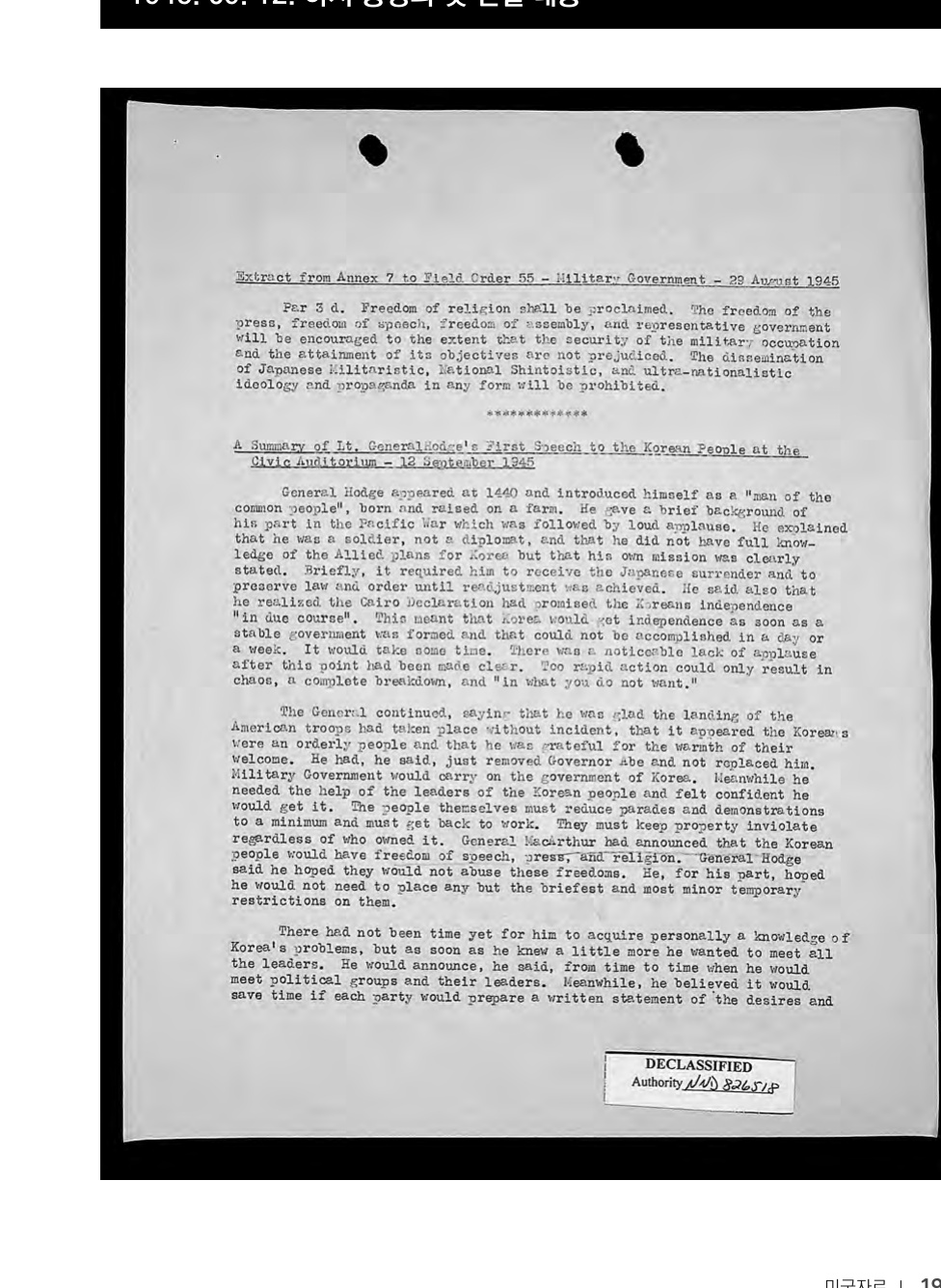
1945년 9월 12일 하지 중장이 시민운동장에서 조선인에게 한 첫 연설 요지 -1945년 9월 12일 오후 2시 40분 등장 한 하지 장군은 자신을 농촌에서 태어나고 자란 "평범한 사람"이라고 소개했다. 그는 태평양 전쟁 중 그가 맡았던 역할에 대해 간단하게 배경을 설명했고 큰 박수가 나왔다. 그는 자신이 군인이었지 외교관은 아니었다고 설명했다. 이어 조선에 대한 연합국의 계획에 대한 완전한 지식은 갖고 있지 않다고 했지만, 자신의 임무에 대해선 명확하게 얘기했다. 요약하면, 그는 일본군의 항복을 받아내고, 재조정이 이루어 질 때까지 법과 질서를 유지하는 것이었다. 그는 또한 카이로선언이 적절한 시기에(in due course) 조선인의 독립을 약속했다는 것을 알게 됐다고 말했다. 이는 안정된 정부가 구성되면 가능한 한 이른 시일 내에 조선이 독립하게 될 것이란 것을 의미했고, 또 하루나 일주일 안에 이뤄질 수 없다는 것을 의미했다. 그것은 시간이 좀 걸릴 것이다. 이 점이 명확해지자 박수 갈채는 눈에 띄게 줄었다. 너무 성급한 행동은 혼란과 완전한 실패를 초래할 뿐이며, "그것은 여러분이 원하는 것이 아니다."
장군은 미군이 들어올 때 사고가 없었던 것에 감사한다고 말하면서, 조선인은 질서를 지키는 인민이고, 그들의 따뜻한 환영에 감사한다고 말을 이어갔다. 그는 아베(Abe) 총독을 파면했지만, 대체 인물은 없다고 말했다. 군정은 조선에서 정부의 역할을 할 것이다. 그러면서 그는 조선 인민 지도자들의 도움이 필요하며 그는 그 도움을 받을 수 있을 것이라 확신하고 있다고 말했다. 사람들은 스스로 가두행진과 시위를 최대한 자제하고, 일터로 돌아가야 한다. 누가 소유했던 간에 그들은 재산을 침해하지 않아야 한다. 맥아더 사령관은 조선인은 표현, 언론, 종교의 자유를 갖고 있다고 발표했다. 하지 장군은 조선인이 이 같은 자유를 남용하지 않기를 원한다고 말했다. 그는 자신은 최소한의 그리고 매우 일시적인 제한 외에는 그 어떤 제한도 부과할 필요가 없기를 바란다고 희망했다.
조선이 안고 있는 문제점에 대한 지식을 개인적으로 얻을 시간이 아직 없었는데, 좀 더 알게 되면 바로 모든 지도자를 만나기를 그는 원했다. 그는 정치단체와 그 지도자들을 만나야 할 때는 이를 발표하겠다고 말했다. 그는 각 정당이 원하는 것과 그들의 입장을 서면으로 준비한다면 시간을 절약할 수 있을 것이라고 생각 했다. 그는 회의에 앞서 문 앞에서 등록할 기회를 갖지 못한 사람들은 나가는 길에 등록할 수 있기를 바란다고 말했다. 그는 "당신(들)처럼 훌륭한 사람이 누구인 지" 알고 싶어 했다. 그는 그들(조선인)에게 도움이 된 것은 (주한미육군총사령관 인) 자신에게도 도움이 됐기 때문에 "우리의 임무"를 수행하는 데 그들이 도움을 줄 것으로 기대했다. 그는 조선은 위대한 미래를 갖고 있으며, 그들에게 그것을 망치지 말라고 강조했다.
Extract from Annex 7 to Field Order 55 - Military Government - 29 August 1945
Par 3 d. Freedom of religion shall be proclaimed. The freedom of the press, freedom of speech, freedom of assembly, and representative government will be encouraged to the extent that the security of the military occupation and the attainment of its objectives are not prejudiced. The dissemination of Japanese Militaristic, National Shintoistic, and ultra-nationalistic ideology and propaganda in any form will be prohibited.
*************
A Summary of Lt. General Hodge's First Speech to the Korean People at the Civic Auditorium - 12 September 1945
General Hodge appeared at 1440 and introduced himself as a "man of the common people", born and raised on a farm. He gave a brief background of his part in the Pacific War which was followed by loud applause. He explained that he was a soldier, not a diplomat, and that he did not have full knowledge of the Allied plans for Korea but that his own mission was clearly stated. Briefly, it required him to receive the Japanese surrender and to preserve law and order until readjustment was achieved. He said also that he realized the Cairo Declaration had promised the Koreans independence "in due course". This meant that Korea would get independence as soon as a stable government was formed and that could not be accomplished in a day or a week. It would take some time. There was a noticeable lack of applause after this point had been made clear. Too rapid action could only result in chaos, a complete breakdown, and "in what you do not want."
The General continued, saying that he was glad the landing of the American troops had taken place without incident, that it appeared the Koreans were an orderly people and that he was grateful for the warmth of their welcome. He had, he said, just removed Governor Abe and not replaced him. Military Government would carry on the government of Korea. Meanwhile he needed the help of the leaders of the Korean people and felt confident he would get it. The people themselves must reduce parades and demonstrations to a minimum and must get back to work. They must keep property inviolate regardless of who owned it. General MacArthur had announced that the Korean people would have freedom of speech, press, and religion. General Hodge said he hoped they would not abuse these freedoms. He, for his part, hoped he would not need to place any but the briefest and most minor temporary restrictions on them.
There had not been time yet for him to acquire personally a knowledge of Korea's problems, but as soon as he knew a little more he wanted to meet all the leaders. He would announce, he said, from time to time when he would meet political groups and their leaders. Meanwhile, he believed it would save time if each party would prepare a written statement of the desires and
DECLASSIFIED
Authority NND 826518
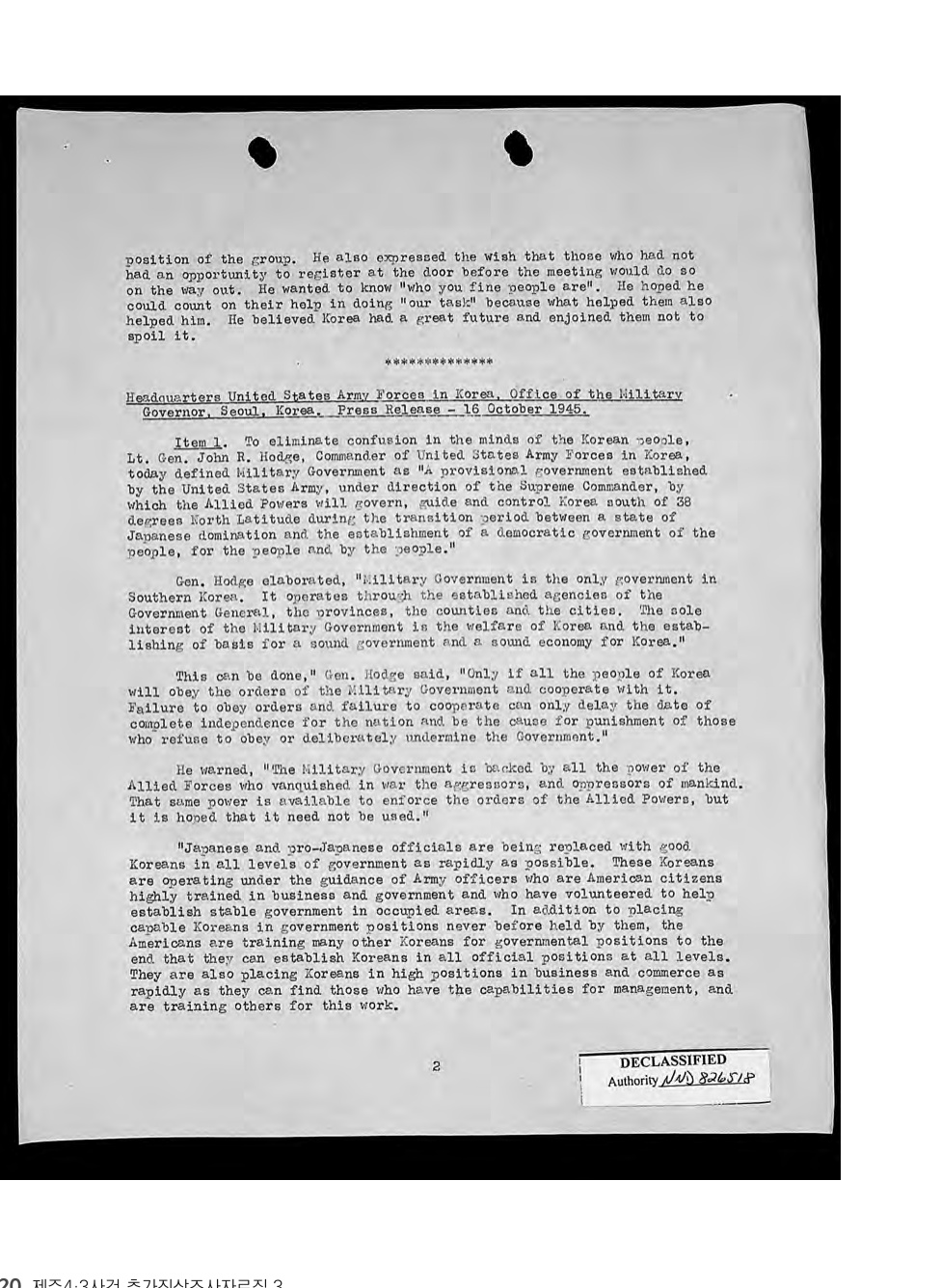
position of the group. He also expressed the wish that those who had not had an opportunity to register at the door before the meeting would do so on the way out. He wanted to know "who you fine people are". He hoped he could count on their help in doing "our task" because what helped them also helped him. He believed Korea had a great future and enjoined them not to spoil it.
**************
Headquarters United States Army Forces in Korea, Office of the Military
Governor, Seoul, Korea. Press Release – 16 October 1945.
Item 1. To eliminate confusion in the minds of the Korean people, Lt. Gen. John R. Hodge, Commander of United States Army Forces in Korea, today defined Military Government as "a provisional government established by the United States Army, under direction of the Supreme Commander, by which the Allied Powers will govern, guide and control Korea south of 38 degrees North Latitude during the transition period between a state of
Japanese domination and the establishment of a democratic government of the people, for the people and by the people."
Gen. Hodge elaborated, "Military Government is the only government in
Southern Korea. It operates through the established agencies of the
Government General, the provinces, the counties and the cities. The sole interest of the Military Government is the welfare of Korea and the establishing of basis for a sound government and a sound economy for Korea."
This can be done," Gen. Hodge said, "Only if all the people of Korea will obey the orders of the Military Government and cooperate with it.
Failure to obey orders and failure to cooperate can only delay the date of complete independence for the nation and be the cause for punishment of those who refuse to obey or deliberately undermine the Government."
He warned, "The Military Government is backed by all the power of the
Allied Forces who vanquished in war the aggressors, and oppressors of mankind.
That same power is available to enforce the orders of the Allied Powers, but it is hoped that it need not be used."
"Japanese and pro-Japanese officials are being replaced with good
Koreans in all levels of government as rapidly as possible. These Koreans are operating under the guidance of Army officers who are American citizens highly trained in business and government and who have volunteered to help establish stable government in occupied areas. In addition to placing capable Koreans in government positions never before held by them, the
Americans are training many other Koreans for governmental positions to the end that they can establish Koreans in all official positions at all levels.
They are also placing Koreans in high positions in business and commerce as rapidly as they can find those who have the capabilities for management, and are training others for this work.
2
DECLASSIFIED
Authority NND 826518
출처:
제주4·3평화재단 편,
『추가진상조사자료집-미국자료1』,
p. 19–20.
— NARA (RG 554, Entry 1399, Box 296)
×
![]()