스캔 원본
100%
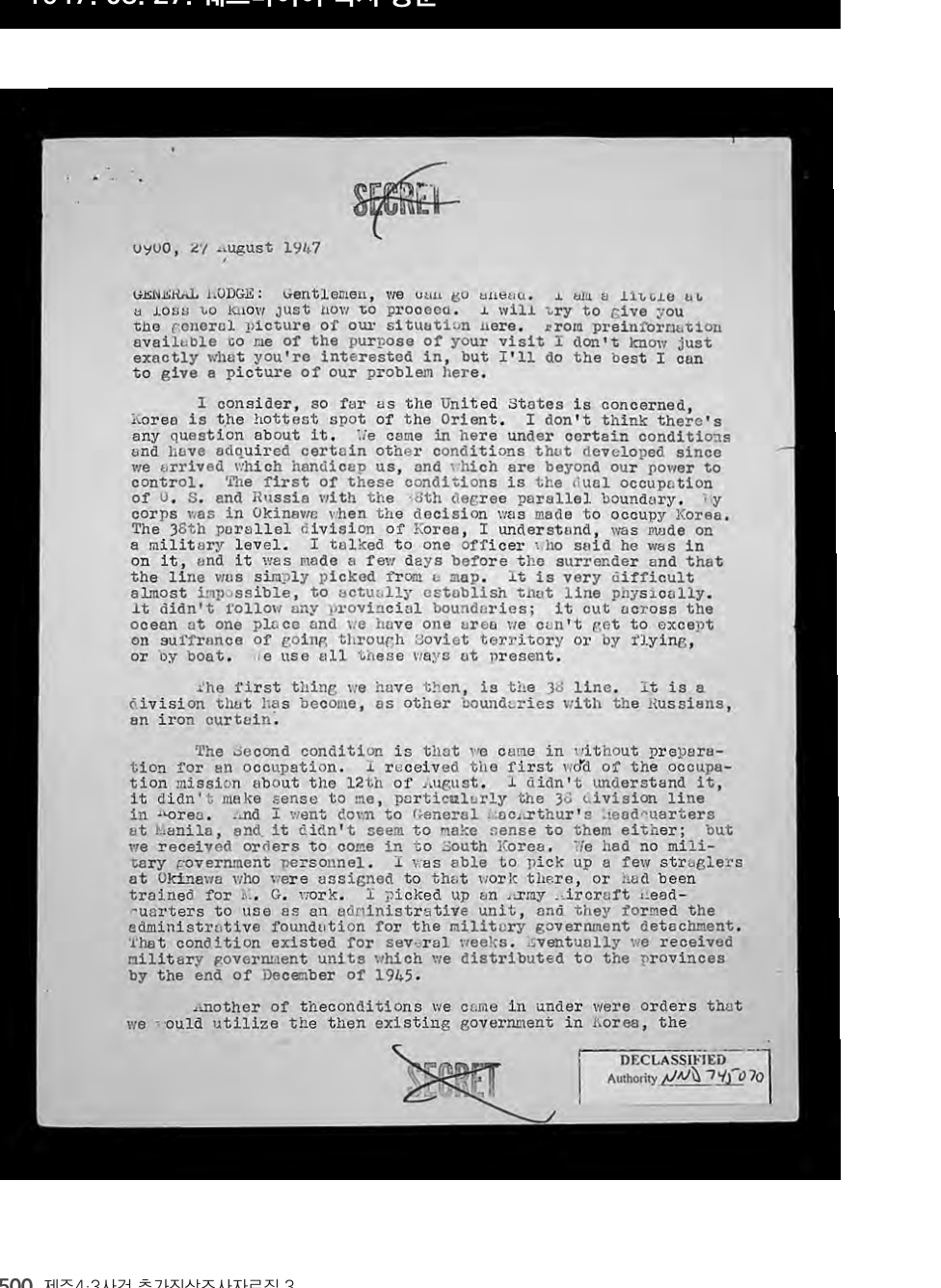
p.500
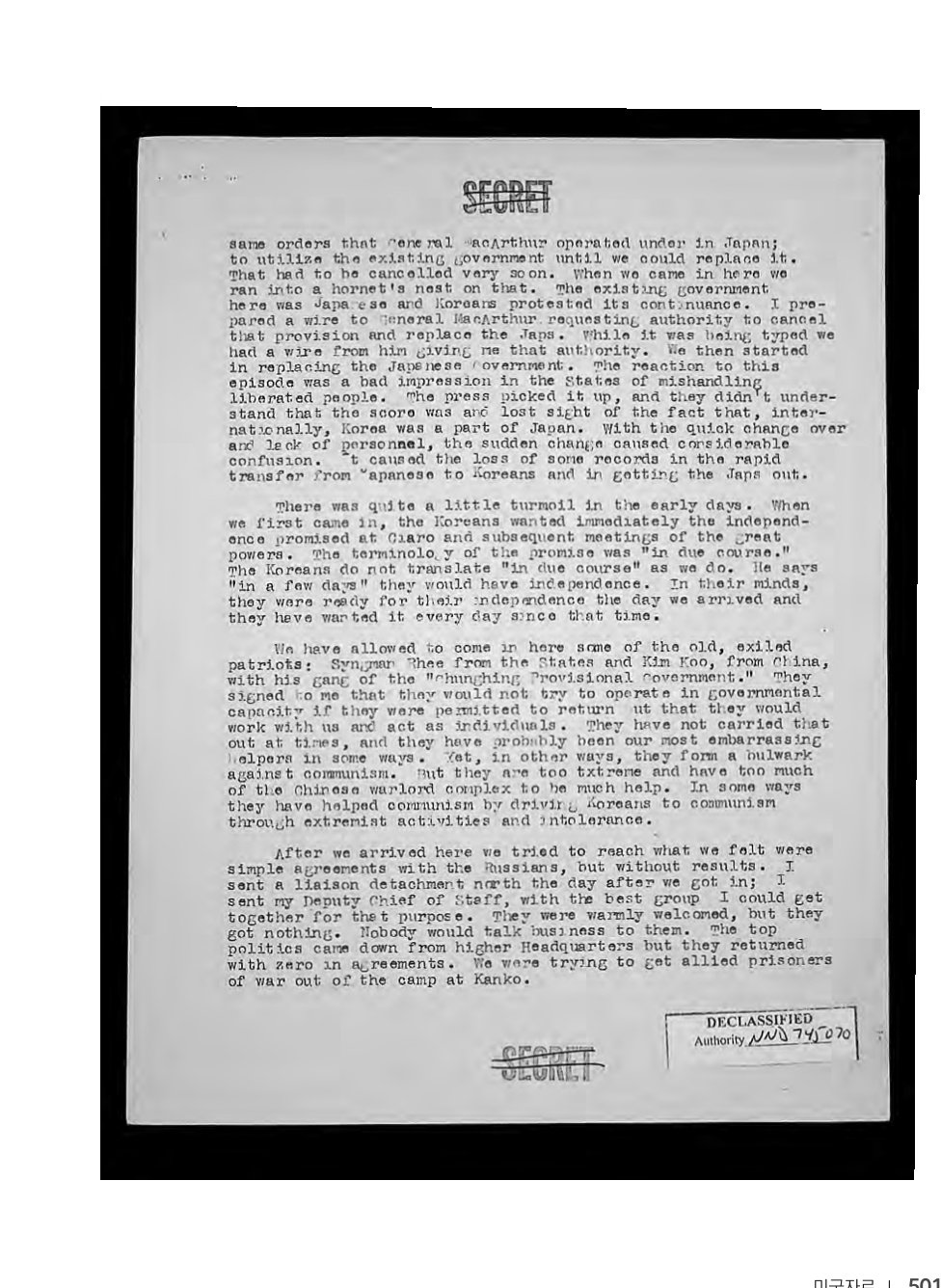
p.501
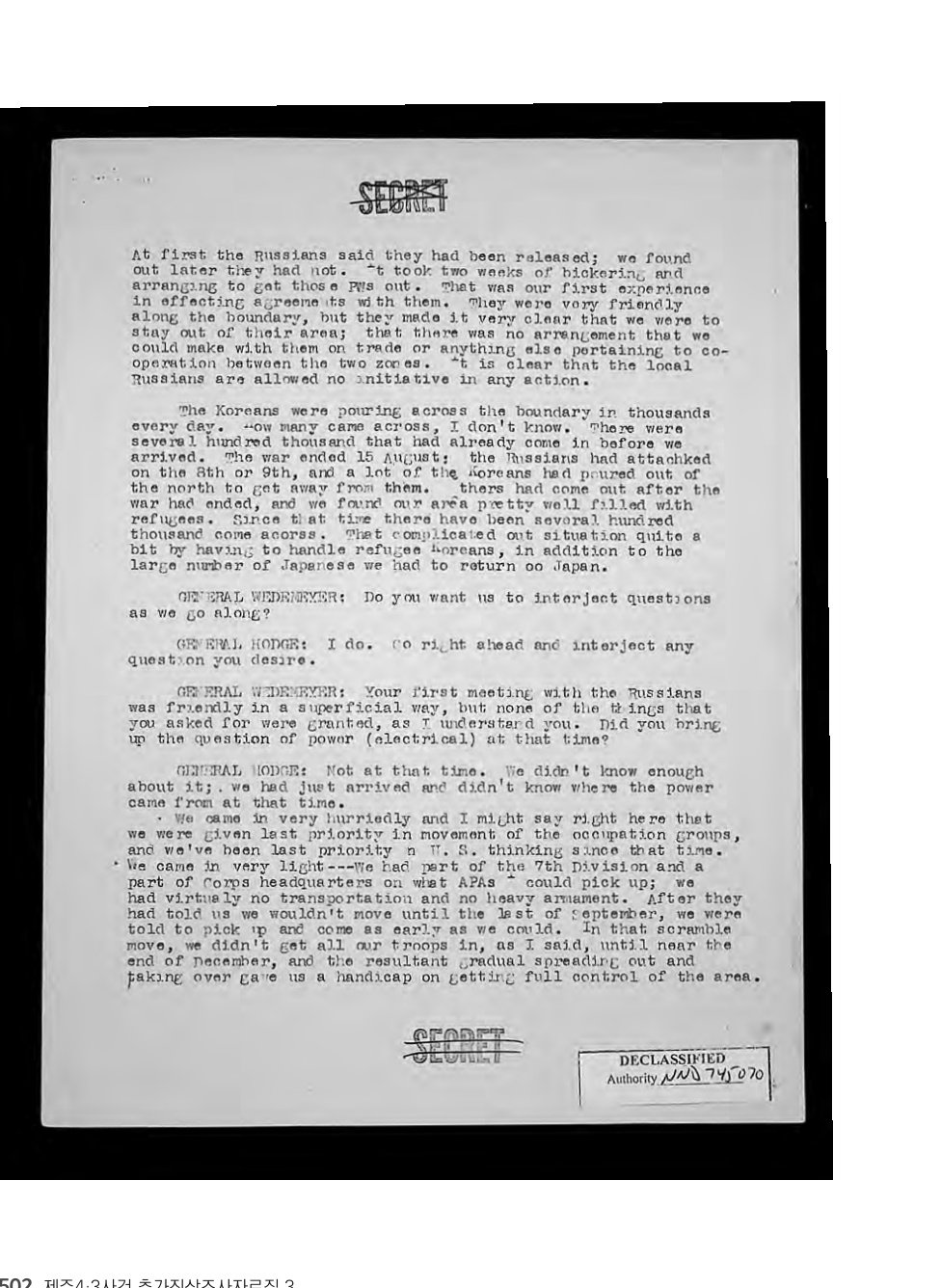
p.502
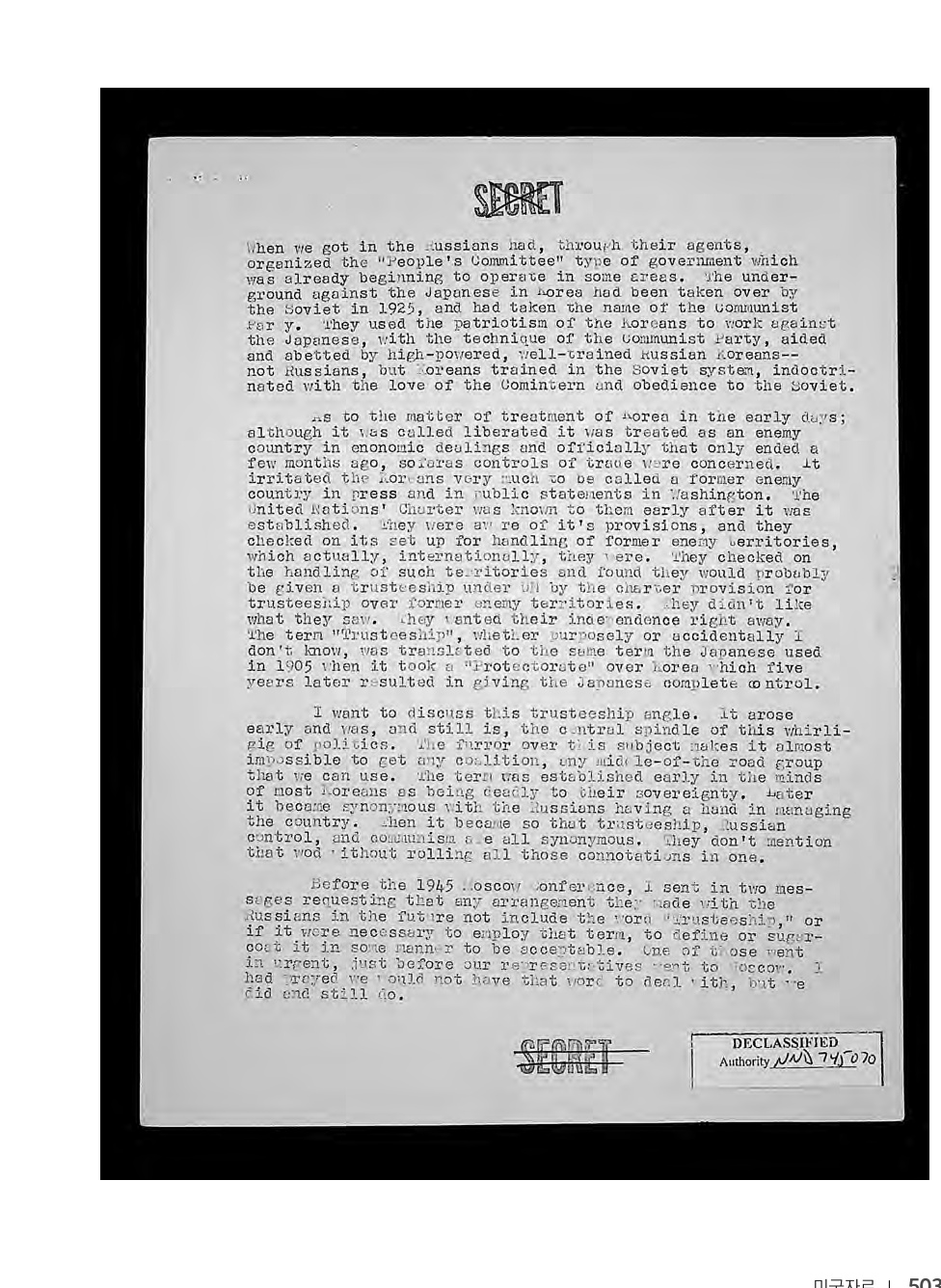
p.503
p.504
p.505
p.506
p.507
p.508
p.509
p.510
p.511
p.512
p.513
p.514
p.515
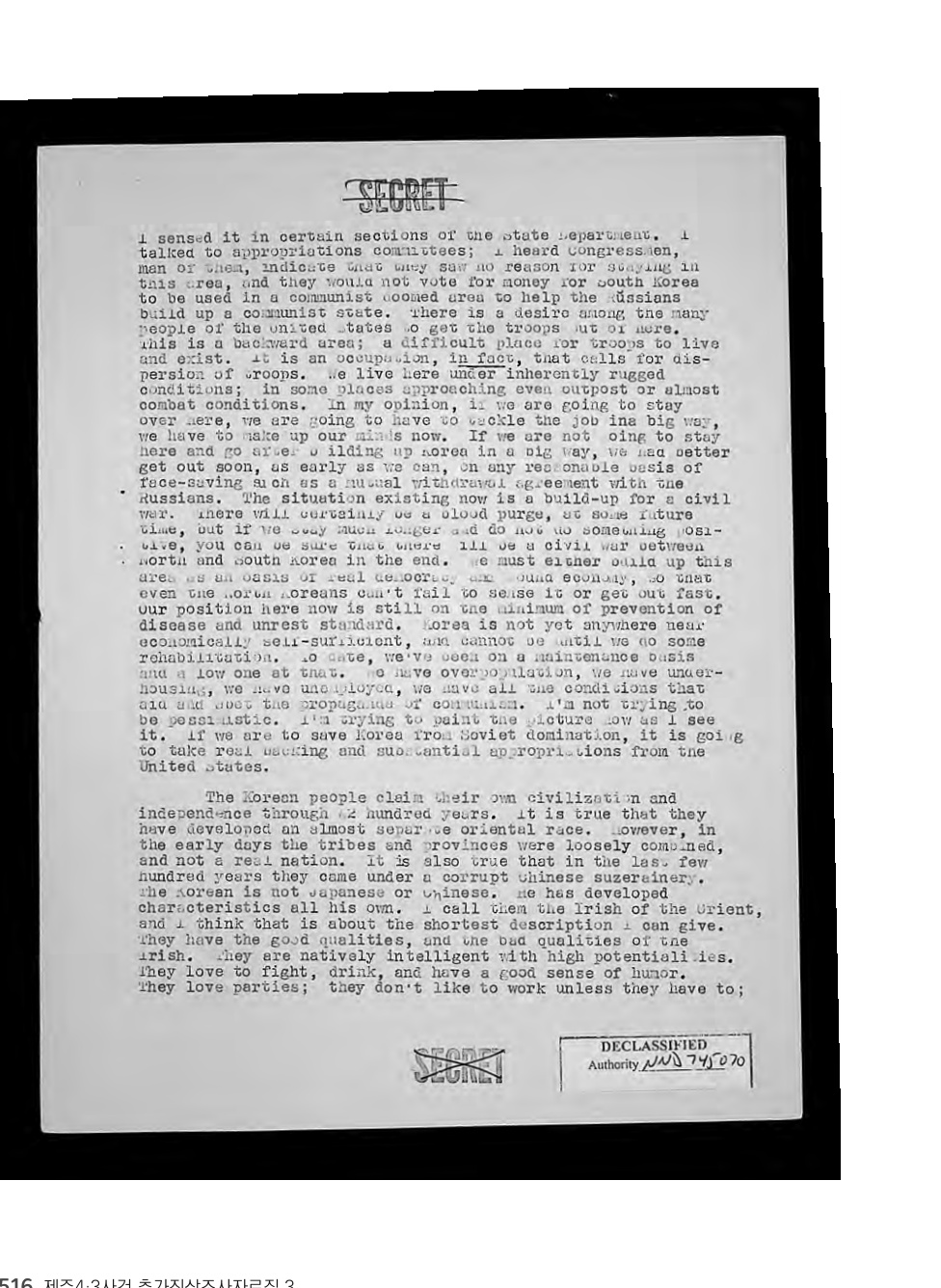
p.516
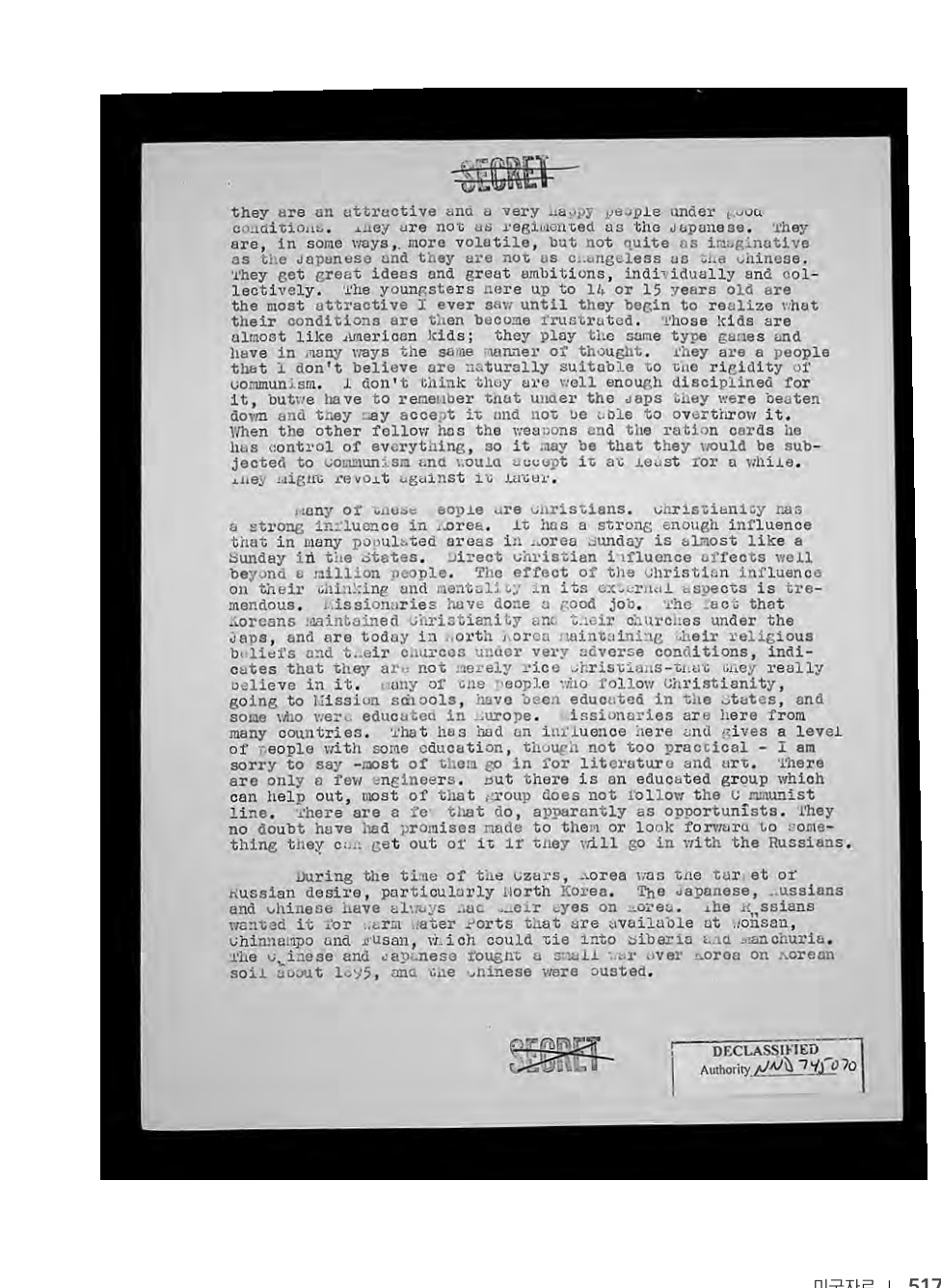
p.517
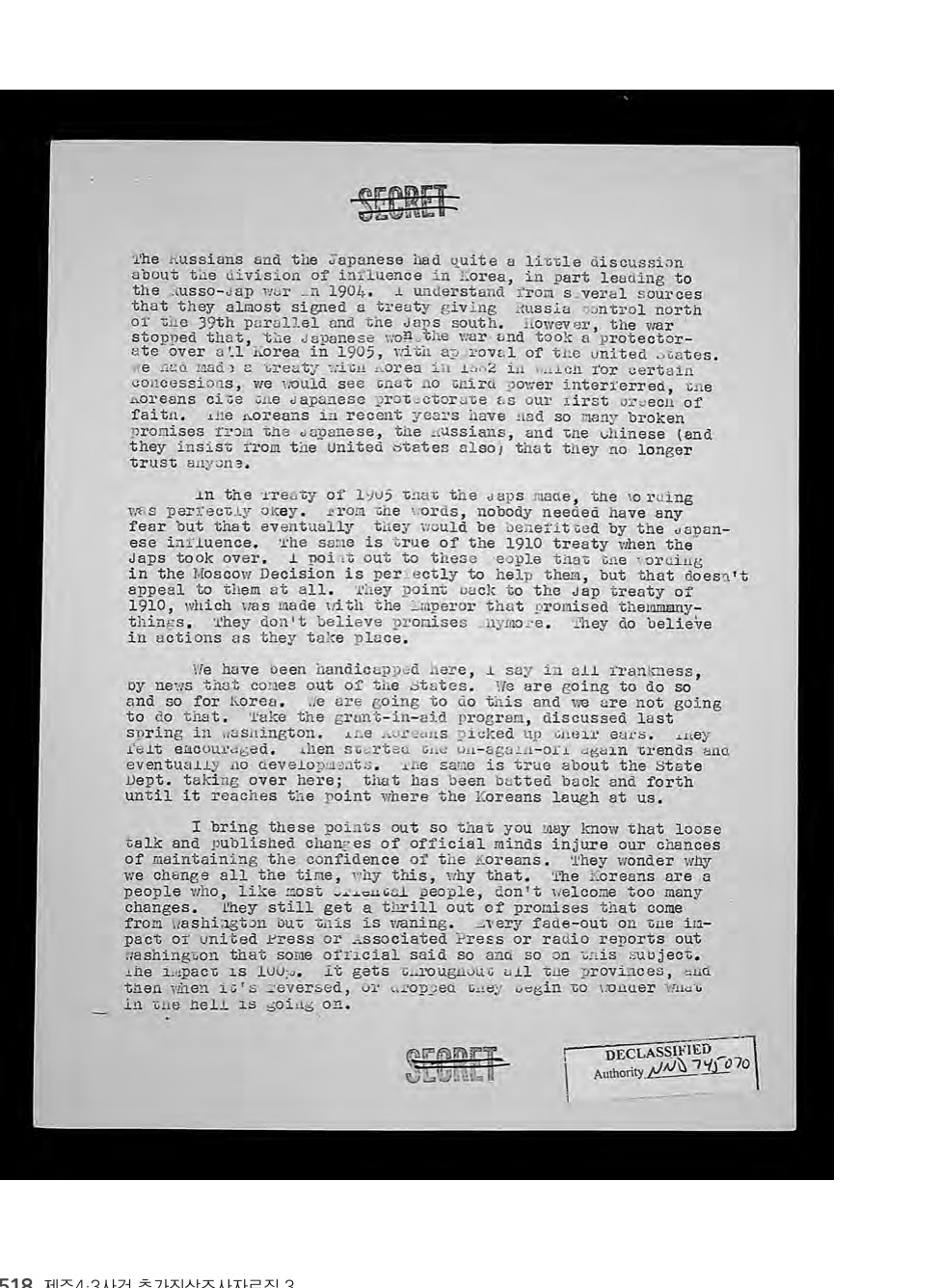
p.518
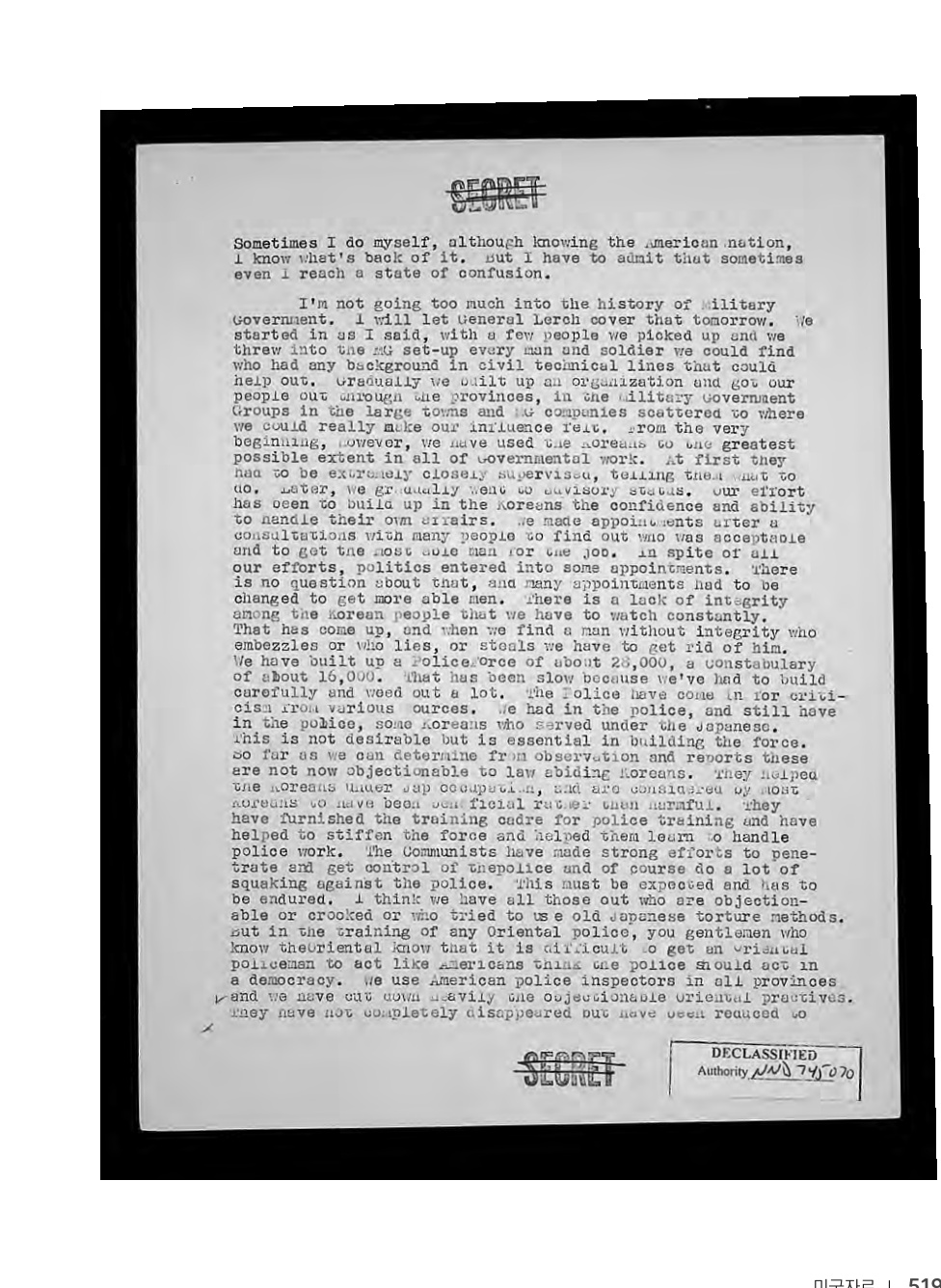
p.519
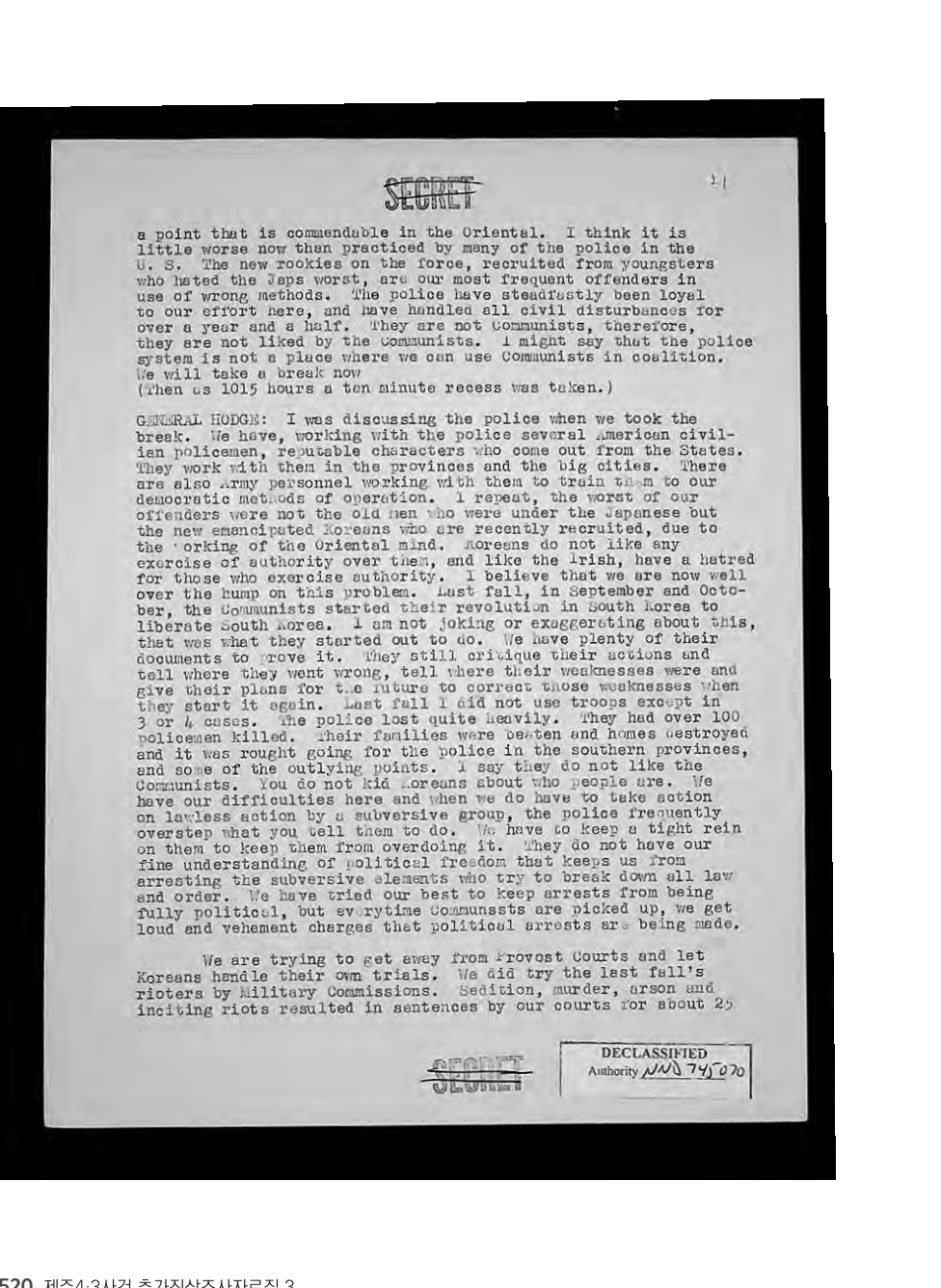
p.520
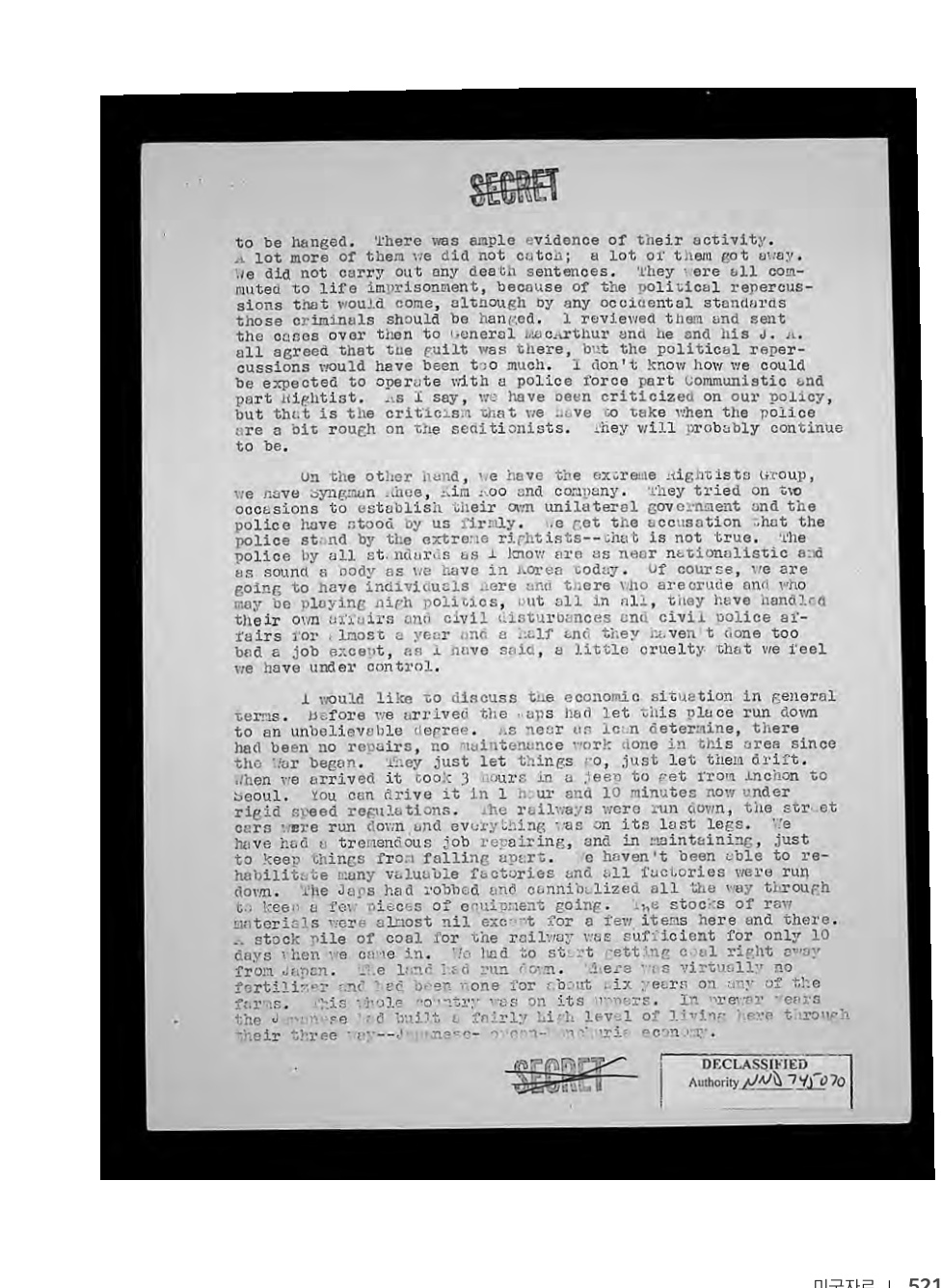
p.521
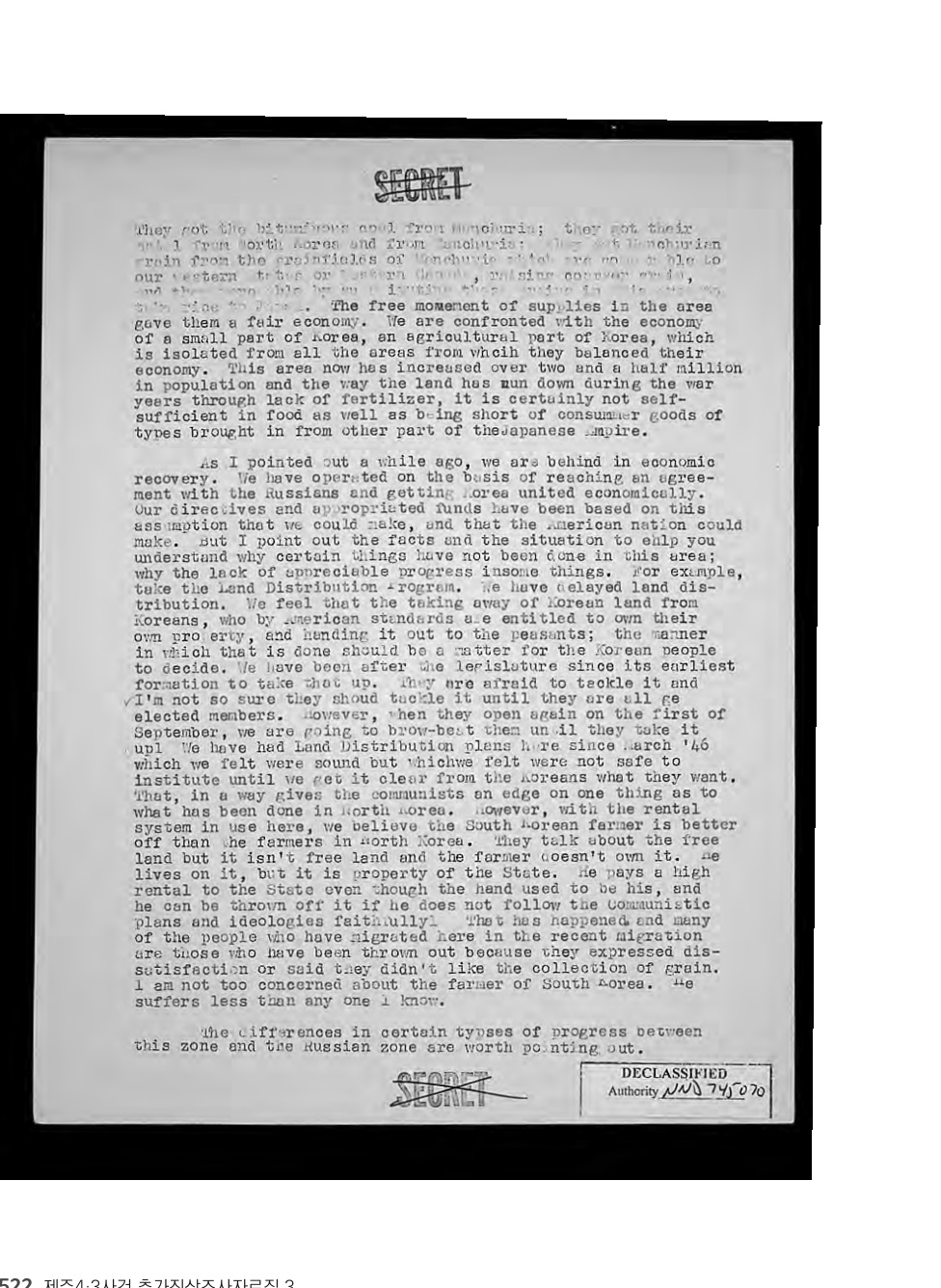
p.522
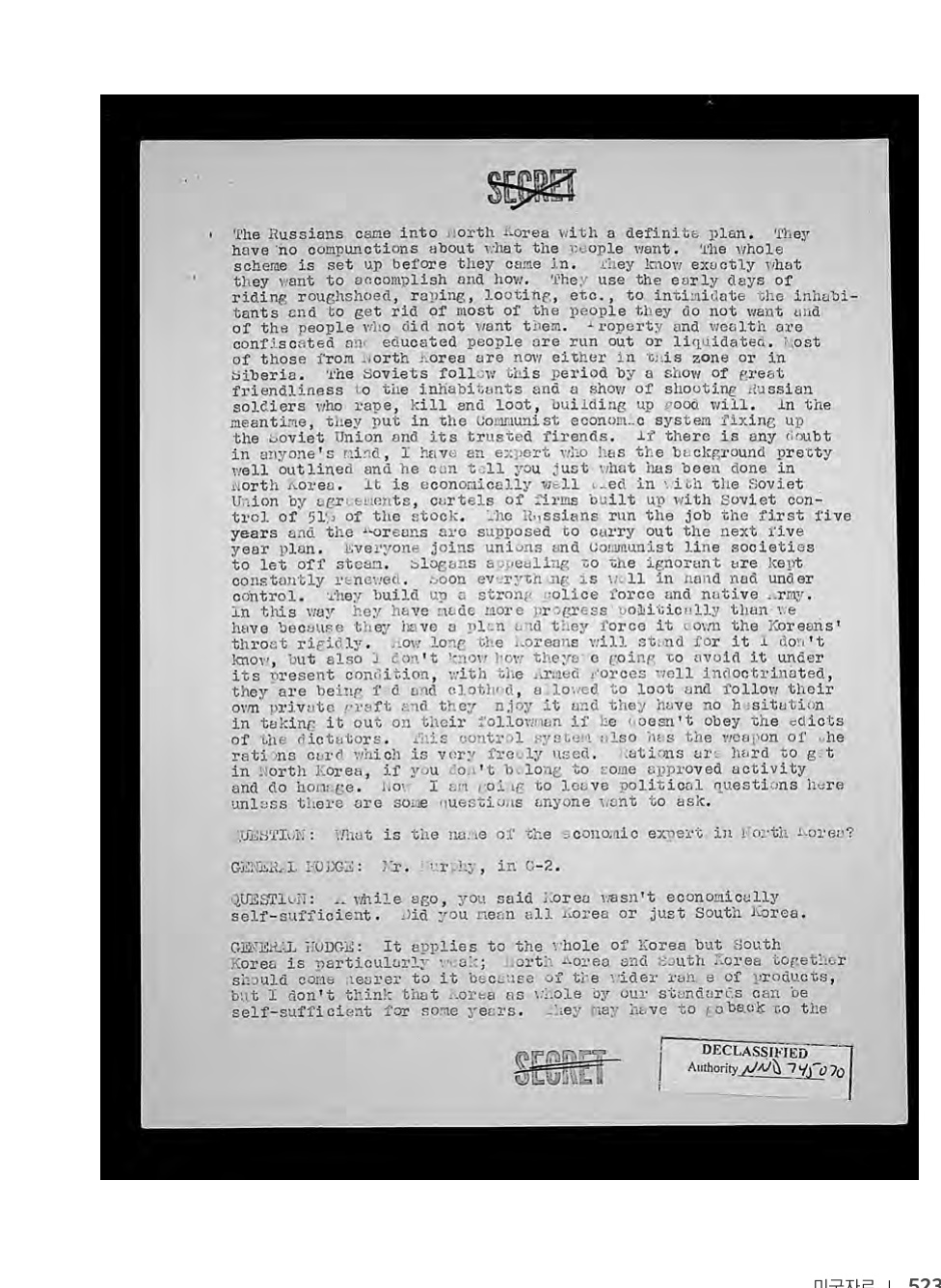
p.523
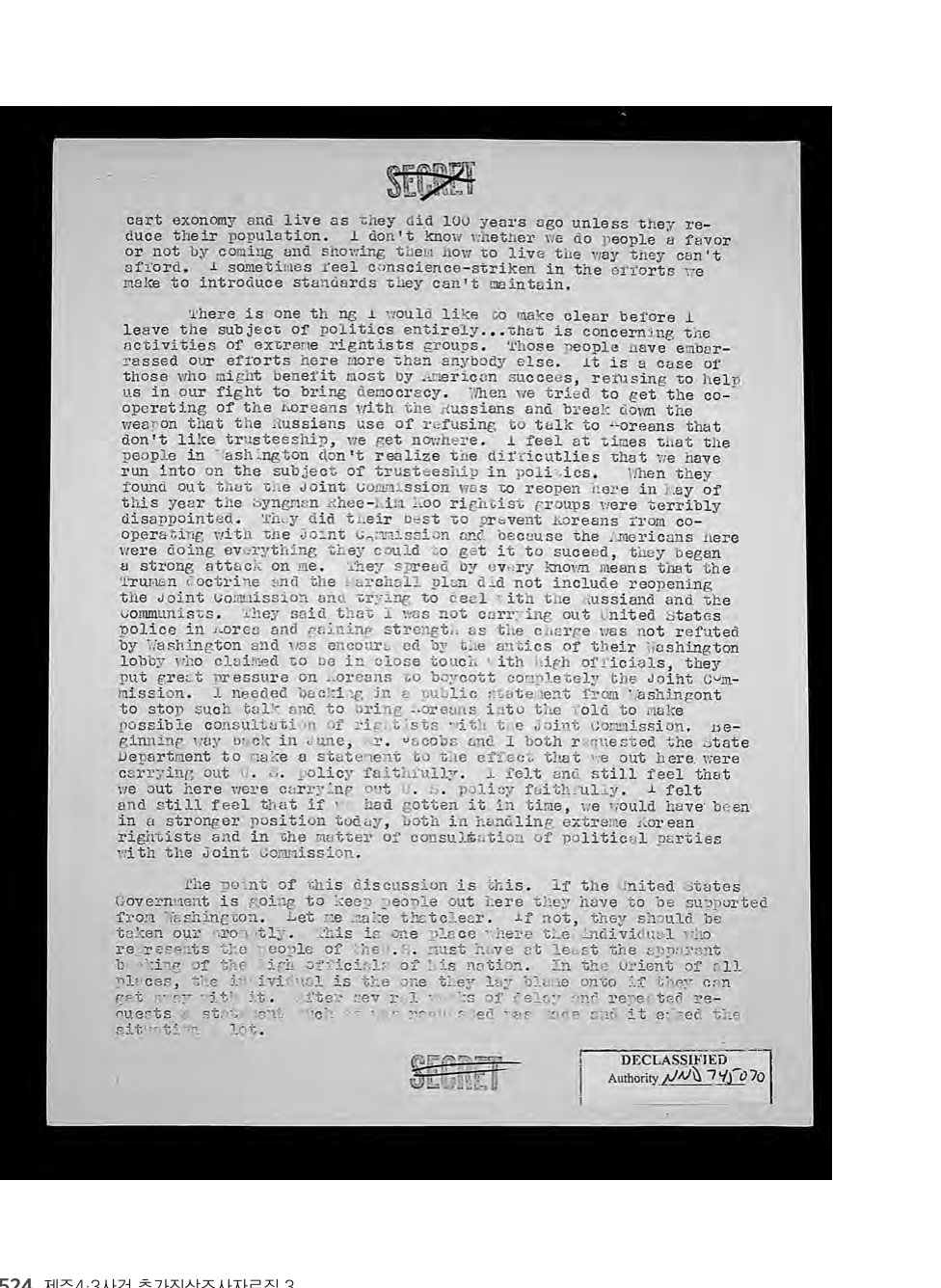
p.524
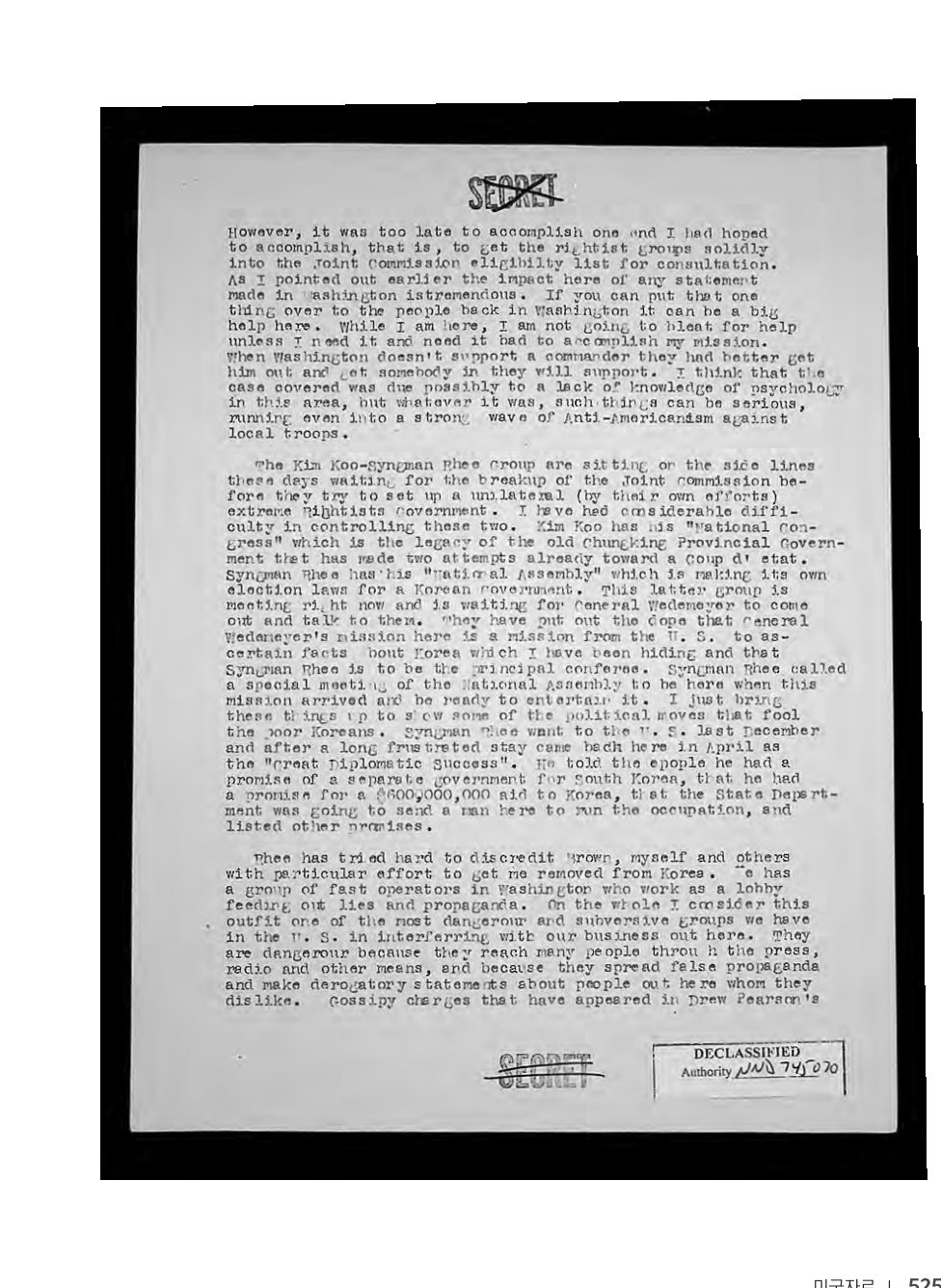
p.525
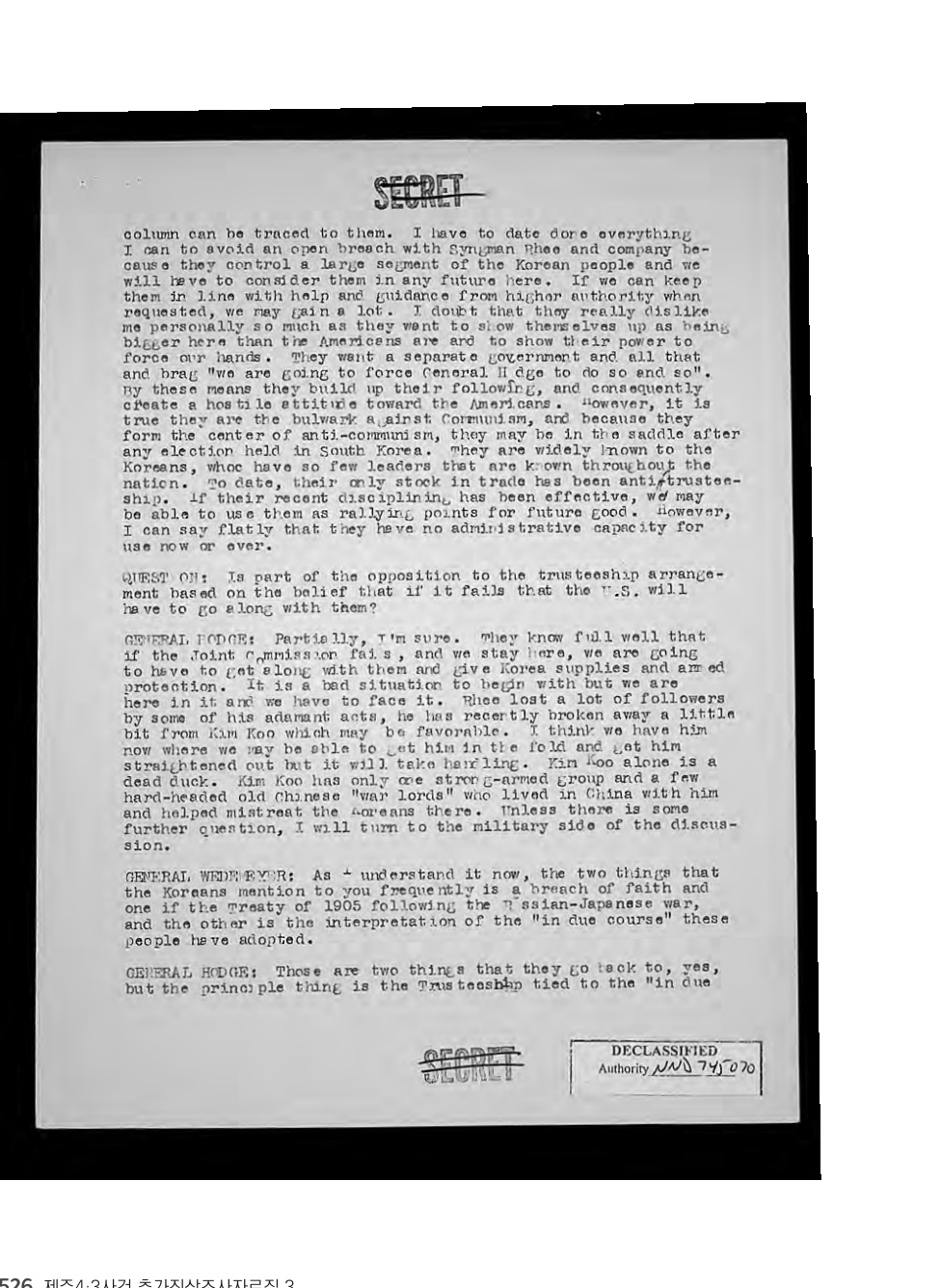
p.526
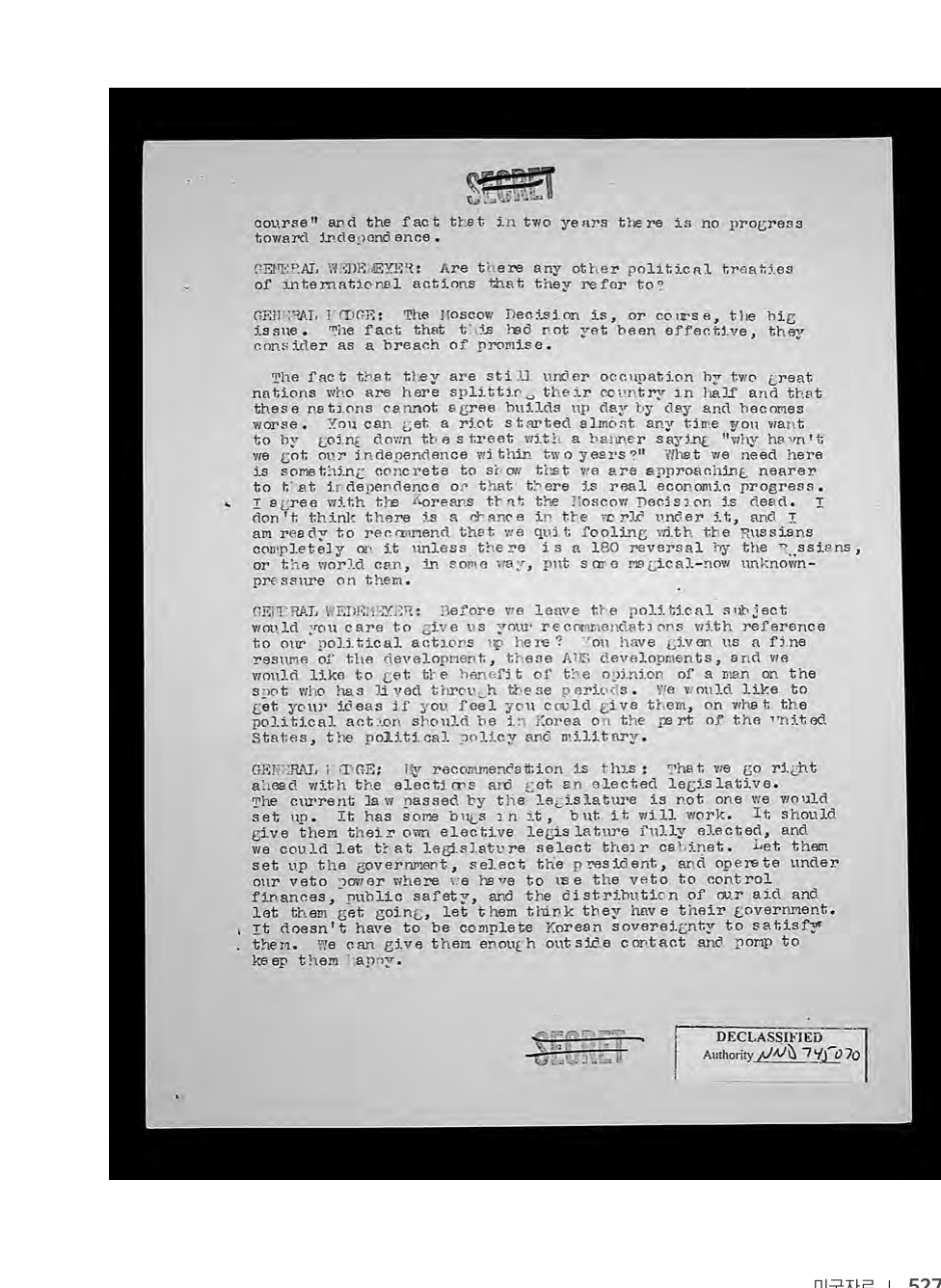
p.527
p.528
p.529
p.530
p.531
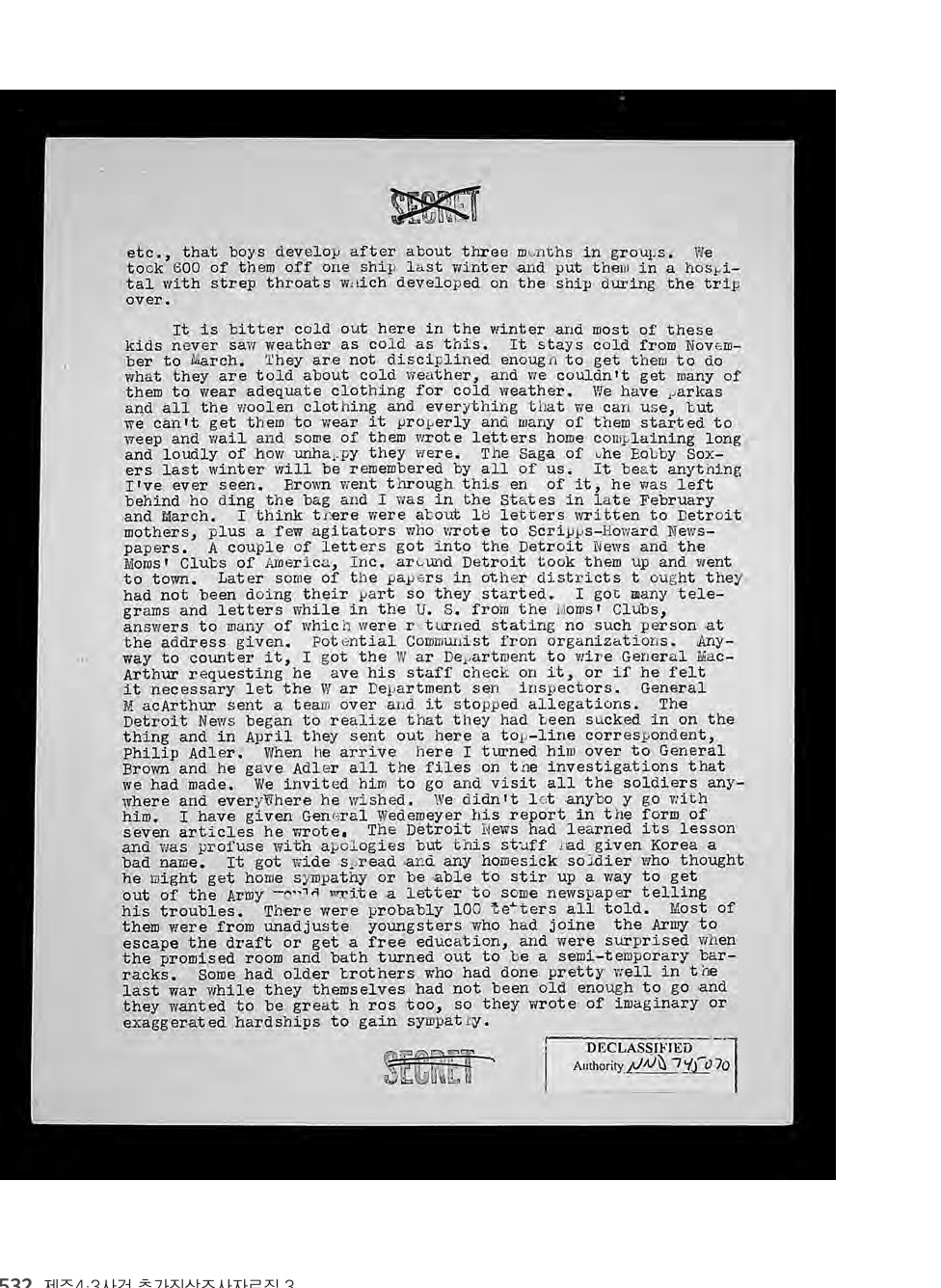
p.532
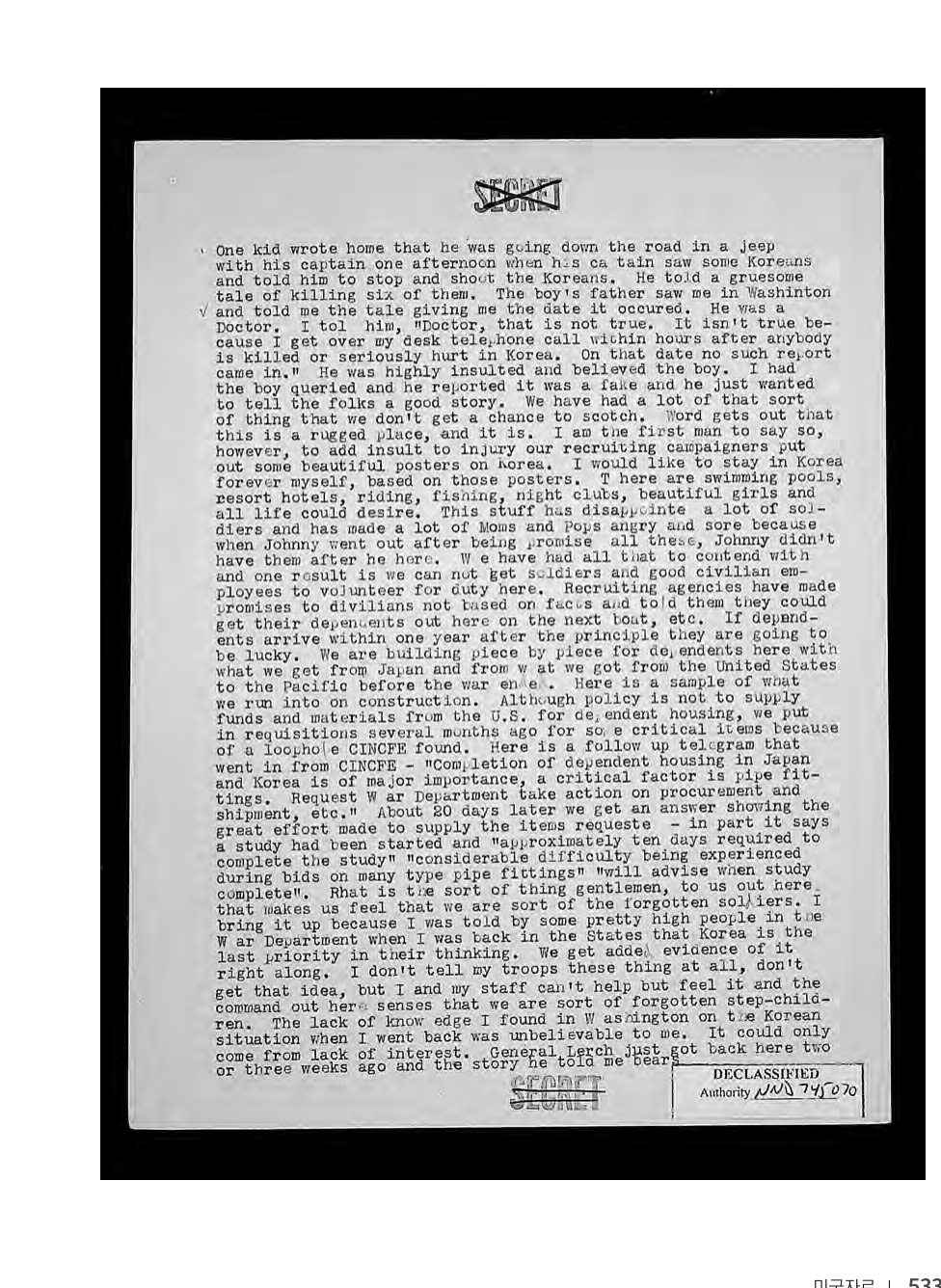
p.533
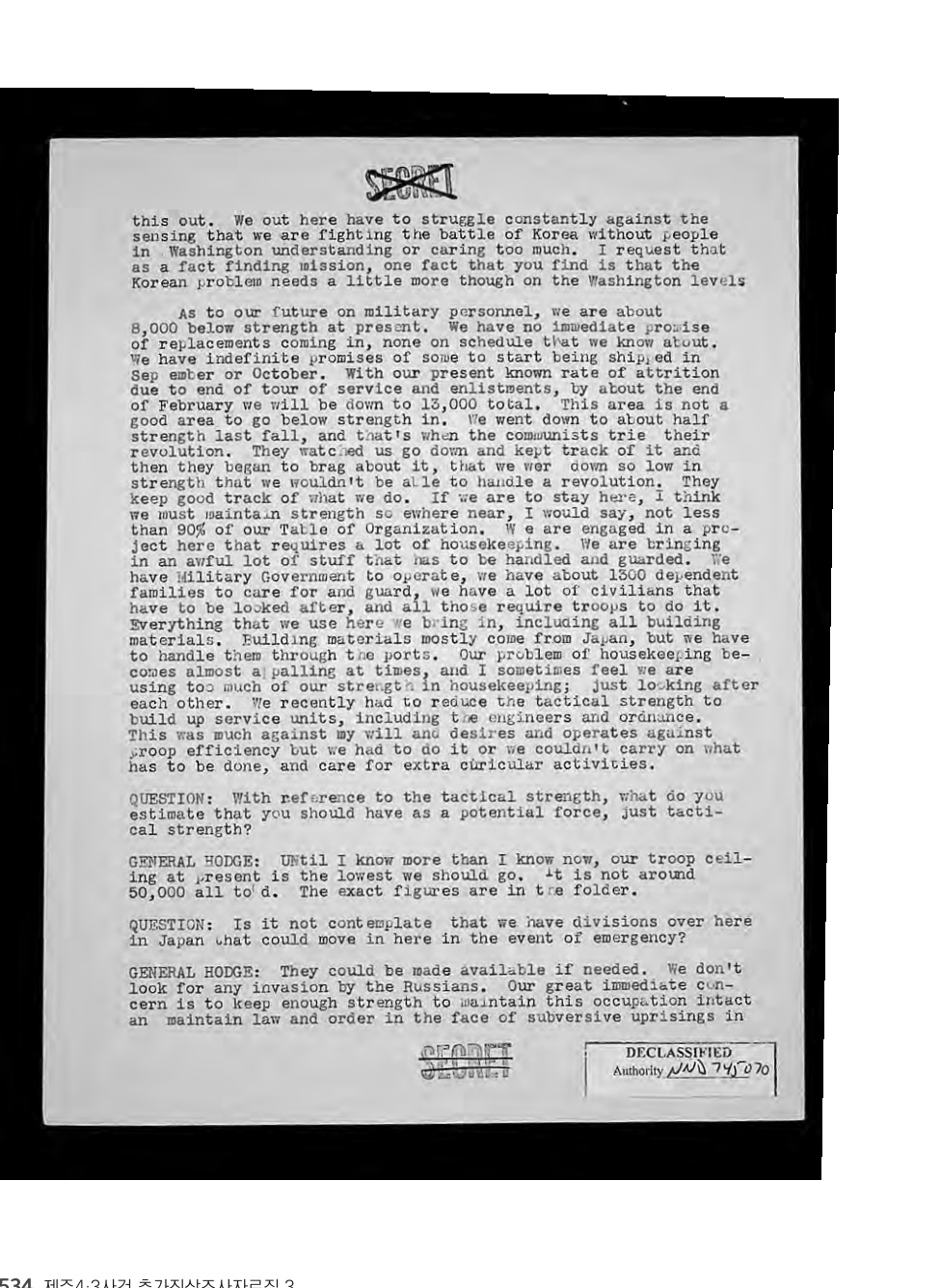
p.534
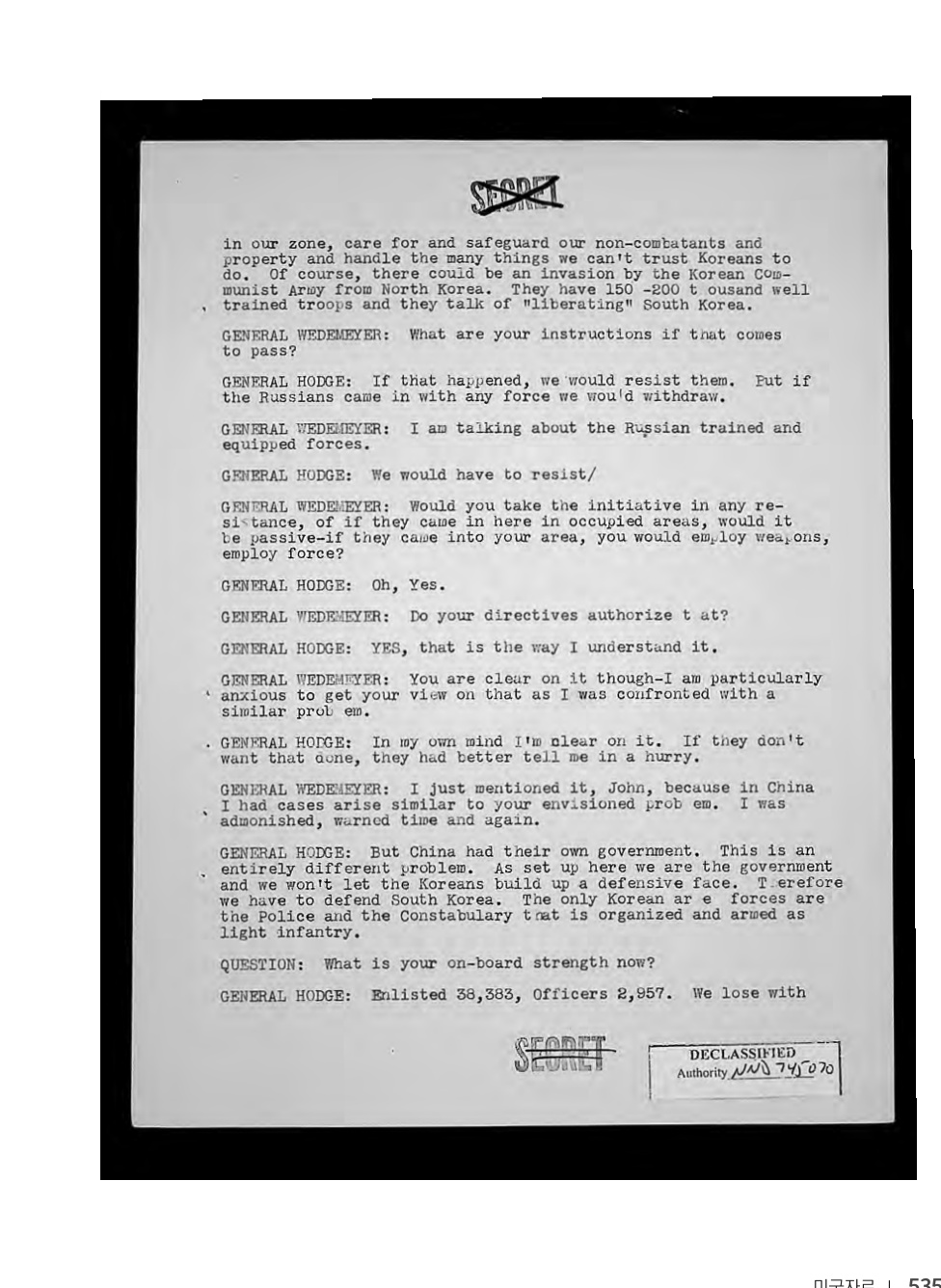
p.535
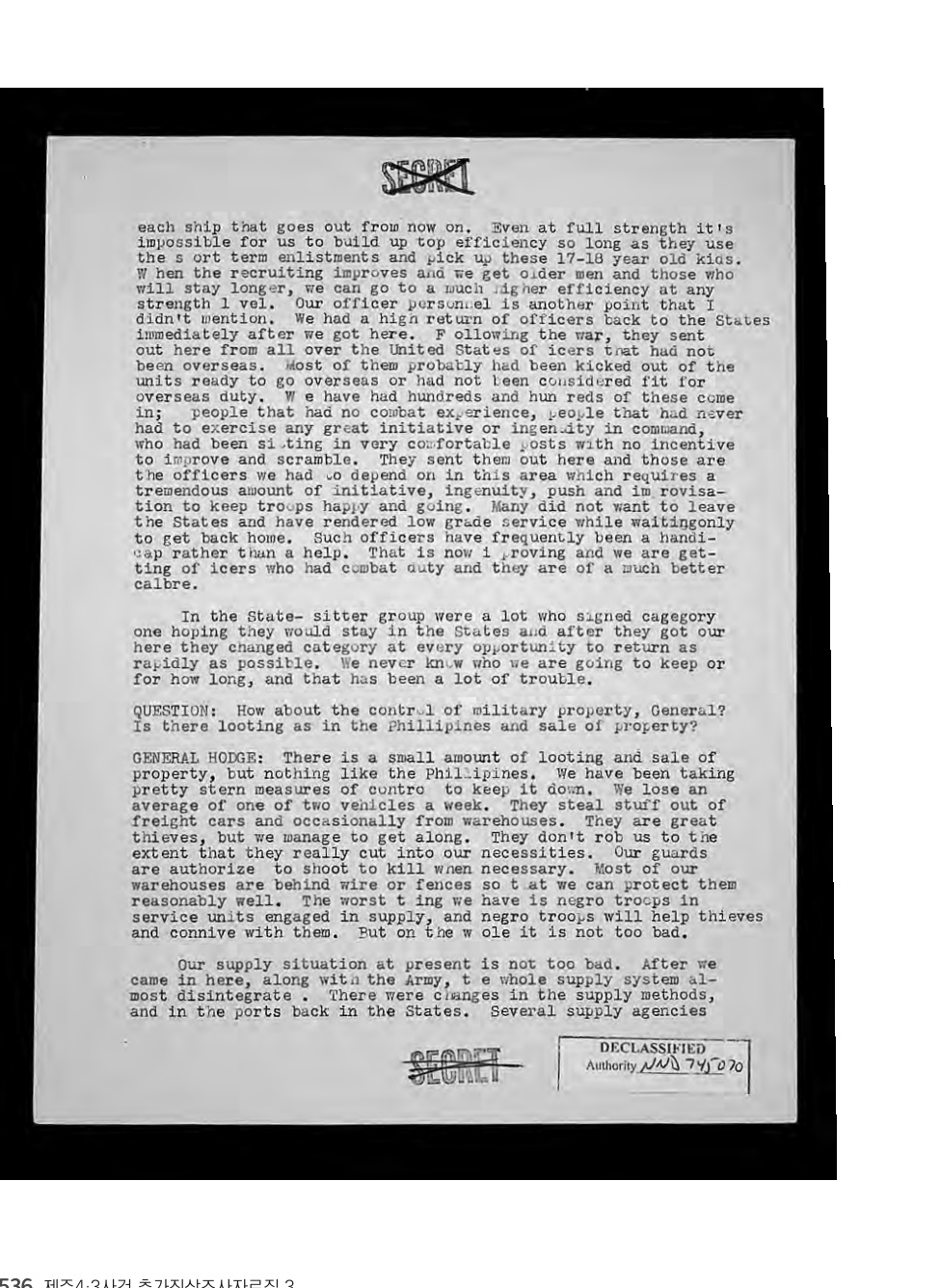
p.536
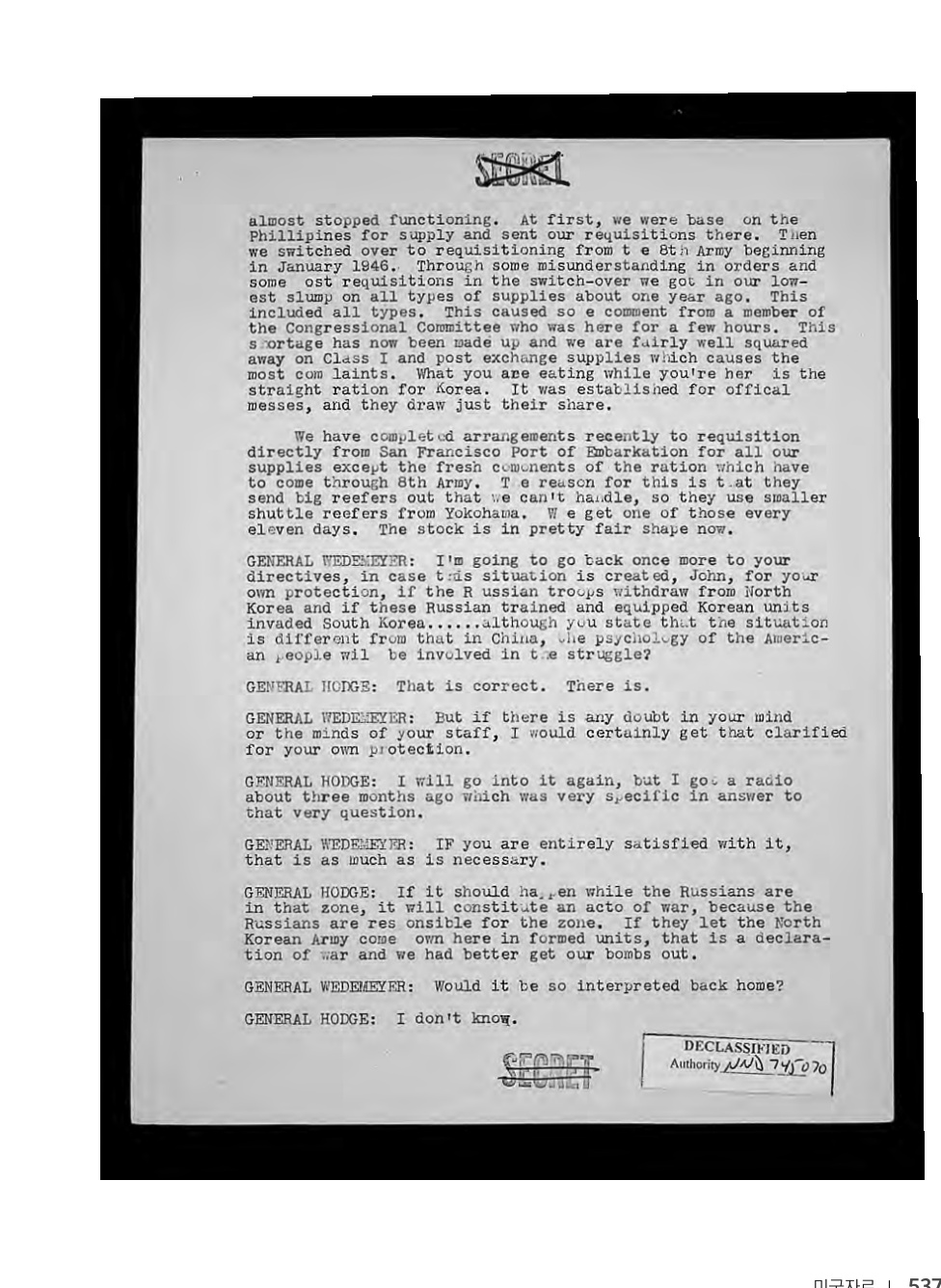
p.537
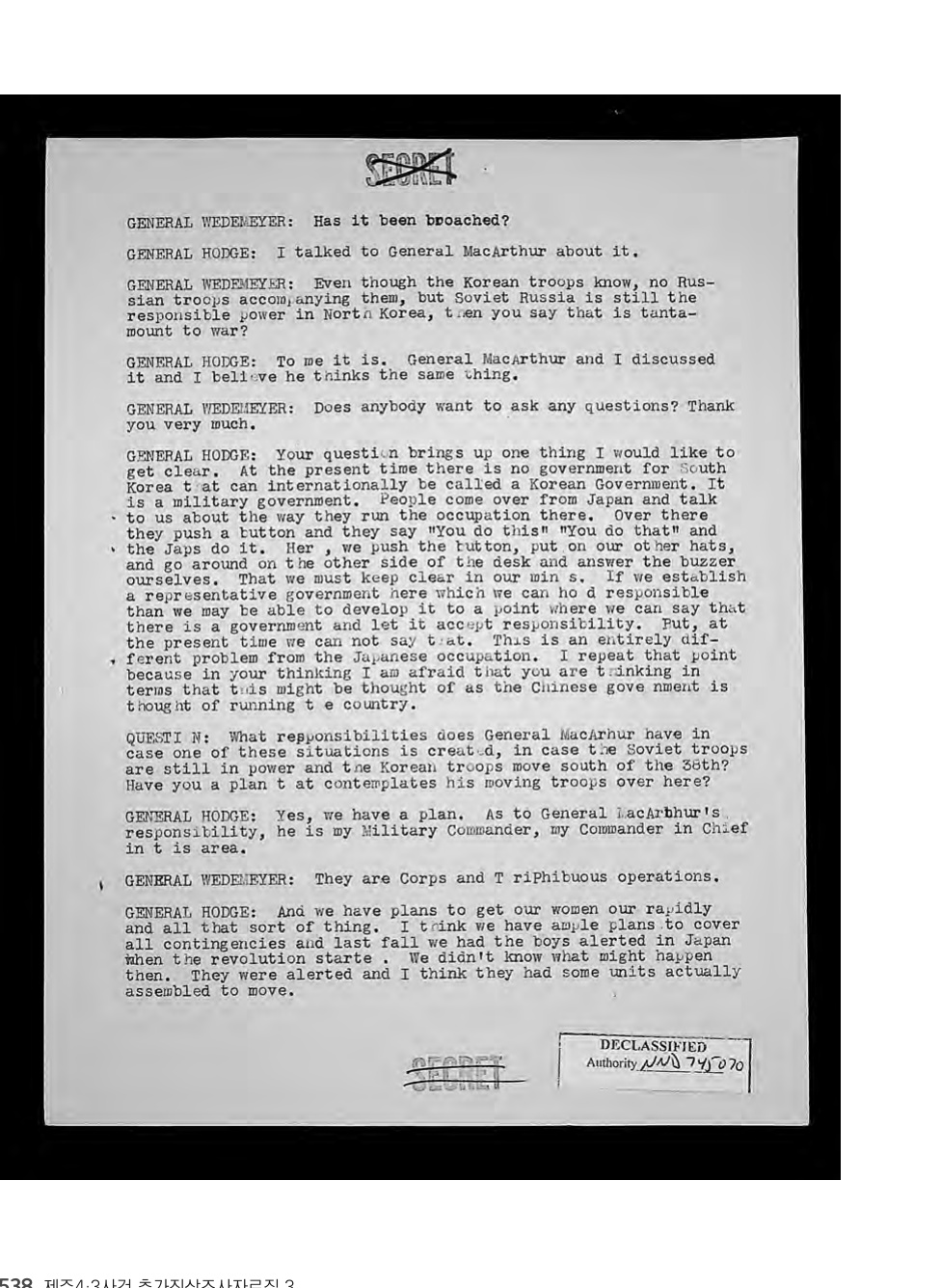
p.538
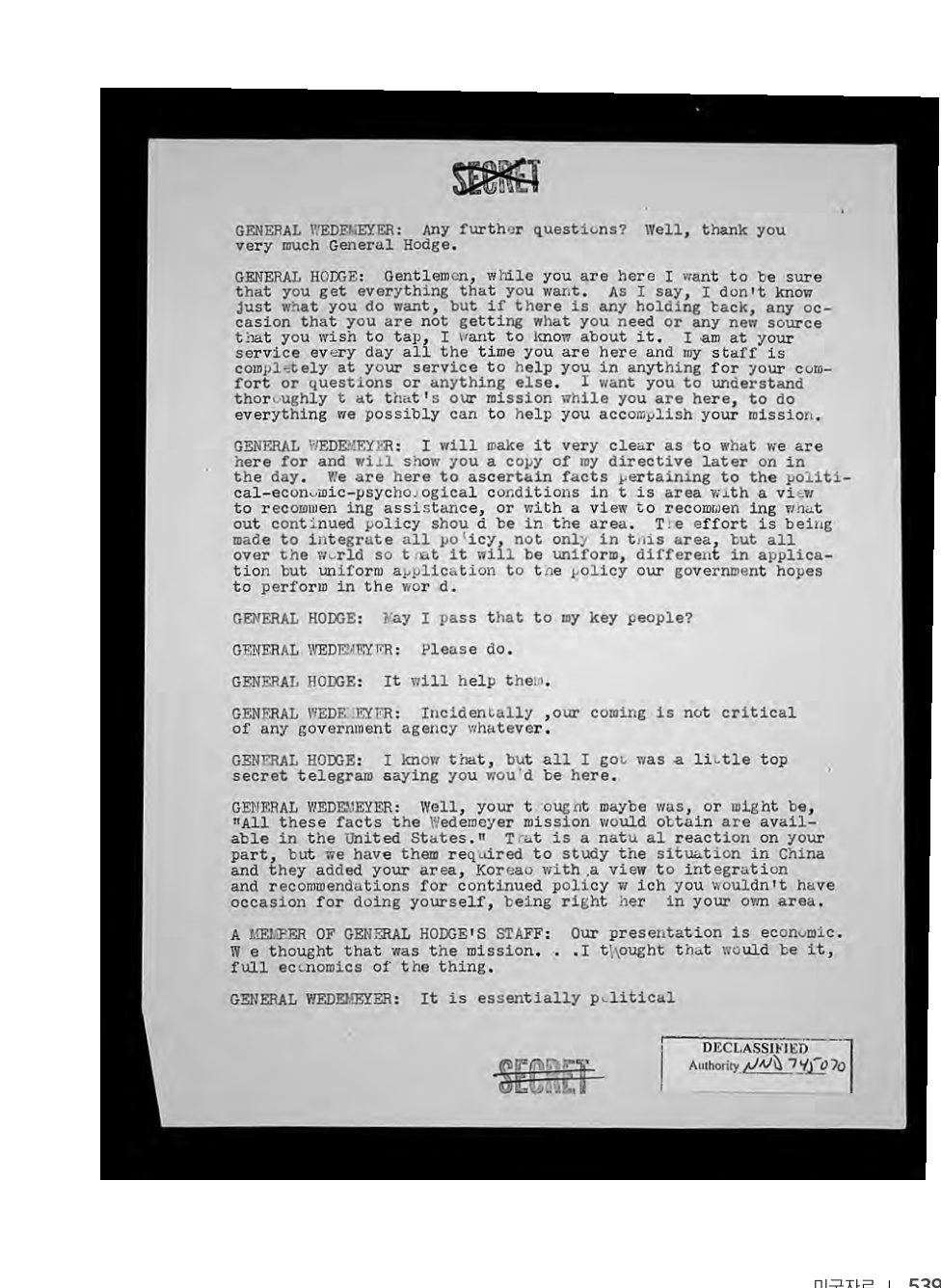
p.539
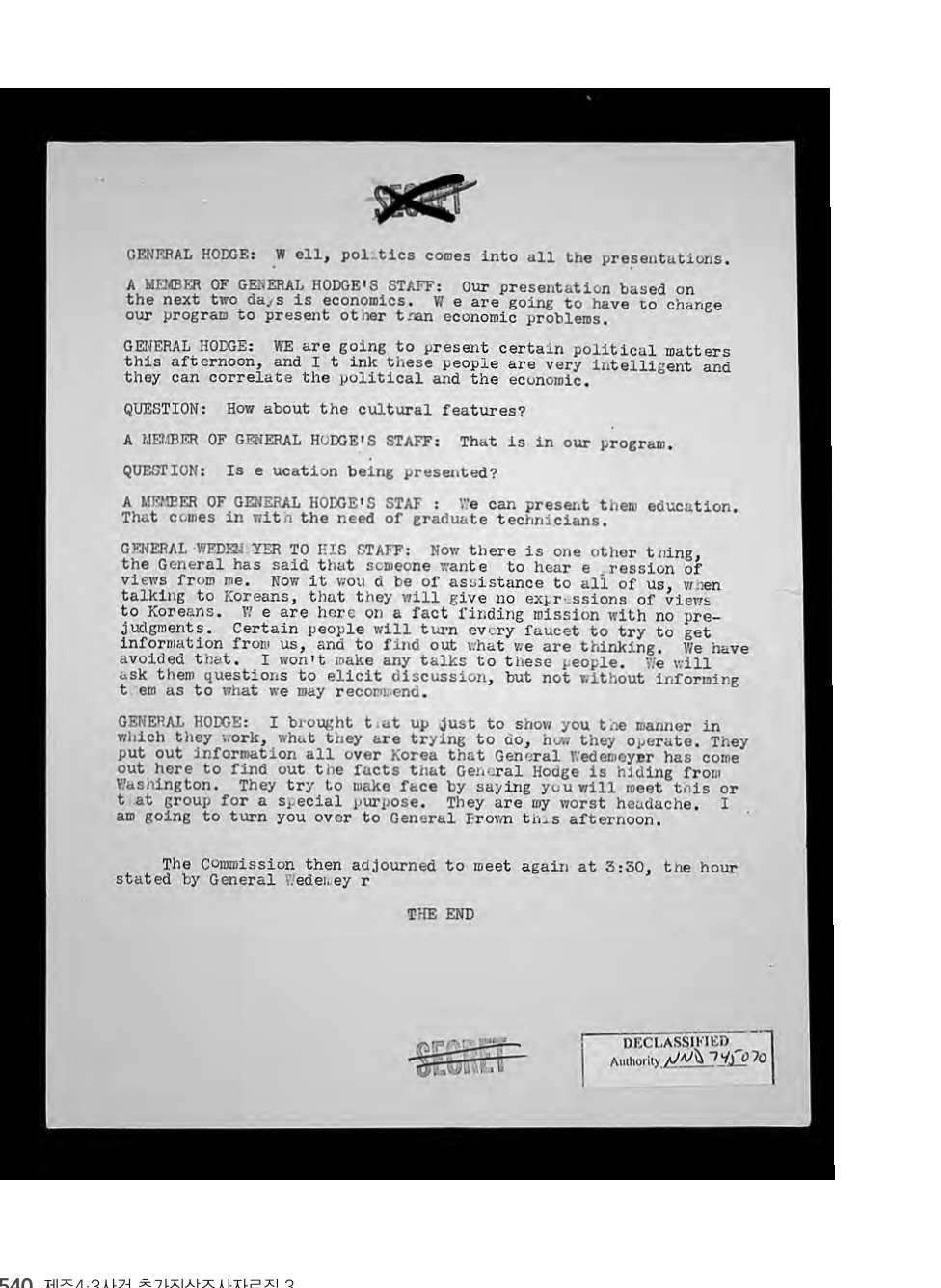
p.540
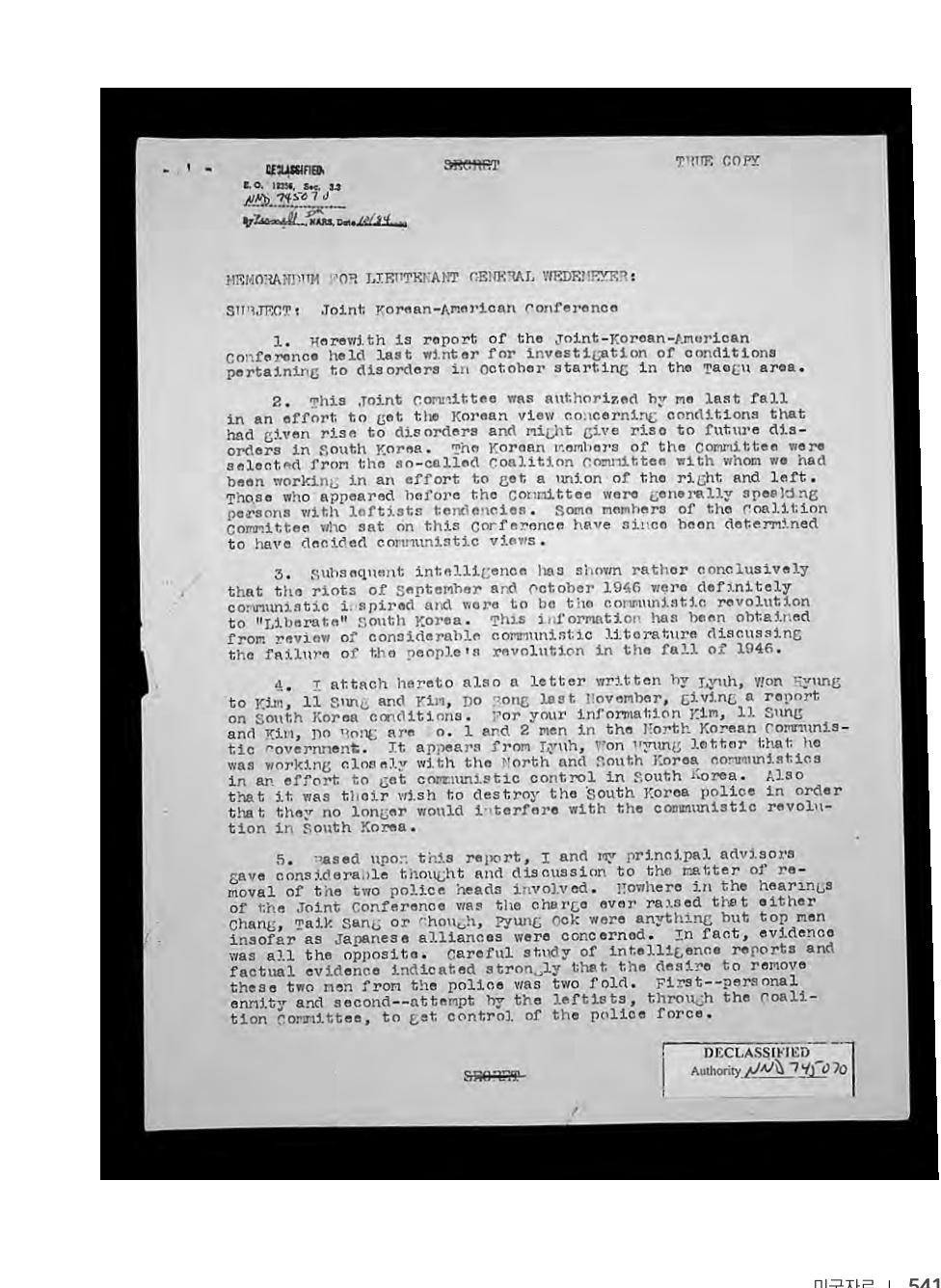
p.541
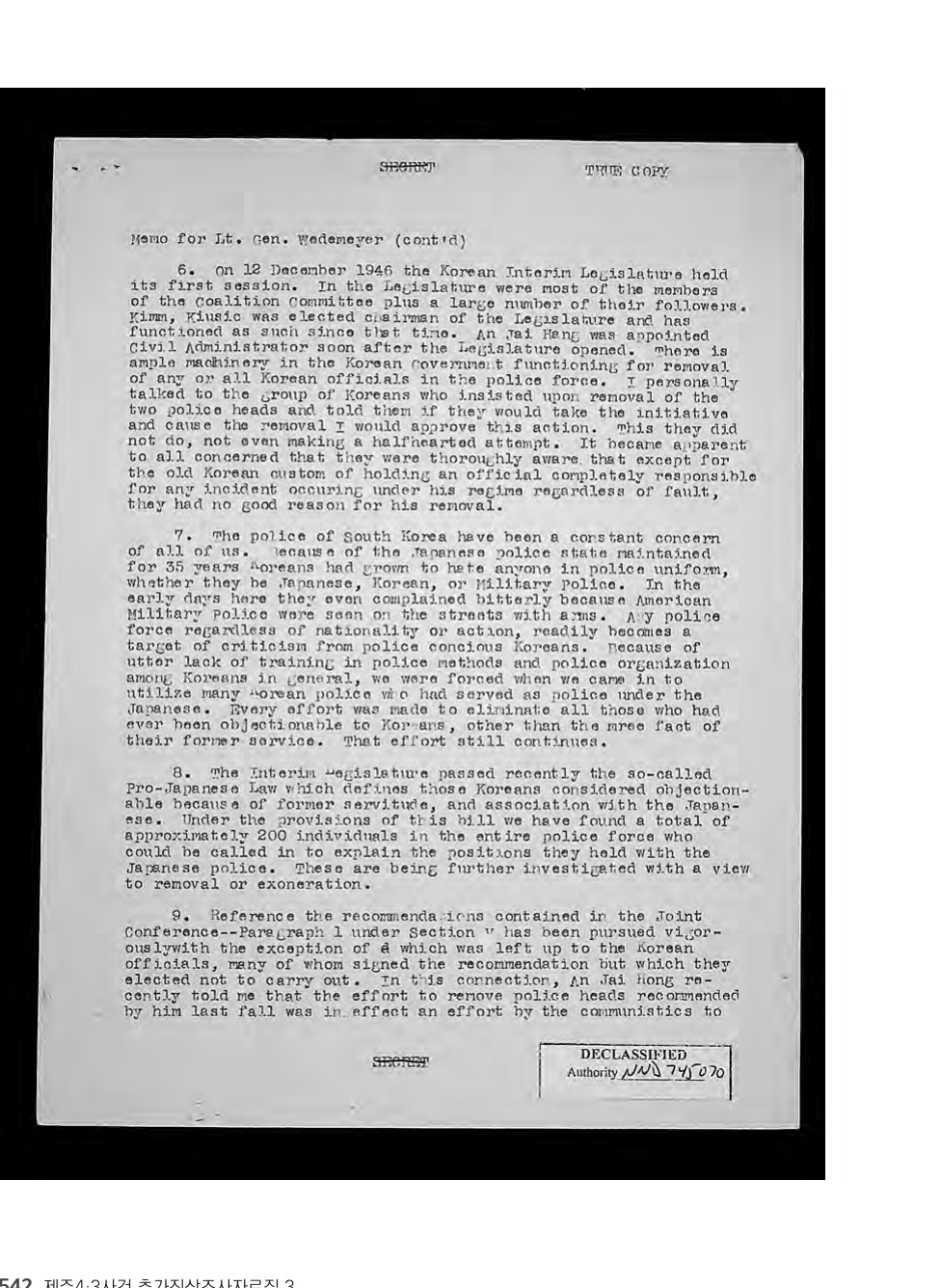
p.542
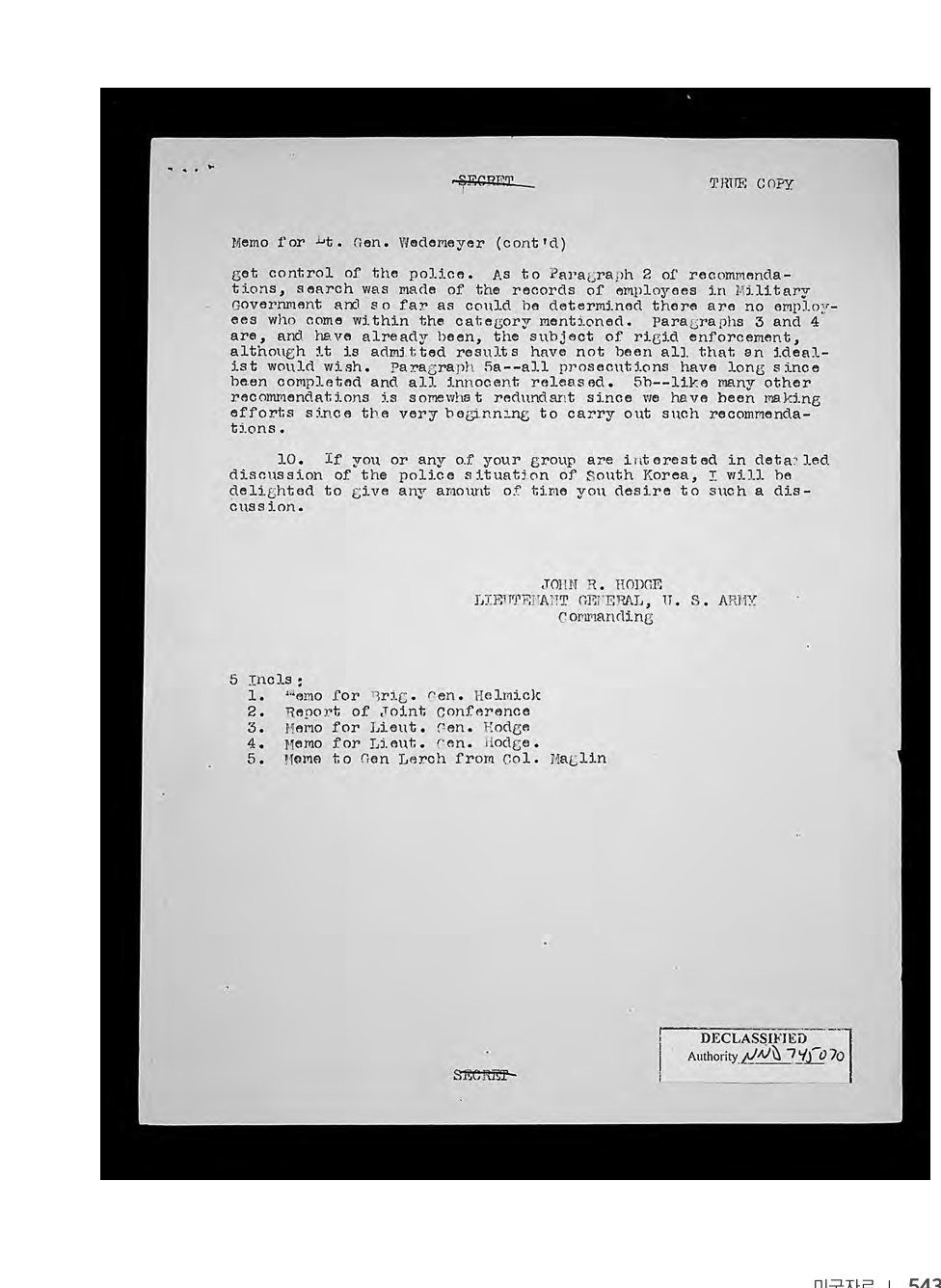
p.543
1947년 8월 20일 웨드마이어(Wedemeyer) 특사 방문
– 웨드마이어 중장에게 전달된 메모와 1947년 8월 27일 하지 장군이 웨드마이어 중장에게 한 발언 요약
1947년 8월 27일 9시 00분
하지 사령관: 계속 진행하겠습니다. 어떤 식으로 진행해야 할 지 잘 모르겠지만 사전에 전달받은 여러분의 방문 목적에 맞게 이곳 상황을 전반적으로 설명해 드 리겠습니다. 여러분의 관심 분야가 무엇인지 정확히는 알지 못하지만 이곳에서 우리가 겪는 문제들을 최선을 다해 설명하겠습니다.
미국이 관심을 가지는 한 조선은 아시아에서 가장 치열한 분쟁 지역이라고 생 각합니다. 이에 관해 의문의 여지는 없을 것입니다. 우리는 특정 상황에서 이곳에 오게 되었습니다. 그리고 우리가 도착한 후 우리에게 불리하고 우리의 통제를 벗 어나는 상황들이 생겨났습니다. 그중 첫 번째가 북위 38도선을 중심으로 미국과 러시아20가 조선을 이중 점령하게 된 것입니다. 조선 점령 결정이 내려졌을 때 우 리 부대는 오키나와에 주둔해 있었습니다. 조선의 38선 분할은 군 차원에서 결정 된 것으로 알고 있습니다. 당시 그 자리에 있었다는 한 장교에게 물어보니 일본이 항복하기 며칠 전이었고 38선은 단순히 지도를 보고 고른 것이라고 했습니다. 실 제 그 선을 그렇게 물리적으로 나누기란 굉장히 어려운 일입니다. 불가능에 가까 운 일이죠. 지역 경계를 따르지도 않았습니다. 이 선은 한 자리에 있는 바다를 가 로지르고 소련 영토를 거치도록 허가를 받거나 비행기나 선박을 이용하는 경우를 제외하고는 갈 수 없는 지역도 있습니다. 우리는 현재 이 모든 방법을 사용하고 있습니다.
20) 역주: 당시 소비에트 연방(소련)을 의미하나 원문에 실린 러시아(Russia)를 그대로 번역함. 이하 동.
따라서 우선 염두에 둬야 할 것은 38선입니다. 38선은 러시아와의 장벽과 마찬가지로 철의 장막이 된 경계선입니다.
두 번째는 우리가 점령에 대한 준비도 없이 들어왔다는 점입니다. 제가 점령 임무에 관해 처음 들은 때는 8월 12일 경입니다. 상황이 이해가 되지 않았고 특히 조선의 38선 분할은 납득이 가지 않았습니다. 저는 마닐라의 맥아더 원수 본부로 내려갔는데 거기 사람들 역시 그 상황을 납득하지 못하는 것 같았습니다. 하지만 저희는 남조선으로 들어가라는 명령을 받았습니다. 우리 부대에는 군정 업무를 담당할 인원이 없었습니다. 저는 오키나와에서 낙오자 몇 명을 골라 군정 업무에 배치하고 관련 교육을 시킬 수 있었습니다. 그리고 육군 항공기 본부를 골라 행정 부대로 사용했고 군정 파견대를 위한 행정 기초를 다졌습니다. 이 같은 상황은 몇 주 지속되었습니다. 마침내 군정 부대가 도착했고 우리는 1945년 12월 말까지 각 지방으로 파견되었습니다.
또 다른 상황으로는 당시 조선에 있는 기존 정부를 활용하라는 명령을 받은 것입니다. 맥아더 원수께서 일본에서 시행하신 명령과 같은 것으로 대체할 수 있을 때까지 기존 정부를 활용했습니다. 기존 정부는 이내 중지되어야 했습니다. 남조선에 들어왔을 때 우리는 벌집에 뛰어든거나 마찬가지였습니다. 이곳의 기존 정부는 일본 정부였고 조선인들은 기존 정부가 지속된다는 것에 항의했습니다. 저는 맥아더 원수 앞으로 해당 조항을 취소하고 일제를 대체할 수 있는 권한을 요청하는 전보를 작성했습니다. 이 내용을 타이핑하는 와중에 맥아더 원수로부터 그 권한을 저에게 부여한다는 전보가 도착했습니다. 그래서 우리는 일본 정부 교체 작업에 돌입했습니다. 이 일화에 대한 반응은 미국이 해방된 인민을 제대로 관리하지 못한다는 나쁜 인상이었습니다. 언론에서도 이 내용을 다루었지만 언론은 상황이 어떻게 돌아가는지 이해하지 못했고 국제적으로 조선은 일본의 일부라는 사실을 잊고 있었습니다. 빠른 변화와 인력 부족으로 인한 갑작스러운 변화는 상당한 혼란을 야기했습니다. 그 과정에서 일본에서 조선으로의 빠른 전환과 일본의 퇴출에 관한 기록이 일부 소실되었습니다.
초기에는 상당한 혼란이 있었습니다. 우리가 처음 남조선에 들어왔을 때 조선인들은 카이로 회담과 이후 강대국들의 회담에서 약속한 독립을 즉각적으로 원했습니다. 당시 약속이라는 용어는 '적시에'라는 뜻이었습니다. 조선인들은 '적시에'를 우리와 다르게 해석하여 '며칠 후에' 독립한다고 말을 합니다. 그들은 우리가 도착한 날 독립할 준비가 되어 있다고 생각하고 있었고 그 후에 매일 우리에게 요구해 왔습니다.
우리는 조선에서 추방당한 원로 우국지사들의 입국을 허가했고 미국에서는 이승만이, 중국에서는 김구와 '충칭 임시정부' 무리가 들어왔습니다. 그들은 귀국 허가를 받는다면 정부 자격으로 활동하려 하지 않을 것이고 우리에게 협조하며 개인으로 활동하겠다는 신호를 보내왔습니다. 그들은 이 말을 지키지 않은 때가 자주 있어 여러모로 가장 당혹스러운 조력자였습니다. 그렇지만 다른 의미로 그들은 공산주의에 대한 방벽을 형성하고 있습니다. 다만 너무 극단적이고 중국의 군벌 콤플렉스가 너무 심해 큰 도움이 되지는 못합니다. 어떤 점에서는 과격한 행동과 편협함을 통해 조선인들을 공산주의로 몰고 감으로써 공산주의에 도움이 되기도 합니다.
이곳에 도착한 후 간단할 것 같던 러시아와의 협의를 도출하려 했지만 성과는 없었습니다. 우리가 남조선에 들어온 다음 날 러시아는 북조선에 연락파견대를 보냈고 저는 그 목적에 맞게 모을 수 있는 최선의 참모들과 제 참모부장을 보냈습니다. 그들은 따뜻한 환대를 받았지만 아무것도 할 수는 없었습니다. 저들은 아무도 협상에 대해 이야기 하지 않았습니다. 상급사령부에서 고위 정치인들이 내려왔지만 협상에서 아무 성과도 없이 돌아갔습니다. 우리는 칸코 수용소에서 연합군 전쟁 포로를 석방하려 하고 있었습니다.
처음 러시아는 이미 석방했다고 말했지만 그건 사실이 아니라는 것을 나중에 알았습니다. 이에 대해 언쟁을 벌이고 전쟁 포로들의 석방을 처리하는 데 2주가 소요되었습니다. 그것이 러시아와 체결한 최초의 협상이었습니다. 러시아인들은 분계선에서는 굉장히 친절했지만 우리가 자신들의 영역 밖에 머물러야 하고 자신
들과 무역 등 두 지역 간 협력과 관련된 것들을 할 기회는 없을 것이라고 확실히 선을 그었습니다. 그곳에 있는 러시아인들은 어떤 행동에서도 주도권이 허락되지 않고 있음이 분명합니다.
매일 수천 명의 조선인들이 쏟아지듯 분계선을 넘고 있습니다. 얼마나 많이 들어왔는지 저도 모릅니다. 우리가 도착하기 전 이미 수십만 명이 들어와 있었으니까요. 전쟁은 8월 15일에 끝이 났습니다. 러시아가 8일 혹은 9일에 공격을 했고 많은 조선인들이 피난을 위해 북에서 흘러나왔습니다. 나머지는 전쟁이 끝난 후 나왔으며 우리 지역은 피난민들로 거의 꽉 찼습니다. 그 후로도 수십만 명이 들어왔습니다. 조선인 피난민 관리 때문에 상황은 더 복잡해졌습니다. 일본인들도 대거 일본으로 돌려보내야 했습니다.
웨드마이어 중장: 말씀 중에 질문을 해도 되겠습니까?
하지 사령관: 네, 질문이 있으시면 바로 하십시오.
웨드마이어 중장: 러시아와의 첫 번째 회담은 겉으로는 화기애애했지만 우리 측 요구사항은 전혀 받아들여지지 않은 것으로 알고 있습니다. 당시 전력(전기)에 관한 질문도 제기하셨습니까?
하지 사령관: 당시에는 하지 않았습니다. 그 문제에 대해 충분히 알지 못했습니다. 그때 막 조선에 도착한 상태라 당시 전력이 어디에서 나오는지 알지 못했습니다. 우리는 굉장히 급하게 들어왔습니다. 점령군 이동 우선순위에서 우리 부대는 최하위였고, 그 후 미국의 고려사항에서도 마지막 순위였다고 할 수 있겠습니다. 들어올 때 우리 몸은 아주 가벼웠습니다. 우리는 7사단 소속이었고 APA(공격수송함)가 실어 나를 수 있는 부대 본부의 일부였습니다. 사실상 수송수단이나 무거운 장비가 없었습니다. 우리에게 9월 말까지는 이동이 없을 것이라고 말해 놓고는, 이후 가능한 한 빨리 들어오라는 지시를 받았습니다. 그렇게 허둥지둥 이동하면
서 말씀드린 것처럼 우리 부대는 12월 말경까지 전원이 입국하지는 못했습니다.
그래서 배치와 인수인계가 점진적으로 이루어지지 못해 지역을 완전히 통제하는 데 불리했습니다.
우리가 입국했을 당시 러시아는 자신들의 요원을 통해 '인민위원회'라고 이미 일부 지역에서 활동을 시작하고 있는 일종의 정부를 조직해 놓은 상태였습니다.
주한 일본인에 저항하던 지하세력은 1925년에 소련에 넘어가 공산당이라는 이 름을 얻었습니다. 이들은 공산당의 수법으로 일본에 저항하는 데 조선인의 애국 심을 이용했고 영향력 있고 훈련이 잘된 러시아계 조선인의 도움을 받았습니다.
러시아인이 아닌 소련 체제에서 교육을 받은 조선인들이 코민테른에 대한 애정을 심어주고 소련에 대한 복종을 가르쳤습니다.
초기에 조선을 다루는 방식과 관련해, 조선이 해방된 국가라고는 하지만 경제 거래에서는 적국처럼 취급되었고 무역 통제는 몇 개월 전 공식적으로 종료되었습 니다. 조선이 미국 언론과 공식 성명에서 과거의 적국으로 불리자 조선인들은 매 우 불쾌해 했습니다. 유엔 헌장이 확립된 직후 그 내용은 조선인들에게 알려졌습 니다. 조선인들은 유엔 헌장 조항들에 대해 알고 있었고 실제 자신들의 국제적·사 회적 지위인 과거의 적국 영토를 처리하는 절차를 확인했습니다. 조선인들은 해 당 영토의 처리 방법을 확인한 후 아마도 자신들은 과거 적국 영토에 대한 헌장의 신탁통치 조항에 따라 유엔의 지도하에 신탁통치를 받게 되리라는 것을 알게 되 었습니다. 조선인들은 달가워하지 않았습니다. 그들은 바로 독립하길 원했습니 다. '신탁통치'라는 용어는 의도적이든 우연이든 1905년 일본이 조선을 '보호국'
으로 삼을 때 사용한 용어와 똑같이 해석되었습니다. 5년 후 일본은 결국 조선을 전면 통치하게 되었습니다.
저는 이 신탁통치의 관점을 두고 논의를 하고 싶습니다. 이 문제는 초반에 제기 되어 아직까지도 정치 소용돌이의 중심축을 이루고 있습니다. 이 주제에 깊은 골이 있어 우리가 사용할 수 있는 어떠한 합작이나 중도 세력도 만들기가 거의 불가 능합니다. 신탁통치란 용어는 대다수 조선인들 마음속에 주권에 치명적인 것으로
초반에 각인되었습니다. 나중에 이 용어는 이 나라의 통치에 관여하는 러시아와 같은 의미가 되었습니다. 그 후에는 신탁통치, 러시아의 통제, 공산주의가 모두 동의어가 되었습니다. 조선인들은 신탁통치라는 단어를 언급할 때면 항상 모든 함축적 의미를 하나로 뭉뚱그립니다.
1945년 모스크바 3국 외무장관회의가 개최되기 전 저는 두 차례의 전갈을 통 해 향후 러시아와의 만남에서는 '신탁통치'라는 단어를 빼거나 또는 그 용어를 꼭 써야 하는 경우에는 받아들이기 쉽게 정의하거나 완곡한 표현을 쓸 것을 요청했 습니다. 그중 하나가 우리 대표단이 러시아에 가기 직전 긴급하게 전달되었습니 다. 그 단어를 쓰지 않길 기도했지만 결국 쓰게 됐고 지금도 쓰고 있습니다.
12월 후반 우리는 '조선 5년간의 신탁통치'라는 헤드라인을 보았습니다. 모든 조선인이 격노했는데 이 말 말고는 달리 형용할 말이 없습니다. 김구는 정부를 장 악하기 위해 지지자들의 적대감을 이용했습니다. 당시 우리는 아직 정착하지 못 한 상태라 그의 행동은 무척 심각해 보였습니다. 그러나 경찰이 우리와 함께 해 우리는 상황을 통제하고 제압할 수 있었습니다.
반탁 문제에 있어 가장 격렬한 부류는 공산주의자들이었습니다. 저는 시간 단 위로 정계 지도자들과 접견했고 그들은 무리 지어 저를 만나러 와 위 문제를 논의 했습니다. 저는 그때까지 신문 헤드라인에 나온 '조선 5년간의 신탁통치'라는 간 단한 개념 외에는 모스크바 선언의 구체적인 내용은 알지 못했습니다. 이것과 관 련하여 가장 골치 아팠던 조선인들은 공산주의자들이었습니다. 저는 이들 가운데 우파 몇 명, 그중에서도 조선민주당의 송진우에게 조선을 위한 세상은 끝나지 않 았음을 납득시켰습니다. 송진우는 나가서 자신은 합리적으로 행동할 준비가 되었 다고 친구들에게 말했으나 다음날 아침 그는 6발의 총알을 맞고 사망했습니다. 우 리는 송진우를 죽인 범인을 찾았지만 아직 누가 지시했는지는 모릅니다. 배후에 극우파가 있을 것이라고 의심은 하고 있습니다. 공산주의자들은 굉장히 완고하고 남의 말은 듣지 않습니다. 조선에서는 연이어 시위가 일어났는데 이는 모두 좌파와 우파가 벌인 것이었습니다. 당시 좌파들은 스스로를 공산당이라고 불렀습니
다. 그들은 코민테른 공산주의의 소란스러움을 모두 솔직히 인정했습니다. 러시아는 그들의 조국이었습니다. 그들은 스탈린과 레닌의 사진을 지니고 다니며 빨간색과 흰색으로 된 러시아 국기를 사용하고 조선 국기는 사용하지 않았습니다. 당시에는 코민테른 추종자들이 무방비 상태로 널려 있었습니다.
1946년 1월 3일 공산주의자들은 신탁통치에 반대하는 대규모 회의를 계획했습니다. 당시 시위는 시들해져 있었습니다. 저도 지쳐가고 있었습니다. 저는 1월 1일 그들에게 전화해 이 모임이 개최되길 원치 않으며 무력으로 막지는 않겠지만 중단해 줄 것을 요청했습니다. 하지만 소용없는 일이었습니다. 당시 그들은 그 사안에 단호했습니다. 그런데 다음날 오후 그들이 웃으며 저에게 전화해서는 "신탁통치는 괜찮습니다. 괜찮아요. 신탁통치 찬성 시위를 하겠습니다. 걱정하실 필요없습니다"라고 말했습니다. 다음 날, 3만~4만 명의 시민들이 모였습니다. 모인 사람들은 현수막 대부분을 신탁 찬성이라고 바꿔야 했습니다. 1월 2일 러시아로부터 신탁에 호의적이어야 한다는 지령을 받은 게 분명했습니다.
제가 이 이야기를 하는 이유는 이 사건으로 인해 미소공동위원회가 막히기 시작했고 그때부터 러시아가 공산주의자 말고 모든 것을 제외시키는 데 매우 유리해졌기 때문입니다.
저는 러시아가 추종자들에게 모스크바 결정을 전적으로 수용하라는 명령을 내리면 우파들의 신탁통치에 대한 반감이 여기 사람들의 협조를 이끌어내는 데 유리하게 작용할 것이라는 사실을 일찌감치 간파했을 것이라고 생각합니다. 이는 남조선의 좌파와 우파 간 깊고 메울 수 없는 균열의 발단이기도 합니다. 이제 중도 입장을 취하기란 거의 불가능해졌습니다.
따라서 신탁통치, 혹은 모스크바 결정은 우리가 직면한 또 다른 장애가 되었습니다. 장애가 아니라고 해야겠지만 이 사람들을 대할 때 장애가 되는 것은 사실입니다. 이 문제는 우리가 처리해야 할 가장 어려운 숙제입니다. 우리는 신탁통치가 조선인들에게 유익하다고 설득하기 위해 계속 노력했습니다. 공산주의자들은 전
적으로 수용했습니다. 수용하면서 일부에서는 공자가 강간을 수용하라고 조언하는 것과 같다며 빈정대기도 했습니다. 그들은 신탁통치를 좋아하진 않지만 그대로 진행되도록 내버려 둘 것입니다. 하지만 일반적인 여론은 '신탁통치'를 원치 않았습니다. 미소공동위원회에 가입하고 이에 협조하는 공산주의자를 배제한 집단들조차 임시정부를 도와 미소공동위원회에서 나온 주권을 침해하는 신탁통치에 저항할 것이라는 생각에 동참했습니다.
앞서 말했듯 러시아는 과거 조선에 공산주의 수립을 시작하지 않았습니다. 대신 1925년 일본에 저항하는 조선의 지하 활동을 장악하여 그들에게 공산당의 이름과 이상, 개념과 기술을 전수하고 이들을 코민테른의 통제하에 두었습니다. 러시아는 러시아에서 교육을 받은 많은 조선인에게 먹을 것을 주며 이들의 힘을 키우고 개선해 나갔습니다. 전쟁이 끝나고 오래 지나지 않아 러시아는 시베리아계 조선인 출신으로 소련에서 훈련을 받은 조직책들을 추가로 투입했습니다. 그 밖에도 러시아에는 시베리아 군대와 자신들이 통제하는 조직이 있었습니다. 조선 탈취를 목적으로 수립된 이들 조직에는 철저히 세뇌된 3만 명의 조선인들이 있었으며 전설의 우국지사인 김지성(Kim Ji Sung)을 사칭하는 자까지 포함되어 있었습니다.
우리가 남조선에 들어왔을 당시 러시아에서 지령을 받은 조직책들이 전 지역에 퍼져 있었고 그들은 전체 지역의 우수한 세포조직과 함께 훈련을 잘 받은 상태였습니다. 그들은 누구나 조직원으로 받아들입니다. 그들이 필요한 건 강력한 의지를 기반으로 하거나 중앙위원회에서 약간의 다수를 확보하여 통제력을 유지하는 것뿐입니다.
상황을 어렵게 만드는 또 다른 중대 요소는 순전히 러시아의 지령을 받아 이곳에서 행해지는 강력하고 노골적인 공산주의 활동들입니다. 우리가 담당하는 분계선의 길이는 약 257km(160마일) 정도 됩니다. 공산당의 전령이나 요원들은 분계선을 건너고 북조선에서 작은 배를 타고 분계선 주위를 돌아다닙니다. 오고 가는 메시지를 중단시키거나 거의 마음대로 왔다 갔다 하는 요원들을 멈추게 할 도
리가 없습니다. 제가 찾아본 바로 이들의 활동은 발칸이나 중유럽에서 했던 그대로입니다. 공산당이 조선의 애국 독립운동과 결부되면서 공산당 지도자들은 우국지사로 알려지게 되었고 상당한 인기를 얻었습니다.
하지만 '공산주의자'라는 단어는 한동안 굉장히 인기가 없어졌습니다. "러시아는 조국이다"라는 구호와 당원들의 조선 국기 사용 거부는 사라졌습니다. 당 본부에서 위조지폐가 발견된 후 공산주의자들은 이름을 바꾸고 자신들이 통제하던 한두 개 정당과 통합하여 이제 스스로를 '남조선노동당'이라고 부르고 있습니다. '민주주의민족전선'은 모든 연합 정당들과 조합, 정치계 등 공산당에서 통제하던 활동들을 수용하기 위해 남조선노동당보다 먼저 설립되었습니다. 남조선노동당과 민족전선 모두 같은 하나의 집단입니다. 지도자가 같은 동일한 조직인 것입니다. 이러한 술책을 통해 그들은 추종자를 수천 명 늘렸습니다. "우리의 조국은 러시아!" 라는 구호와 스탈린과 레닌 초상화는 사라지고 조선 국기가 다시 나타났습니다. 그들은 이제 "제국주의 국가 미국, 친일파·반역자·협력자들의 친구 미국, 조선을 식민지화하려는 미국"이라는 구호를 집어 들었습니다.
남조선에 도착했던 때로 돌아가서, 이곳에 들어온 후 우리는 일본과 아무런 문제도 없었습니다. 일본은 이 지역에 약 15만 명의 병력을 갖고 있었고 우리는 그들과 민간인들을 일본으로 매우 신속하게 돌려보냈습니다. 처음에 우리가 겪은 문제는 주로 조선인의 법질서 준수 문제였습니다. 조선인들은 일본을 증오했고 일본인들에게 매우 비판적이었으며 복수도 하고 싶어했습니다. 우리는 기술자들을 많이 남기고 싶었지만 일본인을 모두 내보내야 하는 상황이어서 몇 명만 잠시 남아있게 했습니다. 하지만 조선인들은 일본인들과 함께 또는 그들 밑에서 절대 일하지 않으리란 것을 깨달았습니다.
질문: 현재 몇 명이 남아 있습니까?
하지 사령관: 아프거나 인도주의적 소지가 있는 자가 50명 정도가 남아 있습니다.
다. 말씀드렸듯이 조선인들은 일본인들과 함께 일하지 않을 것입니다. 만약 공장에 일본인 기술자가 한 명이라도 있다면 그것이 공장의 원활한 운영에 필요한 경우라도 조선인들은 그곳에서 일하길 거부할 것입니다. 그래서 일본인을 모두 내보내야 했습니다. 우리 지역에 있는 50만 명 정도의 민간인 외에도 남조선과 만주에서 50만 명이 넘는 일본인을 내보냈습니다.
웨드마이어 중장: 어떤 방식을 쓰셨습니까? 러시아가 협조했나요?
하지 사령관: 아닙니다. 그들은 단순히 일본인들을 분계선 너머로 밀어낼 뿐이었습니다. 이와 관련해서 러시아와 협력하여 배편으로 일본인들을 본국으로 보내려는 시도를 했습니다. 하지만 러시아는 우리 측에 일본인들을 분계선에서 인계받고 식량과 옷을 제공한 뒤 모든 기차를 동원하여 그들을 우리 항구로 데려가 배에 실어 일본으로 보내라고 주장했습니다. 당시는 일본인 직접 이동 문제와 관련해 러시아와 연합군 최고사령부(SCAP)의 합의가 있기 전인 지난 12월이었습니다. 한편 러시아는 우리 지역으로 굶주리고 추위에 시달려 다 죽어가는 병든 노인, 여성, 아동을 내려보냈습니다. 이들에게 38선 안내문과 통행증을 쥐어 주며 이들을 분계선 아래로 밀어냈습니다. 북쪽에서 넘어오는 이들을 위해 우리는 난민센터를 운영하며 식량과 옷을 제공하고 이동시키며 그들을 돌봐야 했습니다. 우리는 러시아가 석탄, 차량, 식량을 제공하면 기차로 그들을 데려오는 방안을 제시했지만 러시아는 이런 제안을 하나도 받아들이지 않았습니다. 러시아는 자신들이 우리를 좌지우지하고 있다는 것을 알았습니다. 그들은 사람들을 무작정 남쪽으로 보냈고 전혀 개의치 않았습니다. 러시아는 협조라는 것을 전혀 몰랐습니다.
외부에서 들어온 조선인은 150만 명 정도 되는데 국경을 넘어온 이들 외에는 모두 배편으로 들어왔습니다. 대부분이 일본에서 왔고 일부는 중국, 남태평양 등의 지역에서 들어왔습니다. 제가 아는 한 일본에 있는 집단과 만주에서 발이 묶여있는 사람들을 제하면 이제 대부분 돌아온 것입니다. 일본에 있는 우리 부대에서 이곳으로 돌려보내려는 사람들이 수십만 명 되지만 많은 조선인이 그들이 들어오는 것을 반대하고 있습니다. 그들은 일본 시장의 거물로 꽤 잘 나가고 있고 다른
부정행위들도 하고 있는 것 같습니다.
우리는 북조선에서 내려온 50만 명 정도의 조선인과 만주에서 육로로 들어온 30만 명 정도를 담당했습니다. 이는 우리 측 집계기관에서 산출한 수치입니다. 제 추측이지만 집계되지 않은 도착자의 수는 그보다 절반 이상 많을 것입니다. 이곳의 총 인구 수는 증가했는데, 우리가 들어온 후로 250만~300만 명 정도가 증가했습니다. 이처럼 인구가 크게 증가하면서 식량, 주택, 질병 예방, 경제 재건 등의 문제가 커졌습니다.
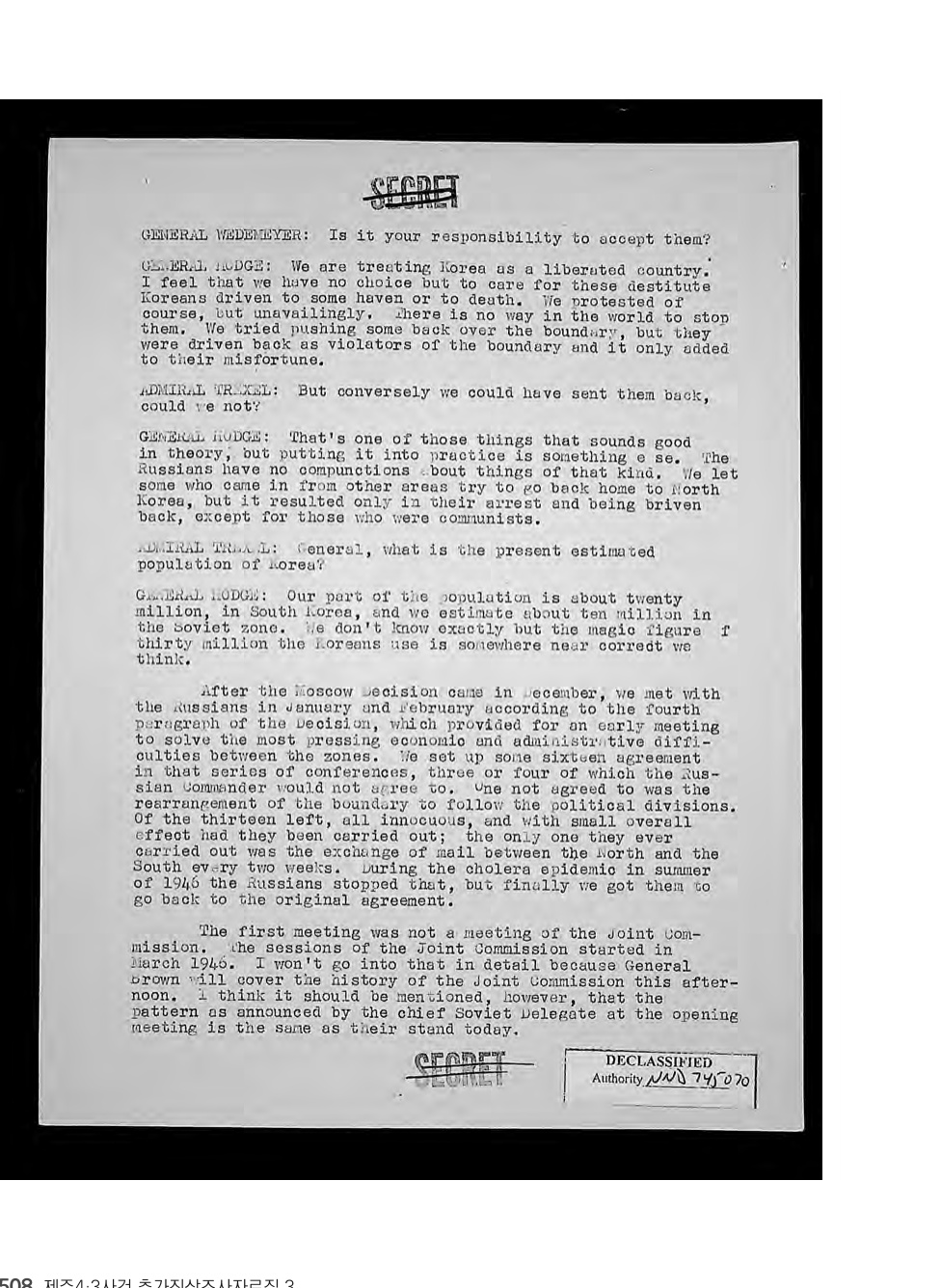
트렉셀(Trexel) 제독: 우리가 북에서 온 피난민의 수용을 거부했다면 그들은 어떻게 되었을까요? 그들이 38선을 건너 들어오는 것을 우리가 허가하지 않았다면 말이죠.
하지 사령관: 대부분 죽었을 것입니다. 우리에게 선택지는 총살 아니면 수용이었습니다. 그들의 유입을 막을 방법이 없었고 일단 우리 지역으로 들어오면 돌려보내는 것은 불가능했습니다.
웨드마이어 중장: 그들을 받아들이는 것이 하지 사령관의 의무였습니까?
하지 사령관: 우리는 조선을 해방된 국가로 대우하고 있습니다. 이 궁핍한 조선인들을 돌봐서 피난처로 보내거나 죽게 내버려 두는 것 외에는 선택의 여지가 없다고 생각합니다. 당연히 항의했지만 소용이 없었습니다. 그들을 멈플 수 있는 방법이 전혀 없었습니다. 일부를 분계선 위로 돌려보내려고 해 보았지만 그들은 다시 분계선 위반자로 내쳐졌는데, 이는 그들의 불운을 가중시킬 뿐이었습니다.
트렉셀 제독: 하지만 반대로 우리도 그들을 돌려 보낼 수 있었습니다. 아닙니까?
하지 사령관: 이론적으로는 그렇지만 실제는 다른 문제입니다. 러시아는 이런 일에 아무런 죄책감도 없습니다. 우리는 다른 지역에서 들어온 사람들 중 몇 명을
북조선으로 돌려 보냈지만 공산주의자를 제외하고는 결국 모두 체포되어 쫓겨났습니다.
트렉셀 제독: 현재 조선의 추정 인구는 몇 명입니까?
하지 사령관: 남조선에 약 2천만 명, 소련에 1천만 명 정도 있는 것으로 추정합니다. 정확히는 모르지만 조선인들이 말하는 3천만 명이라는 믿기 어려운 수치에 거의 다다르는 것 같습니다.
12월에 모스크바 결정이 내려진 후 우리는 그 결정 제4항에 따라 두 지역 간 가장 임박한 경제·행정 문제를 해결하기 위한 조기 회담 준비로 1월과 2월에 러시아와 만남을 가졌습니다. 당시 여러 차례의 회의를 통해 16개가량의 합의사항을 마련했으며 그중 3~4개는 러시아 지휘관이 동의하지 않았습니다. 동의하지 않은 것 중 하나는 행정 구역에 따른 분계선 재정비였습니다. 러시아는 남은 13개 중 전혀 해가 되지 않고 대체로 영향이 적은 것들만 시행했습니다. 그들이 시행한 유일한 합의사항은 2주마다 남과 북이 서신을 교환하는 것뿐입니다. 1946년 여름 러시아에 콜레라가 유행하는 동안 러시아는 이마저도 중단했지만 결국 우리가 원래 합의대로 되돌려 놓았습니다.
첫 번째 회담은 미소공동위원회 회담이 아니었습니다. 미소공동위원회의 회기는 1946년 3월에 시작했습니다. 오늘 오후에 브라운(Brown) 장군이 미소공동위원회 역사에 대해 설명할 테니 이 얘기는 자세히 하지 않겠습니다. 하지만 개회식에서 소련 수석 대표가 발표한 것처럼 그 양상이 현재 그들의 태도와 같다는 점은 언급해두겠습니다.
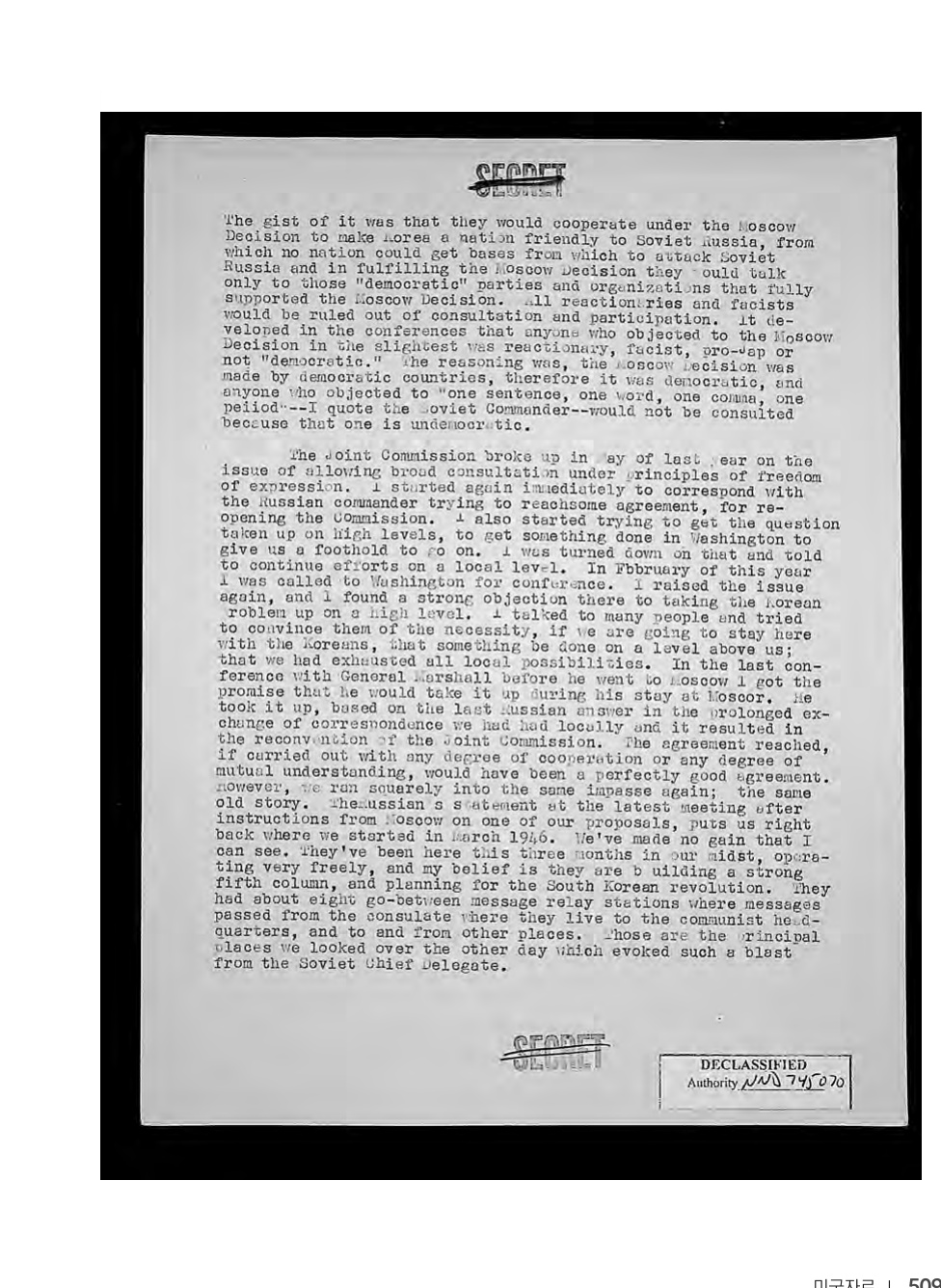
당시 발표의 요점은 자신들은 모스크바 결정에 따라 조선을 소련에 우호적인 국가로 만드는 데 협조할 것이며 어떤 국가도 소련을 공격할 기반을 얻을 수 없고, 모스크바 결정을 이행하는 데 자신들은 모스크바 결정을 전적으로 지지하는 "민주적인" 당사자와 조직하고만 대화하겠다는 것이었습니다. 모든 반동분자와 파
시스트는 협의 및 참여에서 제외되었습니다. 회의에서는 조금이라도 모스크바 결정에 반대하는 사람은 반동분자, 파시스트, 친일파이고, '민주적'이지 않다는 논리가 전개되었습니다. 그 이유는 모스크바 결정은 민주국가들이 내린 것이기 때문에 민주적이며 "문장 하나, 단어 하나, 쉼표 하나, 마침표 하나"(소련 지휘관의 말을 인용)에라도 반대하는 사람은 민주적이지 않은 것이므로 함께 협의할 수 없다는 것이었습니다.
미소공동위원회는 표현의 자유의 원칙에 따라 광범위한 협의를 허용하는 문제로 작년 5월에 결렬되었습니다. 저는 즉시 러시아 사령관과 다시 연락을 취하여 위원회 재개를 위한 합의를 도출하려 노력했습니다. 또한 우리가 계속 나아갈 수 있는 발판을 마련하기 워싱턴에서 뭔가 할 수 있도록 이 문제를 상부에 보고하기 시작했습니다. 하지만 거절 당했고 현지 차원에서 계속 노력해 보라는 답변만 들었을 뿐입니다. 올해 2월 저는 워싱턴 회의에 소집되었습니다. 저는 이 문제를 다시 제기했고, 이내 조선 문제를 상부에 제기하는 것에 대해 강경한 반대가 있음을 알게 됐습니다. 저는 많은 사람들과 대화를 나누며 우리가 남조선에서 조선인들과 함께 머물 것이라면 우리보다 높은 차원에서 뭔가 이루어져야 한다는 것과 현지에서 가능한 일은 다 했다는 점을 납득시키려고 노력했습니다. 마셜(Marshall) 사령관이 모스크바로 가기 전 열린 마지막 회의에서 저는 마셜 사령관으로부터 자신이 모스크바에 있는 동안 이 문제를 상정해 보겠다는 약속을 받았습니다. 우리가 장기간 현지에서 주고 받은 서신 교환 중 러시아로부터 받은 마지막 서신에 따르면 마셜 사령관은 이 문제를 상정했고 그 결과 미소공동위원회가 다시 열렸습니다. 협조와 상호 이해를 바탕으로 시행됐더라면 이때 도출된 합의문은 흠결없이 좋은 합의문이었을 것입니다. 하지만 또다시 정확히 똑같은 난관에 봉착했습니다. 늘 그렇듯 말이죠. 우리의 제안에 대해 러시아에서 지령을 받은 후 열린 마지막 회담에서 러시아가 한 말들은 모든 상황을 위원회가 처음 설립된 1946년 3월 직후로 돌려놓았습니다. 아무런 소득도 얻지 못했습니다. 러시아는 우리들 사이에서 최근 석 달간 머물면서 아주 자유롭게 작전을 벌이고 있으며, 제 생각으로는 강력한 제5열을 구축하고 남조선 혁명을 계획하고 있는 것 같습니다. 그들에게는 기거하는 영사관에서 공산당본부로 그리고 장소 간 메시지 전달을 담당하
는 메시지 중계국이 8개 정도 있습니다. 이곳들은 소련 수석을 그토록 화나게 만들었던 지난날 우리가 살펴보았던 주요 장소들입니다.
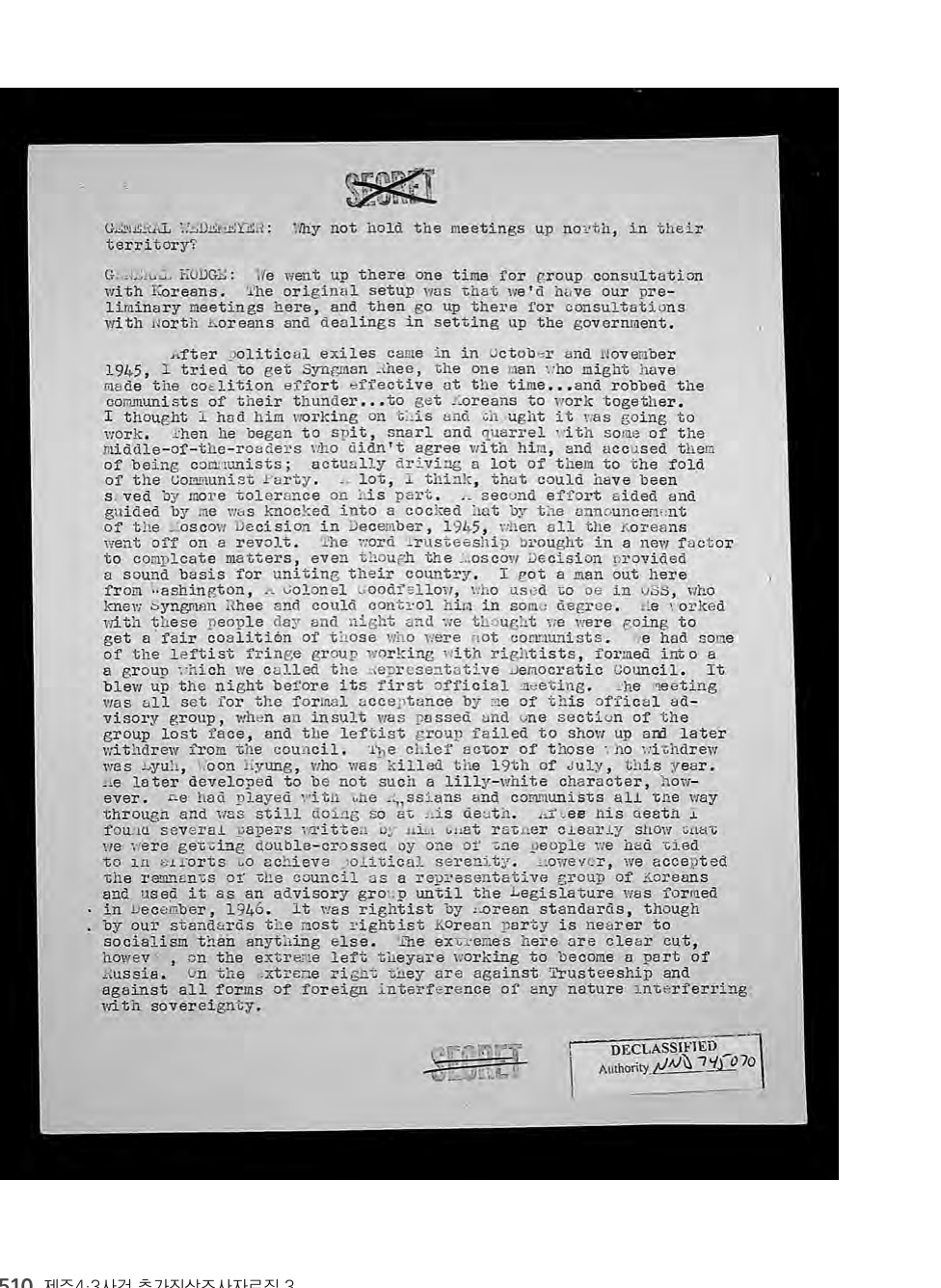
웨드마이어 중장: 회담을 그들의 영토인 북조선에서 열지 않은 이유는 무엇입니까?
하지 사령관: 한번은 조선인 단체 자문을 위해 북쪽에 갔었습니다. 원래는 예비회담을 남조선에서 가진 후 북으로 올라가 북조선과 협의하고 정부 수립에 대해 논의할 예정이었습니다.
1945년 10월과 11월에 정치망명자들이 들어온 후 저는 당시에 합작 노력을 효과적으로 수행할 지 모를 원로인 이승만을 불러들여... 조선인들의 협조를 얻어낼... 공산주의자들의 생각을 가로채 보려고 했습니다. 저는 이승만을 이 일에 끌어들였다고 생각했고 효과가 있을 것이라 여겼습니다. 그 후 이승만은 자신에게 동의하지 않는 중도파 중 일부와 언쟁을 벌이기 시작하더니 그들이 공산주의자가 되었다고 비난했습니다. 사실 이 일로 그들 중 대다수가 옛 보금자리인 공산당으로 돌아갔습니다. 그가 좀 더 관용을 베풀었다면 그렇게 많은 이들을 잃지는 않았을 것입니다. 제가 지원하고 이끈 나의 두 번째 노력은 1945년 12월 모스크바 결정 발표로 인해 수포로 돌아갔고 이때 모든 조선인이 일제히 봉기했습니다. 모스크바 결정이 소련을 결집시키는 확고한 기반이 되었을지는 모르지만 신탁통치란 단어는 상황을 복잡하게 만드는 새로운 변수를 가져왔습니다. 워싱턴에서 이곳으로 온 굿펠로우(Goodfellow) 대령은 미국해군전함(USS) 출신으로, 이승만을 알고 있었고 어느 정도 그를 통제할 수 있었습니다. 굿펠로우 대령은 이 사람들과 밤낮없이 함께 했으며 우리는 공산주의자가 아닌 사람들과 공정하게 합작할 것이라고 생각했습니다. 우리에게는 우파와 결탁하여 남조선대한국민대표민주의원을 결성한 좌파 비주류파 중 일부가 있었습니다. 첫 번째 회의 전날 밤 일이 터졌습니다. 그 회의는 제가 이 공식 자문단을 정식으로 승인하기 위해 준비를 모두 마친 상태였습니다. 그러나 그때 모욕적인 언사가 오가고 조직 한쪽이 체면을 잃었으며, 좌파 조직은 나타나지 않았고 이후 대표민주의원을 탈퇴했습니다. 탈퇴한
인물들 중 주요 인물은 여운형이었으며 그는 그해 7월 19일 암살당했습니다. 하지만 이후 여운형은 그렇게 백옥같이 순결한 인물로 발전하지는 않았습니다. 시종 러시아와 공산주의자들을 가지고 놀았고 이는 죽을 때까지 계속됐습니다. 여운형이 죽은 후 저는 우리가 정치적 평화를 위해 연대했던 사람들 중 하나가 우리를 배신하고 있었다는 사실을 명백히 보여주는 그의 글을 몇 개 발견했습니다. 하지만 우리는 남은 대표민주의원들을 조선 측 자문단으로 받아들이고 1946년 12월 의회가 수립될 때까지 자문단으로 이용했습니다. 이들은 조선의 기준으로는 우파였지만 우리 기준에서 가장 우파인 정당은 그 어떤 것보다 사회주의에 가까웠습니다. 이곳의 극단주의는 명확하지만 극좌파들은 러시아의 일부가 되기 위해 노력하고 있습니다. 극우파들은 신탁통치와 주권에 간섭하는 모든 종류의 외부 간섭은 그 성격을 불문하고 모두 반대하고 있습니다.
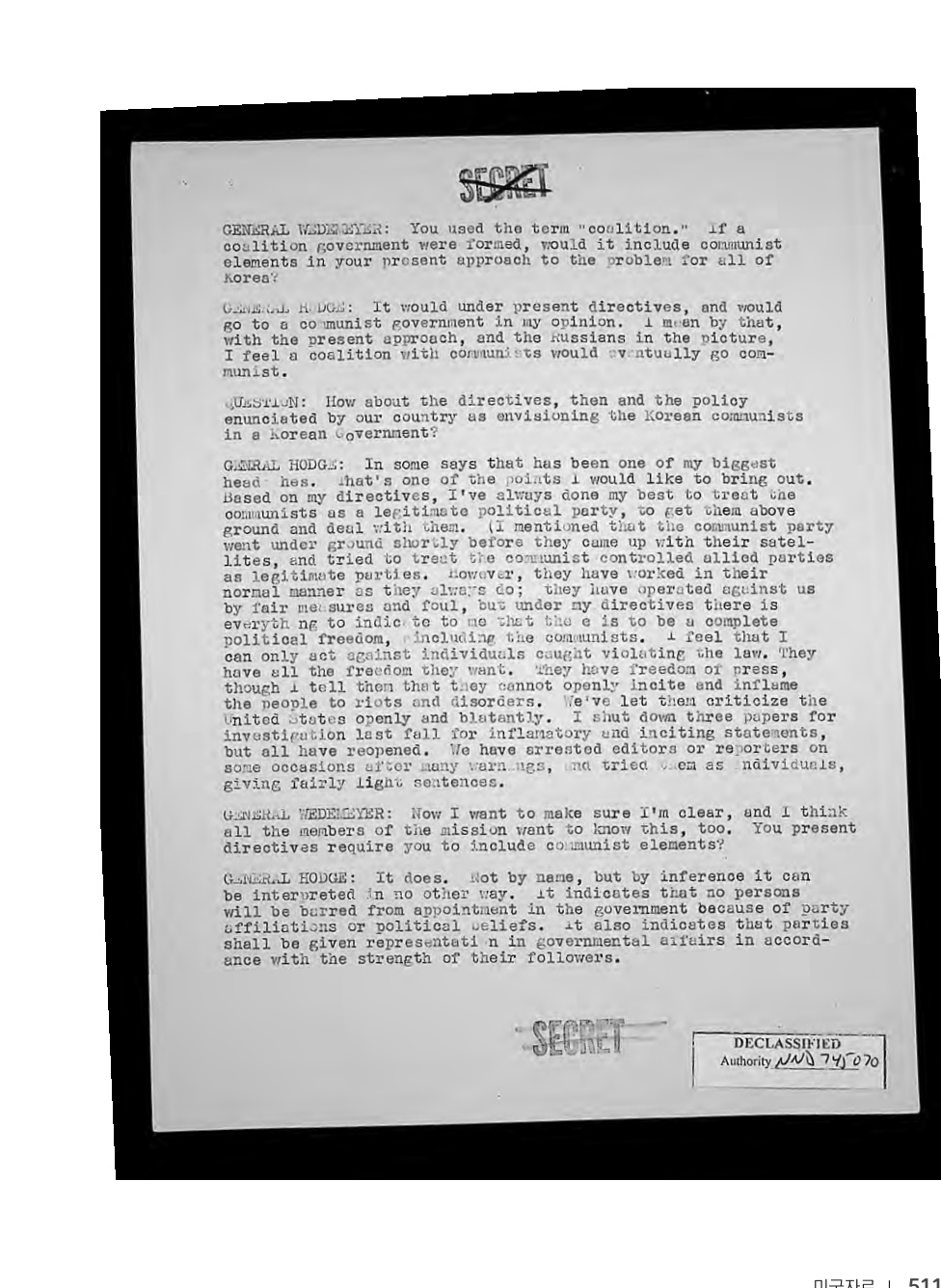
웨드마이어 중장: "합작(coalition)"이라는 용어를 사용하셨습니다. 연립정부가 설립된다면 조선인 모두의 문제에 대한 현재의 접근법에 공산분자들도 포함될까요?
하지 사령관: 현재의 훈령에 따를 것이며 제 생각이지만 그 정부는 공산주의 정부가 될 것입니다. 다시 말해, 현재의 접근법을 쓰거나 러시아의 그림에서는 공산주의자들과 합작하면 결국 공산주의가 되는 것 같습니다.
질문: 조선 정부 내 조선 공산주의자들을 예상하여 우리나라에서 전달한 지시와 이후의 정책들은 어떻습니까?
하지 사령관: 어떤 의미에서 그 점이 가장 큰 골칫거리인데 사실 꺼내고 싶었던 사안 중 하나이기도 합니다. 저의 훈령에 근거하여 저는 공산주의자들을 합법적인 정당으로 대우하고 그들을 지상으로 끌어올리기 위해 항상 최선을 다했습니다(전에 말씀드렸듯이 공산당은 위성 정당을 만들기 직전 지하로 숨어들었고 공산당이 통제하는 연합 정당들을 합법적인 정당으로 처리하기 위해 노력했습니다). 하지만 그들은 언제나 비정상적인 방식으로 행동했습니다. 수단과 방법을 가리지 않고 우리에게 대항했지만 제 훈령하에서는 공산주의자를 포함하여 완전한 정치
적 자유가 있으리라는 것을 알 수 있습니다. 저는 법을 위반하여 적발된 개인을 상대로만 조치를 취할 수 있다고 생각합니다. 그들은 자신들이 원하는 모든 자유를 누리고 있습니다. 저는 이들에게 폭동과 무질서를 공개적으로 조장하거나 부추길 수 없다고 말하고 있지만 그들에게도 언론의 자유는 있습니다. 우리는 공산주의자가 미국을 공개적이고 노골적으로 비판할 수 있는 환경을 만들었습니다. 지난 가을 선동적이고 자극적인 기사를 쓴 신문사 세 곳을 폐간하고 수사했지만 세 곳 모두 다시 영업을 재개했습니다. 편집자 또는 기자를 상대로 수차례 경고 후 체포하고 개인 자격으로 재판하여 상당히 가벼운 형을 선고한 적도 있습니다.
웨드마이어 중장: 이쯤에서 제가 제대로 이해하고 있는지 확인을 하고 싶습니다. 사절단원들도 모두 이 점을 알고 싶어할 것 같은데요. 현재 훈령에 따라 장군은 공산분자들을 포용합니까?
하지 사령관: 그렇습니다. 명칭이 아닌 추론에 따라 다른 방법으로는 해석할 수 없습니다. 어떤 사람도 자신이 속한 정당이나 정치적 신념 때문에 정부에서 근무할 기회를 박탈당할 수는 없습니다. 또한 정당에는 정당 지지도에 따라 정무적 대표성이 주어져야 합니다.
며칠 전 우리는 체제전복적인 활동을 중단시키기 위해 선동가를 몇 명 체포해야 했습니다. 저는 제가 본 상황들을 자세히 설명하며 공산주의자들을 너무 정중히 대하면 안 되는 시기가 오고 있는 것 같다고 말했습니다.
나는 앞서 러시아인들과 지역적인 거래를 중단하고, 이곳의 공산주의자들을 근절할 것을 권고했습니다.
웨드마이어 중장: 하지 장군, 그럼에도 불구하고 현실적으로 대의정치에서 공산분자들을 제외시켜야 할 때가 왔다고 생각합니까?
하지 사령관: 자유선거에 의한 경우를 제외하고 그들이 반드시 포함되어야 한다
고 생각하지는 않습니다. 2년 동안 그들의 협조를 구하기 위해 필사적으로 노력한
끝에 깨달은 것은 자발적으로 그들을 포용하는 일은 소용없다는 점이었습니다. 그 들은 자신들이 통제권을 쥐거나 우리를 이용할 수 있는 경우에만 협조할 것입니 다. 아직까지 제가 아는 누구도 공산주의자를 이용해 가치 있는 것을 얻지 못했습 니다. 오히려 여러분을 이용할 것입니다. 여기 조선의 좌파 집단을 통제하는 진짜 공산주의자들이 말입니다. 지난 가을에 선거를 실시했는데 공산주의자들은 참여를 거부했습니다. 다만 제주도에서는 인민위원회에서 두 명의 의회 대표를 선출 했습니다. 그 두 명의 당선인을 서울로 보냈는데 그들은 곧바로 사라졌습니다.
공산주의자들은 그들이 의회에 입성하도록 놔두지 않았을 것입니다. 이런 이유로 저는 더 완전한 연합을 위해 의회의 절반을 임명직으로 채우기로 결정했습니 다. 45명의 선출직 의원들은 모두 완전한 우파였습니다. 제주도에서 선출된 두 명 만이 예외였지만 그들은 이후 선출된 우파로 대체되었습니다. 45명의 임명직 의 원들은 소위 좌우합작위원회가 "중도파" 및 "중도좌파" 집단에서 추천한 인물들 중에서 고른 것입니다. 제가 처음에 지명한 45명 가운데 몇 명은 공산당의 명령 때 문에 저의 제안을 수락하지 않았습니다. 현재 의회의 90명 중 42명은 "우파"이고 나머지는 지역 자유주의자 기준으로 "중도파" 및 "중도좌파"입니다. 일부는 민족주 의자 같은 분위기를 풍기고 코민테른에 완전히 복종하지 않지만, 분명히 마르크 스 노선의 열렬한 지지자입니다. 하지만 이런 것들조차 공산주의자들의 전반적인 침투 프로그램에서 "심어졌다"고 생각할 수 있습니다.
웨드마이어 중장: 장군께서 2월과 3월 본국에 귀국하셨을 때 이 같은 결론에 도
달했습니까? 그때 사령관의 훈령에서 요구하는 이 연립정부를 설립하는 것이 불 가능하다는 확신이 드셨습니까? 그 결론은 지난 봄에 내리신 건가요?
하지 사령관: 네, 하지만 지금처럼 열의를 가졌던 것은 아닙니다. 그곳에서 이
주제를 꺼내어 논의했습니다. 맥아더 원수께 두세 차례 이 사안을 꺼냈는데 원수 께서는 전반적으로 제 의견에 동의하셨습니다. 완전한 연합을 이루기란 언제나 불가능해 보였습니다. 하지만 한번은 집에 있던 날 갑자기 의회가 작동할 수도 있
겠다는 생각이 들었습니다. 의회는 제 기능을 시작하고 있었습니다. 스스로 집단적으로 처리한 경험이 부족하다는 단점은 극복할 수 있고 그들이 성숙할지도 모른다는 생각과 의회가 우리를 도울지도 모른다는 생각이 들었습니다. 저는 여전히 공산주의자들에게서 민족주의자 추종자들을 상당 부분 떼어놓길 바랐습니다. 여운형에게 접근하여 그를 공산주의자들에게서 떼어 내 우리를 돕도록 만들 수 있을 것 같았습니다. 우리에게는 우리가 발전시킨 합작위원회 세력이 있었습니다. 저는 애초부터 코민테른 공산주의자들을 합작에 참여시킬 수 있다고 단 한 번도 생각한 적이 없습니다. 하지만 민족주의적 좌파들을 코민테른 공산주의자들(이 나라에는 그렇게 많을 것이라고는 생각하지 않습니다)에게서 떼어놓을 수 있다면 이들의 세력을 약화시켜 잠재울 수 있을 것으로 보였습니다. 우리의 당면 과제는 여전히 모스크바 결정이었고 그 결정을 시행하기 위해 노력해야 했습니다. 공산주의자 세력을 배제하는 것은 도움이 되지 못했습니다. 그런 행동을 즉시 방해할 러시아인들을 상대해야 했기 때문입니다. 네 나라가 연루된 국제적인 결정이었기 때문에 우리는 모스크바 결정을 시행할 또 다른 노력을 들여야 했고, 모스크바 결정을 재개한다는 기조를 유지하며 조선의 통일과 선거를 위한 또 다른 노력을 기울여야 했습니다. 조선에서 전국적으로 실질적인 자유 선거를 실시하여 조선인들이 정부를 구성할 의원들을 뽑을 수 있다면 조선은 민주주의가 뿌리내릴 기회를 가질 것이었습니다. 미소공동위원회가 실패하고 우리가 단독으로 남조선을 담당하게 된다면 공산주의를 불법으로 다스려야 할지도 모를 일입니다. 이것이 질문에 답변이 되었을지 모르겠군요.
웨드마이어 중장: 네, 답변이 되었습니다. 하지 장군이 그들을 어떻게 배제할 수 있을지는 모르겠지만 일단 넘어가겠습니다. 만약 그들이 나중에라도 합류를 선택하고 협조한다면 장군은 여전히 그들을 받아들일 것이지만 그들을 정부에 들이려는 노력은 하지 않겠지요?
하지 사령관: 저는 훈령에 관하여 많은 이들과 대화를 나눴습니다. 훈령을 수행하는 많은 이들과 이야기하면서 모든 이념을 존중해야 한다는 위대한 미국인의 소신 때문에 훈령을 충실히 따르려 노력했습니다. 하지만 이제는 확실히 말할 수
있습니다. 예전에도 그랬지만 이제는 우리가 공산주의자들을 계속 상대하고 정치적 상황과 국제 정세가 지금과 같이 유지되는 한 조선의 중도파에게 기회는 없을 것입니다. 이곳에서 신탁통치 문제를 배제한다면 진정한 중도파를 발전시킬 수 있을지도 모릅니다. 우파 세력이 신탁통치 공포증을 없앤다면 공산주의자들과 한 배에 탄 이들을 그들로부터 떼어낼 수 있으리라 확신합니다.
조선인 전체가 민족주의자라는 데에는 의심의 여지가 없습니다. 하지만 공산주의자들이 밤낮으로 벌이는 눈속임과 끊임없는 노력들은 위험합니다. 이 지역 공산주의자들은 그런 행동에 대해 충분한 금전적 대가를 받고 있으며 훈련도 잘 받고 세뇌도 잘 되어 있습니다. 공산주의자들은 계속해서 외부의 새로운 선동가들에게 먹이를 주고 있습니다. 이들은 북조선에서 선동, 선전 방법, 사보타주(파괴행위) 및 혁명 방법을 가르치는 학교를 운영하고 있습니다. 시베리아 소련 지역에도 학교를 몇 개 가지고 있습니다. 러시아는 이 문제를 진지하게 받아들이고 있습니다. 러시아는 조선을 원합니다. 다롄을 지키고 싶어합니다. 만주를 오른쪽에서 측면 공격하고 싶어합니다. 또한 원산과 진남포의 부동항을 원합니다. 남조선에 미국의 군사나 그 영향력이 있는 한 행복하지 않을 것입니다.
조금 뒤로 돌아가서, 우리가 이곳에 들어왔을 때 서울에는 러시아 영사관이 있었습니다. 영사관에는 10~12명 정도의 병력이 있었습니다. 전쟁 중 일본은 이들을 간섭하지 않았습니다. 전쟁이 끝나 우리가 들어와 보니 러시아는 우리의 동맹이 되어 있었습니다. 러시아가 조선 공산주의자들이 세운 "인민공화국" 정부의 활동을 지시하고 지도하는 배후라는 사실이 나중에 드러났습니다. 우리는 우리의 훈령에 따라 인민공화국을 받아들일 수 없었습니다. 만약 받아들였다면 인민공화국은 그때부터 모든 조선인을 공산화했을 것입니다. 이들은 러시아가 1946년 1월 회의를 위해 남조선에 내려왔을 때까지 이곳에 머물렀습니다. 3월에 그들이 돌아간 후 영사관을 내보낸 것은 좋은 정치적 판단이 아니었습니다. 또한 그들이 북조선에 있는 소련 본부에 전화해 "새로운 식민지"를 위하여 자주 축배를 든다는 사실을 알아낼 만큼 전화 통화를 충분히 감시했지만, 당시에는 그들에게 충분히 관심을 가지지 않았습니다. 나중에 가서 영사관 2인자가 남조선을 공산화할 임무
를 맡은 남조선의 정치 책임자라는 사실을 알아냈습니다. 5월에 미소공동위원회가 결렬되자마자 저는 러시아는 스스로를 합법화해야 하며 남조선의 러시아 영사관 같은 대표부가 북조선에도 있어야 하다고 말해 총영사를 곤혹스럽게 했습니다. 러시아 영사관은 그 일로 철수했고 저는 우호적이지 못한 행위로 비난을 받았습니다. 러시아 영사관이 떠날 때 러시아는 두세 명의 영사관 관리인들을 내려보냈습니다. 한 명은 상당히 영향력이 크고 아주 적극적이었고, 다른 한 명은 내부세력들의 모임에 속한 슈티코프(Shtykov) 장군의 측근세력 중 하나였습니다. 이지역에서 소련의 정치 활동은 끝이 없습니다. 그에 대한 자세한 사항은 바라는 만큼 명확하지가 않습니다. 저는 미국식 증거로 증명할 만한 일련의 사실이나 사건을 단 한 건도 알아내지는 못했지만, 우리 지역의 체제전복적 활동에 관한 지령이라는 의심이 드는 전투 정보와 그 지령의 출처를 평가하는 것에는 굉장히 많은 경험을 가지고 있습니다. 이곳 공산주의자들의 선전 노선은 전 세계의 노선과 정확히 똑같이 매일 변하고 있습니다. 저는 이곳의 상황만 보고 48시간 안에 모스크바가 어떻게 변했는지 말할 수 있습니다.
이번에는 초반에 겪었던 또 다른 애로사항에 대해 말씀드리겠습니다. 초반에는 우리가 따라야 할 훈령과 행동양식이 부족했습니다. 저는 1945년 12월에 11월날짜가 적힌 정치 훈령을 처음 받았습니다. 몇 가지 변화는 있었지만 이후 훈령들은 여전히 모두 러시아를 다루는 능력을 가시화하고 있습니다. 이 훈령들은 그 능력을 가시화하고 있으며 세상의 평범한 사람들을 대우하는 방법이라는 측면에서 그들을 대우하는 방법을 가시화하고 있습니다. 그러나 최근 3부조정위원회에서 현재 전개되고 있는 사건들을 다룰 조치가 있었습니다. 여러분도 최근 마셜 사령관과 몰로토프 외상이 주고 받은 서한에 대해 아실 것입니다. 조만간 몰로토프 외상에게 서한을 한 번 더 보내야 합니다. 저는 조치가 취해질 수 밖에 없는 국면을 맞이하기를 바라고 있습니다.
러시아를 상대하려는 우리의 노력 때문에 그리고 모스크바 결정이 순조롭게 진행되길 바랐기 때문에 (여러분이 여러분을 상대하고 협조할 의향이 있는 이들을 상대하고 있다면 모스크바 결정은 완벽하게 올바른 결정입니다) 남조선은 예상보
다 정치적으로 1년 반 정도 뒤처지고 경제적으로 1년 정도 뒤처진 것 같습니다.
러시아의 반응을 확인하기까지 너무 오래 기다렸습니다.
러시아를 기다리지 않고 정면돌파하여 전진했다면 훨씬 더 빨리 진보를 앞당겼을 수도 있습니다. 그동안에도 조선인을 대상으로 교육을 실시해왔기 때문에 이는 모든 면에서 100% 사실은 아니지만 대체로 타당한 추측입니다. 우리가 수행 한 작업 중 교육 분야에서는 조선인들에게 정부 관직에 대해 교육하는 데 많은 발 전이 있었습니다. 하지만 인민들의 정치적 자율성을 발전시키고 감정이나 책임감을 기르는 데 자신들만의 방식으로 조절하고 경제 개혁을 발전시켜 나가는 것에 서는 뒤처졌습니다. 최근 훈령에서는 예산 요청에서 편성한 점령 지역 자금 및 보 조금 프로그램을 구체적으로 설명하고 있습니다. 저는 며칠 전에 현재 정해진 자 금으로는 이 훈령을 수행하는 것이 불가능하다고 지적한 무선 전보를 보냈습니 다. 미군 점령지역 구호대책위원회 기금(GARIOA fund), 즉 점령 유지를 위한 질 병 및 불안 방지 자금의 1948년 예산은 크게 삭감(약 4,500만 달러) 되었습니다.
삭감된 예산으로 올해를 꾸려나갈 수 있을지 또한 조선을 평화롭게 유지할 수 있 을지 의문입니다. 훈령은 예상 지출에 근거하며, 자금을 더 받지 못하면 계획을 수행할 수 없습니다. 이 지역을 공산주의에서 구할 생각이 있고 이곳에 머물며 고 개를 들고 있으려면, 또 조선인들에게 "여러분의 재건을 도울 것이고, 여러분이 시작할 수 있도록 도울 것이며, 여러분이 일어설 수 있도록 도울 것입니다"라고 말하려면 더 많은 자금이 필요합니다.
워싱턴에 갔을 때 의회의 많은 고위 관료들이 조선에서 나오고 싶어 한다는 것을 느꼈습니다. 전쟁부에서 그런 느낌을 받았습니다. 국무부의 일부 부서에서도 같은 느낌을 받았습니다. 세출위원회에 출석했을 때는 의원들로부터 미국이 남조 선에 머무는 이유를 모르겠다는 말과 함께 러시아가 공산국가를 세우는 걸 돕고 있는 불행한 공산주의 지역인 남조선에서 사용될 자금을 지원하는데 투표하지 않 겠다는 말을 들었습니다. 많은 미국인 사이에는 남조선에서 군대를 철수해야 한 다는 바람이 있습니다. 남조선은 낙후된 지역입니다. 군대가 생활하거나 머물기 어렵습니다. 사실 이곳을 점령하려면 군대를 분산시켜야 합니다. 우리는 본질적
으로 험난한 조건에서 이곳에 살고 있습니다. 어떤 곳에서는 전초 기지나 심지어 전투 상황에도 이르게 됩니다. 여기에 머물 예정이라면 이 문제와 정면으로 크게 한 번 부딪치고 결심을 해야 한다고 생각합니다. 여기에 머물며 조선을 제대로 키울 생각이 아니라면 러시아와의 동시 철수 협정 따위의 체면을 차릴 합당한 이유를 찾지 말고 가능한 한 빨리 철수하는 편이 낫습니다. 현재는 내전 조짐이 고조되고 있습니다. 조만간 분명히 피의 숙청이 있을 것이지만 우리가 훨씬 더 오래 주둔하면서 적극적인 노력은 하지 않는다면 결국 남북 간 내전은 발발할 것이 확실합니다. 우리는 북조선도 확실히 느낄 수 있도록 이곳을 진정한 민주주의와 건전한 경제의 오아시스로 건설하거나 아니면 빨리 철수해야 합니다. 우리는 현재 이곳에서 질병과 불안의 예방이라는 기준으로 볼 때 최저 수준의 상황 속에서 살고 있습니다. 조선은 아직 경제적으로 자급자족할 수준이 못되며 우리가 어느 정도 재건을 하기 전까지는 그럴 능력을 갖출 수 없습니다. 현재까지 우리는 유지관리 수준에 머물러 있는데 그것마저 낮은 수준입니다. 현재 이곳은 인구 과잉, 주택 부족, 실업 등 공산주의를 방조하는 모든 조건을 갖추고 있습니다. 저는 애써 비관적이려 하지는 않습니다. 제가 볼 수 있는 그림을 그려보는 중입니다. 조선을 소련의 점령에서 구하고자 한다면 미국으로 부터 실질적인 지원과 충분한 자금 책정을 받아야 할 것입니다. 조선인들은 4,200년 동안 자신들만의 문명과 독립을 영위해 왔다고 주장합니다. 그들이 거의 독자적인 동양 인종을 개발했다는 것은 사실입니다. 하지만 과거의 부족들과 지역 연합은 느슨했고 실제 국가로 발전하지 못했습니다. 조선이 최근 수백 년 동안 부패한 중국 종주권의 지배를 받은 것도 사실입니다. 조선인은 일본인도, 중국인도 아닙니다. 그들은 고유의 특성을 개발했습니다. 저는 조선인을 동양의 아일랜드인이라고 부르는데 이것이 제가 할 수 있는 가장 간결한 설명이라고 생각합니다. 조선은 아일랜드의 좋은 점과 나쁜 점을 가지고 있습니다. 조선인들은 선천적으로 총명하고 높은 잠재력을 지녔습니다. 그들은 싸우기를 좋아하고 음주를 즐기며 유머 감각도 좋습니다. 잔치를 좋아하며 꼭 해야 할 일이 아니면 일하는 것을 좋아하지 않습니다. 그들은 좋은 환경에서 매력 있고 매우 행복한 민족입니다. 조선인들은 일본인만큼 엄격하지 않습니다. 어떤 면에서는 더 변
덕스럽지만 일본인만큼 상상력이 풍부하지 않고 중국인만큼 변화가 없는 것은 아닙니다. 조선인들은 개인적으로나 집단적으로 위대한 생각과 큰 포부를 가지고 있습니다. 이곳의 14~15세 이하 아이들은 자신들이 처한 상황을 깨닫고 낙담하기 전까지는 제가 봐온 어떤 아이들보다 사랑스럽습니다. 여기 아이들은 미국 아이들과 거의 비슷합니다. 비슷한 놀이를 하고 비슷한 생각을 합니다. 저는 이 아이들이 선천적으로 공산주의의 경직성에 적합한 사람이라고는 생각하지 않으며 그것을 위해 충분한 훈육을 받았다고도 생각하지 않습니다. 단, 이 아이들이 일제 치하에서 탄압받았다는 사실은 기억해야 합니다. 아이들은 그 상황을 받아들였지만 상황을 전복시킬 능력은 없었습니다. 다른 친구가 무기나 배급 카드를 가졌다면 그 친구가 모든 것을 지배할 것이고, 그렇게 아이들은 공산주의에 종속되어 잠시나마 공산주의를 받아들이게 되는 것입니다. 아이들은 나중에 반란을 일으킬 수도 있습니다.
여기 사람들 다수는 기독교인입니다. 기독교는 조선에서 강력한 영향력을 행사하고 있습니다. 이곳 거주 지역의 일요일 풍경은 미국의 일요일과 거의 비슷할 정도로 큰 영향력을 발휘하고 있습니다. 기독교는 수백 명이 훨씬 넘는 많은 사람에게 직접적인 영향을 미치고 있습니다. 외적인 측면에서 사람들의 생각과 정신에 영향을 미치고 있는 기독교의 영향력은 엄청납니다. 선교사들이 임무를 훌륭하게 수행하고 있습니다. 일제 치하에서 조선인들은 기독교와 교회를 유지했고 현재 북조선이라는 악조건에서도 자신들의 종교적 신념과 교회를 유지하고 있다는 사실을 보면 그들이 단순한 쌀 신자(rice Christians)가 아니라는 점을 알 수 있습니다. 그들의 믿음은 진실합니다. 기독교를 믿고 미션스쿨(종교학교)에 다니는 사람 대부분은 미국에서 교육을 받았으며 일부는 유럽에서 교육을 받았습니다. 선교사들은 세계 각지에서 이곳으로 들어왔습니다. 이 사실이 이곳에 영향을 끼쳤고, 일정 수준의 사람들은 어느 정도의 교육을 받고 있습니다. 이런 말 하긴 유감스럽지만 교육 내용은 굉장히 실용적이진 않고 대부분 문학과 예술에 치중되어 있습니다. 기술자들도 얼마 없습니다. 하지만 도움을 줄 수 있는 교육 받은 집단이 있으며 이러한 집단의 대부분은 공산주의 노선을 따르지 않습니다. 확실히 기회주의자처럼 행동하는 사람들도 몇 명 있습니다. 이들이 러시아에 협력한다면
분명 러시아로부터 어떤 약속을 받았거나 러시아에서 얻을 수 있는 뭔가를 기대 하고 있는 것입니다.
제정 러시아 시절에 조선, 특히 북조선은 러시아가 갈망하던 대상이었습니다.
중국, 러시아 일본은 모두 조선을 눈여겨보고 있었습니다. 러시아는 시베리아와 만주 공격의 전초기지가 될 수 있는 원산, 진남포, 부산의 부동항 때문에 조선을 원했습니다. 중국과 일본은 1895년 경 조선 영토를 두고 조선에서 작은 전쟁을 치렀고 그 결과 중국이 축출되었습니다.
러시아와 일본은 조선 내 세력 분할을 두고 상당한 논쟁을 벌였으며, 이는 1904 년 러일전쟁의 어느 정도 단초가 되었습니다. 몇 가지 자료를 통해 알아본 바, 두 나라는 북위 39도 이북은 러시아에, 이남은 일본에 지배권을 부여하는 조약을 체 결할 뻔했지만, 1905년 전쟁이 끝나고 일본이 전쟁에서 이기면서 미국의 승인하에 조선 전체에 대한 보호국 자격을 획득했습니다. 우리는 제3의 세력이 개입하 지 않을 것이라는 확실한 양보 조약을 1882년에 조선과 체결했고, 조선은 일본의 보호국화를 우리의 첫 번째 배신이라고 말합니다. 조선은 최근 중국, 러시아, 일본이 조선과의 약속을 여러 번 어겨(조선인들은 미국 역시 그랬다고 주장합니 다) 더 이상 아무도 믿지 않습니다.
1905년 일본이 작성한 조약 문구는 아무 문제가 없었습니다. 문구에서는 아무도 두려움을 가질 필요가 없으며 일본의 영향으로 결국 혜택을 입을 것이라 명시 하고 있었습니다. 일본이 조선을 탈취한 1910년 조약에서도 마찬가지였습니다.
저는 조선인들에게 모스크바 결정의 문구가 자신들에게 도움이 될 것이라 말했지만 호소력은 전혀 없었습니다. 조선인들은 많은 것을 약속한 황제와 체결한 1910 년 일본의 조약을 다시 들먹였습니다. 이들은 더 이상 약속을 믿지 않습니다. 오 로지 자신들이 직접 행하는 행동만 믿습니다.
솔직히 말해 우리는 미국발 뉴스 때문에 이곳에서 불리한 입장에 처해 있는 것 입니다. 우리는 조선에서 이런저런 일들을 할 것이고 이것은 하고 저것은 하지 않
을 것이라는 식의 뉴스들 말입니다. 지난 봄 워싱턴에서 논의되었던 보조금 프로그램을 떠올려 봅시다. 그때 조선인들은 귀를 쫑긋 세웠습니다. 그들은 용기를 얻었습니다. 그다음 상황이 종잡을 수 없이 흘러가기 시작했고 결국 아무런 진전이 없었습니다. 이곳을 맡은 국무부도 마찬가지입니다. 조선인들이 우리를 비웃는 단계까지 올 동안 오락가락하기만 했습니다.
저는 세심하지 못한 언행과 공표된 관리들 생각의 변화는 우리가 조선인으로부터 신뢰를 얻을 기회를 빼앗아갔다는 사실을 여러분이 아셨으면 합니다. 조선인들은 미국이 왜 항상 말을 바꾸는지 이건 왜 이렇고 저건 왜 저런지 알고 싶어 합니다. 조선인들은 대부분의 동양인과 마찬가지로 너무 많은 변화를 환영하지 않습니다. 여전히 워싱턴의 약속에 설레어 하지만 그 강도는 약해지고 있습니다. 이사안에 관해 일부 관료들이 이러저러했다는 워싱턴발 UP, AP 또는 라디오 보도는 점차 줄어들었습니다. 그 영향은 100%였습니다. 뉴스는 전국으로 퍼집니다. 그래서 약속이 뒤집히거나 취소되면 조선인들은 도대체 무슨 일인지 궁금해하기 시작합니다. 미국을 알고 그 배후가 무엇인지 아는 저도 가끔 그렇습니다. 저조차도 가끔은 혼란 상태에 빠진다는 점은 인정하겠습니다.
미군정의 역사에 대해 깊게 설명하진 않겠습니다. 그건 내일 러치 소장에게 맡기겠습니다.
말씀드렸다시피 우리는 직접 선발한 몇 명과 함께 시작을 했고, 도움이 될 만한 민간 기술 분야 배경을 가진 사람들 중 가능한 한 모든 민간인과 군인을 모아 군정 설립에 노력을 기울였습니다. 점차 조직을 확립해 나갔고 각 지방, 대도시의 군정 집단, 우리의 영향력이 확실히 각인된 곳에 흩어져 있는 여러 군정 기업에 우리 사람들을 보냈습니다. 처음부터 우리는 모든 군정 업무에 최대한 조선인들을 썼습니다. 처음에는 업무를 알려주고 꽤 면밀히 감시했으며 나중에 가서 우리는 점점 자문단의 위치에 있게 되었습니다. 우리의 역할은 조선인들에게 자신감과 스스로 일을 처리할 수 있는 능력을 길러주는 것입니다. 우리는 받아들 일 수 있는 사람을 찾아내고 해당 업무를 가장 잘 할 사람을 확보하기 위해 많은 사람과 협의 후 약속을 잡았습니다. 우리의 갖은 노력에도 불구하고 일부 약속에는 정치적 견
해가 들어갔습니다. 그에 대해선 의심할 여지가 없기에 더 능력 있는 사람을 찾기 위해 약속을 바꿔야 했습니다. 조선인들은 청령섬이 부족해 우리는 끊임없이 감 시를 해야 했습니다. 그런 일이 일어나면, 횡령을 하거나 거짓말을 하거나 절도를 한 청렴결백하지 않은 사람을 찾아내 제거해야 합니다. 우리는 26,000여 명의 경 찰과 약 16,000명의 경비대를 구축했습니다. 모집에 신중을 기하고 많은 인원을 추려내야 했기 때문에 이 작업의 진행은 더뎠습니다. 경찰은 여기저기에서 비판을 받았습니다. 우리가 모집 중인 경찰 중 일부는 일본 경찰에서 근무했던 조선인 들입니다. 이는 바람직하지 않지만 병력 구축에는 꼭 필요한 일입니다. 그동안의 관찰과 보고 내용으로 판단하건대 이 방식은 법을 준수하는 조선인들의 빈축을 살 만한 일은 아닌 것 같습니다. 그들은 일제 치하에서 조선인들을 도왔고 대부분의 조선인들에게 해가 되기 보다는 유익한 존재로 여겨지고 있습니다. 그들은 경찰 교육에 필요한 교육 핵심 인력을 제공합니다. 또한 병력의 기강을 잡고 경찰 업무의 습득을 지원하고 있습니다. 공산주의자들은 경찰에 침투해 경찰을 통제하기 위 해 혼신의 힘을 다했고 당연히 경찰에 대한 불평도 많이 했습니다. 이는 당연하고 감내해야 하는 부분입니다. 비난받을 여지가 있거나 정직하지 못하거나 일본의 오 랜 고문 기술을 사용한 사람은 모두 제외했다고 생각합니다. 하지만 동양 경찰을 훈련시키다 보면 동양을 좀 아시는 분들이라면 미국인의 생각처럼 민주국가 경찰의 행동 양식을 동양 경찰이 따르도록 만드는 것이 어려운 일이라는 것을 아실 겁 니다. 우리는 전국에 미국인 경감을 배치해 비난 받을 만한 동양의 관행은 강력히 잘라냈습니다. 완전히 사라지진 않았지만 동양에서 칭찬을 받을만한 수준으로는 줄어들었습니다. 이제는 미국의 대다수 경찰들과 비교해도 더 나쁘지 않은 것 같 습니다. 경찰대에 채용된 신참 중에서도 일본을 가장 증오하는 젊은이들이 잘못을 가장 많이 저지릅니다. 경찰은 이곳에서 우리의 노력에 변함없이 충성하고 1년 반 동안 모든 민간인 소요 사태를 처리했습니다. 그들은 공산주의자가 아니었기 때문에 공산주의자들의 호감을 사지도 않습니다. 경찰 조직은 공산주의자들을 연 합해서 이용할 곳은 아닌 듯 보입니다. 이제 잠시 쉬겠습니다.
(10시 15분부터 10분간 휴식)
하지 사령관: 쉬는 동안 경찰에 대해 논의를 했습니다. 우리는 미국 출신의 평판이 좋은 민간 경찰관 몇 명과 함께 일했습니다. 지방과 대도시에서 그들(조선경찰)과 함께 일했습니다. 우리의 민주적인 작전 방식을 훈련시키기 위해 그들과 협력하는 육군 관계자들도 있습니다. 다시 말씀드리지만 우리의 골머리를 썩이는 주범은 일제 밑에서 일한 나이 든 사람들이 아니라 최근 채용된 해방된 조선인들입니다. 동양사상이 문제인 것이죠. 조선인들은 자신에게 권한을 행사하는 것을 달가워하지 않고 아일랜드인들처럼 권한을 행사하는 사람을 미워합니다. 현재 이 문제는 고비를 잘 넘기고 있다고 생각합니다. 지난 가을 9월과 10월 공산주의자들은 남조선 해방을 위한 혁명을 시작했습니다. 농담이나 과장이 아닙니다. 실제 시작되고 있는 일입니다. 이를 증명할 그들의 문서를 다수 확보해 놓았습니다. 이 공산주의자들은 여전히 자신들의 행동을 비평합니다. 어디에서 잘못되었고 자신들의 약점은 무엇인지 따져보고 그러한 약점을 고치기 위한 미래 계획을 세우고 있습니다. 지난 가을 저는 서너 번을 제외하고는 군대를 사용하지 않았습니다. 경찰의 손실은 꽤 컸습니다. 100명 이상의 경찰관이 사망했습니다. 경찰 가족들은 두들겨 맞고 집은 허물어졌습니다. 남쪽 지방과 일부 외딴 지역의 경찰은 고전했습니다. 그들은 공산주의자들을 좋아하지 않습니다. 조선사람들에게 공산주의자 정체에 관한 농담은 하지 않는 게 좋습니다. 여기서는 우리가 겪는 어려움이 있습니다. 체제전복적인 집단이 벌이는 무법 행동에 대한 조치를 취할 때 경찰은 해서는 안 될 선을 넘는 행동을 자주 합니다. 우리는 경찰이 도를 넘지 않도록 고삐를 바짝 죄어야 합니다. 조선 경찰은 우리가 모든 법과 질서를 붕괴시키려는 체제전복적 자들을 체포하지 못하게 만드는 정치적 자유를 잘 이해하지 못합니다. 우리는 체포가 완전히 정치적인 것이 되지 않도록 최선을 다하지만 공산주의자들이 잡힐 때마다 정치적 체포라는 요란하고 격렬한 비난을 받습니다.
우리는 군사재판소가 아닌 곳에서 조선인들이 스스로 재판을 진행하도록 하기 위해 노력하고 있습니다. 지난 가을 폭도들을 군사위원회에 회부 했습니다. 우리 법정에서 소요죄, 살인, 방화, 폭동 선동으로 약 25명에게 교수형이 선고되었습니다. 그자들이 벌인 일에 관한 증거는 충분했습니다. 그들 중 훨씬 많은 이들이 잡히지 않았고 많이 도망을 친 상태입니다. 사형 선고는 집행되지 않았습니다.
양의 기준으로 해당 범죄자들은 교수형에 처해져야 하지만 후에 예상되는 정치적 파급효과 때문에 모두 종신형으로 감형되었습니다. 저는 해당 사건들을 검토한 후 맥아더 원수께 보냈고 맥아더 원수와 법무관들은 모두 유죄인 것은 자명하지만 정치적 파급효과가 굉장히 컸을 것이라는 데에 동의했습니다. 일부는 공산주 의자이고 일부는 우파인 경찰을 어떻게 운영해야 할지 모르겠습니다. 우리는 우 리의 정책 때문에 비판을 받았지만 그것은 경찰이 소요죄에 대해 좀 거칠게 나갔을 경우 받아야 하는 비판입니다. 비판은 계속 이어질 것입니다.
반대로 극우파도 있습니다. 이승만, 김구와 그 무리들이 있습니다. 극우파는 자 신들만의 단독정부를 세우려고 두 번 시도를 했으나 경찰은 확고히 우리 편을 들 어주었습니다. 우리는 경찰이 극우파를 옹호한다는 비난을 받지만 그것은 사실이 아닙니다. 제가 아는 모든 기준을 빗대어 봐도 이 경찰들은 오늘날 조선에 있는 경찰만큼 민족주의에 가깝고 건전한 조직입니다. 물론 여기저기 상스러운 사람이 나 고도의 정치를 하는 사람들은 있을 것입니다. 하지만 대체로 이들은 자기들만의 문제뿐 아니라 민간인 소요 및 민간인 경찰 문제를 약 1년 반 동안 처리해 왔 고, 우리가 경계하는 약간의 잔인함을 제외하고는 그리 나쁘지 않게 해왔습니다.
전반적인 경제 상황에 대해 말씀드리겠습니다. 우리가 도착하기 전 일본은 이 곳을 믿을 수 없을 정도로 위축시켜 놨습니다. 다시 말해, 전쟁이 시작된 후로 이 지역에서는 보수나 유지관리 업무가 한 건도 없었습니다. 일본인들은 모든 것을 방치하고 되는 대로 내버려 두었습니다. 도착 당시 인천에서 서울까지 지프로 3 시간이 걸렸습니다. 지금은 속도를 엄격히 제한하더라도 차로 1시간 10분이 걸 립니다. 철도와 전차의 상태는 상당히 낡아 있었고 모든 것이 곧 무너져 내릴 듯 보였습니다. 붕괴를 막고자 상당히 많은 보수와 유지관리 작업을 진행했습니다.
많은 중요한 공장을 살리지 못했고 모든 공장이 문을 닫았습니다. 일본은 장비의 부품 몇 개를 계속 작동시키기 위해 도둑질을 일삼고 부품을 떼어내 재사용했습 니다. 원자재 재고는 여기저기 흩어져 있는 몇 개를 제외하고는 거의 바닥이었습 니다. 우리가 도착했을 당시 석탄 비축량은 단 열흘 치 밖에 없었습니다. 우리는 즉시 일본에서 석탄을 가져와야 했습니다. 토지도 황폐했습니다. 사실상 비료는
없었고 6년여 동안 그 어떤 농장에도 없었습니다. 나라 전체가 몹시 궁핍했습니다. 전쟁 전 일본은 일본-조선-만주 3방향 경제 정책을 통해 이곳에 상당히 높은 생활 수준을 건설했습니다. 만주에서 역청탄(瀝靑炭)을 들여오고 북조선과 만주에서 금속을 가져왔습니다. 거친 곡식을 기르는 서양 국가나 서구 캐나다에 맞먹는 만주의 곡식 밭에서 곡식을 가져와 이 지역 곡식들과 바꾸고 쌀은 일본으로 가져갔습니다. 이 지역의 자유로운 물자 이동으로 공정 경제가 형성되었습니다. 우리는 조선 경제에서 작은 부분인 농업 문제에 직면해 있는데 이 분야는 다른 모든 분야에서 소외되어 경제 균형을 이루지 못했습니다. 이 지역의 인구는 현재 250만 명 늘어났고 전쟁 동안 비료 부족으로 토지는 황폐해졌습니다. 식량 자급자족이 불가능하고 일제의 다른 지역에서 들여온 소비재들도 턱없이 부족합니다.
조금 전에 말씀드렸듯이 경제 회복 측면에서의 성과는 저조합니다. 우리는 러시아와의 합의를 타결하고 조선을 경제적으로 통일시키는 것을 근간으로 임무를 수행했습니다. 우리의 훈령과 필요한 자금은 우리 그리고 미국 국민이 충당할 수 있다는 가정에 기반합니다. 이 지역에서 특정한 일들이 수행되지 않은 이유와 일부에서 주목할 만한 진전이 부족했던 이유를 이해하실 수 있도록 몇 가지 사실과 상황들을 설명해 드리려고 합니다. 토지분배계획을 예로 들겠습니다. 우리는 토지분배계획을 연기했습니다. 미국인의 기준에서 볼 때 재산에 대한 권리가 있는 조선인에게서 토지를 몰수하여 소작농에게 주는 것이므로 그 방식은 조선인들이 결정해야 할 사안이라고 생각합니다. 우리는 의회가 결정하기를 바랐지만 아무런 일도 진행되지 않았습니다. 의회는 이 문제와 씨름하는 것을 염려하고 있고 저 역시 의원들이 모두 재선될 때까지 의회가 이 문제로 골머리를 앓아야 하는지 잘 모르겠습니다. 하지만 9월 1일에 다시 회기가 시작되면 이 업무를 맡을 때까지 압력을 가할 생각입니다. 3월부터 토지분배계획을 세웠는데, 이는 타당한 것 같지만 조선인들로부터 그들이 원하는 것이 무엇인지 확실히 듣기 전까지는 안전하게 시행할 수 없을 것 같습니다. 이것으로 어떤 면에서는 북조선에서 완수한 일에 대하여 공산주의자들이 우위를 점하게 됩니다. 하지만 이곳에서는 임대제도를 시행하기 때문에 남조선 농부의 경제 상황이 북조선 농부보다는 낫습니다. 북조선에서는 무료 토지라고 말하지만 무료도 아니고 농부가 소유한 것도 아닙니다. 농부
들이 살고 있지만 사실 그 땅은 국가의 재산입니다. 그 땅이 한때 농부들의 것이었다 하더라도 현재는 국가에 비싼 임대료를 내고 있고 공산주의 계획과 이념을 성실하게 따르지 않으면 그 땅에서 쫓겨날 수 있습니다. 이런 일은 실제 벌어졌습니다. 최근 이곳으로 이주해 온 사람들의 대다수가 곡물 수집에 불만을 표했거나 싫어한다고 말해 쫓겨났습니다. 저는 남조선 농부들을 그렇게 많이 걱정하지는 않습니다. 그들이 겪는 고통은 제가 아는 다른 이들보다 크지 않습니다.
이 지역과 러시아 지역 간 진행 속도의 차이는 지적할 만 합니다. 러시아인들은 확실한 계획을 가지고 북조선에 들어갔습니다. 그들은 조선인들이 무엇을 원하는지는 신경 쓰지 않습니다. 모든 계획은 북조선에 들어가기 전에 세워졌습니다. 그들은 무엇을 어떻게 달성할 것인지 정확하게 알고 있습니다. 러시아인들은 초기에 각종 횡포와 강간, 약탈 등을 일삼으며 주민들을 위협하고 눈에 거슬리는 세력이나 과거에 자신들을 반기지 않았던 세력은 제거했습니다. 부와 재산은 몰수되었고 교육을 받은 사람들은 달아나거나 제거당했습니다. 이때 빠져나온 북조선인들 대부분은 현재 이 지역이나 시베리아에 머물고 있습니다. 한편, 이 시기 이후 소련은 주민들에게 친선을 표시하고 강간, 살인, 약탈을 저지른 러시아 군인들을 총살하여 신임을 얻었으며, 소련 및 그 친선국들과 어울릴 수 있도록 공산주의 경제를 구축했습니다. 이에 관해 조금이라도 의문점이 드시면 이 일과 관련한 배경지식에 해박한 전문가를 불러 북조선의 현황을 설명해 드릴 수 있습니다. 북조선은 각종 합의, 즉 소련이 주식의 51%를 통제하면서 생긴 기업 카르텔(연합)을 통해 소련과 경제적으로 긴밀하게 묶여 있습니다. 처음 5년은 러시아가 그것을 운영하고 이후 5년은 러시아의 지원을 받아 조선이 계획을 수행하기로 되어 있습니다. 인민들은 모두 조합이나 공산주의 노선의 조직에 가입해 울분을 토해냈습니다. 무지한 사람들의 흥미를 일으키는 슬로건은 계속 바뀌고 있습니다. 모든 것이 장악되고 통제되고 있습니다. 러시아는 강력한 경찰력과 현지인으로 구성된 군대를 구축했습니다. 이렇게 하여 러시아는 우리보다 정치적으로 더 앞섰습니다. 러시아는 확실한 계획을 갖고 조선인들에게 그 계획을 엄격하게 강요했습니다. 조선인들이 얼마나 버틸지 잘 모르겠습니다. 세뇌된 군인들이 장악한 현재 상황에서 조선인들이 어떻게 이 상황을 모면할지도 잘 모르겠습니다. 군인들에게는 식
량과 의복이 제공되고 약탈을 하거나 사사로운 접대를 받는 것이 허용됩니다. 군인들은 이를 즐기면서 독재자의 포고령을 따르지 않는 동료는 주저 없이 응징합니다. 이 지배 체제에는 아주 자유롭게 사용되는 배급 카드라는 무기도 있습니다. 공인 활동에 속해있지 않거나 경의를 표하지 않으면 북조선에서는 배급을 받기 어렵습니다. 질문이 없으시면 이제 정치 현안으로 넘어가겠습니다.
질문: 북조선 경제 전문가의 이름이 뭡니까?
하지 사령관: C-2 소속 머피(Murphy)입니다.
질문: 방금 전 남조선은 경제적으로 자립하지 못했다고 하셨습니다. 조선 전체가 그렇습니까, 남조선만 그렇습니까?
하지 사령관: 조선 전체에 해당되지만 특히 남조선이 취약합니다. 남조선과 북조선은 생산물의 범위가 보다 넓기 때문에 서로 더 가까워져야겠지만, 우리는 조선 전체가 몇 년 안에 자립할 것으로는 보고 있지 않습니다. 조선은 인구를 줄이지 않으면 수레 경제(cart economy)로 돌아가 100년 전처럼 살아야 할 지도 모릅니다. 우리가 이곳에 들어와 조선인들이 감당할 수 없는 삶의 방식을 보여주는 것이 과연 그들에게 호의를 베푸는 일인지 잘 모르겠습니다. 가끔 조선인들이 유지할 수 없는 기준을 도입하면서 양심의 가책을 느낄 때도 있습니다.
정치 문제로 넘어가기 전에 확실히 짚고 넘어가야 할 부분이 있는데 바로 극우파의 활동입니다. 극우파는 그 누구보다 방해가 되고 있습니다. 민주주의를 위한 싸움에서 우리를 돕는 것은 거부하면서 정작 미국이 거두는 성공의 혜택을 가장 많이 받을 사람들입니다. 우리는 조선인들과 러시아인들의 협조를 구하고 러시아가 신탁통치를 좋아하지 않는 조선인과의 대화를 거부할 때 사용하는 무기를 처리하려 했을 때 아무런 성과도 얻지 못했습니다. 가끔은 신탁통치 문제로 생기는 마찰을 워싱턴에서는 인지하지 못하고 있는 것 같은 생각이 듭니다. 이승만과 김구의 극우 세력은 올해 5월 이곳에서 미소공동위원회가 재개된다는 사실에 굉장
히 실망했습니다. 이들은 갖은 노력을 다해 조선인들이 미소공동위원회에 협조하지 못하도록 막았고, 미국인들이 미소공동위원회 성공 개최를 위해 할 수 있는 것은 다했다는 이유로 저를 강력하게 공격하기 시작했습니다. 또한 갖은 수단을 다써서 트루먼 독트린(Truman Doctrine)과 마셜 플랜(Marshall Plan)에는 미소공동위원회의 속개가 포함되어 있지 않고, 러시아와 공산주의자를 처리하려 한다는 소문을 퍼뜨리고 있습니다. 그들은 제가 조선에서 미국의 정책을 수행하지 않고 있고 워싱턴에서도 이를 문제삼지 않자 제가 힘을 얻었으며, 고위 관료와 긴밀히 연락을 주고 받는다고 주장하는 워싱턴 로비스트의 말도 안 되는 태도에 고무되었다고 합니다. 극우 세력은 조선인들에게 미소공동위원회를 완전히 보이콧하라고 압박했습니다. 저는 그런 소문을 중단시키고 조선인들을 우리 편으로 끌어들여 우파가 미소공동위원회와 협의하도록 하기 위해 워싱턴의 공식 발표라는 지원이 필요했습니다. 지난 6월부터 제이콥스(Jacobs)와 저는 국무부에 우리가 미국의 정책을 남조선에서 성실히 이행 중이라는 내용의 성명을 발표해 달라고 요청했습니다. 그때나 지금이나 제 생각은 늦지 않게 성명이 발표되면 조선의 극우주의자들을 다룰 때나 미소공동위원회와 관련한 정당의 자문을 구할 때 저희의 입지가 좀 더 강해질 것이라는 점입니다.
이 논의의 핵심은 이것입니다. 미국 정부가 이곳에 계속 사람들을 주둔시킬 생각이라면 워싱턴은 그 사람들을 지원해야 합니다. 이건 확실합니다. 그렇지 않을 생각이라면 즉시 빠져나가야 합니다. 이곳은 미국 국민을 대표하는 개인이 최소한 자국 고위 관료의 확실한 지원을 받아야 하는 곳입니다. 동양에서 이 같은 개인은 피하지 못하면 모든 잘못을 뒤집어 쓰게 됩니다. 몇 주의 지연이 있었지만 요청을 반복한 끝에 요청한 성명이 발표되어 상황은 많이 수월해졌습니다.
하지만 제가 달성하려던 목표, 즉 우파를 미소공동위원회의 적격 협의자 목록에 확실히 포함시키려던 목표를 이루기에는 너무 늦었습니다. 앞서 말씀드린 것처럼 워싱턴에서 발표한 성명서가 여기에 미치는 영향력은 지대합니다. 여러분들이 워싱턴으로 돌아가 그 한 가지만 확실하게 해결해 주신다면 이곳에는 큰 도움이 될 것입니다. 이곳에 있는 동안 저는 임무 수행에 꼭 필요한 경우가 아니면 우
는 소리로 도와달라고 하지 않을 것입니다. 워싱턴이 지휘관을 지원하지 않는다면 차라리 그 지휘관을 내보내고 지원할 다른 사람을 앉히는 것이 낫습니다. 이번 사례는 이곳 사람들의 심리를 잘 몰라 생긴 일이라고 생각합니다. 하지만 이유가 무엇이든 그것은 심각한 문제가 될 소지가 있고, 이 지역 군대에 강력한 반미 감정을 일으킬 수도 있습니다.
최근 김구-이승만파는 방관하며 미소공동위원회가 결렬되길 기다리고 있습니다. 결렬된 이후에는 극우파들의 단일 정부를 (자력으로) 설립하려 할 것입니다. 이 둘을 통제하기란 여간 힘든 일이 아닙니다. 김구는 이미 쿠데타를 두 번 시도한 경험이 있는 구 충칭 임시정부의 후신인 '국민의회'를 조직했습니다. 이승만에게는 조선 정부의 자체 선거법을 제정하는 '국민회의'가 있습니다. 국민회의는 현재 이승만과 회의 중이며, 웨드마이어 장군이 자신들과 대화하기를 기다리고 있습니다. 그들은 남조선에 파견된 웨드마이어 장군 사절단이 제가 조선에 대해 숨겨 온 사실과 이승만이 주요 회의 출석자라는 사실을 확인하기 위해 미국에서 보낸 사절단이라는 정보를 퍼트리고 있습니다. 사절단이 도착했을 때 이승만은 국민회의 특별 회의를 소집하여 접대할 준비를 했습니다. 이러한 일들을 말씀드리는 이유는 불쌍한 조선인들을 농락하는 일부 정치적 행보가 있음을 보여드리기 위해서입니다. 이승만은 지난 12월 미국에 가 장기간 두문불출한 후 "외교적 큰 성과"를 거두었다며 4월에 돌아왔습니다. 이승만은 사람들에게 남조선만의 별도 정부 설립을 약속받았으며, 미 국무부가 점령지역 운영 자금으로 6억 달러의 보조금을 지원하겠다는 약속을 받았다고 말하면서 그 외 다른 약속들도 받았다고 했습니다.
이승만은 브라운(Brown) 장군과 저를 비롯한 다른 이들에 대한 신뢰를 떨어뜨려 저희를 조선에서 쫓아내기 위해 온갖 노력을 다하고 있습니다. 이승만은 워싱턴에 숙련된 조직책을 두고 있는데 이들은 거짓말과 선동을 양산하는 로비스트로 활동 중입니다. 대체로 저는 미국에 있는 이 조직책이 우리의 남조선 임무를 방해하는 가장 위험하고 체제전복적인 집단이라고 생각합니다. 그들은 언론, 라디오, 기타 수단을 통해 많은 사람을 만나고 거짓 선전을 퍼트리며, 자신들이 싫어하는
이곳 사람들에 대해 경멸적으로 말하기 때문에 위험합니다. 드류 피어슨(Drew Pearson)의 칼럼에 실린 험담성 비난을 거슬러 올라가면 그들이 있습니다. 지금까지 저는 이승만과 그 집단과의 공개적 결별이나 동맹을 피하기 위해 할 수 있는 모든 것은 다 했습니다. 그들은 조선인의 상당 부분을 통제하고 있고 앞으로 우리는 그들을 고려해야 하기 때문입니다. 우리가 요청할 때 상부의 도움과 지시를 받아 그들과의 관계를 유지했더라면 많은 것을 얻었을 지도 모릅니다. 자신들이 이곳에서 미국인보다 더 큰 존재로 보이길 원하고 우리를 통제할 수 있는 힘을 과시하길 바라기 때문에 그들이 저를 개인적으로 정말 싫어하는지는 의문입니다 저들은 개별 정부를 원하며 "우리가 하지 사령관이 그렇게 하도록 만들 것"이라며 허풍을 떨고 있습니다. 이렇게 그들은 지지층을 결집시키며 결과적으로 미국인에 대한 적대적인 태도를 가지게 되었습니다. 하지만 그들이 공산주의에 대한 방어벽이라는 것은 사실이고 그들이 반공의 주축을 형성하고 있으므로 남조선에서 선거가 실시된 후에는 실권을 쥐게 될 것입니다. 이 이승만파는 전국적으로 알려진 지도자가 거의 없는 조선에서 널리 알려진 인물들입니다. 현재까지 그들의 유일한 밑천은 반탁뿐입니다. 최근 그들이 들인 수고가 효과가 있다면 향후 사람들을 결집시키는 데 그들을 이용할 수 있을 것입니다. 하지만 그들은 현재나 앞으로도 행정 능력은 전혀 없다고 딱 잘라 말씀드릴 수 있습니다.
질문: 신탁통치 합의에 반대한 일부는 신탁통치가 실패할 경우 미국이 그들에 동조하지 않을 수 없다는 믿음에 기초한 것입니까?
하지 사령관: 부분적으로는 그렇다고 생각합니다. 그들은 미소공동위원회가 결렬될 경우 우리가 이곳에 머무르며 그들에 동조하고 조선에 물자와 무장 보호를 제공할 것이라는 것을 잘 알고 있습니다. 처음에는 상황이 나쁜데 이것이 현재 우리가 처해 있고 마주해야 하는 현실입니다. 이승만은 요지부동한 태도 때문에 많은 지지자를 잃었고 유리할 수 있는 김구와의 관계에서도 최근 약간의 균열이 있었습니다. 바로 지금이 이승만을 우리 편으로 만들어 오해를 풀고 손을 잡을 수 있는 기회라고 생각합니다. 김구는 혼자서는 가망이 없습니다. 김구에게는 무장단체 하나와 중국에서 함께 지내며 이곳 조선인들을 같이 혹사시켰던 고지식한
'군 지도자' 몇 명밖에 없습니다. 추가 질문이 없으시면 군사 측면에 대한 논의로
넘어가겠습니다.
웨드마이어 중장: 현재 이해한 바로는 조선인들이 장군께 자주 언급한 두 가지
는 배신에 대한 것입니다. 하나는 러일전쟁 후에 체결된 1905년 조약이고, 다른 하나는 사람들이 채택한 '적절한 시기에'라는 문구의 해석입니다.
하지 사령관: 그들이 되짚어 말하는 두 가지는 그게 맞습니다. 하지만 중요한 것
은 신탁통치와 관련하여 '적절한 시기에' 문구와 2년 동안 독립을 위한 진전이 없 었다는 사실입니다.
웨드마이어 중장: 국제적 조치에 관한 다른 정치 협약도 언급된 것이 있습니까?
하지 사령관: 당연히 모스크바 결정은 중요한 사안입니다. 그들은 이를 아직 시
행하지 않았다는 사실도 약속 위반이라고 여기고 있습니다. 자신들의 나라를 반으로 나눈 두 강대국이 아직도 자신들을 통제한다는 사실과 이 두 나라가 합의를 내리지 못한다는 사실 또한 조금씩 더해져 상황을 악화시켰습니다. 언제든 거리에서 "우리는 왜 2년 안에 독립을 하지 못했는가?"라는 현수막을 보신다면 폭동이 시작되었다는 것을 아실 수 있을 겁니다. 우리에게는 현재 독립에 점점 더 접 근하고 있다거나 경제가 실질적으로 나아지고 있다는 것을 확실히 보여줄 뭔가가 필요합니다. 저는 모스크바 결정이 이제 끝났다는 조선인들의 생각에 동의합니 다. 이제 모스크바 결정에 좌지우지되는 세상은 끝났다고 생각하고 러시아가 180도 바뀌거나 세상이 이 문제에 마법과도 같은 알 수 없는 압력을 가할 수 있는 것이 아니라면, 이 문제로 러시아와 왈가왈부하는 일은 완전히 끝내라고 말할 준비가 되어있습니다.
웨드마이어 중장: 정치에 관한 이야기를 끝내기 전에, 이곳에서 우리의 정치적
조치와 관련한 권고사항이 있으십니까? 장군은 이 AUS 개발에 대해 잘 정리해 주셨고 저희는 이 기간 이곳에서 생활하신 분의 의견을 듣고 싶습니다. 미국이 조
선에서 정치적인 조치를 취해야 때 정치 정책과 군사 측면에서 어떻게 해야 하는지에 대해 장군의 생각은 어떠합니까?
하지 사령관: 제가 권장하는 것은 이렇습니다. 즉시 선거를 실시해 선출된 입법기관을 세워야 합니다. 의회에서 통과된 현재 법은 우리가 제정할 법이 아닙니다. 그 법에는 약간의 오류가 있지만 시행은 될 것입니다. 그 법으로 조선인들은 자체적으로 완전히 선출된 의회를 설립하고 의회에서 각료를 선출할 수 있습니다. 조선인들이 정부를 세우고 대통령을 뽑고 운영하도록 하되 이는 우리가 재정, 치안, 미국의 원조 분배를 통제하기 위해 사용해야 하는 우리의 거부권하에서 이루어지도록 해야 합니다. 그렇게 그들 방식대로 운영해 가며 자신들의 정부를 가지고 있다고 생각하게 두는 것입니다. 조선인들을 만족시키기 위해 완전한 조선 주권을 제공할 필요는 없습니다. 조선인들이 행복할 수 있도록 충분히 외부와 접촉하게 하고 화려한 모습을 보여주면 되는 것입니다.
질문: 선거를 실시할 장치는 있습니까?
하지 사령관: 네, 조선의 관련 법률에 관련 조항이 있습니다. 우리 군을 투입하여 선거를 감시할 수 있으며, 조선인들이 다당제 자유선거를 위한 충분한 견제장치가 있다고 느낄 조항이 선거법에 명시되어 있습니다.
웨드마이어 중장: 이 선거를 여러 권력 집단의 협박을 최소한으로 줄여 실시할 수 있다고 생각하십니까?
하지 사령관: 분명 협박은 있겠지만 언젠가는 시작해야 할 일입니다. 기다리는 것은 아무 도움이 되지 못합니다. 기다릴 수록 협박 위험은 더 커지기만 할 것입니다. 선거가 완벽하진 않겠지만 우리 병사와 장교들을 동원해 선거를 감시하면서 협박은 많이 차단할 수 있습니다.
질문: 조선인들은 자신의 의사를 제대로 표현할 만큼 글을 읽고 쓸 수 있습니까?
하지 사령관: 조선인들은 자신의 지역에서 어떤 사람을 선출하고 싶은지 알 정도로 글을 읽고 쓸 줄 압니다. 즉, 인구 10만 명 단위로 선거구를 나누어 대표를 뽑을 것이며 사람들은 누구를 뽑을지 잘 알고 있습니다.
질문: 투표 자격은 어떻습니까? 읽기 쓰기 검사가 있습니까?
하지 사령관: 현재 법에서는 후보의 이름을 쓸 수 있는 자로 규정하고 있지만 이틀이면 건전한 성인 모두에게 후보의 이름을 한글로 쓰도록 가르칠 수 있습니다. 그 일은 선거 운동원이 할 것입니다. 우리는 이 조항이 읽고 쓸 줄 모르는 사람을 배척하는 것이라며 반대했지만 우파와 좌파를 포함한 의원들이 이에 만장일치로 동의했습니다. 물론 여성도 투표할 수 있습니다. 우리가 제기한 또 다른 문제는 선거 연령이 23세라는 점입니다. 선거 연령 역시 의회의 만장일치로 통과되었습니다. 공산주의자들은 21세를 원했고 우파는 25세를 주장하여 23세로 합의했습니다.
질문: 그것은 공산주의자들이 비교적 어린 사람들에게 접근하여 공산주의 이념을 심어주는 데 더 성공했기 때문입니까?
하지 사령관: 저도 그렇게 생각했지만 이 규정대로 라면 선거에 불참하는 우파의 수는 최소 공산주의자의 수와 비슷합니다. 제가 아는 조선인 중에서 이에 반대하는 사람은 보지 못했는데 보기에 좋은 것 같지는 않습니다. 하지만 조선인들이 바란 것이며, 이 지역에서 선거를 치른다면 우리도 조선인들이 자체 선거법을 시행하게 둘 것입니다. 그게 우리가 그들에게 할 수 있는 최선일 것입니다. 투명한 선거가 될지는 보장할 수 없지만 빨리 시행할수록 결과의 투명성은 높으리라 생각합니다. 공산주의자들이 방해공작을 할 시간이 길어질수록 그 결과는 더 나쁠 것입니다.
질문: 이 선거는 대체로 중앙 정부 구성을 위한 것입니까, 아니면 지방 정부도 포함됩니까?
하지 사령관: 첫 번째 선거에서는 의원들만 선출합니다. 의회를 구성해 그들이
원하는 것을 수립할 때까지는 하위 단계 선거는 실시할 수 없을 것 같습니다. 조 선인들은 지방 선거나 지역구 선거를 해 본 적이 없습니다. 그런 선거를 해 본 적이 없기 때문에 모두 서두르지 말고 지금 선거를 치르며 너무 무리하지는 말자는 의견입니다. 차라리 중앙정부에서 임명한 사람을 군수로 두려 할 것입니다. 조선 인들은 이렇게 말합니다. "지역에서 사람을 뽑으면 선출된 사람은 바로 자신을 뽑 아준 사람들의 노예가 되고, 그 사람은 국가와의 이해관계는 무시하고 해당 지역에서 사람들이 원하는 모든 것을 할 것입니다. 선출된 사람이 민주주의 사상이 부 족하더라도 사람들은 그 사람의 직책을 영구화시킬 것이며 그 사람은 엽관제하에서 영원히 자신의 직책을 유지할 것입니다."
러치 소장: 지방 선거 및 임명과 관련하여 법령으로 정해진 틀이 있는데 추가해
도 되겠습니까? 그런데 그러려면 의회에서 정한 헌법을 시행해야 합니다.
하지 사령관: 네, 저희도 그 생각을 밀어붙이고 사용하려 해봤으나 조선인들이
크게 열정적이지는 않습니다. 갈 길이 멉니다. 조선인들은 정치적으로는 유아 수 준입니다. 일본의 압제 외에는 정치적 지식 같은 것이 전무하고 각자 자신이 원하는 것에 대한 개인적인 생각이 강합니다. 현재 근로 연령인 사람들은 일본의 영향 말고는 직접적인 지식이 없습니다. 미국에 살았던 일부를 제외하고는 서구 기준의 지식이 알려지기 시작한 건 1945년 9월입니다. 그들은 조선의 정당에 대해 전 혀 알지 못합니다. 미국 정당이 아니라 급여를 받고 한 사람의 영향 아래에 있는 동양 집단에 대한 이야기입니다. 다수결의 원칙도 모릅니다. 그래서 정치적 단결 이나 조치를 취하기가 정말 어렵습니다. 나의 말에 공산주의자는 포함되지 않습 니다. 그들은 다른 곳처럼 여기서도 활동합니다. 또 다른 요인으로 신분 계층제를 들 수 있습니다. 신분 계층은 조선 전체를 관통하는 주제입니다. 조선에서 노인은 우둔한 여부를 떠나 모두 공경을 받습니다. 한번은 지식인 몇 명이 어떤 노인에 대해 불평하길래 직접 가서 말하라고 했더니 "그럴 수 없어요. 저보다 나이가 많 잖아요"라고 대답했습니다. 조선인들은 정치적 상황에 대해 완전 문외한입니다.
우리는 이들을 교육하는 업무를 맡았으므로 할 수 있는 한 최선을 다해야 합니다.
완벽을 기대할 수는 없으며 훨씬 적은 자원을 가지고 해야 할지도 모릅니다.
이제 군 사안으로 넘어가겠습니다. 제가 드린 말씀이 모두 군 분야에서 완벽을 기하지 않는다는 뜻은 아닙니다. 다른 곳과 마찬가지로 여기서 가장 큰 골칫거리도 사람입니다. 이는 군 인력뿐 아니라 민간 고용인에게도 해당합니다. 그 다음으로 큰 문제가 생활 환경입니다. 조선은 낙후 지역으로 오늘날 모든 문명 세계만큼 이나 낙후되어 있습니다. 미국 기준으로는 모든 생활 편의시설이 낙후되었습니 다. 난방, 배관, 전기부터 여가 및 오락 시설까지 모든 것이 말이죠. 조선에서 유 일하게 괜찮은 호텔은 여러분이 현재 묵으시는 곳이니 어딘지 아실 것입니다. 건 너편 반도호텔도 그리 나쁘지 않습니다. 방금 제가 여러분께 최선이라고 예를 든 곳입니다. 그 밖에 모든 곳들은 낡고 닳아 조선에는 미국 표준 근처에 있는 것도 없습니다. 여기는 관광호텔도 없고 남는 공간도 없습니다. 조선의 모든 장소는 그 곳에 사는 사람들이 활용하거나 농사를 짓고 있습니다. 골프 코스도 없고 골프장을 세울 장소도 구할 수 없습니다. 수영장이나 오락시설도 우리가 지은 것 말고는 없습니다. 또한 현대 세련된 미국 남성이라면 갖게 되는 영원한 숙제, 바로 여자 친구 문제가 있습니다. 이곳 여성들은 유교 사회질서에 따라 7세 정도부터 남성과 동석하지 않으며 결혼 전까지는 따로 지내며 조선인이든 미국인이든 남성과는 외출하지 않습니다. 조선 여성은 결혼하지 않는 한 남성과 커플로 밖에 나가지 않을 것입니다. 미혼 여성들은 거의 집안에 있거나 가족이나 동성 친구들과 함께 외 출합니다. 이로 인해 실질적인 문제가 발생합니다. 이곳에는 친교를 금지하는 법이 없기 때문에 그 문제로 처벌받을 일은 없지만 조선인들이 스스로에게 강요하는 문화 법칙이란 게 있습니다. 여성이 군인과 외출한다면 그 여성은 가족들에게 매를 맞거나 배척당하게 됩니다. 우리는 조선 식당을 이용할 수 없고 부상병을 치 료할 병상도 충분하지 않습니다. 조선에는 냉장고 같은 설비가 없고 위생 관념도 없기 때문에 우리 위생 기준에 맞는 식당을 찾을 수 없습니다. 여기 녹색 채소에는 모두 분뇨 거름이 뿌려져 있습니다. 어디서든 물은 반드시 처리를 거쳐 마십니 다. 우리가 먹을 수 있는 건 처리를 한 물뿐입니다. 아무거나 먹지 않습니다. 우리는 위생을 철저히 관리하기 때문에 건강 상태가 우수합니다. 처음 조선에 들어왔을 때 우리 중 몇 명이 천연두에 걸렸었습니다. 매우 엄격한 백신 체계를 수립한
결과 도착한지 약 3달 후 상태가 종식되었으며, 이후 확진자는 발생하지 않았습니다. 알려진 모든 지역 풍토병과 일부 열대성 질환이 이 지역에 횡행합니다. 작년 여름에는 콜레라가 크게 유행했습니다. 콜레라 종식을 위해 환자들을 돌봤으나 미국인은 한 사람도 병에 걸리지 않고 지나갔습니다. 9,000~1만 명 정도의 조선인이 사망했고 1만~2만 명이 콜레라에 걸렸으며 그중 대다수가 바로 우리 부대 안에 있었습니다.
다음은 인력 문제입니다. 전쟁 후 육군은 해체되었습니다. 달리 말할 도리는 없습니다. 어느 기준으로 보나 제 부대는 완전히 산산조각이 났습니다. 저는 그것을 지켜보기만 했습니다. 팀워크와 "노하우"가 모두 사라지는 것을 보았습니다. 이후 명령의 군사적 효율성은 합리적이고 용인되는 기준의 25% 이상 올라간 적이 없습니다. 해체가 시작되자 효율성을 복구할 수 있을 때까지 장교와 병사를 길게 잡아둘 수가 없었습니다. 중대장의 평균 재직 기간은 두세 달 정도일 것입니다. 사령부 인력은 네 번이나 완전히 교체됐습니다. 수치상으로는 전반적인 교체입니다. 처음 우리 부대가 이곳에 들어왔을 때 있던 유일한 부대원은 저와 다른 두 명뿐인데 이 두 명도 다음 달이면 고향으로 돌아갑니다. 사병들의 수준이 심각하게 떨어졌습니다. 작년 겨울에는 9월부터 3월까지 약 5만 명이 교체되었고 그중 다수가 굉장히 추운 한겨울에 교체되었습니다. 병사들은 17~19세였고 한 병사는 면도가 굉장히 낯설다고 말하는 10살 소년이었습니다. 그들은 5~6주 훈련을 받고 미국을 떠나 이곳으로 들어왔으며 나이, 정신교육, 적응, 가정교육 면에서 점령 업무에 전혀 맞지 않았습니다. 그저 착한 미국 아이들이었습니다. 그 아이들을 개인적으로 비난할 생각은 없지만, 그들은 자신들이 들어오는 목적에 맞게 그 어떠한 준비도 되어 있지 않았고 누구도 그들에게 세상의 쓴 맛에 대해 말해주지 않았으며, 그들 중 대다수가 조선이 남해의 한 섬이라고 생각했습니다. 그들은 세계정세나 동양, 러시아의 상황 등에 대해 전혀 몰랐습니다. 저는 조선에 들어오는 모든 병사들과 대화를 나눈 뒤 한 시간에서 한 시간 반 정도 개인적으로 예비교육을 해 주었습니다. 저는 수백 명과 개별 면담을 했습니다. 왜 입대했냐는 질문에 돌아온 답은 "제대군인원호법"과 "무상교육"이었습니다. 대부분 무료 직업교육을 받을 수 있거나 "제대군인원호법"의 적용을 받을 수 있으리라 생각했습니다.
200~300명 중 한 명 정도는 "미국과 다른 세상을 보고 싶었습니다"라고 말했습니다. 그런 극히 예외적인 병사는 대부분 어떤 상황에서도 빠르게 출세할 것입니다. 하지만 이런 낙후 지역으로 들어오는 일은 정신교육을 받지 않았거나 훈련을 받지 않은 이들에게는 심한 충격입니다. 이런 식으로 단기 입대가 늘고 제대 기준이 빈번하게 변경되면 우리가 부대를 유지할 경우 겨울을 한 번 더 보내기에는 이직률이 너무 높습니다. 부대를 유지하지 않으면 이직도 없고 그저 증발해 버릴 것입니다. 병사 파견 전 13주 훈련을 실시하겠다는 약속을 받았습니다. 그렇게 되길 바랍니다. 지금까지 이곳에 파견되기 전 병사들이 받은 훈련은 안 하느니만 못했기 때문입니다. 병사들은 좋은 습관이 아닌 나쁜 습관들을 배웠고 장기 여행에 대해 받아야 할 진짜 교육은 거의 받지 못했습니다. 또한 이곳에 도착한지 약 세 달 후에는 볼거리, 홍역, 수두, 패혈증 인두염 같은 성장기 질병에 단체로 걸렸습니다. 작년 겨울에는 병사들 중 600명 정도를 한 배에 태웠고 이동 중 배에서 급성 인후염증에 걸린 이들을 병원에 입원시켰습니다.
이곳의 겨울은 너무 춥고 대부분의 병사들은 이렇게 추운 날씨를 경험한 적이 없습니다. 11월부터 3월까지는 계속 춥습니다. 병사들은 추운 계절을 나는 법을 배우지 못했고, 우리는 그들에게 추운 날씨에 맞는 의복을 입힐 형편이 안 됩니다. 파카와 모직 옷이 있지만 어린 병사들에게 입히기엔 적당치 않습니다. 대다수의 병사들이 울부짖기 시작했고 일부는 자신이 얼마나 불행한지 토로하는 길고 통렬한 편지를 써서 보내기도 했습니다. 작년 겨울의 일화는 우리 모두에게 기억될 것입니다. 우리가 그동안 겪은 어떤 일보다 강렬했으니까요. 당시 브라운 장군이 이 일을 처리했습니다. 아무도 하고 싶어하지 않아 갑자기 그 일을 맡게 됐고, 저는 2월 말부터 3월까지 미국에 있었습니다. 당시 디트로이트에 살고 있는 어머니들께 18통의 편지가 부쳐졌고 일부 선동적인 병사들이 하워드 뉴스(Howard News)의 스크립스(Scripps) 기자에게 편지를 쓴 것 같습니다. 두어 통의 편지가 디트로이트 뉴스(Detroit News)로 보내졌고 디트로이트 미국어머니회(Moms' Clubs of America, Inc)에서 이 편지를 받아 지역사회로 보냈습니다. 이후 타지역 신문들이 자신들이 소임을 다하지 못했다고 생각하여 동참하기 시작했습니다. 미국에 있을 때 어머니회로부터 많은 전보와 편지를 받았는데 답장을 보내면 그
주소에 그런 사람이 없다고 되돌아오는 경우가 많았습니다. 아마도 공산주의 전선 조직들의 짓이었던 것 같습니다. 이에 대처하기 위해 저는 전쟁부로 가서 맥아더 원수께 전보를 보내 당신의 부하에게 이를 확인해 줄 것을 부탁했고, 필요하다고 판단되면 전쟁부가 조사관을 파견해 줄 것을 요청했습니다. 맥아더 원수는 조사팀을 파견했고 이 근거 없는 주장은 중단되었습니다. 디트로이트 뉴스는 자신들이 속았다는 사실을 깨닫고 4월에 선임(top-line) 특파원 필립 아들러(Philip Adler)를 이곳으로 파견했습니다. 아들러 기자가 도착하자 저는 그를 브라운 장군에게 보냈고, 아들러 기자는 브라운 장군으로부터 우리가 수행한 모든 조사 파일을 받았습니다. 우리는 아들러 기자가 원하는 모든 곳의 병사들을 방문할 수 있도록 했습니다. 그가 만날 수 있는 사람을 고르는 일은 없었습니다. 저는 아들러 기자가 쓴 일곱 건의 기사 형식의 보고서를 웨드마이어 중장께 보냈습니다. 디트로이트 뉴스는 많은 것을 뉘우치고 여러 번 사과를 했지만 이 일로 조선은 오명을 얻게 됐습니다. 이는 널리 퍼졌습니다. 집에 갈 수도 있다고 생각한 향수병 걸린 병사들은 군에서 나가려면 자신의 문제를 편지로 써 신문사에 보내면 되겠다는 생각을 하게 되었습니다. 총 100여 통의 편지가 부쳐졌을 겁니다. 대부분은 징집을 피하거나 무상교육을 받기 위해 육군에 입대했다가 약속된 방과 화장실이 반임시 막사라는 사실을 알게 되자 적응하지 못한 어린 병사들이 쓴 것이었습니다. 일부는 지난 전쟁을 잘 치르고 돌아온 형을 둔 병사들로, 자신들은 군대에 갈 나이가 되지 않았는데 위대한 영웅이 되고 싶었던 경우도 있습니다. 이들은 동정을 얻기 위해 상상력을 발휘하고 과장된 내용을 적어 보냈습니다. 한 병사는 어느 날 오후 대위와 지프를 타고 가는 길에 그 대위가 조선인들을 보자 차를 세운 뒤 자신에게 그들을 쏘라고 지시했다고 편지에 썼습니다. 그 병사는 그중 여섯 명을 죽였다는 섬뜩한 이야기를 했습니다. 그의 아버지가 워싱턴에서 저를 찾아와 그 이야기를 하며 사건이 발생한 날짜를 말했습니다. 그는 의사였습니다. 저는 그에게 "선생님, 그건 사실이 아닙니다. 조선에서 누군가 죽거나 심하게 다치면 몇 시간 안에 제가 전화로 보고를 받는데 그 날짜에는 그런 보고를 받지 못했습니다"라고 말했지만 아버지는 굉장히 모욕감을 느끼며 아들을 믿었습니다. 제가 당사자에게 묻자 그 병사는 자기가 거짓말을 했으며 그저 사람들에게 재
미있는 이야기를 해주고 싶었다고 보고했습니다. 여기서는 우리가 막을 수 없는 그런 일들이 많이 발생합니다. 여기가 험난한 지역이라는 소문이 퍼지고 있는데 사실이기도 합니다. 그렇게 처음 말한 게 저였고, 한국의 아름다운 포스터를 붙이 라고 해 모병관들에게 모욕을 준 것 역시 저였습니다. 그 포스터를 보면 저도 조선에서 영원히 살고 싶다는 생각이 듭니다. 이곳에 수영장, 관광호텔, 승마, 낚시, 나 이트클럽, 아름다운 여성 등이 있다면 지상 낙원일 것입니다. 그런 게 없다는 사실이 병사들을 실망시켰습니다. 또한 아들이 이 모든 것을 약속받고 떠났는데 아무 것도 지켜지지 않자 수많은 부모들이 분노하고 상처받았습니다. 우리는 그 모든 난관에 부딪쳤고 그 결과 이곳에 자원 입대할 병사와 우수한 민간 고용인을 찾을 수 없게 되었습니다. 모집 대행사는 민간인들을 대상으로 뜬구름 같은 약속을 하 며 다음 배편으로 부양가족을 데려올 수 있다는 등의 말도 했습니다. 원칙 대로 1 년 후에 부양가족이 도착한다면 그건 운이 좋은 것일 겁니다. 우리는 전쟁이 끝나 기 전부터 미국과 일본에서 가져온 것들로 이곳 부양가족들을 위한 시설들을 조 금씩 짓고 있습니다. 이것이 건설 중인 것들의 견본입니다. 부양가족용 주택을 위 한 자금과 물자를 미국에서 공급 받는 정책은 없지만, 극동사령부 총사령관
(CINCFE)이 발견한 법률상의 허점 때문에 우리는 몇 가지 중요한 품목을 몇 개월 전에 요청했습니다. 극동사령부 총사령관은 "조선과 일본의 부양가족 주택 준공은 매우 중요하며, 핵심 요소는 배관이다. 전쟁부에 조달 및 운송 등에 관한 조치를 취할 것을 요청했다"는 회신 전보가 왔습니다. 20일 정도 후 요청한 품목을 공 급하기 위해 노력을 다하고 있다는 회신을 받았습니다. 일부 내용을 말씀드리면 "연구가 시작되었고" "연구가 끝나는 데 약 열흘 정도가 필요"하며 "다양한 종류의 배관에 대한 입찰로 상당한 어려움을 겪고 있으며" "연구가 끝나면 알리겠다"
는 내용이었습니다. 이러한 회신은 여기 와 있는 우리가 잊혀진 병사처럼 느껴지 게 했습니다. 제가 이 이야기를 말씀드리는 이유는 얼마 전 미국에 갔을 때 전쟁부의 일부 고위간부들에게서 조선이 마지막 고려 대상이라는 얘기를 들었기 때문입 니다. 그에 대한 증거는 계속 추가되고 있습니다. 부대원들에게는 전혀 말하지 않 았고 앞으로도 그러하겠지만, 저와 참모진들은 그런 느낌을 떨칠 수 없습니다. 이 곳 사령부는 우리를 잊혀진 의붓자식쯤으로 여기고 있습니다. 미국에 갔을 때 워 싱턴이 조선의 상황에 대해 잘 모른다는 것을 알았을 때는 믿을 수가 없었습니다.
그것은 관심 부족 말고는 설명이 안 되기 때문입니다. 러치 소장이 2~3주 전에 돌아와 제게 들려준 이야기 때문에 이 생각이 사실이라는 것이 확실해 졌습니다. 우리는 워싱턴 사람들의 이해나 관심을 많이 받지 못한 채 조선에서 전쟁을 치르고 있다는 느낌과 계속 사투를 벌여야 합니다. 진상조사단 여러분이 조선 문제는 워싱턴 차원에서 조금 더 생각할 필요가 있다는 사실을 알아주셨으면 합니다.
우리 병력을 말씀드리면, 현재 8,000명 정도 정원 미달입니다. 인원 보충에 관한 즉각적인 약속은 받지 못했고 예정된 인력도 아는 바가 없습니다. 9월이나 10월에 일부를 보낸다는 애매한 약속을 받았을 뿐입니다. 복무 기간 종료로 인한 현재의 감소율을 감안하면 2월 말 정도가 되면 총 인원은 1만 3,000명으로 떨어질 것입니다. 여기는 정원 부족이 발생해도 되는 지역이 아닙니다. 작년 가을 인원이 절반 정도로 줄자 공산주의자들이 혁명을 시도했었습니다. 공산주의자들은 우리의 병력이 줄어든 것을 관찰하고 계속 주시하고 있다가 우리의 병력이 너무 적어 혁명을 제압할 수 없을 것이라고 떠들기 시작했습니다. 그들은 우리의 상황을 너무 잘 파악하고 있습니다. 여기서 계속 머무를 생각이라면, 우리 부대 군사 편성표의 최소 90% 이상 정도로 병력을 유지해야 한다고 생각합니다. 우리 부대는 시설 관리 업무가 많이 필요한 프로젝트를 추진하고 있습니다. 또한 처리하고 보호해야 할 일도 매우 많습니다. 군정도 운영해야 하고 약 1,500여 명의 부양가족을 돌보고 보호해야 하며, 많은 민간인을 살펴야 합니다. 그 모든 일을 부대가 해야 합니다. 여기서 사용하는 모든 것은 건축 자재를 포함해 전부 우리가 가져온 것입니다. 건축 자재는 거의 일본에서 들여오지만 항구를 거쳐야 합니다. 현재는 시설 관리가 엉망이고 가끔 시설 관리에 너무 많은 힘을 쓰고 있다는 생각마저 듭니다. 우리는 그저 서로를 돌보고 있습니다. 최근에는 엔지니어와 군수품을 포함하여 수리반 증강을 위해 전술 인력을 줄여야 했습니다. 이 운영은 제 의지나 바람, 나아가 부대의 효율성에 반하는 것이었지만, 도리가 없었습니다. 그렇게 하지 않으면 해야 할 일을 하면서 과외 활동을 돌볼 수 없었을 것입니다.
질문: 전술 인력만 따졌을 때 잠재 병력으로 어느 정도를 보유해야 한다고 추산하십니까?
하지 사령관: 우리 부대의 현재 인원은 필수 최저 인력입니다. 모두 합쳐 5만 명도 안 됩니다. 정확한 수치는 폴더에 있습니다.
질문: 비상시 이곳으로 파견될 수 있는 사단이 일본에 있다는 사실은 고려하지 않으십니까?
하지 사령관: 필요할 경우 이용할 수는 있습니다. 하지만 러시아의 침략은 바라지 않습니다. 우리의 큰 관심사는 이 점령 지역을 온전하게 유지하고 체제전복적 소요에 직면했을 때 법과 질서를 유지할 뿐 아니라, 비전투원과 재산을 돌보고 보호하며 우리가 조선인에게 믿고 맡길 수 없는 많은 일들을 처리할 충분한 병력을 유지하는 것입니다. 물론, 북조선 공산군의 침략도 간과하지 않고 있습니다. 공산군은 잘 훈련된 15만~20만 명 규모의 부대를 보유하고 있으며 남조선을 '해방'시킬 것이라고 말합니다.
웨드마이어 중장: 그런 일이 발생할 경우 어떤 지시를 내리실 겁니까?
하지 사령관: 북조선이 침략할 경우 저항할 것입니다. 하지만 러시아가 군을 대동해 들어온다면 철수할 것입니다.
웨드마이어 중장: 러시아식 훈련을 받고 러시아의 장비를 갖춘 북조선군을 말하는 것입니다.
하지 사령관: 저항해야겠죠.
웨드마이어 중장: 어떤 저항에서도 선제적으로 움직일 겁니까? 북조선군이 이 점령 지역으로 들어온다면 소극적으로 바뀔까요? 저들이 장군의 지역으로 들어온다면 무기와 군대를 동원하실 겁니까?
하지 사령관: 그렇습니다.
웨드마이어 중장: 사령관의 훈령으로 그게 허용됩니까 ?
하지 사령관: 네, 제가 알고 있기로 그렇습니다.
웨드마이어 중장: 장군께서는 그 점에 대해 확고하시지만 비슷한 일을 겪은 저
로서는 장군의 견해를 받아들이기가 특히 불안합니다.
하지 사령관: 저는 그에 대해 분명한 입장입니다. 그런 일이 생기지 않길 바라
신다면 빨리 저에게 말씀해 주시는 것이 좋을 것입니다.
웨드마이어 중장: 방금 말씀드렸듯이 중국에서도 장군께서 생각했던 것과 비슷
한 사례가 있었습니다. 제가 몇 번이나 권고하고 경고했었습니다.
하지 사령관: 하지만 중국은 자체 정부를 수립했습니다. 이것은 완전히 다른 문
제입니다. 여기서는 우리가 국가를 재건했기 때문에 우리가 정부이며, 우리는 조 선인들이 방어적인 국면을 만들게 두지 않을 것입니다. 따라서 우리가 남조선을 방어해야 합니다. 조선의 유일한 군대는 경찰과 경보병(light infantry)대로 조직 되고 무장한 경찰대입니다.
질문: 현재 기동 병력은 얼마나 됩니까?
하지 사령관: 사병 5만 8,383명, 장교 2,957명입니다. 지금부터 배가 빠져 나
갈 때마다 병력이 줄어들 것입니다. 총력을 다한다 하더라도 단기 입대제가 유지 되고 17~18세 소년들을 뽑는 한 최고의 효율을 구축하기는 불가능합니다. 장병 모집이 개선되어 나이가 좀 많고 군에 오래 머물 장병을 뽑는다면 어떤 병력 수준 에서도 효율성이 훨씬 좋아질 수 있습니다. 우리 부대의 장교 인사는 제가 언급하 지 않은 또 다른 문제입니다. 이곳에 도착하자마자 많은 장교들이 미국으로 돌아 갔습니다. 전쟁 이후에는 해외에 한 번도 나가본 적 없는 장교들이 미국 전역에서 이곳으로 파병되었습니다. 그들 대부분은 아마 해외 파병을 준비하는 부대에서
쫓겨났거나 해외 임무에는 부적합하다고 여겨진 사람들일 것입니다. 그런 장교들 수백 명이 우리 부대로 들어왔습니다. 그들은 전투 경험이 없고 중요한 계획이나 독창적 업무를 지휘한 경험도 전무하며, 발전이나 승진하겠다는 포부도 없이 아주 편안한 직책에 앉아 있던 사람들이었습니다. 그런 이들이 이곳으로 파병되었습니다. 그들은 부대의 행복과 안녕을 유지하기 위해 엄청난 양의 계획, 독창성, 압력, 임기응변이 요구되는 이 지역에서 우리가 의지해야 하는 장교들입니다. 대다수가 미국을 떠나길 원치 않았고, 다시 고향으로 돌아가기만을 기다리며 하급 업무를 수행했습니다. 그런 장교들은 도움이 되기보다는 장애가 되는 경우가 많습니다. 이 문제는 개선되어 가고 있어 현재는 전투 경험이 있고 훨씬 능력 있는 장교들이 유입되고 있습니다.
미국에 주둔 중인 장교들은 계속 미국에 머물길 바라며 1번 범주를 신청한 많은 이들이 있었는데, 이곳으로 파병된 후에는 가능한 한 빨리 돌아가기 위해 기회가 될 때마다 범주를 변경했습니다. 누가 계속 머무를 것이고, 얼마나 머무를 것인지 전혀 알 수 없었으며 이것은 큰 문제입니다.
질문: 군용재산 관리는 어떻습니까? 필리핀에서처럼 약탈이나 재산을 파는 행위가 있었습니까?
하지 사령관: 약간의 약탈과 재산 매각이 있었지만 필리핀과 똑같지는 않았습니다. 우리는 사태를 진정시키기 위해 상당히 철저한 통제 조치를 취했습니다. 일주일에 평균적으로 차량 두 대 중 한 대를 분실했습니다. 저들은 화차의 물건들을 훔치고 가끔씩은 창고의 물건에도 손을 댔습니다. 대범한 절도범이지만 우리는 그럭저럭 헤쳐나가고 있습니다. 그들은 필수품이 축날 정도로 절도를 하지는 않습니다. 우리 경비대는 필요하면 그들에게 총을 쏠 수 있는 권한이 있습니다. 우리 창고는 철책이나 울타리 뒤에 있기 때문에 철저히 보호할 수 있습니다. 가장 큰 문제는 물자에 관여하는 정비반의 흑인 부대입니다. 흑인 부대는 절도범들에게 도움을 주고 공모를 할 것입니다. 하지만 전반적으로 크게 심각하지는 않습니다.
현재 수급 상황은 그리 나쁘지 않습니다. 이곳에 육군과 함께 들어왔을 때 전반적인 보급 체계는 거의 붕괴된 상태였습니다. 공급 방식과 미국의 항구 지원에도 변화가 있었습니다. 몇몇 공급 기관은 거의 기능을 중단했습니다. 우리는 처음에 필리핀에 보급 기지를 두고 그곳으로 요청서를 보냈습니다. 그 후 1946년 1월부터는 미8군에서 요청서를 보내는 방식으로 바꾸었습니다. 몇 가지 주문 착오와 전환 과정에서 일부 요청서가 분실되는 등의 일들을 겪으며 1년 전쯤에는 모든 물자가 최저 수준으로 급감했습니다. 모든 종류의 물자가 해당합니다. 이 일로 의회 위원회의 한 위원이 이곳에 몇 시간 머물며 몇 가지 지적을 하기도 했습니다. 이때 부족했던 물자는 현재 보충되었고, 현재는 제1종(Class I)과 가장 큰 불만이 제기되었던 PX 물품이 상당히 정상화되었습니다. 여러분이 여기 있는 동안 먹는 것은 한국에서 정량으로 배급되는 것입니다. 그것은 공적인 혼란에 대비해 만들어진 것으로, 그들은 그들의 몫만 가져갑니다.
우리는 최근 미8군을 거쳐야 하는 배급 중 신선 식품을 제외한 모든 물자를 샌프란시스코 탑승항구에서 직접 신청하기 위한 준비를 마쳤습니다. 이렇게 한 이유는 샌프란시스코 탑승항구에서는 우리가 처리할 수 없는 대형 냉장선을 보낸 후 요코하마에서 그보다 작은 왕복 냉장선을 사용하기 때문입니다. 우리는 11일간격으로 물자를 받고 있습니다. 현재는 비축량이 꽤 안정화되었습니다.
웨드마이어 중장: 다시 장군의 훈령으로 돌아가겠습니다. 이런 상황이 생길 경우 장군의 보호를 위해 러시아 부대가 북조선에서 철수하고 러시아의 훈련을 받고 무장한 북조선 군대가 남조선을 침략한다면 말입니다. 장군께서는 그 상황은 중국의 경우와 다르다고는 하셨지만, 미국인들의 심리는 그 싸움과 관련이 있을까요?
하지 사령관: 네, 그렇습니다. 상황이 그러합니다.
웨드마이어 중장: 하지만 장군과 부대원들 마음에 의심이 생긴다면 여러분의 보호를 위해 분명하게 밝히겠습니다.
하지 사령관: 해당 문제와 다시 맞닥뜨리겠지만, 석 달 전쯤 그 문제에 관한 매우 구체적인 답변을 무선으로 받았습니다.
웨드마이어 중장: 그 답변에 완전히 만족하셨다면 그 정도가 필요하신 거군요.
하지 사령관: 러시아가 그 지역에 있는 동안 그런 일이 발생한다면 러시아가 해당 지역의 책임자이므로 그것은 전쟁 행위로 해석될 수 있을 것입니다. 만약 러시아가 정규부대 형태로 북조선군을 남하시킨다면, 그것은 전쟁 선포이므로 우리는 폭탄을 쓰는 편이 나을 것입니다.
웨드마이어 중장: 본국에서도 그렇게 해석될 것 같습니까?
하지 사령관: 모르겠습니다.
웨드마이어 중장: 그런 얘기를 한 적이 있습니까?
하지 사령관: 맥아더 원수께 말씀드렸습니다.
웨드마이어 중장: 조선 부대가 러시아 군대와 동행하지 않는다는 것을 알고도 소련은 여전히 북조선을 책임진 국가이기 때문에 전쟁이나 마찬가지라는 말씀이십니까?
하지 사령관: 제게는 그렇습니다. 맥아더 원수와 저는 그것에 대해 대화를 나누었고 맥아더 원수도 같은 생각이라 믿습니다.
웨드마이어 중장: 질문 있으신 분 계십니까? 감사합니다.
하지 사령관: 그 질문을 들으니 명확하게 하고 싶은 한 가지가 떠올랐습니다. 현재 남조선에는 국제적으로 조선 정부라 불릴 수 있는 정부가 없습니다. 지금은 군
정 체제입니다. 일본에서 온 사람들로부터 일본에서 점령지를 운영하는 방식을
들었습니다. 그곳에서는 버튼을 누르고 "이거 해", "저거 해"라고 말하면 일본인 들이 그렇게 한다고 합니다. 이곳에서 우리는 버튼을 누르고 다른 모자를 쓴 다음 책상 반대편으로 가서 우리가 누른 버저에 우리가 답합니다. 우리는 그 점을 명심 해야 합니다. 만약 여기에 우리가 책임질 수 있는 대표 정부를 수립한다면, 이곳에 정부가 있다고 말할 수 있고 그 정부에 책임을 맡길 수 있는 정도까지 정부를 발전시킬 수 있어야 할 것입니다. 하지만 현재로서는 그렇게 말할 수 없습니다.
이것은 일본의 점령과는 완전히 다른 얘기입니다. 중국 정부가 그 나라를 운영하 고 있다고 생각하실 수도 있기 때문에 노파심으로 그 점을 다시 말씀드립니다.
질문: 이 같은 상황이 발생하고, 소련 군대가 여전히 권력을 쥐고 있는 상태에
서 북조선 군대가 38도 이남으로 이동한다면 맥아더 원수는 어떤 책임을 지게 됩 니까? 맥아더 원수의 부대가 이곳으로 오게 할 계획이 있습니까?
하지 사령관: 네, 우리에게는 계획이 있습니다. 맥아더 원수는 군 사령관이자 이
지역 총사령관이십니다.
웨드마이어 중장: 그들은 부대이고 육·해·공 합동 작전을 수행합니다.
하지 사령관: 또한 여성들을 신속하게 대피시킬 계획도 있습니다. 저는 모든 만
일의 사태에 대비해 충분한 계획을 세웠다고 생각합니다. 지난 가을에는 혁명이 시작되었을 때 일본에 있는 병사들에게 했습니다. 그때는 어떤 일이 생길지 몰랐 습니다. 그들은 통지를 받고 이동을 위해 실제로 팀을 몇 개 만든 것 같습니다.
웨드마이어 중장: 추가 질문 있으십니까? 네, 하지 장군님 감사합니다.
하지 사령관: 여러분이 이곳에 계시는 동안 원하는 모든 것을 파악할 수 있기를
바랍니다. 저는 여러분이 뭘 원하시는지 잘 모르지만, 방해되는 것이 있거나 원하는 것을 얻지 못하거나 새로운 자료가 필요하면 제게 알려 주시기 바랍니다. 여러
분이 여기 계시는 동안은 언제든 무엇이든지 도울 것이며, 우리 부대원들 역시 여 러분의 편의를 도모하고 모든 질문에 답하기 위해 전적으로 협조할 것입니다. 또 한 여러분들이 임무를 완수할 수 있도록 가능한 한 모든 도움을 드리는 것이 저희의 임무라는 점을 알아주시길 바랍니다.
웨드마이어 중장: 이곳에 온 목적이 무엇인지 확실하게 알려드리고, 늦은 오후
에는 지령 사본을 보내드리겠습니다. 우리는 어떤 도움이 필요한지 건의하거나이 지역에서 어떤 정책을 진행해야 하는지 건의할 목적으로 이 지역의 정치·경제· 심리적 상황에 관한 사실을 확인하기 위해 왔습니다. 이 지역뿐만 아니라 전 세계 모든 지역의 모든 정책을 통합하여 정책에 있어 적용 방법은 다를지라도 우리 정 부가 전 세계에서 수행하길 바라는 정책은 통일성 있게 적용하려는 노력이 이루 어지고 있습니다.
하지 사령관: 그 얘기를 제 측근들에게 전해도 되겠습니까?
웨드마이어 중장: 네, 그렇게 하십시오.
하지 사령관: 도움이 될 것입니다.
웨드마이어 중장: 우리가 온 것은 어떤 정부 기관에도 적대적으로 작용하지 않
습니다.
하지 사령관: 그건 알지만 제가 들은 것이라고는 여러분이 이곳에 온다는 극비
전보뿐이었습니다.
웨드마이어 중장: "웨드마이어 사절단이 입수하는 사실들은 모두 미국에서 구
할 수 있는 것"이라고 생각하셨을 것입니다. 장군의 입장에서는 그런 반응이 당연 합니다. 하지만 필수적으로 중국의 상황을 살펴야 했고 장군의 지역인 조선도 포 함시켰습니다. 이는 장군께서 여기 머무는 동안에는 하실 필요가 없는 지속적인
정책에 관한 통합 및 권고를 목적으로 한 것입니다.
하지 사령관의 참모: 저희의 발표 내용은 경제에 관한 것입니다. 그것이 임무라고 생각했습니다. ... 저는 경제적인 측면만 발표하는 것이라고 생각했습니다.
웨드마이어 중장: 근본적으로는 정치적인 것입니다.
하지 사령관: 발표라는 것이 모두 정치적 측면이 있겠지요
하지 사령관의 참모: 향후 이틀간 저희의 발표는 기본적으로 경제를 다루게 될 것입니다. 경제 문제 이외의 것을 발표하려면 프로그램을 수정해야 합니다.
하지 사령관: 오늘 오후에 특정 정치 문제를 발표할 예정인데 굉장히 똑똑한 분들이시니 정치와 경제를 연관 지을 수 있으리라 생각합니다.
질문: 문화적 특성은 어떻습니까?
하지 사령관의 참모: 그 내용은 프로그램에 있습니다.
질문: 교육 사안도 발표합니까?
하지 사령관의 참모: 교육 사안은 발표할 수 있습니다. 대학을 졸업한 기술자가 필요하다는 내용에 나옵니다.
웨드마이어 중장이 자신의 참모에게: 한 가지 더, 하지 장군은 누군가 내 견해를 듣고 싶어한다고 말했습니다. 그렇게 하면 우리 모두에게 도움이 될 것이고, 조선인들과 대화할 때 그들은 조선인들에게 견해를 말하지 않을 것입니다. 우리에겐 예단하지 말고 진상을 파악할 임무가 있습니다. 누군가는 우리에게서 정보를 얻고 우리가 어떤 생각을 하는지 알아내기 위해 갖은 노력을 다 해야 합니다.
우리는 그것을 피해왔습니다. 이런 사람들과는 아무런 말도 나누지 않을 것입니다. 우리는 토론을 이끌어내기 위해 질문을 할 것이고, 그러기 위해선 우리가 어떤 건의를 할 것인지에 대해 알리지 않으면 안 될 것입니다.
하지 사령관: 그들의 작업 방식, 그들의 계획, 운영 방식을 알려드리기 위해 그 문제를 제기했습니다. 그들은 하지 사령관이 워싱턴에 숨기는 사실들을 알아내기 위해 웨드마이어 중장이 온다는 말을 조선 전역에 퍼트렸습니다. 중장님이 특수한 목적으로 이런저런 단체들을 만날 것이라고 말하며 인상을 찌푸리고 있습니다. 그들이 가장 큰 골칫거리입니다. 오늘 오후에 브라운 장군이 발표할 것입니다.
이후 사절단의 회의는 휴회되었고 웨드마이어 중장이 말한 5시 50분에 다시 소집되었다.
끝
제목: 조미 합동회의
1. 다음은 대구 지역에서 시작된 10월 소요와 관련한 정세 조사를 목적으로 지난 겨울 개최된 조미 합동회의의 보고서입니다.
2. 이 합동회의는 이미 발생한 소요의 배경과 향후 남조선에서 소요가 발생할 수 있는 조건에 대한 조선인들의 견해를 듣기 위해 작년 가을 제가 승인한 것입니다. 위원회의 조선인 구성원은 우리가 우파와 좌파를 결합시키기 위해 만든 소위 합작위원회에서 선발했습니다. 위원회에 출석한 이들은 일반적으로 좌파 성향의 대변인들이었습니다. 이 회의에 출석한 합작위원회의 일부 위원들은 그 후로 공산주의적 입장을 취하기로 결정했습니다.
3. 그 이후 정보에서는 1946년 9월과 10월의 폭동은 공산주의에서 영감을 얻
은 것이 확실하고, 남조선을 '해방'시키기 위한 공산주의 혁명이었다는 것을 다소 확정적으로 보여주고 있습니다. 이 정보는 1946년 가을 인민 혁명의 실패 원인을 분석하는 상당량의 공산주의 문헌을 검토하여 알게 된 것입니다.
4. 지난 11월 여운형이 김일성과 김두봉에게 남조선의 상황을 보고하는 내용의 서신 한 통을 이 보고서에 첨부했습니다. 참고로 김일성과 김두봉은 북조선 공산 당 정부의 1인자와 2인자입니다. 여운형의 편지를 보면 여운형은 남조선의 공산 주의 통제를 위해 남과 북의 공산주의자들과 긴밀하게 협조했던 것으로 보입니 다. 또한 남조선 내에서 공산주의 혁명을 더 이상 방해할 수 없도록 남조선의 경 찰을 무너뜨리려 했던 사실도 알 수 있습니다.
5. 이 보고서에 기반하여 저와 제 수석 고문단은 두 명의 경찰 우두머리 제거 등과 같은 사건에 대해 상당히 심사숙고했으며 논의도 거쳤습니다. 합동회의의 청 문회 중 어디에서도 장택상이나 조병옥이 일본 동맹에 관한 한 수뇌부라는 데 비 난이 제기되지 않았습니다. 사실상 증거는 정반대였습니다. 기밀 보고서와 사실 증거를 신중하게 연구한 결과 경찰 수뇌부에서 이 둘을 제거하려는 욕망은 이중 성을 띤다는 강력한 암시가 있었습니다. 첫 번째로는 이들에게 갖는 개인적인 원 한이고, 두 번째는 좌파들이 합작위원회를 통해 경찰권을 통제하려는 의도입니다.
6. 1946년 12월 12일 과도입법의원이 1차 회기를 개원했습니다. 의원 대부분은 좌우합작위원회 위원들과 그 추종자 다수로 구성되었습니다. 의장직에는 김규 식이 선출되었습니다. 의회 개원 후 얼마 되지 않아 안재홍이 민정장관에 임명되 었습니다. 조선 정부는 경찰 내 조선인 관료 제거를 위한 충분한 시스템을 갖고 있습니다. 저는 두 경찰 수뇌의 제거를 주장하는 조선인 단체와 개인적으로 대화를 나누며, 그들이 주도권을 잡고 제거할 생각이라면 그 행동을 승인하겠다고 말 했습니다. 그들은 결국 행동하지 않았고 성의 없는 시도조차 하지 않았습니다. 공 무원은 자신의 정권하에서 발생하는 모든 사건에 완전한 책임을 져야 한다는 오 래된 조선의 관습을 제외하고 경찰 수뇌를 제거할 충분한 명분이 없다는 사실을 자신들도 확실히 깨달았다는 것이 관계자 전원에게 명백해졌습니다.
7. 35년간 일본의 경찰 국가가 유지되었기 때문에 우리는 남조선의 경찰을 끊 im없이 걱정했습니다. 조선인들은 경찰 제복을 입은 사람은 조선인, 일본인 헌병 대 할 것 없이 모두 증오하게 되었습니다. 초반에는 미군 헌병대가 무장을 하고 거리에 나타났다는 이유로 거센 항의를 받았습니다. 국적이나 행동에 관계없이 모든 경찰은 경찰에 예민한 조선인들의 비판의 대상이 되기 쉬웠습니다. 일반적으로 조선인들 사이에는 경찰의 방식과 경찰 조직에 대한 교육이 매우 부족했기 때문에 조선에 들어왔을 때 우리는 어쩔 수 없이 일제하에서 경찰로 근무했던 많은 조선 경찰들을 활용해야 했습니다. 단순히 전에 근무한 경우를 제외하고, 조선 인들이 꺼리는 인물은 모두 제외시키려고 모든 노력을 다 했습니다. 그 노력은 아 직도 계속되고 있습니다.
8. 과도의원은 일제 앞잡이 역할을 했거나 일제에 협력한 이유로 비난을 받을 만하다고 판단되는 조선인들을 정하는 이른바 친일파법(Pro-Japanese Law)을 최근 통과시켰습니다. 이 법안의 규정에 따르면 전체 경찰 중 총 200명 정도가 소 환되어 일본 경시청에서 그들이 수행한 직책에 대해 설명해야 합니다. 이들의 제 거 또는 면책 여부는 추후 조사할 예정입니다.
9. 합동회의에 기재된 권고사항에 대해 말씀드리겠습니다. 제5조 1항은 조선 관료들에게 맡긴 것을 제외하고는 활발하게 추진되었습니다. 조선 관료들 중 다 수는 권고사항에 서명했지만 시행하지는 않기로 결정했습니다. 이와 관련해 안재 홍은 작년 가을 자신이 제안했던 경찰 수뇌부 제거 계획은 경찰을 통제하려는 공 산주의자들의 노력으로 시행되었다고 최근 제게 말했습니다. 권고사항 제2항과 관련해서 군정 직원들에 대한 기록을 조사했는데 현재까지는 위에서 언급한 부류에 속하는 직원은 아직 한 명도 없는 것으로 나타났습니다. 제3항과 제4항은 결 과가 바라던 것만큼 이상적이지는 않았지만, 엄격하게 시행되어야 하는 조항이고 이미 시행이 되고 있습니다. 제5a항의 모든 기소 사건은 오래 전에 완료되었고, 무고한 사람들은 모두 석방되었습니다. 다른 권고사항들과 마찬가지로 제5b항은 우리가 처음부터 그러한 권고사항을 수행하기 위해 노력해왔기 때문에 다소 중복 되는 것이 있습니다.
10. 남조선의 경장 상황에 대해 자세히 논의하고 있은 분들이 계시면 중분히 이 아기할 시간은 얼마든지 드리고 싶습니다.
SECRET
0900, 27 August 1947
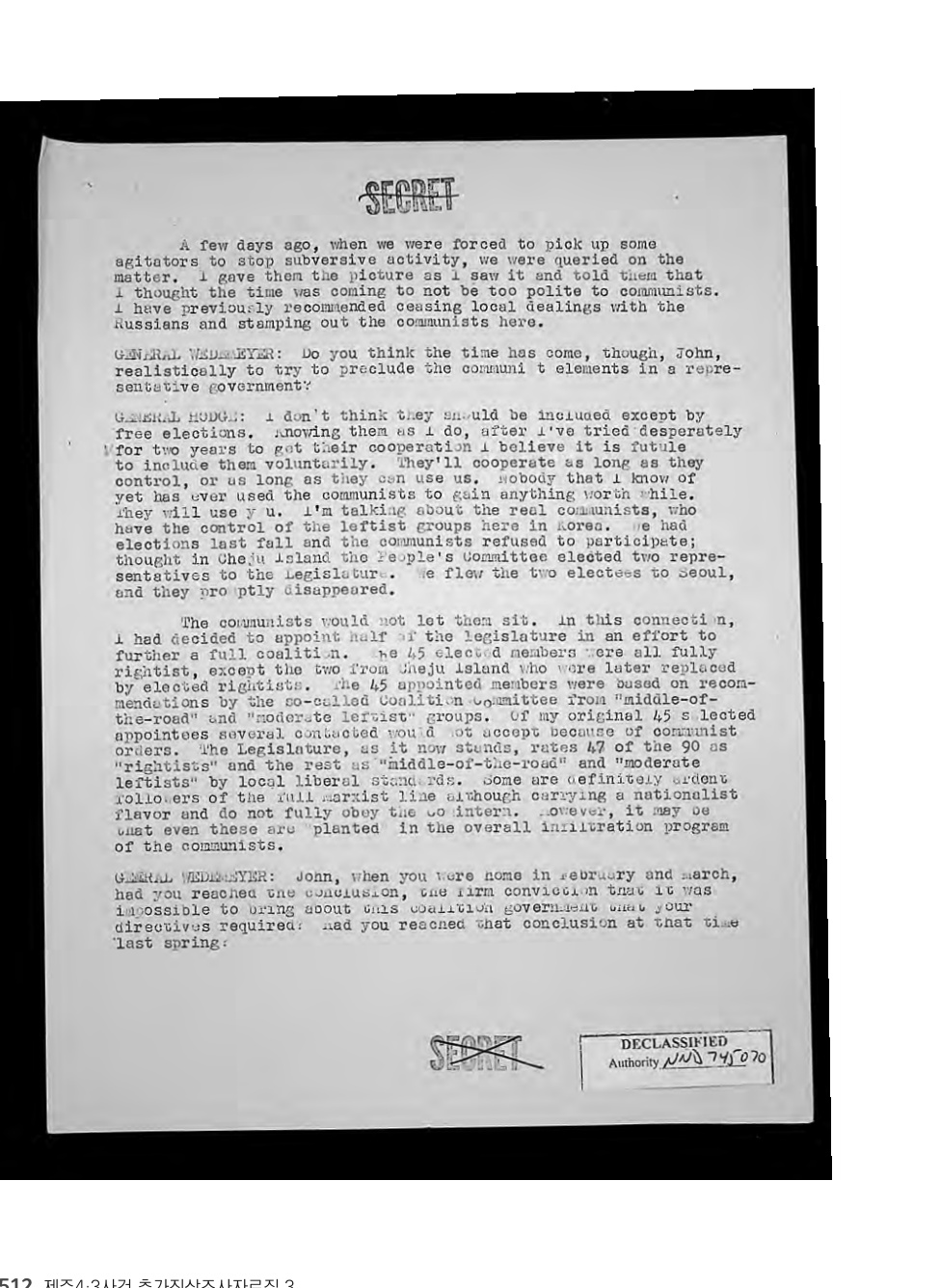
GENERAL HODGE: Gentlemen, we can go ahead. I am a little at a loss to know just how to proceed. I will try to give you the general picture of our situation here. From preinformation available to me of the purpose of your visit I don't know just exactly what you're interested in, but I'll do the best I can to give a picture of our problem here.
I consider, so far as the United States is concerned, Korea is the hottest spot of the Orient. I don't think there's any question about it. We came in here under certain conditions and have acquired certain other conditions that developed since we arrived which handicap us, and which are beyond our power to control. The first of these conditions is the dual occupation of U. S. and Russia with the 38th degree parallel boundary. My corps was in Okinawa when the decision was made to occupy Korea. The 38th parallel division of Korea, I understand, was made on a military level. I talked to one officer who said he was in on it, and it was made a few days before the surrender and that the line was simply picked from a map. It is very difficult almost impossible, to actually establish that line physically. It didn't follow any provincial boundaries; it cut across the ocean at one place and we have one area we can't get to except on suffrance of going through Soviet territory or by flying, or by boat. We use all these ways at present.
The first thing we have then, is the 38 line. It is a division that has become, as other boundaries with the Russians, an iron curtain.
The Second condition is that we came in without preparation for an occupation. I received the first word of the occupation mission about the 12th of August. I didn't understand it, it didn't make sense to me, particularly the 38 division line in Korea. And I went down to General MacArthur's Headquarters at Manila, and it didn't seem to make sense to them either; but we received orders to come in to South Korea. We had no military government personnel. I was able to pick up a few straglers at Okinawa who were assigned to that work there, or had been trained for M. G. work. I picked up an Army Aircraft Headquarters to use as an administrative unit, and they formed the administrative foundation for the military government detachment. That condition existed for several weeks. Eventually we received military government units which we distributed to the provinces by the end of December of 1945.
Another of the conditions we came in under were orders that we would utilize the then existing government in Korea, the
SECRET
DECLASSIFIED
Authority NND 745070
SECRET
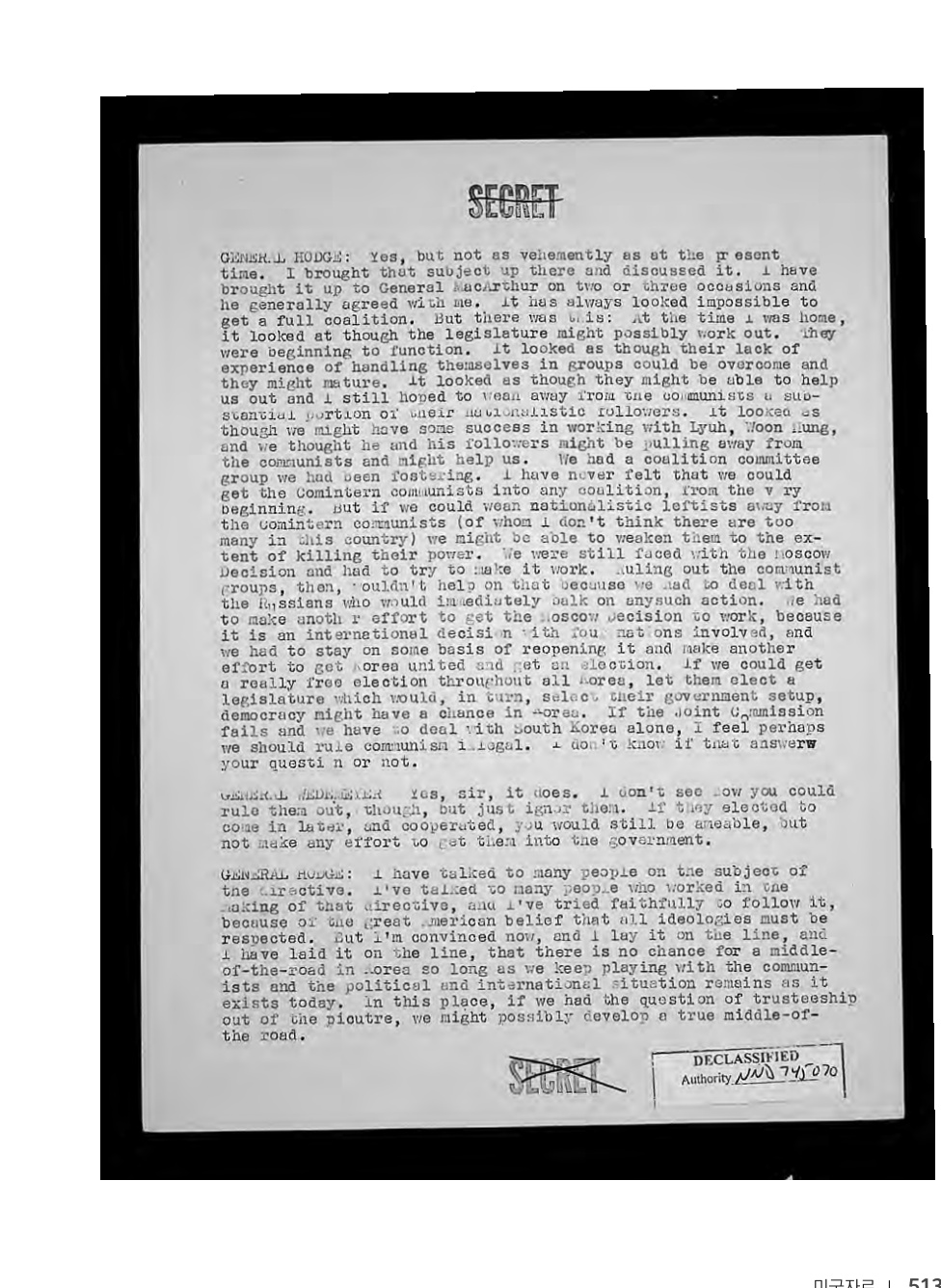
same orders that General MacArthur operated under in Japan; to utilize the existing government until we could replace it.
That had to be cancelled very soon. When we came in here we ran into a hornet's nest on that. The existing government here was Japanese and Koreans protested its continuance. I prepared a wire to General MacArthur requesting authority to cancel that provision and replace the Japs. While it was being typed we had a wire from him giving me that authority. We then started in replacing the Japanese Government. The reaction to this episode was a bad impression in the States of mishandling liberated people. The press picked it up, and they didn't understand that the score was and lost sight of the fact that, internationally, Korea was a part of Japan. With the quick change over and lack of personnel, the sudden change caused considerable confusion. It caused the loss of some records in the rapid transfer from Japanese to Koreans and in getting the Japs out.
There was quite a little turmoil in the early days. When we first came in, the Koreans wanted immediately the independence promised at Cairo and subsequent meetings of the great powers. The terminology of the promise was "in due course."
The Koreans do not translate "in due course" as we do. He says
"in a few days" they would have independence. In their minds, they were ready for their independence the day we arrived and they have wanted it every day since that time.
We have allowed to come in here some of the old, exiled
patriots: Syngman Rhee from the States and Kim Koo, from China,
with his gang of the "Chungking Provisional Government." They signed to me that they would not try to operate in governmental capacity if they were permitted to return but that they would work with us and act as individuals. They have not carried that out at times, and they have probably been our most embarrassing helpers in some ways. Yet, in other ways, they form a bulwark against communism. But they are too extreme and have too much of the Chinese warlord complex to be much help. In some ways they have helped communism by driving Koreans to communism through extremist activities and intolerance.
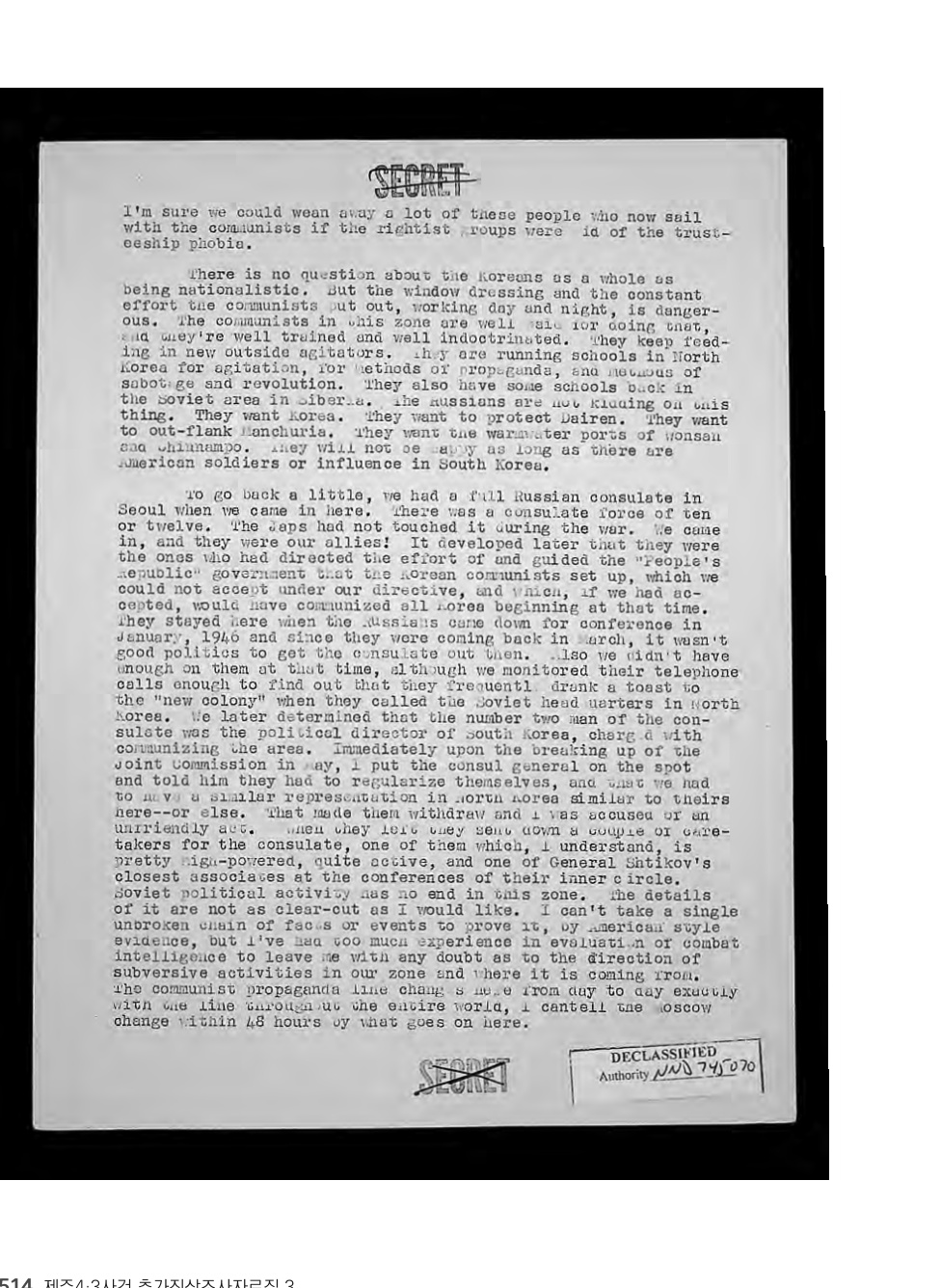
After we arrived here we tried to reach what we felt were simple agreements with the Russians, but without results. I sent a liaison detachment north the day after we got in; I sent my Deputy Chief of Staff, with the best group I could get together for that purpose. They were warmly welcomed, but they got nothing. Nobody would talk business to them. The top politics came down from higher Headquarters but they returned with zero in agreements. We were trying to get allied prisoners of war out of the camp at Kanko.
SECRET
DECLASSIFIED
Authority NND 745070
SECRET
At first the Russians said they had been released; we found out later they had not. It took two weeks of bickering and arranging to get those PWs out. That was our first experience in effecting agreements with them. They were very friendly along the boundary, but they made it very clear that we were to stay out of their area; that there was no arrangement that we could make with them on trade or anything else pertaining to cooperation between the two zones. It is clear that the local
Russians are allowed no initiative in any action.
The Koreans were pouring across the boundary in thousands every day. How many came across, I don't know. There were several hundred thousand that had already come in before we arrived. The war ended 15 August; the Russians had attachked on the 8th or 9th, and a lot of the Koreans had poured out of the north to get away from them. Others had come out after the war had ended, and we found our area pretty well filled with refugees. Since that time there have been several hundred thousand come acorss. That complicated out situation quite a bit by having to handle refugee Koreans, in addition to the large number of Japanese we had to return to Japan.
GENERAL WEDEMEYER: Do you want us to interject questions as we go along?
GENERAL HODGE: I do. Go right ahead and interject any question you desire.
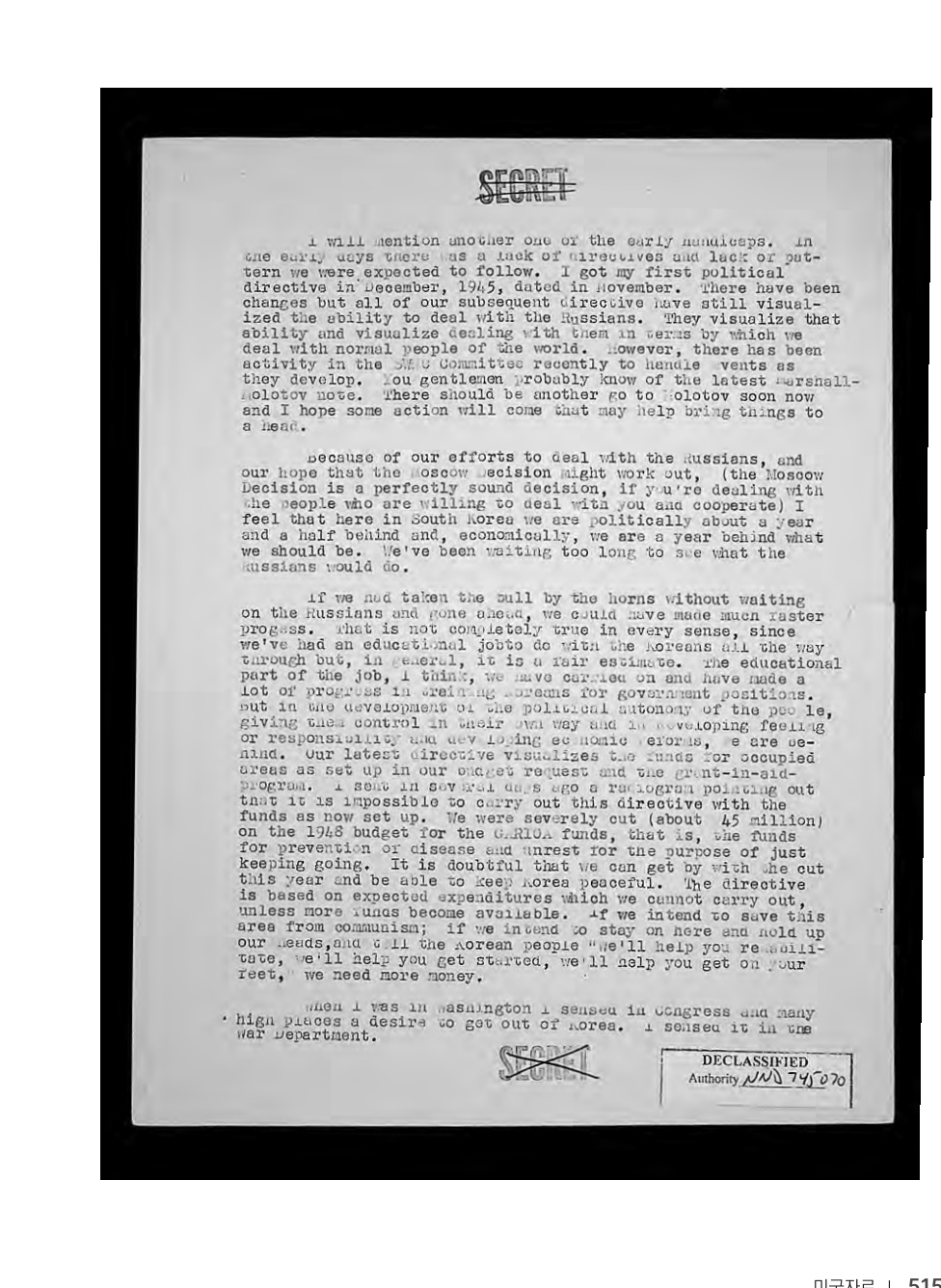
GENERAL WEDEMEYER: Your first meeting with the Russians was friendly in a superficial way, but none of the things that you asked for were granted, as I understand you. Did you bring up the question of power (electrical) at that time?
GENERAL HODGE: Not at that time. We didn't know enough about it; we had just arrived and didn't know where the power came from at that time.
· We came in very hurriedly and I might say right here that we were given last priority in movement of the occupation groups, and we've been last priority in U. S. thinking since that time.
· We came in very light---We had part of the 7th Division and a part of Corps headquarters on what APAs could pick up; we had virtually no transportation and no heavy armament. After they had told us we wouldn't move until the last of September, we were told to pick up and come as early as we could. In that scramble move, we didn't get all our troops in, as I said, until near the end of December, and the resultant gradual spreading out and taking over gave us a handicap on getting full control of the area.
SECRET
DECLASSIFIED
Authority NND 745070
SECRET
When we got in the Russians had, through their agents, organized the "People's Committee" type of government which was already beginning to operate in some areas. The underground against the Japanese in Korea had been taken over by the Soviet in 1925, and had taken the name of the Communist Par y. They used the patriotism of the Koreans to work against the Japanese, with the technique of the Communist Party, aided and abetted by high-powered, well-trained Russian Koreans-- not Russians, but Koreans trained in the Soviet system, indoctrinated with the love of the Comintern and obedience to the Soviet.
As to the matter of treatment of Korea in the early days; although it was called liberated it was treated as an enemy country in economic dealings and officially that only ended a few months ago, soferas controls of trade were concerned. It irritated the Koreans very much to be called a former enemy country in press and in public statements in Washington. The United Nations' Charter was known to them early after it was established. They were aware of it's provisions, and they checked on its set up for handling of former enemy territories, which actually, internationally, they were. They checked on the handling of such territories and found they would probably be given a trusteeship under UN by the charter provision for trusteeship over former enemy territories. They didn't like what they saw. They wanted their independence right away. The term "Trusteeship", whether purposely or accidentally I don't know, was translated to the same term the Japanese used in 1905 when it took a "Protectorate" over Korea which five years later resulted in giving the Japanese complete control.
I want to discuss this trusteeship angle. It arose early and was, and still is, the central spindle of this whirligig of politics. The furror over this subject makes it almost impossible to get any coalition, any middle-of-the road group that we can use. The term was established early in the minds of most Koreans as being deadly to their sovereignty. Later it became synonymous with the Russians having a hand in managing the country. Then it became so that trusteeship, Russian control, and communism are all synonymous. They don't mention that word without rolling all those connotations in one.
Before the 1945 Moscow Conference, I sent in two messages requesting that any arrangement they made with the Russians in the future not include the word "Trusteeship," or if it were necessary to employ that term, to define or sugarcoat it in some manner to be acceptable. One of those went in urgent, just before our representatives went to Moscow. I had prayed we would not have that word to deal with, but we did and still do.
SECRET
SECRET
DECLASSIFIED
Authority NND 745070
SECRET
5
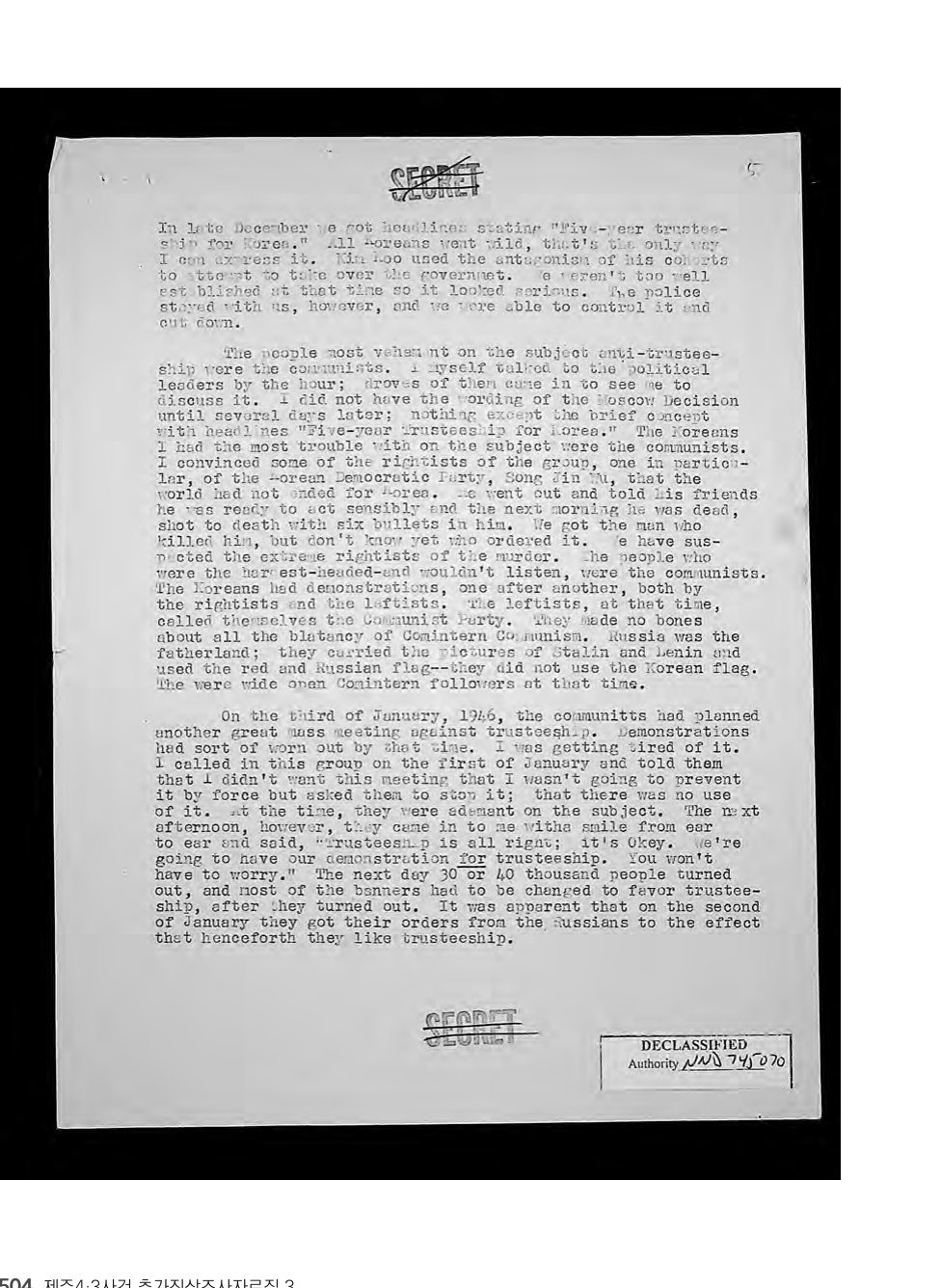
In late December we got headlines stating "Five-year trusteeship for Korea." All Koreans went wild, that's the only way I can express it. Kim Koo used the antagonism of his cohorts to attempt to take over the government. We weren't too well established at that time so it looked serious. The police stayed with us, however, and we were able to control it and cut down.
The people most vehement on the subject anti-trusteeship were the communists. I myself talked to the political leaders by the hour; droves of them came in to see me to discuss it. I did not have the wording of the Moscow Decision until several days later; nothing except the brief concept with headlines "Five-year Trusteeship for Korea." The Koreans I had the most trouble with on the subject were the communists. I convinced some of the rightists of the group, one in particular, of the Korean Democratic Party, Song Jin Wu, that the world had not ended for Korea. He went out and told his friends he was ready to act sensibly and the next morning he was dead, shot to death with six bullets in him. We got the man who killed him, but don't know yet who ordered it. We have suspected the extreme rightists of the murder. The people who were the hardest-headed and wouldn't listen, were the communists. The Koreans had demonstrations, one after another, both by the rightists and the leftists. The leftists, at that time, called themselves the Communist Party. They made no bones about all the blatancy of Comintern Communism. Russia was the fatherland; they carried the pictures of Stalin and Lenin and used the red and Russian flag--they did not use the Korean flag. The were wide open Comintern followers at that time.
On the third of January, 1946, the communists had planned another great mass meeting against trusteeship. Demonstrations had sort of worn out by that time. I was getting tired of it. I called in this group on the first of January and told them that I didn't want this meeting that I wasn't going to prevent it by force but asked them to stop it; that there was no use of it. At the time, they were adamant on the subject. The next afternoon, however, they came in to me with a smile from ear to ear and said, "Trusteeship is all right; it's Okey. We're going to have our demonstration for trusteeship. You won't have to worry." The next day 30 or 40 thousand people turned out, and most of the banners had to be changed to favor trusteeship, after they turned out. It was apparent that on the second of January they got their orders from the Russians to the effect that henceforth they like trusteeship.
SECRET
DECLASSIFIED
Authority NND 745070
SECRET
6
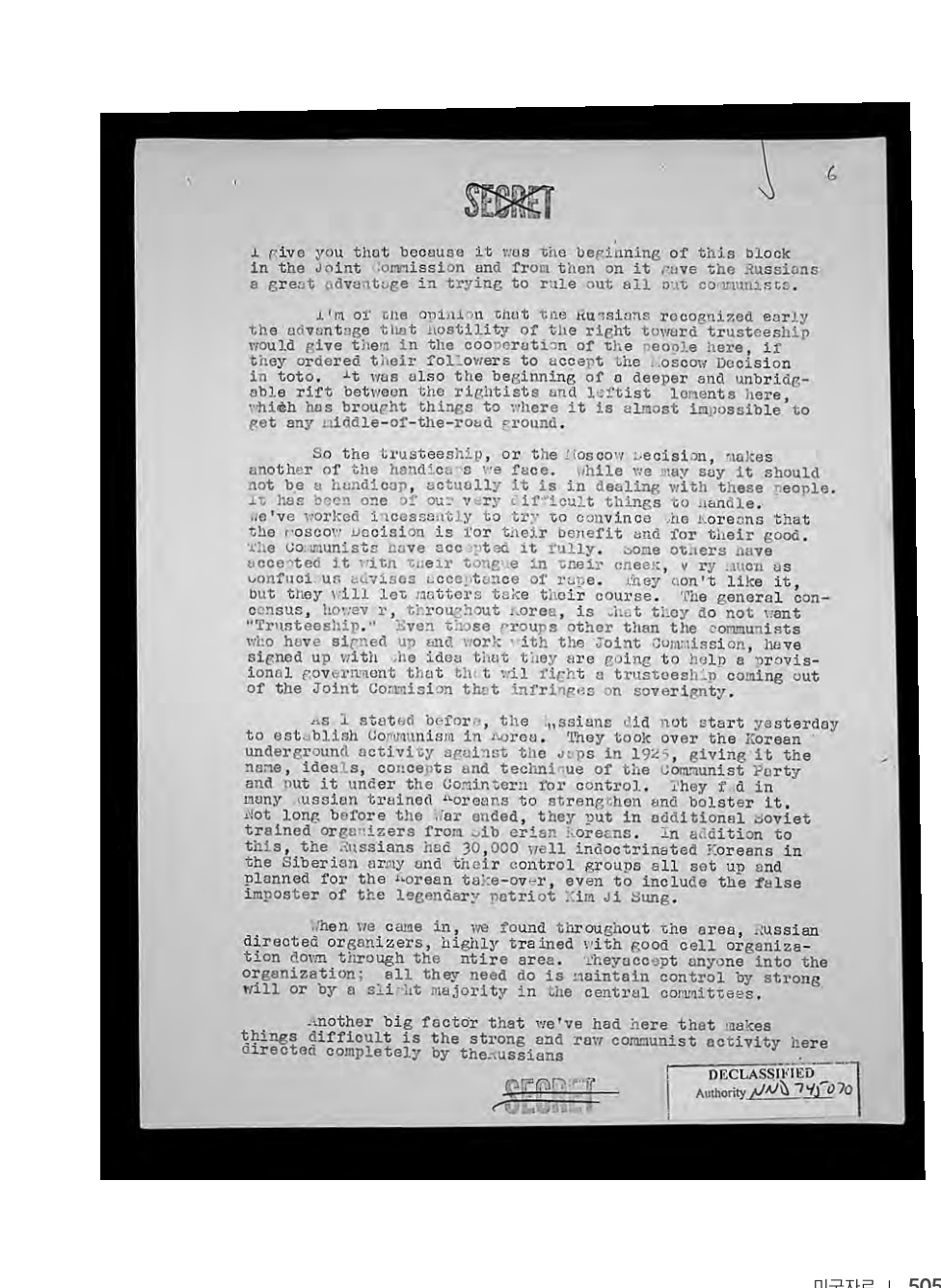
I give you that because it was the beginning of this block in the Joint Commission and from then on it gave the Russians a great advantage in trying to rule out all but communists.
I'm of the opinion that the Russians recognized early the advantage that hostility of the right toward trusteeship would give them in the cooperation of the people here, if they ordered their followers to accept the Moscow Decision in toto. It was also the beginning of a deeper and unbridgable rift between the rightists and leftist elements here, which has brought things to where it is almost impossible to get any middle-of-the-road ground.
So the trusteeship, or the Moscow Decision, makes another of the handicaps we face. While we may say it should not be a handicap, actually it is in dealing with these people.
It has been one of our very difficult things to handle.
We've worked incessantly to try to convince the Koreans that the Moscow Decision is for their benefit and for their good.
The Communists have accepted it fully. Some others have accepted it with their tongue in their cheek, very much as
Confucius advises acceptance of rape. They don't like it, but they will let matters take their course. The general concensus, however, throughout Korea, is that they do not want
"Trusteeship." Even those groups other than the communists who have signed up and work with the Joint Commission, have signed up with the idea that they are going to help a provisional government that that will fight a trusteeship coming out of the Joint Commision that infringes on sovereignty.
As I stated before, the Russians did not start yesterday to establish Communism in Korea. They took over the Korean underground activity against the Japs in 1925, giving it the name, ideals, concepts and technique of the Communist Party and put it under the Comintern for control. They fed in many Russian trained Koreans to strengthen and bolster it.
Not long before the War ended, they put in additional Soviet trained organizers from Siberian Koreans. In addition to this, the Russians had 30,000 well indoctrinated Koreans in the Siberian army and their control groups all set up and planned for the Korean take-over, even to include the false imposter of the legendary patriot Kim Ji Sung.
When we came in, we found throughout the area, Russian directed organizers, highly trained with good cell organization down through the entire area. They accept anyone into the organization; all they need do is maintain control by strong will or by a slight majority in the central committees.
Another big factor that we've had here that makes things difficult is the strong and raw communist activity here directed completely by the Russians
DECLASSIFIED
Authority NND 745070
SECRET
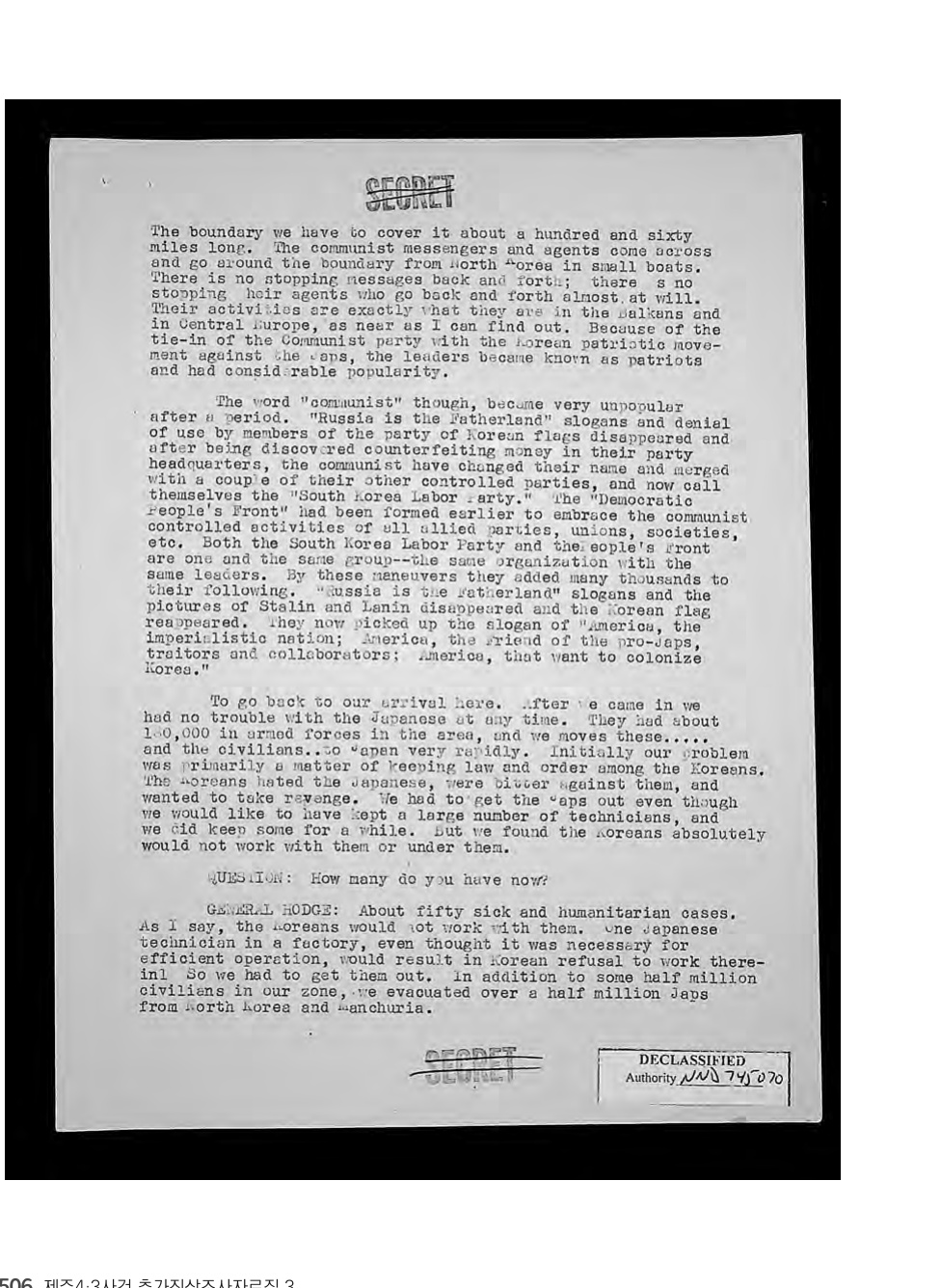
The boundary we have to cover it about a hundred and sixty miles long. The communist messengers and agents come across and go around the boundary from North Korea in small boats. There is no stopping messages back and forth; there s no stopping heir agents who go back and forth almost at will. Their activities are exactly what they are in the Balkans and in Central Europe, as near as I can find out. Because of the tie-in of the Communist party with the Korean patriotic movement against the Japs, the leaders became known as patriots and had considerable popularity.
The word "communist" though, became very unpopular after a period. "Russia is the Fatherland" slogans and denial of use by members of the party of Korean flags disappeared and after being discovered counterfeiting money in their party headquarters, the communist have changed their name and merged with a couple of their other controlled parties, and now call themselves the "South Korea Labor Party." The "Democratic People's Front" had been formed earlier to embrace the communist controlled activities of all allied parties, unions, societies, etc. Both the South Korea Labor Party and the People's Front are one and the same group--the same organization with the same leaders. By these maneuvers they added many thousands to their following. "Russia is the Fatherland" slogans and the pictures of Stalin and Lenin disappeared and the Korean flag reappeared. They now picked up the slogan of "America, the imperialistic nation; America, the friend of the pro-Japs, traitors and collaborators; America, that want to colonize Korea."
To go back to our arrival here. After we came in we had no trouble with the Japanese at any time. They had about 180,000 in armed forces in the area, and we moves these..... and the civilians..to Japan very rapidly. Initially our problem was primarily a matter of keeping law and order among the Koreans. The Koreans hated the Japanese, were bitter against them, and wanted to take revenge. We had to get the Japs out even though we would like to have kept a large number of technicians, and we did keep some for a while. But we found the Koreans absolutely would not work with them or under them.
QUESTION: How many do you have now?
GENERAL HODGE: About fifty sick and humanitarian cases. As I say, the Koreans would not work with them. One Japanese technician in a factory, even thought it was necessary for efficient operation, would result in Korean refusal to work therein. So we had to get them out. In addition to some half million civilians in our zone, we evacuated over a half million Japs from North Korea and Manchuria.
SECRET
DECLASSIFIED
Authority NND 74[illegible]070
SECRET
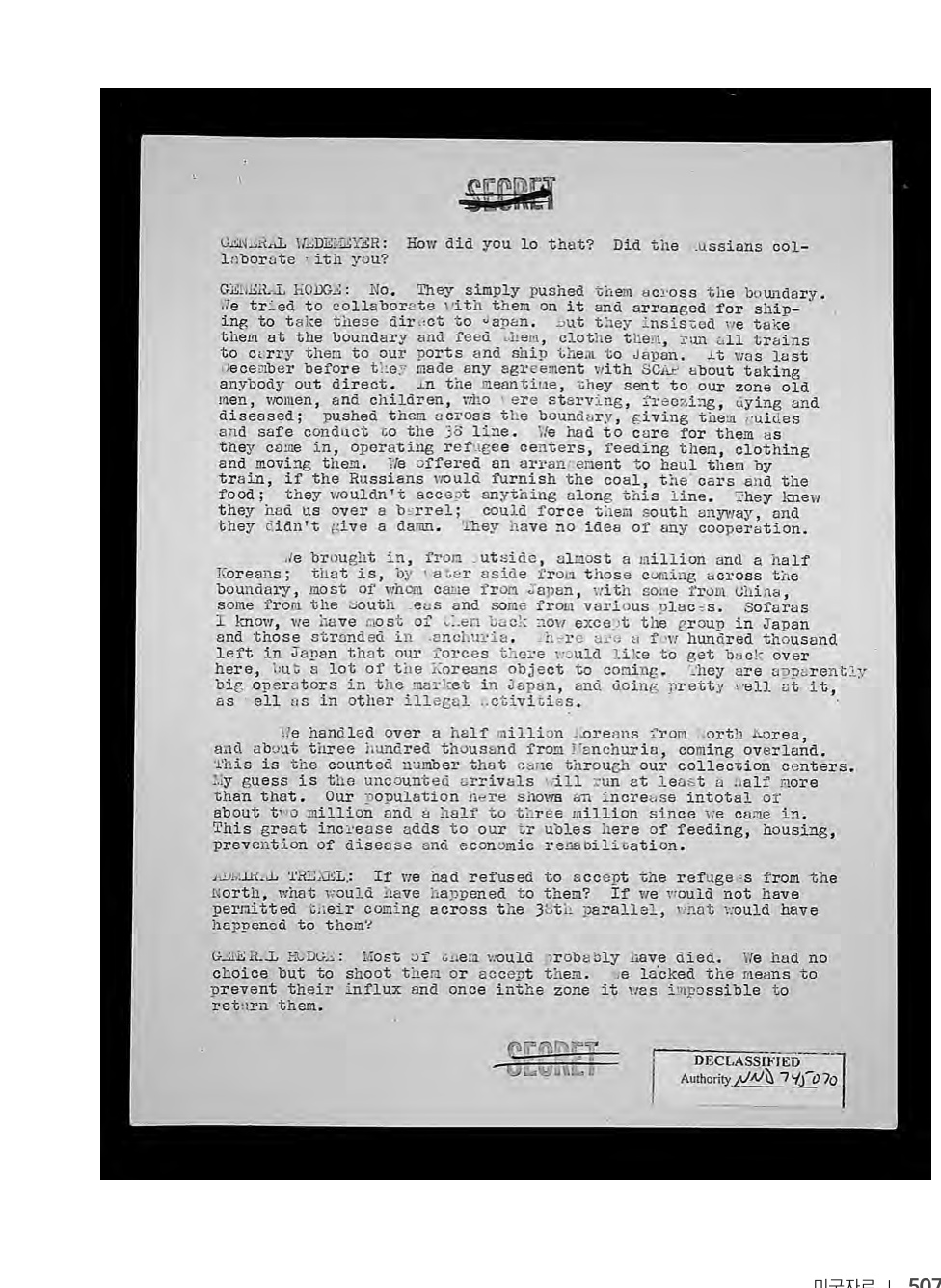
GENERAL WEDEMEYER: How did you lo that? Did the Russians collaborate with you?
GENERAL HODGE: No. They simply pushed them across the boundary. We tried to collaborate with them on it and arranged for shipping to take these direct to Japan. But they insisted we take them at the boundary and feed them, clothe them, run all trains to carry them to our ports and ship them to Japan. It was last December before they made any agreement with SCAP about taking anybody out direct. In the meantime, they sent to our zone old men, women, and children, who were starving, freezing, dying and diseased; pushed them across the boundary, giving them guides and safe conduct to the 38 line. We had to care for them as they came in, operating refugee centers, feeding them, clothing and moving them. We offered an arrangement to haul them by train, if the Russians would furnish the coal, the cars and the food; they wouldn't accept anything along this line. They knew they had us over a barrel; could force them south anyway, and they didn't give a damn. They have no idea of any cooperation.
We brought in, from outside, almost a million and a half Koreans; that is, by later aside from those coming across the boundary, most of whom came from Japan, with some from China, some from the South seas and some from various places. Sofares I know, we have most of them back now except the group in Japan and those stranded in Manchuria. There are a few hundred thousand left in Japan that our forces there would like to get back over here, but a lot of the Koreans object to coming. They are apparently big operators in the market in Japan, and doing pretty well at it, as well as in other illegal activities.
We handled over a half million Koreans from North Korea, and about three hundred thousand from Manchuria, coming overland. This is the counted number that came through our collection centers. My guess is the uncounted arrivals will run at least a half more than that. Our population here shows an increase intotal of about two million and a half to three million since we came in. This great increase adds to our troubles here of feeding, housing, prevention of disease and economic rehabilitation.
ADMIRAL TREXEL: If we had refused to accept the refugees from the North, what would have happened to them? If we would not have permitted their coming across the 38th parallel, what would have happened to them?
GENERAL HODGE: Most of them would probably have died. We had no choice but to shoot them or accept them. We lacked the means to prevent their influx and once inthe zone it was impossible to return them.
SECRET
DECLASSIFIED
Authority NND 745070
SECRET
GENERAL WEDEMEYER: Is it your responsibility to accept them?
GENERAL HODGE: We are treating Korea as a liberated country.
I feel that we have no choice but to care for these destitute
Koreans driven to some haven or to death. We protested of course, but unavailingly. There is no way in the world to stop them. We tried pushing some back over the boundary, but they were driven back as violators of the boundary and it only added to their misfortune.
ADMIRAL TREXEL: But conversely we could have sent them back, could we not?
GENERAL HODGE: That's one of those things that sounds good in theory, but putting it into practice is something else. The
Russians have no compunctions about things of that kind. We let some who came in from other areas try to go back home to North
Korea, but it resulted only in their arrest and being driven back, except for those who were communists.
ADMIRAL TREXEL: General, what is the present estimated population of Korea?
GENERAL HODGE: Our part of the population is about twenty million, in South Korea, and we estimate about ten million in the Soviet zone. We don't know exactly but the magic figure of thirty million the Koreans use is somewhere near correct we think.
After the Moscow Decision came in December, we met with the Russians in January and February according to the fourth paragraph of the Decision, which provided for an early meeting to solve the most pressing economic and administrative difficulties between the zones. We set up some sixteen agreement in that series of conferences, three or four of which the Russian Commander would not agree to. One not agreed to was the rearrangement of the boundary to follow the political divisions.
Of the thirteen left, all innocuous, and with small overall effect had they been carried out; the only one they ever carried out was the exchange of mail between the North and the
South every two weeks. During the cholera epidemic in summer of 1946 the Russians stopped that, but finally we got them to go back to the original agreement.
The first meeting was not a meeting of the Joint Commission. The sessions of the Joint Commission started in
March 1946. I won't go into that in detail because General
Brown will cover the history of the Joint Commission this afternoon. I think it should be mentioned, however, that the pattern as announced by the chief Soviet Delegate at the opening meeting is the same as their stand today.
SECRET DECLASSIFIED
Authority NND 745070
SECRET
The gist of it was that they would cooperate under the Moscow
Decision to make Korea a nation friendly to Soviet Russia, from which no nation could get bases from which to attack Soviet
Russia and in fulfilling the Moscow Decision they would talk only to those "democratic" parties and organizations that fully supported the Moscow Decision. All reactionries and facists would be ruled out of consultation and participation. It developed in the conferences that anyone who objected to the Moscow
Decision in the slightest was reactionary, facist, pro-Jap or not "democratic." The reasoning was, the Moscow Decision was made by democratic countries, therefore it was democratic, and anyone who objected to "one sentence, one word, one comma, one period"--I quote the Soviet Commander--would not be consulted because that one is undemocratic.
The Joint Commission broke up in May of last year on the issue of allowing broad consultation under principles of freedom of expression. I started again immediately to correspond with the Russian commander trying to reach some agreement, for reopening the Commission. I also started trying to get the question taken up on high levels, to get something done in Washington to give us a foothold to go on. I was turned down on that and told to continue efforts on a local level. In February of this year
I was called to Washington for conference. I raised the issue again, and I found a strong objection there to taking the Korean problem up on a high level. I talked to many people and tried to convince them of the necessity, if we are going to stay here with the Koreans, that something be done on a level above us; that we had exhausted all local possibilities. In the last conference with General Marshall before he went to Moscow I got the promise that he would take it up during his stay at Moscow. He took it up, based on the last Russian answer in the prolonged exchange of correspondence we had had locally and it resulted in the reconvention of the Joint Commission. The agreement reached, if carried out with any degree of cooperation or any degree of mutual understanding, would have been a perfectly good agreement.
However, we ran squarely into the same impasse again; the same old story. The Russian's statement at the latest meeting after instructions from Moscow on one of our proposals, puts us right back where we started in March 1946. We've made no gain that I can see. They've been here this three months in our midst, operating very freely, and my belief is they are building a strong fifth column, and planning for the South Korean revolution. They had about eight go-between message relay stations where messages passed from the consulate where they live to the communist headquarters, and to and from other places. Those are the principal places we looked over the other day which evoked such a blast from the Soviet Chief Delegate.
SECRET
DECLASSIFIED
Authority NND 745070
SECRET
GENERAL WEDEMEYER: Why not hold the meetings up north, in their territory?
GENERAL HODGE: We went up there one time for group consultation with Koreans. The original setup was that we'd have our pre-liminary meetings here, and then go up there for consultations with North Koreans and dealings in setting up the government.
After political exiles came in in October and November 1945, I tried to get Syngman Rhee, the one man who might have made the coalition effort effective at the time...and robbed the communists of their thunder...to get Koreans to work together. I thought I had him working on this and thought it was going to work. Then he began to spit, snarl and quarrel with some of the middle-of-the-roaders who didn't agree with him, and accused them of being communists; actually driving a lot of them to the fold of the Communist Party. A lot, I think, that could have been saved by more tolerance on his part. A second effort aided and guided by me was knocked into a cocked hat by the announcement of the Moscow Decision in December, 1945, when all the Koreans went off on a revolt. The word Trusteeship brought in a new factor to complicate matters, even though the Moscow Decision provided a sound basis for uniting their country. I got a man out here from Washington, A Colonel Goodfellow, who used to be in OSS, who knew Syngman Rhee and could control him in some degree. He worked with these people day and night and we thought we were going to get a fair coalition of those who were not communists. We had some of the leftist fringe group working with rightists, formed into a group which we called the Representative Democratic Council. It blew up the night before its first official meeting. The meeting was all set for the formal acceptance by me of this official advisory group, when an insult was passed and one section of the group lost face, and the leftist group failed to show up and later withdrew from the council. The chief actor of those who withdrew was Lyuh, Woon Hyung, who was killed the 19th of July, this year. He later developed to be not such a lilly-white character, however. He had played with the Russians and communists all the way through and was still doing so at his death. After his death I found several papers written by him that rather clearly show that we were getting double-crossed by one of the people we had tied to in efforts to achieve political serenity. However, we accepted the remnants of the council as a representative group of Koreans and used it as an advisory group until the Legislature was formed in December, 1946. It was rightist by Korean standards, though by our standards the most rightist Korean party is nearer to socialism than anything else. The extremes here are clear cut, however, on the extreme left they are working to become a part of Russia. On the extreme right they are against Trusteeship and against all forms of foreign interference of any nature interferring with sovereignty.
DECLASSIFIED
Authority NND 745070
SECRET
GENERAL WEDEMEYER: You used the term "coalition." If a coalition government were formed, would it include communist elements in your present approach to the problem for all of
Korea?
GENERAL HODGE: It would under present directives, and would go to a communist government in my opinion. I mean by that, with the present approach, and the Russians in the picture, I feel a coalition with communists would eventually go communist.
QUESTION: How about the directives, then and the policy enunciated by our country as envisioning the Korean communists in a Korean Government?
GENERAL HODGE: In some says that has been one of my biggest head aches. That's one of the points I would like to bring out.
Based on my directives, I've always done my best to treat the communists as a legitimate political party, to get them above ground and deal with them. (I mentioned that the communist party went under ground shortly before they came up with their satellites, and tried to treat the communist controlled allied parties as legitimate parties. However, they have worked in their normal manner as they always do; they have operated against us by fair measures and foul, but under my directives there is everything to indicate to me that there is to be a complete political freedom, including the communists. I feel that I can only act against individuals caught violating the law. They have all the freedom they want. They have freedom of press, though I tell them that they cannot openly incite and inflame the people to riots and disorders. We've let them criticize the
United States openly and blatantly. I shut down three papers for investigation last fall for inflammatory and inciting statements, but all have reopened. We have arrested editors or reporters on some occasions after many warnings, and tried them as individuals, giving fairly light sentences.
GENERAL WEDEMEYER: Now I want to make sure I'm clear, and I think all the members of the mission want to know this, too. You present directives require you to include communist elements?
GENERAL HODGE: It does. Not by name, but by inference it can be interpreted in no other way. It indicates that no persons will be barred from appointment in the government because of party affiliations or political beliefs. It also indicates that parties shall be given representation in governmental affairs in accordance with the strength of their followers.
SECRET
DECLASSIFIED
Authority NND 745070
SECRET
A few days ago, when we were forced to pick up some agitators to stop subversive activity, we were queried on the matter. I gave them the picture as I saw it and told them that
I thought the time was coming to not be too polite to communists.
I have previously recommended ceasing local dealings with the
Russians and stamping out the communists here.
GENERAL WEDEMEYER: Do you think the time has come, though, John, realistically to try to preclude the communi t elements in a representative government?
GENERAL HODGE: I don't think they should be included except by free elections. Knowing them as I do, after I've tried desperately for two years to get their cooperation I believe it is futile to include them voluntarily. They'll cooperate as long as they control, or as long as they can use us. Nobody that I know of yet has ever used the communists to gain anything worth while.
They will use you. I'm talking about the real communists, who have the control of the leftist groups here in Korea. We had elections last fall and the communists refused to participate; thought in Cheju Island the People's Committee elected two representatives to the Legislature. We flew the two electees to Seoul, and they promptly disappeared.
The communists would not let them sit. In this connection, I had decided to appoint half of the legislature in an effort to further a full coalition. The 45 elected members were all fully rightist, except the two from Cheju Island who were later replaced by elected rightists. The 45 appointed members were based on recommendations by the so-called Coalition Committee from "middle-ofthe-road" and "moderate leftist" groups. Of my original 45 selected appointees several contacted would not accept because of communist orders. The Legislature, as it now stands, rates 47 of the 90 as
"rightists" and the rest as "middle-of-the-road" and "moderate leftists" by local liberal standards. Some are definitely ardent followers of the full Marxist line although carrying a nationalist flavor and do not fully obey the Comintern. However, it may be that even these are "planted" in the overall infiltration program of the communists.
GENERAL WEDEMEYER: John, when you were home in February and March, had you reached the conclusion, the firm conviction that it was impossible to bring about this coalition government that your directives required? Had you reached that conclusion at that time last spring?
SECRET
DECLASSIFIED
Authority NND 745070
SECRET
GENERAL HODGE: Yes, but not as vehemently as at the present time. I brought that subject up there and discussed it. I have brought it up to General MacArthur on two or three occasions and he generally agreed with me. It has always looked impossible to get a full coalition. But there was this: At the time I was home, it looked at though the legislature might possibly work out. They were beginning to function. It looked as though their lack of experience of handling themselves in groups could be overcome and they might mature. It looked as though they might be able to help us out and I still hoped to wean away from the communists a substantial portion of their nationalistic followers. It looked as though we might have some success in working with Lyuh, Woon Hung, and we thought he and his followers might be pulling away from the communists and might help us. We had a coalition committee group we had been fostering. I have never felt that we could get the Comintern communists into any coalition, from the very beginning. But if we could wean nationalistic leftists away from the Comintern communists (of whom I don't think there are too many in this country) we might be able to weaken them to the extent of killing their power. We were still faced with the Moscow Decision and had to try to make it work. Ruling out the communist groups, then, couldn't help on that because we had to deal with the Russians who would immediately balk on any such action. We had to make another effort to get the Moscow Decision to work, because it is an international decision with four nations involved, and we had to stay on some basis of reopening it and make another effort to get Korea united and get an election. If we could get a really free election throughout all Korea, let them elect a legislature which would, in turn, select their government setup, democracy might have a chance in Korea. If the Joint Commission fails and we have to deal with South Korea alone, I feel perhaps we should rule communism illegal. I don't know if that answers your question or not.
GENERAL WEDEMEYER: Yes, sir, it does. I don't see how you could rule them out, though, but just ignore them. If they elected to come in later, and cooperated, you would still be amenable, but not make any effort to get them into the government.
GENERAL HODGE: I have talked to many people on the subject of the directive. I've talked to many people who worked in the making of that directive, and I've tried faithfully to follow it, because of the great American belief that all ideologies must be respected. But I'm convinced now, and I lay it on the line, and I have laid it on the line, that there is no chance for a middle-of-the-road in Korea so long as we keep playing with the communists and the political and international situation remains as it exists today. In this place, if we had the question of trusteeship out of the picture, we might possibly develop a true middle-of-the road.
SECRET
DECLASSIFIED
Authority NND 745070
SECRET
I'm sure we could wean away a lot of these people who now sail with the communists if the rightist groups were rid of the trusteeship phobia.
There is no question about the Koreans as a whole as being nationalistic. But the window dressing and the constant effort the communists put out, working day and night, is dangerous. The communists in this zone are well paid for doing that, and they're well trained and well indoctrinated. They keep feeding in new outside agitators. They are running schools in North
Korea for agitation, for methods of propaganda, and methods of sabotage and revolution. They also have some schools back in the Soviet area in Siberia. The Russians are not kidding on this thing. They want Korea. They want to protect Dairen. They want to out-flank Manchuria. They want the warmwater ports of Wonsan and Chinnampo. They will not be happy as long as there are
American soldiers or influence in South Korea.
To go back a little, we had a full Russian consulate in
Seoul when we came in here. There was a consulate force of ten or twelve. The Japs had not touched it during the war. We came in, and they were our allies! It developed later that they were the ones who had directed the effort of and guided the "People's
Republic" government that the Korean communists set up, which we could not accept under our directive, and which, if we had accepted, would have communized all Korea beginning at that time.
They stayed here when the Russians came down for conference in
January, 1946 and since they were coming back in March, it wasn't good politics to get the consulate out then. Also we didn't have enough on them at that time, although we monitored their telephone calls enough to find out that they frequently drank a toast to the "new colony" when they called the Soviet head quarters in North
Korea. We later determined that the number two man of the consulate was the political director of South Korea, charged with communizing the area. Immediately upon the breaking up of the
Joint Commission in May, I put the consul general on the spot and told him they had to regularize themselves, and that we had to have a similar representation in North Korea similar to theirs here--or else. That made them withdraw and I was accused of an unfriendly act. When they left they sent down a couple of caretakers for the consulate, one of them which, I understand, is pretty high-powered, quite active, and one of General Shtikov's closest associates at the conferences of their inner circle.
Soviet political activity has no end in this zone. The details of it are not as clear-cut as I would like. I can't take a single unbroken chain of facts or events to prove it, by American style evidence, but I've had too much experience in evaluation of combat intelligence to leave me with any doubt as to the direction of subversive activities in our zone and where it is coming from.
The communist propaganda line changes here from day to day exactly with the line throughout the entire world, I can tell the Moscow change within 48 hours by what goes on here.
SECRET
DECLASSIFIED
Authority NND 745070
SECRET
I will mention another one of the early handicaps. In the early days there was a lack of directives and lack of pattern we were expected to follow. I got my first political directive in December, 1945, dated in November. There have been changes but all of our subsequent directive have still visualized the ability to deal with the Russians. They visualize that ability and visualize dealing with them in terms by which we deal with normal people of the world. However, there has been activity in the [illegible] Committee recently to handle events as they develop. You gentlemen probably know of the latest Marshall-Molotov note. There should be another go to Molotov soon now and I hope some action will come that may help bring things to a head.
Because of our efforts to deal with the Russians, and our hope that the Moscow decision might work out, (the Moscow Decision is a perfectly sound decision, if you're dealing with the people who are willing to deal with you and cooperate) I feel that here in South Korea we are politically about a year and a half behind and, economically, we are a year behind what we should be. We've been waiting too long to see what the Russians would do.
If we had taken the bull by the horns without waiting on the Russians and gone ahead, we could have made much faster progress. That is not completely true in every sense, since we've had an educational job to do with the Koreans all the way through but, in general, it is a fair estimate. The educational part of the job, I think, we have carried on and have made a lot of progress in training Koreans for government positions. But in the development of the political autonomy of the people, giving them control in their own way and in developing feeling or responsibility and developing economic reforms, we are behind. Our latest directive visualizes the funds for occupied areas as set up in our budget request and the grant-in-aid program. I sent in several days ago a radiogram pointing out that it is impossible to carry out this directive with the funds as now set up. We were severely cut (about 45 million) on the 1948 budget for the GARIOA funds, that is, the funds for prevention of disease and unrest for the purpose of just keeping going. It is doubtful that we can get by with the cut this year and be able to keep Korea peaceful. The directive is based on expected expenditures which we cannot carry out unless more funds become available. If we intend to save this area from communism; if we intend to stay on here and hold up our heads, and tell the Korean people "We'll help you rehabilitate, we'll help you get started, we'll help you get on your feet," we need more money.
When I was in Washington I sensed in Congress and many high places a desire to get out of Korea. I sensed it in the War Department.
SECRET
DECLASSIFIED
Authority NND 74[illegible]070
SECRET
i sensed it in certain sections of the State Department. I talked to appropriations committees; I heard Congressmen, men of them, indicate that they saw no reason for staying in this area, and they would not vote for money for South Korea to be used in a communist doomed area to help the Russians build up a communist state. There is a desire among the many people of the United States to get the troops out of here. This is a backward area; a difficult place for troops to live and exist. It is an occupation, in fact, that calls for dispersion of troops. We live here under inherently rugged conditions; in some places approaching even outpost or almost combat conditions. In my opinion, if we are going to stay over here, we are going to have to tackle the job in a big way, we have to make up our minds now. If we are not going to stay here and go after building up Korea in a big way, we had better get out soon, as early as we can, on any reasonable basis of face-saving such as a mutual withdrawal agreement with the Russians. The situation existing now is a build-up for a civil war. There will certainly be a blood purge, at some future time, but if we stay much longer and do not do something positive, you can be sure that there will be a civil war between North and South Korea in the end. We must either build up this area as an oasis of real democracy and sound economy, so that even the North Koreans can't fail to sense it or get out fast. Our position here now is still on the minimum of prevention of disease and unrest standard. Korea is not yet anywhere near economically self-sufficient, and cannot be until we do some rehabilitation. To date, we've been on a maintenance basis and a low one at that. We have overpopulation, we have underhousing, we have unemployed, we have all the conditions that aid and abet the propaganda of communism. I'm not trying to be pessimistic. I'm trying to paint the picture how as I see it. If we are to save Korea from Soviet domination, it is going to take real backing and substantial appropriations from the United States.
The Korean people claim their own civilization and independence through a2 hundred years. It is true that they have developed an almost separate oriental race. However, in the early days the tribes and provinces were loosely combined, and not a real nation. It is also true that in the last few hundred years they came under a corrupt Chinese suzerainry. The Korean is not Japanese or Chinese. He has developed characteristics all his own. I call them the Irish of the Orient, and I think that is about the shortest description I can give. They have the good qualities, and the bad qualities of the Irish. They are natively intelligent with high potentialities. They love to fight, drink, and have a good sense of humor. They love parties; they don't like to work unless they have to;
SECRET
DECLASSIFIED
Authority NND 745070
SECRET
they are an attractive and a very happy people under good conditions. They are not as regimented as the Japanese. They are, in some ways, more volatile, but not quite as imaginative as the Japanese and they are not as changeless as the Chinese.
They get great ideas and great ambitions, individually and collectively. The youngsters here up to 14 or 15 years old are the most attractive I ever saw until they begin to realize what their conditions are then become frustrated. Those kids are almost like American kids: they play the same type games and have in many ways the same manner of thought. They are a people that I don't believe are naturally suitable to the rigidity of communism. I don't think they are well enough disciplined for it, but we have to remember that under the Japs they were beaten down and they may accept it and not be able to overthrow it.
When the other fellow has the weapons and the ration cards he has control of everything, so it may be that they would be subjected to communism and would accept it at least for a while.
They might revolt against it later.
Many of these people are Christians. Christianity has a strong influence in Korea. It has a strong enough influence that in many populated areas in Korea Sunday is almost like a
Sunday in the States. Direct Christian influence affects well beyond a million people. The effect of the Christian influence on their thinking and mentality in its external aspects is tremendous. Missionaries have done a good job. The fact that
Koreans maintained Christianity and their churches under the
Japs, and are today in North Korea maintaining their religious beliefs and their churches under very adverse conditions, indicates that they are not merely rice Christians-that they really believe in it. Many of the people who follow Christianity, going to Mission schools, have been educated in the States, and some who were educated in Europe. Missionaries are here from many countries. That has had an influence here and gives a level of people with some education, though not too practical - I am sorry to say -most of them go in for literature and art. There are only a few engineers. But there is an educated group which can help out, most of that group does not follow the Communist line. There are a few that do, apparently as opportunists. They no doubt have had promises made to them or look forward to something they can get out of it if they will go in with the Russians.
During the time of the czars, Korea was the target of
Russian desire, particularly North Korea. The Japanese, Russians and Chinese have always had their eyes on Korea. The Russians wanted it for warm water ports that are available at Wonsan, Chinnampo and Fusan, which could tie into Siberia and Manchuria.
The Chinese and Japanese fought a small war over Korea on Korean soil about 1895, and the Chinese were ousted.
SECRET
DECLASSIFIED
Authority NND 74[illegible]070
SECRET
The Russians and the Japanese had quite a little discussion about the division of influence in Korea, in part leading to the Russo-Jap war in 1904. I understand from several sources that they almost signed a treaty giving Russia control north of the 39th parallel and the Japs south. However, the war stopped that, the Japanese won the war and took a protectorate over all Korea in 1905, with approval of the United States.
We also made a treaty with Korea in 1882 in which for certain concessions, we would see that no third power interfered, the
Koreans cite the Japanese protectorate as our first breach of faith. The Koreans in recent years have had so many broken promises from the Japanese, the Russians, and the Chinese (and they insist from the United States also) that they no longer trust anyone.
In the Treaty of 1905 that the Japs made, the wording was perfectly okay. From the words, nobody needed have any fear but that eventually they would be benefitted by the Japanese influence. The same is true of the 1910 treaty when the
Japs took over. I point out to these people that the wording in the Moscow Decision is perfectly to help them, but that doesn't appeal to them at all. They point back to the Jap treaty of
1910, which was made with the Emperor that promised them many things. They don't believe promises anymore. They do believe in actions as they take place.
We have been handicapped here, I say in all frankness, by news that comes out of the States. We are going to do so and so for Korea. We are going to do this and we are not going to do that. Take the grant-in-aid program, discussed last spring in Washington. The Koreans picked up their ears. They felt encouraged. Then started the on-again-off again trends and eventually no developments. The same is true about the State
Dept. taking over here; that has been batted back and forth until it reaches the point where the Koreans laugh at us.
I bring these points out so that you may know that loose talk and published changes of official minds injure our chances of maintaining the confidence of the Koreans. They wonder why we change all the time, why this, why that. The Koreans are a people who, like most Oriental people, don't welcome too many changes. They still get a thrill out of promises that come from Washington but this is waning. Every fade-out on the impact of United Press or Associated Press or radio reports out
Washington that some official said so and so on this subject.
The impact is 100%. It gets throughout all the provinces, and then when it's reversed, or dropped they begin to wonder what in the hell is going on.
SECRET
DECLASSIFIED
Authority NND 745070
SECRET
Sometimes I do myself, although knowing the American nation, I know what's back of it. But I have to admit that sometimes even I reach a state of confusion.
I'm not going too much into the history of Military
Government. I will let General Lerch cover that tomorrow. We started in as I said, with a few people we picked up and we threw into the MG set-up every man and soldier we could find who had any background in civil technical lines that could help out. Gradually we built up an organization and got our people out through the provinces, in the Military Government
Groups in the large towns and MG companies scattered to where we could really make our influence felt. From the very beginning, however, we have used the Koreans to the greatest possible extent in all of Governmental work. At first they had to be extremely closely supervised, telling them what to do. Later, we gradually went to advisory status. Our effort has been to build up in the Koreans the confidence and ability to handle their own affairs. We made appointments after a consultations with many people to find out who was acceptable and to get the most able man for the job. In spite of all our efforts, politics entered into some appointments. There is no question about that, and many appointments had to be changed to get more able men. There is a lack of integrity among the Korean people that we have to watch constantly.
That has come up, and when we find a man without integrity who embezzles or who lies, or steals we have to get rid of him.
We have built up a Police force of about 25,000, a constabulary of about 16,000. That has been slow because we've had to build carefully and weed out a lot. The Police have come in for criticism from various sources. We had in the police, and still have in the police, some Koreans who served under the Japanese.
This is not desirable but is essential in building the force.
So far as we can determine from observation and reports these are not now objectionable to law abiding Koreans. They helped the Koreans under Jap occupation, and are considered by most
Koreans to have been beneficial rather than harmful. They have furnished the training cadre for police training and have helped to stiffen the force and helped them learn to handle police work. The Communists have made strong efforts to penetrate and get control of the police and of course do a lot of squaking against the police. This must be expected and has to be endured. I think we have all those out who are objectionable or crooked or who tried to use old Japanese torture methods.
But in the training of any Oriental police, you gentlemen who know the Oriental know that it is difficult to get an Oriental policeman to act like Americans think the police should act in a democracy. We use American police inspectors in all provinces and we have cut down heavily the objectionable oriental practices.
They have not completely disappeared but have been reduced to
SECRET DECLASSIFIED
Authority NND 745070
SECRET
11
a point that is commendable in the Oriental. I think it is little worse now then practiced by many of the police in the
U. S. The new rookies on the force, recruited from youngsters who hated the Japs worst, are our most frequent offenders in use of wrong methods. The police have steadfastly been loyal to our effort here, and have handled all civil disturbances for over a year and a half. They are not Communists, therefore, they are not liked by the Communists. I might say that the police system is not a place where we can use Communists in coalition.
We will take a break now
(Then as 1015 hours a ten minute recess was taken.)
GENERAL HODGE: I was discussing the police when we took the break. We have, working with the police several American civilian policemen, reputable characters who come out from the States.
They work with them in the provinces and the big cities. There are also Army personnel working with them to train them to our democratic methods of operation. I repeat, the worst of our offenders were not the old men who were under the Japanese but the new emancipated Koreans who are recently recruited, due to the working of the Oriental mind. Koreans do not like any exercise of authority over them, and like the Irish, have a hatred for those who exercise authority. I believe that we are now well over the hump on this problem. Last fall, in September and October, the Communists started their revolution in South Korea to liberate South Korea. I am not joking or exaggerating about this, that was what they started out to do. We have plenty of their documents to prove it. They still critique their actions and tell where they went wrong, tell where their weaknesses were and give their plans for the future to correct those weaknesses when they start it again. Last fall I did not use troops except in
3 or 4 cases. The police lost quite heavily. They had over 100 policemen killed. Their families were beaten and homes destroyed and it was rought going for the police in the southern provinces, and some of the outlying points. I say they do not like the
Communists. You do not kid Koreans about who people are. We have our difficulties here and when we do have to take action on lawless action by a subversive group, the police frequently overstep what you tell them to do. We have to keep a tight rein on them to keep them from overdoing it. They do not have our fine understanding of political freedom that keeps us from arresting the subversive elements who try to break down all law and order. We have tried our best to keep arrests from being fully political, but everytime Communists are picked up, we get loud and vehement charges that political arrests are being made.
We are trying to get away from Provost Courts and let
Koreans handle their own trials. We did try the last fall's rioters by Military Commissions. Sedition, murder, arson and inciting riots resulted in sentences by our courts for about 25
SECRET
DECLASSIFIED
Authority NND 745070
SECRET
to be hanged. There was ample evidence of their activity.
A lot more of them we did not catch; a lot of them got away.
We did not carry out any death sentences. They were all commuted to life imprisonment, because of the political repercussions that would come, although by any occidental standards those criminals should be hanged. I reviewed them and sent the cases over then to General Macarthur and he and his J. A.
all agreed that the guilt was there, but the political repercussions would have been too much. I don't know how we could be expected to operate with a police force part Communistic and part Rightist. As I say, we have been criticized on our policy, but that is the criticism that we have to take when the police are a bit rough on the seditionists. They will probably continue to be.
On the other hand, we have the extreme Rightists Group, we have Syngman Rhee, Kim Koo and company. They tried on two occasions to establish their own unilateral government and the police have stood by us firmly. We get the accusation that the police stand by the extreme rightists--that is not true. The police by all standards as I know are as near nationalistic and as sound a body as we have in Korea today. Of course, we are going to have individuals here and there who are crude and who may be playing high politics, but all in all, they have handled their own affairs and civil disturbances and civil police affairs for almost a year and a half and they haven't done too bad a job except, as I have said, a little cruelty that we feel we have under control.
I would like to discuss the economic situation in general terms. Before we arrived the Japs had let this place run down to an unbelievable degree. As near as I can determine, there had been no repairs, no maintenance work done in this area since the War began. They just let things go, just let them drift.
When we arrived it took 3 hours in a jeep to get from Inchon to
Seoul. You can drive it in 1 hour and 10 minutes now under rigid speed regulations. The railways were run down, the street cars were run down and everything was on its last legs. We have had a tremendous job repairing, and in maintaining, just to keep things from falling apart. We haven't been able to rehabilitate many valuable factories and all factories were run down. The Japs had robbed and cannibalized all the way through to keep a few pieces of equipment going. The stocks of raw materials were almost nil except for a few items here and there.
A stock pile of coal for the railway was sufficient for only 10 days when we came in. We had to start getting coal right away from Japan. The land had run down. There was virtually no fertilizer and had been none for about six years on any of the farms. This whole country was on its uppers. In prewar years the Japanese had built a fairly high level of living here through their three way--Japanese- Korean- Manchuria economy.
SECRET
DECLASSIFIED
Authority NND 745070
미국자료 | 521
SECRET
They got the bituminous coal from Manchuria; they got their
[illegible] from North Korea and from Manchuria; they got Manchurian grain from the grandfields of Manchuria at that are comparable to our western states on Eastern detail, raising coarser grain, and they were able by an [illegible] [illegible] [illegible] in [illegible] to
[illegible] to Korea. The free movement of supplies in the area gave them a fair economy. We are confronted with the economy of a small part of Korea, an agricultural part of Korea, which is isolated from all the areas from whoih they balanced their economy. This area now has increased over two and a half million in population and the way the land has run down during the war years through lack of fertilizer, it is certainly not selfsufficient in food as well as being short of consumer goods of types brought in from other part of the Japanese Empire.
As I pointed out a while ago, we are behind in economic recovery. We have operated on the basis of reaching an agreement with the Russians and getting Korea united economically.
Our directives and appropriated funds have been based on this assumption that we could make, and that the American nation could make. But I point out the facts and the situation to help you understand why certain things have not been done in this area; why the lack of appreciable progress in some things. For example, take the Land Distribution Program. We have delayed land distribution. We feel that the taking away of Korean land from
Koreans, who by American standards are entitled to own their own property, and handing it out to the peasants; the manner in which that is done should be a matter for the Korean people to decide. We have been after the legislature since its earliest formation to take that up. They are afraid to tackle it and
I'm not so sure they should tackle it until they are all re elected members. However, when they open again on the first of
September, we are going to brow-beat them until they take it up! We have had Land Distribution plans here since March '46 which we felt were sound but which we felt were not safe to institute until we get it clear from the Koreans what they want.
That, in a way gives the communists an edge on one thing as to what has been done in North Korea. However, with the rental system in use here, we believe the South Korean farmer is better off than the farmers in North Korea. They talk about the free land but it isn't free land and the farmer doesn't own it. He lives on it, but it is property of the State. He pays a high rental to the State even though the land used to be his, and he can be thrown off it if he does not follow the Communistic plans and ideologies faithfully! That has happened and many of the people who have migrated here in the recent migration are those who have been thrown out because they expressed dissatisfaction or said they didn't like the collection of grain.
I am not too concerned about the farmer of South Korea. He suffers less than any one I know.
The differences in certain typses of progress between this zone and the Russian zone are worth pointing out.
SECRET
DECLASSIFIED
Authority NND 745070
SECRET
The Russians came into North Korea with a definite plan. They have no compunctions about what the people want. The whole scheme is set up before they came in. They know exactly what they want to accomplish and how. They use the early days of riding roughshoed, raping, looting, etc., to intimidate the inhabitants and to get rid of most of the people they do not want and of the people who did not want them. Property and wealth are confiscated and educated people are run out or liquidated. Most of those from North Korea are now either in this zone or in Siberia. The Soviets follow this period by a show of great friendliness to the inhabitants and a show of shooting Russian soldiers who rape, kill and loot, building up good will. In the meantime, they put in the Communist economic system fixing up the Soviet Union and its trusted firends. If there is any doubt in anyone's mind, I have an expert who has the background pretty well outlined and he can tell you just what has been done in North Korea. It is economically well tied in with the Soviet Union by agreements, cartels of firms built up with Soviet control of 51% of the stock. The Russians run the job the first five years and the Koreans are supposed to carry out the next five year plan. Everyone joins unions and Communist line societies to let off steam. Slogans appealing to the ignorant are kept constantly renewed. Soon everything is well in hand and under control. They build up a strong police force and native Army. In this way they have made more progress politically than we have because they have a plan and they force it down the Koreans' throat rigidly. How long the Koreans will stand for it I don't know, but also I don't know how they are going to avoid it under its present condition, with the Armed Forces well indoctrinated, they are being fed and clothed, allowed to loot and follow their own private craft and they enjoy it and they have no hesitation in taking it out on their fellowman if he doesn't obey the edicts of the dictators. This control system also has the weapon of the rations card which is very freely used. Rations are hard to get in North Korea, if you don't belong to some approved activity and do homage. Now I am going to leave political questions here unless there are some questions anyone want to ask.
QUESTION: What is the name of the economic expert in North Korea?
GENERAL HODGE: Mr. Murphy, in G-2.
QUESTION: A while ago, you said Korea wasn't economically self-sufficient. Did you mean all Korea or just South Korea.
GENERAL HODGE: It applies to the whole of Korea but South Korea is particularly weak; North Korea and South Korea together should come nearer to it because of the wider range of products, but I don't think that Korea as whole by our standards can be self-sufficient for some years. They may have to go back to the
SECRET
DECLASSIFIED
Authority NND 745070
SECRET
cart exonomy and live as they did 100 years ago unless they reduce their population. I don't know whether we do people a favor or not by coming and showing them how to live the way they can't afford. I sometimes feel conscience-striken in the efforts we make to introduce standards they can't maintain.
There is one th ng I would like to make clear before I leave the subject of politics entirely...that is concerning the activities of extreme rightists groups. Those people have embarrassed our efforts here more than anybody else. It is a case of those who might benefit most by American success, refusing to help us in our fight to bring democracy. When we tried to get the cooperating of the Koreans with the Russians and break down the weapon that the Russians use of refusing to talk to Koreans that don't like trusteeship, we get nowhere. I feel at times that the people in Washington don't realize the difficulties that we have run into on the subject of trusteeship in politics. When they found out that the Joint Commission was to reopen here in May of this year the Syngman Rhee-Kim Koo rightist groups were terribly disappointed. They did their best to prevent Koreans from cooperating with the Joint Commission and because the Americans here were doing everything they could to get it to suceed, they began a strong attack on me. They spread by every known means that the
Truman doctrine and the Marshall plan did not include reopening the Joint Commission and trying to deal with the Russians and the
Communists. They said that I was not carrying out United States police in Korea and gaining strength, as the charge was not refuted by Washington and was encouraged by the antics of their Washington lobby who claimed to be in close touch with high officials, they put great pressure on Koreans to boycott completely the Joint Commission. I needed backing in a public statement from Washingont to stop such talk and to bring Koreans into the fold to make possible consultation of rightists with the Joint Commission. Beginning way back in June, Mr. Jacobs and I both requested the State
Department to make a statement to the effect that we out here were carrying out U. S. policy faithfully. I felt and still feel that we out here were carrying out U. S. policy faithfully. I felt and still feel that if we had gotten it in time, we would have been in a stronger position today, both in handling extreme Korean rightists and in the matter of consultation of political parties with the Joint Commission.
The point of this discussion is this. If the United States
Government is going to keep people out here they have to be supported from Washington. Let me make that clear. If not, they should be taken our promptly. This is one place where the individual who represents the people of the U.S. must have at least the apparent backing of the high officials of his nation. In the Orient of all places, the individual is the one they lay blame onto if they can get away with it. After many rel[illegible]ks of delay and repeated requests a statement such as [illegible] promised was made and it ermed the situation a lot.
SECRET
DECLASSIFIED
Authority NND 745070
SECRET
However, it was too late to accomplish one and I had hoped to accomplish, that is, to get the rightist groups solidly into the Joint Commission eligibilty list for consultation.
As I pointed out earlier the impact here of any statement made in Washington is tremendous. If you can put that one thing over to the people back in Washington it can be a big help here. While I am here, I am not going to bleat for help unless I need it and need it had to accomplish my mission.
When Washington doesn't support a commander they had better get him out and get somebody in they will support. I think that the case covered was due possibly to a lack of knowledge of psychology in this area, but whatever it was, such things can be serious, running even into a strong wave of Anti-Americanism against local troops.
The Kim Koo-Syngman Rhee Group are sitting on the side lines these days waiting for the breakup of the Joint Commission before they try to set up a unilateral (by their own efforts)
extreme Rightists Government. I have had considerable difficulty in controlling these two. Kim Koo has his "National Congress" which is the legacy of the old Chungking Provincial Government that has made two attempts already toward a Coup d' etat.
Syngman Rhee has his "National Assembly" which is making its own election laws for a Korean Government. This latter group is meeting right now and is waiting for General Wedemeyer to come out and talk to them. They have put out the dope that General
Wedemeyer's mission here is a mission from the U. S. to ascertain facts about Korea which I have been hiding and that
Syngman Rhee is to be the principal conferee. Syngman Rhee called a special meeting of the National Assembly to be here when this mission arrived and be ready to entertain it. I just bring these things up to show some of the political moves that fool the poor Koreans. Syngman Rhee went to the U. S. last December and after a long frustrated stay came back here in April as the "Great Diplomatic Success". He told the people he had a promise of a separate government for South Korea, that he had a promise for a $600,000,000 aid to Korea, that the State Department was going to send a man here to run the occupation, and listed other promises.
Rhee has tried hard to discredit Brown, myself and others with particular effort to get me removed from Korea. He has a group of fast operators in Washington who work as a lobby feeding out lies and propaganda. On the whole I consider this outfit one of the most dangerous and subversive groups we have in the U. S. in interfering with our business out here. They are dangerous because they reach many people through the press, radio and other means, and because they spread false propaganda and make derogatory statements about people out here whom they dislike. Gossipy charges that have appeared in Drew Pearson's
SECRET
DECLASSIFIED
Authority NND 745020
SECRET
column can be traced to them. I have to date done everything I can to avoid an open breach with Syngman Rhee and company because they control a large segment of the Korean people and we will have to consider them in any future here. If we can keep them in line with help and guidance from higher authority when requested, we may gain a lot. I doubt that they really dislike me personally so much as they want to show themselves up as being bigger here than the Americans are and to show their power to force our hands. They want a separate government and all that and brag "we are going to force General Hodge to do so and so". By these means they build up their following, and consequently create a hostile attitude toward the Americans. However, it is true they are the bulwark against Communism, and because they form the center of anti-communism, they may be in the saddle after any election held in South Korea. They are widely known to the Koreans, whoe have so few leaders that are known throughout the nation. To date, their only stock in trade has been anti-trusteeship. If their recent disciplining has been effective, we may be able to use them as rallying points for future good. However, I can say flatly that they have no administrative capacity for use now or ever.
QUESTION: Is part of the opposition to the trusteeship arrangement based on the belief that if it fails that the U.S. will have to go along with them?
GENERAL HODGE: Partially, I'm sure. They know full well that if the Joint Commission fails, and we stay here, we are going to have to get along with them and give Korea supplies and armed protection. It is a bad situation to begin with but we are here in it and we have to face it. Rhee lost a lot of followers by some of his adamant acts, he has recently broken away a little bit from Kim Koo which may be favorable. I think we have him now where we may be able to get him in the fold and get him straightened out but it will take handling. Kim Koo alone is a dead duck. Kim Koo has only one strong-armed group and a few hard-headed old Chinese "war lords" who lived in China with him and helped mistreat the Koreans there. Unless there is some further question, I will turn to the military side of the discussion.
GENERAL WEDEMEYER: As I understand it now, the two things that the Koreans mention to you frequently is a breach of faith and one if the Treaty of 1905 following the Russian-Japanese war, and the other is the interpretation of the "in due course" these people have adopted.
GENERAL HODGE: Those are two things that they go back to, yes, but the principle thing is the Trusteeship tied to the "in due
SECRET
DECLASSIFIED
Authority NND 745070
SECRET
course" and the fact that in two years there is no progress toward independence.
GENERAL WEDEMEYER: Are there any other political treaties of international actions that they refer to?
GENERAL HODGE: The Moscow Decision is, or course, the big issue. The fact that this had not yet been effective, they consider as a breach of promise.
The fact that they are still under occupation by two great nations who are here splitting their country in half and that these nations cannot agree builds up day by day and becomes worse. You can get a riot started almost any time you want to by going down the street with a banner saying "why haven't we got our independence within two years?" What we need here is something concrete to show that we are approaching nearer to that independence or that there is real economic progress.
I agree with the Koreans that the Moscow Decision is dead. I don't think there is a chance in the world under it, and I am ready to recommend that we quit fooling with the Russians completely on it unless there is a 180 reversal by the Russians, or the world can, in some way, put some magical-now unknownpressure on them.
GENERAL WEDEMEYER: Before we leave the political subject would you care to give us your recommendations with reference to our political actions up here? You have given us a fine resume of the development, these AMG developments, and we would like to get the benefit of the opinion of a man on the spot who has lived through these periods. We would like to get your ideas if you feel you could give them, on what the political action should be in Korea on the part of the United
States, the political policy and military.
GENERAL HODGE: My recommendation is this: That we go right ahead with the elections and get an elected legislative.
The current law passed by the legislature is not one we would set up. It has some bugs in it, but it will work. It should give them their own elective legislature fully elected, and we could let that legislature select their cabinet. Let them set up the government, select the president, and operate under our veto power where we have to use the veto to control finances, public safety, and the distribution of our aid and let them get going, let them think they have their government.
It doesn't have to be complete Korean sovereignty to satisfy them. We can give them enough outside contact and pomp to keep them happy.
SECRET
DECLASSIFIED
Authority NND 74[illegible]020
SECRET
QUESTION: First, do you have the machinery to conduct the election?
GENERAL HODGE: Yes, the Korean law provides the machinery. We can put our troops into supervising it, and the election law as drawn up provides what the Koreans feel are sufficient checks for multi-party free elections.
GENERAL WEDEMEYER: Do you feel, John, that these elections could be conducted with the minimum of intimidations by these various power groups?
GENERAL HODGE: There will no doubt be intimidations, but we have got to start somewhere. Waiting is not going to help us. The danger of intimidation will only grow greater if you wait. The elections would not be perfect but we could put all our soldiers and officers watching the elections and cut out a lot of intimidation.
QUESTION: Are they literate enough to really express their wishes?
GENERAL HODGE: They are literate enough to know whom they want to elect in their localities. In other words, the area is divided into zones of 100,000 population, each to elect their own representative, and they know whom they want to elect.
QUESTION: What about the qualification for voting? Are there any literacytests?
GENERAL HODGE: The current law provides that a man be able to write the name of his candidate, but you can teach any sane adult to write the name of his candidate in two days in the Korean Inman script. The electioneers will do that. We objected to this feature as too restrictive for a largely illiterate people but the legislature was unanimous on that, including the rightists and leftists. Women are allowed to vote of course. Another feature we questioned was 23 years for the voting age. That age was also unanimous on the part of the legislature. The Communists wanted 21 while the rightists wanted 25. The 23 was a compromise.
QUESTION: Is that because they have been more successful in approaching the younger men and inculcating into the minds of the younger people the Communistic ideology?
GENERAL HODGE: I believe so but we have at least as many rightists as Communists who will be banned by it. Knowing Koreans, I have no personal objection to it, it does not sound good on the outside.
SECRET
DECLASSIFIED
Authority NND 74[illegible]070
However, that's what they want, and if we conduct an election in this zone I think we might as well let them have their own election law. It will suit them a lot better than anything we could do. As for getting an honest election, I can't guarantee it, but I think the sooner do it, the more honesty there will be. The longer we give the Communists to sabotage it the worse it will be.
QUESTION: Does this provide for an overall national government and does it also provide a municipal government?
GENERAL HODGE: The first election provides only for electing a legislature. I don't think we can provide for lower echelon elections until we get the national legislature and let them set up what they want. They have never had provincial or municipal elections. They have never had anything of that nature and Koreans all advise against hurring it; advise against going down too far with elections now. They would rather put the governor of the provinces as an appointive man from the central government. Here is what they say: "We elect a man down in the provinces and he immediately become a slave of the people who elected him and he will do whatever they want him to locally without national interest. That's a deficiency in their idea of democracy but they say it will perpetuate a man in office and he will keep his job forever under a spoils system.
GENERAL LERCH: General, may I add there is a framework set up by ordinance for our provincial elections and appointments.
It requires however, a constitutional law by the legislature to put it into effect.
GENERAL HODGE: Yes, we have tried to push the idea on them, we have set it up to use but they are not too enthusiastic about it. They have a long way to go. These people are infantile politically. They have little political knowledge or anything except Japanese oppression and a strong individual idea of each as to what he wants. The ones that are living today of working age have no first hand knowledge about anything other than Japanese influence. Except for a few who were in the States their knowledge of occidental standards began in September 1945. They still have no conception of political parties in Korea, we are not talking about American political parties, we are talking about an Oriental group in the pay and under the influence of one man. They have no idea of majority rule. That's the reason it is so difficult to get any political unity or action. I do not include the
DECLASSIFIED
Authority NND 745070
Communists in this. They operate here as everywhere. You have another factor here, the caste system. The caste group goes all through Korea, as does the respect of the elder, no matter how big a dodo the elder may be. I've had intelligent men complain to me about some old bird and when I say go and talk to him about it they say "I can't talk to him, he is my elder." They are absolutely infantile in political maneuvers. We have the job of training them and must do the best we can with what we have to do with. We cannot expect perfection and we may have to do with much less.
I will now turn to the military. All I've said doesn't mean we don't try to get perfection in our military. Our biggest headache here as everywhere is personnel. This applies not only to the military but to civilian employees as well. Our next biggest headache is living conditions. Korea is a backward area, as backward as anywhere in the civilized world today. This includes all conveniences of living by any standards of the United States, all the way from heat, plumbing and electricity to means of recreation and entertainment. The only decent hotel by any standards in Korea is the one you gentlemen are living in, and you know what is is. The
Banto hotel across the way is not too bad-I'm just giving you these as examples of our best. All else fades by comparison and there is nothing else anywhere near that standard in Korea. We don't have resort hotels-we don't have leave areas-everything in Korea is utilized by somebody living in it or somebody farming it. There are no golf courses and we can't get places to build them; there are no swimming pools except what we have built; there is no entertainment for our people here except what we provide ourselves. We have one everlasting problem for the modern sophisticated American boy and that's the problem of girl friends. The girls here are raised under the Confucian code, by which they are separated from the boys at the age of about seven and they stay separated until marriage and don't go out with the boys, Korean or American. No Korean girl fit to be seen with would dare be seen with any man as a twosome unless married to him. They stay in seclusion until they are married, or go out in family groups or with friends of their own sex. This poses a real problem. There is no law against fraternization here, as has been charged by some people, but there is the cultural law of the
Koreans that they themselves enforce. It a girl goes out with a soldier she would get beaten or ostracized by her own people. We cannot utilize Korean restaurants, we don't have enough hospital beds to care for the casualties. We can't get restaurants up to our standards of sanitation because they don't have the facilities, the refrigeration or the knowledge of sanitation. Green vegetables here of course are all fertilized with night soil. The water everywhere has to be treated; we use none but water we treat ourselves. We don't dare. Our health rate has been excellent because we have been rigid in our sanitation control. When we first came in we had some smallpox, that phase was ended in about three months after arrival by establishment of a very rigid vaccination system and we haven't had a case since. All known Oriental and some tropical diseases are rampant here in season. We had a bad cholera epidemic
DECLASSIFIED
Authority NND 74[illegible]70
SECRET
last summer and got away without a single American getting it, although we worked with the diseased people in helping to stamp it out. Some nine or then thousand Koreans died, probably 10 or 20 thousand had cholera, many of them right in our own troop areas.
On the subject of personnel. After the war, the Army disintegrated. I can't call it anything else. I sat here and watched my forces go completely to pieces by any stan ards and watched all the team work and "knowhow" vanish. I woul say the military efficiency of the command since that time has never risen above atout 20% of reasonable and acceptable standards. Since the disintegration began, we can't keep officers and men long enough to rebuilt ef ectiveness. The average tenure of a company commander is probably two or three months. The command is on the fourth complete turnover of military personnel. That's on the overall turnover in numbers. I myself and two other officers are the only ones I know who came in here with the initial force, and the other two are going home next month.
T he standard of enlisted men has dropped seriously. During last winter we received about 50,000 replacements between September and
March; most of them in the middle of extremely cold winter. The so diers were 17 to 19 years old-10 years old was an old man; a man who had a shaving beard was very unusual. They came in here with five or six weeks training before they left the States, totally unfit for occupational service by age, indoctrination, adjustment, and home training. They were good American kids. I'm not saying against the youngsters as individuals, but they had no background to prepare them for what they were coming into; nobody ever told them the bitter facts of life, and many of them thought Korea was a South Sea Island.
They knew nothing about the world situation, about the situation in the Orient or about Russia, the rampant. I talke to every one of them when they came in; giving them a personal orientation of from an hour to an hour and a half. I have talked to hundreds of them individually. To the question "Why did you enlist?", I got two answers
"G.I. Bill of Rights" and "Free Education." The average one thinks he is going to get free education on the job or under the "G. I. Bill of
Rights." I find about one out of two or three hundre who says "I wanted to see something different from the Unite States. The exceptional boy is usually a youngster that will push his way up pretty fast under any circumstances. But coming into this backward area here has been a severe shock to unindoctrinated and untrained people. The short enlistments and frequent changes of discharge criteria keep the turnover so high that we are going to have another one next winter if we get any troops. If we don't get troops we won't torn over, of course, just evaporate. They have promised me they will give soldiers
13 weeks training before they come out in the future. I hope so, because to date the training the youngsters get before they came was worse than nothing. They learned bad habits, no good ones, lost what little real training they might have received on the long trip out, and upon arriving here they are just in the process of developing a juvenile diseases such as mumps, measles, chicken pox, strep throats,
SECRET
DECLASSIFIED
Authority NND 745070
SECRET
etc., that boys develop after about three months in groups. We took 600 of them off one ship last winter and put them in a hospital with strep throats which developed on the ship during the trip over.
It is bitter cold out here in the winter and most of these kids never saw weather as cold as this. It stays cold from November to March. They are not disciplined enough to get them to do what they are told about cold weather, and we couldn't get many of them to wear adequate clothing for cold weather. We have parkas and all the woolen clothing and everything that we can use, but we can't get them to wear it properly and many of them started to weep and wail and some of them wrote letters home complaining long and loudly of how unhappy they were. The Saga of the Bobby Soxers last winter will be remembered by all of us. It beat anything
I've ever seen. Brown went through this en of it, he was left behind holding the bag and I was in the States in late February and March. I think there were about 18 letters written to Detroit mothers, plus a few agitators who wrote to Scripps-Howard Newspapers. A couple of letters got into the Detroit News and the
Moms' Clubs of America, Inc. around Detroit took them up and went to town. Later some of the papers in other districts thought they had not been doing their part so they started. I got many telegrams and letters while in the U. S. from the Moms' Clubs, answers to many of which were returned stating no such person at the address given. Potential Communist from organizations. Anyway to counter it, I got the War Department to wire General MacArthur requesting he ave his staff check on it, or if he felt it necessary let the War Department send inspectors. General
MacArthur sent a team over and it stopped allegations. The
Detroit News began to realize that they had been sucked in on the thing and in April they sent out here a top-line correspondent, Philip Adler. When he arrived here I turned him over to General
Brown and he gave Adler all the files on the investigations that we had made. We invited him to go and visit all the soldiers anywhere and everywhere he wished. We didn't let anybody go with him. I have given General Wedemeyer his report in the form of seven articles he wrote. The Detroit News had learned its lesson and was profuse with apologies but this stuff had given Korea a bad name. It got wide spread and any homesick soldier who thought he might get home sympathy or be able to stir up a way to get out of the Army could write a letter to some newspaper telling his troubles. There were probably 100 letters all told. Most of them were from unadjusted youngsters who had joined the Army to escape the draft or get a free education, and were surprised when the promised room and bath turned out to be a semi-temporary barracks. Some had older brothers who had done pretty well in the last war while they themselves had not been old enough to go and they wanted to be great heroes too, so they wrote of imaginary or exaggerated hardships to gain sympathy.
SECRET
DECLASSIFIED
Authority NND 74[illegible]070
SECRET
One kid wrote home that he was going down the road in a jeep with his captain one afternoon when his captain saw some Koreans and told him to stop and shoot the Koreans. He told a gruesome tale of killing six of them. The boy's father saw me in Washinton and told me the tale giving me the date it occured. He was a
Doctor. I told him, "Doctor, that is not true. It isn't true because I get over my desk telephone call within hours after anybody is killed or seriously hurt in Korea. On that date no such report came in." He was highly insulted and believed the boy. I had the boy queried and he reported it was a fake and he just wanted to tell the folks a good story. We have had a lot of that sort of thing that we don't get a chance to scotch. Word gets out that this is a rugged place, and it is. I am the first man to say so, however, to add insult to injury our recruiting campaigners put out some beautiful posters on Korea. I would like to stay in Korea forever myself, based on those posters. There are swimming pools, resort hotels, riding, fishing, night clubs, beautiful girls and all life could desire. This stuff has disappointe a lot of soldiers and has made a lot of Moms and Pops angry and sore because when Johnny went out after being promise all these, Johnny didn't have them after he here. We have had all that to contend with and one result is we can not get soldiers and good civilian employees to volunteer for duty here. Recruiting agencies have made promises to civilians not based on facts and told them they could get their dependents out here on the next boat, etc. If dependents arrive within one year after the principle they are going to be lucky. We are building piece by piece for dependents here with what we get from Japan and from what we got from the United States to the Pacific before the war ended. Here is a sample of what we run into on construction. Although policy is not to supply funds and materials from the U.S. for dependent housing, we put in requisitions several months ago for some critical items because of a loophole CINCFE found. Here is a follow up telegram that went in from CINCFE - "Completion of dependent housing in Japan and Korea is of major importance, a critical factor is pipe fittings. Request War Department take action on procurement and shipment, etc." About 20 days later we get an answer showing the great effort made to supply the items requeste - in part it says a study had been started and "approximately ten days required to complete the study" "considerable difficulty being experienced during bids on many type pipe fittings" "will advise when study complete". That is the sort of thing gentlemen, to us out here that makes us feel that we are sort of the forgotten soldiers. I bring it up because I was told by some pretty high people in the
War Department when I was back in the States that Korea is the last priority in their thinking. We get added evidence of it right along. I don't tell my troops these thing at all, don't get that idea, but I and my staff can't help but feel it and the command out here senses that we are sort of forgotten step-children. The lack of know edge I found in Washington on the Korean situation when I went back was unbelievable to me. It could only come from lack of interest. General Lerch just got back here two or three weeks ago and the story he told me bear[s]
SECRET
DECLASSIFIED
Authority NND 745070
SECRET
this out. We out here have to struggle constantly against the sensing that we are fighting the battle of Korea without people in Washington understanding or caring too much. I request that as a fact finding mission, one fact that you find is that the
Korean problem needs a little more though on the Washington levels
As to our future on military personnel, we are about
8,000 below strength at present. We have no immediate promise of replacements coming in, none on schedule that we know about.
We have indefinite promises of some to start being shipped in
September or October. With our present known rate of attrition due to end of tour of service and enlistments, by about the end of February we will be down to 13,000 total. This area is not a good area to go below strength in. We went down to about half strength last fall, and that's when the communists trie their revolution. They watched us go down and kept track of it and then they began to brag about it, that we wer down so low in strength that we wouldn't be able to handle a revolution. They keep good track of what we do. If we are to stay here, I think we must maintain strength so ewhere near, I would say, not less than 90% of our Table of Organization. We are engaged in a project here that requires a lot of housekeeping. We are bringing in an awful lot of stuff that has to be handled and guarded. We have Military Government to operate, we have about 1500 dependent families to care for and guard, we have a lot of civilians that have to be looked after, and all those require troops to do it.
Everything that we use here we bring in, including all building materials. Building materials mostly come from Japan, but we have to handle them through the ports. Our problem of housekeeping becomes almost appalling at times, and I sometimes feel we are using too much of our strength in housekeeping; just looking after each other. We recently had to reduce the tactical strength to build up service units, including the engineers and ordnance.
This was much against my will and desires and operates against troop efficiency but we had to do it or we couldn't carry on what has to be done, and care for extra curicular activities.
QUESTION: With reference to the tactical strength, what do you estimate that you should have as a potential force, just tactical strength?
GENERAL HODGE: Until I know more than I know now, our troop ceiling at present is the lowest we should go. It is not around
50,000 all told. The exact figures are in the folder.
QUESTION: Is it not contemplate that we have divisions over here in Japan that could move in here in the event of emergency?
GENERAL HODGE: They could be made available if needed. We don't look for any invasion by the Russians. Our great immediate concern is to keep enough strength to maintain this occupation intact an maintain law and order in the face of subversive uprisings in
[stamp] SECRET
DECLASSIFIED
Authority NND 745070
SECRET
in our zone, care for and safeguard our non-combatants and property and handle the many things we can't trust Koreans to do. Of course, there could be an invasion by the Korean Communist Army from North Korea. They have 150 -200 t ousand well trained troops and they talk of "liberating" South Korea.
GENERAL WEDEMEYER: What are your instructions if that comes to pass?
GENERAL HODGE: If that happened, we would resist them. But if the Russians came in with any force we would withdraw.
GENERAL WEDEMEYER: I am talking about the Russian trained and equipped forces.
GENERAL HODGE: We would have to resist/
GENERAL WEDEMEYER: Would you take the initiative in any resistance, of if they came in here in occupied areas, would it be passive-if they came into your area, you would employ weapons, employ force?
GENERAL HODGE: Oh, Yes.
GENERAL WEDEMEYER: Do your directives authorize t at?
GENERAL HODGE: YES, that is the way I understand it.
GENERAL WEDEMEYER: You are clear on it though-I am particularly anxious to get your view on that as I was confronted with a similar prob em.
GENERAL HODGE: In my own mind I'm clear on it. If they don't want that done, they had better tell me in a hurry.
GENERAL WEDEMEYER: I just mentioned it, John, because in China
I had cases arise similar to your envisioned prob em. I was admonished, warned time and again.
GENERAL HODGE: But China had their own government. This is an entirely different problem. As set up here we are the government and we won't let the Koreans build up a defensive face. Therefore we have to defend South Korea. The only Korean ar e forces are the Police and the Constabulary that is organized and armed as light infantry.
QUESTION: What is your on-board strength now?
GENERAL HODGE: Enlisted 38,383, Officers 2,957. We lose with
SECRET
DECLASSIFIED
Authority NND 74[illegible]070
SECRET
each ship that goes out from now on. Even at full strength it's impossible for us to build up top efficiency so long as they use the s ort term enlistments and pick up these 17-18 year old kids.
W hen the recruiting improves and we get older men and those who will stay longer, we can go to a much higher efficiency at any strength l vel. Our officer personnel is another point that I didn't mention. We had a high return of officers back to the States immediately after we got here. F ollowing the war, they sent out here from all over the United States of icers that had not been overseas. Most of them probably had been kicked out of the units ready to go overseas or had not been considered fit for overseas duty. W e have had hundreds and hun reds of these come in; people that had no combat experience, people that had never had to exercise any great initiative or ingenuity in command, who had been si ting in very comfortable posts with no incentive to improve and scramble. They sent them out here and those are the officers we had to depend on in this area which requires a tremendous amount of initiative, ingenuity, push and im provisation to keep troops happy and going. Many did not want to leave the States and have rendered low grade service while waitingonly to get back home. Such officers have frequently been a handicap rather than a help. That is now i proving and we are getting of icers who had combat duty and they are of a much better calbre.
In the State- sitter group were a lot who signed cagegory one hoping they would stay in the States and after they got our here they changed category at every opportunity to return as rapidly as possible. We never know who we are going to keep or for how long, and that has been a lot of trouble.
QUESTION: How about the control of military property, General?
Is there looting as in the Phillipines and sale of property?
GENERAL HODGE: There is a small amount of looting and sale of property, but nothing like the Phillipines. We have been taking pretty stern measures of contro to keep it down. We lose an average of one of two vehicles a week. They steal stuff out of freight cars and occasionally from warehouses. They are great thieves, but we manage to get along. They don't rob us to the extent that they really cut into our necessities. Our guards are authorize to shoot to kill when necessary. Most of our warehouses are behind wire or fences so t at we can protect them reasonably well. The worst t ing we have is negro troops in service units engaged in supply, and negro troops will help thieves and connive with them. But on the w ole it is not too bad.
Our supply situation at present is not too bad. After we came in here, along with the Army, t e whole supply system almost disintegrate . There were c anges in the supply methods, and in the ports back in the States. Several supply agencies
SECRET
DECLASSIFIED
Authority NND 745070
SECRET
almost stopped functioning. At first, we were base on the
Phillipines for supply and sent our requisitions there. Then we switched over to requisitioning from t e 8th Army beginning in January 1946. Through some misunderstanding in orders and some ost requisitions in the switch-over we got in our lowest slump on all types of supplies about one year ago. This included all types. This caused so e comment from a member of the Congressional Committee who was here for a few hours. This shortage has now been made up and we are fairly well squared away on Class I and post exchange supplies which causes the most com laints. What you are eating while you're her is the straight ration for Korea. It was established for offical messes, and they draw just their share.
We have completed arrangements recently to requisition directly from San Francisco Port of Embarkation for all our supplies except the fresh comonents of the ration which have to come through 8th Army. T e reason for this is that they send big reefers out that we can't handle, so they use smaller shuttle reefers from Yokohama. W e get one of those every eleven days. The stock is in pretty fair shape now.
GENERAL WEDEMEYER: I'm going to go back once more to your directives, in case this situation is created, John, for your own protection, if the R ussian troops withdraw from North
Korea and if these Russian trained and equipped Korean units invaded South Korea......although you state that the situation is different from that in China, the psychology of the American people wil be involved in the struggle?
GENERAL HODGE: That is correct. There is.
GENERAL WEDEMEYER: But if there is any doubt in your mind or the minds of your staff, I would certainly get that clarified for your own protection.
GENERAL HODGE: I will go into it again, but I got a radio about three months ago which was very specific in answer to that very question.
GENERAL WEDEMEYER: IF you are entirely satisfied with it, that is as much as is necessary.
GENERAL HODGE: If it should happen while the Russians are in that zone, it will constitute an acto of war, because the
Russians are responsible for the zone. If they let the North
Korean Army come own here in formed units, that is a declaration of war and we had better get our bombs out.
GENERAL WEDEMEYER: Would it be so interpreted back home?
GENERAL HODGE: I don't know.
SECRET
DECLASSIFIED
Authority NND 745070
SECRET
GENERAL WEDEMEYER: Has it been broached?
GENERAL HODGE: I talked to General MacArthur about it.
GENERAL WEDEMEYER: Even though the Korean troops know, no Russian troops accompanying them, but Soviet Russia is still the responsible power in North Korea, then you say that is tantamount to war?
GENERAL HODGE: To me it is. General MacArthur and I discussed it and I believe he thinks the same thing.
GENERAL WEDEMEYER: Does anybody want to ask any questions? Thank you very much.
GENERAL HODGE: Your question brings up one thing I would like to get clear. At the present time there is no government for South Korea that can internationally be called a Korean Government. It is a military government. People come over from Japan and talk to us about the way they run the occupation there. Over there they push a button and they say "You do this" "You do that" and the Japs do it. Her , we push the button, put on our other hats, and go around on the other side of the desk and answer the buzzer ourselves. That we must keep clear in our min s. If we establish a representative government here which we can hold responsible than we may be able to develop it to a point where we can say that there is a government and let it accept responsibility. But, at the present time we can not say that. This is an entirely different problem from the Japanese occupation. I repeat that point because in your thinking I am afraid that you are thinking in terms that this might be thought of as the Chinese government is thought of running the country.
QUESTION: What responsibilities does General MacArhur have in case one of these situations is created, in case the Soviet troops are still in power and the Korean troops move south of the 38th? Have you a plan that contemplates his moving troops over here?
GENERAL HODGE: Yes, we have a plan. As to General MacArhur's responsibility, he is my Military Commander, my Commander in Chief in this area.
GENERAL WEDEMEYER: They are Corps and Triphibuous operations.
GENERAL HODGE: And we have plans to get our women our rapidly and all that sort of thing. I think we have ample plans to cover all contingencies and last fall we had the boys alerted in Japan when the revolution started. We didn't know what might happen then. They were alerted and I think they had some units actually assembled to move.
SECRET
DECLASSIFIED
Authority NND 745070
SECRET
GENERAL WEDEMEYER: Any further questions? Well, thank you very much General Hodge.
GENERAL HODGE: Gentlemen, while you are here I want to be sure that you get everything that you want. As I say, I don't know just what you do want, but if there is any holding back, any occasion that you are not getting what you need or any new source that you wish to tap, I want to know about it. I am at your service every day all the time you are here and my staff is completely at your service to help you in anything for your comfort or questions or anything else. I want you to understand thoroughly that that's our mission while you are here, to do everything we possibly can to help you accomplish your mission.
GENERAL WEDEMEYER: I will make it very clear as to what we are here for and will show you a copy of my directive later on in the day. We are here to ascertain facts pertaining to the political-economic-psychological conditions in this area with a view to recommending assistance, or with a view to recommending what out continued policy should be in the area. The effort is being made to integrate all policy, not only in this area, but all over the world so that it will be uniform, different in application but uniform application to the policy our government hopes to perform in the world.
GENERAL HODGE: May I pass that to my key people?
GENERAL WEDEMEYER: Please do.
GENERAL HODGE: It will help them.
GENERAL WEDEMEYER: Incidentally ,our coming is not critical of any government agency whatever.
GENERAL HODGE: I know that, but all I got was a little top secret telegram saying you would be here.
GENERAL WEDEMEYER: Well, your thought maybe was, or might be,
"All these facts the Wedemeyer mission would obtain are available in the United States." That is a natural reaction on your part, but we have them required to study the situation in China and they added your area, Korea with a view to integration and recommendations for continued policy which you wouldn't have occasion for doing yourself, being right here in your own area.
A MEMBER OF GENERAL HODGE'S STAFF: Our presentation is economic.
We thought that was the mission. . .I thought that would be it, full economics of the thing.
GENERAL WEDEMEYER: It is essentially political
SECRET
DECLASSIFIED
Authority NND 745070
SECRET
GENERAL HODGE: Well, politics comes into all the presentations.
A MEMBER OF GENERAL HODGE'S STAFF: Our presentation based on the next two days is economics. We are going to have to change our program to present other than economic problems.
GENERAL HODGE: WE are going to present certain political matters this afternoon, and I think these people are very intelligent and they can correlate the political and the economic.
QUESTION: How about the cultural features?
A MEMBER OF GENERAL HODGE'S STAFF: That is in our program.
QUESTION: Is education being presented?
A MEMBER OF GENERAL HODGE'S STAFF: We can present them education.
That comes in with the need of graduate technicians.
GENERAL WEDEMEYER TO HIS STAFF: Now there is one other thing, the General has said that someone wants to hear expression of views from me. Now it would be of assistance to all of us, when talking to Koreans, that they will give no expressions of views to Koreans. We are here on a fact finding mission with no prejudgments. Certain people will turn every faucet to try to get information from us, and to find out what we are thinking. We have avoided that. I won't make any talks to these people. We will ask them questions to elicit discussion, but not without informing them as to what we may recommend.
GENERAL HODGE: I brought that up just to show you the manner in which they work, what they are trying to do, how they operate. They put out information all over Korea that General Wedemeyer has come out here to find out the facts that General Hodge is hiding from
Washington. They try to make face by saying you will meet this or that group for a special purpose. They are my worst headache. I am going to turn you over to General Brown this afternoon.
The Commission then adjourned to meet again at 3:30, the hour stated by General Wedemeyer
THE END
SECRET
DECLASSIFIED
Authority NND 745070
DECLASSIFIED
E.O. 12356, Sec. 3.3
NND 74587 0
By [illegible] NARS, Date [illegible]
SECRET TRUE COPY
MEMORANDUM FOR LIEUTENANT GENERAL WEDEMEYER:
SUBJECT: Joint Korean-American Conference
1. Herewith is report of the Joint-Korean-American
Conference held last winter for investigation of conditions pertaining to disorders in October starting in the Taegu area.
2. This Joint Committee was authorized by me last fall in an effort to get the Korean view concerning conditions that had given rise to disorders and might give rise to future disorders in South Korea. The Korean members of the Committee were selected from the so-called Coalition Committee with whom we had been working in an effort to get a union of the right and left.
Those who appeared before the Committee were generally speaking persons with leftists tendencies. Some members of the Coalition
Committee who sat on this Conference have since been determined to have decided communistic views.
3. Subsequent intelligence has shown rather conclusively that the riots of September and October 1946 were definitely communistic inspired and were to be the communistic revolution to "Liberate" South Korea. This information has been obtained from review of considerable communistic literature discussing the failure of the people's revolution in the fall of 1946.
4. I attach hereto also a letter written by Lyuh, Won Hyung to Kim, Il Sung and Kim, Do Song last November, giving a report on South Korea conditions. For your information Kim, Il Sung and Kim, Do Yong are No. 1 and 2 men in the North Korean Communistic Government. It appears from Lyuh, Won Hyung letter that he was working closely with the North and South Korea communistics in an effort to get communistic control in South Korea. Also that it was their wish to destroy the South Korea police in order that they no longer would interfere with the communistic revolution in South Korea.
5. Based upon this report, I and my principal advisors gave considerable thought and discussion to the matter of removal of the two police heads involved. Nowhere in the hearings of the Joint Conference was the charge ever raised that either
Chang, Taik Sang or Chough, Pyung Ook were anything but top men insofar as Japanese alliances were concerned. In fact, evidence was all the opposite. Careful study of intelligence reports and factual evidence indicated strongly that the desire to remove these two men from the police was two fold. First--personal enmity and second--attempt by the leftists, through the Coalition Committee, to get control of the police force.
SECRET
DECLASSIFIED
Authority NND 745070
SECRET TRUE COPY
Memo for Lt. Gen. Wedemeyer (cont'd)
6. On 12 December 1946 the Korean Interim Legislature held its first session. In the Legislature were most of the members of the Coalition Committee plus a large number of their followers.
Kimm, Kiusic was elected chairman of the Legislature and has functioned as such since that time. An Jai Heng was appointed
Civil Administrator soon after the Legislature opened. There is ample machinery in the Korean government functioning for removal of any or all Korean officials in the police force. I personally talked to the group of Koreans who insisted upon removal of the two police heads and told them if they would take the initiative and cause the removal I would approve this action. This they did not do, not even making a halfhearted attempt. It became apparent to all concerned that they were thoroughly aware that except for the old Korean custom of holding an official completely responsible for any incident occuring under his regime regardless of fault, they had no good reason for his removal.
7. The police of South Korea have been a constant concern of all of us. Because of the Japanese police state maintained for 35 years Koreans had grown to hate anyone in police uniform, whether they be Japanese, Korean, or Military Police. In the early days here they even complained bitterly because American
Military Police were seen on the streets with arms. Any police force regardless of nationality or action, readily becomes a target of criticism from police concious Koreans. Because of utter lack of training in police methods and police organization among Koreans in general, we were forced when we came in to utilize many Korean police who had served as police under the
Japanese. Every effort was made to eliminate all those who had ever been objectionable to Koreans, other than the mere fact of their former service. That effort still continues.
8. The Interim Legislature passed recently the so-called
Pro-Japanese Law which defines those Koreans considered objectionable because of former servitude, and association with the Japanese. Under the provisions of this bill we have found a total of approximately 200 individuals in the entire police force who could be called in to explain the positions they held with the
Japanese police. These are being further investigated with a view to removal or exoneration.
9. Reference the recommendations contained in the Joint
Conference--Paragraph 1 under Section V has been pursued vigorouslywith the exception of d which was left up to the Korean officials, many of whom signed the recommendation but which they elected not to carry out. In this connection, An Jai Hong recently told me that the effort to remove police heads recommended by him last fall was in effect an effort by the communistics to
SECRET
DECLASSIFIED
Authority NND 745070
SECRET TRUE COPY
Memo for Lt. Gen. Wedemeyer (cont'd)
get control of the police. As to Paragraph 2 of recommendations, search was made of the records of employees in Military Government and so far as could be determined there are no employees who come within the category mentioned. Paragraphs 3 and 4 are, and have already been, the subject of rigid enforcement, although it is admitted results have not been all that an idealist would wish. Paragraph 5a--all prosecutions have long since been completed and all innocent released. 5b--like many other recommendations is somewhat redundant since we have been making efforts since the very beginning to carry out such recommendations.
10. If you or any of your group are interested in detailed discussion of the police situation of South Korea, I will be delighted to give any amount of time you desire to such a discussion.
JOHN R. HODGE
LIEUTENANT GENERAL, U. S. ARMY
Commanding
5 Incls:
1. Memo for Brig. Gen. Helmick
2. Report of Joint Conference
3. Memo for Lieut. Gen. Hodge
4. Memo for Lieut. Gen. Hodge.
5. Memo to Gen Lerch from Col. Maglin
SECRET
DECLASSIFIED
Authority NND 745020
출처:
제주4·3평화재단 편,
『추가진상조사자료집-미국자료1』,
p. 500–543.
— NARA (RG 554, Entry 1256, Box 44)
×
![]()