국무부
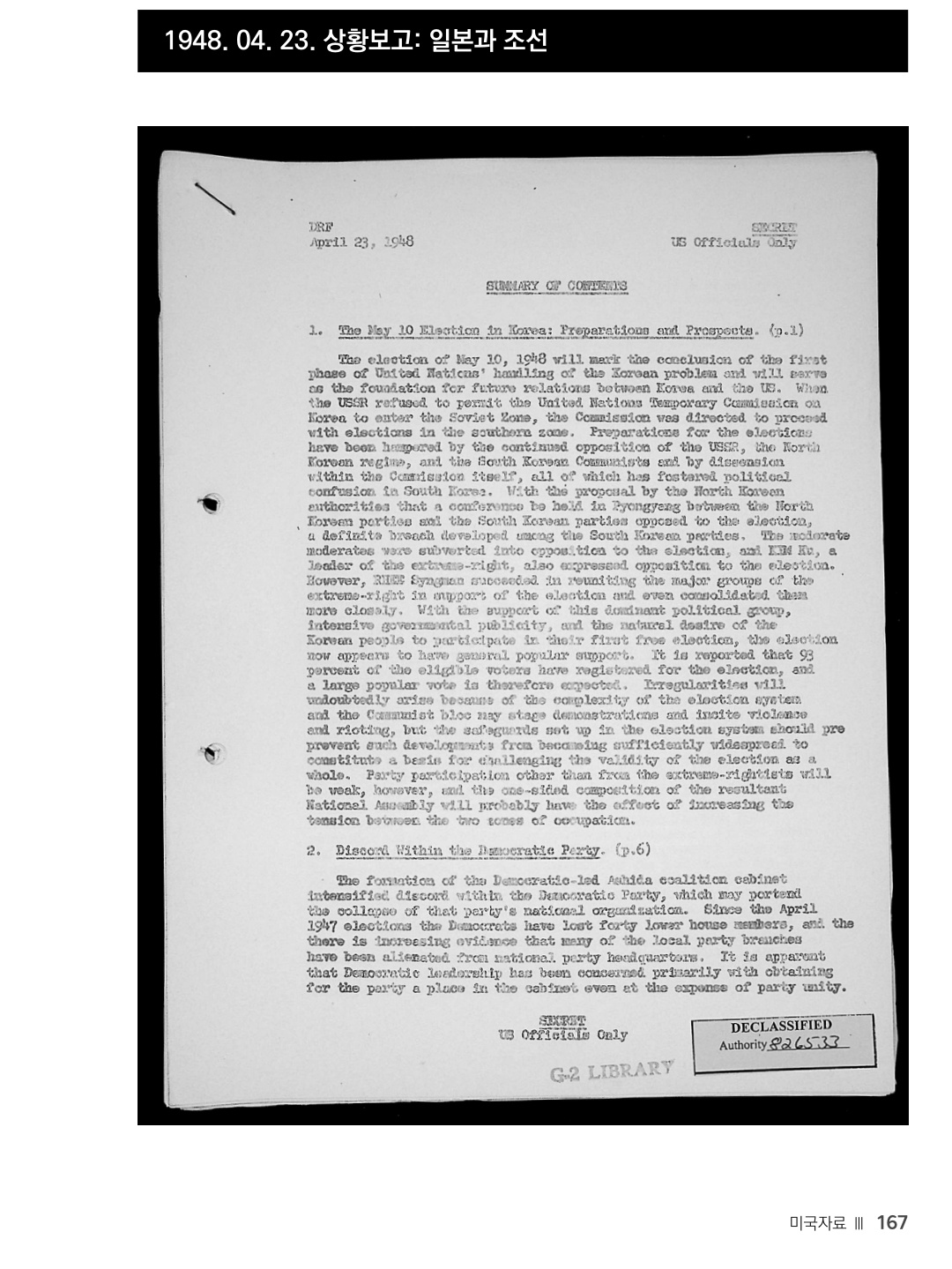
정보조사국 극동조사처 2급 비밀 미국 관계자 전용 1948년 4월 23일 내용 요약
1. 남조선에서 5월 10일 선거: 준비와 전망.
1948년 5월 10일 선거는 유엔의 조선 문제 처리 첫 단계의 마무리가 될 것이고 조선-미국 관계의 미래를 위한 기반이 될 것이다. 소련이 유엔조선임시위원단이 소련 구역에 들어오는 것을 거부했을 때, 위원단은 남쪽 구역에서 선거를 진행하도록 지침을 받았다. 선거 준비는 소련, 북조선 정권, 남조선 공산주의자들의 지속적인 반대와 위원단 내 견해 차이로 지장을 받아 왔다. 그리고 이 모든 것은 남조선에서 정치적 혼란을 조성했다. 선거에 반대하는 남북 정당들이 평양에 모여 회의를 열자는 북조선 당국의 제안과 함께 남조선 정당들 사이에서 뚜렷한 불화가 발생했다. 온건파는 선거 반대로 전향해버렸으며, 극우파 지도자인 김구 또한 선거 반대를 표명했다. 하지만 이승만은 극우파 주요 집단의 선거 지지를 재규합하는 데 성공했고 이들을 더욱 긴밀하게 결속시키기까지 했다. 주요 정치 집단의 지지, 적극적인 정부 홍보, 사상 첫 자유 선거에 참여하고자 하는 조선 인민들의 자연스러운 열망과 함께 투표는 이제 대중의 전반적인 지지를 얻고 있는 것으로 보인다. 유권자 중 93%가 선거를 위해 등록한 것으로 보고됐고 많은 인구가 투표에 참여할 것으로 예상된다. 선거 제도의 복잡성 때문에 분명 불상사가 발생할 것이다. 또한 공산주의 진영에서 시위를 조직하거나 폭력이나 폭동을 선동할 수 있다. 그러나 선거 제도에 마련된 안전장치들이 그와 같은 사태가 선거 전체의 정당성에 대한 문제 제기의 근거가 될 수 있을 정도로 널리 확산되는 것을 방지해 줄 것이다. 하지만 극우파 외 정당들의 참여는 미약할 것이고 국회의 일방적인 구성은 두 점령 구역 간의 긴장도를 높이는 효과를 유발할 것이다.
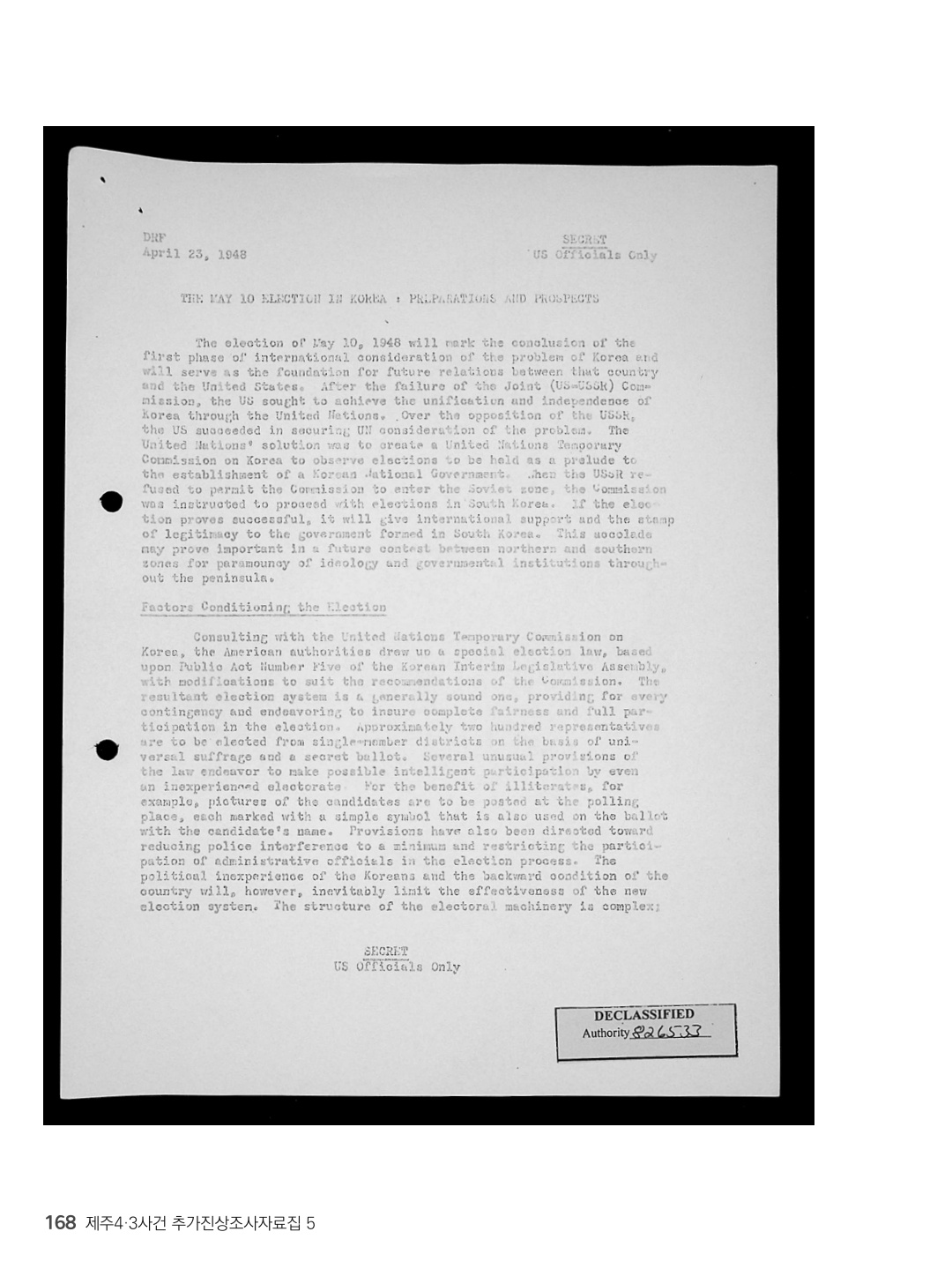
조선의 5월 10일 선거: 준비와 전망 1948년 5월 10일 선거는 조선 문제에 관한 국제적 고려 첫 단계의 마무리가 될 것이고, 조선-미국 관계의 미래를 위한 기반이 될 것이다. 미소공동위원회의 실패 이후 미국은 유엔을 통해 조선의 통일과 독립 달성을 추구해 왔다. 소련이 반대하는 상황에서도 미국은 유엔이 이 문제를 고려하게 하는 데 성공했다. 유엔의해결책은 유엔조선임시위원단을 만들어 조선 정부를 수립하기 위한 준비단계로써 시행될 선거를 감시하는 것이었다. 소련이 위원단의 소련 구역 진입을 거부하자 위원단은 남조선에서 선거를 진행하라는 지침을 받았다. 만약 선거가 성공적으로 치러진다면, 이는 남조선에서 수립된 정부에 국제적인 지지를 제공하고 정당성을 부여해줄 것이다. 이런 포상은 이후 한반도 전역에서 펼쳐질 남측과 북측의 이데올로기 및 정부 제도의 우월성 경쟁에서 중요해질 수 있다.
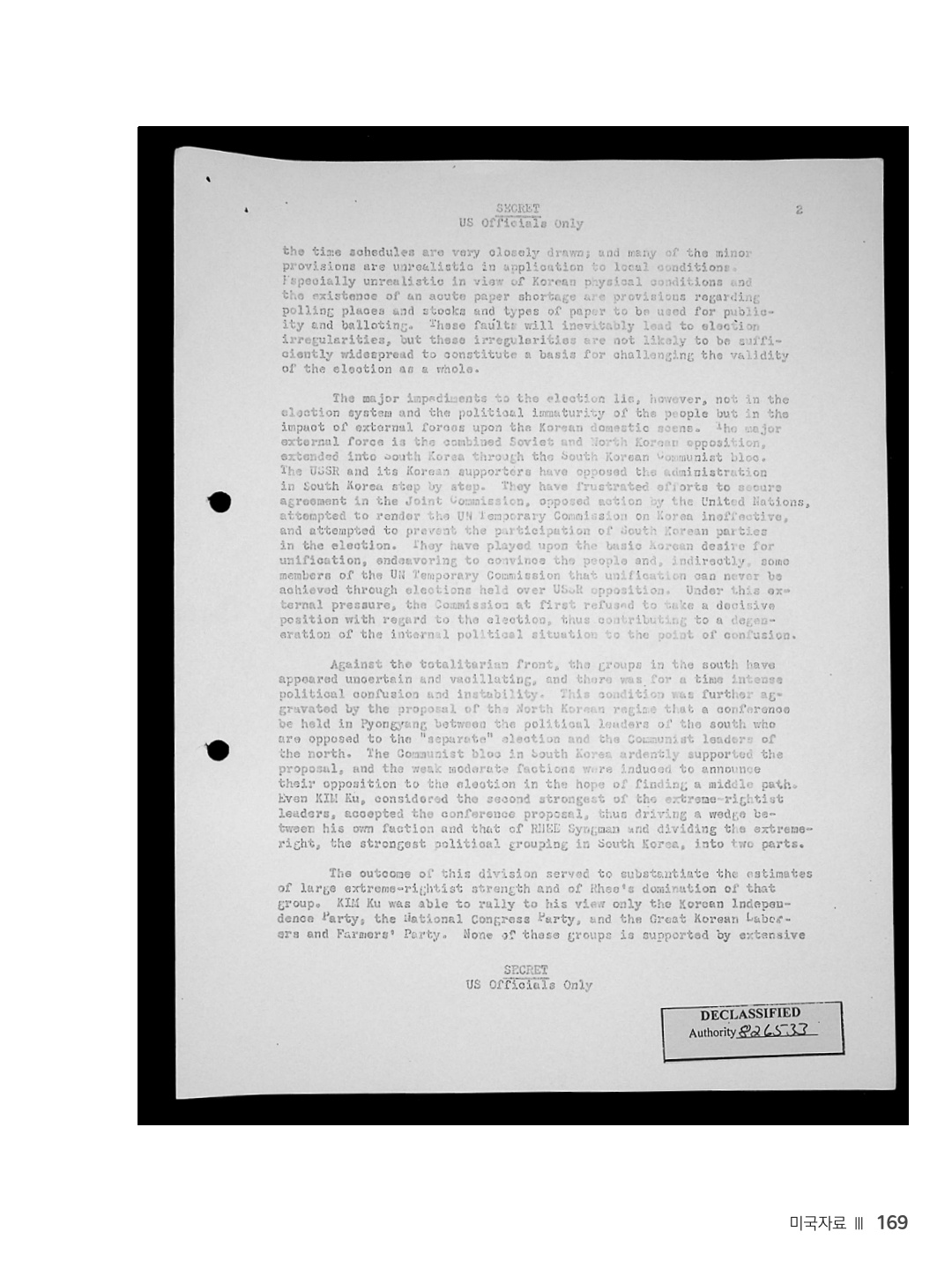
선거에 영향을 미치는 요인들 유엔조선임시위원단과 협의한 미국 당국은 군정법령 제5호에 입각하여 위원단의 권고사항을 충족할 수 있도록 수정된 특별선거법을 만들었다. 그 결과 탄생하게 된 선거 시스템은 만일의 사태에 대비할 수 있고 완전한 공정성과 전적인 선거참여를 보장할 수 있는 건전한 것이다. 보통 선거와 비밀 투표에 기반하여 소선거구제를 통해 200여 명의 의원이 선출될 것이다. 선거법의 몇몇 특별한 조항은 경험이 없는 유권자라도 지적으로 참여할 수 있도록 노력하고 있다. 예컨대 문맹자들을 위해서는 투표소에 후보들의 사진이 게시될 것이고, 각각의 사진에는 투표용지에서 후보를 나타내는 데 사용되는 간단한 기호가 표시돼 있을 것이다. 선거과정에 대한 경찰의 개입을 최소화하고 행정부 관리들의 참여를 금지하는 조항들도 있다. 하지만 조선인들의 정치 경험 부족과 조선의 후진적 조건은 필연적으로 새로운 선거 시스템의 유효성을 제한할 것이다. 선거 기구의 구조는 복잡하다. 시간 계획은 촉박하고 몇몇 부차적 조항들은 지역 상황에 적용하기엔 비현실적이다. 조선의 물리적 조건과 극심한 종이 부족을 고려했을 때 특히 비현실적인 것들로는 투표소와 관련된 조항들, 그리고 공보 및 투표용지에 사용될 종이의 재고와 종류에 관한 조항들이 있다. 이런 문제점들은 선거에서 불상사로 이어지게 될 것이다. 그러나 이런 불상사가 선거 전체의 정당성에 대한 이의 제기의 근거를 구성할 만큼 충분히 널리 퍼지진 않을 것으로 보인다.
하지만 선거에 가장 큰 장애물은 선거 제도나 조선 인민의 정치적 미성숙이 아니라 외부 세력이 조선 국내에 미치는 영향이다. 주요 외부 세력으로는 남조선 공산주의자 블록을 통해 남조선에까지 뻗어 있는 소련, 북조선의 연합 반대를 들 수 있다. 소련과 소련을 지지하는 조선인들은 남조선의 행정을 착실히 반대해왔다. 그들은 미소공동위원회에서 합의를 도출하려는 노력을 좌절시켰고, 유엔의 활동을 반대했고, 유엔조선임시위원단을 무용지물로 만들려고 시도했고, 남조선 정당들의 선거 참여를 막으려 노력했다. 그들은 통일에 대한 조선인들의 근본적 열망을 이용하며, 소련이 반대하는 상황에서는 선거를 통한 통일이 절대 달성될 수 없다는 점을 인민들에게 그리고 간접적으로는 유엔조선임시위원단의 몇몇 위원들에게 납득시키고자 노력했다. 이런 외부 압력 아래 위원단은 처음에는 선거에 관해 단호한 태도를 보이기를 거부했고, 이로써 내부 정치 상황을 거의 혼란 수준으로 악화시키는 데 기여했다.
전체주의 전선에 대면하게 된 남조선 내 집단들은 확신이 없고 망설이는 것처럼 보였다. 그리고 한동안은 심각한 정치적 혼란과 불안정이 있었다. 이 같은 상황은 선거 "분리"를 반대하는 남측의 정치 지도자들과 북측 공산주의 지도자들 간의 회의를 평양에서 열자는 북조선 정권의 제안 때문에 더욱 악화됐다. 남조선 내 공산주의자 블록은 위의 제안을 열성적으로 지지했고, 미약했던 온건파는 중도를 찾아내길 바라며 선거에 대한 자신들의 반대를 발표하게 됐다. 극우 지도자들 중 두 번째로 강하다고 여겨졌던 김구조차도 회의 제안을 수용했고, 그로써 자신의 분파와 이승만의 분파의 관계를 틀어지게 만들고 남조선에서 가장 강력한 정치 집단이었던 극우파를 양분해버리기에 이르렀다.
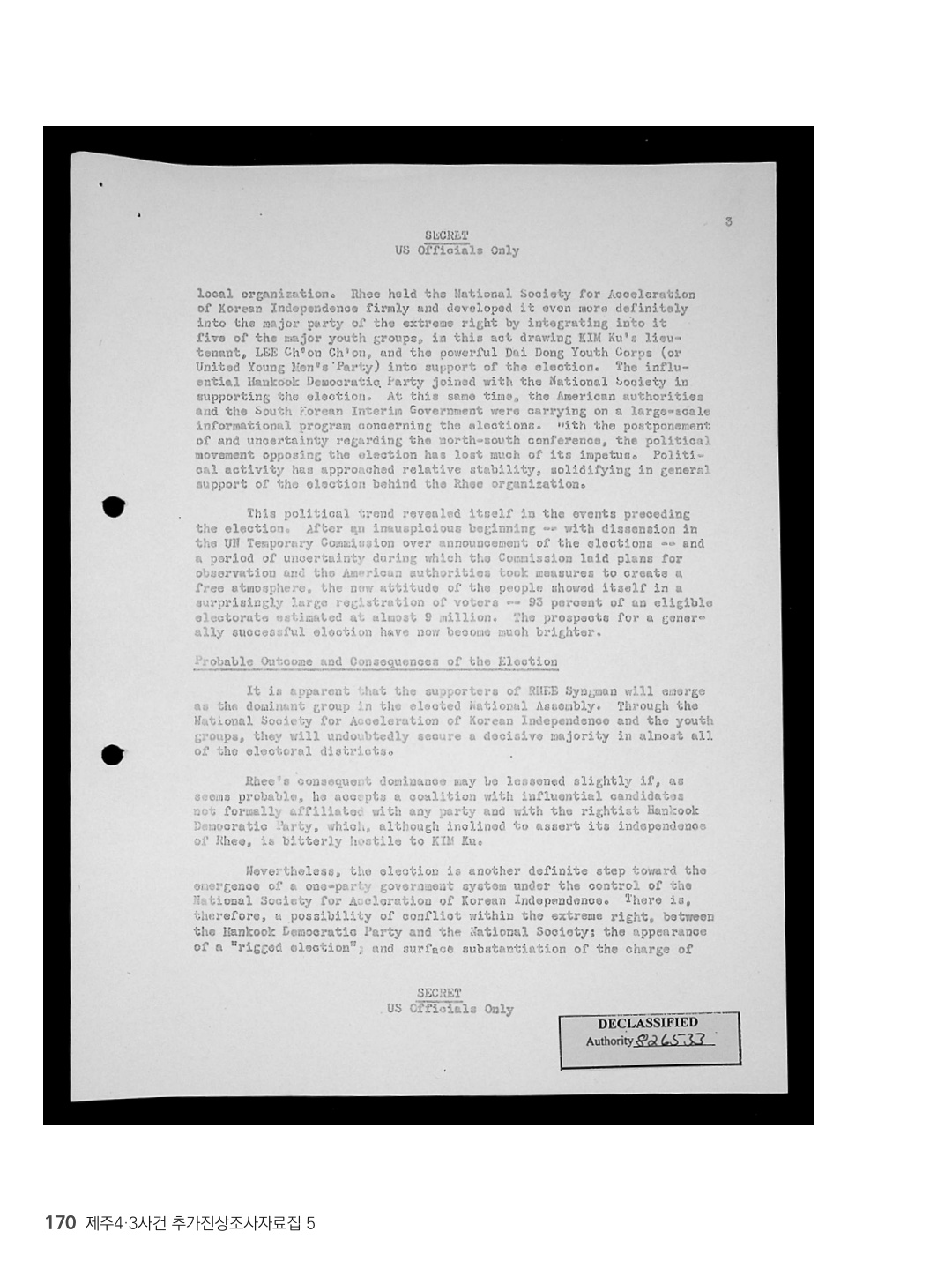
이 분할의 결과는 극우파의 거대한 세력에 관한 추산과 그 집단에 대한 이승만의 지배를 입증하는 역할을 했다. 김구는 한국독립당, 국민의회, 대한독립농민총연맹 및 대한독립노동총연맹만을 자신의 견해 아래 규합할 수 있었다. 이 단체들 중 어느 곳도 대규모 지역 조직으로부터 지지를 얻지 못하고 있다. 이승만은 대한독립촉성국민회를 확실하게 장악하고, 거기에 주요 청년단체 5개를 통합함으로써 대한독립촉성국민회를 극우파의 주요 정당으로 더 확고하게 만들었다. 이승만은 이 과정에서 김구의 부관인 지청천과 강력한 대동청년단을 선거 찬성으로 끌어들였다. 영향력이 큰 한국민주당도 국민회의 선거 찬성에 동참했다. 이와 동시에 미국 당국과 남조선과도입법정부는 선거에 관한 대규모 정보 제공 프로그램을 시행했다. 남북 연석회의의 연기와 불확실성 때문에 선거를 반대하는 정치적 움직임은 동력의 대부분을 잃었다. 정치활동은 비교적 안정적인 상태에 도달했고, 이승만 조직의 배후에서 선거에 대한 전반적 지지를 확고히 하고 있다.
이런 정치적 경향은 선거 이전에 발생한 사건들에서 드러났다. 선거 발표를 둘러싼 위원단 내 알력으로 인한 불길한 시작 그리고 위원단이 선거 감시에 대한 계획을 세우고 미국 당국이 자유로운 선거 분위기를 조성하기 위해 조치를 취하던 불확실성의 기간 이후, 놀라울 정도의 대규모 투표 등록(약 900만 명으로 추산되는 유권자의 93%)을 통해 인민들의 새로운 태도가 드러나게 됐다. 선거가 전반적인 성공을 거두리라는 전망이 이제 보다 더 밝아졌다.
선거 결과 예상 및 영향 선출된 국회에서 이승만의 지지자들이 주요 집단으로 부상하게 되리라는 점은 명백하다. 의심의 여지 없이 그들은 대한독립촉성국민회와 청년단체를 통해 거의 모든 선거구에서 명백하게 다수를 점할 것이다.
만약 이승만이 이전에 (이승만으로부터의 독립성을 주장하는 경향이 있으나 김구에 대해서는 극도로 적대적인) 한국민주당이나 다른 정당과 연계하지 않았던 영향력 있는 후보들과의 연합을 수용한다면, 그의 지배력은 약간은 감소할 수도 있다. 그리고 이승만의 연합 수용은 가능성이 있어 보인다.
그럼에도 불구하고 이번 선거는 대한독립촉성국민회가 통제하는 단일 정당 정부 체제의 등장을 향한 또 하나의 확실한 발걸음이다. 따라서 극우파 내에서 "부정선거"의 발생, "단독" 정부에 대한 책임을(이승만 분파는 단독선거와 단독정부를 지지해 왔다)을 놓고 한국민주당과 대한독립촉성국민회 사이에 갈등이 발생할 가능성이 있다.
선거 등록으로 보건대, 투표는 매우 대규모로 이뤄질 것이다. 대한독립촉성국민회와 청년단체들은 남조선에 있는 거의 모든 거주지에서 선거와 자기 세력에 대한 지지를 계속 북돋을 것이다. 이런 정치 캠페인과 정부의 공보 프로그램, 그리고 이번 첫 선거에 참여하고자 하는 인민들의 자연스러운 열망 때문에 대중들의 선거 보이콧을 끌어내려 하는 선거 반대 정치 분파의 노력은 거의 효과가 없을 것이다. 그러나 공산주의자의 장악력이 강한 몇몇 지역은 선거를 거부할 수 있다. 경상북도 포항, 전라남도 나주 근처의 농촌 거주지들, 제주도, 경상남도 서남부 해안 지역을 그 예로 들 수 있다. 선거 감시로부터 멀리 떨어진 지역에서는 우파 지역에서의 전원 참여를 달성하기 위해, 또한 소수 거주지를 겁박하기 위해 강압적인 무력이 행사될 것이다. 그러므로 강압을 받은 몇몇 투표자들은 기권표를 낼 수도 있다.
대한독립촉성국민회와 한국민주당 외에 정당의 선거 참여는 미약할 것이다. 공산주의자들은 선거 보이콧에 관해서는 완고한 자세를 유지할 것이다. 온건파가 선거에 참여한다고 하더라도 서울 밖에서 그들의 인원은 무시해도 될 만한 수준이고 뒤늦게 선거에 참여한다고 해도 별로 영향은 없을 것이다. 김구 측 후보자들은 당의 참여 없이 개인 자격으로 출마했다고 보고됐다. 따라서 이번 선거는 대부분 대한독립촉성국민회와 한국민주당, 그리고 무소속 간의 경쟁이 될 것이며, 무소속에 대한 양당의 태도가 당선과 새로운 정부에의 참여를 바라는 무소속 후보들의 희망과 관련하여 중요한 역할을 하게 될 것이다. 이는 아무리 좋게 봐도 새로운 국회가 모든 정치 집단의 대표자들을 담아내지 못하는 정치적으로 불균형한 국회가 되리라는 것을 뜻한다.
불상사는 분명 발생할 것이다. 하지만 그것이 몇몇 개인의 당선의 정당성을 무효로 만들 만큼 충분히 널리 퍼지진 않을 것으로 보인다. 선거 기구는 너무 복잡하고 시간 계획표는 그대로 따르기에는 너무 촉박하다. 몇몇 선거구는 신청된 이의제기의 숫자를 감당할 수 없을 것이다. 불상사가 발생한다면 그것은 지역 수준에서, 유엔조선임시위원단과 미국 당국의 감시를 벗어나서 발생하게 될 것이다. 군정장관과 선거심사위원회는 의심의 여지 없이 선거에 관한 소송으로 압박을 받을 것이다. 몇몇 선거, 특히 좌파 강세 지역의 선거는 무효로 선포될 것이다. 하지만 전체적으로 선거는 성공적일 것이고 특정 선거구들에 관한 소송을 위해 설치된 기구들은 상황을 처리할 수 있을 만큼 강력하다는 것을 스스로 증명할 것이다. 특히 군정장관이 강력하게 관여한다면 말이다. 물론 어느 상황에서든 특정 선거구의 선거 무효 여부는 선거심사위원회보다는 군정장관이 정하게 될 듯하다. 왜냐하면 선거심사위원회는 국회가 모이고 시간이 어느 정도 흐르기 전까지는 설치되지 않을 것이 확실하고, 그 구성원은 조선인이 될 것이고, 그 중 둘은 국회가 스스로 선택할 것이기 때문이다.
선거 당일에는 폭력이나 폭동이 발생할 것이 거의 확실하다. 공산주의자 강세지역에서는 이런 활동이 광범위하게 펼쳐져 선거 과정을 완전히 중단시킬 수 있다. 다음 지역이 이와 같은 범주에 속한다. 경상북도 대구의 해안가 지역, 경상남도 삼천포, 고성, 통영의 주변 지역, 전라남도 나주 주변의 주거지, 그리고 제주도.
다른 지역에서도, 만일 우파들이 자신들과 반대되는 관점을 가진 거주지들을 완전히 탄압하려 시도하거나 조직된 공산주의자들이 투표소를 공격하거나 투표용지를 훔치고 훼손하려고 시도한다면 소규모 지역에 제한된 폭력이 발생할 수 있다. 이미 서울과 전라남도에 있는 등록소들이 공격당했다. 강력한 대응은 아마 폭력 발생을 최소한으로 줄여줄 것이다. 북조선 정권이나 소련이 남조선 공산주의자들에게 공개적으로 폭력을 사주하지는 않을 것이다. 대신 남조선 공산주의자들은 단독선거와 단독정부에 반대하는 "자발적인" 시위를 펼칠 것이다.
DEF
April 23, 1948
SECRET
US Officials Only
SUMMARY OF CONTENTS
1. The May 10 Election in Korea: Preparations and Prospects. (p.1)
The election of May 10, 1948 will mark the conclusion of the first phase of United Nations' handling of the Korean problem and will serve as the foundation for future relations between Korea and the US. When the USSR refused to permit the United Nations Temporary Commission on
Korea to enter the Soviet Zone, the Commission was directed to proceed with elections in the southern zone. Preparations for the elections have been hampered by the continued opposition of the USSR, the North
Korean regime, and the South Korean Communists and by dissension within the Commission itself, all of which has fostered political confusion in South Korea. With the proposal by the North Korean authorities that a conference be held in Pyongyang between the North
Korean parties and the South Korean parties opposed to the election, a definite breach developed among the South Korean parties. The moderate moderates were subverted into opposition to the election, and KIM Ku, a leader of the extreme-Right, also expressed opposition to the election.
However, RHEE Syngman succeeded in reuniting the major groups of the extreme-Right in support of the election and even consolidated them more closely. With the support of this dominant political group, intensive governmental publicity, and the natural desire of the
Korean people to participate in their first free election, the election now appears to have general popular support. It is reported that 93 percent of the eligible voters have registered for the election, and a large popular vote is therefore expected. Irregularities will undoubtedly arise because of the complexity of the election system and the Communist bloc may stage demonstrations and incite violence and rioting, but the safeguards set up in the election system should pre prevent such developments from becoming sufficiently widespread to constitute a basis for challenging the validity of the election as a whole. Party participation other than from the extreme-rightists will be weak, however, and the one-sided composition of the resultant
National Assembly will probably have the effect of increasing the tension between the two zones of occupation.
2. Discord Within the Democratic Party. (p.6)
The formation of the Democratic-led Ashida coalition cabinet intensified discord within the Democratic Party, which may portend the collapse of that party's national organization. Since the April
1947 elections the Democrats have lost forty lower house members, and there is increasing evidence that many of the local party branches have been alienated from national party headquarters. It is apparent that Democratic leadership has been concerned primarily with obtaining for the party a place in the cabinet even at the expense of party unity.
SECRET
US Officials Only
**DECLASSIFIED**
Authority 8265733
G-2 LIBRARY
DRP
April 23, 1948
SECRET
US Officials Only
THE MAY 10 ELECTION IN KOREA : PREPARATIONS AND PROSPECTS
The election of May 10, 1948 will mark the conclusion of the first phase of international consideration of the problem of Korea and will serve as the foundation for future relations between that country and the United States. After the failure of the Joint (US-USSR) Commission, the US sought to achieve the unification and independence of
Korea through the United Nations. Over the opposition of the USSR, the US succeeded in securing UN consideration of the problem. The
United Nations' solution was to create a United Nations Temporary
Commission on Korea to observe elections to be held as a prelude to the establishment of a Korean National Government. When the USSR refused to permit the Commission to enter the Soviet zone, the Commission was instructed to proceed with elections in South Korea. If the election proves successful, it will give international support and the stamp of legitimacy to the government formed in South Korea. This accolade may prove important in a future contest between northern and southern zones for paramouncy of ideology and governmental institutions throughout the peninsula.
Factors Conditioning the Election
Consulting with the United Nations Temporary Commission on
Korea, the American authorities drew up a special election law, based upon Public Act Number Five of the Korean Interim Legislative Assembly, with modifications to suit the recommendations of the Commission. The resultant election system is a generally sound one, providing for every contingency and endeavoring to insure complete fairness and full participation in the election. Approximately two hundred representatives are to be elected from single-member districts on the basis of universal suffrage and a secret ballot. Several unusual provisions of the law endeavor to make possible intelligent participation by even an inexperienced electorate. For the benefit of illiterates, for example, pictures of the candidates are to be posted at the polling place, each marked with a simple symbol that is also used on the ballot with the candidate's name. Provisions have also been directed toward reducing police interference to a minimum and restricting the participation of administrative officials in the election process. The political inexperience of the Koreans and the backward condition of the country will, however, inevitably limit the effectiveness of the new election system. The structure of the electoral machinery is complex;
SECRET
US Officials Only
DECLASSIFIED
Authority 8265-33
SECRET
US Officials Only
2
the time schedules are very closely drawn; and many of the minor provisions are unrealistic in application to local conditions.
Especially unrealistic in view of Korean physical conditions and the existence of an acute paper shortage are provisions regarding polling places and stocks and types of paper to be used for publicity and balloting. These faults will inevitably lead to election irregularities, but these irregularities are not likely to be sufficiently widespread to constitute a basis for challenging the validity of the election as a whole.
The major impediments to the election lie, however, not in the election system and the political immaturity of the people but in the impact of external forces upon the Korean domestic scene. The major external force is the combined Soviet and North Korean opposition, extended into South Korea through the South Korean Communist bloc.
The USSR and its Korean supporters have opposed the administration in South Korea step by step. They have frustrated efforts to secure agreement in the Joint Commission, opposed action by the United Nations, attempted to render the UN Temporary Commission on Korea ineffective, and attempted to prevent the participation of South Korean parties in the election. They have played upon the basic Korean desire for unification, endeavoring to convince the people and, indirectly, some members of the UN Temporary Commission that unification can never be achieved through elections held over USSR opposition. Under this external pressure, the Commission at first refused to take a decisive position with regard to the election, thus contributing to a degeneration of the internal political situation to the point of confusion.
Against the totalitarian front, the groups in the south have appeared uncertain and vacillating, and there was for a time intense political confusion and instability. This condition was further aggravated by the proposal of the North Korean regime that a conference be held in Pyongyang between the political leaders of the south who are opposed to the "separate" election and the Communist leaders of the north. The Communist bloc in South Korea ardently supported the proposal, and the weak moderate factions were induced to announce their opposition to the election in the hope of finding a middle path.
Even KIM Ku, considered the second strongest of the extreme-rightist leaders, accepted the conference proposal, thus driving a wedge between his own faction and that of RHEE Syngman and dividing the extremeright, the strongest political grouping in South Korea, into two parts.
The outcome of this division served to substantiate the estimates of large extreme-rightist strength and of Rhee's domination of that group. KIM Ku was able to rally to his view only the Korean Independence Party, the National Congress Party, and the Great Korean Laborers and Farmers' Party. None of these groups is supported by extensive
SECRET
US Officials Only
DECLASSIFIED
Authority 826533
SECRET
US Officials Only
3
local organization. Rhee held the National Society for Acceleration of Korean Independence firmly and developed it even more definitely into the major party of the extreme right by integrating into it five of the major youth groups, in this act drawing KIM Ku's lieutenant, LEE Ch'on Ch'on, and the powerful Dai Dong Youth Corps (or
United Young Men's Party) into support of the election. The influential Hankook Democratic Party joined with the National Society in supporting the election. At this same time, the American authorities and the South Korean Interim Government were carrying on a large-scale informational program concerning the elections. With the postponement of and uncertainty regarding the north-south conference, the political movement opposing the election has lost much of its impetus. Political activity has approached relative stability, solidifying in general support of the election behind the Rhee organization.
This political trend revealed itself in the events preceding the election. After an inauspicious beginning -- with dissension in the UN Temporary Commission over announcement of the elections -- and a period of uncertainty during which the Commission laid plans for observation and the American authorities took measures to create a free atmosphere, the new attitude of the people showed itself in a surprisingly large registration of voters -- 95 percent of an eligible electorate estimated at almost 9 million. The prospects for a generally successful election have now become much brighter.
Probable Outcome and Consequences of the Election
It is apparent that the supporters of RHEE Syngman will emerge as the dominant group in the elected National Assembly. Through the
National Society for Acceleration of Korean Independence and the youth groups, they will undoubtedly secure a decisive majority in almost all of the electoral districts.
Rhee's consequent dominance may be lessened slightly if, as seems probable, he accepts a coalition with influential candidates not formally affiliated with any party and with the rightist Hankook
Democratic Party, which, although inclined to assert its independence of Rhee, is bitterly hostile to KIM Ku.
Nevertheless, the election is another definite step toward the emergence of a one-party government system under the control of the
National Society for Acceleration of Korean Independence. There is, therefore, a possibility of conflict within the extreme right, between the Hankook Democratic Party and the National Society; the appearance of a "rigged election"; and surface substantiation of the charge of
SECRET
US Officials Only
DECLASSIFIED
Authority 826533
SECRET
US Officials Only
4
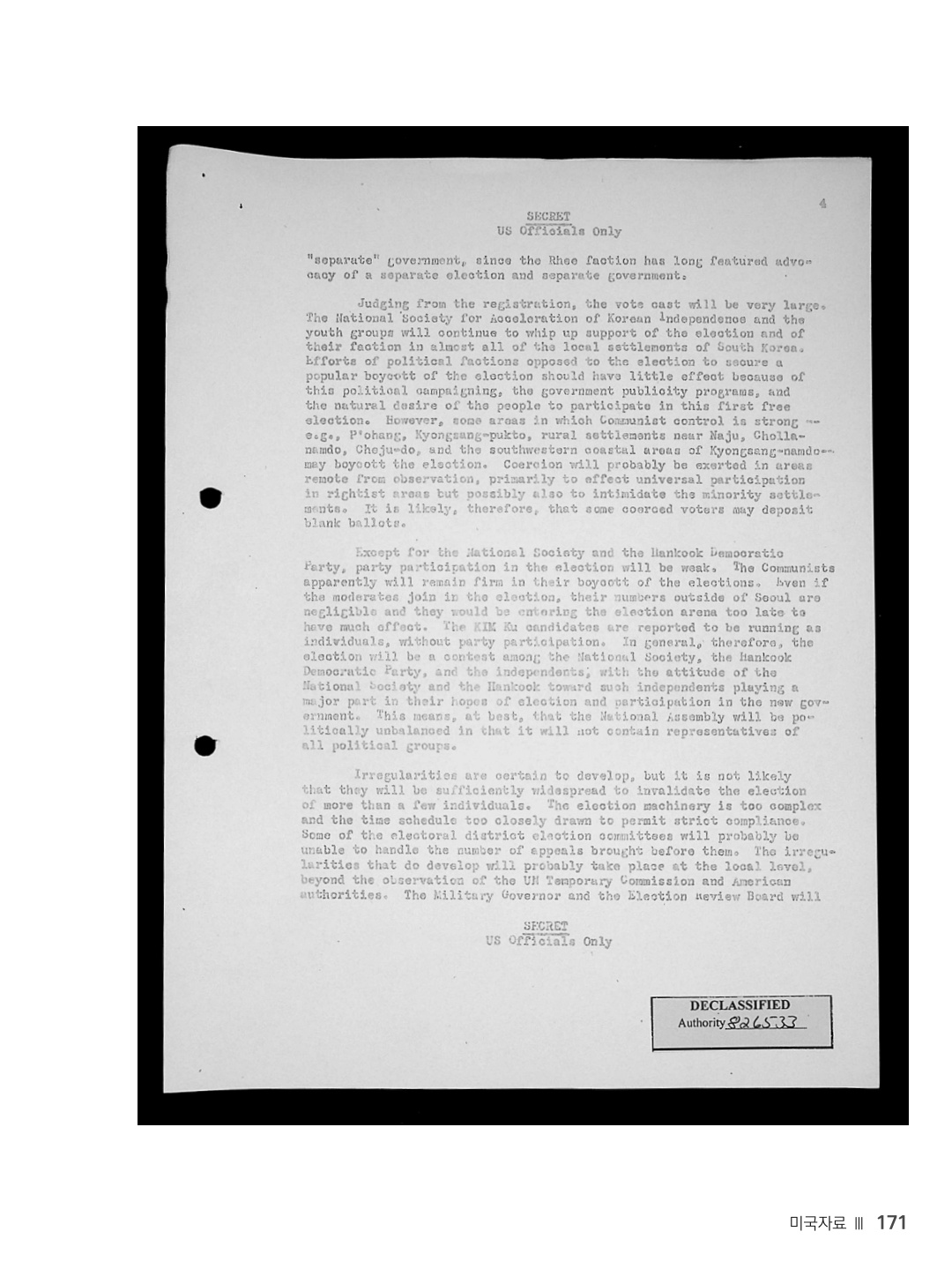
"separate" government, since the Rhee faction has long featured advocacy of a separate election and separate government.
Judging from the registration, the vote cast will be very large. The National Society for Acceleration of Korean Independence and the youth groups will continue to whip up support of the election and of their faction in almost all of the local settlements of South Korea. Efforts of political factions opposed to the election to secure a popular boycott of the election should have little effect because of this political campaigning, the government publicity programs, and the natural desire of the people to participate in this first free election. However, some areas in which Communist control is strong -- e.g., P'ohang, Kyongsang-pukto, rural settlements near Naju, Cholla-namdo, Cheju-do, and the southwestern coastal areas of Kyongsang-namdo-- may boycott the election. Coercion will probably be exerted in areas remote from observation, primarily to effect universal participation in rightist areas but possibly also to intimidate the minority settlements. It is likely, therefore, that some coerced voters may deposit blank ballots.
Except for the National Society and the Hankook Democratic Party, party participation in the election will be weak. The Communists apparently will remain firm in their boycott of the elections. Even if the moderates join in the election, their numbers outside of Seoul are negligible and they would be entering the election arena too late to have much effect. The KIM Ku candidates are reported to be running as individuals, without party participation. In general, therefore, the election will be a contest among the National Society, the Hankook Democratic Party, and the independents; with the attitude of the National Society and the Hankook toward such independents playing a major part in their hopes of election and participation in the new government. This means, at best, that the National Assembly will be politically unbalanced in that it will not contain representatives of all political groups.
Irregularities are certain to develop, but it is not likely that they will be sufficiently widespread to invalidate the election of more than a few individuals. The election machinery is too complex and the time schedule too closely drawn to permit strict compliance. Some of the electoral district election committees will probably be unable to handle the number of appeals brought before them. The irregularities that do develop will probably take place at the local level, beyond the observation of the UN Temporary Commission and American authorities. The Military Governor and the Election Review Board will
SECRET
US Officials Only
**DECLASSIFIED**
Authority 826533
SECRET
US Officials Only
5
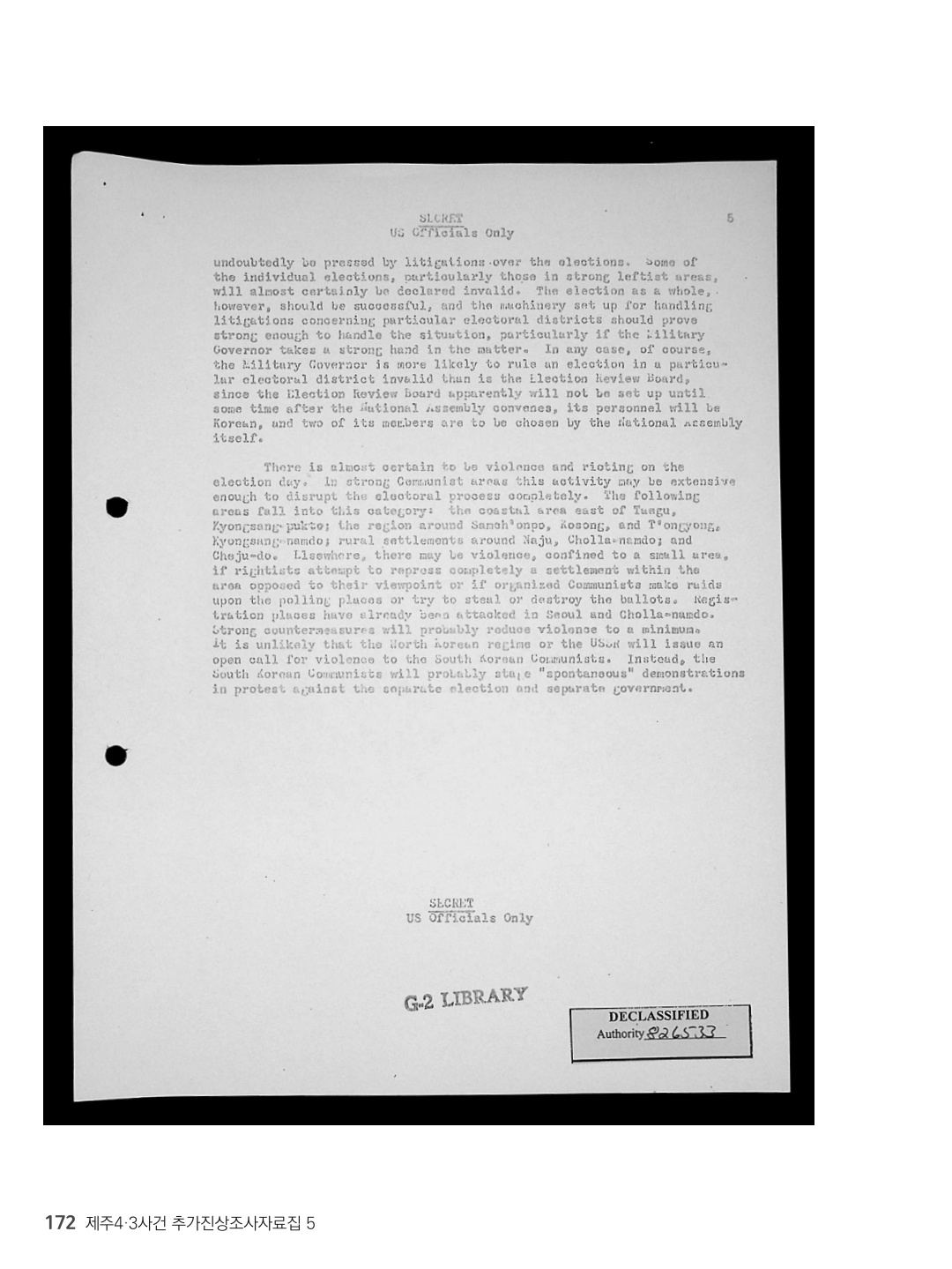
undoubtedly be pressed by litigations over the elections. Some of the individual elections, particularly those in strong leftist areas, will almost certainly be declared invalid. The election as a whole, however, should be successful, and the machinery set up for handling litigations concerning particular electoral districts should prove strong enough to handle the situation, particularly if the Military
Governor takes a strong hand in the matter. In any case, of course, the Military Governor is more likely to rule an election in a particular electoral district invalid than is the Election Review Board, since the Election Review Board apparently will not be set up until some time after the National Assembly convenes, its personnel will be
Korean, and two of its members are to be chosen by the National Assembly itself.
There is almost certain to be violence and rioting on the election day. In strong Communist areas this activity may be extensive enough to disrupt the electoral process completely. The following areas fall into this category: the coastal area east of Taegu, Kyongsang-pukto; the region around Sunchonpo, Kosong, and T'ongyong, Kyongsang-namdo; rural settlements around Naju, Cholla-namdo; and
Cheju-do. Elsewhere, there may be violence, confined to a small area, if rightists attempt to repress completely a settlement within the area opposed to their viewpoint or if organized Communists make raids upon the polling places or try to steal or destroy the ballots. Registration places have already been attacked in Seoul and Cholla-namdo.
Strong countermeasures will probably reduce violence to a minimum.
It is unlikely that the North Korean regime or the USSR will issue an open call for violence to the South Korean Communists. Instead, the
South Korean Communists will probably stage "spontaneous" demonstrations in protest against the separate election and separate government.
SECRET
US Officials Only
G-2 LIBRARY
DECLASSIFIED
Authority 826533
출처:
제주4·3평화재단 편,
『추가진상조사자료집-미국자료3』,
p. 159–172.
— NARA (RG 554, Entry 143(A1), Box 53)
×
![]()