정보참모부 주간요약보고
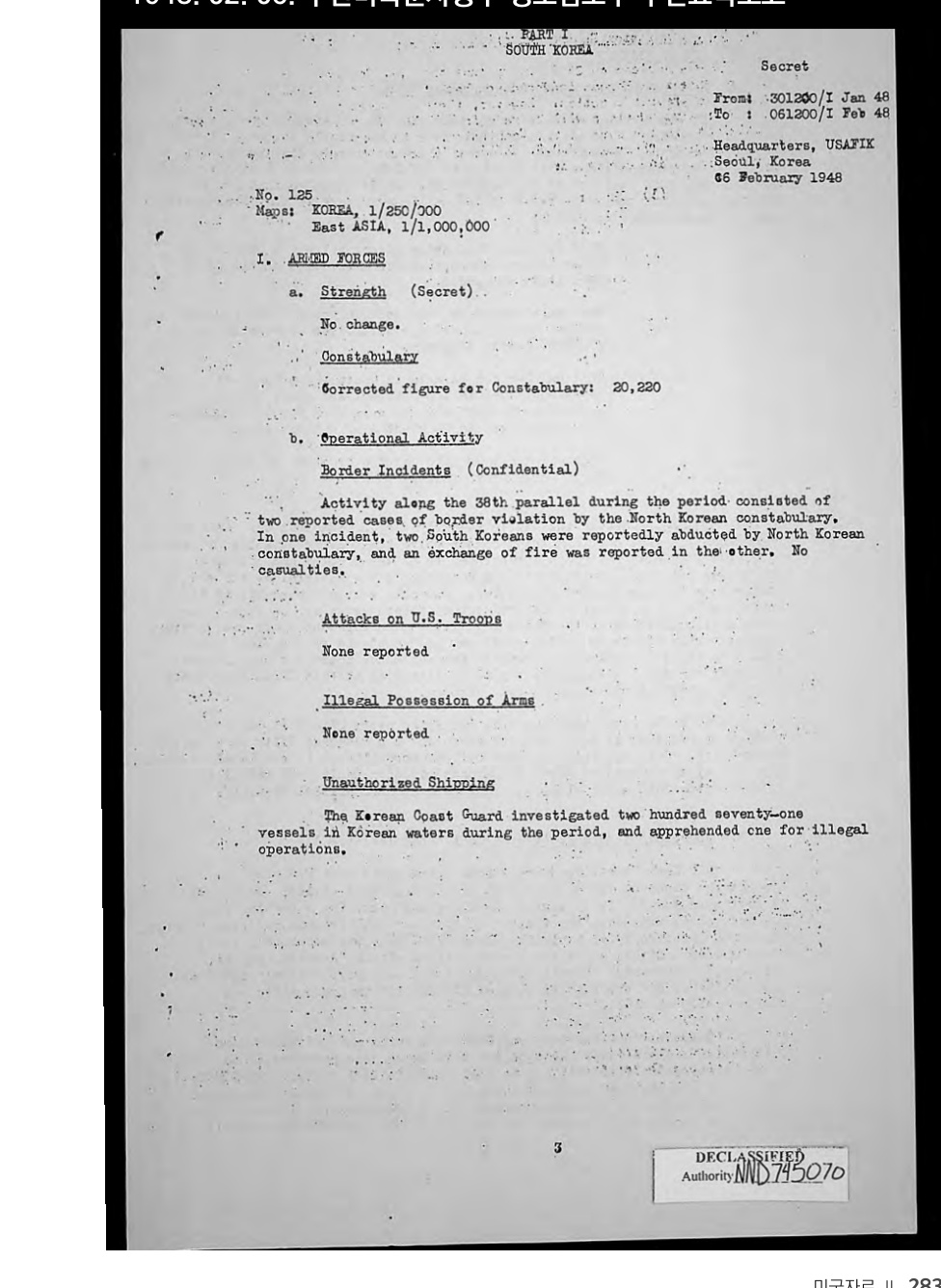
기간: 1948년 1월 30일~1948년 2월 6일
주한미육군사령부
서울, 조선
1948년 2월 6일 제125호
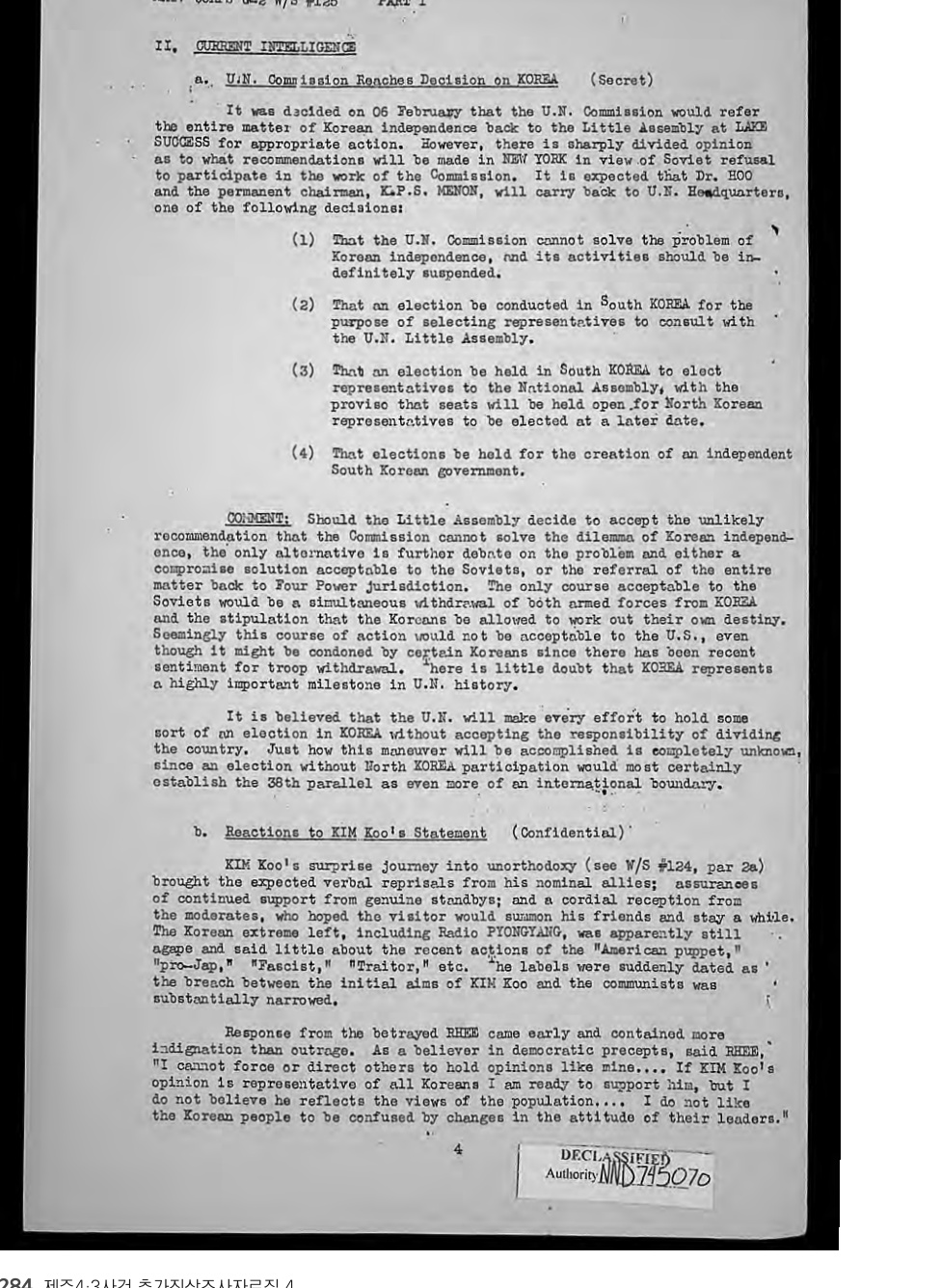
II. 현용 정보
a. 유엔위원단이 조선에 관한 결정에 이르다 (2급 비밀)
2월 6일, 유엔위원단은 적절한 조치를 위해 레이크 석세스에서 열리는 소총회에 조선 독립의 문제 전체를 안건으로 다시 회부했다. 하지만 소련의 위원단 활동참여 거절에 대한 고려 때문에, 뉴욕에서 어떤 권고안이 제시될 것인지에 대해서는 의견이 극명하게 갈린다. 후 박사와 K. P. S. 메논의장은 유엔 본부에 다음 중하나의 결정을 가져갈 것으로 예상된다.
(1) 유엔위원단은 조선 독립 문제를 해결할 수 없으며, 위원단의 활동은 무기한유예돼야 한다.
(2) 남조선에서 유엔소총회와 협의할 대표자를 선출하는 선거를 시행한다.
(3) 남조선에서 선거를 시행하여 국회에서 활동할 대표자를 선출하고, 추후 선출될 북조선 대표자의 의석은 공석으로 남겨둔다.
(4) 독립적인 남조선 정부의 수립을 위한 선거를 시행한다.
논평: 만일 유엔소총회가 유엔위원단이 조선 독립의 딜레마를 해결할 수 없다는 예상 밖의 입장을 받아들이기로 결정한다면, 문제에 대해 더 논의하여 소련에서도 받아들일 수 있는 절충안을 만들어내거나 모든 문제를 다시 4개국의 관할로넘기는 것만이 대안일 것이다. 소련이 받아들이는 유일한 방침은 미소 양군의 동시 철수와 조선인의 자기 운명 결정 허용뿐일 것이다. 최근 제기되는 철군 옹호의견 때문에 몇몇 조선인들이 이를 용납할지도 모르지만, 미국은 이런 방향의 조치들을 받아들일 수 없을 것이다. 조선 문제가 유엔 역사에서 매우 중요한 획기적 사건이라 점에는 의심의 여지가 없다.
유엔은 조선의 분할에 대한 책임을 면하면서도 조선에서 선거 같은 것을 시행할 수 있도록 모든 노력을 기울일 것이다. 단지 이 교묘한 조치가 어떻게 완수될 수 있는지는 전혀 알 수가 없다. 북조선의 참여가 없는 선거는 38선을 더욱 국경선 같은 것으로 만들 것이기 때문이다.
III. 개전 가능성 (2급 비밀)
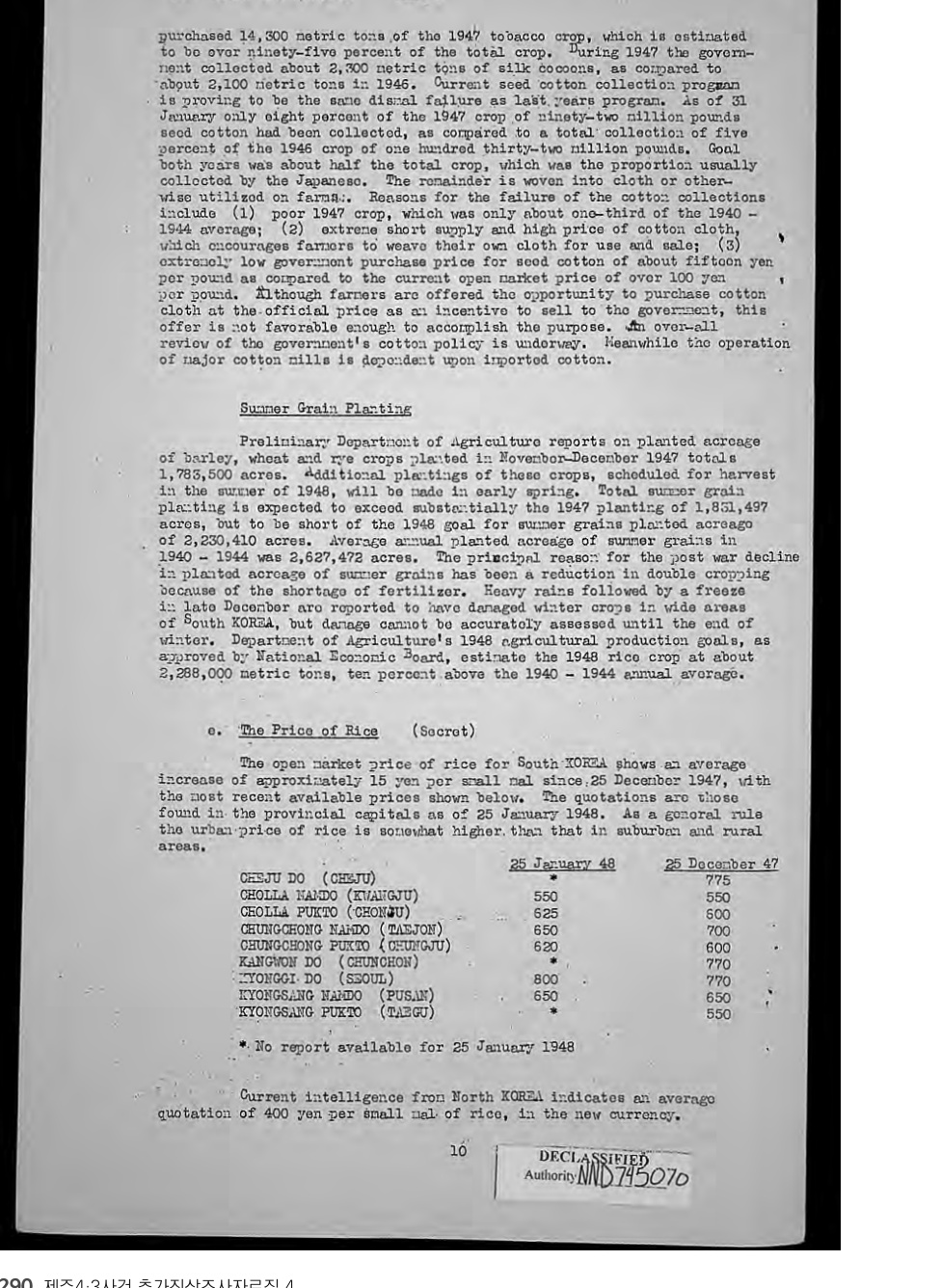
e. 미곡 가격 (2급 비밀)
1947년 12월 25일 이후 남조선의 미곡 시장가격은 1말(작은 단위)에 평균 15엔 정도 상승했다. 아래는 입수 가능한 가장 최신의 가격 자료다. 시세는 1948년 1월 25일 기준으로 도별 중심도시의 미곡 시세를 따른 것이다. 일반적으로 도시지역의 미곡 가격이 도시 근교와 농촌 지역의 미곡 가격보다 좀 더 높다.
* 1948년 1월 25일 자 보고 없음.
북조선으로부터 입수된 현용 정보는 미곡 1말(작은 단위) 당 새로운 통화로 평균 400엔의 시세를 보인다.
1948년 1월 25일 / 1947년 12월 25일 제주도 (제주) * / 775 전라남도 (광주) 550 / 550 전라북도 (전주) 625 / 600 충청남도 (대전) 650 / 700 충청북도 (청주) 620 / 600 강원도 (춘천) * / 770 경기도 (서울) 800 / 770 경상남도 (부산) 650 / 650 경상북도 (대구) * / 550
PART I
SOUTH KOREA
Secret
From: 301200/I Jan 48
To : 061200/I Feb 48
Headquarters, USAFIK
Seoul, Korea
06 February 1948
No. 125
Maps: KOREA, 1/250/000
East ASIA, 1/1,000,000
I. ARMED FORCES
a. Strength (Secret)
No change.
Constabulary
Corrected figure for Constabulary: 20,220
b. Operational Activity
Border Incidents (Confidential)
Activity along the 38th parallel during the period consisted of two reported cases of border violation by the North Korean constabulary.
In one incident, two South Koreans were reportedly abducted by North Korean constabulary, and an exchange of fire was reported in the other. No casualties.
Attacks on U.S. Troops
None reported
Illegal Possession of Arms
None reported
Unauthorized Shipping
The Korean Coast Guard investigated two hundred seventy-one vessels in Korean waters during the period, and apprehended one for illegal operations.
3
DECLASSIFIED
Authority NND 745070
XXIV CORPS G-2 W/S #125 PART I
II. CURRENT INTELLIGENCE
a. U.N. Commission Reaches Decision on KOREA (Secret)
It was decided on 06 February that the U.N. Commission would refer the entire matter of Korean independence back to the Little Assembly at LAKE
SUCCESS for appropriate action. However, there is sharply divided opinion as to what recommendations will be made in NEW YORK in view of Soviet refusal to participate in the work of the Commission. It is expected that Dr. HOO and the permanent chairman, K.P.S. MENON, will carry back to U.N. Headquarters, one of the following decisions:
(1) That the U.N. Commission cannot solve the problem of
Korean independence, and its activities should be indefinitely suspended.
(2) That an election be conducted in South KOREA for the purpose of selecting representatives to consult with the U.N. Little Assembly.
(3) That an election be held in South KOREA to elect representatives to the National Assembly, with the proviso that seats will be held open for North Korean representatives to be elected at a later date.
(4) That elections be held for the creation of an independent
South Korean government.
COMMENT: Should the Little Assembly decide to accept the unlikely recommendation that the Commission cannot solve the dilemma of Korean independence, the only alternative is further debate on the problem and either a compromise solution acceptable to the Soviets, or the referral of the entire matter back to Four Power jurisdiction. The only course acceptable to the
Soviets would be a simultaneous withdrawal of both armed forces from KOREA and the stipulation that the Koreans be allowed to work out their own destiny.
Seemingly this course of action would not be acceptable to the U.S., even though it might be condoned by certain Koreans since there has been recent sentiment for troop withdrawal. There is little doubt that KOREA represents a highly important milestone in U.N. history.
It is believed that the U.N. will make every effort to hold some sort of an election in KOREA without accepting the responsibility of dividing the country. Just how this maneuver will be accomplished is completely unknown, since an election without North KOREA participation would most certainly establish the 38th parallel as even more of an international boundary.
b. Reactions to KIM Koo's Statement (Confidential)
KIM Koo's surprise journey into unorthodoxy (see W/S #124, par 2a)
brought the expected verbal reprisals from his nominal allies; assurances of continued support from genuine standbys; and a cordial reception from the moderates, who hoped the visitor would summon his friends and stay a while.
The Korean extreme left, including Radio PYONGYANG, was apparently still agape and said little about the recent actions of the "American puppet,"
"pro-Jap," "Fascist," "Traitor," etc. The labels were suddenly dated as the breach between the initial aims of KIM Koo and the communists was substantially narrowed.
Response from the betrayed RHEE came early and contained more indignation than outrage. As a believer in democratic precepts, said RHEE,
"I cannot force or direct others to hold opinions like mine.... If KIM Koo's opinion is representative of all Koreans I am ready to support him, but I do not believe he reflects the views of the population.... I do not like the Korean people to be confused by changes in the attitude of their leaders."
4
DECLASSIFIED
Authority NND 745070
XXIV CORPS G-2 W/S #125 PART I
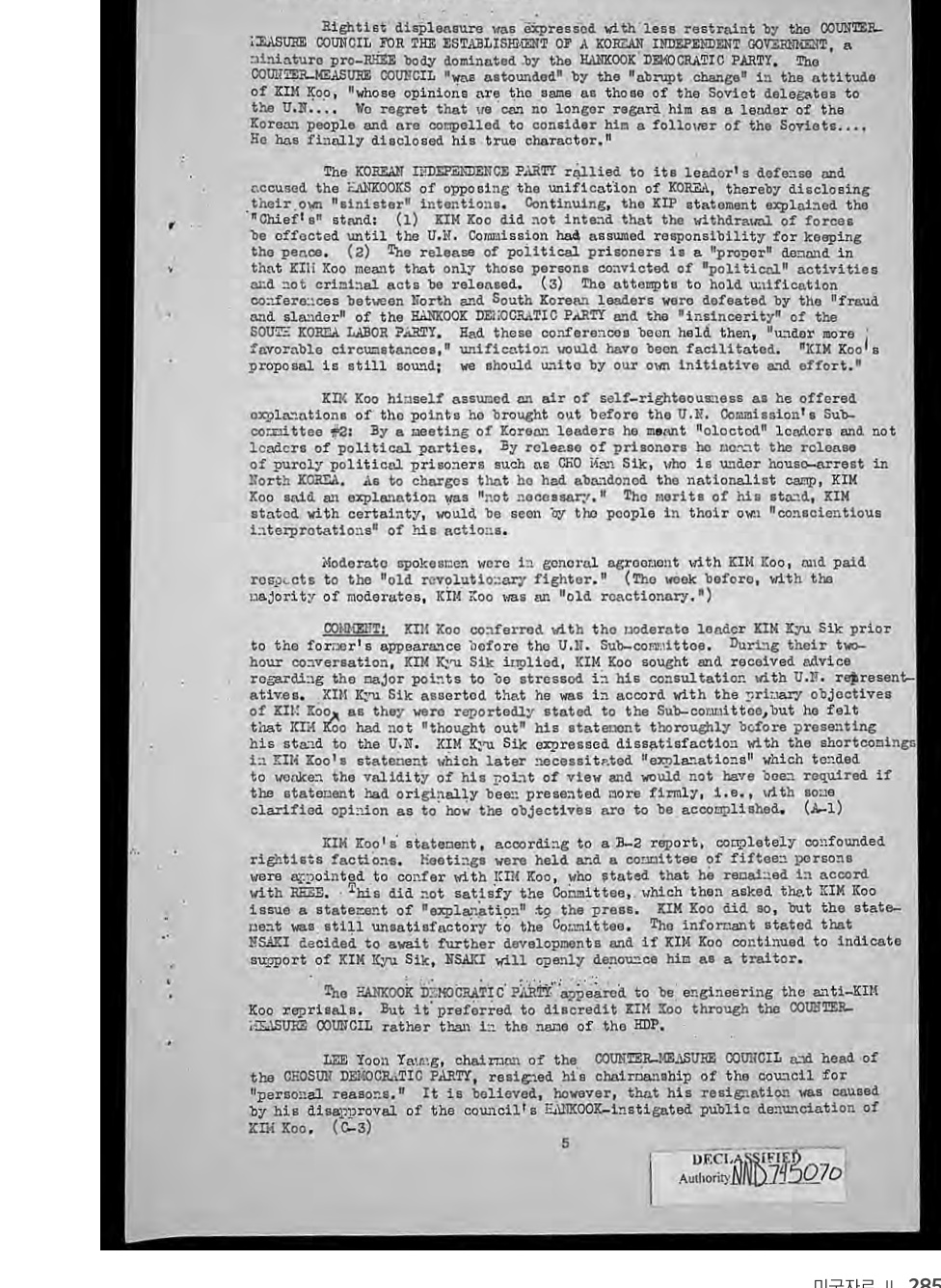
Rightist displeasure was expressed with less restraint by the COUNTER-MEASURE COUNCIL FOR THE ESTABLISHMENT OF A KOREAN INDEPENDENT GOVERNMENT, a miniature pro-RHEE body dominated by the HANKOOK DEMOCRATIC PARTY. The COUNTER-MEASURE COUNCIL "was astounded" by the "abrupt change" in the attitude of KIM Koo, "whose opinions are the same as those of the Soviet delegates to the U.N.... We regret that we can no longer regard him as a leader of the Korean people and are compelled to consider him a follower of the Soviets.... He has finally disclosed his true character."
The KOREAN INDEPENDENCE PARTY rallied to its leader's defense and accused the HANKOOKS of opposing the unification of KOREA, thereby disclosing their own "sinister" intentions. Continuing, the KIP statement explained the "Chief's" stand: (1) KIM Koo did not intend that the withdrawal of forces be effected until the U.N. Commission had assumed responsibility for keeping the peace. (2) The release of political prisoners is a "proper" demand in that KIM Koo meant that only those persons convicted of "political" activities and not criminal acts be released. (3) The attempts to hold unification conferences between North and South Korean leaders were defeated by the "fraud and slander" of the HANKOOK DEMOCRATIC PARTY and the "insincerity" of the SOUTH KOREA LABOR PARTY. Had these conferences been held then, "under more favorable circumstances," unification would have been facilitated. "KIM Koo's proposal is still sound; we should unite by our own initiative and effort."
KIM Koo himself assumed an air of self-righteousness as he offered explanations of the points he brought out before the U.N. Commission's Sub-committee #3: By a meeting of Korean leaders he meant "elected" leaders and not leaders of political parties. By release of prisoners he meant the release of purely political prisoners such as CHO Man Sik, who is under house-arrest in North KOREA. As to charges that he had abandoned the nationalist camp, KIM Koo said an explanation was "not necessary." The merits of his stand, KIM stated with certainty, would be seen by the people in their own "conscientious interpretations" of his actions.
Moderate spokesmen were in general agreement with KIM Koo, and paid respects to the "old revolutionary fighter." (The week before, with the majority of moderates, KIM Koo was an "old reactionary.")
COMMENT: KIM Koo conferred with the moderate leader KIM Kyu Sik prior to the former's appearance before the U.N. Sub-committee. During their two-hour conversation, KIM Kyu Sik implied, KIM Koo sought and received advice regarding the major points to be stressed in his consultation with U.N. representatives. KIM Kyu Sik asserted that he was in accord with the primary objectives of KIM Koo, as they were reportedly stated to the Sub-committee, but he felt that KIM Koo had not "thought out" his statement thoroughly before presenting his stand to the U.N. KIM Kyu Sik expressed dissatisfaction with the shortcomings in KIM Koo's statement which later necessitated "explanations" which tended to weaken the validity of his point of view and would not have been required if the statement had originally been presented more firmly, i.e., with some clarified opinion as to how the objectives are to be accomplished. (A-1)
KIM Koo's statement, according to a B-2 report, completely confounded rightists factions. Meetings were held and a committee of fifteen persons were appointed to confer with KIM Koo, who stated that he remained in accord with RHEE. This did not satisfy the Committee, which then asked that KIM Koo issue a statement of "explanation" to the press. KIM Koo did so, but the statement was still unsatisfactory to the Committee. The informant stated that NSAKI decided to await further developments and if KIM Koo continued to indicate support of KIM Kyu Sik, NSAKI will openly denounce him as a traitor.
The HANKOOK DEMOCRATIC PARTY appeared to be engineering the anti-KIM Koo reprisals. But it preferred to discredit KIM Koo through the COUNTER-MEASURE COUNCIL rather than in the name of the HDP.
LEE Yoon Yung, chairman of the COUNTER-MEASURE COUNCIL and head of the CHOSUN DEMOCRATIC PARTY, resigned his chairmanship of the council for "personal reasons." It is believed, however, that his resignation was caused by his disapproval of the council's HANKOOK-instigated public denunciation of KIM Koo. (C-3)
5
DECLASSIFIED
Authority NND 745070
XXIV CORPS G-2 W/S #125 PART I
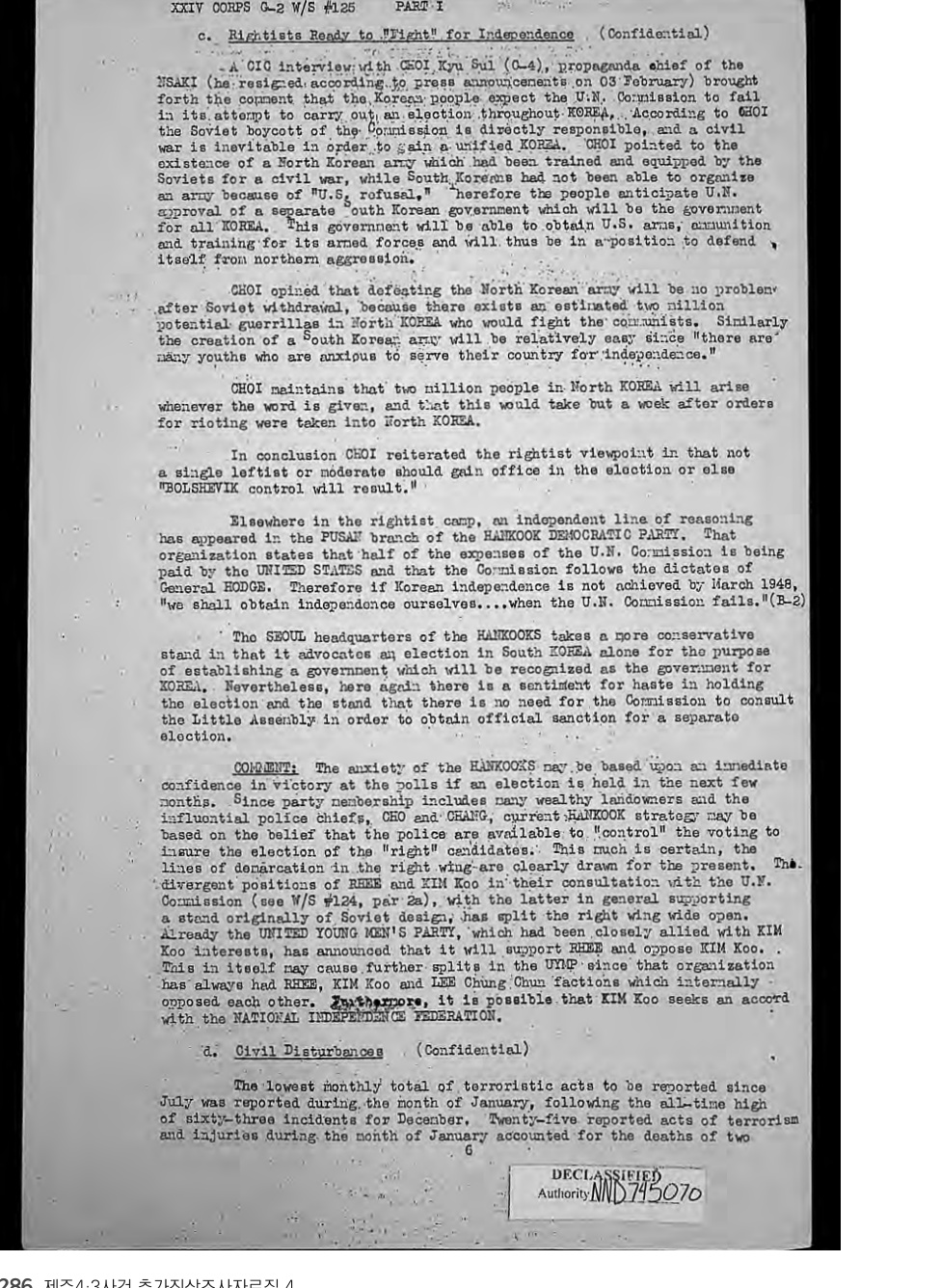
c. Rightists Ready to "Fight" for Independence (Confidential)
A CIC interview with CHOI Kyu Sul (C-4), propaganda chief of the MSAKI (he resigned according to press announcements on 03 February) brought forth the comment that the Korean people expect the U.N. Commission to fail in its attempt to carry out an election throughout KOREA. According to CHOI the Soviet boycott of the Commission is directly responsible, and a civil war is inevitable in order to gain a unified KOREA. CHOI pointed to the existence of a North Korean army which had been trained and equipped by the Soviets for a civil war, while South Koreans had not been able to organize an army because of "U.S. refusal." Therefore the people anticipate U.N. approval of a separate South Korean government which will be the government for all KOREA. This government will be able to obtain U.S. arms, ammunition and training for its armed forces and will thus be in a position to defend itself from northern aggression.
CHOI opined that defeating the North Korean army will be no problem after Soviet withdrawal, because there exists an estimated two million potential guerrillas in North KOREA who would fight the communists. Similarly the creation of a South Korean army will be relatively easy since "there are many youths who are anxious to serve their country for independence."
CHOI maintains that two million people in North KOREA will arise whenever the word is given, and that this would take but a week after orders for rioting were taken into North KOREA.
In conclusion CHOI reiterated the rightist viewpoint in that not a single leftist or moderate should gain office in the election or else "BOLSHEVIK control will result."
Elsewhere in the rightist camp, an independent line of reasoning has appeared in the PUSAN branch of the HANKOOK DEMOCRATIC PARTY. That organization states that half of the expenses of the U.N. Commission is being paid by the UNITED STATES and that the Commission follows the dictates of General HODGE. Therefore if Korean independence is not achieved by March 1948, "we shall obtain independence ourselves....when the U.N. Commission fails."(R-2)
The SEOUL headquarters of the HANKOOKS takes a more conservative stand in that it advocates an election in South KOREA alone for the purpose of establishing a government which will be recognized as the government for KOREA. Nevertheless, here again there is a sentiment for haste in holding the election and the stand that there is no need for the Commission to consult the Little Assembly in order to obtain official sanction for a separate election.
COMMENT: The anxiety of the HANKOOKS may be based upon an immediate confidence in victory at the polls if an election is held in the next few months. Since party membership includes many wealthy landowners and the influential police chiefs, CHO and CHANG, current HANKOOK strategy may be based on the belief that the police are available to "control" the voting to insure the election of the "right" candidates. This much is certain, the lines of demarcation in the right wing are clearly drawn for the present. The divergent positions of RHEE and KIM Koo in their consultation with the U.N. Commission (see W/S #124, par 2a), with the latter in general supporting a stand originally of Soviet design, has split the right wing wide open. Already the UNITED YOUNG MEN'S PARTY, which had been closely allied with KIM Koo interests, has announced that it will support RHEE and oppose KIM Koo. This in itself may cause further splits in the UYMP since that organization has always had RHEE, KIM Koo and LEE Chung Chun factions which internally opposed each other. Furthermore, it is possible that KIM Koo seeks an accord with the NATIONAL INDEPENDENCE FEDERATION.
d. Civil Disturbances (Confidential)
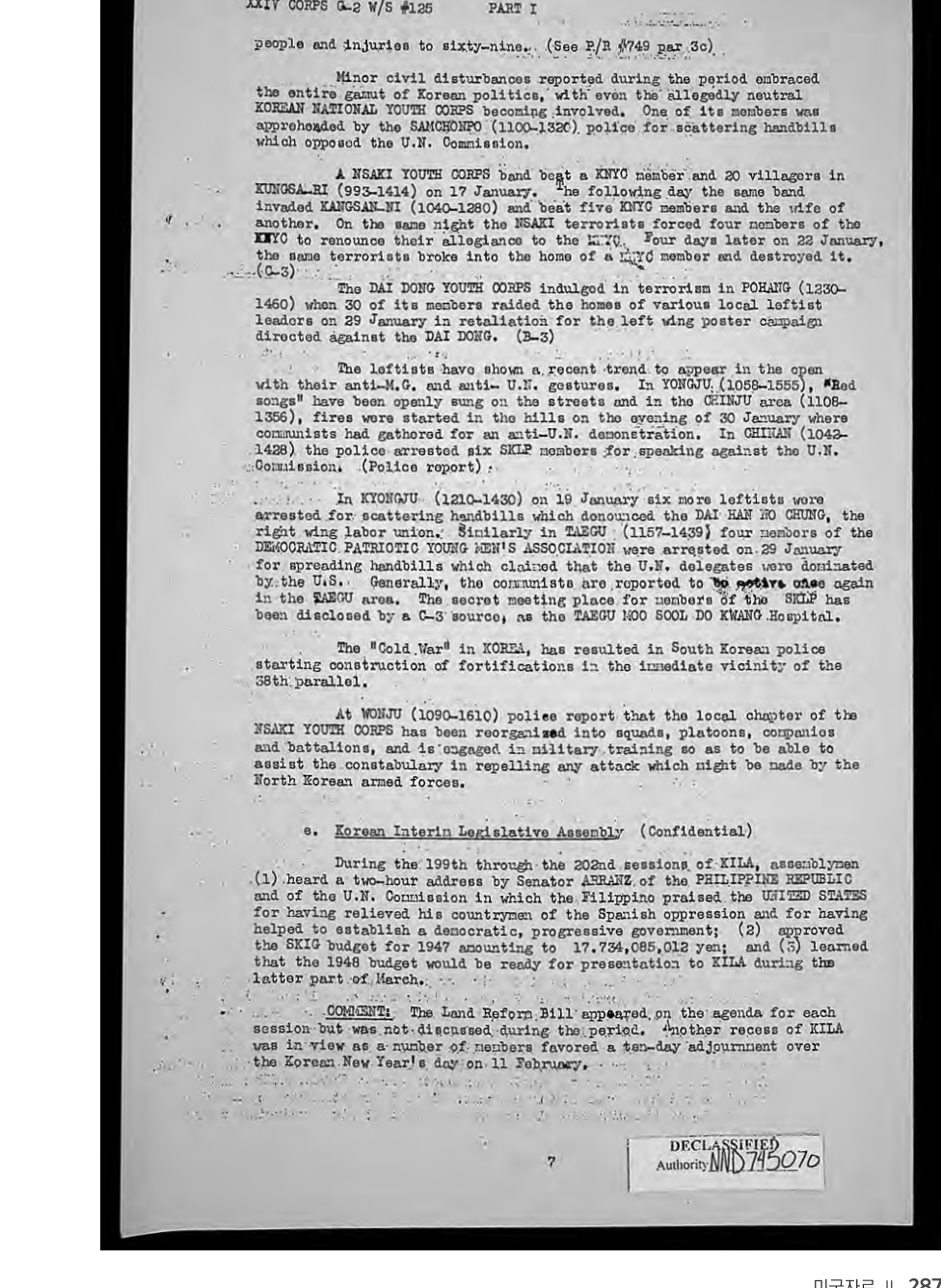
The lowest monthly total of terroristic acts to be reported since July was reported during the month of January, following the all-time high of sixty-three incidents for December. Twenty-five reported acts of terrorism and injuries during the month of January accounted for the deaths of two
6
DECLASSIFIED
Authority NND 745070
XXIV CORPS G-2 W/S #125 PART I
people and injuries to sixty-nine. (See P/R #749 par 3c)
Minor civil disturbances reported during the period embraced the entire gamut of Korean politics, with even the allegedly neutral KOREAN NATIONAL YOUTH CORPS becoming involved. One of its members was apprehended by the SAMCHONPO (1100-1320) police for scattering handbills which opposed the U.N. Commission.
A NSAKI YOUTH CORPS band beat a KNYC member and 20 villagers in KUNGSA-RI (993-1414) on 17 January. The following day the same band invaded KANGSAN-NI (1040-1280) and beat five KNYC members and the wife of another. On the same night the NSAKI terrorists forced four members of the KNYC to renounce their allegiance to the KNYC. Four days later on 22 January, the same terrorists broke into the home of a KNYC member and destroyed it. (C-3)
The DAI DONG YOUTH CORPS indulged in terrorism in POHANG (1230-1460) when 30 of its members raided the homes of various local leftist leaders on 29 January in retaliation for the left wing poster campaign directed against the DAI DONG. (B-3)
The leftists have shown a recent trend to appear in the open with their anti-M.G. and anti- U.N. gestures. In YONGJU (1059-1555), "Red songs" have been openly sung on the streets and in the CHINJU area (1108-1356), fires were started in the hills on the evening of 30 January where communists had gathered for an anti-U.N. demonstration. In CHINAN (1042-1428) the police arrested six SKLP members for speaking against the U.N. Commission. (Police report):
In KYONGJU (1210-1430) on 19 January six more leftists were arrested for scattering handbills which denounced the DAI HAN NO CHUNG, the right wing labor union. Similarly in TAEGU (1157-1439) four members of the DEMOCRATIC PATRIOTIC YOUNG MEN'S ASSOCIATION were arrested on 29 January for spreading handbills which claimed that the U.N. delegates were dominated by the U.S. Generally, the communists are reported to be active once again in the TAEGU area. The secret meeting place for members of the SKLP has been disclosed by a C-3 source, as the TAEGU MOO SOOL DO KWANG Hospital.
The "Cold War" in KOREA, has resulted in South Korean police starting construction of fortifications in the immediate vicinity of the 38th parallel.
At WONJU (1090-1610) police report that the local chapter of the NSAKI YOUTH CORPS has been reorganized into squads, platoons, companies and battalions, and is engaged in military training so as to be able to assist the constabulary in repelling any attack which might be made by the North Korean armed forces.
9. Korean Interin Legislative Assembly (Confidential)
During the 199th through the 202nd sessions of KILA, assemblymen (1) heard a two-hour address by Senator ARRANZ of the PHILIPPINE REPUBLIC and of the U.N. Commission in which the Filipino praised the UNITED STATES for having relieved his countrymen of the Spanish oppression and for having helped to establish a democratic, progressive government; (2) approved the SKIG budget for 1947 amounting to 17,734,085,012 yen; and (3) learned that the 1948 budget would be ready for presentation to KILA during the latter part of March.
COMMENT: The Land Reform Bill appeared on the agenda for each session but was not discussed during the period. Another recess of KILA was in view as a number of members favored a ten-day adjournment over the Korean New Year's day on 11 February.
7
DECLASSIFIED
Authority NND 745070
XXIV CORPS G-2 W/S #125 PART I
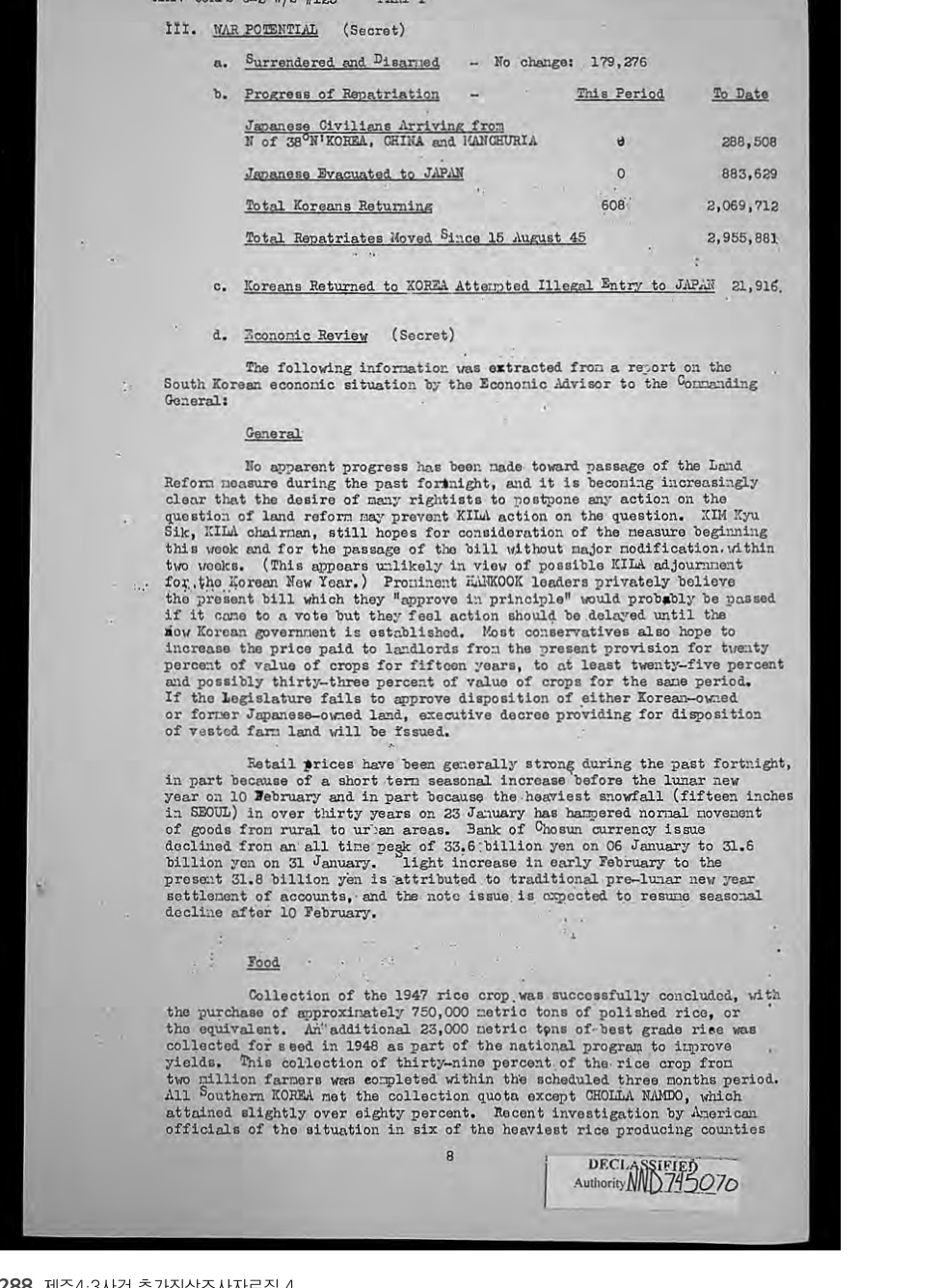
III. WAR POTENTIAL (Secret)
a. Surrendered and Disarmed -- No change: 179,276
b. Progress of Repatriation -- This Period To Date
Japanese Civilians Arriving from
N of 38°N KOREA, CHINA and MANCHURIA 8 288,508
Japanese Evacuated to JAPAN 0 883,629
Total Koreans Returning 608 2,069,712
Total Repatriates Moved Since 15 August 45 2,955,881
c. Koreans Returned to KOREA Attempted Illegal Entry to JAPAN 21,916.
d. Economic Review (Secret)
The following information was extracted from a report on the
South Korean economic situation by the Economic Advisor to the Commanding
General:
General
No apparent progress has been made toward passage of the Land
Reform measure during the past fortnight, and it is becoming increasingly clear that the desire of many rightists to postpone any action on the question of land reform may prevent KILA action on the question. KIM Kyu
Sik, KILA chairman, still hopes for consideration of the measure beginning this week and for the passage of the bill without major modification within two weeks. (This appears unlikely in view of possible KILA adjournment for the Korean New Year.) Prominent HANKOOK leaders privately believe the present bill which they "approve in principle" would probably be passed if it came to a vote but they feel action should be delayed until the new Korean government is established. Most conservatives also hope to increase the price paid to landlords from the present provision for twenty percent of value of crops for fifteen years, to at least twenty-five percent and possibly thirty-three percent of value of crops for the same period.
If the Legislature fails to approve disposition of either Korean-owned or former Japanese-owned land, executive decree providing for disposition of vested farm land will be issued.
Retail prices have been generally strong during the past fortnight, in part because of a short term seasonal increase before the lunar new year on 10 February and in part because the heaviest snowfall (fifteen inches in SEOUL) in over thirty years on 23 January has hampered normal movement of goods from rural to urban areas. Bank of Chosun currency issue declined from an all time peak of 33.6 billion yen on 06 January to 31.6 billion yen on 31 January. Light increase in early February to the present 31.8 billion yen is attributed to traditional pre-lunar new year settlement of accounts, and the note issue is expected to resume seasonal decline after 10 February.
Food
Collection of the 1947 rice crop was successfully concluded, with the purchase of approximately 750,000 metric tons of polished rice, or the equivalent. An additional 23,000 metric tons of best grade rice was collected for seed in 1948 as part of the national program to improve yields. This collection of thirty-nine percent of the rice crop from two million farmers was completed within the scheduled three months period.
All Southern KOREA met the collection quota except CHOLLA NAMDO, which attained slightly over eighty percent. Recent investigation by American officials of the situation in six of the heaviest rice producing counties
8
DECLASSIFIED
Authority NND 745070
XXIV CORPS G-2 W/S #125 PART I
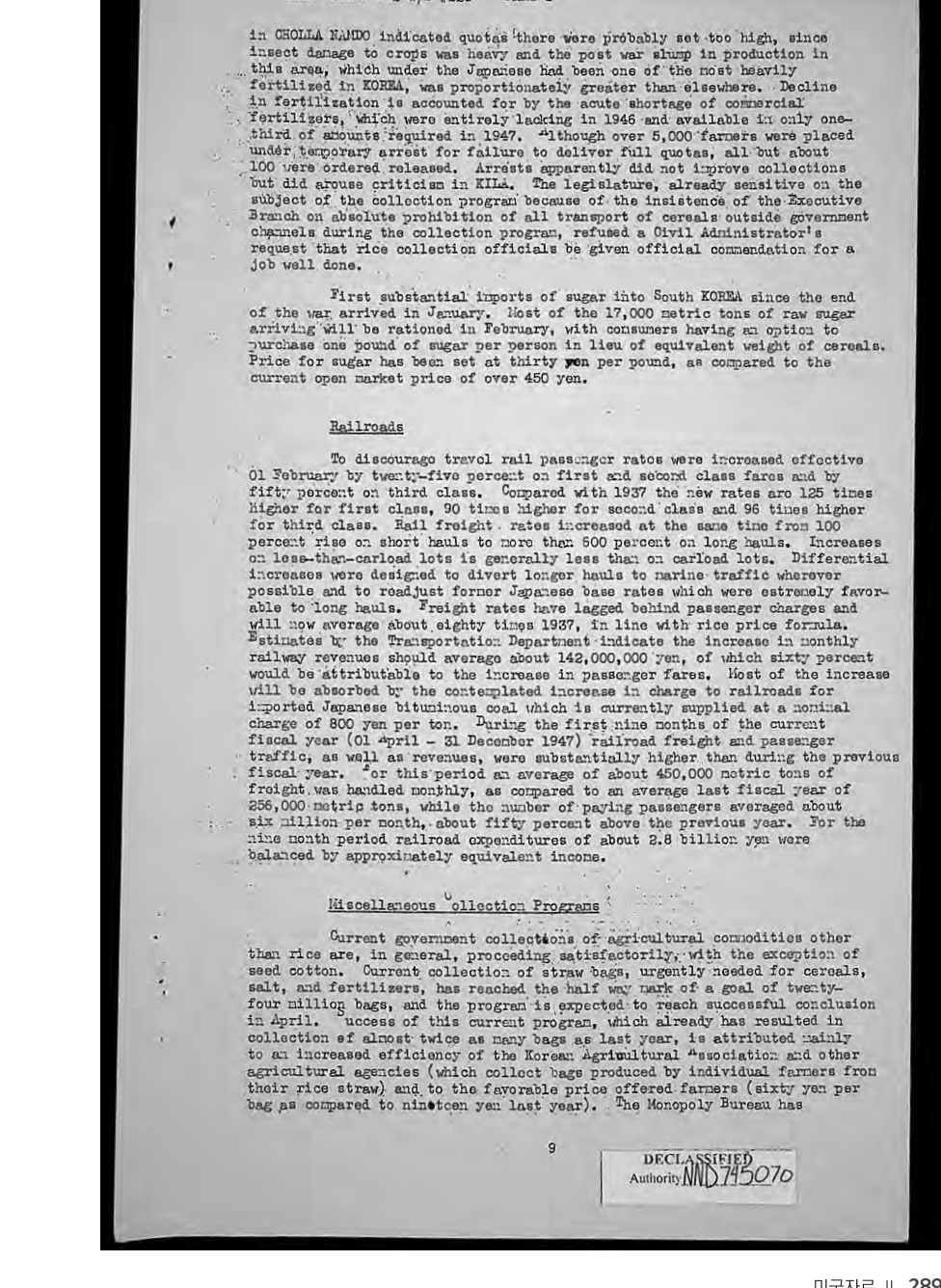
in CHOLLA NAMDO indicated quotas there were probably set too high, since insect damage to crops was heavy and the post war slump in production in this area, which under the Japanese had been one of the most heavily fertilized in KOREA, was proportionately greater than elsewhere. Decline in fertilization is accounted for by the acute shortage of commercial fertilizers, which were entirely lacking in 1946 and available in only onethird of amounts required in 1947. Although over 5,000 farmers were placed under temporary arrest for failure to deliver full quotas, all but about
100 were ordered released. Arrests apparently did not improve collections but did arouse criticism in KILA. The legislature, already sensitive on the subject of the collection program because of the insistence of the Executive
Branch on absolute prohibition of all transport of cereals outside government channels during the collection program, refused a Civil Administrator's request that rice collection officials be given official commendation for a job well done.
First substantial imports of sugar into South KOREA since the end of the war arrived in January. Most of the 17,000 metric tons of raw sugar arriving will be rationed in February, with consumers having an option to purchase one pound of sugar per person in lieu of equivalent weight of cereals.
Price for sugar has been set at thirty yen per pound, as compared to the current open market price of over 450 yen.
Railroads
To discourage travel rail passenger rates were increased effective
01 February by twenty-five percent on first and second class fares and by fifty percent on third class. Compared with 1937 the new rates are 125 times higher for first class, 90 times higher for second class and 96 times higher for third class. Rail freight rates increased at the same time from 100 percent rise on short hauls to more than 500 percent on long hauls. Increases on less-than-carload lots is generally less than on carload lots. Differential increases were designed to divert longer hauls to marine traffic wherever possible and to readjust former Japanese base rates which were extremely favorable to long hauls. Freight rates have lagged behind passenger charges and will now average about eighty times 1937, in line with rice price formula.
Estimates by the Transportation Department indicate the increase in monthly railway revenues should average about 142,000,000 yen, of which sixty percent would be attributable to the increase in passenger fares. Most of the increase will be absorbed by the contemplated increase in charge to railroads for imported Japanese bituminous coal which is currently supplied at a nominal charge of 800 yen per ton. During the first nine months of the current fiscal year (01 April - 31 December 1947) railroad freight and passenger traffic, as well as revenues, were substantially higher than during the previous fiscal year. For this period an average of about 450,000 metric tons of freight was handled monthly, as compared to an average last fiscal year of
256,000 metric tons, while the number of paying passengers averaged about six million per month, about fifty percent above the previous year. For the nine month period railroad expenditures of about 2.8 billion yen were balanced by approximately equivalent income.
Miscellaneous Collection Programs
Current government collections of agricultural commodities other than rice are, in general, proceeding satisfactorily, with the exception of seed cotton. Current collection of straw bags, urgently needed for cereals, salt, and fertilizers, has reached the half way mark of a goal of twentyfour million bags, and the program is expected to reach successful conclusion in April. Success of this current program, which already has resulted in collection of almost twice as many bags as last year, is attributed mainly to an increased efficiency of the Korean Agricultural Association and other agricultural agencies (which collect bags produced by individual farmers from their rice straw) and to the favorable price offered farmers (sixty yen per bag as compared to nineteen yen last year). The Monopoly Bureau has
9
DECLASSIFIED
Authority NND 745070
XXIV CORPS G-2 W/S #125 PART I
purchased 14,300 metric tons of the 1947 tobacco crop, which is estimated to be over ninety-five percent of the total crop. During 1947 the government collected about 2,300 metric tons of silk cocoons, as compared to about 2,100 metric tons in 1946. Current seed cotton collection program is proving to be the same dismal failure as last years program. As of 31 January only eight percent of the 1947 crop of ninety-two million pounds seed cotton had been collected, as compared to a total collection of five percent of the 1946 crop of one hundred thirty-two million pounds. Goal both years was about half the total crop, which was the proportion usually collected by the Japanese. The remainder is woven into cloth or otherwise utilized on farms. Reasons for the failure of the cotton collections include (1) poor 1947 crop, which was only about one-third of the 1940 - 1944 average; (2) extreme short supply and high price of cotton cloth, which encourages farmers to weave their own cloth for use and sale; (3) extremely low government purchase price for seed cotton of about fifteen yen per pound as compared to the current open market price of over 100 yen per pound. Although farmers are offered the opportunity to purchase cotton cloth at the official price as an incentive to sell to the government, this offer is not favorable enough to accomplish the purpose. An over-all review of the government's cotton policy is underway. Meanwhile the operation of major cotton mills is dependent upon imported cotton.
Summer Grain Planting
Preliminary Department of Agriculture reports on planted acreage of barley, wheat and rye crops planted in November-December 1947 totals 1,783,500 acres. Additional plantings of these crops, scheduled for harvest in the summer of 1948, will be made in early spring. Total summer grain planting is expected to exceed substantially the 1947 planting of 1,831,497 acres, but to be short of the 1948 goal for summer grains planted acreage of 2,230,410 acres. Average annual planted acreage of summer grains in 1940 - 1944 was 2,627,472 acres. The principal reason for the post war decline in planted acreage of summer grains has been a reduction in double cropping because of the shortage of fertilizer. Heavy rains followed by a freeze in late December are reported to have damaged winter crops in wide areas of South KOREA, but damage cannot be accurately assessed until the end of winter. Department of Agriculture's 1948 agricultural production goals, as approved by National Economic Board, estimate the 1948 rice crop at about 2,288,000 metric tons, ten percent above the 1940 - 1944 annual average.
e. The Price of Rice (Secret)
The open market price of rice for South KOREA shows an average increase of approximately 15 yen per small mal since 25 December 1947, with the most recent available prices shown below. The quotations are those found in the provincial capitals as of 25 January 1948. As a general rule the urban price of rice is somewhat higher than that in suburban and rural areas.
25 January 48 25 December 47
CHEJU DO (CHEJU) * 775
CHOLLA NANDO (KWANGJU) 550 550
CHOLLA PUKTO (CHONJU) 625 600
CHUNGCHONG NANDO (TAEJON) 650 700
CHUNGCHONG PUKTO (CHUNGJU) 620 600
KANGWON DO (CHUNCHON) * 770
KYONGGI DO (SEOUL) 800 770
KYONGSANG NANDO (PUSAN) 650 650
KYONGSANG PUKTO (TAEGU) * 550
* No report available for 25 January 1948
Current intelligence from North KOREA indicates an average quotation of 400 yen per small mal of rice, in the new currency.
10
DECLASSIFIED
Authority NND 745070
XXIV CORPS G-2 W/S #125 PART I
IV. PSYCHOLOGICAL
a. The Press (Confidential)
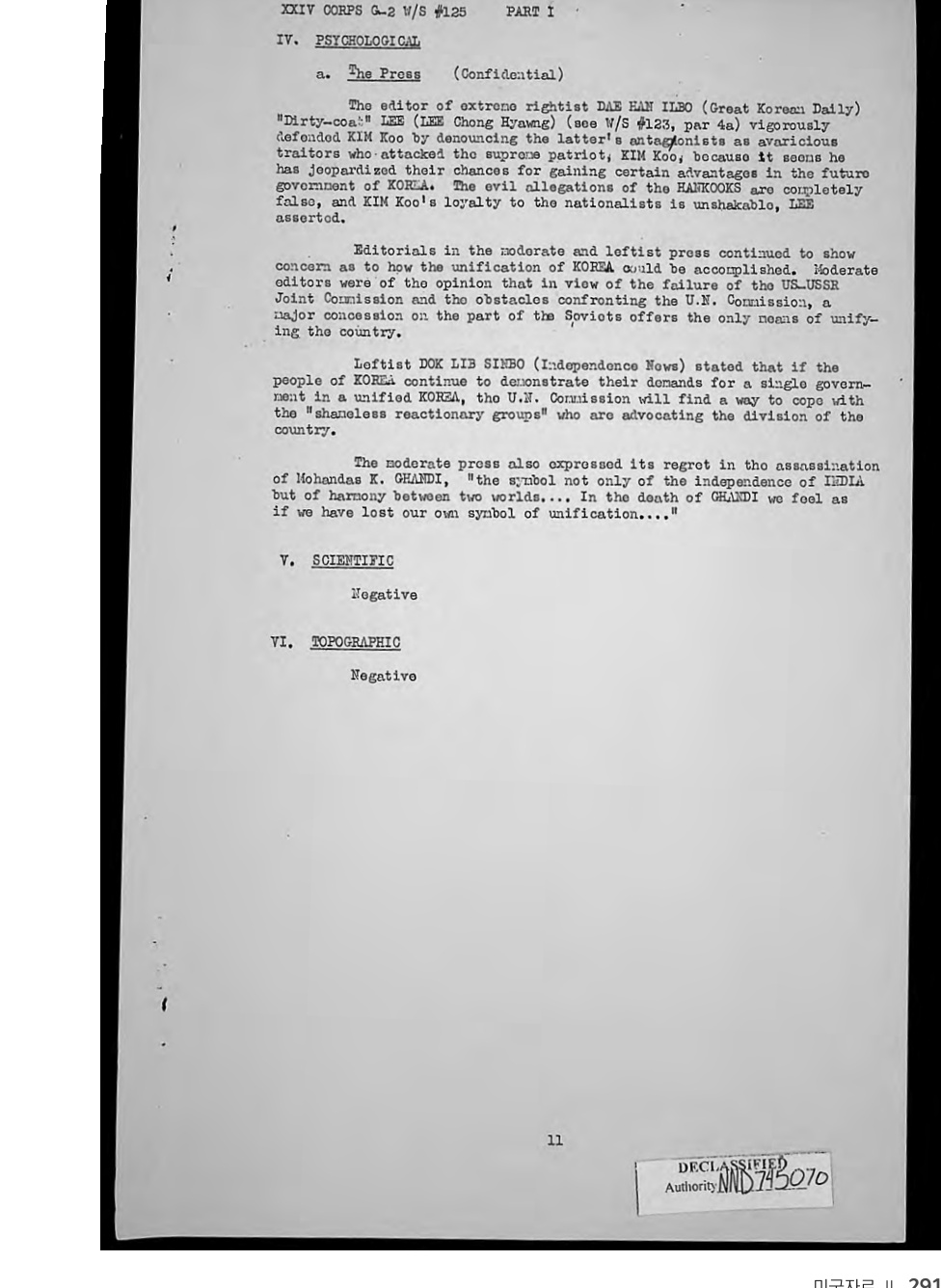
The editor of extreme rightist DAE HAN ILBO (Great Korean Daily)
"Dirty-coat" LEE (LEE Chong Hyawng) (see W/S #123, par 4a) vigorously defended KIM Koo by denouncing the latter's antagonists as avaricious traitors who attacked the supreme patriot, KIM Koo, because it seems he has jeopardized their chances for gaining certain advantages in the future government of KOREA. The evil allegations of the HANKOOKS are completely false, and KIM Koo's loyalty to the nationalists is unshakable, LEE asserted.
Editorials in the moderate and leftist press continued to show concern as to how the unification of KOREA could be accomplished. Moderate editors were of the opinion that in view of the failure of the US-USSR
Joint Commission and the obstacles confronting the U.N. Commission, a major concession on the part of the Soviets offers the only means of unifying the country.
Leftist DOK LIB SINBO (Independence News) stated that if the people of KOREA continue to demonstrate their demands for a single government in a unified KOREA, the U.N. Commission will find a way to cope with the "shameless reactionary groups" who are advocating the division of the country.
The moderate press also expressed its regret in the assassination of Mohandas K. GHANDI, "the symbol not only of the independence of INDIA but of harmony between two worlds.... In the death of GHANDI we feel as if we have lost our own symbol of unification...."
V. SCIENTIFIC
Negative
VI. TOPOGRAPHIC
Negative
11
DECLASSIFIED
Authority NND 745070
XXIV CORPS G-2 W/S #125 PART I
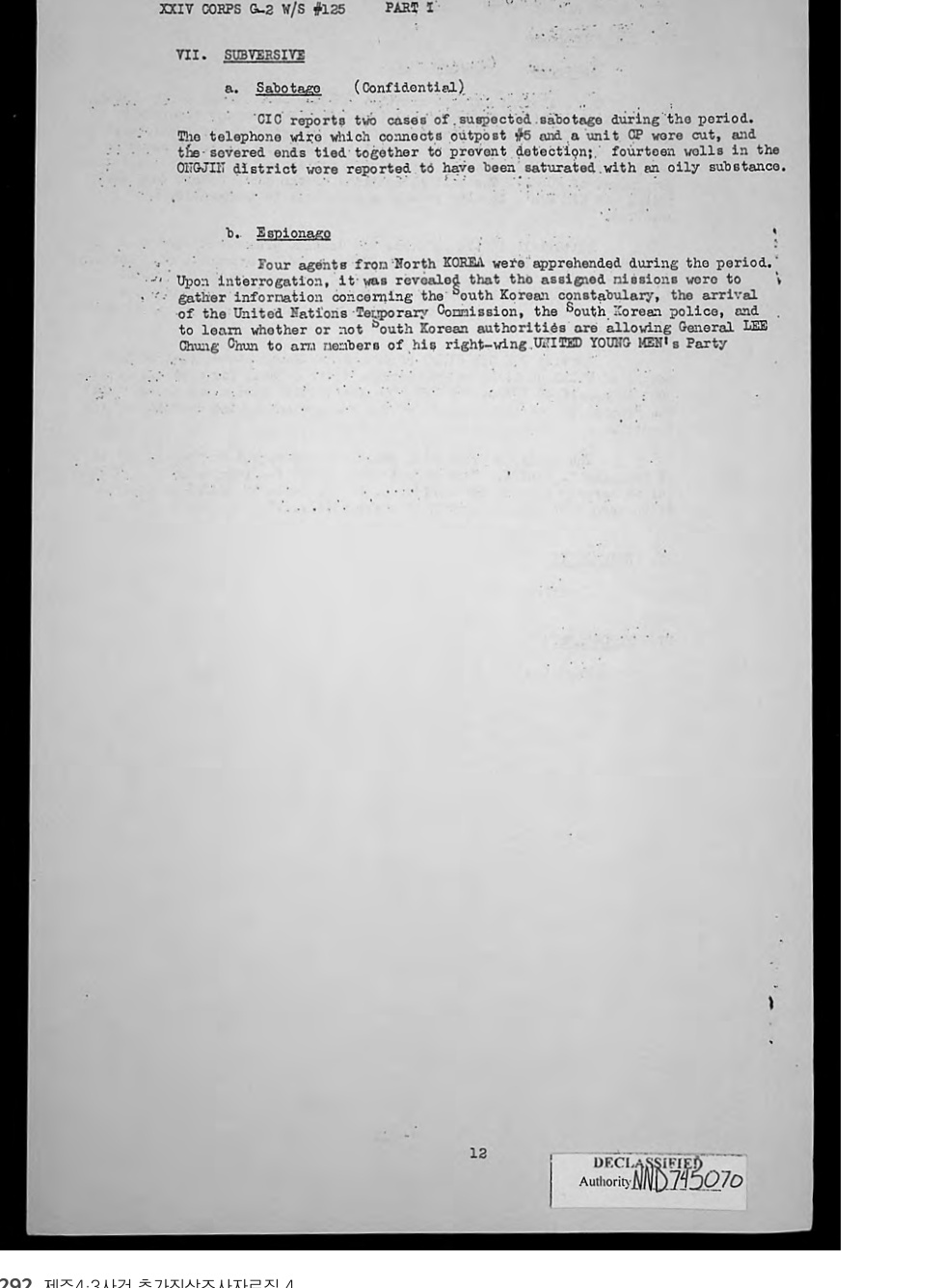
VII. SUBVERSIVE
a. Sabotage (Confidential)
CIC reports two cases of suspected sabotage during the period.
The telephone wire which connects outpost #5 and a unit CP were cut, and the severed ends tied together to prevent detection; fourteen wells in the
ONGJIN district were reported to have been saturated with an oily substance.
b. Espionage
Four agents from North KOREA were apprehended during the period.
Upon interrogation, it was revealed that the assigned missions were to gather information concerning the South Korean constabulary, the arrival of the United Nations Temporary Commission, the South Korean police, and to learn whether or not South Korean authorities are allowing General LEE
Chung Chun to arm members of his right-wing UNITED YOUNG MEN's Party
12
DECLASSIFIED
Authority NND 745070
출처:
제주4·3평화재단 편,
『추가진상조사자료집-미국자료2』,
p. 283–292.
— NARA (RG 554, Entry 1256, Box 59)
×
![]()