존 R. 하지 중장 편지에 첨부 1948년 3월 30일 유엔조선임시위원단 사실에 대한 진술 (STATEMENT OF FACTS)
주한미육군사령관이 임시위원단 의장에게 보낸 통신문에 담긴 내용과 관련해
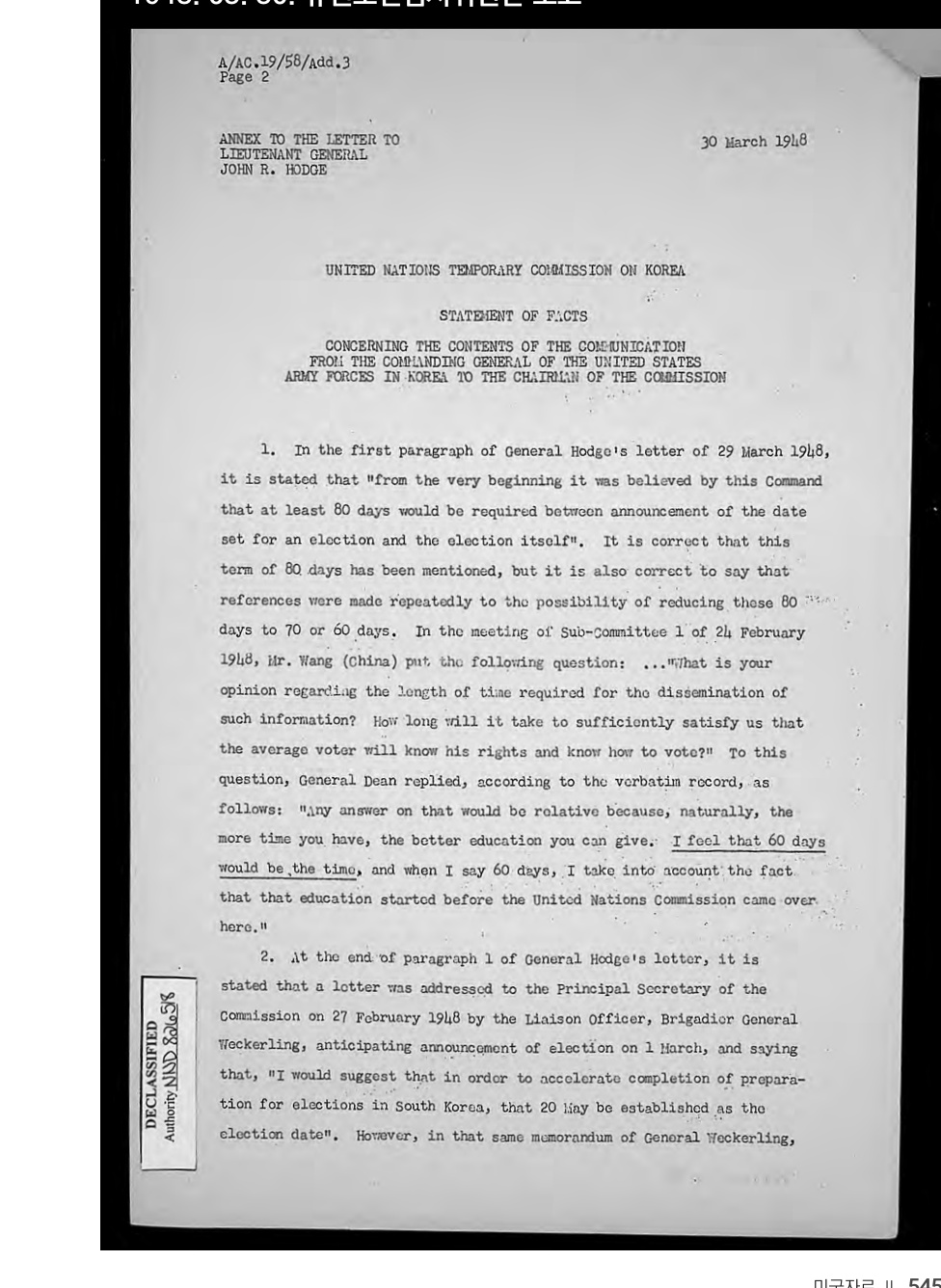
1. 하지 장군의 1948년 3월 29일 편지의 첫째 단락에는 "처음부터 선거일 공표 로부터 실재 선거까지 최소 80일이 필요하다고 사령부는 믿고 있었다"고 기술돼 있다. 80일이라는 기간이 언급된 것은 맞지만, 이 80일을 70 혹은 60일로 줄일 가능성에 대한 언급이 되풀이된 것 역시 정확하다고 할 수 있다. 1948년 2월 24 일 제1분과위원회 회의에서 왕(Wang, 중국)20은 다음과 같은 질문을 했다. "당신은 그런 정보를 배포하는데 시간이 얼마나 필요하다고 생각하느냐? 일반 유권자 들이 자신의 권리를 알고 어떻게 투표하는지 알게 돼 우리를 충분히 만족시키기까지 시간이 얼마나 걸리겠는가?" 이 질문에 대한 하지 장군의 대답은, 발언 기록 그대로에 따르면, 다음과 같다. "그에 대한 그 어떤 대답도 상대적일 것이다. 왜냐 하면, 당연히 시간이 많으면 많을수록 더 좋은 교육을 할 수 있기 때문이다. 나는 60일이 좋다고 생각한다, 그리고 내가 60일이라고 말할 때는, 유엔위원단이 여기에 오기 전에 그 교육이 시작됐다는 사실을 고려한 것이다.
2. 하지 장군 편지의 첫 단락 끝에는, 1948년 2월 29일 연락장교 웨컬링 준장이 3월 1일 선거 공표를 예상하면서, "나는 남조선에서 선거 준비를 빨리 끝내기 위해 5월 20일을 선거일로 할 것을 제안한다"는 내용의 편지를 위원단의 수석비 서관에게 보냈다고 적혀 있다. 그러나 웨컬링 장군의 바로 그 비망록에는 하지 장 군의 편지에서는 빠진 다음과 같은 문구가 있다. "만약 당신이 이 기간을 대략 10 일 정도 줄이는 것을 생각한다면, 나는 그 절차에 크게 반대하지는 않을 것이다."
20) 왕공행 (Wang Gung-Hsing): 중국 대표대리
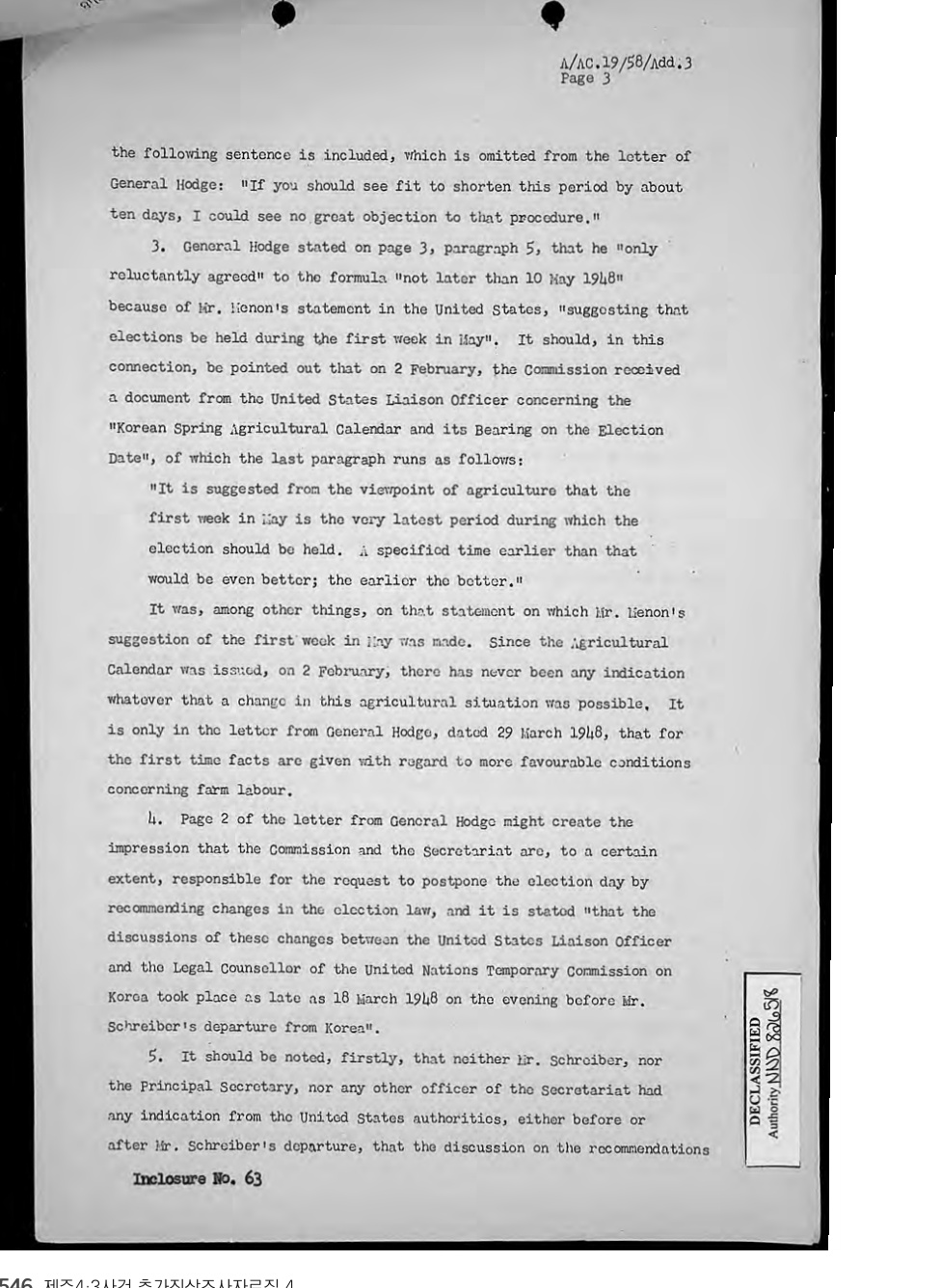
3. 하지 장군은 편지의 3쪽 다섯 번째 단락에서 "5월 첫째 주 선거 개최를 제안한다"는 메논(Menon)의 미국에서의 발언 때문에 "1948년 5월 10일을 넘기지않는" 방식에 마지못해 동의한 것이라고 말했다. 이와 관련해, 위원단이 2월 2일 미국 연락장교으로부터 "조선의 봄 농사 달력과 선거일의 관계"란 문건을 받은 사실이 지적되어야 한다. 해당 문건의 마지막 단락에는 다음과 같이 적혀 있다. "그것은 농사의 관점에서 제안된 것으로, 5월 첫째 주는 선거가 치러져야 하는 최후의 시기이다. 그보다 빠른 명시된 시간이 있다면 더욱 좋을 것이다. 빠르면 빠를수록 좋다." 그것은 메논의 5월 첫째 주 제안에서 언급된 것 중 하나였다. 2월 2일 농사 달력이 발행된 이후 농사 상황에 변화가 있을 수 있다는 암시는 전혀 없었다. 하지 장군의 1948년 3월 29일자 편지에 가서야 농사에 관련된 보다 알맞은 조건에 관한 사실들이 처음으로 제시됐다.
4. 하지 장군의 편지 2쪽은, 위원단과 사무국이 선거법 개정을 권고함으로써 선거 연기를 요청한 데 대해 일정 부분 책임이 있다는 인상을 줄 수 있다. 그리고 "이 개정에 대한 미국 연락장교와 유엔임시위원단 법률고문관 사이의 논의가 슈라이버(Schreiber)21가 조선을 떠나기 전인 1948년 3월 18일 저녁에 있었다"고 기술돼 있었다.
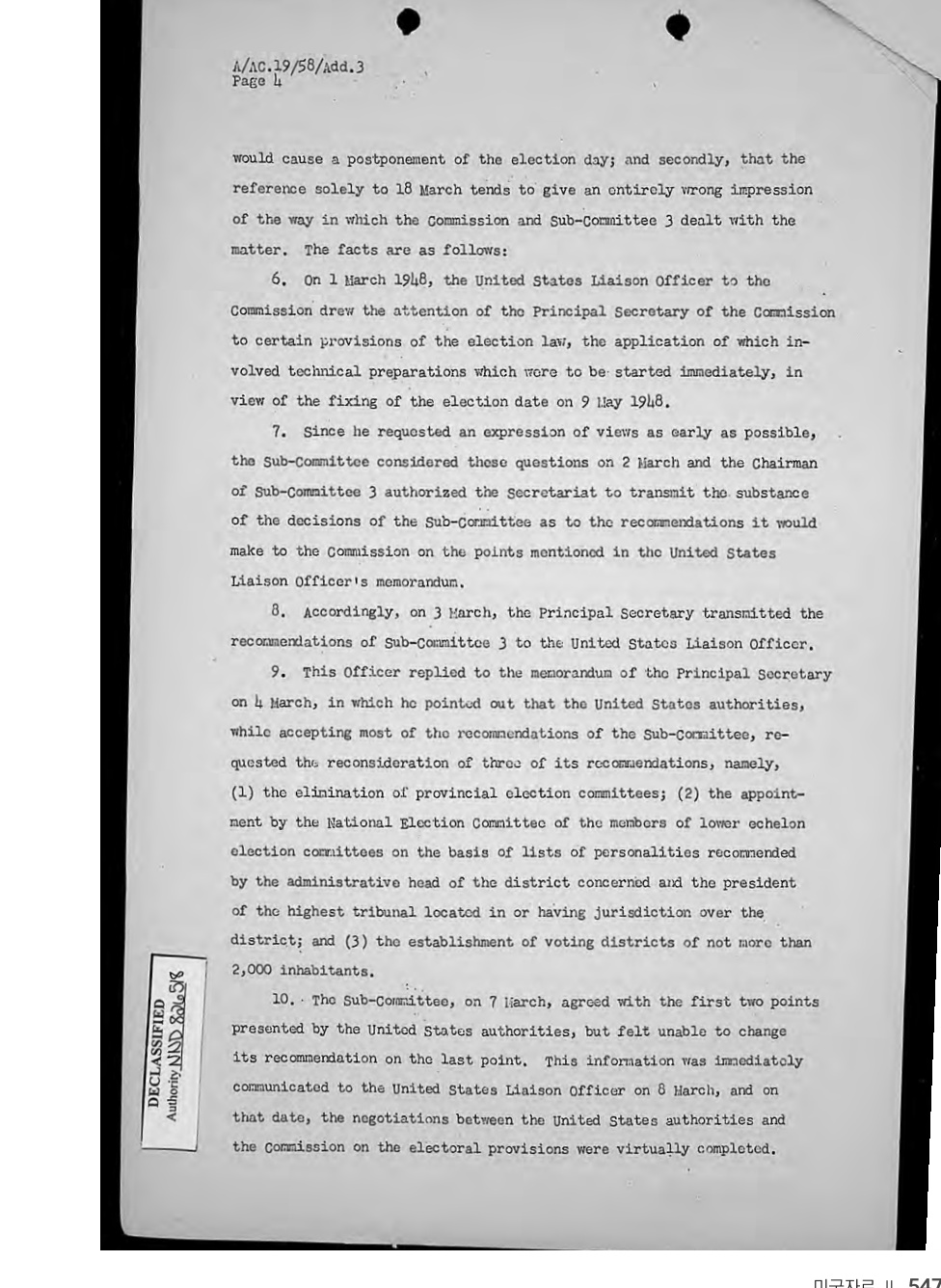
5. 슈라이버도, 수석비서관도, 사무처의 그 어느 간부(officer)도 슈라이버의 출발을 전후해 미국 당국으로부터 권고사항에 대한 논의가 선거일 연기를 가져올 것이라는 어떤 말도 듣지 못했다는 것을 가장 먼저 지적해야 하고, 그리고 두 번째로, 3월 18일만을 언급하면 위원단과 제3분과위원회가 그 문제를 다루는 방식에 대해 완전히 잘못된 인상을 줄 수 있다고 지적해야 한다. 사실은 다음과 같다.
6. 1948년 3월 1일, 위원단의 미국 연락장교가 위원단 수석비서관에게 선거법의 특정 조항을 주목하게 했는데, 그 조항의 적용은 선거일이 5월 9일로 확정된
21) [역주] 슈라이버 (Marc Schreiber) - 유엔임시위원단 법률고문관
다고 볼 때 즉시 시작되어야 할 기술적인 준비와 연관돼 있었다.
7. 그가 최대한 신속하게 의견표명을 해 줄 것을 요청했기 때문에 분과위원회가 3월 2일 이 문제를 검토했으며, 제3분과위원회 위원장은 미국 연락장교의 비망록에서 언급된 사항에 대해 분과위원회가 위원단에 제시할 권고사항의 결정 요지를 전달할 권한을 사무처에 부여했다.
8. 이에 따라 3월 2일 수석비서관이 미국 연락장교에게 제3분과위원회 권고사항을 전달했다.
9. 이 연락장교는 3월 4일 수석비서관 비망록에 대해 답변을 했는데, 그 답변에서 그는 미국 당국이 분과위원회 권고사항의 대부분을 수용하면서도 3가지 권고사항에 대해선 재고를 요청했다고 지적했다. 그 3가지는 (1) 도(道) 선거위원회 폐지, (2) 지역의 행정 책임자와 해당 지역에 있거나 혹은 관할권을 가진 최고재판소 수장에 의해 추천된 인물 목록에 기초해 국회선거위원회 하급 선거위원회 구성원을 임명, (3) 주민 수 2,000명 이하의 선거구 설치.
10. 분과위원회는 3월 7일 미국 당국이 제시한 것 중에서 첫 두 가지 사안에 대해 동의했으나, 마지막 한 가지는 위원회의 권고를 바꿀 수 없다고 판단했다. 이소식을 3월 8일 미국 연락장교가 알게 됐고, 당일 선거규정에 관한 미국 당국과 위원단의 협상이 사실상 마무리됐다.
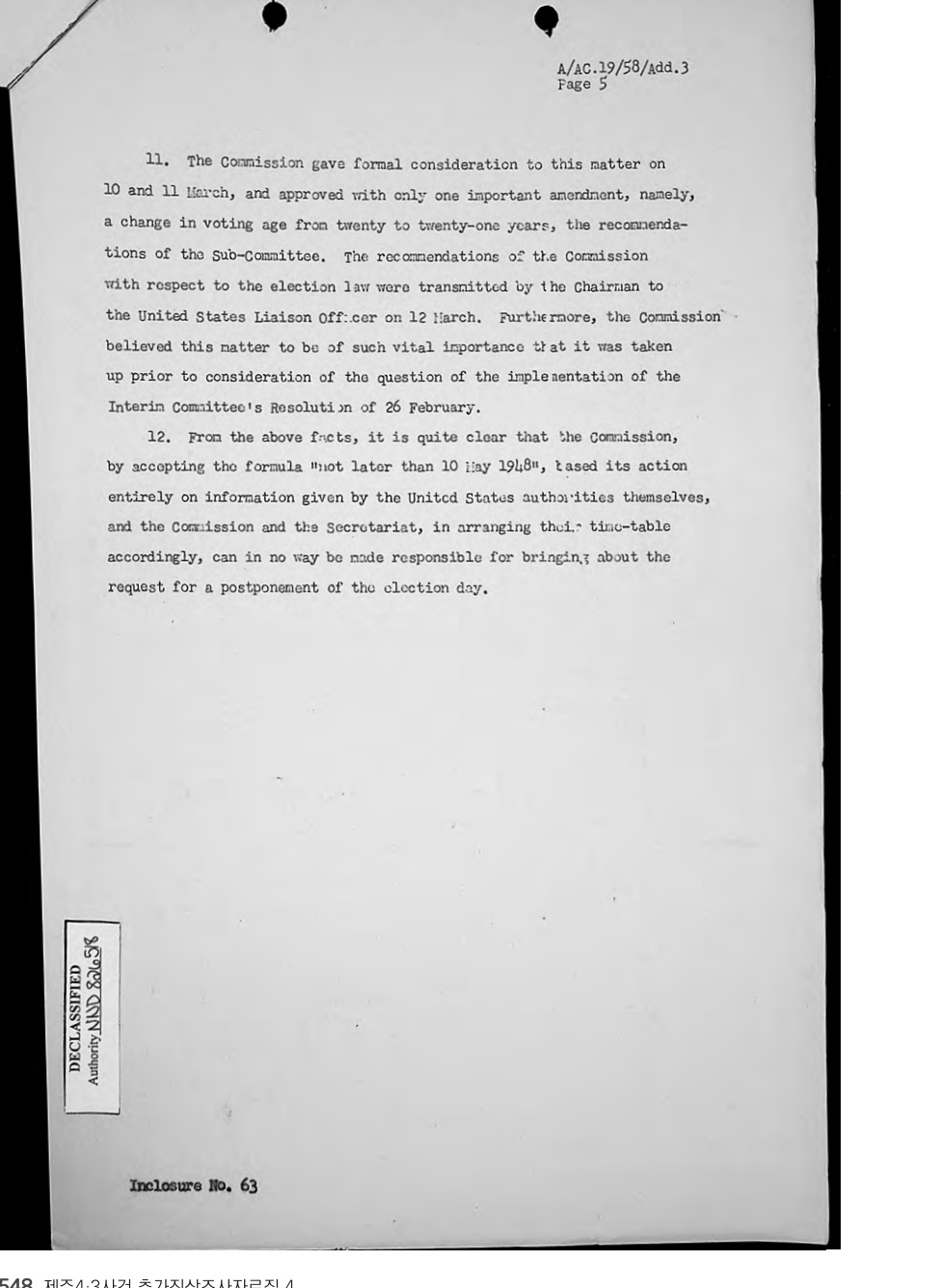
11. 위원단은 3월 10, 11일 양 일 간 이 문제를 공식적으로 검토했고, 단 한 가지 중요한 수정, 즉 분과위원회 권고사항인 투표 연령을 20세에서 21세로 변경해 이를 승인했다. 선거법과 관련한 위원단의 권고사항들은 위원단 의장에 의해 3월 12일 미국 연락관에게 전달됐다. 위원단은 이 사안이 임시위원회의 2월 26일 결의 이행 문제 검토보다 앞서 채택될 정도로 매우 중요하다고 믿었다.
12. 이상의 사실을 볼 때, 위원단은 전적으로 미국 당국이 제공한 정보에 근거
해 "1948년 5월 10일 이전"이라는 방식을 받아들였다는 것, 그리고 위원단과 사무처는 그에 따라 일정표를 조정하는 데 있어, 선거일 연기 요청을 야기한 데 대한 어떠한 책임도 없음이 아주 명백하다.
첨부문서 No.63
A/AC.19/58/Add.3
Page 2
ANNEX TO THE LETTER TO
LIEUTENANT GENERAL
JOHN R. HODGE
30 March 1948
UNITED NATIONS TEMPORARY COMMISSION ON KOREA
STATEMENT OF FACTS
CONCERNING THE CONTENTS OF THE COMMUNICATION
FROM THE COMMANDING GENERAL OF THE UNITED STATES
ARMY FORCES IN KOREA TO THE CHAIRMAN OF THE COMMISSION
1. In the first paragraph of General Hodge's letter of 29 March 1948, it is stated that "from the very beginning it was believed by this Command that at least 80 days would be required between announcement of the date set for an election and the election itself". It is correct that this term of 80 days has been mentioned, but it is also correct to say that references were made repeatedly to the possibility of reducing these 80 days to 70 or 60 days. In the meeting of Sub-Committee 1 of 24 February
1948, Mr. Wang (China) put the following question: ..."What is your opinion regarding the length of time required for the dissemination of such information? How long will it take to sufficiently satisfy us that the average voter will know his rights and know how to vote?" To this question, General Dean replied, according to the verbatim record, as
follows: "Any answer on that would be relative because, naturally, the
more time you have, the better education you can give. I feel that 60 days would be the time, and when I say 60 days, I take into account the fact that that education started before the United Nations Commission came over here."
2. At the end of paragraph 1 of General Hodge's letter, it is stated that a letter was addressed to the Principal Secretary of the
Commission on 27 February 1948 by the Liaison Officer, Brigadier General
Weckerling, anticipating announcement of election on 1 March, and saying that, "I would suggest that in order to accelerate completion of preparation for elections in South Korea, that 20 May be established as the election date". However, in that same memorandum of General Weckerling,
DECLASSIFIED
Authority NND 83653
A/AC.19/58/Add.3
Page 3
the following sentence is included, which is omitted from the letter of
General Hodge: "If you should see fit to shorten this period by about ten days, I could see no great objection to that procedure."
3. General Hodge stated on page 3, paragraph 5, that he "only reluctantly agreed" to the formula "not later than 10 May 1948"
because of Mr. Menon's statement in the United States, "suggesting that elections be held during the first week in May". It should, in this connection, be pointed out that on 2 February, the Commission received a document from the United States Liaison Officer concerning the
"Korean Spring Agricultural Calendar and its Bearing on the Election
Date", of which the last paragraph runs as follows:
"It is suggested from the viewpoint of agriculture that the first week in May is the very latest period during which the election should be held. A specified time earlier than that would be even better; the earlier the better."
It was, among other things, on that statement on which Mr. Menon's suggestion of the first week in May was made. Since the Agricultural
Calendar was issued, on 2 February, there has never been any indication whatever that a change in this agricultural situation was possible. It is only in the letter from General Hodge, dated 29 March 1948, that for the first time facts are given with regard to more favourable conditions concerning farm labour.
4. Page 2 of the letter from General Hodge might create the impression that the Commission and the Secretariat are, to a certain extent, responsible for the request to postpone the election day by recommending changes in the election law, and it is stated "that the discussions of these changes between the United States Liaison Officer and the Legal Counsellor of the United Nations Temporary Commission on
Korea took place as late as 18 March 1948 on the evening before Mr.
Schreiber's departure from Korea".
5. It should be noted, firstly, that neither Mr. Schreiber, nor the Principal Secretary, nor any other officer of the Secretariat had any indication from the United States authorities, either before or after Mr. Schreiber's departure, that the discussion on the recommendations
Inclosure No. 63
DECLASSIFIED
Authority NND 826658
A/AC.19/58/Add.3
Page 4
would cause a postponement of the election day; and secondly, that the reference solely to 18 March tends to give an entirely wrong impression of the way in which the Commission and Sub-Committee 3 dealt with the matter. The facts are as follows:
6. On 1 March 1948, the United States Liaison Officer to the
Commission drew the attention of the Principal Secretary of the Commission to certain provisions of the election law, the application of which involved technical preparations which were to be started immediately, in view of the fixing of the election date on 9 May 1948.
7. Since he requested an expression of views as early as possible, the Sub-Committee considered these questions on 2 March and the Chairman of Sub-Committee 3 authorized the Secretariat to transmit the substance of the decisions of the Sub-Committee as to the recommendations it would make to the Commission on the points mentioned in the United States
Liaison Officer's memorandum.
8. Accordingly, on 3 March, the Principal Secretary transmitted the recommendations of Sub-Committee 3 to the United States Liaison Officer.
9. This Officer replied to the memorandum of the Principal Secretary on 4 March, in which he pointed out that the United States authorities, while accepting most of the recommendations of the Sub-Committee, requested the reconsideration of three of its recommendations, namely,
(1) the elimination of provincial election committees; (2) the appointment by the National Election Committee of the members of lower echelon election committees on the basis of lists of personalities recommended by the administrative head of the district concerned and the president of the highest tribunal located in or having jurisdiction over the district; and (3) the establishment of voting districts of not more than
2,000 inhabitants.
10. The Sub-Committee, on 7 March, agreed with the first two points presented by the United States authorities, but felt unable to change its recommendation on the last point. This information was immediately communicated to the United States Liaison Officer on 8 March, and on that date, the negotiations between the United States authorities and the Commission on the electoral provisions were virtually completed.
DECLASSIFIED
Authority NND 832658
A/AC.19/58/Add.3
Page 5
11. The Commission gave formal consideration to this matter on
10 and 11 March, and approved with only one important amendment, namely, a change in voting age from twenty to twenty-one years, the recommendations of the Sub-Committee. The recommendations of the Commission with respect to the election law were transmitted by the Chairman to the United States Liaison Officer on 12 March. Furthermore, the Commission believed this matter to be of such vital importance that it was taken up prior to consideration of the question of the implementation of the
Interim Committee's Resolution of 26 February.
12. From the above facts, it is quite clear that the Commission, by accepting the formula "not later than 10 May 1948", based its action entirely on information given by the United States authorities themselves, and the Commission and the Secretariat, in arranging their time-table accordingly, can in no way be made responsible for bringing about the request for a postponement of the election day.
DECLASSIFIED
Authority NND 83458
Inclosure No. 63
출처:
제주4·3평화재단 편,
『추가진상조사자료집-미국자료2』,
p. 545–548.
— NARA (RG 554, Entry 1400, Box 298)
×
![]()