유엔조선임시위원단
1948년 3월 20일 제27차 회의에서 채택된 선거 참관 방법에 관한 임시 소위원회 보고서에 대한 결정.
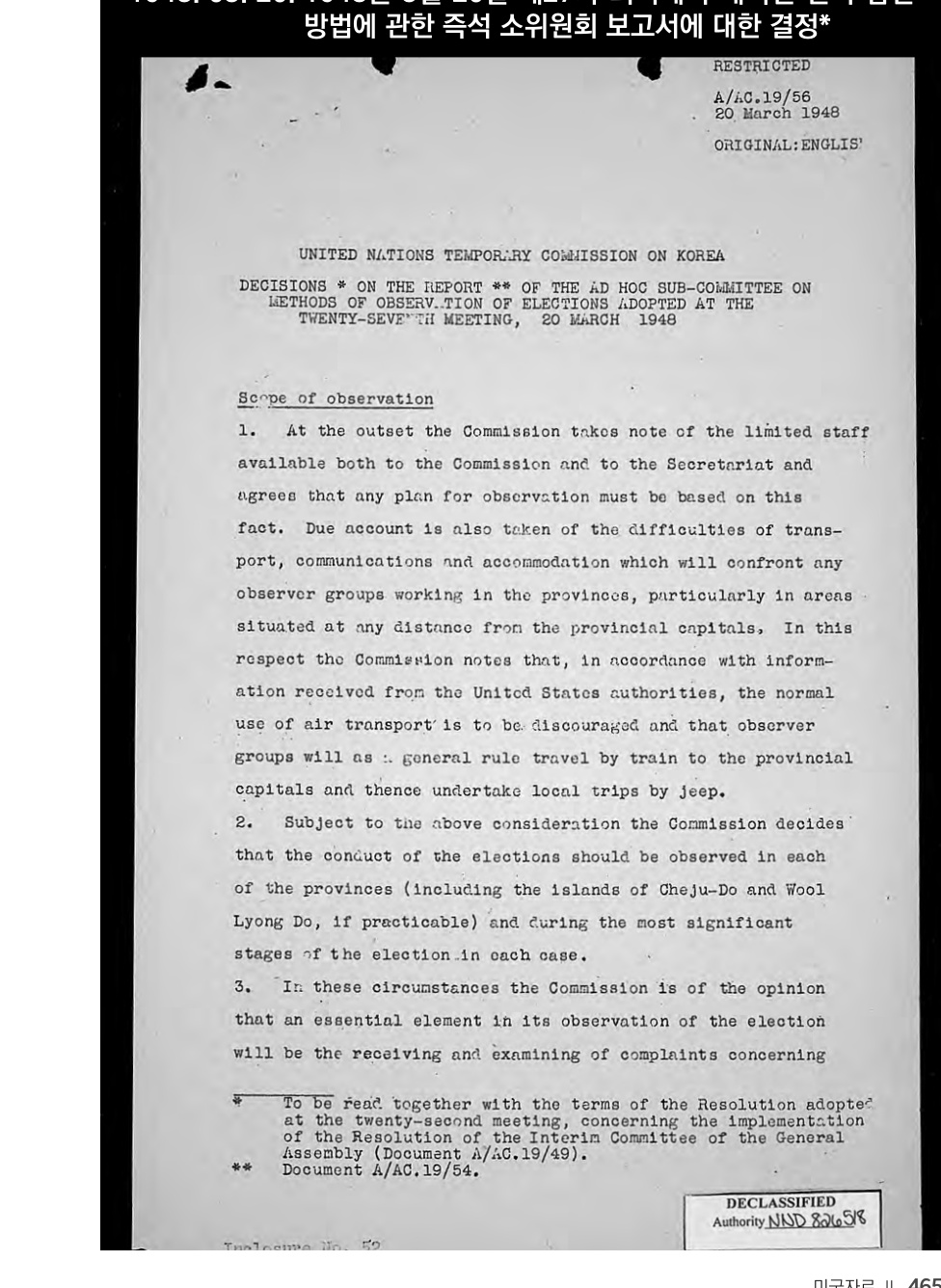
참관 범위
1. 먼저, 위원단은 위원단과 사무국의 한정된 가용 인력에 주목하면서, 그 어떤 참관 계획도 이 같은 사실에 기초해야 한다는 데 동의한다. 도 지역, 특히 도의 중심도시에서 떨어진 곳에서 일할 감시반이 직면할 교통수단, 통신, 숙박시설의 애로사항도 충분히 고려한다. 이와 관련해, 위원단은 미국 당국으로부터 받은 정보에 의하면 항공편의 정상적인 이용은 어려울 것이며, 감시반은 원칙적으로 기차로 도의 주요 도시로 이동한 뒤 다시 지프로 이동하게 될 것이라는 사실을 유념하고 있다.
2. 위와 같은 고려사항이 있음에도 선거 행위는 각 도(가능하다면, 제주도와 울릉도 포함)에서, 그리고 선거의 가장 중요한 단계에서 감시가 이뤄져야 한다고 위원단은 결정한다.
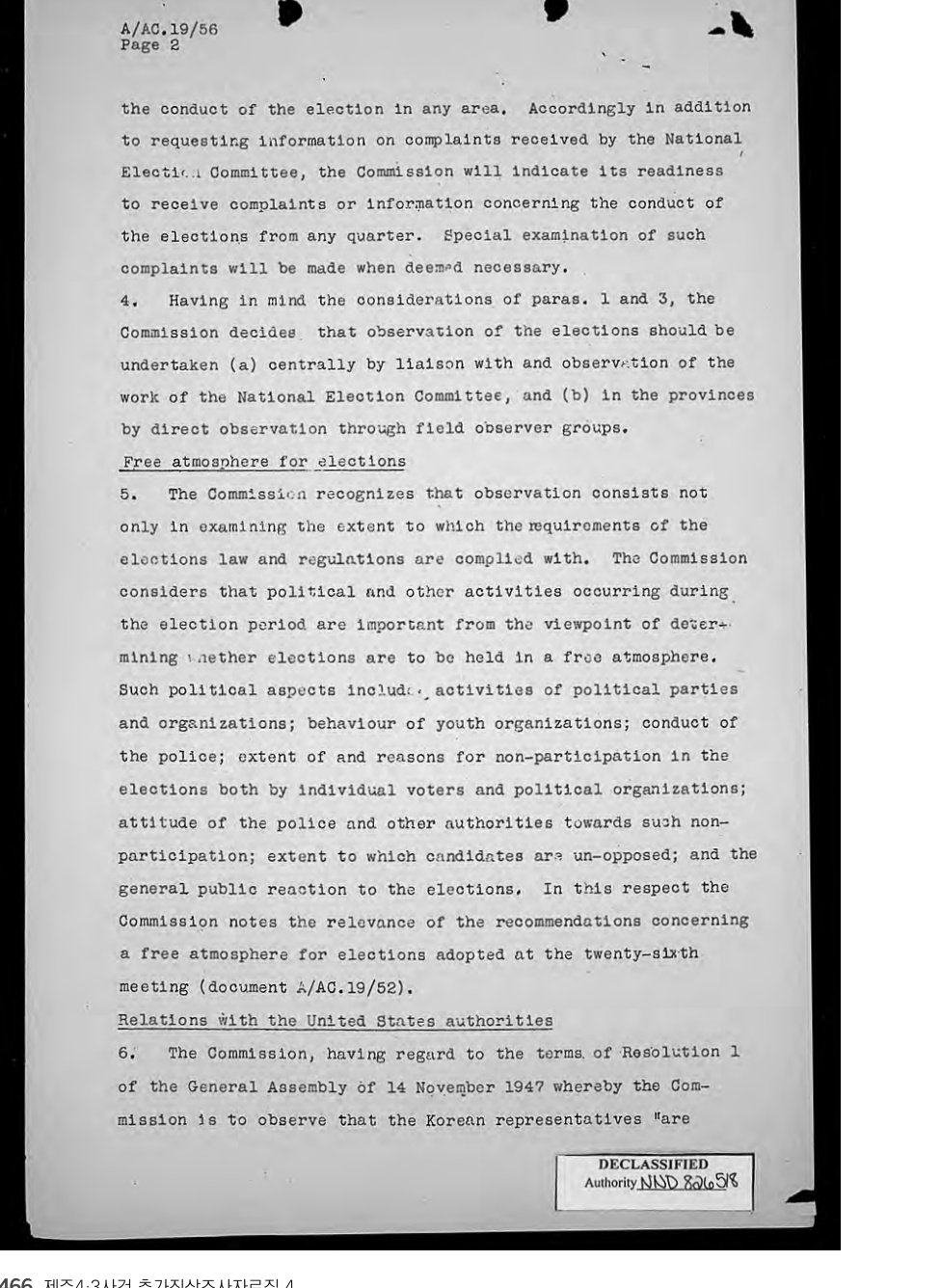
3. 선거를 감시하는 데 있어 가장 중요한 요소는, 지역에서 선거 행위와 관련된 불만 사항을 접수하고 검토하는 것이라고 위원단은 생각한다. 국회선거위원회가 접수한 불만 사항에 대한 정보를 요청하는 것 외에, 위원단 역시 불만 사항을 접수하고 선거 행위와 관련된 정보를 접수할 준비가 되어 있음을 알릴 것이다. 필요한 때에는 그 같은 불만 사항에 대한 특별 검토가 이뤄질 것이다.
4. 1과 3번 항목을 염두에 두고, 선거 감시는 (a) 국회선거위원회와 연계하고 또 그 업무에 대한 감시를 통해 중앙집중식으로, 그리고 (b) 도 지역에서는 현장 감시반을 통한 직접적인 감시 방식으로 이뤄져야 한다고 결정한다.
선거의 자유분위기
5. 위원단은 감시가 단순히 선거법과 규정의 요구사항이 어느 정도까지 준수되고 있는지 조사하는 것만은 아니란 것을 알고 있다. 위원단은 선거기간 발생하는 정치적인 혹은 다른 행위가, 자유분위기 속에서 선거가 치러지고 있는지는 여부를 판단하는 데 있어 중요하다고 생각한다. 그런 정치적인 측면에는 정당이나 단
체들의 행위, 청년단체들의 행위, 경찰 활동, 개인 유권자와 정치단체들이 선거에 불참하는 정도와 이유, 그런 불참자를 향한 경찰과 다른 당국들의 태도, 경쟁자가 없는 후보의 규모, 선거에 대한 일반 대중의 반응이 포함된다. 이런 측면에서 위 원단은 제26차 회의에서 채택된 선거의 자유분위기와 관련한 건의의 타당성에 유념하고 있다.(문건 A/AC. 19/52)
미국 당국과의 관계
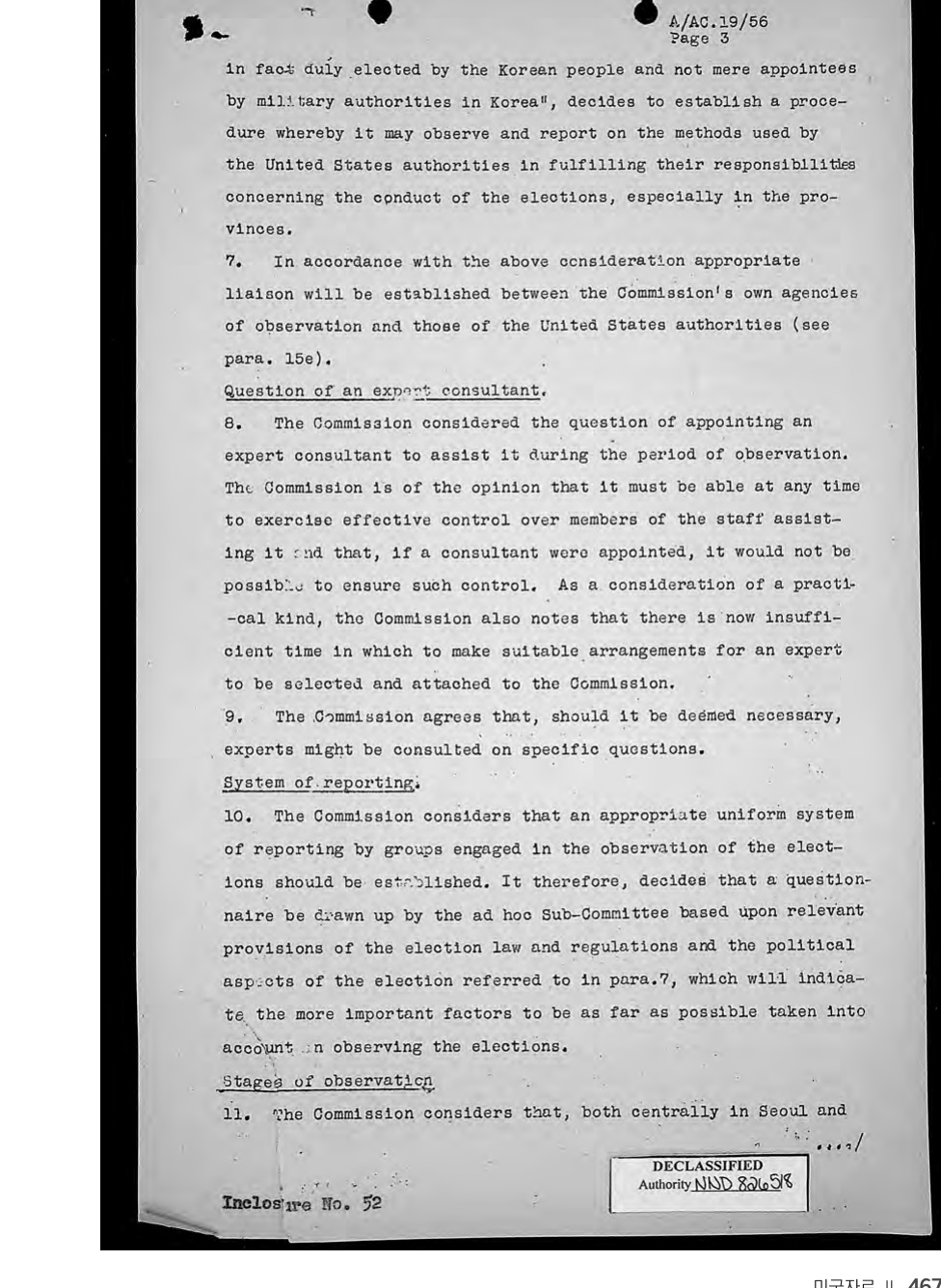
6. 위원단은 조선인의 대표가 조선에 있는 군 당국에 의해 지명되는 것이 아니라 조선 인민이 정당하게 선출할 수 있도록 위원단이 감시하게 한 1947년 11월 14일 총회 결의 제1호의 조항들을 유념하여, 미국 당국이 선거 특히 도 지역 선 거 수행에 대한 자신의 책임을 다하기 위해 사용하는 방법을 감시하고 보고할 수 있는 절차를 만들기로 결정했다.
7. 위 고려사항에 따라, 위원단 감시 조직과 미국 당국의 조직 간에 적절한 연락 체계가 설치될 것이다.(15항 e 참고)
전문가 자문 문제
8. 위원단은 감시기간 이를 도와줄 전문 컨설턴트를 지명하는 문제를 검토했다.
위원단은 참관을 지원하는 구성원에 대한 효과적인 통제가 언제든 가능해야 하는 데, 자문이 지명된다면 그 같은 통제가 보장될 수 없다고 생각한다. 현실적으로 검토하더라도, 위원단은 전문가를 선발해 위원단에 합류시키는데 필요한 충분한 시간적 여유가 없다는 점에 유념하고 있다.
9. 위원단은 정말 필요하다면, 컨설턴트는 구체적인 문제에 대해 조언할 수 있 다는 데 동의한다.
보고 시스템
10. 위원단은 선거 감시반별로 통일된 보고 시스템이 마련되어야 한다고 생각한 다. 위원단은 선거법과 선거법 시행세칙의 관련 조항과 위 7항에 언급된 선거의 정 치적 측면을 바탕으로 특별분과위원회가 질문지를 작성해야 한다고 결정했으며, 그것은 선거 감시에서 최대한 고려되어야 할 대단히 중요한 요소를 보여줄 것이다.
감시 단계
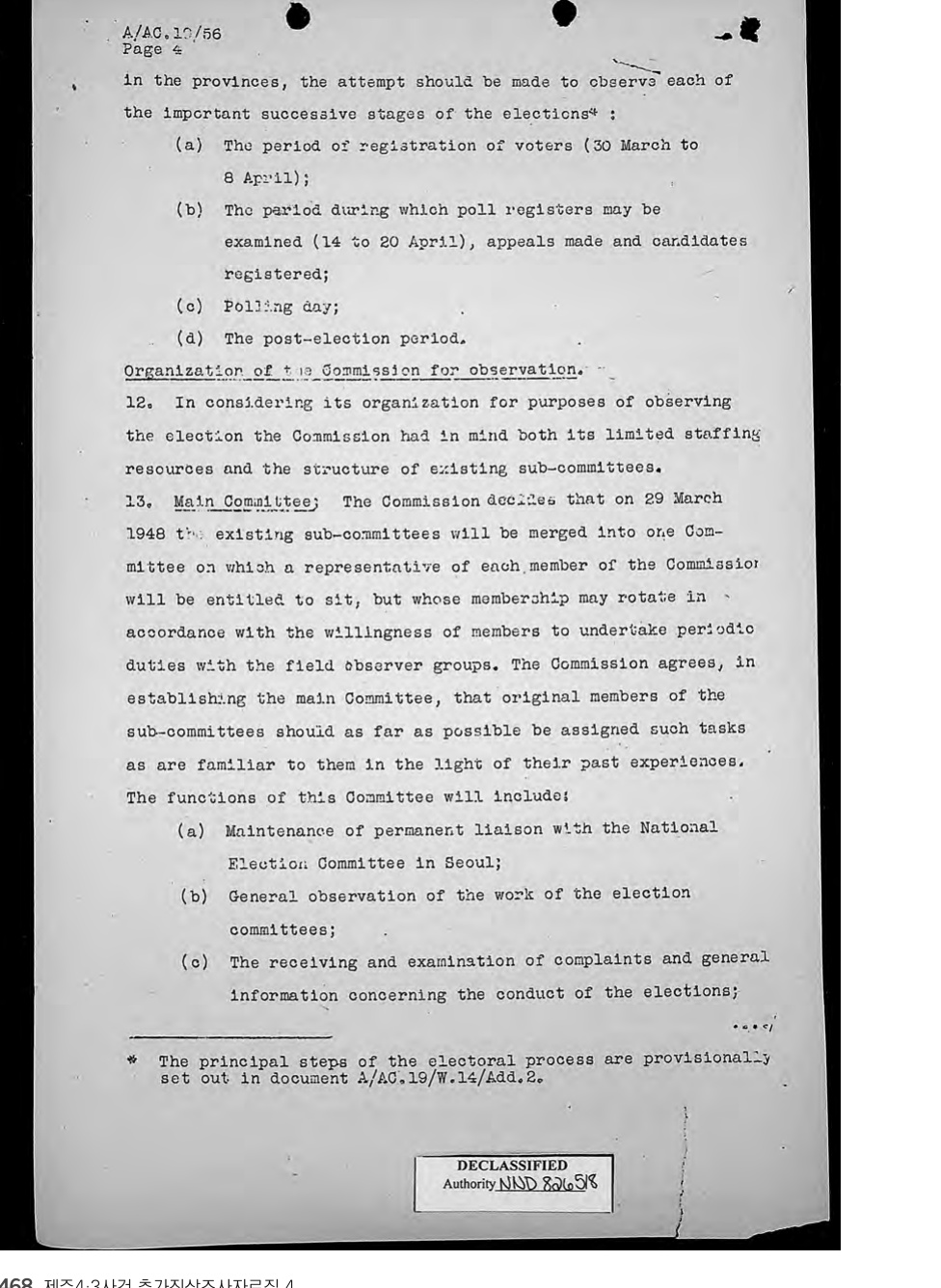
11. 위원단은 서울과 도 모두에서 중앙집중적으로 선거의 중요한 연속적 단계 마다 감시가 이루어져야 한다고 생각한다.12 *
(a) 유권자 등록 기간.(3월 30일부터 4월 8일까지)
(b) 선거인 명부 검토 기간 (4월 14일부터 20일) 이의신청 및 후보자 등록.
(c) 투표일.
(d) 선거 후 기간.
감시를 위한 위원단 조직
12. 선거 감시를 목적으로 한 위원단 조직을 고려함에 있어, 위원단은 한정된 인적 자원과 기존의 분과위원회 구조를 모두 염두에 두고 있다.
13. 주무위원회: 위원단은 1948년 3월 29일 기존의 분과위원회들을 하나의 위 원회로 통합하기로 결정했으며, 위원단 각 구성원의 대표 1명은 위원회의 일원이 될 자격은 있으나, 그 자격은 현장 감시반과 주기적으로 임무를 수행하는 위원들의 뜻에 따라 순환될 수 있다. 위원단은 본위원회를 설립하는 데 있어, 분과위원 회 원래의 구성원에게 그들의 과거 경험에 비추어 익숙한 임무를 최대한 배정한 다는 데 동의했다.
이 위원회의 기능은 다음과 같다.
(a) 서울에 있는 국회선거위원회와 상시 연락망 유지.
(b) 선거위원회 업무에 대한 전반적인 감시.
(c) 선거위원회 활동과 관련한 일반적인 정보와 불만사항 접수 및 검토.
(d) 위원단의 감시반으로부터 받은 보고서 분석.
(e) 선거 참가에 대한 조선인들의 태도와 관련한 정보 획득과 분석.
(f) 선거실시의 자유분위기와 관련된 양상을 검토하고 위원단에 보고.
(g) 위원단의 일반적인 지시에 따라 지방 감시반의 활동을 계획하고 조정.
14. 위의 책무를 이행하는 데 있어, 위원단은 언급된 사항의 구체적 기간에 따라 분과별 소위원회를 설치하고, 불만 사항을 검토할 특별 조직을 설치할 수 있 다.
12) [원주] 선거 과정의 주요 단계는 서류 A/AC.19/W/Add.2.에 잠정적으로 설정돼 있다.
다.(15항 c)
지방 감시반
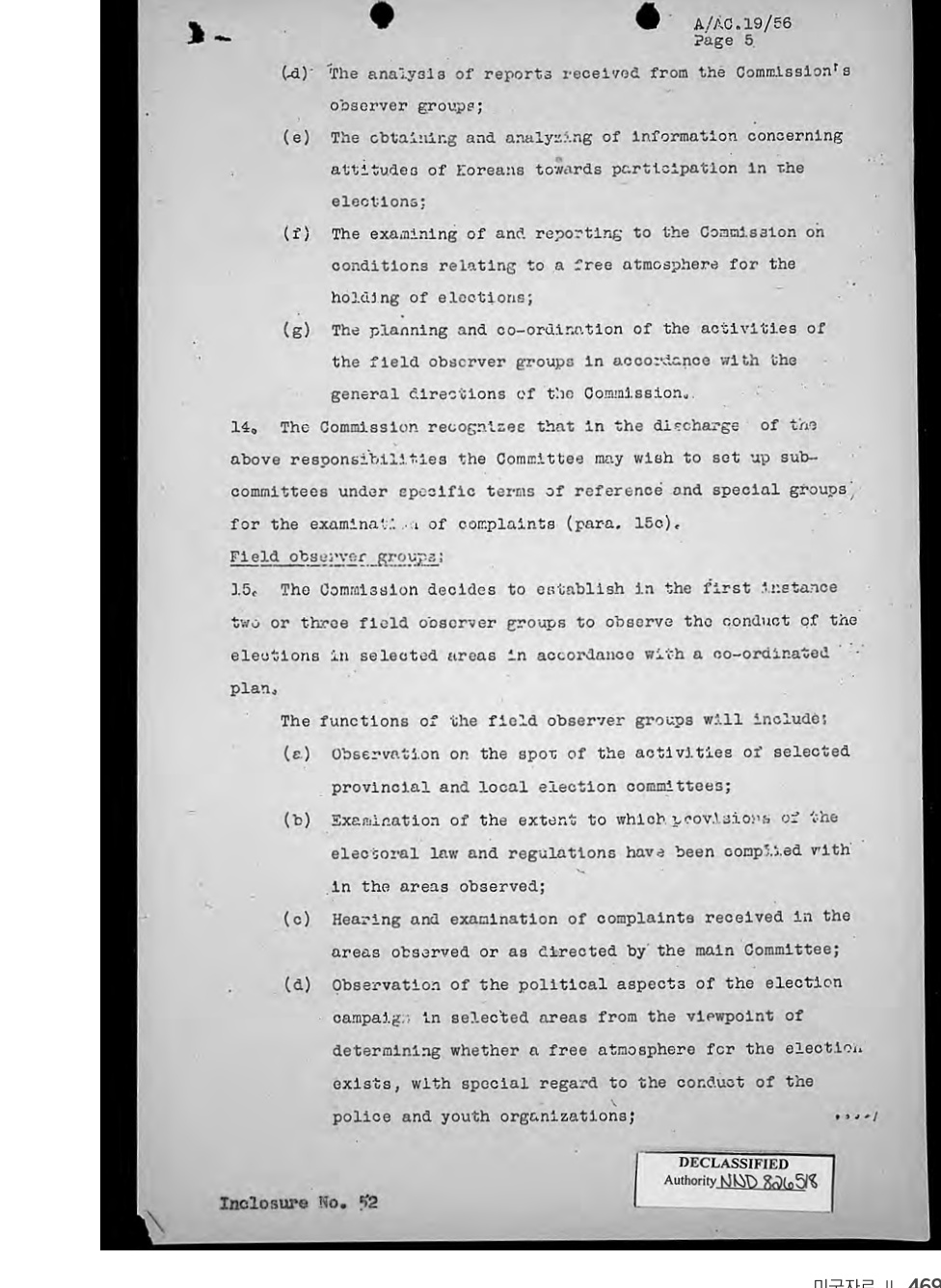
15. 위원단은 조정된 계획에 맞춰 선정된 지역에서 선거를 감시할 2~3개의 지방 감시반을 먼저 만들기로 결정했다.
지방 감시반의 기능은 다음과 같다.
(a) 선정된 도와 지역 선거위원회의 활동 현장 감시.
(b) 선거법과 선거법 시행세칙 조항이 감시지역에서 준수되고 있는 정도를 조사.
(c) 감시지역에서 접수된, 또는 본위원회의 지시에 따라 불만 사항을 듣고 검토.
(d) 선정된 지역에서, 특히 경찰과 청년단체들의 행동과 관련해, 자유로운 선거분위기 여부를 판단한다는 관점에서 선거운동의 정치적인 측면을 감시.
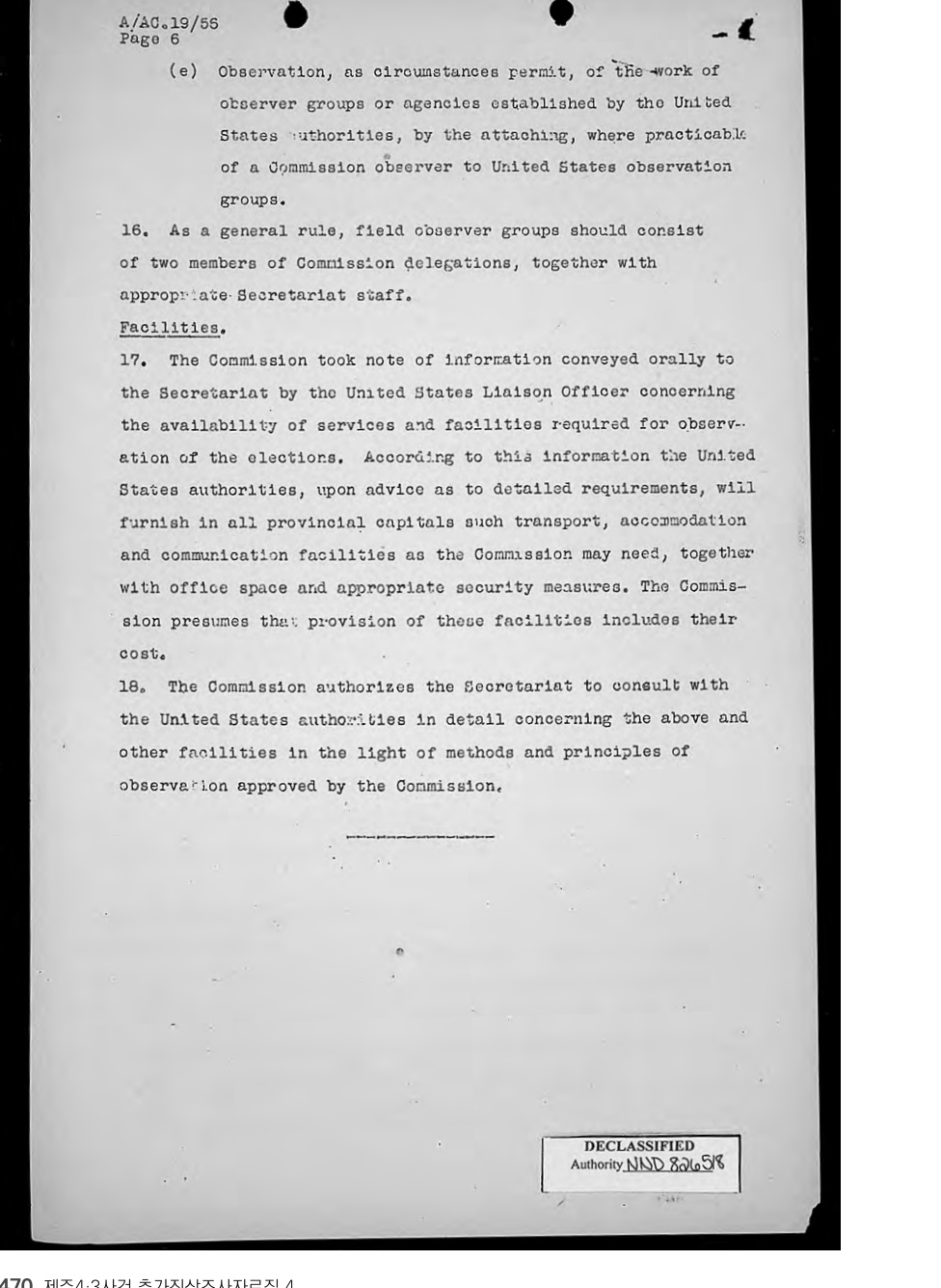
(e) 상황이 허락한다면, 미국 당국이 설립한 감시조직이나 기관의 업무에 대한 감시를, 실행 가능한 곳에서는, 미국 감시조직에 위원단 감시자를 붙여서 실시.
16. 일반적으로 지방 감시반은, 적절한 사무국 직원과 함께 위원단 대표 구성원 2명으로 구성되어야 한다.
시설
17. 위원단은 선거 감시를 위해 필요한 편의와 시설 이용에 관해 미군 연락장교가 사무국에 구두로 전한 정보에 주목하고 있다. 이 정보에 의하면 미국 당국은, 구체적인 요구사항에 맞춰 모든 도의 주요 도시에 위원단에 필요한 충분한 공간, 적절한 보안 조치와 함께, 교통 숙박 통신 시설을 제공할 것이다. 위원단은 이런 시설 제공에 그 비용도 포함된 것으로 추정한다.
18. 위원단은, 위원단이 승인한 감시 방법과 원칙을 고려해 위에서 언급 사항과 기타 다른 시설에 관한 세부적인 내용을 미국 당국과 협의하도록 사무국에 권한을 부여했다.
RESTRICTED
A/AC.19/56
20 March 1948
ORIGINAL:ENGLIS[H]
UNITED NATIONS TEMPORARY COMMISSION ON KOREA
DECISIONS * ON THE REPORT ** OF THE AD HOC SUB-COMMITTEE ON
METHODS OF OBSERVATION OF ELECTIONS ADOPTED AT THE
TWENTY-SEVE[N]TH MEETING, 20 MARCH 1948
Scope of observation
1. At the outset the Commission takes note of the limited staff available both to the Commission and to the Secretariat and agrees that any plan for observation must be based on this fact. Due account is also taken of the difficulties of transport, communications and accommodation which will confront any observer groups working in the provinces, particularly in areas situated at any distance from the provincial capitals. In this respect the Commission notes that, in accordance with information received from the United States authorities, the normal use of air transport is to be discouraged and that observer groups will as a general rule travel by train to the provincial capitals and thence undertake local trips by jeep.
2. Subject to the above consideration the Commission decides that the conduct of the elections should be observed in each of the provinces (including the islands of Cheju-Do and Wool
Lyong Do, if practicable) and during the most significant stages of the election in each case.
3. In these circumstances the Commission is of the opinion that an essential element in its observation of the election will be the receiving and examining of complaints concerning
* To be read together with the terms of the Resolution adopted at the twenty-second meeting, concerning the implementation of the Resolution of the Interim Committee of the General
Assembly (Document A/AC.19/49).
** Document A/AC.19/54.
DECLASSIFIED
Authority NND 826518
[illegible] No. [illegible]
A/AC.19/56
Page 2
the conduct of the election in any area. Accordingly in addition to requesting information on complaints received by the National
Election Committee, the Commission will indicate its readiness to receive complaints or information concerning the conduct of the elections from any quarter. Special examination of such complaints will be made when deemed necessary.
4. Having in mind the considerations of paras. 1 and 3, the
Commission decides that observation of the elections should be undertaken (a) centrally by liaison with and observation of the work of the National Election Committee, and (b) in the provinces by direct observation through field observer groups.
Free atmosphere for elections
5. The Commission recognizes that observation consists not only in examining the extent to which the requirements of the elections law and regulations are complied with. The Commission considers that political and other activities occurring during the election period are important from the viewpoint of determining whether elections are to be held in a free atmosphere.
Such political aspects include activities of political parties and organizations; behaviour of youth organizations; conduct of the police; extent of and reasons for non-participation in the elections both by individual voters and political organizations; attitude of the police and other authorities towards such nonparticipation; extent to which candidates are un-opposed; and the general public reaction to the elections. In this respect the
Commission notes the relevance of the recommendations concerning a free atmosphere for elections adopted at the twenty-sixth meeting (document A/AC.19/52).
Relations with the United States authorities
6. The Commission, having regard to the terms of Resolution 1 of the General Assembly of 14 November 1947 whereby the Commission is to observe that the Korean representatives "are
DECLASSIFIED
Authority NND 80[illegible]5[illegible]8
A/AC.19/56
Page 3
in fact duly elected by the Korean people and not mere appointees by military authorities in Korea", decides to establish a procedure whereby it may observe and report on the methods used by the United States authorities in fulfilling their responsibilities concerning the conduct of the elections, especially in the provinces.
7. In accordance with the above consideration appropriate liaison will be established between the Commission's own agencies of observation and those of the United States authorities (see para. 15e).
Question of an expert consultant.
8. The Commission considered the question of appointing an expert consultant to assist it during the period of observation.
The Commission is of the opinion that it must be able at any time to exercise effective control over members of the staff assisting it and that, if a consultant were appointed, it would not be possible to ensure such control. As a consideration of a practi-cal kind, the Commission also notes that there is now insufficient time in which to make suitable arrangements for an expert to be selected and attached to the Commission.
9. The Commission agrees that, should it be deemed necessary, experts might be consulted on specific questions.
System of reporting.
10. The Commission considers that an appropriate uniform system of reporting by groups engaged in the observation of the elections should be established. It therefore, decides that a questionnaire be drawn up by the ad hoc Sub-Committee based upon relevant provisions of the election law and regulations and the political aspects of the election referred to in para.7, which will indicate the more important factors to be as far as possible taken into account in observing the elections.
Stages of observation
11. The Commission considers that, both centrally in Seoul and
. . . . /
DECLASSIFIED
Authority NND 826518
Inclosure No. 52
A/AC.10/56
Page 4
in the provinces, the attempt should be made to observe each of the important successive stages of the elections* :
(a) The period of registration of voters (30 March to
8 April);
(b) The period during which poll registers may be examined (14 to 20 April), appeals made and candidates registered;
(c) Polling day;
(d) The post-election period.
Organization of the Commission for observation.
12. In considering its organization for purposes of observing the election the Commission had in mind both its limited staffing resources and the structure of existing sub-committees.
13. Main Committee; The Commission decides that on 29 March
1948 the existing sub-committees will be merged into one Committee on which a representative of each member of the Commission will be entitled to sit, but whose membership may rotate in accordance with the willingness of members to undertake periodic duties with the field observer groups. The Commission agrees, in establishing the main Committee, that original members of the sub-committees should as far as possible be assigned such tasks as are familiar to them in the light of their past experiences.
The functions of this Committee will include:
(a) Maintenance of permanent liaison with the National
Election Committee in Seoul;
(b) General observation of the work of the election committees;
(c) The receiving and examination of complaints and general information concerning the conduct of the elections;
....
* The principal steps of the electoral process are provisionally set out in document A/AC.19/W.14/Add.2.
DECLASSIFIED
Authority NND 826598
A/AC.19/56
Page 5
(d) The analysis of reports received from the Commission's observer groups;
(e) The obtaining and analyzing of information concerning attitudes of Koreans towards participation in the elections;
(f) The examining of and reporting to the Commission on conditions relating to a free atmosphere for the holding of elections;
(g) The planning and co-ordination of the activities of the field observer groups in accordance with the general directions of the Commission.
14. The Commission recognizes that in the discharge of the above responsibilities the Committee may wish to set up subcommittees under specific terms of reference and special groups for the examination of complaints (para. 15c).
Field observer groups:
15. The Commission decides to establish in the first instance two or three field observer groups to observe the conduct of the elections in selected areas in accordance with a co-ordinated plan.
The functions of the field observer groups will include:
(a) Observation on the spot of the activities of selected provincial and local election committees;
(b) Examination of the extent to which provisions of the electoral law and regulations have been complied with in the areas observed;
(c) Hearing and examination of complaints received in the areas observed or as directed by the main Committee;
(d) Observation of the political aspects of the election campaign in selected areas from the viewpoint of determining whether a free atmosphere for the election exists, with special regard to the conduct of the police and youth organizations;
. . . . /
DECLASSIFIED
Authority NND 83[illegible]5[illegible]
Inclosure No. 52
A/AC.19/55
Page 6
(e) Observation, as circumstances permit, of the work of observer groups or agencies established by the United
States authorities, by the attaching, where practicable of a Commission observer to United States observation groups.
16. As a general rule, field observer groups should consist of two members of Commission delegations, together with appropriate Secretariat staff.
Facilities.
17. The Commission took note of information conveyed orally to the Secretariat by the United States Liaison Officer concerning the availability of services and facilities required for observation of the elections. According to this information the United
States authorities, upon advice as to detailed requirements, will furnish in all provincial capitals such transport, accommodation and communication facilities as the Commission may need, together with office space and appropriate security measures. The Commission presumes that provision of these facilities includes their cost.
18. The Commission authorizes the Secretariat to consult with the United States authorities in detail concerning the above and other facilities in the light of methods and principles of observation approved by the Commission.
DECLASSIFIED
Authority NND 802658
출처:
제주4·3평화재단 편,
『추가진상조사자료집-미국자료2』,
p. 465–470.
— NARA (RG 554, Entry 1400, Box 298)
×
![]()