스캔 원본
100%
p.91
p.92
p.93
p.94
p.95
p.96
p.97
p.98
p.99
p.100
p.101
p.102
p.103
p.104
p.105
p.106
p.107
p.108
p.109
p.110
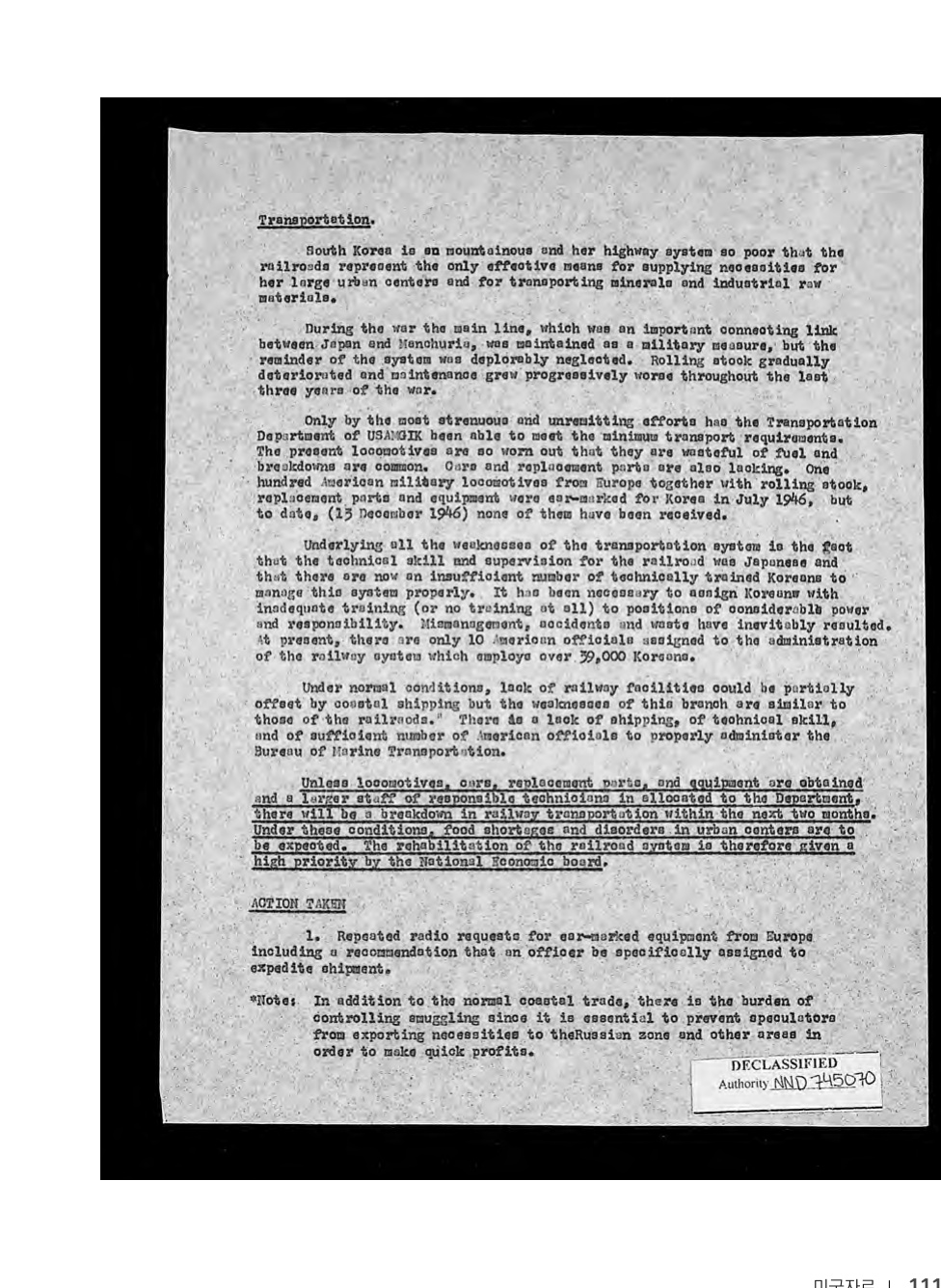
p.111
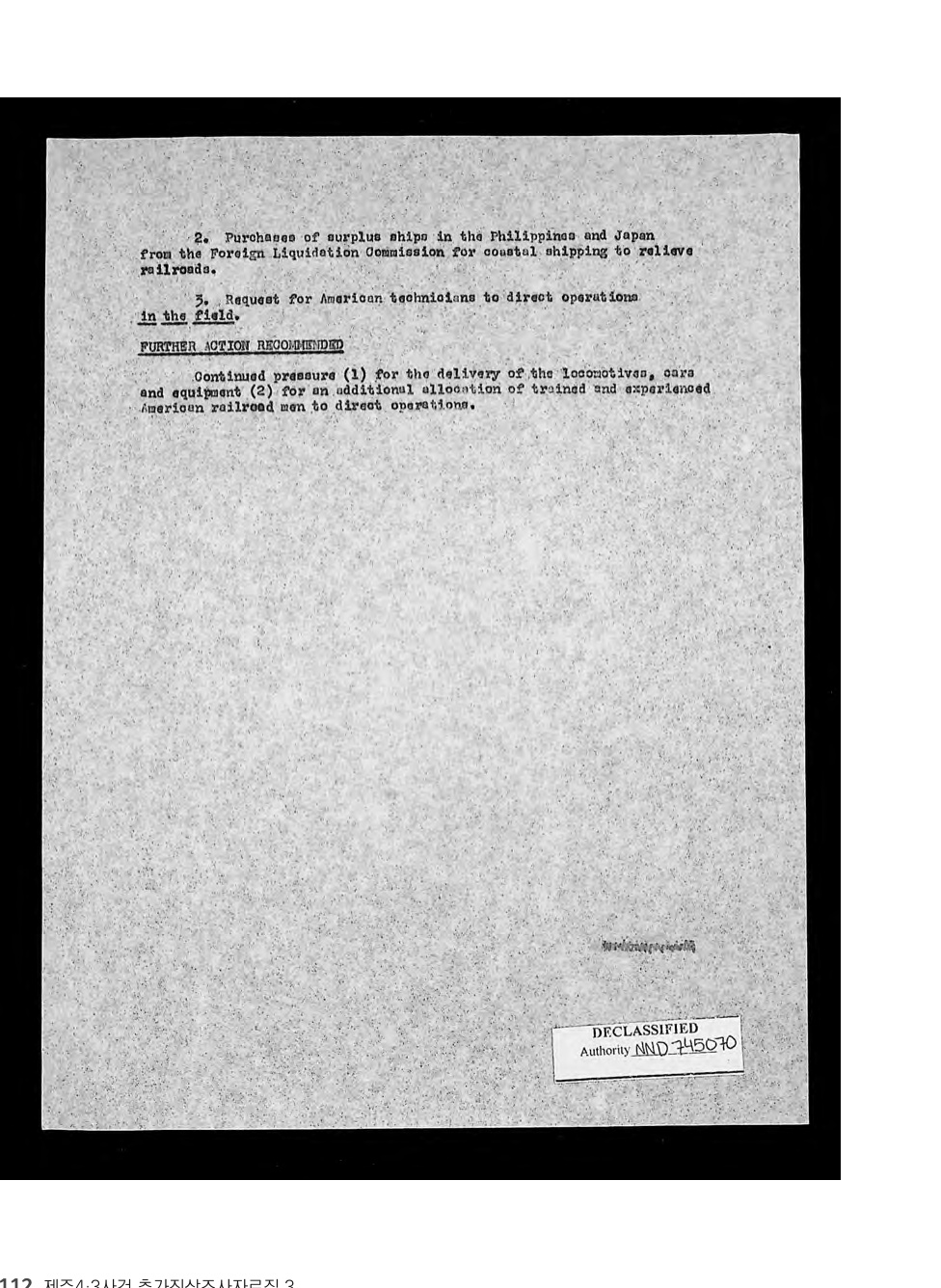
p.112
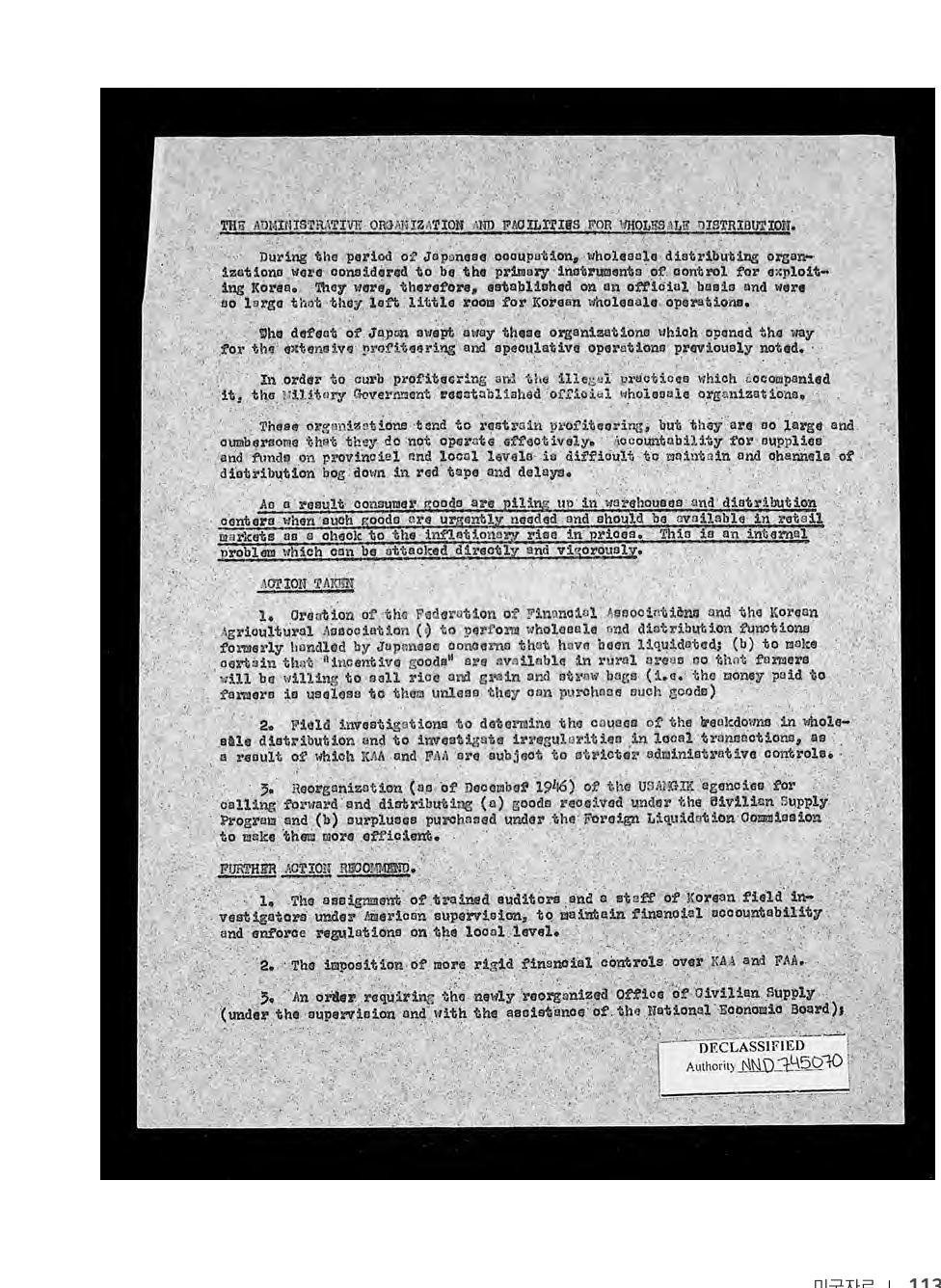
p.113
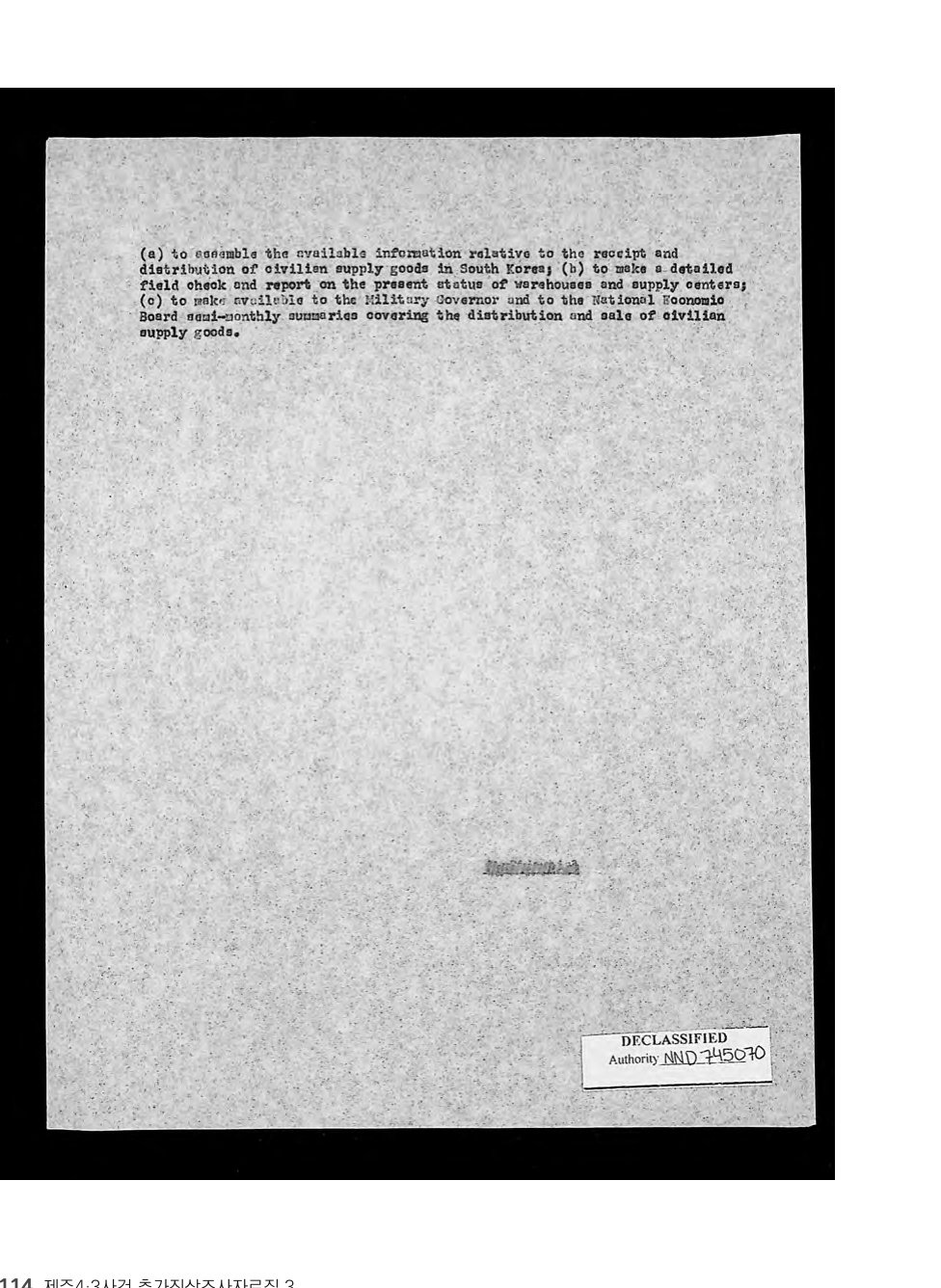
p.114
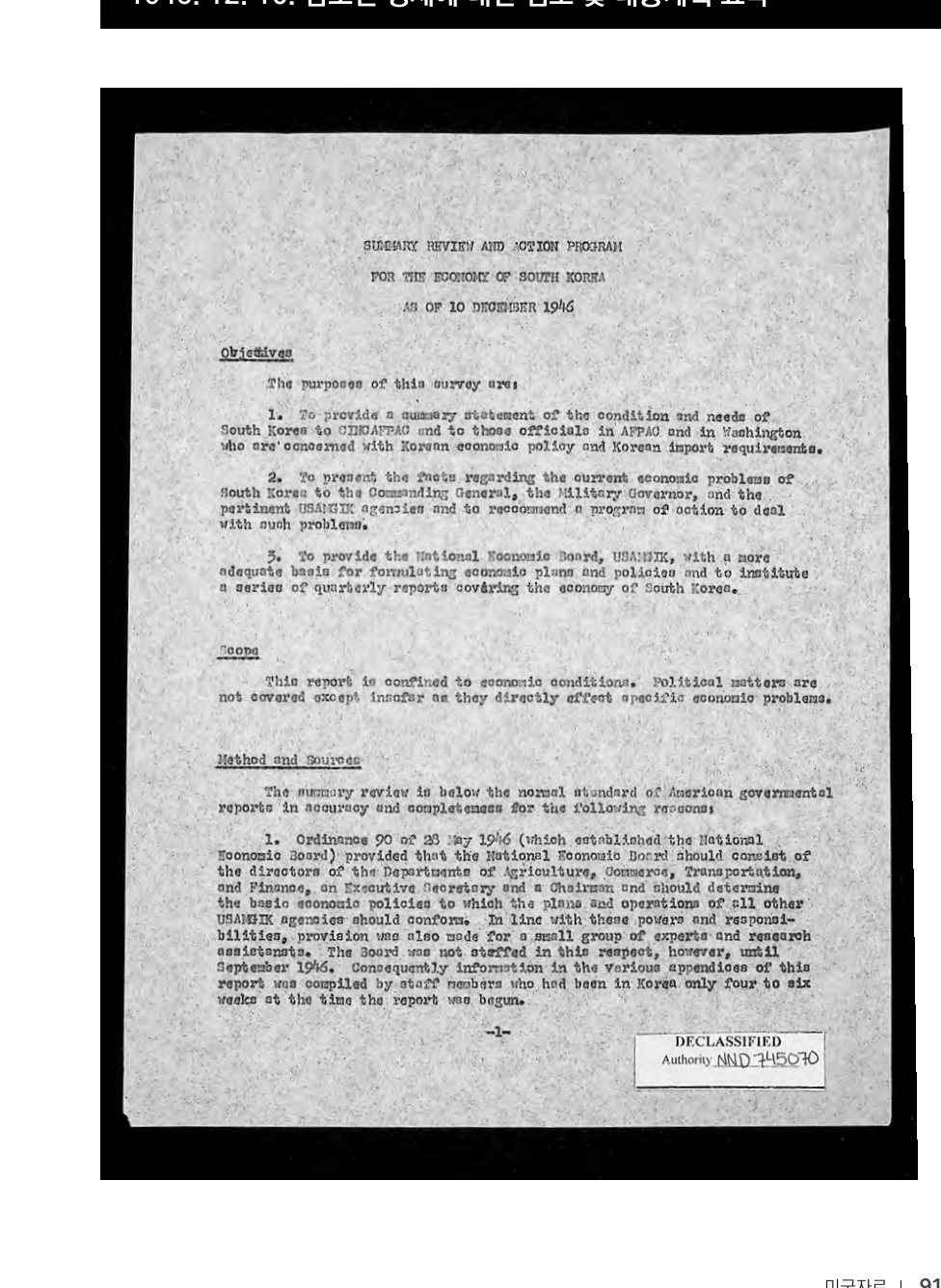
1946년 12월 10일 남조선 경제에 대한 검토 및 대응계획 요약
조사 목적
이 조사의 목적은:
1. 남조선의 상황과 수요에 관한 요약된 정보를 미육군태평양방면군사령부(CINCAFPAC)와 태평양지구연합군사령부(AFPAC) 관료들, 그리고 조선의 경제정책과 수입 요건에 관심을 가진 워싱턴에 제공하기 위한 것이다.
2. 남조선이 안고 있는 경제적 문제점들을 총사령관과 군정장관, 그리고 군정의 관계기관에 알리고, 그것을 해결할 대응계획을 권고하기 위한 것이다.
3. 중앙경제위원회와 군정에 경제계획 수립을 위한 보다 적절한 기반을 제공하고, 남조선 경제를 다루는 분기별 보고서를 만들기 위한 것이다.
2. 일본 점령의 경제적 영향
일본이 점령한 40년 동안 조선의 산업화와 극단적인 착취에 대한 많은 글이 있었다.
그러나 조선의 현 경제 상태를 이해하는 데에는, 일본 정책의 두 가지 다른 측면이 훨씬 더 중요하다는 것을 알아야 한다.
(a) 중세의 농업, 수공업 경제에 속했던 조선의 광범위한 생산구조에 일본이 상부구조를 두는 형태로, 산업의 소유와 기술인력 공급, 경영은 일본인에 의해 이뤄졌다.
(b) 이런 중첩된 산업구조의 주된 목적은 조선을 만주와 조선, 대만, 일본으로 구성되는 훨씬 큰 경제블록으로 끌어들임으로써 노동력과 광물, 그리고 조선이 공급할 수 있는 다른 자원을 착취하기 위한 것이었다.
조선의 공장들은 일본의 자본과 기술력, 경영에 의존했을 뿐만 아니라 일본 제국 내 경제 관계 속에서 발달했다: 사실 조선의 공장들은 이런 관계나 이와 유사한 것들 없이는 존재할 수 없었다.
한 다른 지역과의 관계를 통해서만 원자재와 전문 장비, 무역 판로를 지속해서 확보할 수 있었다. 예를 들어, 면직물이나 고무신 등 지역에서 필요로 하는 물건을 만드는 공장들도 원자재와 기계류는 외부 공급에 의존했다. 1945년 3월 1일부터 8월 15일 사이 대규모 기습공격으로 일본의 68개 주요 도시가 불탔고, 조선의 공장에 전문 장비를 제공하던 많은 공장이 파괴됐다는 사실도 주목해야 한다.
산업적으로, 남조선은 장기간에 걸쳐 파탄과 붕괴, 그리고 재조정에 직면하고 있다. (a) 그 이유는, 남조선의 산업구조가 조선의 필요를 충족하기 위한 것이 아니라 조선인을 착취해 일본 제국에 제공하기 위해 중세적 조선 경제 위에 얹힌 것이었기 때문이고, (b) 조선의 산업시설은 일본의 패전으로 사라져 버린 경제적 관계에 경영자, 기술자, 전문 장비를 의존해 왔으며, © 남조선 산업에 필요한 기술과 경영 능력을 갖춘 조선인이 턱없이 부족하고 (d) 일본에 의한 산업화로 늘어날 수 있었던 인구가 이제는 실업 문제에 직면하고 있다.
3. 전쟁의 경제적 영향 조선의 산업은 전쟁(태평양전쟁)을 치르면서 이 전에 가지고 있었던 문제점이 더욱 심화하였다. 일본인 기술자나 경영자들에 의해 관리된 조선의 산업은 기술 장비와 원자재를 일본에 거의 의존했고, 일본의 전쟁 수요에 전적으로 맞춰졌다는 점에서 조선 경제의 기반과는 완전히 분리돼 있었다. 조선의 산업은 자신들의 미래 경제의 건전성이나 미래의 필요에 대한 고려 없이 세워졌다.
E. 특화된 훈련 부족 그 어떤 집단도 조선에서의 군정을 위해 특별히 훈련받지 않았다. 점령이 촉박하게 이뤄져 계획이나 준비를 할 기회가 거의 없었다. 그냥 일반적인 능력에 따라, 배속된 자리를 위한 특화된 훈련이나 실질적 경험은 거의 고려하지 않고 사람을 군정에 배치해야 했다. 약간의 개선은 있지만, 여전히 많은 자리가 주어진 책임을 다할 만큼 특화된 훈련을 받지 않은 사람들로 채워진 게 사실이다. 행정 관리와 산업생산과 같이 고도로 전문화된 분야에서는 그 같은 기술적인 훈련의 미비는 값비싼 실책으로 이어진다.
즉각적인 조치가 필요한 중대한 경제적 약점
A. 미곡 수집과 배급 "미곡수집 프로그램"이 당면한 모든 경제계획 중에서 가장 중요한 핵심인 이유는 다음과 같다:
(a) 산업인구의 1/3이 미곡수집 프로그램에 의존하고 있다.
(b) 1945년 9월부터 11월 사이 "자유 시장" 경제 정책 아래 민간 상인에 의해이러한 기능이 수행되었을 때 (1) 폭리, (2) 불공평한 분배, (3) 수확 직후의 미곡낭비와 그 이후 극심한 부족으로 이어졌다.
(c) 미곡수집 프로그램은 (1) 쌀을 구해서 먹어야 하는 사람들의 수요를 충족하고, (2) 연중 쌀 소비를 균등하게 하며, (3) 수요에 맞춰 쌀 배급을 공평하게 하고,(4) 임금 구조에 맞춰 쌀 가격을 통제할 수 있는 유일한 수단이다.
미곡수집 프로그램의 실패는 (a) 임금과 생활비의 격차를 만들어 임금이 가파르게 상승할 것이며, (b) 물가상승 기조에 강력한 자극제가 될 것이고, (c) 1947년 봄 여름 동안 극심한 부족 현상을 초래할 것이며, (d) 심각한 노동문제와 정치적 불안을 가져오고, (e) 이미 강력한 파괴력을 가진 공산주의자들의 선전전에 비옥한 들판을 제공하게 될 것이다. 이러한 이유로 미곡수집은 1946년 가을 내내그 어떤 대응계획보다도 군정의 더 큰 지원을 받고 있다.
그러나 미곡수집 프로그램에는 다음과 같은 심각한 장애물이 있다 :
(a) 쌀이 부족한 공업 및 도시 중심지로 쌀을 보내는 데 대해 쌀이 "풍족한 지방"의 공개적인 불만. "쌀이 풍족한 지방"이라는 것은 순전히 상대적인 용어로 ;손쉽게 소비할 수 있을 만큼 쌀이 풍족한 지역은 없으며, 결국 그런 지역에는 억울한 감정이 있다.
(b) 미곡수집 프로그램에 대해 잘못된 루머를 퍼뜨리고 프로그램에 대해 오해를 유발하는 공산주의자들의 적극적인 반대.(예를 들어 "쌀을 미국으로 보내기 위해 수집하고 있다.")
(c) 지방의 미비한 수송 수단 (트럭과 기름이 부족하고, 바위투성이 산길로 인한
고장.)
(d) 정치적 소요.
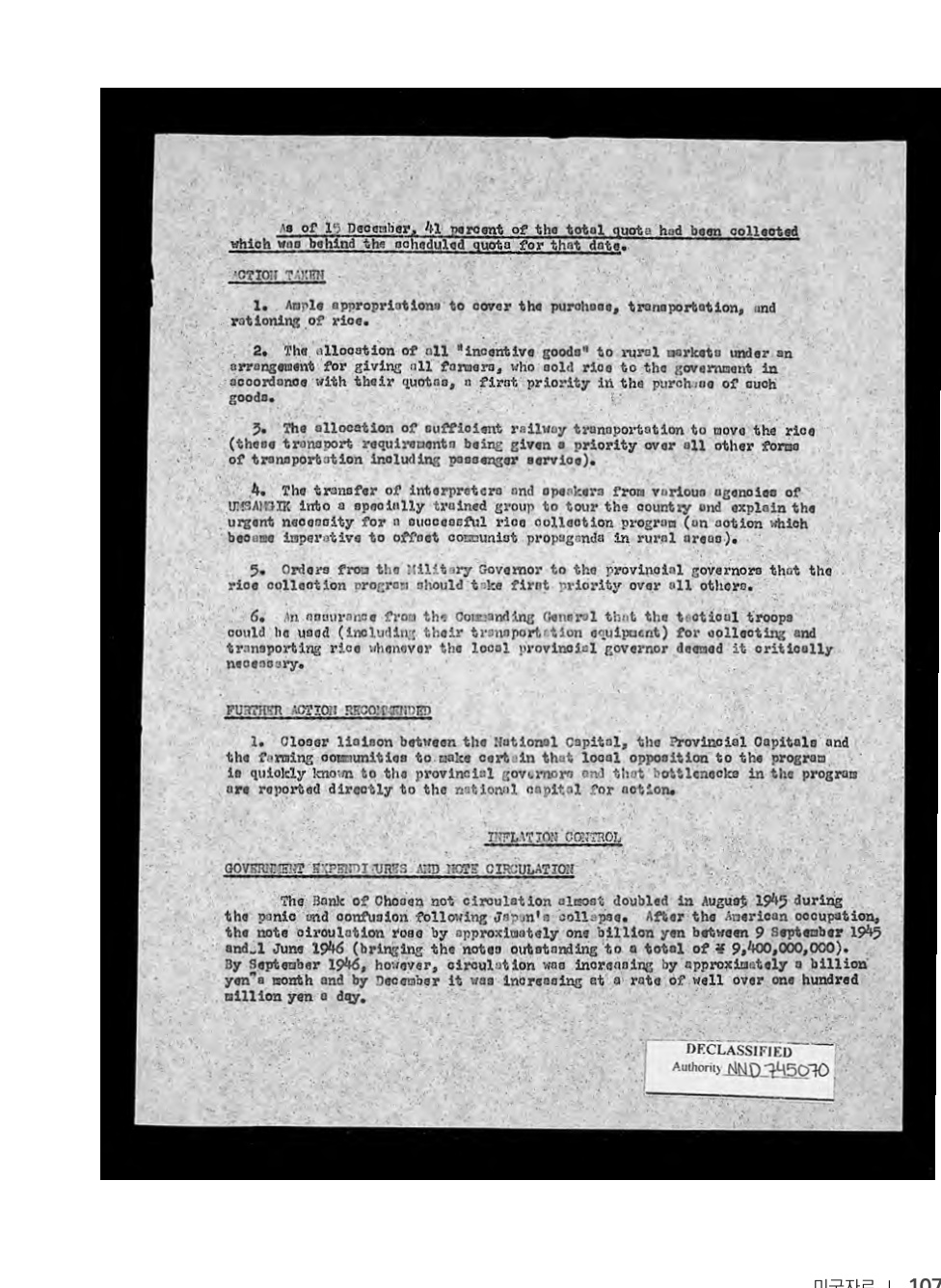
12월 15일 현재, 전체 할당량의 41%가 수집됐는데 이는 그 날짜로 예정됐던 할당량에 미치지 못하는 것이다.
취해진 조치
1. 구매, 수송, 쌀 배급을 감당할 수 있는 충분한 자금 지출.
2. 자신에 할당된 쌀을 정부에 판매한 모든 농민에게 물품 구입에 있어 우선권을 주는 방식으로 농촌 시장에 모든 "보상물자"를 할당하였음.
3. 쌀을 옮기기에 충분하도록 철도를 배차하였음.(이 운송 조건은 승객 서비스를 포함한 모든 다른 형태의 운송에 우선)
4. 지방을 돌며 미곡수집 프로그램의 성공 필요성을 설명할 수 있도록 군정의 다양한 부서로부터 통역자와 대변인을 뽑아 전문그룹으로 파견하였음.(이는 농촌 지역에서의 공산주의 선동을 상쇄하기 위해 반드시 해야 하는 일이다.)
5. 군정장관이 도지사들에게 미곡수집 프로그램이 다른 모든 것에 우선해야 한 다고 명령하였음.
6. 도지사가 미곡수집과 수송을 위해 중대하게 필요하다고 생각할 때는 언제든 지 전술부대(수송장비를 포함해)를 사용할 수 있다는 사령관의 보장이 있었음.
권고된 향후 조치
1. 수도와 도내 중심도시, 농촌 지역 간의 연락망을 보다 긴밀하게 해 미곡수집 프로그램에 대한 지역의 반대를 도지사에게 신속하게 알리고, 프로그램의 장애물은 수도에 바로 보고해 조치가 취해질 수 있도록 할 것.
SUMMARY REVIEW AND ACTION PROGRAM
FOR THE ECONOMY OF SOUTH KOREA
AS OF 10 DECEMBER 1946
Objectives
The purposes of this survey are:
1. To provide a summary statement of the condition and needs of
South Korea to CINCAFFAC and to those officials in AFFAC and in Washington who are concerned with Korean economic policy and Korean import requirements.
2. To present the facts regarding the current economic problems of
South Korea to the Commanding General, the Military Governor, and the pertinent USAMGIK agencies and to reccommend a program of action to deal with such problems.
3. To provide the National Economic Board, USAMGIK, with a more adequate basis for formulating economic plans and policies and to institute a series of quarterly reports covering the economy of South Korea.
Scope
This report is confined to economic conditions. Political matters are not covered except insofar as they directly affect specific economic problems.
Method and Sources
The summary review is below the normal standard of American governmental reports in accuracy and completeness for the following reasons:
1. Ordinance 90 of 28 May 1946 (which established the National
Economic Board) provided that the National Economic Board should consist of the directors of the Departments of Agriculture, Commerce, Transportation, and Finance, an Executive Secretary and a Chairman and should determine the basic economic policies to which the plans and operations of all other
USAMGIK agencies should conform. In line with these powers and responsibilities, provision was also made for a small group of experts and research assistants. The Board was not staffed in this respect, however, until
September 1946. Consequently information in the various appendices of this report was compiled by staff members who had been in Korea only four to six weeks at the time the report was begun.
-1-
DECLASSIFIED
Authority NND 745070
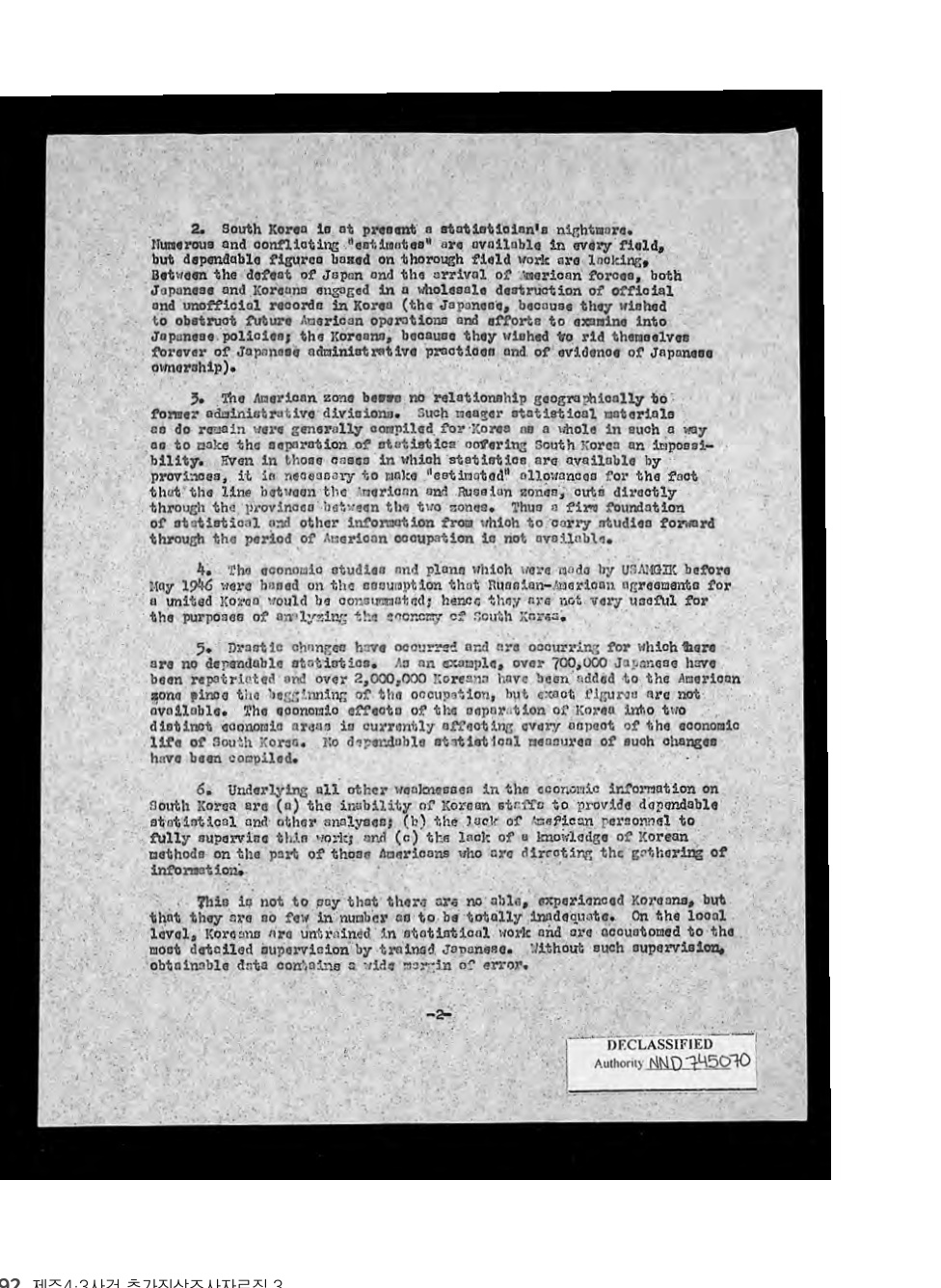
2. South Korea is at present a statistician's nightmare. Numerous and conflicting "estimates" are available in every field, but dependable figures based on thorough field work are lacking. Between the defeat of Japan and the arrival of American forces, both Japanese and Koreans engaged in a wholesale destruction of official and unofficial records in Korea (the Japanese, because they wished to obstruct future American operations and efforts to examine into Japanese policies; the Koreans, because they wished to rid themselves forever of Japanese administrative practices and of evidence of Japanese ownership).
3. The American zone bears no relationship geographically to former administrative divisions. Such meager statistical materials as do remain were generally compiled for Korea as a whole in such a way as to make the separation of statistics covering South Korea an impossibility. Even in those cases in which statistics are available by provinces, it is necessary to make "estimated" allowances for the fact that the line between the American and Russian zones, cuts directly through the provinces between the two zones. Thus a firm foundation of statistical and other information from which to carry studies forward through the period of American occupation is not available.
4. The economic studies and plans which were made by USAFGIK before May 1946 were based on the assumption that Russian-American agreements for a united Korea would be consummated; hence they are not very useful for the purposes of analyzing the economy of South Korea.
5. Drastic changes have occurred and are occurring for which there are no dependable statistics. As an example, over 700,000 Japanese have been repatriated and over 2,000,000 Koreans have been added to the American zone since the beginning of the occupation, but exact figures are not available. The economic effects of the separation of Korea into two distinct economic areas is currently affecting every aspect of the economic life of South Korea. No dependable statistical measures of such changes have been compiled.
6. Underlying all other weaknesses in the economic information on South Korea are (a) the inability of Korean staffs to provide dependable statistical and other analyses; (b) the lack of American personnel to fully supervise this work; and (c) the lack of a knowledge of Korean methods on the part of those Americans who are directing the gathering of information.
This is not to say that there are no able, experienced Koreans, but that they are so few in number as to be totally inadequate. On the local level, Koreans are untrained in statistical work and are accustomed to the most detailed supervision by trained Japanese. Without such supervision, obtainable data contains a wide margin of error.
-2-
DECLASSIFIED
Authority NND 745070
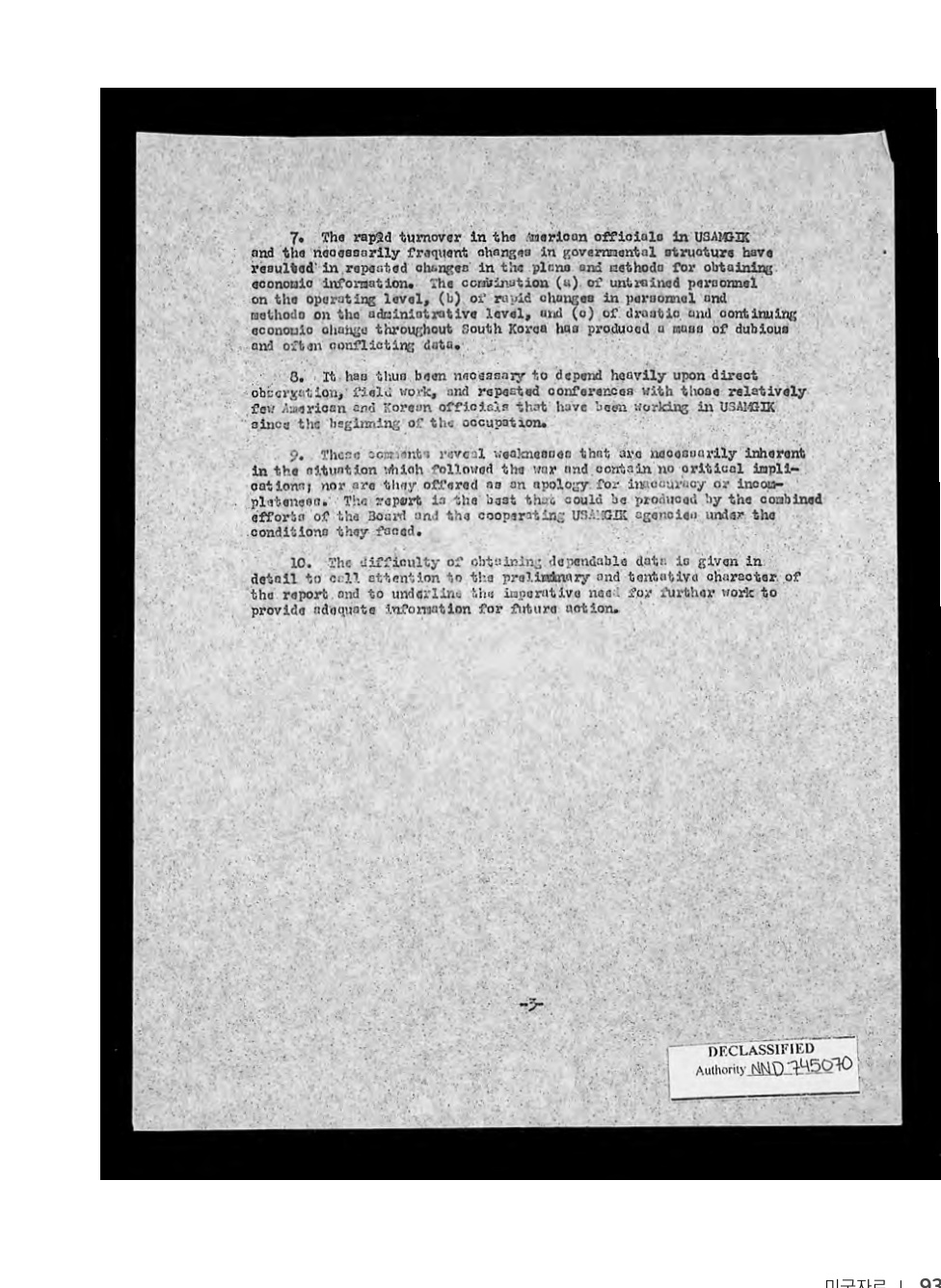
7. The rapid turnover in the American officials in USAMGIK and the necessarily frequent changes in governmental structure have resulted in repeated changes in the plans and methods for obtaining economic information. The combination (a) of untrained personnel on the operating level, (b) of rapid changes in personnel and methods on the administrative level, and (c) of drastic and continuing economic change throughout South Korea has produced a mass of dubious and often conflicting data.
8. It has thus been necessary to depend heavily upon direct observation, field work, and repeated conferences with those relatively few American and Korean officials that have been working in USAMGIK since the beginning of the occupation.
9. These comments reveal weaknesses that are necessarily inherent in the situation which followed the war and contain no critical implications; nor are they offered as an apology for inaccuracy or incompleteness. The report is the best that could be produced by the combined efforts of the Board and the cooperating USAMGIK agencies under the conditions they faced.
10. The difficulty of obtaining dependable data is given in detail to call attention to the preliminary and tentative character of the report and to underline the imperative need for further work to provide adequate information for future action.
-3-
DECLASSIFIED
Authority NND 745070
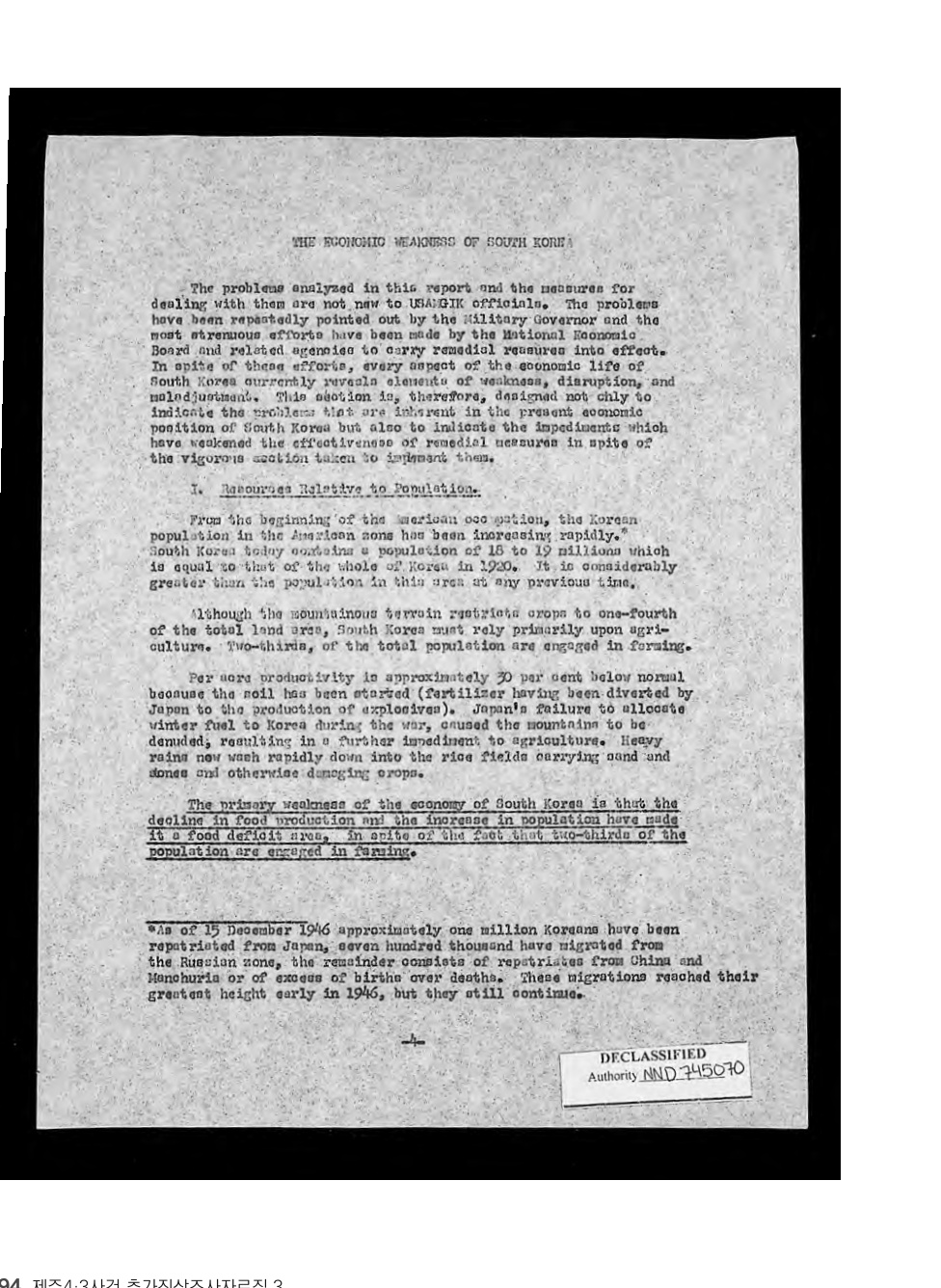
THE ECONOMIC WEAKNESSES OF SOUTH KOREA
The problems analyzed in this report and the measures for dealing with them are not new to USAMGIK officials. The problems have been repeatedly pointed out by the Military Governor and the most strenuous efforts have been made by the National Economic
Board and related agencies to carry remedial measures into effect.
In spite of these efforts, every aspect of the economic life of
South Korea currently reveals elements of weakness, disruption, and maladjustment. This section is, therefore, designed not only to indicate the problems that are inherent in the present economic position of South Korea but also to indicate the impediments which have weakened the effectiveness of remedial measures in spite of the vigorous action taken to implement them.
I. Resources Relative to Population.
From the beginning of the American occupation, the Korean population in the American zone has been increasing rapidly.*
South Korea today contains a population of 18 to 19 millions which is equal to that of the whole of Korea in 1920. It is considerably greater than the population in this area at any previous time.
Although the mountainous terrain restricts crops to one-fourth of the total land area, South Korea must rely primarily upon agriculture. Two-thirds, of the total population are engaged in farming.
Per acre productivity is approximately 30 per cent below normal because the soil has been starved (fertilizer having been diverted by
Japan to the production of explosives). Japan's failure to allocate winter fuel to Korea during the war, caused the mountains to be denuded, resulting in a further impediment to agriculture. Heavy rains now wash rapidly down into the rice fields carrying sand and stones and otherwise damaging crops.
The primary weakness of the economy of South Korea is that the decline in food production and the increase in population have made it a food deficit area. In spite of the fact that two-thirds of the population are engaged in farming.
*As of 15 December 1946 approximately one million Koreans have been repatriated from Japan, seven hundred thousand have migrated from the Russian zone, the remainder consists of repatriates from China and
Manchuria or of excess of births over deaths. These migrations reached their greatest height early in 1946, but they still continue.
-4-
DECLASSIFIED
Authority NND 745070
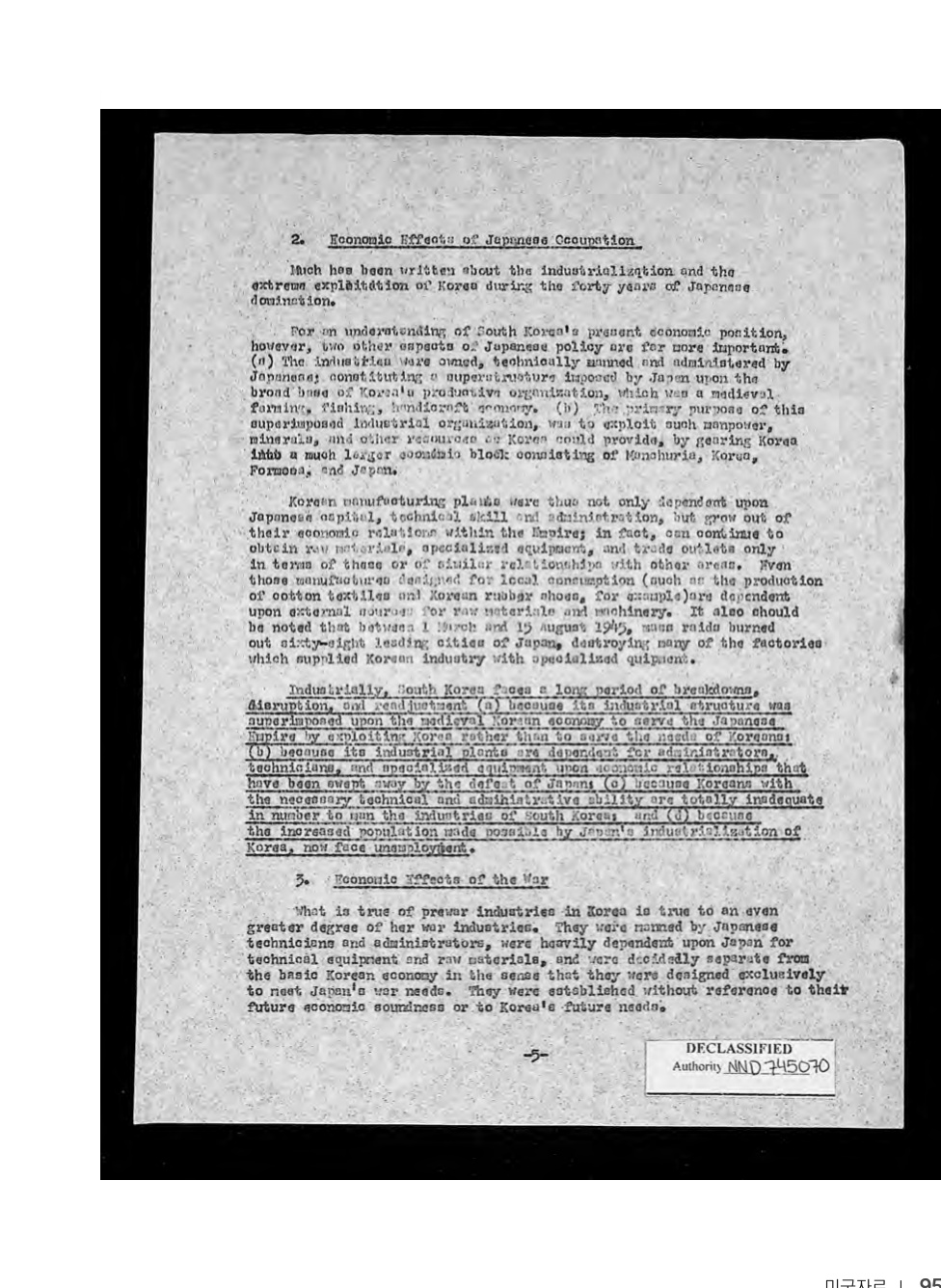
2. Economic Effects of Japanese Occupation
Much has been written about the industrialization and the extreme exploitation of Korea during the forty years of Japanese domination.
For an understanding of South Korea's present economic position, however, two other aspects of Japanese policy are far more important. (a) The industries were owned, technically manned and administered by Japanese; constituting a superstructure imposed by Japan upon the broad base of Korea's productive organization, which was a medieval farming, fishing, handicraft economy. (b) The primary purpose of this superimposed industrial organization, was to exploit such manpower, minerals, and other resources of Korea could provide, by gearing Korea into a much larger economic block consisting of Manchuria, Korea, Formosa, and Japan.
Korean manufacturing plants were thus not only dependent upon Japanese capital, technical skill and administration, but grew out of their economic relations within the Empire; in fact, can continue to obtain raw materials, specialized equipment, and trade outlets only in terms of these or of similar relationships with other areas. Even those manufactures designed for local consumption (such as the production of cotton textiles and Korean rubber shoes, for example)are dependent upon external sources for raw materials and machinery. It also should be noted that between 1 March and 15 August 1945, when raids burned out sixty-eight leading cities of Japan, destroying many of the factories which supplied Korean industry with specialized equipment.
Industrially, South Korea faces a long period of breakdowns, disruption, and readjustment (a) because its industrial structure was superimposed upon the medieval Korean economy to serve the Japanese Empire by exploiting Korea rather than to serve the needs of Koreans; (b) because its industrial plants are dependent for administrators, technicians, and specialized equipment upon economic relationships that have been swept away by the defeat of Japan; (c) because Koreans with the necessary technical and administrative ability are totally inadequate in number to man the industries of South Korea; and (d) because the increased population made possible by Japan's industrialization of Korea, now face unemployment.
3. Economic Effects of the War
What is true of prewar industries in Korea is true to an even greater degree of her war industries. They were manned by Japanese technicians and administrators, were heavily dependent upon Japan for technical equipment and raw materials, and were decidedly separate from the basic Korean economy in the sense that they were designed exclusively to meet Japan's war needs. They were established without reference to their future economic soundness or to Korea's future needs.
-5-
DECLASSIFIED
Authority NND 745070
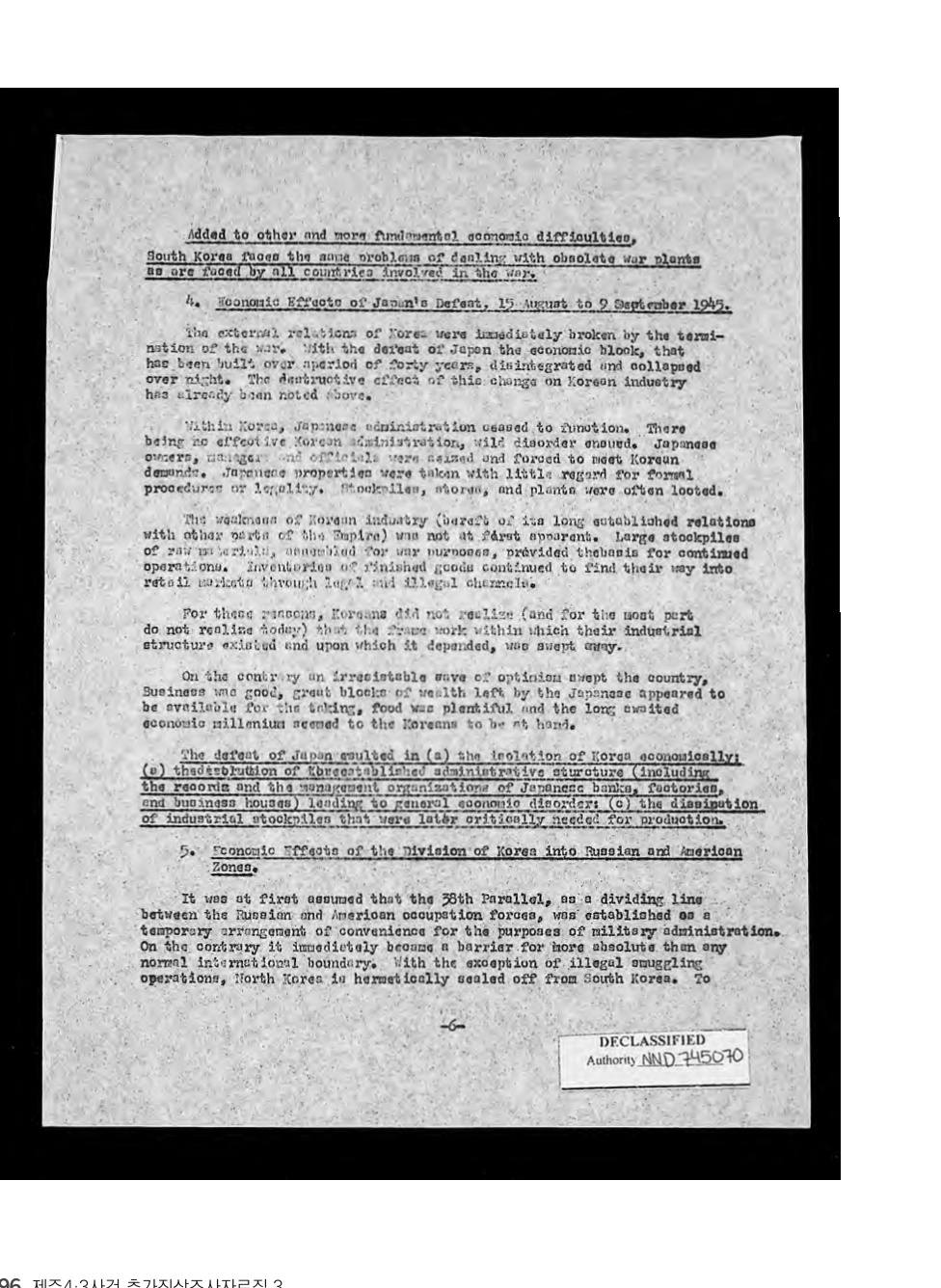
Added to other and more fundamental economic difficulties, South Korea faces the same problems of dealing with obsolete war plants as are faced by all countries involved in the war.
4. Economic Effects of Japan's Defeat, 15 August to 2 September 1945.
The external relations of Korea were immediately broken by the termination of the war. With the defeat of Japan the economic block, that has been built over a period of forty years, disintegrated and collapsed over night. The destructive effect of this change on Korean industry has already been noted above.
Within Korea, Japanese administration ceased to function. There being no effective Korean administration, wild disorder ensued. Japanese owners, managers and officials were seized and forced to meet Korean demands. Japanese properties were taken with little regard for formal procedures or legality. Stockpiles, stores, and plants were often looted.
The weakness of Korean industry (bereft of its long established relations with other parts of the Empire) was not at first apparent. Large stockpiles of raw materials, assembled for war purposes, provided the basis for continued operations. Inventories of finished goods continued to find their way into retail markets through legal and illegal channels.
For these reasons, Koreans did not realize (and for the most part do not realize today) that the frame work within which their industrial structure existed and upon which it depended, was swept away.
On the contrary an irresistable wave of optimism swept the country.
Business was good, great blocks of wealth left by the Japanese appeared to be available for the taking, food was plentiful and the long awaited economic millenium seemed to the Koreans to be at hand.
The defeat of Japan resulted in (a) the isolation of Korea economically;
(b) the dissolution of Korean-established administrative structure (including the records and the management organizations of Japanese banks, factories, and business houses) leading to general economic disorder; (c) the dissipation of industrial stockpiles that were later critically needed for production.
5. Economic Effects of the Division of Korea into Russian and American
Zones.
It was at first assumed that the 38th Parallel, as a dividing line between the Russian and American occupation forces, was established as a temporary arrangement of convenience for the purposes of military administration.
On the contrary it immediately became a barrier far more absolute than any normal international boundary. With the exception of illegal smuggling operations, North Korea is hermetically sealed off from South Korea. To
-6-
DECLASSIFIED
Authority NND 745070
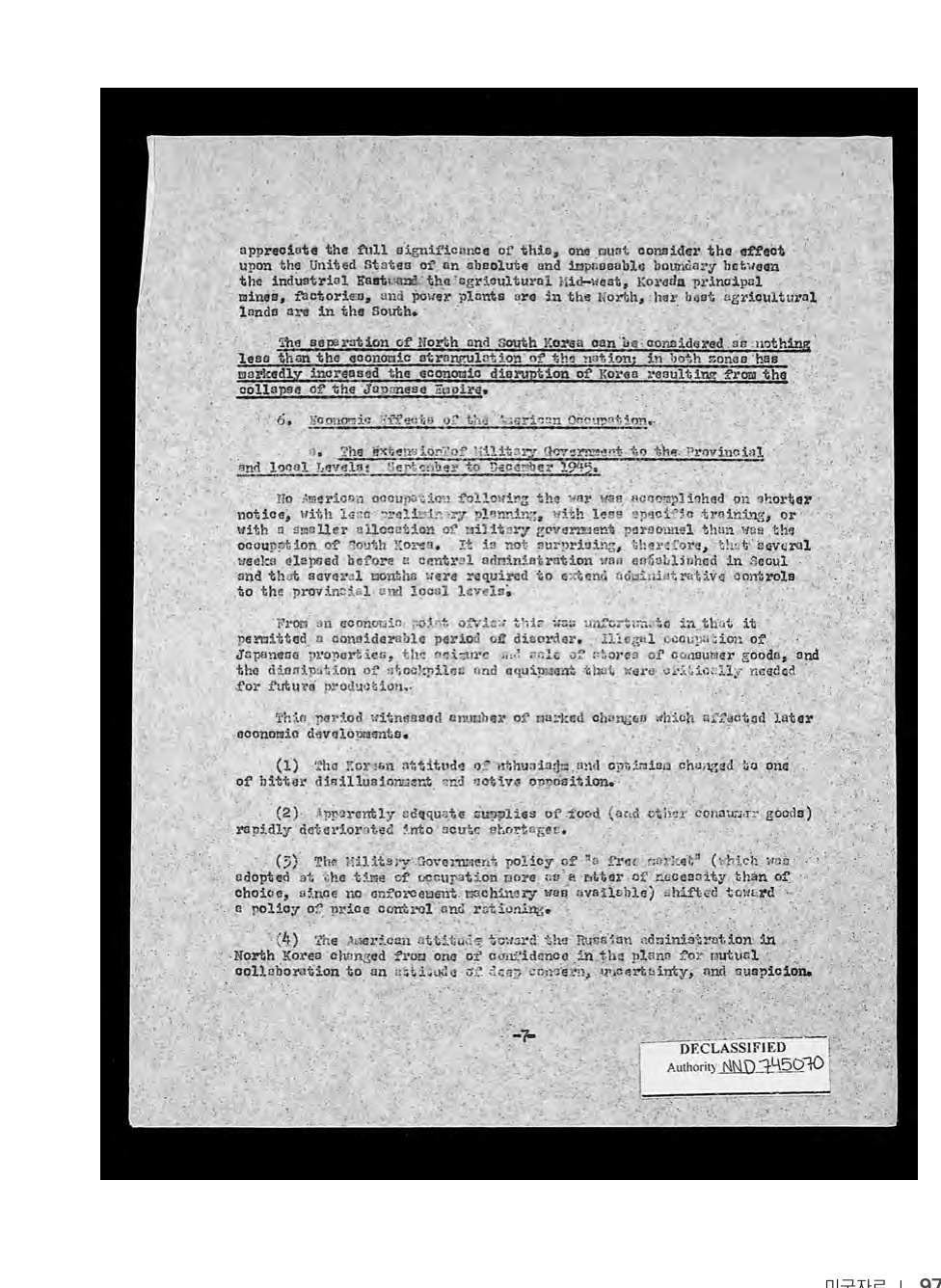
appreciate the full significance of this, one must consider the effect upon the United States of an absolute and impassable boundary between the industrial East and the agricultural Mid-west, Korea's principal mines, factories, and power plants are in the North, her best agricultural lands are in the South.
The separation of North and South Korea can be considered as nothing less than the economic strangulation of the nation; in both zones has markedly increased the economic disruption of Korea resulting from the collapse of the Japanese Empire.
6. Economic Effects of the American Occupation.
a. The Extension of Military Government to the Provincial and local Levels: September to December 1945.
No American occupation following the war was accomplished on shorter notice, with less preliminary planning, with less specific training, or with a smaller allocation of military government personnel than was the occupation of South Korea. It is not surprising, therefore, that several weeks elapsed before a central administration was established in Seoul and that several months were required to extend administrative controls to the provincial and local levels.
From an economic point of view this was unfortunate in that it permitted a considerable period of disorder. Illegal occupation of
Japanese properties, the seizure and sale of stores of consumer goods, and the dissipation of stockpiles and equipment that were critically needed for future production.
This period witnessed a number of marked changes which affected later economic developments.
(1) The Korean attitude of enthusiasm and optimism changed to one of bitter disillusionment and active opposition.
(2) Apparently adequate supplies of food (and other consumer goods)
rapidly deteriorated into acute shortages.
(3) The Military Government policy of "a free market" (which was adopted at the time of occupation more as a matter of necessity than of choice, since no enforcement machinery was available) shifted toward a policy of price control and rationing.
(4) The American attitude toward the Russian administration in
North Korea changed from one of confidence in the plans for mutual collaboration to an attitude of deep concern, uncertainty, and suspicion.
-7-
DECLASSIFIED
Authority NND 745070
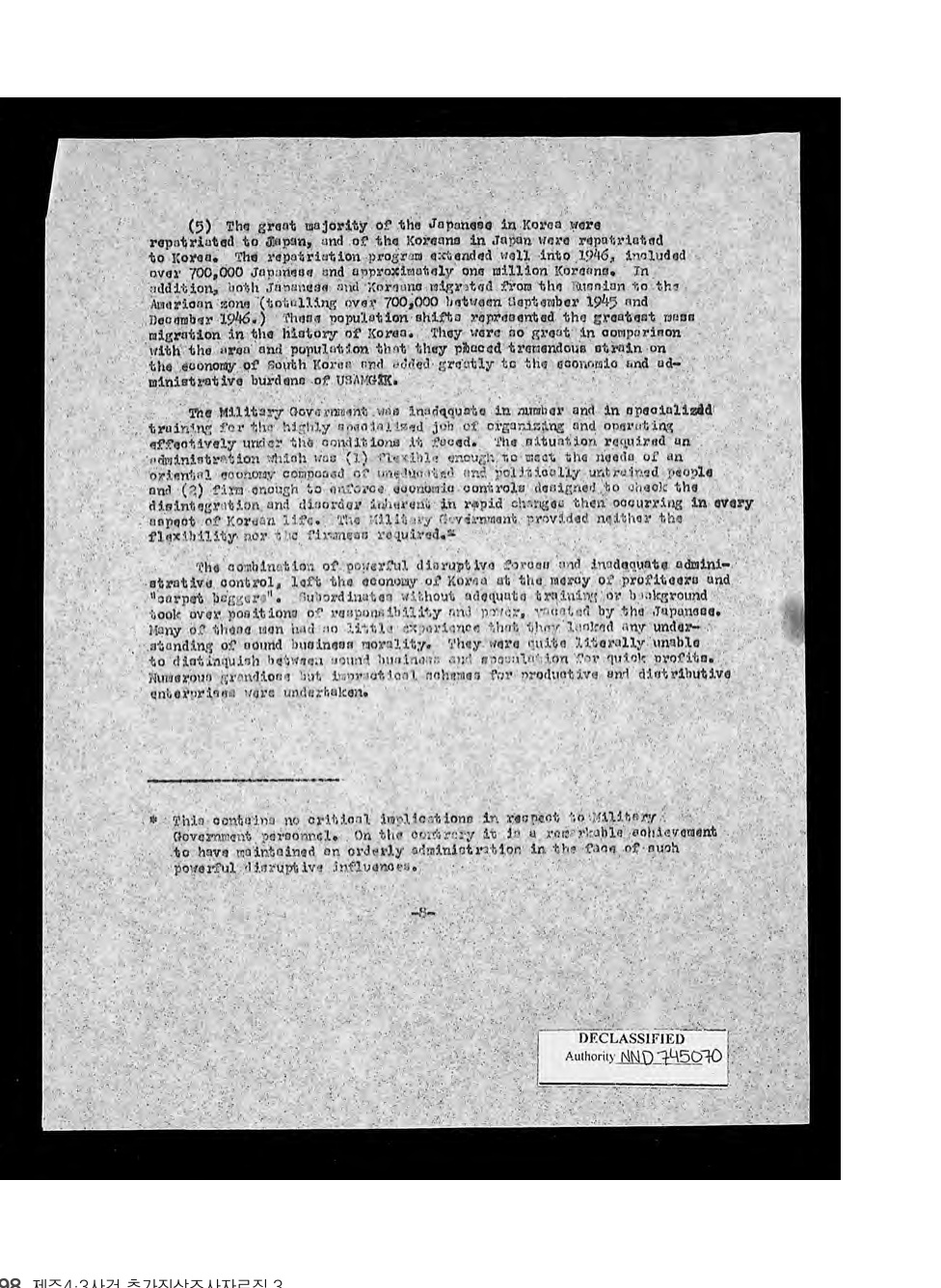
(5) The great majority of the Japanese in Korea were repatriated to Japan, and of the Koreans in Japan were repatriated to Korea. The repatriation program extended well into 1946, included over 700,000 Japanese and approximately one million Koreans. In addition, both Japanese and Koreans migrated from the Russian to the American zone (totalling over 700,000 between September 1945 and December 1946.) These population shifts represented the greatest mass migration in the history of Korea. They were so great in comparison with the area and population that they placed tremendous strain on the economy of South Korea and added greatly to the economic and administrative burdens of USAMGIK.
The Military Government was inadequate in number and in specialized training for the highly specialized job of organizing and operating effectively under the conditions it faced. The situation required an administration which was (1) flexible enough to meet the needs of an oriental economy composed of uneducated and politically untrained people and (2) firm enough to enforce economic controls designed to check the disintegration and disorder inherent in rapid changes then occurring in every aspect of Korean life. The Military Government provided neither the flexibility nor the firmness required.*
The combination of powerful disruptive forces and inadequate administrative control, left the economy of Korea at the mercy of profiteers and "carpet beggers". Subordinates without adequate training or background took over positions of responsibility and power, vacated by the Japanese. Many of these men had so little experience that they lacked any understanding of sound business morality. They were quite literally unable to distinguish between sound business and speculation for quick profits. Numerous grandiose but impractical schemes for productive and distributive enterprises were undertaken.
---
* This contains no critical implications in respect to Military Government personnel. On the contrary it is a remarkable achievement to have maintained an orderly administration in the face of such powerful disruptive influences.
-8-
DECLASSIFIED
Authority NND 745070
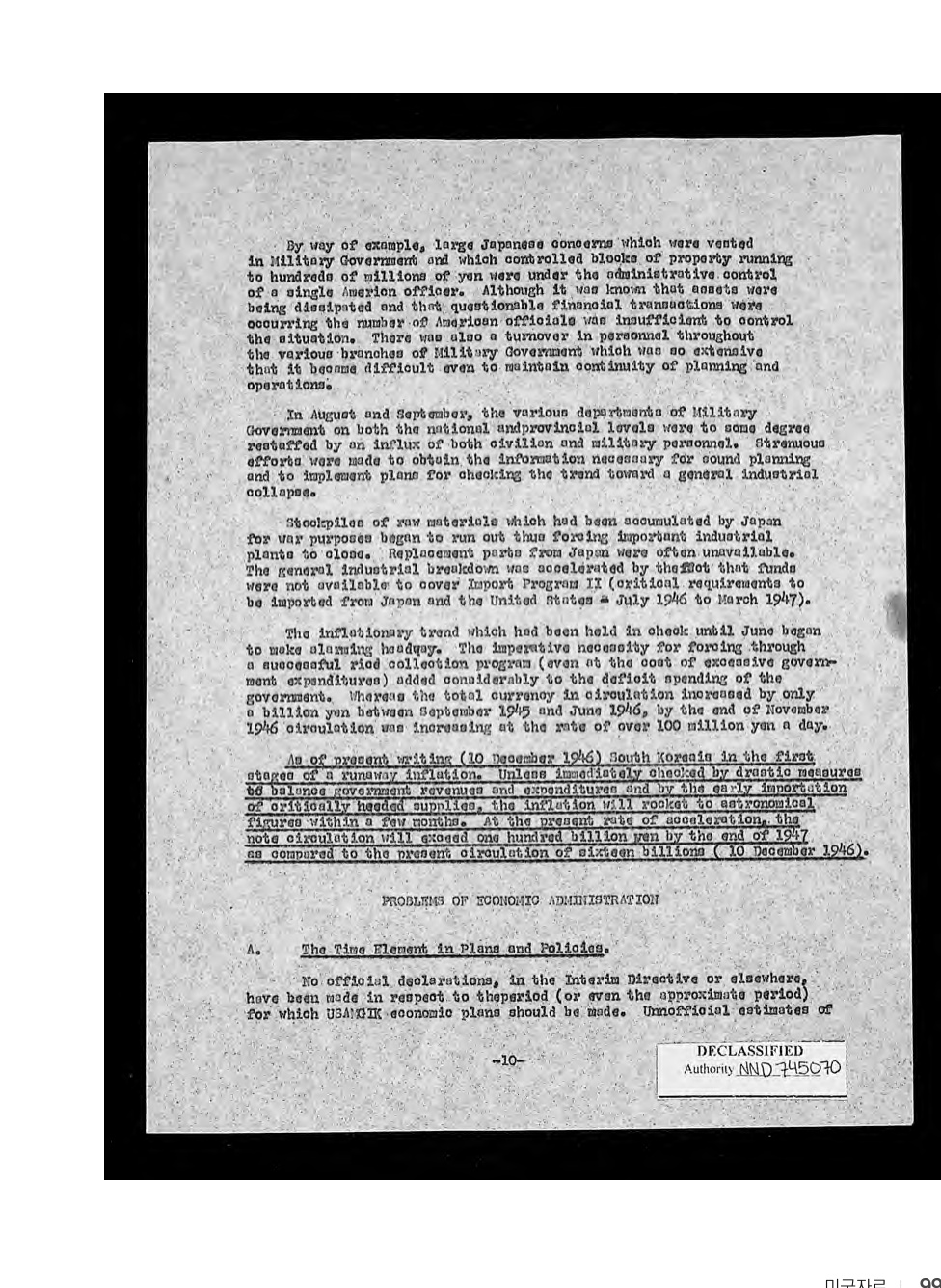
By way of example, large Japanese concerns which were vested in Military Government and which controlled blocks of property running to hundreds of millions of yen were under the administrative control of a single American officer. Although it was known that assets were being dissipated and that questionable financial transactions were occurring the number of American officials was insufficient to control the situation. There was also a turnover in personnel throughout the various branches of Military Government which was so extensive that it became difficult even to maintain continuity of planning and operations.
In August and September, the various departments of Military Government on both the national and provincial levels were to some degree restaffed by an influx of both civilian and military personnel. Strenuous efforts were made to obtain the information necessary for sound planning and to implement plans for checking the trend toward a general industrial collapse.
Stockpiles of raw materials which had been accumulated by Japan for war purposes began to run out thus forcing important industrial plants to close. Replacement parts from Japan were often unavailable. The general industrial breakdown was accelerated by the fact that funds were not available to cover Import Program II (critical requirements to be imported from Japan and the United States - July 1946 to March 1947).
The inflationary trend which had been held in check until June began to make alarming headway. The imperative necessity for forcing through a successful rice collection program (even at the cost of excessive government expenditures) added considerably to the deficit spending of the government. Whereas the total currency in circulation increased by only a billion yen between September 1945 and June 1946, by the end of November 1946 circulation was increasing at the rate of over 100 million yen a day.
As of present writing (10 December 1946) South Koreais in the first stages of a runaway inflation. Unless immediately checked by drastic measures to balance government revenues and expenditures and by the early importation of critically needed supplies, the inflation will rocket to astronomical figures within a few months. At the present rate of acceleration, the note circulation will exceed one hundred billion yen by the end of 1947 as compared to the present circulation of sixteen billions ( 10 December 1946).
PROBLEMS OF ECONOMIC ADMINISTRATION
A. The Time Element in Plans and Policies.
No official declarations, in the Interim Directive or elsewhere, have been made in respect to the period (or even the approximate period) for which USAMGIK economic plans should be made. Unofficial estimates of
-10-
DECLASSIFIED
Authority NND 745070
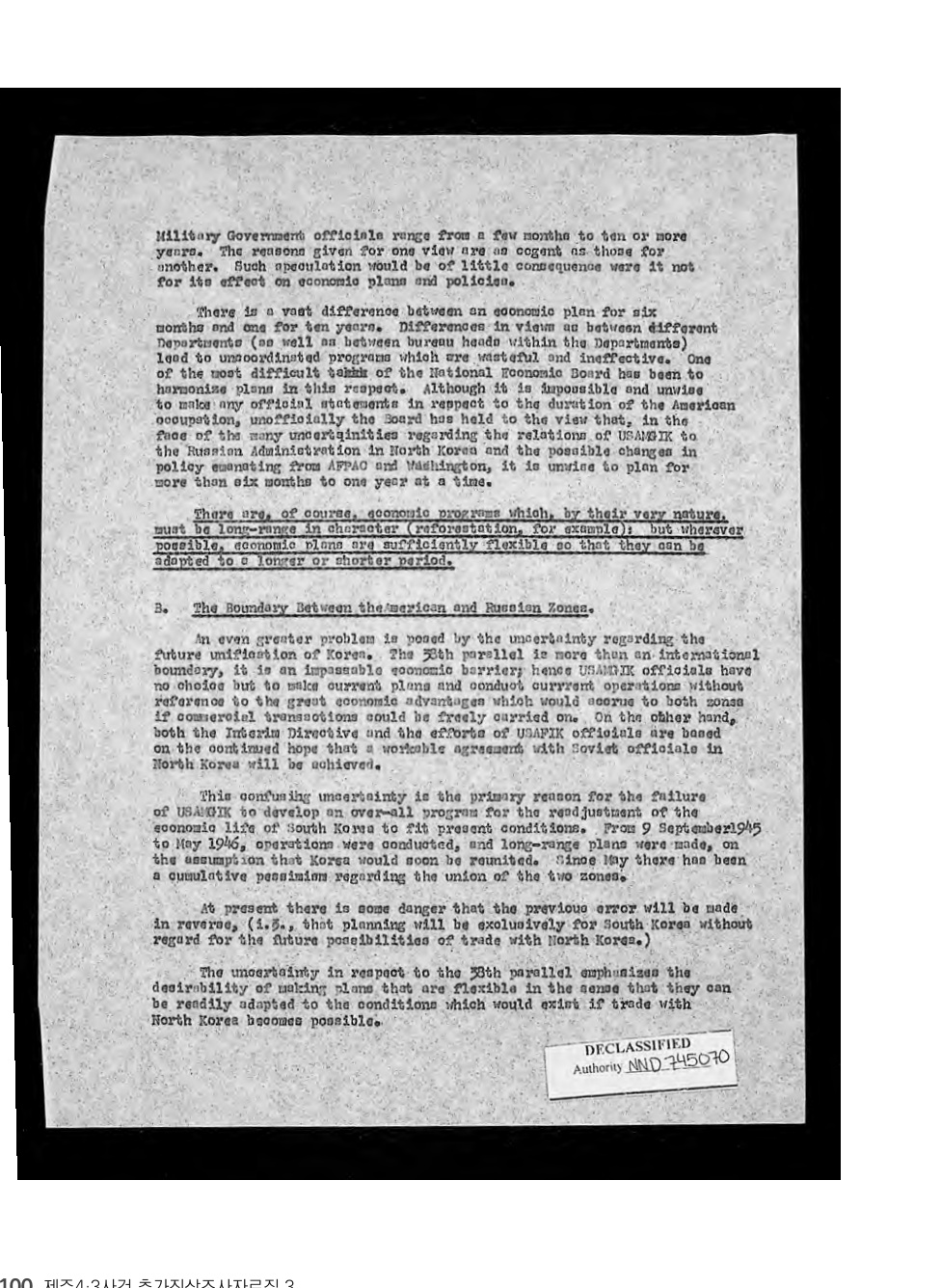
Military Government officials range from a few months to ten or more years. The reasons given for one view are as cogent as those for another. Such speculation would be of little consequence were it not for its effect on economic plans and policies.
There is a vast difference between an economic plan for six months and one for ten years. Differences in views as between different
Departments (as well as between bureau heads within the Departments)
lead to uncoordinated programs which are wasteful and ineffective. One of the most difficult tasks of the National Economic Board has been to harmonize plans in this respect. Although it is impossible and unwise to make any official statements in respect to the duration of the American occupation, unofficially the Board has held to the view that, in the face of the many uncertainties regarding the relations of USAMGIK to the Russian Administration in North Korea and the possible changes in policy emanating from AFFAC and Washington, it is unwise to plan for more than six months to one year at a time.
There are, of course, economic programs which, by their very nature, must be long-range in character (reforestation, for example); but wherever possible, economic plans are sufficiently flexible so that they can be adapted to a longer or shorter period.
B. The Boundary Between the American and Russian Zones.
An even greater problem is posed by the uncertainty regarding the future unification of Korea. The 38th parallel is more than an international boundary, it is an impassable economic barrier; hence USAMGIK officials have no choice but to make current plans and conduct current operations without reference to the great economic advantages which would accrue to both zones if commercial transactions could be freely carried on. On the other hand, both the Interim Directive and the efforts of USAFIK officials are based on the continued hope that a workable agreement with Soviet officials in
North Korea will be achieved.
This confusing uncertainty is the primary reason for the failure of USAMGIK to develop an over-all program for the readjustment of the economic life of South Korea to fit present conditions. From 9 September1945 to May 1946, operations were conducted, and long-range plans were made, on the assumption that Korea would soon be reunited. Since May there has been a cumulative pessimism regarding the union of the two zones.
At present there is some danger that the previous error will be made in reverse, (i.e., that planning will be exclusively for South Korea without regard for the future possibilities of trade with North Korea.)
The uncertainty in respect to the 38th parallel emphasizes the desirability of making plans that are flexible in the sense that they can be readily adapted to the conditions which would exist if trade with
North Korea becomes possible.
DECLASSIFIED
Authority NND 745070
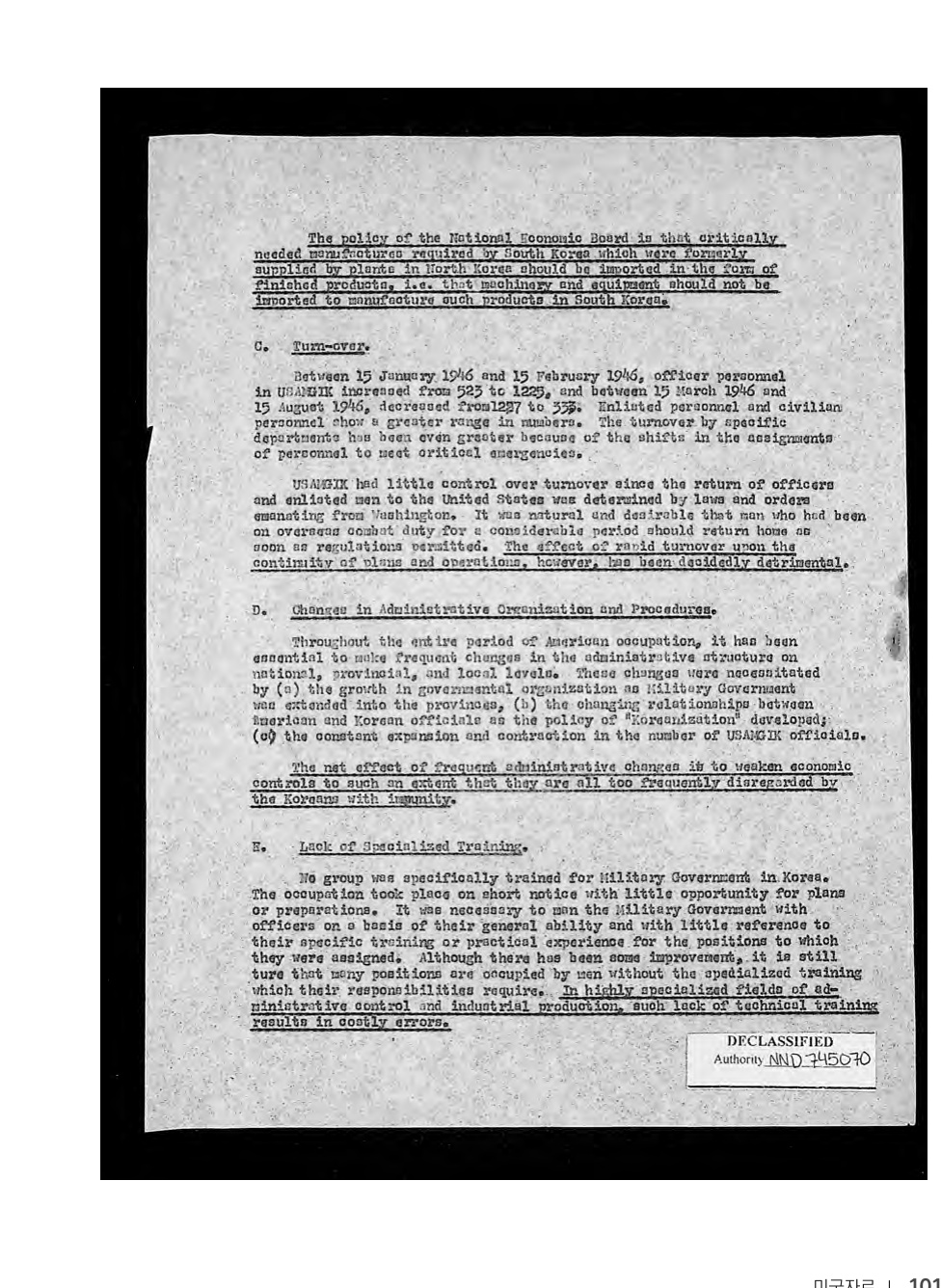
The policy of the National Economic Board is that critically needed manufactures required by South Korea which were formerly supplied by plants in North Korea should be imported in the form of finished products, i.e. that machinery and equipment should not be imported to manufacture such products in South Korea.
C. Turn-over.
Between 15 January 1946 and 15 February 1946, officer personnel in USAMGIK increased from 523 to 1225, and between 15 March 1946 and 15 August 1946, decreased from1257 to 533. Enlisted personnel and civilian personnel show a greater range in numbers. The turnover by specific departments has been even greater because of the shifts in the assignments of personnel to meet critical emergencies.
USAMGIK had little control over turnover since the return of officers and enlisted men to the United States was determined by laws and orders emanating from Washington. It was natural and desirable that men who had been on overseas combat duty for a considerable period should return home as soon as regulations permitted. The effect of rapid turnover upon the continuity of plans and operations, however, has been decidedly detrimental.
D. Changes in Administrative Organization and Procedures.
Throughout the entire period of American occupation, it has been essential to make frequent changes in the administrative structure on national, provincial, and local levels. These changes were necessitated by (a) the growth in governmental organization as Military Government was extended into the provinces, (b) the changing relationships between American and Korean officials as the policy of "Koreanization" developed; (c) the constant expansion and contraction in the number of USAMGIK officials.
The net effect of frequent administrative changes is to weaken economic controls to such an extent that they are all too frequently disregarded by the Koreans with impunity.
E. Lack of Specialized Training.
No group was specifically trained for Military Government in Korea. The occupation took place on short notice with little opportunity for plans or preparations. It was necessary to man the Military Government with officers on a basis of their general ability and with little reference to their specific training or practical experience for the positions to which they were assigned. Although there has been some improvement, it is still true that many positions are occupied by men without the specialized training which their responsibilities require. In highly specialized fields of administrative control and industrial production, such lack of technical training results in costly errors.
DECLASSIFIED
Authority NND 745070
THE ACUTE SHORTAGE OF EXPERIENCED KOREAN
TECHNICIANS AND ADMINISTRATORS
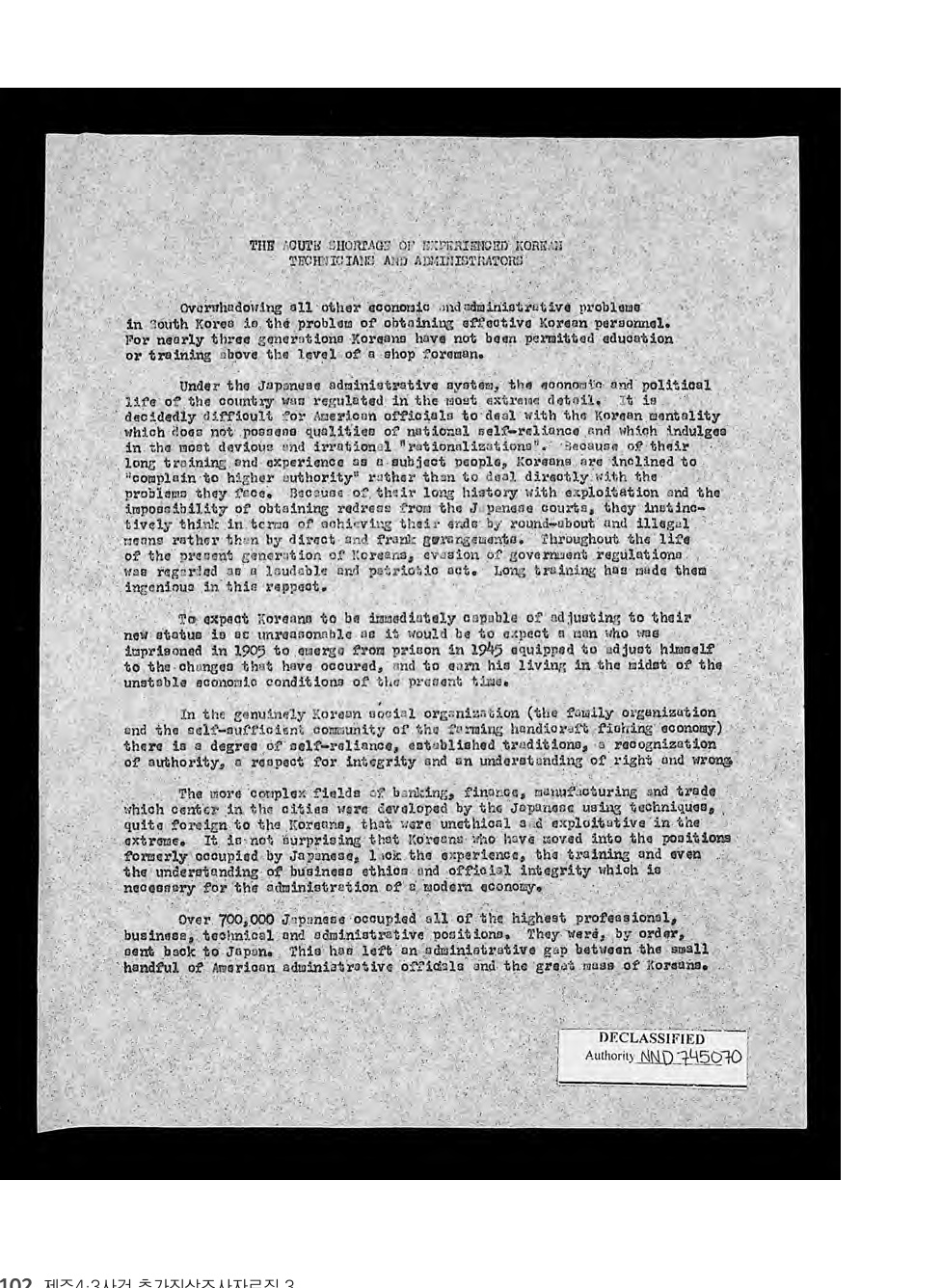
Overshadowing all other economic and administrative problems in South Korea is the problem of obtaining effective Korean personnel.
For nearly three generations Koreans have not been permitted education or training above the level of a shop foreman.
Under the Japanese administrative system, the economic and political life of the country was regulated in the most extreme detail. It is decidedly difficult for American officials to deal with the Korean mentality which does not possess qualities of national self-reliance and which indulges in the most devious and irrational "rationalizations". Because of their long training and experience as a subject people, Koreans are inclined to
"complain to higher authority" rather than to deal directly with the problems they face. Because of their long history with exploitation and the impossibility of obtaining redress from the Japanese courts, they instinctively think in terms of achieving their ends by round-about and illegal means rather than by direct and frank arrangements. Throughout the life of the present generation of Koreans, evasion of government regulations was regarded as a laudable and patriotic act. Long training has made them ingenious in this respect.
To expect Koreans to be immediately capable of adjusting to their new status is as unreasonable as it would be to expect a man who was imprisoned in 1905 to emerge from prison in 1945 equipped to adjust himself to the changes that have occured, and to earn his living in the midst of the unstable economic conditions of the present time.
In the genuinely Korean social organization (the family organization and the self-sufficient community of the farming handicraft fishing economy)
there is a degree of self-reliance, established traditions, a recognization of authority, a respect for integrity and an understanding of right and wrong.
The more complex fields of banking, finance, manufacturing and trade which center in the cities were developed by the Japanese using techniques, quite foreign to the Koreans, that were unethical and exploitative in the extreme. It is not surprising that Koreans who have moved into the positions formerly occupied by Japanese, lack the experience, the training and even the understanding of business ethics and official integrity which is necessary for the administration of a modern economy.
Over 700,000 Japanese occupied all of the highest professional, business, technical and administrative positions. They were, by order, sent back to Japan. This has left an administrative gap between the small handful of American administrative officials and the great mass of Koreans.
DECLASSIFIED
Authority NND 745070
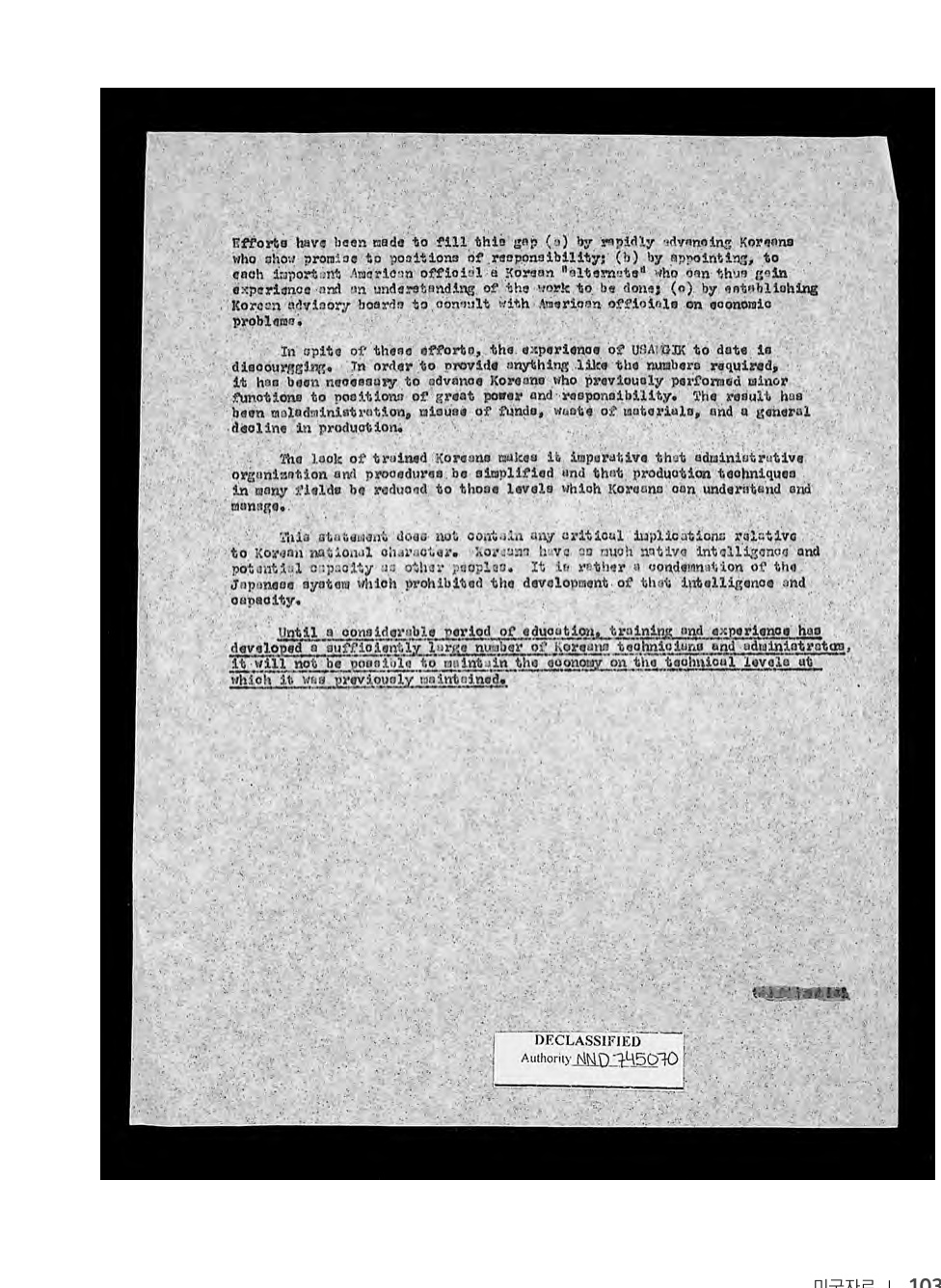
Efforts have been made to fill this gap (a) by rapidly advancing Koreans who show promise to positions of responsibility; (b) by appointing, to each important American official a Korean "alternate" who can thus gain experience and an understanding of the work to be done; (c) by establishing
Korean advisory boards to consult with American officials on economic problems.
In spite of these efforts, the experience of USAMGIK to date is discouraging. In order to provide anything like the numbers required, it has been necessary to advance Koreans who previously performed minor functions to positions of great power and responsibility. The result has been maladministration, misuse of funds, waste of materials, and a general decline in production.
The lack of trained Koreans makes it imperative that administrative organization and procedures be simplified and that production techniques in many fields be reduced to those levels which Koreans can understand and manage.
This statement does not contain any critical implications relative to Korean national character. Koreans have as much native intelligence and potential capacity as other peoples. It is rather a condemnation of the
Japanese system which prohibited the development of that intelligence and capacity.
Until a considerable period of education, training and experience has developed a sufficiently large number of Koreans technicians and administrators, it will not be possible to maintain the economy on the technical levels at which it was previously maintained.
DECLASSIFIED
Authority NND 745070
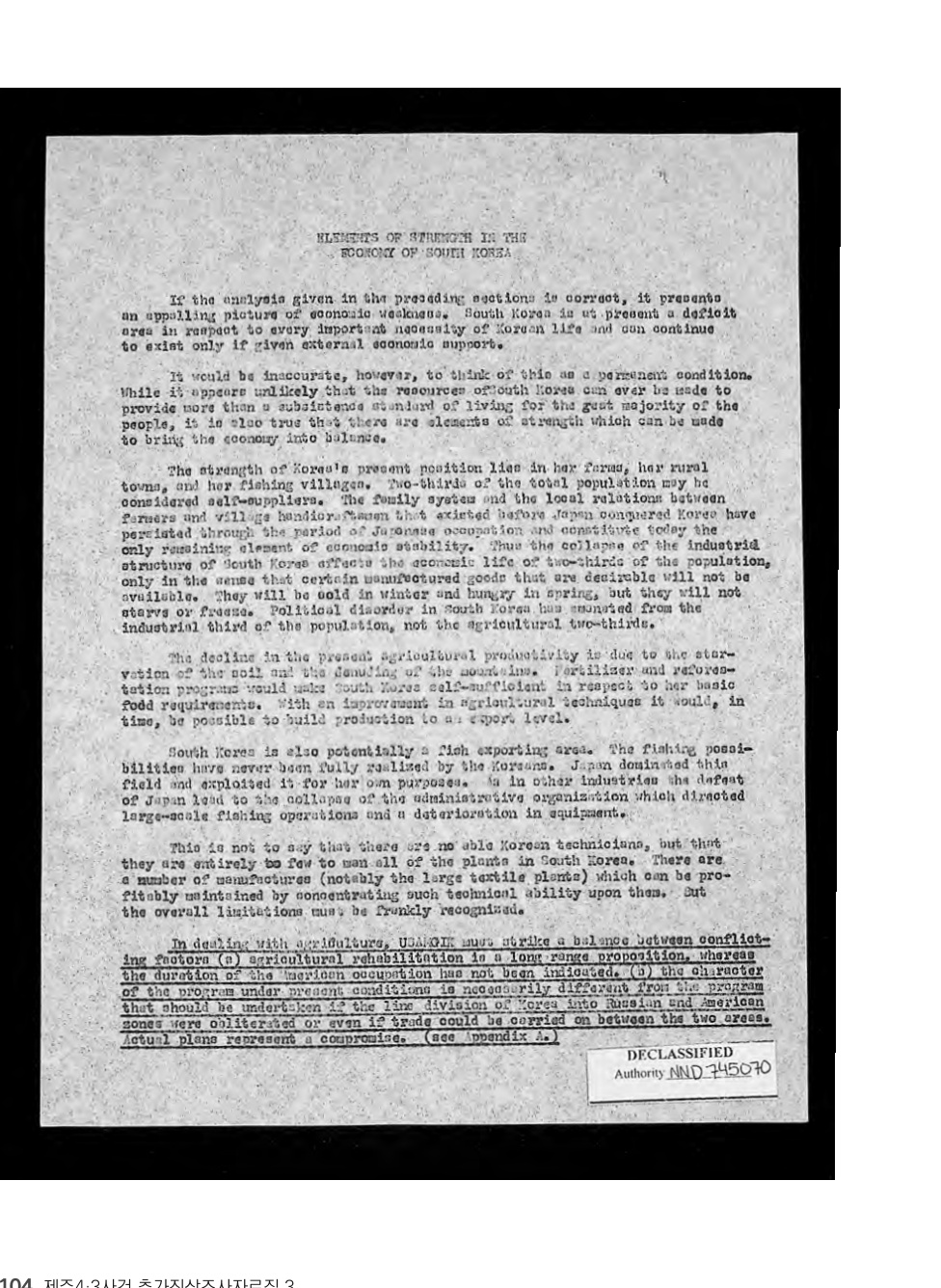
ELEMENTS OF STRENGTH IN THE
ECONOMY OF SOUTH KOREA
If the analysis given in the preceding sections is correct, it presents an appalling picture of economic weakness. South Korea is at present a deficit area in respect to every important necessity of Korean life and can continue to exist only if given external economic support.
It would be inaccurate, however, to think of this as a permanent condition. While it appears unlikely that the resources of South Korea can ever be made to provide more than a subsistence standard of living for the great majority of the people, it is also true that there are elements of strength which can be made to bring the economy into balance.
The strength of Korea's present position lies in her farms, her rural towns, and her fishing villages. Two-thirds of the total population may be considered self-suppliers. The family system and the local relations between farmers and village handicraftsmen that existed before Japan conquered Korea have persisted through the period of Japanese occupation and constitute today the only remaining element of economic stability. Thus the collapse of the industrial structure of South Korea affects the economic life of two-thirds of the population, only in the sense that certain manufactured goods that are desirable will not be available. They will be cold in winter and hungry in spring, but they will not starve or freeze. Political disorder in South Korea has emanated from the industrial third of the population, not the agricultural two-thirds.
The decline in the present agricultural productivity is due to the starvation of the soil and the denuding of the mountains. Fertilizer and reforestation programs would make South Korea self-sufficient in respect to her basic food requirements. With an improvement in agricultural techniques it would, in time, be possible to build production to an export level.
South Korea is also potentially a fish exporting area. The fishing possibilities have never been fully realized by the Koreans. Japan dominated this field and exploited it for her own purposes. As in other industries the defeat of Japan lead to the collapse of the administrative organization which directed large-scale fishing operations and a deterioration in equipment.
This is not to say that there are no able Korean technicians, but that they are entirely too few to man all of the technical plants in South Korea. There are a number of manufactures (notably the large textile plants) which can be profitably maintained by concentrating such technical ability upon them. But the overall limitations must be frankly recognized.
In dealing with agriculture, USAMGIK must strike a balance between conflicting factors (a) agricultural rehabilitation is a long range proposition, whereas the duration of the American occupation has not been indicated. (b) the character of the program under present conditions is necessarily different from the program that should be undertaken if the line division of Korea into Russian and American zones were obliterated or even if trade could be carried on between the two areas. Actual plans represent a compromise. (see Appendix A.)
DECLASSIFIED
Authority NND 745070
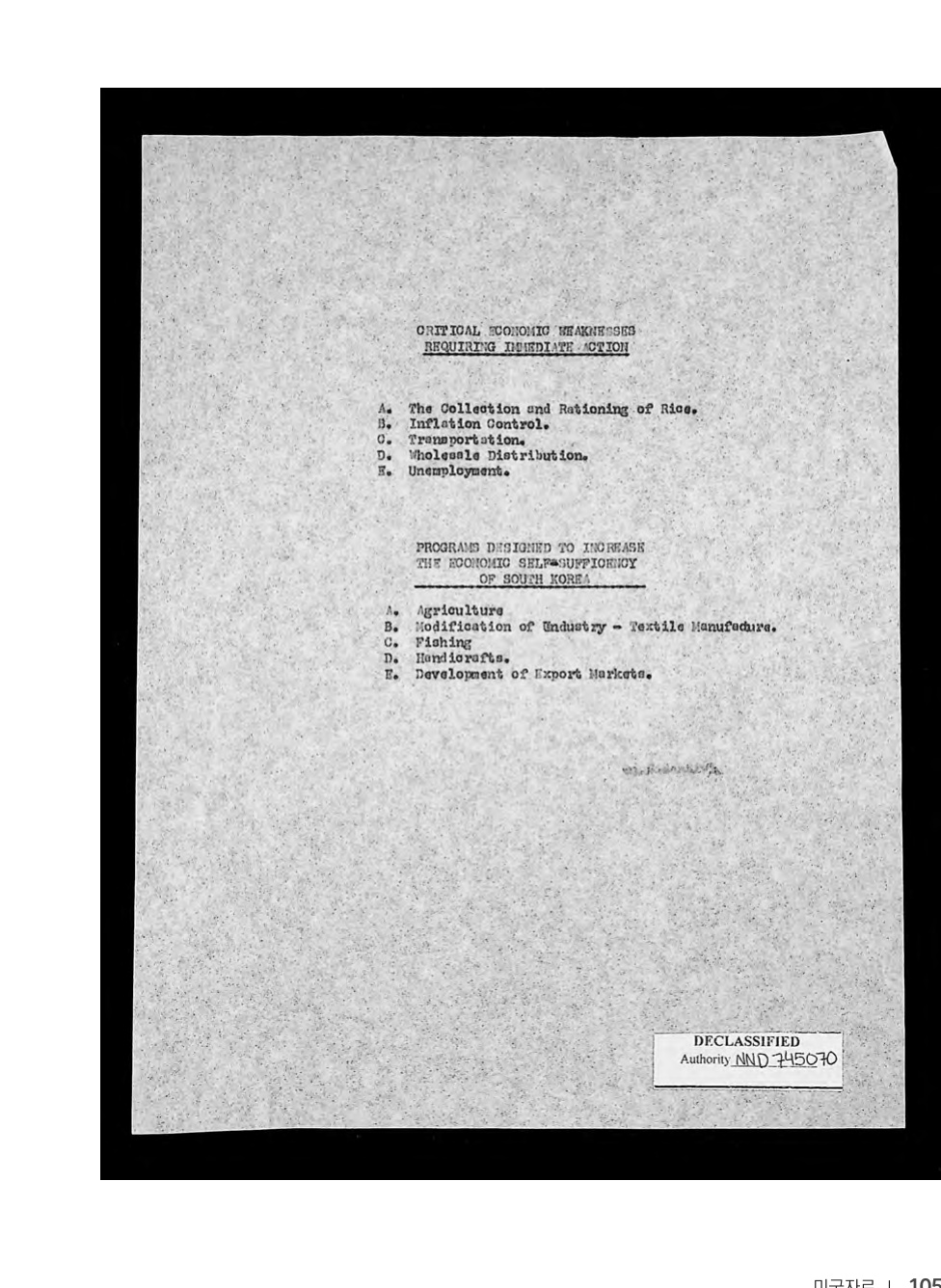
CRITICAL ECONOMIC WEAKNESSES
REQUIRING IMMEDIATE ACTION
A. The Collection and Rationing of Rice.
B. Inflation Control.
C. Transportation.
D. Wholesale Distribution.
E. Unemployment.
PROGRAMS DESIGNED TO INCREASE
THE ECONOMIC SELF-SUFFICIENCY
OF SOUTH KOREA
A. Agriculture
B. Modification of Industry - Textile Manufacture.
C. Fishing
D. Handicrafts.
E. Development of Export Markets.
[illegible]
DECLASSIFIED
Authority NND 745070
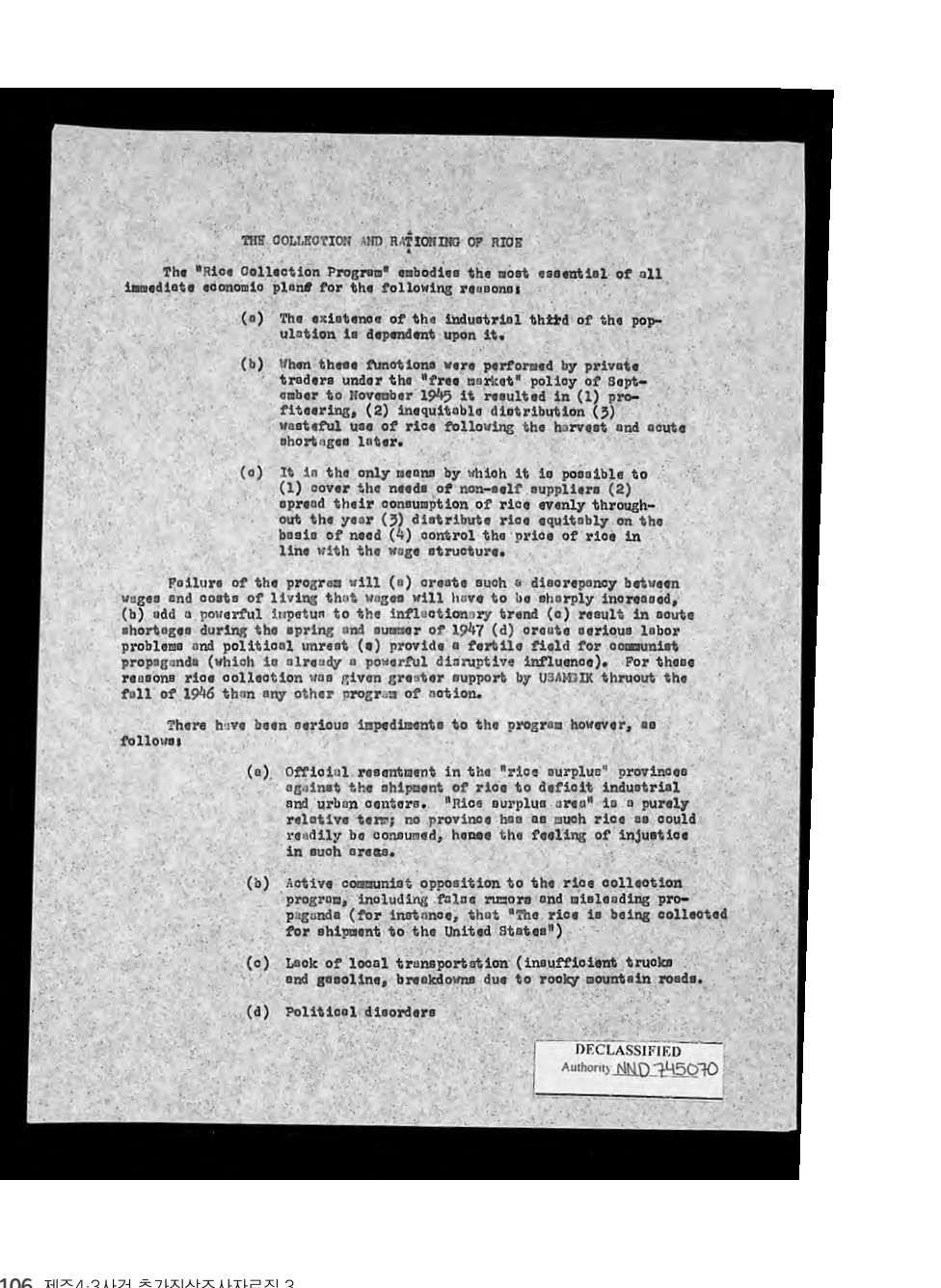
THE COLLECTION AND RATIONING OF RICE
The "Rice Collection Program" embodies the most essential of all immediate economic plans for the following reasons:
(a) The existence of the industrial third of the population is dependent upon it.
(b) When these functions were performed by private traders under the "free market" policy of September to November 1945 it resulted in (1) profiteering, (2) inequitable distribution (3)
wasteful use of rice following the harvest and acute shortages later.
(c) It is the only means by which it is possible to
(1) cover the needs of non-self suppliers (2)
spread their consumption of rice evenly throughout the year (3) distribute rice equitably on the basis of need (4) control the price of rice in line with the wage structure.
Failure of the program will (a) create such a discrepancy between wages and costs of living that wages will have to be sharply increased,
(b) add a powerful impetus to the inflationary trend (c) result in acute shortages during the spring and summer of 1947 (d) create serious labor problems and political unrest (e) provide a fertile field for communist propaganda (which is already a powerful disruptive influence). For these reasons rice collection was given greater support by USAMGIK thruout the fall of 1946 than any other program of action.
There have been serious impediments to the program however, as
follows:
(a) Official resentment in the "rice surplus" provinces
against the shipment of rice to deficit industrial and urban centers. "Rice surplus area" is a purely relative term; no province has as much rice as could readily be consumed, hence the feeling of injustice in such areas.
(b) Active communist opposition to the rice collection program, including false rumors and misleading propaganda (for instance, that "The rice is being collected for shipment to the United States").
(c) Lack of local transportation (insufficient trucks and gasoline, breakdowns due to rocky mountain roads.
(d) Political disorders
DECLASSIFIED
Authority NND 745070
As of 15 December, 41 percent of the total quota had been collected which was behind the scheduled quota for that date.
ACTION TAKEN
1. Ample appropriations to cover the purchase, transportation, and rationing of rice.
2. The allocation of all "incentive goods" to rural markets under an arrangement for giving all farmers, who sold rice to the government in accordance with their quotas, a first priority in the purchase of such goods.
3. The allocation of sufficient railway transportation to move the rice (these transport requirements being given a priority over all other forms of transportation including passenger service).
4. The transfer of interpreters and speakers from various agencies of USAMGIK into a specially trained group to tour the country and explain the urgent necessity for a successful rice collection program (an action which becomes imperative to offset communist propaganda in rural areas).
5. Orders from the Military Governor to the provincial governors that the rice collection program should take first priority over all others.
6. An assurance from the Commanding General that the tactical troops could be used (including their transportation equipment) for collecting and transporting rice whenever the local provincial governor deemed it critically necessary.
FURTHER ACTION RECOMMENDED
1. Closer liaison between the National Capital, the Provincial Capitals and the farming communities to make certain that local opposition to the program is quickly known to the provincial governors and that bottlenecks in the program are reported directly to the national capital for action.
INFLATION CONTROL
GOVERNMENT EXPENDITURES AND NOTE CIRCULATION
The Bank of Chosen not circulation almost doubled in August 1945 during the panic and confusion following Japan's collapse. After the American occupation, the note circulation rose by approximately one billion yen between 9 September 1945 and 1 June 1946 (bringing the notes outstanding to a total of ¥ 9,400,000,000). By September 1946, however, circulation was increasing by approximately a billion yen a month and by December it was increasing at a rate of well over one hundred million yen a day.
DECLASSIFIED
Authority NND 745070
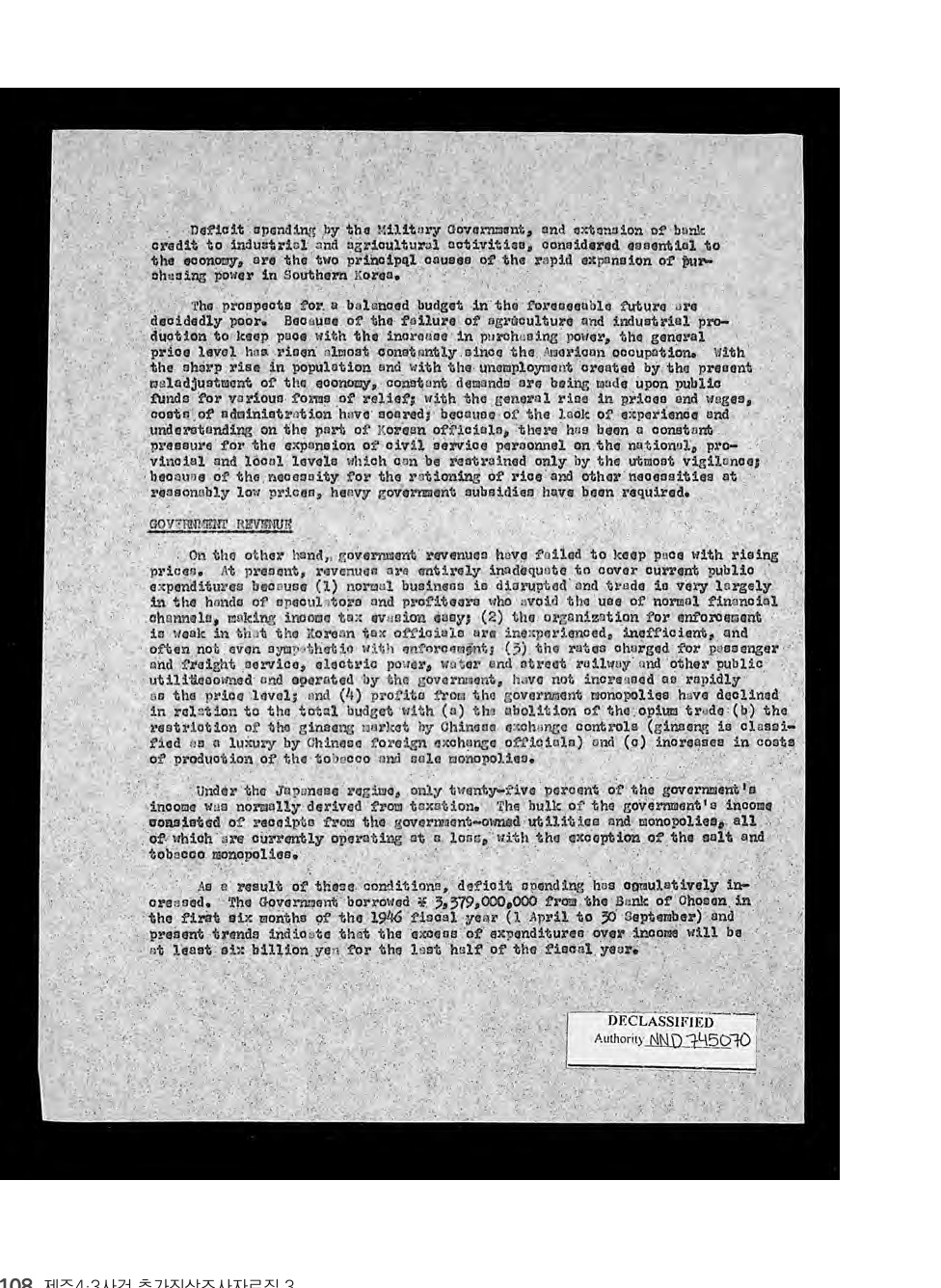
Deficit spending by the Military Government, and extension of bank credit to industrial and agricultural activities, considered essential to the economy, are the two principal causes of the rapid expansion of purchasing power in Southern Korea.
The prospects for a balanced budget in the foreseeable future are decidedly poor. Because of the failure of agriculture and industrial production to keep pace with the increase in purchasing power, the general price level has risen almost constantly since the American occupation. With the sharp rise in population and with the unemployment created by the present maladjustment of the economy, constant demands are being made upon public funds for various forms of relief; with the general rise in prices and wages, costs of administration have soared; because of the lack of experience and understanding on the part of Korean officials, there has been a constant pressure for the expansion of civil service personnel on the national, provincial and local levels which can be restrained only by the utmost vigilance; because of the necessity for the rationing of rice and other necessities at reasonably low prices, heavy government subsidies have been required.
GOVERNMENT REVENUE
On the other hand, government revenues have failed to keep pace with rising prices. At present, revenues are entirely inadequate to cover current public expenditures because (1) normal business is disrupted and trade is very largely in the hands of speculators and profiteers who avoid the use of normal financial channels, making income tax evasion easy; (2) the organization for enforcement is weak in that the Korean tax officials are inexperienced, inefficient, and often not even sympathetic with enforcement; (3) the rates charged for passenger and freight service, electric power, water and street railway and other public utilities owned and operated by the government, have not increased as rapidly as the price level; and (4) profits from the government monopolies have declined in relation to the total budget with (a) the abolition of the opium trade (b) the restriction of the ginseng market by Chinese exchange controls (ginseng is classified as a luxury by Chinese foreign exchange officials) and (c) increases in costs of production of the tobacco and sale monopolies.
Under the Japanese regime, only twenty-five percent of the government's income was normally derived from taxation. The bulk of the government's income consisted of receipts from the government-owned utilities and monopolies, all of which are currently operating at a loss, with the exception of the salt and tobacco monopolies.
As a result of these conditions, deficit spending has cumulatively increased. The Government borrowed ¥ 3,379,000,000 from the Bank of Chosen in the first six months of the 1946 fiscal year (1 April to 30 September) and present trends indicate that the excess of expenditures over income will be at least six billion yen for the last half of the fiscal year.
DECLASSIFIED
Authority NND 745070
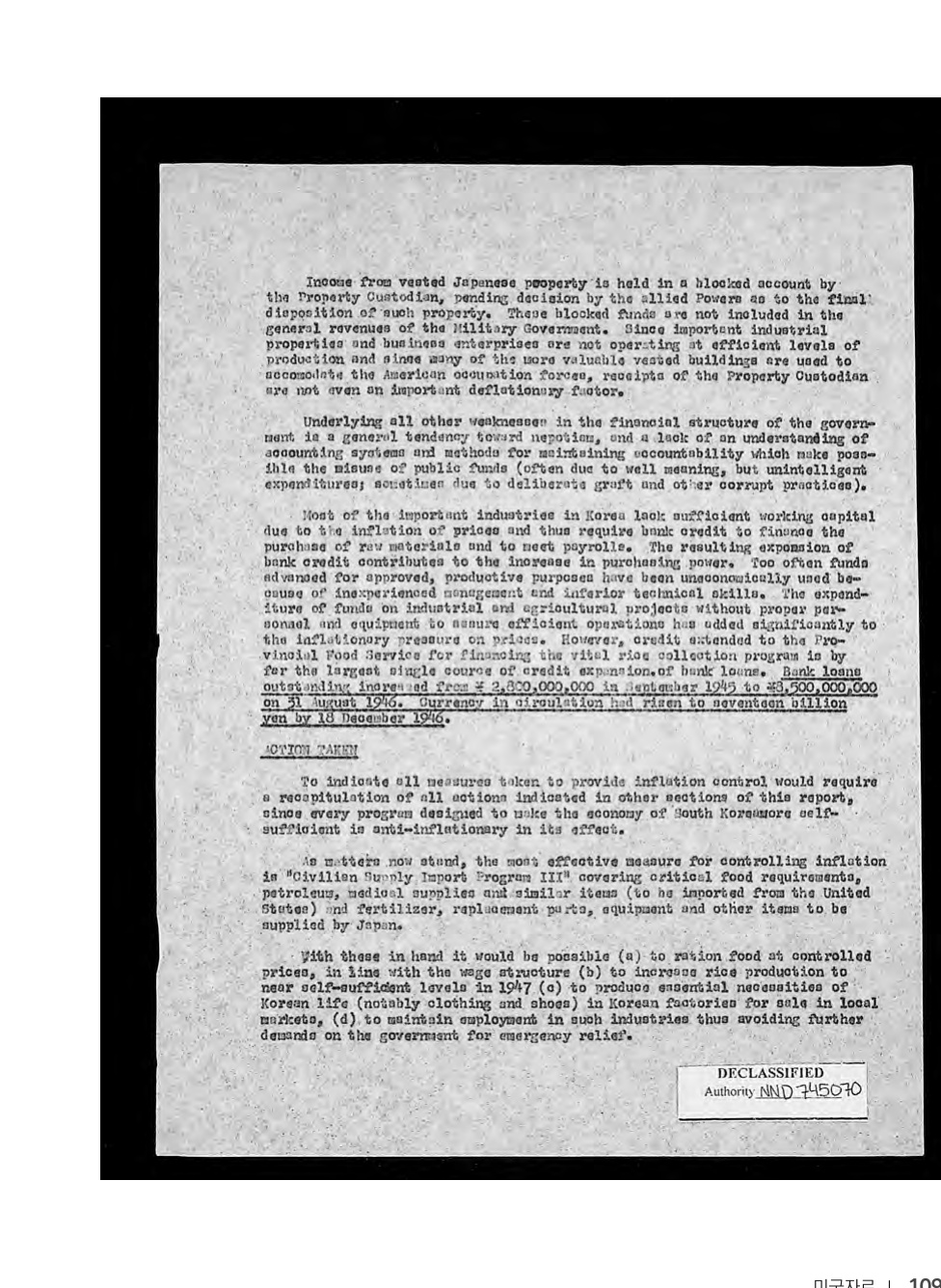
Income from vested Japanese property is held in a blocked account by the Property Custodian, pending decision by the Allied Powers as to the final disposition of such property. These blocked funds are not included in the general revenues of the Military Government. Since important industrial properties and business enterprises are not operating at efficient levels of production and since many of the more valuable vested buildings are used to accomodate the American occupation forces, receipts of the Property Custodian are not even an important deflationary factor.
Underlying all other weaknesses in the financial structure of the government is a general tendency toward nepotism, and a lack of an understanding of accounting systems and methods for maintaining accountability which make possible the misuse of public funds (often due to well meaning, but unintelligent expenditures; sometimes due to deliberate graft and other corrupt practices).
Most of the important industries in Korea lack sufficient working capital due to the inflation of prices and thus require bank credit to finance the purchase of raw materials and to meet payrolls. The resulting expansion of bank credit contributes to the increase in purchasing power. Too often funds advanced for approved, productive purposes have been uneconomically used because of inexperienced management and inferior technical skills. The expenditure of funds on industrial and agricultural projects without proper personnel and equipment to assure efficient operations has added significantly to the inflationary pressure on prices. However, credit extended to the Provincial Food Service for financing the vital rice collection program is by far the largest single source of credit expansion of bank loans. Bank loans outstanding increased from ¥ 2,300,000,000 in September 1945 to ¥3,500,000,000 on 31 August 1946. Currency in circulation had risen to seventeen billion yen by 18 December 1946.
ACTION TAKEN
To indicate all measures taken to provide inflation control would require a recapitulation of all actions indicated in other sections of this report, since every program designed to make the economy of South Koreamore self-sufficient is anti-inflationary in its effect.
As matters now stand, the most effective measure for controlling inflation is "Civilian Supply Import Program III" covering critical food requirements, petroleum, medical supplies and similar items (to be imported from the United States) and fertilizer, replacement parts, equipment and other items to be supplied by Japan.
With these in hand it would be possible (a) to ration food at controlled prices, in line with the wage structure (b) to increase rice production to near self-sufficient levels in 1947 (c) to produce essential necessities of Korean life (notably clothing and shoes) in Korean factories for sale in local markets, (d) to maintain employment in such industries thus avoiding further demands on the government for emergency relief.
DECLASSIFIED
Authority NND 745070
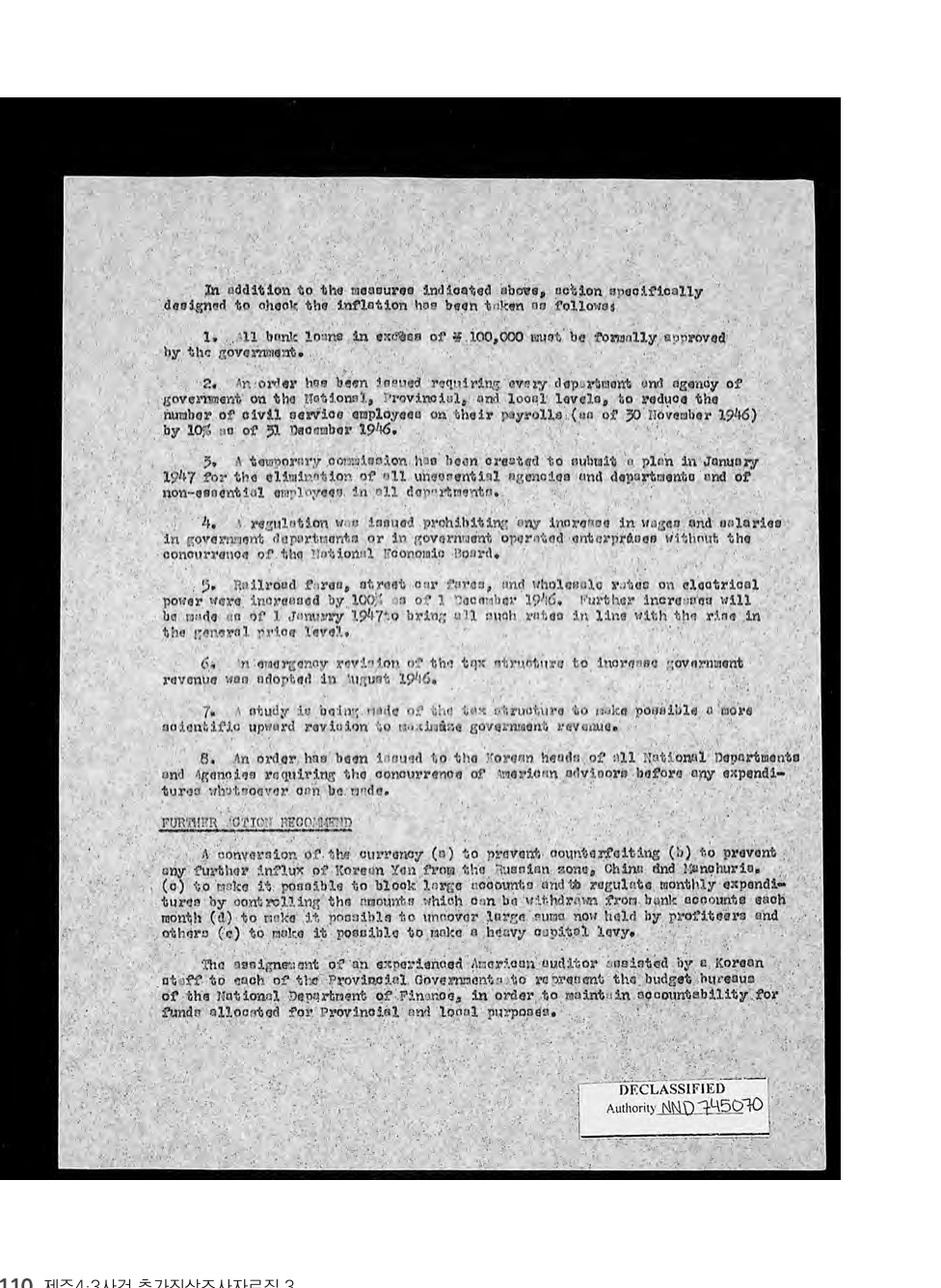
In addition to the measures indicated above, action specifically designed to check the inflation has been taken as follows:
1. All bank loans in excess of # 100,000 must be formally approved by the government.
2. An order has been issued requiring every department and agency of government on the National, Provincial, and local levels, to reduce the number of civil service employees on their payrolls (as of 30 November 1946) by 10% as of 31 December 1946.
3. A temporary commission has been created to submit a plan in January 1947 for the elimination of all unessential agencies and departments and of non-essential employees in all departments.
4. A regulation was issued prohibiting any increase in wages and salaries in government departments or in government operated enterprises without the concurrence of the National Economic Board.
5. Railroad fares, street car fares, and wholesale rates on electrical power were increased by 100% as of 1 December 1946. Further increases will be made as of 1 January 1947 to bring all such rates in line with the rise in the general price level.
6. An emergency revision of the tax structure to increase government revenue was adopted in August 1946.
7. A study is being made of the tax structure to make possible a more scientific upward revision to maximize government revenue.
8. An order has been issued to the Korean heads of all National Departments and Agencies requiring the concurrence of American advisors before any expenditures whatsoever can be made.
FURTHER ACTION RECOMMENDED
A conversion of the currency (a) to prevent counterfeiting (b) to prevent any further influx of Korean Yen from the Russian zone, China and Manchuria. (c) to make it possible to block large accounts and to regulate monthly expenditures by controlling the amounts which can be withdrawn from bank accounts each month (d) to make it possible to uncover large sums now held by profiteers and others (e) to make it possible to make a heavy capital levy.
The assignment of an experienced American auditor assisted by a Korean staff to each of the Provincial Governments to represent the budget bureaus of the National Department of Finance, in order to maintain accountability for funds allocated for Provincial and local purposes.
DECLASSIFIED
Authority NND 745070
Transportation.
South Korea is an mountainous and her highway system so poor that the railroads represent the only effective means for supplying necessities for her large urban centers and for transporting minerals and industrial raw materials.
During the war the main line, which was an important connecting link between Japan and Manchuria, was maintained as a military measure, but the reminder of the system was deplorably neglected. Rolling stock gradually deteriorated and maintenance grew progressively worse throughout the last three years of the war.
Only by the most strenuous and unremitting efforts has the Transportation Department of USAMGIK been able to meet the minimum transport requirements. The present locomotives are so worn out that they are wasteful of fuel and breakdowns are common. Cars and replacement parts are also lacking. One hundred American military locomotives from Europe together with rolling stock, replacement parts and equipment were ear-marked for Korea in July 1946, but to date, (15 December 1946) none of them have been received.
Underlying all the weaknesses of the transportation system is the fact that the technical skill and supervision for the railroad was Japanese and that there are now an insufficient number of technically trained Koreans to manage this system properly. It has been necessary to assign Koreans with inadequate training (or no training at all) to positions of considerable power and responsibility. Mismanagement, accidents and waste have inevitably resulted. At present, there are only 10 American officials assigned to the administration of the railway system which employs over 39,000 Koreans.
Under normal conditions, lack of railway facilities could be partially offset by coastal shipping but the weaknesses of this branch are similar to those of the railroads.* There is a lack of shipping, of technical skill, and of sufficient number of American officials to properly administer the Bureau of Marine Transportation.
Unless locomotives, cars, replacement parts, and equipment are obtained and a larger staff of responsible technicians in allocated to the Department, there will be a breakdown in railway transportation within the next two months. Under these conditions, food shortages and disorders in urban centers are to be expected. The rehabilitation of the railroad system is therefore given a high priority by the National Economic Board.
ACTION TAKEN
1. Repeated radio requests for ear-marked equipment from Europe including a recommendation that an officer be specifically assigned to expedite shipment.
*Note: In addition to the normal coastal trade, there is the burden of controlling smuggling since it is essential to prevent speculators from exporting necessities to the Russian zone and other areas in order to make quick profits.
DECLASSIFIED
Authority NND 745070
2. Purchases of surplus ships in the Philippines and Japan from the Foreign Liquidation Commission for coastal shipping to relieve railroads.
3. Request for American technicians to direct operations in the field.
FURTHER ACTION RECOMMENDED
Continued pressure (1) for the delivery of the locomotives, cars and equipment (2) for an additional allocation of trained and experienced
American railroad men to direct operations.
[illegible]
DECLASSIFIED
Authority NND 745070
THE ADMINISTRATIVE ORGANIZATION AND FACILITIES FOR WHOLESALE DISTRIBUTION.
During the period of Japanese occupation, wholesale distributing organizations were considered to be the primary instruments of control for exploiting Korea. They were, therefore, established on an official basis and were so large that they left little room for Korean wholesale operations.
The defeat of Japan swept away these organizations which opened the way for the extensive profiteering and speculative operations previously noted.
In order to curb profiteering and the illegal practices which accompanied it, the Military Government reestablished official wholesale organizations.
These organizations tend to restrain profiteering, but they are so large and cumbersome that they do not operate effectively. Accountability for supplies and funds on provincial and local levels is difficult to maintain and channels of distribution bog down in red tape and delays.
As a result consumer goods are piling up in warehouses and distribution centers when such goods are urgently needed and should be available in retail markets as a check to the inflationary rise in prices. This is an internal problem which can be attacked directly and vigorously.
ACTION TAKEN
1. Creation of the Federation of Financial Associations and the Korean Agricultural Association (?) to perform wholesale and distribution functions formerly handled by Japanese concerns that have been liquidated; (b) to make certain that "incentive goods" are available in rural areas so that farmers will be willing to sell rice and grain and straw bags (i.e. the money paid to farmers is useless to them unless they can purchase such goods)
2. Field investigations to determine the causes of the breakdowns in wholesale distribution and to investigate irregularities in local transactions, as a result of which KAA and FAA are subject to stricter administrative controls.
3. Reorganization (as of December 1946) of the USAMGIK agencies for calling forward and distributing (a) goods received under the Civilian Supply Program and (b) surpluses purchased under the Foreign Liquidation Commission to make them more efficient.
FURTHER ACTION RECOMMENDED.
1. The assignment of trained auditors and a staff of Korean field investigators under American supervision, to maintain financial accountability and enforce regulations on the local level.
2. The imposition of more rigid financial controls over KAA and FAA.
3. An order requiring the newly reorganized Office of Civilian Supply (under the supervision and with the assistance of the National Economic Board);
DECLASSIFIED
Authority NND 745070
(a) to assemble the available information relative to the receipt and distribution of civilian supply goods in South Korea; (b) to make a detailed field check and report on the present status of warehouses and supply centers;
(c) to make available to the Military Governor and to the National Economic
Board semi-monthly summaries covering the distribution and sale of civilian supply goods.
[illegible]
DECLASSIFIED
Authority NND 745070
출처:
제주4·3평화재단 편,
『추가진상조사자료집-미국자료1』,
p. 91–114.
— NARA (RG 554, Entry 1256, Box 41)
×
![]()