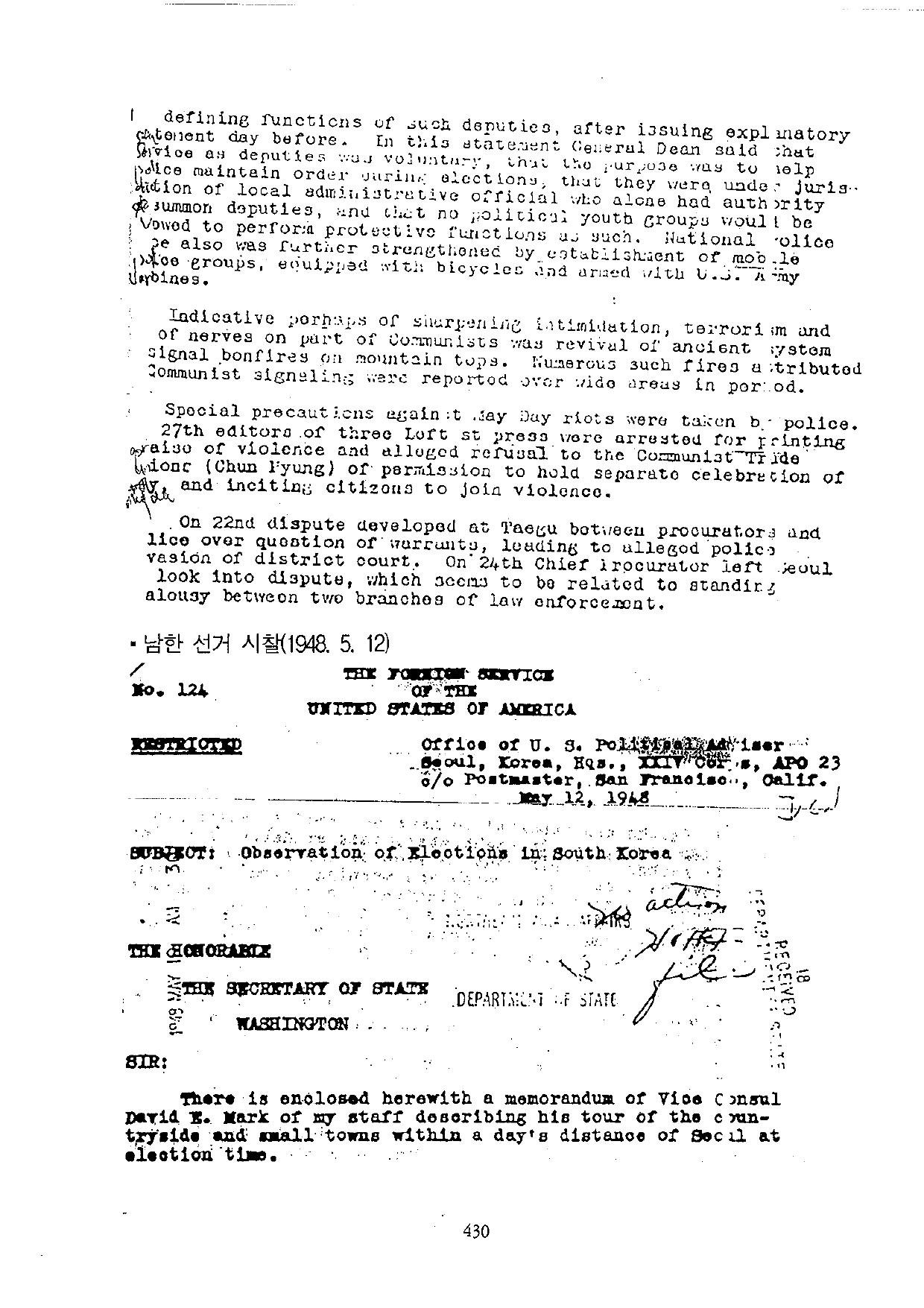
남한 선거 시찰
발신: 제24군단 사령부 정치고문관실
국무장관 귀하
선거일에 지방과 서울에서 한나절 거리에 있는 소도시를 방문한 소감을 담은 본인의 참모 데이비드 마크 부영사의 비망록을 첨부합니다.
투표를 위한 훌륭한 시설과 주민들의 반응, 자유롭고 평화스런 선거분위기를 보여주는 마크의 선거관련 직접 설명은 매우 흥미롭고 유익할 것입니다. 이와 관련해 서울과 대조적으로 지방은 공휴일 분위기가 있다는 것도 언급할 것입니다.
서울에서는 아침나절에 투표가 대부분 끝나자 상점과 식당, 집들은 굳게 문이 닫힌 채 대개 붐비던 거리는 정적이 흐르고 인적이 없었습니다.
이날의 휴일 방식은 보통 공원에 모이거나 길거리를 산책하는 일상적인 휴가 이용방법과는 매우 달라서 소요와 무질서에 대한 공포가 존재하고 있음이 명백했습니다.
시골에서와 마찬가지로 투표소 입구에 선거구에서 출마한 5, 6명 후보의 사진과 이력 등이 붙여져 있으며 입구에는 의자나 벤치에 선거관리위원들이 앉아있었습니다. 투표소에서 약간 떨어진 곳에는 완장을 두르고 몽둥이를 든 젊은 청년들이 앉아있습니다. 현지 향보단원들은 군정장관의 4월 21일자 법령에 따라 조직됐습니다. 투표소에 이르는 골목길과 중요 지점에는 다른 향보단원들이 순찰을 돌고 의심스럽게 보이는 사람들을 찾아내거나 도로를 차단하고 있습니다.
기동경찰이 트럭이나 자전거를 타고 도로를 순찰하는 모습이 보이지만 대개 경찰은 총검을 꽂은 채 지서에 남아 있습니다. 이런 경계조처에 따라 유권자들과 투표소는 충분히 보호됐으며 선거일은 최소한의 소요만 있었을 뿐 지나갔습니다.
그러므로 대체적으로 선거는 기대했던 것보다 훨씬 만족스러울 정도로 끝났습니다. 35명(경찰관 5명, 공산주의자 16명, 우익 14명)이 숨진 것으로 보고됐으나 이 정도의 폭력행위는 2,000만 명의 인구라는 점을 고려하면 중요하지 않습니다. 북한 공산주의자들로부터의 위협과 경고는 김구와 김규식 같은 뛰어난 지도자들의 불만과 결합됐습니다. 결과는 공산주의자들의 말로만 떠들던 조직이 보여줄 것으로 생각되는 것만큼 강하지 않다는 것을 보여줍니다.
정당별 당선자들의 보고서는 최종 선거결과가 나온 뒤 제출하겠습니다.
정치고문관 죠셉 제이콥스(Joseph E. Jacobs)
<첨부문서> 데이비드 마크 부영사의 5‧10선거 비망록
선거 비망록
1948년 5월 12일
특파원의 선거 당일과 그 전의 보도가 1948년 5월 10일의 남한내의 긴장과 소요 등을 실었기 때문에 선거일과 일요일 계속해서 3개 도(道)를 지프를 이용해 존 로지어(John W. Rozier)와 동행했던 본인이 작성한 일부 간단한 관찰을 기록하는 것이 보다 균형있는 견해를 갖는데 도움이 될 것이라고 생각합니다. 지방순회는 비교적 대도시인 경기도의 수원과 인천, 평택과 충청남도의 천안, 공주, 조치원, 대전(도청 소재지), 그리고 충청북도의 충주와 청주(도청 소재지)뿐 아니라 농촌지역도 답사했습니다.
5월 9일, 한국의 풍경은 여느 봄과 여름철에 그러한 것처럼 상당히 비슷했습니다. 농민들은 밭에서 쟁기를 갈고 여성들은 집 근처에서 일을 하고 있었으며 꼬마들은 우리가 지나가면 놀다가 “Hello-O.K”하고 소리칩니다.
도회지 사람들은 선거보다는 개기일식에 훨씬 더 관심을 갖고 있고 심지어 사업과 일에 몰두했습니다. 후보자들의 포스터가 투표참가를 독려하기 위해 곳곳에 붙어 있었습니다. 본인이 말을 건넨 여러 사람들은 일상대화와 농담을 했습니다. 본인이 대화의 주제로 선거문제를 끄집어내자 사람들은 모든 것이 조용했었고 지금도 조용하다는 한결 같은 주장에 힘을 실어주는 또 다른 일상적인 화제로 간주했습니다.
5월 10일에 비교적 가까운 15마일 정도 떨어진 여러 투표소를 방문해 질문하고 시찰하는 것이 우리의 목적이었습니다. 또 우리가 지나간 다른 투표소의 상황을 알아보는 것도 우리의 목적이었습니다. 이것은 일반적인 현황을 파악하기 위한 만족할만한 접근이었습니다.
우리가 방문했던 모든 곳이 너무나 잘 조직됐다는데 놀랐습니다. 선거법과 선거규칙, 그리고 선거규칙의 일람표에 대한 교육이 잘 이뤄졌습니다. 일반적으로 유권자는 투표소에 들어가면 선거인 명부를 갖고 있는 서기에게 갑니다. 이름을 확인하고 나면 유권자는 다른 서기에게 가고, 그 서기는 표준 투표용지와 봉투를 줍니다. 그리고 나서 유권자는 비밀 기표대에 들어가 봉투 속에 투표용지를 넣습니다. 마지막으로 투표소의 한 가운데 있는 투표함에 봉투를 넣고 떠납니다. 선관위원과 긴 의자에 일렬로 앉아있는 후보자들의 지역 대표(참관인)들이 전체 선거과정을 지켜봅니다.
눈에 잘 띄는 출입구 바깥쪽에 선거구 각 후보자들의 사진과 이름, 상징마크들이 붙여져 있습니다. 투표소 안에는 소음이나 흥분이 전혀 없었으나 많은 유권자들에게 선거절차를 간단하게 설명하는 것이 필요했습니다.
선거일 오전 내내 모든 투표소 바깥에는 줄을 길게 늘어섰습니다. 읍‧면에서 사람들은 즐거운 마음으로 휴일 외출복 복장을 한 채 참을성 있게 투표순서를 기다립니다. 도시민들은 보다 더 사무적인 태도를 보였습니다. 그러나 모든 사람들은 선거에 진짜 흥미를 느끼고 참여했습니다.
본인은 통역자이기도 했기 때문에 사람들이 열정적으로 우리를 초대해 우리의 질문에 대답하고 통계수치를 언급했다고 단언할 수 있습니다.
늦게 투표하는 사람이 드물어서 정오 이후에는 투표활동이 사실상 이뤄지지 않았습니다. 그러나 선관위원들은 마감시간까지 참을성 있고 진지하게 앉아 있었습니다.
등록 유권자가 582명인 한 투표구에서는 오전 9시 20분까지 200명이 투표를 끝마쳤습니다. 또 다른 투표구에서는 640명 가운데 620명이 낮 12시 30분까지 투표를 끝마쳤다고 자랑했습니다. 청주시의 세 번째 투표구는 정오까지 600명 가운데 450명 정도가 투표를 했습니다. 농촌지역의 읍은 오후 2시까지 940명 가운데 885명이 투표를 해 눈길을 끌었습니다. 일반 농민들이 다시 밭에서 일하는 모습이 보이기도 했습니다.
일반적인 평가는 모든 것이 지극히 질서정연했다는 것입니다. 딱 한가지 예외는 충청남도 조치원에서 있었습니다. 그곳에서는 이틀 전 야간에 면장의 집이 불에 탔습니다. 경찰이 곳곳에 깔렸고 비상경계에 들어갔습니다. 충청북도에서는 대부분의 지서들이 모래주머니나 장애물을 설치했습니다. 우리는 이런 조처가 지역 관구청장의 지시에 따른 결과이지 충돌우려 때문에 설치한 것이 아니라고 들었습니다.
의용 소방수들이 법과 질서유지를 강화하기 위해 곤봉을 들고 제복을 입고 있었습니다. 많은 일반 시민들은 ‘평화 보호자’로서 대리인이 됐으며 이들에게는 군정장관의 4월 21일 법령 실시에 따른 권한 아래 곤봉이 주어졌습니다.
사실상 대리인이 된 일반인들은 통틀어서 경찰보조기관으로 바뀐 우익청년단체들의 회원이 됐습니다. 일부는 새로운 완장을 찼으며 다른 사람들은 바꾸도록 괴롭힘을 당하지 않았습니다. 그러나 어떠한 경우에도 이런 것들이 유권자들에게 조금도 공포스러운 힘을 보여주는 징후는 없었습니다.
모든 지역에서 법을 집행하는 사람들은 유권자와 선관위원들의 친구로 받아들여졌고 투표소 모습의 필요한 한 부분으로 간주됐습니다. 더욱이 우리는 투표소 안에서 이들을 전혀 볼 수 없었습니다.
거의 목가적인 이런 모습들은 소요가 일어나는 부산과 대구, 광주, 서울, 제주도에서는 맞지 않는다는 것을 시인합니다. 그러나 우리가 다닌 지역은 좌익세가 강한 적이 없고 산업인구가 거의 없다는 것을 염두에 두어야 합니다.
실제 긴장감은 어디에도 없지만 보다 큰 지역에서는 분위기가 다소 무겁습니다.
비교적 큰 도시는 좀더 가변적인 분위기에 휩싸이는 경향이 있다고 말할 수 있습니다. 본인은 남한의 농촌지역 (제주도 제외) 어디든지 간에 여기서 설명한 지역과 크게 다르지 않다고 생각합니다.
게다가 북한사람들과 지방 공산주의 선동가들은 비교적 큰 도시에 남아있는 보다 잘 조직된 남로당의 잔존세력을 찾아낼 수 있습니다.
한 마을에서 모든 사람이 서로 알고 있는 것과는 달리 그곳에서는 발견되지 않도록 보다 많은 사람들과 섞입니다. 대개 도시에는 행복하지 않은 불평분자들이 있습니다.
올 한국의 농민들은 풍작이었던 지난해의 벼 작황을 기억하고 있고 훨씬 더 나은 작황이 될 것이라고 전망하고 있으며 일부 농민들에 대한 토지 분배 및 나머지 농민들을 위한 분배를 희망했습니다. 농촌이 70%를 차지하는 한국에서는 현재 폭력을 저지를만한 비옥한 토양이 없습니다.
물론 선거를 평가하는데 있어 선거일만을 고려하여 이전에 겪은 모든 것을 잊는 것은 불가능합니다.
본인은 개인적으로 과거 미국의 조처가 한국사회에서 우익정치집단의 장악을 불러일으키고 선거 참여로부터 이승만 박사에 대한 일종의 반대행위를 할 세력으로써 공산주의자뿐 아니라 반이승만, 반공진영을 좌절시키기 위해 많은 일을 해왔다고 생각합니다.
그러나 그것은 우리가 관찰했듯이 선거의 독특한 특징을 바꾸지는 않습니다. 거기에는 ‘자유스러운 분위기’가 있었습니다. 즉 유권자들은 두려움을 느끼지 않고 투표를 할 수 있었습니다. 서두르거나 긴장감이 없는 평화스런 분위기였습니다. 각각의 유권자들이 익명으로 선택할 수 있었던 진짜 비밀투표였습니다.
무엇보다도 한국인들이 가까운 장래에 잘 기억하고 필적할만한 진정한 민주적인 선거과정이었으며 조직이었습니다.
부영사 데이비드 마크(David E. Mark)
THE FOREIGN SERVICE
No. 124 OF THE
UNITED STATES OF AMERICA
RESTRICTION Office of U. S. Poli[illegible] [illegible]iser
Seoul, Korea, Hqs., XXIV Cor[illegible]s, APO 23
c/o Postmaster, San Francisco, Calif.
May 12, 1948
SUBJECT: Observation of Elections in South Korea
THE HONORABLE
THE SECRETARY OF STATE DEPARTMENT OF STATE
WASHINGTON
SIR:
There is enclosed herewith a memorandum of Vice Consul David E. Mark of my staff describing his tour of the countryside and small towns within a day's distance of Seoul at election time.
--- p441 ---
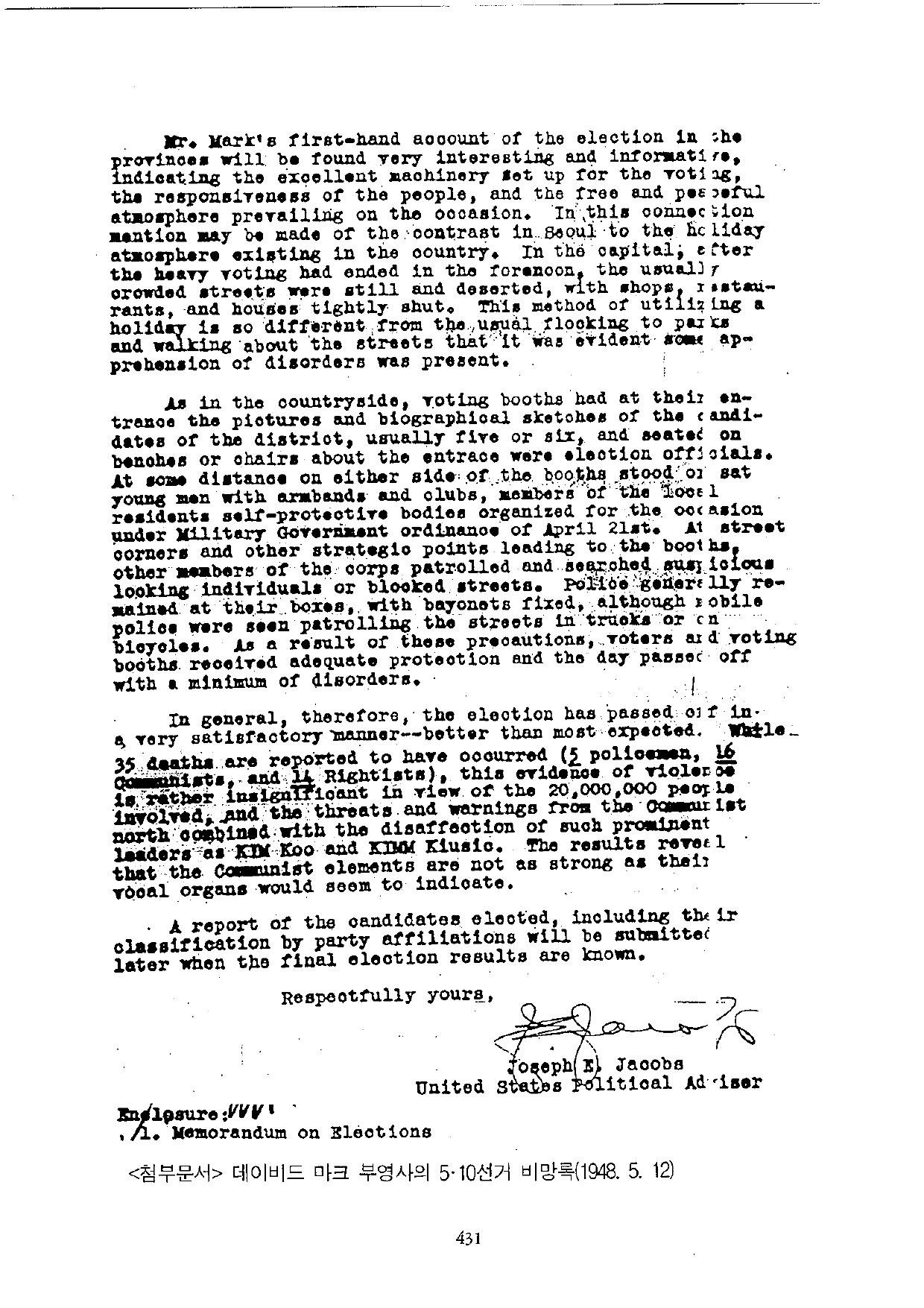
Mr. Mark's first-hand account of the election in the provinces will be found very interesting and informative, indicating the excellent machinery set up for the voting, the responsiveness of the people, and the free and peaceful atmosphere prevailing on the occasion. In this connection mention may be made of the contrast in Seoul to the holiday atmosphere existing in the country. In the capital, after the heavy voting had ended in the forenoon, the usually crowded streets were still and deserted, with shops, restaurants, and houses tightly shut. This method of utilizing a holiday is so different from the usual flocking to parks and walking about the streets that it was evident some apprehension of disorders was present.
As in the countryside, voting booths had at their entrance the pictures and biographical sketches of the candidates of the district, usually five or six, and seated on benches or chairs about the entrace were election officials. At some distance on either side of the booths stood or sat young men with armbands and clubs, members of the local residents self-protective bodies organized for the occasion under Military Government ordinance of April 21st. At street corners and other strategic points leading to the booths, other members of the corps patrolled and searched suspicious looking individuals or blocked streets. Police generally remained at their boxes, with bayonets fixed, although mobile police were seen patrolling the streets in trucks or on bicycles. As a result of these precautions, voters and voting booths received adequate protection and the day passed off with a minimum of disorders.
In general, therefore, the election has passed off in a very satisfactory manner--better than most expected. While 35 deaths are reported to have occurred (5 policemen, 16 Communists, and 14 Rightists), this evidence of violence is rather insignificant in view of the 20,000,000 people involved, and the threats and warnings from the Communist north combined with the disaffection of such prominent leaders as KIM Koo and KIMM Kiusic. The results reveal that the Communist elements are not as strong as their vocal organs would seem to indicate.
A report of the candidates elected, including their classification by party affiliations will be submitted later when the final election results are known.
Respectfully yours,
Joseph E. Jacobs
United States Political Adviser
Enclosure:VVV'
. /1. Memorandum on Elections
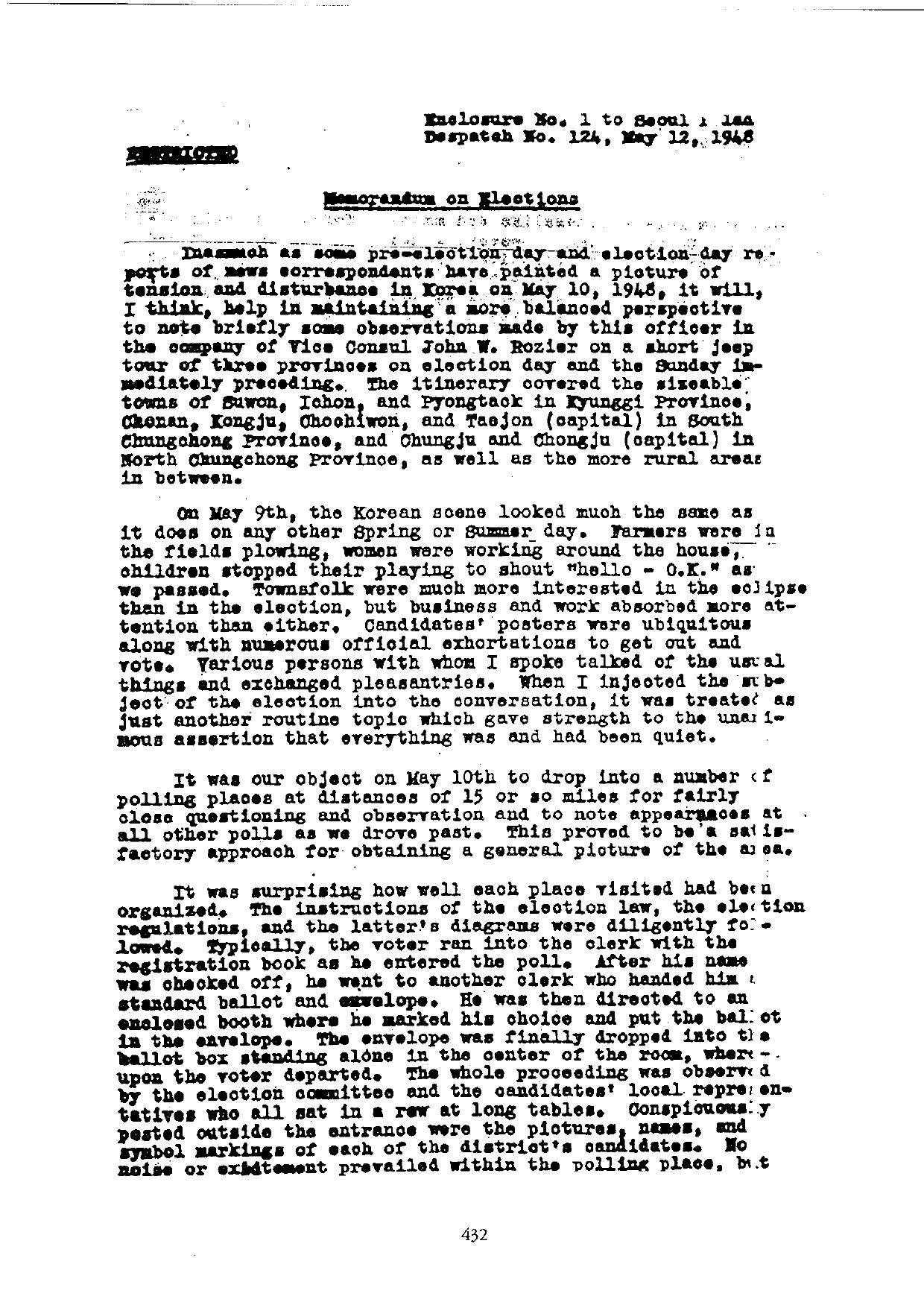
Enclosure No. 1 to Seoul 1 144
Despateh No. 124, May 12, 1948
ENCLOSURE
Memorandum on Elections
[illegible] ma beb 실시(ser. [illegible]
Inasmuch as some pre-election day and election day reports of news correspondents have painted a picture of tension and disturbance in Korea on May 10, 1948, it will, I think, help in maintaining a more balanced perspective to note briefly some observations made by this officer in the company of Vice Consul John W. Rozier on a short jeep tour of three provinces on election day and the Sunday immediately preceding. The itinerary covered the sizeable towns of Suwon, Ichon, and Pyongtaok in Kyunggi Province, Chonan, Kongju, Choohiwon, and Taejon (capital) in South Chungchong Province, and Chungju and Chongju (capital) in North Chungchong Province, as well as the more rural areas in between.
On May 9th, the Korean scene looked much the same as it does on any other Spring or Summer day. Farmers were in the fields plowing, women were working around the house, children stopped their playing to shout "hello - O.K." as we passed. Townsfolk were much more interested in the eclipse than in the election, but business and work absorbed more attention than either. Candidates' posters were ubiquitous along with numerous official exhortations to get out and vote. Various persons with whom I spoke talked of the usual things and exchanged pleasantries. When I injected the subject of the election into the conversation, it was treated as just another routine topic which gave strength to the unanimous assertion that everything was and had been quiet.
It was our object on May 10th to drop into a number of polling places at distances of 15 or so miles for fairly close questioning and observation and to note appearances at all other polls as we drove past. This proved to be a satisfactory approach for obtaining a general picture of the area.
It was surprising how well each place visited had been organized. The instructions of the election law, the election regulations, and the latter's diagrams were diligently followed. Typically, the voter ran into the clerk with the registration book as he entered the poll. After his name was checked off, he went to another clerk who handed him a standard ballot and envelope. He was then directed to an enclosed booth where he marked his choice and put the ballot in the envelope. The envelope was finally dropped into the ballot box standing alone in the center of the room, where- upon the voter departed. The whole proceeding was observed by the election committee and the candidates' local representatives who all sat in a row at long tables. Conspicuously posted outside the entrance were the pictures, names, and symbol markings of each of the district's candidates. No noise or excitement prevailed within the polling place, but a short explanation of the procedure was necessary for many of the voters.
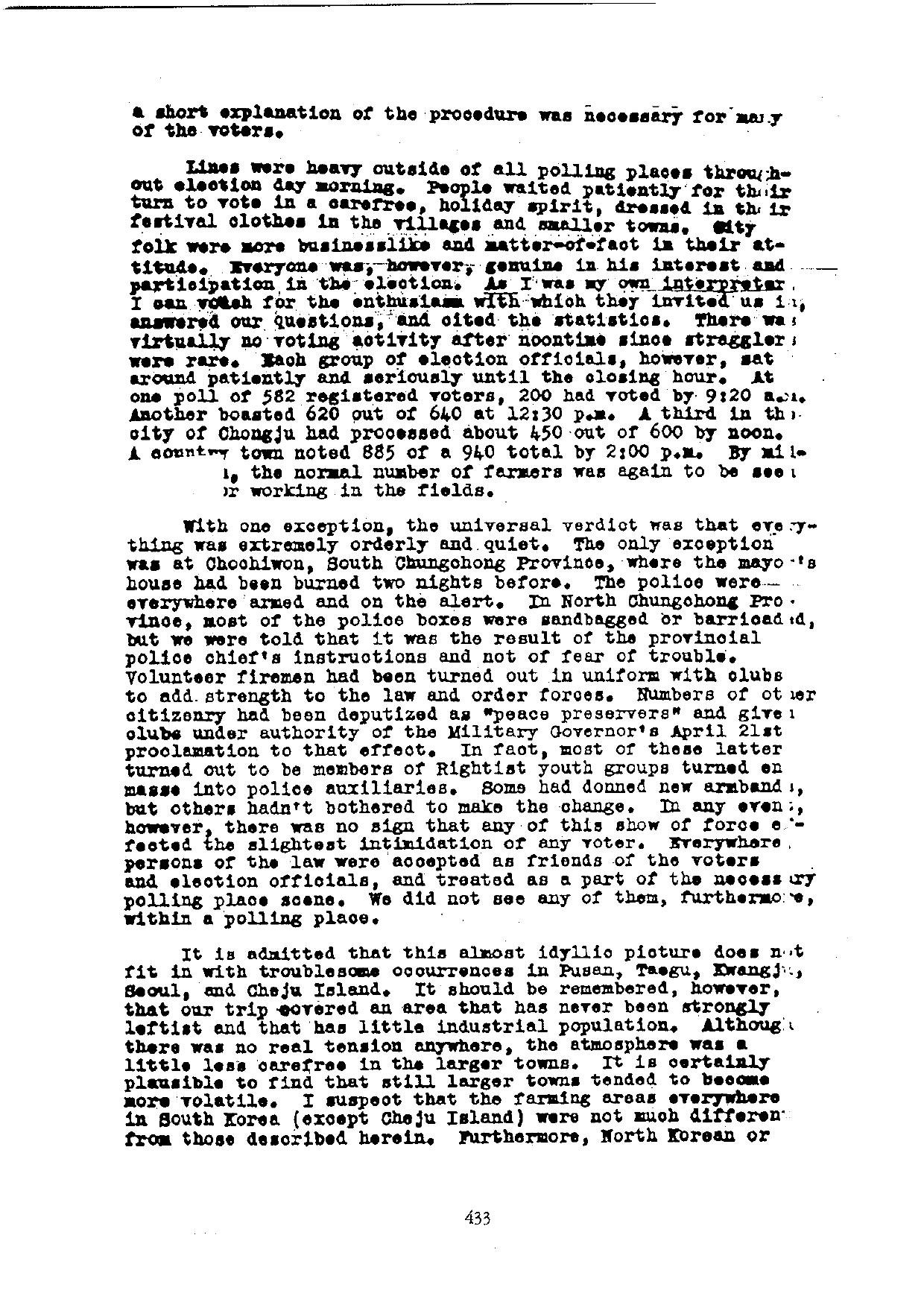
Lines were heavy outside of all polling places throughout election day morning. People waited patiently for their turn to vote in a carefree, holiday spirit, dressed in their festival clothes in the villages and smaller towns. City folk were more businesslike and matter-of-fact in their attitude. Everyone was, however, genuine in his interest and participation in the election. As I was my own interpreter, I can vouch for the enthusiasm with which they invited us in, answered our questions, and cited the statistics. There was virtually no voting activity after noontime since stragglers were rare. Each group of election officials, however, sat around patiently and seriously until the closing hour. At one poll of 582 registered voters, 200 had voted by 9:20 a.m. Another boasted 620 out of 640 at 12:30 p.m. A third in the city of Chongju had processed about 450 out of 600 by noon. A country town noted 885 of a 940 total by 2:00 p.m. By mile, the normal number of farmers was again to be see: or working in the fields.
With one exception, the universal verdict was that everything was extremely orderly and quiet. The only exception was at Chochiwon, South Chungchong Province, where the mayo's house had been burned two nights before. The police were everywhere armed and on the alert. In North Chungchong Province, most of the police boxes were sandbagged or barricaded, but we were told that it was the result of the provincial police chief's instructions and not of fear or trouble. Volunteer firemen had been turned out in uniform with clubs to add strength to the law and order forces. Numbers of other citizenry had been deputized as "peace preservers" and give: clubs under authority of the Military Governor's April 21st proclamation to that effect. In fact, most of these latter turned out to be members of Rightist youth groups turned en masse into police auxiliaries. Some had donned new armbands, but others hadn't bothered to make the change. In any even:, however, there was no sign that any of this show of force e'fected the slightest intimidation of any voter. Everywhere, persons of the law were accepted as friends of the voters and election officials, and treated as a part of the necessary polling place scene. We did not see any of them, furthermore, within a polling place.
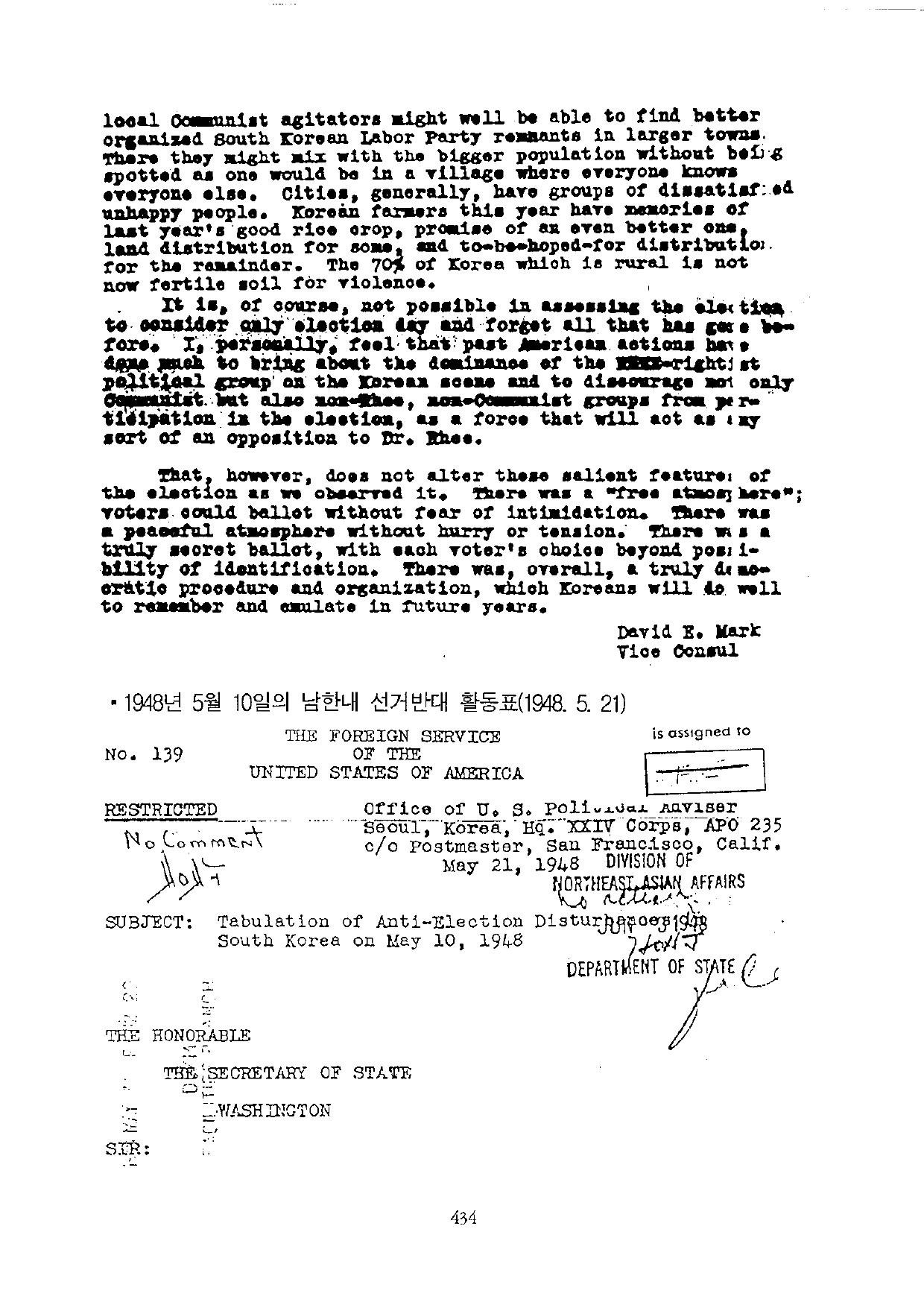
It is admitted that this almost idyllic picture does not fit in with troublesome occurrences in Pusan, Taegu, Kwangju, Seoul, and Cheju Island. It should be remembered, however, that our trip covered an area that has never been strongly leftist and that has little industrial population. Although there was no real tension anywhere, the atmosphere was a little less carefree in the larger towns. It is certainly plausible to find that still larger towns tended to become more volatile. I suspect that the farming areas everywhere in South Korea (except Cheju Island) were not much different from those described herein. Furthermore, North Korean or local Communist agitators might well be able to find better organized South Korean Labor Party remnants in larger towns. There they might mix with the bigger population without being spotted as one would be in a village where everyone knows everyone else. Cities, generally, have groups of dissatisfied unhappy people. Korean farmers this year have memories of last year's good rice crop, promise of an even better one, land distribution for some, and to-be-hoped-for distribution for the remainder. The 70% of Korea which is rural is not now fertile soil for violence.
It is, of course, not possible in assessing the election to consider only election day and forget all that has gone before. I, personally, feel that past American actions have done much to bring about the dominance of the extreme-right; at political group on the Korean scene and to discourage not only Communist but also non-thee, non-Communist groups from participation in the election, as a force that will act as a my sort of an opposition to Dr. Rhee.
That, however, does not alter these salient feature: of the election as we observed it. There was a "free atmosphere"; voters could ballot without fear of intimidation. There was a peaceful atmosphere without hurry or tension. There was a truly secret ballot, with each voter's choice beyond possibility of identification. There was, overall, a truly democratic procedure and organization, which Koreans will do well to remember and emulate in future years.
David E. Mark
Vice Consul
출처:
제주4·3사건진상규명및희생자명예회복위원회 편,
『제주4·3사건자료집 9』 [미국자료편],
번역문 p.191
/ 원문 p.430–434 / No. 124.
×
![]()