스캔 원본
100%
p.484
p.485
p.486
p.487
p.488
p.489
p.490
p.491
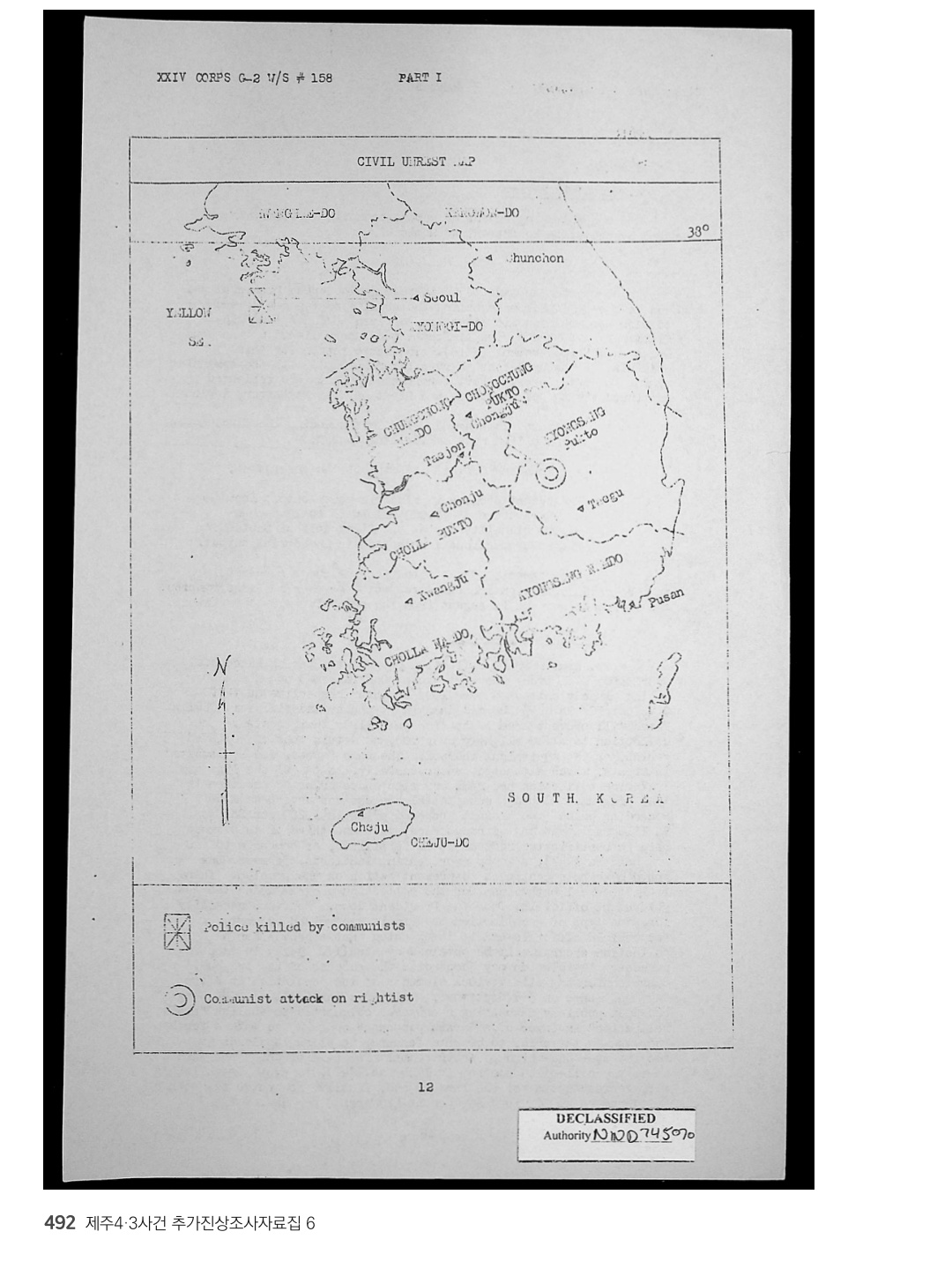
p.492
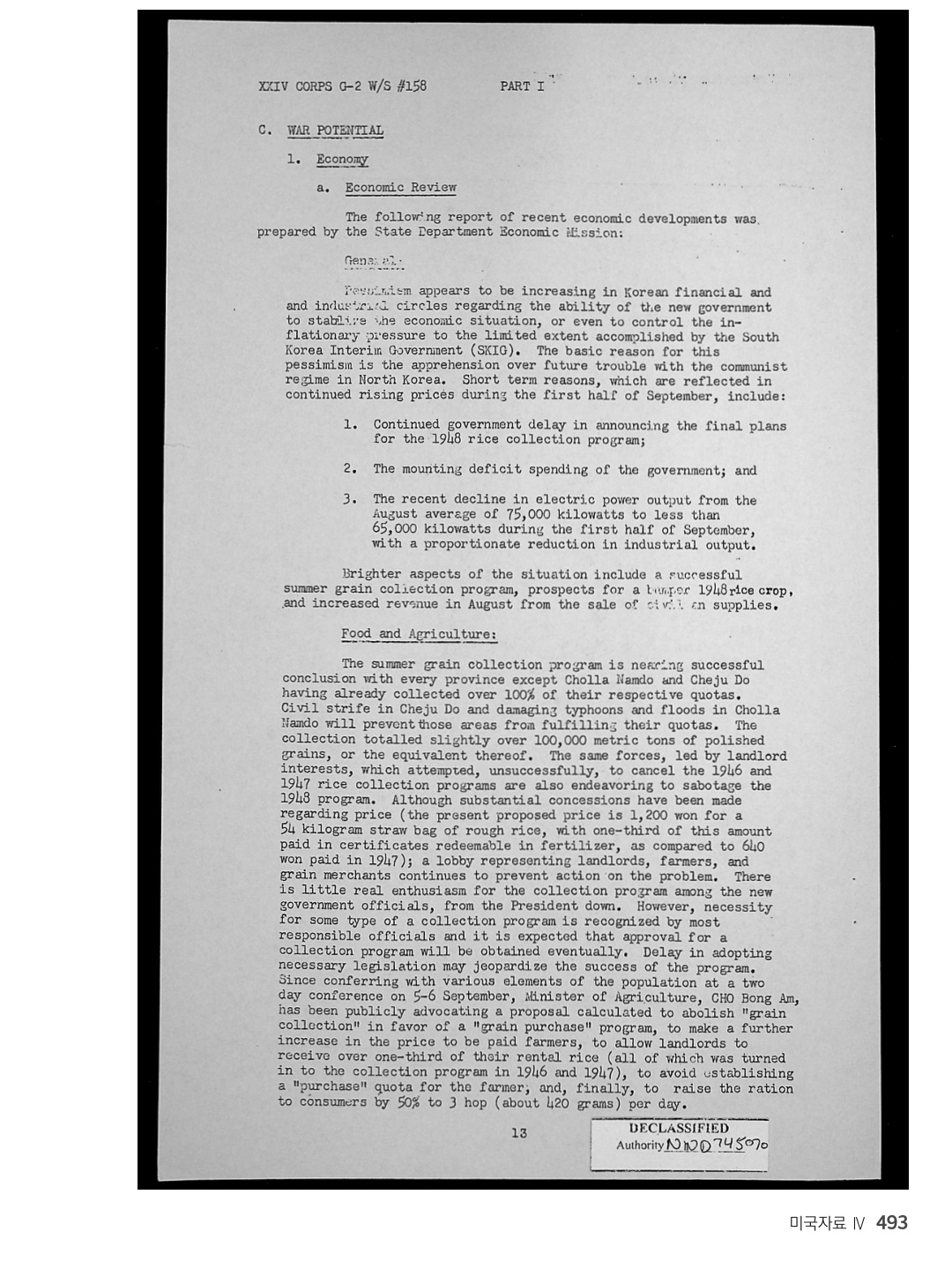
p.493
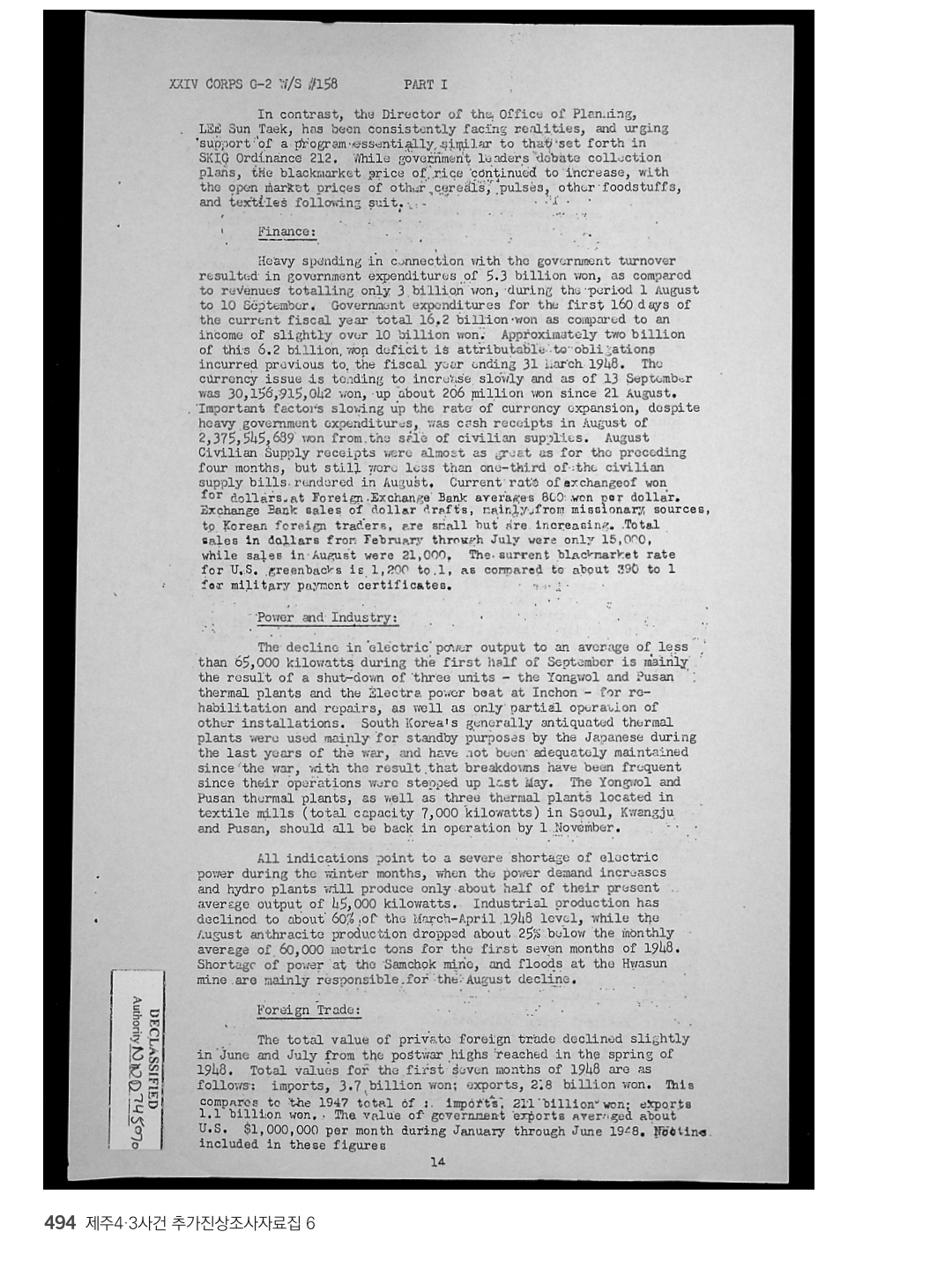
p.494
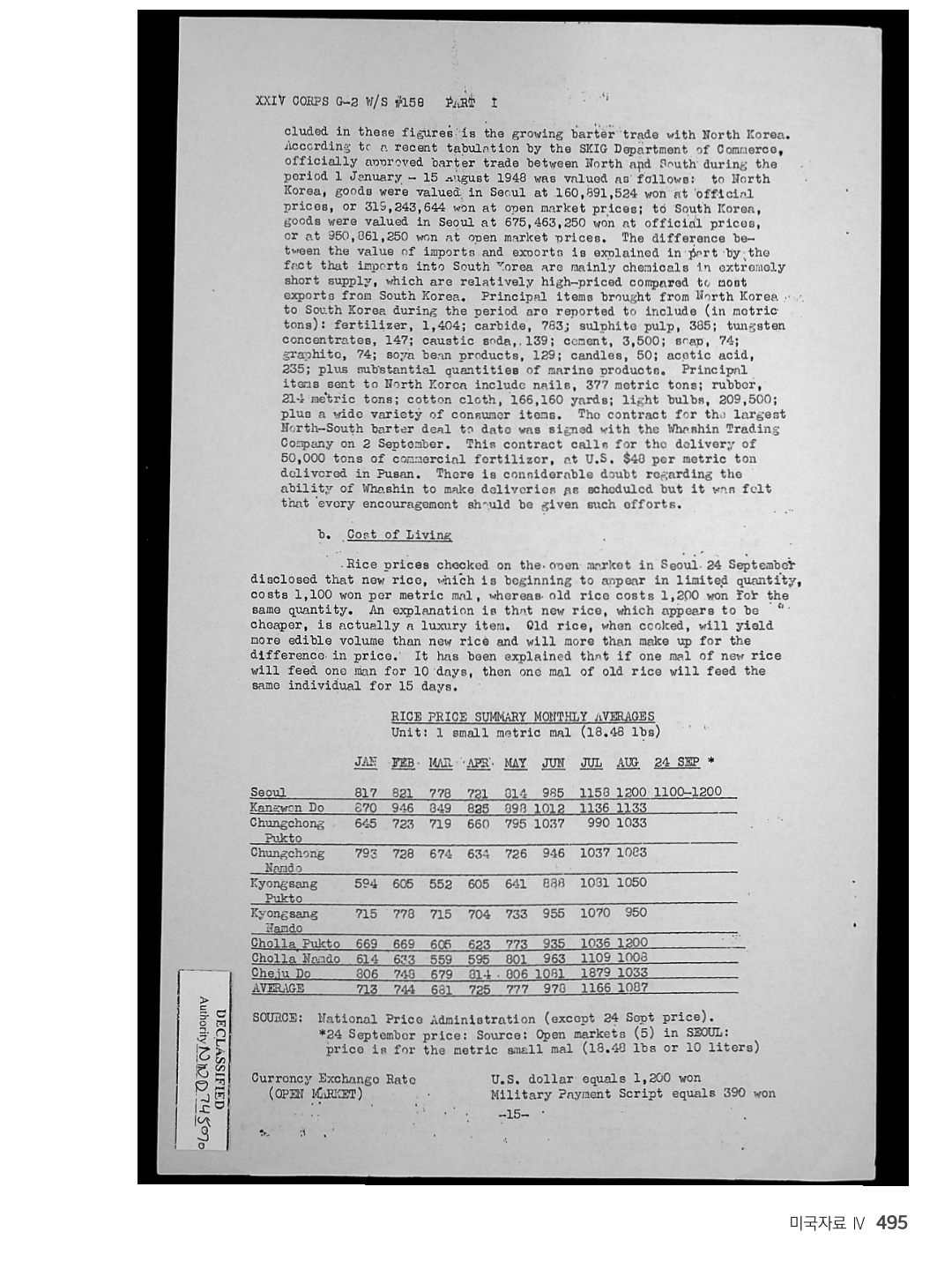
p.495
p.496
p.497
정보참모부 주간요약보고
보고 기간: 1948년 9월 17일~1948년 9월 24일
주한미육군사령부
서울, 한국
1948년 9월 24일 제158호
A. 군대
1. 병력 (2급 비밀)
경찰: 변동없음.
경비대: 51,524명 (간부후보 1,026명, 선서하지 않은 신병 603명 포함)
해안경비대: 3,013명 (간부후보 259명 포함)
B. 현용 정보
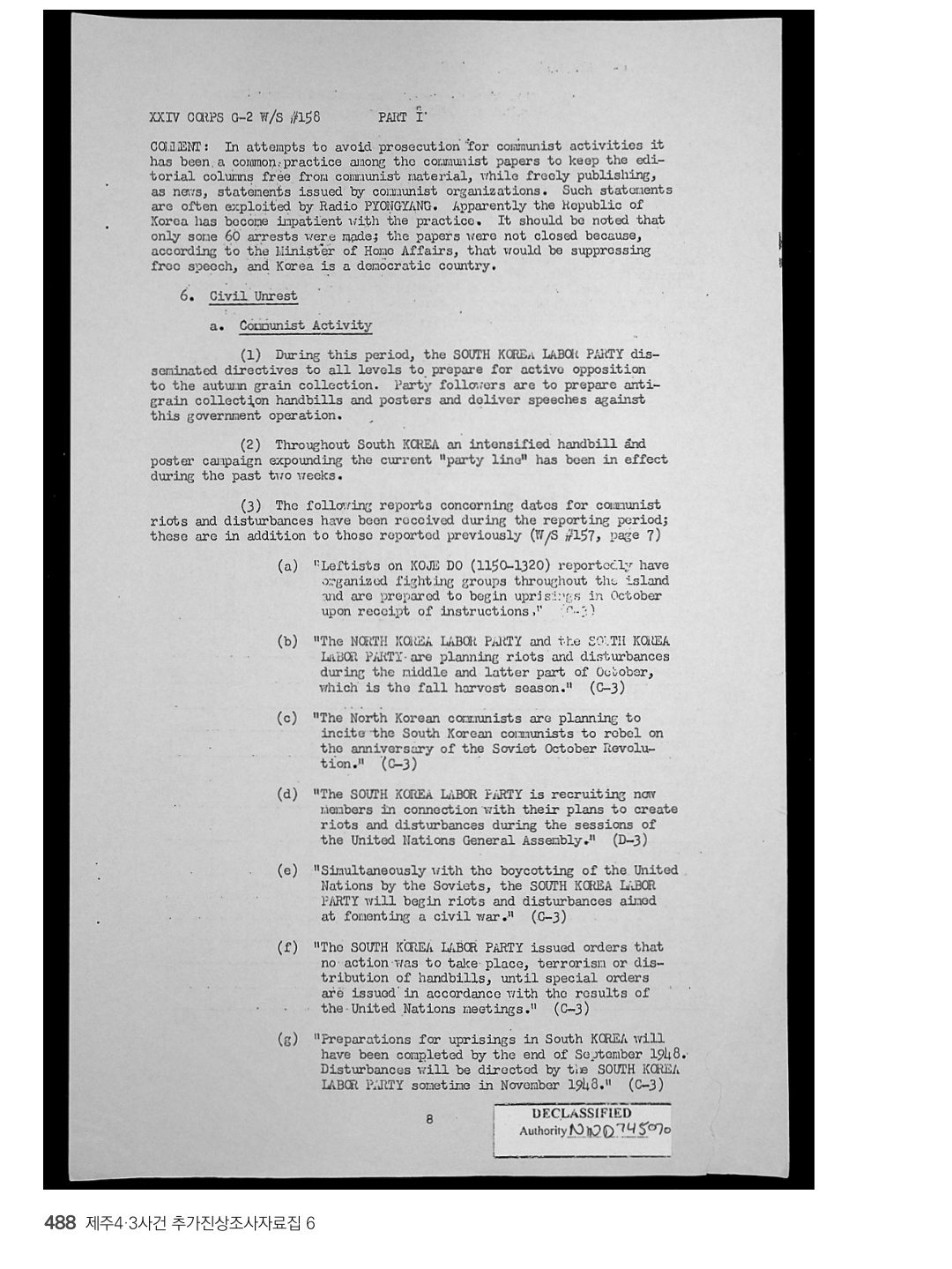
6. 민간인 소요
a. 공산주의자 활동
(1) 이번 기간 동안 남조선노동당은 전 당원에게 추계 곡물 수집에 대한 적극 반대를 준비하라는 지령을 내렸다. 당원들은 곡물 수집에 반대하는 삐라와 포스터를 준비할 것이며 정부의 곡물 수집 시행에 반대하는 연설을 할 것이다.
(2) 지난 2주 동안 남한 전역에서 현재의 "당 노선"을 상설하는 삐라와 포스터운동이 전개됐다.
(3) 보고 기간 동안 여러 정보원으로부터 공산주의 폭동 및 소요의 예정일과 관련된 보고를 받았다. 이는 이전에 보고됐던 것들에 더 추가된 것이다. (주간요약보고 제157호, 7쪽)
(a) "거제도(1150-1320)의 좌파들이 섬 전역에서 전투 부대를 조직해 왔으며지침이 있으면 10월에 폭동을 일으킬 준비가 돼 있다는 보고가 들어왔다." (C-3)
(b) "북조선노동당과 남조선노동당이 10월 중순과 하순에 폭동과 소요를 일으킬 계획을 세우고 있다. 이는 추수 기간에 해당된다." (C-3)
(c) "북한 공산주의자들은 남한 공산주의자들이 소련의 10월혁명 기념일에 맞춰 폭동을 일으키도록 선동하려 계획 중이다." (C-3)
(d) "남조선노동당이 유엔총회 기간에 폭동과 소요를 일으키려는 계획과 관련하여 새로운 당원을 모집하는 중이다." (D-3)
(e) "소련에 의한 유엔 보이콧과 동시에 남조선노동당은 내전의 조성을 목표로하는 폭동과 소요를 일으킬 것이다." (C-3)
(f) "남조선노동당은 유엔회의에 따른 새로운 명령이 있기 전까지 테러나 삐라살포 등 그 어떤 행동도 해서는 안 된다는 명령을 내렸다." (C-3)
(g) "남한에서 폭동을 일으키려는 준비는 1948년 9월 말에 완료될 것이다. 남조선노동당이 1948년 11월 어느 시점에 소요를 이끌게 될 것이다." (C-3)
(h) "통일 독립을 위해 봉기할 시점은 분명 1948년이다." (C-3)
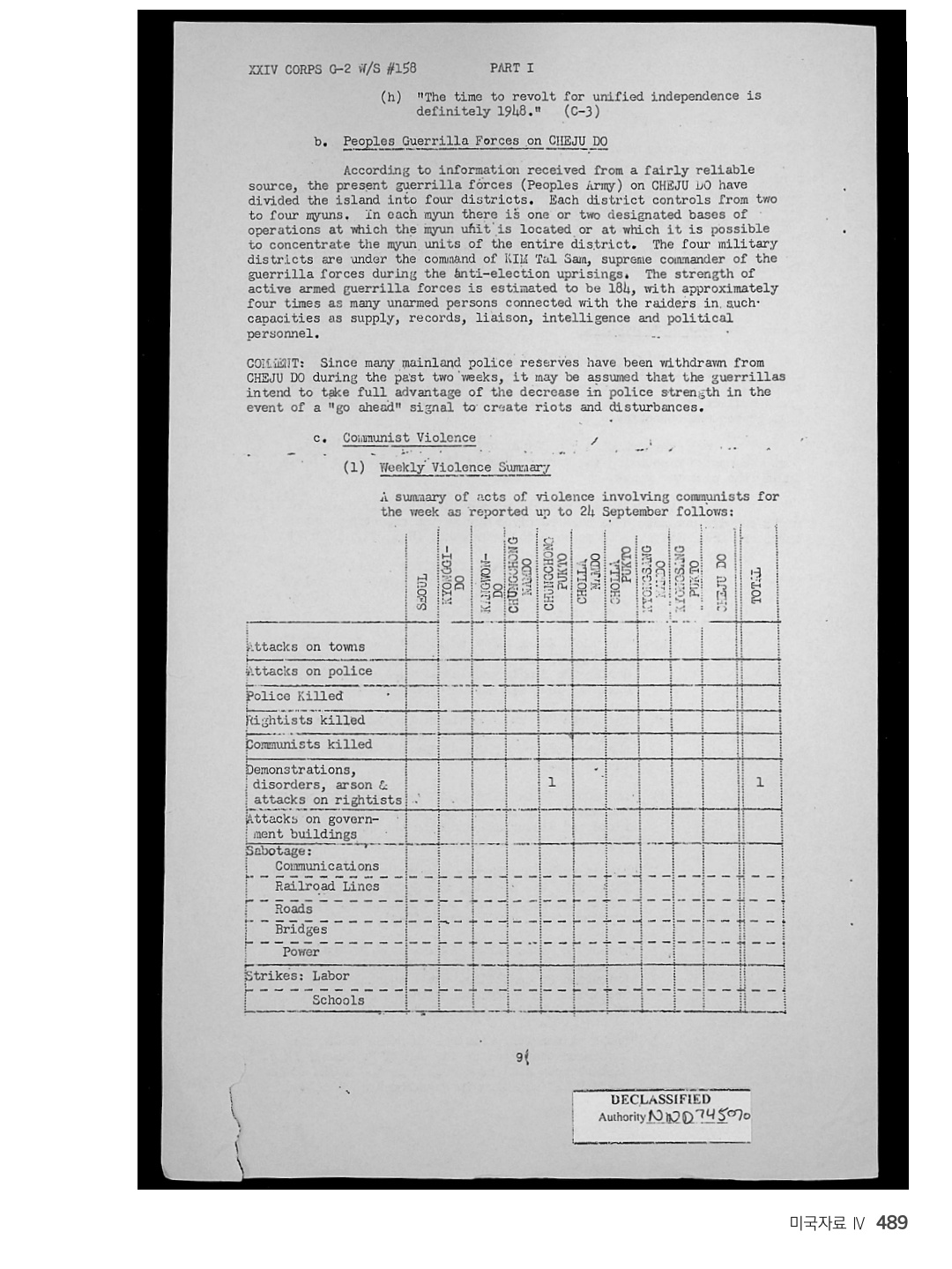
b. 제주도 인민 게릴라 부대 꽤 믿을만한 정보원이 제공한 정보에 따르면 현재 제주도의 게릴라 부대(인민군)는 섬을 4개의 지구로 나누었다. 각 지구는 2~4개의 면을 관리한다. 각 면에는 면 부대가 위치하고 있거나 전체 지구의 면 부대들을 한 곳에 모을 수 있는 1~2개의 지정 작전기지가 있다. 4개의 군사지구는 선거 반대 폭동 기간에 게릴라 부대 최고 사령관이었던 김달삼이 지휘하고 있다. 활동 중인 무장 게릴라의 병력은 184명으로 추정되며, 이보다 4배 많은 비무장 민간인들이 무장대와 연관되어 보급, 기록, 연락, 정보, 정치 업무를 담당하고 있다.
논평: 지난 2주 동안 본토에서 온 응원경찰대 다수가 제주도로부터 철수했기 때문에, 폭동과 소요를 위한 "승인" 신호가 떨어진다면 게릴라들은 경찰 병력의 감소를 최대한 이용하려 들 것으로 생각된다.
c. 공산주의자 폭력
(1) 주간 폭력 요약 이번 주 9월 24일까지 보고된 공산주의자가 연루된 폭력행위의 요약은 다음과같다.
제주4·3사건 추가진상조사자료집 6
(2) 지난주에 대한 추가보고 없음.
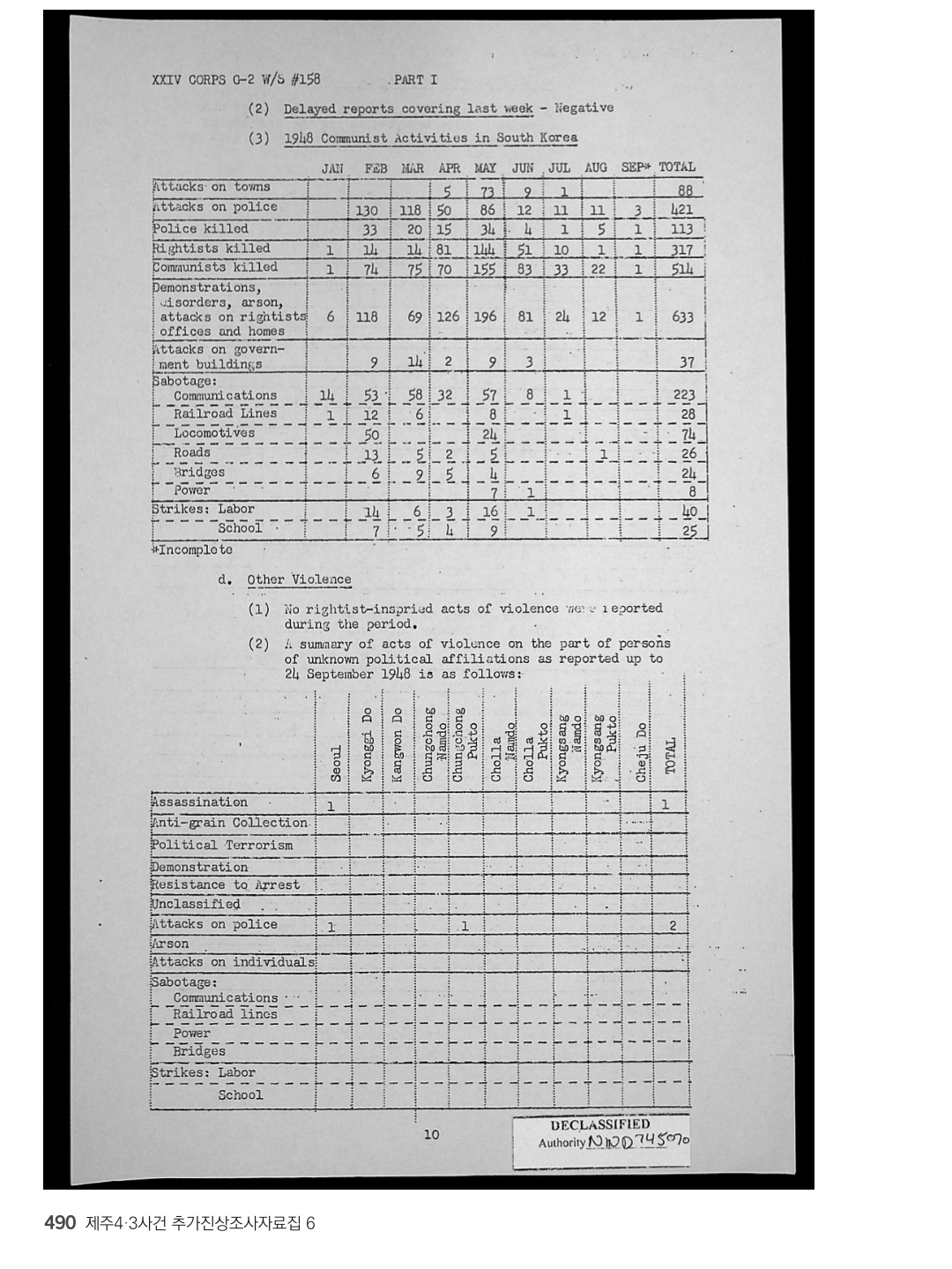
(3) 1948년 남한에서의 공산주의자 활동
서울 경기 강원 충남 충북 전남 전북 경남 경북 제주 총계
마을 공격 경찰 공격 경찰 사망 우파 사망 공산주의자 사망 시위, 소요, 방화, 우파 공격 1 1 관공서 공격 사보타주(통신)
사보타주(철로)
사보타주(도로)
사보타주(교량)
사보타주(전력)
노동자 파업
동맹휴교
동맹휴교
1월 2월 3월 4월 5월 6월 7월 8월 9월* 총계
마을 공격 5 73 9 1 88 경찰 공격 130 118 50 86 12 11 11 3 421 경찰 사망 33 20 15 34 4 1 5 1 113 우파 사망 1 14 14 81 144 51 10 1 1 317 공산주의자 사망 1 74 75 70 155 83 33 22 1 514 소요, 시위, 방화, 우파 사무실·자택 공격 6 118 69 126 196 81 24 12 1 633 관공서 공격 9 14 2 9 3 37 사보타주(통신) 14 53 58 32 57 8 1 223
* 미완
b. 기타 폭력
(1) 우파에 의해 부추겨진 폭력행위는 이번 주에 보고되지 않았다.
(2) 1948년 9월 24일까지 보고된 정치적 소속이 미상인 자들에 의한 폭력행위의 요약은 다음과 같다.
1월 2월 3월 4월 5월 6월 7월 8월 9월* 총계 사보타주(철로)
1
12
6
8
1
28
사보타주(기관차)
50
24
74
사보타주(도로)
13
5
2
5
1
26
사보타주(교량)
6
9
5
4
24
사보타주(전력)
7
1
8
노동자 파업
14
6
3
16
1
40
동맹휴교
7
5
4
9
25
서울 경기 강원 충남 충북 전남 전북 경남 경북 제주 총계 암살 1 1 곡물 수집 반대 정치 테러 시위 체포 항거 미분류 경찰 공격 1 1 2 방화 개인 공격 사보타주(통신)
사보타주(철로)
사보타주(전력)
사보타주(교량)
노동자 파업
동맹휴교
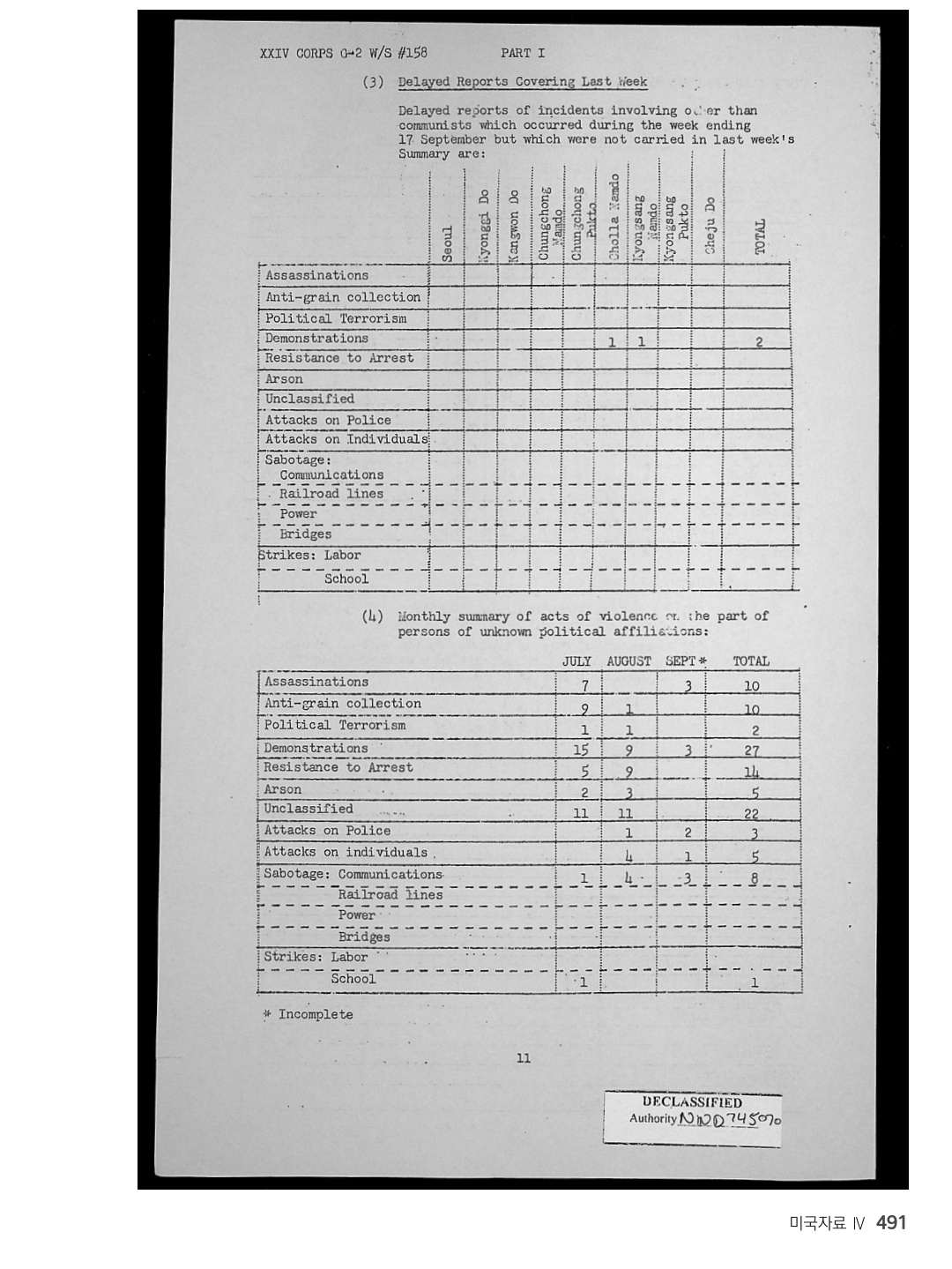
(3) 지난주에 대한 추가보고 9월 17일에 마감한 주간에 발생했으나 지난주 요약보고에 실리지 않은 공산주의자 외의 자들이 연루된 사건에 관한 추가보고는 다음과 같다.
(4) 정치적 소속이 미상인 자들에 의한 폭력행위의 월간 요약
7월 8월 9월* 총계 암살 7 3 10 곡물 수집 반대 9 1 10 정치 테러 1 1 2 시위 15 9 3 27 체포 항거 5 9 14 방화 2 3 5 미분류 11 11 22 경찰 공격 1 2 3 개인 공격 4 1 5
서울 경기 강원 충남 충북 전남 전북 경남 경북 제주 총계 암살 곡물 수집 반대 정치 테러 시위 1 1 2 체포 항거 방화 미분류 경찰 공격 개인 공격 사보타주(통신)
사보타주(철로)
사보타주(전력)
사보타주(교량)
노동자 파업
동맹휴교
* 미완
C. 개전 가능성
1. 경제
b. 물가
월간 평균 미곡 가격 요약
단위: 미터법 1말(작은 단위) (18.48파운드)
출처 - 중앙물가행정처 (9월 24일 가격 제외)
* 9월 24일 가격: 출처: 서울 내 시장(자유 시장) 5곳: 가격은 미터법 1말(작은 단위)(18.48파운드 또는 10리터)의 가격이다.
| 지역 | 1월 | 2월 | 3월 | 4월 | 5월 | 6월 | 7월 | 8월 | 9월 17일 | |------|-----|-----|-----|-----|-----|-----|------|------|----------| | 서울 | 817 | 821 | 778 | 721 | 814 | 985 | 1158 | 1200 | 1100-1200 | | 강원 | 870 | 946 | 849 | 825 | 898 | 1012 | 1136 | 1133 | | | 충북 | 645 | 723 | 719 | 660 | 795 | 1037 | 990 | 1033 | | | 충남 | 793 | 728 | 674 | 634 | 726 | 946 | 1037 | 1083 | | | 경북 | 594 | 605 | 552 | 605 | 641 | 888 | 1081 | 1050 | | | 경남 | 715 | 778 | 715 | 704 | 733 | 955 | 1070 | 950 | | | 전북 | 669 | 669 | 605 | 623 | 773 | 935 | 1036 | 1200 | | | 전남 | 614 | 633 | 559 | 595 | 801 | 963 | 1109 | 1008 | | | 제주 | 806 | 748 | 679 | 814 | 806 | 1081 | 1879 | 1033 | | | 평균 | 713 | 744 | 681 | 725 | 777 | 978 | 1166 | 1087 | |
통화 환율(시장가): 미국 달러 = 1,200원 미군 군표 = 390원
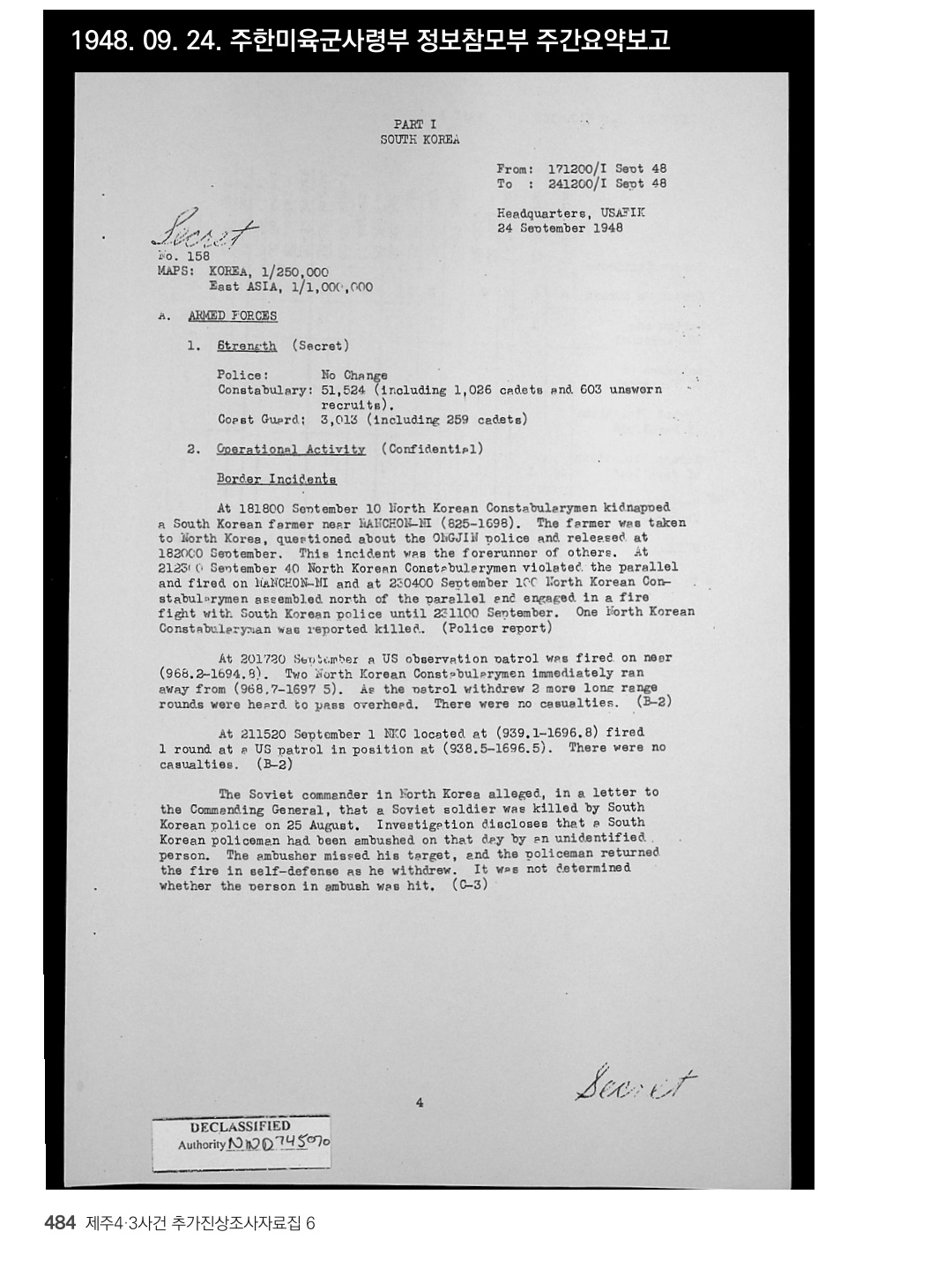
PART I
SOUTH KOREA
From: 171200/I Sept 48
To : 241200/I Sept 48
Headquarters, USAFIK
24 September 1948
Secret
No. 158
MAPS: KOREA, 1/250,000
East ASIA, 1/1,000,000
A. ARMED FORCES
1. Strength (Secret)
Police: No Change
Constabulary: 51,524 (including 1,026 cadets and 603 unsworn recruits).
Coast Guard: 3,013 (including 259 cadets)
2. Operational Activity (Confidential)
Border Incidents
At 181800 September 10 North Korean Constabularymen kidnapped a South Korean farmer near MANCHON-NI (825-1698). The farmer was taken to North Korea, questioned about the ONGJIN police and released at
182000 September. This incident was the forerunner of others. At
212300 September 40 North Korean Constabularymen violated the parallel and fired on MANCHON-NI and at 230400 September 100 North Korean Constabularymen assembled north of the parallel and engaged in a fire fight with South Korean police until 231100 September. One North Korean
Constabularymen was reported killed. (Police report)
At 201730 September a US observation patrol was fired on near
(968.2-1694.9). Two North Korean Constabularymen immediately ran away from (968.7-1697.5). As the patrol withdrew 2 more long range rounds were heard to pass overhead. There were no casualties. (B-2)
At 211520 September 1 NKC located at (939.1-1696.8) fired
1 round at a US patrol in position at (938.5-1696.5). There were no casualties. (B-2)
The Soviet commander in North Korea alleged, in a letter to the Commanding General, that a Soviet soldier was killed by South
Korean police on 25 August. Investigation discloses that a South
Korean policeman had been ambushed on that day by an unidentified person. The ambusher missed his target, and the policeman returned the fire in self-defense as he withdrew. It was not determined whether the person in ambush was hit. (C-3)
Secret
4
DECLASSIFIED
Authority NND 745070
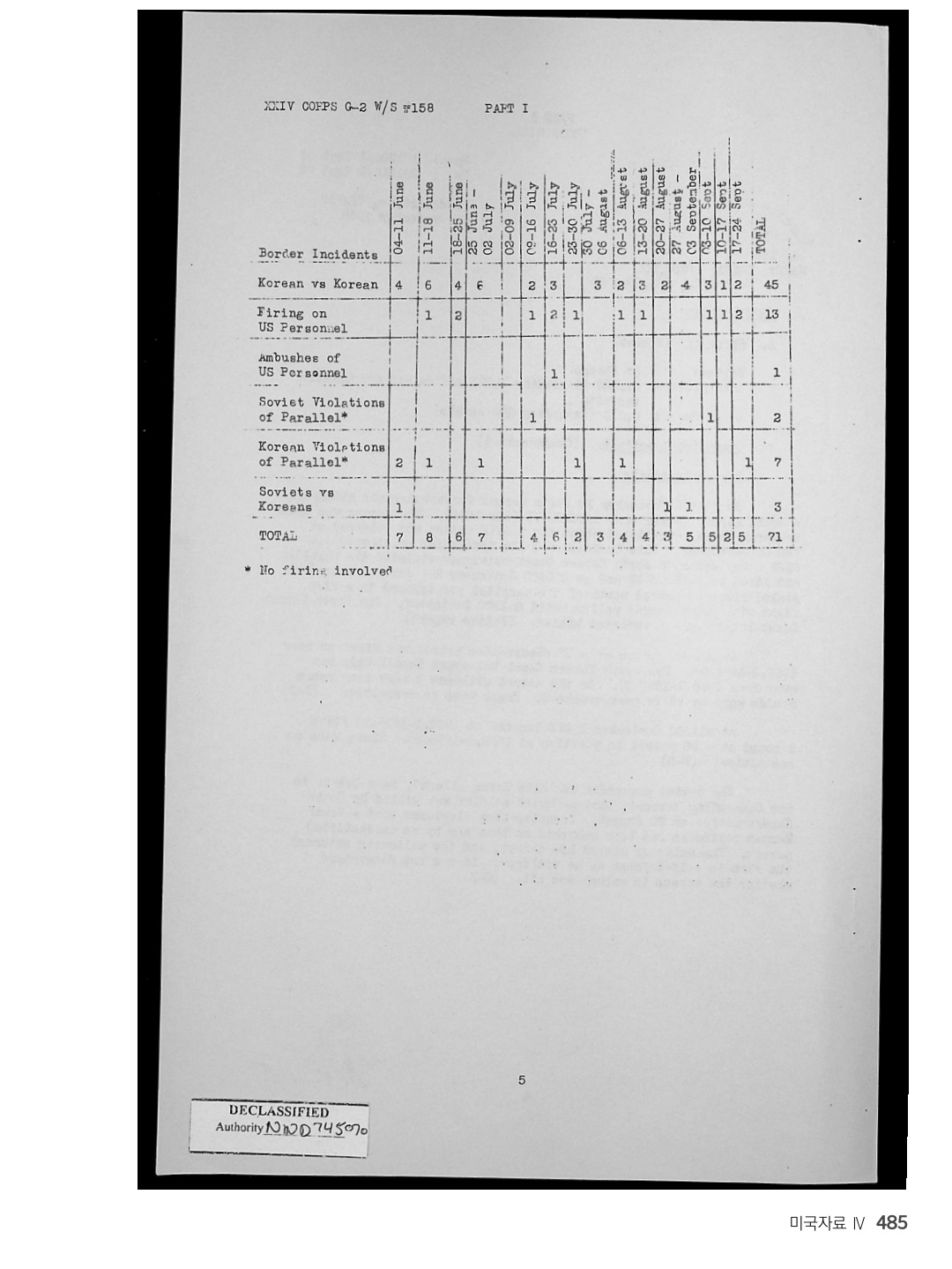
XXIV CORPS G-2 W/S #158 PART I
Border Incidents
| Border Incidents | 04-11 June | 11-18 June | 15-25 June | 25 June 02 July | 03-09 July | 09-16 July | 16-25 July | 23-30 July | 08 August | 06-13 August | 13-20 August | 20-27 August | 27 August - 03 September | 03-10 Sept | 10-17 Sept | 17-24 Sept | TOTAL |
|---|---|---|---|---|---|---|---|---|---|---|---|---|---|---|---|---|---|
| Korean vs Korean | 4 | 6 | 4 | 6 | | 2 | 3 | | 3 | 2 | 3 | 2 | 4 | 3 | 1 | 2 | 45 |
| Firing on US Personnel | | 1 | 2 | | 1 | 2 | 1 | | 1 | 1 | | | 1 | 1 | 2 | | 13 |
| Ambushes of US Personnel | | | | | | 1 | | | | | | | | | | | 1 |
| Soviet Violations of Parallel* | | | | | 1 | | | | | | | | 1 | | | | 2 |
| Korean Violations of Parallel* | 2 | 1 | | 1 | | | | 1 | | 1 | | | | | 1 | | 7 |
| Soviets vs Koreens | 1 | | | | | | | | | | 1 | 1 | | | | | 3 |
| TOTAL | 7 | 8 | 6 | 7 | | 4 | 6 | 2 | 3 | 4 | 4 | 3 | 5 | 5 | 2 | 5 | 71 |
* No firing involved
DECLASSIFIED
Authority NND 745070
5
XXIV CORPS G-2 W/S #158 PART I
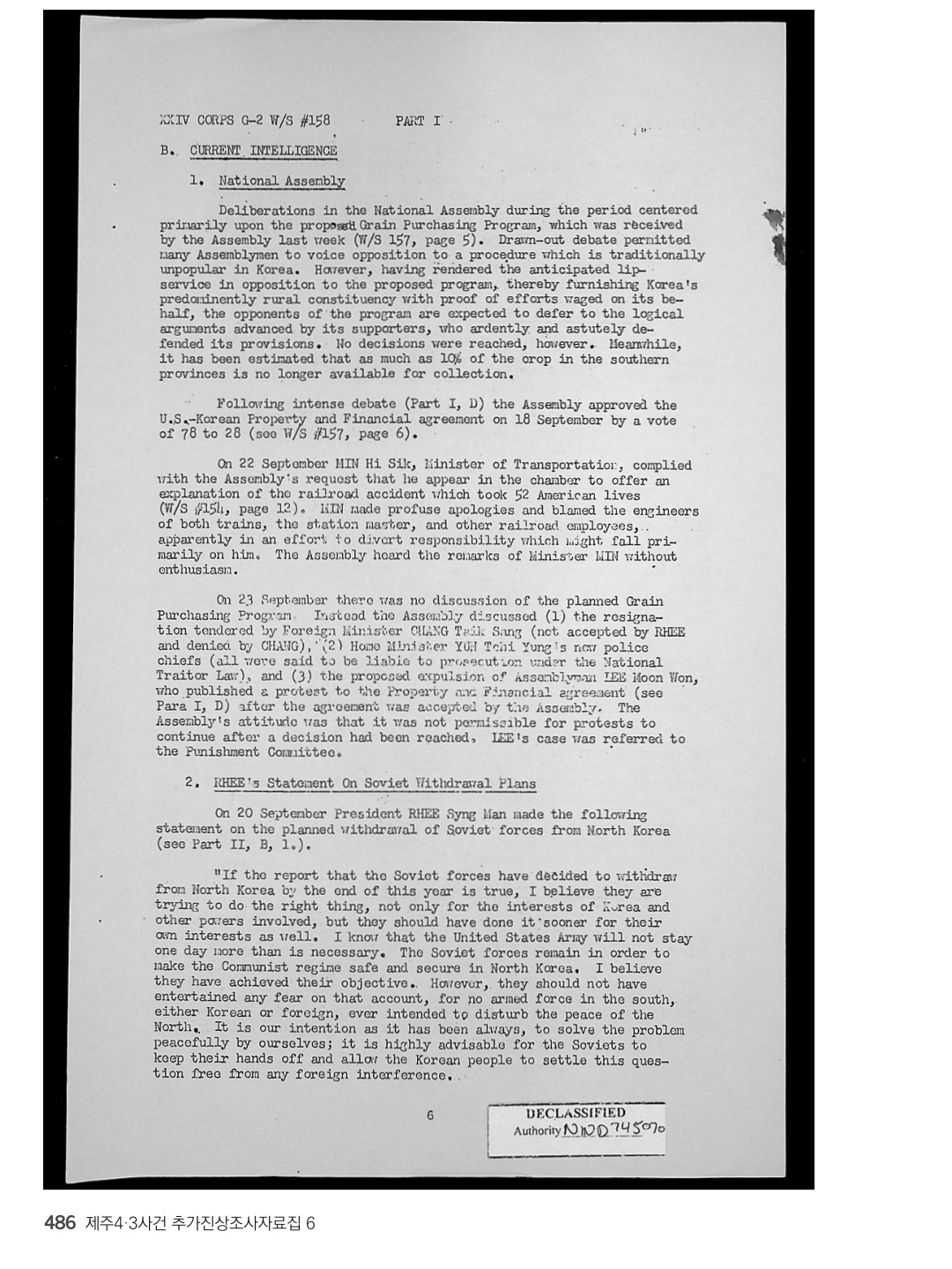
B. CURRENT INTELLIGENCE
1. National Assembly
Deliberations in the National Assembly during the period centered primarily upon the proposed Grain Purchasing Program, which was received by the Assembly last week (W/S 157, page 5). Drawn-out debate permitted many Assemblymen to voice opposition to a procedure which is traditionally unpopular in Korea. However, having rendered the anticipated lipservice in opposition to the proposed program, thereby furnishing Korea's predominently rural constituency with proof of efforts waged on its behalf, the opponents of the program are expected to defer to the logical arguments advanced by its supporters, who ardently and astutely defended its provisions. No decisions were reached, however. Meanwhile, it has been estimated that as much as 10% of the crop in the southern provinces is no longer available for collection.
Following intense debate (Part I, D) the Assembly approved the
U.S.-Korean Property and Financial agreement on 18 September by a vote of 78 to 28 (see W/S #157, page 6).
On 22 September MIN Hi Sik, Minister of Transportation, complied with the Assembly's request that he appear in the chamber to offer an explanation of the railroad accident which took 52 American lives
(W/S #154, page 12). MIN made profuse apologies and blamed the engineers of both trains, the station master, and other railroad employees, apparently in an effort to divert responsibility which might fall primarily on him. The Assembly heard the remarks of Minister MIN without enthusiasm.
On 23 September there was no discussion of the planned Grain
Purchasing Program. Instead the Assembly discussed (1) the resignation tendered by Foreign Minister CHIAN Taik Sung (not accepted by RHEE and denied by CHANG), (2) Home Minister YUI Tchi Yung's new police chiefs (all were said to be liable to prosecution under the National
Traitor Law), and (3) the proposed expulsion of Assemblyman LEE Hoon Won, who published a protest to the Property and Financial agreement (see
Para I, D) after the agreement was accepted by the Assembly. The
Assembly's attitude was that it was not permissible for protests to continue after a decision had been reached. LEE's case was referred to the Punishment Committee.
2. RHEE's Statement On Soviet Withdrawal Plans
On 20 September President RHEE Syng Man made the following statement on the planned withdrawal of Soviet forces from North Korea
(see Part II, B, 1.).
"If the report that the Soviet forces have decided to withdraw from North Korea by the end of this year is true, I believe they are trying to do the right thing, not only for the interests of Korea and other powers involved, but they should have done it sooner for their own interests as well. I know that the United States Army will not stay one day more than is necessary. The Soviet forces remain in order to make the Communist regime safe and secure in North Korea. I believe they have achieved their objective. However, they should not have entertained any fear on that account, for no armed force in the south, either Korean or foreign, ever intended to disturb the peace of the
North. It is our intention as it has been always, to solve the problem peaceably by ourselves; it is highly advisable for the Soviets to keep their hands off and allow the Korean people to settle this question free from any foreign interference.
6
DECLASSIFIED
Authority NND 745070
XXIV CORPS G-2 W/S #158 PART I
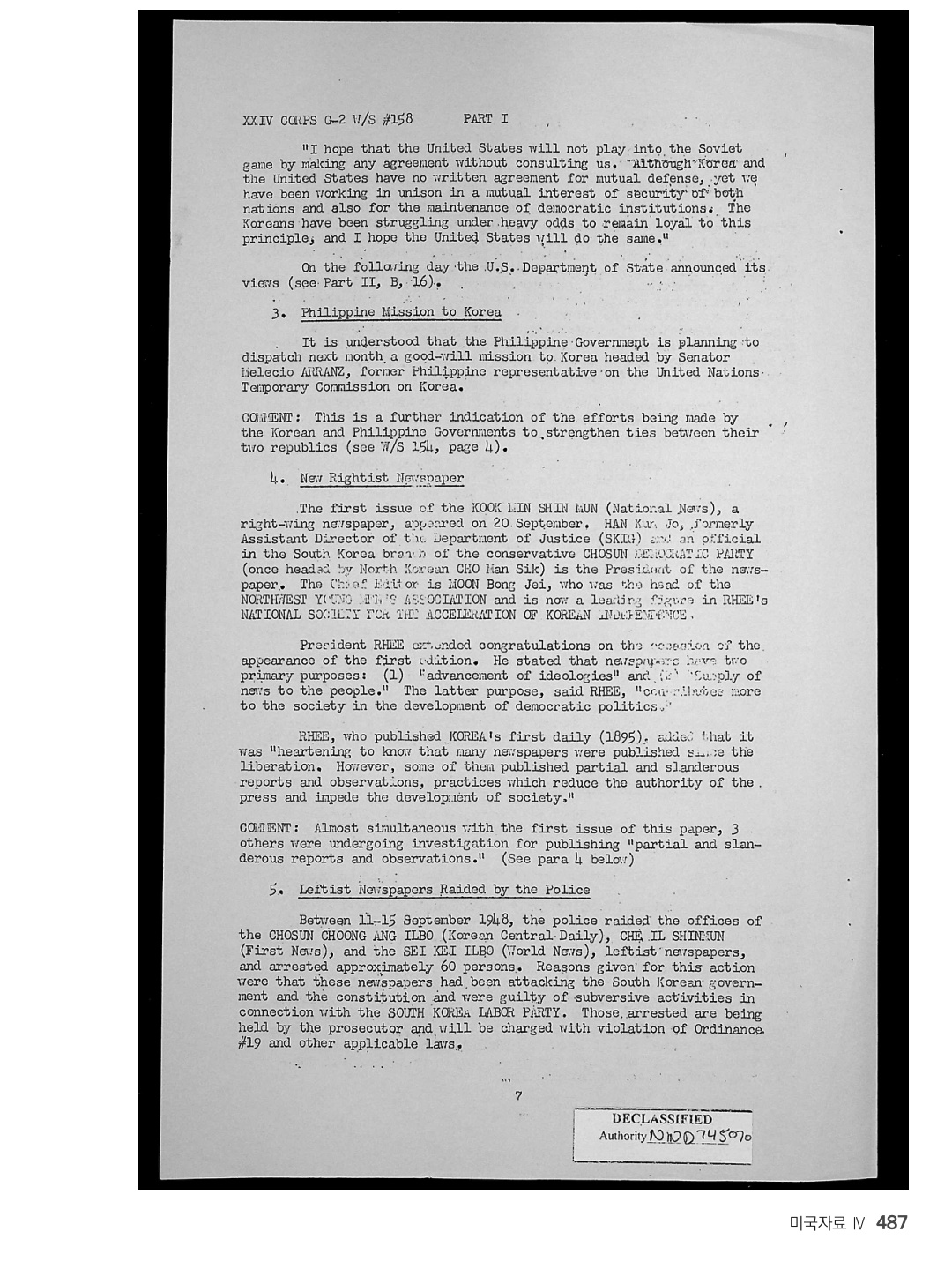
"I hope that the United States will not play into the Soviet game by making any agreement without consulting us. Although Korea and the United States have no written agreement for mutual defense, yet we have been working in unison in a mutual interest of security of both nations and also for the maintenance of democratic institutions. The
Koreans have been struggling under heavy odds to remain loyal to this principle, and I hope the United States will do the same."
On the following day the U.S. Department of State announced its views (see Part II, B, 16).
3. Philippine Mission to Korea
It is understood that the Philippine Government is planning to dispatch next month a good-will mission to Korea headed by Senator
Helecio ARRANZ, former Philippine representative on the United Nations
Temporary Commission on Korea.
COMMENT: This is a further indication of the efforts being made by the Korean and Philippine Governments to strengthen ties between their two republics (see W/S 154, page 4).
4. New Rightist Newspaper
The first issue of the KOOK MIN SHIN MUN (National News), a right-wing newspaper, appeared on 20 September. HAN Kun Jo, formerly
Assistant Director of the Department of Justice (SKIG) and an official in the South Korea branch of the conservative CHOSUN DEMOCRATIC PARTY
(once headed by North Korean CHO Han Sik) is the President of the newspaper. The Chief Editor is MOON Bong Jei, who was the head of the
NORTHWEST YOUNG MEN'S ASSOCIATION and is now a leading figure in RHEE's
NATIONAL SOCIETY FOR THE ACCELERATION OF KOREAN INDEPENDENCE.
President RHEE extended congratulations on the occasion of the appearance of the first edition. He stated that newspapers have two primary purposes: (1) "advancement of ideologies" and (2) "supply of news to the people." The latter purpose, said RHEE, "contributes more to the society in the development of democratic politics."
RHEE, who published KOREA's first daily (1895), added that it was "heartening to know that many newspapers were published since the liberation. However, some of them published partial and slanderous reports and observations, practices which reduce the authority of the press and impede the development of society."
COMMENT: Almost simultaneous with the first issue of this paper, 3 others were undergoing investigation for publishing "partial and slanderous reports and observations." (See para 4 below)
5. Loftist Newspapers Raided by the Police
Between 11-15 September 1948, the police raided the offices of the CHOSUN CHOONG ANG ILBO (Korean Central Daily), CHE IL SHINNUN
(First News), and the SEI KEI ILBO (World News), leftist newspapers, and arrested approximately 60 persons. Reasons given for this action were that these newspapers had been attacking the South Korean government and the constitution and were guilty of subversive activities in connection with the SOUTH KOREA LABOR PARTY. Those arrested are being held by the prosecutor and will be charged with violation of Ordinance
#19 and other applicable laws.
7
DECLASSIFIED
Authority NND 745070
XXIV CORPS G-2 W/S #158 PART I
COMMENT: In attempts to avoid prosecution for communist activities it has been a common practice among the communist papers to keep the editorial columns free from communist material, while freely publishing, as news, statements issued by communist organizations. Such statements are often exploited by Radio PYONGYANG. Apparently the Republic of
Korea has become inpatient with the practice. It should be noted that only some 60 arrests were made; the papers were not closed because, according to the Minister of Home Affairs, that would be suppressing free speech, and Korea is a democratic country.
6. Civil Unrest
a. Communist Activity
(1) During this period, the SOUTH KOREA LABOR PARTY disseminated directives to all levels to prepare for active opposition to the autumn grain collection. Party followers are to prepare antigrain collection handbills and posters and deliver speeches against this government operation.
(2) Throughout South KOREA an intensified handbill and poster campaign expounding the current "party line" has been in effect during the past two weeks.
(3) The following reports concerning dates for communist riots and disturbances have been received during the reporting period; these are in addition to those reported previously (W/S #157, page 7)
(a) "Leftists on KOJE DO (1150-1320) reportedly have organized fighting groups throughout the island and are prepared to begin uprisings in October upon receipt of instructions." (C-3)
(b) "The NORTH KOREA LABOR PARTY and the SOUTH KOREA
LABOR PARTY are planning riots and disturbances during the middle and latter part of October, which is the fall harvest season." (C-3)
(c) "The North Korean communists are planning to incite the South Korean communists to rebel on the anniversary of the Soviet October Revolution." (C-3)
(d) "The SOUTH KOREA LABOR PARTY is recruiting new members in connection with their plans to create riots and disturbances during the sessions of the United Nations General Assembly." (D-3)
(e) "Simultaneously with the boycotting of the United
Nations by the Soviets, the SOUTH KOREA LABOR
PARTY will begin riots and disturbances aimed at fomenting a civil war." (C-3)
(f) "The SOUTH KOREA LABOR PARTY issued orders that no action was to take place, terrorism or distribution of handbills, until special orders are issued in accordance with the results of the United Nations meetings." (C-3)
(g) "Preparations for uprisings in South KOREA will have been completed by the end of September 1948.
Disturbances will be directed by the SOUTH KOREA
LABOR PARTY sometime in November 1948." (C-3)
8
DECLASSIFIED
Authority NND 745070
XXIV CORPS G-2 W/S #158 PART I
(h) "The time to revolt for unified independence is definitely 1948." (C-3)
b. Peoples Guerrilla Forces on CHEJU DO
According to information received from a fairly reliable source, the present guerrilla forces (Peoples Army) on CHEJU DO have divided the island into four districts. Each district controls from two to four myuns. In each myun there is one or two designated bases of operations at which the myun unit is located or at which it is possible to concentrate the myun units of the entire district. The four military districts are under the command of KIM Tal Sam, supreme commander of the guerrilla forces during the anti-election uprisings. The strength of active armed guerrilla forces is estimated to be 184, with approximately four times as many unarmed persons connected with the raiders in such capacities as supply, records, liaison, intelligence and political personnel.
COMMENT: Since many mainland police reserves have been withdrawn from
CHEJU DO during the past two weeks, it may be assumed that the guerrillas intend to take full advantage of the decrease in police strength in the event of a "go ahead" signal to create riots and disturbances.
c. Communist Violence
(1) Weekly Violence Summary
A summary of acts of violence involving communists for the week as reported up to 24 September follows:
[TABLE WITH COLUMNS: SEOUL / KYONGGI-DO / KANGWON-DO / CHUNGCHONG PUKTO / CHUNGCHONG NAMDO / CHOLLA PUKTO / CHOLLA NAMDO / KYONGSANG PUKTO / KYONGSANG NAMTO / CHEJU DO / TOTAL]
Attacks on towns
Attacks on police
Police Killed
Rightists killed
Communists killed
Demonstrations, disorders, arson & attacks on rightists | | | | | 1 | | | | | | 1
Attacks on government buildings
Sabotage:
Communications
Railroad Lines
Roads
Bridges
Power
Strikes: Labor
Schools
91
DECLASSIFIED
Authority NND 745070
XXIV CORPS G-2 W/S #158 PART I
(2) Delayed reports covering last week - Negative
(3) 1948 Communist Activities in South Korea
JAN FEB MAR APR MAY JUN JUL AUG SEP* TOTAL
Attacks on towns 5 73 9 1 88
Attacks on police 130 118 50 86 12 11 11 3 421
Police killed 33 20 15 34 4 1 5 1 113
Rightists killed 1 14 14 81 144 51 10 1 1 317
Communists killed 1 74 75 70 155 83 33 22 1 514
Demonstrations, disorders, arson, attacks on rightists 6 118 69 126 196 81 24 12 1 633 offices and homes
Attacks on government buildings 9 14 2 9 3 37
Sabotage:
Communications 14 53 58 32 57 8 1 223
Railroad Lines 1 12 6 8 1 28
Locomotives 50 24 74
Roads 13 5 2 5 1 26
Bridges 6 2 5 4 24
Power 7 1 8
Strikes: Labor 14 6 3 16 1 40
School 7 5 4 9 25
*Incomplete
d. Other Violence
(1) No rightist-inspired acts of violence were reported during the period.
(2) A summary of acts of violence on the part of persons of unknown political affiliations as reported up to
24 September 1948 is as follows:
Seoul Kyonggi Do Kangwon Do Chungchong Namdo Chungchong Pukto Cholla Namdo Cholla Pukto Kyongsang Namdo Kyongsang Pukto Cheju Do TOTAL
Assassination 1 1
Anti-grain Collection
Political Terrorism
Demonstration
Resistance to Arrest
Unclassified
Attacks on police 1 1 2
Arson
Attacks on individuals
Sabotage:
Communications
Railroad lines
Power
Bridges
Strikes: Labor
School
10 DECLASSIFIED
Authority NND 745070
XXIV CORPS G-2 W/S #158 PART I
(3) Delayed Reports Covering Last Week
Delayed reports of incidents involving other than communists which occurred during the week ending
17 September but which were not carried in last week's
Summary are:
[TABLE WITH COLUMNS: Seoul, Kyonggi Do, Kangwon Do, Chungchong Namdo, Chungchong Pakto, Cholla Namdo, Kyongsang Namdo, Kyongsang Pakto, Cheju Do, TOTAL]
Assassinations
Anti-grain collection
Political Terrorism
Demonstrations 1 1 2
Resistance to Arrest
Arson
Unclassified
Attacks on Police
Attacks on Individuals
Sabotage:
Communications
Railroad lines
Power
Bridges
Strikes: Labor
School
(4) Monthly summary of acts of violence on the part of persons of unknown political affiliations:
JULY AUGUST SEPT* TOTAL
Assassinations 7 3 10
Anti-grain collection 9 1 10
Political Terrorism 1 1 2
Demonstrations 15 9 3 27
Resistance to Arrest 5 9 14
Arson 2 3 5
Unclassified 11 11 22
Attacks on Police 1 2 3
Attacks on individuals 4 1 5
Sabotage: Communications 1 4 3 8
Railroad lines
Power
Bridges
Strikes: Labor
School 1 1
* Incomplete
11
DECLASSIFIED
Authority NND 745070
XXIV CORPS G-2 W/S # 158 PART I
CIVIL UNREST MAP
HWANGHAE-DO KANGWON-DO
38°
◄ Chunchon
◄ Seoul
KYONGGI-DO
CHUNGCHUNG
CHUNGCHONG-N- BUKTO
DO ◄ Chongu
KYONGSANG
Taejon ► BUKTO
◄ Puito
◄ Chonju
CHOLLA BUKTO
◄ Taegu
KYONGSANG-N-DO
◄ Kwangju ◄ Pusan
CHOLLA HA-DO
N
↑
SOUTH KOREA
Cheju
CHEJU-DO
☒ Police killed by communists
⊙ Communist attack on rightist
12
DECLASSIFIED
Authority NND 745070
492 제주4·3사건 추가진상조사자료집 6
XXIV CORPS G-2 W/S #158 PART I
C. WAR POTENTIAL
1. Economy
a. Economic Review
The following report of recent economic developments was prepared by the State Department Economic Mission:
General.
Pessimism appears to be increasing in Korean financial and and industrial circles regarding the ability of the new government to stabilize the economic situation, or even to control the inflationary pressure to the limited extent accomplished by the South
Korea Interim Government (SKIG). The basic reason for this pessimism is the apprehension over future trouble with the communist regime in North Korea. Short term reasons, which are reflected in continued rising prices during the first half of September, include:
1. Continued government delay in announcing the final plans for the 1948 rice collection program;
2. The mounting deficit spending of the government; and
3. The recent decline in electric power output from the
August average of 75,000 kilowatts to less than
65,000 kilowatts during the first half of September, with a proportionate reduction in industrial output.
Brighter aspects of the situation include a successful summer grain collection program, prospects for a bumper 1948 rice crop, and increased revenue in August from the sale of civil an supplies.
Food and Agriculture:
The summer grain collection program is nearing successful conclusion with every province except Cholla Namdo and Cheju Do having already collected over 100% of their respective quotas.
Civil strife in Cheju Do and damaging typhoons and floods in Cholla
Namdo will prevent those areas from fulfilling their quotas. The collection totalled slightly over 100,000 metric tons of polished grains, or the equivalent thereof. The same forces, led by landlord interests, which attempted, unsuccessfully, to cancel the 1946 and
1947 rice collection programs are also endeavoring to sabotage the
1948 program. Although substantial concessions have been made regarding price (the present proposed price is 1,200 won for a
54 kilogram straw bag of rough rice, with one-third of this amount paid in certificates redeemable in fertilizer, as compared to 640 won paid in 1947); a lobby representing landlords, farmers, and grain merchants continues to prevent action on the problem. There is little real enthusiasm for the collection program among the new government officials, from the President down. However, necessity for some type of a collection program is recognized by most responsible officials and it is expected that approval for a collection program will be obtained eventually. Delay in adopting necessary legislation may jeopardize the success of the program.
Since conferring with various elements of the population at a two day conference on 5-6 September, Minister of Agriculture, CHO Bong Am, has been publicly advocating a proposal calculated to abolish "grain collection" in favor of a "grain purchase" program, to make a further increase in the price to be paid farmers, to allow landlords to receive over one-third of their rental rice (all of which was turned in to the collection program in 1946 and 1947), to avoid establishing a "purchase" quota for the farmer, and, finally, to raise the ration to consumers by 50% to 3 hop (about 420 grams) per day.
13 DECLASSIFIED
Authority NND 745070
XXIV CORPS G-2 W/S #158 PART I
In contrast, the Director of the Office of Planning, LEE Sun Taek, has been consistently facing realities, and urging support of a program essentially similar to that set forth in
SKIG Ordinance 212. While government leaders debate collection plans, the blackmarket price of rice continued to increase, with the open market prices of other cereals, pulses, other foodstuffs, and textiles following suit.
Finance:
Heavy spending in connection with the government turnover resulted in government expenditures of 5.3 billion won, as compared to revenues totalling only 3 billion won, during the period 1 August to 10 September. Government expenditures for the first 160 days of the current fiscal year total 16.2 billion won as compared to an income of slightly over 10 billion won. Approximately two billion of this 6.2 billion won deficit is attributable to obligations incurred previous to the fiscal year ending 31 March 1948. The currency issue is tending to increase slowly and as of 13 September was 30,156,915,042 won, up about 206 million won since 21 August.
Important factors slowing up the rate of currency expansion, despite heavy government expenditures, was cash receipts in August of
2,375,545,689 won from the sale of civilian supplies. August
Civilian Supply receipts were almost as great as for the preceding four months, but still were less than one-third of the civilian supply bills rendered in August. Current rate of exchange of won for dollars at Foreign Exchange Bank averages 800 won per dollar.
Exchange Bank sales of dollar drafts, mainly from missionary sources, to Korean foreign traders, are small but are increasing. Total sales in dollars from February through July were only 15,000, while sales in August were 21,000. The current blackmarket rate for U.S. greenbacks is 1,200 to 1, as compared to about 390 to 1 for military payment certificates.
Power and Industry:
The decline in electric power output to an average of less than 65,000 kilowatts during the first half of September is mainly the result of a shut-down of three units - the Yongwol and Pusan thermal plants and the Electra power boat at Inchon - for rehabilitation and repairs, as well as only partial operation of other installations. South Korea's generally antiquated thermal plants were used mainly for standby purposes by the Japanese during the last years of the war, and have not been adequately maintained since the war, with the result that breakdowns have been frequent since their operations were stepped up last May. The Yongwol and
Pusan thermal plants, as well as three thermal plants located in textile mills (total capacity 7,000 kilowatts) in Seoul, Kwangju and Pusan, should all be back in operation by 1 November.
All indications point to a severe shortage of electric power during the winter months, when the power demand increases and hydro plants will produce only about half of their present average output of 45,000 kilowatts. Industrial production has declined to about 60% of the March-April 1948 level, while the
August anthracite production dropped about 25% below the monthly average of 60,000 metric tons for the first seven months of 1948.
Shortage of power at the Samchok mine, and floods at the Hwasun mine are mainly responsible for the August decline.
Foreign Trade:
The total value of private foreign trade declined slightly in June and July from the postwar highs reached in the spring of
1948. Total values for the first seven months of 1948 are as
follows: imports, 3.7 billion won; exports, 2.8 billion won. This
compares to the 1947 total of: imports, 211 billion won; exports
1.1 billion won. The value of government exports averaged about
U.S. $1,000,000 per month during January through June 1948. Netting included in these figures
14
DECLASSIFIED
Authority [illegible]
494 제주4·3사건 추가진상조사자료집 6
XXIV CORPS G-2 W/S #158 PART I
cluded in these figures is the growing barter trade with North Korea.
According to a recent tabulation by the SKIG Department of Commerce, officially approved barter trade between North and South during the period 1 January - 15 August 1948 was valued as follows: to North
Korea, goods were valued in Seoul at 160,591,524 won at official prices, or 319,243,644 won at open market prices; to South Korea, goods were valued in Seoul at 675,463,250 won at official prices, or at 950,861,250 won at open market prices. The difference between the value of imports and exports is explained in part by the fact that imports into South Korea are mainly chemicals in extremely short supply, which are relatively high-priced compared to most exports from South Korea. Principal items brought from North Korea to South Korea during the period are reported to include (in metric tons): fertilizer, 1,404; carbide, 763; sulphite pulp, 365; tungsten concentrates, 147; caustic soda, 139; cement, 3,500; scap, 74; graphite, 74; soy bean products, 129; candles, 50; acetic acid,
235; plus substantial quantities of marine products. Principal items sent to North Korea include nails, 377 metric tons; rubber,
214 metric tons; cotton cloth, 166,160 yards; light bulbs, 209,500; plus a wide variety of consumer items. The contract for the largest
North-South barter deal to date was signed with the Whnshin Trading
Company on 2 September. This contract calls for the delivery of
50,000 tons of commercial fertilizer, at U.S. $48 per metric ton delivered in Pusan. There is considerable doubt regarding the ability of Whnshin to make deliveries as scheduled but it was felt that every encouragement should be given such efforts.
b. Cost of Living
Rice prices checked on the open market in Seoul 24 September disclosed that new rice, which is beginning to appear in limited quantity, costs 1,100 won per metric mal, whereas old rice costs 1,200 won for the same quantity. An explanation is that new rice, which appears to be cheaper, is actually a luxury item. Old rice, when cooked, will yield more edible volume than new rice and will more than make up for the difference in price. It has been explained that if one mal of new rice will feed one man for 10 days, then one mal of old rice will feed the same individual for 15 days.
RICE PRICE SUMMARY MONTHLY AVERAGES
Unit: 1 small metric mal (18.48 lbs)
JAN FEB MAR APR MAY JUN JUL AUG 24 SEP *
Seoul 817 821 778 721 614 985 1158 1200 1100-1200
Kangwon Do 870 946 849 885 893 1012 1136 1133
Chungchong 645 723 719 660 795 1037 990 1033
Pukto
Chungchong 793 728 674 634 726 946 1037 1083
Nando
Kyongsang 594 605 552 605 641 888 1031 1050
Pukto
Kyongsang 715 778 715 704 733 955 1070 950
Namdo
Cholla Pukto 669 669 606 623 773 935 1036 1200
Cholla Nando 614 633 559 595 801 963 1109 1008
Cheju Do 806 749 679 314 806 1081 1879 1033
AVERAGE 713 744 661 725 777 978 1166 1087
SOURCE: National Price Administration (except 24 Sept price).
*24 September price: Source: Open markets (5) in SEOUL:
price is for the small mal (18.48 lbs or 10 liters)
Currency Exchange Rate U.S. dollar equals 1,200 won
(OPEN MARKET) Military Payment Script equals 390 won
-15-
DECLASSIFIED
Authority NND 74 5570
XXIV CORPS G-2 W/S #158 PART I
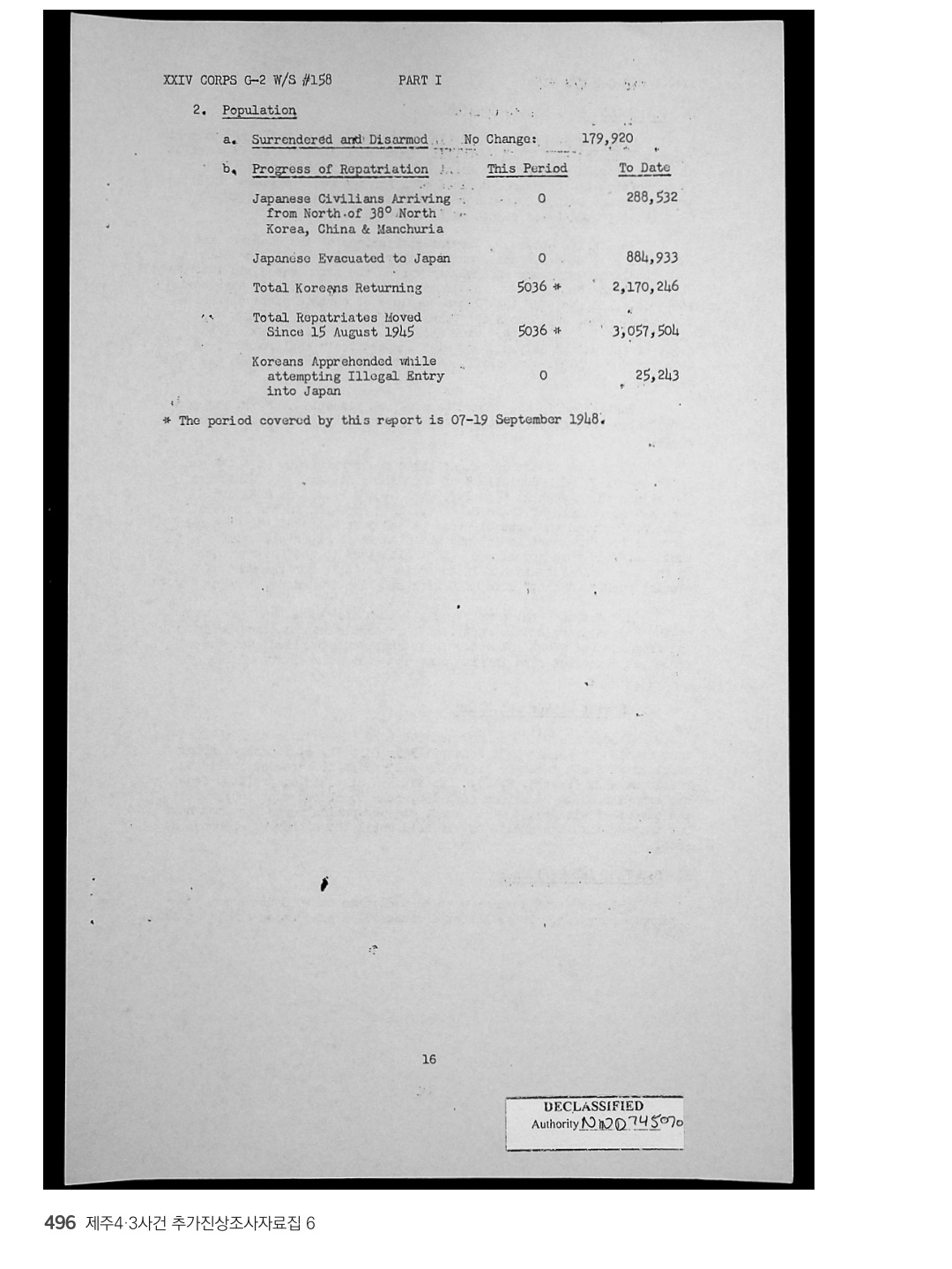
2. Population
a. Surrendered and Disarmed No Change: 179,920
b. Progress of Repatriation This Period To Date
Japanese Civilians Arriving 0 288,532 from North of 38° North
Korea, China & Manchuria
Japanese Evacuated to Japan 0 884,933
Total Koreans Returning 5036 * 2,170,246
Total Repatriates Moved
Since 15 August 1945 5036 * 3,057,504
Koreans Apprehended while attempting Illegal Entry 0 25,243 into Japan
* The period covered by this report is 07-19 September 1948.
16
DECLASSIFIED
Authority NND 745070
XXIV CORPS G-2 W/S #158
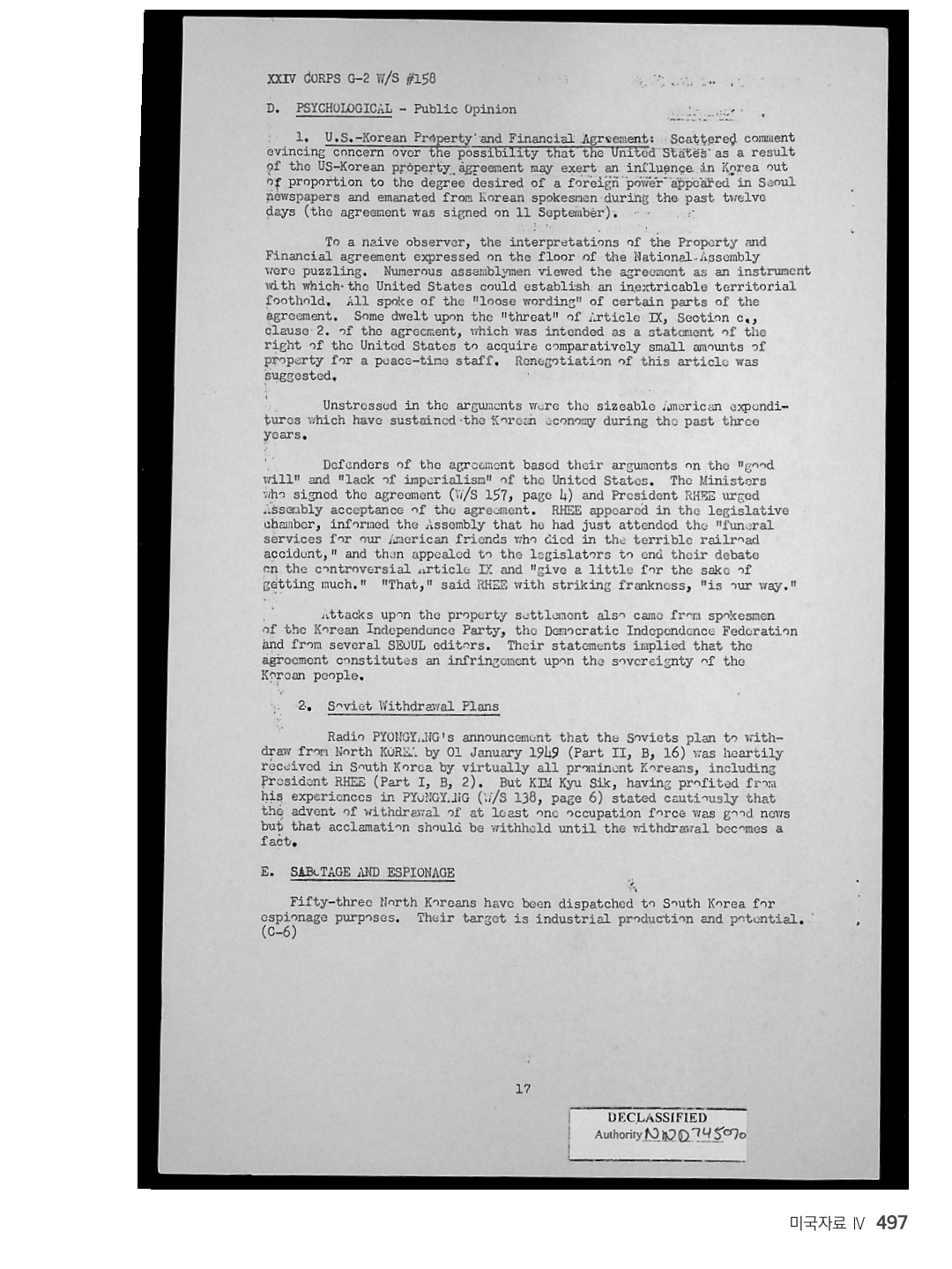
D. PSYCHOLOGICAL - Public Opinion
1. U.S.-Korean Property and Financial Agreement: Scattered comment evincing concern over the possibility that the United States as a result of the US-Korean property agreement may exert an influence in Korea out of proportion to the degree desired of a foreign power appeared in Seoul newspapers and emanated from Korean spokesmen during the past twelve days (the agreement was signed on 11 September).
To a naive observer, the interpretations of the Property and Financial agreement expressed on the floor of the National Assembly were puzzling. Numerous assemblymen viewed the agreement as an instrument with which the United States could establish an inextricable territorial foothold. All spoke of the "loose wording" of certain parts of the agreement. Some dwelt upon the "threat" of Article IX, Section c., clause 2. of the agreement, which was intended as a statement of the right of the United States to acquire comparatively small amounts of property for a peace-time staff. Renegotiation of this article was suggested.
Unstressed in the arguments were the sizeable American expenditures which have sustained the Korean economy during the past three years.
Defenders of the agreement based their arguments on the "good will" and "lack of imperialism" of the United States. The Ministers who signed the agreement (W/S 157, page 4) and President RHEE urged Assembly acceptance of the agreement. RHEE appeared in the legislative chamber, informed the Assembly that he had just attended the "funeral services for our American friends who died in the terrible railroad accident," and then appealed to the legislators to end their debate on the controversial Article IX and "give a little for the sake of getting much." "That," said RHEE with striking frankness, "is our way."
Attacks upon the property settlement also came from spokesmen of the Korean Independence Party, the Democratic Independence Federation and from several SEOUL editors. Their statements implied that the agreement constitutes an infringement upon the sovereignty of the Korean people.
2. Soviet Withdrawal Plans
Radio PYONGYANG's announcement that the Soviets plan to withdraw from North KOREA by 01 January 1949 (Part II, B, 16) was heartily received in South Korea by virtually all prominent Koreans, including President RHEE (Part I, B, 2). But KIM Kyu Sik, having profited from his experiences in PYONGYANG (W/S 138, page 6) stated cautiously that the advent of withdrawal of at least one occupation force was good news but that acclamation should be withheld until the withdrawal becomes a fact.
E. SABOTAGE AND ESPIONAGE
Fifty-three North Koreans have been dispatched to South Korea for espionage purposes. Their target is industrial production and potential. (C-6)
17
DECLASSIFIED
Authority NND 745070
출처:
제주4·3평화재단 편,
『추가진상조사자료집-미국자료4』,
p. 484–497.
— NARA (RG 554, Entry 1256, Box 60)
×
![]()