정보참모부 주간요약보고
보고 기간: 1948년 4월 2일~1948년 4월 9일
주한미육군사령부
서울, 조선
1948년 4월 9일 제134호
B. 현용 정보
1. 정치 활동
a. 유권자 등록 상황
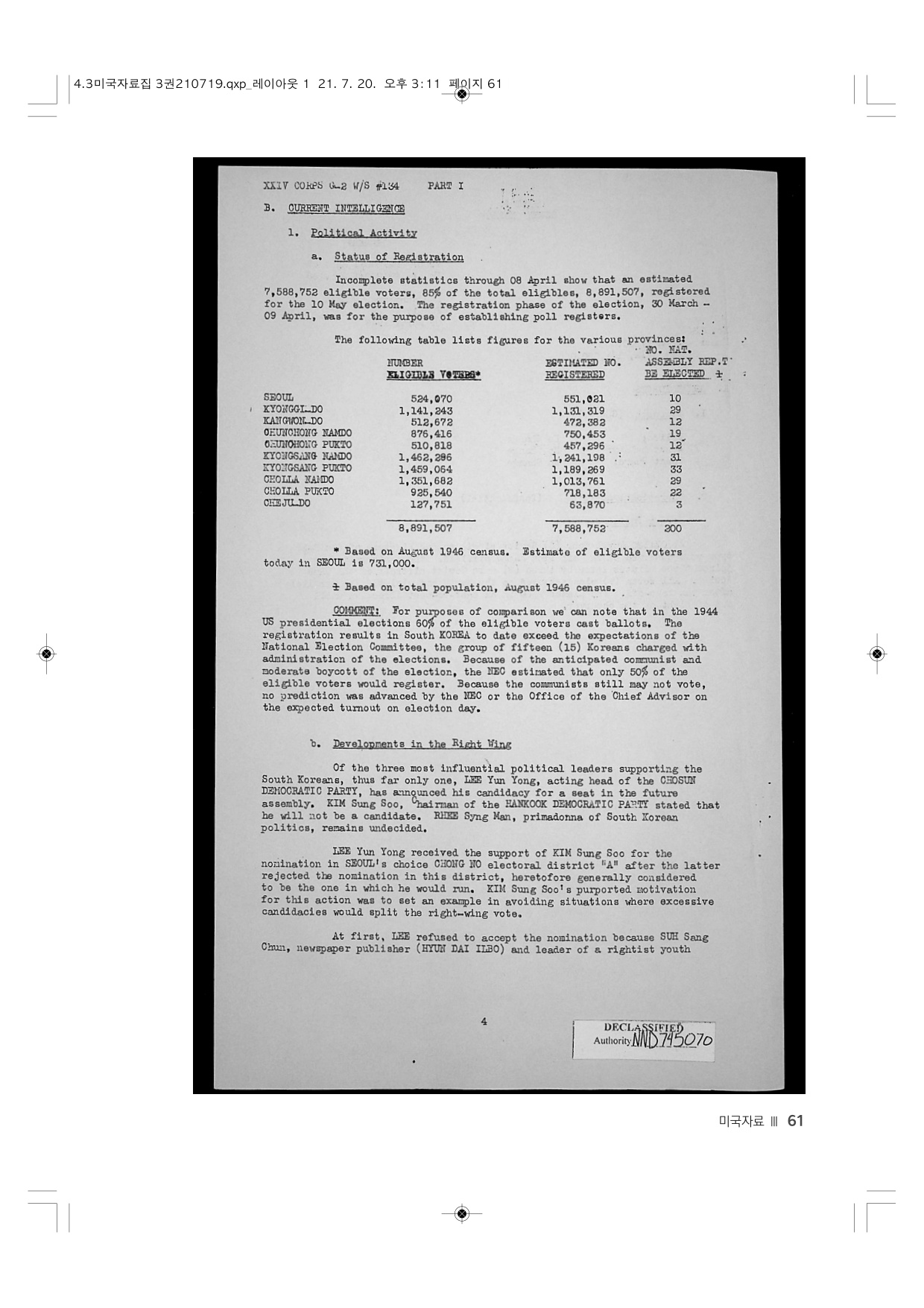
5월 10일 선거와 관련해 4월 8일까지 전체 유권자 889만 1,507명 가운데 85%인 약 758만 8,752명의 유권자가 등록한 것으로 집계됐다. 3월 30일부터 4월 9일까지 이루어진 선거 등록 업무는 선거인명부를 만드는 데 목적이 있다.
다음 표는 각 도의 유권자와 등록 유권자를 나타낸 것이다.
* 1946년 8월 인구조사에 의거함. 금일 기준 서울의 추정 유권자수는 731,000
| 지역 | 유권자 수 | 추정 등록유권자 수 | 의석수 | | 서울 | 524,070 | 551,021 | 10 | | 경기도 | 1,141,243 | 1,131,319 | 29 | | 강원도 | 512,672 | 472,382 | 12 | | 충청남도 | 876,416 | 750,453 | 19 | | 충청북도 | 510,818 | 457,296 | 12 | | 경상남도 | 1,462,286 | 1,241,198 | 31 | | 경상북도 | 1,459,064 | 1,189,269 | 33 | | 전라남도 | 1,351,682 | 1,013,761 | 29 | | 전라북도 | 925,540 | 718,183 | 22 | | 제주도 | 127,751 | 63,870 | 3 | | 총계 | 8,891,507 | 7,588,752 | 200 |
명이다.
2. 민간인 소요
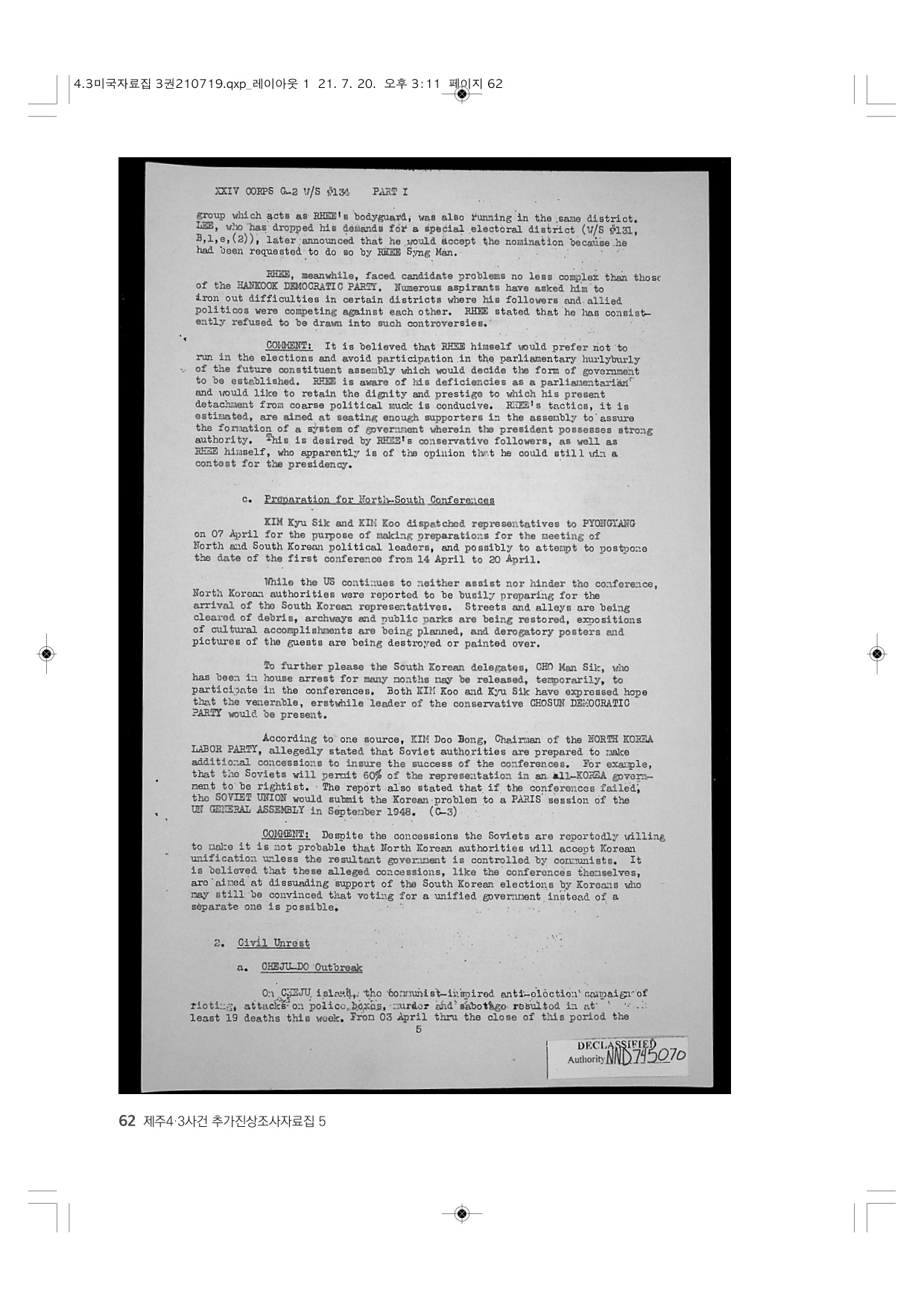
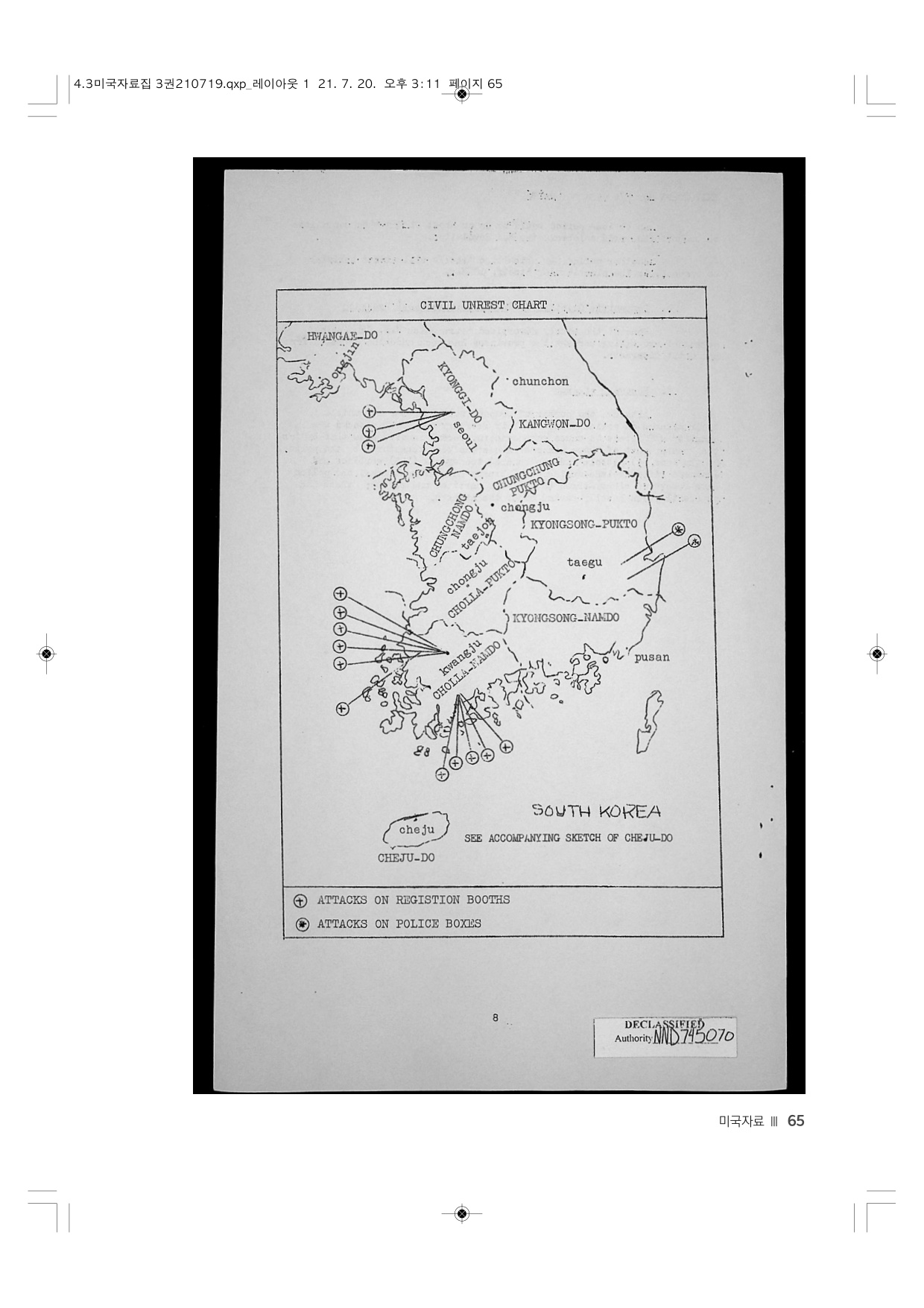
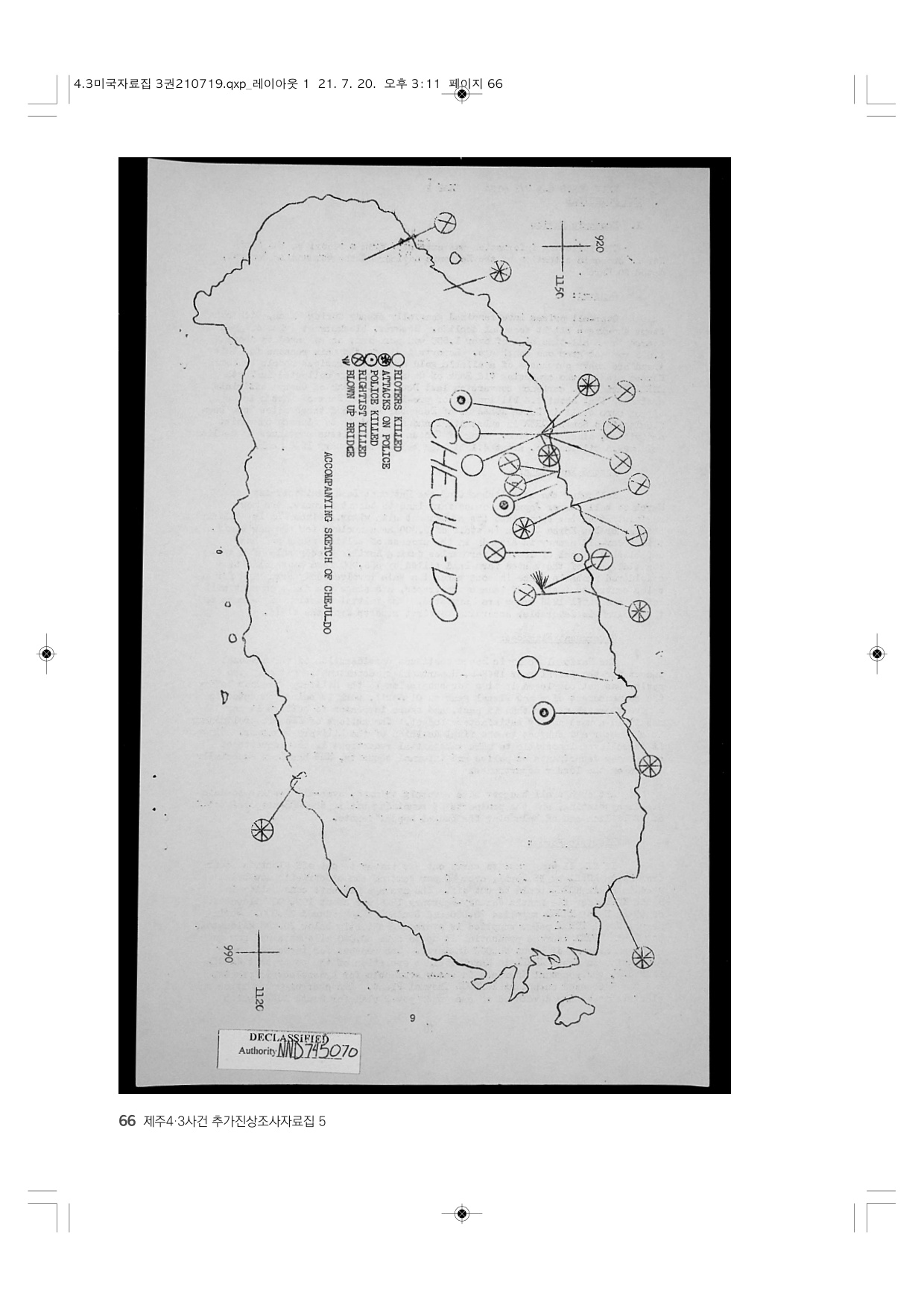
a. 제주도에서 사건 발생 공산주의자들이 선동한 선거 반대 폭동이 제주도에서 일어나 지서를 습격하고 살인과 사보타주로 최소 19명이 이번주 사망했다. 4월 3일부터 보고 기간 말까 지 사망한 사람은 우익 민간인 12명, 경찰 4명, 공산주의자 3명이다. 공산주의자 들은 최소한 10차례 경찰지서를 습격했다. 한 경찰시설이 방화자들에 의해 파괴 됐다. 사보타주에 참여한 사람들이 교량 1곳을 파괴하고, 다른 1곳에 가벼운 손 상을 입혔다. 선거등록사무소가 공격받은 적은 없는 것으로 보고됐다. 숨진 3명의 폭도 가운데 2명은 제주도민이 아닌 것으로 밝혀졌다.
논평: 사망한 폭도 가운데 2명이 제주도 출신이 아닌 것으로 밝혀졌다는 보고
는 공산주의자 폭력배들이 경찰 공격을 부추기고 선동하기 위해 한 지역에서 다 른 지역으로 옮겨 다니고 있다는 오랜 의심을 증명해준다. 그뿐만 아니라 국경선과 해안 초소에서 계속 들어오고 있는 보고에 따르면, 사망과 투옥으로 약해진 공 산당의 지도력을 복원하기 위해 북조선인들이 남조선에 침투하고 있다. 지도력의 증원은 선거를 방해하기 위한 총공세에도 필요하다.
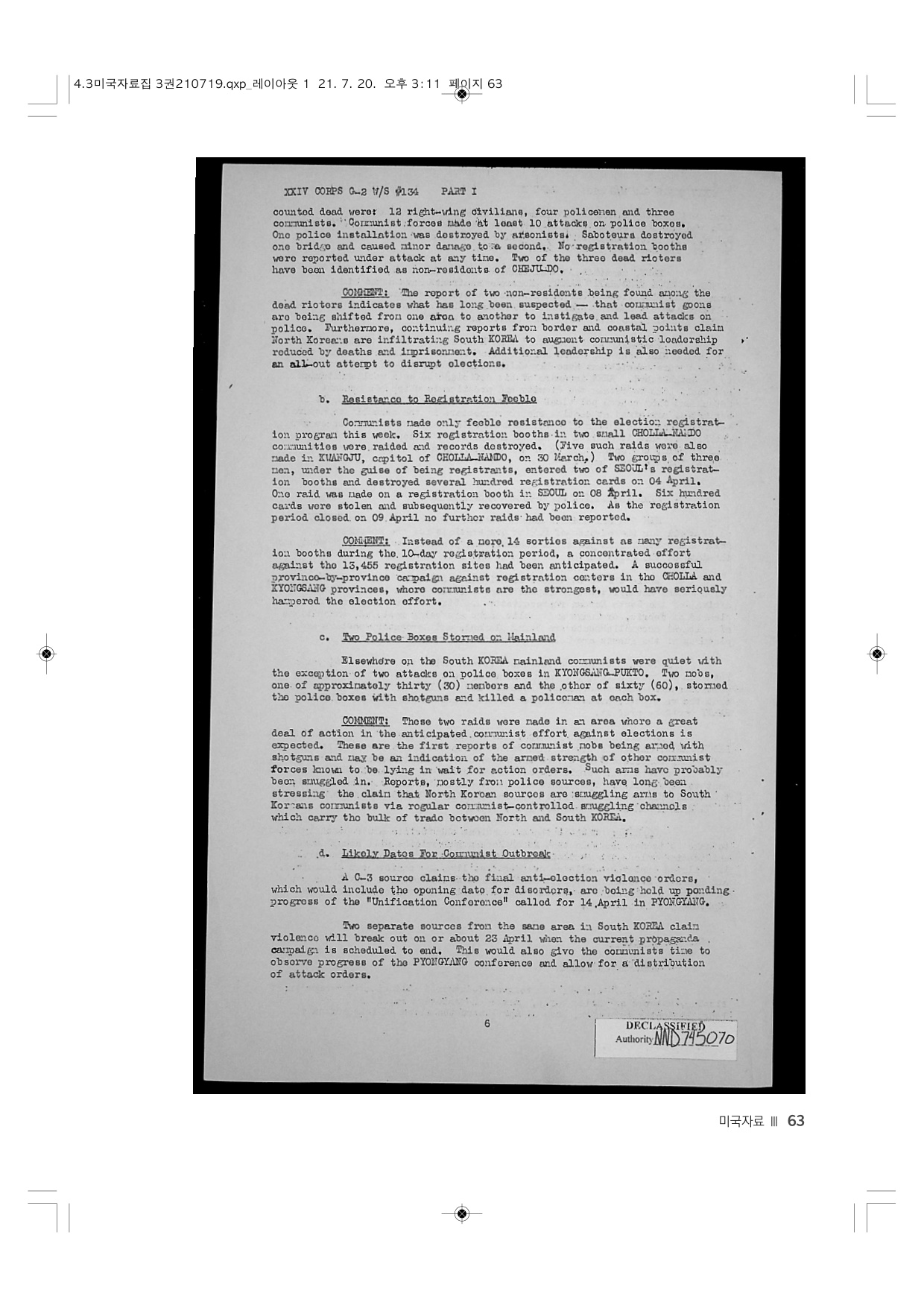
b. 선거 등록에 대한 저항 약화 이번 주 공산주의자들은 선거 등록에 대해 미약한 저항만을 보였다. 전라남도의 두 마을에 있는 선거등록사무소 6곳이 공격당하고 등록 서류가 훼손됐다. (전 라남도 중심도시인 광주에서도 3월 30일 비슷한 공격이 5건 있었다.) 4월 4일에는 3명으로 구성된 2개 무리가 선거등록인으로 위장하고 서울의 선거등록사무소 2곳에 진입하여 등록카드 수 백 개를 훼손했다. 4월 8일에도 서울의 선거등록사 무소에 공격이 가해졌다. 600개의 등록카드가 도난됐다가 경찰에 의해 회수됐다.
4월 9일 등록 기간이 끝난 이후 추가적인 공격 보고는 없었다.
논평: 10일에 걸친 등록 기간 동안 선거등록사무소에 대해 14건의 공격이 있었
는데, 원래는 13,455개 선거등록사무소에 대해 집중적인 공격 노력이 있을 것이라 예상됐었다. 각 도에서 있었던 선거 등록 반대 캠페인이 성공을 거뒀다면, 특
히 공산주의자 세력이 강한 전라도나 경상도에서 성공을 거뒀었다면, 선거를 위 한 노력이 심각하게 방해받았을 것이다.
d. 공산주의자 폭동 예상 일자 어느 C-3 정보원의 주장에 따르면, 선거 반대를 위한 최종 폭력 지령이 4월 14 일 남북제정당사회단체대표자연석회의("Unification Conference")가 진행될 때까지 미뤄지고 있는 것이라고 한다.
남조선 내 같은 지역에 있는 개별 정보원 2명으로부터 받은 정보에 따르면, 지 금 진행 중인 캠페인이 마무리되는 시점인 4월 23일이나 그쯤에 폭동이 발생할 것이다. 이는 공산주의자들에게 평양 연석회의(PYONGYANG conference)의 진행을 파악하고 공격 지령을 고려할 수 있는 시간적 여유를 제공할 것이다.
전 세계 공산주의자들이 적색혁명을 기념하는 5월 1일이나 그쯤이 확실한 기 간일 것이다.
소요 사태가 거의 확실하게 만연할 또 다른 시기는 선거일인 5월 10일이다.
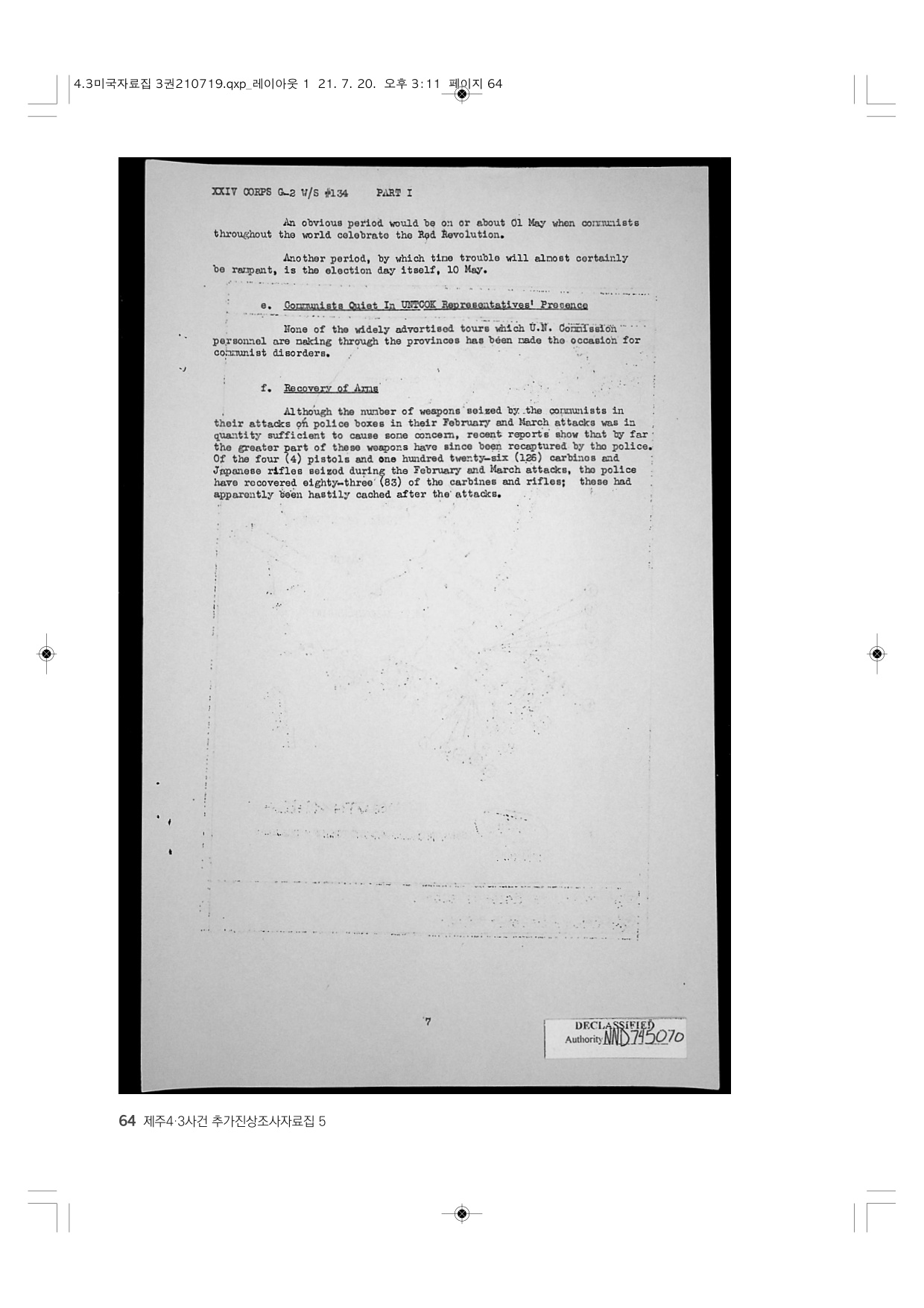
e. 유엔조선임시위원단 대표들의 등장에도 공산주의자 침묵 유엔조선임시위원단 인사들이 여러 지방을 순방했으나, 그 어떤 순방도 공산주의 소요로 이어지지 않았다.
f. 무기 회수
공산주의자들이 2~3월에 경찰지서를 공격하며 탈취한 무기들의 양은 약간 우 려를 유발할 정도였으나, 최근 보고들은 탈취됐던 무기들 대부분이 경찰에 의해 회수됐다는 것을 보여준다. 2~3월의 공격 과정에서 권총 4정, 카빈 126정, 일본 제 소총들이 탈취됐었는데, 경찰은 그 중 카빈과 소총 83정을 회수했다. 이 무기 들은 공격 이후에 급하게 은닉됐던 것이 확실하다.
C. 개전 가능성
1. 경제적 평가
미곡 가격:
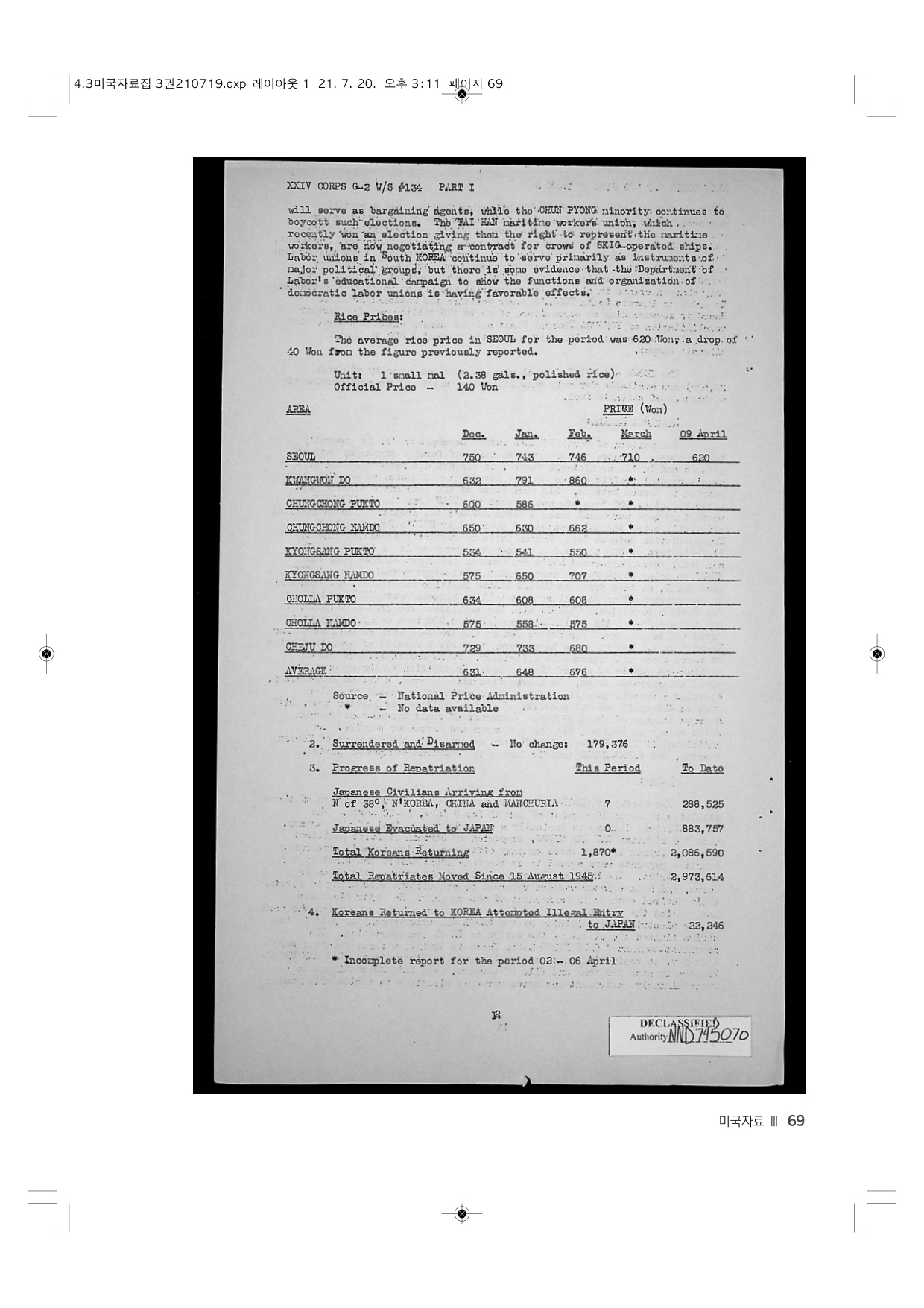
보고 기간 서울의 미곡 가격은 이전에 보고된 수치에서 60원 하락하여 620원이 됐다.
단위: 1 말(작은 단위) (2.38갤런, 도정미)
공정 가격 - 140원 출처 - 중앙물가행정처
* - 데이터 없음
지역 | 가격 (원) | 12월 | 1월 | 2월 | 3월 | 4월 9일 서울 | 750 | 743 | 746 | 710 | 620 강원 | 632 | 791 | 860 | * | 충북 | 600 | 586 | * | * | 충남 | 650 | 630 | 662 | * | 경북 | 534 | 541 | 550 | * | 경남 | 575 | 650 | 707 | * | 전북 | 634 | 608 | 608 | * | 전남 | 575 | 558 | 575 | * | 제주 | 729 | 733 | 680 | * | 평균 | 631 | 648 | 676 | * |
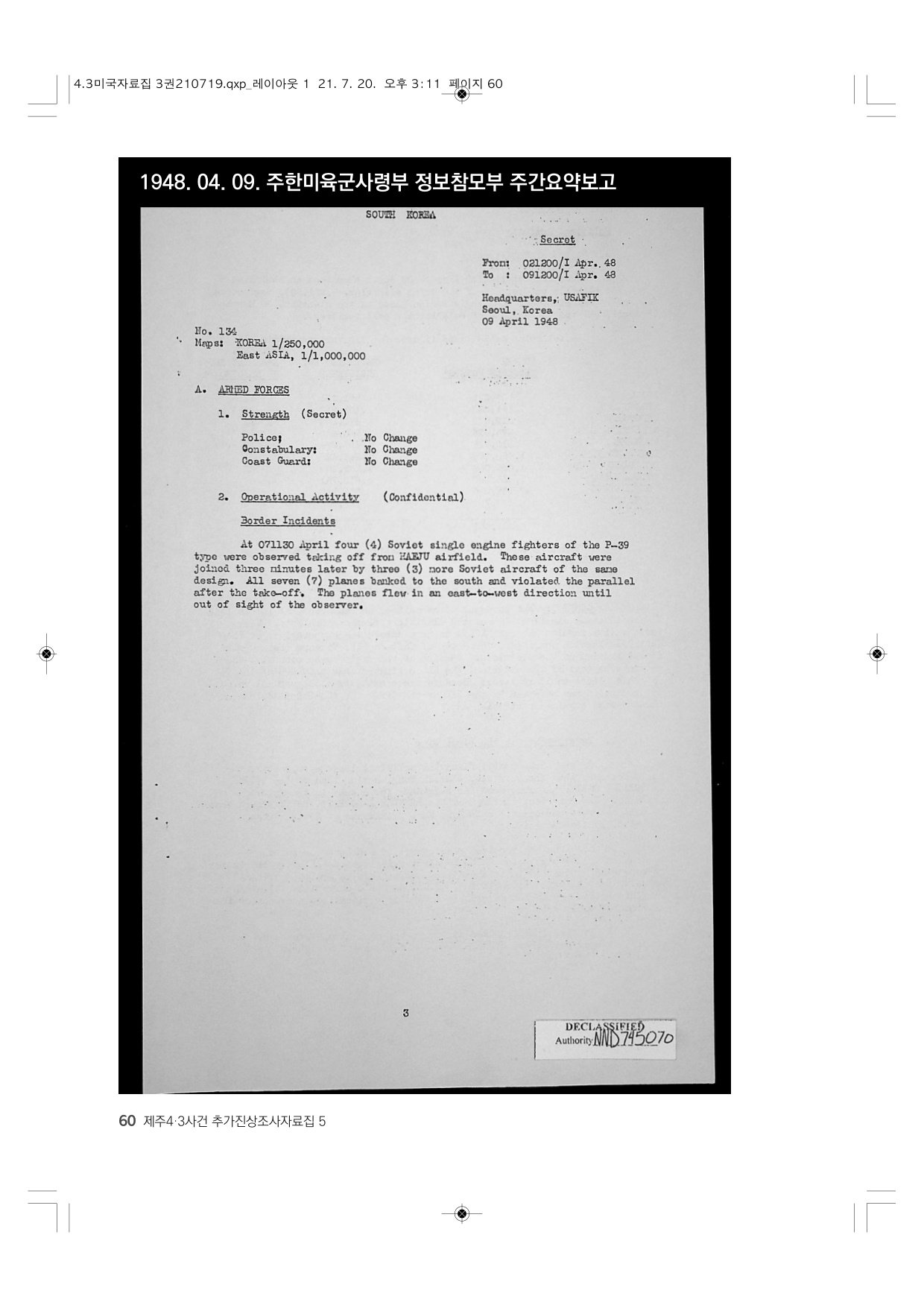
SOUTH KOREA
Secret
From: 021200/I Apr. 48
To : 091200/I Apr. 48
Headquarters, USAFIK
Seoul, Korea
09 April 1948
No. 134
Maps: KOREA 1/250,000
East ASIA, 1/1,000,000
A. ARMED FORCES
1. Strength (Secret)
Police: No Change
Constabulary: No Change
Coast Guard: No Change
2. Operational Activity (Confidential)
Border Incidents
At 071130 April four (4) Soviet single engine fighters of the P-39 type were observed taking off from HAEJU airfield. These aircraft were joined three minutes later by three (3) more Soviet aircraft of the same design. All seven (7) planes banked to the south and violated the parallel after the take-off. The planes flew in an east-to-west direction until out of sight of the observer.
3
DECLASSIFIED
Authority NND 745070
XXIV CORPS G-2 W/S #134 PART I
B. CURRENT INTELLIGENCE
1. Political Activity
a. Status of Registration
Incomplete statistics through 08 April show that an estimated
7,588,752 eligible voters, 85% of the total eligibles, 8,891,507, registered for the 10 May election. The registration phase of the election, 30 March -
09 April, was for the purpose of establishing poll registers.
The following table lists figures for the various provinces:
NO. NAT.
NUMBER ESTIMATED NO. ASSEMBLY REP.T
ELIGIBLE VOTERS* REGISTERED BE ELECTED ±
SEOUL 524,070 551,021 10
KYONGGI-DO 1,141,243 1,131,319 29
KANGWON-DO 512,672 472,382 12
CHUNCHONG NAMDO 876,415 750,453 19
CHUNCHONG PUKTO 510,818 457,296 12
KYONGSANG NAMDO 1,462,286 1,241,198 31
KYONGSANG PUKTO 1,459,064 1,189,269 33
CHOLLA NANDO 1,351,682 1,013,761 29
CHOLLA PUKTO 925,540 718,183 22
CHEJULDO 127,751 63,870 3
8,891,507 7,588,752 200
* Based on August 1946 census. Estimate of eligible voters today in SEOUL is 731,000.
± Based on total population, August 1946 census.
COMMENT: For purposes of comparison we can note that in the 1944
US presidential elections 60% of the eligible voters cast ballots. The registration results in South KOREA to date exceed the expectations of the
National Election Committee, the group of fifteen (15) Koreans charged with administration of the elections. Because of the anticipated communist and moderate boycott of the election, the NEC estimated that only 50% of the eligible voters would register. Because the communists still may not vote, no prediction was advanced by the NEC or the Office of the Chief Advisor on the expected turnout on election day.
b. Developments in the Right Wing
Of the three most influential political leaders supporting the
South Koreans, thus far only one, LEE Yun Yong, acting head of the CHOSUN
DEMOCRATIC PARTY, has announced his candidacy for a seat in the future assembly. KIM Sung Soo, Chairman of the HANKOOK DEMOCRATIC PARTY stated that he will not be a candidate. RHEE Syng Man, primadonna of South Korean politics, remains undecided.
LEE Yun Yong received the support of KIM Sung Soo for the nomination in SEOUL's choice CHONG NO electoral district "A" after the latter rejected the nomination in this district, heretofore generally considered to be the one in which he would run. KIM Sung Soo's purported motivation for this action was to set an example in avoiding situations where excessive candidacies would split the right-wing vote.
At first, LEE refused to accept the nomination because SUH Sang
Chun, newspaper publisher (HYUN DAI ILBO) and leader of a rightist youth
4
DECLASSIFIED
Authority NND 745070
XXIV CORPS G-2 I/S #134 PART I
group which acts as RHEE's bodyguard, was also running in the same district.
LEE, who has dropped his demands for a special electoral district (I/S #131, B,1,e,(2)), later announced that he would accept the nomination because he had been requested to do so by RHEE Syng Man.
RHEE, meanwhile, faced candidate problems no less complex than those of the HANKOOK DEMOCRATIC PARTY. Numerous aspirants have asked him to iron out difficulties in certain districts where his followers and allied politicos were competing against each other. RHEE stated that he has consistently refused to be drawn into such controversies.
COMMENT: It is believed that RHEE himself would prefer not to run in the elections and avoid participation in the parliamentary hurlyburly of the future constituent assembly which would decide the form of government to be established. RHEE is aware of his deficiencies as a parliamentarian and would like to retain the dignity and prestige to which his present detachment from coarse political muck is conducive. RHEE's tactics, it is estimated, are aimed at seating enough supporters in the assembly to assure the formation of a system of government wherein the president possesses strong authority. This is desired by RHEE's conservative followers, as well as
RHEE himself, who apparently is of the opinion that he could still win a contest for the presidency.
c. Preparation for North-South Conferences
KIM Kyu Sik and KIM Koo dispatched representatives to PYONGYANG on 07 April for the purpose of making preparations for the meeting of
North and South Korean political leaders, and possibly to attempt to postpone the date of the first conference from 14 April to 20 April.
While the US continues to neither assist nor hinder the conference, North Korean authorities were reported to be busily preparing for the arrival of the South Korean representatives. Streets and alleys are being cleared of debris, archways and public parks are being restored, expositions of cultural accomplishments are being planned, and derogatory posters and pictures of the guests are being destroyed or painted over.
To further please the South Korean delegates, CHO Man Sik, who has been in house arrest for many months may be released, temporarily, to participate in the conferences. Both KIM Koo and Kyu Sik have expressed hope that the venerable, erstwhile leader of the conservative CHOSUN DEMOCRATIC
PARTY would be present.
According to one source, KIM Doo Bong, Chairman of the NORTH KOREA
LABOR PARTY, allegedly stated that Soviet authorities are prepared to make additional concessions to insure the success of the conferences. For example, that the Soviets will permit 60% of the representation in an all-KOREA government to be rightist. The report also stated that if the conferences failed, the SOVIET UNION would submit the Korean problem to a PARIS session of the
UN GENERAL ASSEMBLY in September 1948. (C-3)
COMMENT: Despite the concessions the Soviets are reportedly willing to make it is not probable that North Korean authorities will accept Korean unification unless the resultant government is controlled by communists. It is believed that these alleged concessions, like the conferences themselves, are aimed at dissuading support of the South Korean elections by Koreans who may still be convinced that voting for a unified government instead of a separate one is possible.
2. Civil Unrest
a. CHEJU-DO Outbreak
On CHEJU island, the communist-inspired anti-election campaign of rioting, attacks on police boxes, murder and sabotage resulted in at [illegible]
least 19 deaths this week. From 03 April thru the close of this period the
5
DECLASSIFIED
Authority NND 745070
XXIV CORPS G-2 W/S #134 PART I
counted dead were: 12 right-wing civilians, four policemen and three communists. Communist forces made at least 10 attacks on police boxes.
One police installation was destroyed by arsonists. Saboteurs destroyed one bridge and caused minor damage to a second. No registration booths were reported under attack at any time. Two of the three dead rioters have been identified as non-residents of CHEJULDO.
COMMENT: The report of two non-residents being found among the dead rioters indicates what has long been suspected — that communist goons are being shifted from one area to another to instigate and lead attacks on police. Furthermore, continuing reports from border and coastal points claim
North Koreans are infiltrating South KOREA to augment communistic leadership reduced by deaths and imprisonment. Additional leadership is also needed for an all-out attempt to disrupt elections.
b. Resistance to Registration Feeble
Communists made only feeble resistance to the election registration program this week. Six registration booths in two small CHOLLA-NANDO communities were raided and records destroyed. (Five such raids were also made in KWANGJU, capitol of CHOLLA-NANDO, on 30 March.) Two groups of three men, under the guise of being registrants, entered two of SEOUL's registration booths and destroyed several hundred registration cards on 04 April.
One raid was made on a registration booth in SEOUL on 08 April. Six hundred cards were stolen and subsequently recovered by police. As the registration period closed on 09 April no further raids had been reported.
COMMENT: Instead of a mere 14 sorties against as many registration booths during the 10-day registration period, a concentrated effort against the 13,455 registration sites had been anticipated. A successful province-by-province campaign against registration centers in the CHOLLA and
KYONGSANG provinces, where communists are the strongest, would have seriously hampered the election effort.
c. Two Police Boxes Stormed on Mainland
Elsewhere on the South KOREA mainland communists were quiet with the exception of two attacks on police boxes in KYONGSANG-BUKTO. Two mobs, one of approximately thirty (30) members and the other of sixty (60), stormed the police boxes with shotguns and killed a policeman at each box.
COMMENT: These two raids were made in an area where a great deal of action in the anticipated communist effort against elections is expected. These are the first reports of communist mobs being armed with shotguns and may be an indication of the armed strength of other communist forces known to be lying in wait for action orders. Such arms have probably been smuggled in. Reports, mostly from police sources, have long been stressing the claim that North Korean sources are smuggling arms to South
Koreans communists via regular communist-controlled smuggling channels which carry the bulk of trade between North and South KOREA.
d. Likely Dates For Communist Outbreak
A C-3 source claims the final anti-election violence orders, which would include the opening date for disorders, are being held up pending progress of the "Unification Conference" called for 14 April in PYONGYANG.
Two separate sources from the same area in South KOREA claim violence will break out on or about 23 April when the current propaganda campaign is scheduled to end. This would also give the communists time to observe progress of the PYONGYANG conference and allow for a distribution of attack orders.
6
DECLASSIFIED
Authority NND 745070
XXIV CORPS G-2 W/S #134 PART I
An obvious period would be on or about 01 May when communists throughout the world celebrate the Red Revolution.
Another period, by which time trouble will almost certainly be rampant, is the election day itself, 10 May.
e. Communists Quiet In UNTCOK Representatives' Presence
None of the widely advertised tours which U.N. Commission personnel are making through the provinces has been made the occasion for communist disorders.
f. Recovery of Arms
Although the number of weapons seized by the communists in their attacks on police boxes in their February and March attacks was in quantity sufficient to cause some concern, recent reports show that by far the greater part of these weapons have since been recaptured by the police. Of the four (4) pistols and one hundred twenty-six (126) carbines and Japanese rifles seized during the February and March attacks, the police have recovered eighty-three (83) of the carbines and rifles; these had apparently been hastily cached after the attacks.
7
DECLASSIFIED
Authority NND 745070
CIVIL UNREST CHART
HWANGAE-DO
[illegible]
chunchon
KANGWON-DO
KYONGGІ-DO
seoul
CHUNGCHONG
NANDO
CHUNGCHUNG
PUKTO
chongju
KYONGSONG-PUKTO
taejon
choneju
CHOLLA-PUKTO
taegu
KYONGSONG-NANDO
kwangju
CHOLLA-NANDO
pusan
제주
SOUTH KOREA
cheju
CHEJU-DO
SEE ACCOMPANYING SKETCH OF CHEJU-DO
⊕ ATTACKS ON REGISTION BOOTHS
⊛ ATTACKS ON POLICE BOXES
8
DECLASSIFIED
Authority NND 745070
RIOTERS KILLED
ATTACKS ON POLICE
RIGHTIST KILLED
POLICE KILLED
BLOWN UP BRIDGE
ACCOMPANYING SKETCH OF CHEJU-DO
CHEJU-DO
920
115[illegible]
990
112C
9
DECLASSIFIED
Authority NND 745070
XXIV CORPS G-2 W/S #134 PART I
C. WAR POTENTIAL
1. Economic Review
The following information was extracted from a report on the South
Korean economic situation by the Economic Advisor of the Commanding General, dated 30 March.
General:
Over-all prices have remained generally steady during March, with some items showing a slight seasonal decline. However, blackmarket price of gold has soared to an all-time high of over 1,500 won per gram, as compared to about
1,000 won per gram one month ago. Reports indicate the main reasons for this trend are heavy purchases of available gold and other precious metals by North
Korean agents, who are using Old Bank of Chosun currency collected in North
KOREA during the currency conversion last December. Bank of Chosun officials estimated that about 1.4 billion won of pre-liberation Bank of Chosun issue of won were still in North KOREA as of December 1947, and these notes have been flowing into South KOREA in substantial amounts, mainly to finance communist activities, since that time. Bank of Chosun currency issue continues to decline being 29.5 billion won, about 4.1 billion below the January 1948 peak.
Vested Farm Land:
Following the establishment of the National Land Administration on 22
March to sell former Japanese owned farm land to tenant farmers, the new administration has swung into its assignment with vigor. Since NLA is utilizing the former New Korea Company's staff of 6,300 as a nucleus for the new staff, this 5 day-old agency is already in the process of selling farms and has established a goal of 100,000 farm sales during April. Speedy sale of a substantial part of the vested farm land tilled by 558,000 farm households is considered probable since in most cases the sale involves only arranging for sales contracts instead of tenancy contracts, and since the first payment will not be due until 1948 crops are harvested. The initial reaction of farmers to the program is favorable, according to first reports from the field.
Government Finances:
The National Economic Board continues consideration of the national budget for the fiscal year 1948-9, department by department. Although the review was not completed in time for submission to the Military Governor before the commencement of a new fiscal year on 01 April, work is being conducted in a more thorough manner than in past, and there is reason to believe it may result in a more nearly satisfactory budget. The actions of NEB are preliminary in character and subject to the final decision of the Military Governor. Since it is believed impossible to make substantial reductions in the requests of such major departments as police and internal security, NEB has been especially severe on the lesser departments.
Although small budgets were severely trimmed, over-all results to date are disappointing, and the prospects of remaining within the NEB-proposed total of 22 billion and of balancing the budget appear remote.
Electric Power:
If KIM Il Sung were to carry out his threat to cut off electric power from North KOREA by 15 April, over 60 per cent of the electricity now being used in South KOREA would be cut off. The average kilowatt consumption in
South KOREA for the months January-February 1948 was about 102,000 kilowatts, of which North KOREA supplied 70,000 and South KOREA produced 32,000. During
March, North KOREA power supplied is averaging slightly below 70,000 kilowatts, but South KOREA average production is up to over 40,000 kilowatts and may go up to an average of about 50,000 in April. The reasons for increased power production in South KOREA in March include operation of the power boat JACONA in PUSAN, the seasonal increase in water available for hydroelectric plants, and the increased output at YONGWOL Thermal Plant. The emergency committee on electric power has developed an emergency power plan for South KOREA which
10
DECLASSIFIED
Authority NND 745070
XXIV CORPS G-2 I/S #134 PART I
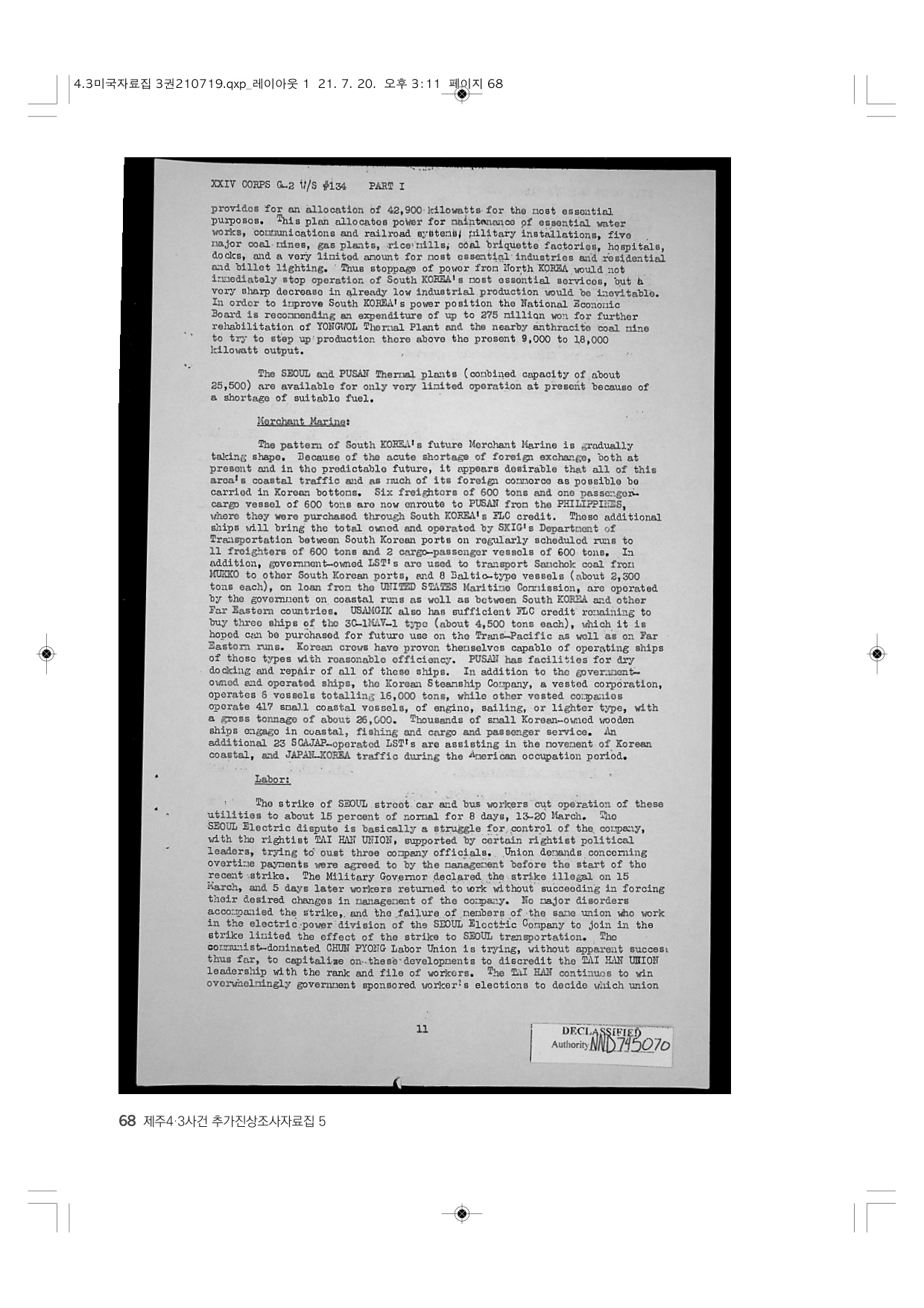
provides for an allocation of 42,900 kilowatts for the most essential purposes. This plan allocates power for maintenance of essential water works, communications and railroad systems; military installations, five major coal mines, gas plants, rice mills, coal briquette factories, hospitals, docks, and a very limited amount for most essential industries and residential and billet lighting. Thus stoppage of power from North KOREA would not immediately stop operation of South KOREA's most essential services, but a very sharp decrease in already low industrial production would be inevitable.
In order to improve South KOREA's power position the National Economic
Board is recommending an expenditure of up to 275 million won for further rehabilitation of YONGWOL Thermal Plant and the nearby anthracite coal mine to try to step up production there above the present 9,000 to 18,000 kilowatt output.
The SEOUL and PUSAN Thermal plants (combined capacity of about
25,500) are available for only very limited operation at present because of a shortage of suitable fuel.
Merchant Marine:
The pattern of South KOREA's future Merchant Marine is gradually taking shape. Because of the acute shortage of foreign exchange, both at present and in the predictable future, it appears desirable that all of this area's coastal traffic and as much of its foreign commerce as possible be carried in Korean bottoms. Six freighters of 600 tons and one passengercargo vessel of 600 tons are now enroute to PUSAN from the PHILIPPINES, where they were purchased through South KOREA's FLC credit. These additional ships will bring the total owned and operated by SKIG's Department of
Transportation between South Korean ports on regularly scheduled runs to
11 freighters of 600 tons and 2 cargo-passenger vessels of 600 tons. In addition, government-owned LST's are used to transport Samchok coal from
MUKKO to other South Korean ports, and 6 Baltic-type vessels (about 2,300 tons each), on loan from the UNITED STATES Maritime Commission, are operated by the government on coastal runs as well as between South KOREA and other
Far Eastern countries. USAMGIK also has sufficient FLC credit remaining to buy three ships of the SC-1MAV-1 type (about 4,500 tons each), which it is hoped can be purchased for future use on the Trans-Pacific as well as on Far
Eastern runs. Korean crews have proven themselves capable of operating ships of those types with reasonable efficiency. PUSAN has facilities for dry docking and repair of all of these ships. In addition to the governmentowned and operated ships, the Korean Steamship Company, a vested corporation, operates 6 vessels totalling 16,000 tons, while other vested companies operate 417 small coastal vessels, of engine, sailing, or lighter type, with a gross tonnage of about 26,000. Thousands of small Korean-owned wooden ships engage in coastal, fishing and cargo and passenger service. An additional 23 SCAJAP-operated LST's are assisting in the movement of Korean coastal, and JAPAN-KOREA traffic during the American occupation period.
Labor:
The strike of SEOUL street car and bus workers cut operation of these utilities to about 15 percent of normal for 8 days, 13-20 March. The
SEOUL Electric dispute is basically a struggle for control of the company, with the rightist TAI HAN UNION, supported by certain rightist political leaders, trying to oust three company officials. Union demands concerning overtime payments were agreed to by the management before the start of the recent strike. The Military Governor declared the strike illegal on 15
March, and 5 days later workers returned to work without succeeding in forcing their desired changes in management of the company. No major disorders accompanied the strike, and the failure of members of the same union who work in the electric power division of the SEOUL Electric Company to join in the strike limited the effect of the strike to SEOUL transportation. The communist-dominated CHUN PYONG Labor Union is trying, without apparent success thus far, to capitalize on these developments to discredit the TAI HAN UNION leadership with the rank and file of workers. The TAI HAN continues to win overwhelmingly government sponsored worker's elections to decide which union
11
DECLASSIFIED
Authority NND 745070
68 제주4·3사건 추가진상조사자료집 5
XXIV CORPS G-2 W/S #134 PART I
will serve as bargaining agents, while the CHUN PYONG minority continues to boycott such elections. The TAI HAN maritime workers union, which recently won an election giving them the right to represent the maritime workers, are now negotiating a contract for crews of SKIG-operated ships.
Labor unions in South KOREA continue to serve primarily as instruments of major political groups, but there is some evidence that the Department of
Labor's educational campaign to show the functions and organization of democratic labor unions is having favorable effects.
Rice Prices:
The average rice price in SEOUL for the period was 620 Won; a drop of
40 Won from the figure previously reported.
Unit: 1 small mal (2.38 gals., polished rice)
Official Price -- 140 Won
AREA PRICE (Won)
Dec. Jan. Feb. March 09 April
SEOUL 750 743 746 710 620
KWANGWON DO 632 791 850 * .
CHUNGCHONG PUKTO 600 586 * *
CHUNGCHONG NAMDO 550 630 682 *
KYONGSANG PUKTO 534 541 550 *
KYONGSANG NAMDO 575 650 707 *
CHOLLA PUKTO 634 608 608 *
CHOLLA NAMDO 575 558 575 *
CHEJU DO 729 733 680 *
AVERAGE 631 648 676 *
Source -- National Price Administration
* -- No data available
2. Surrendered and Disarmed -- No change: 179,376
3. Progress of Repatriation This Period To Date
Japanese Civilians Arriving from
N of 38°, N KOREA, CHINA and MANCHURIA 7 288,525
Japanese Evacuated to JAPAN 0 883,757
Total Koreans Returning 1,870* 2,086,590
Total Repatriates Moved Since 15 August 1945 2,973,514
4. Koreans Returned to KOREA Attempted Illegal Entry to JAPAN 22,246
* Incomplete report for the period 02 -- 06 April
B
DECLASSIFIED
Authority NND 745070
XXIV CORPS G-2 W/S #134 PART I
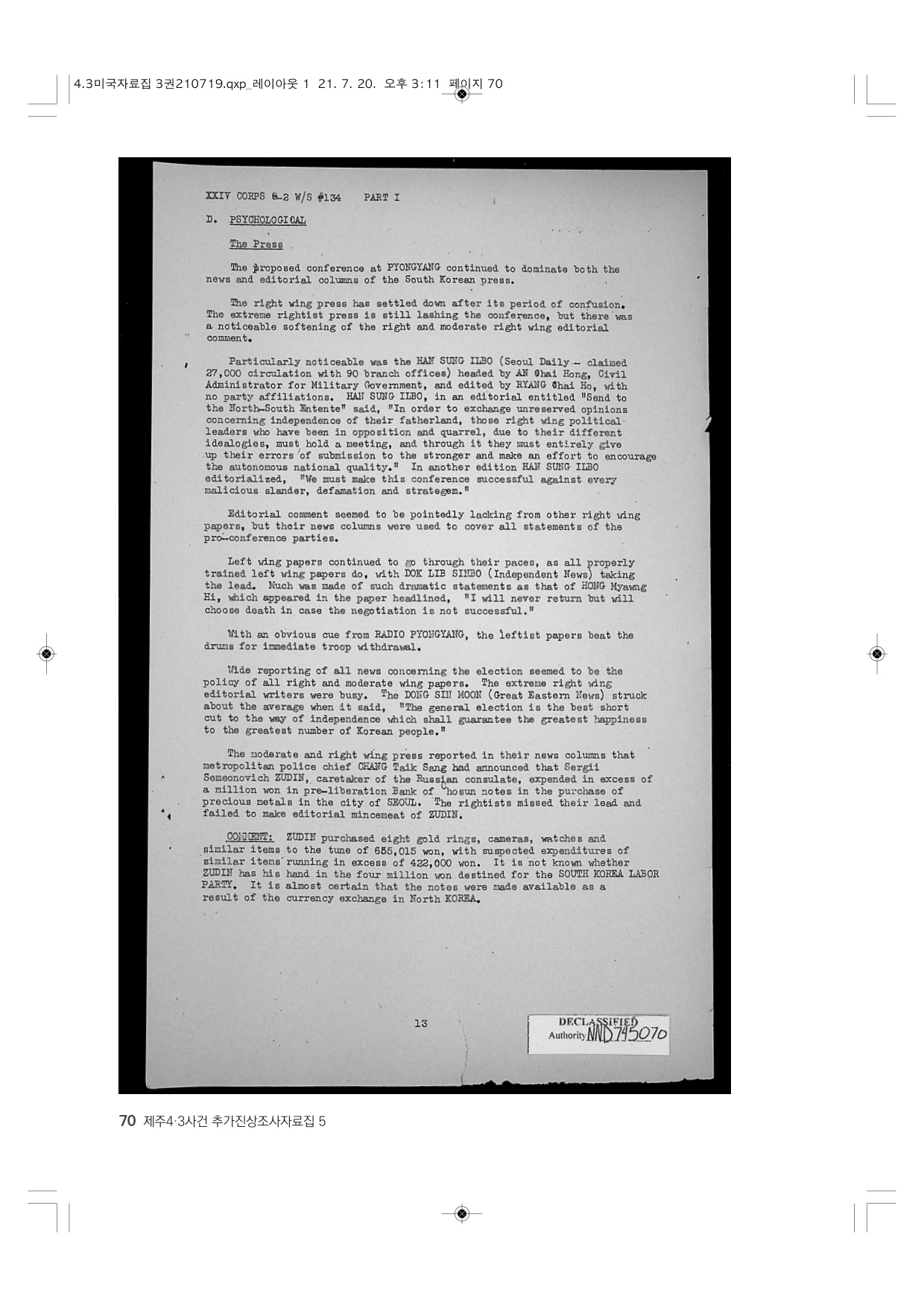
D. PSYCHOLOGICAL
The Press
The proposed conference at PYONGYANG continued to dominate both the news and editorial columns of the South Korean press.
The right wing press has settled down after its period of confusion.
The extreme rightist press is still lashing the conference, but there was a noticeable softening of the right and moderate right wing editorial comment.
Particularly noticeable was the HAN SUNG ILBO (Seoul Daily — claimed
27,000 circulation with 90 branch offices) headed by AN Ohai Hong, Civil
Administrator for Military Government, and edited by RYANG Ohai Ho, with no party affiliations. HAN SUNG ILBO, in an editorial entitled "Send to the North-South Entente" said, "In order to exchange unreserved opinions concerning independence of their fatherland, those right wing political leaders who have been in opposition and quarrel, due to their different idealogies, must hold a meeting, and through it they must entirely give up their errors of submission to the stronger and make an effort to encourage the autonomous national quality." In another edition HAN SUNG ILBO editorialized, "We must make this conference successful against every malicious slander, defamation and stratagem."
Editorial comment seemed to be pointedly lacking from other right wing papers, but their news columns were used to cover all statements of the pro-conference parties.
Left wing papers continued to go through their paces, as all properly trained left wing papers do, with DOK LIB SINBO (Independent News) taking the lead. Much was made of such dramatic statements as that of HONG Myawng
Hi, which appeared in the paper headlined, "I will never return but will choose death in case the negotiation is not successful."
With an obvious cue from RADIO PYONGYANG, the leftist papers beat the drums for immediate troop withdrawal.
Wide reporting of all news concerning the election seemed to be the policy of all right and moderate wing papers. The extreme right wing editorial writers were busy. The DONG SIM MOON (Great Eastern News) struck about the average when it said, "The general election is the best short cut to the way of independence which shall guarantee the greatest happiness to the greatest number of Korean people."
The moderate and right wing press reported in their news columns that metropolitan police chief CHANG Taik Sang had announced that Sergii
Semeonovich ZUDIN, caretaker of the Russian consulate, expended in excess of a million won in pre-liberation Bank of [illegible]hosun notes in the purchase of precious metals in the city of SEOUL. The rightists missed their lead and failed to make editorial mincemeat of ZUDIN.
COMMENT: ZUDIN purchased eight gold rings, cameras, watches and similar items to the tune of 655,015 won, with suspected expenditures of similar items running in excess of 422,000 won. It is not known whether
ZUDIN has his hand in the four million won destined for the SOUTH KOREA LABOR
PARTY. It is almost certain that the notes were made available as a result of the currency exchange in North KOREA.
13 DECLASSIFIED
Authority NND 745070
XXIV CORPS G-2 W/S #134 PART I
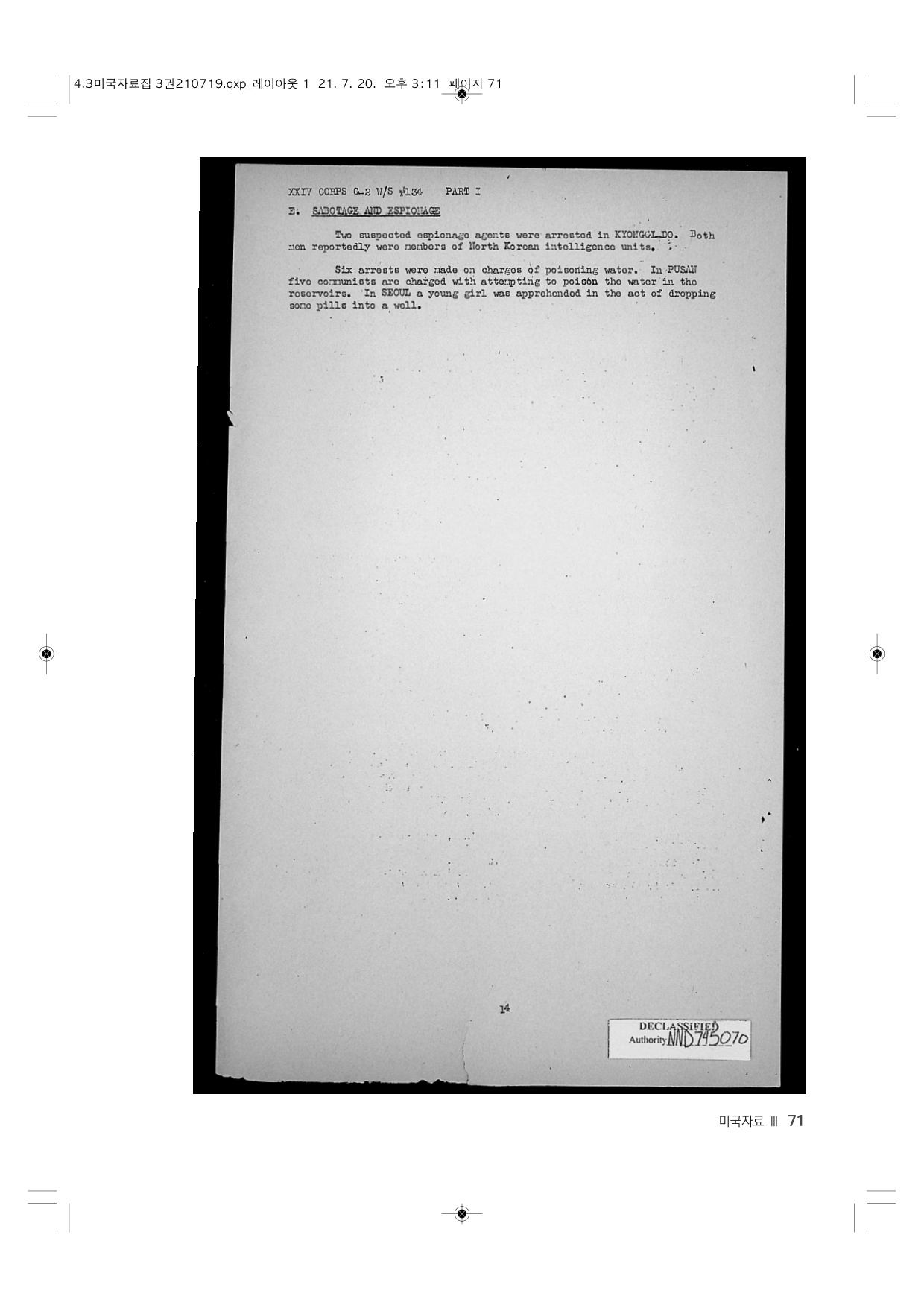
2. SABOTAGE AND ESPIONAGE
Two suspected espionage agents were arrested in KYONGGI-DO. Both men reportedly were members of North Korean intelligence units.
Six arrests were made on charges of poisoning water. In PUSAN five communists are charged with attempting to poison the water in the reservoirs. In SEOUL a young girl was apprehended in the act of dropping some pills into a well.
14
DECLASSIFIED
Authority NND 745070
출처:
제주4·3평화재단 편,
『추가진상조사자료집-미국자료3』,
p. 60–71.
— NARA (RG 554, Entry 1256, Box 59)
×
![]()