남조선과도정부
중앙식량행정처
서울, 조선
1948년 1월 3일
제목: 제주도 배급 계획 시행
수신: 중앙식량행정처장 지용은, 중앙식량행정처 고문관 캐롤 V. 힐 (Carroll V. Hill)
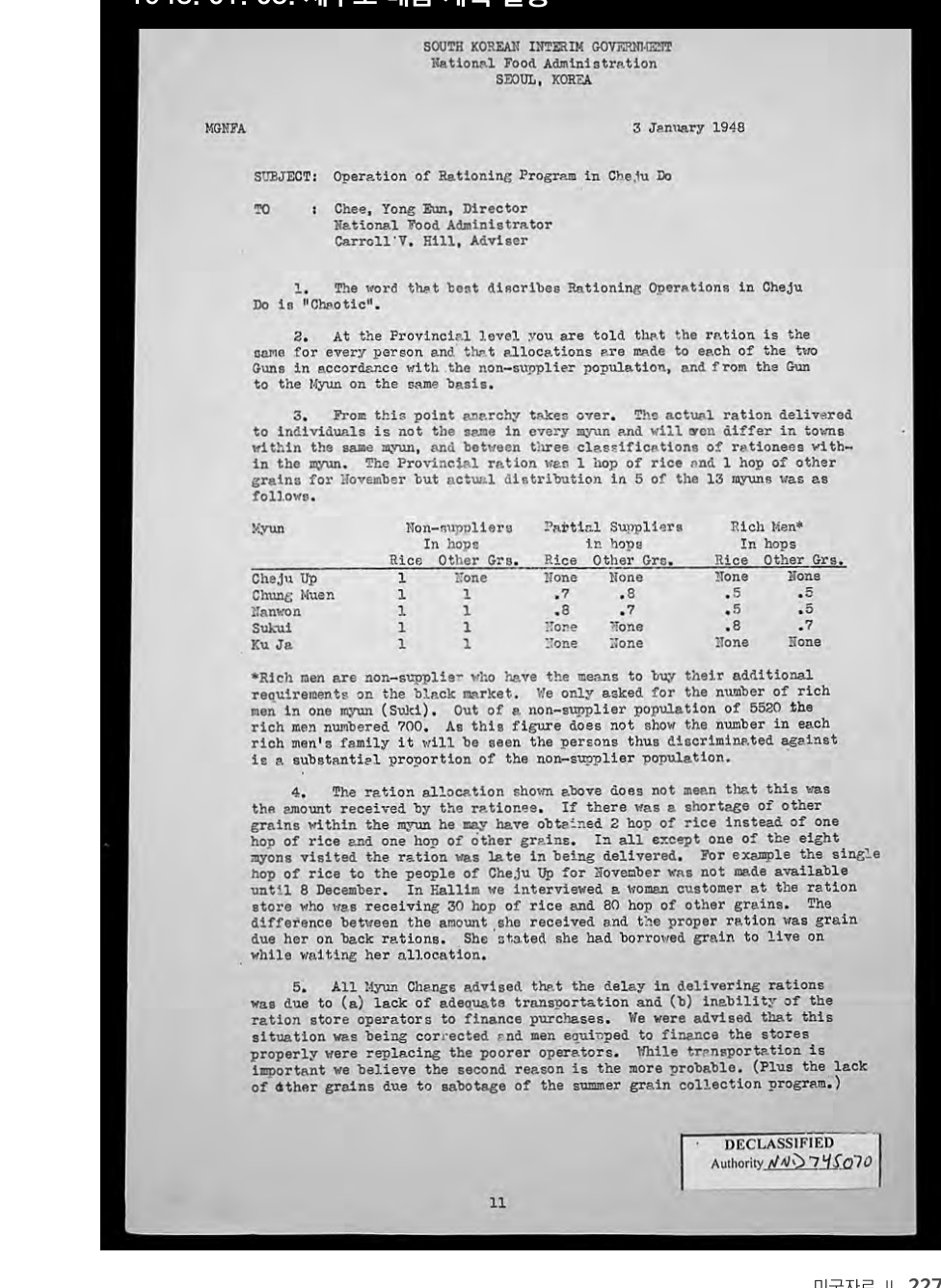
1. 제주도의 식량 배급 운영을 가장 잘 설명한 용어는 한마디로 '혼란'이라고 할 수 있다.
2. 귀하는 도 차원에서 모든 주민의 배급량이 같고 군과 면이 같은 기준으로 비경작 주민 인구수에 따라 2개 군의 각각에 대하여 할당량이 정해졌다고 보고 받았다.
3. 이 점에서부터 무정부상태가 시작되었다. 개인에게 전달된 실제 배급량은 모든 면이 같지 않았고 심지어 같은 면이라도 마을에 따라 다를 것이며 면내의 배급받는 3개 부류 사이에도 다를 것이다. 제주도의 배급량은 11월 미곡 1홉과 잡곡 1홉이지만 13개 읍면 가운데 5개 읍면의 실제 분배량은 다음과 같다.
* 재산가는 암시장에서 추가 필요량을 살 재산이 있는 비경작자이다. 우리는 단지 한 면(서귀면)의 재산가 숫자를 요청했다. 5,520명의 비경작 주민 가운데 재산가는 700 명에 이르렀다. 이 수치는 개개의 부유한 가정에 대한 가족수를 나타내고 있지 않기 때 문에, 이런 식으로 구분되는 사람들은 비경작 인구에서 큰 비율을 점하는 것으로 보일 것이다.
4. 위에 보여준 배급량 분배는 이것이 배급받은 주민들이 받은 양을 의미하지는 않는다. 면내에서 잡곡이 부족하다면 이 주민은 미곡 1홉과 잡곡 1홉 대신에 미곡 2홉을 받을 수도 있다. 방문했던 8개 면 가운데 1개 면을 제외하고 모든 면에서 배급량이 늦게 전달됐다. 예를 들어 11월 제주읍 주민들에게 줄 미곡 1홉씩은 12월 8일까지 전달되지 않았다. 우리는 한림의 배급소에서 미곡 30홉과 잡곡 80홉을 받고 있던 한 부녀자를 면담했다. 그녀가 실제 받은 양과 적정한 배급량의 차이는 그녀가 배급소에 갚아야 할 곡물이었다. 이 여성은 그녀가 배급을 기다 리는 동안 먹고 살기 위해 곡물을 빌렸다고 말했다.
5. 모든 면장들은 할당량 전달이 지연된 이유가 ⒜ 충분한 운송수단의 부족 ⒝ 구입곡물에 대한 재정처리를 하는 배급소 운영자의 무능 때문이라고 말했다. 우 리는 이 상황이 수정되고 있고 무능력한 운영자 대신에 적정하게 배급소 재정을 처리할 수 있는 능력을 갖춘 사람들로 대체하고 있다고 통고받았다. 운송수단도 중요하겠으나 우리는 두 번째 이유가 좀 더 개연성이 있다고 믿는다(추가로 하곡 수집계획 사보타주로 인한 잡곡 부족도 이유이다).
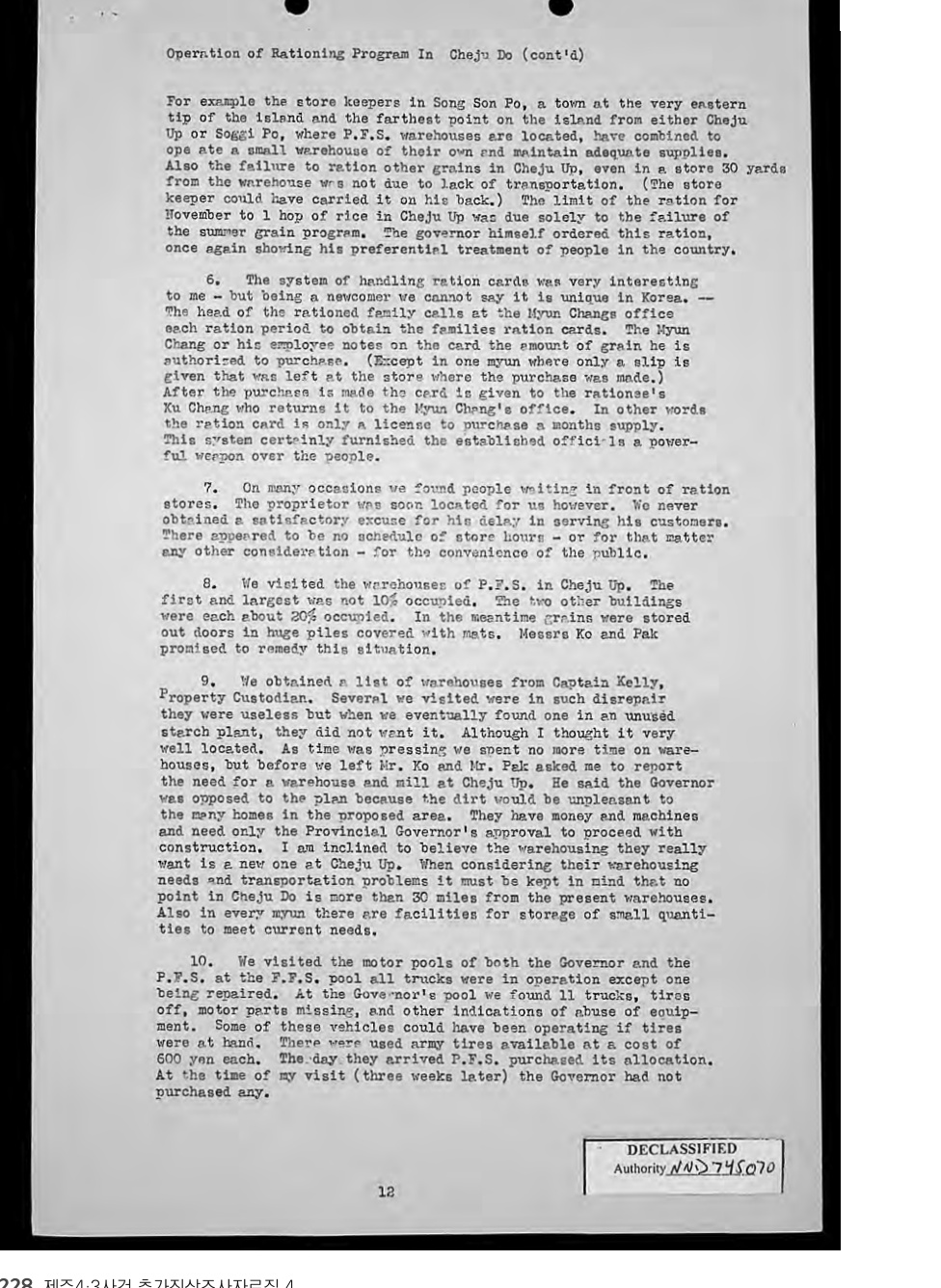
예를 들어 제주도의 동쪽 끝이며, 제주읍과 서귀포에서 가장 먼 곳에 있는 성산 포-이곳에는 도 식량사무소가 위치해 있다-의 배급소 주인들은 자신들의 작은 창 고 운영을 겸업하고 충분한 물자를 가지고 있다. 또한 제주도의 잡곡 배급의 실패는 (심지어 창고로부터 30 야드 떨어진 배급소에서도 실패가 있었음) 운송수단의 부족 때문이 아니다. (배급소 주인은 이를 등짐으로 나를 수 있었을 것이다.) 제주 읍에서 11월에 배급량을 미곡 1홉으로 제한한 것은 전적으로 하곡수집계획의 실 패 때문이었다. 도지사 자신은 다시 한번 시골 주민들에 대한 우선적인 우대를 보여주는 이러한 배급량을 명령했다.
6. 배급표 처리체계는 본인에게 매우 흥미로운 일이었다. 그러나 새로 온 사람인 우리로서는 그것이 조선에서도 특별한 것이라 말할 수는 없다. 배급받는 가족의 책임자는 가족배급표를 받기 위해 각각의 배급 기간에 면장실을 방문한다. 면장이나 그의 고용인들은 구매가 승인된 곡물의 양을 표에 적는다. (예외적으로 1개 면에서는 구매가 이뤄진 배급소에 남겨진 표가 주어졌다.) 구매가 이뤄진 후 배급을 받은 주민의 표는 구장에게 전달되고 구장은 이를 다시 면장실로 반환한다. 바꿔 말해 배급표는 월별 공급량을 구매하기 위한 유일한 허가증이다. 이 체제는 확실히 기존의 관리들에게 주민들에 대한 강력한 통제 수단을 제공하였다.
7. 우리는 여러 차례 배급소 앞에서 기다리는 주민들을 발견했다. 그러나 배급소 주인은 곧 우리들에게 위치가 파악되었다. 우리는 배급소 주인이 고객들에게 배급을 지연하는 데 대한 만족할 만한 변명을 얻은 적이 없다. 주민들의 편의를 위하여 배급소 영업시간이 없는 것 같았으며 그 문제에 대하여 다른 대책도 없는 듯했다.
8. 우리는 제주읍의 도 식량사무소 창고를 방문했다. 처음 방문했으며 가장 큰 창고는 10%도 채워지지 않았다. 다른 2개의 창고는 각각 약 20% 정도 채워져 있었다. 반면 곡물은 포대로 덮인 거대한 더미로 야외에 쌓여 있다. 고 씨와 박 씨는 이 상황을 바로잡겠다고 약속했다.
9. 우리는 재산관리관인 켈리 대위로부터 창고 목록을 받았다. 우리가 방문했던 몇 곳의 창고는 파손상태에 있어 쓸모 없었다. 하지만 우리가 마침내 어느 미가동 전분 공장에서 사용 가능한 창고를 1개 찾았을 때, 그들은 그 창고를 원하지 않았다. 본인이 생각하기에는 그 창고가 매우 좋은 위치에 자리 잡고 있었는데도 말이다. 시간이 촉박하여 우리는 창고에 더 시간을 소비할 수 없었다. 그러나 우리가 떠나기 전에 고 씨와 박 씨는 제주읍에 창고와 정미소가 필요하다 보고해달라고 본인에게 요청했다. 정미소와 창고가 계획된 지역의 주민들에게 먼지 피해가 있다는 이유로 도지사는 그 계획에 반대했다고 그는 말했다. 그들은 자금과 기계를 갖고 있기 때문에 건설공사를 하기 위해서는 단지 도지사의 승인만 필요하다. 본 인이 생각하기에 그들이 진정 원하는 것은 제주읍에 새로운 창고를 짓는 것이다.
그들의 창고에 대한 필요성과 운송 수단 문제를 고려해 볼 때 제주도의 어떤 곳도 현재의 창고에서 30마일 이상 떨어지지 않았다는 것을 명심해야 한다. 또한 모든 면에는 현재 필요한 수준만큼 작은 양의 저장시설들이 있다.
10. 우리는 도청과 도 식량사무소의 차고지 둘 다 방문했다. 도 식량사무소의 차고지에서는 수리 중인 1대를 제외하고 모든 차량이 가동하고 있었다. 도청 차 고지에서는 타이어가 없거나 부속품이 없는가 하면 기타 장비의 남용을 보여주는 11대의 트럭을 발견했다. 이들 차량 가운데 일부는 타이어가 있으면 가동할 수 있을 것이다. 활용할 수 있는 개당 600엔 짜리 중고 군용 타이어가 있었다. 타이 어가 도착한 날 도 식량사무소는 배당치를 매입했다. 본인이 방문한 때(3주일 뒤)에 도지사는 아무것도 매입하지 않았었다.
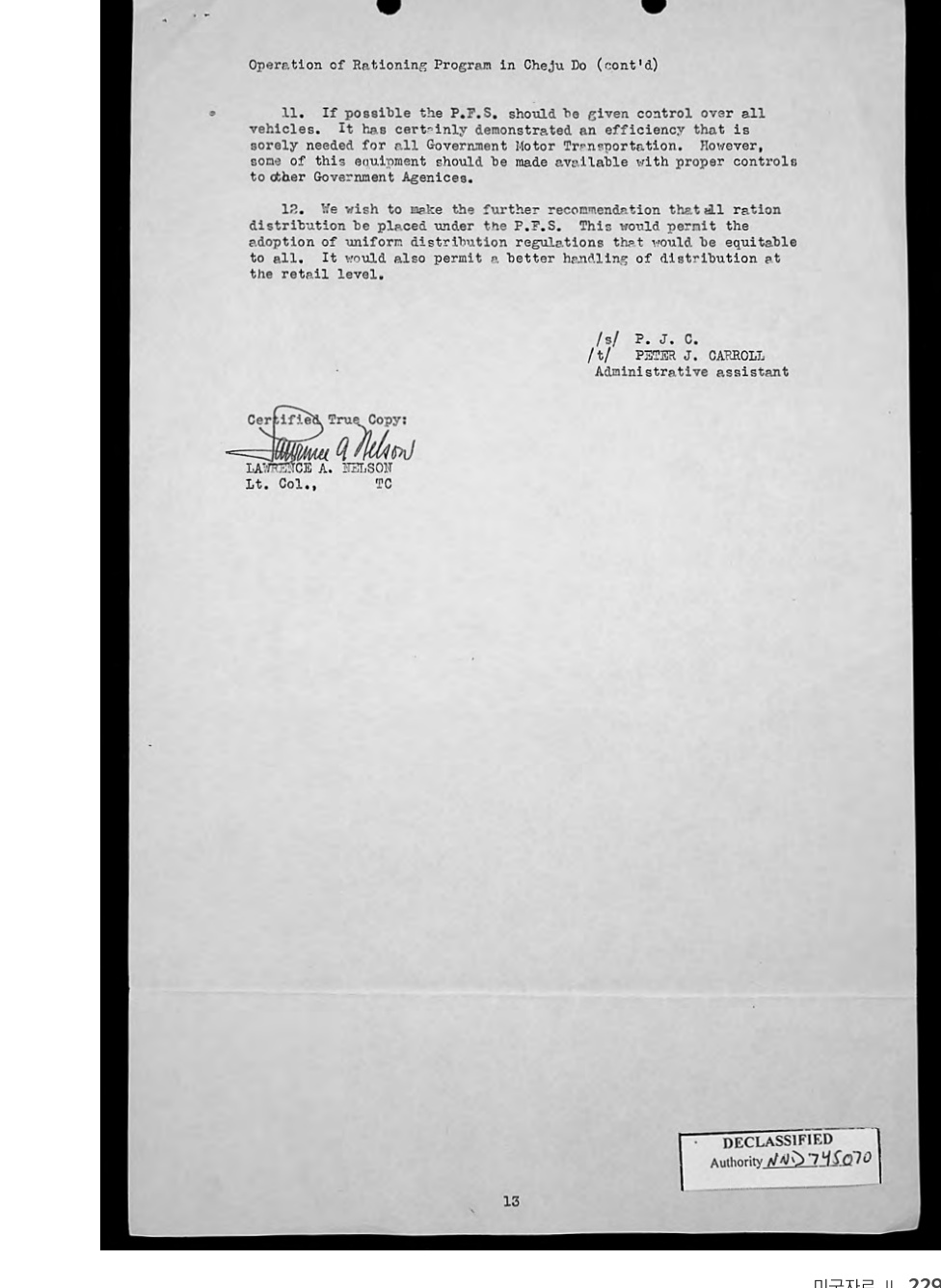
11. 가능하다면 도 식량사무소에 모든 차량에 대한 통제권이 주어져야 한다. 도 식량사무소는 확실히 모든 정부 수송부가 유일하게 필요로 하는 효율성을 보여왔 다. 그러나 이 장비의 일부는 다른 정부 기관들의 적정한 통제로 활용할 수 있도 록 해야 한다.
12. 우리는 모든 배급량 분배가 도 식량사무소의 통제에 놓이기를 추가로 건의 하고 싶다. 이것은 모든 주민에게 동등한 단일 배분 규정을 채택하는 길을 열어줄 것이다. 또한 소매 수준에서 더 나은 분배를 허락할 것이다.
행정보좌관 피터 J. 캐롤 (Peter J. Carroll)
SOUTH KOREAN INTERIM GOVERNMENT
National Food Administration
SEOUL, KOREA
MGNFA 3 January 1948
SUBJECT: Operation of Rationing Program in Cheju Do
TO : Chee, Yong Eun, Director
National Food Administrator
Carroll V. Hill, Adviser
1. The word that best describes Rationing Operations in Cheju
Do is "Chaotic".
2. At the Provincial level you are told that the ration is the same for every person and that allocations are made to each of the two
Guns in accordance with the non-supplier population, and from the Gun to the Myun on the same basis.
3. From this point anarchy takes over. The actual ration delivered to individuals is not the same in every myun and will even differ in towns within the same myun, and between three classifications of rationees within the myun. The Provincial ration was 1 hop of rice and 1 hop of other grains for November but actual distribution in 5 of the 13 myuns was as follows.
Myun Non-suppliers Partial Suppliers Rich Men*
In hops in hops In hops
Rice Other Grs. Rice Other Grs. Rice Other Grs.
Cheju Up 1 None None None None None
Chung Muen 1 1 .7 .8 .5 .5
Hanwon 1 1 .8 .7 .5 .5
Sukui 1 1 None None .8 .7
Ku Ja 1 1 None None None None
*Rich men are non-supplier who have the means to buy their additional requirements on the black market. We only asked for the number of rich men in one myun (Suki). Out of a non-supplier population of 5520 the rich men numbered 700. As this figure does not show the number in each rich men's family it will be seen the persons thus discriminated against is a substantial proportion of the non-supplier population.
4. The ration allocation shown above does not mean that this was the amount received by the rationee. If there was a shortage of other grains within the myun he may have obtained 2 hop of rice instead of one hop of rice and one hop of other grains. In all except one of the eight myons visited the ration was late in being delivered. For example the single hop of rice to the people of Cheju Up for November was not made available until 8 December. In Hallim we interviewed a woman customer at the ration store who was receiving 30 hop of rice and 80 hop of other grains. The difference between the amount she received and the proper ration was grain due her on back rations. She stated she had borrowed grain to live on while waiting her allocation.
5. All Myun Change advised that the delay in delivering rations was due to (a) lack of adequate transportation and (b) inability of the ration store operators to finance purchases. We were advised that this situation was being corrected and men equipped to finance the stores properly were replacing the poorer operators. While transportation is important we believe the second reason is the more probable. (Plus the lack of other grains due to sabotage of the summer grain collection program.)
DECLASSIFIED
Authority NND 745070
11
Operation of Rationing Program In Cheju Do (cont'd)
For example the store keepers in Song Son Po, a town at the very eastern tip of the island and the farthest point on the island from either Cheju
Up or Soggi Po, where P.F.S. warehouses are located, have combined to ope ate a small warehouse of their own and maintain adequate supplies.
Also the failure to ration other grains in Cheju Up, even in a store 30 yards from the warehouse was not due to lack of transportation. (The store keeper could have carried it on his back.) The limit of the ration for
November to 1 hop of rice in Cheju Up was due solely to the failure of the summer grain program. The governor himself ordered this ration, once again showing his preferential treatment of people in the country.
6. The system of handling ration cards was very interesting to me - but being a newcomer we cannot say it is unique in Korea. -The head of the rationed family calls at the Myun Changs office each ration period to obtain the families ration cards. The Myun
Chang or his employee notes on the card the amount of grain he is authorized to purchase. (Except in one myun where only a slip is given that was left at the store where the purchase was made.)
After the purchase is made the card is given to the rationee's
Ku Chang who returns it to the Myun Chang's office. In other words the ration card is only a license to purchase a months supply.
This system certainly furnished the established officials a powerful weapon over the people.
7. On many occasions we found people waiting in front of ration stores. The proprietor was soon located for us however. We never obtained a satisfactory excuse for his delay in serving his customers.
There appeared to be no schedule of store hours - or for that matter any other consideration - for the convenience of the public.
8. We visited the warehouses of P.F.S. in Cheju Up. The first and largest was not 10% occupied. The two other buildings were each about 20% occupied. In the meantime grains were stored out doors in huge piles covered with mats. Messrs Ko and Pak promised to remedy this situation.
9. We obtained a list of warehouses from Captain Kelly, Property Custodian. Several we visited were in such disrepair they were useless but when we eventually found one in an unused starch plant, they did not want it. Although I thought it very well located. As time was pressing we spent no more time on warehouses, but before we left Mr. Ko and Mr. Pak asked me to report the need for a warehouse and mill at Cheju Up. He said the Governor was opposed to the plan because the dirt would be unpleasant to the many homes in the proposed area. They have money and machines and need only the Provincial Governor's approval to proceed with construction. I am inclined to believe the warehousing they really want is a new one at Cheju Up. When considering their warehousing needs and transportation problems it must be kept in mind that no point in Cheju Do is more than 30 miles from the present warehouses.
Also in every myun there are facilities for storage of small quantities to meet current needs.
10. We visited the motor pools of both the Governor and the
P.F.S. at the F.F.S. pool all trucks were in operation except one being repaired. At the Governor's pool we found 11 trucks, tires off, motor parts missing, and other indications of abuse of equipment. Some of these vehicles could have been operating if tires were at hand. There were used army tires available at a cost of
600 yen each. The day they arrived P.F.S. purchased its allocation.
At the time of my visit (three weeks later) the Governor had not purchased any.
DECLASSIFIED
Authority NND 745070
12
Operation of Rationing Program in Cheju Do (cont'd)
11. If possible the P.F.S. should be given control over all vehicles. It has certainly demonstrated an efficiency that is sorely needed for all Government Motor Transportation. However, some of this equipment should be made available with proper controls to other Government Agencies.
12. We wish to make the further recommendation that all ration distribution be placed under the P.F.S. This would permit the adoption of uniform distribution regulations that would be equitable to all. It would also permit a better handling of distribution at the retail level.
/s/ P. J. C.
/t/ PETER J. CARROLL
Administrative assistant
Certified True Copy:
[signature]
LAWRENCE A. NELSON
Lt. Col., TC
13
DECLASSIFIED
Authority NND 745070
출처:
제주4·3평화재단 편,
『추가진상조사자료집-미국자료2』,
p. 227–229.
— NARA (RG 554, Entry 1256, Box 83)
×
![]()