북한선거와 해주대회
주한미사절단
제목: 1948년 8월의 정치요약
존경하는 국무장관 귀하
1948년 7월의 정치발전 상황을 보고한 8월 16일자 <급송문서> 제264호에 계속해 본인은 1948년 8월의 한국의 정치발전 상황을 보고하게 돼 영광입니다.
3년 동안의 ‘자유’와 ‘해방’의 절정은 남북이 각각 민족전체를 관할한다고 주장하는 2개의 적대적인 정부 수립으로 나타났습니다. 이승만 대통령이 서울에서 유엔과 미국이 후원하는 정부 수립 시작을 끝낸 반면 평양은 8월 25일의 남북한 양쪽의 ‘선거’를 통해 ‘민주주의인민공화국’의 수립을 발표했습니다. 양쪽 정권은 유엔 총회에 한국의 진정한 정부로 보이려고 할 것입니다. 그러나 유엔한국위원단은 뉴욕의 유엔 본부로 출발하기에 앞서 이승만의 정부를 최종적으로 인정했습니다.
(중략)
남북한 지역의 공산주의자 활동
남한내 공산주의자 그룹은 공동체의 일상생활과는 떨어진 세력이 됐고 이 보고서를 정독하면 외세의 부속품이라는 것이 분명해질 것입니다.
이렇게 해서 세세한 공산주의자들의 활동은 오직 북한에서 소련이 조종하는 사건, 계획 그리고 소련의 직접적인 공작들과 관련해 이뤄진다는 것을 주목해야 할 것입니다.
8월 한달 동안 모든 활동의 초점은 8월 25일에 있었던 이른바 공산당 선거를 위한 남북한에서의 준비에 맞춰졌습니다.
이 계획은 아마도 유엔한국임시위원단이 한국(남북한: 역주)의 ‘미국 점령지구’에서 활동하는데 대한 응답으로서 2월께 모스크바에서 마련됐었을 것입니다. 첫 단계는 승인된 소비에트 형태의 헌법을 마련하는 것이었습니다. 이것은 꼭두각시인 북한의 인민위원회를 통해서 나왔으며 4월 승인됐습니다. 그러나 그 당시부터 시행되지는 않았습니다. 동시에 김규식이 주도하는 남한의 중도파와 김구 주도의 불만을 품은 우익인사들을 유인해 통일한국정부 계획을 해결하기 위해 평양에 출현하도록 하는 비슷한 노력을 기울였습니다.
이 계획의 결실은 미∙소 양군의 철수와 조선인에 의한 조선 정부의 수립을 요구한 평양의 4월 남북통일회의(North-South Unity Conference, 남북제정당사회단체대표자연석회의: 역주)에서 나왔습니다.
남쪽의 협상대표들은 아무도 어떻게 이런 조처들이 이전의 소련이 애써온 선전활동과 이상하리만치 비슷하거나 공산주의자들의 전과정 통제가 명백한지를 관찰하지 않는 것처럼 보였습니다.
그러나 몇 달 동안 심사숙고를 통해 이것이 명백해졌고 소비에트가 평양의 제2차 대표자회의에 초청하자 남한의 주요 지도자들은 거부했습니다. 어쨌든 러시아의 계획대로 배신한 남쪽사람들과의 반쪽회담은 7월에 열려 8월 25일 총선거를 발표했습니다. 러시아가 준비한 반응은 ‘조선민주주의인민공화국’을 선포하는 것으로서 새로운 ‘인민헌법’을 즉각 실시하는 명령을 내리는 것이었습니다.
2차 연석회의에 참가했던 남한의 공산주의자들과 추종세력들로 구성된 선거지도위원회의 지시에 따라 모든 남로당 조직에 지령이 전달됐으며 세포들은 여전히 새로운 평양의 ‘최고인민회의’에 대의원 선출 투표에 남한 사람들을 참여하도록 역할을 하고 있습니다. 남한에서의 투표는 사실상 평양회의에 참가할 최종 360명의 대의원을 선출하기 위해 해주에 참가할 ‘남조선 인민대표자회의’의 1,080명의 대의원을 선출하는 것이었습니다.
이 지하선거에서 사용된 것처럼 남한의 투표용지표는 때때로 ‘참가정당’(공산주의자 등)에 의해 미리 뽑은 명단이었습니다. 그러나 그것들은 대개 남한 사람들을 유혹하거나 위협하려는 아무것도 없는 백지이거나 백지명부였습니다. 비록 이런 백지형식이 투표를 구성하고 있다는 보고가 있지만 기껏해야 그것들은 사실 날인한 사람이 북한의 선거와 계획에 따른 것이라는 것을 가리키고 있습니다. 그러나 종종 그렇지는 않습니다. 많은 경우 투표용지나 명부를 갖고 다니는 사람들은 농민과 도시인들에게 이것이 통일한국을 위한 탄원이거나 그들이 서명을 요청받은 다른 정부조직 계획을 위한 탄원이라고 말합니다.
광범한 활동, 많은 삐라와 선전, 일부 지역에서의 게릴라에 의한 위협에도 불구하고 100만 명이 채 안되는 남한 사람들이 선거와 관련한 서류나 명부, 투표용지에 서명한 것으로 생각됩니다.
남한 경찰은 그들이 나타나기만 하면 언제 어디서든지 외세가 부추긴 불법활동을 강경하게 대처하고 있습니다. 이 달까지 경무부장 조병옥은 1,379명이 선거와 관련해 체포됐다고 발표했습니다. 226명은 재판에 회부됐고 414명은 경찰재판에서 심문을 받았으며 616명은 지금도 경찰에 구금돼 있는 한편 123명은 석방됐습니다. 체포된 사람들 가운데 100여 명은 남조선과도정부의 관리들이었습니다. 이들은 여전히 공산주의 세포들임이 명백합니다.
다른 사람들은 체포된 노동당원이거나 민전 회원으로 이들이 소문을 퍼뜨립니다.
최대 소득은 11만 1,798명이 서명한 서류를 갖고 있는 것으로 알려진 민주애국청년연맹(공산주의 남한청년세력)의 대표 체포건이었습니다. 또 하나의 대형 체포건은 전라북도 전역에서 8만 2,458명의 이름이 있는 8만여 장의 서류를 발견한 것으로 보고한 전라북도 경찰에 의해 이뤄졌습니다. 이보다 작은 체포사건들은 전국에서 이뤄졌습니다.
사전에 조정됐었고, 남한에서의 투표결과에 관계없이 일어났었던 것처럼 인민의회(남조선인민대표자회의: 역주)는 8월 21일 여러 가지 이유로 78명이 불참하고 1,002명이 참가한 가운데 해주에서 소집됐습니다. 소집자체로 칭찬을 받은 의회는 법적으로 선출됐다고 확인하고 남한의 반대파들을 비난했으며 북한의 조언자들을 찬양했습니다. 그리고 8월 25일 ‘최고 인민회의’의 대의원 360명을 선출했습니다. 물론 그들에게 제시된 명부는 일반적으로 가부를 묻는 것이었습니다.
회의에서 발표된 남한 사람들의 투표참가율 최종 집계는 전체 유권자의 77.48%였습니다. 북한의 선거는 대개 소련이나 그 위성국가에서 실시하는 것과는 크게 다르지 않습니다. 기본적으로 212석의 자리에 227명의 단독 지명후보가 유권자들에게 공개됐습니다. 유권자들은 공개적으로 찬‧반 투표함 가운데 한곳에 투표용지를 집어넣는 것으로만 선택했습니다.
나머지 15명의 후보들은 제2후보를 위한 제3의 투표함을 인정하는 것을 발표하지 않았기 때문에 등록과 선거시간에 지워졌습니다. 전체 선거활동은 국민들의 정치적 관심을 이끌어내고 친정권적으로 만드는 전국적인 노력이었습니다.
국민들이 살고 ‘참가’하는 특권을 누리는 은혜로운 사회에 감사하게 됐다면 모든 것은 좋습니다. 그러므로 평양라디오방송이 진짜 ‘민주적인’ 선거에 대한 경이로움에 관해 큰 목소리로 자찬하는 가운데 유권자의 99%가 후보자들에게 찬성했다는 데 대해 아무도 놀라지 않았습니다. 남한 대의원 360명과 북한 대의원 212명이 참가한 ‘최고인민회의’의 제1차 회의는 9월 2일 요청됐습니다.
북한의 다른 소식은 이번 달에는 주의를 끌지 않았습니다. 소련군은 병력감축을 발표했으나 그렇게 할 것 같지는 않습니다.
인민군은 소련군과 공동근무를 위해 38선 접경지역으로 이동을 계속했지만 북한군 단독의 정찰은 아직 이뤄지지 않고 있습니다. 38선 사건은 이전과 같은 비율로 계속됐습니다. 북한경비대는 16차례 국경선을 넘어 남한 경찰에 발포하고 3차례는 미군에게 발포한 것으로 알려졌습니다. 또한 남한 경찰이 때때로 38선을 넘었다는 것은 그럴듯 하지만 이와 같은 활동 보고서는 북한의 소련군 당국에 의해 주한미군사령부에 항의하는 것으로서만 끝났습니다.
8월 15일이나 8월 25일에 남한에서 봉기와 폭동이 일어날 것이라는 보고는 끊임없이 나왔지만 완전히 잘못된 것으로 판명됐습니다. 그러나 북한간첩들은 여전히 남한과 제주도에 침입하고 있습니다. 한 보고서는 평양의 김일성대학 공산주의 학생들이 공산주의 세포를 활성화시키고 폭동과 시위를 일으키는 것 뿐 아니라 남한의 학교와 정부, 사업체, 군에 침투하기 위해 대규모로 남한에 파견되고 있다고 밝혔습니다.
또 다른 소문은 북로당과 남로당이 새로운 이름으로 새로운 단일 조직으로 곧 통합할 것이라는 것입니다.
마지막으로, 계속해서 남한내 공산주의자들의 소요 예상시기를 고찰한 결과 현재 8월 15일이나 25일 어느 쪽도 구체화되지 않았습니다. 몇몇 정보원들은 파리 유엔총회 이후일 것이라고 밝혔습니다.
이와 관련해 1947년 8월의 남한 공산주의자들에 대한 대규모 한국과 미국의 탄압 이후 정보 보고서와 정치정보원들이 끊임없이 북한의 침략날짜와 (또는) 지방의 공산봉기 목표날짜를 정했다는 주장은 다소 주목할 만합니다. 미군이 경계상태에 들어간 일자는 3월 1일, 5월 1일, 5월 30일, 8월 15일, 8월 25일입니다. 늘상 이런 날들은 미군의 경계가 이 사실과 상당한 관계가 있었다는 증거없이 조용하게 지나갔습니다.
여러 시골지역에서는 공산주의자들의 활동이 활발하지만 남한 공산주의자들의 힘은 실질적으로 비교적 덜 무장되고 조직화되지 않은 데 기인한 수준 이하로 추정할 수 있습니다. 이런 사례에 포함되지 않은 한 곳인 제주도에서는 지속적인 ‘게릴라’ 공격이 모든 남한의 공산주의자들이 그들이 원한다면 무엇이든 할 수 있다는 것을 보여주고 있습니다.
기타
1945년 9월 점령한 이후 주한사령관인 존 하지(John R. Hodge) 중장이 미국의 새로운 지역으로 부임하기 위해 8월 27일 ‘양자’의 나라 한국을 떠났습니다. 군통수권자인 트루만 대통령과 육군장관 로얄, 육군참모총장 브래들리 장군이 그의 훌륭한 업적에 대해 표창했습니다. 하지 장군은 서울에서 환송만찬에 참석해 이 대통령으로부터 한국민들을 대신해 충심에서 우러나오는 감사를 표시하는 서한을 받았습니다.
하지 장군이 진심어린 마음을 가지고 한국을 떠나자 콜터(John B. Coulter) 소장이 주한미육군사령관이 됐습니다. 그러나 미국의 대표로서 하지의 지위는 미합중국 대통령의 특별대표에게로 넘어갔습니다.
(중략).
8월 15일에 수많은 일본 압제에 대한 언급과는 별도로 가장 중요한 사건은 이 대통령의 기자회견 가운데 나온 발언이었습니다. 이 대통령은 부산과 일본의 규슈섬 중간에 위치한 쓰시마가 한국으로 ‘귀속’돼야 한다고 발언했습니다. 한 일본 신문과 일본 정부관리는 이것은 북미를 인디언들에게 주는 것과 마찬가지라고 말했습니다. 공보부장 김동성은 서울에서 이것은 일본인들이 아직 충분히 고통을 받지 않거나 패전에 대해 깊이 참회하지 않고 있다는 것을 보여주는 것이라고 언급했습니다. 그는 일본의 평화조약 회담에 한국의 참가요구를 반복했습니다.
또 흥미로운 대통령의 기자회견 발언은 그가 ‘건설적인’ 정신에 바탕을 둔 언론의 공정한 비판에 감사하는 것이었습니다.
그는 또 이 중요한 시기에 ‘편협한 파벌행위’를 그만두도록 자신의 입장을 바꾸고 ‘잘 정돈된’ 정당들이 정부구조 안에서 명확한 기능을 갖도록 결정했습니다.
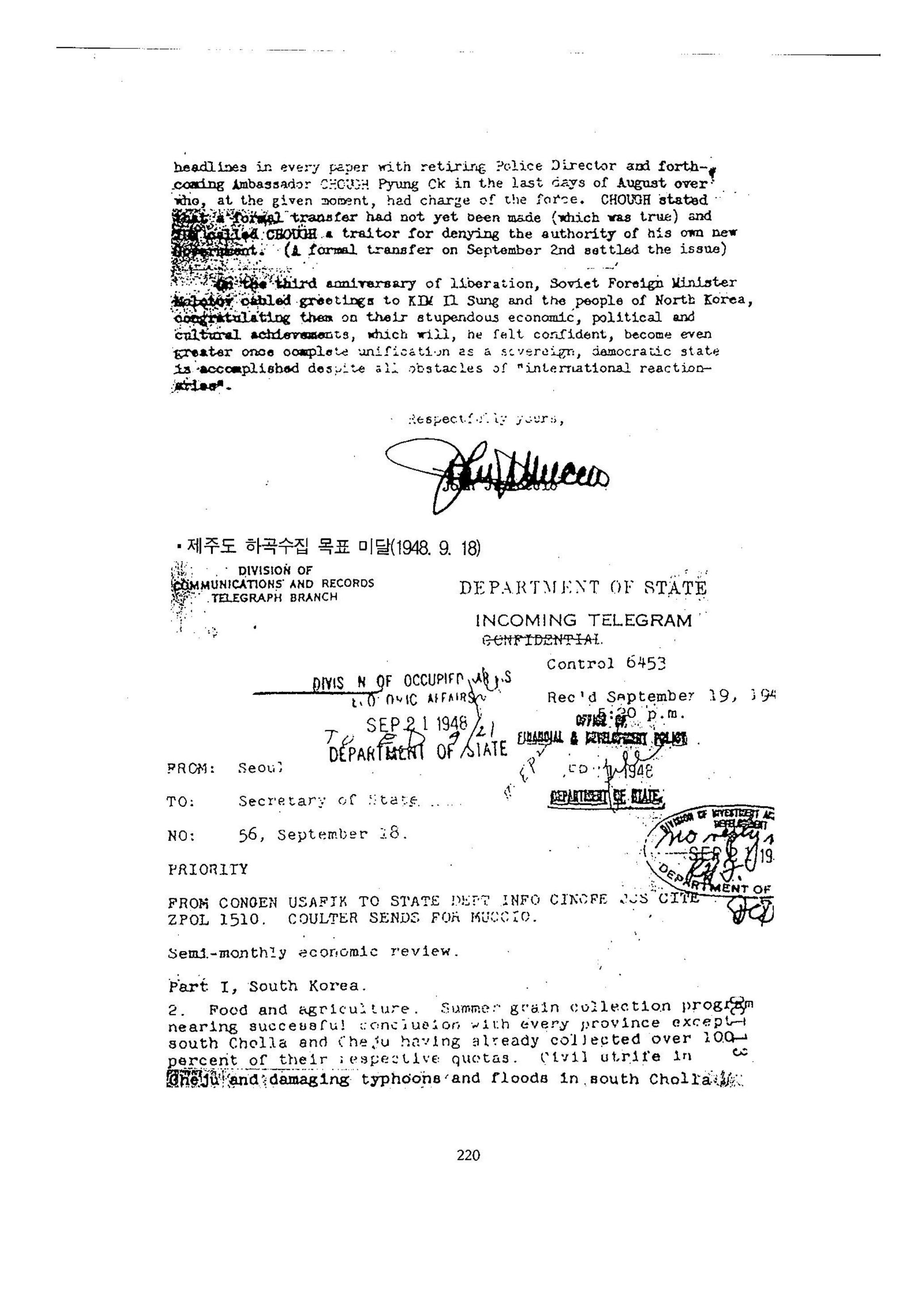
경무부를 맡게 될 윤치영 내무장관이 퇴임해 8월 말 대사로 나가는 조병옥과 신랄한 설전을 벌인 것이 모든 신문의 머릿기사를 장식했습니다. 조는 공식이양은 아직 이뤄지지 않았다(이는 사실이었습니다)고 말했고, 윤은 조를 신생정부의 권위를 부인하는 반역자로 불렀습니다(9월 2일의 공식이양으로 이 문제가 해결됐습니다).
해방 3주년을 맞아 소련 외상 몰로토프는 김일성과 북한 인민들에게 축하전문을 보내 그들의 엄청난 경제, 정치, 문화적 성취를 축하했습니다. ‘국제반동자’들의 모든 방해에도 불구하고 주권국가, 민주국가로서 일단 보다 큰 완전통일국가가 성취될 그는 확신했습니다.
존 무쵸(John J. Muccio)
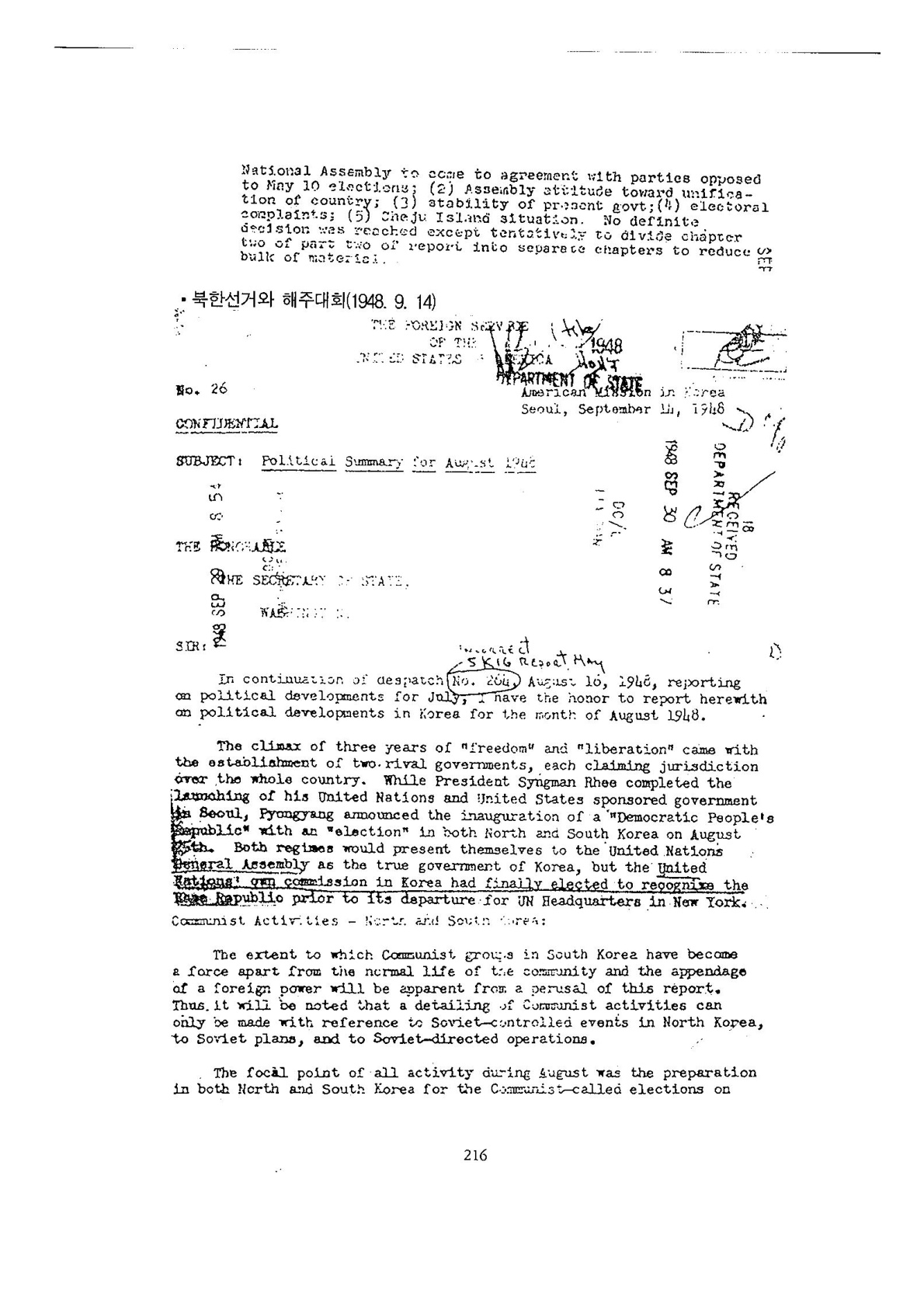
THE FOREIGN SERVICE OF THE UNITED STATES … 1948
DEPARTMENT OF STATE
American Mission in Korea
Seoul, September 14, 1948
No. 26
CONFIDENTIAL
SUBJECT: Political Summary for August 1948
THE HONORABLE
THE SECRETARY OF STATE,
WASHINGTON
SIR:
In continuation of despatch No. 204, August 16, 1948, reporting on political developments for July, I have the honor to report herewith on political developments in Korea for the month of August 1948.
The climax of three years of "freedom" and "liberation" came with the establishment of two rival governments, each claiming jurisdiction over the whole country. While President Syngman Rhee completed the launching of his United Nations and United States sponsored government in Seoul, Pyongyang announced the inauguration of a "Democratic People's Republic" with an "election" in both North and South Korea on August 25th. Both regimes would present themselves to the United Nations General Assembly as the true government of Korea, but the United Nations own commission in Korea had finally elected to recognize the Rhee Republic prior to its departure for UN Headquarters in New York.
Communist Activities – North and South Korea:
The extent to which Communist groups in South Korea have become a force apart from the normal life of the community and the appendage of a foreign power will be apparent from a perusal of this report. Thus it will be noted that a detailing of Communist activities can only be made with reference to Soviet-controlled events in North Korea, to Soviet plans, and to Soviet-directed operations.
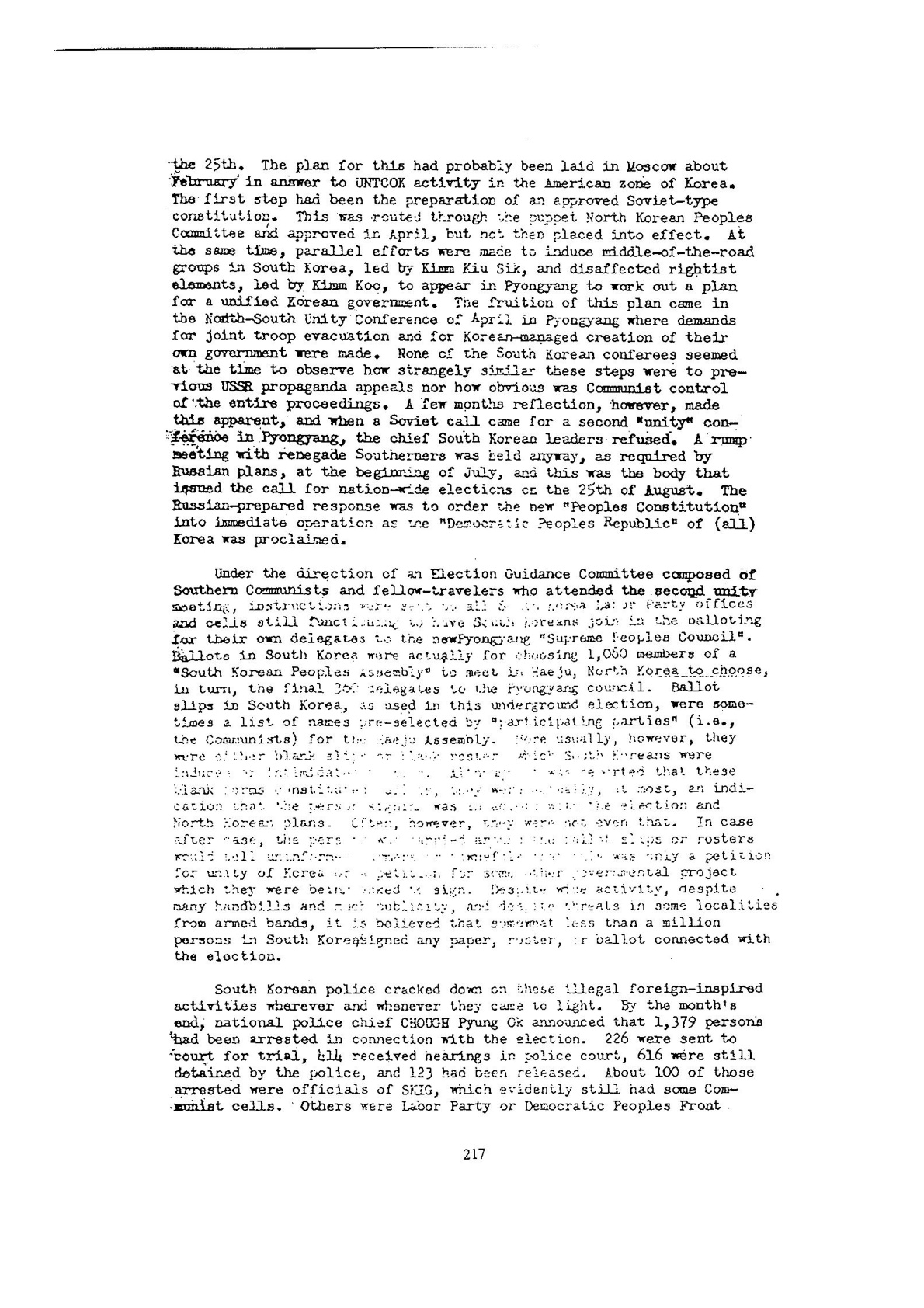
The focal point of all activity during August was the preparation in both North and South Korea for the Communist-called elections on the 25th. The plan for this had probably been laid in Moscow about February in answer to UNTCOK activity in the American zone of Korea. The first step had been the preparation of an approved Soviet-type constitution. This was routed through the puppet North Korean Peoples Committee and approved in April, but not then placed into effect. At the same time, parallel efforts were made to induce middle-of-the-road groups in South Korea, led by Kimm Kiu Sik, and disaffected rightist elements, led by Kimm Koo, to appear in Pyongyang to work out a plan for a unified Korean government. The fruition of this plan came in the North-South Unity Conference of April in Pyongyang where demands for joint troop evacuation and for Korean-managed creation of their own government were made. None of the South Korean conferees seemed at the time to observe how strangely similar these steps were to previous USSR propaganda appeals nor how obvious was Communist control of the entire proceedings. A few months reflection, however, made this apparent, and when a Soviet call came for a second "unity" conference in Pyongyang, the chief South Korean leaders refused. A rump meeting with renegade Southerners was held anyway, as required by Russian plans, at the beginning of July, and this was the body that issued the call for nation-wide elections on the 25th of August. The Russian-prepared response was to order the new "Peoples Constitution" into immediate operation as the "Democratic Peoples Republic" of (all) Korea was proclaimed.
Under the direction of an Election Guidance Committee composed of Southern Communists and fellow-travelers who attended the second unity meeting, instructions were sent to all South Korea Labor Party offices and cells still functioning to have South Koreans join in the balloting for their own delegates to the new Pyongyang "Supreme Peoples Council". Ballots in South Korea were actually for choosing 1,080 members of a "South Korean Peoples Assembly" to meet in Haeju, North Korea to choose, in turn, the final 360 delegates to the Pyongyang council. Ballot slips in South Korea, as used in this underground election, were sometimes a list of names pre-selected by "participating parties" (i.e., the Communists) for the Haeju Assembly. More usually, however, they were either blank slips or blank rosters which South Koreans were induced by intimidation to sign. Although it was reported that these blank forms constituted ballots, they were actually, at most, an indication that the person signing was in accord with the election and North Korean plans. Often, however, they were not even that. In case after case, the persons who carried around the ballot slips or rosters would tell uninformed signers in good faith that this was only a petition for unity of Korea or a petition for some other governmental project which they were being asked to sign. Despite wide activity, despite many handbills and much publicity, and despite threats in some localities from armed bands, it is believed that somewhat less than a million persons in South Korea signed any paper, roster, or ballot connected with the election.
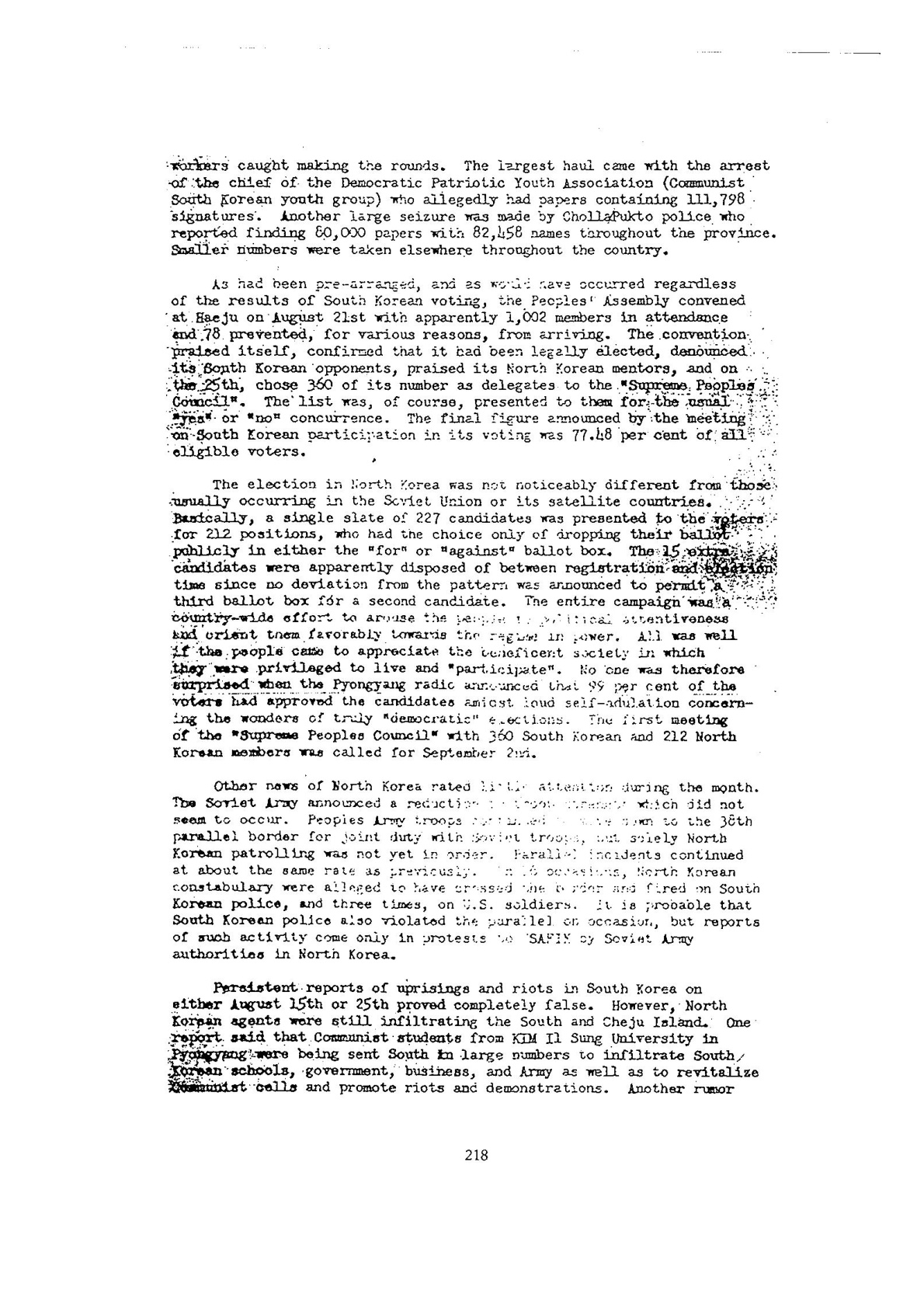
South Korean police cracked down on these illegal foreign-inspired activities wherever and whenever they came to light. By the month's end, national police chief CHOUGH Pyung Ok announced that 1,379 persons had been arrested in connection with the election. 226 were sent to court for trial, 414 received hearings in police court, 616 were still detained by the police, and 123 had been released. About 100 of those arrested were officials of SKIG, which evidently still had some Communist cells. Others were Labor Party or Democratic Peoples Front workers caught making the rounds. The largest haul came with the arrest of the chief of the Democratic Patriotic Youth Association (Communist South Korean youth group) who allegedly had papers containing 111,798 signatures. Another large seizure was made by ChollaPukto police who reported finding 80,000 papers with 82,458 names throughout the province. Smaller numbers were taken elsewhere throughout the country.
As had been pre-arranged, and as would have occurred regardless of the results of South Korean voting, the Peoples' Assembly convened at Haeju on August 21st with apparently 1,002 members in attendance and 78 prevented, for various reasons, from arriving. The convention praised itself, confirmed that it had been legally elected, denounced its South Korean opponents, praised its North Korean mentors, and on the 25th, chose 360 of its number as delegates to the "Supreme Peoples Council". The list was, of course, presented to them for the usual "yes" or "no" concurrence. The final figure announced by the meeting on South Korean participation in its voting was 77.48 per cent of all eligible voters.
The election in North Korea was not noticeably different from those usually occurring in the Soviet Union or its satellite countries. Basically, a single slate of 227 candidates was presented to the voters for 212 positions, who had the choice only of dropping their ballot publicly in either the "for" or "against" ballot box. The 15 extra candidates were apparently disposed of between registration and election time since no deviation from the pattern was announced to permit a third ballot box for a second candidate. The entire campaign was a country-wide effort to arouse the people to political attentiveness and orient them favorably towards the regime in power. All was well if the people came to appreciate the beneficent society in which they were privileged to live and "participate". No one was therefore surprised when the Pyongyang radio announced that 99 per cent of the voters had approved the candidates amidst loud self-adulation concerning the wonders of truly "democratic" elections. The first meeting of the "Supreme Peoples Council" with 360 South Korean and 212 North Korean members was called for September 2nd.
Other news of North Korea rated little attention during the month. The Soviet Army announced a reduction of troop strength which did not seem to occur. Peoples Army troops patrolled down to the 38th parallel border for joint duty with Soviet troops, but solely North Korean patrolling was not yet in order. Parallel incidents continued at about the same rate as previously. On 16 occasions, North Korean constabulary were alleged to have crossed the border and fired on South Korean police, and three times, on U.S. soldiers. It is probable that South Korean police also violated the parallel on occasion, but reports of such activity come only in protests to USAFIK by Soviet Army authorities in North Korea.
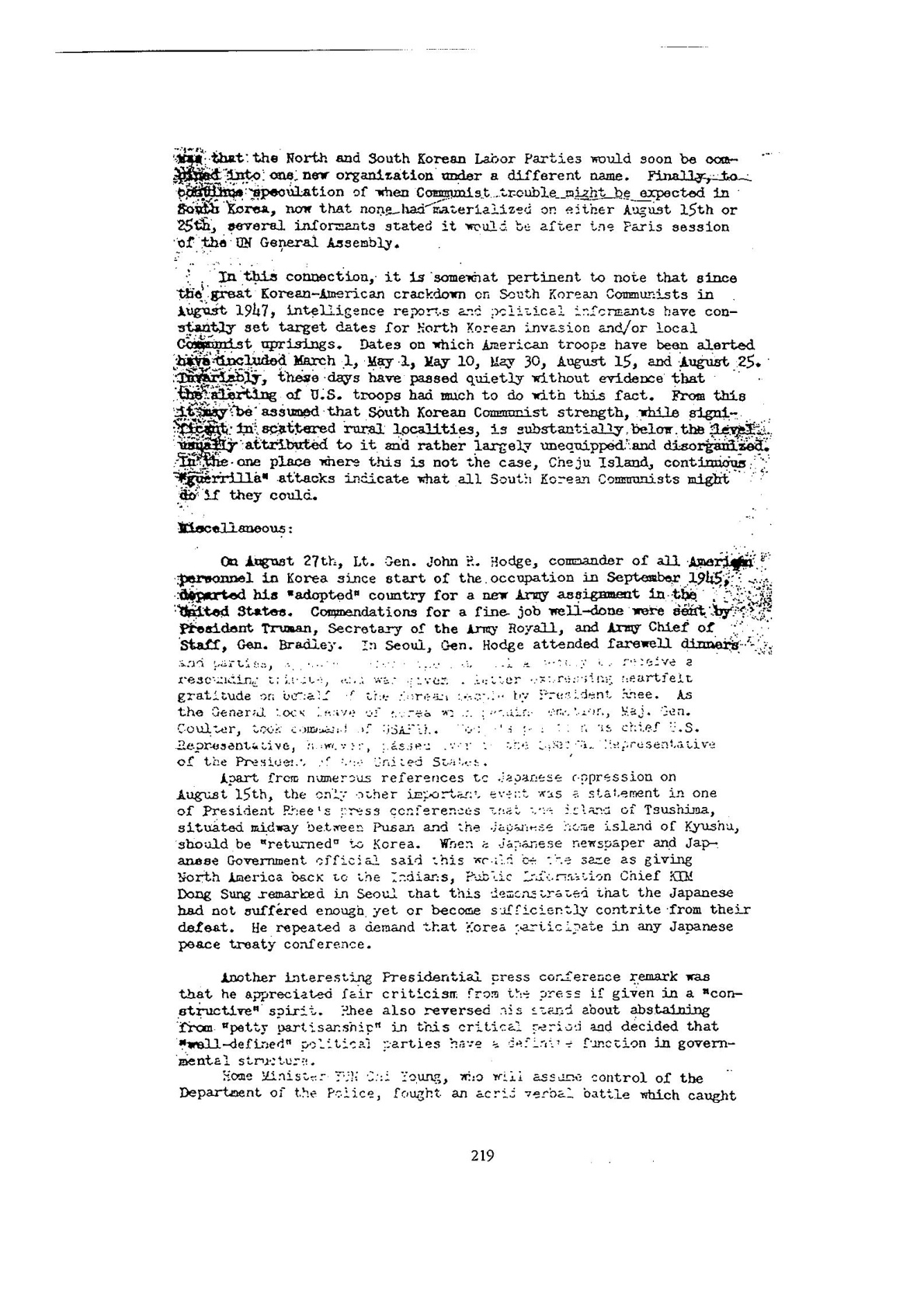
Persistent reports of uprisings and riots in South Korea on either August 15th or 25th proved completely false. However, North Korean agents were still infiltrating the South and Cheju Island. One report said that Communist students from KIM Il Sung University in Pyongyang were being sent South in large numbers to infiltrate South Korean schools, government, business, and Army as well as to revitalize Communist cells and promote riots and demonstrations. Another rumor was that the North and South Korean Labor Parties would soon be combined into one new organization under a different name. Finally, to continue speculation of when Communist trouble might be expected in South Korea, now that none had materialized on either August 15th or 25th, several informants stated it would be after the Paris session of the UN General Assembly.
In this connection, it is somewhat pertinent to note that since the great Korean-American crackdown on South Korean Communists in August 1947, intelligence reports and political informants have constantly set target dates for North Korean invasion and/or local Communist uprisings. Dates on which American troops have been alerted have included March 1, May 1, May 10, May 30, August 15, and August 25. Invariably, these days have passed quietly without evidence that the alerting of U.S. troops had much to do with this fact. From this it may be assumed that South Korean Communist strength, while significant in scattered rural localities, is substantially below the level usually attributed to it and rather largely unequipped and disorganized. In the one place where this is not the case, Cheju Island, continuous "guerrilla" attacks indicate what all South Korean Communists might do if they could.
Miscellaneous:
On August 27th, Lt. Gen. John R. Hodge, commander of all American personnel in Korea since start of the occupation in September 1945, departed his "adopted" country for a new Army assignment in the United States. Commendations for a fine job well-done were sent by President Truman, Secretary of the Army Royall, and Army Chief of Staff, Gen. Bradley. In Seoul, Gen. Hodge attended farewell dinners and parties, at which he was given a resounding tribute, and was given a letter expressing heartfelt gratitude on behalf of the Korean people by President Rhee. As the General took leave of Korea with genuine emotion, Maj. Gen. Coulter, took command of USAFIK. Muccio passed over to the chief U.S. Representative, however, passed over to the Special Representative of the President of the United States.
Apart from numerous references to Japanese oppression on August 15th, the only other important event was a statement in one of President Rhee's press conferences that the island of Tsushima, situated midway between Pusan and the Japanese home island of Kyushu, should be "returned" to Korea. When a Japanese newspaper and Japanese Government official said this would be the same as giving North America back to the Indians, Public Information Chief KIM Dong Sung remarked in Seoul that this demonstrated that the Japanese had not suffered enough yet or become sufficiently contrite from their defeat. He repeated a demand that Korea participate in any Japanese peace treaty conference.
Another interesting Presidential press conference remark was that he appreciated fair criticism from the press if given in a "constructive" spirit. Rhee also reversed his stand about abstaining from "petty partisanship" in this critical period and decided that "well-defined" political parties have a definite function in governmental structure.
Home Minister YUN Chi Young, who will assume control of the Department of the Police, fought an acrid verbal battle which caught headlines in every paper with retiring Police Director and forthcoming Ambassador CHOUGH Pyung Ok in the last days of August over who, at the given moment, had charge of the force. CHOUGH stated that a formal transfer had not yet been made (which was true) and called CHOUGH a traitor for denying the authority of his own new government. (A formal transfer on September 2nd settled the issue.)
On the third anniversary of liberation, Soviet Foreign Minister Molotov cabled greetings to KIM Il Sung and the people of North Korea, congratulating them on their stupendous economic, political and cultural achievements, which will, he felt confident, become even greater once complete unification as a sovereign, democratic state is accomplished despite all obstacles of "international reactionaries".
Respectfully yours,
John J. Muccio
출처:
제주4·3사건진상규명및희생자명예회복위원회 편,
『제주4·3사건자료집 11』 [미국자료편],
번역문 p.16
/ 원문 p.216–220 / No. 26.
×
![]()