(1) 제971방첩대 지대 조직
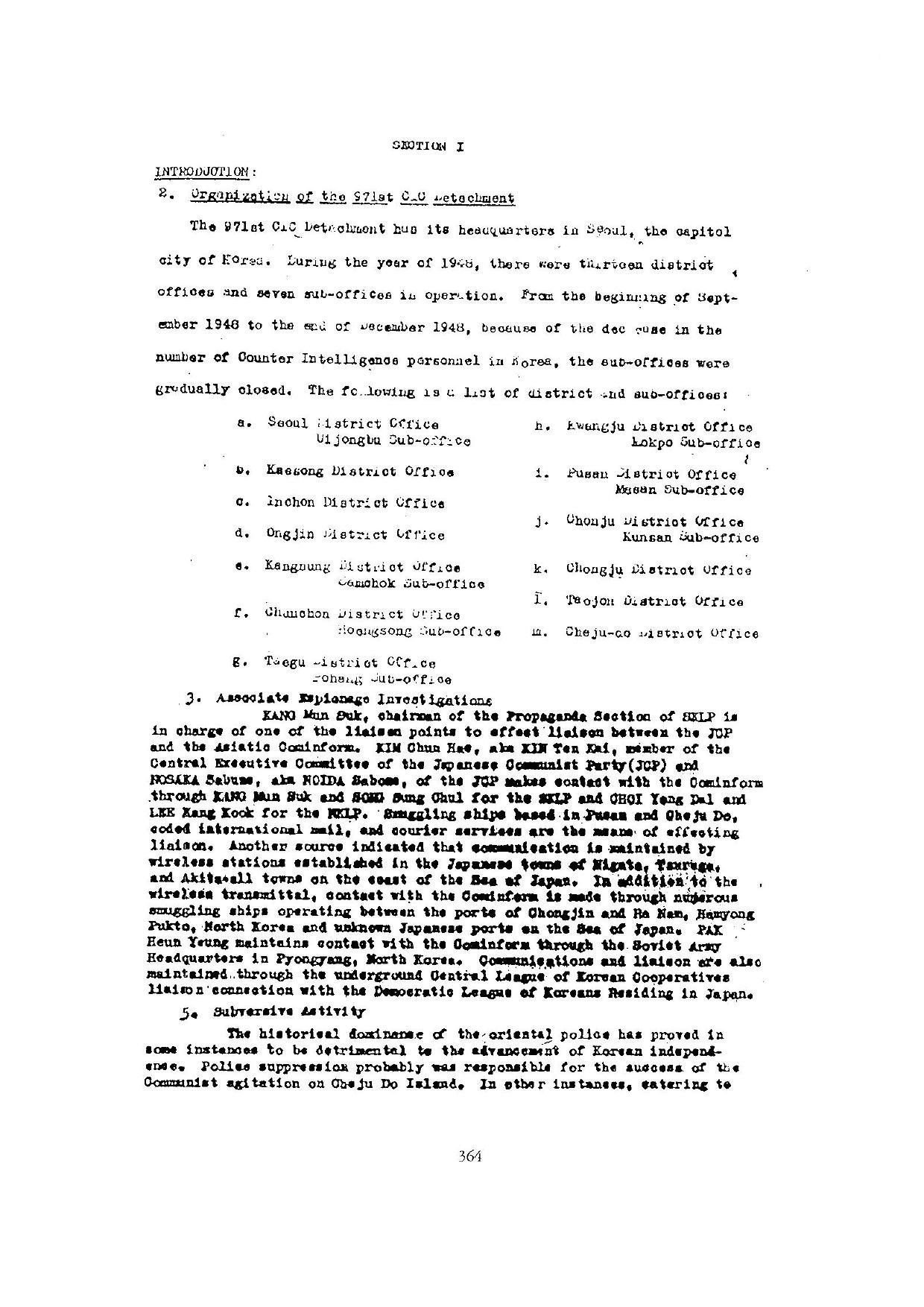
제971지대는 서울에 사령부를 두고 있다. 1948년 한 해 동안 지구대 13곳과 파견대 7곳이 운영됐다. 1948년 9월 초부터 1948년 12월 말까지 주한 방첩대 요원들이 감소함에 따라 파견대는 점차 폐쇄됐다. 다음은 지구대와 파견대의 목록이다.
㈀ 서울 지구대, 의정부 파견대
㈁ 개성 지구대
㈂ 인천 지구대
㈃ 옹진 지구대
㈄ 강릉 지구대, 삼척 파견대
㈅ 춘천 지구대, 횡성 파견대
㈆ 대구 지구대, 포항 파견대
㈇ 광주 지구대, 목포 파견대
㈈ 부산 지구대, 마산 파견대
㈉ 전주 지구대, 군산 파견대
㈊ 청주 지구대
㈋ 대전 지구대
㈌ 제주도 지구대
(2) 정보원 조사
남로당 선전부장 강문석(Kang Mun Suk)은 일본공산당과 아시아 코민포름과의 연락을 담당하는 한 연락소의 책임자이다. 일본공산당의 중앙집행위원인 김천해(Kim Chun Hae)와 일본공산당의 노사카 사부로(Nosaka Saburo)는 남로당의 강문석과 송성철, 북로당의 최용달과 이강국을 통해 코민포름과 연락을 취하고 있다. 암호로 된 국제우편물에 따르면, 밀수선들이 부산과 제주도에 근거지를 두고 활동하고 있으며 밀사가 연락수단으로 이용되기도 한다. 다른 정보원은 일본해에 접한 니가타, 타우루가, 아키타 등의 무선국을 통해서도 연락이 이루어진다고 추정했다. 또 코민포름과의 연락은 무선 연락 이외에도 함경북도 청진항과 나남항, 그리고 일본해에 접한 일본의 알려지지 않은 항구들 사이를 운항하는 밀수선을 통해서도 이뤄진다.
(3) 전복 활동
역사적으로 경찰이 우수할 때 한국 독립의 길은 멀어진다는 사실이 몇 가지 예에서 밝혀졌다. 경찰의 탄압은 제주도에서 공산주의자들의 선동이 성공하는데 기여했다. 경찰 관리들의 변덕이 특정 산업분야의 생산감소를 초래한 사례도 있다. 남한의 파괴분자들을 진압하는 데에는 대규모의 강력한 경찰력이 필요하지만, 과잉진압은 미 사령부가 바라는 선의(善意)를 어느 정도 훼손하는 것은 물론 미국의 정책에 상당한 비판을 불러일으켰다. 방첩대는 전복활동 혐의가 있는 몇몇 사건의 원인 규명을 놓고 주요 인사들 간에 마찰이 일고 있음을 인지했다.
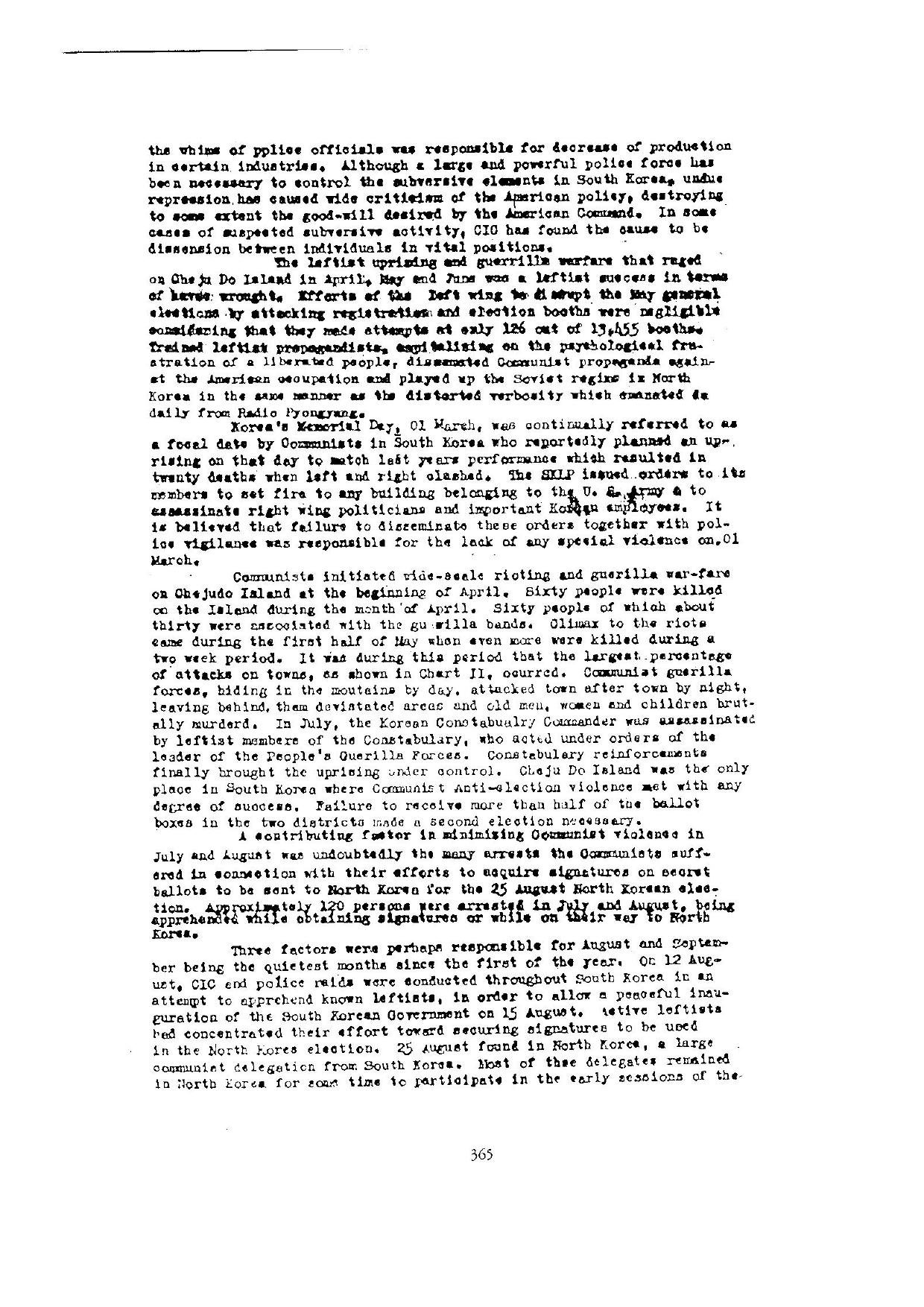
1948년 4, 5, 6월 제주도에 휘몰아친 좌익 폭동과 유격전은 대파괴의 측면에서는 좌익의 성공이었다. 그러나 좌익이 전체 1만 3,455곳의 투표소 가운데 단지 126곳만 습격하는데 그친 것을 고려하면 선거인 등록사무소와 투표소를 공격하여 5월 총선거를 저지하려던 이들의 노력은 의미없는 것이 되어 버렸다.
보고에 따르면 지난 해 좌우익의 충돌로 20명이 숨지기도 했던 3월 1일은 한국의 기념일로 남한의 공산주의자들이 봉기를 계획한 중요한 날이라고 계속 언급됐다. 남로당은 이 날 당원들에게 미군 건물을 방화하고 우익 정치가와 주요 공무원들을 암살하도록 명령했다. 그러나 3월 1일에 특별한 폭력행위는 일어나지 않았다. 경찰의 경계 강화로 남로당의 명령은 유포되지 못했기 때문이다.
공산분자들은 4월 초 제주도에서 대규모 폭동과 유격전을 시작했다. 4월 한달 동안 60명이 숨졌다. 60명 가운데 30명은 게릴라와 관계가 있었다. 폭동의 절정기는 더 많은 인명이 희생된 5월 상반기였다. 공산게릴라의 대부분의 마을 공격은 이 기간에 이루어졌다. 공산게릴라는 낮에는 산에 숨었다가 밤에 마을을 공격한 뒤 떠나면서 노인과 부녀자, 어린이들을 잔인하게 살해하고 지역을 초토화시켰다. 7월에 국방경비대 사령관이 인민게릴라 사령관의 지령을 받은 좌익 경비대원에게 암살됐다. 경비대의 증강으로 마침내 폭동은 진압됐다. 제주도는 남한에서 공산주의자들의 선거 반대 폭동이 어느 정도 성공한 유일한 지역이다. 2개 선거구가 투표수 과반수 미달로 2차 선거를 실시해야 했다.
7, 8월 들어 공산 폭동이 감소한 이유는 8월에 있을 북한선거와 관련하여 무기명 투표용지에 서명을 받는 과정에서 많은 공산주의자들이 체포됐기 때문이다. 7, 8월에 전국에서 약 120명이 체포됐다. 이들은 서명을 받거나 서명용지를 북한으로 발송하는 도중이었다.
올 들어 8, 9월은 가장 조용한 달이었다. 그 이유는 다음 세 가지 요인 때문으로 추정됐다. 8월 12일, 방첩대와 경찰은 같은 달 15일의 남한 정부의 평화적인 수립을 위해 남한 전역에서 저명한 좌익인사들을 급습했다. 열성 좌익분자들은 북한선거에 이용할 서명자를 확보하기 위해 총력을 기울였다. 8월 25일에는 한국의 많은 공산주의자 대표들이 북한에 나타났다. 대표단의 대부분은 대표자대회의 초기 회기에 참가하고 추가 지령을 받기 위해 북한에 남았다. 남한에서 간 나머지 무리들은 게릴라 양성을 위해 설립된 학교에 등록했다. 이 학교를 졸업하자마자 그들은 예상대로 남한으로 파견됐다. 이들에게는 추곡수집에 적극 반대하고 당 노선을 엄격히 고수하라는 명령이 내려졌다. 보고에 따르면 게릴라는 9월 말에 활발하게 공격을 재개한 제주도에서 조직되고 있다.
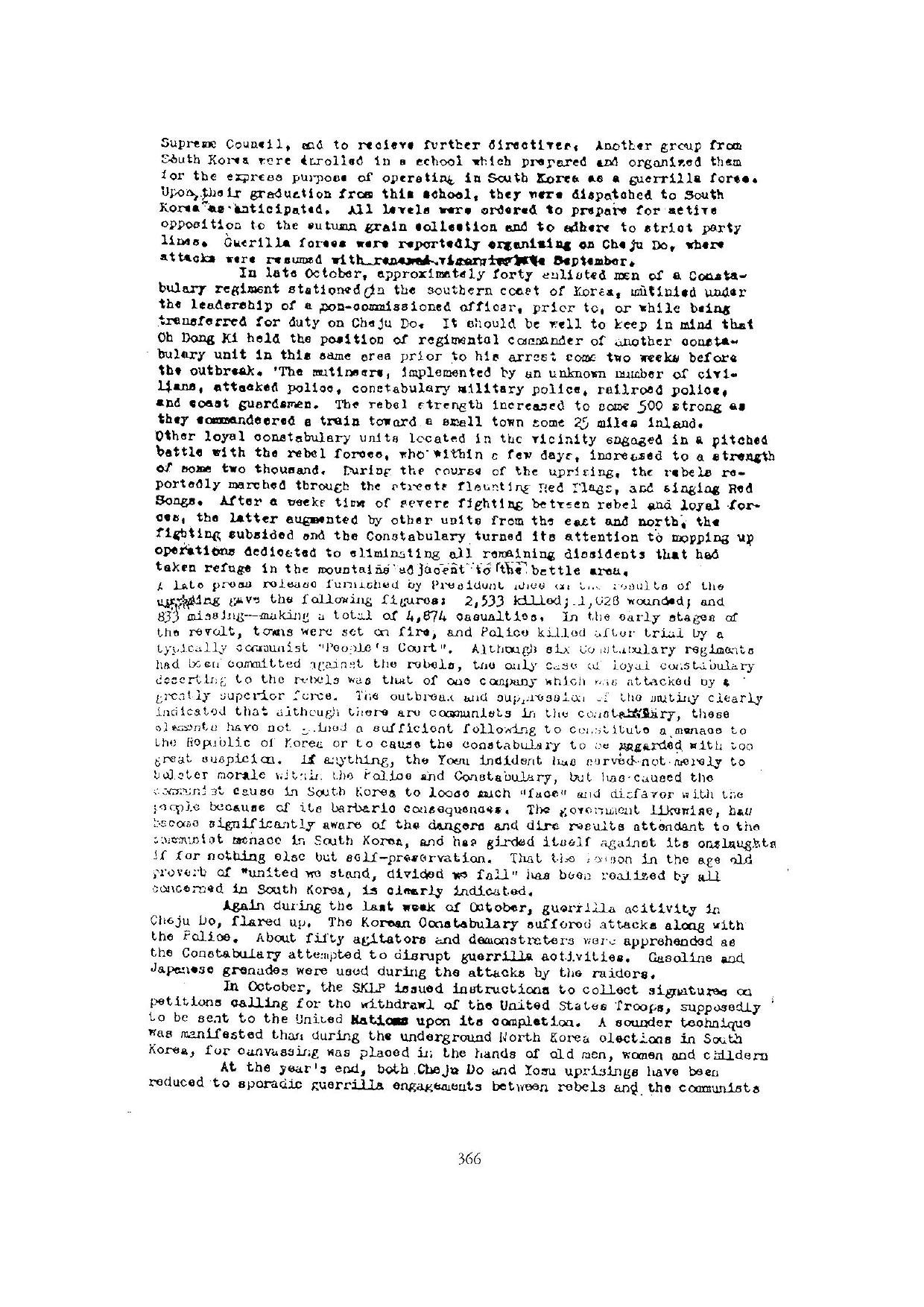
남해안에 주둔하고 있던 한 국방경비연대의 장병 40여 명이 10월 말 하사관의 지휘 아래 제주도 파견 직전에 반란을 일으켰다. 반란이 일어나기 2주일 전에 체포된 국방경비대의 오동기 소령은 이 지역 다른 경비대의 연대급 지휘관이었다는 사실을 명심해야 한다. 숫자 미상의 민간인들을 대동한 반도들은 경찰과 경비대 헌병, 철도경찰, 해안경비대 등을 공격했다. 반도 병력은 25마일 정도 내륙에 있는 작은 도시로 향하던 열차를 강탈하면서 500여명으로 증가했다. 부근에 있던 경비대 진압부대는 며칠 이내에 약 2,000명으로 증가한 반도들과 적당한 거리를 두고 전투를 벌였다. 보고에 따르면 반도들은 폭동이 계속되는 동안 적기가를 부르고, 적기를 휘날리며 시내를 행진했다 한다. 반도들과 진압군의 일 주일에 걸친 격렬한 전투가 벌어진 뒤 진압군은 동쪽과 북쪽 방면으로부터 병력이 증강됐다. 전투는 소강상태에 접어들었다. 경비대는 반도들이 전투지역과 인접한 산으로 도피한 뒤 나머지 반란군 소탕에 나섰다.
이승만 대통령은 폭동으로 사망 2,533명, 부상 1,028명, 실종 833명 등 전체 사상자가 4,874명 발생했다고 최근 언론에 밝혔다. 반란 초기, 도시는 방화되고 경찰들은 ‘인민재판’을 거친 뒤 처형됐다. 경비대 6개 연대가 반도들과 전투를 벌였으나 반도 진영에 가담한 경비대는 화력이 우세한 반도들로부터 공격을 받았던 1개 중대뿐이었다. 이번 반란 사건의 발발과 진압 과정에서 비록 경비대 내부에 공산주의자들이 침투해 있다 하더라도 이들이 대한민국에 위협적인 요소가 되거나, 경비대를 의심스런 눈길로 바라보게 할 명분이 되지 못한다는 사실이 밝혀졌다. 결과적으로 여수사건은 경찰과 경비대에는 사기를 높여준 요인이 되고, 정부도 남한 내 공산주의자들의 위협에 따른 위험과 무서운 결과를 인식해 급습에 대비하도록 했다. 그러나 남한 내 공산주의자들은 잔혹한 행위로 인해 명분과 체면을 상당 부분 상실하면서 국민들로부터 멀어지게 되었다. 남한의 모든 국민들이 깨달은 ‘뭉치면 살고 흩어지면 죽는다’라는 옛 속담이 주는 교훈은 명백해졌다.
10월 마지막 주에 제주도의 게릴라는 다시 활발하게 활동하기 시작했다. 국방경비대와 경찰은 게릴라의 공격을 받았다. 경비대가 게릴라 활동을 봉쇄하면서 선동가와 시위자 약 50명을 체포했다. 폭도들은 공격할 때 휘발유와 일본제 수류탄을 사용했다.
10월에 남로당은 국제연합으로 보낼 예정인 ‘미군 철수요구 탄원서’에 주민들의 서명을 받도록 지시했다. 노인과 여자, 어린이들이 서명을 부탁하고 다니는 등 지하선거가 치러졌던 때보다 더 고단수의 방법이 동원됐다.
연말이 되자 제주도와 여수의 폭동은 반도 및 공산주의자 진영과 정부 진압군 사이의 산발적인 유격전으로 축소됐다. 최근 보고에 따르면 양쪽 지역의 폭도들은 올 겨울에 혹독한 시련을 겪을 것이다. 식량은 모자라고 사기도 그만큼 떨어졌기 때문이다.
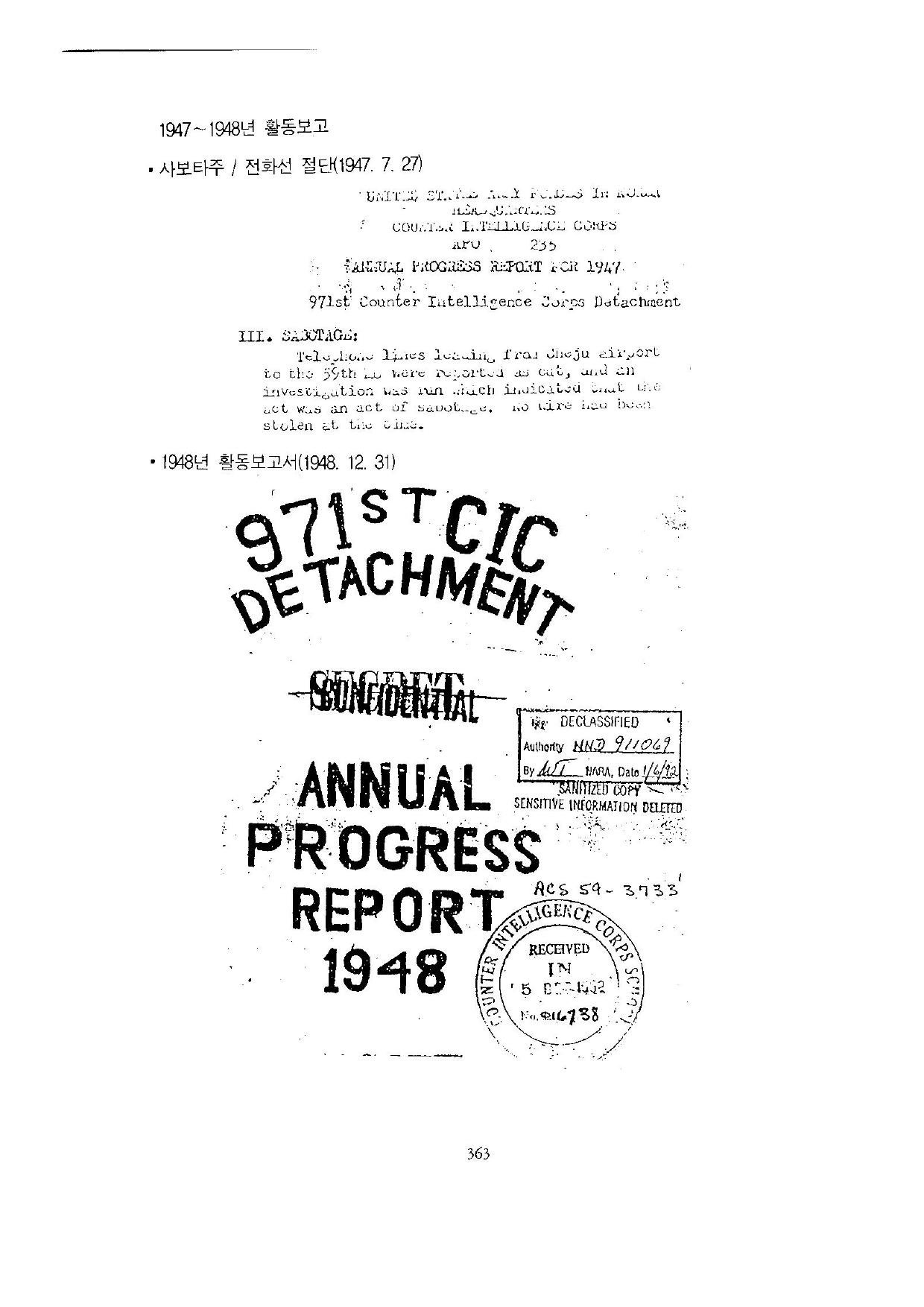
주한미육군 971방첩대
(971 Counter Intelligence Corps, USAFIK)
971ST CIC
DETACHMENT
~~CONFIDENTIAL~~
ANNUAL
PROGRESS
REPORT
1948
Re DECLASSIFIED
Authority NND 911069
By &UT NARA, Date 1/6/[illegible]
SANITIZED COPY
SENSITIVE INFORMATION DELETED
ACS 59-3733
RECEIVED
IN
5 DEC 1942
No. 04738
SECTION I
INTRODUCTION:
2. Organization of the 971st C.C Detachment
The 971st CIC Detachment has its headquarters in Seoul, the capitol city of Korea. During the year of 1948, there were thirteen district offices and seven sub-offices in operation. From the beginning of September 1948 to the end of December 1948, because of the decrease in the number of Counter Intelligence personnel in Korea, the sub-offices were gradually closed. The following is a list of district and sub-offices:
a. Seoul district Office h. Kwangju District Office
Uijongbu Sub-office Lokpo Sub-office
b. Kaesong District Office i. Pusan District Office
Masan Sub-office
c. Inchon District Office
j. Chonju District Office
d. Ongjin District Office Kunsan Sub-office
e. Kanguung District Office k. Chongju District Office
Camchok Sub-office
l. Taejon District Office
f. Chunchon District Office
Honggsong Sub-office m. Cheju-do District Office
g. Taegu District Office
Pohang Sub-office
3. Associate Espionage Investigations
KANG Mun Buk, chairman of the Propaganda Section of SKLP is in charge of one of the liaison points to effect liaison between the JOP and the Asiatic Cominform. KIM Chun Hae, aka KIM Ten Kai, member of the Central Executive Committee of the Japanese Communist Party(JCP) and KOSAKA Sabume, aka KOIDA Sabome, of the JCP makes contact with the Cominform through KANG Mun Buk and SONG Sung Chul for the SKLP and CHOI Yong Dal and LEE Kang Kook for the NKLP. Smuggling ships based in Pusan and Cheju Do, coded international mail, and courier services are the means of effecting liaison. Another source indicated that communication is maintained by wireless stations established in the Japanese towns of Nigate, Tauruga, and Akitaall towns on the coast of the Sea of Japan. In addition to the wireless transmittal, contact with the Cominform is made through numerous smuggling ships operating between the ports of Chongjin and Ha Nam, Hamyong Pukto, North Korea and unknown Japanese ports on the Sea of Japan. PAK Heun Young maintains contact with the Cominform through the Soviet Army Headquarters in Pyongyang, North Korea. Communications and liaison are also maintained through the underground Central League of Korean Cooperatives liaison connection with the Democratic League of Koreans Residing in Japan.
5. Subversive Activity
The historical dominance of the oriental police has proved in some instances to be detrimental to the advancement of Korean independence. Police suppression probably was responsible for the success of the Communist agitation on Cheju Do Island. In other instances, catering to
the whims of pplice officials was responsible for decrease of production in certain industries. Although a large and powerful police force has been necessary to control the subversive elements in South Korea, undue repression has caused wide criticism of the American policy, destroying to some extent the good-will desired by the American Command. In some cases of suspected subversive activity, CIC has found the cause to be dissension between individuals in vital positions.
The leftist uprising and guerrilla warfare that raged on Cheju Do Island in April, May and June was a leftist success in terms of herve wrought. Efforts of the left wing to disrupt the May general elections by attacking registration and election booths were negligible considering that they made attempts at only 126 out of 13,455 booths. trained leftist propagandists, capitalizing on the psychological frustration of a liberated people, dissemated Communist propaganda against the American occupation and played up the Soviet regime in North Korea in the same manner as the distorted verbosity which emanated da daily from Radio Pyongyang.
Korea's Memorial Day, 01 March, was continually referred to as a focal date by Communists in South Korea who reportedly planned an up-rising on that day to match last years performance which resulted in twenty deaths when left and right clashed. The SKLP issued orders to its members to set fire to any building belonging to the U. S. Army & to assassinate right wing politicians and important Korean employees. It is believed that failure to disseminate these orders together with police vigilance was responsible for the lack of any special violence on.01 March.
Communists initiated wide-scale rioting and guerilla war-fare on Chejudo Island at the beginning of April. Sixty people were killed on the Island during the month of April. Sixty people of which about thirty were associated with the gu willa bands. Climax to the riots came during the first half of May when even more were killed during a two week period. It was during this period that the largest percentage of attacks on towns, as shown in Chart II, occurred. Communist guerilla forces, hiding in the mountains by day, attacked town after town by night, leaving behind, them devistated areas and old men, women and children brutally murderd. In July, the Korean Constabulary Commander was assassinated by leftist members of the Constabulary, who acted under orders of the leader of the People's Guerilla Forces. Constabulary reinforcements finally brought the uprising under control. Cheju Do Island was the only place in South Korea where Communist Anti-election violence met with any degree of success. Failure to receive more than half of the ballot boxes in the two districts made a second election necessary.
A contributing factor in minimizing Communist violence in July and August was undoubtedly the many arrests the Communists suffered in connection with their efforts to acquire signatures on secret ballots to be sent to North Korea for the 25 August North Korean election. Approximately 120 persons were arrested in July and August, being apprehended while obtaining signatures or while on their way to North Korea.
Three factors were perhaps responsible for August and September being the quietest months since the first of the year. On 12 August, CIC and police raids were conducted throughout South Korea in an attempt to apprehend known leftists, in order to allow a peaceful inauguration of the South Korean Government on 15 August. Active leftists had concentrated their effort toward securing signatures to be used in the North Korea election. 25 August found in North Korea, a large communist delegation from South Korea. Most of these delegates remained in North Korea for some time to participate in the early sessions of the
Supreme Council, and to receive further directives. Another group from South Korea were enrolled in a school which prepared and organized them for the express purpose of operating in South Korea as a guerrilla force. Upon their graduation from this school, they were dispatched to South Korea as anticipated. All levels were ordered to prepare for active opposition to the autumn grain collection and to adhere to strict party lines. Guerilla forces were reportedly organizing on Cheju Do, where attacks were resumed with renewed vigor in the September.
In late October, approximately forty enlisted men of a Constabulary regiment stationed on the southern coast of Korea, mutinied under the leadership of a non-commissioned officer, prior to, or while being transferred for duty on Cheju Do. It should be well to keep in mind that Oh Dong Ki held the position of regimental commander of another constabulary unit in this same area prior to his arrest come two weeks before the outbreak. The mutineers, implemented by an unknown number of civilians, attacked police, constabulary military police, railroad police, and coast guardsmen. The rebel strength increased to some 500 strong as they commandeered a train toward a small town some 25 miles inland. Other loyal constabulary units located in the vicinity engaged in a pitched battle with the rebel forces, who within a few days, increased to a strength of some two thousand. During the course of the uprising, the rebels reportedly marched through the streets flaunting Red Flags, and singing Red Songs. After a weeks time of severe fighting between rebel and loyal forces, the latter augmented by other units from the east and north, the fighting subsided and the Constabulary turned its attention to mopping up operations dedicated to eliminating all remaining dissidents that had taken refuge in the mountains adjacent to the battle area.
A late press release furnished by President Rhee at the results of the uprising gave the following figures: 2,533 killed; 1,028 wounded; and 833 missing--making a total of 4,874 casualties. In the early stages of the revolt, towns were set on fire, and Police killed after trial by a typically communist "People's Court". Although six constabulary regiments had been committed against the rebels, the only case of loyal constabulary deserting to the rebels was that of one company which was attacked by a greatly superior force. The outbreak and suppression of the mutiny clearly indicated that although there are communists in the constabulary, these elements have not gained a sufficient following to constitute a menace to the Republic of Korea or to cause the constabulary to be regarded with too great suspicion. If anything, the Yosu incident has served not merely to bolster morale within the Police and Constabulary, but has caused the communist cause in South Korea to loose much "face" and disfavor with the people because of its barbaric consequences. The government likewise, has become significantly aware of the dangers and dire results attendant to the communist menace in South Korea, and has girded itself against its onslaughts if for nothing else but self-preservation. That the person in the age old proverb of "united we stand, divided we fall" has been realized by all concerned in South Korea, is clearly indicated.
Again during the last week of October, guerrilla activity in Cheju Do, flared up. The Korean Constabulary suffered attacks along with the Police. About fifty agitators and demonstrators were apprehended as the Constabulary attempted to disrupt guerrilla activities. Gasoline and Japanese grenades were used during the attacks by the raiders.
In October, the SKLP issued instructions to collect signatures on petitions calling for the withdrawal of the United States Troops, supposedly to be sent to the United Nations upon its completion. A sounder technique was manifested than during the underground North Korea elections in South Korea, for canvassing was placed in the hands of old men, women and children
At the year's end, both Cheju Do and Yosu uprisings have been reduced to sporadic guerrilla engagements between rebels and the communists
on one hand, and the forces of the government on the other. Recent indications have been that the raiders in both places have a hard winter to look forward to. Food is reportedly low, and morale equally **is** low.
출처:
제주4·3사건진상규명및희생자명예회복위원회 편,
『제주4·3사건자료집 8』 [미국자료편],
번역문 p.159
/ 원문 p.363–367.
×
![]()