일반문서
브라운 대령의 제주도 활동 보고서
Colonel Brown's Activity Report on Jeju Island
1948-07-17
· 보고일 1948-07-17
미군정청
United States Army Military Government in Korea, USAFIK
11연대
1948년
5·10선거
7월
CIC
경비대
경찰
군사작전
귀순·생포
김달삼
남로당
딘
무기처리
무장대
미군부대
미군정
브라운
서울
선거
소요
수감
수용소
식량·구호
외교통신
우익
유엔
인민위원회
일반문서
일본군귀환
정기보고
제주도
제주읍
좌익
주한미군
진압
테러
토벌
포로
하지
스캔 원본
100%
p.282
p.283
p.284
p.285
p.286
p.287
p.288
p.289
p.290
p.291
p.292
p.293
p.294
p.295
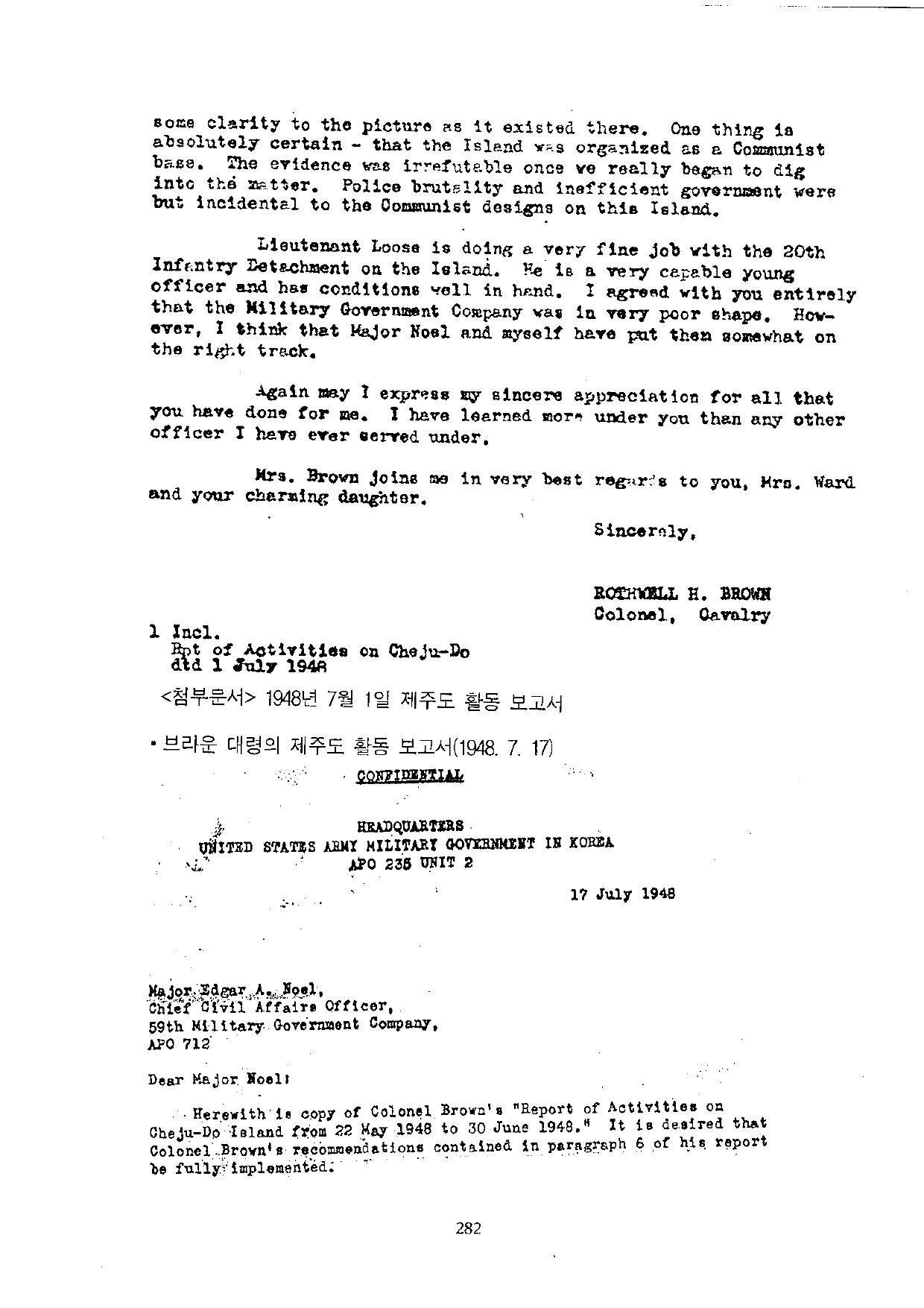
수신: 제59군정중대 민정장관 에드가 노엘(Edgar A. Noel) 소령
주한미육군사령부 군정청
노엘 소령 귀하
여기 브라운 대령의 ‘1948년 5월 22일에서 1948년 6월 30일까지 제주도에서의 활동 보고서’ 복사본을 동봉한다. 브라운 대령의 보고서 제6항에 있는 건의가 완전히 이행되기를 바란다.
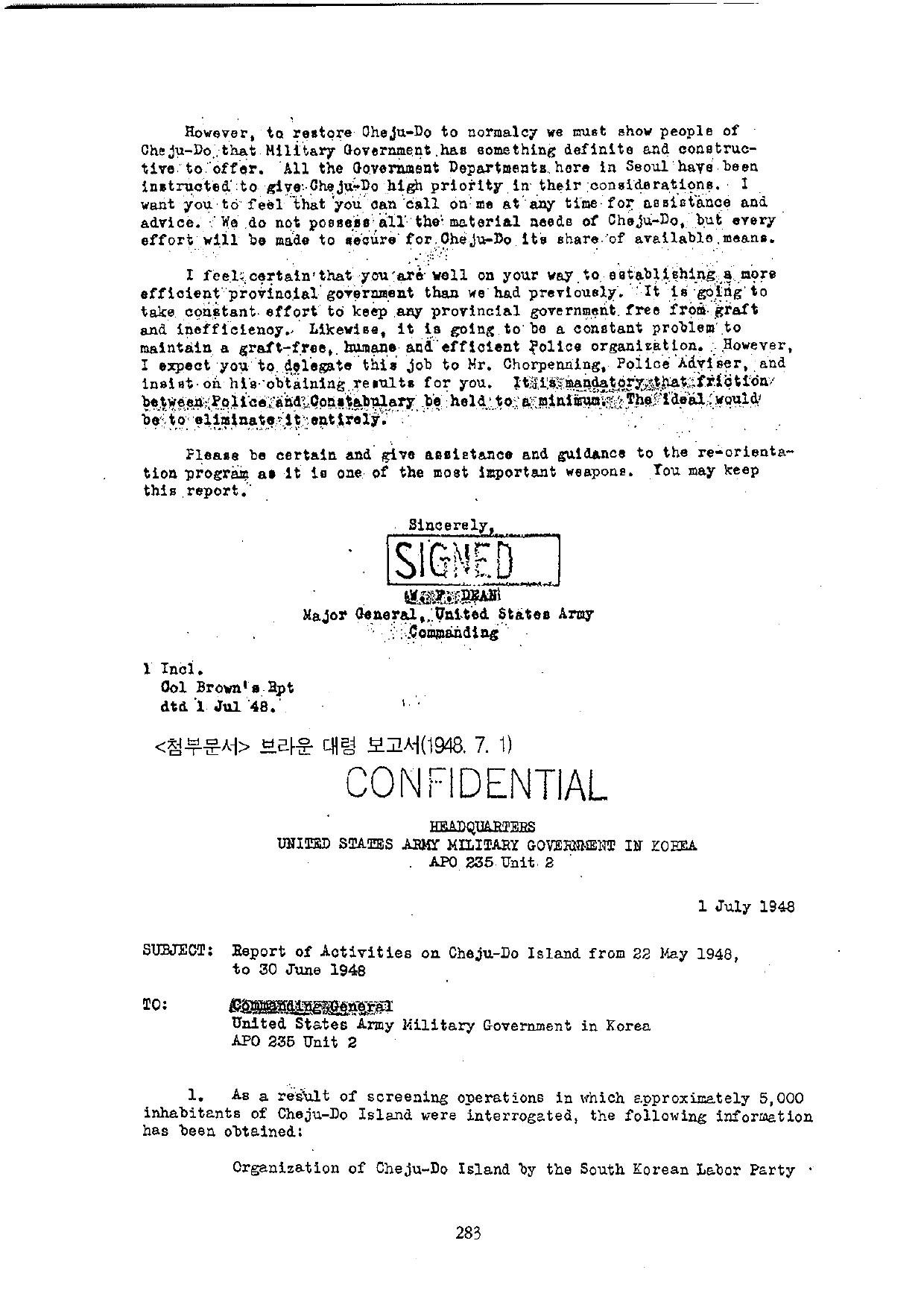
그러나 제주도를 원상태로 회복시키기 위해 우리는 제주 도민들에게 군정청이 무엇인가 명확하고 건설적인 제안을 갖고 있다는 것을 보여줘야 한다. 서울에 있는 모든 정부 부처에도 관심사 가운데 제주도를 우선 순위에 두도록 지시했다.
본관은 귀관이 언제든지 도움과 조언을 청하기를 바란다. 우리는 제주도에 대한 필요한 자료들을 모두 갖고 있지는 않다. 그러나 모든 방법을 동원해 제주도의 안전을 지키기 위해 노력을 다 할 것이다.
본관은 귀관이 우리가 이전에 가졌던 어떤 지방행정기관보다 더욱 효율적인 기관으로 건설해 나가고 있다고 확신한다. 부패와 비효율성이 없는 도청이 되도록 하기 위해 지속적인 노력을 할 것이다.
마찬가지로 경찰을 부패가 없고 인간적이며 효율적인 조직으로 유지하는데에는 난관이 있을 것이다. 그러나 본관은 귀관이 경찰 고문관 코페닝(Mr. Chorpening)에게 이 일을 위임하기 바라며, 그가 좋은 결과를 얻어내기를 기대한다.
경찰과 경비대 사이의 갈등은 반드시 최소화돼야 하며 갈등이 완전히 제거되기를 바란다.
가장 중요한 무기 가운데 하나인 재교육 계획에 대해 지원과 지도를 아끼지 않기 바란다. 이 보고서는 귀관이 보관해도 좋다.
미육군 사령관 소장 윌리엄 딘(W. F. DEAN)
<첨부문서> 브라운 대령 보고서( 48년 7월 1일자)
주한미육군사령부 군정청
1948년 7월 1일
제목: 1948년 5월 22일부터 1948년 6월 30일까지 제주도에서의 활동보고
수신: 주한미국육군사령부 군정청 사령관
1. 약 5,000명의 제주도 주민들을 심문한 결과 다음과 같은 정보를 얻었음:
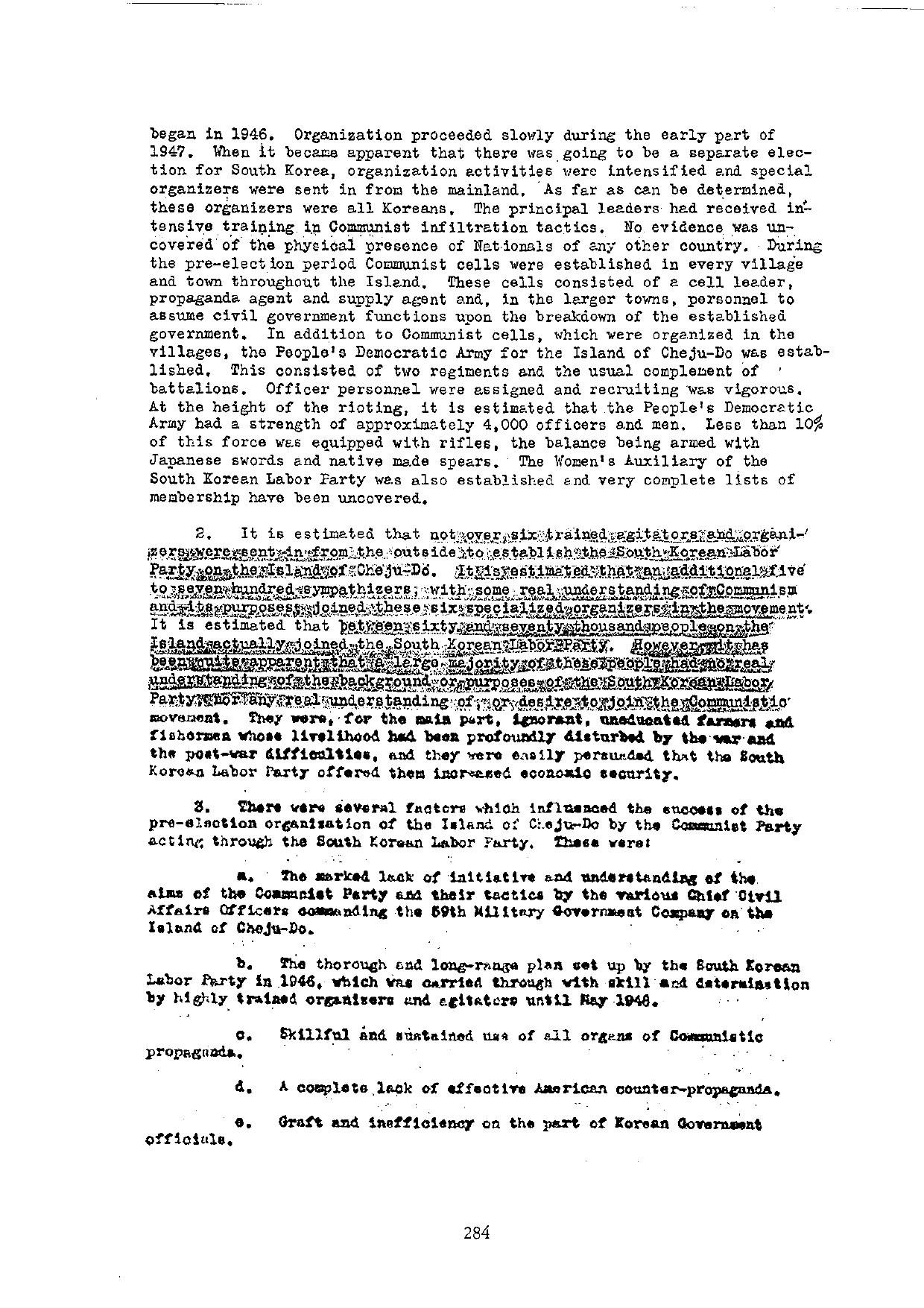
남로당에 의한 제주도의 조직은 1946년에 시작되었다. 조직은 1947년 상반기 동안에 천천히 진행되었다. 남한만의 단독선거가 치러질 것이라는 사실이 분명해지자 조직활동이 강화되었고 특별 조직책들이 본토에서 파견되었다. 이들은 모두 한국인들이었다. 주요 지도자들은 공산주의 침투전략을 위한 집중교육을 받았다. 다른 나라 국적을 가진 사람들이 참여하고 있다는 증거는 없다. 선거 이전 기간동안 공산주의 세포조직이 제주도의 모든 마을과 도시에 조성되었다. 이들 세포조직은 한 명의 지도자, 선동 전문가 그리고 보급 전문가, 그리고 큰 도시에는 현존하는 정부의 붕괴시 시민행정 기능을 담당할 요원 등으로 구성되어 있다. 촌락에 조직된 공산주의자 세포조직 이외에 제주도를 위한 인민민주주의 군대(the People's Democratic Army)가 구성되었다. 이 군대는 2개 연대와 보충 전투대대로 구성되어 있다. 장교요원들이 임명되었고 신병모집은 활발하다. 폭동이 최고조에 달했을 때 인민민주주의 군대 약 4,000명의 장교와 사병을 보유한 것으로 추산된다. 이들 중 10% 정도는 총으로 무장하였고, 나머지는 일본도와 재래식 창으로 무장하였다. 남로당의 여성조직도 구성되었으며 전체 회원명단이 밝혀졌다.
2. 6명 정도의 훈련된 선동가와 조직가들이 제주도에 남로당을 설치하기 위하여 외부에서 파견된 것으로 추정된다. 또한 공산주의와 그 목적에 대하여 얼마간 이해를 하고 있는 500~700명 정도의 동조자들이 파견된 6명의 특수 조직책들의 운동에 참여하였다. 또한 주민 6,000~7,000여 명이 남로당에 실제 가입한 것으로 추정된다. 그러나 참여한 사람들 중 대부분은 남로당의 배경과 목적에 대한 이해가 없으며 공산주의 운동에 대한 이해와 그에 대한 참여의사가 없다는 것이 매우 분명하다. 그들 중 대부분은 2차 대전과 그 이후의 곤궁함으로 인하여 깊이 영향을 받은 무지한 교육받지 못한 농부들과 어부들이며, 그들은 남로당이 그들에게 제시한 보다 나은 경제적인 보장에 쉽사리 설득 당하였다.
3. 남로당을 통한 공산당의 활동이 제주도에서 5‧10선거 이전에 성공했던 몇 가지 요인이 있다. 그것들은:
a. 제주도 주둔 제59군정중대의 민간업무 집행 장교들의 공산당의 목적과 전술에 대한 이해와 주도권의 현저한 부족.
b. 1946년에 남로당이 세운 철저하고 장기적인 계획이 1948년 5월까지 고도로 훈련된 선동가와 조직가들에 의하여 능숙하고 단호하게 수행되었다는 점
c. 모든 공산주의 선동 조직의 능숙하고 지속적인 사용.
d. 미국의 효율적인 역선전의 부재.
e. 한국정부 관리들의 독직과 비능률.
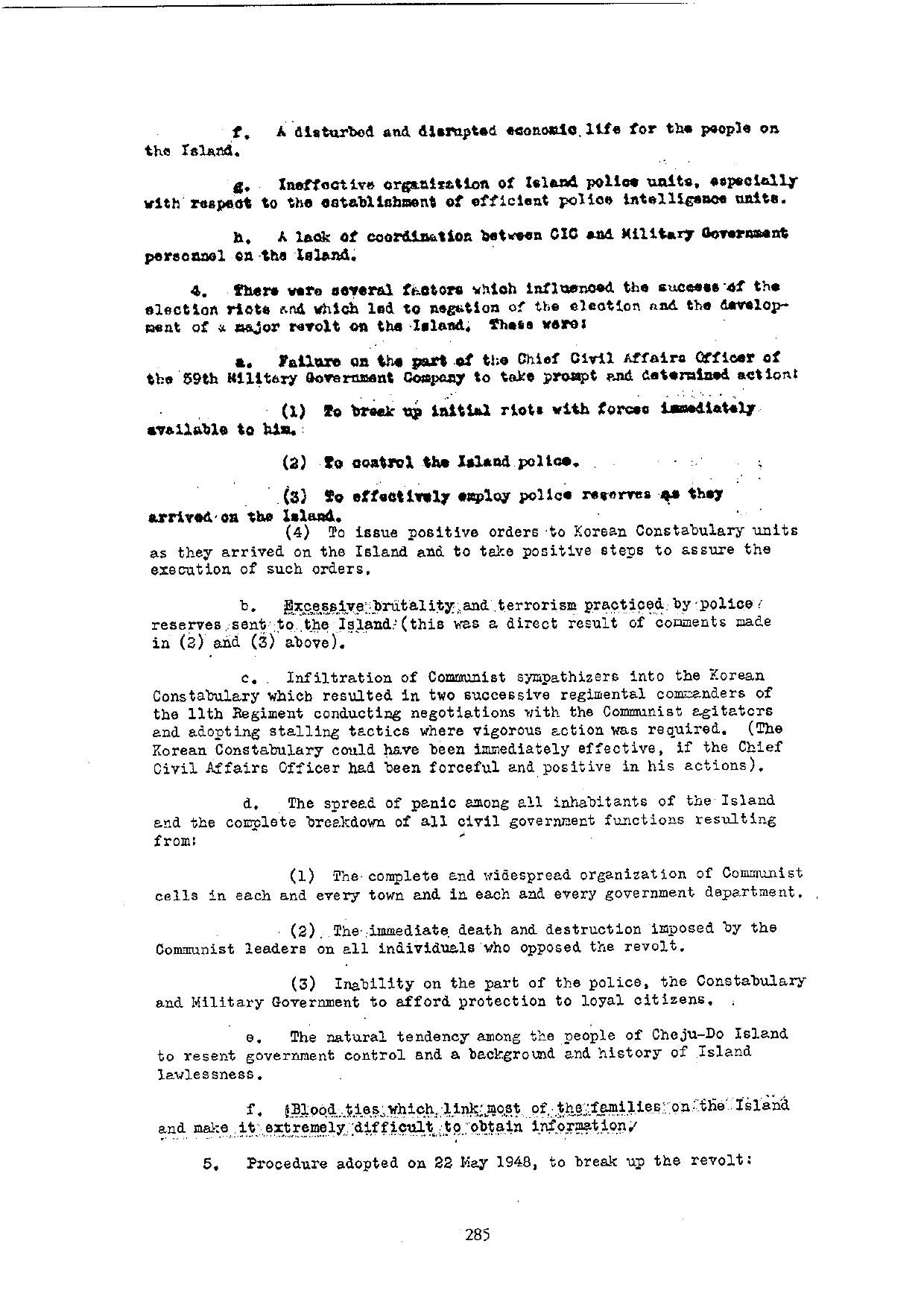
f. 제주도 주민의 불안하고 혼란스러운 경제적 생활.
g. 제주도 경찰조직의 비효율적인 구성, 특히 효율적인 경찰 정보부서 확립의 실패
h. 제주도 주둔 미군정중대 요원들과 방첩대 간의 협조 부족
4. 제주도에서 주요 폭동의 전개와 선거의 무효를 초래하고 선거폭동을 성공으로 이끈 몇 가지 요소들은 다음과 같다.
a. 제59군정중대의 민간업무 담당 장교는 다음과 같이 신속하고 단호하게 행동하여야 함에도 실패하였다.
(1) 초기 폭동을 자신에게 즉시 가용한 병력을 이용하여 진압하는데 실패하였다.
(2) 제주도 경찰을 통제하는데 실패하였다.
(3) 제주도에 도착한 예비 경찰병력을 효과적으로 동원하는데 실패하였다.
(4) 제주도에 도착한 한국 경비대 병력에게 적극적인 명령을 발표하고 그 명령을 확실히 실행할 적극적인 조치를 취하는데 실패하였다.
b. 지나친 잔혹행위와 테러가 제주도에 도착한 경찰 예비병력에 의하여 자행되었다(이것은 위의 (2)항과 (3)항으로 인한 직접적인 결과였다).
c. 공산주의 동조자들의 한국 경비대 침투는 두 명의 11연대장들이 공산 선동가들과 협상을 벌이면서 단호한 작전이 필요한 곳에 지연전략을 구사하는 결과를 초래하였다. (만일 군정중대의 민간업무 담당 장교(Chief Civil Affairs Officer)가 단호하고 적극적으로 행동하였더라면 한국 경비대는 즉각 효과적으로 대처할 수 있었을 것이다).
d. 제주도 주민들 사이에 광범위하게 퍼진 공포와 민간 정부기능의 완전한 붕괴는
(1) 모든 정부부서와 각급 지역에 공산주의 세포조직이 완벽하고 광범위하게 존재하였기 때문이다.
(2) 폭동을 반대하는 모든 개인들에 대한 공산주의 지도자들에 의한 즉각적인 살해와 파괴 때문에 초래되었다.
(3) 충성스런 시민들에 대한 경찰, 경비대, 군정중대의 보호 실패 때문에 야기되었다.
e. 제주도 주민들의 정부 지배를 반대한 자연스러운 경향과 제주도의 무법성의 역사와 배경.
f. 제주도 대부분의 가족들을 연결하는 혈연과 그것으로 인하여 정보의 취득이 어려운 점.
5. 폭동을 진압하기 위하여 1948년 5월 22일에 취해진 조치:
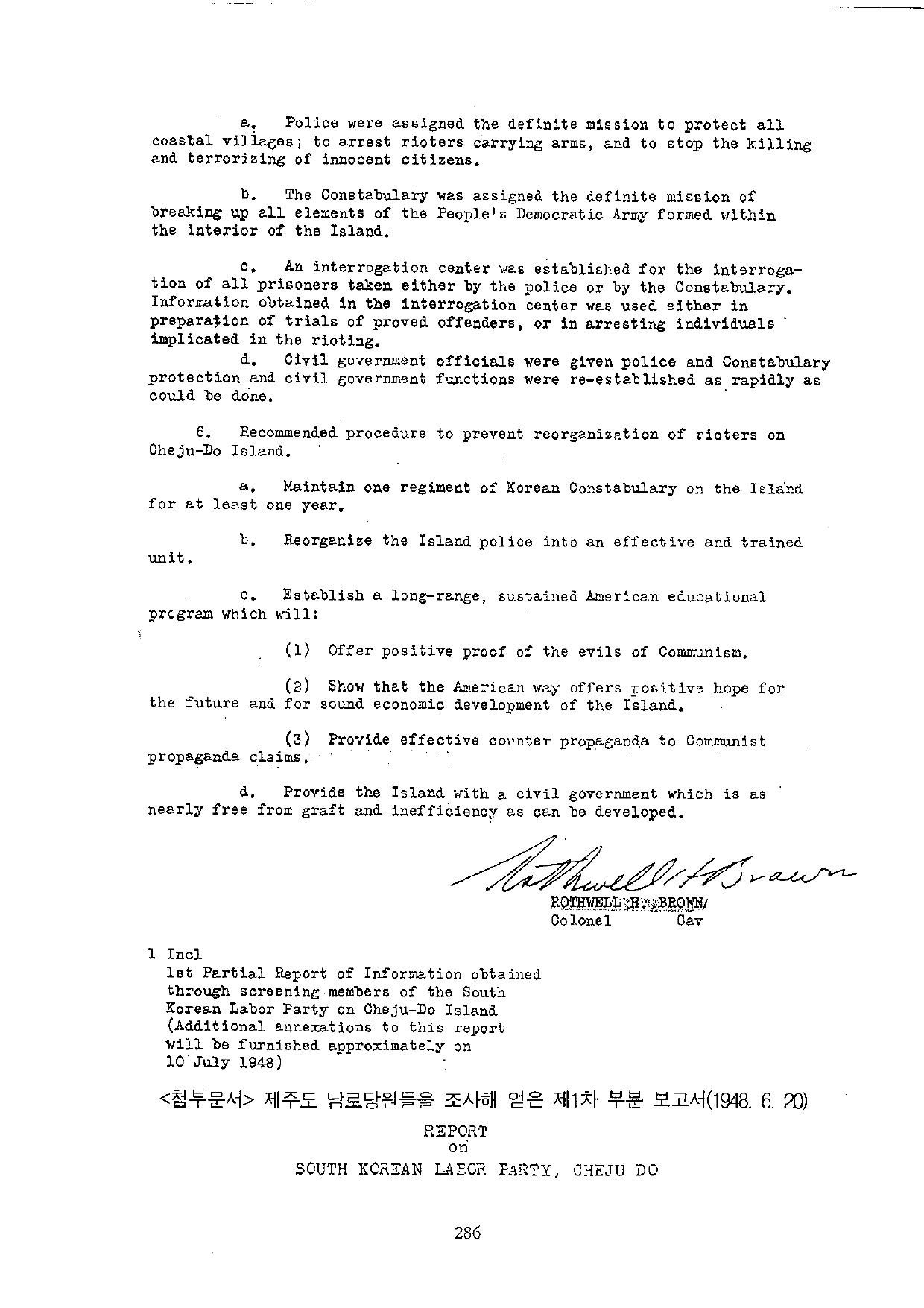
a. 경찰은 모든 해안 마을들을 보호하며, 무기를 소지한 폭도들을 체포하며, 양민에게 테러를 가하고 살해하는 것을 중지시킬 분명한 임무를 부여받았다.
b. 경비대는 제주도의 내부에 조직된 인민민주주의군대의 모든 요소를 진압할 분명한 임무를 부여받았다.
c. 경찰과 경비대에 의하여 체포된 모든 포로를 심문할 취조실이 설립되었다. 심문센터에서 획득된 정보는 명백한 범죄자의 재판준비에 이용되거나 혹은 폭동에 참가한 개인들을 체포하는데 이용되었다.
d. 행정기관 관리들은 경찰과 경비대의 보호를 받으며 행정기관 기능은 최대한 신속히 복구되었다.
6. 제주도에 폭동의 재조직을 방지하기 위하여 권고된 조치들.
a. 제주도에 최소한 일년동안 경비대 1개 연대를 주둔시킬 것.
b. 제주도 경찰을 효율적이고 훈련된 단위로 재조직할 것.
c. 장기적이고 지속적인 미국적 교육 프로그램을 실시할 것. 이 프로그램은:
(1) 공산주의 사악성의 적극적인 증거를 제시할 것.
(2) 미국적 방법이 장래를 위한 적극적인 희망과 제주도의 건전한 경제적 발전을 제공한다는 점을 보여줄 것.
(3) 공산주의 선동 주장에 대한 효율적인 역선전을 제시할 것.
d. 제주도에 가능한 한 독직과 비능률이 없는 민간정부를 제공할 것
로스웰 브라운(Rothwell H. Brown) 대령
<첨부문서> 제주도 남로당원들을 조사해 얻은 제1차 부분 보고서
(이 보고서에 대한 추가보고서는 1948년 7월 10일 보낼 것임)
제주도 남로당 조사 보고서
1948년 6월 20일
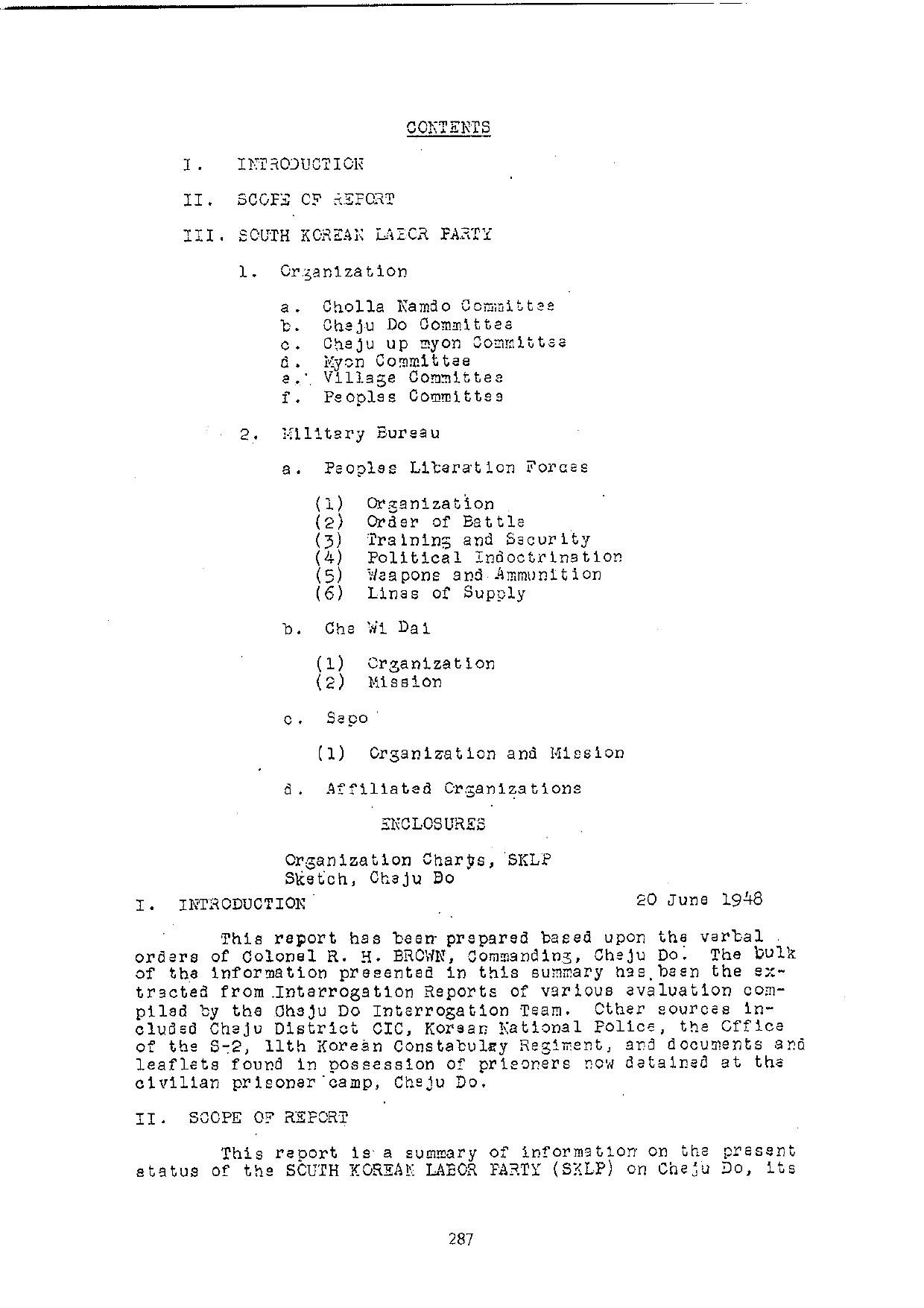
1. 개관
2. 보고서 범위
3. 남로당
1) 조직
a. 전라남도위원회
b. 제주도위원회
c. 제주읍면위원회
d. 면위원회
e. 마을위원회
f. 인민위원회
2) 군사부
a. 인민해방군
⑴ 조직
⑵ 전투
⑶ 훈련과 보안
⑷ 정치학습
⑸ 무기와 탄약
⑹ 보급선
b. 자위대
⑴ 조직
⑵ 임무
c. 세포
⑴ 조직과 임무
d. 연계 조직
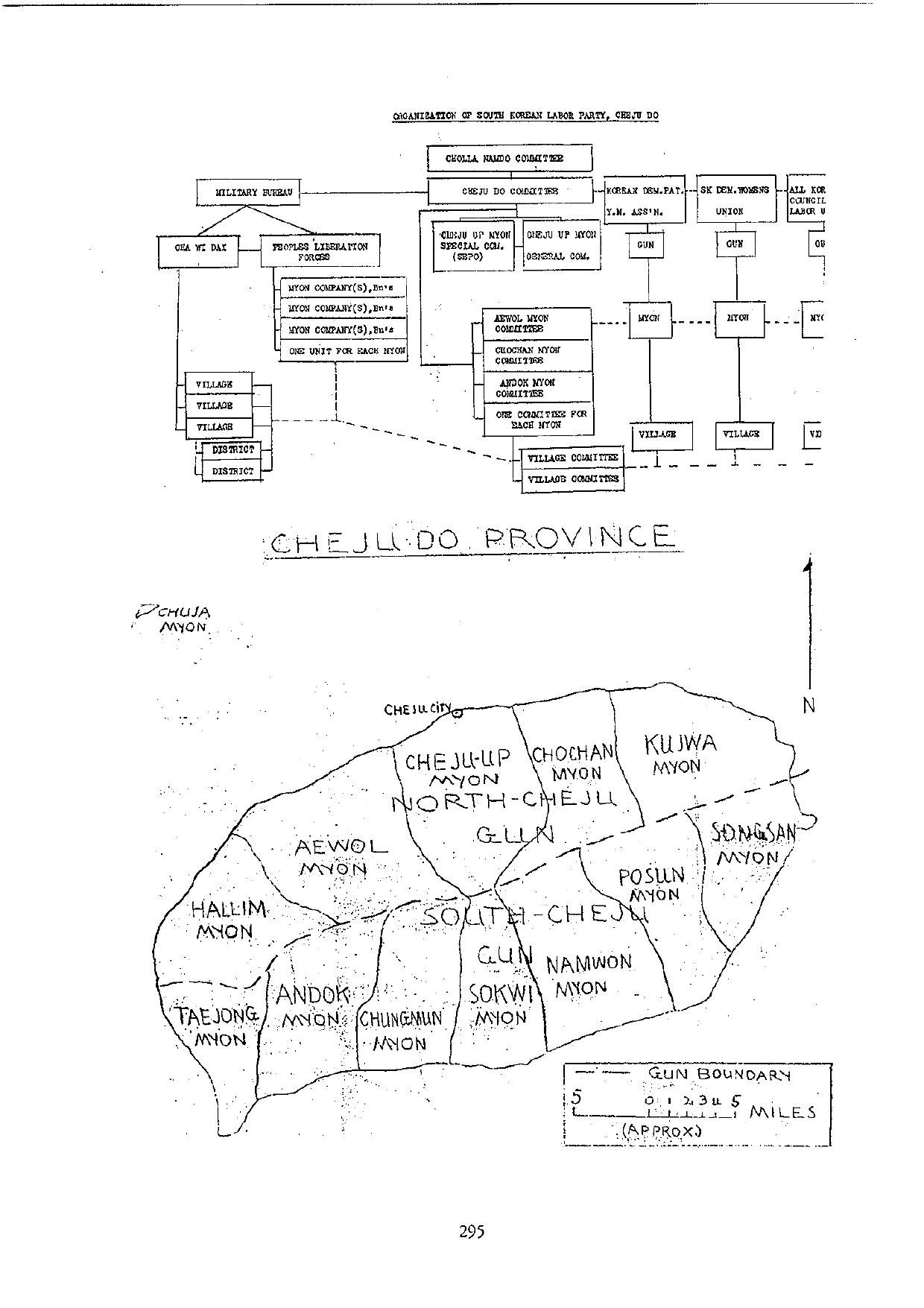
남로당 조직표, 제주도 개관
1. 개관
이 보고서는 제주도 사령관 브라운(R. H. Brown) 대령의 구두명령에 따라 준비됐다. 여기 제시된 정보의 대부분은 제주도 취조팀이 작성한 다양한 평가를 담고 있는 취조보고서에서 발췌했다. 그 외 다른 정보출처는 방첩대 제주지구대, 국립경찰, 정보과, 경비대 제11연대, 그리고 현재 제주도 민간인 포로수용소에 억류된 포로들의 소지품에서 발견된 서류와 유인물들이다.
2. 보고서 범위
이 보고서는 제주도 남로당의 당과 군사조직 양쪽의 현재 상황과 조직, 지휘체계 등에 대한 정보를 요약한 것이다.
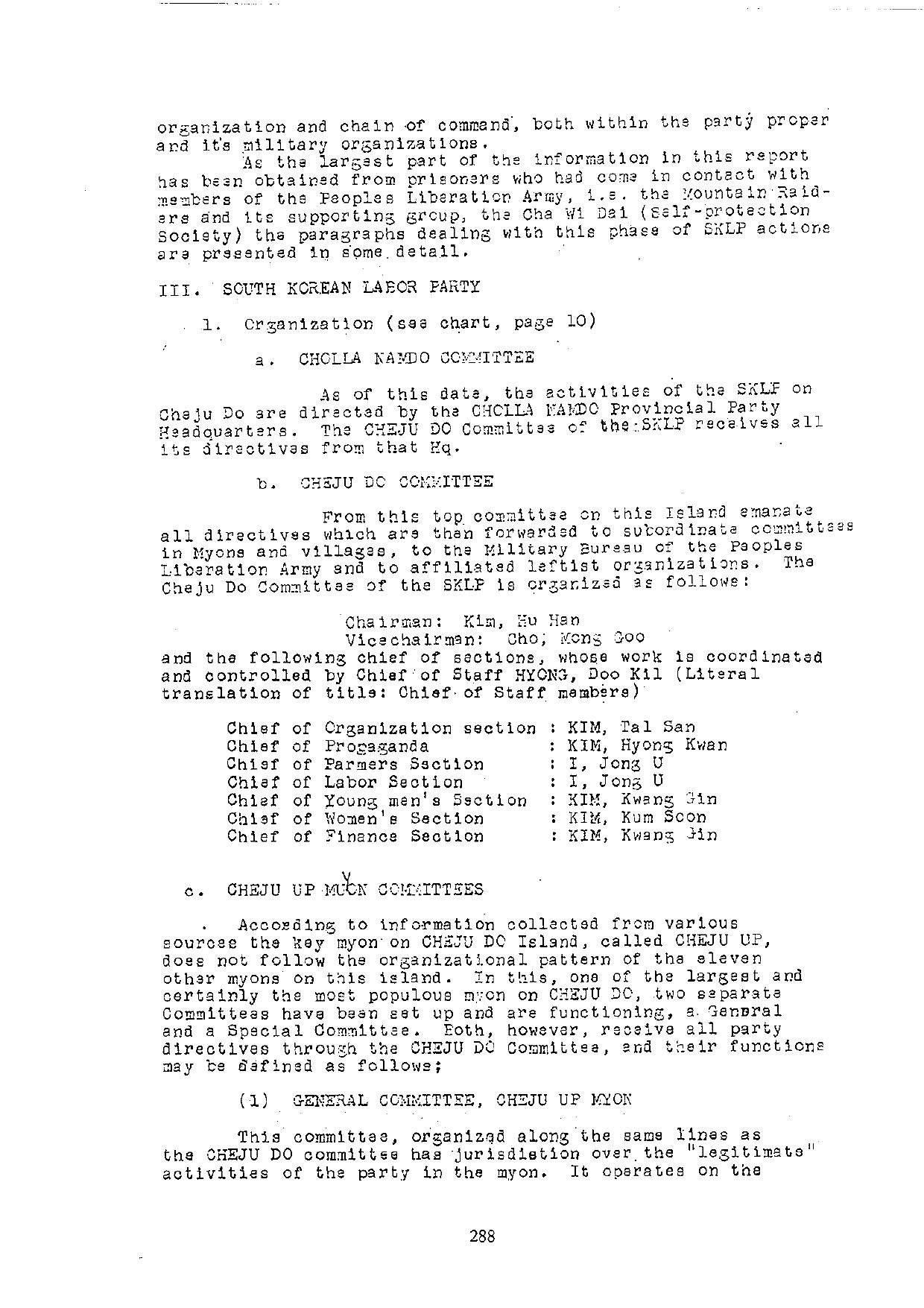
이 보고서에 나와 있는 정보의 상당부분은 인민해방군, 즉 재산무장대(Mountain Raiders)와 그 지원단체인 자위대 등의 조직원들과 접촉해왔던 포로들로부터 얻은 것으로 남로당 활동에 대한 내용을 어느 정도 자세하게 제시하고 있다.
3. 남로당
1) 조직 (도표 참조)
a. 전라남도위원회
현재까지 제주도 남로당의 활동은 전라남도 도당의 지시를 받고 있다. 남로당 제주도위원회는 도당 본부로부터 모든 지령을 받는다.
b. 제주도위원회
섬에 있는 이 최고위원회는 면과 마을에 있는 하부 위원회, 인민해방군의 군사부, 관련 좌익단체들에 보내는 모든 지령을 내린다. 남로당 제주도위원회는 다음과 같이 조직돼 있다.
위원장: 김유환
부위원장: 조몽구
그리고 간부부장 현두길은 다음의 각 부장들을 조정하고 통제한다.
조직부장: 김달삼
선전부장: 김용관
농민부장: 이종우
노동부장: 이종우
청년부장: 김광진
여성부장: 김금순
재정부장: 김광진
c. 제주읍면위원회
여러 자료를 통해 얻어진 정보에 따르면 제주읍이라고 불리는 제주도의 핵심 읍(역주: 원문에는 면으로 돼 있음)은 이 섬에 있는 11개의 면 조직 형태와는 다르다. 제주도에서 가장 크고 가장 인구가 많은 이 곳에는 2개의 독립위원회인 일반위원회와 특별위원회가 조직돼 활동하고 있다.
그러나 양쪽 위원회는 제주도위원회를 통해 당의 모든 지령을 받고 있으며 기능은 다음과 같이 정의할 수 있다.
⑴ 제주읍 일반위원회
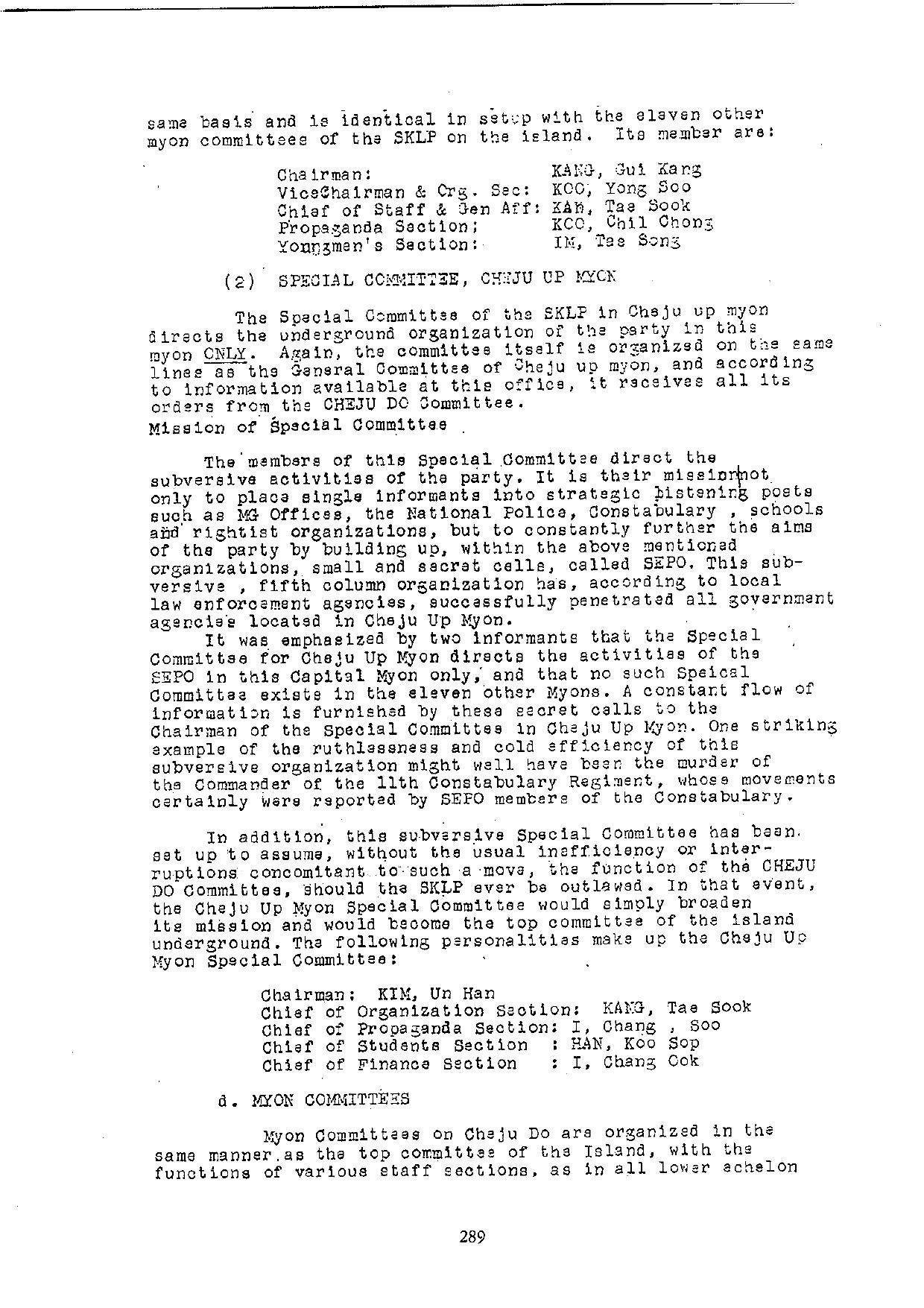
제주도위원회와 같은 방식으로 조직된 이 위원회는 읍내 당의 합법 활동에 대한 사법권을 갖는다. 이 위원회는 섬에 있는 11개의 다른 남로당 면위원회와 같은 기반에서 활동하고 구성이 같다. 조직원들은 다음과 같다:
위원장: 강규찬
부위원장겸 조직부장: 고갑수
간부부장겸 총무부장: 강대석
선전부장: 고칠종
청년부장: 임태성
⑵ 제주읍 특별위원회
남로당 제주읍 특별위원회는 제주읍에만 있는 당의 지하조직을 지휘한다. 더욱이 우리가 입수할 수 있는 정보에 따르면 위원회 자체는 제주읍 위원회와 같은 노선에 따라 조직되고 제주도위원회로부터 모든 명령을 받는다.
특별위원회의 임무
특별위원회 조직원들은 당의 전복활동을 지휘한다. 그들의 임무는 군정청, 국립경찰, 경비대, 학교, 우익단체 같은 전략적 정보청취소에 정보원을 심는 일 뿐 아니라 위에 언급된 조직 내에 소규모 비밀 ‘세포’를 증강해 당의 목표를 지속적으로 추진하는 것이다.
지방 법 집행기관들에 따르면 이런 전복활동을 도모하는 제5열 조직이 제주읍에 있는 모든 행정기관에 성공적으로 침투했다.
정보원 2명은 제주읍 특별위원회가 유일하게 제주읍 세포의 활동을 지시하며 11개 면에는 이런 특별위원회가 없다고 강조했다.
이런 비밀 세포들은 제주읍 특별위원회 위원장에게 정보를 지속적으로 제공하고 있다. 전복활동을 도모하는 이 조직의 무모하고 냉혹한 효율성을 보여주는 놀랄만한 한가지 사례는 국방경비대 제11연대장을 살해한 일일 것이다. 이 연대장의 활동은 경비대에 침투한 세포들에 의해 확실하게 보고됐다.
더욱이 전복활동을 꾀하는 특별위원회는 남로당이 불법화될 경우에 이와 관련한 일상적인 비효율성이나 방해없이 제주도위원회의 기능을 맡게 하기 위해 만들어졌다.
이런 측면에서 제주읍 특별위원회는 임무를 확대하는 한편 제주도 지하조직의 최고위원회가 될 것이다. 제주읍 특별위원회는 다음과 같은 인물로 구성돼 있다.
위원장 : 김응환
조직부장 : 강대석
선전부장 : 이창수
학생부장 : 한국섭
재정부장 : 이창욱
d. 면 위원회
면위원회들은 제주도의 최고위원회와 같이 여러 부서로 조직되어 있다. 또 모든 하위 군사조직과 준군사조직처럼 구성돼 있으며 한 조직원이 담당한다.
e. 마을 위원회
위에 언급한 것처럼 마을위원회는 한 조직원이 여러 부서의 임무를 겸한다. 그러나 취조보고서는 마을 위원회가 최소한 조직원 3명, 즉 위원장과 선전부장, 조직부로 구성된다고 밝히고 있다.
f. 인민위원회
여러 취조보고서에 따르면 최소한 한 마을에서 폭도들이 마을사람들에게 위원장을 지명하도록 강요한 다음 박수갈채로 인민위원회 위원장을 선출하도록 했다. 이 사례에서는 1945년 일본이 항복한 뒤 조직됐던 인민위원회의 위원장을 역임했던 사람이 선출됐다. 이런 선거절차는 무장한 폭도들이 감시하는 가운데 이루어졌다. 현재 제주도 민간인 수용소에 수감된 인민위원회 위원장은 폭도들이 마을을 떠난 뒤 그들의 명령에 따라 선전 및 조직부장으로 임명됐다고 밝혔다. (상세한 내용은 2. 군사부와 3. 훈련 및 보안을 참조)
2. 군사부
주: 한 소식통에 따르면 이 부서의 이름은 1948년 4월 초 구국투쟁위원회로 바뀌었다. 이 보고서에서는 군사부라는 용어를 계속 사용할 것이다.
개관
남로당 제주도당의 무장부대는 인민해방군의 군사부에서 명령을 받고 있다. 인민해방군과 자위대 등 2개의 주요 부서로 구성된다. 인민해방군 구성원들은 재산무장대들이며 그들은 제1선의 전투부대라 할 수 있다. 자위대는 재산무장대 인력을 보충하고 마을과 폭도부대 사이의 연락 책임을 맡는 기능 이외에 일반 군대의 보급부 기능을 수행하고 있다.
a. 인민해방군(재산무장대)
소규모 폭도부대들은 1948년 1월 이전 한림지역의 오름 중턱에 설치된 전 일본군 군사시설에서 조직돼 생활했다.
경찰보고에 따르면 1948년 2월초 대규모 군사훈련에 관한 최초 보고 가운데 하나를 받았다. 당시에 폭도 300여 명이 애월면의 오름(역주: 샛별오름으로 추정)에서 훈련 중인 것으로 보고됐다.
다이너마이트와 식량, 민간인 옷이 훈련장소에서 발견됐다.
그때부터 폭도들은 이 섬의 모든 지역에서 비협력자들을 죽이고 주택을 불태웠으며 포로들을 데려가는가 하면 시골에 테러를 가하는 등 적극적인 활동을 해왔다.
⑴ 조직
모든 보고에 따르면 제주도 각 면은 현재 최소한 적극적인 활동을 벌이는 폭도 1개 중대를 구성하기에 충분한 인원을 제공하고 있는 것으로 파악됐다. 이런 중대들과 대대들은 종종 그들 고유의 마을 이름을 사용했다. 경비대의 압력이나 경찰의 기습활동 등에 따라 폭도부대의 병력 규모는 계속 달라진다.
⑵ 전투서열
모든 소식통을 통해 얻은 정보에 근거해 폭도부대의 평균 인원에 대한 다음과 같은 구성표를 그릴 수 있다.
대대 지휘관들은 정보부, 병기부, 보급부, 의료부 등의 조직을 갖고 있다는 증거가 있다. 한 보고서에 따르면 폭도들과 근무하던 환자가 아프게 되자 내과의사가 매일 방문해 약을 주고 주사를 놓았다고 밝혔다. 그러나 별도의 병원 건물은 없다고 말했다.
중대 지휘관들은 소련군의 영향을 받거나 이를 본뜬 모든 군대의 전형인 정무 담당 부지휘관(역주: 정치지도원)의 도움을 받는다. 폭도부대에서 취사병으로 일했던 정보원은 그가 속했던 부대가 약 80명으로 구성돼 있으며 이 병력은 2개 중대로 구성된 1개 대대와 1개 기동부대로 나누어진다고 밝혔다. 기동부대는 폭도 사령관의 직접 명령에 따라서만 움직인다.
장교들은 보통 일본식 권총과 철모로 신원이 확인되며, 대부분 일본식 장교 칼로 확인된다.
주: 남로당 연락병에게서 획득한 한 자료는 모든 부대에 유포하기 위한 것으로 보이는 일반적인 정보 고시 형태로 인쇄됐다. 이 자료에는 “…철모를 더 이상 착용하지 않는다…”라고 언급돼 있다.
경례를 하지 않으며 어떤 표식이나 신분 증명서, 또는 군 상징 표식도 보고되지 않았다. 폭도들은 서로 ‘동무’라고 부른다.
⑶ 훈련 및 보안
폭도부대에서 이뤄지는 군기와 훈련의 강도에 대한 보고 내용들은 다소 다르다. 한 보고서는 “지휘관이 인원을 파악할 수 있도록 막사 앞에 2열 종대로 집합하는 하루 3차례의 점호가 있으며 오전 점호 뒤에는 1시간 동안 달리는 등 엄격한 체력훈련이 계획된다”고 밝히고 있다.
또 다른 부대에 대한 보고서에는 부대에 있는 동안 나무 모으기와 숯 만들기 식량창고에서 식량을 운반하는 등의 가사임무만 한다고 언급돼 있다.
대부분의 부대 입구에는 보초(한국어 빗게)를 서며 100야드 정도 떨어진 곳에 2개의 검문초소가 있다는 것이 한 폭도부대에서 보고됐다. 보고서에 따르면 한 건물에 살고 있는 모든 사람들은 새로 들어온 사람들과 엄격하게 격리되며, 막사 부근을 떠나지 말도록 명령받는다.
또 이 부대에 있는 건물들은 약 100야드 정도씩 떨어져 있으며, 인접 건물에 있는 사람 사이의 개인적인 접촉은 이뤄지지 않는다고 밝혔다.
실제 습격 나갈 때만 여러 건물의 인원들이 2열 종대로 집합해 점호를 받으며, 무기와 실탄이 지급된다.
⑷ 정치학습
폭도부대에 소속된 정치지도원들은 끊임없이 남로당의 목적을 강조하며 특히 습격에 앞서 “어떤 특정 마을에 있는 모든 인민은 가치가 없어 죽어 마땅하고 조선인민공화국의 반역자다”라는 말을 확고한 진실로 받아들일 것을 대원들에게 강요한다.
정치지도원들은 또 경찰이나 경비대에 잡힐 때는 부대의 위치나 인원을 누설하지 말고, 오도(誤導)하거나 거짓말하도록 하는 것과 같은 세부지침을 대원들에게 지시한다.
부대 지휘관들에게는 ‘선전 선동 활동’과 관련해 신중하게 준비되고 씌어진 지침들이 하달된다. 이 지침들은 흔히 그렇듯이 폭도들이 결정을 해야 할 경우에 각각의 단계를 주의깊게 고려한 것으로서 폭도 지휘관은 모든 마을 주민들을 불러모아서 연설을 하게 되어 있다. 지침에는 “실내 집회가 위험하지 않습니까?”와 같은 질문들을 하게 되어 있고 답변도 상세히 나와 있다. 몇몇 보고서에 따르면 보안을 이유로 간부들은 이름을 내세우지 않고 단순히 ‘지휘관’으로 명명된다.
⑸ 무기와 탄약
폭도들은 미제와 일제 무기들을 사용하는데 일본제 장비들이 압도적이고 99식 일제 소총이 주류를 이룬다. 미제 카빈총과 M1 소총을 보유하고 있음이 확인됐으며 한 보고서는 약 25명으로 구성된 기동부대가 미제 카빈총 10정과 일제 99식 소총 15정으로 무장했다고 밝혔다.
대부분의 보고된 사례를 보면 실탄은 실제 습격이 계획될 때만 지급된다. 그리고 총을 갖고 있는 폭도들은 습격이 끝난 뒤 사용하지 않은 실탄을 반납하라는 명령과 함께 20~50발의 실탄을 받는다. 상태가 나쁜 일제 기관총 부품이 경비대가 급습한 부대에서 발견됐다.
폭도들이 갖고 다녔던 다른 무기들은 일본 장교 칼과 총검, 지팡이나 곤봉, 죽창과 같은 숨길 수 있는 에페(끝이 뾰족한 칼) 모양의 긴 비수들이 있다. 지난 3주 동안 소련제 장비는 발견되지 않았다. 접촉한 모든 소식통들도 그런 것이 있다는 것을 언급하지 않았다.
⑹ 보급선
폭도들은 ‘지원기관’ 즉, 면내 마을에 있는 남로당과 긴밀한 연락을 유지하며 이 마을의 남로당은 사전계획에 따라 음식물과 의류, 자금, 인력충원, 명령과 정보를 제공한다. 남로당 부대는 자위대에 있는 폭도들의 연락과 보급에 책임이 있다.
b. 자위대
남로당의 주요 부분인 이 조직은 1948년 2월께 마을 단위로 제주도 전역에 걸쳐 조직됐으며 1948년 5월 초 인민자위대로 명칭이 바뀌었다.
⑴ 조직
이 조직은 표면상으로는 폭도들의 활동으로부터 마을을 보호하기 위해 만들어졌으나 사실상 교활한 폭도부대의 임시보급창이며 마을기지다. 자위대는 자신이 지원하는 폭도부대와 비슷하게 군사노선에 따라 조직되었으며 각각의 부락과 소대와 분대마다 장교(지도자)를 두고 있다. 마을 자위대에 대한 명령은 남로당 마을위원회 위원장이 내린다.
⑵ 임무
자위대의 임무는 이름이 뜻하는 것과는 다르다. 폭도들의 공격으로부터 마을을 보호하는 것이 아니라 어떤 부대가 마을을 습격할 때 테러 공격에 적극 참여하고 폭도들과 합류하는 것이다. 경비대나 경찰이 가까이 있을 때만 경고한다. 자위대 구성원들은 군대가 전투를 계속 할 수 있도록 보급조직 임무를 수행한다.
식량과 자금 모집은 정기적으로 이뤄지고 이렇게 모집된 식량과 자금은 폭도부대의 연락원에게 전달하기 위해 마을 남로당위원회 위원장에게 건네진다.
전 자위대원들로부터 얻은 자세한 보고서에 따르면 언제, 무엇을, 누구에 의해, 누구로부터 어느 정도 모집했는지 언급돼 있고 전달 계획도 작성돼 있다.
한 보고서에는 폭도 2명이 실제 자위대의 구역 책임자로 활동했고 그들을 통해서 면 지역의 폭도부대와 남로당 마을 조직 사이에 매우 긴밀한 연락이 이뤄지고 있다고 밝혔다. 접촉한 정보원들은 면 단위 자위대 조직에 관해서는 정보를 갖고 있지 못했다. 현재까지는 단지 마을과 마을 내에 있는 부락조직들만이 활동하는 것으로 보인다.
c. 세포(전복 세포)
⑴ 임무와 조직
남로당은 관공서와 법 집행기관, 학교, 우익인사단체 등과 같은 정보청취기관에 프락치들을 심기 위해 온갖 노력을 다하고 있다.
(주: 경비대의 공세가 시작된 뒤 인쇄된 일자불명의 한 문건에는 경찰로 근무하는 (남로당) 당원들은 이런 긴장된 시기에 특별히 더 조심해야 한다고 언급했다.)
제주읍 특별위원회의 임무에 대해 말할 때 위에서 언급했듯이, 이들 프락치들의 임무는 관찰과 보고 등의 수동적 역할뿐 아니라 전복활동을 꾀하는 세포를 적극적으로 조직하는 것이다.
제5열 분자(역주: 프락치)들이 마을이나 면위원장에게 보고하는지, 또는 아직까지 알려지지 않은 특별 경로를 통해 남로당 제주도위원회에 보고하는지 등에 대해서는 알려지지 않았다. 제주읍 특별위원회가 섬 전역에서 이런 전복조직의 활동을 명령한다는 주장을 받쳐주는 정보는 현재까지 없다.
d. 연계조직들
명목상 독립된 좌익단체들인 아래 나열한 단체들은 남로당의 정책을 지지하고 많은 구성원들이 이중회원으로 활동하고 있다.
민애청
남조선 민주여성동맹
전평
제24군단 정보참모부 헝거(R. Hunger) 상사
<조직도>
<지도>
CONFIDENTIAL
HEADQUARTERS
UNITED STATES ARMY MILITARY GOVERNMENT IN KOREA
APO 235 UNIT 2
17 July 1948
Major Edgar A. Noel,
Chief Civil Affairs Officer,
59th Military Government Company,
APO 712
Dear Major Noel:
Herewith is copy of Colonel Brown's "Report of Activities on Cheju-Do Island from 22 May 1948 to 30 June 1948." It is desired that Colonel Brown's recommendations contained in paragraph 6 of his report be fully implemented.
However, to restore Cheju-Do to normalcy we must show people of Cheju-Do that Military Government has something definite and constructive to offer. All the Government Departments here in Seoul have been instructed to give Cheju-Do high priority in their considerations. I want you to feel that you can call on me at any time for assistance and advice. We do not possess all the material needs of Cheju-Do, but every effort will be made to secure for Cheju-Do its share of available means.
I feel certain that you are well on your way to establishing a more efficient provincial government than we had previously. It is going to take constant effort to keep any provincial government free from graft and inefficiency. Likewise, it is going to be a constant problem to maintain a graft-free, humane and efficient Police organization. However, I expect you to delegate this job to Mr. Chorpenning, Police Adviser, and insist on his obtaining results for you. It is mandatory that friction between Police and Constabulary be held to a minimum. The ideal would be to eliminate it entirely.
Please be certain and give assistance and guidance to the re-orientation program as it is one of the most important weapons. You may keep this report.
Sincerely,
SIGNED
W.F. DEAN
Major General, United States Army
Commanding
1 Incl.
Col Brown's Rpt
dtd 1 Jul 48.
<첨부문서> 브라운 대령 보고서(1948. 7. 1)
CONFIDENTIAL
HEADQUARTERS
UNITED STATES ARMY MILITARY GOVERNMENT IN KOREA
APO 235 Unit 2
1 July 1948
SUBJECT: Report of Activities on Cheju-Do Island from 22 May 1948, to 30 June 1948
TO: Commanding General
United States Army Military Government in Korea
APO 235 Unit 2
1. As a result of screening operations in which approximately 5,000 inhabitants of Cheju-Do Island were interrogated, the following information has been obtained:
Organization of Cheju-Do Island by the South Korean Labor Party
began in 1946. Organization proceeded slowly during the early part of 1947. When it became apparent that there was going to be a separate election for South Korea, organization activities were intensified and special organizers were sent in from the mainland. As far as can be determined, these organizers were all Koreans. The principal leaders had received intensive training in Communist infiltration tactics. No evidence was uncovered of the physical presence of Nationals of any other country. During the pre-election period Communist cells were established in every village and town throughout the Island. These cells consisted of a cell leader, propaganda agent and supply agent and, in the larger towns, personnel to assume civil government functions upon the breakdown of the established government. In addition to Communist cells, which were organized in the villages, the People's Democratic Army for the Island of Cheju-Do was established. This consisted of two regiments and the usual complement of ' battalions. Officer personnel were assigned and recruiting was vigorous. At the height of the rioting, it is estimated that the People's Democratic Army had a strength of approximately 4,000 officers and men. Less than 10% of this force was equipped with rifles, the balance being armed with Japanese swords and native made spears. The Women's Auxiliary of the South Korean Labor Party was also established and very complete lists of membership have been uncovered.
2. It is estimated that not over six trained agitators and organizers were sent in from the outside to establish the South Korean Labor Party on the Island of Cheju-Do. It is estimated that an additional five to seven hundred sympathizers, with some real understanding of Communism and its purposes, joined these six specialized organizers in the movement. It is estimated that between sixty and seventy thousand people on the Island actually joined the South Korean Labor Party. However, it has been quite apparent that a large majority of these people had no real understanding of the background or purposes of the South Korean Labor Party [illegible] any real understanding of or desire to join the Communistic movement. They were, for the main part, ignorant, uneducated farmers and fishermen whose livelihood had been profoundly disturbed by the war and the post-war difficulties, and they were easily persuaded that the South Korean Labor Party offered them increased economic security.
3. There were several factors which influenced the success of the pre-election organization of the Island of Cheju-Do by the Communist Party acting through the South Korean Labor Party. These were:
a. The marked lack of initiative and understanding of the aims of the Communist Party and their tactics by the various Chief Civil Affairs Officers commanding the 59th Military Government Company on the Island of Cheju-Do.
b. The thorough and long-range plan set up by the South Korean Labor Party in 1946, which was carried through with skill and determination by highly trained organizers and agitators until May 1948.
c. Skillful and sustained use of all organs of Communistic propaganda.
d. A complete lack of effective American counter-propaganda.
e. Graft and inefficiency on the part of Korean Government officials.
f. A disturbed and disrupted economic life for the people on the Island.
g. Ineffective organization of Island police units, especially with respect to the establishment of efficient police intelligence units.
h. A lack of coordination between CIC and Military Government personnel on the Island.
4. There were several factors which influenced the success of the election riots and which led to negation of the election and the development of a major revolt on the Island. These were:
a. Failure on the part of the Chief Civil Affairs Officer of the 59th Military Government Company to take prompt and determined action:
(1) To break up initial riots with forces immediately available to him.
(2) To control the Island police.
(3) To effectively employ police reserves as they arrived on the Island.
(4) To issue positive orders to Korean Constabulary units as they arrived on the Island and to take positive steps to assure the execution of such orders.
b. Excessive brutality and terrorism practiced by police / reserves sent to the Island (this was a direct result of comments made in (2) and (3) above).
c. Infiltration of Communist sympathizers into the Korean Constabulary which resulted in two successive regimental commanders of the 11th Regiment conducting negotiations with the Communist agitators and adopting stalling tactics where vigorous action was required. (The Korean Constabulary could have been immediately effective, if the Chief Civil Affairs Officer had been forceful and positive in his actions).
d. The spread of panic among all inhabitants of the Island and the complete breakdown of all civil government functions resulting from:
(1) The complete and widespread organization of Communist cells in each and every town and in each and every government department.
(2) The immediate death and destruction imposed by the Communist leaders on all individuals who opposed the revolt.
(3) Inability on the part of the police, the Constabulary and Military Government to afford protection to loyal citizens.
e. The natural tendency among the people of Cheju-Do Island to resent government control and a background and history of Island lawlessness.
f. Blood ties which link most of the families on the Island and make it extremely difficult to obtain information.
5. Procedure adopted on 22 May 1948, to break up the revolt:
a. Police were assigned the definite mission to protect all coastal villages; to arrest rioters carrying arms, and to stop the killing and terrorizing of innocent citizens.
b. The Constabulary was assigned the definite mission of breaking up all elements of the People's Democratic Army formed within the interior of the Island.
c. An interrogation center was established for the interrogation of all prisoners taken either by the police or by the Constabulary. Information obtained in the interrogation center was used either in preparation of trials of proved offenders, or in arresting individuals implicated in the rioting.
d. Civil government officials were given police and Constabulary protection and civil government functions were re-established as rapidly as could be done.
6. Recommended procedure to prevent reorganization of rioters on Cheju-Do Island.
a. Maintain one regiment of Korean Constabulary on the Island for at least one year.
b. Reorganize the Island police into an effective and trained unit.
c. Establish a long-range, sustained American educational program which will:
(1) Offer positive proof of the evils of Communism.
(2) Show that the American way offers positive hope for the future and for sound economic development of the Island.
(3) Provide effective counter propaganda to Communist propaganda claims.
d. Provide the Island with a civil government which is as nearly free from graft and inefficiency as can be developed.
Rothwell H. Brown
ROTHWELL H. BROWN/
Colonel Cav
1 Incl
1st Partial Report of Information obtained through screening members of the South Korean Labor Party on Cheju-Do Island (Additional annexations to this report will be furnished approximately on 10 July 1948)
<첨부문서> 제주도 남로당원들을 조사해 얻은 제1차 부분 보고서(1948. 6. 20)
REPORT
on
SOUTH KOREAN LABOR PARTY, CHEJU DO
CONTENTS
I. INTRODUCTION
II. SCOPE OF REPORT
III. SOUTH KOREAN LABOR PARTY
1. Organization
a. Cholla Namdo Committee
b. Cheju Do Committee
c. Cheju up myon Committee
d. Myon Committee
e. Village Committee
f. Peoples Committee
2. Military Bureau
a. Peoples Liberation Forces
(1) Organization
(2) Order of Battle
(3) Training and Security
(4) Political Indoctrination
(5) Weapons and Ammunition
(6) Lines of Supply
b. Che Wi Dai
(1) Organization
(2) Mission
c. Sapo
(1) Organization and Mission
d. Affiliated Organizations
ENCLOSURES
Organization Charts, SKLP
Sketch, Cheju Do
I. INTRODUCTION
20 June 1948
This report has been prepared based upon the verbal orders of Colonel R. H. BROWN, Commanding, Cheju Do. The bulk of the information presented in this summary has been the extracted from Interrogation Reports of various evaluation compiled by the Cheju Do Interrogation Team. Other sources included Cheju District CIC, Korean National Police, the Office of the S-2, 11th Korean Constabulary Regiment, and documents and leaflets found in possession of prisoners now detained at the civilian prisoner camp, Cheju Do.
II. SCOPE OF REPORT
This report is a summary of information on the present status of the SOUTH KOREAN LABOR PARTY (SKLP) on Cheju Do, its
organization and chain of command, both within the party proper and it's military organizations.
As the largest part of the information in this report has been obtained from prisoners who had come in contact with members of the Peoples Liberation Army, i.e. the Mountain Raiders and its supporting group, the Cha Wi Dal (Self-protection Society) the paragraphs dealing with this phase of SKLP actions are presented in some detail.
III. SOUTH KOREAN LABOR PARTY
1. Organization (see chart, page 10)
a. CHOLLA NAMDO COMMITTEE
As of this date, the activities of the SKLF on Cheju Do are directed by the CHOLLA NAMDO Provincial Party Headquarters. The CHEJU DO Committee of the SKLP receives all its directives from that Hq.
b. CHEJU DC COMMITTEE
From this top committee on this Island emanate all directives which are then forwarded to subordinate committees in Myons and villages, to the Military Bureau of the Peoples Liberation Army and to affiliated leftist organizations. The Cheju Do Committee of the SKLP is organized as follows:
Chairman: Kim, Hu Han
Vicechairman: Cho; Mong Goo
and the following chief of sections, whose work is coordinated and controlled by Chief of Staff HYONG, Doo Kil (Literal translation of title: Chief of Staff members)
Chief of Organization section : KIM, Tal San
Chief of Propaganda : KIM, Hyong Kwan
Chief of Farmers Section : I, Jong U
Chief of Labor Section : I, Jong U
Chief of Young men's Section : KIM, Kwang Sin
Chief of Women's Section : KIM, Kum Scon
Chief of Finance Section : KIM, Kwang Jin
c. CHEJU UP MUON COMMITTEES
According to information collected from various sources the key myon on CHEJU DC Island, called CHEJU UP, does not follow the organizational pattern of the eleven other myons on this island. In this, one of the largest and certainly the most populous myon on CHEJU DC, two separate Committees have been set up and are functioning, a General and a Special Committee. Both, however, receive all party directives through the CHEJU DO Committee, and their functions may be defined as follows;
(1) GENERAL COMMITTEE, CHEJU UP MYON
This committee, organized along the same lines as the CHEJU DO committee has jurisdiction over the "legitimate" activities of the party in the myon. It operates on the
same basis and is identical in setup with the eleven other myon committees of the SKLP on the island. Its member are:
Chairman: KANG, Gui Kang
ViceChairman & Org. Sec: KCO, Yong Soo
Chief of Staff & Gen Aff: KAN, Tae Sook
Propaganda Section; KCC, Chil Chong
Youngmen's Section: IM, Tae Song
(2) SPECIAL COMMITTEE, CHEJU UP MYON
The Special Committee of the SKLP in Cheju up myon directs the underground organization of the party in this myon ONLY. Again, the committee itself is organized on the same lines as the General Committee of Cheju up myon, and according to information available at this office, it receives all its orders from the CHEJU DO Committee.
Mission of Special Committee
The members of this Special Committee direct the subversive activities of the party. It is their missionot only to place single informants into strategic listening posts such as MG Offices, the National Police, Constabulary, schools and rightist organizations, but to constantly further the aims of the party by building up, within the above mentioned organizations, small and secret cells, called SEPO. This subversive, fifth column organization has, according to local law enforcement agencies, successfully penetrated all government agencies located in Cheju Up Myon.
It was emphasized by two informants that the Special Committee for Cheju Up Myon directs the activities of the SEPO in this Capital Myon only, and that no such Speical Committee exists in the eleven other Myons. A constant flow of information is furnished by these secret cells to the Chairman of the Special Committes in Cheju Up Myon. One striking example of the ruthlessness and cold efficiency of this subversive organization might well have been the murder of the Commander of the 11th Constabulary Regiment, whose movements certainly were reported by SEPO members of the Constabulary.
In addition, this subversive Special Committee has been. set up to assume, without the usual inefficiency or interruptions concomitant to such a move, the function of the CHEJU DO Committee, should the SKLP ever be outlawed. In that event, the Cheju Up Myon Special Committee would simply broaden its mission and would become the top committee of the island underground. The following personalities make up the Cheju Up Myon Special Committee:
Chairman: KIM, Un Han
Chief of Organization Section: KANG, Tae Sook
Chief of Propaganda Section: I, Chang, Soo
Chief of Students Section : HAN, Koo Sop
Chief of Finance Section : I, Chang Cok
d. MYON COMMITTEES
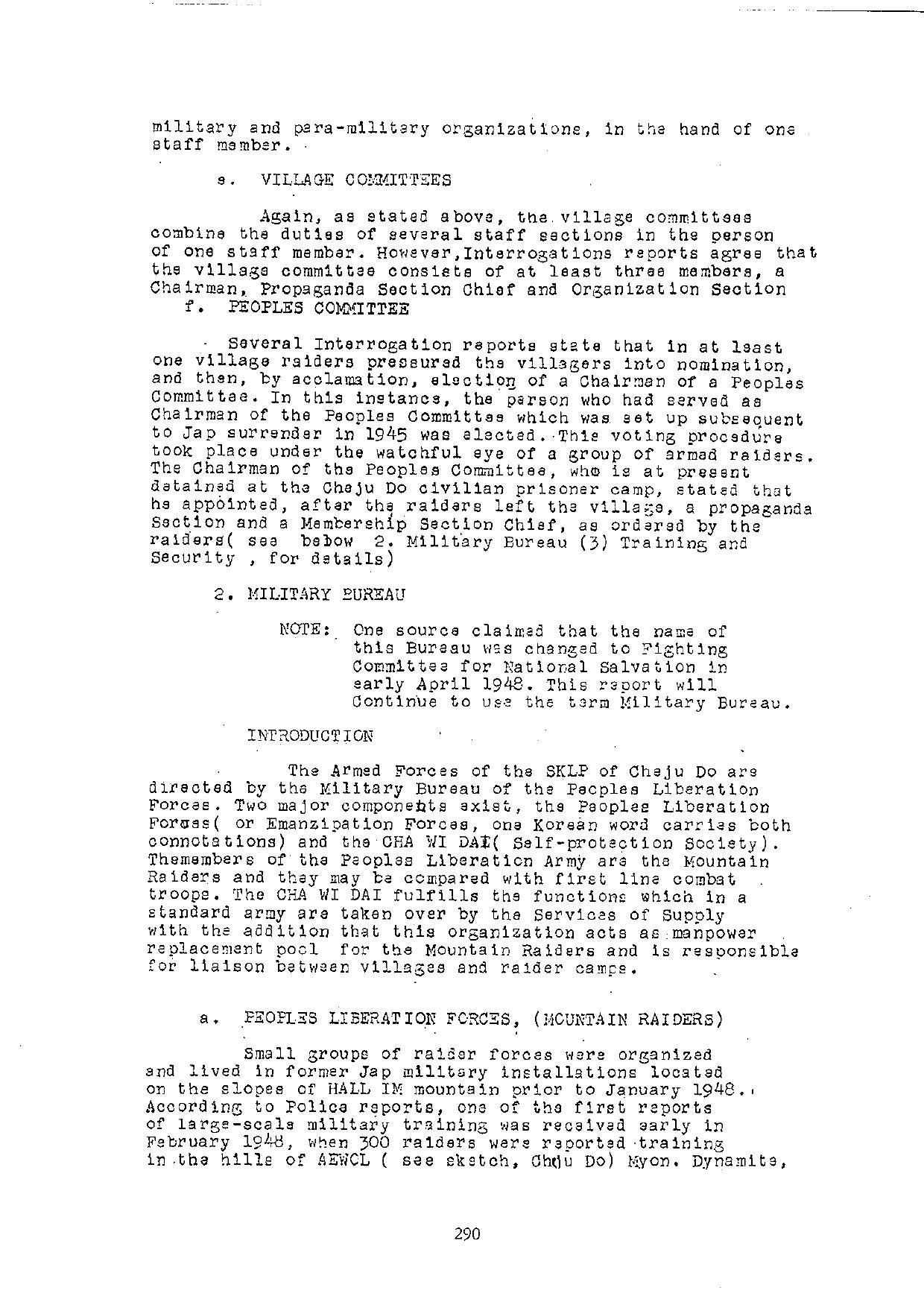
Myon Committees on Cheju Do are organized in the same manner as the top committee of the Island, with the functions of various staff sections, as in all lower echelon
military and para-military organizations, in the hand of one staff member.
e. VILLAGE COMMITTEES
Again, as stated above, the village committees combine the duties of several staff sections in the person of one staff member. However,Interrogations reports agree that the village committee consists of at least three members, a Chairman, Propaganda Section Chief and Organization Section
f. PEOPLES COMMITTEE
Several Interrogation reports state that in at least one village raiders pressured the villagers into nomination, and then, by acclamation, election of a Chairman of a Peoples Committee. In this instance, the person who had served as Chairman of the Peoples Committee which was set up subsequent to Jap surrender in 1945 was elected. This voting procedure took place under the watchful eye of a group of armed raiders. The Chairman of the Peoples Committee, who is at present detained at the Cheju Do civilian prisoner camp, stated that he appointed, after the raiders left the village, a propaganda Section and a Membership Section Chief, as ordered by the raiders( sea below 2. Military Bureau (3) Training and Security , for details)
2. MILITARY BUREAU
NOTE: One source claimed that the name of this Bureau was changed to Fighting Committee for National Salvation in early April 1948. This report will Continue to use the term Military Bureau.
INTRODUCTION
The Armed Forces of the SKLP of Cheju Do are directed by the Military Bureau of the Peoples Liberation Forces. Two major components exist, the Peoples Liberation Forces( or Emanzipation Forces, one Korean word carries both connotations) and the CHA WI DAI( Self-protection Society). Themembers of the Peoples Liberation Army are the Mountain Raiders and they may be compared with first line combat troops. The CHA WI DAI fulfills the functions which in a standard army are taken over by the Services of Supply with the addition that this organization acts as manpower replacement pool for the Mountain Raiders and is responsible for liaison between villages and raider camps.
a. PEOPLES LIBERATION FORCES, (MOUNTAIN RAIDERS)
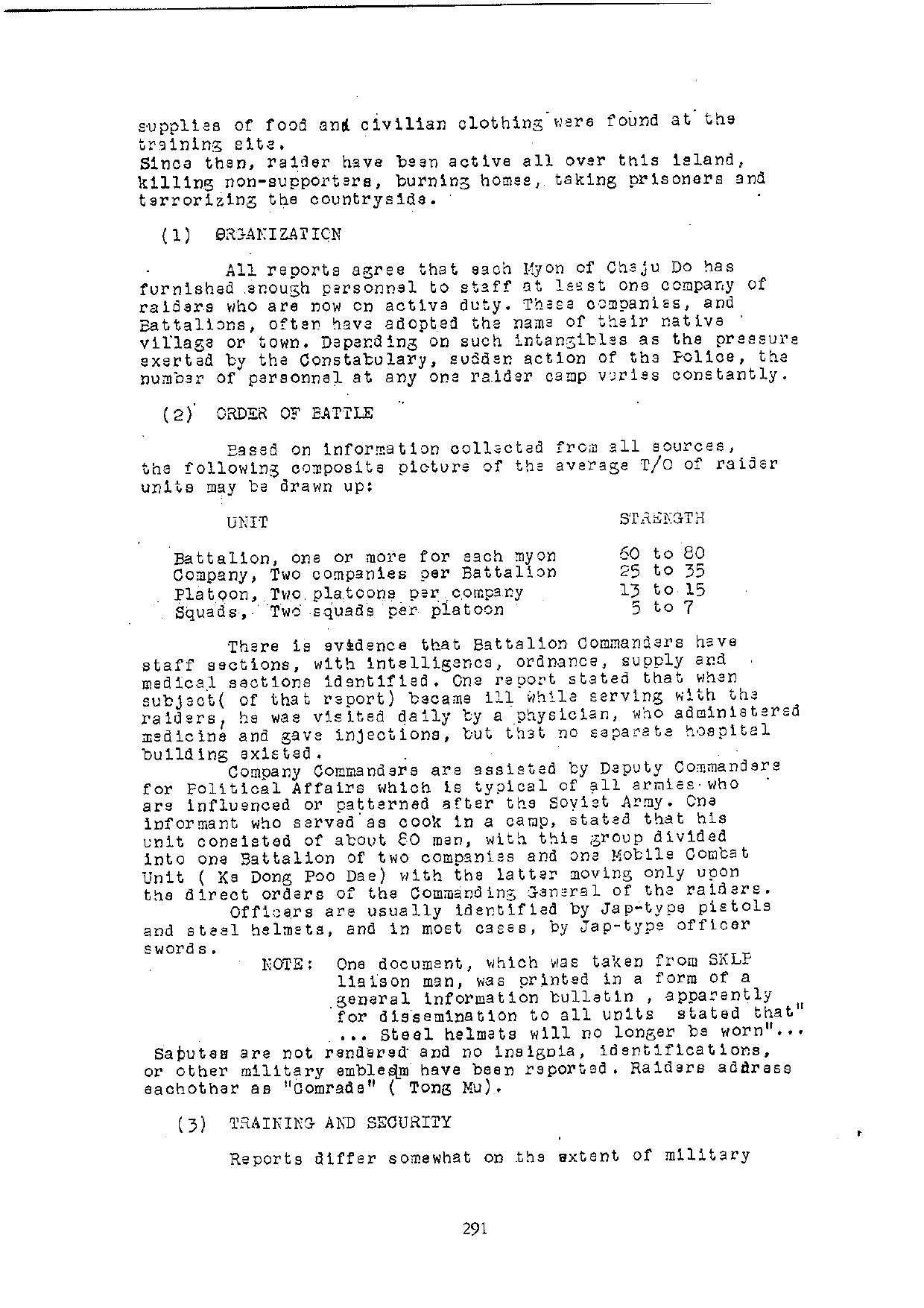
Small groups of raider forces were organized and lived in former Jap military installations located on the slopes of HALL IM mountain prior to January 1948. According to Police reports, one of the first reports of large-scale military training was received early in February 1948, when 300 raiders were reported training in the hills of AEWCL ( see sketch, Choju Do) Myon. Dynamite,
supplies of food and civilian clothing were found at the training site.
Since then, raider have been active all over this island, killing non-supporters, burning homes, taking prisoners and terrorizing the countryside.
(1) ORGANIZATION
All reports agree that each Myon of Cheju Do has furnished enough personnel to staff at least one company of raiders who are now on active duty. These companies, and Battalions, often have adopted the name of their native village or town. Depending on such intangibles as the pressure exerted by the Constabulary, sudden action of the Police, the number of personnel at any one raider camp varies constantly.
(2) ORDER OF BATTLE
Based on information collected from all sources, the following composite picture of the average T/O of raider units may be drawn up:
UNIT STRENGTH
Battalion, one or more for each myon 60 to 80
Company, Two companies per Battalion 25 to 35
Platoon, Two platoons per company 13 to 15
Squads, Two squads per platoon 5 to 7
There is evidence that Battalion Commanders have staff sections, with intelligence, ordnance, supply and medical sections identified. One report stated that when subject( of that report) became ill while serving with the raiders, he was visited daily by a physician, who administered medicine and gave injections, but that no separate hospital building existed.
Company Commanders are assisted by Deputy Commanders for Political Affairs which is typical of all armies who are influenced or patterned after the Soviet Army. One informant who served as cook in a camp, stated that his unit consisted of about 80 men, with this group divided into one Battalion of two companies and one Mobile Combat Unit ( Ks Dong Poo Dae) with the latter moving only upon the direct orders of the Commanding General of the raiders.
Officers are usually identified by Jap-type pistols and steel helmets, and in most cases, by Jap-type officer swords.
NOTE: One document, which was taken from SKLF liaison man, was printed in a form of a general information bulletin , apparently for dissemination to all units stated that" ... Steel helmets will no longer be worn"...
Salutes are not rendered and no insignia, identifications, or other military emblem have been reported. Raiders address eachother as "Comrade" ( Tong Mu).
(3) TRAINING AND SECURITY
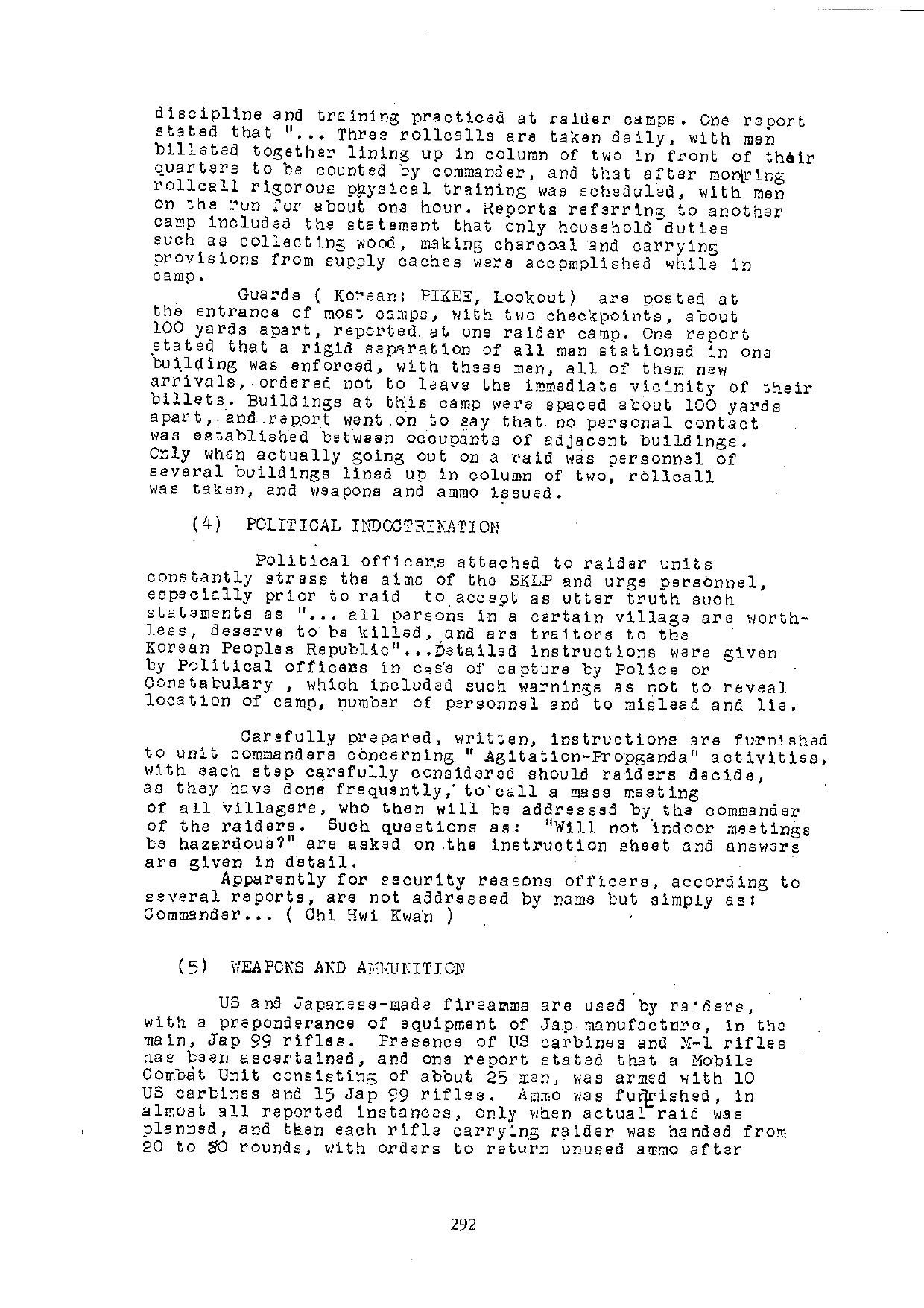
Reports differ somewhat on the extent of military
discipline and training practiced at raider camps. One report stated that "... Three rollcalls are taken daily, with men billeted together lining up in column of two in front of their quarters to be counted by commander, and that after morning rollcall rigorous physical training was scheduled, with men on the run for about one hour. Reports referring to another camp included the statement that only household duties such as collecting wood, making charcoal and carrying provisions from supply caches were accomplished while in camp.
Guards ( Korean: PIKEI, Lookout) are posted at the entrance of most camps, with two checkpoints, about 100 yards apart, reported at one raider camp. One report stated that a rigid separation of all men stationed in one building was enforced, with these men, all of them new arrivals, ordered not to leave the immediate vicinity of their billets. Buildings at this camp were spaced about 100 yards apart, and report went on to say that no personal contact was established between occupants of adjacent buildings. Only when actually going out on a raid was personnel of several buildings lined up in column of two, rollcall was taken, and weapons and ammo issued.
(4) POLITICAL INDOCTRINATION
Political officers attached to raider units constantly stress the aims of the SKLP and urge personnel, especially prior to raid to accept as utter truth such statements as "... all persons in a certain village are worthless, deserve to be killed, and are traitors to the Korean Peoples Republic"...Detailed instructions were given by Political officers in case of capture by Police or Constabulary , which included such warnings as not to reveal location of camp, number of personnel and to mislead and lie.
Carefully prepared, written, instructions are furnished to unit commanders concerning " Agitation-Propaganda" activities, with each step carefully considered should raiders decide, as they have done frequently, to call a mass meeting of all villagers, who then will be addressed by the commander of the raiders. Such questions as: "Will not indoor meetings be hazardous?" are asked on the instruction sheet and answers are given in detail.
Apparently for security reasons officers, according to several reports, are not addressed by name but simply as: Commander... ( Chi Hwi Kwan )
(5) WEAPONS AND AMMUNITION
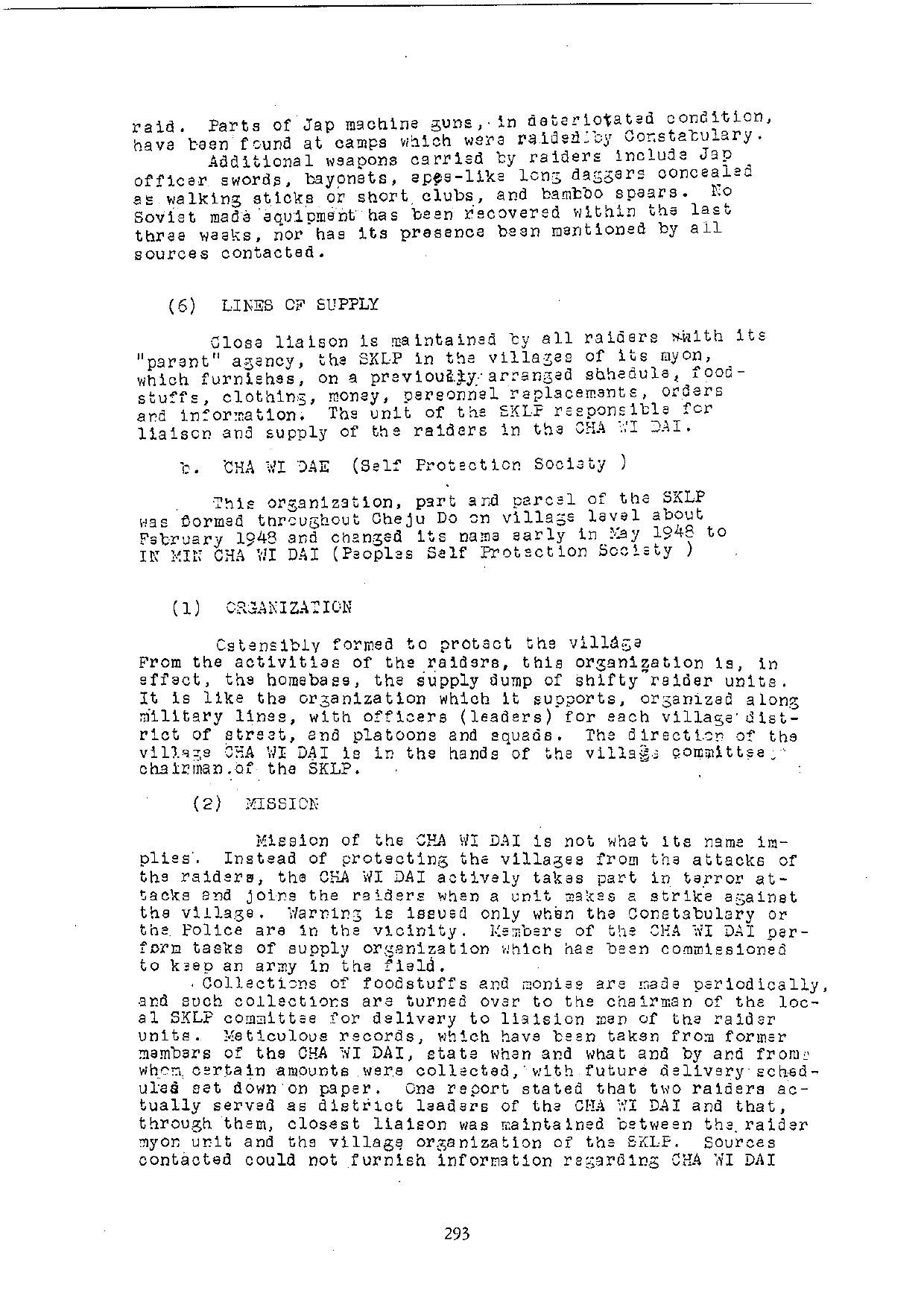
US and Japanese-made firearms are used by raiders, with a preponderance of equipment of Jap manufacture, in the main, Jap 99 rifles. Presence of US carbines and M-1 rifles has been ascertained, and one report stated that a Mobile Combat Unit consisting of about 25 men, was armed with 10 US carbines and 15 Jap 99 rifles. Ammo was furnished, in almost all reported instances, only when actual raid was planned, and then each rifle carrying raider was handed from 20 to 50 rounds, with orders to return unused ammo after
raid. Parts of Jap machine guns, in deteriorated condition, have been found at camps which were raided by Constabulary. Additional weapons carried by raiders include Jap officer swords, bayonets, epes-like long daggers concealed as walking sticks or short clubs, and bamboo spears. No Soviet made equipment has been recovered within the last three weeks, nor has its presence been mentioned by all sources contacted.
(6) LINES OF SUPPLY
Close liaison is maintained by all raiders with its "parent" agency, the SKLP in the villages of its myon, which furnishes, on a previously arranged schedule, foodstuffs, clothing, money, personnel replacements, orders and information. The unit of the SKLP responsible for liaison and supply of the raiders in the CHA WI DAI.
b. CHA WI DAE (Self Protection Society )
This organization, part and parcel of the SKLP was formed throughout Cheju Do on village level about February 1948 and changed its name early in May 1948 to IN MIN CHA WI DAI (Peoples Self Protection Society )
(1) ORGANIZATION
Ostensibly formed to protect the village From the activities of the raiders, this organization is, in effect, the homebase, the supply dump of shifty raider units. It is like the organization which it supports, organized along military lines, with officers (leaders) for each village district of street, and platoons and squads. The direction of the village CHA WI DAI is in the hands of the village committee chairman of the SKLP.
(2) MISSION
Mission of the CHA WI DAI is not what its name implies. Instead of protecting the villages from the attacks of the raiders, the CHA WI DAI actively takes part in terror attacks and joins the raiders when a unit makes a strike against the village. Warning is issued only when the Constabulary or the Police are in the vicinity. Members of the CHA WI DAI perform tasks of supply organization which has been commissioned to keep an army in the field.
Collections of foodstuffs and monies are made periodically, and such collections are turned over to the chairman of the local SKLP committee for delivery to liaison men of the raider units. Meticulous records, which have been taken from former members of the CHA WI DAI, state when and what and by and from whom certain amounts were collected, with future delivery schedules set down on paper. One report stated that two raiders actually served as district leaders of the CHA WI DAI and that, through them, closest liaison was maintained between the raider myon unit and the village organization of the SKLP. Sources contacted could not furnish information regarding CHA WI DAI
organization on myon level. All agree that up to this date, only village and district (within village) organizations seem to be functioning.
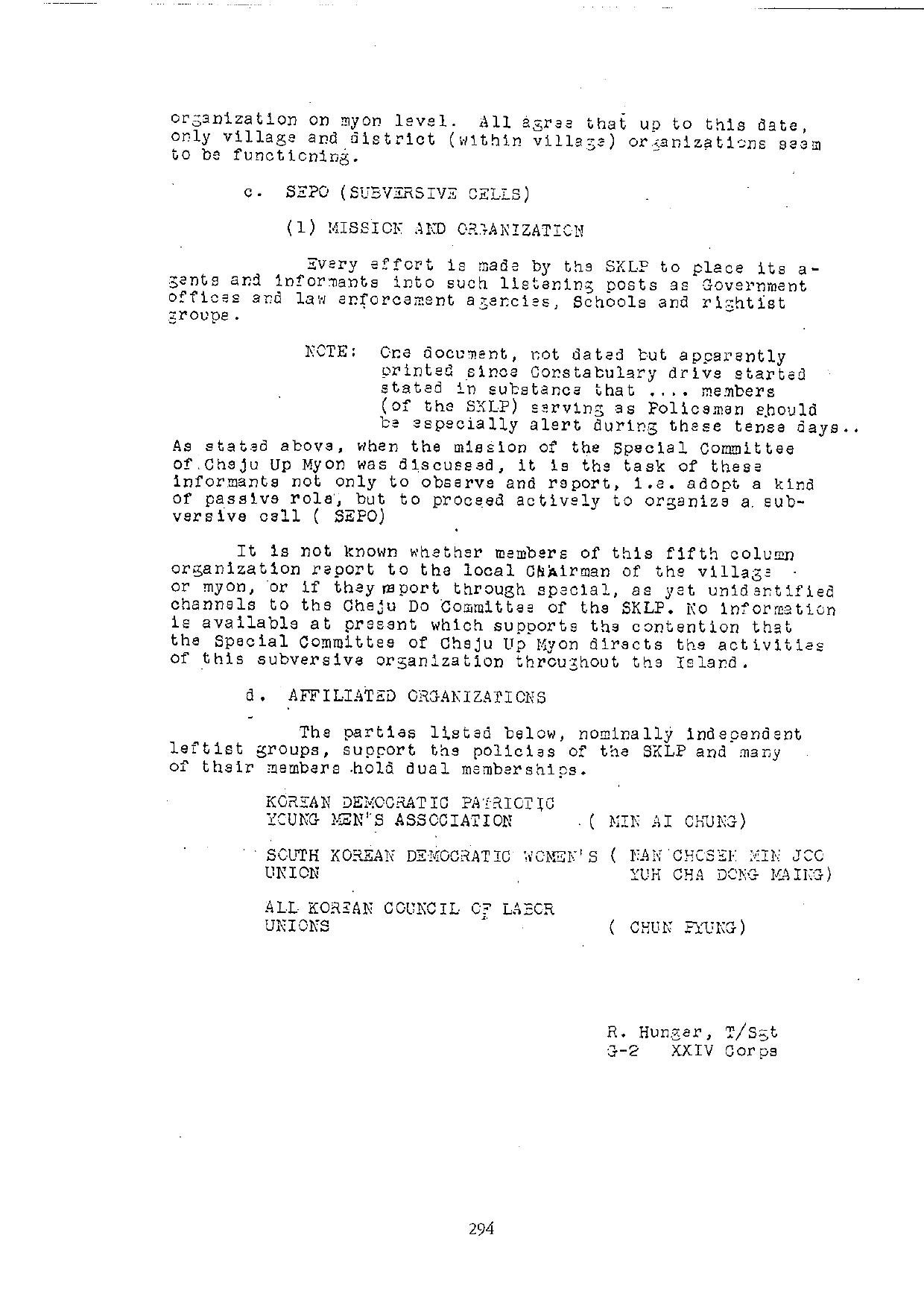
c. SEPO (SUBVERSIVE CELLS)
(1) MISSION AND ORGANIZATION
Every effort is made by the SKLP to place its agents and informants into such listening posts as Government offices and law enforcement agencies, Schools and rightist groupe.
NOTE: One document, not dated but apparently printed since Constabulary drive started stated in substance that .... members (of the SKLP) serving as Policemen should be especially alert during these tense days..
As stated above, when the mission of the Special Committee of Cheju Up Myon was discussed, it is the task of these informants not only to observe and report, i.e. adopt a kind of passive role, but to proceed actively to organize a subversive cell ( SEPO)
It is not known whether members of this fifth column organization report to the local Chairman of the village or myon, or if they report through special, as yet unidentified channels to the Cheju Do Committee of the SKLP. No information is available at present which supports the contention that the Special Committee of Cheju Up Myon directs the activities of this subversive organization throughout the Island.
d. AFFILIATED ORGANIZATIONS
The parties listed below, nominally independent leftist groups, support the policies of the SKLP and many of their members hold dual memberships.
KOREAN DEMOCRATIC PATRIOTIC YOUNG MEN'S ASSOCIATION ( MIN AI CHUNG)
SOUTH KOREAN DEMOCRATIC WOMEN'S ( MAN CHOSEN MIN JOO UNION YUH CHA DONG MAING)
ALL KOREAN COUNCIL OF LABOR UNIONS ( CHUN FYUNG)
R. Hunger, T/Sgt
G-2 XXIV Corps
ORGANIZATION OF SOUTH KOREAN LABOR PARTY, CHEJU DO
CHOLLA NAMDO COMMITTEE
CHEJU DO COMMITTEE
MILITARY BUREAU
KOREAN DEM.PAT. SK DEM.WOMENS ALL KOR
COUNCIL
Y.M. ASS'N. UNION LABOR U
CHEJU UP MYON CHEJU UP MYON
SPECIAL COM. GENERAL COM. GUN GUN GU
(SEPO)
OHA WI DAI PEOPLES LIBERATION
FORCES
MYON COMPANY(S),Bn's
MYON COMPANY(S),Bn's
MYON COMPANY(S),Bn's
ONE UNIT FOR EACH MYON
AEWOL MYON MYON MYON MYO
COMMITTEE
CHOCHAN MYON
COMMITTEE
VILLAGE
VILLAGE
VILLAGE
ANDOK MYON
COMMITTEE
ONE COMMITTEE FOR
EACH MYON
VILLAGE VILLAGE VI
DISTRICT
DISTRICT
VILLAGE COMMITTEE
VILLAGE COMMITTEE
CHEJU DO PROVINCE
CHUJA
MYON
CHEJU CITY
CHEJU-UP CHOCHAN KUJWA
MYON MYON MYON
NORTH-CHEJU
GLLN SONGSAN
AEWOL MYON
MYON POSUN
MYON
HALLIM SOUTH-CHEJU
MYON
GUN NAMWON
ANDOK SOKWI MYON
TAEJONG MYON CHUNGMUN MYON
MYON MYON
GUN BOUNDARY
5 0 1 2 3 4 5
MILES
(APPROX.)
출처:
제주4·3사건진상규명및희생자명예회복위원회 편,
『제주4·3사건자료집 9』 [미국자료편],
번역문 p.38
/ 원문 p.282–295.
×
![]()