주한미사절단 및 주한미대사관
급송문서 (358) 제주도 시찰에 관한 유엔한국위원단 보고서
급송문서 (358) 제주도 시찰에 관한 유엔한국위원단 보고서
1949-06-17
· 보고일 1949-06-17
미대사관
American Mission in Korea & American Embassy in Korea
1949년
5·10총선
6월
경찰
군사작전
귀순
귀순·생포
남로당
드럼라이트
모슬포
무장대
미군정
반란
봉기
부대교대
서귀포
서북청년단
서울
선거
성산포
소요
수감
수용소
식량·구호
유엔
인민위원회
일본군귀환
전투·사상
정기보고
제주도
제주읍
좌익
주민소개
주한미사절단 및 주한미대사관
진압
청년단
테러
토벌
포로
피난민
하지
한국전쟁
주한미대사관
제목: 제주도 시찰에 관한 유엔한국위원단 보고서 가운데 발췌 송달
대사는 제주도의 실정에 관한 주제로 대사관으로부터 다양한 통신수단을 이용해 언급하고 있고, 1949년 5월 8일부터 14일까지 제주도에 대한 위원단 제2분과위원회가 작성한 여행보고서를 구체화한 1949년 6월 9일의 유엔한국위원단의 보고서에서 발췌한 사본을 국무부 정보용으로 동봉하게 돼 영광입니다. 제2분과위원회 위원들은 대한민국 정부의 초청으로 1949년 5월 10일 2개 선거구에서 시행한 재선거를 시찰하기 위해 제주도를 방문했습니다. 주한미육군사령관은 분과위원회 위원들에게 제주행 무료항공편을 제공했습니다.
동봉된 보고서가 분과위원회 의원들이 제주도에 있는 동안 분과위원회의 활동과 시찰결과를 충분하게 설명하고 있다는 것이 대사관의 견해입니다.
제주도를 장악하기 위해 오랫동안 노력을 기울여온 공산주의자들이 추구한 테러와 파괴에 대한 분과위원회의 설명에 특별한 관심이 모아집니다. 이런 노력은 정말 아슬아슬하게 실패했습니다. 분과위원회는 보고서에서 섬의 불운한 도민들을 대상으로 공산주의자들이 꾸민 대파괴와 비참함을 지적하고 있으나 제주도에 대한 짧은 방문으로 완전히 잿더미가 된 수백개의 마을과 비참한 수용소에 몰려있는 수천명의 불행한 피난민들, 그리고 경작되지도 사람이 살지도 않는 수많은 경작지의 모습이 있는 제주도의 실제 상황을 얻을 수 없습니다.
드럼라이트(Drumright)
국무부에 원본 전송
도쿄 미 정치고문관에게 사본 전송
모스크바 미대사관에 사본 전송
첨부문서: 1949년 6월 9일자 유엔한국위원단 보고서 발췌
<첨부문서> 최근 소요로 영향을 받은 지방여행 보고서 (1949. 6. 17. 보고)
주한미대사관의 1949년 6월 17일자 <급송문서> 제358호에 동봉
유엔한국위원단(발췌) 1949. 6. 9 A/AC.26/SC.2/15
제2분과위원회
최근 소요로 영향을 받은 지방 여행 보고서
(전략)
제주도 여행
1) 1949년 5월 10일 북제주군에서 실시한 선거를 시찰하고 일반 상황을 연구하기 위해 분과위원회는 (한)반도의 땅끝에서 약 30마일 정도 떨어진 제주도에 제2차로 주요 시찰반을 조직했다. 또한 퀠파트로 알려진 120평방마일 크기의 이 섬은 약 900년전 한국의 한 부분이 됐다. 대한해협 남쪽 그리고 일본의 남부와 중국의 북부 해안에 위치한 제주도의 전략적 중요성은 명백하며 제2차 세계대전 기간에 중요한 일본군 군사기지였다. 최근의 인구추계를 보면 도청 소재지인 제주읍에 약 3만여 명이 거주하는 것을 포함해 거의 30만 명의 인구가 살고 있다. 섬 주민들의 주요 직업은 농업과 어업, 목축업이다. 주민들은 매우 근면하고 자립심이 강하다. 그러나 섬나라 근성과 외부세계와의 문화교류 결핍 때문에 지역경제와 토착문화 체제는 두드러지고 강한 지방색이 눈에 띈다.
2) 일본 지배로부터 해방된 뒤 제주도에 인민위원회가 조직됐다. 이는 아마도 공산주의 지도자들의 영향으로 세워졌을 것이다. 미군의 뒤늦은 진주와 군정기간 제주도에서의 비효율적인 행정 때문에 공산주의자들에게 전지역 장악을 시도할 기회를 줬다고 한다.
공산주의 활동을 억제하기 위한 뒤늦은 엄격한 조처로 인해 1948년 4월 3일 정부 기관들에 대한 공개적인 저항이 일어나게 됐다. 소요가 점차 확대되고 5월 10일 선거를 위한 선거등록 기간이나 선거일 당일에 폭력이 확대됐다. 등록 유권자의 50% 미만이 투표를 했기 때문에 북제주군의 선거는 무효화됐다. 소요는 많은 지역에서 일어났고 반도들의 주요 활동은 분과위원회가 그곳에 가기 수주일 전인 1949년 4월까지 진압되지 않았다.
3) 연락위원회 장기영 위원이 수행하고 한국인 통역사 2명을 포함한 프랑스 대표 코스틸(Henry Costilhes), 인도대표 싱(Anup Singh), 사무국 직원 6명으로 구성된 시찰단은 5월 8일 오전 수송기편으로 서울을 출발했다. 중국과 필리핀 대표들은 협의차 자국 정부가 소환했기 때문에 참가할 수 없었다. 4월 제주에 착륙하지 못한 시찰단에 포함됐던 중국 대리대표는 건강상의 문제로 참가할 수 없었다. 궂은 날씨 때문에 일행은 5월 12일 계획대로 돌아올 수 없었다. 대신 선박편과 열차편으로 5월 14일 서울로 돌아왔다. 제주비행장에 도착하자마자 지사와 군사령관, 경찰청장, 기타 관리들과 환호하는 군중들이 일행을 영접했다. 도지사 관사가 시찰단의 숙소가 됐다. 오후 늦게 위원단을 환영하기 위한 대규모 집회가 제주읍 광장에서 열렸고, 공식만찬이 이어졌다. 도지사와 애국부인회 대표가 환영사를 낭독했고 프랑스와 인도대표가 이에 답사를 했다.
5월 9일 오전 시찰단은 여러 지역의 선거와 일반 상황을 시찰하기 위해 2개반으로 나눴다.
4) 사무국 직원 3명과 함께 인도 대표가 이끄는 제1반은 제주읍과 인근 지역의 선거를 감시하고 제주읍 주변의 상황을 시찰하기 위해 제주읍에 잔류했다.
선거 전날 제1반은 4,800여 명의 인구를 가진 주요 어업기지인 추자도를 방문했다. 시찰단은 면장과 일부 주민들로부터 통일에 대한 주민들의 열렬한 염원을 들었다. 이와 관련해 그들은 주민들의 중요한 생계수단인 야간 어로작업에 필요한 카바이드가 매우 부족해 공급이 절박하다고 강조했다. 연간 300드럼의 카바이드가 필요하다. 그러나 카바이드의 주요 공급원은 38선 이북으로 국토분단 때문에 공급이 크게 제한되고 있다.
5) 선거 당일 도지사와 경찰국장이 수행한 제1반은 읍내 일원의 투표소를 둘러보았다. 갑 선거구에는 11곳의 투표소가 있었고 오전 7시부터 오후 4시까지 개방됐다. 주민들은 선거를 심각하게 받아들이는 것 같았다. 즉 등록 유권자의 60%가 정오까지 투표소를 다녀갔다. 투표는 질서정연하게 실시됐다.
6) 제1반은 다음날 수용소와 제주주정공장을 방문했다. 수용소에는 2,000여명의 수감자가 오래된 창고에서 살고 있는 것이 발견됐다. 여성숫자가 남성보다 대략 3대1정도로 많았고 팔에 안긴 아기들과 어린이들도 많았다. 이들은 반도들과 오름에 숨어 있었다. 수용소장에 따르면 수감자의 90%가 귀순했고 나머지는 한국군이 체포했다. 바로 며칠전 붙잡힌 반도들을 상대로 질문을 던졌다. 2명은 자신들이 반도쪽에 가담하게 된 이유를 설명했다. 한 어린 소년은 자신이 무엇을 하는지 인식하지 못한 채 협박을 받고 남로당에 들어갔다고 말했다. 30살이 넘은 솔직한 성격의 이동원은 해방 뒤에 만연한 상황에 불만을 갖고 있던 차에 제주도로 오기 전 인천에서 남로당원이 돼 1948년 6월 산에서 반도쪽에 가담했다. 자신은 공산주의자가 아니며 오직 남로당만이 한국문제를 해결할 수 있다고 힘주어 말했다. 그는 경찰과 군을 비난하면서 이들이 인민의 복지를 위해 진지하게 일하고, 정부가 진실로 한국의 완전한 주권을 주장했더라면 반란이 없었을 것이라고 말했다.
시찰단의 질문에 응하면서 나이든 수감자는 반도들이 자신의 마을을 습격한 뒤 그들과 함께 도피해야 했던 비극적인 상황에 빠진 이유를 설명했다. 이것이 도피했다가 다시 돌아온 다른 많은 수감자들의 사례일 것이다.
제주주정공장은 진주만(진주만 기습작전: 역주) 바로 전에 일본인들이 건설해 당시 매달 1,000석의 상품을 내놓았다. 해방 뒤 대한민국 정부가 수립되자 공장은 적산이 된 뒤 상공부의 통제하에 들어갔다. 생산품은 석탄과 숙련 기술자들의 부족으로 감소했고 현재 전쟁 전 수치의 50%에 그치고 있다. 주정을 만드는 데 사용되는 기본원료는 제주도에서 재배한 고구마다. 그러나 공장은 원래 북한으로부터 들여오는 석탄공급량이 부족에 직면해 있다. 주정 제조와 함께 이 공장은 제주읍에서 현재 소비하는 전력의 3분의 2를 생산했다. 공장장은 시찰단에게 남북통일이 이뤄지면 공장은 고품질의 석탄과 전력을 충분하게 공급받을 수 있을 것이라고 말했다.
제주에 주둔하고 있는 한국군의 작전에 관한 추가 정보를 얻기 위해 제1반은 유 대령의 참모본부와 산간지역에 있는 작전본부를 방문했다. 소탕작전을 완수하기 위해 1949년 3월 서울에서 파견됐던 유 대령은 나중에 위원단의 위원들과 함께 서울로 돌아왔다. 그는 3월 25일부터 4월 12일 사이에 반도들의 사상자 수는 2,345명이고 군은 3,600명을 포로로 잡았다고 밝혔다. 이 기간 민간인의 전체 사망자는 1,668명이었다. 제주도에서 공산주의의 기본 요인들이 제거됐는지의 여부를 묻자 유 대령은 신뢰할 만한 답변을 할 수 없다고 말했다. 그러나 그는 현재 참회를 하고 투항한 반도들을 아무런 조처없이 그대로 놔둔다면 더욱 소요를 야기할 것이라고 보고 있다. 그는 신생 공화국이 심각한 재정곤란에 직면한 것을 알고 있지만 그럼에도 불구하고 복구사업이 정부의 책임이라는 점을 강조했다.
7) 시찰단이 서울로 귀경하기 전 북제주군의 선거 결과가 발표됐다. 결과에 따르면 갑 선거구에서는 등록 유권자의 97%가 투표를 했고 을 선거구에서는 등록 유권자의 99%가 투표에 참가했다. 각 선거구별로 7명씩이 입후보했다. 갑 선거구의 당선자인 국민회(이 대통령이 이끄는 대한독립촉성국민회) 회원 홍순녕과 을 선거구의 당선자인 한국독립당 당원 출신인 양병직이 무소속으로 출마했다. 홍과 양 등 2명은 제주도에서 나고 평생을 그곳에서 살았으며, 5월 12일 오후에 위원단 위원들을 방문했다. 대학 출신이며 10여년 이상 제주읍내의 여학교 교장을 역임한 홍씨는 복구사업의 큰 문제점들을 역설했다. 그는 폭동과 많은 지역에의 불가능한 농사짓기, 대량의 보리 소실, 주로 북한에서 들어오는 비료의 부족 때문에 제주도에는 식량이 극히 부족하다는 사실을 지적했다. 제주도의 구호민들을 위해 미곡 6만석이 들어오지 않는 한 많은 사람들이 10월 추수 전에 기아에 직면할 것이다. 청년운동과 지역문제에 관심을 갖고 있는 양씨는 현재 아무런 정당에도 속하지 않았다고 주장했다. 그는 4월 폭동 전에 공산주의자들이 활동했다고 말했다. 경찰의 소심성으로 많은 마을과 주택들이 습격이 개시됐을 때 무방비 상태에 놓여 있었다.
반도들은 주민들에게 자신들을 따라 산으로 가도록 강요했고 대부분의 경우 경찰에 체포되는 것을 두려워한 가족들이 아버지를 따라가는 것을 선택했다. 그는 주민들이 경찰을 존경하지만 일부 주민들은 은밀히 반도들을 도와주고 있다고 생각했다. 제주도가 비교적 안전을 회복했지만 아직도 500여명의 반도들이 산속에 숨어 있다고 믿었다. 그는 제주도의 재건에 정부의 책임과 공산주의에 대한 예방수단으로 교육체계 개선의 중요성을 역설했다.
8) 분과위원회의 결정에 따라 분과위원장 및 사무국 간사와 사무국의 다른 2명의 직원으로 구성된 제주도를 방문중인 제2반은 지프로 섬 주위를 답사했다.
내무부장관과 제주의 행정기관에 최소한의 경찰호송만 하고 공식영접을 생략하도록 여러 차례 요청했음에도 불구하고 제2반은 1대의 트럭에 가득찬 경찰이 선도하고 경찰이 탄 지프가 뒤따르는데 합의했다. 시찰단이 마을에 이를 때는 언제나 그 마을의 모든 주민들로 보이는 사람들이 길가에 줄을 지어 국기를 흔들고 환호하면서 영접했다. 모든 마을의 입구는 똑같은 환영포스터와 한국의 통일에 관한 구호로 장식돼 있었다. 창을 든 보초들과 교대로 경찰관들이 모든 도로를 따라 서 있었다. 한국인 관리들의 열성과 환대, 세심한 보안책 때문에 시찰단은 완전한 행동의 자유와 융통성 있는 시찰일정을 갖는 데 어렵게 했다. 시찰단은 제주읍에서 30여 마일 떨어진 소규모 항구가 있는 애월리에서 엔진이 꺼진 경찰지프를 기다리기 위해 처음으로 정차했다. 이 기회를 이용해 항구와 현지 투표소를 방문했다. 일행은 선거관리위원장의 환영을 받고 현재 선거에 관한 정보뿐 아니라 지난해 선거에 대한 기억들을 서로 나누었다.
오후 조금 지나 시찰단은 좋은 항구와 일본인이 건설한 큰 비행장이 있는 모슬포에 도착했다. 면장과 경찰서장, 기타 유지들이 시찰단에게 오찬을 대접했다. 한국인 관리들은 시찰단 위원들과 대화를 하는 과정에서 이 면의 곤궁과 면을 무역기지로 발전시킬 가능성 등 2가지 점을 강조했다.
제주도의 남쪽 해안 중심지에 위치한 서귀포로 가는 도중 시찰단은 부분적으로 파괴된 마을의 숫자가 점점 증가하는 것을 목격했다. 이들 가운데 일부 마을은 완전히 불에 타 없어졌다. 모든 거주지역은 현재 제주도의 돌로 알려진 화산암석으로 느슨하게 쌓여진 석성으로 둘러싸여 있다. 마을입구에는 보초를 서고 야간에는 폐쇄됐다. 가장 충격적인 장면은 강정리에서 보였다. 강정리는 모든 주택이 전소됐고 남녀노소가 복구작업을 벌이고 있었다.
일행은 어스름해지기 전에 서귀포에 도착했다. 여관 숙박시설이 빈약하고 군수의 강요로 일행은 그 지역에서 이틀 동안 군수 집에서 유숙했다. 첫날 저녁 위원들은 만찬회와 환영회에 참석했으며, 모든 지방관리와 유지들이 참석했다. 군수가 환영사를 하고 코스틸이 시찰단을 대표해 답사했다.
9) 다음날 오전 일행은 대부분의 시간을 서귀포 지역의 여행에 소비했다. 군수에 따르면 서귀리는 1948년 10월 반도들의 첫 습격과 11월의 재차 습격으로 고통을 겪었다. 교전과정에서 주택 190채가 불에 탔다. 지금도 폐허가 보인다. 민간인과 경찰, 반도의 사상자수는 수백여 명에 이르렀다. 우선 일행은 수용소를 방문했다.
남녀노소, 이들 가운데 수백명이 2개의 개별 집에 모여있다. 다시 말해 한곳은 이미 심사를 받은 사람들이고 나머지 한곳은 아직 조사를 받고 있는 사람들이 있었다.
일행은 많은 마을을 방문하기 위해 더욱 산간지역까지 내륙으로 몇 마일 차를 몰았다. 전날 여행과 같은 양식이 되풀이 돼 가는 곳마다 주민들이 전과 같은 대규모 환영행사를 위해 모였다. 해안지대와 산간지대 사이의 분기선에 위치해 있으며, 이 지역에서 가장 부유한 마을인 하예리는 반도들의 습격을 받지 않았다. 일행은 대부분의 마을에서와 같이 이 마을에서 가장 걸출한 건물인 학교를 방문했다. 교장은 일행을 영접하면서 많은 다른 지역의 경우와는 달리 학교선생들 가운데 아무도 반도쪽에 가담하거나 주모자가 된 사람이 없음을 지적하면서 자랑했다.
서귀포로 돌아오는 길에 시찰단은 해산물과 해초를 캐기 위해 잠수하는 약 100여 명이 되는 많은 해녀들을 보기 위해 멈췄다. 해산물과 해초는 모두 제주도 경제의 주요한 생산품이다.
10) 5월 11일 제주읍으로 돌아오다 일행은 옛 일본군 해군기지였던 성산리에 들렀다. 일행은 해안을 따라 있는 일본군 탄약 임시집적소였던 곳을 방문했고, 가동중인 통조림공장과 원료와 기술자 부족으로 현재 폐쇄된 염소(요오드)공장을 시찰했다. 면장은 현지 실정을 이야기하면서 그곳과 제주도 전지역의 일반적인 식량부족의 암울한 모습을 말했다. 두 번째로 제주읍에서 30마일 떨어진 북쪽 해안에 있는 동복리에 들렀다. 동복리는 1월 5일 완전히 파괴됐다. 동북쪽과 중남해안에 있는 마을들에 대한 파괴는 제주도내의 어떤 다른 지역보다 더 큰 것으로 보였다. 서귀포로부터 오는 도중 내내 일행은 마을에 들어가거나 지날 때마다 환호하는 군중들의 환영을 받았다. 오후에 일행은 제주읍에 도착했고 시찰단의 제1반과 재합류했다.
제주도 폭동의 원인과 결과
11) 단지 파괴와 폐허의 직접적인 시찰만으로도 정부가 직면한 복구문제의 중요성을 충분히 짐작할 수 있다. 반도들이 일으킨 파괴에 관한 공식 숫자로 시찰단 전체의 인상은 더욱 깊어졌다. 1949년 3월 25일부터 5월 12일까지의 인명 및 재산피해에 관한 통계는 없었다. 이 기간에 육군은 평정계획을 강화했다. 3월 25일까지 반도를 뺀 전체 민간인 사상자 수는 3,560명 이상에 이르렀다. 가재도구와 함께 전파됐거나 파손된 주택 숫자는 3만 3,489채를 넘었다. 이 파괴를 금액으로 환산하면 10억원 이상에 달했다. 봉기로 인한 가축 손실도 그만큼 컸다. 즉 소, 말, 돼지, 양 4만 6,000마리가 피해를 입어 피해액수는 10억원 이상에 이른다. 제주도에서 소요가 발생한 1년 동안 초등학교가 96개교에서 51개교로 줄었고 취학아동은 3만 5,701명에서 2만 7,205명으로 감소했다. 11개 중학교 가운데 2개교가 전소됐고 중학교 취학학생은 3,359명에서 3,258명으로 줄었다. 교사 17명이 폭도쪽에 가담했거나 지도했고 283명 이상의 학생들이 그들을 따랐다. 학교를 원상태로 복구하기 위해서는 5,500만원 이상이 필요할 것이다.
12) 제주도의 폭동과 소요의 주요 원인은 다양하다. 다음과 같은 이유들이 일반적으로 중요한 원인으로 인식된다.
⒜ 제주도가 원거리에 있을 뿐 아니라 전략적 요충지이기 때문에 남로당이 해방 후 자신들의 활동거점으로 선택했다.
⒝ 제주도의 궁핍한 경제상황이 극단주의자들의 정치적 활동을 위한 번식장소를 제공했다.
⒞ 본토와의 긴밀한 접촉이 결여돼 강력한 지방색을 초래했고 뒤이어 정부에 대한 불화를 조성했으며 소요를 야기했다.
⒟ 당국이 자발적이거나 강요에 의해 반도들과 도피한 주민들을 처벌하기 위해 무차별적으로 취한 조처는 반도 지도자들에게 정부에 대한 보다 큰 세력을 규합하는 기회를 제공했다.
13) 서북청년단이 제주도에 나타나 공산주의자들과 그 혐의자들을 색출하면서 경찰과 협력하자 충돌이 시작됐다. 그렇게 함으로써 서북청년단 회원들은 자신들의 권한을 넘어섰다. 공산주의자들과 그 혐의자들이 서북청년단원들로부터 심하게 폭행 당했다는 소문이 있다.
마을에서의 싸움과 파괴가 다소간 같은 양상을 띠었다. 처음에는 반도들과 경찰간의 싸움이었다. 그리고 나서 점차적으로 주민뿐 아니라 군대도 휩쓸려 들어갔다. 주민들은 협박을 받았거나 또는 당국의 보복이나 처벌을 피하기 위해 반도쪽에 가담했다. 양쪽이 파괴를 일으켰고 잔인성을 노출했다.
14) 위원단 위원들은 제주도 여행을 통해 불에 탔거나 소개됐던 마을들이 재건중에 있으며 이들 지역의 상황이 점차 정상화되고 있다는 증거를 얻게 됐다. 복구의 중대한 문제를 인식하고 통찰하기 위해 시찰해야만 했다.
시찰여행의 평가
15) 최근 소요가 일어난 2개 지역을 방문하면서 위원단은 파괴의 심각성과 복구문제의 절박성, 폭동으로 영향을 받은 정부조직의 범위를 직접 볼 기회를 가졌을 뿐 아니라 38선으로 인한 국토분단이 산업회복과 주민들이 생계에 영향을 끼친 정도를 연구하기 위한 좋은 기회를 가졌다.
16) 서울에서 멀리 떨어진 이들 지역에 위원단의 출현은 유엔의 이념을 보통사람들에게 전파하는데 도움을 줬고 그들로 하여금 일반적으로 유엔의 업무, 특히 위원단 임무를 이해하고 감사하도록 했다.
17) 시찰단에 참가했던 위원단 위원들은 자신들을 환영하고 환호하기 위해 연도에 모여든 대규모 군중들의 열광에 감명을 받았다. 한국 당국은 시찰단과 위원단 위원들이 여행도중 아무런 불편이 없도록 운송수단과 숙박시설을 마련하는 데 최선을 다했다. 지방 관청과 주민들의 환영회는 명백히 중앙집권화 된 행정의 존재와 이 조직의 비교적 효율적인 운영모습을 보여줬다.
18) 시찰단은 소요지역에서 치안질서가 회복되고 읍면지역의 생활이 정상으로 돌아갔음을 확인했다. 아직도 산간지역에 숨어있는 적은 수의 반도들은 2개 지방의 치안에 직접적인 위협이나 심각한 위협 요소가 되지 않았으며 정부 당국에 대한 도전 요소가 되지 않았다.
19) 효율적인 지방 행정기관이 수행할 잘 짜여진 복구계획과 주민들이 정부에 참여할 보다 큰 기회를 통해 그와 같은 폭동의 재발에 대한 대부분의 원인을 제거해야 한다.
20) 시찰단이 방문했던 모든 지역의 주민들은 한결같이 한국통일의 절박한 염원과 통일을 가져오기 위해 위원단에 커다란 신뢰를 표명했다. (후략)
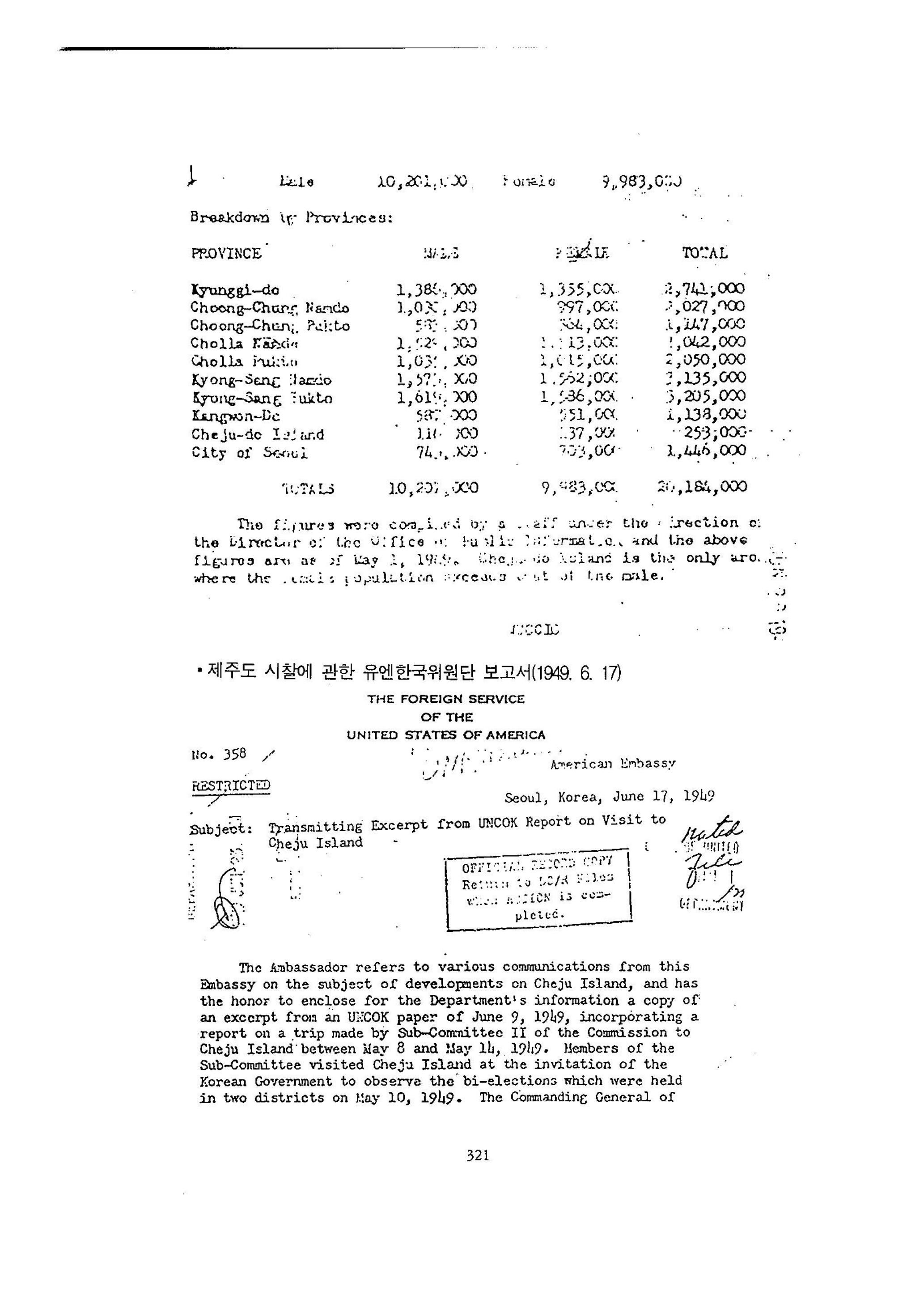
THE FOREIGN SERVICE
OF THE
UNITED STATES OF AMERICA
No. 358 [illegible] American Embassy
RESTRICTED
Seoul, Korea, June 17, 1949
Subject: Transmitting Excerpt from UNCOK Report on Visit to Cheju Island
OFFICIAL RECORD COPY
Return to LO/A Files
when ACTION is completed.
The Ambassador refers to various communications from this Embassy on the subject of developments on Cheju Island, and has the honor to enclose for the Department's information a copy of an excerpt from an UNCOK paper of June 9, 1949, incorporating a report on a trip made by Sub-Committee II of the Commission to Cheju Island between May 8 and May 14, 1949. Members of the Sub-Committee visited Cheju Island at the invitation of the Korean Government to observe the bi-elections which were held in two districts on May 10, 1949. The Commanding General of USAFIK provided the Sub-Committee members with free air transportation to Cheju Island.
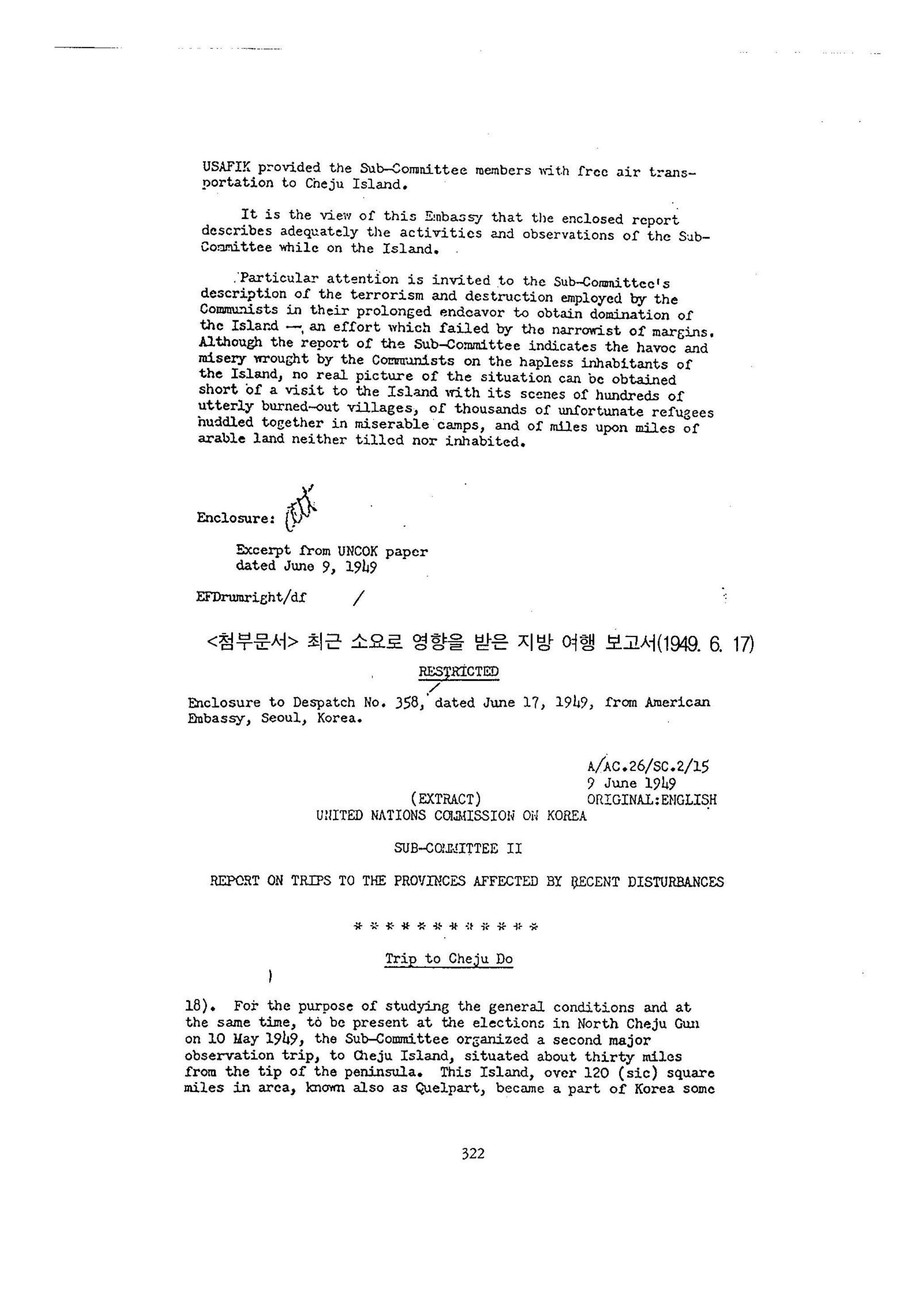
It is the view of this Embassy that the enclosed report describes adequately the activities and observations of the Sub-Committee while on the Island.
Particular attention is invited to the Sub-Committee's description of the terrorism and destruction employed by the Communists in their prolonged endeavor to obtain domination of the Island — an effort which failed by the narrowist of margins. Although the report of the Sub-Committee indicates the havoc and misery wrought by the Communists on the hapless inhabitants of the Island, no real picture of the situation can be obtained short of a visit to the Island with its scenes of hundreds of utterly burned-out villages, of thousands of unfortunate refugees huddled together in miserable camps, and of miles upon miles of arable land neither tilled nor inhabited.
Enclosure: (N
Excerpt from UNCOK paper
dated June 9, 1949
EFDrumright/df /
RESTRICTED
Enclosure to Despatch No. 358, dated June 17, 1949, from American Embassy, Seoul, Korea.
A/AC.26/SC.2/15
9 June 1949
(EXTRACT) ORIGINAL:ENGLISH
UNITED NATIONS COMMISSION ON KOREA
SUB-COMMITTEE II
REPORT ON TRIPS TO THE PROVINCES AFFECTED BY RECENT DISTURBANCES
* * * * * * * * * * * *
Trip to Cheju Do
)
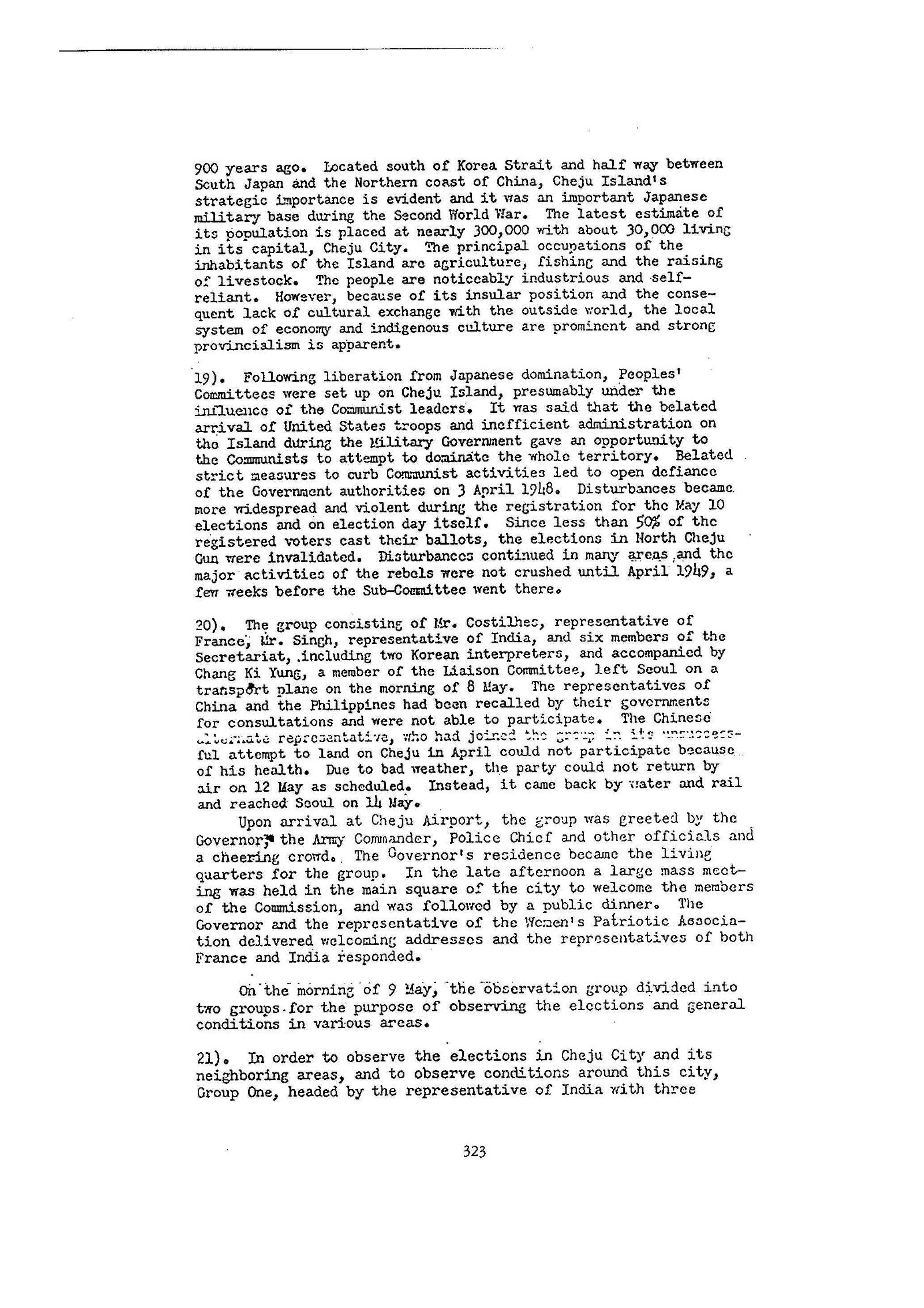
18). For the purpose of studying the general conditions and at the same time, to be present at the elections in North Cheju Gun on 10 May 1949, the Sub-Committee organized a second major observation trip, to Cheju Island, situated about thirty miles from the tip of the peninsula. This Island, over 120 (sic) square miles in area, known also as Quelpart, became a part of Korea some 900 years ago. Located south of Korea Strait and half way between South Japan and the Northern coast of China, Cheju Island's strategic importance is evident and it was an important Japanese military base during the Second World War. The latest estimate of its population is placed at nearly 300,000 with about 30,000 living in its capital, Cheju City. The principal occupations of the inhabitants of the Island are agriculture, fishing and the raising of livestock. The people are noticeably industrious and self-reliant. However, because of its insular position and the consequent lack of cultural exchange with the outside world, the local system of economy and indigenous culture are prominent and strong provincialism is apparent.
19). Following liberation from Japanese domination, Peoples' Committees were set up on Cheju Island, presumably under the influence of the Communist leaders. It was said that the belated arrival of United States troops and inefficient administration on the Island during the Military Government gave an opportunity to the Communists to attempt to dominate the whole territory. Belated strict measures to curb Communist activities led to open defiance of the Government authorities on 3 April 1948. Disturbances became more widespread and violent during the registration for the May 10 elections and on election day itself. Since less than 50% of the registered voters cast their ballots, the elections in North Cheju Gun were invalidated. Disturbances continued in many areas,and the major activities of the rebels were not crushed until April 1949, a few weeks before the Sub-Committee went there.
20). The group consisting of Mr. Costilhes, representative of France, Mr. Singh, representative of India, and six members of the Secretariat, including two Korean interpreters, and accompanied by Chang Ki Yung, a member of the Liaison Committee, left Seoul on a transport plane on the morning of 8 May. The representatives of China and the Philippines had been recalled by their governments for consultations and were not able to participate. The Chinese [illegible] representative, who had joined the group in its unsuccessful attempt to land on Cheju in April could not participate because of his health. Due to bad weather, the party could not return by air on 12 May as scheduled. Instead, it came back by water and rail and reached Seoul on 14 May.
Upon arrival at Cheju Airport, the group was greeted by the Governor, the Army Commander, Police Chief and other officials and a cheering crowd. The Governor's residence became the living quarters for the group. In the late afternoon a large mass meeting was held in the main square of the city to welcome the members of the Commission, and was followed by a public dinner. The Governor and the representative of the Women's Patriotic Association delivered welcoming addresses and the representatives of both France and India responded.
On the morning of 9 May, the observation group divided into two groups for the purpose of observing the elections and general conditions in various areas.
21). In order to observe the elections in Cheju City and its neighboring areas, and to observe conditions around this city, Group One, headed by the representative of India with three
--- p334 ---
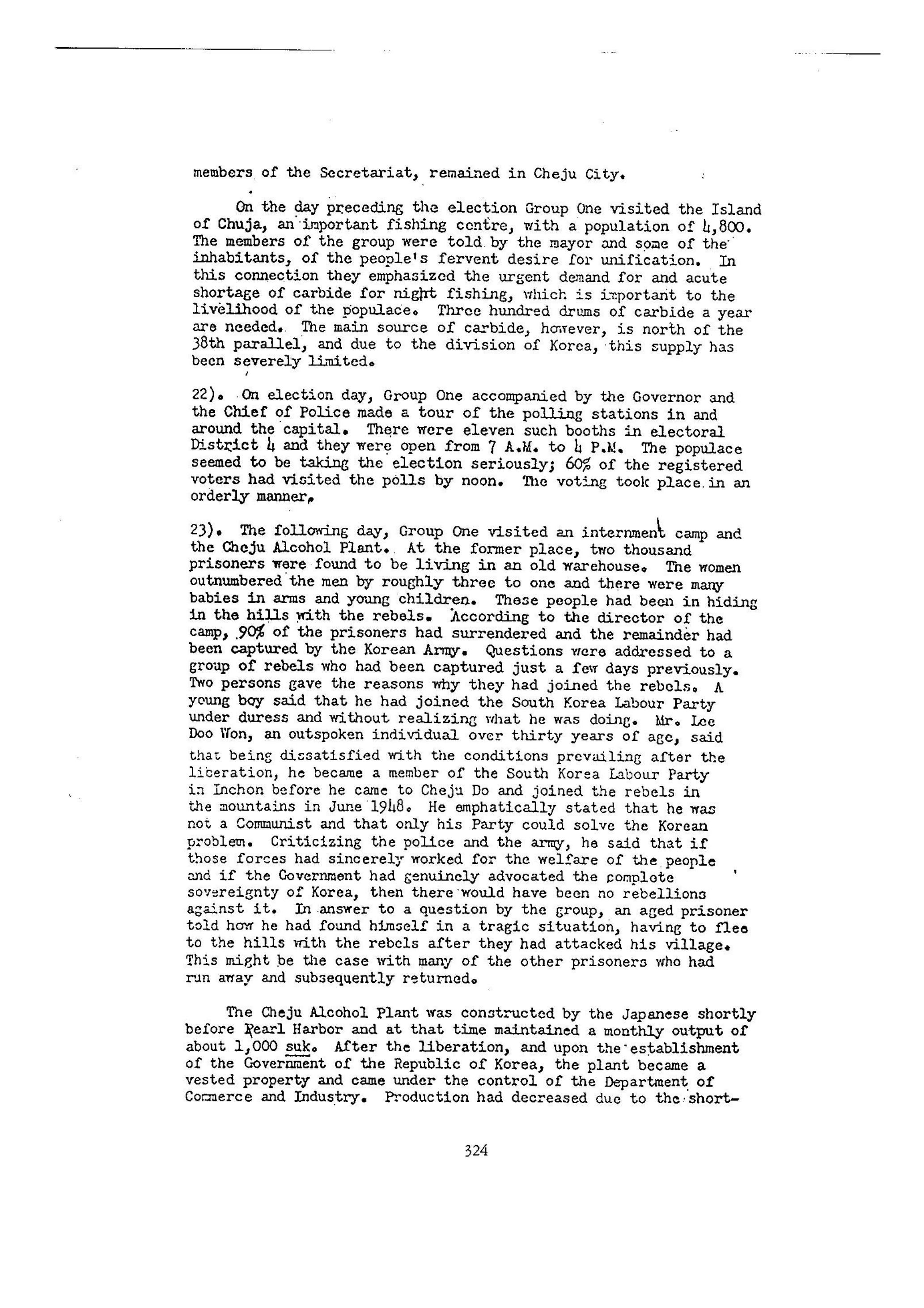
members of the Secretariat, remained in Cheju City.
On the day preceding the election Group One visited the Island of Chuja, an important fishing centre, with a population of 4,800. The members of the group were told by the mayor and some of the inhabitants, of the people's fervent desire for unification. In this connection they emphasized the urgent demand for and acute shortage of carbide for night fishing, which is important to the livelihood of the populace. Three hundred drums of carbide a year are needed. The main source of carbide, however, is north of the 38th parallel, and due to the division of Korea, this supply has been severely limited.
22). On election day, Group One accompanied by the Governor and the Chief of Police made a tour of the polling stations in and around the capital. There were eleven such booths in electoral District 4 and they were open from 7 A.M. to 4 P.M. The populace seemed to be taking the election seriously; 60% of the registered voters had visited the polls by noon. The voting took place in an orderly manner.
23). The following day, Group One visited an internment camp and the Cheju Alcohol Plant. At the former place, two thousand prisoners were found to be living in an old warehouse. The women outnumbered the men by roughly three to one and there were many babies in arms and young children. These people had been in hiding in the hills with the rebels. According to the director of the camp, 90% of the prisoners had surrendered and the remainder had been captured by the Korean Army. Questions were addressed to a group of rebels who had been captured just a few days previously. Two persons gave the reasons why they had joined the rebels. A young boy said that he had joined the South Korea Labour Party under duress and without realizing what he was doing. Mr. Lee Doo Won, an outspoken individual over thirty years of age, said that being dissatisfied with the conditions prevailing after the liberation, he became a member of the South Korea Labour Party in Inchon before he came to Cheju Do and joined the rebels in the mountains in June 1948. He emphatically stated that he was not a Communist and that only his Party could solve the Korean problem. Criticizing the police and the army, he said that if those forces had sincerely worked for the welfare of the people and if the Government had genuinely advocated the complete sovereignty of Korea, then there would have been no rebellions against it. In answer to a question by the group, an aged prisoner told how he had found himself in a tragic situation, having to flee to the hills with the rebels after they had attacked his village. This might be the case with many of the other prisoners who had run away and subsequently returned.
The Cheju Alcohol Plant was constructed by the Japanese shortly before Pearl Harbor and at that time maintained a monthly output of about 1,000 suk. After the liberation, and upon the establishment of the Government of the Republic of Korea, the plant became a vested property and came under the control of the Department of Commerce and Industry. Production had decreased due to the short-
--- p335 ---
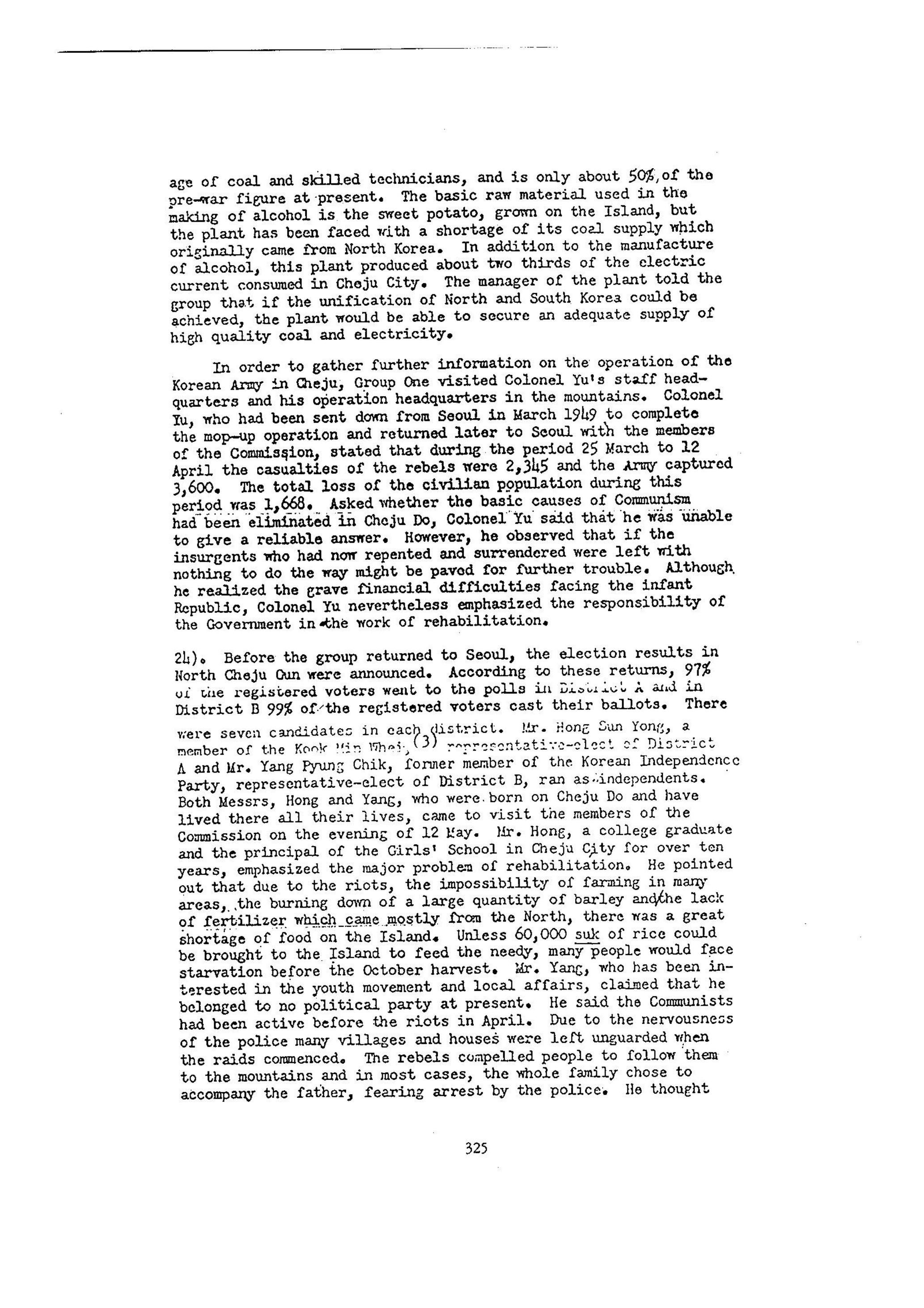
age of coal and skilled technicians, and is only about 50% of the pre-war figure at present. The basic raw material used in the making of alcohol is the sweet potato, grown on the Island, but the plant has been faced with a shortage of its coal supply which originally came from North Korea. In addition to the manufacture of alcohol, this plant produced about two thirds of the electric current consumed in Cheju City. The manager of the plant told the group that if the unification of North and South Korea could be achieved, the plant would be able to secure an adequate supply of high quality coal and electricity.
In order to gather further information on the operation of the Korean Army in Cheju, Group One visited Colonel Yu's staff headquarters and his operation headquarters in the mountains. Colonel Yu, who had been sent down from Seoul in March 1949 to complete the mop-up operation and returned later to Seoul with the members of the Commission, stated that during the period 25 March to 12 April the casualties of the rebels were 2,345 and the Army captured 3,600. The total loss of the civilian population during this period was 1,668. Asked whether the basic causes of Communism had been eliminated in Cheju Do, Colonel Yu said that he was unable to give a reliable answer. However, he observed that if the insurgents who had now repented and surrendered were left with nothing to do the way might be paved for further trouble. Although he realized the grave financial difficulties facing the infant Republic, Colonel Yu nevertheless emphasized the responsibility of the Government in the work of rehabilitation.
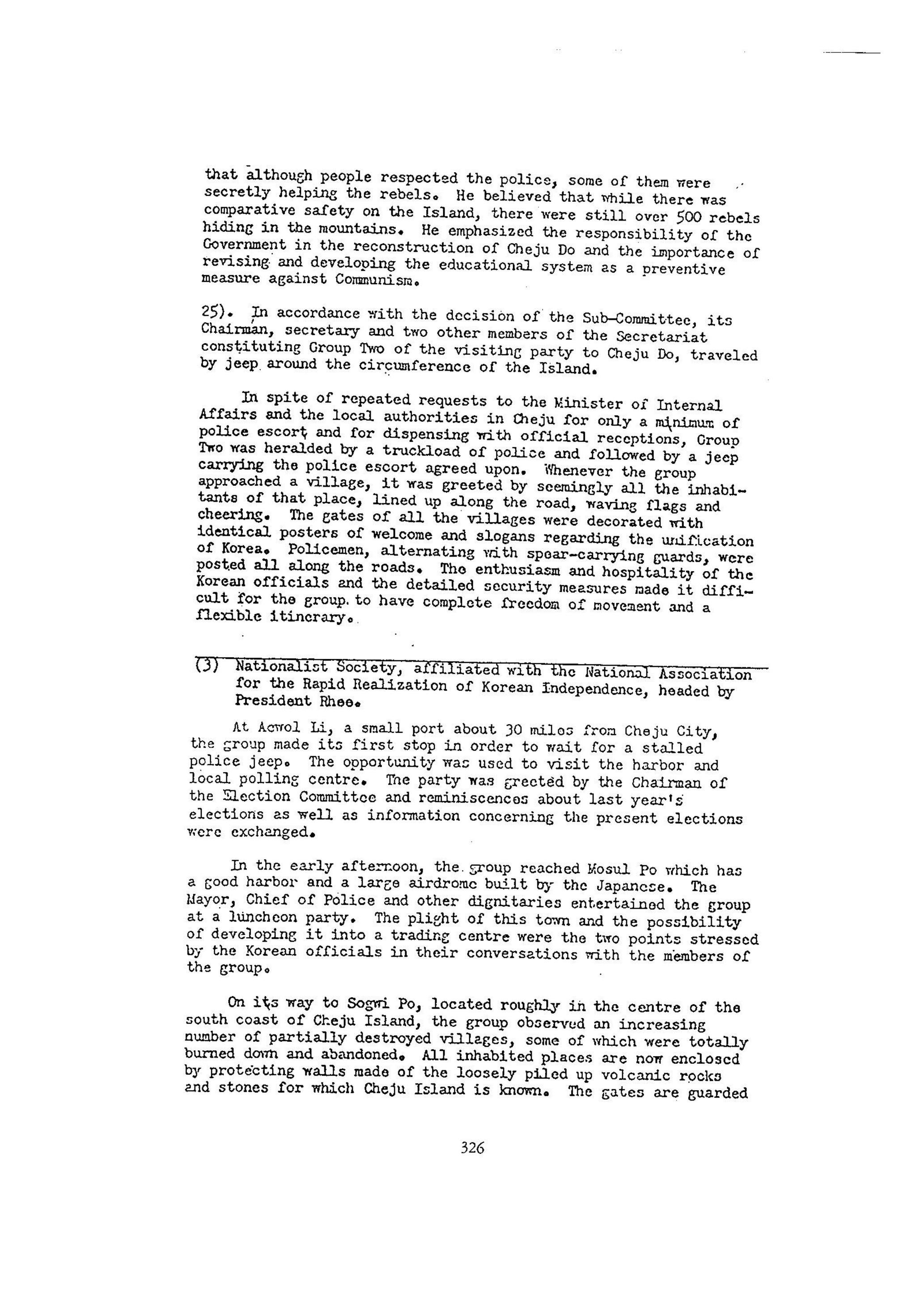
24). Before the group returned to Seoul, the election results in North Cheju Gun were announced. According to these returns, 97% of the registered voters went to the polls in District A and in District B 99% of the registered voters cast their ballots. There were seven candidates in each district. Mr. Hong Sun Yong, a member of the Kook Min Whei (3) representative-elect of District A and Mr. Yang Pyung Chik, former member of the Korean Independence Party, representative-elect of District B, ran as independents. Both Messrs, Hong and Yang, who were born on Cheju Do and have lived there all their lives, came to visit the members of the Commission on the evening of 12 May. Mr. Hong, a college graduate and the principal of the Girls' School in Cheju City for over ten years, emphasized the major problem of rehabilitation. He pointed out that due to the riots, the impossibility of farming in many areas, the burning down of a large quantity of barley and the lack of fertilizer which came mostly from the North, there was a great shortage of food on the Island. Unless 60,000 suk of rice could be brought to the Island to feed the needy, many people would face starvation before the October harvest. Mr. Yang, who has been interested in the youth movement and local affairs, claimed that he belonged to no political party at present. He said the Communists had been active before the riots in April. Due to the nervousness of the police many villages and houses were left unguarded when the raids commenced. The rebels compelled people to follow them to the mountains and in most cases, the whole family chose to accompany the father, fearing arrest by the police. He thought
--- p336 ---
that although people respected the police, some of them were
secretly helping the rebels. He believed that while there was
comparative safety on the Island, there were still over 500 rebels
hiding in the mountains. He emphasized the responsibility of the
Government in the reconstruction of Cheju Do and the importance of
revising and developing the educational system as a preventive
measure against Communism.
25). In accordance with the decision of the Sub-Committee, its
Chairman, secretary and two other members of the Secretariat
constituting Group Two of the visiting party to Cheju Do, traveled
by jeep around the circumference of the Island.
In spite of repeated requests to the Minister of Internal
Affairs and the local authorities in Cheju for only a minimum of
police escort and for dispensing with official receptions, Group
Two was heralded by a truckload of police and followed by a jeep
carrying the police escort agreed upon. Whenever the group
approached a village, it was greeted by seemingly all the inhabi-
tants of that place, lined up along the road, waving flags and
cheering. The gates of all the villages were decorated with
identical posters of welcome and slogans regarding the unification
of Korea. Policemen, alternating with spear-carrying guards, were
posted all along the roads. The enthusiasm and hospitality of the
Korean officials and the detailed security measures made it diffi-
cult for the group to have complete freedom of movement and a
flexible itinerary.
(3) Nationalist Society, affiliated with the National Association
for the Rapid Realization of Korean Independence, headed by
President Rhee.
At Aewol Li, a small port about 30 miles from Cheju City,
the group made its first stop in order to wait for a stalled
police jeep. The opportunity was used to visit the harbor and
local polling centre. The party was greeted by the Chairman of
the Election Committee and reminiscences about last year's
elections as well as information concerning the present elections
were exchanged.
In the early afternoon, the group reached Mosul Po which has
a good harbor and a large airdrome built by the Japanese. The
Mayor, Chief of Police and other dignitaries entertained the group
at a luncheon party. The plight of this town and the possibility
of developing it into a trading centre were the two points stressed
by the Korean officials in their conversations with the members of
the group.
On its way to Sogwi Po, located roughly in the centre of the
south coast of Cheju Island, the group observed an increasing
number of partially destroyed villages, some of which were totally
burned down and abandoned. All inhabited places are now enclosed
by protecting walls made of the loosely piled up volcanic rocks
and stones for which Cheju Island is known. The gates are guarded
--- p337 ---
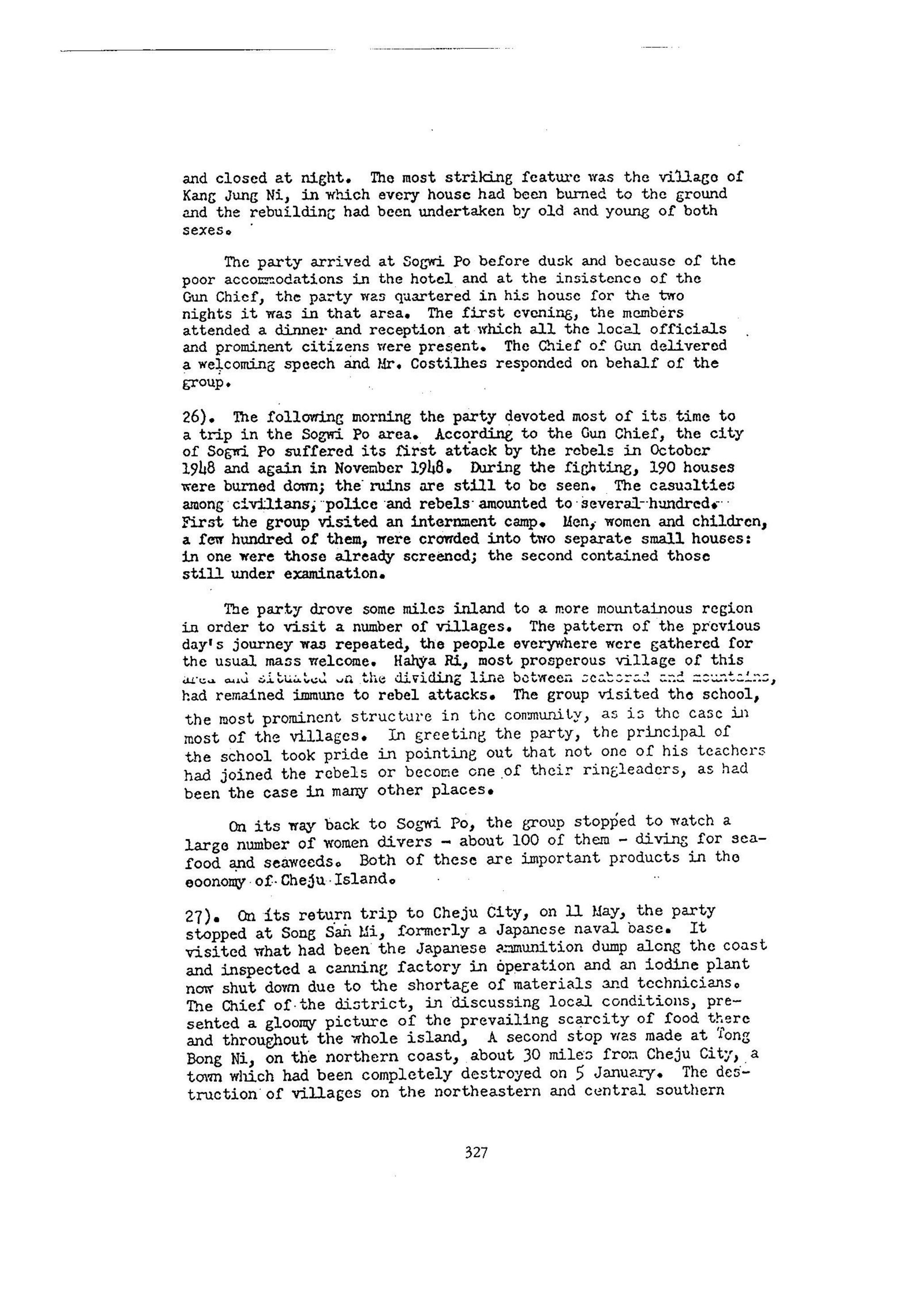
and closed at night. The most striking feature was the village of Kang Jung Ni, in which every house had been burned to the ground and the rebuilding had been undertaken by old and young of both sexes.
The party arrived at Sogwi Po before dusk and because of the poor accommodations in the hotel and at the insistence of the Gun Chief, the party was quartered in his house for the two nights it was in that area. The first evening, the members attended a dinner and reception at which all the local officials and prominent citizens were present. The Chief of Gun delivered a welcoming speech and Mr. Costilhes responded on behalf of the group.
26). The following morning the party devoted most of its time to a trip in the Sogwi Po area. According to the Gun Chief, the city of Sogwi Po suffered its first attack by the rebels in October 1948 and again in November 1948. During the fighting, 190 houses were burned down; the ruins are still to be seen. The casualties among civilians, police and rebels amounted to several hundred. First the group visited an internment camp. Men, women and children, a few hundred of them, were crowded into two separate small houses: in one were those already screened; the second contained those still under examination.
The party drove some miles inland to a more mountainous region in order to visit a number of villages. The pattern of the previous day's journey was repeated, the people everywhere were gathered for the usual mass welcome. Hahya Ri, most prosperous village of this area and situated on the dividing line between seaboard and mountains, had remained immune to rebel attacks. The group visited the school, the most prominent structure in the community, as is the case in most of the villages. In greeting the party, the principal of the school took pride in pointing out that not one of his teachers had joined the rebels or become one of their ringleaders, as had been the case in many other places.
On its way back to Sogwi Po, the group stopped to watch a large number of women divers - about 100 of them - diving for seafood and seaweeds. Both of these are important products in the economy of Cheju Island.
27). On its return trip to Cheju City, on 11 May, the party stopped at Song San Mi, formerly a Japanese naval base. It visited what had been the Japanese ammunition dump along the coast and inspected a canning factory in operation and an iodine plant now shut down due to the shortage of materials and technicians. The Chief of the district, in discussing local conditions, presented a gloomy picture of the prevailing scarcity of food there and throughout the whole island, A second stop was made at Tong Bong Ni, on the northern coast, about 30 miles from Cheju City, a town which had been completely destroyed on 5 January. The destruction of villages on the northeastern and central southern
--- p338 ---
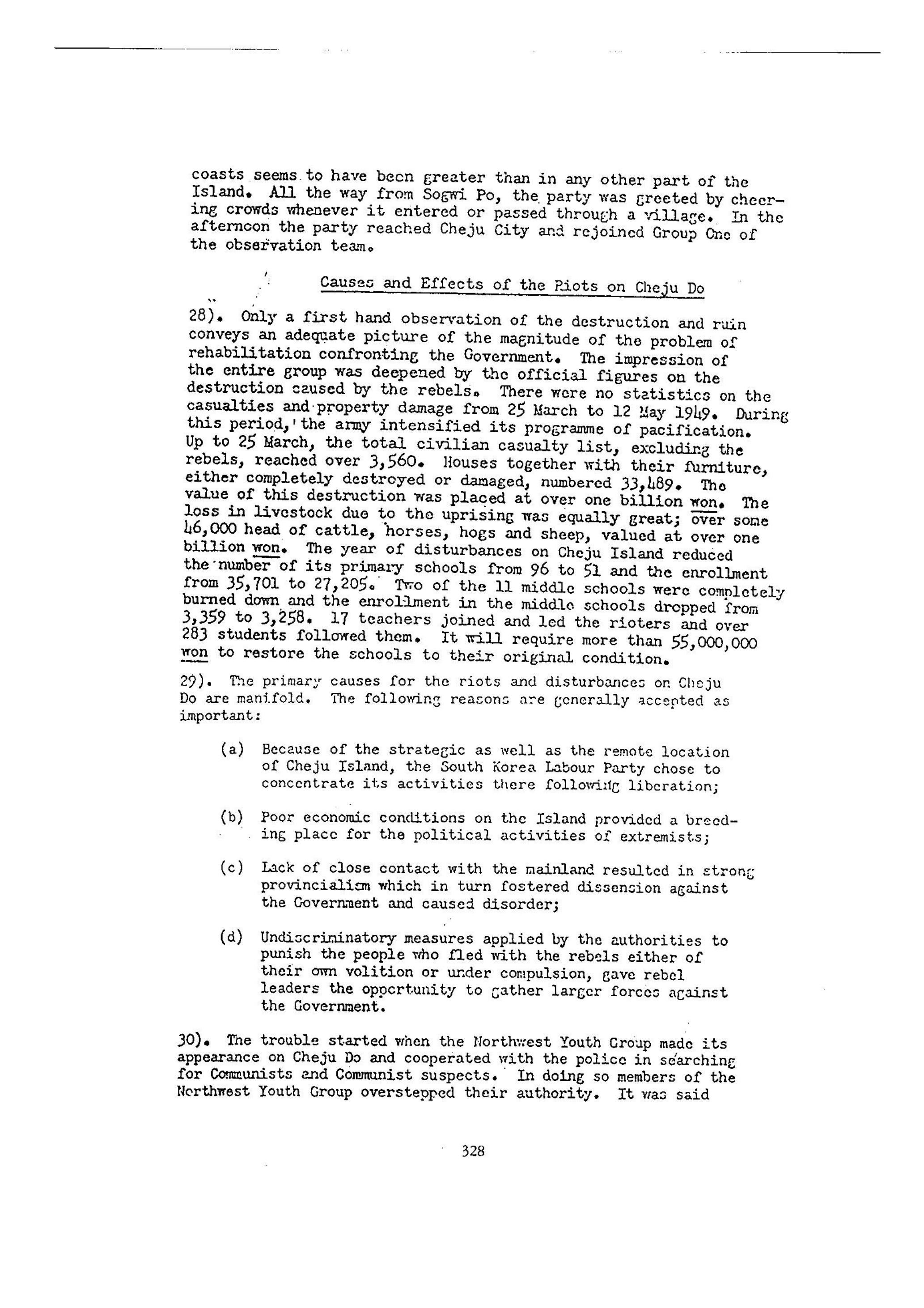
coasts seems to have been greater than in any other part of the Island. All the way from Sogwi Po, the party was greeted by cheering crowds whenever it entered or passed through a village. In the afternoon the party reached Cheju City and rejoined Group One of the observation team.
Causes and Effects of the Riots on Cheju Do
28). Only a first hand observation of the destruction and ruin conveys an adequate picture of the magnitude of the problem of rehabilitation confronting the Government. The impression of the entire group was deepened by the official figures on the destruction caused by the rebels. There were no statistics on the casualties and property damage from 25 March to 12 May 1949. During this period, the army intensified its programme of pacification. Up to 25 March, the total civilian casualty list, excluding the rebels, reached over 3,560. Houses together with their furniture, either completely destroyed or damaged, numbered 33,489. The value of this destruction was placed at over one billion won. The loss in livestock due to the uprising was equally great; over some 46,000 head of cattle, horses, hogs and sheep, valued at over one billion won. The year of disturbances on Cheju Island reduced the number of its primary schools from 96 to 51 and the enrollment from 35,701 to 27,205. Two of the 11 middle schools were completely burned down and the enrollment in the middle schools dropped from 3,359 to 3,258. 17 teachers joined and led the rioters and over 283 students followed them. It will require more than 55,000,000 won to restore the schools to their original condition.
29). The primary causes for the riots and disturbances on Cheju Do are manifold. The following reasons are generally accepted as important:
(a) Because of the strategic as well as the remote location of Cheju Island, the South Korea Labour Party chose to concentrate its activities there following liberation;
(b) Poor economic conditions on the Island provided a breeding place for the political activities of extremists;
(c) Lack of close contact with the mainland resulted in strong provincialism which in turn fostered dissension against the Government and caused disorder;
(d) Undiscriminatory measures applied by the authorities to punish the people who fled with the rebels either of their own volition or under compulsion, gave rebel leaders the opportunity to gather larger forces against the Government.
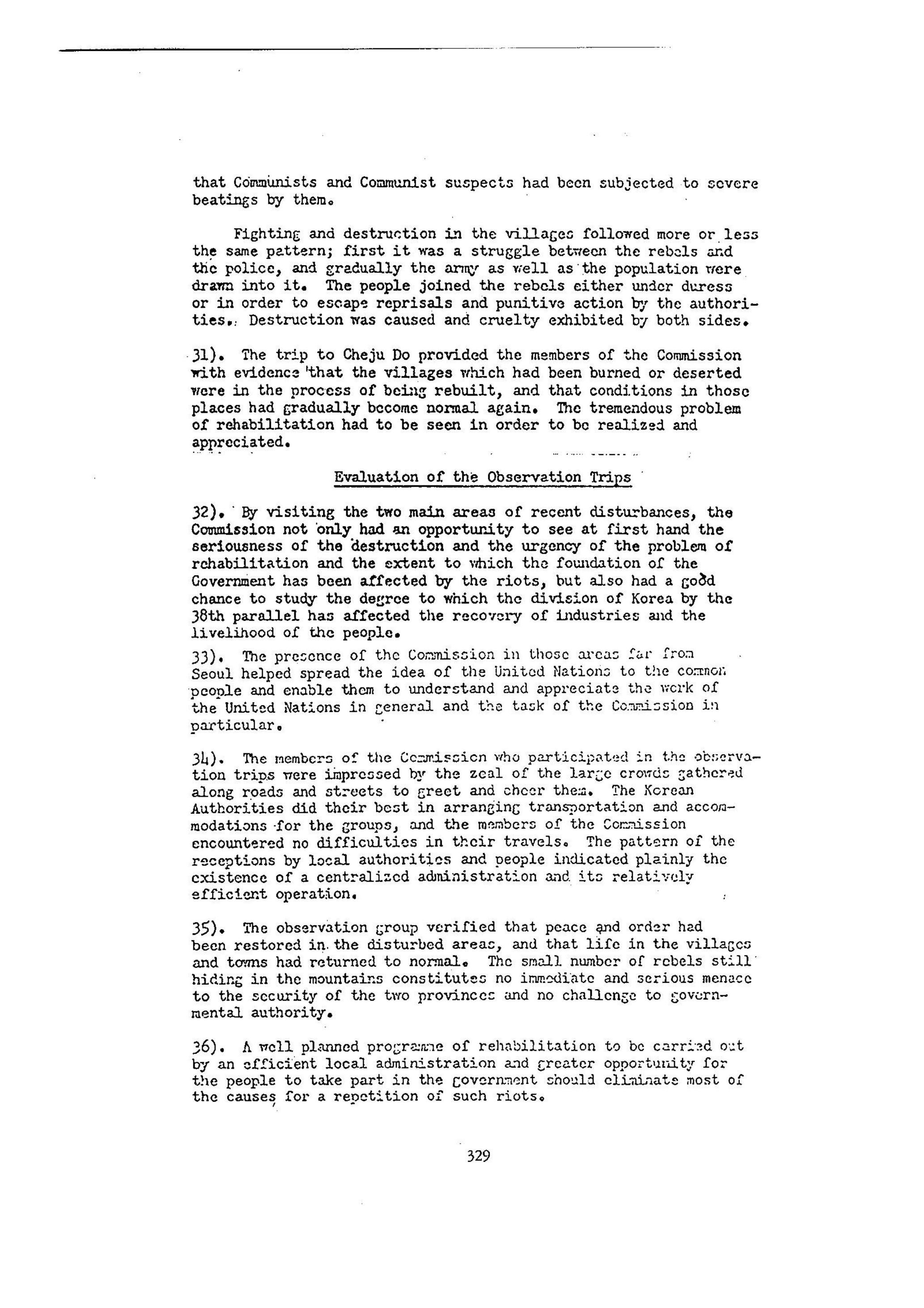
30). The trouble started when the Northwest Youth Group made its appearance on Cheju Do and cooperated with the police in searching for Communists and Communist suspects. In doing so members of the Northwest Youth Group overstepped their authority. It was said
--- p339 ---
that Communists and Communist suspects had been subjected to severe beatings by them.
Fighting and destruction in the villages followed more or less the same pattern; first it was a struggle between the rebels and the police, and gradually the army as well as the population were drawn into it. The people joined the rebels either under duress or in order to escape reprisals and punitive action by the authorities. Destruction was caused and cruelty exhibited by both sides.
31). The trip to Cheju Do provided the members of the Commission with evidence 'that the villages which had been burned or deserted were in the process of being rebuilt, and that conditions in those places had gradually become normal again. The tremendous problem of rehabilitation had to be seen in order to be realized and appreciated.
Evaluation of the Observation Trips
32). By visiting the two main areas of recent disturbances, the Commission not only had an opportunity to see at first hand the seriousness of the destruction and the urgency of the problem of rehabilitation and the extent to which the foundation of the Government has been affected by the riots, but also had a good chance to study the degree to which the division of Korea by the 38th parallel has affected the recovery of industries and the livelihood of the people.
33). The presence of the Commission in those areas far from Seoul helped spread the idea of the United Nations to the common people and enable them to understand and appreciate the work of the United Nations in general and the task of the Commission in particular.
34). The members of the Commission who participated in the observation trips were impressed by the zeal of the large crowds gathered along roads and streets to greet and cheer them. The Korean Authorities did their best in arranging transportation and accommodations for the groups, and the members of the Commission encountered no difficulties in their travels. The pattern of the receptions by local authorities and people indicated plainly the existence of a centralized administration and its relatively efficient operation.
35). The observation group verified that peace and order had been restored in the disturbed areas, and that life in the villages and towns had returned to normal. The small number of rebels still hiding in the mountains constitutes no immediate and serious menace to the security of the two provinces and no challenge to governmental authority.
36). A well planned programme of rehabilitation to be carried out by an efficient local administration and greater opportunity for the people to take part in the government should eliminate most of the causes for a repetition of such riots.
--- p340 ---
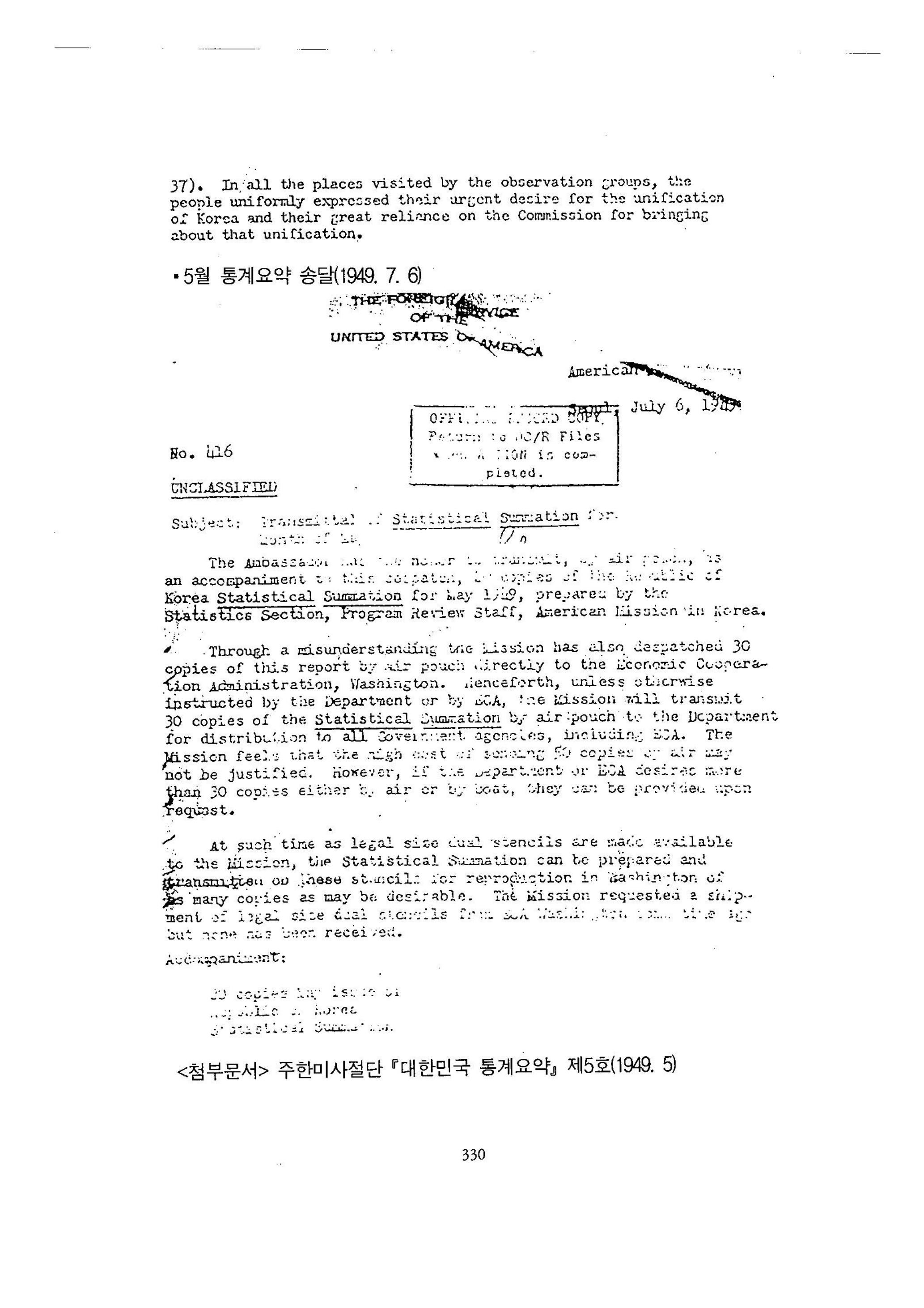
37). In all the places visited by the observation groups, the people uniformly expressed their urgent desire for the unification of Korea and their great reliance on the Commission for bringing about that unification.
출처:
제주4·3사건진상규명및희생자명예회복위원회 편,
『제주4·3사건자료집 11』 [미국자료편],
번역문 p.131
/ 원문 p.321–330 / No. 358.
×
![]()