발신 : 주한미군사령관
수신 : 미극동군사령관
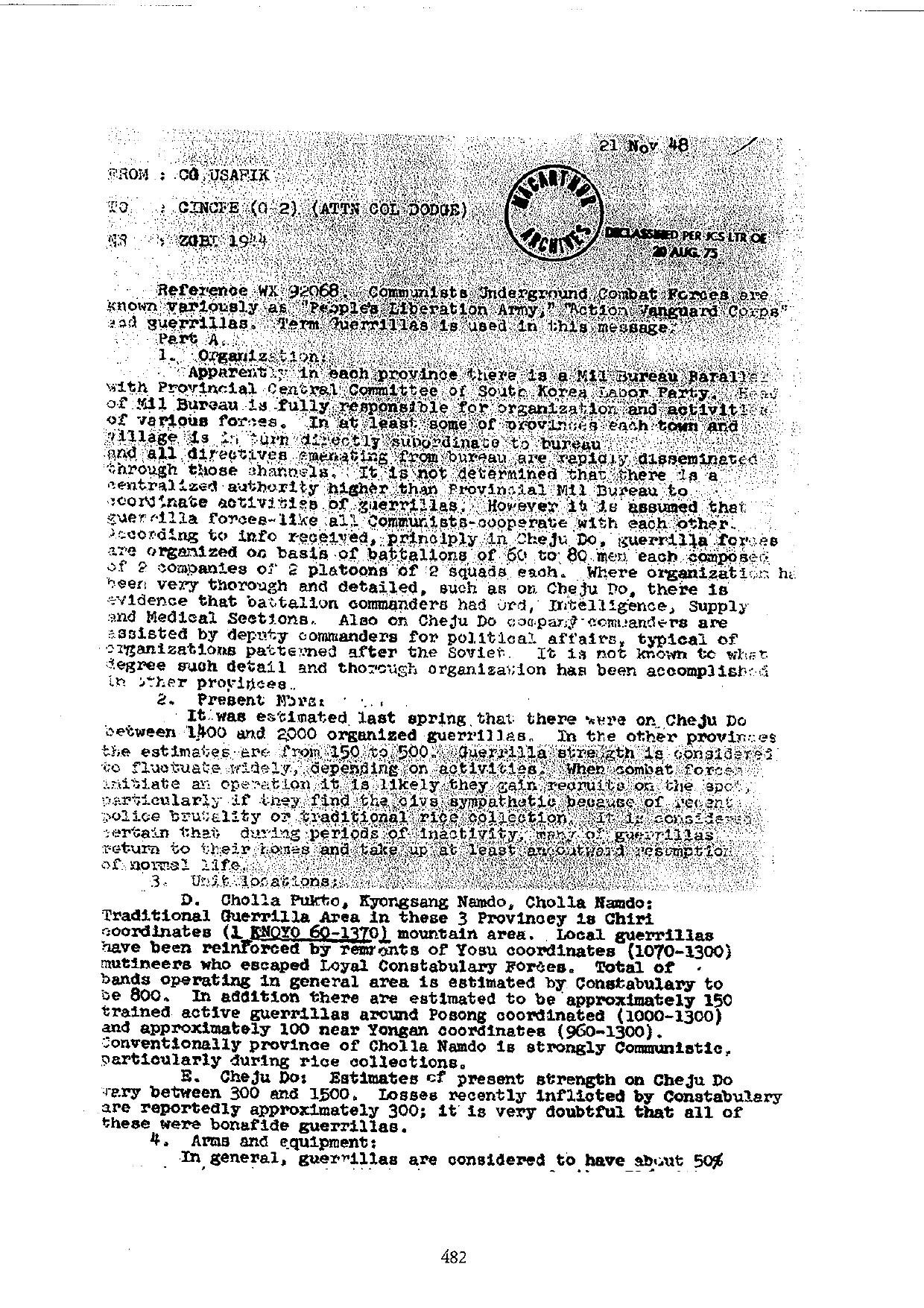
공산주의 지하 전투 부대들은 인민해방군, 행동전위대, 게릴라 등으로 다양하게 알려져 있다. 본 보고에서는 게릴라라는 용어를 사용한다.
1. 조직
분명히 각 도에는 남로당 도 중앙 위원회와 나란히 군사부가 있다. 군사부장은 다양한 부대들의 조직과 활동에 전적인 책임을 지고 있다. 적어도 몇몇 도의 각 도시와 촌락에 군사부의 직접적인 하부조직이 있고 군사부로부터 나오는 모든 지령들은 그러한 경로를 통해서 급속도로 확산된다. 게릴라의 활동에 협력하는 각 도의 군사국 보다도 더욱 집권화된 권위 기구는 결정되지 않았다. 그러나 게릴라 부대들은, 모든 공산주의자들과 마찬가지로, 서로 협조하는 것으로 생각된다. 특히 제주도에서 접수된 정보에 따르면 게릴라 부대들은 2개 중대, 2개 소대, 2개 분대의 체제를 가진 60명~80명 단위의 대대들로 조직되었다. 제주도와 같이 게릴라 조직이 매우 철저하고도 상세하게 조직되었던 곳은 대대장이 작전, 정보, 군수, 의무 등의 부서를 가지고 있었다는 증거가 있다. 또한 제주도에서 중대장들은 소련을 본받은 전형적인 게릴라 조직의 유형이 된 정치업무를 관장하는 부중대장의 보좌를 받는다. 그러한 세부적이고도 철저한 조직이 다른 도에서 어느 정도까지 완료되었는지는 알 수 없다.
2. 현재의 규모
지난 봄 제주도에서 1,400~2,000명 사이의 게릴라가 조직되었던 것으로 추정되었다. 다른 도에서는 추정된 숫자는 150~500명 선이다. 게릴라 부대의 규모는 변동이 심한 것으로 파악된다. 전투 부대들이 작전을 개시하면 최근의 경찰의 무자비함과 전통적인 쌀 수매 때문에 그들에게 동조하는 양민이 있으면 특별히 현장에서 지원자들을 충당하는 것으로 보인다. 활동하지 않는 시기에 게릴라들의 대다수는 그들의 집으로 돌아와서 적어도 외견상으로는 정상적인 삶을 영위한다.
3. 부대의 위치
(중략)
D. 전라북도, 경상남도, 전라남도 : 이 세 도의 전통적인 게릴라 지역은 지리산이다. 지방 게릴라들은 국방경비대를 탈출하였던 여수의 반란군 잔여 무리에 의해 강화되어 왔다. 일반 지역에서 작전을 수행하고 있는 (게릴라)무리의 총수는 800명이 되는 것으로 국방경비대는 추정하고 있다. 게다가 보성 주위에서 훈련을 받아 활동하고 있는 게릴라들은 대략 150명 정도 있는 것으로 추산되며 영안(Yongan 좌표 960-1300) 근처에서도 약 100명이 활동하고 있는 것으로 추정된다. 판에 박은 듯이 전라남도는 특별히 쌀 수매 기간 동안에 강한 공산주의적 색채를 띠었다.
E. 제주도 : 현재 제주도에서 활동하고 있는 게릴라 병력은 300명~1500명 사이로 다양하게 추산된다. 국방경비대에 의해서 최근에 타격을 입은 게릴라 손실은 대략 300명 정도 된다고 한다. 이들 모두가 진짜 게릴라였는지는 매우 의심스럽다.
4. 무기와 장비
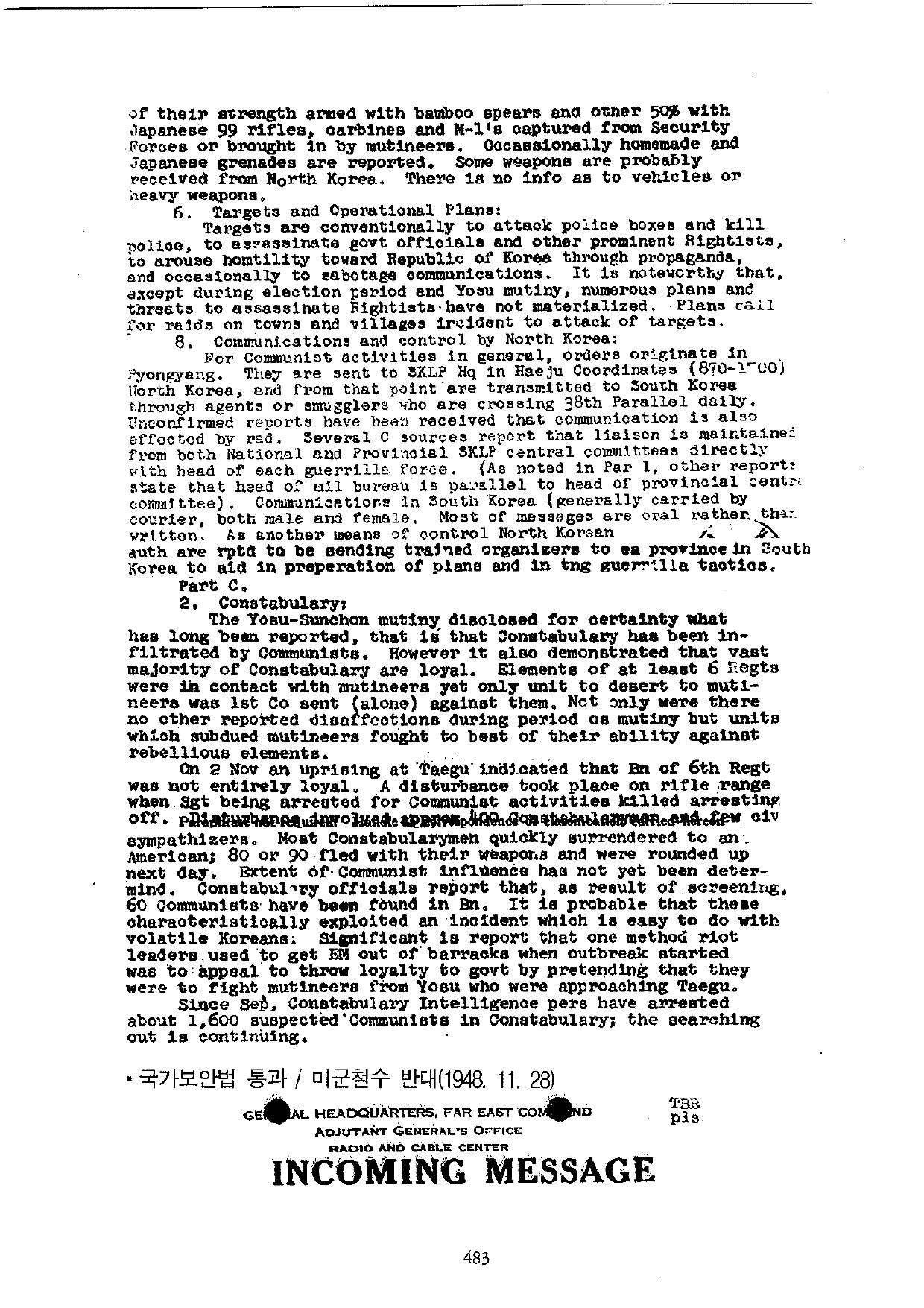
일반적으로 게릴라들은 약 50%는 대나무 창으로 무장하고 나머지 50%는 국방경비대로부터 탈취하거나 반란군에게서 건네 받은 일본제 99소총, 칼빈 소총과 M-1으로 무장한 것으로 생각된다. 때때로 집에서 제조한 무기와 일본제 수류탄이 보고되기도 했다. 어떤 무기들은 아마도 북한에서 제공받은 것으로 보인다. 차량 혹은 중화기에 관한 정보는 없다. (중략)
6. 목표와 작전 계획:
목표는 상투적인데 경찰 초소를 공격하여 경찰관을 살해하는 것, 정부 공무원들과 다른 저명한 우익인사들을 암살하는 것, 정치적 선전을 통해 남한에 대한 적개심을 부추기는 것, 그리고 때때로 통신장비를 고의로 파손시키는 것이었다. 총선거 기간과 여수반란 사건 기간을 제외하면 우익인사들을 암살하려는 수많은 계획과 위협이 실현되지 못했다는 점은 주목할 만한 가치가 있다. (작전)계획은 목표물의 공격에서 흔히 있는 도시와 마을에 대한 습격을 요한다. (중략)
8. 북한에 의한 통제와 통신 :
일반적으로 공산주의자 활동에 관한 지령은 평양에서 내려진다. 그 지령들은 북한 해주(좌표 870-1700)에 있는 남로당 본부로 보내지고 매일 38선을 오가는 (공산당) 요원들이나 잠입자들을 통해서 해주로부터 남한으로 전해진다. 라디오로도 통신을 취한다는 확인되지 않은 보고가 들어왔다. 몇 가지 C급의 보고는 연락이 중앙과 도의 남로당 중앙 위원회로부터 직접 게릴라 우두머리들에게 취해진다. (첫 번째 단락에서 기록되어 있듯이 다른 보고서들은 군사부장이 각 도 중앙 위원회 위원장과 대등하다는 점을 말해 준다). 남한 내에서 통신은 일반적으로 남성과 여성 연락자에 의해 수행되었다. 대부분의 전달사항은 문서보다는 구두로 이루어진다. 북한당국의 또 다른 통제 수단은 작전 계획의 준비를 돕고 게릴라 전술을 훈련시키기 위해서 남한 각 도에 훈련받은 조직가를 파견하는 것이다. (중략)
2. 국방경비대 :
여수순천 반란 사건은 오랫동안 보고되어 온 바와 같이 공산주의자들이 국방경비대에 침투했다는 사실을 확실하게 드러내 주었다. 그러나 여순반란 사건은 국방경비대의 대다수는 충성스럽다는 점을 여실히 입증해 주었다. 최소한 6개 연대의 요원들이 그들과 싸우기 위해 제 1중대만을 내보냈던 반란군을 구축하기 위해 반란군과 접전을 펼쳤다. 폭동이 일어난 시기에 그 어떤 (정부에 대한) 불만 사항도 보고되지 않았고 반란군을 진압했던 국방경비대 부대들은 반역한 무리에 대해 최선의 능력을 발휘하여 싸웠다.
11월 2일 대구에서의 폭동은 제 6연대의 1개 대대가 전적으로 충성스럽지 않았음을 보여준다. 공산주의 활동을 한 것으로 체포된 상사가 체포된 상태로 죽음을 당했을 때 사격장에서 폭동이 발생하였다. 대략 400명의 국방경비대원들과 극소수의 시민 동조자들이 폭동에 가담하였다. 대다수의 국방경비대원들은 미군정 요원에게 항복하였다. 80~90명이 무기를 소지한 채 도망쳤으나 다음 날 검거되었다. 공산주의자가 끼친 영향의 범위는 아직까지 단정지어 말할 수 없다. 국방경비대의 관리들은 심문결과 공산주의자 60명이 대대에서 적발되었다고 보고했다. 이들이 변덕스러운 한국인들을 쉽게 상대할 수 있는 한 사건을 특징적으로 잘 이용했던 것 같다. (대구)폭동이 일어났을 때 폭동 지휘자가 막사 밖으로 병사들을 집합시켰던 한 방법은 대구에 접근하고 있었던 여수의 반란군과 그들이 싸워야 한다고 가장하면서 정부에 충성을 바칠 것을 호소하는 것이었다는 의미심장한 보고가 있다.
9월 이후, 국방경비대 내부에서 공산주의자로 의심을 받았던 약 1,600명의 국방경비대 정보 요원들이 체포되었다. 색출작업은 계속되고 있다.
(후략)
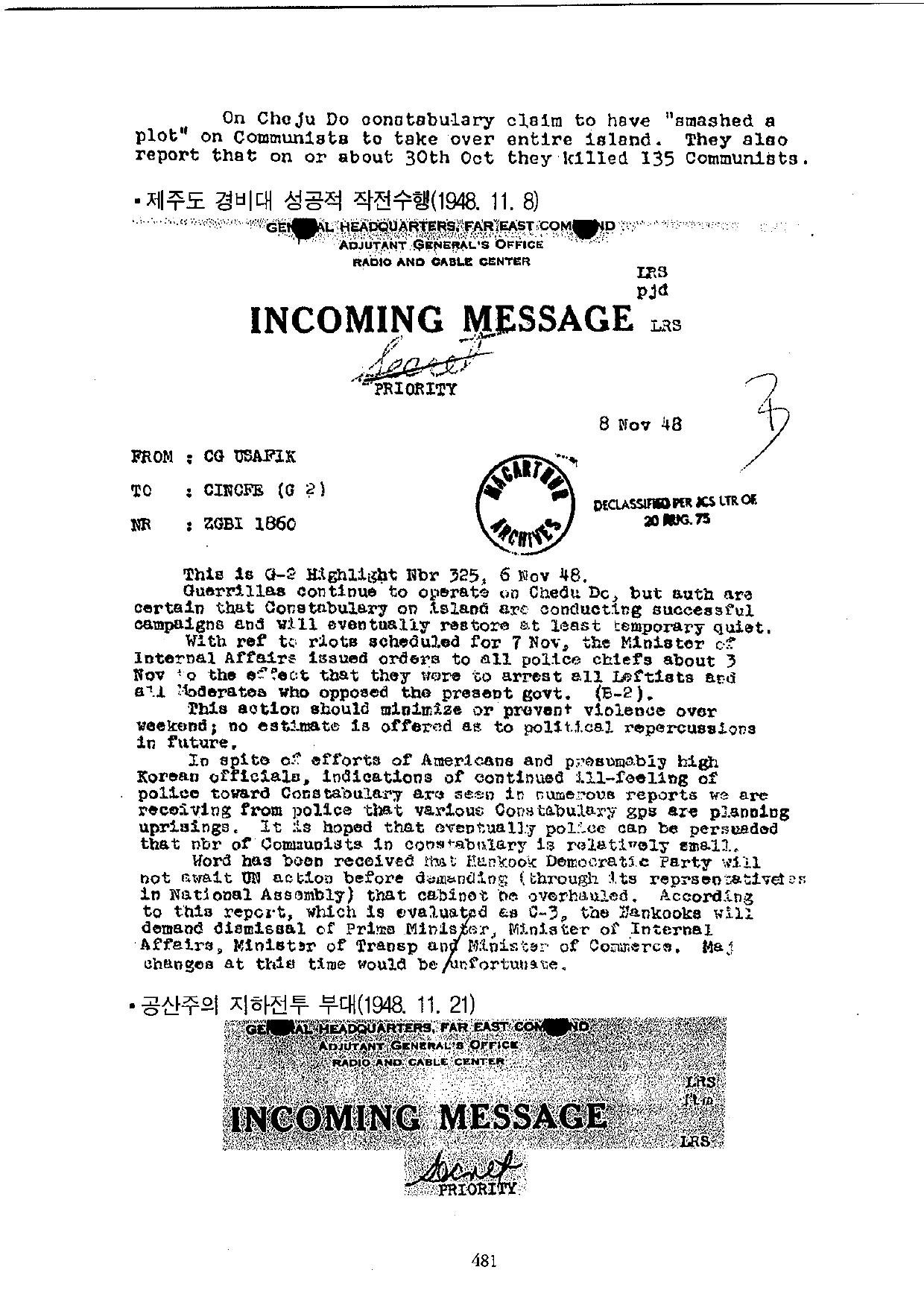
GENERAL HEADQUARTERS, FAR EAST COMMAND
ADJUTANT GENERAL'S OFFICE
RADIO AND CABLE CENTER
LRS
# INCOMING MESSAGE
LRS
PRIORITY
FROM : CG USAFIK
TO : CINCFE (G-2) (ATTN COL DODDS)
43 > ZQBT 1944
21 Nov 48
DECLASSIFIED PER CS LTR OF
20 AUG 73
Reference WX 92068. Communists Underground Combat Forces are known variously as "People's Liberation Army," "Action Vanguard Corps" and guerrillas. Term Guerrillas is used in this message.
Part A.
1. Organization:
Apparently in each province there is a Mil Bureau Parallel with Provincial Central Committee of South Korea Labor Party. Head of Mil Bureau is fully responsible for organization and activities of various forces. In at least some of provinces each town and village is in turn directly subordinate to bureau and all directives emanating from bureau are rapidly disseminated through those channels. It is not determined that there is a centralized authority higher than Provincial Mil Bureau to coordinate activities of guerrillas. However it is assumed that guerrilla forces-like all Communists-cooperate with each other. According to info received, principly in Cheju Do, guerrilla forces are organized on basis of battalions of 60 to 80 men each composed of 2 companies of 2 platoons of 2 squads each. Where organization has been very thorough and detailed, such as on Cheju Do, there is evidence that battalion commanders had ord, Intelligence, Supply and Medical Sections. Also on Cheju Do company commanders are assisted by deputy commanders for political affairs, typical of organizations patterned after the Soviet. It is not known to what degree such detail and thorough organization has been accomplished in other provinces.
2. Present Morale :
It was estimated last spring that there were on Cheju Do between 1400 and 2000 organized guerrillas. In the other provinces the estimates are from 150 to 500. Guerrilla strength is considered to fluctuate widely, depending on activities. When combat forces initiate an operation it is likely they gain recruits on the spot, particularly if they find the civs sympathetic because of recent police brutality or traditional rice collection. It is considered certain that during periods of inactivity, many of guerrillas return to their homes and take up at least an outward resumption of normal life.
3. Unit locations:
D. Cholla Pukto, Kyongsang Namdo, Cholla Namdo: Traditional Guerrilla Area in these 3 Provincey is Chiri coordinates (1 KNOYO 60-1370) mountain area. Local guerrillas have been reinforced by remnants of Yosu coordinates (1070-1300) mutineers who escaped Loyal Constabulary Forces. Total of bands operating in general area is estimated by Constabulary to be 800. In addition there are estimated to be approximately 150 trained active guerrillas around Posong coordinated (1000-1300) and approximately 100 near Yongan coordinates (960-1300). Conventionally province of Cholla Namdo is strongly Communistic, particularly during rice collections.
E. Cheju Do: Estimates of present strength on Cheju Do vary between 300 and 1500. Losses recently inflicted by Constabulary are reportedly approximately 300; it is very doubtful that all of these were bonafide guerrillas.
4. Arms and equipment:
In general, guerrillas are considered to have about 50%
of their strength armed with bamboo spears and other 50% with Japanese 99 rifles, carbines and M-1's captured from Security Forces or brought in by mutineers. Occasionally homemade and Japanese grenades are reported. Some weapons are probably received from North Korea. There is no info as to vehicles or heavy weapons.
6. Targets and Operational Plans:
Targets are conventionally to attack police boxes and kill police, to assassinate govt officials and other prominent Rightists, to arouse homtility toward Republic of Korea through propaganda, and occasionally to sabotage communications. It is noteworthy that, except during election period and Yosu mutiny, numerous plans and threats to assassinate Rightists have not materialized. Plans call for raids on towns and villages incident to attack of targets.
8. Communications and control by North Korea:
For Communist activities in general, orders originate in Pyongyang. They are sent to SKLP Hq in Haeju Coordinates (870-1700) North Korea, and from that point are transmitted to South Korea through agents or smugglers who are crossing 38th Parallel daily. Unconfirmed reports have been received that communication is also effected by rad. Several C sources report that liaison is maintained from both National and Provincial SKLP central committees directly with head of each guerrilla force. (As noted in Par 1, other reports state that head of mil bureau is parallel to head of provincial central committee). Communications in South Korea (generally carried by courier, both male and female. Most of messages are oral rather than written. As another means of control North Korean ∠ ⊘ auth are rptd to be sending trained organizers to ea province in South Korea to aid in preperation of plans and in tng guerrilla tactics.
Part C.
2. Constabulary:
The Yosu-Sunchon mutiny disclosed for certainty what has long been reported, that is that Constabulary has been infiltrated by Communists. However it also demonstrated that vast majority of Constabulary are loyal. Elements of at least 6 Regts were in contact with mutineers yet only unit to desert to mutineers was 1st Co sent (alone) against them. Not only were there no other reported disaffections during period os mutiny but units which subdued mutineers fought to best of their ability against rebellious elements.
On 2 Nov an uprising at Taegu indicated that Bn of 6th Regt was not entirely loyal. A disturbance took place on rifle range when Sgt being arrested for Communist activities killed arresting off. p[illegible] civ sympathizers. Most Constabularymen quickly surrendered to an. American; 80 or 90 fled with their weapons and were rounded up next day. Extent of Communist influence has not yet been determined. Constabulary officials report that, as result of screening, 60 Communists have been found in Bn. It is probable that these characteristically exploited an incident which is easy to do with volatile Koreans. Significant is report that one method riot leaders used to get EM out of barracks when outbreak started was to appeal to throw loyalty to govt by pretending that they were to fight mutineers from Yosu who were approaching Taegu.
Since Sep, Constabulary Intelligence pers have arrested about 1,600 suspected Communists in Constabulary; the searching out is continuing.
출처:
제주4·3사건진상규명및희생자명예회복위원회 편,
『제주4·3사건자료집 7』 [미국자료편],
번역문 p.253
/ 원문 p.481–483.
×
![]()