정보참모부 정기보고
보고 기간: 1948년 12월 12일~1948년 12월 13일
주한미육군사령부
서울, 한국
1948년 12월 13일 제1011호
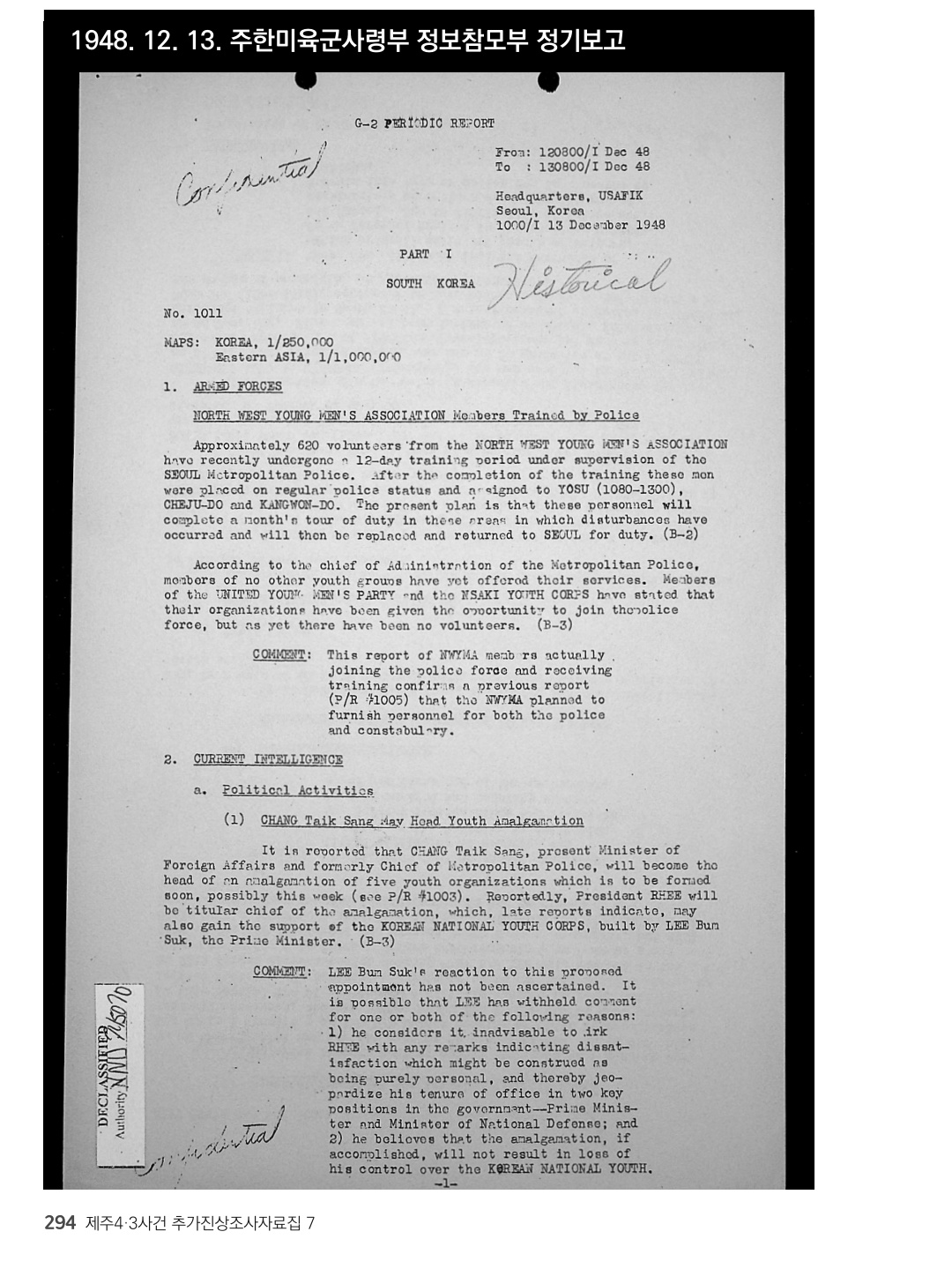
1. 군대 서북청년단원 경찰에 의해 훈련
서북청년단 지원자 약 620명이 최근 수도경찰청의 감독 아래 12일 동안의 훈련을 받았다. 훈련이 끝난 후 이들은 정규 경찰로 임명되어 여수, 제주도, 강원도에 배치되었다. 이들은 소요가 발생한 이 지역에서 한 달 동안의 의무 근무기간이 끝나면 재배치되어 서울로 올라올 계획이다. (B-2)
수도경찰청장에 따르면 다른 청년단체에서는 지원자가 없다. 대동청년단과 대한독립촉성전국청년총연맹은 자신들도 경찰 복무를 요청받았으나 아직 지원자가 없다고 말했다.
논평: 실제로 경찰에 투입되어 훈련을 받은 서북청년단원들에 대한 이 보고는 서북청년단이 경찰과 경비대에 인력을 제공하기로 계획을 세웠다는 지난번 보고(정기보고 NO.1005)를 확인하고 있다.
G-2 PERIODIC REPORT
From: 120800/I Dec 48
To : 130800/I Dec 48
Confidential
Headquarters, USAFIK
Seoul, Korea
1000/I 13 December 1948
PART I
SOUTH KOREA Historical
No. 1011
MAPS: KOREA, 1/250,000
Eastern ASIA, 1/1,000,000
1. ARMED FORCES
NORTH WEST YOUNG MEN'S ASSOCIATION Members Trained by Police
Approximately 620 volunteers from the NORTH WEST YOUNG MEN'S ASSOCIATION have recently undergone a 12-day training period under supervision of the SEOUL Metropolitan Police. After the completion of the training these men were placed on regular police status and assigned to YOSU (1080-1300), CHEJU-DO and KANGWON-DO. The present plan is that these personnel will complete a month's tour of duty in these areas in which disturbances have occurred and will then be replaced and returned to SEOUL for duty. (B-2)
According to the chief of Administration of the Metropolitan Police, members of no other youth groups have yet offered their services. Members of the UNITED YOUNG MEN'S PARTY and the NSAKI YOUTH CORPS have stated that their organizations have been given the opportunity to join the police force, but as yet there have been no volunteers. (B-3)
COMMENT: This report of NWYMA members actually joining the police force and receiving training confirms a previous report (P/R #1005) that the NWYMA planned to furnish personnel for both the police and constabulary.
2. CURRENT INTELLIGENCE
a. Political Activities
(1) CHANG Taik Sang May Head Youth Amalgamation
It is reported that CHANG Taik Sang, present Minister of Foreign Affairs and formerly Chief of Metropolitan Police, will become the head of an amalgamation of five youth organizations which is to be formed soon, possibly this week (see P/R #1003). Reportedly, President RHEE will be titular chief of the amalgamation, which, late reports indicate, may also gain the support of the KOREAN NATIONAL YOUTH CORPS, built by LEE Bum Suk, the Prime Minister. (B-3)
COMMENT: LEE Bum Suk's reaction to this proposed appointment has not been ascertained. It is possible that LEE has withheld consent for one or both of the following reasons: 1) he considers it inadvisable to irk RHEE with any remarks indicating dissatisfaction which might be construed as being purely personal, and thereby jeopardize his tenure of office in two key positions in the government—Prime Minister and Minister of National Defense; and 2) he believes that the amalgamation, if accomplished, will not result in loss of his control over the KOREAN NATIONAL YOUTH.
DECLASSIFIED
NND [illegible]
Authority [illegible]
[illegible signature]
-1-
XXIV CORPS G-2 P/R #1011 Confidential
(2) Rightist Trends of the LABORING PEOPLE'S PARTY
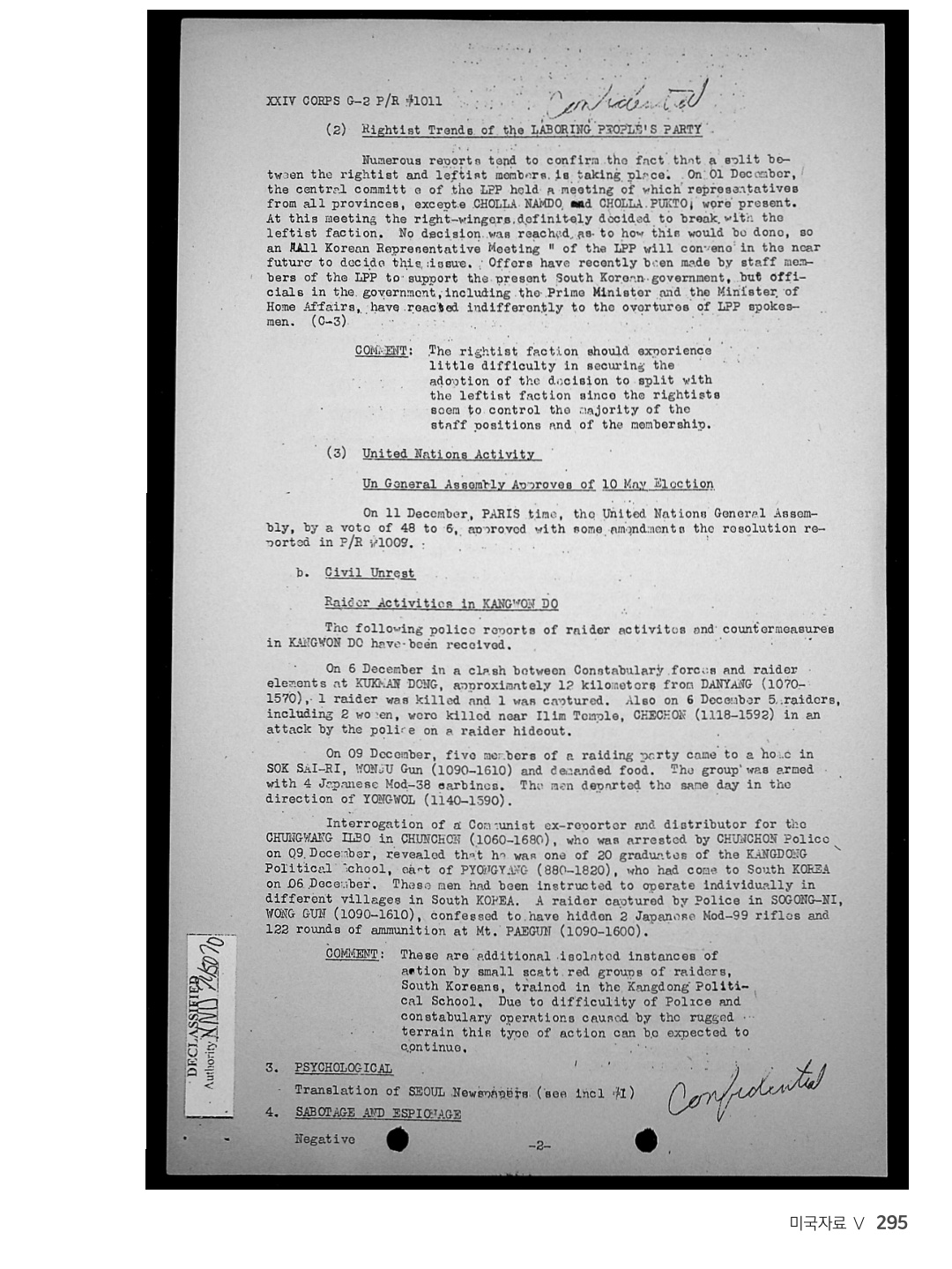
Numerous reports tend to confirm the fact that a split between the rightist and leftist members is taking place. On 01 December, the central committee of the LPP held a meeting of which representatives from all provinces, excepts CHOLLA NAMDO and CHOLLA PUKTO, were present. At this meeting the right-wingers definitely decided to break with the leftist faction. No decision was reached as to how this would be done, so an All Korean Representative Meeting of the LPP will convene in the near future to decide this issue. Offers have recently been made by staff members of the LPP to support the present South Korean government, but officials in the government, including the Prime Minister and the Minister of Home Affairs, have reacted indifferently to the overtures of LPP spokesmen. (C-3)
COMMENT: The rightist faction should experience little difficulty in securing the adoption of the decision to split with the leftist faction since the rightists seem to control the majority of the staff positions and of the membership.
(3) United Nations Activity
Un General Assembly Approves of 10 May Election
On 11 December, PARIS time, the United Nations General Assembly, by a vote of 48 to 6, approved with some amendments the resolution reported in P/R #1009.
b. Civil Unrest
Raider Activities in KANGWON DO
The following police reports of raider activities and countermeasures in KANGWON DO have been received.
On 6 December in a clash between Constabulary forces and raider elements at KUKMAN DONG, approximately 12 kilometers from DANYANG (1070-1570), 1 raider was killed and 1 was captured. Also on 6 December 5 raiders, including 2 women, were killed near Ilim Temple, CHECHON (1118-1592) in an attack by the police on a raider hideout.
On 09 December, five members of a raiding party came to a house in SOK SAI-RI, WONJU Gun (1090-1610) and demanded food. The group was armed with 4 Japanese Mod-38 carbines. The men departed the same day in the direction of YONGWOL (1140-1590).
Interrogation of a Communist ex-reporter and distributor for the CHUNGWANG ILBO in CHUNCHON (1060-1680), who was arrested by CHUNCHON Police on 09 December, revealed that he was one of 20 graduates of the KANGDONG Political School, east of PYONGYANG (880-1820), who had come to South KOREA on 06 December. These men had been instructed to operate individually in different villages in South KOREA. A raider captured by Police in SOGONG-NI, WONG GUN (1090-1610), confessed to have hidden 2 Japanese Mod-99 rifles and 122 rounds of ammunition at Mt. PAEGUN (1090-1600).
COMMENT: These are additional isolated instances of action by small scattered groups of raiders, South Koreans, trained in the Kangdong Political School. Due to difficulty of Police and constabulary operations caused by the rugged terrain this type of action can be expected to continue.
3. PSYCHOLOGICAL
Translation of SEOUL Newspapers (see incl #1) Confidential
4. SABOTAGE AND ESPIONAGE
Negative
-2-
DECLASSIFIED
Authority: NND 725070
XXIV CORPS G-2 F/R #1011
5. WAR POTENTIAL
Economic Review
The following review of recent economic developments was prepared by the State Department Economic Mission:
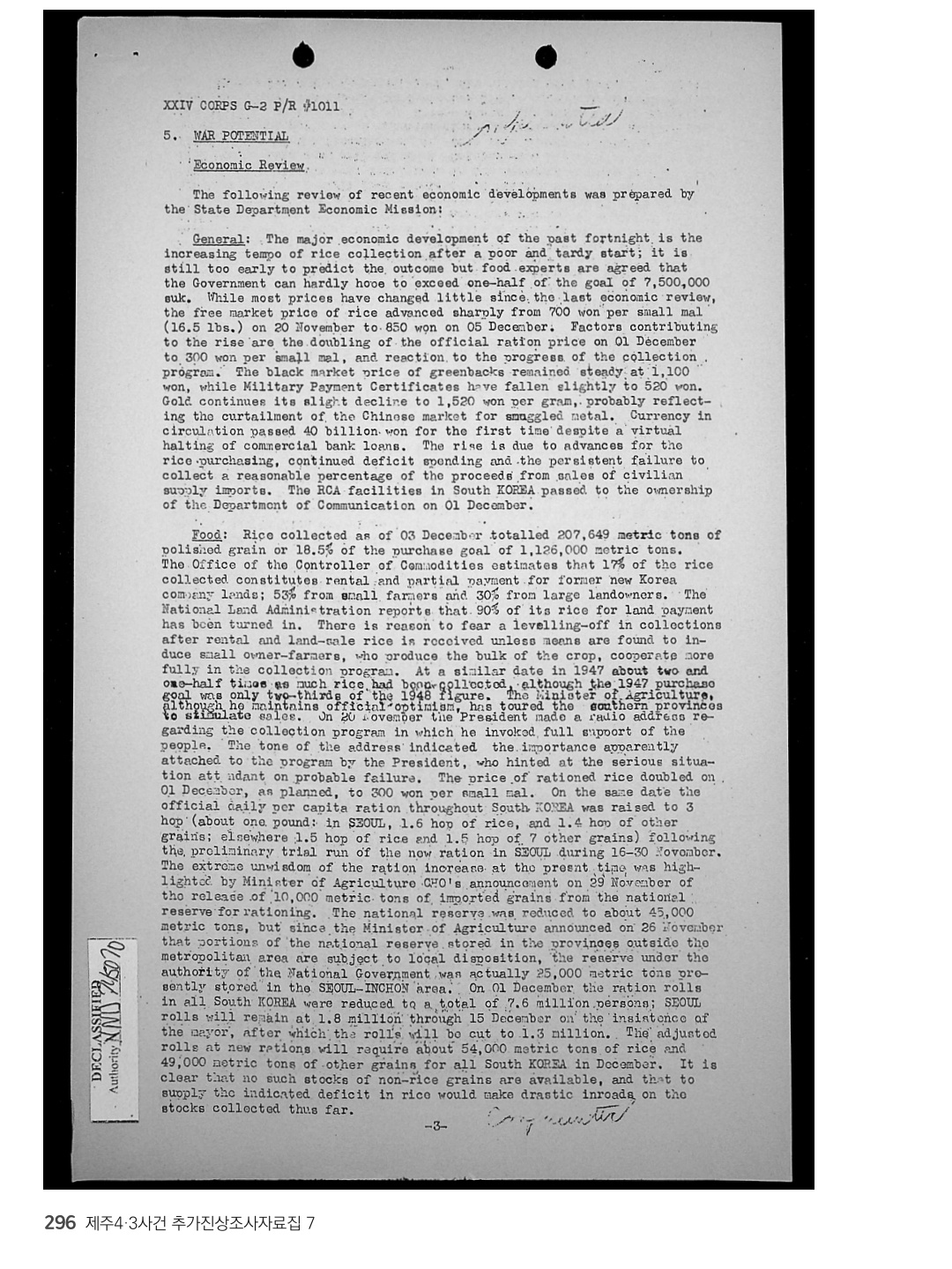
General: The major economic development of the past fortnight is the increasing tempo of rice collection after a poor and tardy start; it is still too early to predict the outcome but food experts are agreed that the Government can hardly hope to exceed one-half of the goal of 7,500,000 suk. While most prices have changed little since the last economic review, the free market price of rice advanced sharply from 700 won per small mal (16.5 lbs.) on 20 November to 850 won on 05 December. Factors contributing to the rise are the doubling of the official ration price on 01 December to 300 won per small mal, and reaction to the progress of the collection program. The black market price of greenbacks remained steady at 1,100 won, while Military Payment Certificates have fallen slightly to 520 won. Gold continues its slight decline to 1,520 won per gram, probably reflecting the curtailment of the Chinese market for smuggled metal. Currency in circulation passed 40 billion won for the first time despite a virtual halting of commercial bank loans. The rise is due to advances for the rice purchasing, continued deficit spending and the persistent failure to collect a reasonable percentage of the proceeds from sales of civilian supply imports. The RCA facilities in South KOREA passed to the ownership of the Department of Communication on 01 December.
Food: Rice collected as of 03 December totalled 207,649 metric tons of polished grain or 18.5% of the purchase goal of 1,126,000 metric tons. The Office of the Controller of Commodities estimates that 17% of the rice collected constitutes rental and partial payment for former new Korea company lands; 53% from small farmers and 30% from large landowners. The National Land Administration reports that 90% of its rice for land payment has been turned in. There is reason to fear a levelling-off in collections after rental and land-sale rice is received unless means are found to induce small owner-farmers, who produce the bulk of the crop, cooperate more fully in the collection program. At a similar date in 1947 about two and one-half times as much rice had been collected, although the 1947 purchase goal was only two-thirds of the 1948 figure. The Minister of Agriculture, although he maintains official optimism, has toured the southern provinces to stimulate sales. On 20 November the President made a radio address regarding the collection program in which he invoked full support of the people. The tone of the address indicated the importance apparently attached to the program by the President, who hinted at the serious situation att ndant on probable failure. The price of rationed rice doubled on 01 December, as planned, to 300 won per small mal. On the same date the official daily per capita ration throughout South KOREA was raised to 3 hop (about one pound; in SEOUL, 1.6 hop of rice and 1.4 hop of other grains; elsewhere 1.5 hop of rice and 1.5 hop of 7 other grains) following the preliminary trial run of the new ration in SEOUL during 16-30 November. The extreme unwisdom of the ration increase at the present time was highlighted by Minister of Agriculture CHO's announcement on 29 November of the release of 10,000 metric tons of imported grains from the national reserve for rationing. The national reserve was reduced to about 45,000 metric tons, but since the Minister of Agriculture announced on 26 November that portions of the national reserve stored in the provinces outside the metropolitan area are subject to local disposition, the reserve under the authority of the National Government was actually 25,000 metric tons presently stored in the SEOUL-INCHON area. On 01 December the ration rolls in all South KOREA were reduced to a total of 7.6 million persons; SEOUL rolls will remain at 1.8 million through 15 December on the insistence of the mayor, after which the rolls will be cut to 1.3 million. The adjusted rolls at new rations will require about 54,000 metric tons of rice and 49,000 metric tons of other grains for all South KOREA in December. It is clear that no such stocks of non-rice grains are available, and that to supply the indicated deficit in rice would make drastic inroads on the stocks collected thus far.
DECLASSIFIED
Authority [illegible]
-3- [illegible]
XXIV CORPS G-2 P/R #1011
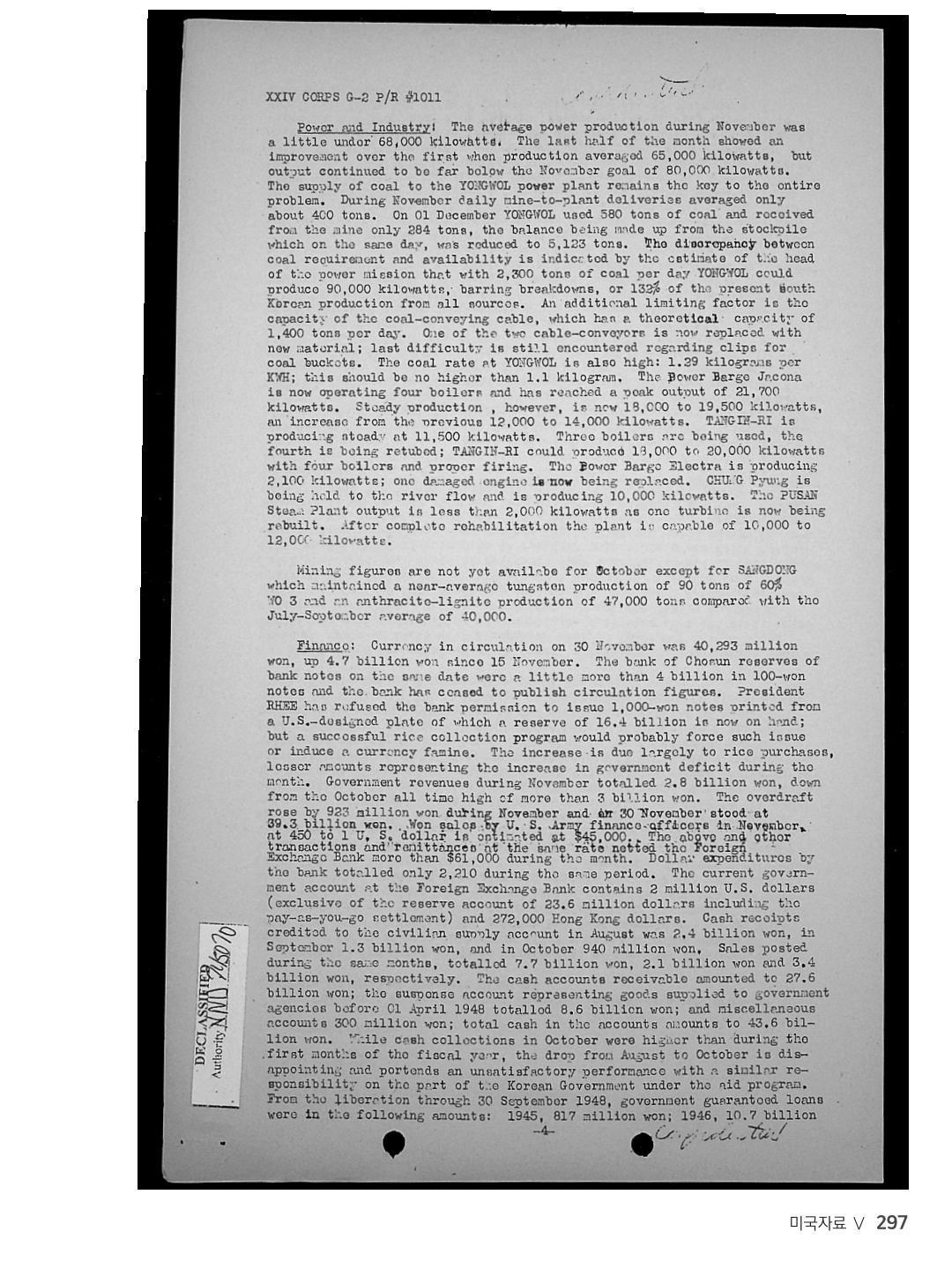
Power and Industry: The average power production during November was a little under 68,000 kilowatts. The last half of the month showed an improvement over the first when production averaged 65,000 kilowatts, but output continued to be far below the November goal of 80,000 kilowatts. The supply of coal to the YONGWOL power plant remains the key to the entire problem. During November daily mine-to-plant deliveries averaged only about 400 tons. On 01 December YONGWOL used 580 tons of coal and received from the mine only 284 tons, the balance being made up from the stockpile which on the same day, was reduced to 5,123 tons. The discrepancy between coal requirement and availability is indicated by the estimate of the head of the power mission that with 2,300 tons of coal per day YONGWOL could produce 90,000 kilowatts, barring breakdowns, or 132% of the present South Korean production from all sources. An additional limiting factor is the capacity of the coal-conveying cable, which has a theoretical capacity of 1,400 tons per day. One of the two cable-conveyors is now replaced with new material; last difficulty is still encountered regarding clips for coal buckets. The coal rate at YONGWOL is also high: 1.29 kilograms per KWH; this should be no higher than 1.1 kilogram. The Power Barge Jacona is now operating four boilers and has reached a peak output of 21,700 kilowatts. Steady production, however, is now 18,000 to 19,500 kilowatts, an increase from the previous 12,000 to 14,000 kilowatts. TANGIN-RI is producing steadily at 11,500 kilowatts. Three boilers are being used, the fourth is being retubed; TANGIN-RI could produce 13,000 to 20,000 kilowatts with four boilers and proper firing. The Power Barge Electra is producing 2,100 kilowatts; one damaged engine is now being replaced. CHUNG Pyung is being held to the river flow and is producing 10,000 kilowatts. The PUSAN Steam Plant output is less than 2,000 kilowatts as one turbine is now being rebuilt. After complete rehabilitation the plant is capable of 10,000 to 12,000 kilowatts.
Mining figures are not yet available for October except for SANGDONG which maintained a near-average tungsten production of 90 tons of 60% WO 3 and an anthracite-lignite production of 47,000 tons compared with the July-September average of 40,000.
Finance: Currency in circulation on 30 November was 40,293 million won, up 4.7 billion won since 15 November. The bank of Chosun reserves of bank notes on the same date were a little more than 4 billion in 100-won notes and the bank has ceased to publish circulation figures. President RHEE has refused the bank permission to issue 1,000-won notes printed from a U.S.-designed plate of which a reserve of 16.4 billion is now on hand; but a successful rice collection program would probably force such issue or induce a currency famine. The increase is due largely to rice purchases, lesser amounts representing the increase in government deficit during the month. Government revenues during November totalled 2.8 billion won, down from the October all time high of more than 3 billion won. The overdraft rose by 923 million won during November and on 30 November stood at 39.3 billion won. Won sales by U. S. Army finance officers in November, at 450 to 1 U. S. dollar is estimated at $45,000. The above and other transactions and remittances at the same rate netted the Foreign Exchange Bank more than $51,000 during the month. Dollar expenditures by the bank totalled only 2,210 during the same period. The current government account at the Foreign Exchange Bank contains 2 million U.S. dollars (exclusive of the reserve account of 23.6 million dollars including the pay-as-you-go settlement) and 272,000 Hong Kong dollars. Cash receipts credited to the civilian supply accounts in August was 2.4 billion won, in September 1.3 billion won, and in October 940 million won. Sales posted during the same months, totalled 7.7 billion won, 2.1 billion won and 3.4 billion won, respectively. The cash accounts receivable amounted to 27.6 billion won; the suspense account representing goods supplied to government agencies before 01 April 1948 totalled 8.6 billion won; and miscellaneous accounts 300 million won; total cash in the accounts amounts to 43.6 billion won. While cash collections in October were higher than during the first months of the fiscal year, the drop from August to October is disappointing and portends an unsatisfactory performance with a similar responsibility on the part of the Korean Government under the aid program. From the liberation through 30 September 1948, government guaranteed loans were in the following amounts: 1945, 817 million won; 1946, 10.7 billion
-4-
DECLASSIFIED
Authority [illegible]
XXIV CORPS G-2 P/R #1011
Confidential
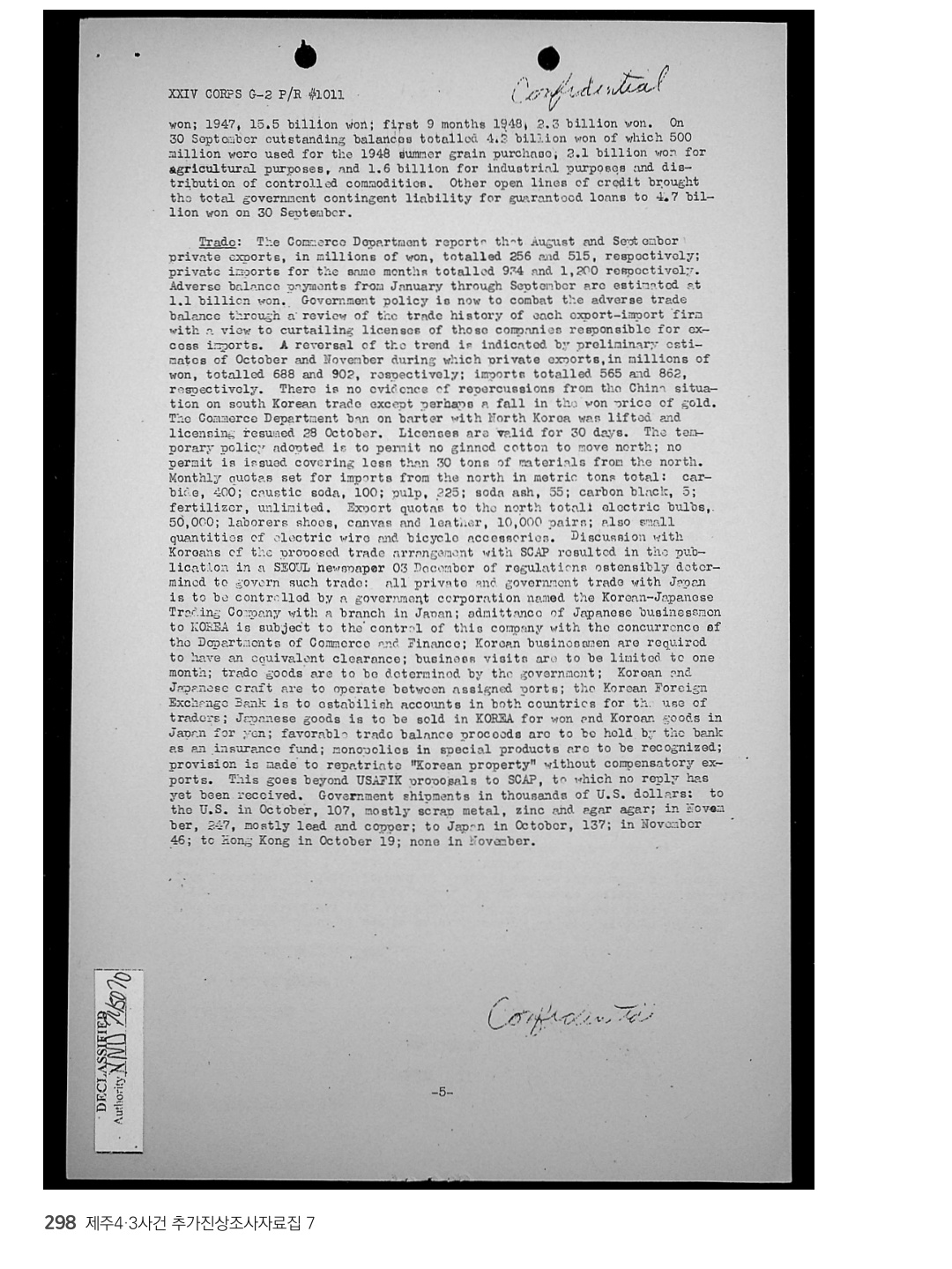
won; 1947, 15.5 billion won; first 9 months 1948, 2.3 billion won. On
30 September outstanding balances totalled 4.2 billion won of which 500 million were used for the 1948 summer grain purchase, 2.1 billion won for agricultural purposes, and 1.6 billion for industrial purposes and distribution of controlled commodities. Other open lines of credit brought the total government contingent liability for guaranteed loans to 4.7 billion won on 30 September.
Trade: The Commerce Department reports that August and September private exports, in millions of won, totalled 256 and 515, respectively; private imports for the same months totalled 934 and 1,200 respectively.
Adverse balance payments from January through September are estimated at
1.1 billion won. Government policy is now to combat the adverse trade balance through a review of the trade history of each export-import firm with a view to curtailing licenses of those companies responsible for excess imports. A reversal of the trend is indicated by preliminary estimates of October and November during which private exports, in millions of won, totalled 688 and 902, respectively; imports totalled 565 and 862, respectively. There is no evidence of repercussions from the China situation on south Korean trade except perhaps a fall in the won price of gold.
The Commerce Department ban on barter with North Korea was lifted and licensing resumed 28 October. Licenses are valid for 30 days. The temporary policy adopted is to permit no ginned cotton to move north; no permit is issued covering less than 30 tons of materials from the north.
Monthly quotas set for imports from the north in metric tons total: carbide, 400; caustic soda, 100; pulp, 225; soda ash, 55; carbon black, 5; fertilizer, unlimited. Export quotas to the north total: electric bulbs,
50,000; laborers shoes, canvas and leather, 10,000 pairs; also small quantities of electric wire and bicycle accessories. Discussion with
Koreans of the proposed trade arrangement with SCAP resulted in the publication in a SEOUL newspaper 03 December of regulations ostensibly determined to govern such trade: all private and government trade with Japan is to be controlled by a government corporation named the Korean-Japanese
Trading Company with a branch in Japan; admittance of Japanese businessmen to KOREA is subject to the control of this company with the concurrence of the Departments of Commerce and Finance; Korean businessmen are required to have an equivalent clearance; business visits are to be limited to one month; trade goods are to be determined by the government; Korean and
Japanese craft are to operate between assigned ports; the Korean Foreign
Exchange Bank is to establish accounts in both countries for the use of traders; Japanese goods is to be sold in KOREA for won and Korean goods in
Japan for yen; favorable trade balance proceeds are to be held by the bank as an insurance fund; monopolies in special products are to be recognized; provision is made to repatriate "Korean property" without compensatory exports. This goes beyond USAFIK proposals to SCAP, to which no reply has yet been received. Government shipments in thousands of U.S. dollars: to the U.S. in October, 107, mostly scrap metal, zinc and agar agar; in November, 247, mostly lead and copper; to Japan in October, 137; in November
46; to Hong Kong in October 19; none in November.
-5-
Confidential
DECLASSIFIED
[illegible]
Authority [illegible]
출처:
제주4·3평화재단 편,
『추가진상조사자료집-미국자료5』,
p. 294–298.
— NARA (RG 554, Entry 1256, Box 47)
×
![]()