스캔 원본
100%
p.257
p.258
p.259
p.260
p.261
p.262
p.263
p.264
p.265
p.266
p.267
p.268
p.269
p.270
p.271
p.272
정보참모부 주간요약보고
기간: 1948년 1월 16일~1948년 1월 23일
주한미육군사령부
서울, 조선
1948년 1월 23일 제123호
2. 방첩
a. 남조선에서의 현재 공산당 활동 (2급 비밀)
다음은 도별 공산주의자 현황에 관한 평가의 일부다.
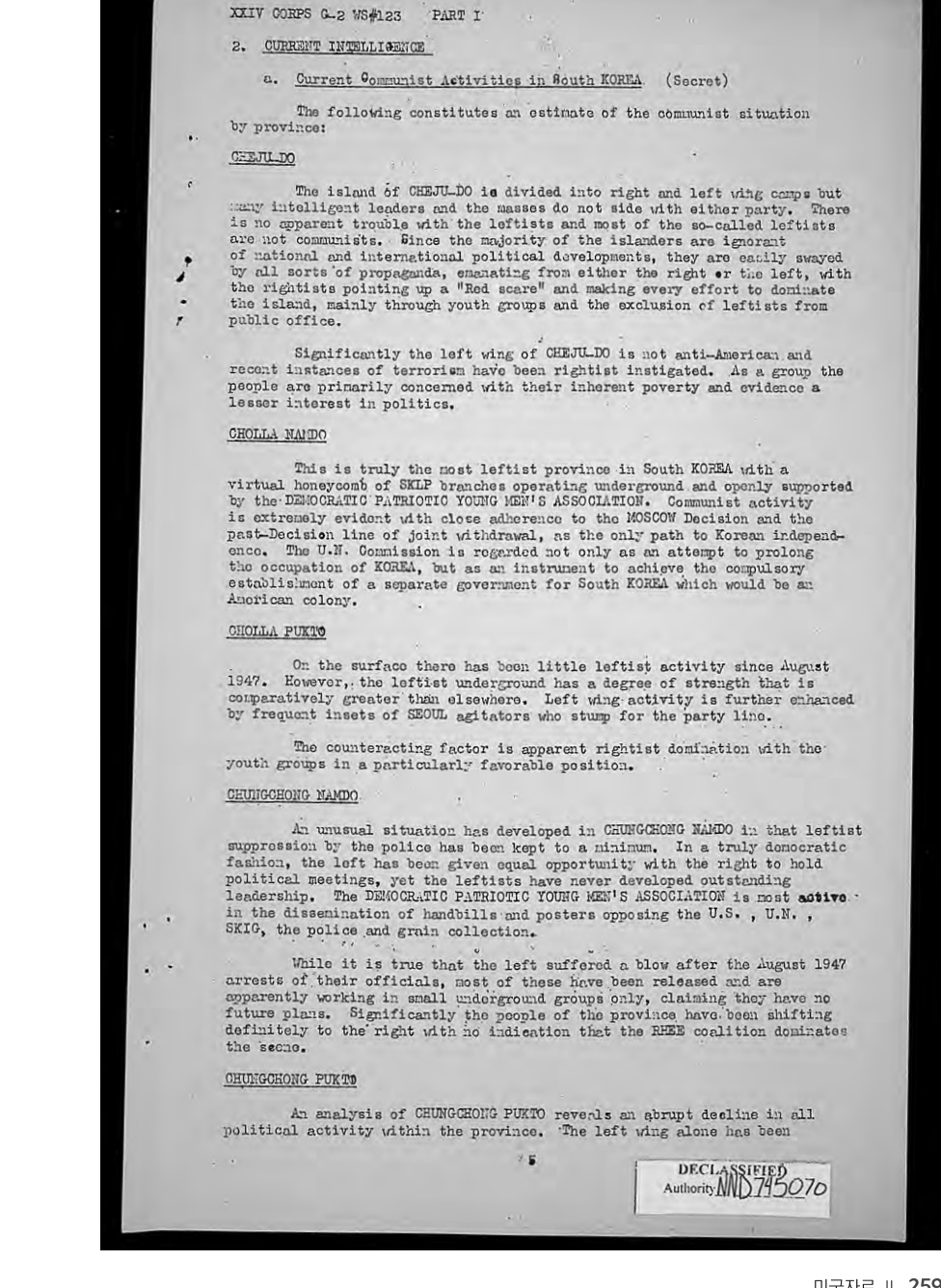
제주도
제주도는 우익진영과 좌익진영으로 나누어져 있지만, 많은 현명한 지도층과 대 중은 어느 집단의 편도 들지 않고 있다. 좌익과의 두드러지는 충돌은 없으며, 좌 익이라고 일컬어지는 이들도 공산주의자가 아니다. 제주도민 대부분은 국내외 정 치 상황에 대해 무지한바, 우익이나 좌익에서 나오는 온갖 선전에 쉽게 휩쓸린다.
우익은 "빨갱이 공포"를 강조하며, 주로 청년단체를 통해, 그리고 공직에서의 좌 파 배제를 통해 제주도를 장악하려고 전력을 다하고 있다.
의미심장하게도 제주도의 좌익은 반미적이지 않다. 최근 테러 사례들은 우파가 선동한 것이었다. 주민들은 전체적으로 자신들의 타고난 빈곤에 대해 주로 염려 하고 있으며, 정치에는 별로 관심을 보이지 않는다.
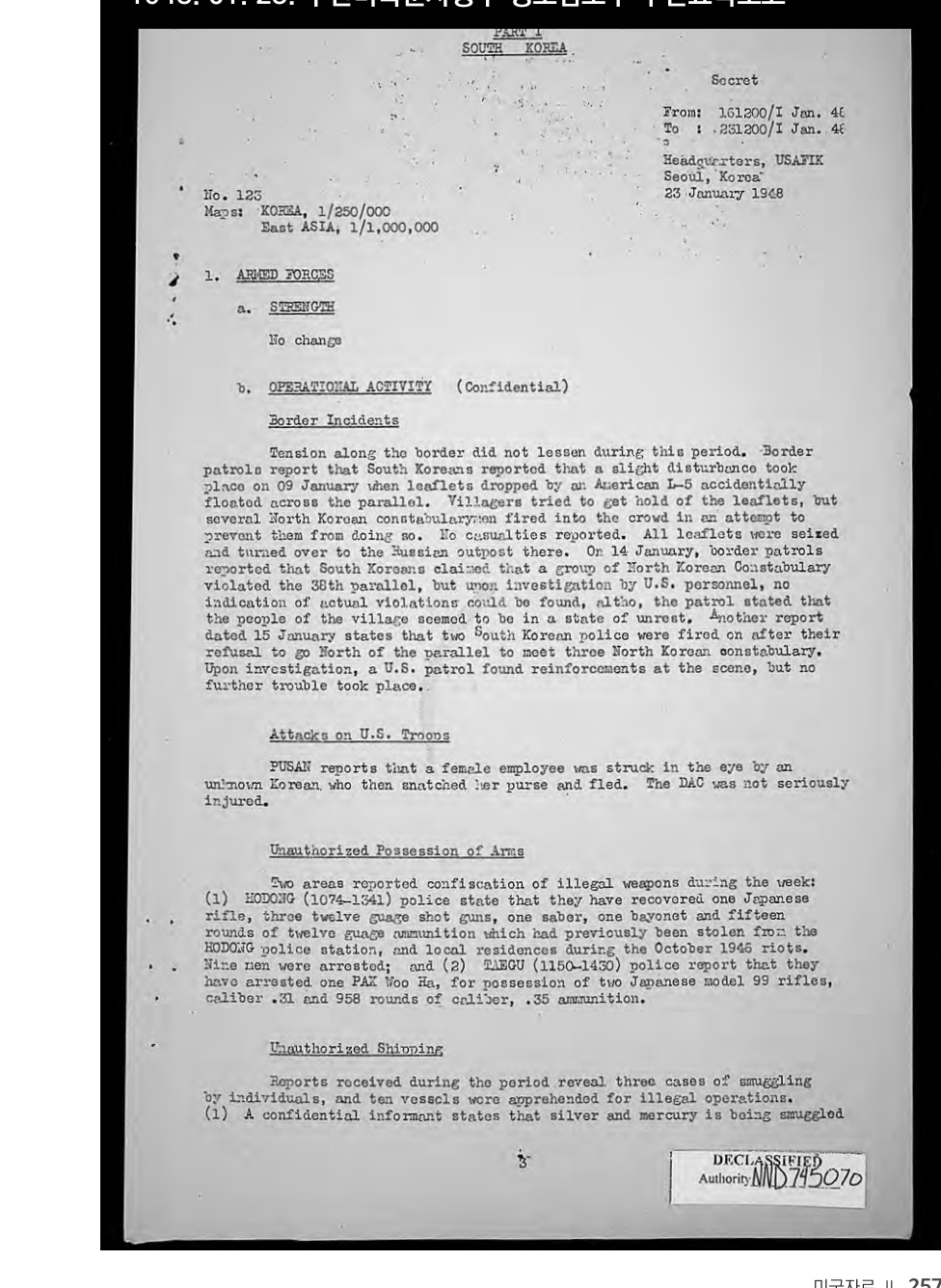
PART I
SOUTH KOREA
Secret
From: 161200/I Jan. 48
To : 231200/I Jan. 48
Headquarters, USAFIK
Seoul, Korea
23 January 1948
No. 123
Maps: KOREA, 1/250,000
East ASIA, 1/1,000,000
1. ARMED FORCES
a. STRENGTH
No change
b. OPERATIONAL ACTIVITY (Confidential)
Border Incidents
Tension along the border did not lessen during this period. Border patrols report that South Koreans reported that a slight disturbance took place on 09 January when leaflets dropped by an American L-5 accidentially floated across the parallel. Villagers tried to get hold of the leaflets, but several North Korean constabularymen fired into the crowd in an attempt to prevent them from doing so. No casualties reported. All leaflets were seized and turned over to the Russian outpost there. On 14 January, border patrols reported that South Koreans claimed that a group of North Korean Constabulary violated the 38th parallel, but upon investigation by U.S. personnel, no indication of actual violations could be found, altho, the patrol stated that the people of the village seemed to be in a state of unrest. Another report dated 15 January states that two South Korean police were fired on after their refusal to go North of the parallel to meet three North Korean constabulary.
Upon investigation, a U.S. patrol found reinforcements at the scene, but no further trouble took place.
Attacks on U.S. Troops
PUSAN reports that a female employee was struck in the eye by an unknown Korean who then snatched her purse and fled. The DAC was not seriously injured.
Unauthorized Possession of Arms
Two areas reported confiscation of illegal weapons during the week:
(1) HODONG (1074-1341) police state that they have recovered one Japanese rifle, three twelve guage shot guns, one saber, one bayonet and fifteen rounds of twelve guage ammunition which had previously been stolen from the
HODONG police station, and local residences during the October 1945 riots.
Nine men were arrested; and (2) TAEGU (1150-1430) police report that they have arrested one PAK Woo Ha, for possession of two Japanese model 99 rifles, caliber .31 and 958 rounds of caliber, .35 ammunition.
Unauthorized Shipping
Reports received during the period reveal three cases of smuggling by individuals, and ten vessels were apprehended for illegal operations.
(1) A confidential informant states that silver and mercury is being smuggled
3
DECLASSIFIED
Authority NND 745070
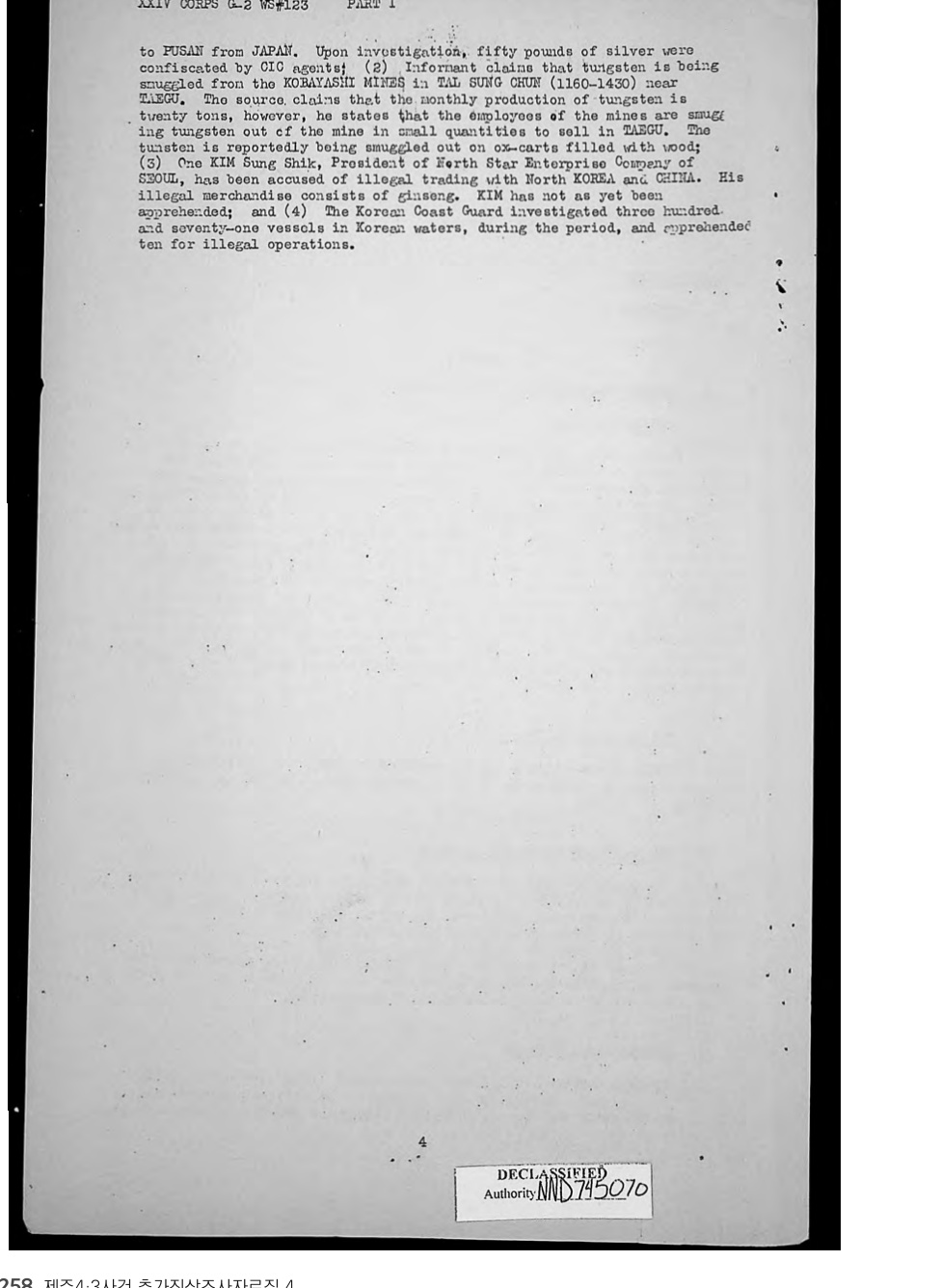
XXIV CORPS G-2 WS#123 PART I
to PUSAN from JAPAN. Upon investigation, fifty pounds of silver were confiscated by CIC agents; (2) Informant claims that tungsten is being smuggled from the KOBAYASHI MINES in TAL SUNG CHUN (1160-1430) near
TAEGU. The source claims that the monthly production of tungsten is twenty tons, however, he states that the employees of the mines are smug[g]
ing tungsten out of the mine in small quantities to sell in TAEGU. The tunsten is reportedly being smuggled out on ox-carts filled with wood;
(3) One KIM Sung Shik, President of North Star Enterprise Company of
SEOUL, has been accused of illegal trading with North KOREA and CHINA. His illegal merchandise consists of ginseng. KIM has not as yet been apprehended; and (4) The Korean Coast Guard investigated three hundred and seventy-one vessels in Korean waters, during the period, and apprehended ten for illegal operations.
4
DECLASSIFIED
Authority NND 745070
XXIV CORPS G-2 MS#123 PART I
2. CURRENT INTELLIGENCE
a. Current Communist Activities in South KOREA. (Secret)
The following constitutes an estimate of the communist situation by province:
CHEJU-DO
The island of CHEJU-DO is divided into right and left wing camps but many intelligent leaders and the masses do not side with either party. There is no apparent trouble with the leftists and most of the so-called leftists are not communists. Since the majority of the islanders are ignorant of national and international political developments, they are easily swayed by all sorts of propaganda, emanating from either the right or the left, with the rightists pointing up a "Red scare" and making every effort to dominate the island, mainly through youth groups and the exclusion of leftists from public office.
Significantly the left wing of CHEJU-DO is not anti-American and recent instances of terrorism have been rightist instigated. As a group the people are primarily concerned with their inherent poverty and evidence a lesser interest in politics.
CHOLLA NAMDO
This is truly the most leftist province in South KOREA with a virtual honeycomb of SKLP branches operating underground and openly supported by the DEMOCRATIC PATRIOTIC YOUNG MEN'S ASSOCIATION. Communist activity is extremely evident with close adherence to the MOSCOW Decision and the past-Decision line of joint withdrawal, as the only path to Korean independence. The U.N. Commission is regarded not only as an attempt to prolong the occupation of KOREA, but as an instrument to achieve the compulsory establishment of a separate government for South KOREA which would be an American colony.
CHOLLA PUKTO
On the surface there has been little leftist activity since August 1947. However, the leftist underground has a degree of strength that is comparatively greater than elsewhere. Left wing activity is further enhanced by frequent insets of SEOUL agitators who stump for the party line.
The counteracting factor is apparent rightist domination with the youth groups in a particularly favorable position.
CHUNGCHONG NAMDO
An unusual situation has developed in CHUNGCHONG NAMDO in that leftist suppression by the police has been kept to a minimum. In a truly democratic fashion, the left has been given equal opportunity with the right to hold political meetings, yet the leftists have never developed outstanding leadership. The DEMOCRATIC PATRIOTIC YOUNG MEN'S ASSOCIATION is most active in the dissemination of handbills and posters opposing the U.S., U.N., SKIG, the police and grain collection.
While it is true that the left suffered a blow after the August 1947 arrests of their officials, most of these have been released and are apparently working in small underground groups only, claiming they have no future plans. Significantly the people of the province have been shifting definitely to the right with no indication that the RHEE coalition dominates the scene.
CHUNGCHONG PUKTO
An analysis of CHUNGCHONG PUKTO reveals an abrupt decline in all political activity within the province. The left wing alone has been
5
DECLASSIFIED
Authority NND 745070
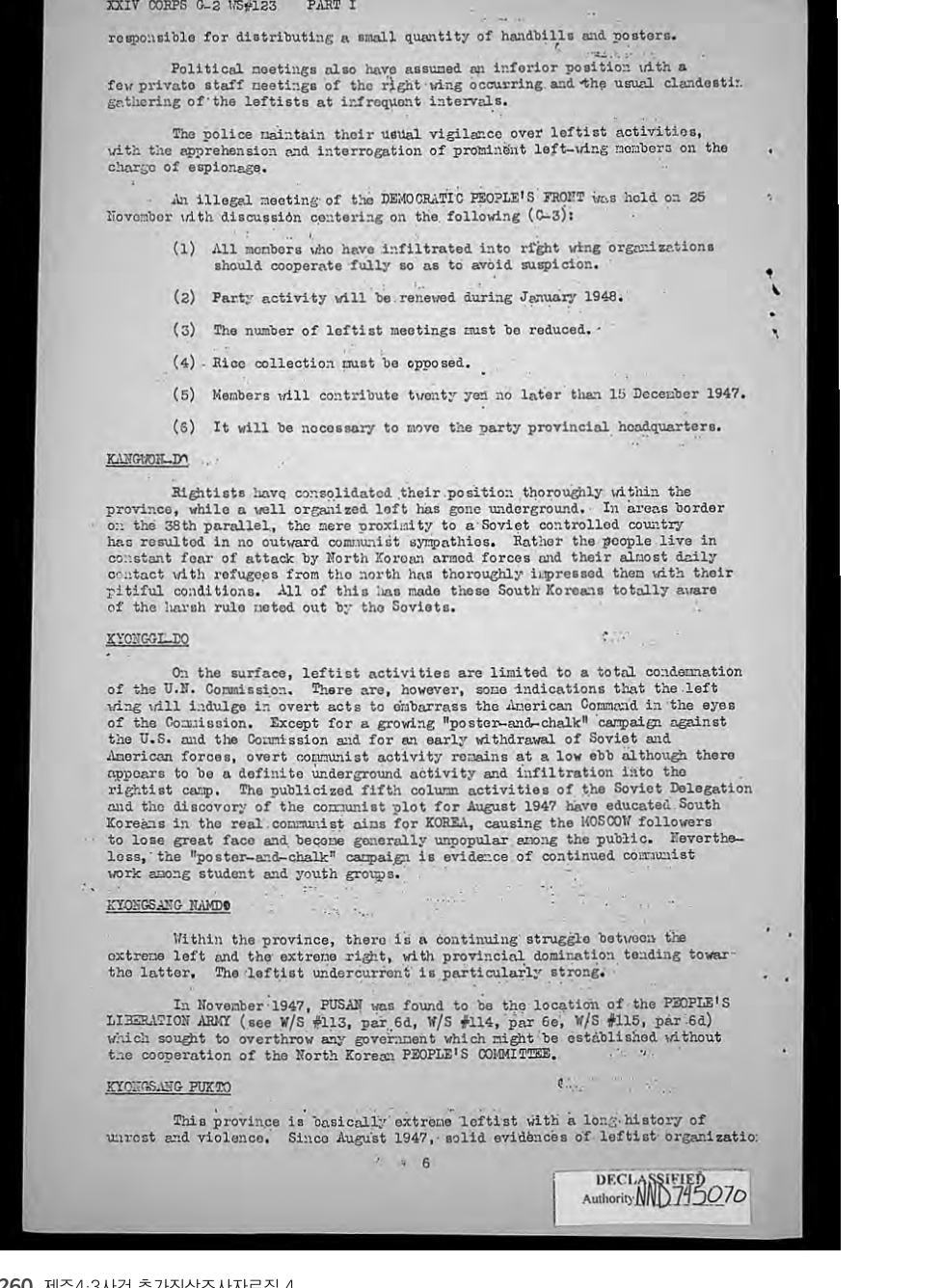
XXIV CORPS G-2 WS#123 PART I
responsible for distributing a small quantity of handbills and posters.
Political meetings also have assumed an inferior position with a few private staff meetings of the right wing occurring and the usual clandestine gathering of the leftists at infrequent intervals.
The police maintain their usual vigilance over leftist activities, with the apprehension and interrogation of prominent left-wing members on the charge of espionage.
An illegal meeting of the DEMOCRATIC PEOPLE'S FRONT was held on 25 November with discussion centering on the following (C-3):
(1) All members who have infiltrated into right wing organizations should cooperate fully so as to avoid suspicion.
(2) Party activity will be renewed during January 1948.
(3) The number of leftist meetings must be reduced.
(4) Rice collection must be opposed.
(5) Members will contribute twenty yen no later than 15 December 1947.
(6) It will be necessary to move the party provincial headquarters.
KANGWON-DO
Rightists have consolidated their position thoroughly within the province, while a well organized left has gone underground. In areas bordering on the 38th parallel, the mere proximity to a Soviet controlled country has resulted in no outward communist sympathies. Rather the people live in constant fear of attack by North Korean armed forces and their almost daily contact with refugees from the north has thoroughly impressed them with their pitiful conditions. All of this has made these South Koreans totally aware of the harsh rule meted out by the Soviets.
KYONGGI-DO
On the surface, leftist activities are limited to a total condemnation of the U.N. Commission. There are, however, some indications that the left wing will indulge in overt acts to embarrass the American Command in the eyes of the Commission. Except for a growing "poster-and-chalk" campaign against the U.S. and the Commission and for an early withdrawal of Soviet and American forces, overt communist activity remains at a low ebb although there appears to be a definite underground activity and infiltration into the rightist camp. The publicized fifth column activities of the Soviet Delegation and the discovery of the communist plot for August 1947 have educated South Koreans in the real communist aims for KOREA, causing the MOSCOW followers to lose great face and become generally unpopular among the public. Nevertheless, the "poster-and-chalk" campaign is evidence of continued communist work among student and youth groups.
KYONGSANG NAMDO
Within the province, there is a continuing struggle between the extreme left and the extreme right, with provincial domination tending toward the latter. The leftist undercurrent is particularly strong.
In November 1947, PUSAN was found to be the location of the PEOPLE'S LIBERATION ARMY (see W/S #113, par 6d, W/S #114, par 6e, W/S #115, par 6d) which sought to overthrow any government which might be established without the cooperation of the North Korean PEOPLE'S COMMITTEE.
KYONGSANG PUKTO
This province is basically extreme leftist with a long history of unrest and violence. Since August 1947, solid evidences of leftist organizatio[n]
6
DECLASSIFIED
Authority NND 745070
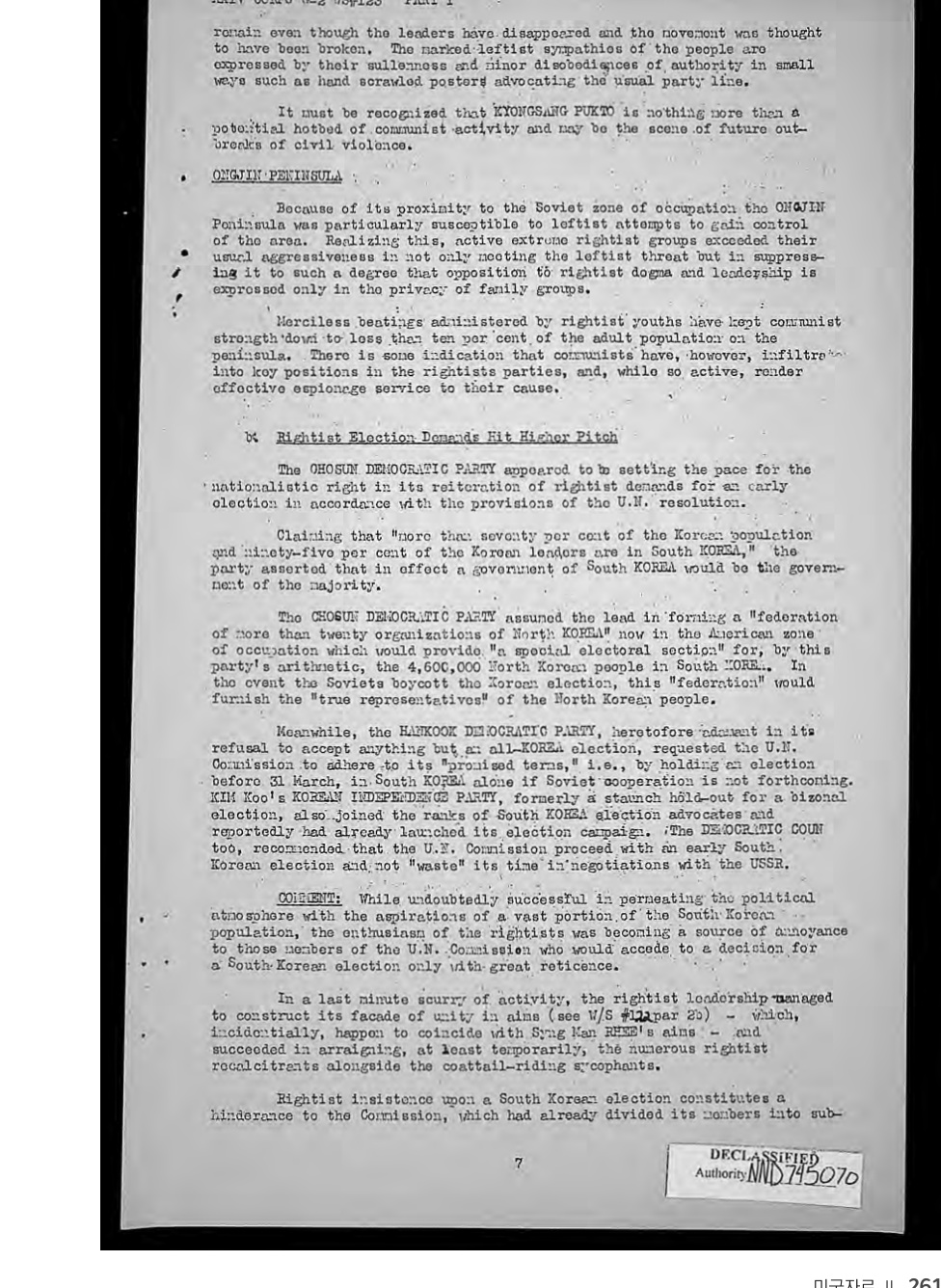
XXIV CORPS G-2 WS#123 PART I
remain even though the leaders have disappeared and the movement was thought to have been broken. The marked leftist sympathies of the people are expressed by their sullenness and minor disobediences of authority in small ways such as hand scrawled posters advocating the usual party line.
It must be recognized that KYONGSANG PUKTO is nothing more than a potential hotbed of communist activity and may be the scene of future outbreaks of civil violence.
ONGJIN PENINSULA
Because of its proximity to the Soviet zone of occupation the ONGJIN Peninsula was particularly susceptible to leftist attempts to gain control of the area. Realizing this, active extreme rightist groups exceeded their usual aggressiveness in not only meeting the leftist threat but in suppressing it to such a degree that opposition to rightist dogma and leadership is expressed only in the privacy of family groups.
Merciless beatings administered by rightist youths have kept communist strength down to less than ten per cent of the adult population on the peninsula. There is some indication that communists have, however, infiltrated into key positions in the rightists parties, and, while so active, render effective espionage service to their cause.
b. Rightist Election Demands Hit Higher Pitch
The CHOSUN DEMOCRATIC PARTY appeared to be setting the pace for the nationalistic right in its reiteration of rightist demands for an early election in accordance with the provisions of the U.N. resolution.
Claiming that "more than seventy per cent of the Korean population and ninety-five per cent of the Korean leaders are in South KOREA," the party asserted that in effect a government of South KOREA would be the government of the majority.
The CHOSUN DEMOCRATIC PARTY assumed the lead in forming a "federation of more than twenty organizations of North KOREA" now in the American zone of occupation which would provide "a special electoral section" for, by this party's arithmetic, the 4,600,000 North Korean people in South KOREA. In the event the Soviets boycott the Korean election, this "federation" would furnish the "true representatives" of the North Korean people.
Meanwhile, the HANKOOK DEMOCRATIC PARTY, heretofore adamant in its refusal to accept anything but an all-KOREA election, requested the U.N. Commission to adhere to its "promised terms," i.e., by holding an election before 31 March, in South KOREA alone if Soviet cooperation is not forthcoming. KIM Koo's KOREAN INDEPENDENCE PARTY, formerly a staunch hold-out for a bizonal election, also joined the ranks of South KOREA election advocates and reportedly had already launched its election campaign. The DEMOCRATIC COUN too, recommended that the U.N. Commission proceed with an early South Korean election and not "waste" its time in negotiations with the USSR.
COMMENT: While undoubtedly successful in permeating the political atmosphere with the aspirations of a vast portion of the South Korean population, the enthusiasm of the rightists was becoming a source of annoyance to those members of the U.N. Commission who would accede to a decision for a South Korean election only with great reticence.
In a last minute scurry of activity, the rightist leadership managed to construct its facade of unity in aims (see W/S #12 par 2b) - which, incidentally, happen to coincide with Syng Man RHEE's aims - and succeeded in arraigning, at least temporarily, the numerous rightist recalcitrants alongside the coattail-riding sycophants.
Rightist insistence upon a South Korean election constitutes a hinderance to the Commission, which had already divided its members into sub-
7
DECLASSIFIED
Authority NND 745070
XXIV CORPS G-2 WS#123 PART I
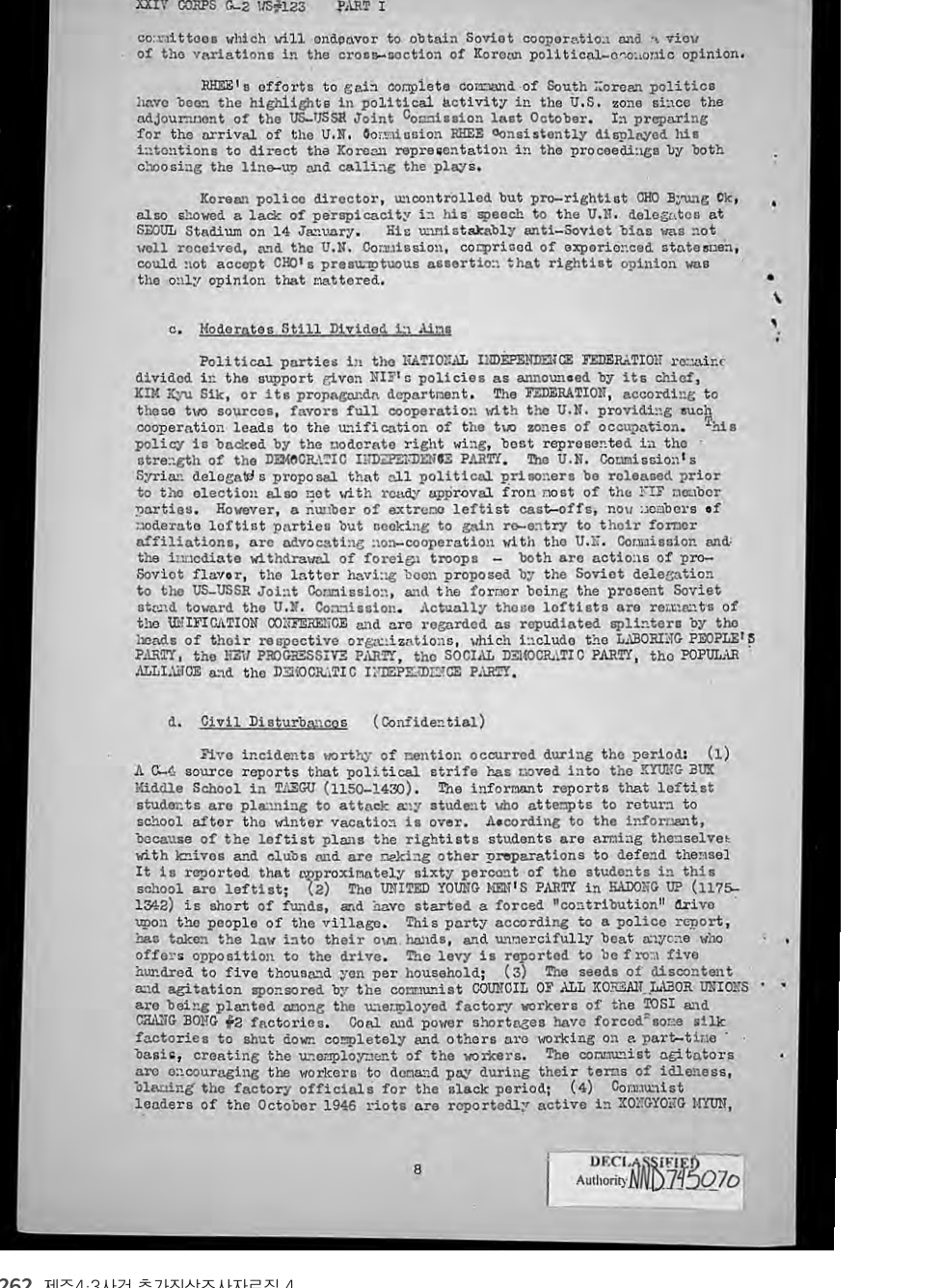
committees which will endeavor to obtain Soviet cooperation and a view of the variations in the cross-section of Korean political-economic opinion.
RHEE's efforts to gain complete command of South Korean politics have been the highlights in political activity in the U.S. zone since the adjournment of the US-USSR Joint Commission last October. In preparing for the arrival of the U.N. Commission RHEE consistently displayed his intentions to direct the Korean representation in the proceedings by both choosing the line-up and calling the plays.
Korean police director, uncontrolled but pro-rightist CHO Byung Ok, also showed a lack of perspicacity in his speech to the U.N. delegates at
SEOUL Stadium on 14 January. His unmistakably anti-Soviet bias was not well received, and the U.N. Commission, comprised of experienced statesmen, could not accept CHO's presumptuous assertion that rightist opinion was the only opinion that mattered.
c. Moderates Still Divided in Aims
Political parties in the NATIONAL INDEPENDENCE FEDERATION remains divided in the support given NIF's policies as announced by its chief, KIM Kyu Sik, or its propaganda department. The FEDERATION, according to these two sources, favors full cooperation with the U.N. providing such cooperation leads to the unification of the two zones of occupation. This policy is backed by the moderate right wing, best represented in the strength of the DEMOCRATIC INDEPENDENCE PARTY. The U.N. Commission's
Syrian delegate's proposal that all political prisoners be released prior to the election also met with ready approval from most of the NIF member parties. However, a number of extreme leftist cast-offs, now members of moderate leftist parties but seeking to gain re-entry to their former affiliations, are advocating non-cooperation with the U.N. Commission and the immediate withdrawal of foreign troops -- both are actions of proSoviet flavor, the latter having been proposed by the Soviet delegation to the US-USSR Joint Commission, and the former being the present Soviet stand toward the U.N. Commission. Actually these leftists are remnants of the UNIFICATION CONFERENCE and are regarded as repudiated splinters by the heads of their respective organizations, which include the LABORING PEOPLE'S
PARTY, the NEW PROGRESSIVE PARTY, the SOCIAL DEMOCRATIC PARTY, the POPULAR
ALLIANCE and the DEMOCRATIC INDEPENDENCE PARTY.
d. Civil Disturbances (Confidential)
Five incidents worthy of mention occurred during the period: (1)
A G-4 source reports that political strife has moved into the KYUNG BUK
Middle School in TAEGU (1150-1430). The informant reports that leftist students are planning to attack any student who attempts to return to school after the winter vacation is over. According to the informant, because of the leftist plans the rightists students are arming themselves with knives and clubs and are making other preparations to defend themselves.
It is reported that approximately sixty percent of the students in this school are leftist; (2) The UNITED YOUNG MEN'S PARTY in HADONG UP (1175-
1342) is short of funds, and have started a forced "contribution" drive upon the people of the village. This party according to a police report, has taken the law into their own hands, and unmercifully beat anyone who offers opposition to the drive. The levy is reported to be from five hundred to five thousand yen per household; (3) The seeds of discontent and agitation sponsored by the communist COUNCIL OF ALL KOREAN LABOR UNIONS are being planted among the unemployed factory workers of the TOSI and
CHANG BONG #2 factories. Coal and power shortages have forced some silk factories to shut down completely and others are working on a part-time basis, creating the unemployment of the workers. The communist agitators are encouraging the workers to demand pay during their terms of idleness, blaming the factory officials for the slack period; (4) Communist leaders of the October 1946 riots are reportedly active in KONGYONG MYUN,
8
DECLASSIFIED
Authority NND 745070
XXIV CORPS G-2 US#123 PART I
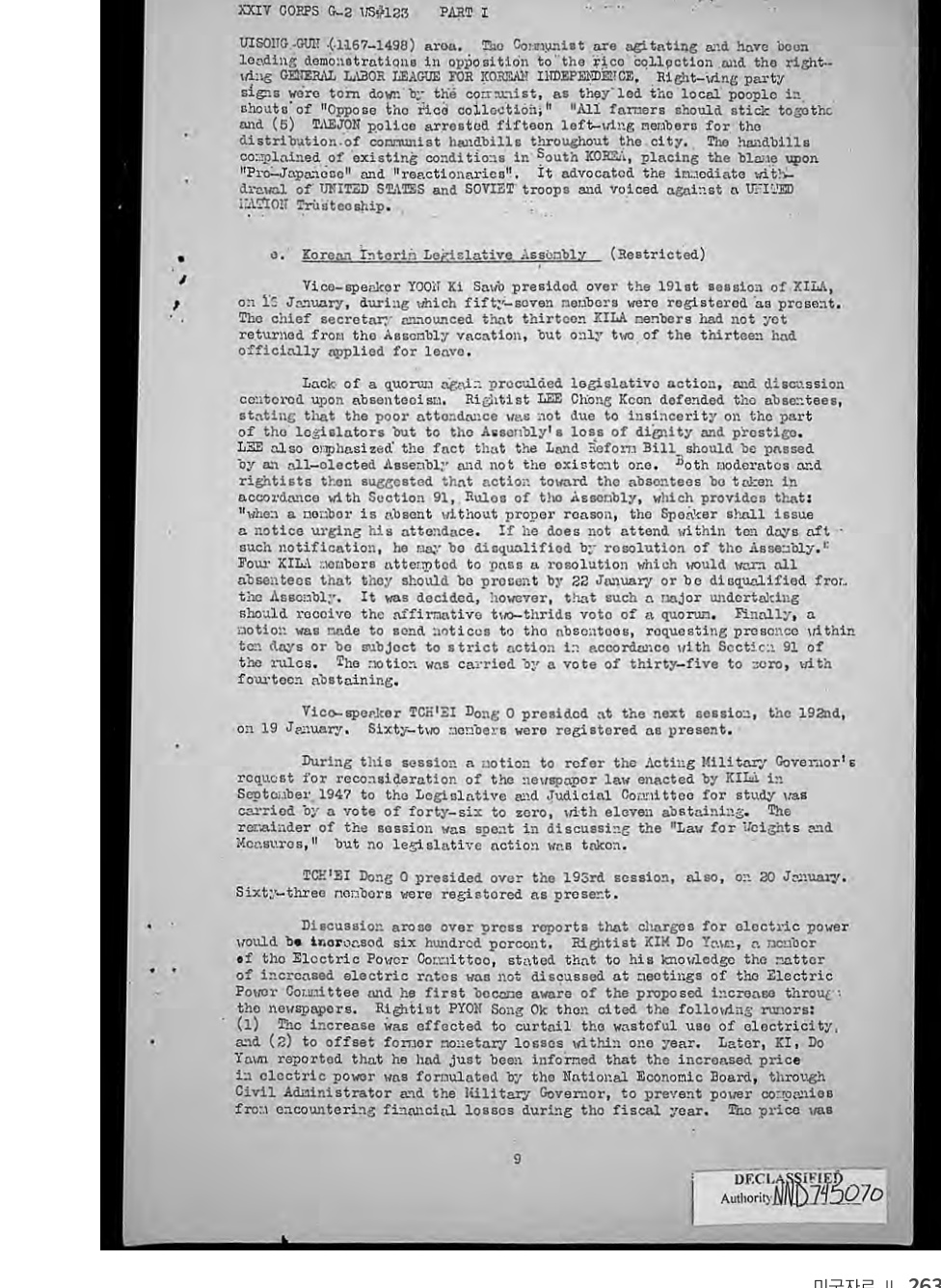
UISONG-GUN (1167-1498) area. The Communist are agitating and have been leading demonstrations in opposition to the rice collection and the right-wing GENERAL LABOR LEAGUE FOR KOREAN INDEPENDENCE. Right-wing party signs were torn down by the communist, as they led the local people in shouts of "Oppose the rice collection;" "All farmers should stick together and (5) TAEJON police arrested fifteen left-wing members for the distribution of communist handbills throughout the city. The handbills complained of existing conditions in South KOREA, placing the blame upon "Pro-Japanese" and "reactionaries". It advocated the immediate withdrawal of UNITED STATES and SOVIET troops and voiced against a UNITED NATION Trusteeship.
o. Korean Interim Legislative Assembly (Restricted)
Vice-speaker YOON Ki Sawb presided over the 191st session of KILA, on 18 January, during which fifty-seven members were registered as present. The chief secretary announced that thirteen KILA members had not yet returned from the Assembly vacation, but only two of the thirteen had officially applied for leave.
Lack of a quorum again precluded legislative action, and discussion centered upon absenteeism. Rightist LEE Chong Koon defended the absentees, stating that the poor attendance was not due to insincerity on the part of the legislators but to the Assembly's loss of dignity and prestige. LEE also emphasized the fact that the Land Reform Bill should be passed by an all-elected Assembly and not the existent one. Both moderates and rightists then suggested that action toward the absentees be taken in accordance with Section 91, Rules of the Assembly, which provides that: "when a member is absent without proper reason, the Speaker shall issue a notice urging his attendance. If he does not attend within ten days after such notification, he may be disqualified by resolution of the Assembly." Four KILA members attempted to pass a resolution which would warn all absentees that they should be present by 22 January or be disqualified from the Assembly. It was decided, however, that such a major undertaking should receive the affirmative two-thirds vote of a quorum. Finally, a motion was made to send notices to the absentees, requesting presence within ten days or be subject to strict action in accordance with Section 91 of the rules. The motion was carried by a vote of thirty-five to zero, with fourteen abstaining.
Vice-speaker TCH'EI Dong O presided at the next session, the 192nd, on 19 January. Sixty-two members were registered as present.
During this session a motion to refer the Acting Military Governor's request for reconsideration of the newspaper law enacted by KILA in September 1947 to the Legislative and Judicial Committee for study was carried by a vote of forty-six to zero, with eleven abstaining. The remainder of the session was spent in discussing the "Law for Weights and Measures," but no legislative action was taken.
TCH'EI Dong O presided over the 193rd session, also, on 20 January. Sixty-three members were registered as present.
Discussion arose over press reports that charges for electric power would be increased six hundred percent. Rightist KIM Do Youn, a member of the Electric Power Committee, stated that to his knowledge the matter of increased electric rates was not discussed at meetings of the Electric Power Committee and he first become aware of the proposed increase through the newspapers. Rightist PYOM Song Ok then cited the following rumors: (1) The increase was effected to curtail the wasteful use of electricity, and (2) to offset former monetary losses within one year. Later, KI, Do Youn reported that he had just been informed that the increased price in electric power was formulated by the National Economic Board, through Civil Administrator and the Military Governor, to prevent power companies from encountering financial losses during the fiscal year. The price was
9
DECLASSIFIED
Authority NND 745070
XXIV CORPS G-2 US#123 PART I
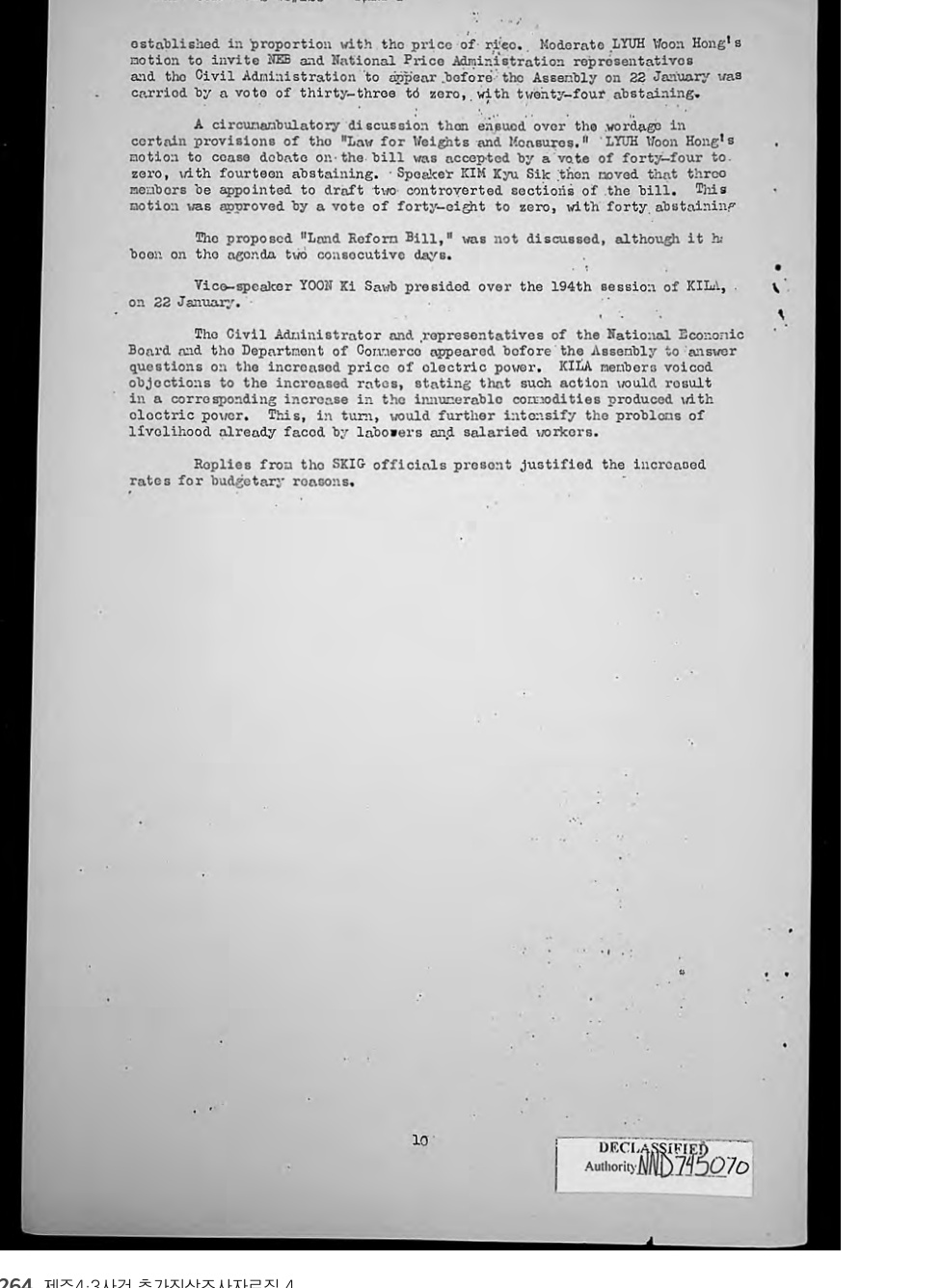
established in proportion with the price of rice. Moderate LYUH Woon Hong's motion to invite NEB and National Price Administration representatives and the Civil Administration to appear before the Assembly on 22 January was carried by a vote of thirty-three to zero, with twenty-four abstaining.
A circumambulatory discussion then ensued over the wordage in certain provisions of the "Law for Weights and Measures." LYUH Woon Hong's motion to cease debate on the bill was accepted by a vote of forty-four to zero, with fourteen abstaining. Speaker KIM Kyu Sik then moved that three members be appointed to draft two controverted sections of the bill. This motion was approved by a vote of forty-eight to zero, with forty abstaining.
The proposed "Land Reform Bill," was not discussed, although it ha been on the agenda two consecutive days.
Vice-speaker YOON Ki Sawb presided over the 194th session of KILA, on 22 January.
The Civil Administrator and representatives of the National Economic
Board and the Department of Commerce appeared before the Assembly to answer questions on the increased price of electric power. KILA members voiced objections to the increased rates, stating that such action would result in a corresponding increase in the innumerable commodities produced with electric power. This, in turn, would further intensify the problems of livelihood already faced by laborers and salaried workers.
Replies from the SKIG officials present justified the increased rates for budgetary reasons.
10
DECLASSIFIED
Authority NND 745070
XXIV CORPS G-2 W/S #123 PART I
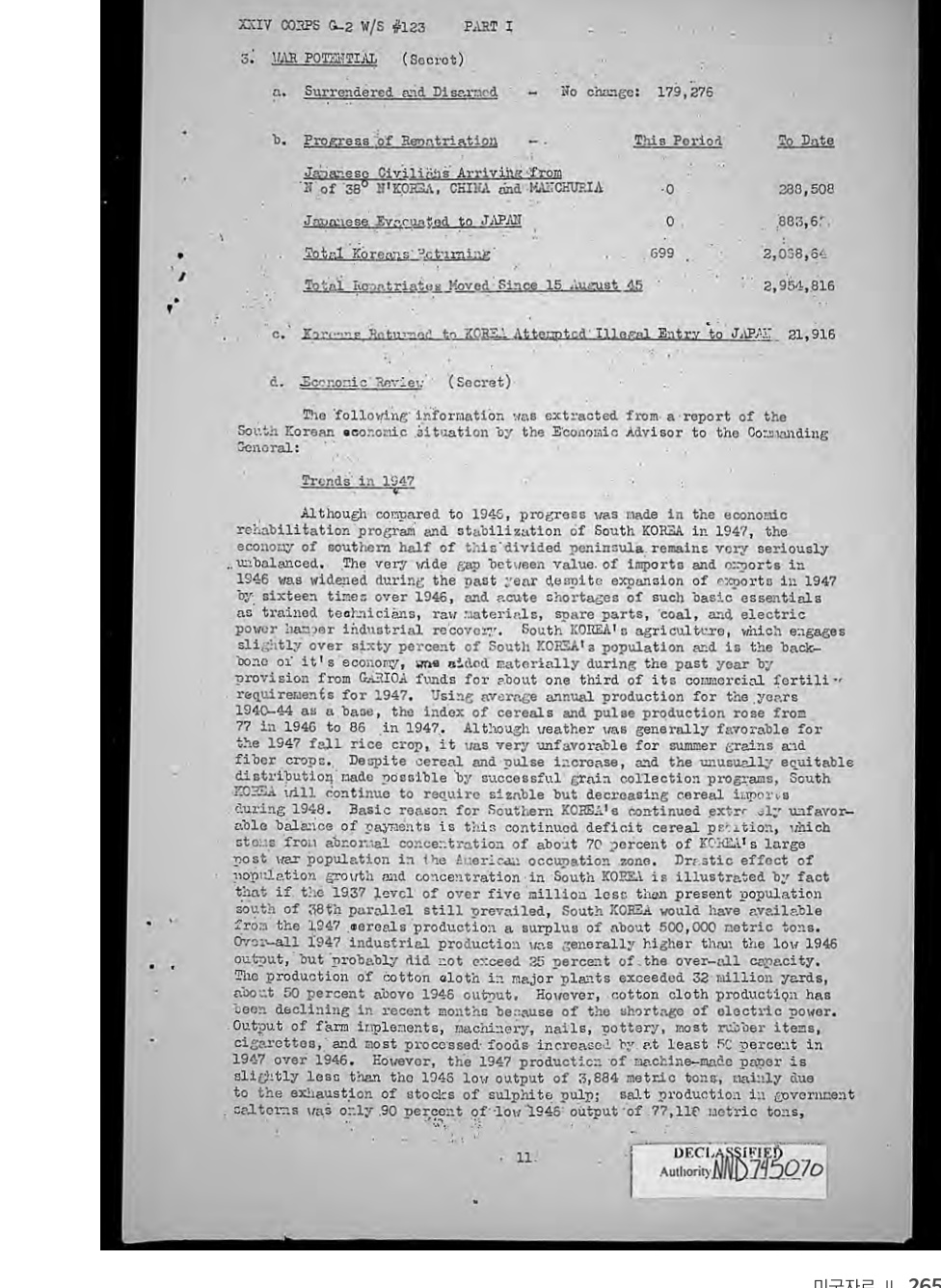
3. WAR POTENTIAL (Secret)
a. Surrendered and Disarmed -- No change: 179,276
b. Progress of Repatriation -- This Period To Date
Japanese Civilians Arriving from
N of 38° N'KOREA, CHINA and MANCHURIA -0 288,508
Japanese Evacuated to JAPAN 0 883,6[illegible]
Total Koreans Returning 699 2,038,64[illegible]
Total Repatriates Moved Since 15 August 45 2,954,816
c. Koreans Returned to KOREA Attempted Illegal Entry to JAPAN 21,916
d. Economic Review (Secret)
The following information was extracted from a report of the
South Korean economic situation by the Economic Advisor to the Commanding
General:
Trends in 1947
Although compared to 1946, progress was made in the economic
rehabilitation program and stabilization of South KOREA in 1947, the economy of southern half of this divided peninsula remains very seriously unbalanced. The very wide gap between value of imports and exports in
1946 was widened during the past year despite expansion of exports in 1947 by sixteen times over 1946, and acute shortages of such basic essentials as trained technicians, raw materials, spare parts, coal, and electric power hamper industrial recovery. South KOREA's agriculture, which engages slightly over sixty percent of South KOREA's population and is the backbone of it's economy, was aided materially during the past year by provision from GARIOA funds for about one third of its commercial fertilirequirements for 1947. Using average annual production for the years
1940-44 as a base, the index of cereals and pulse production rose from
77 in 1946 to 86 in 1947. Although weather was generally favorable for the 1947 fall rice crop, it was very unfavorable for summer grains and fiber crops. Despite cereal and pulse increase, and the unusually equitable distribution made possible by successful grain collection programs, South
KOREA will continue to require sizable but decreasing cereal imports during 1948. Basic reason for Southern KOREA's continued extr[illegible]ly unfavorable balance of payments is this continued deficit cereal po[illegible]ition, which stems from abnormal concentration of about 70 percent of KOREA's large post war population in the American occupation zone. Drastic effect of population growth and concentration in South KOREA is illustrated by fact that if the 1937 level of over five million less than present population south of 38th parallel still prevailed, South KOREA would have available from the 1947 cereals production a surplus of about 500,000 metric tons.
Over-all 1947 industrial production was generally higher than the low 1946 output, but probably did not exceed 25 percent of the over-all capacity.
The production of cotton cloth in major plants exceeded 32 million yards, about 50 percent above 1946 output. However, cotton cloth production has been declining in recent months because of the shortage of electric power.
Output of farm implements, machinery, nails, pottery, most rubber items, cigarettes, and most processed foods increased by at least 50 percent in
1947 over 1946. However, the 1947 production of machine-made paper is slightly less than the 1946 low output of 3,884 metric tons, mainly due to the exhaustion of stocks of sulphite pulp; salt production in government salterns was only 90 percent of low 1946 output of 77,110 metric tons,
11
DECLASSIFIED
Authority NND 745070
XXIV CORPS G-2 VS#123 PART I
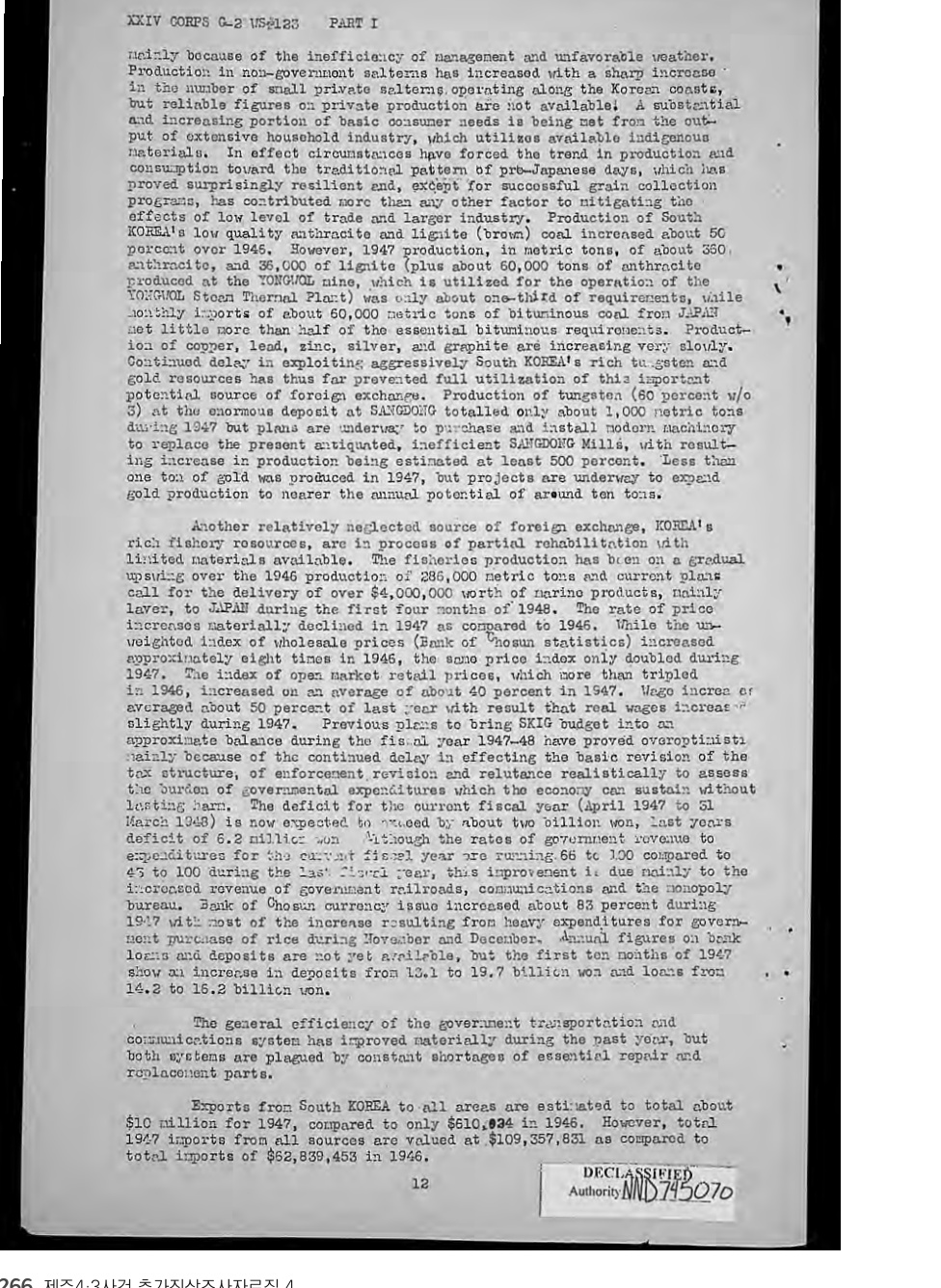
mainly because of the inefficiency of management and unfavorable weather.
Production in non-government salterns has increased with a sharp increase in the number of small private salterns operating along the Korean coasts, but reliable figures on private production are not available. A substantial and increasing portion of basic consumer needs is being met from the output of extensive household industry, which utilizes available indigenous materials. In effect circumstances have forced the trend in production and consumption toward the traditional pattern of pre-Japanese days, which has proved surprisingly resilient and, except for successful grain collection programs, has contributed more than any other factor to mitigating the effects of low level of trade and larger industry. Production of South
KOREA's low quality anthracite and lignite (brown) coal increased about 50 percent over 1946. However, 1947 production, in metric tons, of about 350, anthracite, and 36,000 of lignite (plus about 60,000 tons of anthracite produced at the YONGWOL mine, which is utilized for the operation of the
YONGWOL Steam Thermal Plant) was only about one-third of requirements, while monthly imports of about 60,000 metric tons of bituminous coal from JAPAN met little more than half of the essential bituminous requirements. Production of copper, lead, zinc, silver, and graphite are increasing very slowly.
Continued delay in exploiting aggressively South KOREA's rich tungsten and gold resources has thus far prevented full utilization of this important potential source of foreign exchange. Production of tungsten (80 percent w/o
3) at the enormous deposit at SANGDONG totalled only about 1,000 metric tons during 1947 but plans are underway to purchase and install modern machinery to replace the present antiquated, inefficient SANGDONG Mills, with resulting increase in production being estimated at least 500 percent. Less than one ton of gold was produced in 1947, but projects are underway to expand gold production to nearer the annual potential of around ten tons.
Another relatively neglected source of foreign exchange, KOREA's rich fishery resources, are in process of partial rehabilitation with limited materials available. The fisheries production has been on a gradual upswing over the 1946 production of 286,000 metric tons and current plans call for the delivery of over $4,000,000 worth of marine products, mainly layer, to JAPAN during the first four months of 1948. The rate of price increases materially declined in 1947 as compared to 1946. While the unweighted index of wholesale prices (Bank of Chosen statistics) increased approximately eight times in 1946, the same price index only doubled during
1947. The index of open market retail prices, which more than tripled in 1946, increased on an average of about 40 percent in 1947. Wage increases averaged about 50 percent of last year with result that real wages increased slightly during 1947. Previous plans to bring SKIG budget into an approximate balance during the fiscal year 1947-48 have proved overoptimistic mainly because of the continued delay in effecting the basic revision of the tax structure, of enforcement revision and reluctance realistically to assess the burden of governmental expenditures which the economy can sustain without lasting harm. The deficit for the current fiscal year (April 1947 to 31
March 1948) is now expected to exceed by about two billion won, last years deficit of 6.2 million won. Although the rates of government revenue to expenditures for the current fiscal year are running 66 to 100 compared to
45 to 100 during the last fiscal year, this improvement is due mainly to the increased revenue of government railroads, communications and the monopoly bureau. Bank of Chosen currency issue increased about 83 percent during
1947 with most of the increase resulting from heavy expenditures for government purchase of rice during November and December. Annual figures on bank loans and deposits are not yet available, but the first ten months of 1947 show an increase in deposits from 13.1 to 19.7 billion won and loans from
14.2 to 16.2 billion won.
The general efficiency of the government transportation and communications system has improved materially during the past year, but both systems are plagued by constant shortages of essential repair and replacement parts.
Exports from South KOREA to all areas are estimated to total about
$10 million for 1947, compared to only $610,034 in 1946. However, total
1947 imports from all sources are valued at $109,357,831 as compared to total imports of $82,839,453 in 1946.
12
DECLASSIFIED
Authority NND 745070
XXIV CORPS G-2 WS#123 PART I
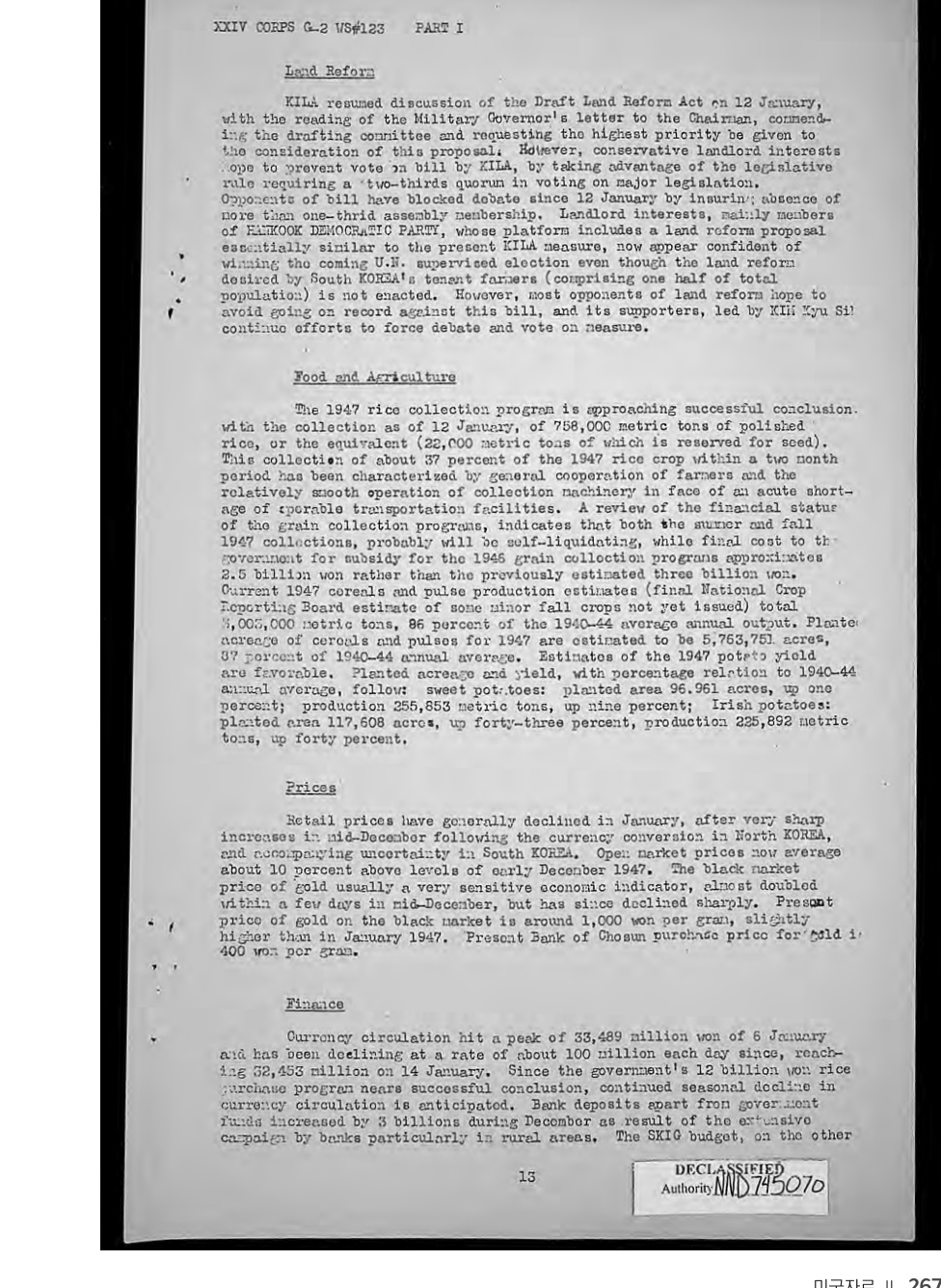
Land Reform
KILA resumed discussion of the Draft Land Reform Act on 12 January, with the reading of the Military Governor's letter to the Chairman, commending the drafting committee and requesting the highest priority be given to the consideration of this proposal. However, conservative landlord interests hope to prevent vote on bill by KILA, by taking advantage of the legislative rule requiring a two-thirds quorum in voting on major legislation. Opponents of bill have blocked debate since 12 January by insuring absence of more than one-third assembly membership. Landlord interests, mainly members of HANKOOK DEMOCRATIC PARTY, whose platform includes a land reform proposal essentially similar to the present KILA measure, now appear confident of winning the coming U.N. supervised election even though the land reform desired by South KOREA's tenant farmers (comprising one half of total population) is not enacted. However, most opponents of land reform hope to avoid going on record against this bill, and its supporters, led by KIM Kyu Si! continue efforts to force debate and vote on measure.
Food and Agriculture
The 1947 rice collection program is approaching successful conclusion. with the collection as of 12 January, of 758,000 metric tons of polished rice, or the equivalent (22,000 metric tons of which is reserved for seed). This collection of about 37 percent of the 1947 rice crop within a two month period has been characterized by general cooperation of farmers and the relatively smooth operation of collection machinery in face of an acute shortage of operable transportation facilities. A review of the financial status of the grain collection programs, indicates that both the summer and fall 1947 collections, probably will be self-liquidating, while final cost to the government for subsidy for the 1946 grain collection programs approximates 2.5 billion won rather than the previously estimated three billion won. Current 1947 cereals and pulse production estimates (final National Crop Reporting Board estimate of some minor fall crops not yet issued) total 4,003,000 metric tons, 86 percent of the 1940-44 average annual output. Planted acreage of cereals and pulses for 1947 are estimated to be 5,763,751 acres, 37 percent of 1940-44 annual average. Estimates of the 1947 potato yield are favorable. Planted acreage and yield, with percentage relation to 1940-44 annual average, follow: sweet potatoes: planted area 96,961 acres, up one percent; production 255,853 metric tons, up nine percent; Irish potatoes: planted area 117,608 acres, up forty-three percent, production 225,892 metric tons, up forty percent.
Prices
Retail prices have generally declined in January, after very sharp increases in mid-December following the currency conversion in North KOREA, and accompanying uncertainty in South KOREA. Open market prices now average about 10 percent above levels of early December 1947. The black market price of gold usually a very sensitive economic indicator, almost doubled within a few days in mid-December, but has since declined sharply. Present price of gold on the black market is around 1,000 won per gram, slightly higher than in January 1947. Present Bank of Chosun purchase price for gold is 400 won per gram.
Finance
Currency circulation hit a peak of 33,489 million won of 6 January and has been declining at a rate of about 100 million each day since, reaching 32,433 million on 14 January. Since the government's 12 billion won rice purchase program nears successful conclusion, continued seasonal decline in currency circulation is anticipated. Bank deposits apart from government funds increased by 3 billions during December as result of the extensive campaign by banks particularly in rural areas. The SKIG budget, on the other
13
DECLASSIFIED
Authority NND 745070
XXIV CORPS G-2 US#123 PART I
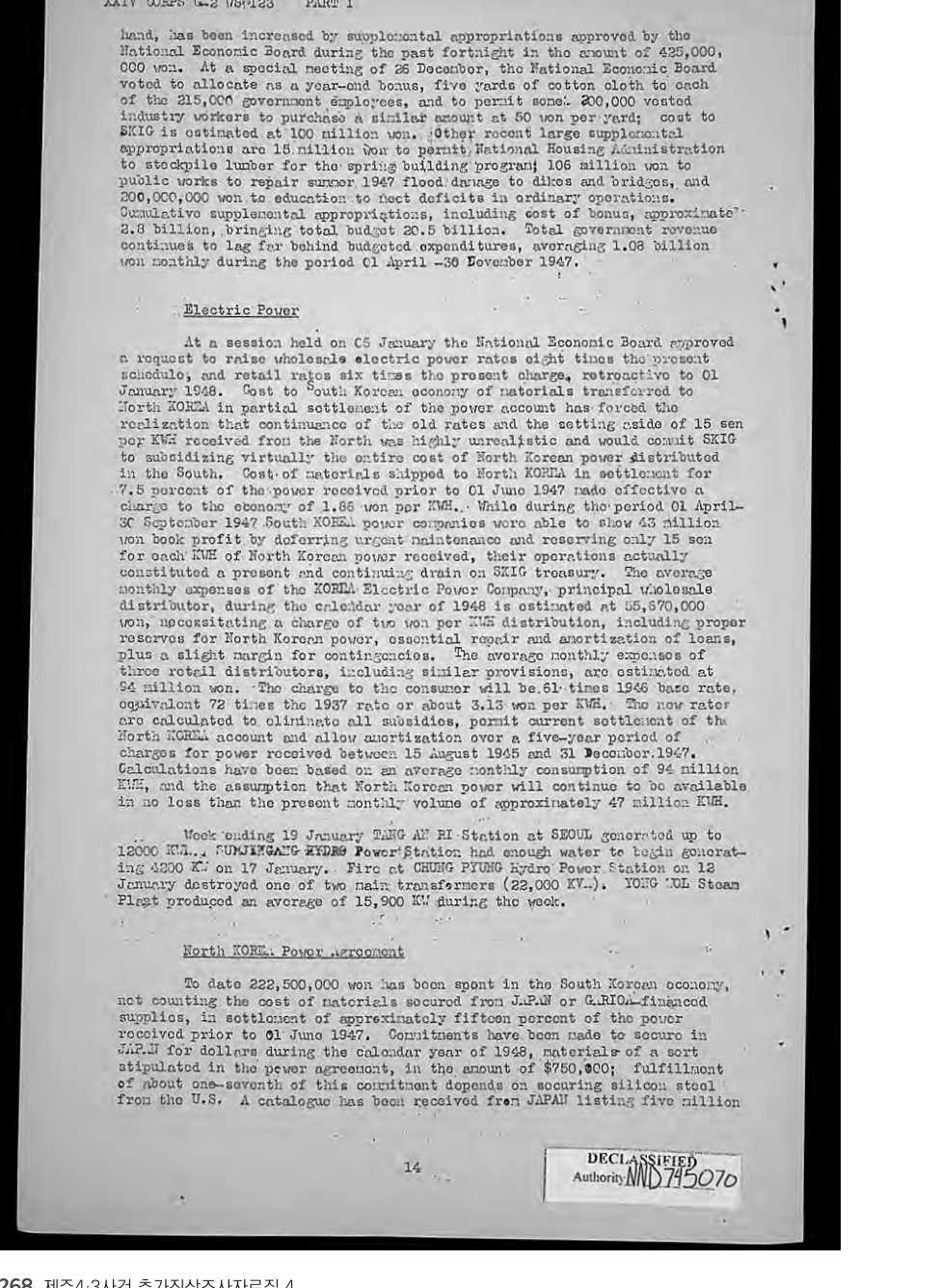
hand, has been increased by supplemental appropriations approved by the
National Economic Board during the past fortnight in the amount of 425,000,
000 won. At a special meeting of 26 December, the National Economic Board voted to allocate as a year-end bonus, five yards of cotton cloth to each of the 215,000 government employees, and to permit some 200,000 vested industry workers to purchase a similar amount at 50 won per yard; cost to
SKIG is estimated at 100 million won. Other recent large supplemental appropriations are 15 million won to permit National Housing Administration to stockpile lumber for the spring building program; 106 million won to public works to repair summer 1947 flood damage to dikes and bridges, and
200,000,000 won to education to meet deficits in ordinary operations.
Cumulative supplemental appropriations, including cost of bonus, approximate
2.3 billion, bringing total budget 20.5 billion. Total government revenue continues to lag far behind budgeted expenditures, averaging 1.08 billion won monthly during the period 01 April -30 November 1947.
Electric Power
At a session held on 05 January the National Economic Board approved a request to raise wholesale electric power rates eight times the present schedule, and retail rates six times the present charge, retroactive to 01
January 1948. Cost to South Korean economy of materials transferred to
North KOREA in partial settlement of the power account has forced the realization that continuance of the old rates and the setting aside of 15 sen per KWH received from the North was highly unrealistic and would commit SKIG to subsidizing virtually the entire cost of North Korean power distributed in the South. Cost of materials shipped to North KOREA in settlement for
7.5 percent of the power received prior to 01 June 1947 made effective a charge to the economy of 1.66 won per KWH. While during the period 01 April-
30 September 1947 South KOREA power companies were able to show 43 million won book profit by deferring urgent maintenance and reserving only 15 sen for each KWH of North Korean power received, their operations actually constituted a present and continuing drain on SKIG treasury. The average monthly expenses of the KOREA Electric Power Company, principal wholesale distributor, during the calendar year of 1948 is estimated at 55,370,000 won, necessitating a charge of two won per KWH distribution, including proper reserves for North Korean power, essential repair and amortization of loans, plus a slight margin for contingencies. The average monthly expenses of three retail distributors, including similar provisions, are estimated at
94 million won. The charge to the consumer will be 61 times 1946 base rate, equivalent 72 times the 1937 rate or about 3.13 won per KWH. The new rates are calculated to eliminate all subsidies, permit current settlement of the
North KOREA account and allow amortization over a five-year period of charges for power received between 15 August 1945 and 31 December 1947.
Calculations have been based on an average monthly consumption of 94 million
KWH, and the assumption that North Korean power will continue to be available in no less than the present monthly volume of approximately 47 million KWH.
Week ending 19 January TANG AN RI Station at SEOUL generated up to
12000 KW..., SUWJENGAUG HYDRO Power Station had enough water to begin generating 3200 KW on 17 January. Fire at CHUNG PYUNG Hydro Power Station on 12
January destroyed one of two main transformers (22,000 KV...). YONG WOL Steam
Plant produced an average of 15,900 KW during the week.
North KOREA Power Agreement
To date 222,500,000 won has been spent in the South Korean economy, not counting the cost of materials secured from JAPAN or GARIOA-financed supplies, in settlement of approximately fifteen percent of the power received prior to 01 June 1947. Commitments have been made to secure in
JAPAN for dollars during the calendar year of 1948, materials of a sort stipulated in the power agreement, in the amount of $750,900; fulfillment of about one-seventh of this commitment depends on securing silicon steel from the U.S. A catalogue has been received from JAPAN listing five million
14
DECLASSIFIED
Authority NND 745070
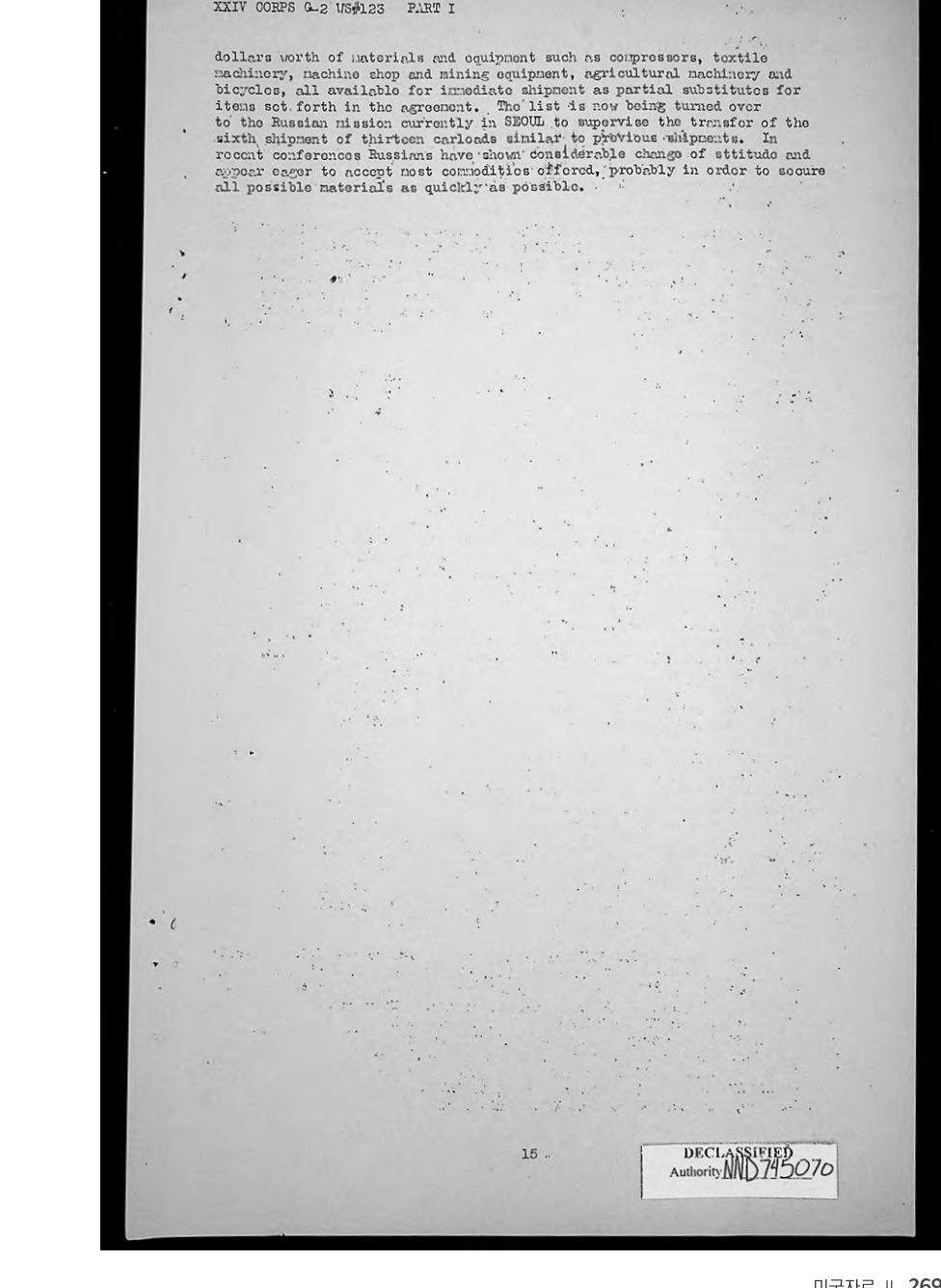
XXIV CORPS G-2 US#123 PART I
dollars worth of materials and equipment such as compressors, textile machinery, machine shop and mining equipment, agricultural machinery and bicycles, all available for immediate shipment as partial substitutes for items set forth in the agreement. The list is now being turned over to the Russian mission currently in SEOUL to supervise the transfer of the sixth shipment of thirteen carloads similar to previous shipments. In recent conferences Russians have shown considerable change of attitude and appear eager to accept most commodities offered, probably in order to secure all possible materials as quickly as possible.
15
DECLASSIFIED
Authority NND 745070
XXIV CORPS G-2 W/S #125 PART I
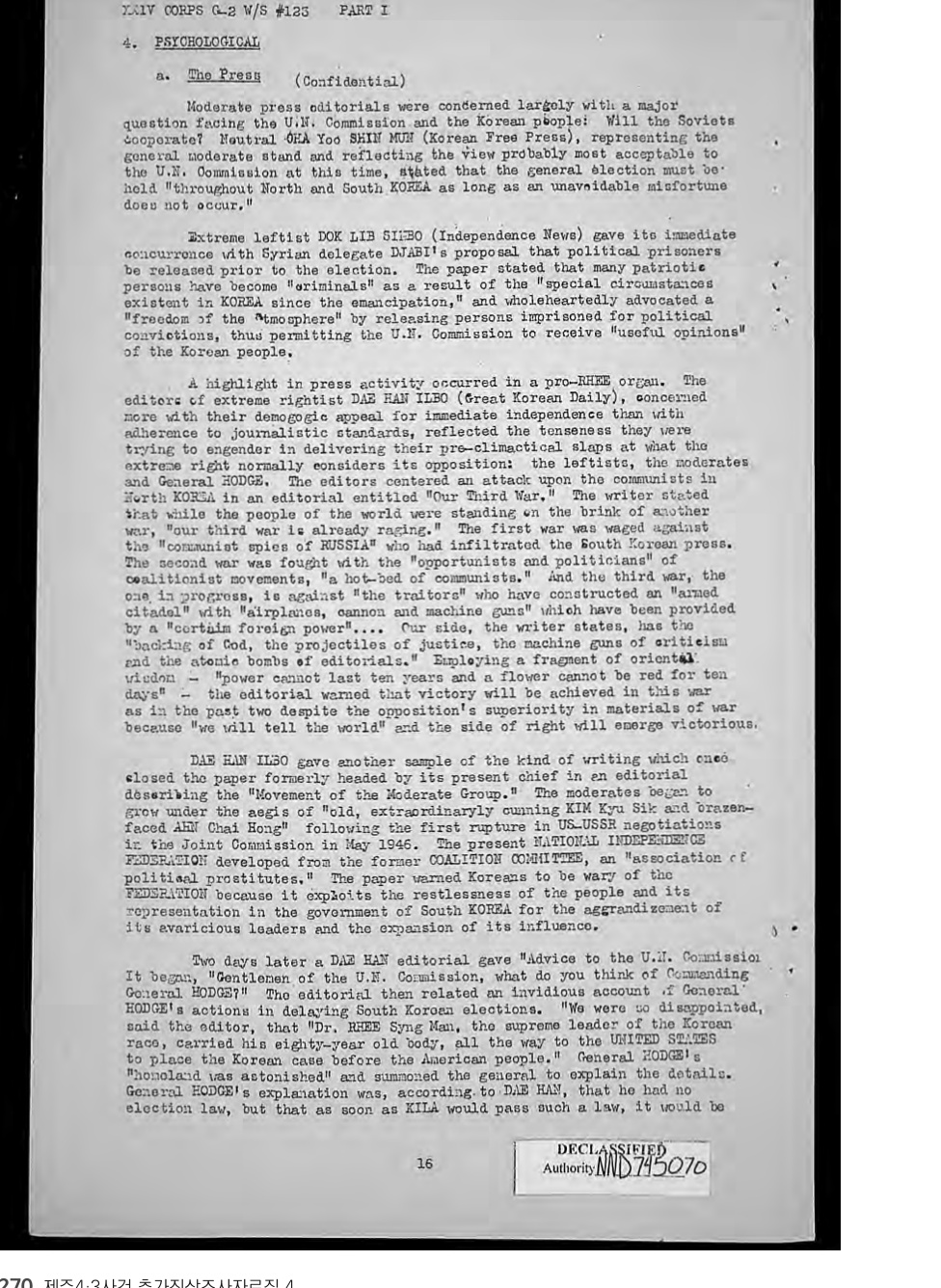
4. PSYCHOLOGICAL
a. The Press (Confidential)
Moderate press editorials were concerned largely with a major question facing the U.N. Commission and the Korean people: Will the Soviets cooperate? Neutral OHA Yoo SHIN MUN (Korean Free Press), representing the general moderate stand and reflecting the view probably most acceptable to the U.N. Commission at this time, stated that the general election must be held "throughout North and South KOREA as long as an unavoidable misfortune does not occur."
Extreme leftist DOK LIB SINBO (Independence News) gave its immediate concurrence with Syrian delegate DJABI's proposal that political prisoners be released prior to the election. The paper stated that many patriotic persons have become "criminals" as a result of the "special circumstances existent in KOREA since the emancipation," and wholeheartedly advocated a
"freedom of the atmosphere" by releasing persons imprisoned for political convictions, thus permitting the U.N. Commission to receive "useful opinions"
of the Korean people.
A highlight in press activity occurred in a pro-RHEE organ. The editors of extreme rightist DAE HAN ILBO (Great Korean Daily), concerned more with their demagogic appeal for immediate independence than with adherence to journalistic standards, reflected the tenseness they were trying to engender in delivering their pre-climactical slaps at what the extreme right normally considers its opposition: the leftists, the moderates and General HODGE. The editors centered an attack upon the communists in
North KOREA in an editorial entitled "Our Third War." The writer stated that while the people of the world were standing on the brink of another war, "our third war is already raging." The first war was waged against the "communist spies of RUSSIA" who had infiltrated the South Korean press.
The second war was fought with the "opportunists and politicians" of coalitionist movements, "a hot-bed of communists." And the third war, the one in progress, is against "the traitors" who have constructed an "armed citadel" with "airplanes, cannon and machine guns" which have been provided by a "certain foreign power".... Our side, the writer states, has the
"backing of God, the projectiles of justice, the machine guns of criticism and the atomic bombs of editorials." Employing a fragment of oriental wisdom — "power cannot last ten years and a flower cannot be red for ten days" — the editorial warned that victory will be achieved in this war as in the past two despite the opposition's superiority in materials of war because "we will tell the world" and the side of right will emerge victorious.
DAE HAN ILBO gave another sample of the kind of writing which once closed the paper formerly headed by its present chief in an editorial describing the "Movement of the Moderate Group." The moderates began to grow under the aegis of "old, extraordinaryly cunning KIM Kyu Sik and brazenfaced AHN Chai Hong" following the first rupture in US-USSR negotiations in the Joint Commission in May 1946. The present NATIONAL INDEPENDENCE
FEDERATION developed from the former COALITION COMMITTEE, an "association of political prostitutes." The paper warned Koreans to be wary of the
FEDERATION because it exploits the restlessness of the people and its representation in the government of South KOREA for the aggrandizement of its avaricious leaders and the expansion of its influence.
Two days later a DAE HAN editorial gave "Advice to the U.N. Commission
It began, "Gentlemen of the U.N. Commission, what do you think of Commending
General HODGE?" The editorial then related an invidious account of General
HODGE's actions in delaying South Korean elections. "We were so disappointed, said the editor, that "Dr. RHEE Syng Man, the supreme leader of the Korean race, carried his eighty-year old body, all the way to the UNITED STATES to place the Korean case before the American people." General HODGE's
"homeland was astonished" and summoned the general to explain the details.
General HODGE's explanation was, according to DAE HAN, that he had no election law, but that as soon as KILA would pass such a law, it would be
16
DECLASSIFIED
Authority NND 745070
XXIV CORPS G-2 W/S #123 PART I
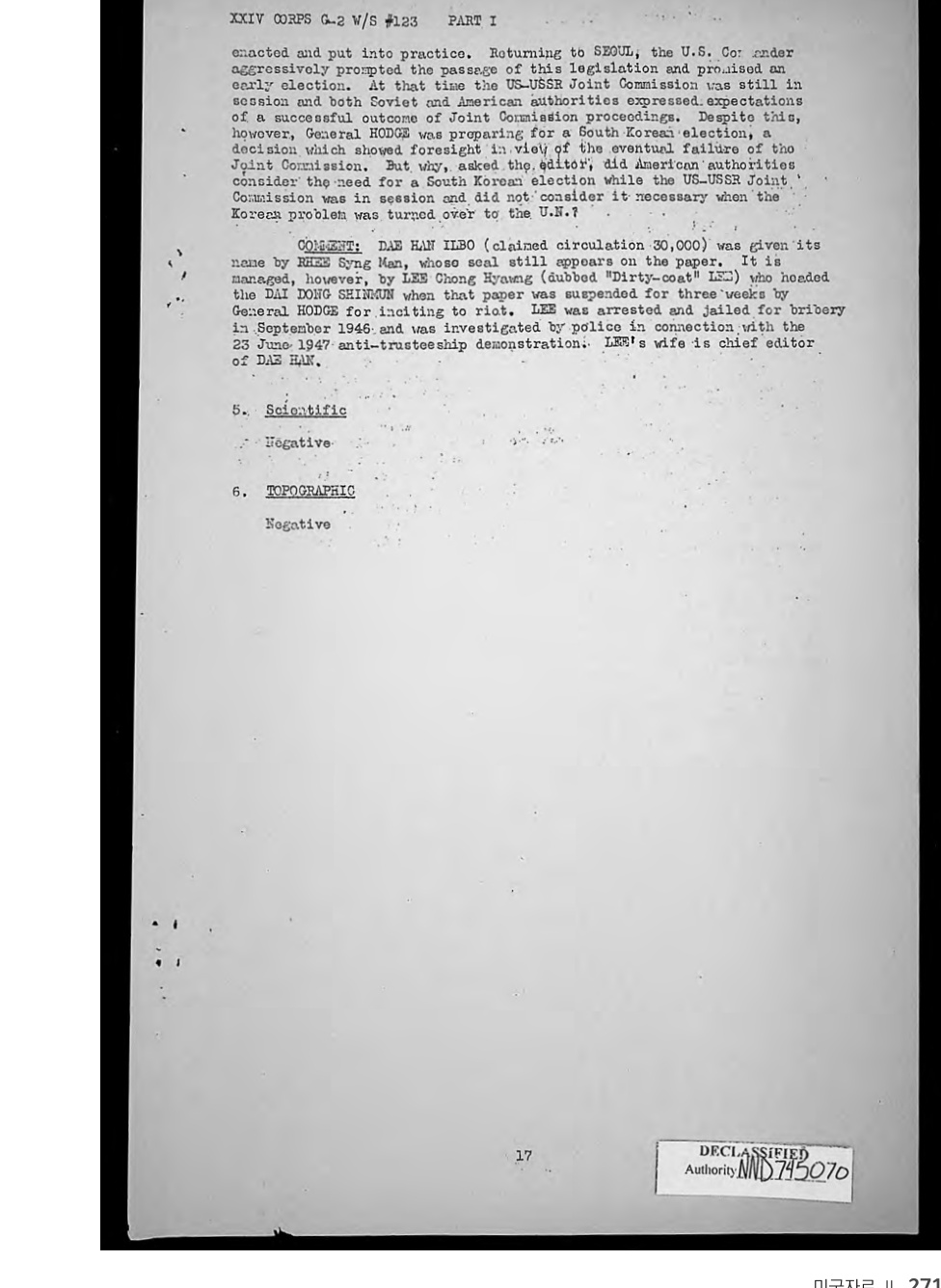
enacted and put into practice. Returning to SEOUL, the U.S. Co[mm]ander aggressively prompted the passage of this legislation and promised an early election. At that time the US-USSR Joint Commission was still in session and both Soviet and American authorities expressed expectations of a successful outcome of Joint Commission proceedings. Despite this, however, General HODGE was preparing for a South Korean election, a decision which showed foresight in view of the eventual failure of the
Joint Commission. But why, asked the editor, did American authorities consider the need for a South Korean election while the US-USSR Joint
Commission was in session and did not consider it necessary when the
Korean problem was turned over to the U.N.?
COMMENT: DAE HAN ILBO (claimed circulation 30,000) was given its name by RHEE Syng Man, whose seal still appears on the paper. It is managed, however, by LEE Chong Hyawng (dubbed "Dirty-coat" LEE) who headed the DAI DONG SHINMUN when that paper was suspended for three weeks by
General HODGE for inciting to riot. LEE was arrested and jailed for bribery in September 1946 and was investigated by police in connection with the
23 June 1947 anti-trusteeship demonstration. LEE's wife is chief editor of DAE HAN.
5. Scientific
Negative
6. TOPOGRAPHIC
Negative
17
DECLASSIFIED
Authority NND 745070
XXIV CORPS G-2 W/S #123 PART I
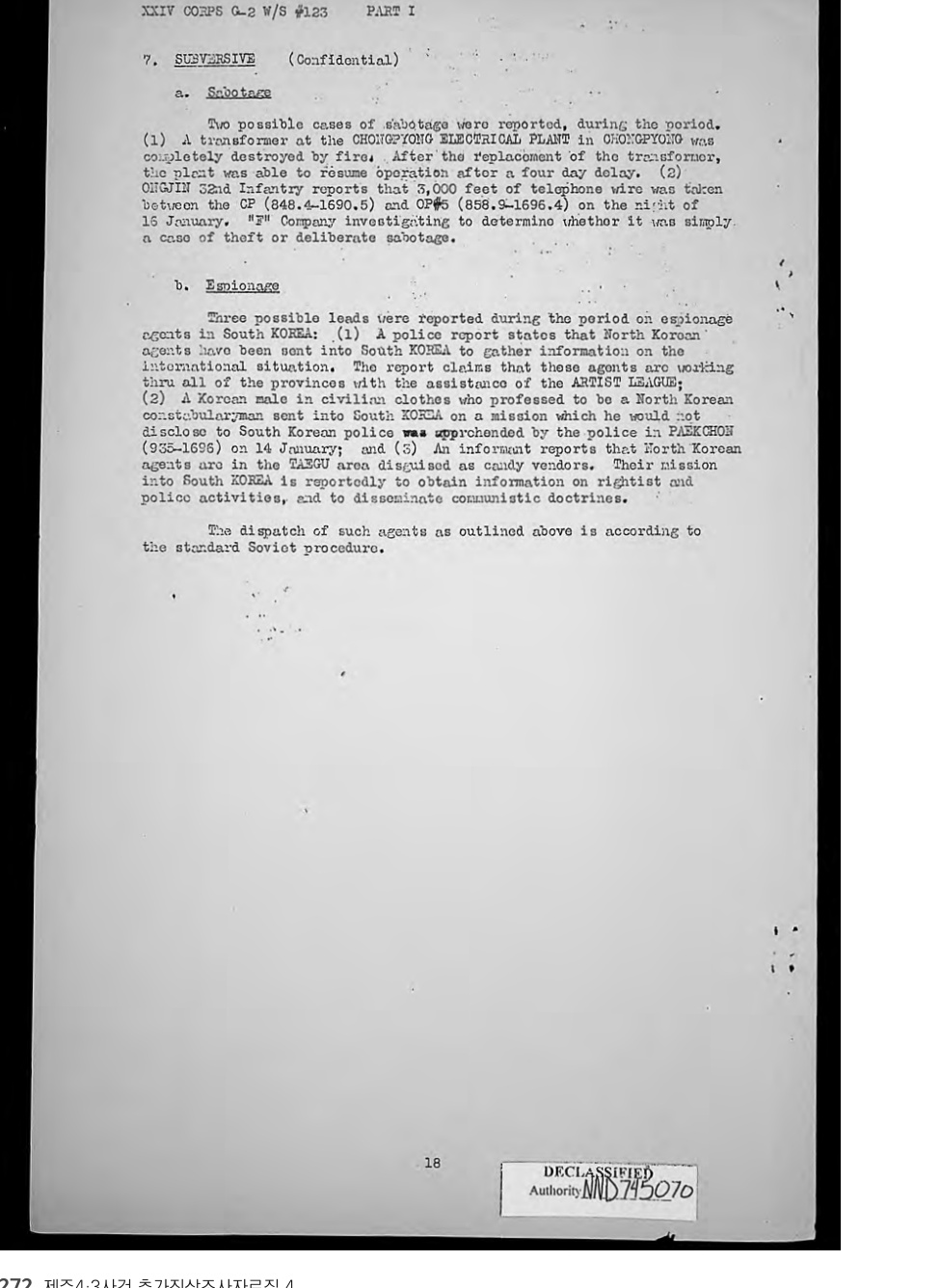
7. SUBVERSIVE (Confidential)
a. Sabotage
Two possible cases of sabotage were reported, during the period.
(1) A transformer at the CHONGPYONG ELECTRICAL PLANT in CHONGPYONG was completely destroyed by fire. After the replacement of the transformer, the plant was able to resume operation after a four day delay. (2)
ONGJIN 32nd Infantry reports that 3,000 feet of telephone wire was taken between the CP (848.4-1690.5) and OP#5 (858.9-1696.4) on the night of
16 January. "F" Company investigating to determine whether it was simply a case of theft or deliberate sabotage.
b. Espionage
Three possible leads were reported during the period on espionage agents in South KOREA: (1) A police report states that North Korean agents have been sent into South KOREA to gather information on the international situation. The report claims that these agents are working thru all of the provinces with the assistance of the ARTIST LEAGUE;
(2) A Korean male in civilian clothes who professed to be a North Korean constabularyman sent into South KOREA on a mission which he would not disclose to South Korean police was apprehended by the police in PAEKCHON
(935-1696) on 14 January; and (3) An informant reports that North Korean agents are in the TAEGU area disguised as candy vendors. Their mission into South KOREA is reportedly to obtain information on rightist and police activities, and to disseminate communistic doctrines.
The dispatch of such agents as outlined above is according to the standard Soviet procedure.
18
DECLASSIFIED
Authority NND 745070
출처:
제주4·3평화재단 편,
『추가진상조사자료집-미국자료2』,
p. 257–272.
— NARA (RG 554, Entry 1256, Box 59)
×
![]()