스캔 원본
100%
p.428
p.429
p.430
p.431
p.432
p.433
p.434
p.435
p.436
p.437
p.438
p.439
p.440
p.441
p.442
p.443
p.444
본부 24군단
G-2 사무국
APO 235
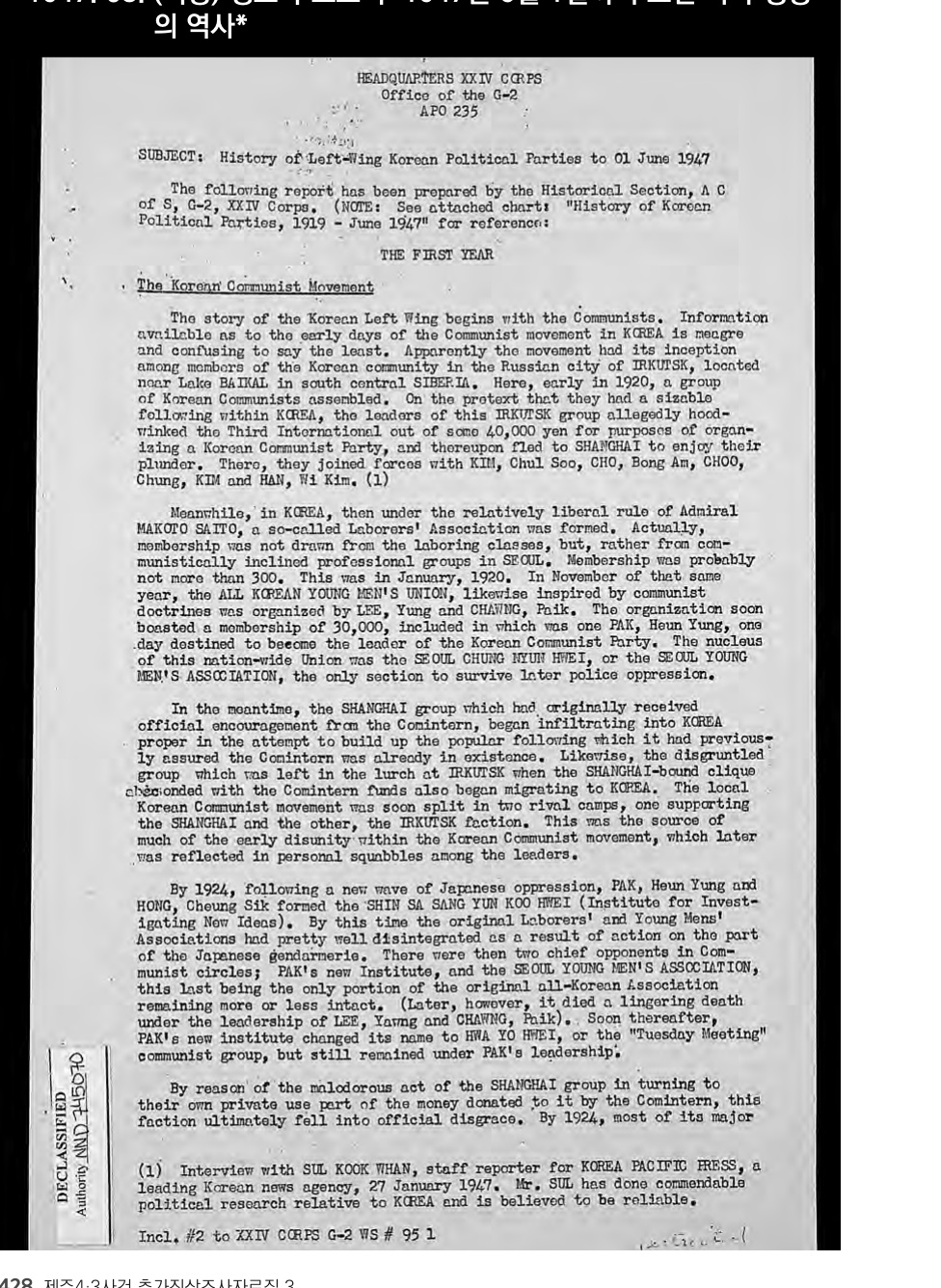
1947년 6월 1일까지 조선 좌파 정당의 역사 아래 보고서는 24군단 정보참모부 군사실에서 작성함 첫 번째 해 조선의 공산주의 운동 조선 좌익의 역사는 공산주의로 시작한다. 조선 공산주의 운동의 초창기 정보는 빈약하며 혼란스럽기까지 하다. 이 운동은 시베리아 남쪽 중앙의 바이칼호 인근 러시아 이르쿠츠크 시에 있는 한인사회 구성원들 사이에서 시작된 것은 분명하다. 1920년 초 한 무리의 조선 공산주의자들이 이곳에 모였다. 이르쿠츠크파 지도자들은 조선에 추종자가 많다는 명목으로 제3인터내셔널을 속여 조선공산당을 조직할 목적이라며 4만엔 가량을 뜯어낸 후 상하이로 달아났다고 전해진다. 그곳에서 그들은 김철수, 조봉암, 주창건, 김산, 한위건과 협력하였다.18 한편 조선에서는 사이토 마코토 총독의 비교적 자유로운 통치하에 소위 노동단체가 형성되었다. 사실상 회원은 노동자층이 아닌 공산주의로 편향된 서울 전문가 집단에서 뽑았다. 회원 수는 300명 이하 정도이다. 이것이 1920년 1월의 일이다. 같은 해 11월에는 이영과 정백 역시 공산주의 신조에 고무되어 조선청년총동맹을 조직한다. 이 단체는 3만 명이라는 회원 수를 자랑했으며 여기에는 장차 조선공산당의 당수가 될 박헌영도 포함되어 있었다. 이 전국 연맹의 핵심은 서울 청년회로써 이후 경찰의 탄압에서 유일하게 살아남은 단체이기도 하다.
한편, 본래 코민테른에서 공식적인 성원을 받은 상하이파는 코민테른이 이미 존 재한다고 전부터 확신한 추종자 수를 키우기 위해 조선으로 침투하기 시작했다.
마찬가지로 상하이파가 코민테른의 자금을 가지고 종적을 감췄을 때 이르쿠츠크에 방치되어 불만에 찬 조직 역시 조선으로 이주하기 시작했다. 조선의 공산주의 운동은 곧 상하이파를 지지하는 집단과 이르쿠츠크파를 지지하는 집단이라는 두 개의 경쟁 구도로 나뉘었다. 이는 조선 공산주의 운동 초반에 있었던 분열 대부분의 원인이었고 후에는 지도자들 간 사적인 말다툼에서도 드러난다.
1924년경 일제의 새로운 탄압이 시작되면서 박헌영과 홍증식은 신사상연구회를 설립했다. 이때까지 기존의 노동 단체나 청년 단체들은 일본 헌병대 측의 단속으로 인해 거의 해체된 상태였다. 당시 공산주의 사회에는 박헌영의 새로운 조직과 서울청년회 등 두 개의 주요 반대파가 있었는데, 서울청년회는 조선청년총동 맹 본래의 성격이 거의 그대로 유지되는 유일한 단체였다.(하지만 이후 이영과 정 백의 지도하에 천천히 해체된다.) 얼마 후 박헌영의 새로운 조직은 "화요회"라 개 칭하지만 지도자는 여전히 박헌영이었다.
코민테른이 상하이파에 기부한 자금을 개인 자금으로 빼돌리는 상하이파의 악 행 때문에 이 파벌은 결국 공개적인 망신을 당한다.
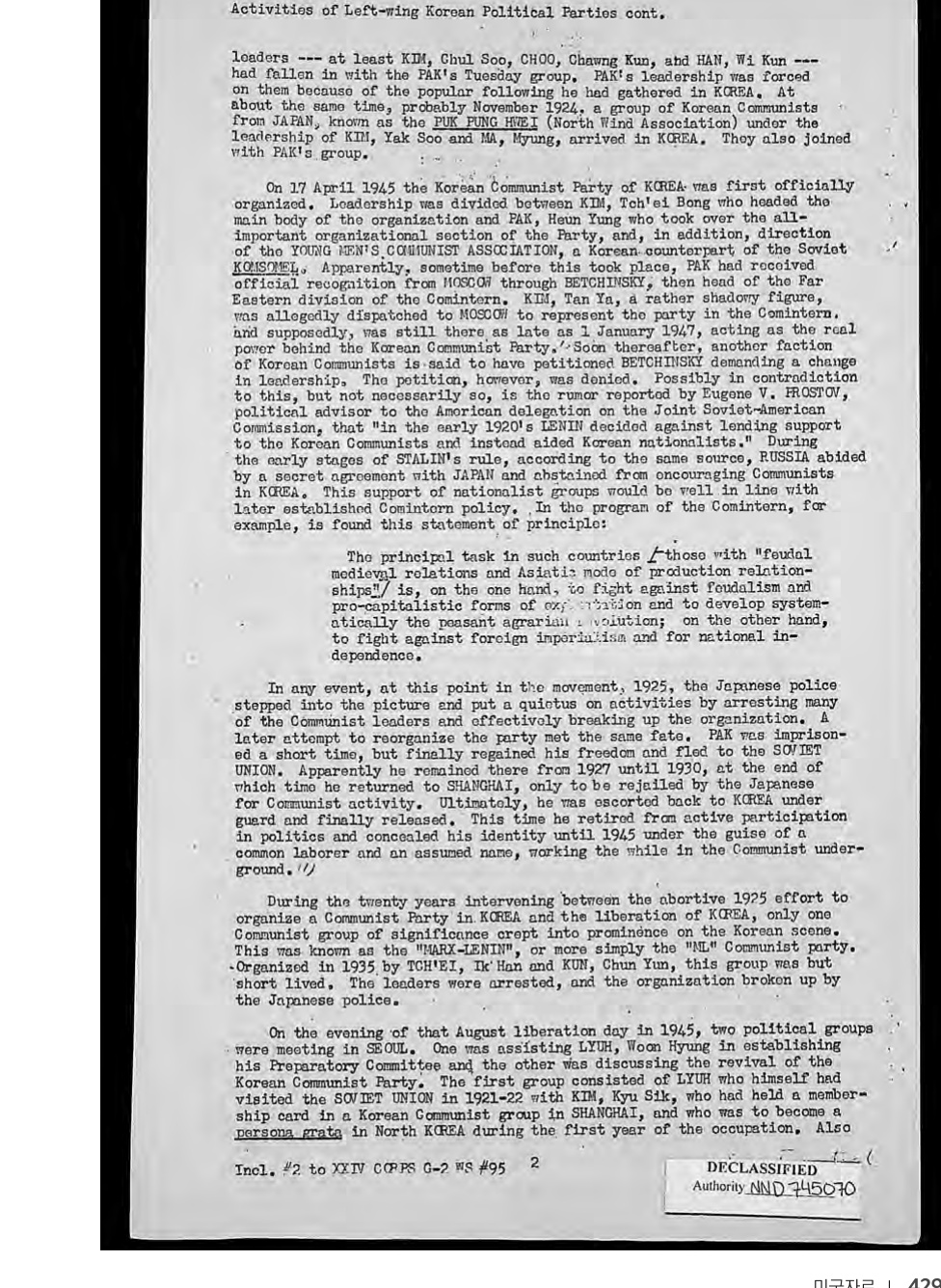
김철수, 주창건, 한위건 등 주요 지도자 대다수는 박헌영의 화요회를 받아들였 다. 조선에 있는 박헌영의 추종자들 때문에 박헌영의 지도력은 그들에게 강요된 것이나 마찬가지였다. 그 무렵(아마 1924년 11월), 김약수와 마명의 지도하에 북 풍회(北風會)라는 조선의 공산주의자 무리도 일본에서 조선으로 건너와 박헌영의 화요회에 합류했다.
1945년 4월 17일 조선공산당이 처음 공식적으로 창당했다. 지도부는 이 당의 주요부를 이끄는 김재봉과 당의 모든 중요 조직 부문과 소련의 콤소몰(Komsomol)에 해당하는 조선의 고려공산청년회의 지휘를 맡은 박헌영으로 나뉘었다. 이 일이 있기 전, 박헌영은 보이틴스키(Voitinsky)를 통해 모스크바로부터 공식 인정을 받은 후 코민테른의 극동지부 수장직을 맡은 것이 분명하다. 김단야는 비교적 잘 알려지지 않은 인물로 코민테른에서 당을 대표하기 위해 모스크바로 파견되었다고 전해지는데, 추정컨대 1947년 1월 1일까지 그곳에 머물며 조선공산당의 막후에서 실세 역할을 했을 것으로 보인다. 얼마 후 또 다른 조선 공산주의자 분파가 보이틴스키에게 지도부 교체를 요구하는 진정서를 보냈다고 전해진다. 하지만 그 진정서는 반려되었다. 미소공동위원회 미국 대표 정치 보좌관 유진 프로스토브(Eugene V. Prostov)가 "1920년대 초 레닌은 조선 공산주의자 지원에 반대하고 조선 민족주의자들을 원조하기로 결정했다"고 보고했다는 소문은 이와 모순될 수 있지만 꼭 그런 것도 아니다. 같은 정보원에 따르면 스탈린 통치 초반 러시아는 일본과의 밀약을 준수하여 조선 내 공산주의자들을 격려하는 것을 삼갔다. 민족주의 단체에 대한 이 같은 지원은 이후 정립된 코민테른 정책과도 그 맥을 같이 할 것이었다. 예를 들어, 코민테른 프로그램에는 다음과 같은 원칙이 나온다. "중세 봉건 시대 관계와 아시아의 생산양식 관계"를 띠고 있는 해당 국가의 주요 과업은 봉건주의와 친자본주의 형식의 착취에 맞서 싸우고 소작농의 농업 혁명을 체계적으로 발전시켜 나가는 한편, 외세의 제국주의에 맞서 국가의 독립을 위해 싸우는 일이다. 이 운동이 진행되던 1925년에 일본 경찰은 행동에 착수하여 공산주의 지도자 다수를 체포하고 조직을 효과적으로 해산시켜 활동에 종지부를 찍었다. 이후 당을 다시 조직하려는 시도는 같은 운명을 맞이했다. 박헌영은 잠시 수감되기는 했지만 끝내 자유를 되찾고 소련으로 달아났다. 박헌영은 1927년부터 1930년까지 소련에 머물렀으며 상하이로 돌아가서는 공산주의 활동 때문에 일제에 의해 결국 재수감된 듯하다. 감시하에 조선으로 송환된 박헌영은 마침내 석방되었다. 이때 박헌영은 적극적인 정치 일선에서는 한발 물러나 일반 노동자로 가장하여 1945년까지 정체를 숨기고 가명으로 지하의 공산주의자로 활동했다.
1925년 조선에 공산당을 창당하려는 노력이 수포로 돌아간 후 조선이 해방되던 해까지 20년의 세월 동안 유일하게 유의미했던 한 공산주의 세력이 조선 역사에서 두각을 드러내기 시작했다. 이는 '마르크스-레닌(Marx-Lenin, 이후 ML)' 공산당으로 알려진 집단으로, 1935년 최익한과 김준연이 창립했고 존립 기간은 짧았다. 지도자들은 체포되었고 조직은 일본 경찰에 의해 해산되었다.
1945년 8월 해방당일 저녁, 두 개 정치 집단이 서울에서 회동을 하고 있었다. 한 집단은 여운형의 조선건국준비위원회 창립을 지원하고 있었고 다른 한 집단은 조선공산당의 부활을 논하고 있었다. 전자는 1921~1922년 소련을 방문한 여운형과 상하이 소재 조선 공산주의 단체 회원증을 소지하고 점령 첫해에 북조선에서 선호하는 인물이 되는 김규식으로 구성되었다. 여기에는 정백, 홍남표, 안기성, 홍증식, 홍덕유 등도 포함되었다. 마지막 두 명은 박헌영의 화요회의 전 회원이다. 후자는 ML의 전 회원이었던 최익한과 한때 서울청년회 회원이었던 하필원, 김광수(김철수와 형제), 이영으로 이루어졌다. 두 단체가 서로에 대해 알게 되자 빠르게 통합이 추진되었고 이틀 후인 8월 17일 여운형과 홍덕수를 제외한 전원 합의하에 장안파(장안파 공산당)가 출범했다. 이 집단은 출범 당시 조선의 독립을 추구하기 위해 우익과 타협할 의사가 있는 민족주의자의 분파인 것으로 여겨진다.
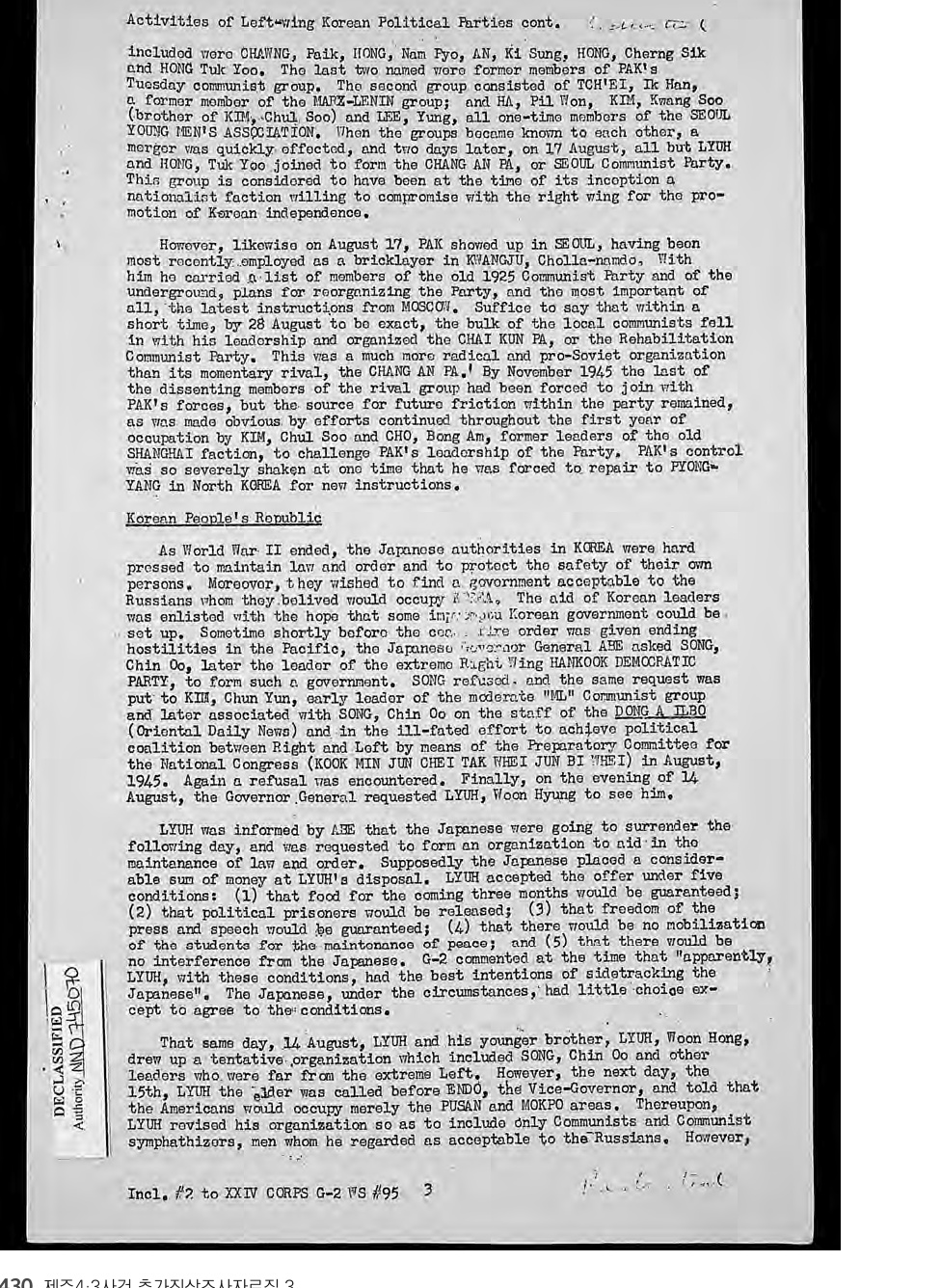
한편 8월 17일 최근 전남 광주에서 벽돌공으로 취직한 박헌영도 서울에 모습을 드러냈다. 그는 과거 1925년 조선공산당 당원 명단과 지하 활동을 한 동지들의 명단, 당 재건 계획, 그리고 무엇보다 중요한 모스크바의 최신 지령을 들고 나타났다. 여기서는 단기간 내 정확히는 8월 28일까지 지역의 많은 공산주의자가 박헌영의 지휘 아래 재건파를 조직했다는 것까지만 말해둔다. 이 재건파는 당시 경쟁 관계였던 장안파에 비해 훨씬 더 급진적인 친소련 조직이었다. 1945년 11월까지 경쟁 조직에서 반대 의견을 갖고 있던 회원들이 박헌영의 조직에 마지막으로 강제 합류되었지만 당내에는 향후 분쟁을 일으킬 씨앗이 남아있었는데, 이는 과거 상하이파의 전 지도자였던 김철수와 조봉암이 당내 박헌영의 지도력에 도전하기 위해 점령 첫 해 내내 지속적으로 노력을 들인 것으로 명백해진다. 박헌영의 당내 지도력은 새로운 지령을 받기 위해 북조선 평양으로 가야 했을 때 한 번 심
조선인민공화국 2차 세계대전이 끝나자 조선의 일제 당국은 법과 질서를 유지하고 자국민의 안전을 보호하는 데 애를 먹었다. 아울러 일제는 자신들 생각에 조선을 점령하게 될 러시아가 받아들일 만한 정부를 찾으려 했다. 조선 임시정부가 수립될 수 있으리란 희망으로 조선 지도자들에게 도움을 요청했다. 태평양 지역에서의 적대 행위를 종식하기 위한 전투 중지 명령이 내려지기 직전 일제 총독 아베는 후에 극우파 한국민주당의 당수가 될 송진우에게 임시정부 수립을 요청했다. 송진우는 이 제의를 거절했고 이 요청은 김준연에게 넘어갔다. 김준연은 중도 성향의 "ML" 공산당의 초기 당수였으며 후에 동아일보 간부 송진우와 결탁하여 1945년 8월 국민대회준비회를 통해 좌우 정치 연합을 달성하려 했으나 실패로 끝난 바 있다. 김준연 역시 이 제의를 거절했다. 결국 8월 14일 저녁 조선총독은 여운형에게 회동을 요청했다.
여운형은 아베로부터 다음 날 일본이 항복할 것이라는 소식과 함께 법과 질서를 위한 조직을 설립해 달라는 요청을 받았다. 아마 일본은 여운형이 맘껏 사용할 수 있는 상당액에 달하는 돈을 쥐어 줬을 것이다. 여운형은 (1) 향후 3개월간의 식량 보장, (2) 정치범 석방, (3) 언론출판의 자유 보장, (4) 평화 유지를 위한 학생동원 금지, (5) 일본의 간섭 부재라는 다섯 개 조건을 내걸고 제의를 수락했다. 정보참모부(G-2)는 당시 이 조건 때문에 여운형은 일본을 곁길로 빠지게 만들 최선의 계획을 세웠을 것이라고 논평했다. 그 상황에서 일본은 해당 조건에 동의하는 것 외에는 선택의 여지가 거의 없었다.
같은 날 8월 14일, 여운형과 그의 동생 여운홍은 송진우와 극좌파가 아닌 지도자들이 포함된 임시 조직을 만들었다. 그러나 다음날인 8월 15일, 여운형은 부총독 엔도에게 불려가 미국이 부산과 목포 일대를 점령할 것이라는 이야기를 들었다. 그러자 여운형은 조직을 개편하여 러시아에서 수용할 것으로 여겨지는 공산주의자와 공산주의 동조자로만 조직을 구성하였다. 다만 정치적으로 중도 우파로 여겨지는 안재홍은 조직계층에 참여하도록 초대되었다.
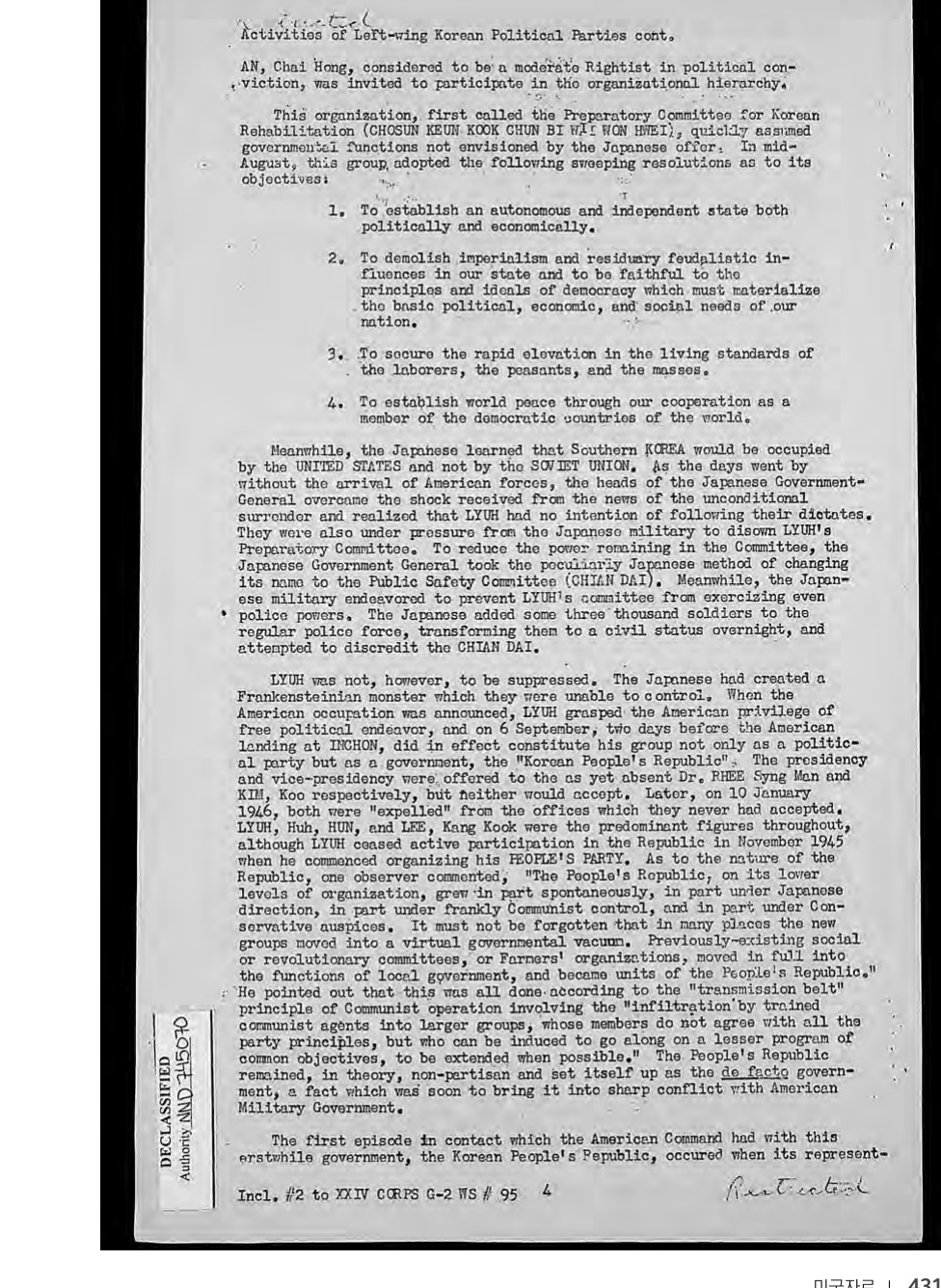
이 조직의 최초 이름은 조선건국준비위원회였으며, 일제가 제안한 그림과는 다 른 정부 기능을 신속하게 맡았다. 8월 중순 이 조직은 목적 달성을 위해 아래와 같은 전면적 결의문을 채택했다.
1. 정치·경제적으로 자주적이고 독립적인 국가를 건설한다.
2. 우리나라에서 제국주의와 잔재해 있는 봉건적 영향을 무너뜨리고 우리 인민이 정 치, 경제, 사회 측면에서 기본적으로 필요한 사항을 구체화하는 민주주의의 원칙과 이상에 충실한다.
3. 노동자, 소작농, 대중의 생활 수준을 빠르게 높인다.
4. 세계 민주국가의 일원으로서 자국의 협조를 통해 세계 평화를 구축한다.
한편 일본은 남조선이 소련이 아닌 미국에 점령당할 것이라는 사실을 알게 되 었다. 미군이 도착하지 않은 채 며칠이 지나는 동안 조선총독은 무조건 항복이라는 뉴스로 인한 충격에서 벗어나고 여운형은 자신의 지시를 따를 의사가 없음을 깨달았다. 총독부는 일본군으로부터 여운형의 조선건국준비위원회와 의절하라는 압박도 받았다. 위원회에 남아있는 권력을 줄이기 위해 조선총독은 그 이름을 치 안대로 바꾸는 일본 특유의 방식을 취한다. 한편 일본군은 여운형의 위원회가 경 찰권조차 행사하지 못하도록 방해 공작을 편다. 일본은 정규 경찰력에 3,000명 가량의 군인을 추가 증원하여 이들을 하룻밤 사이 민간인 신분으로 전환시키고 치안대의 신뢰도를 떨어뜨리기 위해 노력했다.
하지만 여운형은 탄압할 수 있는 존재가 아니었다. 일본은 자신들이 통제할 수 없는 프랑켄슈타인을 만든 것이다. 미국의 점령 소식이 발표되자 여운형은 미국의 정치적 자유라는 특권을 움켜쥐고 미국이 인천에 상륙하기 이틀 전에 사실상 자신의 조직을 정당을 넘어 하나의 정부인 "조선인민공화국"으로 구성했다. 대통 령직과 부통령직은 아직 고국으로 돌아오지 않은 이승만과 김구에게 각각 제안했으나 둘 다 고사했다. 이후 1946년 1월 10일 이 두 인사는 모두 자신들이 받아들인 적도 없는 공직에서 "제명"된다.
여운형은 1945년 11월 조선인민당을 창당하며 더 이상 공화국 일에는 적극적으로 참여하지 않았지만 여운형과 허헌, 이강국은 두드러지는 인물이었다. 공화국의 특성과 관련해서 한 관찰자는 "조선인민 공화국의 하위 조직을 살펴보면 일부는 자발적으로 일부는 일본의 지휘하에서 또 일부는 공산주의자의 통제하에서 또 다른 일부는 보수당의 찬조하에서 성장했다"고 논평했다. 많은 곳에서 새 조직은 가상 정부의 부재 속으로 들어갔다는 점을 절대 잊어서는 안 된다. 이전에 존재했던 사회적 또는 혁명적 위원회나 농민 조직은 지방 정부의 기능으로 완전히 흡수되어 조선인민공화국의 일원이 되었다. 그는 이는 모두 "구성원들이 당의 모든 원칙에는 동의하지 않아도 공통의 목표를 가진 소수의 프로그램에는 동조할 수 있어 가능한 경우 조직을 확대할 수 있도록 더 큰 조직에 훈련된 공산주의 첩보원을 침투시킨다" 같은 공산주의 운영 원칙인 '인전대(引傳帶)' 원칙에 따라 수행되었다고 지적했다. 조선인민공화국은 이론적으로는 초당적으로 남았고 스스로를 사실상의 정부로 설정했다. 이 사실은 곧 미군정과의 첨예한 갈등으로 이어졌다.
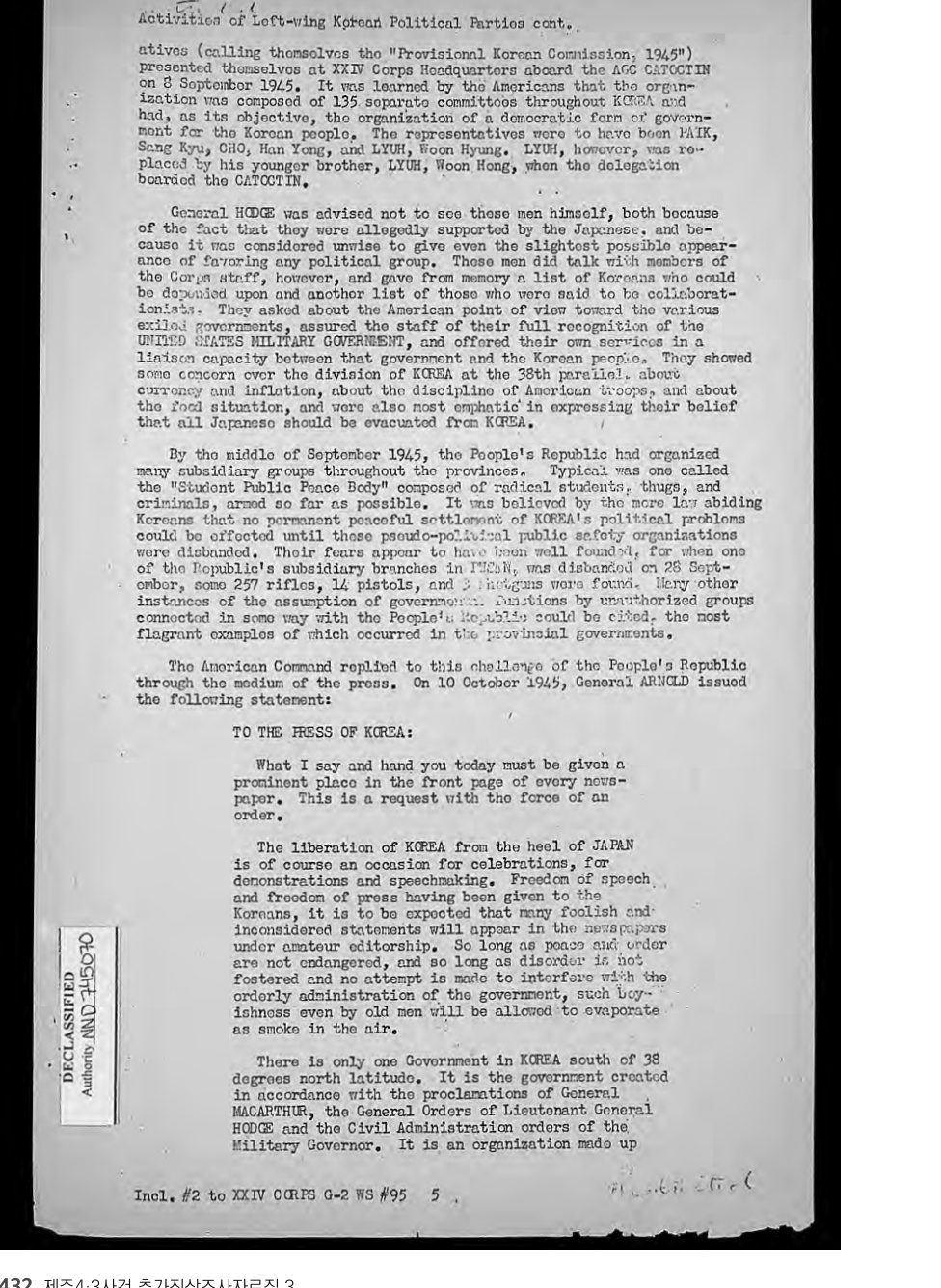
미 사령부가 당시 정부였던 조선인민공화국과 접촉한 첫 번째 일화는 1945년 9월 8일 캐톡틴함(AGC Catoctin)의 24군단 본부에 자신들의 대표(자칭 "건국준비위원회(1945년)")를 보냈을 때 일어났다. 미국은 이 조직이 조선의 135개 개별 위원회로 구성되었고 민주적인 형태의 조직 또는 조선인민을 위한 정부를 만드는 것이 그 목표임을 알게 되었다. 건국준비위원회의 대표단은 백상규, 조한영, 여운형이었다. 그러나 대표단이 캐톡틴함에 오를 때 여운형은 동생 여운홍으로 대체되었다. 하지 사령관은 이들과 만나지 말라는 말을 들었다. 그 이유는 이들이 일본의 지원을 받고 있다고 전해지는 사실과 정치 집단에 호의를 베푸는 행동은 아주 작은 것이라도 현명하지 못하다고 판단했기 때문이다. 이들 대표단은 군단의 참모들과 대화를 나누었으며 기억을 더듬어 신뢰할 만한 조선인 명단과 일제협조자들의 명단을 제공했다. 대표단은 다양한 망명 정부에 대해 미국이 어떤 시각을 갖고 있는지 질문하고 참모들에게는 자신들이 미군정을 전적으로 인정하고 있다는 사실을 확인시켜주었으며 자신들이 미군정과 조선인민 간 연락망의 역할을 할 수 있다고 제안했다. 또한 이들은 38도선을 기준으로 한 조선의 분단, 통화 및 물가인상, 미군의 기강, 식량 사정 등에 관한 우려를 표시했고 무엇보다 모든 일본인들이 조선에서 축출되어야 한다는 신념을 가장 단호하게 피력했다.
1945년 9월 중순에 이르러 조선인민공화국은 전국에 수많은 하부단체를 조직 했다. 전형적인 단체 중 하나가 급진적인 학생, 폭력배, 범죄자 등으로 구성되고 무장까지 한 '학생 치안대'였다.법을 준수하는 많은 조선인들은 공공 치안을 유지 한다고 자처하는 정치 집단들이 해체되지 않는 한 조선의 정치 문제의 평화적 해 결은 영원히 불가능하다고 믿었다. 조선인들의 두려움은 사실로 확인되었다. 부 산에 있는 공화국의 하부조직 중 하나가 9월 28일 해산되었을 때 257정의 소총, 14정의 권총, 4정의 엽총이 발견되었기 때문이다. 조선인민공화국과 어떤 식으 로든 연결되어 있던 인정되지 않은 단체들이 정부의 기능을 담당하려고 시도한 사례는 그 외에도 많았고 가장 명백한 사례들은 지방정부에서 발생했다.
미 사령부는 언론매체를 통해 조선인민공화국의 이 같은 도전에 응답했다.
1945년 10월 10일 아놀드(Arnold) 장군은 다음과 같은 성명을 발표했다.
조선 언론에 전하는 말:
오늘 본인이 말하고 배포하는 내용은 모든 신문 1면 주요 위치에 실려야 한다. 이 요청은 명령에 준한다.
조선이 일제의 탄압으로부터 해방된 것은 당연히 축하하고, 드러내고, 연설도 할만한 사안이다. 조선인들에게 언론·출판의 자유가 주어지면서 아마추어적인 편집 실력을 가진 신문에는 많이 어리석고 경솔한 기사가 실릴 것으로 예상된다. 평화와 질서를 위태롭게 하거나 무질서를 조장하거나 정부의 원활한 행정 업무를 방해하려는 시도가 없는 한 심지어 성인이 한다고 해도 그것이 저절로 사라지도록 내버려 둘 것이다.
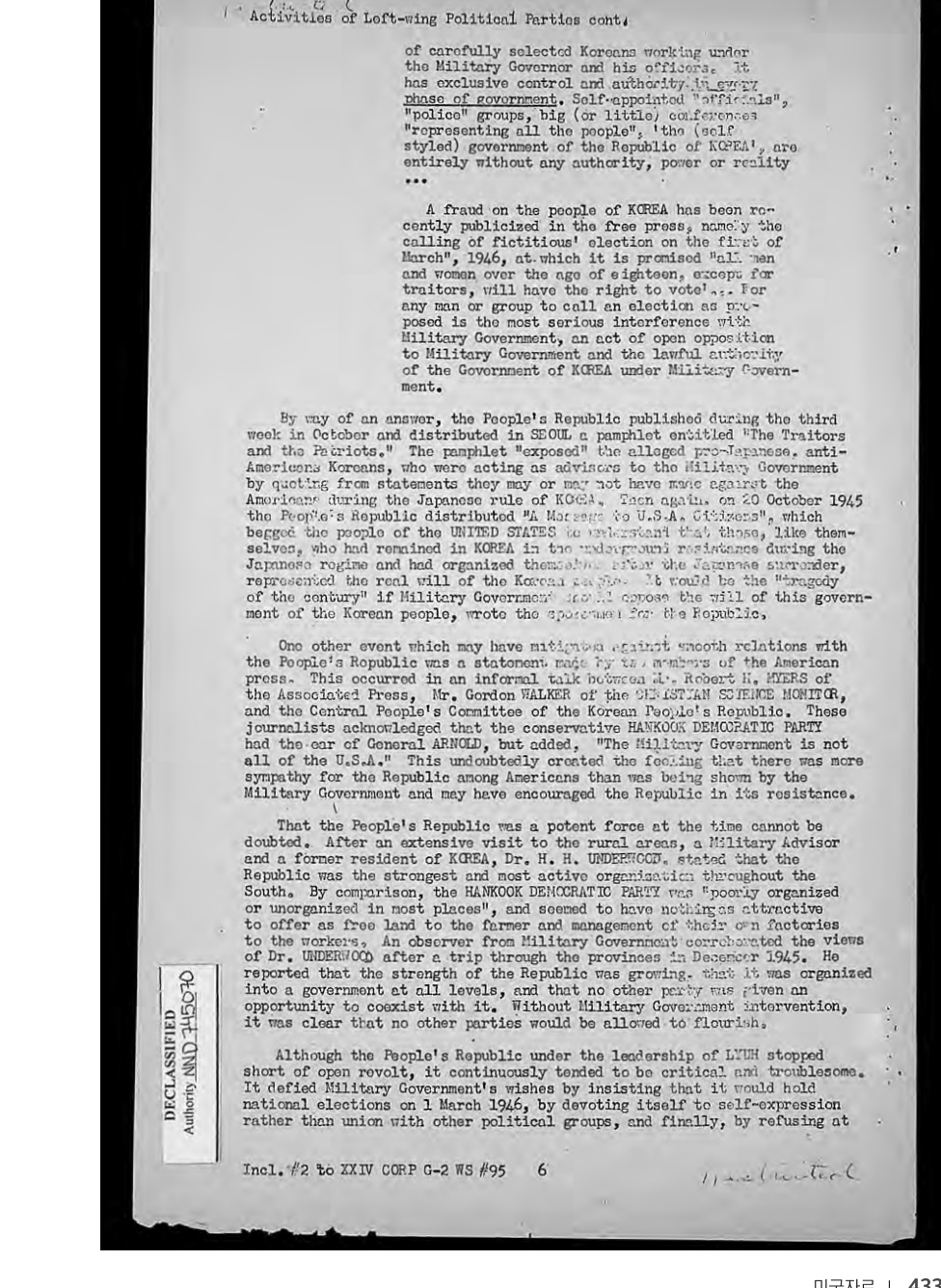
38도선 이남 지역 조선에는 오직 하나의 정부만 있다. 이 정부는 맥아더 원수의 포고령, 하지 사령관의 일반명령, 군정장관의 민정명령에 따라 세워진 정부로 군정장관과 그 보좌관들 밑에서 일하는 조선인을 엄선하여 구성한 조직이다. 이 조직은 정부의 모든 방면에서 독점적인 통제권과 권한을 지닌다. 자칭 '경찰' 단체, '전 인민을 대표하는' 대규모(또는 소규모) 회의, (자칭) 조선인민공화국 정부에는 어떠한 지휘권이나 권한 또는 실체가 없다.
최근 자유신문(the Free Press)에는 조선 인민에 대한 사기 행위, 즉 1946년 3월 1일 "반역자를 제외한 18세 이상의 모든 남녀에게 투표권이 주어질 것"이라고 약속하는 허구의 선거를 요구하는 내용이 공개되었다. 어떤 사람이나 단체가 이 같은 선거를 요구하는 것은 군정을 가장 심각하게 방해하는 것이며 군정과 군정 휘하에 있는 조선 정부의 합법적인 권위에 대한 공공연한 반대 행위이다.
아놀드 장군의 성명에 대한 답변으로 인민공화국은 10월 셋째 주에 <반역자와 애국자(Traitors and the Patriots)>라는 제목의 소책자를 인쇄하여 서울에 배포했다. 이 책자는 군정의 고문으로 활동하고 있는 인사들 중 친일·반미 인사로 의심되는 조선인들을 "공개"하며 그들이 일제 통치 기간에 작성하거나 작성했을 수도 있는 반미 성향의 글들을 인용하였다. 그 후 1945년 10월 20일 인민공화국은 <미국 시민에게 보내는 메시지(Message to USA Citizens)>라는 글을 발표하였다. 여기서 공화국 대변인은 일제 치하에서 조선에 남아 지하 저항운동을 하고 일본의 항복 이후 자체적으로 조직을 구성한 자신들 같은 사람들이 조선인민들의 진정한 의지를 대표하며, 군정이 이러한 조선 정부의 의지를 탄압한다면 '세기의 비극'이 될 것이라고 미국인들에게 간청했다.
군정과 인민공화국의 원만한 관계를 방해한 또 다른 사건은 미국 언론의 성명이었다. 이 사건은 미국 AP통신의 로버트 마이어스(Robert H, Myers) 기자, 크리스천 사이언스 모니터(Christian Science Monitor)지의 고든 워커(Gordon Walker) 기자, 조선인민공화국 중앙인민위원회가 가진 비공식적인 대화에서 비롯되었다. 이 기자들은 조선민주당이 아놀드 장군의 관심을 받는다는 것은 인정하지만 "군정이 모든 미국인을 대변하는 것은 아니다"라는 설명을 덧붙였다. 이를 통해 인민공화국에 대한 미국 여론은 군정이 보여주는 것보다 동정적이라는 것을 확연히 느낄 수 있었으며 이는 공화국의 저항운동에 힘이 되었을 것이다.
인민공화국이 당시에 잠재력을 지녔다는 사실은 의심할 여지가 없다. 군정의 군사고문이자 과거 조선에 거주한 적이 있었던 언더우드(H. H. Underwood) 박사는 조선의 지방 곳곳을 다녀본 뒤 인민공화국이 남조선에서 가장 강력하고 가장 활발한 조직이라고 주장했다. 반면 한국민주당은 "대부분의 지역에서 조직이 빈약하거나 아예 조직이 이루어져 있지 않았고", 농부들에게 토지를 무상 제공하거나 노동자들에게 공장을 자체 관리하게 해주는 등의 매력적인 것을 갖고 있지 않아 보였다. 군정의 한 관찰자는 1945년 12월 전국의 지방을 둘러본 뒤 언더우드 박사의 견해를 뒷받침했다. 그는 인민공화국의 힘이 강해지고 있다고 보고했다. 인민공화국은 모든 수준에서 정부로서의 조직을 갖추고 있었고 인민공화국과 공존할 가능성이 있는 당은 없었다. 군정이 개입하지 않는 한 다른 정당의 번영은 불가능하리란 점은 불 보듯 뻔했다.
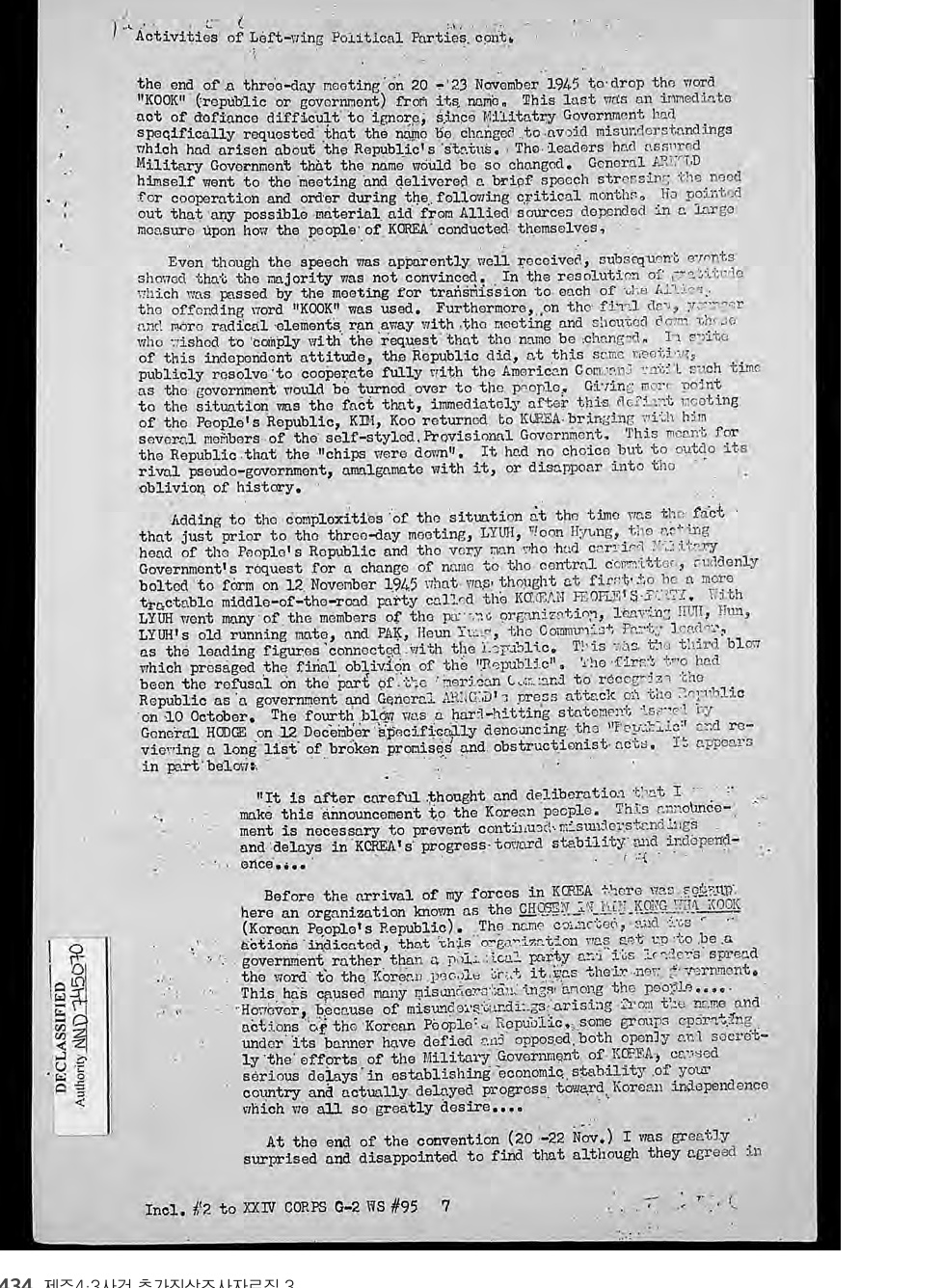
여운형이 이끄는 인민공화국은 공공연한 반란은 중단했지만 지속적으로 비판적이었고 골칫거리가 되는 경향이 있었다. 인민공화국은 1946년 3월 1일 총선을 실시할 것이라 주장하고 다른 정당과의 연대보다는 자기표현에 몰두하며 결정적으로 1945년 11월 20~23일 3일간 열린 회의 끝에 당명에서 '국'(공화국, 정부의 의미) 자를 빼는 것을 거부하면서 군정의 바람을 거역했다. 공화국이라는 지위로 생길 수 있는 오해를 피하고자 군정이 인민공화국이라는 명칭을 바꿔줄 것을 분명하게 요구한 것이기 때문에 이 마지막 사안은 무시하기 어려운 직접적인 도전 행위였다. 인민공화국 지도자들은 군정에 명칭을 바꿀 것이라고 확약했었다. 아놀드 장군은 직접 회의에 참석하여 중대한 몇 개월간 협조와 질서 유지의 필요성을 강조하는 짧은 연설을 했다. 아놀드 장군은 연합국으로부터 받을 수 있는 모든 물질적 원조는 상당 부분 조선인민들이 어떻게 행동하느냐에 달려 있다고 지적했다.
연설은 잘 전달된 것처럼 보였지만 이후 사건들을 보면 대다수가 납득하지 못했다는 것을 알 수 있다. 연합국 각국에 전달하기 위해 회의에서 통과시킨 감사의 글에는 문제의 '국' 자가 적혀 있었다. 게다가 마지막 날에는 더 젊고 급진적인 인사들이 회의를 장악하여 명칭 변경 요구를 수용하려는 사람들을 큰 목소리로 제압했다. 이러한 독자적인 태도에도 불구하고 회의에서 인민공화국은 정부가 조선인들에게 넘겨질 때까지 미 사령부에 전적으로 협조하겠다고 공개적으로 결의했다. 인민공화국의 이 같은 도전적인 회의가 있은 직후 김구가 자치 임시정부의 일부 인사들과 함께 조선으로 귀국하면서 상황은 더욱 미묘해졌다. 인민공화국에 이 사실은 상황이 매우 곤란해졌다는 것을 뜻했다. 경쟁 관계인 사이비 정부를 능가하거나 그들과 연합하거나 아니면 역사의 뒤안길로 사라지는 것 외에는 방도가 없었기 때문이다.
설상가상으로 인민공화국의 수장이자 미군정의 명칭 변경 요구를 중앙위원회에 상정한 장본인이었던 여운형이 이 3일간의 회의 직전인 1945년 11월 12일 처음에는 다루기 쉬운 중도정당이라 여긴 조선인민당의 창당을 중단하였다. 여운형이 상위 조직의 많은 인사와 함께 떠나면서 오랜 동지였던 허헌과 공산당 당수 박헌영이 인민공화국과 관련된 주요 인사로 남게 되었다. 이는 '인민공화국'이 결국 잊혀진다는 세 번째 전조였다. 이전의 두 전조는 인민공화국을 정부로 인정해 달라는 요청에 대한 미 사령부 측의 거절과 10월 10일에 있었던 아놀드 장군의 언론 공격이었다. 네 번째 전조는 12월 12일 '인민공화국'을 콕 집어 비난하고 지켜지지 않은 많은 약속들과 방해 행위를 열거한 하지 사령관의 직설적인 선언문이었다. 그 내용의 일부는 아래와 같다.
"신중히 생각하고 숙고한 끝에 다음과 같은 선언문을 조선인민에게 발표한다. 이 선언문은 지속적인 오해와 조선의 안정과 독립을 저해하는 요인을 방지하기 위해 필요한 것이다...
우리 군대가 조선에 상륙하기 전 조선에는 조선인민공화국이라는 조직이 출범해 있었다. 이 조직의 명칭과 활동에는 정당이 아닌 정부로 설립되었다는 것이 함축되어 있었고 지도부는 조선인민들에게 이 조직이 정부라는 말을 퍼트렸다. 이는 사람들 사이에 많은 오해를 불러 일으켰다... 그러나 조선인민공화국의 명칭과 활동으로 인해 생긴 오해 때문에 이 단체의 현수막을 걸고 활동하는 일부 조직들은 공개적으로 또는 비공개적으로 미군정청의 활동에 저항하고 반대하여 귀국의 경제 안정화의 구축을 지연시키고 우리 모두가 그토록 바라는 조선의 독립 과정을 실제로 지연시켰다....
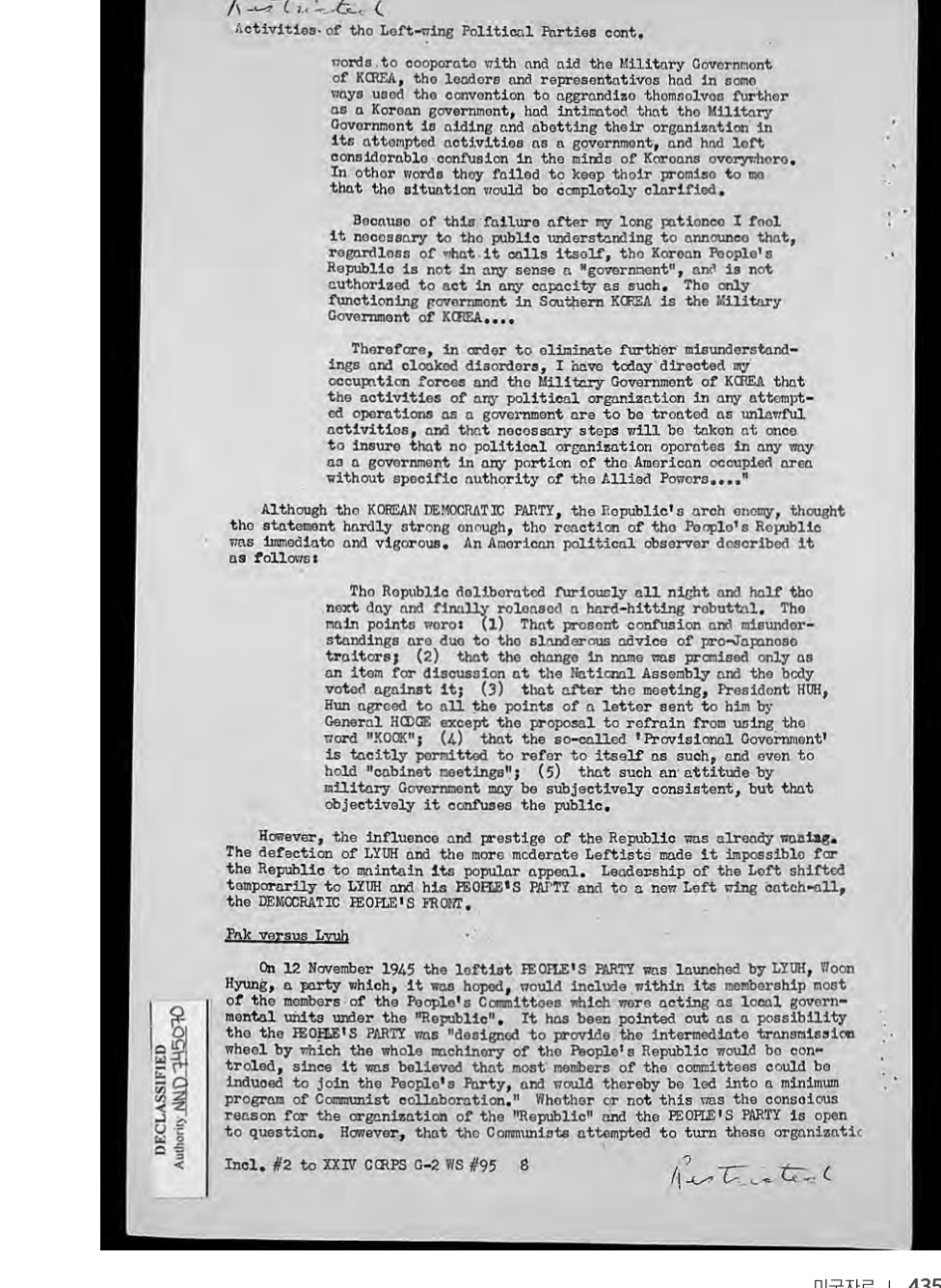
회의 종료 후(11월 20~22일) 그들 스스로 미군정에 협조하고 지원을 하겠다고 합의해놓고는, 그 지도부와 대표들이 그 회의를 다양한 방식으로 이용해 마치 자신들이 조선의 정부인 양 과장하고, 미군정도 자신들의 조직이 정부 기능을 수행하도록 지원하고 방조하고 있다는 식으로 내비쳐 곳곳의 조선인들을 매우 혼란스럽게 했다는 사실에 나는 매우 놀라고 실망했다. 다시 말해 조선인민공화국은 상황이 완전히 명확해 질 것이라고 했던 본인과의 약속을 저버렸다.
오랜 인내 끝에 이처럼 약속이 깨지니 이제 그 명칭에 상관없이 조선인민공화국은 어떤 의미에서든 "정부"가 아니며, 정부와 같은 능력을 갖고 행동할 권한이 없음을 대중에게 공포할 필요성을 느낀다. 남조선에서 유일하게 기능하는 정부는 미군정뿐이다. 따라서 새로 생기는 오해와 눈에 띄지 않는 무질서를 근절하기 위해 본인은 오늘 점령군과 미군정에 정부 기능을 행사하려는 모든 정치 조직의 활동을 불법으로 처리하고, 어떠한 정치 단체도 연합국의 특정한 인가가 없는 한 미국의 점령 지역 어디에서도 어떤 식으로든 정부 역할을 할 수 없도록 필요한 조치를 즉각 취할 것을 명령했다."
인민공화국 최대의 적인 한국민주당은 이 선언문이 충분히 강력하지 않다고 생각했으나 인민공화국의 대응은 즉각적이고 격렬했다. 한 미국인 정치 관측자는 이 상황을 아래와 같이 묘사했다.
인민공화국은 밤을 새고 그 다음날 반나절까지 치열하게 고민한 끝에 신랄한 반박문을 발표했다. 그 요지는 다음과 같다. (1) 현재의 혼란과 오해는 친일파 반역자들의 중상적인 자문 때문이다. (2) 명칭 변경은 국회에서 논의한다고 약속한 것뿐이었고 투표결과 부결되었다. (3) 회의 후 허헌 국무총리는 하지 사령관이 자신에게 보낸 서한에서 "국" 자 사용을 삼가 달라는 제안을 제외한 모든 내용에 동의했다. (4) 소위 "임시정부"는 자체적으로 "각료 회의"라고 칭하고 회의 개최가 암묵적으로 허용되었다. (5) 군정의 그러한 태도는 주관적으로는 일관될 수 있지만 객관적으로는 대중을 혼란에 빠뜨린다.
하지만 인민공화국의 영향력과 권위는 이미 약해지고 있었다. 여운형과 중도좌파들이 탈당한 인민공화당은 대중성을 유지할 수 없게 되었다. 좌파의 지도력은 일시적으로 여운형의 인민당과 새로운 좌익 단체인 민주주의민족전선으로 잠시 옮겨갔다.
박헌영 대 여운형
1945년 11월 12일 여운형은 "공화국" 체제에서 지방정부 역할을 맡고 있던 인민위원회의 위원 대부분이 포함될 좌파 계열의 조선인민당을 결성했다. 조선인민당은 "인민공화국의 조직 전체를 통제하는 중간 전달 매개체를 제공할 목적으로 설계되었을 가능성 때문에 주목을 받았다. 대부분의 위원들을 인민당에 가입하도록 유도할 수 있고 그렇게 함으로써 하나의 작은 공산주의 협력 프로그램으로 이끌 수 있을 것이라고 믿었기 때문이다." 이것이 의도적으로 "인민공화국"과 인민당을 조직한 이유였는지는 미지수다. 하지만 공산주의자들이 이들 조직을 자신들의 목표에 맞게 바꾸려 했다는 사실은 최근의 사건들에 비추어 보면 반박하기 어렵다. 1946년 1월 하지 사령관은 다음과 같은 정세 분석 보고서를 미 국무부에 전달했다.
"조선인민당과 관련하여 국무부는 공산분자들이 있음에도 불구하고 이 당이 자유주의자를 대표한다고 여길지 모른다. 공산분자들은 이전에 설명한 것보다 훨씬 더 강하기 때문에 이는 사실이 아니다... 여운형의 심복은 자신과 허헌이 공산분자에 당의 통제권을 뺏겼음을 인정했다. 그럼에도 불구하고 그들은 명목상 지도자로 남아있으며 아마도 정치권에서 영원히 제명될 것이라는 두려움 때문에 정당 실세와의 관계를 공공연하게 끊지 못하는 것 같다. 현재 공산주의자들은, 아마도 소련의 묵인하에, 대중적이고 "자유주의자"처럼 보이는 인민당을 정치적 도구로서 테러 등의 활동을 수행할 수 있는 전선으로 사용하고 있는 것 같다. 여운형을 배척하는 것은 자신들의 이해와 맞지 않지만, 당을 제외하고는 배경이 없는 기회주의자인 여운형은 자신의 주도권을 내려놓을 생각이 없다.
'인민공화국'이 행사하는 정부 특권에 대한 미국의 반대와 중도좌파의 탈당으로 인민공화국은 새로운 좌파 조직인 민주주의민족전선에 자리를 내주며 서서히 사라졌다. 공식적으로 1946년 2월 15일에 결성된 민주주의민족전선은 모든 좌파 단체(노동조합, 농민단체, 여성 및 청년 동맹)와 정당 및 그 밖의 다양한 집단을 좌파 진영으로 모으는 조직화된 선전 도구 역할을 어느 정도 하고 있다. 하지만 양대 산맥은 인민당과 공산당이다. 얼마 후 이 두 집단 간에는 통제권을 두고 투쟁이 벌어졌다. 소련이 지휘하는 공산주의자는 박헌영이, 반대편의 보다 민족주의로 편향된 좌파는 여운형이 지휘하고 있었다. 결과적으로는 박헌영파가 이겼다. 여운홍은 인민당을 꽤 효과적으로 지휘했으므로 그 개혁은 더 이상 불가능하다고 선언하며 1946년 5월 9일 형의 정당을 탈당했다. 여운형은 정당의 명목상의 지도자로 남긴 했지만 공산당의 통제망에서 한참 동안 벗어나지 못했다.
한편 극좌파 내 오래된 상처가 곪았다. 1946년 7월 17일 한 미국인 정치 관측자는 남조선의 조선공산당 통제권이 박헌영의 손을 확실히 벗어났다고 보고했다. 일반 당원들은 박헌영의 고압적이고 독단적인 지도력 장악과 스스로를 정당 정책의 유일한 근원이라고 생각하는 행동에 적개심을 표출하고 있었고, 무엇보다도 당 대회 개최 요청을 거부한 것에 대해 분개하고 있었다. 박헌영은 거부를 표하면서 당원들의 역량이 아직 부족하고 '민주집중제' 원칙이 준수되어야 한다고 설명했다. 당시 당 지도부의 위태로운 변화는 크렘린에서 아직 승인되지 않았다고 여겨졌다. 그럼에도 불구하고 당의 집행위원회와 중앙위원회가 이강국, 홍남표, 이주하로 구성된 삼두정치를 따르고 있다는 암시가 있었고 최종 지도력은 아마도 '지식인이자 신사'로 여겨지는 김철수에 귀속될 것이었다. 분열이 매우 심해지자 박헌영은 문제를 결국 해결할 곳이라 여긴 북쪽으로 떠났다. 하지 사령관은 그가 서울로 돌아온 직후 다음과 같이 보고했다.
"조선의 정치 상황은 고무적이지 않다. 우리는 지난 몇 주간 결과를 어느 정도 내비치며 좌파와 우파를 회유해 보려고 노력했다. 그러나 전해오는 말에 의하면 지난 7월 23일경 38도선 이북에서 돌아온 박헌영이 소련으로부터 코민테른 노선을 따르지 않는 모든 이들에게 보복이 있을 것이라는 협박 등 단호한 지령과 확실한 정보를 받아온 듯 하다... 그들은 공산당의 통제하에 통합이라는 미끼에 입질을 하고 잠시나마 이성적으로 말하는 변절자들을 덮으려고 몹시 허둥지둥했다. 나는 오늘 아침 믿을 만한 정보를 전해 받았다. 공산주의자들과 그들이 통제하는 위성 당들은 공산당이라는 이름을 없애고 조선노동당으로 통합했기 때문에 이런 속임수를 통해 러시아 공산당 지도부를 경계하는 다수의 좌파들을 끌어들일 수 있다는 내용이었다. 이 당은 공산당이라는 이름은 꺼리지만 기존 연합 형태인 민족전선보다 더 큰 영향력을 갖고 싶어하는 좌파들의 출구가 될 것이다. 북조선에서는 이미 이 같은 절차가 진행 중이다."
박헌영이 여운형에게 '미국 게임'을 하지 말라고 경고한 것과 좌우합작위원회(중도우파와 중도좌파 간 남조선대한국민대표민주의원을 대체할 실질적인 정치적 합의에 이르기 위한 미국식 활동) 역시 실패할 것이며 남조선의 좌파들이 북조선 동포의 곁을 굳건히 지킨다면 조선 내 모든 우파의 반대는 빠른 시일 내에 사라질 것이라고 예상했다는 사실이 추가로 알려졌다. 월북하기 전 박헌영은 합작에 대해 어정쩡한 태도를 보이긴 했지만 적대적이지는 않았다. 그러나 북에서 돌아온 후에는 합작을 단호하고 적극적으로 반대했는데, 이는 북조선에서 받은 지령 때문이었다. 여운형은 하지 사령관에게 자신이 김규식에게 너무 헌신적이고 남조선의 정치 통합을 위한 노력을 느슨하게 하거나 중단시키는 합작 운동에도 매우 전념하고 있으며, 어느 정도 결론이 도출될 때까지 프로젝트를 계속 진행할 것이라고 박헌영에게 말했다고 알렸다.
1946년 8월 9일 하지 사령관은 "여운형이 우리에게 귀띔하기를, 미국의 계획이 성공을 거두기 위해선 7월 29일로 예정된 위폐사건 재판에서 요술을 좀 부려 박헌영을 감옥으로 보내든지 해서 그를 이 시점에 과감하게 처리하는 게 중요하다고 했는데, 그 때문에 이번 만남에서 박헌영의 깊은 두려움이나 엄청난 증오가 수면 위로 떠올랐을 것"이라고 짐작했다. 하지 사령관은 이어서 다음과 같이 말했다. "우리는 여운형에게 통합을 방해하려는 공산주의자들의 의도를 밝히지 않는 이유를 물었다. 그러자 그는 남조선에 있는 많은 노동자, 농부, 청년 공산분자들의 충성이 자신과 박헌영에게 분산되어 있으며 자신과 박헌영이 공개적으로 갈라선다면 통합 운동에 해를 끼칠 것이라고 대답했다. 여운형은 이번에 박헌영의 위신이 깎이게 된다면 자신이 박헌영을 향해 있는 충성도 상당 부분을 얻을 수 있어 결국 우리 쪽에 유리할 것이라고 설명했다. 우리는 여운형이 비굴한 인사이거나 박헌영과의 마지막 결전을 위해 남몰래 공산주의에 굉장히 헌신하고 있으며 우리가 박헌영을 자리에서 물러나게 해주리라 여기고 있다고 생각한다." 박헌영은 이정윤을 당에서 제명하고 김철수, 서중석, 강진, 김건, 문갑송을 "반동분자 우익에 협조하려 한" 혐의로 정직시킴으로써 당 위원회에 대한 지배력을 빠르게 회복했다. 이들은 모두 공산당 중앙위원회 위원이었고 8월 5일 박헌영 타도 결의문을 지역 신문에 발표했다. 여운형은 아마도 자신의 당내에서조차 대립하는 정치 집단 간 점점 벌어지는 간극을 메울 수 없음을 깨달아 8월 15일 조선인민당 당수직에서 물러나 낙향했을 것이다. 이로 인해 인민당은 발칵 뒤집혔고 북조선 계열의 좌익 3대 정당을 통합하라는 공산당의 요구를 두고 서둘러 결정을 내려야 했다. 며칠 뒤 이 사안은 인민당 고등위원회에서 통합 찬성 48표, 반대 31표(기권 53표)로 마무리되었다. 훗날 이 투표에 대해 통합에 찬성하면 200만 엔 이상을 지급했기 때문에 결과에 적지 않은 영향을 미쳤다는 소문이 돌았다. 그 돈의 출처는 분명 공산당이었을 것이다. 하지만 1946년 9월 중순 여운형은 인민당 당수직 사임을 철회하고 목소리가 큰 공산당 의원들이 대거 탈당하자 당내 지배력을 되찾았다. 실제 9월 15일 여운형은 인민당 당수로서의 새 출발을 발표하고 공산당을 겨냥해 손을 떼라고 경고했다. 또한 자신은 여전히 좌익 3당 합당에는 찬성하지만 인민당의 조건이 바탕이 된다는 전제가 선행되어야 한다고 못 박았다.
한편 1946년 9월 3일 공산계열의 조선공산당, 인민당의 공산분자, 남조선신민당(백남운과 과거 연안파들이 이끈 소규모 좌익 단체)이 합당했다. 합당으로 남조선노동당(남로당)이 새로 결성되었고 이 남로당은 곧 박헌영파의 공산당 인사들이 완전히 장악했다. 박헌영 파는 좌파들의 전위 조직인 남로당을 통해 좌파의 정치 통제를 더욱 효과적으로 강화할 수 있으리라 생각한 듯하다. 하지만 공산분자들의 이 긴박한 움직임을 눈치채고 관련 활동을 방해하고 게임에서 이기기 위해 발 빠르게 움직인 여운형, 백남운, 강진(박헌영 반대파 공산주의자)은 모든 좌파들을 포함하는 정당으로 알려진 사회노동당의 창당을 주도했다.
그리하여 점령 첫해는 여운형과 박헌영이 좌파 세력 지배를 두고 서로 싸우는 것으로 끝이 났다. 박헌영은 소련의 지배를 받는 북조선으로부터 공식 지도자로 인정을 받았으나 여운형 또한 북조선에 있는 소련 괴뢰들의 호감을 샀다. 꽤 인기가 있다는 여운형의 위신이 이러한 모순을 설명할 수 있었을지도 모른다.
두 번째 해
우파가 이승만의 지도하에 통합하고 권력을 잡기 위해 강력하게 움직이는 동안 좌파는 크게 분열돼 있었다. 1946년 9월 3일 조선공산당, 인민당의 공산분자, 남조선신민당이 이룬 공산주의 합당에서 남조선노동당 설립을 위한 움직임이 일기 시작했다.
좌익의 분열
하지만 두 집단 모두 나름의 문제가 있었다. 공산당은 박헌영과 상당수의 추종자들 사이의 분열로 위기를 맞았다. 박헌영의 지도력에 가장 강력하게 반기를 든 세력은 부산 공산당원이었던 윤일이 진두지휘했다. 윤일은 반역 혐의로 1946년 여름 박헌영에 의해 공산당에서 축출당했지만 그해 9월 말 반체제 공산당원 대회에 의장 자격으로 서울에 모습을 드러냈다. 이 회의는 9월 28일에 개최했다고 전해진다. 9월 30일 윤일은 당 대표들이 총회에 모이면 자신들의 권한에 위협이 되리라 느낀 박헌영파가 크게 반대한 전국 공산주의자 대회를 자신이 소집하겠다고 방첩대 정보원들에게 말했다. 반박헌영파 지도자는 윤일, 정백, 이영이었다. 윤일은 미국측에도 합법적으로 운영할 계획임을 알렸다. 이 계획이 이후 어떻게 되었는지는 알려지지 않았다. 가을 총파업은 이내 모든 것을 뒤덮어 버렸는데 반박헌영파가 파업과 폭력에 협력한 것은 상당히 명백한 부분이다. 보복에 대한 두려움이 반(反)박헌영파를 잠재웠을 것이다. 박헌영은 미국의 체포 영장 때문에 어쩔 수 없이 지하에서 활동하긴 했지만 당 통제력은 유지한 것으로 보인다.
한편 여운형은 누구의 반대도 없이 그럭저럭 좌익을 지배했다. 여운형은 강진과 그의 반박헌영파 공산주의자, 백남운의 남조선신민당, 조선인민당을 규합하여 사회노동당을 창당했다. 여운형의 합작 운동과 (극좌파들이 변함없이 반대했던) 과도입법의원에 대한 지지는 우익의 최근 입법의원 선거 압승과 함께 사회노동당 내부에 불안과 불만을 야기했다. 이처럼 불만이 쌓여가면서 남조선노동당 창당이라는 지지부진했던 계획을 추진한 박헌영 쪽에 힘이 실렸다.
11월 23일~24일, 과거 조선인민공화국과 민주주의민족전선의 당수로 떠올랐던 허헌의 지도하에 남조선노동당이 공식 출범했다. 신당은 북조선노동당의 남조선측 카운터파트로서 박헌영이 군 당국의 체포를 피해 9월 초 지하로 숨어든 이후 정치계에서 힘이 약해진 극좌파의 부활을 상징했다. 남조선노동당 창당 직전 여운형은 사회노동당과 새로운 정당의 무조건적인 통합을 제안했다. 하지만 이 제안은 극좌파들이 여운형의 과거 행적 때문에 더 이상 그를 신뢰하지 않아 받아들여지지 않은 것으로 보인다.
12월 중순까지 여운형의 사회노동당은 분명 빠르게 쇠퇴하고 있었다. 당원 대부분이 남조선노동당과 우익 단체를 반대했기 때문에 다소 궁지에 몰려 있었다.
이는 극우파와 극좌파의 십자포화에 휩싸인 좌익 자유주의자 지망자들도 마찬가지였다. 그 결과 당원 상당수가 황급히 피신했다. 12월 7일 사회노동당 당원 31명이 탈당했다는 보고가 있었다. 이들은 과거 인민당 소속이었다. 탈당은 구 인민당이 의장 여운형을 중심으로 부활하길 바라는 염원에서 촉발된 것이라고 전해진다. 신당 근로인민당은 1946년 11월 초 강순과 이지탁의 지도하에 조직되었다. 당시 정보참모부는 이 당을 인민당과 공산당 사이쯤으로 분류했다. 12월 신당은 여운형이 좌우합작위원회와 입법의원들과 연락을 유지하기 위해 만든 비밀 거점일 수도 있다는 견해가 나왔다. 방첩대 정보원들은 신당이 여운형의 지시를 따를 것이라고 보고했다.
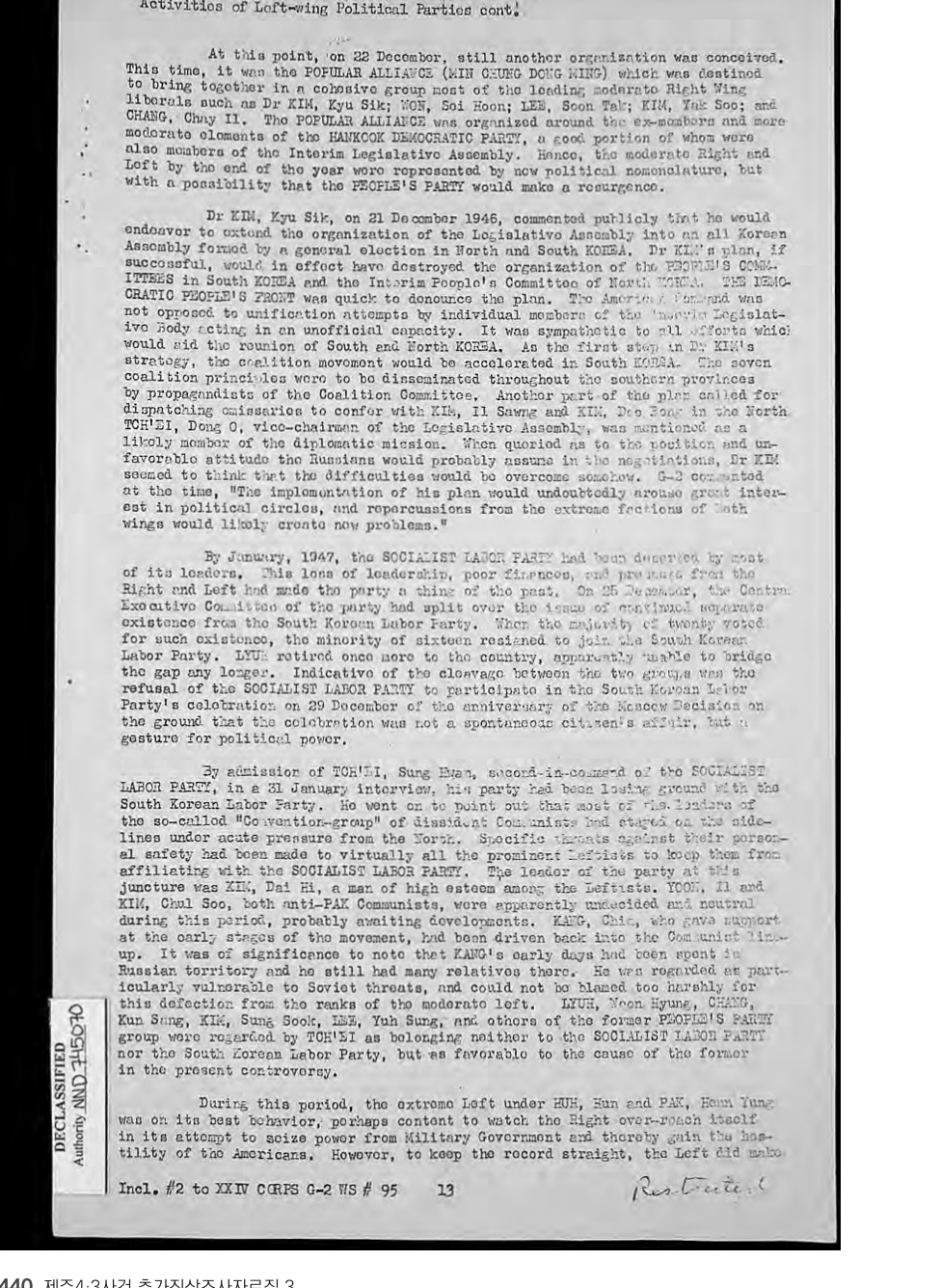
이 시점에서 12월 22일 또 다른 단체가 생겨났다. 이는 김규식, 원세훈, 이순탁, 김약수, 장자일 등 주요 중도 우익 자유주의자 대부분을 결집시킬 민중동맹이었다. 민중동맹은 조선민주당의 전 당원과 온건파들을 중심으로 조직되었으며 그들 중 상당 수는 과도입법의원에도 소속되어 있었다. 따라서 중도우파와 중도좌파는 그 해 말까지 새로운 정치적 명명법으로 표시되었지만 인민당이 부활할 것이라는 가능성도 있었다.
1946년 12월 21일 김규식은 입법의원의 조직을 남북조선 총선거를 통해 구성된 남북조선 의회로 확대하는 데 힘쓸 것이라고 공개적으로 발언했다. 김규식의 계획이 성공한다면 남조선의 인민위원회와 북조선의 임시인민위원회 조직은 사실상 파괴되는 것이었기 때문에 민주주의민족전선은 곧 그 계획을 비난했다. 미사령부측은 비공식적 역할을 하는 과도입법의원 개별 의원들의 통합 노력에 반대하지 않았다. 남북조선 재통합에 도움이 되는 모든 노력에는 동조를 했다. 김규식의 전략 1단계로 남조선에서 합작 운동이 가속화될 것이었다. 7개 합작 원칙이 좌우합작위원회의 선전을 통해 남쪽 지방 전체로 전파될 예정이었다. 계획의 다른 부분을 위해서는 북조선의 김일성, 김두봉과의 협의를 위해 특사를 파견해야 했다. 과도입법의원 부의장 최동오가 외교사절단 단원으로 거론되었다. 협상 자리에서 러시아가 취할 입장과 호의적이지 않을 태도에 관한 질문을 받았을 때 김규식은 그 문제는 어떻게든 극복할 수 있는 것으로 여기는 듯했다. 당시 정보참모부(G-2)는 "김규식이 계획을 실행하면 분명 정계의 큰 관심을 불러일으킬 것이고 좌우익 양극단파들의 반향으로 새로운 문제가 생길 가능성이 크다"고 논평했다.
1947년 1월까지 사회노동당 지도부의 대다수가 탈당했다. 이 같은 지도부 손실, 빈약한 재정, 좌파와 우파로부터 가해지는 압박으로 인해 당은 역사가 되어버렸다. 12월 25일 당 중앙집행위원회에는 남조선노동당을 별개의 존재로 인정하는 문제를 놓고 분열이 일었다. 20명의 다수가 당의 별개 존재를 인정하는 쪽에 찬성 투표를 하자 16명의 소수는 사임하고 남조선노동당에 합류했다. 여운형은 더 이상 간극을 좁히지 못하고 또 다시 낙향했다. 모스크바 결정 기념일인 12월 29일 축하 행사에 참가하라는 당의 지시를 축하 행사는 시민의 자발적 참여가 아닌 정치 권력을 위한 제스처라는 이유를 들어 거부한 사실에서 두 집단 간 분열을 확인할 수 있다.
1월 31일 인터뷰에서 사회노동당 부당수 최성환은 자신의 입당으로 사회노동당과 남조선노동당과의 관계가 틀어졌다고 밝혔다. 또한 반체제 공산주의자 가운데 소위 '대회파'가 북조선의 심한 압박 속에서 방관자적 입장을 고수했다고 지적했다. 사회노동당 가입을 막기 위하여 사실상 모든 주요 좌파들에게 구체적인 신변 위협이 가해졌다. 이 시기 당수는 좌파들 사이에서 평가가 높은 김대희였다. 반박헌영파 공산주의자 윤일과 김철수는 아마도 국면 전개를 기다리며 이 기간에는 결정을 내리지 않은 것으로 보인다. 운동 초기에 지지를 보냈던 강진은 공산당 목록에 다시 올라갔다. 강진은 초기 러시아에 머물렀고 아직도 그곳에 친척이 많다는 사실은 주목해야 할 부분이다. 특히 소련의 위협에 취약한 그가 이번 중도좌파 목록에서 빠진 것에 대해 그를 너무 지탄할 수도 없다. 여운형, 장건상, 김성숙, 이여성 외 기타 전 인민당 인사들은 최성환의 시각에서는 사회노동당도 아니고 남조선노동당도 아니었지만 현 논쟁에서는 사회노동당의 대의에 호의적인 것으로 보였다.
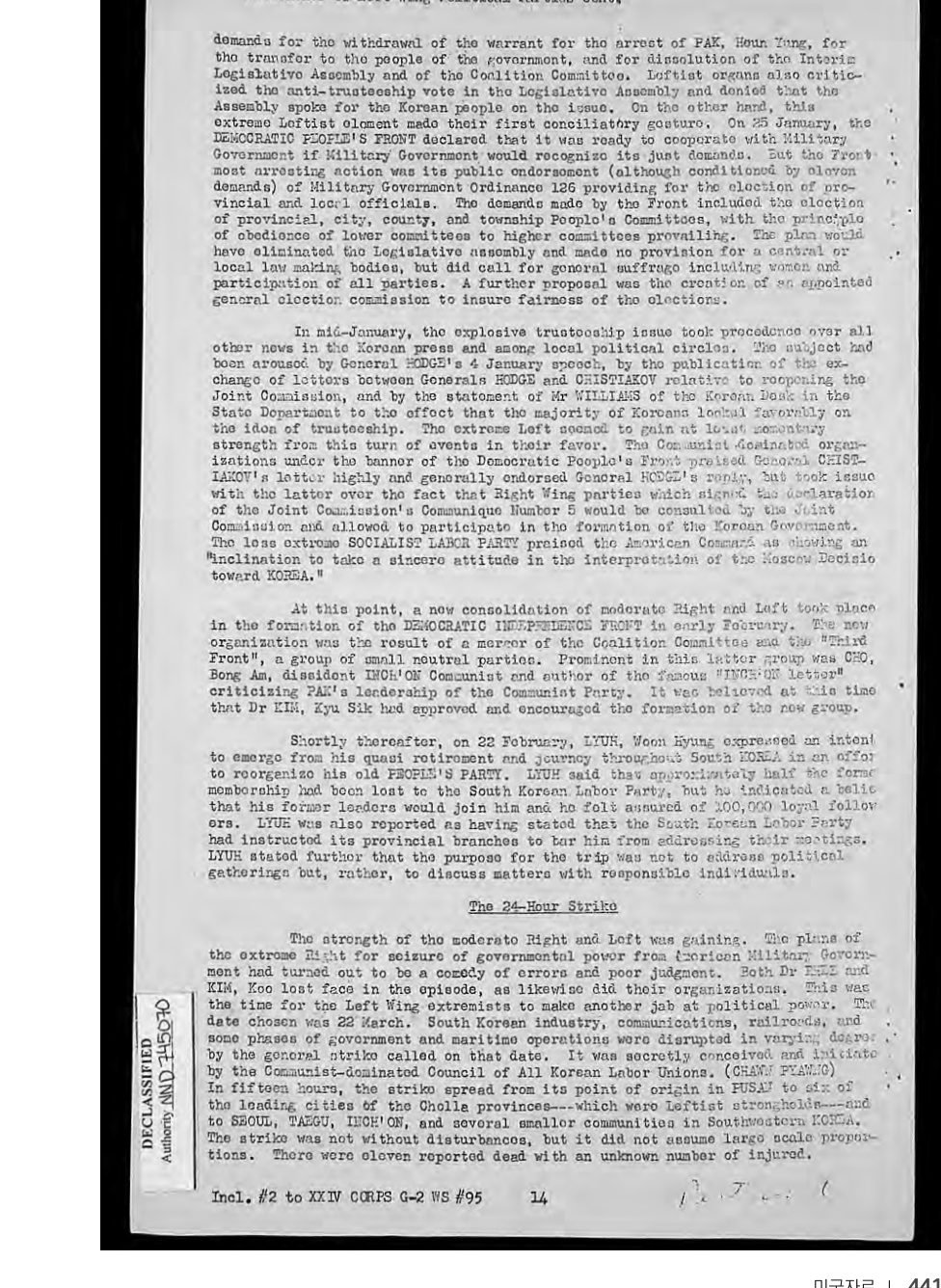
이 기간 허헌과 박헌영 휘하의 극좌파는 자중하면서도 군정으로부터 권력을 잡으려는 우파의 도 넘는 행위를 보는 것에 만족해하며 미국에 대한 적개심을 가졌을 것이다. 그러나 기록을 바로 잡자면 좌파는 박헌영 체포 영장의 철회, 인민에게 정권 이양, 과도입법의원 및 좌우합작위원회의 해산을 요구했다. 또한 좌파 단체들은 과도입법의원의 반탁 투표를 비판하며 입법의원이 해당 사안에서 조선인민을 대표한다는 주장을 거부했다. 반면 이 극좌익분자는 처음으로 화해의 제스처를 취했다. 1월 25일 민주주의민족전선은 군정이 자신들의 정당한 요구를 받아들인다면 군정에 협조하겠다고 선언했다. 그러나 가장 눈길을 끈 민주주의민족전선의 행동은 지방·지역 공무원 선출을 규정하는 군정법령 제126호를 공개적으로 지지한 것(비록 11개 조건을 내걸었지만)이었다. 민전이 내건 조건에는 하급위원회가 상급위원회에 복종한다는 원칙하에 인민위원회의 도, 시, 읍·면·동 단위의 선거 실시가 포함되어 있었다. 그로 인해 과도입법의원은 폐지되고 중앙·지방입법 기구 조항은 만들지 않게 되겠지만 여성의 참정권과 모든 정당의 참여가 크게 요구되었다. 선거의 공정성을 위해 선거관리위원회를 창설하고 임명하자는 제안도 있었다.
1월 중순 일촉즉발의 신탁 문제가 조선 언론과 지역 정계의 모든 뉴스에 우선적으로 보도되었다. 이 문제는 하지 사령관의 1월 4일 연설과 미소공동위원회 재개를 두고 하지 사령관과 치스차코프(Chistiakov) 사이에 오고 간 서한 공개, 대다수 조선인들이 신탁에 호의적이라는 취지의 미 국무부 윌리엄스(Williams)의 성명으로 촉발되었다. 극좌파는 일이 자신들에게 유리한 방향으로 돌아가자 잠시나마 힘을 얻는 듯 했다. 민주주의민족전선이라는 기치 아래 공산주의자가 지배적인 조직들은 치스차코프 사령관의 서한을 높이 치하하고 하지 사령관의 답신을 대체로 지지했지만, 미소공동위원회 공식성명 제5호에 서명한 우익 정당들이 위원회의 자문을 받고 조선 정부 구성의 정식 참여자가 된다는 사실을 두고 윌리엄스의 성명에 이의를 제기했다. 덜 과격한 사회노동당은 미국 사령부측이 "조선에 대한 모스크바 결정을 해석할 때 진정성 있는 태도"를 보였다며 칭송했다.
당시 2월 초 민주주의독립전선을 조직하는 과정에서 중도우파와 중도좌파가 새로 집결했다. 이 새 조직은 좌우합작위원회와 소수 중도파들로 구성된 '제3전선파'가 합병한 결과물이다. 제3전선파의 유명한 인물은 조봉암으로, 인천 공산당의 반체제인사이자 공산당 지도부의 행태를 비판한 그 유명한 <박헌영에게 고함>이라는 서신을 쓴 장본인이다. 당시 김규식이 이 새 조직의 구성을 승인하고 격려한 것으로 보인다.
얼마 지나지 않아 2월 22일 여운형은 칩거에서 벗어나 이전 인민당을 소생시키기 위한 일환으로 남조선 전국여행에 관심을 드러냈다. 여운형은 당원 절반가량을 남조선노동당에 뺏겼다 말하면서도 인민당 전 당수가 자신에게 합류할 것이라는 믿음을 드러내고 충성심이 높은 추종자가 10만여 명은 되리라고 확신했다. 또한 보고에 따르면 여운형은 남조선노동당이 지방 지부에 당 집회에서 자신의 연설을 막으라는 지시를 내렸다고 전했다. 여운형은 여행의 목적은 정치적 모임에서 연설을 하기 위해서가 아니라 책임감 있는 개인들과 사안을 논의하기 위해서라고 강조했다.
24시간 파업
중도우파와 중도좌파의 힘은 강해지고 있었다. 미군정으로부터 정부 권력을 몰수하겠다는 극우파의 계획은 실수 연발에 판단력 부족으로 드러났다. 이승만과 김구 모두 이번 일로 체면을 구겼고 다른 조직들도 마찬가지였다. 이때는 좌파 극단주의자들이 정치 권력에서 또 한 번 위세를 떨치던 시절이었다. 날짜는 3월 22일로 잡혔다. 이날 총파업으로 인해 남조선의 산업, 통신, 철도, 일부 행정 업무 및 해상 업무가 여러 단계에서 중단되었다. 이 파업은 공산당이 장악한 조선노동조합전국평의회(전평)가 주도했다. 파업은 부산에서 시작해 15시간 후 좌파 근거지인 전라도 주요 6개 도시와 서울, 대구, 인천을 거쳐 조선 남서부의 소규모 지역사회 곳곳으로 펴져 나갔다. 파업에 방해가 없는 것은 아니었지만 큰 영향을 끼치지는 않았다. 이 파업으로 11명이 사망했으며 정확한 부상자 수는 알려지지 않았다.
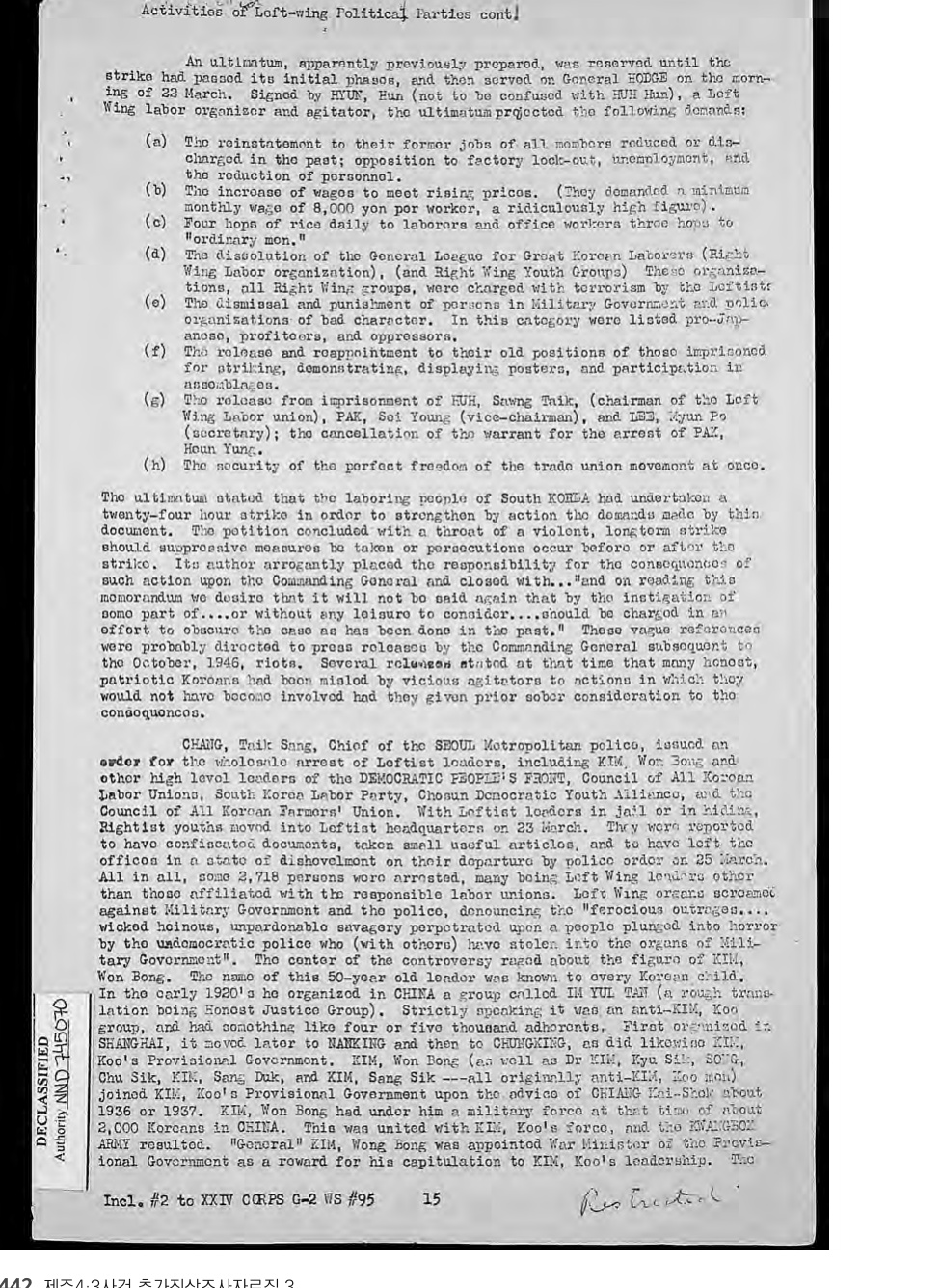
사전에 작성한 듯한 최후통첩은 파업이 초기 국면을 지날 때까지 남겨두고 있다가 3월 22일 오전 하지 사령관에게 전달되었다. 좌익노조 설립자이자 선동가인 현훈(허훈과 헷갈리지 않도록 주의)이 서명한 최후통첩에는 다음과 같은 요구사항이 포함되어 있었다.
(a) 과거 감원 또는 해고된 모든 노동자의 복직 및 공장 폐쇄, 유휴(遊休), 인원 감축 반대
(b) 물가상승을 반영한 임금 인상(최저월급을 터무니없이 높은 8,000원으로 요구함)
(c) 매일 노동자 및 사무직 근로자에게는 쌀 4홉, '일반인'에게는 3홉 지급
(d) 대한노동총연맹(우익계 노동조합)(우익계 청년단체)의 해산. 이러한 조직 등 모 든 우익 단체는 좌익이 저지른 테러로 기소되었다.
(e) 군정 및 경찰 조직 내 행실이 나쁜 인물의 해고 및 처벌. 이 범주에 친일파, 부당 이득자, 압제자도 포함된다.
(f) 파업, 시위, 포스터 전시 및 모임 참석으로 투옥된 인사들의 이전 직위 회복 및 재 임명
(g) 허성택(좌익 노동단체 집행위원장), 박세영(부집행위원장), 이면포(서기)의 석방 및 박헌영 체포 영장 취소
(h) 노조 운동의 완전한 자유 즉시 보장 최후통첩은 남조선 노동자들이 이 문서에 적힌 요구사항을 행동으로 강력하게 보여주기 위해 24시간 파업을 감행한다고 적고 있으며, 진압 조치를 취하거나 파 업 전후에 박해가 있을 경우 폭력적이고 장기적인 파업을 수행한다는 협박으로 끝맺었다. 작성자는 그러한 행동의 결과에 대한 책임을 오만하게도 사령관에게 지우고 "이 최후통첩을 읽으면서, 우리는 일부의 선동에 의했다거나...혹은 고려 할 어떠한 겨를이 없었다거나...과거처럼 사건을 흐리려는 노력의 일환으로 기소 되어야 한다는 식의 말은 다시 나오지 않기를 바란다"며 마무리했다. 모호한 언급은 1946년 10월 폭동 이후 사령관의 대언론 공식 발표를 겨냥한 것일 것이다. 당 시 일부 발표문은 다수의 정직하고 충직한 조선인들이 악랄한 선동가들로 인해 사전에 그 결과를 진지하게 생각한다면 절대로 하지 않았을 행동에 가담했다고 주장했다.
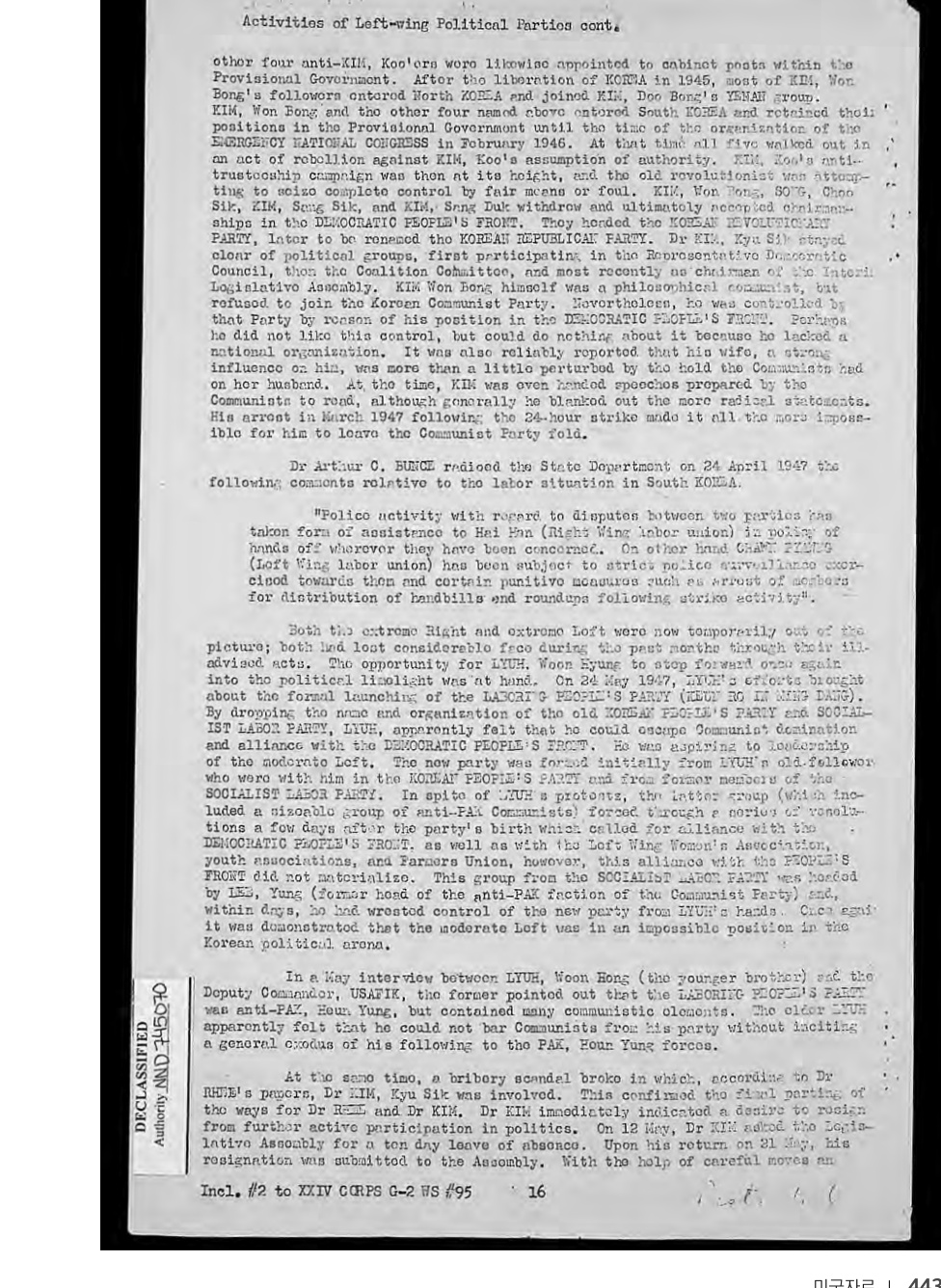
장택상 수도경찰청장은 김원봉을 비롯한 민주주의민족전선, 조선노동조합전국평의회, 남조선노동당, 조선민주주의청년동맹, 조선전국농민연맹의 기타 고위급 지도자 등의 좌파 지도자들을 일제히 검거하라는 명령을 내렸다. 좌파 지도자들이 투옥되거나 숨어버리자 우익 청년들은 3월 23일 좌파의 본부로 이동했다. 보고에 따르면 이들은 서류를 압수하고 쓸모 있는 작은 물품들을 약탈하였으며, 3월 25일 경찰 명령으로 해산했을 당시 사무실을 온통 헤집어놓았다. 총 2,718명이 체포되었으며 대부분이 책임 있는 노동조합과 제휴하고 있지 않은 좌파 지도자들이었다. 좌익 단체들은 군정과 경찰에 "군정 기관들로 슬그머니 들어온 비민주적인 경찰 때문에 공포에 질린 인민을 상대로 맹렬한 분노를 일으킬 사악하고 악랄하며 용서할 수 없는 잔인한 일들이 자행되었다"라고 맹렬히 비난하며 성토했다. 논란의 중심에는 김원봉이라는 인물에 대한 격분이 있었다. 조선의 모든 아이들은 이 50세 지도자의 이름을 다 알고 있다. 김원봉은 1920년대 초 중국에 의열단이라는 조직을 만들었다. 엄밀히 말해 이 단체는 반김구 단체로서 지지자는 약 4,000~5,000명이었다. 의열단은 상하이 설립 이후 김구의 임시정부처럼 난징과 충칭으로 이동했다. 김원봉(김규식, 송주식, 김상덕, 김상식 역시 모두 김구 반대파)은 1936년 또는 1937년경 장개석의 조언에 따라 김구의 임시정부에 들어갔다. 김원봉은 당시 중국에 약 2,000명의 조선인으로 구성된 군대를 휘하에 두고 있었다. 이는 김구의 군대와 합쳐져 광복군이 되었다. 김원봉 '장군'은 김구에 항복한 대가로 임시정부의 군무부장으로 임명되었다. 그 외 김구 반대파 인사 네 명도 이와 비슷하게 임시정부 요직에 임명되었다. 1945년 대한민국 해방 후 김원봉 추종자 대부분은 북조선으로 들어가 김두봉의 연안파에 합류했다. 김원봉과 앞서 언급한 4명의 인사들은 남조선으로 들어가 1946년 2월 비상국민회의가 조직될 때까지 임시정부에서 직책을 유지했다. 당시 이 다섯 명은 모두 김구의 지휘권 상정에 대한 반발로 임시정부를 나왔다. 이후 김구의 반탁 운동이 활기를 띠는 가운데 오랜 혁명가들은 수단과 방법을 가리지 않고 완전한 지휘권 장악을 시도하고 있었다. 김원봉, 송주식, 김상식, 김상덕은 철수하고 결국 민주주의민족전선의 의장직을 수락했다. 이들은 조선민족혁명당(이후 인민공화당으로 개명)으로 향했다. 정치 조직을 멀리하던 김규식은 처음으로 남조선대한국민대표민주의원에 참여했다. 이후 좌우합작위원회에 참여했으며 가장 최근에는 과도입법의원 의장직에 올랐다. 김원봉은 철학적인 공산주의자였지만 조선공산당 입당은 거절했다. 그럼에도 불구하고 김원봉은 민주주의민족전선에서의 지위 때문에 당의 통제를 받고 있었다. 아마 김원봉은 이런 통제를 달가워하지 않았겠지만 전국 단위의 조직이 없었기 때문에 선택의 여지가 없었다. 신뢰할 수 있는 보고에 따르면 김원봉에게 큰 영향을 미친 그의 부인은 공산주의자들이 남편을 쥐고 흔드는 것에 매우 불안해 했다고 전해진다. 당시 김원봉은 공산주의자가 작성한 연설문을 건네받아 읽기도 했다. 너무 과격한 문장은 대체로 건너 뛰었다. 24시간 파업 이후 1947년 3월 체포된 후에는 공산당을 떠나기가 더욱 어려워졌다.
1947년 4월 24일 아더 번스(Arthur C. Bunce) 박사는 남조선의 노동 상황에 대하여 미 국무부에 아래와 같은 의견을 보냈다.
"양당 갈등과 관련한 경찰의 활동은 그들이 관여한 모든 곳에 대한 불간섭주의 정책에 따라 해한(Hai Han19, 우익계 노동조합)을 지원하는 형태로 이루어졌다. 반면 전평(좌익계 노동조합)은 경찰이 엄격하게 감시를 했다. 전단지 살포나 파업 활동 지지자를 소집하는 당원을 체포하는 등 구체적인 처벌 조치를 취하고 있다."
극우파와 극좌파 모두 현재로선 잠시나마 문제가 되지 않고 있지만 모두 지난 몇 개월 동안 경솔한 행동 때문에 위신을 상당히 잃은 상태다. 여운형이 다시 정치적으로 각광 받을 기회가 목전으로 다가왔다. 1947년 5월 24일 여운형의 노력으로 근로인민당이 공식으로 창립되었다. 여운형은 기존 조선인민당과 사회노동당의 이름을 버림으로써 공산주의자의 지배에서 벗어나고 민주주의민족전선과 연합할 수 있다고 생각하는 것 같았다. 여운형은 중도좌파의 수장이 되길 바라고 있었다. 새 정당은 처음에는 여운형의 조선인민당에서 그와 함께 한 오랜 추종자들과 이전 사회노동당 당원들로 구성되었다. 여운형의 항의에도 불구하고 사회노동당(반박헌영파 공산주의자들이 대거 포함되어 있음)은 창당 며칠 전 민주주의민족전선은 물론 좌익계 여성협회, 청년동맹, 농민조합과의 연대가 필요한 일련의 결의안을 밀어붙였다. 하지만 민족전선과의 연대는 구체화 되지 않았다.
사회노동당 출신의 이 조직은 이영(공산당 반박헌영파의 이전 수장)이 이끌었고 며칠 후 그는 여운형에게서 새로운 정당의 통제권을 가까스로 빼앗았다. 조선 정치에서 중도좌파가 설 자리는 없다는 사실이 다시 한번 증명되었다.
여운홍(여운형의 동생)은 주한미육군사령부 부사령관과의 5월 인터뷰에서 근 로인민당은 반박헌영주의였지만 공산주의적 요소가 매우 많았다고 밝혔다. 여운 형은 자신의 추종자들을 박헌영 쪽으로 대거 이탈시키지 않고서는 자신의 당에 공산주의자를 차단하지는 못할 것이라 여긴 듯 하다.
이승만의 보고서에 따르면 같은 시기 김규식이 연루된 뇌물 사건이 터졌다. 이 사건으로 이승만과 김규식의 향방이 완전히 갈리게 된다. 김규식은 즉각 적극적 인 정치 참여에서 물러날 의사를 밝혔다. 5월 12일 김규식은 입법의원에 열흘의 휴가를 신청했다. 5월 21일 복귀하자마자 김규식의 사직서가 의회에 제출되었다.
김규식에 대한 신임투표가 세심한 거물들의 도움으로 진행되었고 이 투표에서 사 직서는 만장일치로 부결되었다. 이처럼 가진 패를 모두 드러내 보이는 노련한 대 처로 김규식은 상당한 특권과 권한을 획득하게 된다. 김규식은 이내 정계 은퇴를 취소했다.
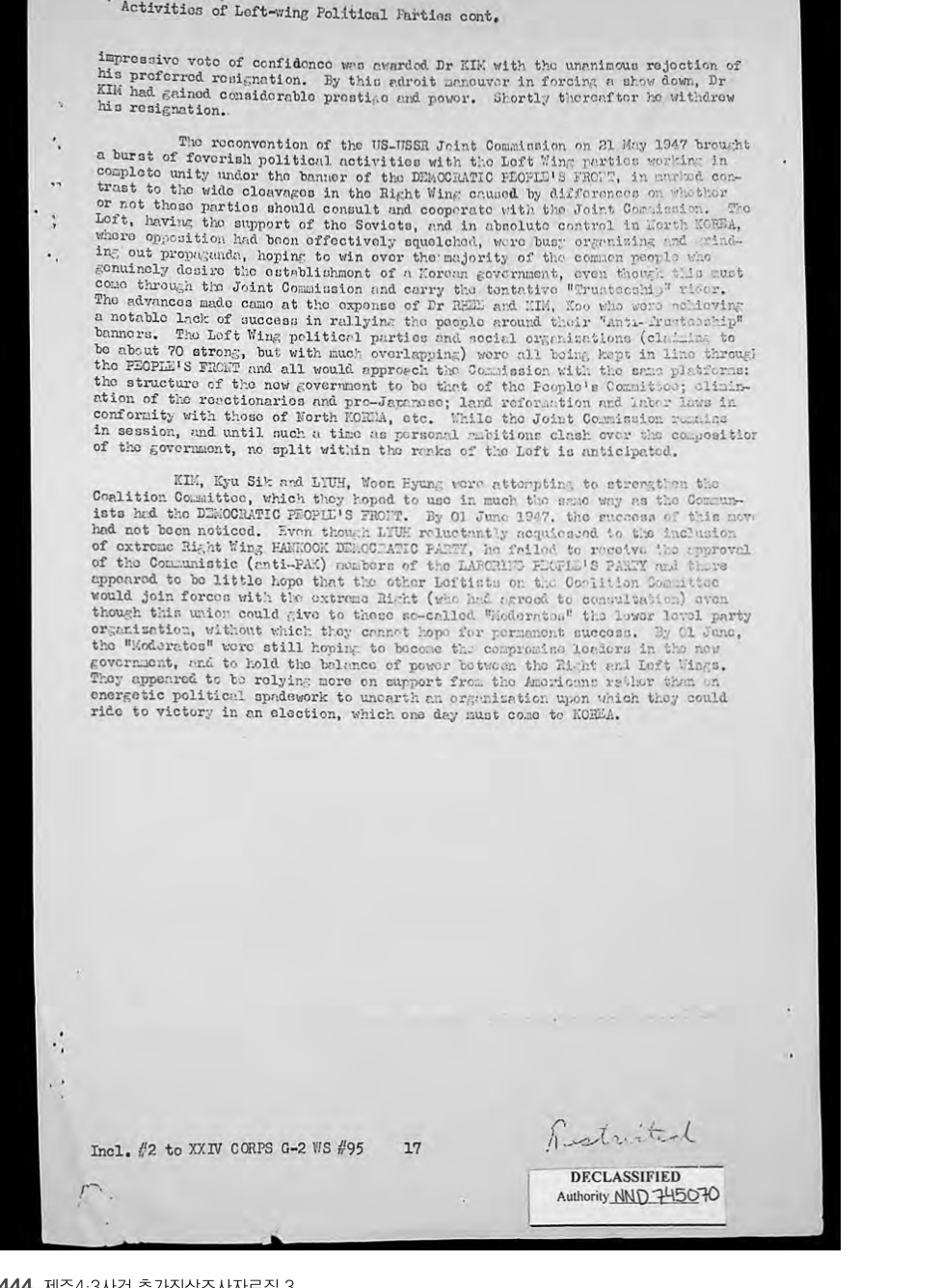
1947년 5월 21일 미소공동위원회 2차 회의에서는 미소공동위원회와 협의 및 협조해야 하는지 여부에 대한 의견이 분분하여 전반적으로 분열된 좌익과는 달리 민주주의민족전선이라는 기치 아래 똘똘 뭉친 좌파 정당들의 과열된 정치 활동이 대거 의제로 올라왔다. 소련의 지지와 북조선의 완전 통제를 받고 있는 좌파는 사 실상 반대 의견은 묵살하면서 대한민국의 정부 수립을 진정으로 원하는 대다수의 평범한 사람들을 자기편으로 끌어들이길 바라는 열망으로 바쁘게 선전을 조직하 고 만들어갔다. 비록 그 정부가 미소공동위원회를 거쳐야 하고 잠정적으로 "신탁 통치"에 편승해야 하지만 말이다. "반탁"이라는 현수막 주위로 사람들을 모으는 데 크게 실패한 이승만과 김구의 희생으로 약간의 진전이 있었다. 좌파 정당과 사회 단체(견고한 70%라고 주장하지만 겹치는 부분이 굉장히 많음)는 모두 민족전선 노선을 유지하고 있고 같은 플랫폼, 즉 인민위원회의 구조를 갖춘 새로운 정부의 구조, 반동분자와 친일파 제거, 토지 개혁, 북조선의 노동법을 따르는 노동법 등을 공유하는 위원회에 접근할 것이었다. 미소공동위원회가 회기 중이며 이 기간에 야심가들이 정부의 구성을 두고 언쟁을 벌일 때까지는 좌파 내부의 서열은 분열되지 않을 것으로 예상된다.
김규식과 여운형은 좌우합작위원회를 강화하려고 노력 중이며 민주주의민족전선에서 공산주의자들이 취한 것과 대부분 같은 방식을 사용하길 바라고 있다.
1947년 6월 1일 이러한 새로운 운동의 성공은 주목받지 못했다. 여운형은 마지못해 극우파인 한국민주당의 당내 편입을 묵인했지만 근로인민당의 공산주의 반박헌영파의 승인을 받는 데는 실패했다. 이 같은 연대로 인해 소위 "온건파"에게 당의 하위직을 줄 수 있었다. 이마저 없다면 영원한 성공을 기대할 수 없는 상황임에도 좌우합작위원회의 다른 좌파들이 (협조에 동의한) 극우파들과 힘을 합치리란 희망은 거의 없는 것 같았다. 6월 1일까지 "온건파"는 여전히 새 정부에서 절충하는 지도자가 될 수 있고 좌우 간 힘의 균형을 유지할 수 있다는 희망을 품고 있었다. 이들은 선거를 승리로 이끌며 언젠가 대한민국이 될 조직을 발굴하기 위해 심혈을 기울여 정치 기반을 다지는 대신 미국의 지지를 얻는 데 더 의존하는 것처럼 보였다.
24군단 정보참모부 주간요약보고 No.951의 첨부문서 No.2
HEADQUARTERS XXIV CORPS
Office of the G-2
APO 235
[illegible]
SUBJECT: History of Left-Wing Korean Political Parties to 01 June 1947
The following report has been prepared by the Historical Section, A C of S, G-2, XXIV Corps. (NOTE: See attached chart: "History of Korean
Political Parties, 1919 - June 1947" for reference:
THE FIRST YEAR
The Korean Communist Movement
The story of the Korean Left Wing begins with the Communists. Information available as to the early days of the Communist movement in KOREA is meagre and confusing to say the least. Apparently the movement had its inception among members of the Korean community in the Russian city of IRKUTSK, located near Lake BAIKAL in south central SIBERIA. Here, early in 1920, a group of Korean Communists assembled. On the pretext that they had a sizable following within KOREA, the leaders of this IRKUTSK group allegedly hoodwinked the Third International out of some 40,000 yen for purposes of organizing a Korean Communist Party, and thereupon fled to SHANGHAI to enjoy their plunder. There, they joined forces with KIM, Chul Soo, CHO, Bong Am, CHOO, Chung, KIM and HAN, Wi Kim. (1)
Meanwhile, in KOREA, then under the relatively liberal rule of Admiral
MAKOTO SAITO, a so-called Laborers' Association was formed. Actually, membership was not drawn from the laboring classes, but, rather from communistically inclined professional groups in SEOUL. Membership was probably not more than 300. This was in January, 1920. In November of that same year, the ALL KOREAN YOUNG MEN'S UNION, likewise inspired by communist doctrines was organized by LEE, Yung and CHAWNG, Paik. The organization soon boasted a membership of 30,000, included in which was one PAK, Heun Yung, one day destined to become the leader of the Korean Communist Party. The nucleus of this nation-wide Union was the SEOUL CHUNG MYUN HWEI, or the SEOUL YOUNG
MEN'S ASSOCIATION, the only section to survive later police oppression.
In the meantime, the SHANGHAI group which had originally received official encouragement from the Comintern, began infiltrating into KOREA proper in the attempt to build up the popular following which it had previously assured the Comintern was already in existence. Likewise, the disgruntled group which was left in the lurch at IRKUTSK when the SHANGHAI-bound clique absconded with the Comintern funds also began migrating to KOREA. The local
Korean Communist movement was soon split in two rival camps, one supporting the SHANGHAI and the other, the IRKUTSK faction. This was the source of much of the early disunity within the Korean Communist movement, which later was reflected in personal squabbles among the leaders.
By 1924, following a new wave of Japanese oppression, PAK, Heun Yung and
HONG, Cheung Sik formed the SHIN SA SANG YUN KOO HWEI (Institute for Investigating New Ideas). By this time the original Laborers' and Young Mens'
Associations had pretty well disintegrated as a result of action on the part of the Japanese gendarmerie. There were then two chief opponents in Communist circles; PAK's new Institute, and the SEOUL YOUNG MEN'S ASSOCIATION, this last being the only portion of the original all-Korean Association remaining more or less intact. (Later, however, it died a lingering death under the leadership of LEE, Yawng and CHAWNG, Paik). Soon thereafter, PAK's new institute changed its name to HWA YO HWEI, or the "Tuesday Meeting"
communist group, but still remained under PAK's leadership.
By reason of the malodorous act of the SHANGHAI group in turning to their own private use part of the money donated to it by the Comintern, this faction ultimately fell into official disgrace. By 1924, most of its major
(1) Interview with SUL KOOK WHAN, staff reporter for KOREA PACIFIC PRESS, a leading Korean news agency, 27 January 1947. Mr. SUL has done commendable political research relative to KOREA and is believed to be reliable.
Incl. #2 to XXIV CORPS G-2 WS # 95 1
DECLASSIFIED
Authority NND 745670
Activities of Left-wing Korean Political Parties cont.
leaders --- at least KIM, Chul Soo, CHOO, Chawng Kun, and HAN, Wi Kun --had fallen in with the PAK's Tuesday group. PAK's leadership was forced on them because of the popular following he had gathered in KOREA. At about the same time, probably November 1924, a group of Korean Communists from JAPAN, known as the PUK PUNG HWEI (North Wind Association) under the leadership of KIM, Yak Soo and MA, Myung, arrived in KOREA. They also joined with PAK's group.
On 17 April 1945 the Korean Communist Party of KOREA was first officially organized. Leadership was divided between KIM, Tch'ei Bong who headed the main body of the organization and PAK, Heun Yung who took over the allimportant organizational section of the Party, and, in addition, direction of the YOUNG MEN'S COMMUNIST ASSOCIATION, a Korean counterpart of the Soviet
KOMSOMOL. Apparently, sometime before this took place, PAK had received official recognition from MOSCOW through BETCHINSKY, then head of the Far
Eastern division of the Comintern. KIM, Tan Ya, a rather shadowy figure, was allegedly dispatched to MOSCOW to represent the party in the Comintern, and supposedly, was still there as late as 1 January 1947, acting as the real power behind the Korean Communist Party. Soon thereafter, another faction of Korean Communists is said to have petitioned BETCHINSKY demanding a change in leadership. The petition, however, was denied. Possibly in contradiction to this, but not necessarily so, is the rumor reported by Eugene V.ROSTOV, political advisor to the American delegation on the Joint Soviet-American
Commission, that "in the early 1920's LENIN decided against lending support to the Korean Communists and instead aided Korean nationalists." During the early stages of STALIN's rule, according to the same source, RUSSIA abided by a secret agreement with JAPAN and abstained from encouraging Communists in KOREA. This support of nationalist groups would be well in line with later established Comintern policy. In the program of the Comintern, for example, is found this statement of principle:
The principal task in such countries [—]those with "feudal medieval relations and Asiatic mode of production relationships"/ is, on the one hand, to fight against feudalism and pro-capitalistic forms of exploitation and to develop systematically the peasant agrarian revolution; on the other hand, to fight against foreign imperialism and for national independence.
In any event, at this point in the movement, 1925, the Japanese police stepped into the picture and put a quietus on activities by arresting many of the Communist leaders and effectively breaking up the organization. A later attempt to reorganize the party met the same fate. PAK was imprisoned a short time, but finally regained his freedom and fled to the SOVIET
UNION. Apparently he remained there from 1927 until 1930, at the end of which time he returned to SHANGHAI, only to be rejailed by the Japanese for Communist activity. Ultimately, he was escorted back to KOREA under guard and finally released. This time he retired from active participation in politics and concealed his identity until 1945 under the guise of a common laborer and an assumed name, working the while in the Communist underground.//
During the twenty years intervening between the abortive 1925 effort to organize a Communist Party in KOREA and the liberation of KOREA, only one
Communist group of significance crept into prominence on the Korean scene.
This was known as the "MARX-LENIN", or more simply the "ML" Communist party.
Organized in 1935 by TCH'EI, Ik Han and KUN, Chun Yun, this group was but short lived. The leaders were arrested, and the organization broken up by the Japanese police.
On the evening of that August liberation day in 1945, two political groups were meeting in SEOUL. One was assisting LYUH, Woon Hyung in establishing his Preparatory Committee and the other was discussing the revival of the
Korean Communist Party. The first group consisted of LYUH who himself had visited the SOVIET UNION in 1921-22 with KIM, Kyu Sik, who had held a membership card in a Korean Communist group in SHANGHAI, and who was to become a persona grata in North KOREA during the first year of the occupation. Also
Incl. #2 to XXIV CORPS G-2 WS #95 2
DECLASSIFIED
Authority NND 745070
Activities of Left-wing Korean Political Parties cont. [illegible]
included were CHAWNG, Paik, HONG, Nam Pyo, AN, Ki Sung, HONG, Cherng Sik and HONG Tuk Yoo. The last two named were former members of PAK's Tuesday communist group. The second group consisted of TCH'EI, Ik Han, a former member of the MARX-LENIN group; and HA, Pil Won, KIM, Kwang Soo (brother of KIM, Chul Soo) and LEE, Yung, all one-time members of the SEOUL YOUNG MEN'S ASSOCIATION. When the groups became known to each other, a merger was quickly effected, and two days later, on 17 August, all but LYUH and HONG, Tuk Yoo joined to form the CHANG AN PA, or SEOUL Communist Party. This group is considered to have been at the time of its inception a nationalist faction willing to compromise with the right wing for the promotion of Korean independence.
However, likewise on August 17, PAK showed up in SEOUL, having been most recently employed as a bricklayer in KWANGJU, Cholla-nando. With him he carried a list of members of the old 1925 Communist Party and of the underground, plans for reorganizing the Party, and the most important of all, the latest instructions from MOSCOW. Suffice to say that within a short time, by 28 August to be exact, the bulk of the local communists fell in with his leadership and organized the CHAI KUN PA, or the Rehabilitation Communist Party. This was a much more radical and pro-Soviet organization than its momentary rival, the CHANG AN PA. By November 1945 the last of the dissenting members of the rival group had been forced to join with PAK's forces, but the source for future friction within the party remained, as was made obvious by efforts continued throughout the first year of occupation by KIM, Chul Soo and CHO, Bong Am, former leaders of the old SHANGHAI faction, to challenge PAK's leadership of the Party. PAK's control was so severely shaken at one time that he was forced to repair to PYONG-YANG in North KOREA for new instructions.
Korean People's Republic
As World War II ended, the Japanese authorities in KOREA were hard pressed to maintain law and order and to protect the safety of their own persons. Moreover, they wished to find a government acceptable to the Russians whom they believed would occupy [illegible]. The aid of Korean leaders was enlisted with the hope that some im[illegible] Korean government could be set up. Sometime shortly before the coc[illegible] fire order was given ending hostilities in the Pacific, the Japanese Governor General ABE asked SONG, Chin Oo, later the leader of the extreme Right Wing HANKOOK DEMOCRATIC PARTY, to form such a government. SONG refused, and the same request was put to KIM, Chun Yun, early leader of the moderate "ML" Communist group and later associated with SONG, Chin Oo on the staff of the DONG A ILBO (Oriental Daily News) and in the ill-fated effort to achieve political coalition between Right and Left by means of the Preparatory Committee for the National Congress (KOOK MIN JUN CHEI TAK WHEI JUN BI WHEI) in August, 1945. Again a refusal was encountered. Finally, on the evening of 14 August, the Governor General requested LYUH, Woon Hyung to see him.
LYUH was informed by ABE that the Japanese were going to surrender the following day, and was requested to form an organization to aid in the maintenance of law and order. Supposedly the Japanese placed a considerable sum of money at LYUH's disposal. LYUH accepted the offer under five conditions: (1) that food for the coming three months would be guaranteed; (2) that political prisoners would be released; (3) that freedom of the press and speech would be guaranteed; (4) that there would be no mobilization of the students for the maintenance of peace; and (5) that there would be no interference from the Japanese. G-2 commented at the time that "apparently, LYUH, with these conditions, had the best intentions of sidetracking the Japanese". The Japanese, under the circumstances, had little choice except to agree to the conditions.
That same day, 14 August, LYUH and his younger brother, LYUH, Woon Hong, drew up a tentative organization which included SONG, Chin Oo and other leaders who were far from the extreme Left. However, the next day, the 15th, LYUH the [illegible]der was called before ENDO, the Vice-Governor, and told that the Americans would occupy merely the PUSAN and MOKPO areas. Thereupon, LYUH revised his organization so as to include only Communists and Communist sympathizers, men whom he regarded as acceptable to the Russians. However,
DECLASSIFIED
Authority NND 74503D
Incl. #2 to XXIV CORPS G-2 WS #95 3
[illegible]
[illegible]
Activities of Left-wing Korean Political Parties cont.
AN, Chai Hong, considered to be a moderate Rightist in political conviction, was invited to participate in the organizational hierarchy.
This organization, first called the Preparatory Committee for Korean
Rehabilitation (CHOSUN KEUN KOOK CHUN BI WAI WON HWEI), quickly assumed governmental functions not envisioned by the Japanese offer. In midAugust, this group adopted the following sweeping resolutions as to its
objectives:
1. To establish an autonomous and independent state both
politically and economically.
2. To demolish imperialism and residuary feudplistic influences in our state and to be faithful to the principles and ideals of democracy which must materialize the basic political, economic, and social needs of our nation.
3. To secure the rapid elevation in the living standards of the laborers, the peasants, and the masses.
4. To establish world peace through our cooperation as a member of the democratic countries of the world.
Meanwhile, the Japanese learned that Southern KOREA would be occupied by the UNITED STATES and not by the SOVIET UNION. As the days went by without the arrival of American forces, the heads of the Japanese GovernmentGeneral overcame the shock received from the news of the unconditional surrender and realized that LYUH had no intention of following their dictates.
They were also under pressure from the Japanese military to disown LYUH's
Preparatory Committee. To reduce the power remaining in the Committee, the
Japanese Government General took the peculiarly Japanese method of changing its name to the Public Safety Committee (CHIAN DAI). Meanwhile, the Japanese military endeavored to prevent LYUH's committee from exercising even police powers. The Japanese added some three thousand soldiers to the regular police force, transforming them to a civil status overnight, and attempted to discredit the CHIAN DAI.
LYUH was not, however, to be suppressed. The Japanese had created a
Frankensteinian monster which they were unable to control. When the
American occupation was announced, LYUH grasped the American privilege of free political endeavor, and on 6 September, two days before the American landing at INCHON, did in effect constitute his group not only as a political party but as a government, the "Korean People's Republic". The presidency and vice-presidency were offered to the as yet absent Dr. RHEE Syng Man and
KIM, Koo respectively, but neither would accept. Later, on 10 January
1946, both were "expelled" from the offices which they never had accepted.
LYUH, Huh, HUN, and LEE, Kang Kook were the predominant figures throughout, although LYUH ceased active participation in the Republic in November 1945 when he commenced organizing his PEOPLE'S PARTY. As to the nature of the
Republic, one observer commented, "The People's Republic, on its lower levels of organization, grew in part spontaneously, in part under Japanese direction, in part under frankly Communist control, and in part under Conservative auspices. It must not be forgotten that in many places the new groups moved into a virtual governmental vacuum. Previously-existing social or revolutionary committees, or Farmers' organizations, moved in full into the functions of local government, and became units of the People's Republic."
He pointed out that this was all done according to the "transmission belt"
principle of Communist operation involving the "infiltration by trained communist agents into larger groups, whose members do not agree with all the party principles, but who can be induced to go along on a lesser program of common objectives, to be extended when possible." The People's Republic remained, in theory, non-partisan and set itself up as the de facto government, a fact which was soon to bring it into sharp conflict with American
Military Government.
The first episode in contact which the American Command had with this erstwhile government, the Korean People's Republic, occured when its represent-
Incl. #2 to XXIV CORPS G-2 WS # 95 4 Restricted
DECLASSIFIED
Authority NND 745070
Activities of Left-wing Korean Political Parties cont.
atives (calling themselves the "Provisional Korean Commission, 1945") presented themselves at XXIV Corps Headquarters aboard the AGC CATOCTIN on 8 September 1945. It was learned by the Americans that the organization was composed of 135 separate committees throughout KOREA and had, as its objective, the organization of a democratic form of government for the Korean people. The representatives were to have been PAIK, Sang Kyu, CHO, Han Yong, and LYUH, Woon Hyung. LYUH, however, was replaced by his younger brother, LYUH, Woon Hong, when the delegation boarded the CATOCTIN.
General HODGE was advised not to see these men himself, both because of the fact that they were allegedly supported by the Japanese, and because it was considered unwise to give even the slightest possible appearance of favoring any political group. These men did talk with members of the Corps staff, however, and gave from memory a list of Koreans who could be depended upon and another list of those who were said to be collaborationists. They asked about the American point of view toward the various exiled governments, assured the staff of their full recognition of the UNITED STATES MILITARY GOVERNMENT, and offered their own services in a liaison capacity between that government and the Korean people. They showed some concern over the division of KOREA at the 38th parallel, about currency and inflation, about the discipline of American troops, and about the food situation, and were also most emphatic in expressing their belief that all Japanese should be evacuated from KOREA.
By the middle of September 1945, the People's Republic had organized many subsidiary groups throughout the provinces. Typical was one called the "Student Public Peace Body" composed of radical students, thugs, and criminals, armed so far as possible. It was believed by the more law abiding Koreans that no permanent peaceful settlement of KOREA's political problems could be effected until these pseudo-political public safety organizations were disbanded. Their fears appear to have been well founded, for when one of the Republic's subsidiary branches in PUSAN, was disbanded on 28 September, some 257 rifles, 14 pistols, and 3 shotguns were found. Many other instances of the assumption of governmental functions by unauthorized groups connected in some way with the People's Republic could be cited, the most flagrant examples of which occurred in the provincial governments.
The American Command replied to this challenge of the People's Republic through the medium of the press. On 10 October 1945, General ARNOLD issued the following statement:
TO THE PRESS OF KOREA:
What I say and hand you today must be given a prominent place in the front page of every newspaper. This is a request with the force of an order.
The liberation of KOREA from the heel of JAPAN is of course an occasion for celebrations, for demonstrations and speechmaking. Freedom of speech and freedom of press having been given to the Koreans, it is to be expected that many foolish and inconsiderate statements will appear in the newspapers under amateur editorship. So long as peace and order are not endangered, and so long as disorder is not fostered and no attempt is made to interfere with the orderly administration of the government, such boyishness even by old men will be allowed to evaporate as smoke in the air.
There is only one Government in KOREA south of 38 degrees north latitude. It is the government created in accordance with the proclamations of General MACARTHUR, the General Orders of Lieutenant General HODGE and the Civil Administration orders of the Military Governor. It is an organization made up
Incl. #2 to XXIV CORPS G-2 WS #95 5
DECLASSIFIED
Authority NND 745010
[illegible] Restricted
Activities of Left-wing Political Parties cont.
of carefully selected Koreans working under the Military Governor and his officers. It has exclusive control and authority in every phase of government. Self-appointed "officials",
"police" groups, big (or little) conferences
"representing all the people"; the (self styled) government of the Republic of KOREA, are entirely without any authority, power or reality
...
A fraud on the people of KOREA has been recently publicized in the free press, namely the calling of fictitious' election on the first of
March", 1946, at which it is promised "all men and women over the age of eighteen, except for traitors, will have the right to vote"... For any man or group to call an election as proposed is the most serious interference with
Military Government, an act of open opposition to Military Government and the lawful authority of the Government of KOREA under Military Government.
By way of an answer, the People's Republic published during the third week in October and distributed in SEOUL a pamphlet entitled "The Traitors and the Patriots." The pamphlet "exposed" the alleged pro-Japanese, antiAmericans Koreans, who were acting as advisors to the Military Government by quoting from statements they may or may not have made against the
Americans during the Japanese rule of KGEA. Then again, on 20 October 1945 the People's Republic distributed "A Message to U.S.A. Citizens", which begged the people of the UNITED STATES to understand that those, like themselves, who had remained in KOREA in the underground resistance during the
Japanese regime and had organized themselves after the Japanese surrender, represented the real will of the Korean people. It would be the "tragedy of the century" if Military Government should oppose the will of this government of the Korean people, wrote the spokesman for the Republic.
One other event which may have mitigated against smooth relations with the People's Republic was a statement made by the members of the American press. This occurred in an informal talk between Mr. Robert H. MYERS of the Associated Press, Mr. Gordon WALKER of the CHRISTIAN SCIENCE MONITOR, and the Central People's Committee of the Korean People's Republic. These journalists acknowledged that the conservative HANKOOK DEMOCRATIC PARTY had the ear of General ARNOLD, but added, "The Military Government is not all of the U.S.A." This undoubtedly created the feeling that there was more sympathy for the Republic among Americans than was being shown by the
Military Government and may have encouraged the Republic in its resistance.
That the People's Republic was a potent force at the time cannot be doubted. After an extensive visit to the rural areas, a Military Advisor and a former resident of KOREA, Dr. H. H. UNDERWOOD, stated that the
Republic was the strongest and most active organization throughout the
South. By comparison, the HANKOOK DEMOCRATIC PARTY was "poorly organized or unorganized in most places", and seemed to have nothing as attractive to offer as free land to the farmer and management of their own factories to the workers. An observer from Military Government corroborated the views of Dr. UNDERWOOD after a trip through the provinces in December 1945. He reported that the strength of the Republic was growing, that it was organized into a government at all levels, and that no other party was given an opportunity to coexist with it. Without Military Government intervention, it was clear that no other parties would be allowed to flourish.
Although the People's Republic under the leadership of LYUH stopped short of open revolt, it continuously tended to be critical and troublesome.
It defied Military Government's wishes by insisting that it would hold national elections on 1 March 1946, by devoting itself to self-expression rather than union with other political groups, and finally, by refusing at
DECLASSIFIED
Authority NND 745870
Incl. #2 to XXIV CORP G-2 WS #95 6 [illegible]
Activities of Left-wing Political Parties cont.
the end of a three-day meeting on 20 - 23 November 1945 to drop the word "KOOK" (republic or government) from its name. This last was an immediate act of defiance difficult to ignore, since Militatry Government had specifically requested that the name be changed to avoid misunderstandings which had arisen about the Republic's status. The leaders had assured Military Government that the name would be so changed. General [illegible] himself went to the meeting and delivered a brief speech stressing the need for cooperation and order during the following critical months. He pointed out that any possible material aid from Allied sources depended in a large measure upon how the people of KOREA conducted themselves.
Even though the speech was apparently well received, subsequent events showed that the majority was not convinced. In the resolution of gratitude which was passed by the meeting for transmission to each of the Allies, the offending word "KOOK" was used. Furthermore, on the final day, younger and more radical elements ran away with the meeting and shouted down those who wished to comply with the request that the name be changed. In spite of this independent attitude, the Republic did, at this same meeting, publicly resolve to cooperate fully with the American Command until such time as the government would be turned over to the people. Giving more point to the situation was the fact that, immediately after this defiant meeting of the People's Republic, KIM, Koo returned to KOREA bringing with him several members of the self-styled Provisional Government. This meant for the Republic that the "chips were down". It had no choice but to outdo its rival pseudo-government, amalgamate with it, or disappear into the oblivion of history.
Adding to the complexities of the situation at the time was the fact that just prior to the three-day meeting, LYUH, Woon Hyung, the acting head of the People's Republic and the very man who had carried Military Government's request for a change of name to the central committee, suddenly bolted to form on 12 November 1945 what was thought at first to be a more tractable middle-of-the-road party called the KOREAN PEOPLE'S PARTY. With LYUH went many of the members of the parent organization, leaving HUH, Hun, LYUH's old running mate, and PAK, Heun Iung, the Communist Party leaders, as the leading figures connected with the Republic. This was the third blow which presaged the final oblivion of the "Republic". The first two had been the refusal on the part of the American Command to recognize the Republic as a government and General ARNOLD's press attack on the Republic on 10 October. The fourth blow was a hard-hitting statement issued by General HODGE on 12 December specifically denouncing the "Republic" and reviewing a long list of broken promises and obstructionist acts. It appears in part below.
"It is after careful thought and deliberation that I make this announcement to the Korean people. This announcement is necessary to prevent continued misunderstandings and delays in KOREA's progress toward stability and independence....
Before the arrival of my forces in KOREA there was SOERUN here an organization known as the CHOSEN IN MIN KONG HWA KOOK (Korean People's Republic). The name connoted, and its actions indicated, that this organization was set up to be a government rather than a political party and its leaders spread the word to the Korean people that it was their new government. This has caused many misunderstandings among the people..... However, because of misunderstandings arising from the name and actions of the Korean People's Republic, some groups operating under its banner have defied and opposed both openly and secretly the efforts of the Military Government of KOREA, caused serious delays in establishing economic stability of your country and actually delayed progress toward Korean independence which we all so greatly desire....
At the end of the convention (20 -22 Nov.) I was greatly surprised and disappointed to find that although they agreed in
Incl. #2 to XXIV CORPS G-2 WS #95 7
DECLASSIFIED
Authority NND 745070
Restricted
Activities of the Left-wing Political Parties cont.
words to cooperate with and aid the Military Government of KOREA, the leaders and representatives had in some ways used the convention to aggrandize themselves further as a Korean government, had intimated that the Military
Government is aiding and abetting their organization in its attempted activities as a government, and had left considerable confusion in the minds of Koreans everywhere.
In other words they failed to keep their promise to me that the situation would be completely clarified.
Because of this failure after my long patience I feel it necessary to the public understanding to announce that, regardless of what it calls itself, the Korean People's
Republic is not in any sense a "government", and is not authorized to act in any capacity as such. The only functioning government in Southern KOREA is the Military
Government of KOREA....
Therefore, in order to eliminate further misunderstandings and cloaked disorders, I have today directed my occupation forces and the Military Government of KOREA that the activities of any political organization in any attempted operations as a government are to be treated as unlawful activities, and that necessary steps will be taken at once to insure that no political organization operates in any way as a government in any portion of the American occupied area without specific authority of the Allied Powers...."
Although the KOREAN DEMOCRATIC PARTY, the Republic's arch enemy, thought the statement hardly strong enough, the reaction of the People's Republic was immediate and vigorous. An American political observer described it
as follows:
The Republic deliberated furiously all night and half the
next day and finally released a hard-hitting rebuttal. The main points were: (1) That present confusion and misunderstandings are due to the slanderous advice of pro-Japanese traitors; (2) that the change in name was promised only as an item for discussion at the National Assembly and the body voted against it; (3) that after the meeting, President HUH, Hun agreed to all the points of a letter sent to him by
General HODGE except the proposal to refrain from using the word "KOOK"; (4) that the so-called 'Provisional Government'
is tacitly permitted to refer to itself as such, and even to hold "cabinet meetings"; (5) that such an attitude by military Government may be subjectively consistent, but that objectively it confuses the public.
However, the influence and prestige of the Republic was already waning.
The defection of LYUH and the more moderate Leftists made it impossible for the Republic to maintain its popular appeal. Leadership of the Left shifted temporarily to LYUH and his PEOPLE'S PARTY and to a new Left wing catch-all, the DEMOCRATIC PEOPLE'S FRONT.
Pak versus Lyuh
On 12 November 1945 the leftist PEOPLE'S PARTY was launched by LYUH, Woon
Hyung, a party which, it was hoped, would include within its membership most of the members of the People's Committees which were acting as local governmental units under the "Republic". It has been pointed out as a possibility the the PEOPLE'S PARTY was "designed to provide the intermediate transmission wheel by which the whole machinery of the People's Republic would be controled, since it was believed that most members of the committees could be induced to join the People's Party, and would thereby be led into a minimum program of Communist collaboration." Whether or not this was the conscious reason for the organization of the "Republic" and the PEOPLE'S PARTY is open to question. However, that the Communists attempted to turn these organizatio
DECLASSIFIED
Authority NND 745070
Incl. #2 to XXIV CORPS G-2 WS #95 8
Restricted
Activities of the Left-wing Political Parties cont.
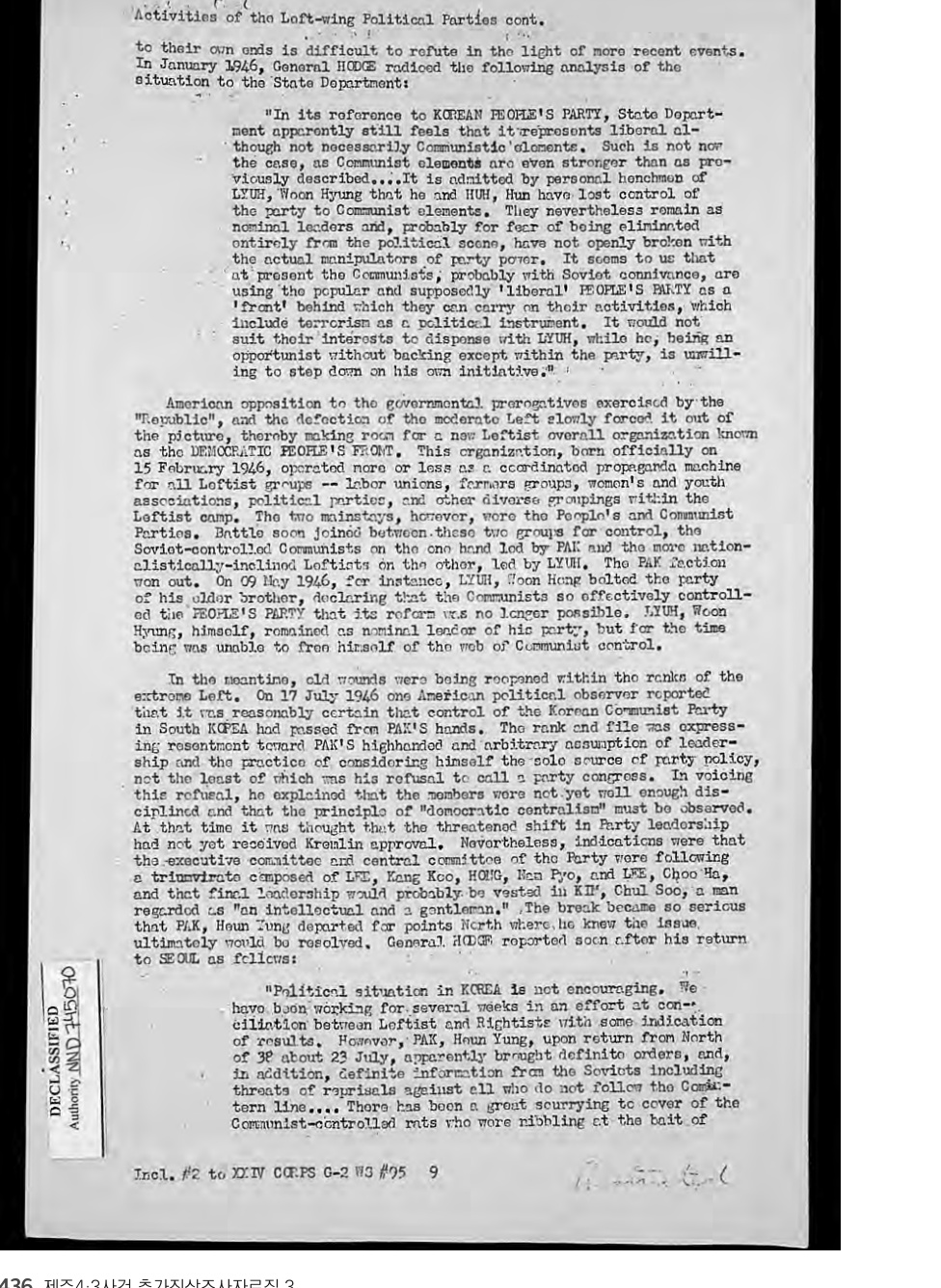
to their own ends is difficult to refute in the light of more recent events.
In January 1946, General HODGE radioed the following analysis of the situation to the State Department:
"In its reference to KOREAN PEOPLE'S PARTY, State Department apparently still feels that it represents liberal elements, though not necessarily Communistic elements. Such is not now the case, as Communist elements are even stronger than as previously described....It is admitted by personal henchmen of
LYUH, Woon Hyung that he and HUH, Hun have lost control of the party to Communist elements. They nevertheless remain as nominal leaders and, probably for fear of being eliminated entirely from the political scene, have not openly broken with the actual manipulators of party power. It seems to us that at present the Communists, probably with Soviet connivance, are using the popular and supposedly 'liberal' PEOPLE'S PARTY as a
'front' behind which they can carry on their activities, which include terrorism as a political instrument. It would not suit their interests to dispense with LYUH, while he, being an opportunist without backing except within the party, is unwilling to step down on his own initiative."
American opposition to the governmental prerogatives exercised by the
"Republic", and the defection of the moderate Left slowly forced it out of the picture, thereby making room for a new Leftist overall organization known as the DEMOCRATIC PEOPLE'S FRONT. This organization, born officially on
15 February 1946, operated more or less as a coordinated propaganda machine for all Leftist groups -- labor unions, farmers groups, women's and youth associations, political parties, and other diverse groupings within the
Leftist camp. The two mainstays, however, were the People's and Communist
Parties. Battle soon joined between these two groups for control, the
Soviet-controlled Communists on the one hand led by PAK and the more nationalistically-inclined Leftists on the other, led by LYUH. The PAK faction won out. On 09 May 1946, for instance, LYUH, Woon Hong bolted the party of his older brother, declaring that the Communists so effectively controlled the PEOPLE'S PARTY that its reform was no longer possible. LYUH, Woon
Hyung, himself, remained as nominal leader of his party, but for the time being was unable to free himself of the web of Communist control.
In the meantime, old wounds were being reopened within the ranks of the extreme Left. On 17 July 1946 one American political observer reported that it was reasonably certain that control of the Korean Communist Party in South KOREA had passed from PAK'S hands. The rank and file was expressing resentment toward PAK'S highhanded and arbitrary assumption of leadership and the practice of considering himself the sole source of party policy, not the least of which was his refusal to call a party congress. In voicing this refusal, he explained that the members were not yet well enough disciplined and that the principle of "democratic centralism" must be observed.
At that time it was thought that the threatened shift in Party leadership had not yet received Kremlin approval. Nevertheless, indications were that the executive committee and central committee of the Party were following a triumvirate composed of LEE, Kang Koo, HONG, Nam Pyo, and LEE, Choo Ha, and that final leadership would probably be vested in KIM, Chul Soo, a man regarded as "an intellectual and a gentleman." The break became so serious that PAK, Heun Yung departed for points North where he knew the issue, ultimately would be resolved. General HODGE reported soon after his return to SEOUL as follows:
"Political situation in KOREA is not encouraging. We have been working for several weeks in an effort at conciliation between Leftist and Rightists with some indication of results. However, PAK, Heun Yung, upon return from North of 38 about 23 July, apparently brought definite orders, and, in addition, definite information from the Soviets including threats of reprisals against all who do not follow the Comutern line.... There has been a great scurrying to cover of the
Communist-controlled rats who were nibbling at the bait of
Incl. #2 to XXIV CORPS G-2 WS #95 9
DECLASSIFIED
Authority NND 745010
[illegible] [illegible]
Activities of the Left-wing Political Parties cont.
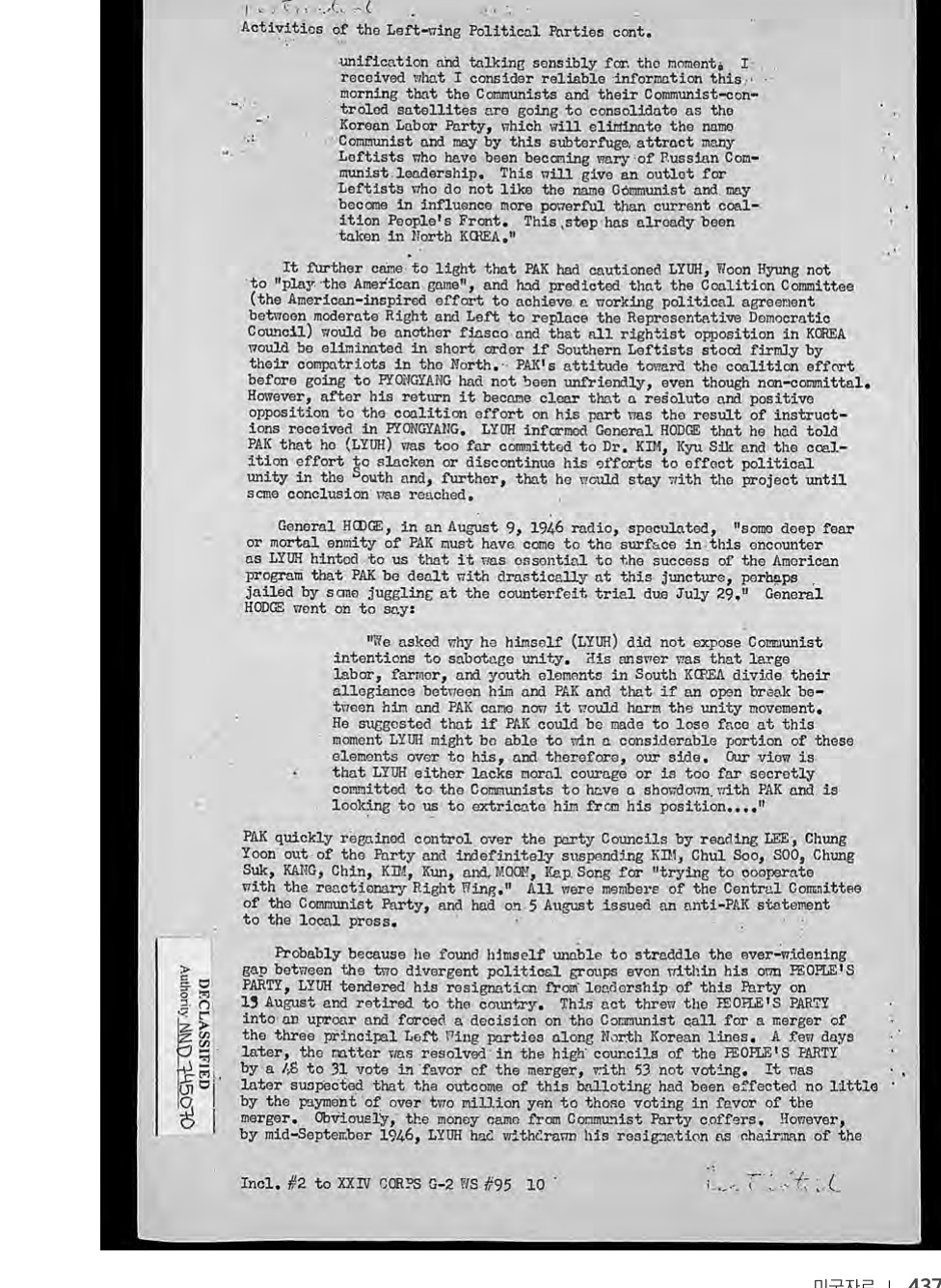
unification and talking sensibly for the moment. I received what I consider reliable information this morning that the Communists and their Communist-controled satellites are going to consolidate as the
Korean Labor Party, which will eliminate the name
Communist and may by this subterfuge attract many
Leftists who have been becoming wary of Russian Communist leadership. This will give an outlet for
Leftists who do not like the name Communist and may become in influence more powerful than current coalition People's Front. This step has already been taken in North KOREA."
It further came to light that PAK had cautioned LYUH, Woon Hyung not to "play the American game", and had predicted that the Coalition Committee
(the American-inspired effort to achieve a working political agreement between moderate Right and Left to replace the Representative Democratic
Council) would be another fiasco and that all rightist opposition in KOREA would be eliminated in short order if Southern Leftists stood firmly by their compatriots in the North. PAK's attitude toward the coalition effort before going to PYONGYANG had not been unfriendly, even though non-committal.
However, after his return it became clear that a resolute and positive opposition to the coalition effort on his part was the result of instructions received in PYONGYANG. LYUH informed General HODGE that he had told
PAK that he (LYUH) was too far committed to Dr. KIM, Kyu Sik and the coalition effort to slacken or discontinue his efforts to effect political unity in the South and, further, that he would stay with the project until some conclusion was reached.
General HODGE, in an August 9, 1946 radio, speculated, "some deep fear or mortal enmity of PAK must have come to the surface in this encounter as LYUH hinted to us that it was essential to the success of the American program that PAK be dealt with drastically at this juncture, perhaps jailed by some juggling at the counterfeit trial due July 29." General
HODGE went on to say:
"We asked why he himself (LYUH) did not expose Communist intentions to sabotage unity. His answer was that large labor, farmer, and youth elements in South KOREA divide their allegiance between him and PAK and that if an open break between him and PAK came now it would harm the unity movement.
He suggested that if PAK could be made to lose face at this moment LYUH might be able to win a considerable portion of these elements over to his, and therefore, our side. Our view is that LYUH either lacks moral courage or is too far secretly committed to the Communists to have a showdown with PAK and is looking to us to extricate him from his position...."
PAK quickly regained control over the party Councils by reading LEE, Chung
Yoon out of the Party and indefinitely suspending KIM, Chul Soo, SOO, Chung
Suk, KANG, Chin, KIM, Kun, and MOON, Kap Song for "trying to cooperate with the reactionary Right Wing." All were members of the Central Committee of the Communist Party, and had on 5 August issued an anti-PAK statement to the local press.
Probably because he found himself unable to straddle the ever-widening gap between the two divergent political groups even within his own PEOPLE'S
PARTY, LYUH tendered his resignation from leadership of this Party on
15 August and retired to the country. This act threw the PEOPLE'S PARTY into an uproar and forced a decision on the Communist call for a merger of the three principal Left Wing parties along North Korean lines. A few days later, the matter was resolved in the high councils of the PEOPLE'S PARTY by a 48 to 31 vote in favor of the merger, with 53 not voting. It was later suspected that the outcome of this balloting had been effected no little by the payment of over two million yen to those voting in favor of the merger. Obviously, the money came from Communist Party coffers. However, by mid-September 1946, LYUH had withdrawn his resignation as chairman of the
Incl. #2 to XXIV CORPS G-2 WS #95 10
DECLASSIFIED
Authority NND [illegible]
[illegible]
Activities of the Left-wing Political Parties cont.
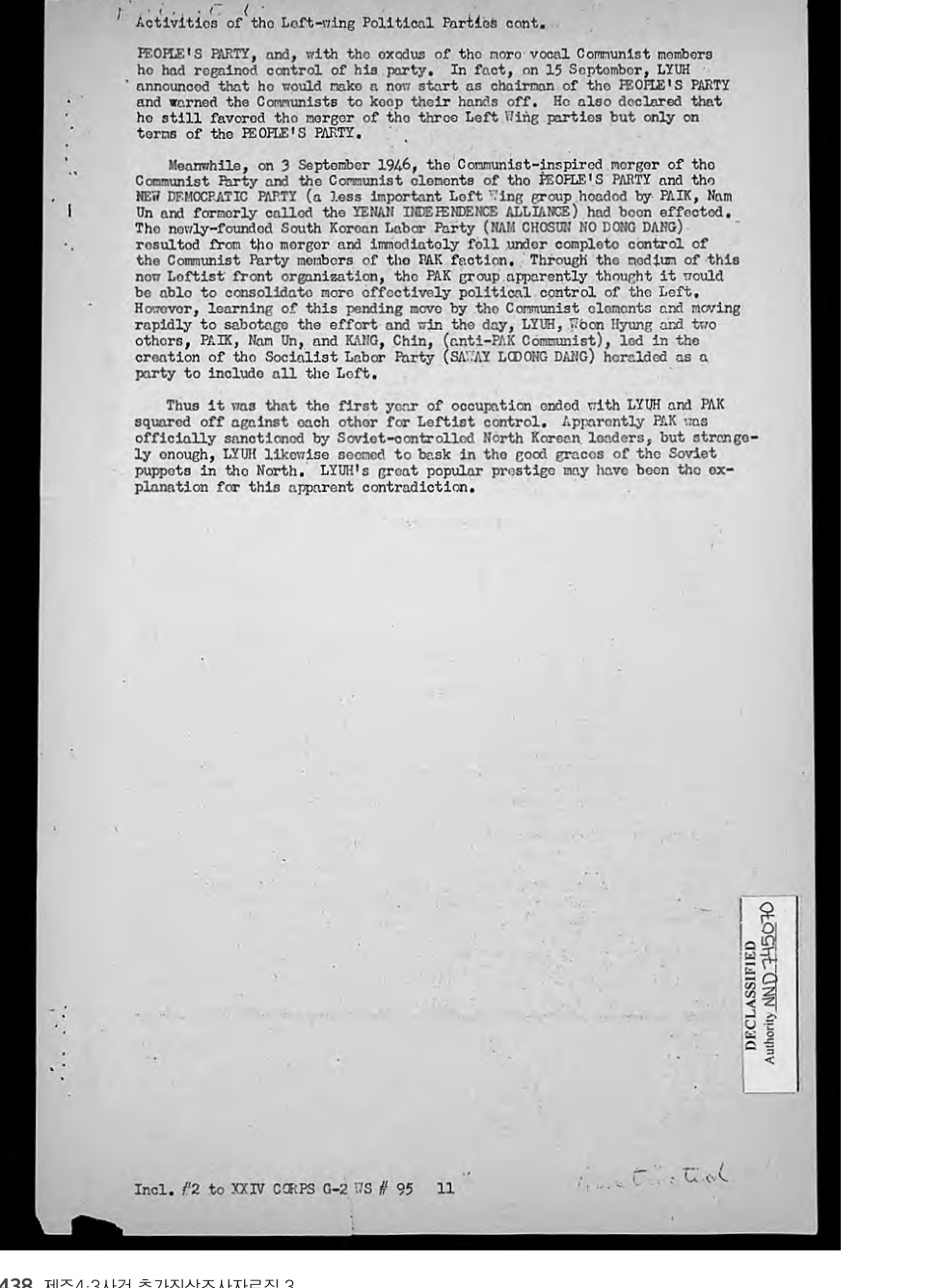
PEOPLE'S PARTY, and, with the exodus of the more vocal Communist members he had regained control of his party. In fact, on 15 September, LYUH announced that he would make a new start as chairman of the PEOPLE'S PARTY and warned the Communists to keep their hands off. He also declared that he still favored the merger of the three Left Wing parties but only on terms of the PEOPLE'S PARTY.
Meanwhile, on 3 September 1946, the Communist-inspired merger of the
Communist Party and the Communist elements of the PEOPLE'S PARTY and the
NEW DEMOCRATIC PARTY (a less important Left Wing group headed by PAIK, Nam
Un and formerly called the YENAN INDEPENDENCE ALLIANCE) had been effected.
The newly-founded South Korean Labor Party (NAM CHOSUN NO DONG DANG)
resulted from the merger and immediately fell under complete control of the Communist Party members of the PAK faction. Through the medium of this new Leftist front organization, the PAK group apparently thought it would be able to consolidate more effectively political control of the Left.
However, learning of this pending move by the Communist elements and moving rapidly to sabotage the effort and win the day, LYUH, Woon Hyung and two others, PAIK, Nam Un, and KANG, Chin, (anti-PAK Communist), led in the creation of the Socialist Labor Party (SAMAY LODONG DANG) heralded as a party to include all the Left.
Thus it was that the first year of occupation ended with LYUH and PAK squared off against each other for Leftist control. Apparently PAK was officially sanctioned by Soviet-controlled North Korean leaders, but strangely enough, LYUH likewise seemed to bask in the good graces of the Soviet puppets in the North. LYUH's great popular prestige may have been the explanation for this apparent contradiction.
DECLASSIFIED
Authority NND 745070
Incl. #2 to XXIV CORPS G-2 WS # 95 11 [illegible]
Activities of Left-wing Political Parties cont.
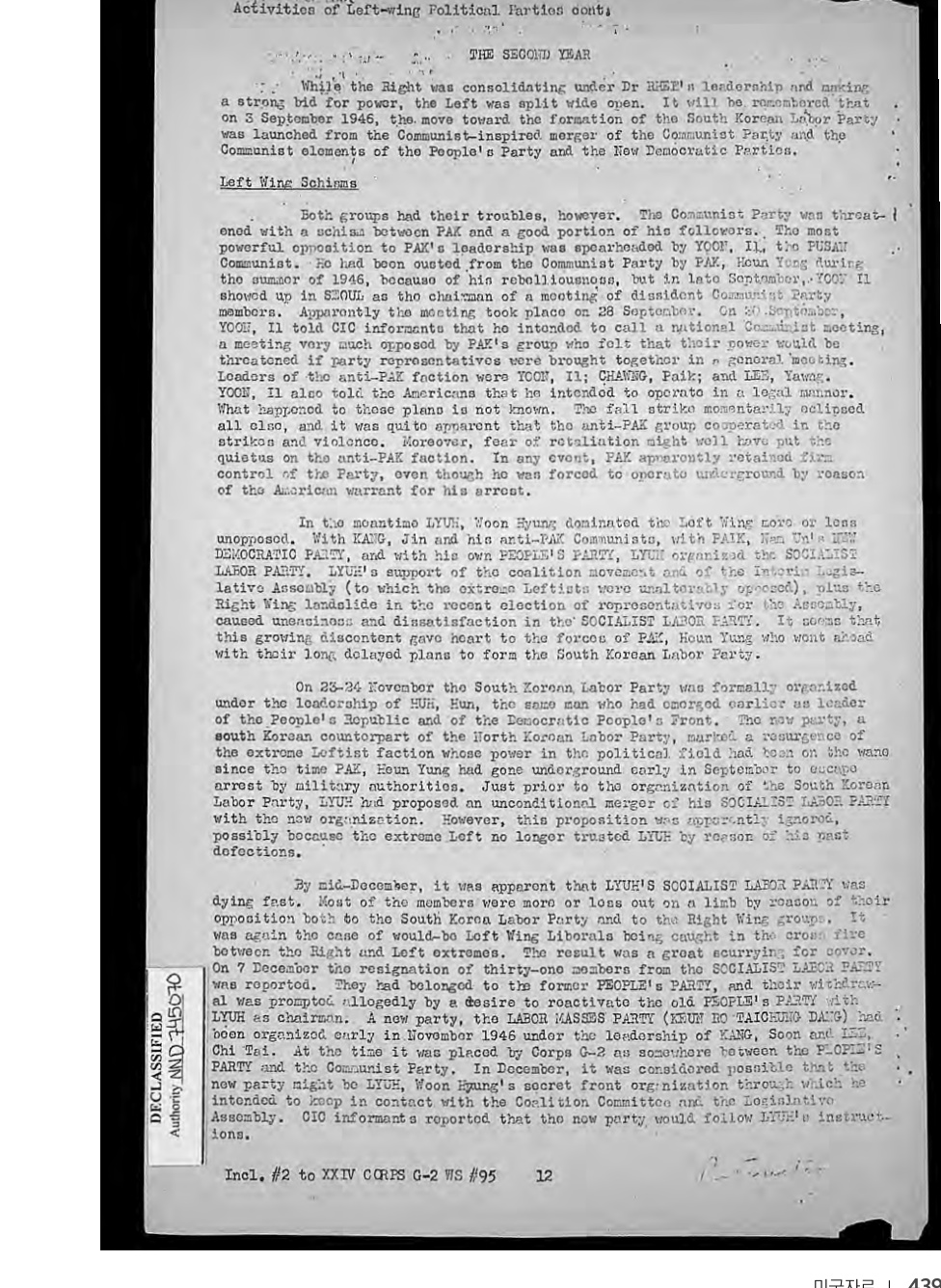
THE SECOND YEAR
While the Right was consolidating under Dr RHEE's leadership and making a strong bid for power, the Left was split wide open. It will be remembered that on 3 September 1946, the move toward the formation of the South Korean Labor Party was launched from the Communist-inspired merger of the Communist Party and the Communist elements of the People's Party and the New Democratic Parties.
Left Wing Schisms
Both groups had their troubles, however. The Communist Party was threat- ened with a schism between PAK and a good portion of his followers. The most powerful opposition to PAK's leadership was spearheaded by YOON, Il, the PUSAN Communist. He had been ousted from the Communist Party by PAK, Houn Yong during the summer of 1946, because of his rebelliousness, but in late September, YOON Il showed up in SEOUL as the chairman of a meeting of dissident Communist Party members. Apparently the meeting took place on 28 September. On 30 September, YOON, Il told CIC informants that he intended to call a national Communist meeting, a meeting very much opposed by PAK's group who felt that their power would be threatened if party representatives were brought together in a general meeting. Leaders of the anti-PAK faction were YOON, Il; CHAWNG, Paik; and LEE, Yawng. YOON, Il also told the Americans that he intended to operate in a legal manner. What happened to these plans is not known. The fall strike momentarily eclipsed all else, and it was quite apparent that the anti-PAK group cooperated in the strikes and violence. Moreover, fear of retaliation might well have put the quietus on the anti-PAK faction. In any event, PAK apparently retained firm control of the Party, even though he was forced to operate underground by reason of the American warrant for his arrest.
In the meantime LYUH, Woon Hyung dominated the Left Wing more or less unopposed. With KANG, Jin and his anti-PAK Communists, with PAIK, Nam Un's NEW DEMOCRATIC PARTY, and with his own PEOPLE'S PARTY, LYUH organized the SOCIALIST LABOR PARTY. LYUH's support of the coalition movement and of the Interim Legislative Assembly (to which the extreme Leftists were unalterably opposed), plus the Right Wing landslide in the recent election of representatives for the Assembly, caused uneasiness and dissatisfaction in the SOCIALIST LABOR PARTY. It seems that this growing discontent gave heart to the forces of PAK, Houn Yung who went ahead with their long delayed plans to form the South Korean Labor Party.
On 23-24 November the South Korean Labor Party was formally organized under the leadership of HUH, Hun, the same man who had emerged earlier as leader of the People's Republic and of the Democratic People's Front. The new party, a south Korean counterpart of the North Korean Labor Party, marked a resurgence of the extreme Leftist faction whose power in the political field had been on the wane since the time PAK, Houn Yung had gone underground early in September to escape arrest by military authorities. Just prior to the organization of the South Korean Labor Party, LYUH had proposed an unconditional merger of his SOCIALIST LABOR PARTY with the new organization. However, this proposition was apparently ignored, possibly because the extreme Left no longer trusted LYUH by reason of his past defections.
By mid-December, it was apparent that LYUH'S SOCIALIST LABOR PARTY was dying fast. Most of the members were more or less out on a limb by reason of their opposition both to the South Korea Labor Party and to the Right Wing groups. It was again the case of would-be Left Wing Liberals being caught in the cross fire between the Right and Left extremes. The result was a great scurrying for cover. On 7 December the resignation of thirty-one members from the SOCIALIST LABOR PARTY was reported. They had belonged to the former PEOPLE's PARTY, and their withdrawal was prompted allegedly by a desire to reactivate the old PEOPLE's PARTY with LYUH as chairman. A new party, the LABOR MASSES PARTY (KEUN HO TAICHUNG DANG) had been organized early in November 1946 under the leadership of KANG, Soon and LEE, Chi Tai. At the time it was placed by Corps G-2 as somewhere between the PEOPLE'S PARTY and the Communist Party. In December, it was considered possible that the new party might be LYUH, Woon Hyung's secret front organization through which he intended to keep in contact with the Coalition Committee and the Legislative Assembly. CIC informants reported that the new party would follow LYUH's instructions.
DECLASSIFIED
Authority NND 745070
Incl. #2 to XXIV CORPS G-2 WS #95 12
Activities of Left-wing Political Parties cont.
At this point, on 22 December, still another organization was conceived. This time, it was the POPULAR ALLIANCE (MIN CHUNG DONG MING) which was destined to bring together in a cohesive group most of the leading moderate Right Wing liberals such as Dr KIM, Kyu Sik; MON, Soi Hoon; LEE, Soon Tak; KIM, Yak Soo; and CHANG, Chay Il. The POPULAR ALLIANCE was organized around the ex-members and more moderate elements of the HANKOK DEMOCRATIC PARTY, a good portion of whom were also members of the Interim Legislative Assembly. Hence, the moderate Right and Left by the end of the year were represented by new political nomenclature, but with a possibility that the PEOPLE'S PARTY would make a resurgence.
Dr KIM, Kyu Sik, on 21 December 1946, commented publicly that he would endeavor to extend the organization of the Legislative Assembly into an all Korean Assembly formed by a general election in North and South KOREA. Dr KIM's plan, if successful, would in effect have destroyed the organization of the PEOPLE'S COMM-ITTEES in South KOREA and the Interim People's Committee of North KOREA. THE DEMO-CRATIC PEOPLE'S FRONT was quick to denounce the plan. The American Command was not opposed to unification attempts by individual members of the Interim Legislative Body acting in an unofficial capacity. It was sympathetic to all efforts which would aid the reunion of South and North KOREA. As the first step in Dr KIM's strategy, the coalition movement would be accelerated in South KOREA. The seven coalition principles were to be disseminated throughout the southern provinces by propagandists of the Coalition Committee. Another part of the plan called for dispatching emissaries to confer with KIM, Il Sung and KIM, Doo Jong in the North. TCH'EI, Dong O, vice-chairman of the Legislative Assembly, was mentioned as a likely member of the diplomatic mission. When queried as to the position and unfavorable attitude the Russians would probably assume in the negotiations, Dr KIM seemed to think that the difficulties would be overcome somehow. G-2 commented at the time, "The implementation of his plan would undoubtedly arouse great interest in political circles, and repercussions from the extreme factions of both wings would likely create new problems."
By January, 1947, the SOCIALIST LABOR PARTY had been deserted by most of its leaders. This loss of leadership, poor finances, and pressure from the Right and Left had made the party a thing of the past. On 25 December, the Central Executive Committee of the party had split over the issue of continued separate existence from the South Korean Labor Party. When the majority of twenty voted for such existence, the minority of sixteen resigned to join the South Korean Labor Party. LYUH retired once more to the country, apparently unable to bridge the gap any longer. Indicative of the cleavage between the two groups was the refusal of the SOCIALIST LABOR PARTY to participate in the South Korean Labor Party's celebration on 29 December of the anniversary of the Moscow Decision on the ground that the celebration was not a spontaneous citizen's affair, but a gesture for political power.
By admission of TCH'EI, Sung Hman, second-in-command of the SOCIALIST LABOR PARTY, in a 31 January interview, his party had been losing ground with the South Korean Labor Party. He went on to point out that most of the leaders of the so-called "Convention-group" of dissident Communists had staged on the sidelines under acute pressure from the North. Specific threats against their personal safety had been made to virtually all the prominent Leftists to keep them from affiliating with the SOCIALIST LABOR PARTY. The leader of the party at this juncture was KIM, Dai Hi, a man of high esteem among the Leftists. YOON, Il and KIM, Chul Soo, both anti-PAK Communists, were apparently undecided and neutral during this period, probably awaiting developments. KANG, Chin, who gave support at the early stages of the movement, had been driven back into the Communist lineup. It was of significance to note that KANG's early days had been spent in Russian territory and he still had many relatives there. He was regarded as particularly vulnerable to Soviet threats, and could not be blamed too harshly for this defection from the ranks of the moderate left. LYUH, Moon Hyung, CHANG, Kun Sang, KIM, Sung Sook, LEE, Yuh Sung, and others of the former PEOPLE'S PARTY group were regarded by TCH'EI as belonging neither to the SOCIALIST LABOR PARTY nor the South Korean Labor Party, but as favorable to the cause of the former in the present controversy.
During this period, the extreme Left under HUH, Hun and PAK, Hean Yung was on its best behavior, perhaps content to watch the Right over-reach itself in its attempt to seize power from Military Government and thereby gain the hostility of the Americans. However, to keep the record straight, the Left did make
Incl. #2 to XXIV CORPS G-2 WS # 95 13 Restricted
DECLASSIFIED
Authority NND 745670
[illegible]
Activities of Left-wing Political Parties cont'd
demands for the withdrawal of the warrant for the arrest of PAK, Heun Yang, for the transfer to the people of the government, and for dissolution of the Interim Legislative Assembly and of the Coalition Committee. Leftist organs also criticized the anti-trusteeship vote in the Legislative Assembly and denied that the Assembly spoke for the Korean people on the issue. On the other hand, this extreme Leftist element made their first conciliatory gesture. On 25 January, the DEMOCRATIC PEOPLE'S FRONT declared that it was ready to cooperate with Military Government if Military Government would recognize its just demands. But the Front most arresting action was its public endorsement (although conditioned by eleven demands) of Military Government Ordinance 126 providing for the election of provincial and local officials. The demands made by the Front included the election of provincial, city, county, and township People's Committees, with the principle of obedience of lower committees to higher committees prevailing. The plan would have eliminated the Legislative Assembly and made no provision for a central or local law making bodies, but did call for general suffrage including women and participation of all parties. A further proposal was the creation of an appointed general election commission to insure fairness of the elections.
In mid-January, the explosive trusteeship issue took precedence over all other news in the Korean press and among local political circles. The subject had been aroused by General HODGE's 4 January speech, by the publication of the exchange of letters between Generals HODGE and CHISTIAKOV relative to reopening the Joint Commission, and by the statement of Mr WILLIAMS of the Korean Desk in the State Department to the effect that the majority of Koreans looked favorably on the idea of trusteeship. The extreme Left seemed to gain at least momentary strength from this turn of events in their favor. The Communist dominated organizations under the banner of the Democratic People's Front praised General CHISTIAKOV's letter highly and generally endorsed General HODGE's reply, but took issue with the latter over the fact that Right Wing parties which signed the declaration of the Joint Commission's Communique Number 5 would be consulted by the Joint Commission and allowed to participate in the formation of the Korean Government. The less extreme SOCIALIST LABOR PARTY praised the American Command as showing an "inclination to take a sincere attitude in the interpretation of the Moscow Decision toward KOREA."
At this point, a new consolidation of moderate Right and Left took place in the formation of the DEMOCRATIC INDEPENDENCE FRONT in early February. The new organization was the result of a merger of the Coalition Committee and the "Third Front", a group of small neutral parties. Prominent in this latter group was CHO, Bong Am, dissident INCH'ON Communist and author of the famous "INCHON letter" criticizing PAK's leadership of the Communist Party. It was believed at this time that Dr KIM, Kyu Sik had approved and encouraged the formation of the new group.
Shortly thereafter, on 22 February, LYUH, Moon Hyung expressed an intent to emerge from his quasi retirement and journey throughout South KOREA in an effort to reorganize his old PEOPLE'S PARTY. LYUH said that approximately half the former membership had been lost to the South Korean Labor Party, but he indicated a belief that his former leaders would join him and he felt assured of 100,000 loyal followers. LYUH was also reported as having stated that the South Korean Labor Party had instructed its provincial branches to bar him from addressing their meetings. LYUH stated further that the purpose for the trip was not to address political gatherings but, rather, to discuss matters with responsible individuals.
The 24-Hour Strike
The strength of the moderate Right and Left was gaining. The plans of the extreme Right for seizure of governmental power from American Military Government had turned out to be a comedy of errors and poor judgment. Both Dr RHEE and KIM, Koo lost face in the episode, as likewise did their organizations. This was the time for the Left Wing extremists to make another jab at political power. The date chosen was 22 March. South Korean industry, communications, railroads, and some phases of government and maritime operations were disrupted in varying degree by the general strike called on that date. It was secretly conceived and initiated by the Communist-dominated Council of All Korean Labor Unions. (CHAMS PYAMLO) In fifteen hours, the strike spread from its point of origin in FUSAN to six of the leading cities of the Cholla provinces---which were Leftist strongholds---and to SEOUL, TAEGU, INCHON, and several smaller communities in Southwestern KOREA. The strike was not without disturbances, but it did not assume large scale proportions. There were eleven reported dead with an unknown number of injured.
Incl. #2 to XXIV CORPS G-2 WS #95 14 [illegible]
DECLASSIFIED
Authority NND 745070
Activities of Loft-wing Political Parties cont.
An ultimatum, apparently previously prepared, was reserved until the strike had passed its initial phases, and then served on General HODGE on the morning of 23 March. Signed by HYUN, Hun (not to be confused with HUH Hun), a Left Wing labor organizer and agitator, the ultimatum projected the following demands:
(a) The reinstatement to their former jobs of all members reduced or discharged in the past; opposition to factory lock-out, unemployment, and the reduction of personnel.
(b) The increase of wages to meet rising prices. (They demanded a minimum monthly wage of 8,000 yon per worker, a ridiculously high figure).
(c) Four hops of rice daily to laborers and office workers three hops to "ordinary men."
(d) The dissolution of the General League for Great Korean Laborers (Right Wing Labor organization), (and Right Wing Youth Groups) These organizations, all Right Wing groups, were charged with terrorism by the Leftists
(e) The dismissal and punishment of persons in Military Government and police organizations of bad character. In this category were listed pro-Japanese, profiteers, and oppressors.
(f) The release and reappointment to their old positions of those imprisoned for striking, demonstrating, displaying posters, and participation in assemblages.
(g) The release from imprisonment of HUH, Sawng Taik, (chairman of the Left Wing Labor union), PAK, Sei Young (vice-chairman), and LEE, Kyun Po (secretary); the cancellation of the warrant for the arrest of PAK, Houn Yung.
(h) The security of the perfect freedom of the trade union movement at once.
The ultimatum stated that the laboring people of South KOREA had undertaken a twenty-four hour strike in order to strengthen by action the demands made by this document. The petition concluded with a threat of a violent, long term strike should suppressive measures be taken or persecutions occur before or after the strike. Its author arrogantly placed the responsibility for the consequences of such action upon the Commanding General and closed with..."and on reading this memorandum we desire that it will not be said again that by the instigation of some part of....or without any leisure to consider....should be charged in an effort to obscure the case as has been done in the past." These vague references were probably directed to press releases by the Commanding General subsequent to the October, 1946, riots. Several releases stated at that time that many honest, patriotic Koreans had been misled by vicious agitators to actions in which they would not have become involved had they given prior sober consideration to the consequences.
CHANG, Taik Sang, Chief of the SEOUL Metropolitan police, issued an order for the wholesale arrest of Leftist leaders, including KIM, Won Bong and other high level leaders of the DEMOCRATIC PEOPLE'S FRONT, Council of All Korean Labor Unions, South Korea Labor Party, Chosun Democratic Youth Alliance, and the Council of All Korean Farmers' Union. With Leftist leaders in jail or in hiding, Rightist youths moved into Leftist headquarters on 23 March. They were reported to have confiscated documents, taken small useful articles, and to have left the offices in a state of dishovelment on their departure by police order on 25 March. All in all, some 2,718 persons were arrested, many being Left Wing leaders other than those affiliated with the responsible labor unions. Left Wing organs screamed against Military Government and the police, denouncing the "ferocious outrages.... wicked heinous, unpardonable savagery perpetrated upon a people plunged into horror by the undemocratic police who (with others) have stolen into the organs of Military Government". The center of the controversy raged about the figure of KIM, Won Bong. The name of this 50-year old leader was known to every Korean child. In the early 1920's he organized in CHINA a group called IM YUL TAN (a rough translation being Honest Justice Group). Strictly speaking it was an anti-KIM, Koo group, and had something like four or five thousand adherents. First organized in SHANGHAI, it moved later to NANKING and then to CHUNGKING, as did likewise KIM, Koo's Provisional Government. KIM, Won Bong (as well as Dr KIM, Kyu Sik, SONG, Chu Sik, KIM, Sang Duk, and KIM, Sang Sik ---all originally anti-KIM, Koo men) joined KIM, Koo's Provisional Government upon the advice of CHIANG Kai-Shek about 1936 or 1937. KIM, Won Bong had under him a military force at that time of about 2,000 Koreans in CHINA. This was united with KIM, Koo's force, and the KWANGBON ARMY resulted. "General" KIM, Wong Bong was appointed War Minister of the Provisional Government as a reward for his capitulation to KIM, Koo's leadership. The
Incl. #2 to XXIV CORPS G-2 WS #95 15 Restricted
DECLASSIFIED
Authority NND 745070
Activities of Left-wing Political Parties cont.
other four anti-KIM, Koo'ers were likewise appointed to cabinet posts within the Provisional Government. After the liberation of KOREA in 1945, most of KIM, Won Bong's followers entered North KOREA and joined KIM, Doo Bong's YENAN group. KIM, Won Bong and the other four named above entered South KOREA and retained their positions in the Provisional Government until the time of the organization of the EMERGENCY NATIONAL CONGRESS in February 1946. At that time all five walked out in an act of rebellion against KIM, Koo's assumption of authority. KIM, Koo's anti-trusteeship campaign was then at its height, and the old revolutionist was attempting to seize complete control by fair means or foul. KIM, Won Bong, SONG, Choo Sik, KIM, Sung Sik, and KIM, Sung Duk withdrew and ultimately accepted chairmanships in the DEMOCRATIC PEOPLE'S FRONT. They headed the KOREAN REVOLUTIONARY PARTY, later to be renamed the KOREAN REPUBLICAN PARTY. Dr KIM, Kyu Sik stayed clear of political groups, first participating in the Representative Democratic Council, then the Coalition Committee, and most recently as chairman of the Interim Legislative Assembly. KIM Won Bong himself was a philosophical communist, but refused to join the Korean Communist Party. Nevertheless, he was controlled by that Party by reason of his position in the DEMOCRATIC PEOPLE'S FRONT. Perhaps he did not like this control, but could do nothing about it because he lacked a national organization. It was also reliably reported that his wife, a strong influence on him, was more than a little perturbed by the hold the Communists had on her husband. At the time, KIM was even handed speeches prepared by the Communists to read, although generally he blanked out the more radical statements. His arrest in March 1947 following the 24-hour strike made it all the more impossible for him to leave the Communist Party fold.
Dr Arthur C. BUNCE radioed the State Department on 24 April 1947 the following comments relative to the labor situation in South KOREA.
"Police activity with regard to disputes between two parties has taken form of assistance to Hei Han (Right Wing labor union) in policy of hands off wherever they have been concerned. On other hand CHAMP PILENG (Left Wing labor union) has been subject to strict police surveillance exercised towards them and certain punitive measures such as arrest of members for distribution of handbills and roundups following strike activity".
Both the extreme Right and extreme Left were now temporarily out of the picture; both had lost considerable face during the past months through their ill-advised acts. The opportunity for LYUH, Woon Hyung to step forward once again into the political limelight was at hand. On 24 May 1947, LYUH's efforts brought about the formal launching of the LABORING PEOPLE'S PARTY (KEUP RO IN MING DANG). By dropping the name and organization of the old KOREAN PEOPLE'S PARTY and SOCIALIST LABOR PARTY, LYUE, apparently felt that he could escape Communist domination and alliance with the DEMOCRATIC PEOPLE'S FRONT. He was aspiring to leadership of the moderate Left. The new party was formed initially from LYUH's old followers who were with him in the KOREAN PEOPLE'S PARTY and from former members of the SOCIALIST LABOR PARTY. In spite of LYUH's protests, the latter group (which included a sizeable group of anti-PAK Communists) forced through a series of resolutions a few days after the party's birth which called for alliance with the DEMOCRATIC PEOPLE'S FRONT, as well as with the Left Wing Women's Association, youth associations, and Farmers Union, however, this alliance with the PEOPLE'S FRONT did not materialize. This group from the SOCIALIST LABOR PARTY was headed by LEE, Yung (former head of the anti-PAK faction of the Communist Party) and, within days, he had wrested control of the new party from LYUH's hands. Once again it was demonstrated that the moderate Left was in an impossible position in the Korean political arena.
In a May interview between LYUH, Woon Hong (the younger brother) and the Deputy Commander, USAFIK, the former pointed out that the LABORING PEOPLE'S PARTY was anti-PAK, Houn Yung, but contained many communistic elements. The elder LYUH apparently felt that he could not bar Communists from his party without inciting a general exodus of his following to the PAK, Houn Yung forces.
At the same time, a bribery scandal broke in which, according to Dr RHEE's papers, Dr KIM, Kyu Sik was involved. This confirmed the final parting of the ways for Dr RHEE and Dr KIM. Dr KIM immediately indicated a desire to resign from further active participation in politics. On 12 May, Dr KIM asked the Legislative Assembly for a ten day leave of absence. Upon his return on 21 May, his resignation was submitted to the Assembly. With the help of careful moves an
Incl. #2 to XXIV CORPS G-2 WS #95 16
DECLASSIFIED
Authority NND 775010
Re[illegible]
Activities of Left-wing Political Parties cont.
impressive vote of confidence was awarded Dr KIM with the unanimous rejection of his proffered resignation. By this adroit maneuver in forcing a show down, Dr
KIM had gained considerable prestige and power. Shortly thereafter he withdrew his resignation.
The reconvention of the US-USSR Joint Commission on 21 May 1947 brought a burst of feverish political activities with the Left Wing parties working in complete unity under the banner of the DEMOCRATIC PEOPLE'S FRONT, in marked contrast to the wide cleavages in the Right Wing caused by differences on whether or not these parties should consult and cooperate with the Joint Commission. The
Left, having the support of the Soviets, and in absolute control in North KOREA, where opposition had been effectively squelched, were busy organizing and grinding out propaganda, hoping to win over the majority of the common people who genuinely desire the establishment of a Korean government, even though this must come through the Joint Commission and carry the tentative "Trusteeship" rider.
The advances made came at the expense of Dr RHEE and KIM, Koo who were achieving a notable lack of success in rallying the people around their "Anti-Trusteeship"
banners. The Left Wing political parties and social organizations (claiming to be about 70 strong, but with much overlapping) were all being kept in line through the PEOPLE'S FRONT and all would approach the Commission with the same platforms:
the structure of the new government to be that of the People's Committee; elimination of the reactionaries and pro-Japanese; land reformation and labor laws in conformity with those of North KOREA, etc. While the Joint Commission remains in session, and until such a time as personal ambitions clash over the composition of the government, no split within the ranks of the Left is anticipated.
KIM, Kyu Sik and LYUH, Moon Hyung were attempting to strengthen the
Coalition Committee, which they hoped to use in much the same way as the Communists had the DEMOCRATIC PEOPLE'S FRONT. By 01 June 1947, the success of this move had not been noticed. Even though LYUH reluctantly acquiesced to the inclusion of extreme Right Wing HANBOOK DEMOCRATIC PARTY, he failed to receive the approval of the Communistic (anti-PAK) members of the LABORING PEOPLE'S PARTY and there appeared to be little hope that the other Leftists on the Coalition Committee would join forces with the extreme Right (who had agreed to consultation) even though this union could give to these so-called "Moderates" the lower level party organization, without which they cannot hope for permanent success. By 01 June, the "Moderates" were still hoping to become the compromise leaders in the new government, and to hold the balance of power between the Right and Left Wings.
They appeared to be relying more on support from the Americans rather than on energetic political spadework to unearth an organization upon which they could ride to victory in an election, which one day must come to KOREA.
Incl. #2 to XXIV CORPS G-2 WS #95 17 Restricted
DECLASSIFIED
Authority NND 745070
출처:
제주4·3평화재단 편,
『추가진상조사자료집-미국자료1』,
p. 428–444.
— NARA (RG 554, Entry 1256, Box 44)
×
![]()