발신: 주한 미대사(무쵸)
수신: 국무장관
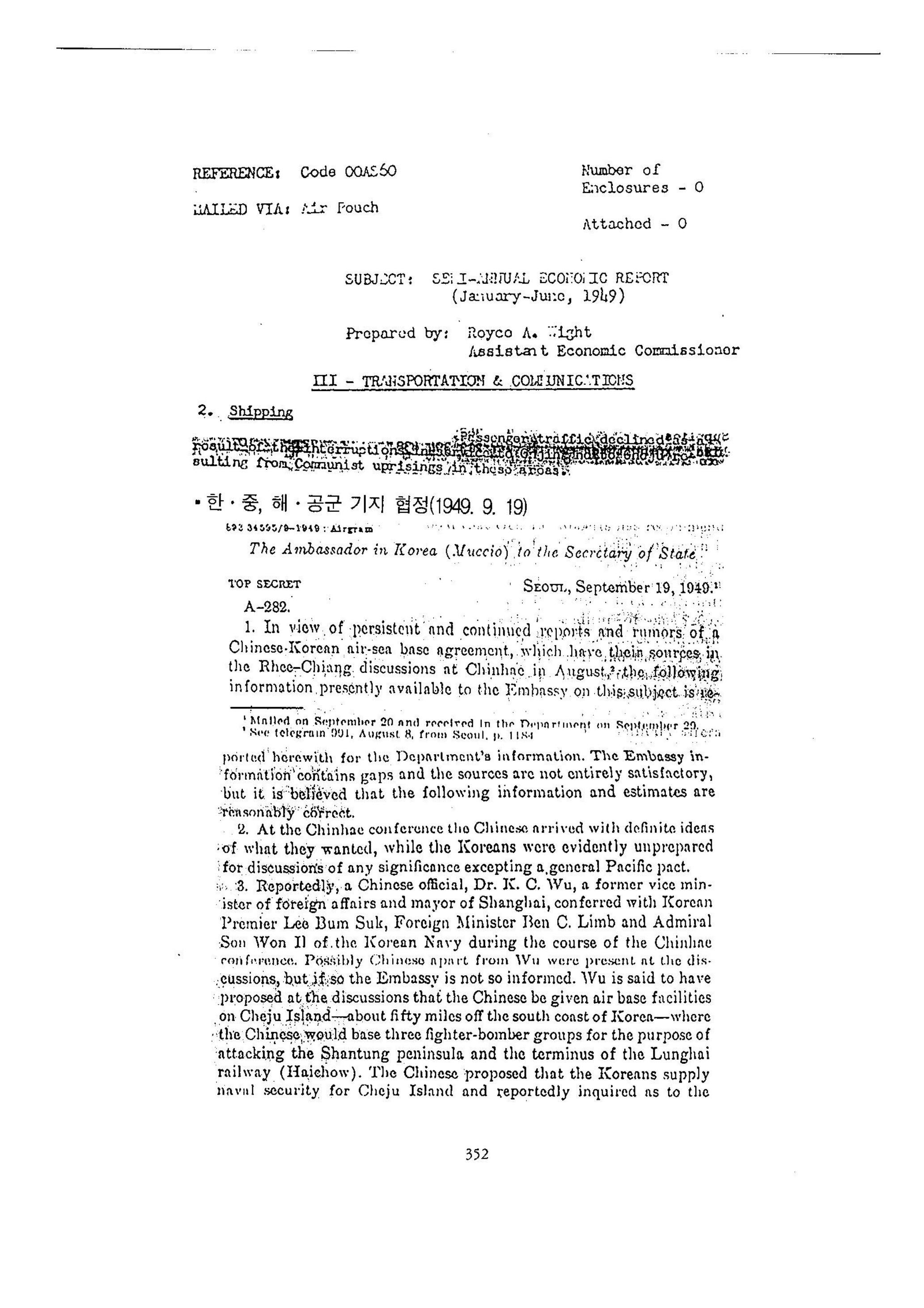
1. 8월 진해(Chinhae)에서 열린 이승만-장개석 회담에 근거를 둔 한-중 공군‧해군 기지 협정(a Chinese-Korean air-sea base agreement)에 대한 끈덕지고도 계속적인 보고와 소문을 고려하여 이 주제에 관해 현재까지 대사관에서 가용한 정보를 국무부에 보고하는 바이다. 대사관의 정보가 일목요연하지 못하고 근거도 완전히 만족스럽지 못하지만 아래의 정보와 평가는 상당히 정확하다.
2. 진해 회담에서 중국인들은 그들이 원했던 것에 대해 명확한 생각을 갖고 방문한 반면 한국인들은 분명히 일반적인 태평양협정(a general Pacific pact)을 제외하고는 어떤 중요한 토론도 준비하지 못했다.
3. 보고에 의하면 이전의 외무부 차관이자 상해(Shanghai) 시장이었던 중국 관리 우(K. C. Wu) 박사는 진해회담 진행 도중에 한국의 국무총리 이범석(Lee Bum Suk), 외무부장관 임병직(영문이름 벤 임, Ben C. Limb), 한국 해군 총사령관 손원일(Son Won Il)과 회담하였다. 우 박사말고도 중국인들이 그 회담에 참석했으나 대사관은 그러한 통보를 받지 못하였다. 우 박사는 중국이 산동(Shantung)반도와 룽하이(Lunghai) 철도(Haichow)의 종점을 공격할 3개의 전투 폭격기 비행단을 주둔시키도록 한국이 한국 남해안에서 약 50마일 떨어져 있는 제주도의 공군기지 설비를 중국에 제공할 것을 그 회담에서 제안한 것으로 알려져 있다. 중국측은 한국측에 제주도에 해군의 방위를 제공할 것을 제안하였으며 한국 해군의 능력에 관해 문의한 것으로 보고되었다. 이에 대한 응답으로 손원일 해군 총사령관은 한국 함정들과 그것의 능력에 대한 완벽한 진술을 하였다. 중국인들은 놀라움과 그들이 한국 해군의 약점이라고 여기는 것에 대하여 실망을 표현했다. 보고에 의하면 한국측은 중국측이 어떤 해군 방위를 제공할 수 있는지 타진했고 중국측은 “아무것도 없다”라고 답하였다. 대사관에서 이용할 수 있는 정보에 따르면 한국 외무부장관과 손원일은 국무총리가 주로 침묵하고 있는 가운데 한국측을 대표하여 대부분의 발언을 하였다. 한국측은 중국항공기의 가솔린 공급에 대한 질문을 하였고 중국측은 미국에 의해 그들에게 제공된 재고로부터 가솔린을 공급할 수 있을 것이라고 말한 것으로 보고되었다.
4. 앞의 회담이 이승만 대통령의 허락 없이 개최되었다는 몇몇 증거가 있다. 그 회담 이후에 외무부장관은 제시된 목적을 위해 제주도에 공군기지를 할당하는 것은 한국을 직접적으로 중국 내전에 연루시키는 것과 같다고 즉각적인 견해를 밝힌 대통령에게 회담의 요지를 보고한 것으로 되어있다. 보고에 의하면 한국 외무부장관은 중국 공산주의자의 보복에 맞서 한국 육군을 엄호할 수 있는 적당한 공군력 없이 한국이 중국 내전 속으로 휘말릴 수 없다고 우 박사에게 말했다. 어떤 경우라도 한국 정부는 중국이 원하는 기지를 제공하지 않을 것이다. 그 다음 한국 외무부장관은 아마도 이승만 대통령의 지시에 따라 만일 한국 육군이 북한을 침공한다면 중국이 어떤 공군 지원을 할 수 있는지를 문의했던 것으로 보고되었다. 보고에 의하면 우 박사는 중국측이 1개 전투 폭격기 비행단을 지원할 수 있다고 응답했다. 외무부장관과 국무총리는 아마도 중국측의 제안이 중국에는 이익이 되지만 한국에는 이익이 되지 않을 것이라고 이승만 대통령에게 보고했다. 이승만 대통령은 이러한 견해에 동의했으며 지금 이러한 신념을 계속 간직하고 있는 것으로 믿어진다.
5. 보고에 의하면 우 박사와 한국인들 사이의 회담은 어떠한 협정이나 양해도 없이 결렬되었다. 이승만-장개석 회담 동안 한국 공군기지의 중국인에 의한 사용에 대한 주제가 취급되지 않았다는 점이 확실하다. 분명히 우 박사와 한국 국무총리, 외무부장관과의 회담의 진행은 (장개석) 총통이 이승만 대통령과 함께 그 주제를 거론할 정도로 발전되지 않았다.
6. 앞에서 말한 설명은 한국 외무부장관이 진해에서 있었던 그 회담 직후 뉴욕타임즈(the New York Times) 특파원에게 말했던 답변과 실질적으로 일치한다. 게다가 보고에 의하면 우 웬사오(Wu Wentsao)라는 이름을 가진 동경에 중국 사절로 있는 한 고위 관리는 최근 시카고트리뷴(the Chicago Tribune) 특파원에게 간략하지만 유사한 답변을 하였다. 한국에 있는 뉴욕타임즈 특파원과 일본에 있는 시카고트리뷴 특파원 양자는 이 대사관의 관리들과 함께 비공식적으로 이 문제를 토론했다.
7. 9월 12일에 한국 외무부장관과의 회담에서 한 대사관 관리가 위에서 기술한 회담에 이의를 제기했다. 그 대사관 관리의 의견은 동경에 있는 중국 사절로부터 기인된 소문에 근거하고 있었다. 한국 외무부장관은 흥분하여 한국인들이 중국인이나 그 밖의 누구에게 제주도에 있는 기지를 제공할 것이라는 점을 부인했다. 그는 한국이 자신의 주권과 영토를 지키려고 몹시 애쓰고 있었기 때문에 한국에 불확실한 이익을 얻을 목적으로 주권과 영토 가운데 어떤 것도 양도할 수 없었으며 아직 한국 정부는 제주도를 개발하는 방법을 연구할 만한 입장에 처해 있지 않다고 말했다.
8. 그 결과로써 한국인과 중국인들이 한 해군 기지로서 중국인들이 인천항을 이용하는 것과 한국 기지로부터 안퉁(Antung)을 폭격하는 문제를 협상하고 있다는 아직 실증되지 않은 소문들이 대사관의 주의를 끌었다. 이러한 소문들은 또한 이승만 대통령이 이러한 주제로 중국인에게 편지 한 통을 쓴 것을 시사하고 있다. 이러한 소문들에 비추어 보아 대사관의 한 관리는 또 다른 주제에 관한 회담의 진행 도중 9월 18일 한국 외무부장관에게 소문의 적절성에 대해 다시 이의를 제기했다. 외무부장관은 그가 진해 회담 이후에 그러한 회담이 있었는지 알지 못했고, 그러한 제안들이 각료 회의(cabinet meetings)에서 토의된 적도 없으며, 그는 중국에 공군 기지나 해군 기지를 할당하는 것이 한국의 안보에 위험을 끼치게 될 것이라고 믿으며, 그는 이승만 대통령이 그러한 소문이 유포되고 있다는 것과 그러한 어떤 협정도 위험하다는 것을 권고 받기를 희망한다고 명확히 진술했다.
9. 이러한 일반적인 관계 속에서 한국 국방부장관은 9월 16일 한 대사관 관리와의 비공식적인 회담 도중 최근 중국 군사 외교관(attache)이 공산주의 문제에 관하여 정보의 교환이 있을 것이며 중국인들이 어떠한 정보 기구를 한국의 육지와 한국의 어느 도서에 설립하는 것을 허락 받아야 된다는 제안을 내놓으며 한국 육군 G-2에 접근했다고 진술했다. 한국 국방부장관은 이러한 제안들은 그와 대통령의 관심을 끌었으며 그들은 이러한 문제에 관한 중국 군사 외교관과의 회담을 중지하라는 훈령을 하달했다고 진술했다. 국방부장관은 어떠한 사건이 있더라도 중국인들은 한국 땅에 그들의 정보 기구를 설립하는 것이 허용되지 않을 것이라고 진술했다.
10. 9월 19일 아침에 이승만 대통령과 또 다른 주제에 관한 다음의 회담에서 한 대사관 관리는 한국 기지 사용을 위해 (한국 정부가) 중국인들과 협상하고 있다는 소문들이 널리 퍼져 있다고 대통령에게 말했고 그러한 소문들의 정확성에 관해서 문의했다. 대통령의 첫 번째 응답은 “기다리시오. 그러면 당신은 그 결과를 알게 될 것이오.”였다. 그 때 대사관 관리가 말했다. “그렇다면 저는 군사기지 사용 문제에 대해 중국 측과 실제적으로 진전된 협상이 있었다고 받아들이겠습니다.” 거기서 즉시 이승만 대통령은 중국 대사가 중국 요원(비록 이승만 대통령이 이 점을 분명히 하지는 않았지만 생각건대 정보 요원일 것으로 생각됨)에게 기지와 숙소 모두를 제공해 달라고 그에게 압력을 행사하였다고 대답했고, 그는 중국과의 관계가 중국인들의 제안을 단호히 거절한다는 것이 부적절하다고 생각을 하였다고 답하였다. 그러나 대통령은 그가 (중국인의 한국)기지 사용에 대한 문제이든지 한국에 중국 요원의 주둔 문제이든지 간에 어떠한 중국인의 제안에도 응할 의향이 없다고 계속해서 말했다. 이승만 대통령은 더욱이 미국 대사관은 회담이 종결된 후에 대통령이 직접적으로 부정적인 응답을 고의적으로 회피했음에도 불구하고 중국인들이 처음보다도 그들의 목표를 성취하는데 더 노력할 가능성은 없다고 믿어도 좋다고 말했다. 대통령은 (미국) 대사관 관리에게 그의 입장에 관련된 정보는 가장 민감한 속성을 가지는 것이라고 경고했으며 그 대사관 관리에게 그러한 정보를 유출하지 말 것을 요청했다.
11. 미 대사관은 이승만 대통령이 국제 공산주의에 맞서 투쟁하고 있는 중국 정부에 동조하고 장개석 총통과 밀접한 관계를 유지하기를 갈망하고 있지만 동시에 중국인의 행동과 동기에 매우 의심을 가지고 있고, 중국 공산주의자들과 서로 살육하는 전쟁 속으로 휘말려 들어갈 의향이 없으며, 아무리 한국과 가까운 우방일지라도 그런 세력에게 한국 기지를 양도하지 않을 것이라는 점을 분명히 알게 되었다. 이승만 대통령은 아마도 한국 항구로의 중국 해군 함선의 방문체류를 반대하지는 않을 것이지만 그가 해군기지로서 이러한 항구들 가운데 어떤 항구도 중국 해군에 양도하지 않을 것 같고 심지어 한국 항구에서 중국인들이 작전하는 것조차도 허용하지 않을 것 같다.
무쵸(Muccio)
693 34595/8-1949: Airgram
The Ambassador in Korea (Muccio) to the Secretary of State
TOP SECRET
Seoul, September 19, 1949.
A-282.
1. In view of persistent and continued reports and rumors of a Chinese-Korean air-sea base agreement, which have their sources in the Rhee-Chiang discussions at Chinhae in August, the following information presently available to the Embassy on this subject is [illegible]
Mailed on September 20 and received in the Department on September 29.
See telegram 991, August 8, from Seoul, p. 1184
ported herewith for the Department's information. The Embassy information contains gaps and the sources are not entirely satisfactory, but it is believed that the following information and estimates are reasonably correct.
2. At the Chinhae conference the Chinese arrived with definite ideas of what they wanted, while the Koreans were evidently unprepared for discussions of any significance excepting a general Pacific pact.
3. Reportedly, a Chinese official, Dr. K. C. Wu, a former vice minister of foreign affairs and mayor of Shanghai, conferred with Korean Premier Lee Bum Suk, Foreign Minister Ben C. Limb and Admiral Son Won Il of the Korean Navy during the course of the Chinhae conference. Possibly Chinese apart from Wu were present at the discussions, but if so the Embassy is not so informed. Wu is said to have proposed at the discussions that the Chinese be given air base facilities on Cheju Island—about fifty miles off the south coast of Korea—where the Chinese would base three fighter-bomber groups for the purpose of attacking the Shantung peninsula and the terminus of the Lunghai railway (Haichow). The Chinese proposed that the Koreans supply naval security for Cheju Island and reportedly inquired as to the
--- p363 ---
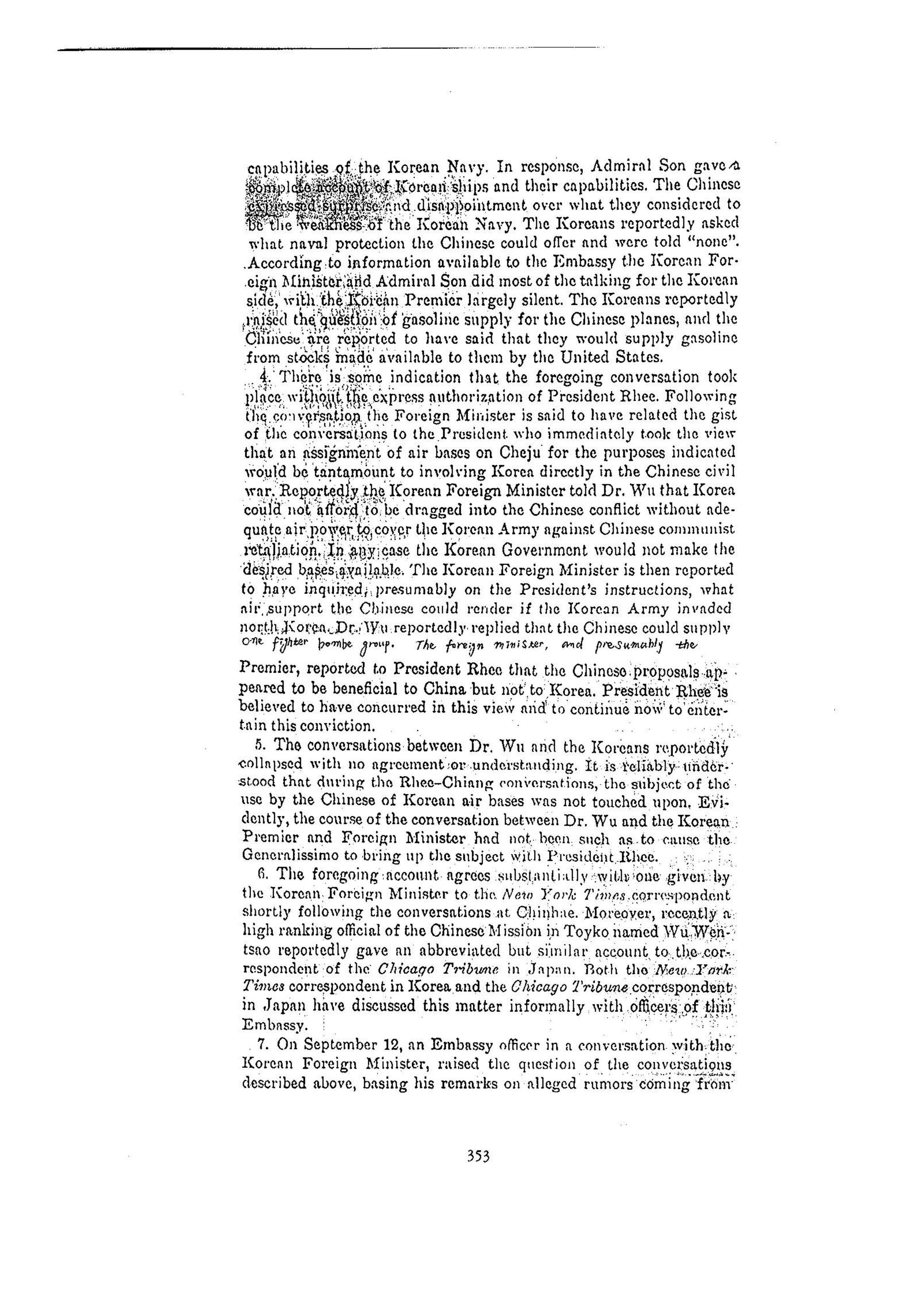
capabilities of the Korean Navy. In response, Admiral Son gave a complete account of Korean ships and their capabilities. The Chinese [illegible] and disappointment over what they considered to be the weakness of the Korean Navy. The Koreans reportedly asked what naval protection the Chinese could offer and were told "none". According to information available to the Embassy the Korean Foreign Minister and Admiral Son did most of the talking for the Korean side, with the Korean Premier largely silent. The Koreans reportedly raised the question of gasoline supply for the Chinese planes, and the Chinese are reported to have said that they would supply gasoline from stocks made available to them by the United States.
4. There is some indication that the foregoing conversation took place without the express authorization of President Rhee. Following the conversation the Foreign Minister is said to have related the gist of the conversations to the President who immediately took the view that an assignment of air bases on Cheju for the purposes indicated would be tantamount to involving Korea directly in the Chinese civil war. Reportedly the Korean Foreign Minister told Dr. Wu that Korea could not afford to be dragged into the Chinese conflict without adequate air power to cover the Korean Army against Chinese communist retaliation. In any case the Korean Government would not make the desired bases available. The Korean Foreign Minister is then reported to have inquired, presumably on the President's instructions, what air support the Chinese could render if the Korean Army invaded north Korea. Dr. Wu reportedly replied that the Chinese could supply one fighter bombe group. The foreign minister, and presumably the Premier, reported to President Rhee that the Chinese proposals appeared to be beneficial to China but not to Korea. President Rhee is believed to have concurred in this view and to continue now to entertain this conviction.
5. The conversations between Dr. Wu and the Koreans reportedly collapsed with no agreement or understanding. It is reliably understood that during the Rhee-Chiang conversations, the subject of the use by the Chinese of Korean air bases was not touched upon. Evidently, the course of the conversation between Dr. Wu and the Korean Premier and Foreign Minister had not been such as to cause the Generalissimo to bring up the subject with President Rhee.
6. The foregoing account agrees substantially with one given by the Korean Foreign Minister to the *New York Times* correspondent shortly following the conversations at Chinhae. Moreover, recently a high ranking official of the Chinese Mission in Toyko named Wu Wen-tsao reportedly gave an abbreviated but similar account to the correspondent of the *Chicago Tribune* in Japan. Both the *New York Times* correspondent in Korea and the *Chicago Tribune* correspondent in Japan have discussed this matter informally with officers of this Embassy.
7. On September 12, an Embassy officer in a conversation with the Korean Foreign Minister, raised the question of the conversations described above, basing his remarks on alleged rumors coming from
--- p364 ---
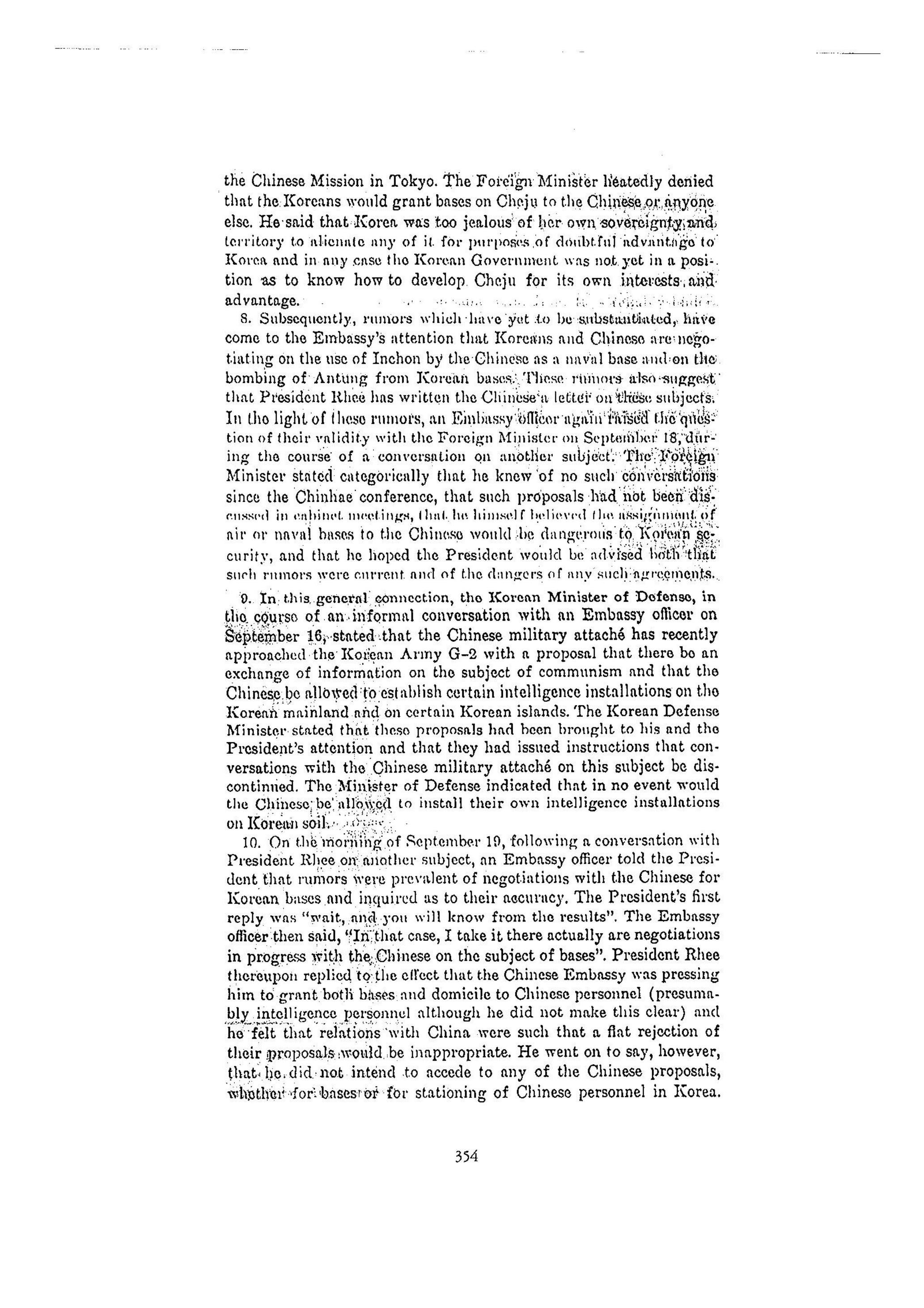
the Chinese Mission in Tokyo. The Foreign Minister heatedly denied that the Koreans would grant bases on Cheju to the Chinese or anyone else. He said that Korea was too jealous of her own sovereignty, and territory to alienate any of it for purposes of doubtful advantage to Korea and in any case the Korean Government was not yet in a position as to know how to develop Cheju for its own interests, and advantage.
8. Subsequently, rumors which have yet to be substantiated, have come to the Embassy's attention that Koreans and Chinese are negotiating on the use of Inchon by the Chinese as a naval base and on the bombing of Antung from Korean bases. These rumors also suggest that President Rhee has written the Chinese a letter on these subjects. In the light of these rumors, an Embassy officer again raised the question of their validity with the Foreign Minister on September 18, during the course of a conversation on another subject. The Foreign Minister stated categorically that he knew of no such conversations since the Chinhae conference, that such proposals had not been discussed in cabinet meetings, that he himself believed the assignment of air or naval bases to the Chinese would be dangerous to Korean security, and that he hoped the President would be advised both that such rumors were current and of the dangers of any such agreements.
9. In this general connection, the Korean Minister of Defense, in the course of an informal conversation with an Embassy officer on September 16, stated that the Chinese military attaché has recently approached the Korean Army G-2 with a proposal that there be an exchange of information on the subject of communism and that the Chinese be allowed to establish certain intelligence installations on the Korean mainland and on certain Korean islands. The Korean Defense Minister stated that these proposals had been brought to his and the President's attention and that they had issued instructions that conversations with the Chinese military attaché on this subject be discontinued. The Minister of Defense indicated that in no event would the Chinese be allowed to install their own intelligence installations on Korean soil.
10. On the morning of September 19, following a conversation with President Rhee on another subject, an Embassy officer told the President that rumors were prevalent of negotiations with the Chinese for Korean bases and inquired as to their accuracy. The President's first reply was "wait, and you will know from the results". The Embassy officer then said, "In that case, I take it there actually are negotiations in progress with the Chinese on the subject of bases". President Rhee thereupon replied to the effect that the Chinese Embassy was pressing him to grant both bases and domicile to Chinese personnel (presumably intelligence personnel although he did not make this clear) and he felt that relations with China were such that a flat rejection of their proposals would be inappropriate. He went on to say, however, that he did not intend to accede to any of the Chinese proposals, whether for bases or for stationing of Chinese personnel in Korea.
--- p365 ---
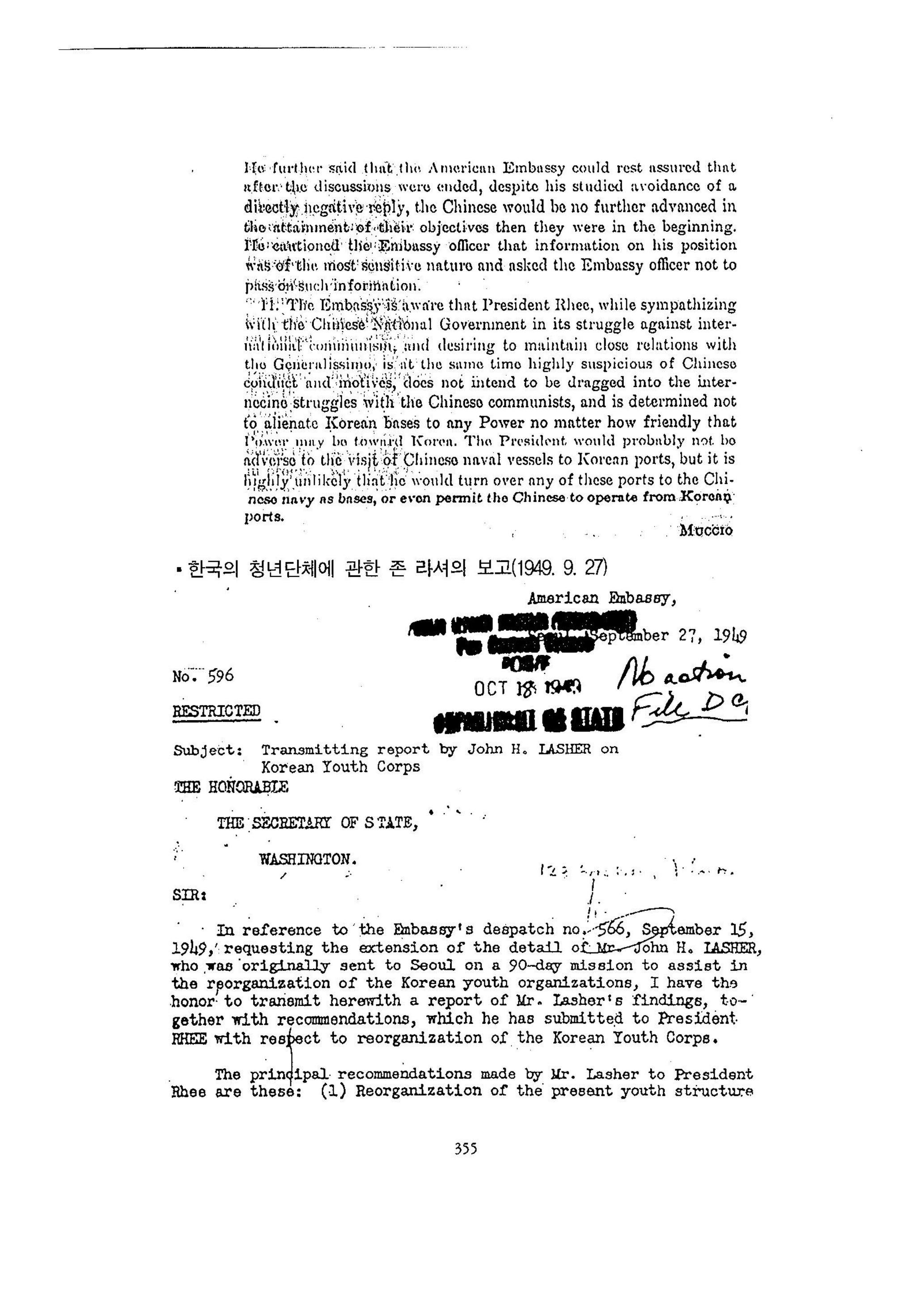
He further said that the American Embassy could rest assured that after the discussions were ended, despite his studied avoidance of a directly negative reply, the Chinese would be no further advanced in the attainment of their objectives then they were in the beginning. He cautioned the Embassy officer that information on his position was of the most sensitive nature and asked the Embassy officer not to pass on such information.
11. The Embassy is aware that President Rhee, while sympathizing with the Chinese National Government in its struggle against international communism, and desiring to maintain close relations with the Generalissimo, is at the same time highly suspicious of Chinese conduct and motives, does not intend to be dragged into the internecine struggles with the Chinese communists, and is determined not to alienate Korean bases to any Power no matter how friendly that Power may be toward Korea. The President would probably not be adverse to the visit of Chinese naval vessels to Korean ports, but it is highly unlikely that he would turn over any of these ports to the Chinese navy as bases, or even permit the Chinese to operate from Korean ports.
Muccio
출처:
제주4·3사건진상규명및희생자명예회복위원회 편,
『제주4·3사건자료집 11』 [미국자료편],
번역문 p.163
/ 원문 p.352–355.
×
![]()