발신: 특별대사 무쵸(Muccio)
수신: 국무장관
국방부장관 신성모(Shin Sung Mo)는 게릴라들이 완전히 소탕되고 질서가 회복될 때까지 (제주도에)머물러 있어야 한다는 명령을 받은 채 이승만 대통령의 특별 요청으로 지금 제주도에 있다. 이전에 신성모 장관은 그가 내무부장관이었을 때 유사한 지시를 받아왔지만 국방부장관직을 맡기 위해 서울로 복귀했었다. 이번 주 초에 그가 출발하기 앞서 그는 신뢰감이 덜 하고 겁이 더 많은 경찰 대신에 육군 습격부대들과 작전을 하고 있기 때문에 게릴라 소탕은 더욱 더 쉬워질 것이라고 진술했다. 사실상 그는 반군들이 그들의 산악 본거지에 포위되어 있으며 더 오랫동안 버티지 못할 것이라고 말했다.
제주도에서의 전투는 오랜 기간 산발적으로 있어 왔다. 평양라디오방송은 지난 해 4월 3일 시작되었던 제주도에서의 ‘빨치산’투쟁 1주년 기념 축하를 장기간 프로그램을 내보내는데 전력했다. 모스크바와 하바로프스크(Khabarovsk)의 유사한 한국어 방송들은 미군 부대들이 철수하자마자 남한전역을 휩쓸기로 예정되어 있는 광범위한 무장 저항의 전조로서 제주도 폭동을 언급하였다.
제주도가 남한에 혼란을 퍼뜨리고 테러를 가하기 위한 소련의 주요한 노력의 장소로 선택되었다는 것은 소련의 통제를 받은 라디오 방송으로부터 뿜어져 나오는 선전의 본질로부터 분명해진다. 이것(남한에 혼란을 퍼뜨리고 테러를 가하기 위한 소련의 노력)은 제주도 북쪽의 한반도 육지부인 전라남도와 경상남도에서 지속적이고도 유사한 작전으로 지속되었다. 대한민국 후방 지역의 그러한 상황 속에서 이승만 대통령은 소요와 불안정을 제거하기 위한 결정을 내릴 수밖에 없었다. 그렇게 하여 공산주의자들이 한국 무대에서 영속시키고자 했던 대량학살의 싸움에 38선의 방위군 부대들을 소모시키지 말아야 한다.
소련요원들이 큰 난관없이 제주도에 침투하고 있었음이 분명하다. 신성모 장관은 그들 가운데 다수가 북한으로부터 소형 어선 편으로 (제주도에)도착했다고 주장했다. 신성모는 한국 해안경비대(the Korean Coast Guard)가 제주도 해안을 순찰하기 위해 노력하고 있지만 현재 해안경비대 함정의 소규모 승무원으로서는 (제주도의) 빈틈없는 봉쇄가 불가능하다고 주장했다. 그것이 국무총리와 신성모 장관 사이에서 특히 국회의 토론에서 논쟁거리로 존재했을 동안에도 제주도 주위에 소련함선과 잠수함들이 맴돌고 있다는 지속적인 보고가 올라오고 있었다.
제주도에서 수행된 작전들을 담은 사진들은 정부군과 게릴라군 양측 모두의 유별난 가학적인 성향을 시사해준다. 보고되어 온 현저한 잔학 행위는 폭넓게 확산된 약탈과 방화에 동반하여 여자들과 아이들을 포함한 마을 주민의 대량학살을 지적해 주고 있다. 어떤 경우에는 육군이 비무장 마을 주민들에게 보복을 감행했던 게릴라들에게 보복작전을 수행하는 잘못을 저질렀다.
지난 일요일 한 평양방송은 제주도에서의 투쟁에 괴뢰 인민공화국의 직접적인 관심을 몹시 드러내고 있었다. 원문대로, 다음과 같이 진술되어 있다.
“더욱이 그들(제주도 게릴라들)은 김일성 주석의 영도 하에 완전한 민주적 토대가 한국의 북반부에 건설되었다는 사실과 우리들의 배후에는 강력한 소련이 있다는 사실에 의해 그들의 투쟁에 고무되어 있다. 또한 제주도 사람들은 강력한 하나의 인민연합전선을 가지고 있다.”
“제주도의 무장 게릴라들의 활동은 (북한) 공화국의 중앙정부(Central Govern -ment)의 설립 이후에 한층 강화되었다.”
무쵸(Muccio)
896.00/4-949 : AIrgram
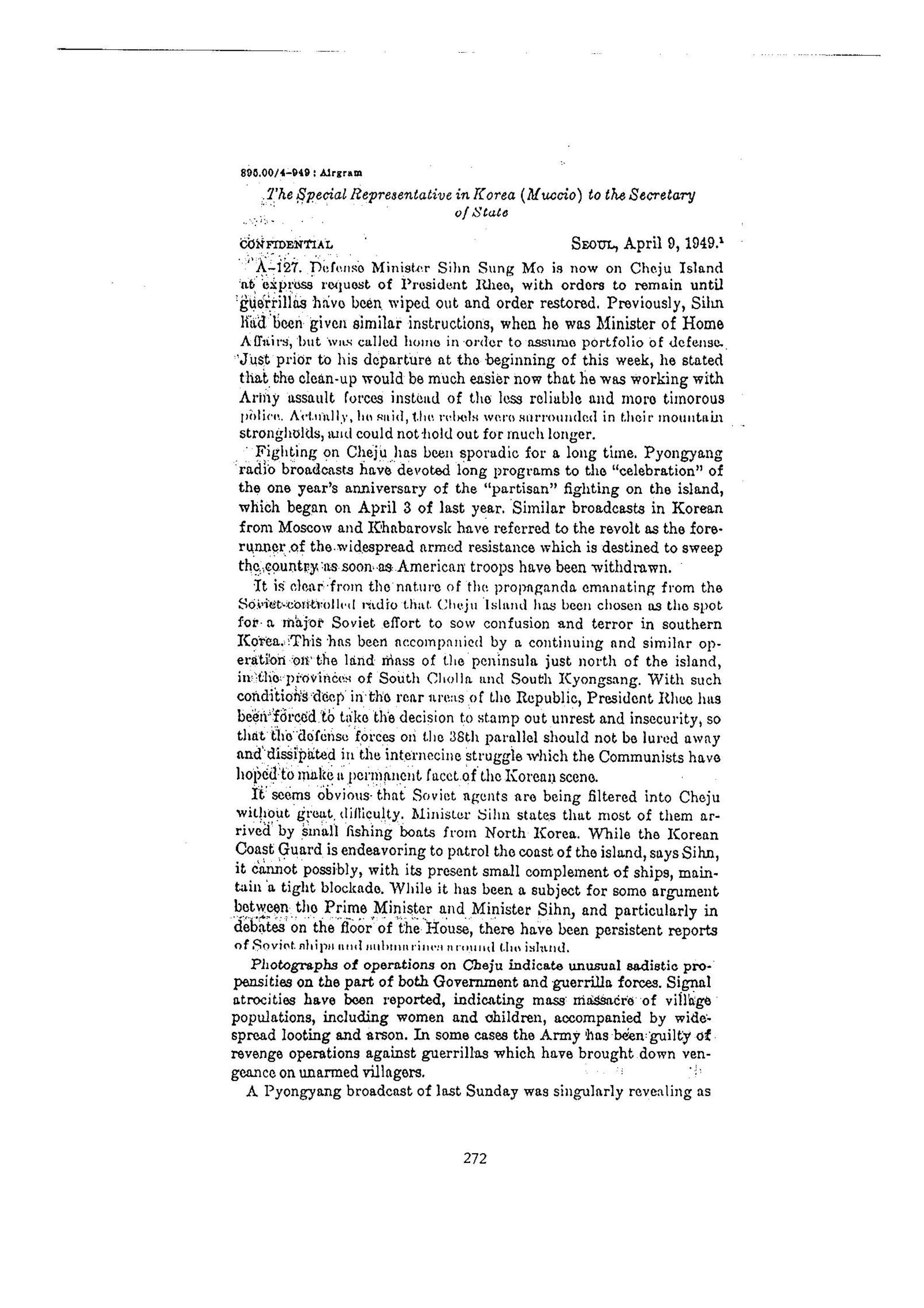
*The Special Representative in Korea (Muccio) to the Secretary of State*
CONFIDENTIAL
SEOUL, April 9, 1949.¹
A-127. Defense Minister Sihn Sung Mo is now on Cheju Island at express request of President Rhee, with orders to remain until guerrillas have been wiped out and order restored. Previously, Sihn had been given similar instructions, when he was Minister of Home Affairs, but was called home in order to assume portfolio of defense. Just prior to his departure at the beginning of this week, he stated that the clean-up would be much easier now that he was working with Army assault forces instead of the less reliable and more timorous police. Actually, he said, the rebels were surrounded in their mountain strongholds, and could not hold out for much longer.
Fighting on Cheju has been sporadic for a long time. Pyongyang radio broadcasts have devoted long programs to the "celebration" of the one year's anniversary of the "partisan" fighting on the island, which began on April 3 of last year. Similar broadcasts in Korean from Moscow and Khabarovsk have referred to the revolt as the forerunner of the widespread armed resistance which is destined to sweep the country as soon as American troops have been withdrawn.
It is clear from the nature of the propaganda emanating from the Soviet-controlled radio that Cheju Island has been chosen as the spot for a major Soviet effort to sow confusion and terror in southern Korea. This has been accompanied by a continuing and similar operation on the land mass of the peninsula just north of the island, in the provinces of South Cholla and South Kyongsang. With such conditions deep in the rear areas of the Republic, President Rhee has been forced to take the decision to stamp out unrest and insecurity, so that the defense forces on the 38th parallel should not be lured away and dissipated in the internecine struggle which the Communists have hoped to make a permanent facet of the Korean scene.
It seems obvious that Soviet agents are being filtered into Cheju without great difficulty. Minister Sihn states that most of them arrived by small fishing boats from North Korea. While the Korean Coast Guard is endeavoring to patrol the coast of the island, says Sihn, it cannot possibly, with its present small complement of ships, maintain a tight blockade. While it has been a subject for some argument between the Prime Minister and Minister Sihn, and particularly in debates on the floor of the House, there have been persistent reports of Soviet ships and submarines around the island.
Photographs of operations on Cheju indicate unusual sadistic propensities on the part of both Government and guerrilla forces. Signal atrocities have been reported, indicating mass massacre of village populations, including women and children, accompanied by widespread looting and arson. In some cases the Army has been guilty of revenge operations against guerrillas which have brought down vengeance on unarmed villagers.
A Pyongyang broadcast of last Sunday was singularly revealing as
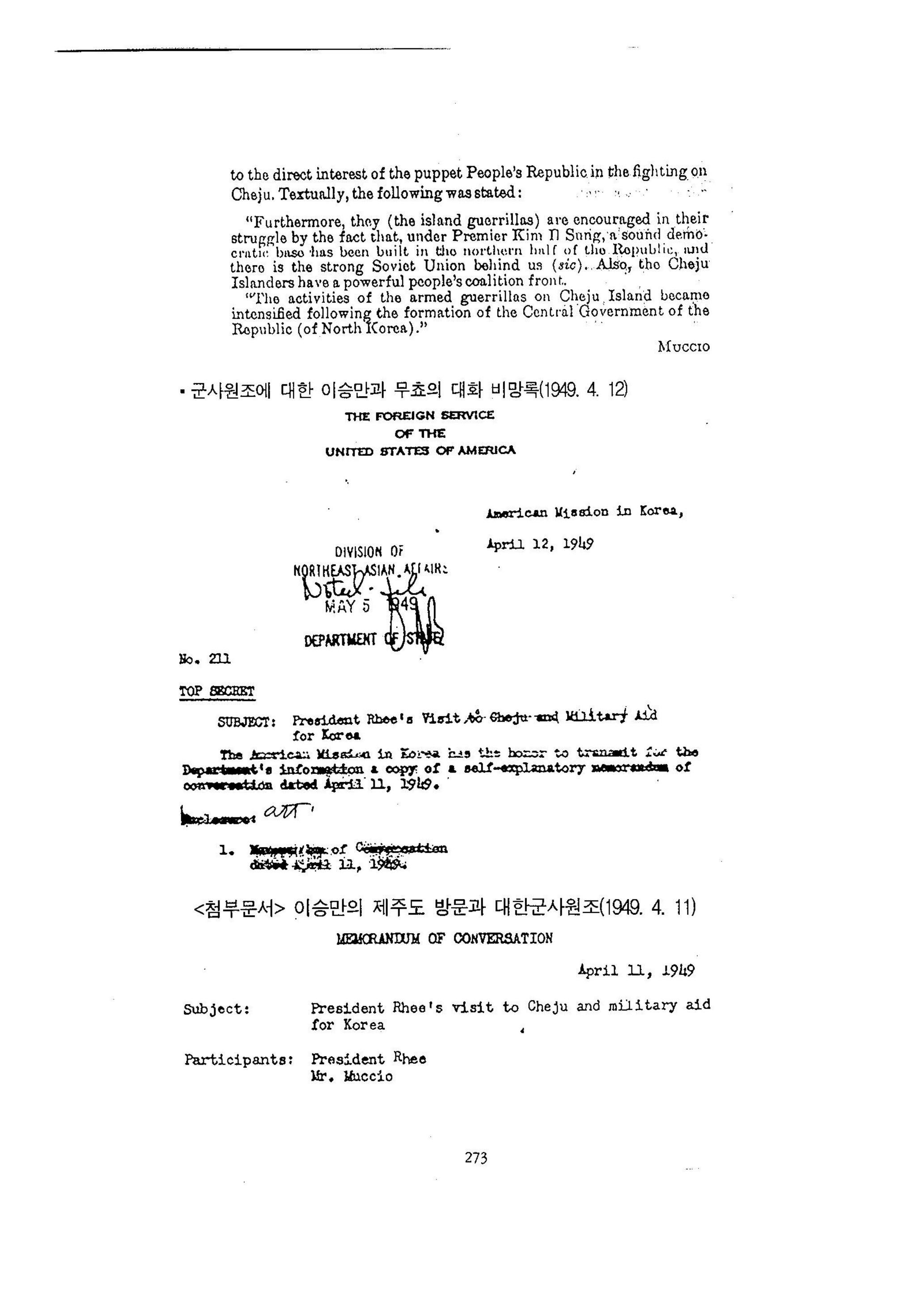
to the direct interest of the puppet People's Republic in the fighting on Cheju. Textually, the following was stated:
"Furthermore, they (the island guerrillas) are encouraged in their struggle by the fact that, under Premier Kim Il Sung, a sound democratic base has been built in the northern half of the Republic, and there is the strong Soviet Union behind us (*sic*). Also, the Cheju Islanders have a powerful people's coalition front.
"The activities of the armed guerrillas on Cheju Island became intensified following the formation of the Central Government of the Republic (of North Korea)."
Muccio
출처:
제주4·3사건진상규명및희생자명예회복위원회 편,
『제주4·3사건자료집 11』 [미국자료편],
번역문 p.79
/ 원문 p.271–273.
×
![]()