(정보요약 제2262호)
정보하이라이트
한국
여수반란 사건의 주요 원인이 ‘병사위원회(Soldiers Committee)’에 의해 드러났다. 제주도에 있는 공산주의자들과 긴밀한 연락을 유지하고 있는 육지의 공산주의자들은 반란의 참여자들을 ‘진정한 조선인민군’으로서 확립하기 위하여 계획한 반란임을 드러내었다.
보고에 의하면 북한인민군은 서울 북동쪽 약 50마일 지점에서 남한 경찰관들을 습격했다. 남한 경찰 1명이 사망했고, 4명은 실종되었다. 미군부대들은 개입하지 않았다. (중략)
한국
군사, 정치, 경제, 사회정세, 신문논평, 민정정보, 기타
군사 정세
1. 남한의 소요
(a) 여수반란의 원인: 10월 20일에 시작되었던 여수반란에 대한 생각할 수 있는 주요 원인은 그 반란 동안에 여수에 있었던 ‘병사위원회(Soldiers Committee)’에서 작성된 한 문서에 의해 드러났다. 병사위원회는 외국 제국주의로부터 나라를 보호하는 것이 그들의 목적이라고 진술했고 이승만 대통령과 이범석 국무총리가 단독정부를 수립함으로써 매국하고 있다고 비난했다. 병사위원회에 따르면 제주도 사람들은 4월에 제국주의 정책에 맞서 투쟁하기 시작하였으며 그들의 조국을 방어하기 위해 목숨을 바치고 있다. 병사위원회는 여수에 있는 병사들이 제주도 사람들을 살해하기를 거부하여 제주도에 파병되는 계획에 찬성하지 않았다고 주장했다. 병사위원회에 따르면 여수반란은 참여자들을 ‘진정한 조선 인민군대’로서 자리 매김하고 진정한 한국의 독립을 쟁취하기 위해 계획된 항쟁이었다. 여수 사람들은 그 반란에 동참할 것을 요청받았다.
보고된 바에 의하면 대규모 집회가 여수에서 열렸고 제주도의 형제들을 죽이는 것을거부한 것에 대해 ‘위대한 인민군 병사들’에게 감사의 메시지가 보내졌다.
논평: 여수 폭도들의 행동에 관한 이전의 보고는 공산주의자들이 그 폭동을 계획했거나 국방경비대의 자발적인 봉기를 이용했다는 점을 시사해 준다. 병사위원회의 문서는 여수반란이 공산당 요원들에 의해 촉발되었다는 점을 알 수 있게 해줄 뿐만 아니라 제주도와 육지에 있는 공산주의자 사이의 긴밀한 접촉이 있었다는 증거도 제시해 주고 있다. 여수 폭동에 관한 최초 보고서의 비교적 선정적인 측면에도 불구하고, 정부관리들의 후원과 적절한 결정권을 갖고 있는 남한 방위병력은 충분히 내부 질서를 유지할 것으로 보인다. 북한에 관한 상황은 소련군 철수 공표의 결과로서 더욱 악화될 수 있으며, 지금까지 소련 당국에 의해 억제되어 왔던 (남한으로의) 강화된 침투 혹은 실제 침략은 현실 가능성이 있다. 이승만 정부가 경험, 힘, 그리고 안정을 이룩하기 위하여 필요한 시일을 명확히 결정지어 말할 수 없다.
2. 남한 내에 있는 북한군
(a) 강원도 전투: 11월 15일 경찰 보고서에 따르면, 대략 150명 정도의 북한인민군 부대가 서울 북동쪽 약 50마일에 있는 남한의 횡성(Hoengsong) 근처에서 총격전을 벌이며 남한 경찰과 교전했다. 남한측 사상자들은 한 명의 사망자와 네 명의 실종자로 집계되었다. 국방경비대 자료를 참고한 또 다른 보고서는 동일한 지역에 위치하고 있던 60명의 인민군 병사들이 11월 14일에 남한 경찰과 국방경비대 1개 대대에게 공격받고 있다고 언급하였다. 다른 보고서들은 60~500명 사이의 인민군 병사들이 작전을 수행하고 있으며 그들 중 약간 명은 민간인 복장을 하고 있다는 사실을 말해 준다. 보고에 의하면 한 인민군 병사가 그 작전에서 사망했고 일본제 99 형 소총이 회수되었다고 한다.(F-6)
제24군단 논평: 민간인 복장을 하고 있는 사람이 어떻게 인민군 병사로 정체가 확인되었는가에 대하여 보고서에서는 어떠한 증거도 나타나 있지 않으며 미군 요원이 인민군 사상자의 신체를 회수할 수도 없었다. 아마 횡성 부근에서 보고되었던 그 부대는 1948년 여름 이후에 그 지역에서 주기적으로 작전을 수행했던 게릴라였을 것으로 생각된다.
논평: 남한 경찰과 국방경비대 측이 쓴 위 보고서의 자료가 종종 부정확하고 과장돼 있긴 하지만, 인민군 부대들이 38선을 가로질러 침투해 왔고 남한군에 대한 선제 공격으로 교전하였을 가능성이 있다. 그러나, 그 보고서들은 단편적이고, 확인되지 못했으며, 그 문서들의 중요성을 정확하게 결정하기 위한 충분한 증거가 없다.
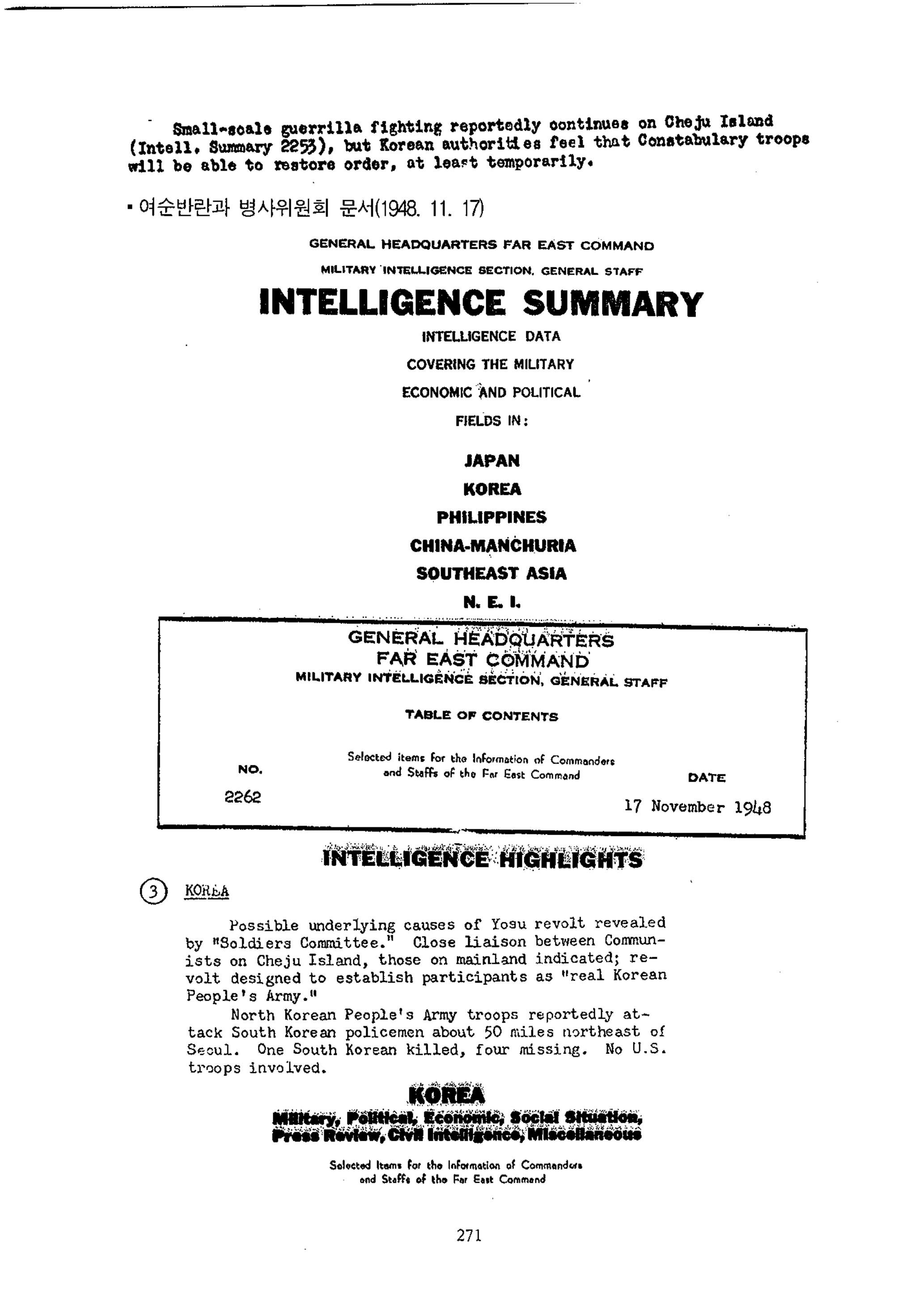
GENERAL HEADQUARTERS FAR EAST COMMAND
MILITARY INTELLIGENCE SECTION, GENERAL STAFF
# INTELLIGENCE SUMMARY
INTELLIGENCE DATA
COVERING THE MILITARY
ECONOMIC AND POLITICAL
FIELDS IN:
**JAPAN**
**KOREA**
**PHILIPPINES**
**CHINA-MANCHURIA**
**SOUTHEAST ASIA**
**N. E. I.**
GENERAL HEADQUARTERS
FAR EAST COMMAND
MILITARY INTELLIGENCE SECTION, GENERAL STAFF
TABLE OF CONTENTS
NO. Selected items for the Information of Commanders and Staffs of the Far East Command DATE
2262 17 November 1948
**INTELLIGENCE HIGHLIGHTS**
(3) KOREA
Possible underlying causes of Yosu revolt revealed by "Soldiers Committee." Close liaison between Communists on Cheju Island, those on mainland indicated; revolt designed to establish participants as "real Korean People's Army."
North Korean People's Army troops reportedly attack South Korean policemen about 50 miles northeast of Seoul. One South Korean killed, four missing. No U.S. troops involved.
**KOREA**
**Military, Political, Economic, Social Situation, Press Review, Civil Intelligence, Miscellaneous**
Selected Items for the Information of Commanders and Staffs of the Far East Command
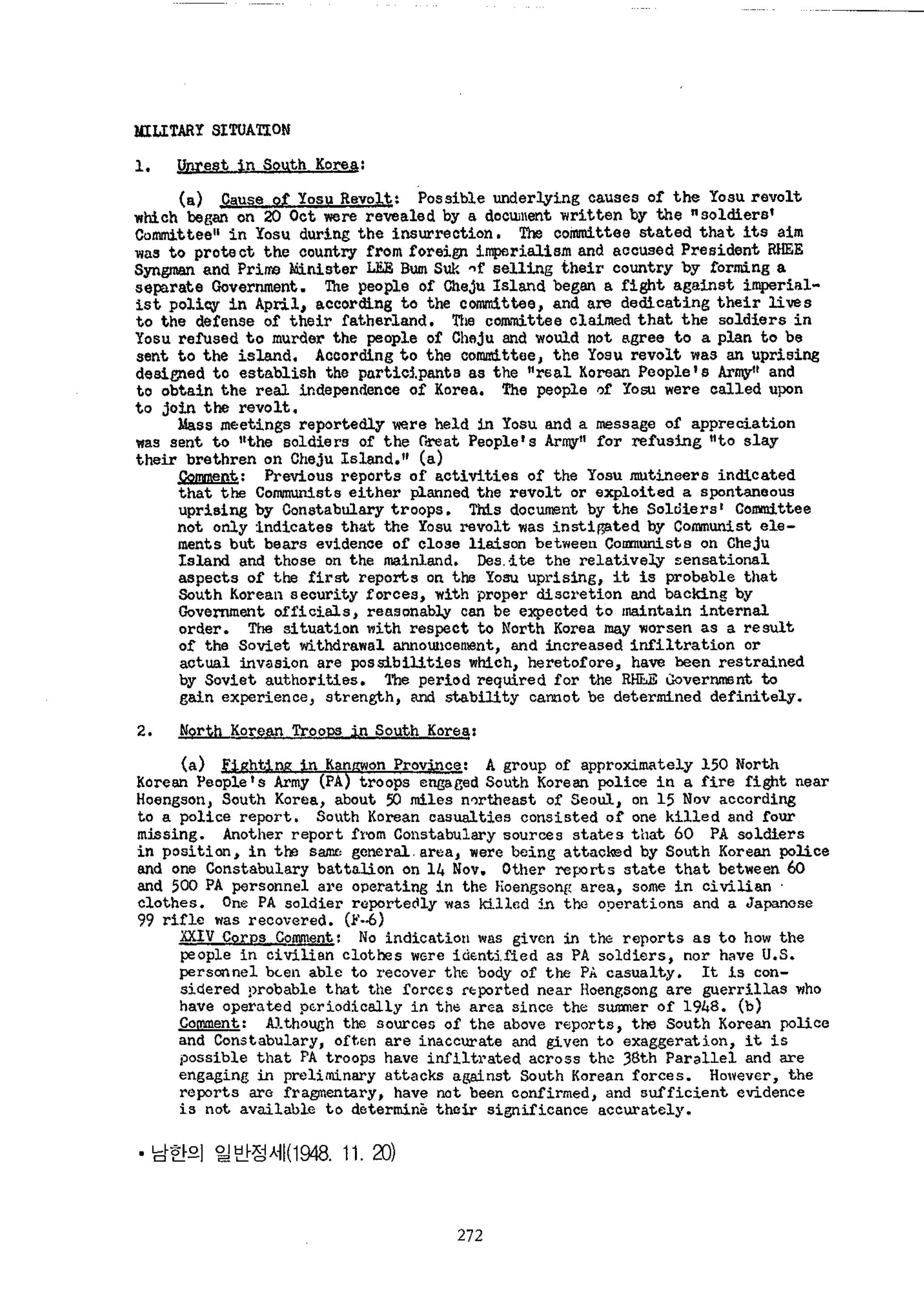
MILITARY SITUATION
1. Unrest in South Korea:
(a) Cause of Yosu Revolt: Possible underlying causes of the Yosu revolt which began on 20 Oct were revealed by a document written by the "soldiers' Committee" in Yosu during the insurrection. The committee stated that its aim was to protect the country from foreign imperialism and accused President RHEE Syngman and Prime Minister LEE Bum Suk of selling their country by forming a separate Government. The people of Cheju Island began a fight against imperialist policy in April, according to the committee, and are dedicating their lives to the defense of their fatherland. The committee claimed that the soldiers in Yosu refused to murder the people of Cheju and would not agree to a plan to be sent to the island. According to the committee, the Yosu revolt was an uprising designed to establish the participants as the "real Korean People's Army" and to obtain the real independence of Korea. The people of Yosu were called upon to join the revolt.
Mass meetings reportedly were held in Yosu and a message of appreciation was sent to "the soldiers of the Great People's Army" for refusing "to slay their brethren on Cheju Island." (a)
Comment: Previous reports of activities of the Yosu mutineers indicated that the Communists either planned the revolt or exploited a spontaneous uprising by Constabulary troops. This document by the Soldiers' Committee not only indicates that the Yosu revolt was instigated by Communist elements but bears evidence of close liaison between Communists on Cheju Island and those on the mainland. Despite the relatively sensational aspects of the first reports on the Yosu uprising, it is probable that South Korean security forces, with proper discretion and backing by Government officials, reasonably can be expected to maintain internal order. The situation with respect to North Korea may worsen as a result of the Soviet withdrawal announcement, and increased infiltration or actual invasion are possibilities which, heretofore, have been restrained by Soviet authorities. The period required for the RHEE Government to gain experience, strength, and stability cannot be determined definitely.
2. North Korean Troops in South Korea:
(a) Fighting in Kangwon Province: A group of approximately 150 North Korean People's Army (PA) troops engaged South Korean police in a fire fight near Hoengseon, South Korea, about 50 miles northeast of Seoul, on 15 Nov according to a police report. South Korean casualties consisted of one killed and four missing. Another report from Constabulary sources states that 60 PA soldiers in position, in the same general area, were being attacked by South Korean police and one Constabulary battalion on 14 Nov. Other reports state that between 60 and 500 PA personnel are operating in the Hoengsong area, some in civilian clothes. One PA soldier reportedly was killed in the operations and a Japanese 99 rifle was recovered. (F-6)
XXIV Corps Comment: No indication was given in the reports as to how the people in civilian clothes were identified as PA soldiers, nor have U.S. personnel been able to recover the body of the PA casualty. It is considered probable that the forces reported near Hoengsong are guerrillas who have operated periodically in the area since the summer of 1948. (b) Comment: Although the sources of the above reports, the South Korean police and Constabulary, often are inaccurate and given to exaggeration, it is possible that PA troops have infiltrated across the 38th Parallel and are engaging in preliminary attacks against South Korean forces. However, the reports are fragmentary, have not been confirmed, and sufficient evidence is not available to determine their significance accurately.
출처:
제주4·3사건진상규명및희생자명예회복위원회 편,
『제주4·3사건자료집 10』 [미국자료편],
번역문 p.74
/ 원문 p.271–272 / No. 2262.
×
![]()