친애하는 딘(Dean) 소장님:
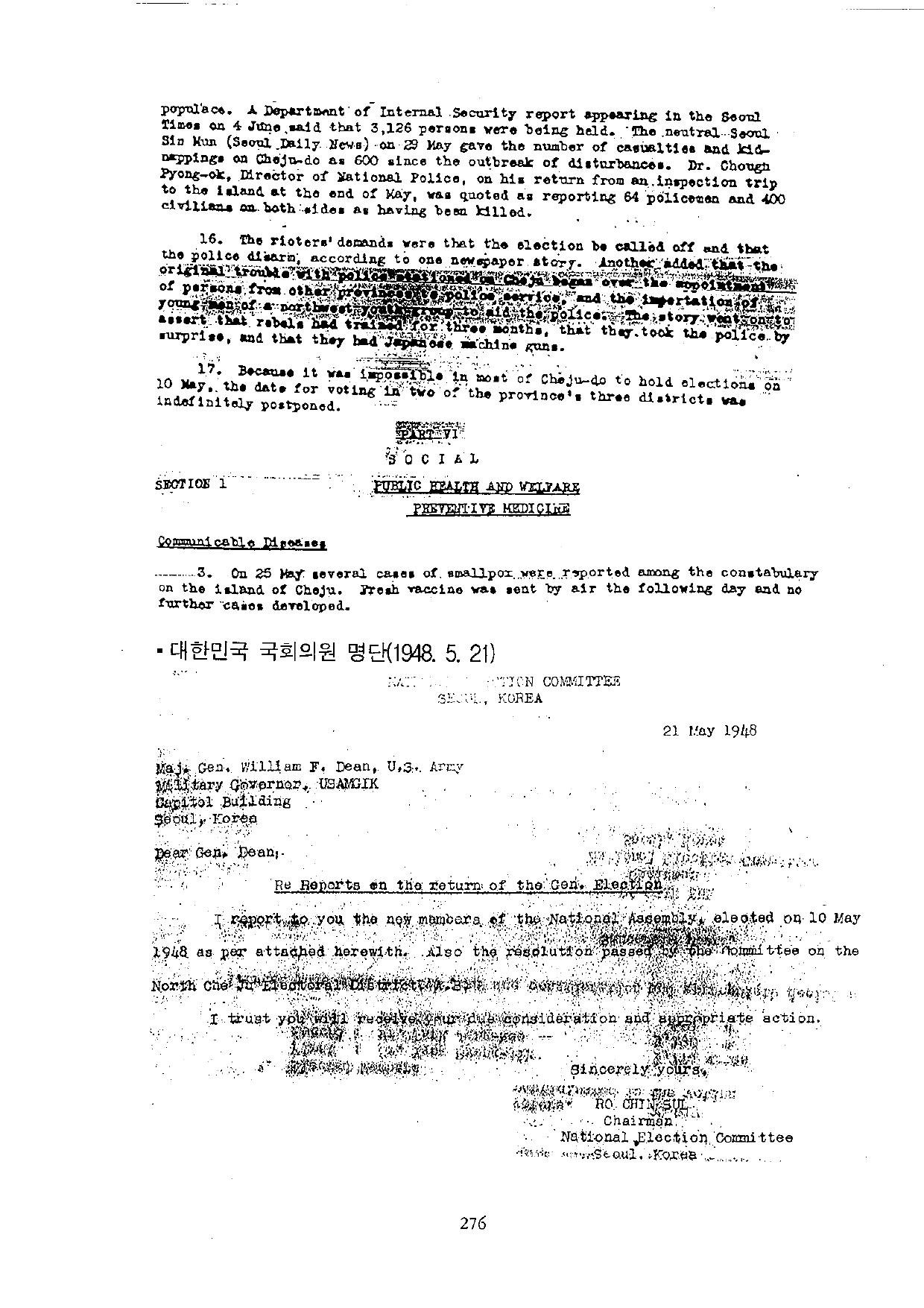
총선거에 관한 회답 보고서
본인은 장군님께 1948년 5월 10일에 선출된 새로운 국회의원들의 명단을 첨부합니다. 또한 북제주 선거구(갑: A 을: B)의 선거관리 위원에 의해서 통과된 의결 내용도 보고 드리겠습니다.
본인은 장군님께서 적당한 판단을 내려서 적절한 조치를 취하시리라 믿습니다.
중앙선관위 위원장 노진설(RO CHIN SUL)
(중략)
국회의원 당선자 명단(중략)
10. 제주도
북제주군(갑<A>) 새로운 선거가 1948년 6월 23일에 예정되어 있음.
북제주군(을<B>) 새로운 선거가 1948년 6월 23일에 예정되어 있음.
남제주군 오용국(Oh Yong-Kook) 44세 12,888표 KILA회원 무소속
[illegible] TION COMMITTEE
SEOUL, KOREA
21 May 1948
Maj. Gen. William F. Dean, U.S. Army
Military Governor, USAMGIK
Capitol Building
Seoul, Korea
Dear Gen. Dean:
Re Reports on the return of the Gen. Election [illegible]
I report to you the new members of the National Assembly, elected on 10 May 1948 as per attached herewith. Also the resolution passed [illegible] committee on the North [illegible]
I trust you will receive [illegible] consideration and appropriate action.
[illegible]
Sincerely yours,
[illegible] RO CHI [illegible]
Chairman
National Election Committee
[illegible] Seoul, Korea [illegible]
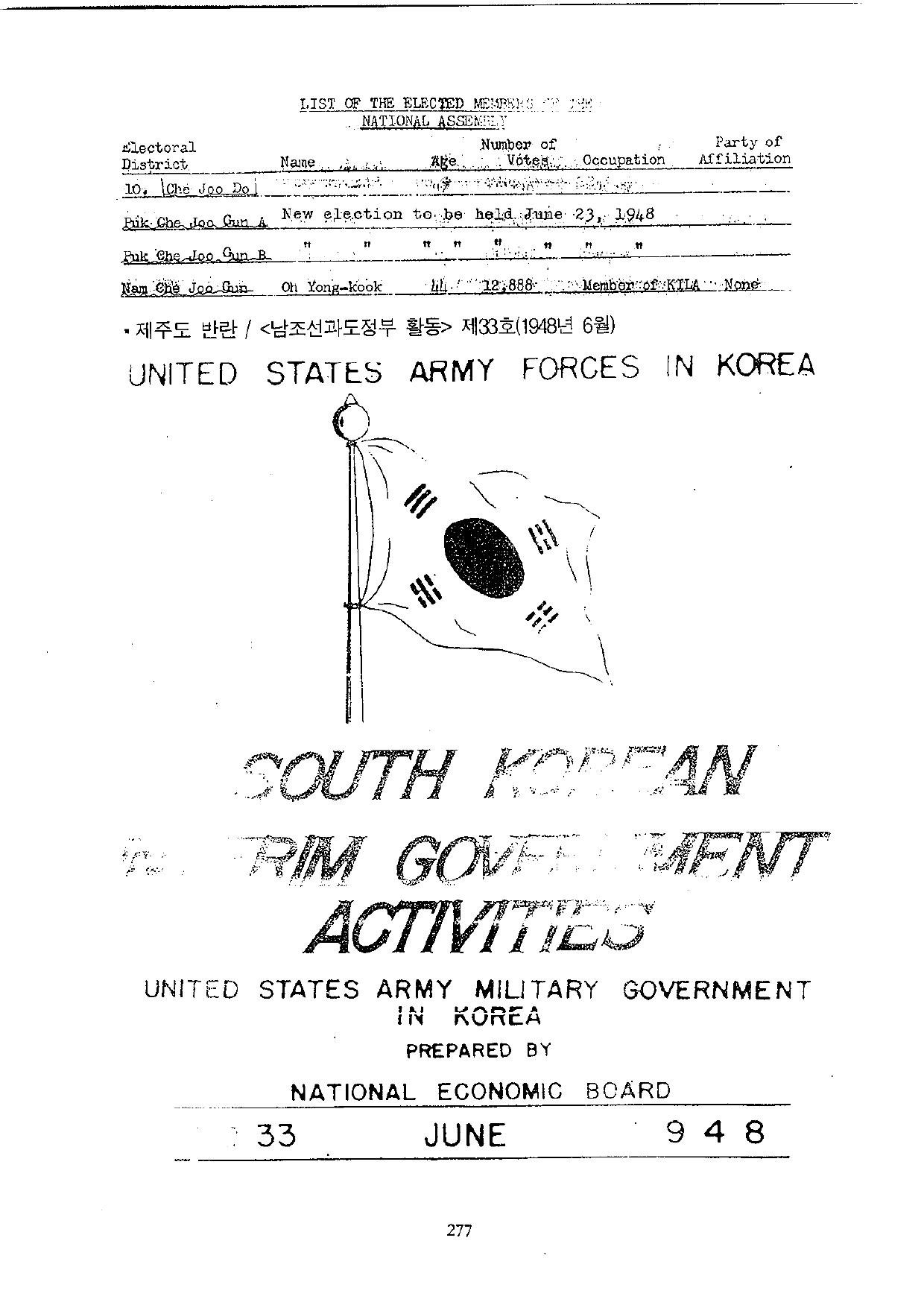
LIST OF THE ELECTED MEMBERS [illegible] THE
NATIONAL ASSEMBLY
Electoral Name Age Number of Votes Occupation Party of Affiliation
District
10. Che Joo Do [illegible] [illegible] [illegible]
Puk Che Joo Gun A New election to be held June 23, 1948
Puk Che Joo Gun B " " " " " " "
Nam Che Joo Gun Oh Yong-Kook 44 12,888 Member of KILA None
• 제주도 반란 / <남조선과도정부 활동> 제33호(1948년 6월)
UNITED STATES ARMY FORCES IN KOREA
SOUTH KOREAN
INTERIM GOVERNMENT
ACTIVITIES
UNITED STATES ARMY MILITARY GOVERNMENT
IN KOREA
PREPARED BY
NATIONAL ECONOMIC BOARD
33 JUNE 948
Production Section
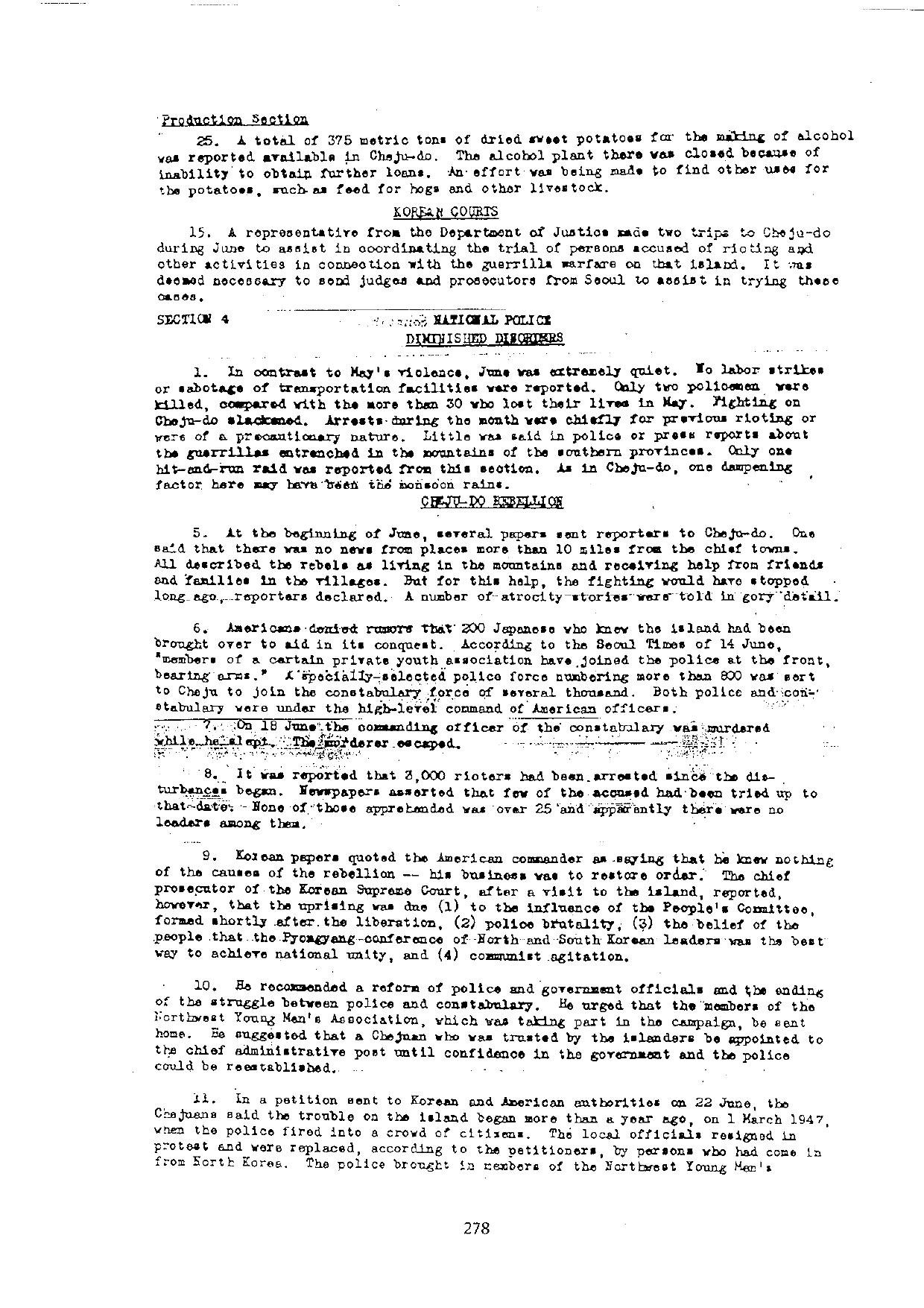
25. A total of 375 metric tons of dried sweet potatoes for the making of alcohol was reported available in Cheju-do. The alcohol plant there was closed because of inability to obtain further loans. An effort was being made to find other uses for the potatoes, such as feed for hogs and other livestock.
KOREAN COURTS
15. A representative from the Department of Justice made two trips to Cheju-do during June to assist in coordinating the trial of persons accused of rioting and other activities in connection with the guerrilla warfare on that island. It was deemed necessary to send judges and prosecutors from Seoul to assist in trying these cases.
SECTION 4
NATIONAL POLICE
DIMINISHED DISORDERS
1. In contrast to May's violence, June was extremely quiet. No labor strikes or sabotage of transportation facilities were reported. Only two policemen were killed, compared with the more than 30 who lost their lives in May. Fighting on Cheju-do slackened. Arrests during the month were chiefly for previous rioting or were of a precautionary nature. Little was said in police or press reports about the guerrillas entrenched in the mountains of the southern provinces. Only one hit-and-run raid was reported from this section. As in Cheju-do, one dampening factor here may have been the monsoon rains.
CHEJU-DO REBELLION
5. At the beginning of June, several papers sent reporters to Cheju-do. One said that there was no news from places more than 10 miles from the chief towns. All described the rebels as living in the mountains and receiving help from friends and families in the villages. But for this help, the fighting would have stopped long ago, reporters declared. A number of atrocity-stories were told in gory detail.
6. Americans denied rumors that 200 Japanese who knew the island had been brought over to aid in its conquest. According to the Seoul Times of 14 June, "members of a certain private youth association have joined the police at the front, bearing arms." A specially-selected police force numbering more than 800 was sent to Cheju to join the constabulary force of several thousand. Both police and constabulary were under the high-level command of American officers.
7. On 18 June the commanding officer of the constabulary was murdered while he'd ept. The [illegible] derer escaped.
8. It was reported that 3,000 rioters had been arrested since the disturbances began. Newspapers asserted that few of the accused had been tried up to that date. None of those apprehended was over 25 and apparently there were no leaders among them.
9. Korean papers quoted the American commander as saying that he knew nothing of the causes of the rebellion -- his business was to restore order. The chief prosecutor of the Korean Supreme Court, after a visit to the island, reported, however, that the uprising was due (1) to the influence of the People's Committee, formed shortly after the liberation, (2) police brutality, (3) the belief of the people that the Pyongyang-conference of North and South Korean leaders was the best way to achieve national unity, and (4) communist agitation.
10. He recommended a reform of police and government officials and the ending of the struggle between police and constabulary. He urged that the members of the Northwest Young Men's Association, which was taking part in the campaign, be sent home. He suggested that a Chejuan who was trusted by the islanders be appointed to the chief administrative post until confidence in the government and the police could be reestablished.
11. In a petition sent to Korean and American authorities on 22 June, the Chejuans said the trouble on the island began more than a year ago, on 1 March 1947, when the police fired into a crowd of citizens. The local officials resigned in protest and were replaced, according to the petitioners, by persons who had come in from North Korea. The police brought in members of the Northwest Young Men's
Association to aid them. The police and their allies then proceeded to terrorize the people, many of whom fled to the mountains. The petitioners asked for a re-examination of fighting and a reform in government.
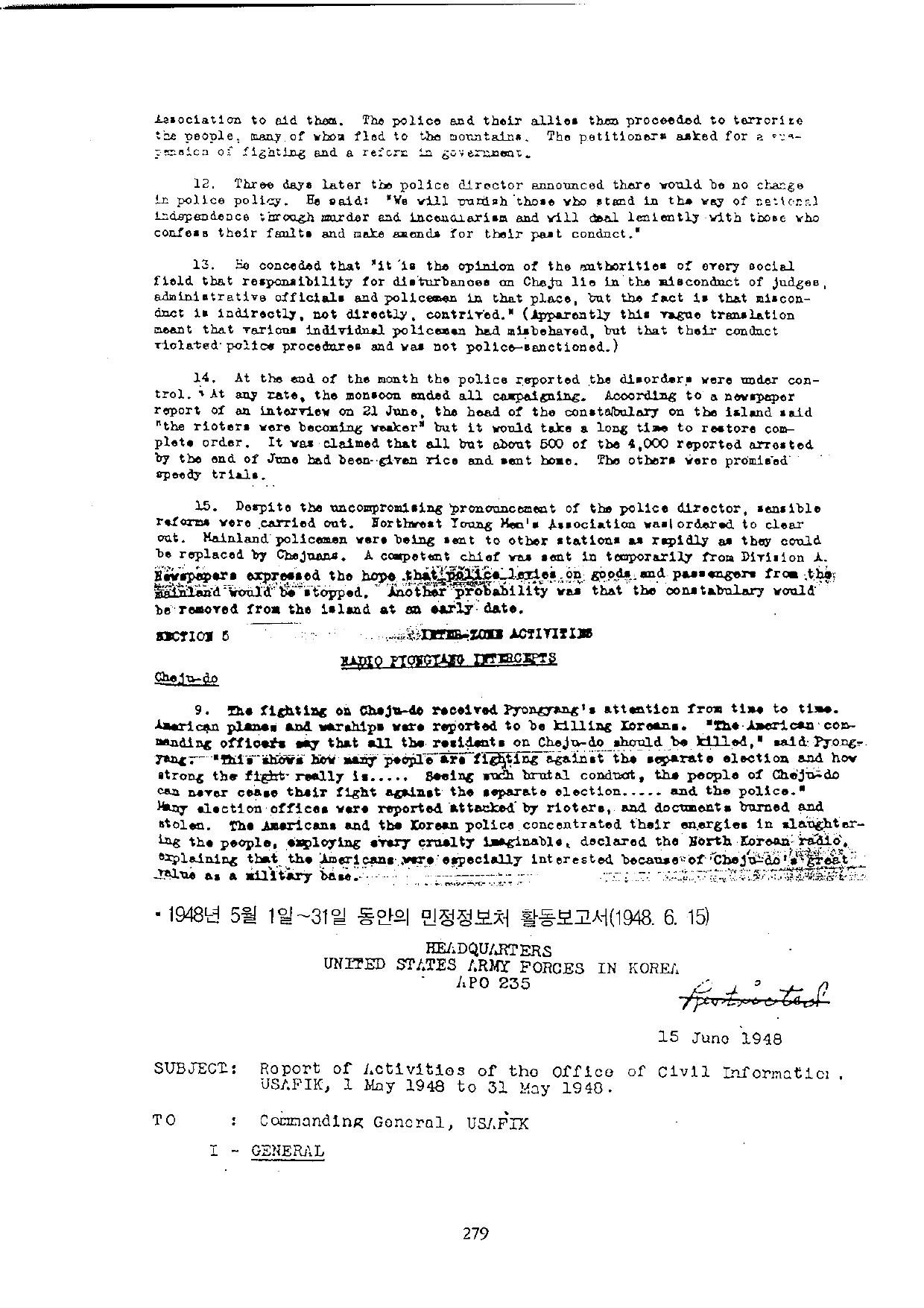
12. Three days later the police director announced there would be no change in police policy. He said: "We will punish those who stand in the way of national independence through murder and incendiarism and will deal leniently with those who confess their faults and make amends for their past conduct."
13. He conceded that "it is the opinion of the authorities of every social field that responsibility for disturbances on Cheju lie in the misconduct of judges, administrative officials and policemen in that place, but the fact is that misconduct is indirectly, not directly, contrived." (Apparently this vague translation meant that various individual policemen had misbehaved, but that their conduct violated police procedures and was not police-sanctioned.)
14. At the end of the month the police reported the disorders were under control. At any rate, the monsoon ended all campaigning. According to a newspaper report of an interview on 21 June, the head of the constabulary on the island said "the rioters were becoming weaker" but it would take a long time to restore complete order. It was claimed that all but about 500 of the 4,000 reported arrested by the end of June had been given rice and sent home. The others were promised speedy trials.
15. Despite the uncompromising pronouncement of the police director, sensible reforms were carried out. Northwest Young Men's Association was ordered to clear out. Mainland policemen were being sent to other stations as rapidly as they could be replaced by Chejuans. A competent chief was sent in temporarily from Division A. Newspapers expressed the hope that police levies on goods and passengers from the mainland would be stopped. Another probability was that the constabulary would be removed from the island at an early date.
SECTION 5
RADIO PYONGYANG ACTIVITIES
RADIO PIONGYANG INTERCEPTS
Cheju-do
9. The fighting on Cheju-do received Pyongyang's attention from time to time. American planes and warships were reported to be killing Koreans. "The American commanding officers say that all the residents on Cheju-do should be killed," said Pyongyang. "This shows how many people are fighting against the separate election and how strong the fight really is..... Seeing such brutal conduct, the people of Cheju-do can never cease their fight against the separate election..... and the police." Many election offices were reported attacked by rioters, and documents burned and stolen. The Americans and the Korean police concentrated their energies in slaughtering the people, employing every cruelty imaginable, declared the North Korean radio, explaining that the Americans were especially interested because of Cheju-do's great value as a military base. [illegible]
출처:
제주4·3사건진상규명및희생자명예회복위원회 편,
『제주4·3사건자료집 9』 [미국자료편],
번역문 p.31
/ 원문 p.276–279.
×
![]()