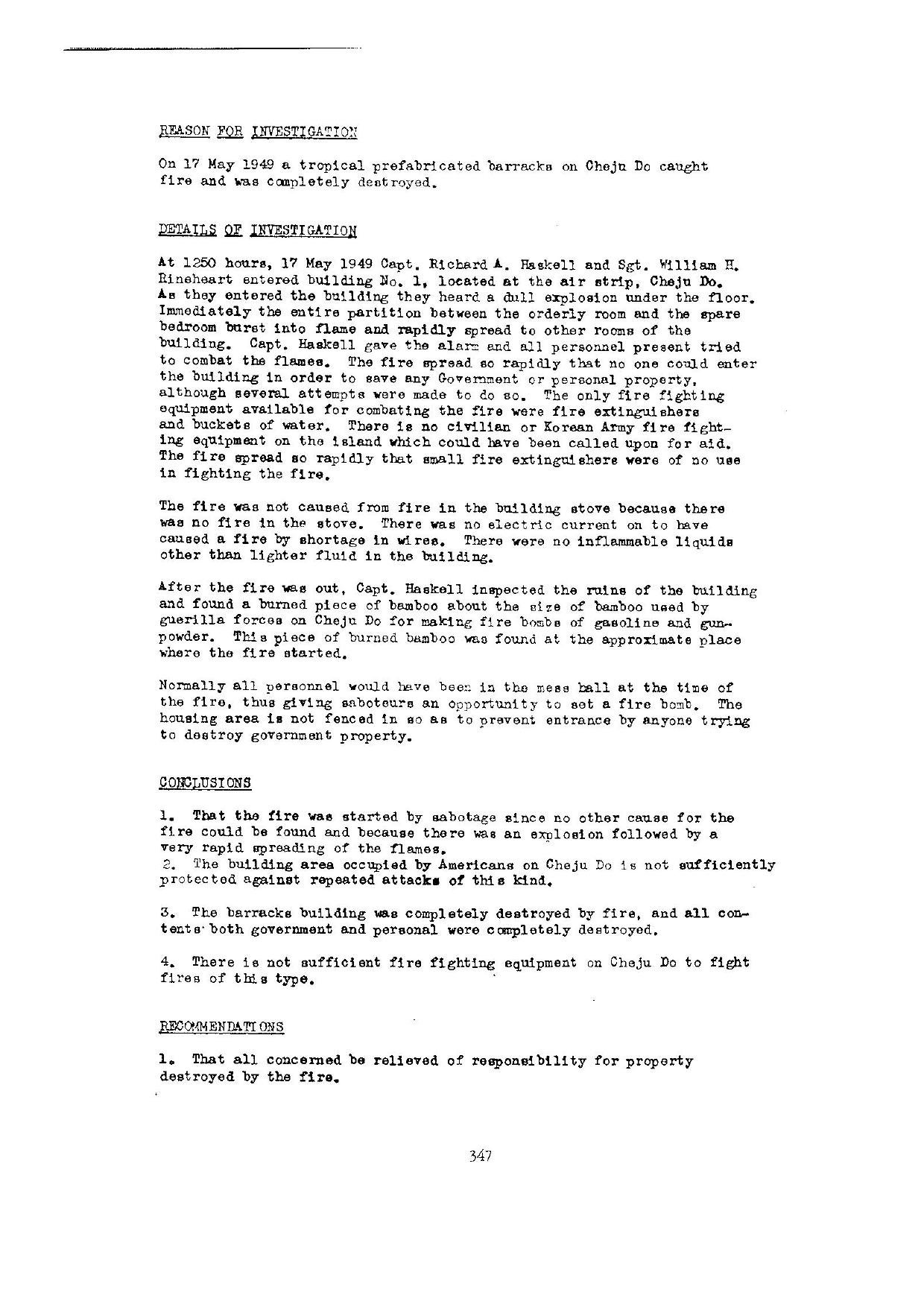
조사의 이유
1949년 5월 17일 제주도의 열대성 조립식 간이막사가 화염에 휩싸여 완전히 소실되었다.
조사내용
1949년 5월 17일 12시 50분 해스켈(Richard A. Haskell) 대위와 라인하트(William H. Rineheart) 하사관은 제주도 비행장에 위치한 1번 건물에 들어갔다. 그들이 건물에 들어섰을 때 그들은 마루 밑에서 둔한 폭발음을 들었다. 순식간에 잘 정돈된 방과 여분의 침실사이에 있는 부분의 전체가 불길에 휩싸였으며 이내 불길은 건물의 다른 방들로 번져나갔다. 해스켈 대위는 경보를 발령하였으며 현장의 모든 인원이 불을 끄기 위하여 노력하였다. 불길이 너무나 신속하게 번져서 몇 번 시도는 하였지만 아무도 건물 내부에 들어가서 정부 또는 개인의 재산을 구할 수 없었다. 가용한 유일한 소방 장비는 소화기와 물 양동이 뿐이었다. 제주도에는 도움을 청할 만한 소방 장비를 민간인과 군대 모두 갖추고 있지 않았다. 불길이 너무나 맹렬하게 번져서 소형 소화기는 불길을 잡는 데 아무런 소용이 없었다.
화재는 건물내의 난로에서 시작되지 않았다. 왜냐하면 난로는 당시에 불이 피어있지 않은 상태였다. 전기선의 부족으로 화재를 일으킬 전기가 흐르고 있지 않았다. 건물에는 라이터용 기름을 제외하고는 가연성 액체는 전혀 없었다.
불이 꺼진 후에 해스켈 대위는 건물의 잔해를 조사하여 제주도 게릴라들이 가솔린과 화약으로 대나무 폭탄을 만드는 데 사용하는 대나무 크기의 대나무 파편을 발견하였다. 이 불에 탄 대나무 파편은 화재가 시작된 장소로 여겨지는 곳에서 발견되었다. 일상적으로 화재가 났던 시간에 모든 인원들은 식당에 있게 되는데 이것이 파괴분자들에게 폭탄을 장치할 기회를 준 것 같다. 주거지역에는 정부재산을 파괴하려는 사람의 입장을 막기 위한 담장이 설치되어 있지 않다.
결론
1. 화재가 사보타주에 의하여 시작되었다는 것이다. 왜냐하면 그 이외의 다른 화재의 원인이 발견되지 않았으며 폭발음을 동반한 맹렬한 불길이 치솟았기 때문이다.
2. 제주도 주둔 미국인들이 확보하고 있는 건물지역은 반복된 이러한 종류의 공격에 대하여 충분히 보호되고 있지 않다.
3. 막사건물은 완전히 파괴되었으며 정부와 개인의 모든 물품이 완전히 소실되었다.
4. 제주도에는 이러한 화재를 진압할 소방 장비가 충분치 않다.
권고
1. 관련된 모든 인원은 화재로 인하여 파괴된 재산에 대한 책임에서 면제되어야 한다.
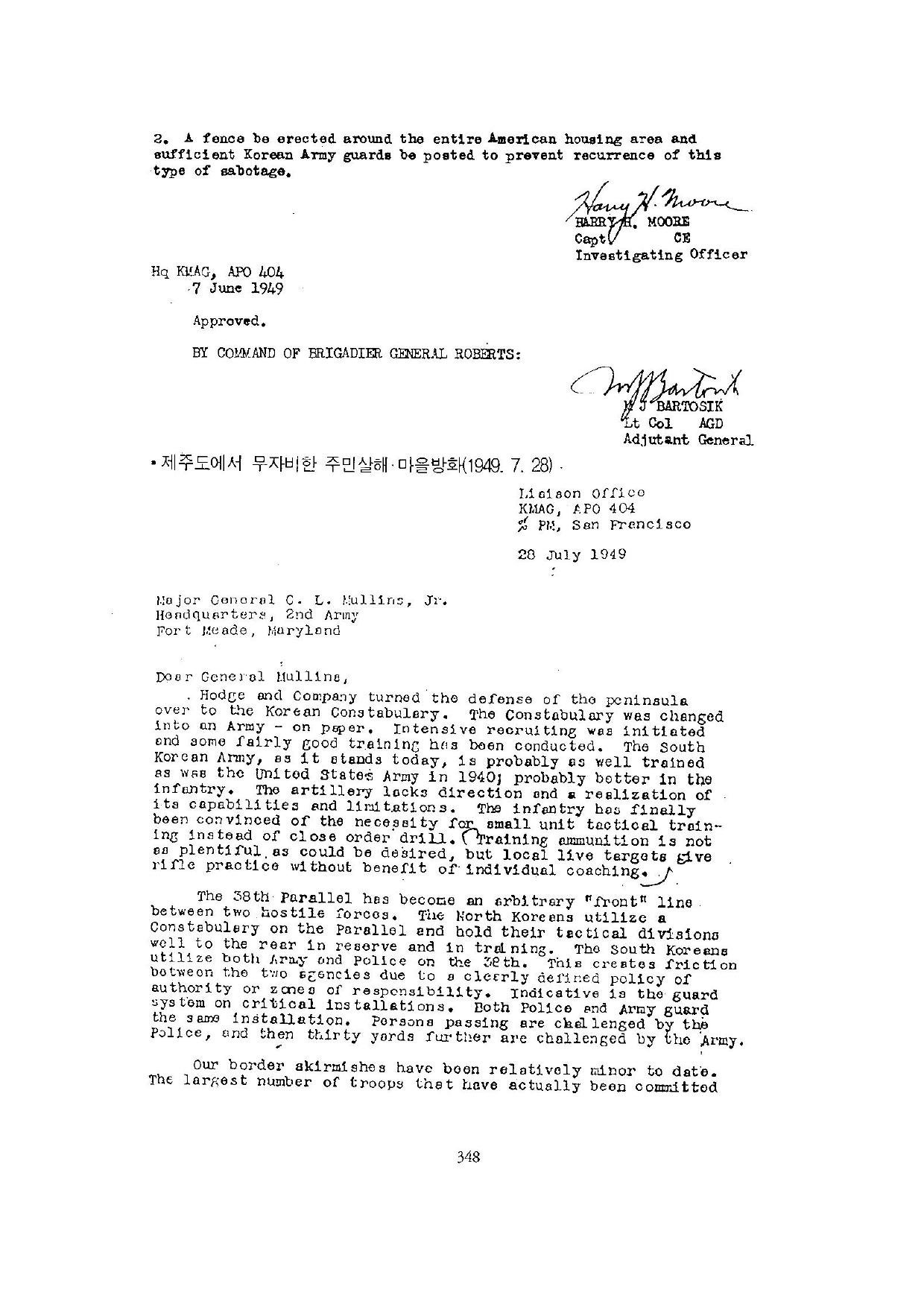
2. 미국인 거주지역 전체에 담장이 설치되어야 하며 이러한 사보타주의 재발 방지를 위하여 한국군 경비병들이 충분한 인원으로 배치되어야 한다.
1949년 6월 7일
미군사고문단 본부 조사관 해리 무어(Harry H. Moore) 대위
미군사고문단장 로버츠(Roberts)의 승인에 의하여
부관 바토식(M J Baotosik) 중령
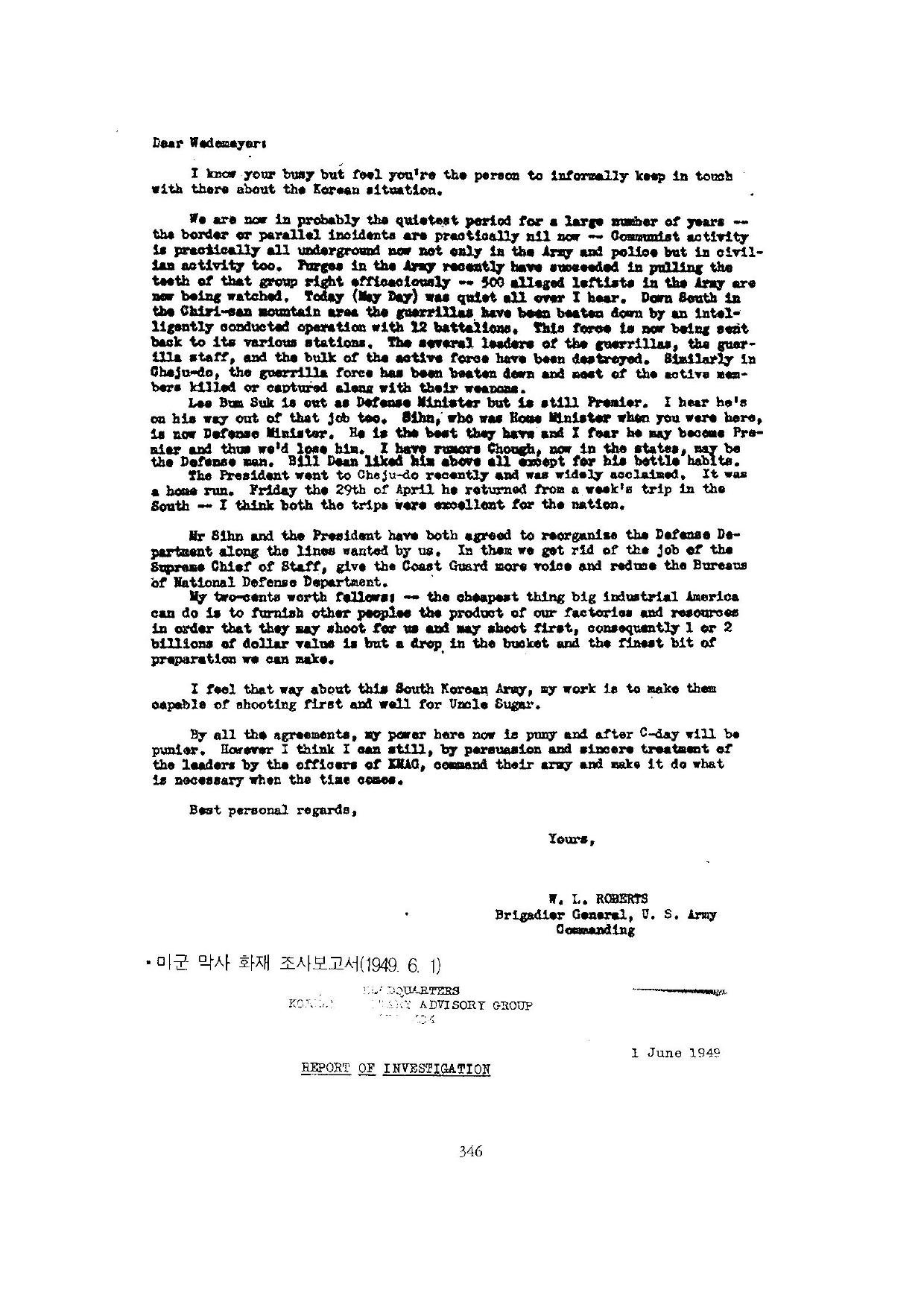
HEADQUARTERS
KOREAN ARMY ADVISORY GROUP
APO 4
1 June 1949
REPORT OF INVESTIGATION
REASON FOR INVESTIGATION
On 17 May 1949 a tropical prefabricated barracks on Cheju Do caught fire and was completely destroyed.
DETAILS OF INVESTIGATION
At 1250 hours, 17 May 1949 Capt. Richard A. Haskell and Sgt. William H. Rineheart entered building No. 1, located at the air strip, Cheju Do. As they entered the building they heard a dull explosion under the floor. Immediately the entire partition between the orderly room and the spare bedroom burst into flame and rapidly spread to other rooms of the building. Capt. Haskell gave the alarm and all personnel present tried to combat the flames. The fire spread so rapidly that no one could enter the building in order to save any Government or personal property, although several attempts were made to do so. The only fire fighting equipment available for combating the fire were fire extinguishers and buckets of water. There is no civilian or Korean Army fire fighting equipment on the island which could have been called upon for aid. The fire spread so rapidly that small fire extinguishers were of no use in fighting the fire.
The fire was not caused from fire in the building stove because there was no fire in the stove. There was no electric current on to have caused a fire by shortage in wires. There were no inflammable liquids other than lighter fluid in the building.
After the fire was out, Capt. Haskell inspected the ruins of the building and found a burned piece of bamboo about the size of bamboo used by guerilla forces on Cheju Do for making fire bombs of gasoline and gunpowder. This piece of burned bamboo was found at the approximate place where the fire started.
Normally all personnel would have been in the mess hall at the time of the fire, thus giving saboteurs an opportunity to set a fire bomb. The housing area is not fenced in so as to prevent entrance by anyone trying to destroy government property.
CONCLUSIONS
1. That the fire was started by sabotage since no other cause for the fire could be found and because there was an explosion followed by a very rapid spreading of the flames.
2. The building area occupied by Americans on Cheju Do is not sufficiently protected against repeated attacks of this kind.
3. The barracks building was completely destroyed by fire, and all contents both government and personal were completely destroyed.
4. There is not sufficient fire fighting equipment on Cheju Do to fight fires of this type.
RECOMMENDATIONS
1. That all concerned be relieved of responsibility for property destroyed by the fire.
2. A fence be erected around the entire American housing area and sufficient Korean Army guards be posted to prevent recurrence of this type of sabotage.
Harry N. Moore
BARRY R. MOORE
Capt CE
Investigating Officer
Hq KMAG, APO 404
7 June 1949
Approved.
BY COMMAND OF BRIGADIER GENERAL ROBERTS:
M J Bartosik
M J BARTOSIK
Lt Col AGD
Adjutant General
출처:
제주4·3사건진상규명및희생자명예회복위원회 편,
『제주4·3사건자료집 8』 [미국자료편],
번역문 p.140
/ 원문 p.346–348.
×
![]()