작전계획
발신 : 작전참모부 슈(M. W. Schewe) 중령
수신 : 작전참모 타이센(A. C. Tychsen) 대령
1. 24군단 G-3 타이센(Tychsen)대령의 지시에 따라 슈(Schewe) 중령은 48년 4월 27일 항공편으로 제주도로 향하였다. 그의 임무는 제주도 주둔 59군정중대장 맨스필드(John Mansfield) 중령을 만나서 섬의 상황을 평가하고 활동을 관찰하며 제주도의 민간인에 대한 통제와 게릴라 활동을 약화시키기 위하여 맨스필드 중령이 제안한 계획을 확인하는 것이었다. 결과보고가 사령부에 제출될 것이다.
2. 27일 12시에 제주도에 도착하자마자 슈 중령은 맨스필드 중령을 그의 본부로 찾아가서 함께 공항으로 향했으며 그곳에서 그들은 20연대장 브라운 대령, 제주도 주둔 20연대 병력을 책임지고 있는 게이스트(Geist) 소령, 그리고 한국 5연대 고문관 드루스(De Reus) 대위 등과 상황을 논의하였다. 브라운 대령은 맨스필드 중령에게 제주도 상황의 처리에 관하여 주한미군사령관의 지시사항을 고지하였다.
지시사항:
a. 경비대는 즉시 임무를 수행하여야 한다.
b. 모든 종류의 시민 무질서는 종식되어야 한다.
c. 게릴라 활동을 신속히 약화시키기 위하여 경비대와 경찰사이에 확실한 결속이 이루어져야 한다.
d. 미군은 개입하지 말아야 한다.
브라운 대령은 맨스필드에게 현재 가용한 한국군으로 상황을 장악할 수 있는지 여부에 대하여 질문하였고 맨스필드는 그렇다고 대답하였다.
3. 첨부된 지도는 현지 진행중이거나 계획된 활동을 나타낸다.
a. 제주도의 한국 5연대 전 병력은 4월 27일 12시 30분에 시작하여 마을을 휩쓸었다. 항공관측자들(6사단 소속 조종사 포인덱스터(Poindexter) 중위, 미군정 소속 번즈(Burns) 대위)은 통위부 부대가 매우 잘 임무를 수행하고 있다고 보고하였다. 즉, 바다로 향한 모든 출구와 모든 도로는 봉쇄되었고 경비부대들은 질서정연하게 거리를 행진하여 가옥과 건물로 들어갔다. 이 보고는 자동차로 마을에 들어간 한국 5연대 고문관 드루스에 의하여 확인되었다. 슈 중령은 드루스와 동행하지 않았는데 그 이유는 맨스필드와 드루스가 작전하는 동안에 많은 숫자의 미군이 함께 있는 것은 바람직하지 않다는 권고 때문이었다.
작전은 마을로 통하는 모든 출구를 봉쇄하고 가옥을 수색하여 숨겨진 무기, 삽, 곡괭이, 도끼, 전선절단기 등을 찾아내고 또 용의자, 단체 조직가, 공산주의자들을 색출하는 것이었다. 경찰은 군대의 감독 하에 작전에 참가해서 민간인 인사들을 수색하는 것이었다. 모든 작전은 5연대장 김 대령의 진두지휘 하에서 이루어졌다.
마을을 휩쓴 결과는 매우 부정적이었다. 주목할 만한 점은 마을에 젊은이는 거의 없었으며 밖에서도 눈에 띄지 않았다. 경찰이 마을 여인들에게 마을 젊은이들이 모두 어디 있는지 물었을 때 그들은 세 종류의 대답을 하였다. (1) 나의 남편은 죽었다. (2) 나의 남편은 본토에 있다. (3) 나의 남편은 일본으로 갔다. 남편이 없다고 대답한 사람은 거의 없었으며 이러한 진술은 대개 거짓이었는데 더 자세한 질문을 하면 “모른다”고 대답을 바꿔버렸다.
메모 : 위의 진술은 4월 27일 제주에서 김 대령(통역을 통하여), 드루스 대위, 메리트(Merritt) 씨(군정 CID) 등이 슈 중령에게 한 내용이다.
b. 4월 28일에 행해질 2번 작전계획은 경비대의 김 대령, 문 소령, 드루스 대위, 한국경찰 고문관 번즈 대위, 그리고 메리트씨 등에 의하여 철저히 논의되었다. 슈 중령은 시종일관 그 논의에 참석하였지만 오직 참관만 하였다. 그러나 그는 주한미군사령관은 제주도에서 작전은 성공하여야 하고 더 나아가서 제주도에서 한국안보를 책임진 군대의 성패에 대하여 남한인민들의 시선이 집중되어 있다는 점을 진지하게 받아들이고 있다고 김 대령에게 말하였다. 이러한 이유로 김 대령은 절대로 실패해서는 안되었다. 김 대령은 정확히 이해하였으며 경비대는 임무를 수행할 것이라고 말하였다.
c. 2번 작전, 4월 28일
제주의 5연대 병력은 오전 10시에 트럭과 행군으로 야영지로 이동해서 마을들을 휩쓸기 시작했다. 슈 중령은 L-5기 안에서 공중으로부터 작전의 시작을 참관하였다. 행군은 질서정연하였고 잘 훈련되어 있었으며 부대원들은 신속히 트럭에서 내려서 진영을 갖춘 다음 임무를 수행하기 시작하였다. 모든 민간인들은 도로에서 정지당했으며, 도로상과 마을에 있었던 민간인들은 모두 행군을 하여 한군데 중앙집결지로 모여졌다. 이러한 작전은 6, 7, 8, 9번의 네 개 마을에서 실시되었고 질서정연히 이루어졌다. 경비대 병력이 가옥과 건물들로 진입하는 것이 관찰되었다. 공중에서 더 이상의 관찰은 불가능했다. 슈 중령은 오전 11시 50분에 59군정중대 본부로 되돌아 왔으나 작전에 관한 아무런 보고도 받지 못하였다. 그는 오후 12시 40분에 중대본부를 출발하여 비행장으로 떠나서 사령부로 복귀하였다.
4. 장래의 작전
a. 3번 작전-맨스필드 중령은 4월 28일 12시에 다음과 같이 말하였다. 4월 29일의 작전은 5연대와 9연대가 제주와 모슬포에서 시작하여 노루악을 향하여 휩쓸 것인데 그 이유는 무장대들이 그 쪽 오름에 있다고 판단되기 때문이다.
b. 4번 작전-4월 30일. 5연대는 4번지역의 마을들을 휩쓴다.
c. 5번 작전-5연대와 9연대는 교래리쪽의 오름들을 휩쓴다. (임시 작전일, 5월 1일)
d. 장래의 작전은 진행중인 작전에서 얻어진 결과에 달려있다.
5. 슈 중령의 제주도 상황에 대한 평가
a. 59미군 군정중대장이 현재 제주도에 있는 병력을 확실히 통솔한다면 제주도에 있는 현재의 병력만으로도 상황을 진정시키는데 충분하다.
b. 공산주의자들과 게릴라 세력이 오름들에 있기 때문에 그들을 진압하기 위해서는 신속하고 활발한 작전이 요구된다.
c. 경찰과 대동청년단원들이 너무나 정력적으로 행동해왔기 때문에 양민들은 반경찰적이고 따라서 그들은 경찰에게 협력하지 않을 것이며 한다고 하더라도 그것은 오직 공포심 때문이다.
d. 현재 게릴라의 숫자는 1,000명에서 2,000명 사이로 추정되며 소단위로 넓게 산재해 있다.
e. 제주도에서 작전을 하고 있는 부대들 간에 원활한 통신을 위하여 양질의 라디오 통신장비가 필요하다.
f. 1948년 4월 28일 이전의 작전은 상황이 공격적인 작전을 정당화시킴에도 불구하고 그렇게 공격적이지는 않았다.
24군단 작전참모부소속 중령 슈(M. W. Schewe)
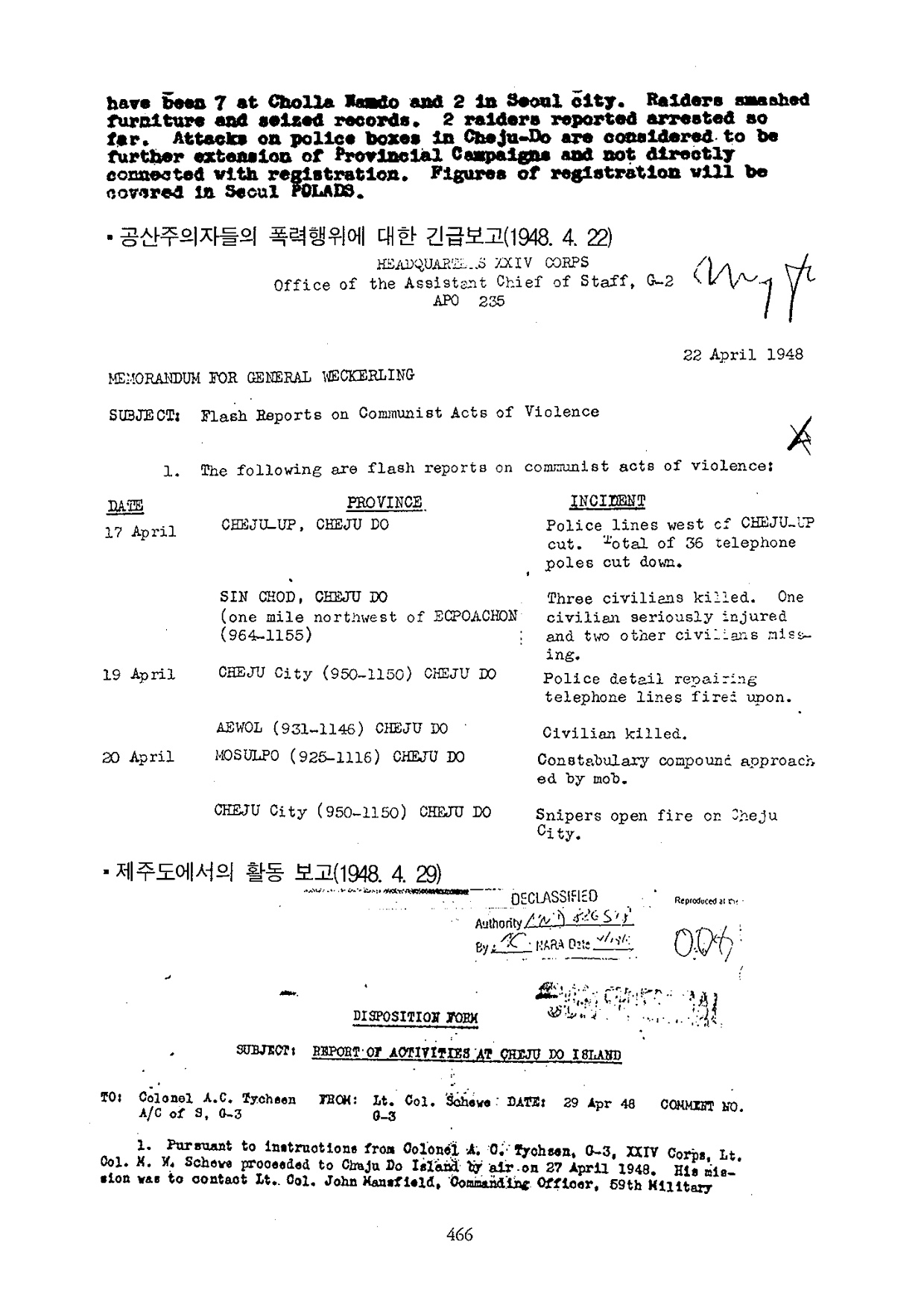
DECLASSIFIED
Authority [illegible] S26 S1j
By [illegible] NARA Date [illegible]
Reproduced at the [illegible]
DISPOSITION FORM
SUBJECT: REPORT OF ACTIVITIES AT CHEJU DO ISLAND
TO: Colonel A.C. Tychsen FROM: Lt. Col. Scheve DATE: 29 Apr 48 COMMENT NO.
A/C of S, G-3 G-3
1. Pursuant to instructions from Colonel A. C. Tychsen, G-3, XXIV Corps, Lt. Col. M. M. Scheve proceeded to Cheju Do Island by air on 27 April 1948. His mission was to contact Lt. Col. John Mansfield, Commanding Officer, 59th Military
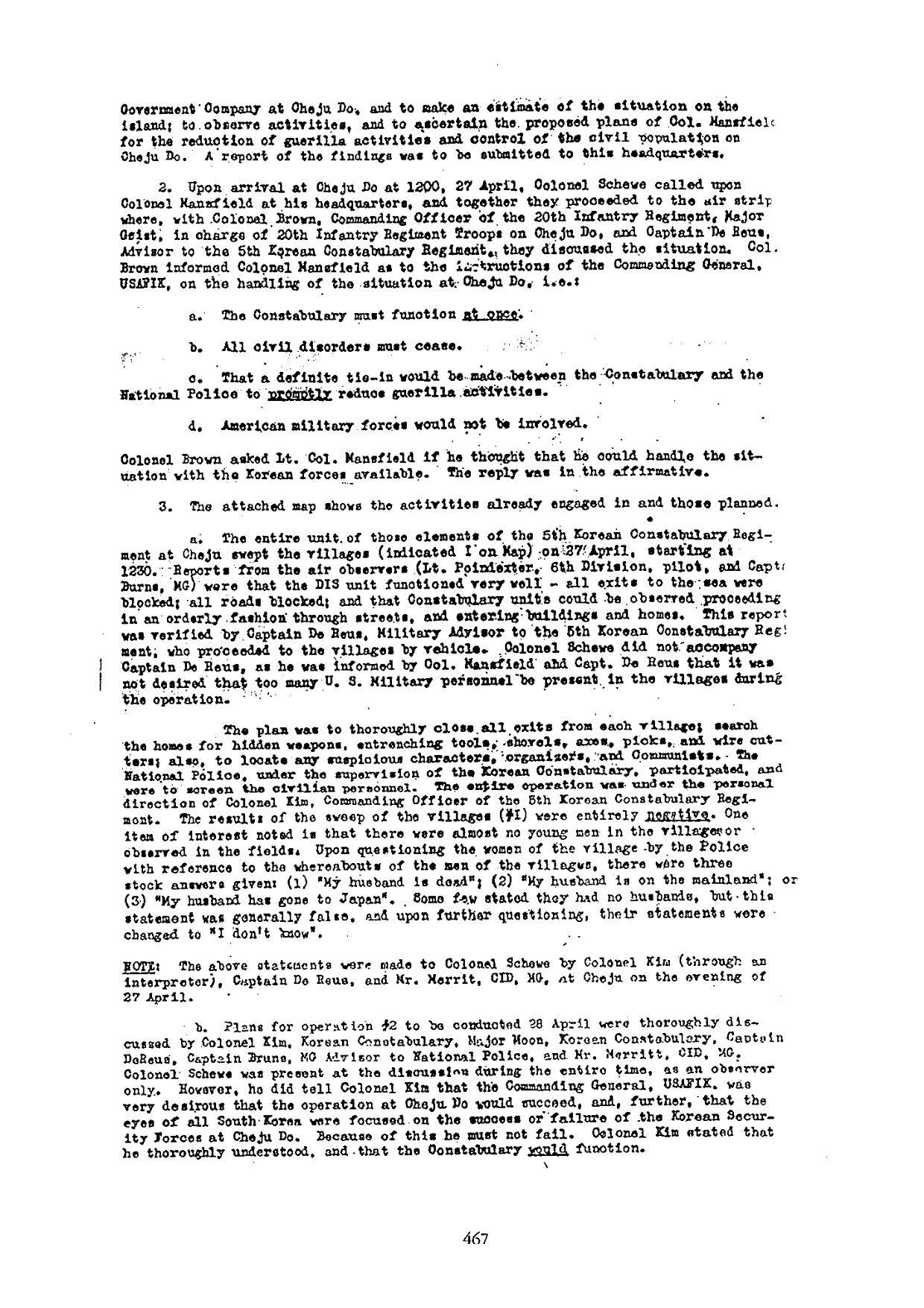
Government Company at Cheju Do, and to make an estimate of the situation on the island; to observe activities, and to ascertain the proposed plans of Col. Mansfield for the reduction of guerilla activities and control of the civil population on Cheju Do. A report of the findings was to be submitted to this headquarters.
2. Upon arrival at Cheju Do at 1200, 27 April, Colonel Schewe called upon Colonel Mansfield at his headquarters, and together they proceeded to the air strip where, with Colonel Brown, Commanding Officer of the 20th Infantry Regiment, Major Geist, in charge of 20th Infantry Regiment Troops on Cheju Do, and Captain De Reus, Advisor to the 5th Korean Constabulary Regiment, they discussed the situation. Col. Brown informed Colonel Mansfield as to the instructions of the Commanding General, USAFIK, on the handling of the situation at Cheju Do, i.e.:
a. The Constabulary must function at once.
b. All civil disorders must cease.
c. That a definite tie-in would be made between the Constabulary and the National Police to promptly reduce guerilla activities.
d. American military forces would not be involved.
Colonel Brown asked Lt. Col. Mansfield if he thought that he could handle the situation with the Korean forces available. The reply was in the affirmative.
3. The attached map shows the activities already engaged in and those planned.
a. The entire unit of those elements of the 5th Korean Constabulary Regiment at Cheju swept the villages (indicated I on Map) on 27 April, starting at 1230. Reports from the air observers (Lt. Pointexter, 6th Division, pilot, and Capt. Burns, MG) were that the DIS unit functioned very well - all exits to the sea were blocked; all roads blocked; and that Constabulary units could be observed proceeding in an orderly fashion through streets, and entering buildings and homes. This report was verified by Captain De Reus, Military Advisor to the 5th Korean Constabulary Regiment, who proceeded to the villages by vehicle. Colonel Schewe did not accompany Captain De Reus, as he was informed by Col. Mansfield and Capt. De Reus that it was not desired that too many U. S. Military personnel be present in the villages during the operation.
The plan was to thoroughly close all exits from each village; search the homes for hidden weapons, entrenching tools, shovels, axes, picks, and wire cutters; also, to locate any suspicious characters, organizers, and Communists. The National Police, under the supervision of the Korean Constabulary, participated, and were to screen the civilian personnel. The entire operation was under the personal direction of Colonel Kim, Commanding Officer of the 5th Korean Constabulary Regiment. The results of the sweep of the villages (#1) were entirely negative. One item of interest noted is that there were almost no young men in the villages or observed in the fields. Upon questioning the women of the village by the Police with reference to the whereabouts of the men of the villages, there were three stock answers given: (1) "My husband is dead"; (2) "My husband is on the mainland"; or (3) "My husband has gone to Japan". Some few stated they had no husbands, but this statement was generally false, and upon further questioning, their statements were changed to "I don't know".
NOTE: The above statements were made to Colonel Schewe by Colonel Kim (through an interpreter), Captain De Reus, and Mr. Merrit, CID, MG, at Cheju on the evening of 27 April.
b. Plans for operation #2 to be conducted 28 April were thoroughly discussed by Colonel Kim, Korean Constabulary, Major Moon, Korean Constabulary, Captain DeReus, Captain Bruns, MG Advisor to National Police, and Mr. Merritt, CID, MG. Colonel Schewe was present at the discussion during the entire time, as an observer only. However, he did tell Colonel Kim that the Commanding General, USAFIK, was very desirous that the operation at Cheju Do would succeed, and, further, that the eyes of all South Korea were focused on the success or failure of the Korean Security Forces at Cheju Do. Because of this he must not fail. Colonel Kim stated that he thoroughly understood, and that the Constabulary would function.
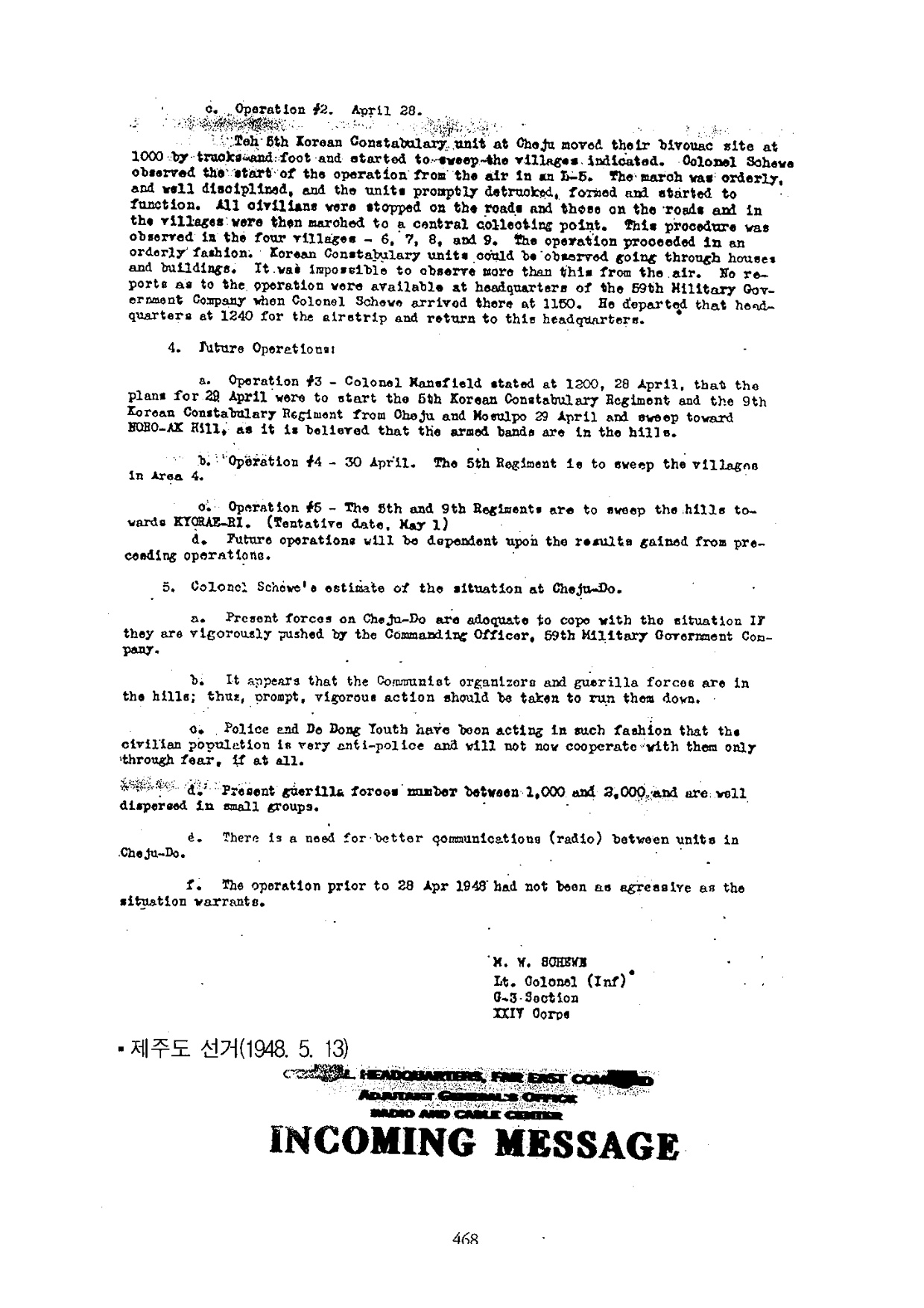
c. Operation #2. April 28.
Teh 6th Korean Constabulary unit at Cheju moved their bivouac site at 1000 by trucks and foot and started to sweep the villages indicated. Colonel Schewe observed the start of the operation from the air in an L-5. The march was orderly, and well disciplined, and the units promptly detrucked, formed and started to function. All civilians were stopped on the roads and those on the roads and in the villages were then marched to a central collecting point. This procedure was observed in the four villages - 6, 7, 8, and 9. The operation proceeded in an orderly fashion. Korean Constabulary units could be observed going through houses and buildings. It was impossible to observe more than this from the air. No reports as to the operation were available at headquarters of the 59th Military Government Company when Colonel Schewe arrived there at 1150. He departed that headquarters at 1240 for the airstrip and return to this headquarters.
4. Future Operations:
a. Operation #3 - Colonel Mansfield stated at 1200, 28 April, that the plans for 29 April were to start the 6th Korean Constabulary Regiment and the 9th Korean Constabulary Regiment from Cheju and Mosulpo 29 April and sweep toward HOBO-AK Hill, as it is believed that the armed bands are in the hills.
b. Operation #4 - 30 April. The 5th Regiment is to sweep the villages in Area 4.
o. Operation #5 - The 5th and 9th Regiments are to sweep the hills towards KYORAE-RI. (Tentative date, May 1)
d. Future operations will be dependent upon the results gained from preceding operations.
5. Colonel Schewe's estimate of the situation at Cheju-Do.
a. Present forces on Cheju-Do are adequate to cope with the situation IF they are vigorously pushed by the Commanding Officer, 59th Military Government Company.
b. It appears that the Communist organizers and guerilla forces are in the hills; thus, prompt, vigorous action should be taken to run them down.
c. Police and De Dong Youth have been acting in such fashion that the civilian population is very anti-police and will not now cooperate with them only through fear, if at all.
d. Present guerilla forces number between 1,000 and 3,000 and are well dispersed in small groups.
e. There is a need for better communications (radio) between units in Cheju-Do.
f. The operation prior to 28 Apr 1948 had not been as aggressive as the situation warrants.
M. W. SCHEWE
Lt. Colonel (Inf)
G-3 Section
XXIV Corps
■ 제주도 선거(1948. 5. 13)
INCOMING MESSAGE
UNCLASSIFIED
PRIORITY
13 May 48
FROM : CG USAFIK
TO : CINCFE (G-2)
NR : GBI-5069
This is G-2 Highlight 145. 13 May 48.
Re election on Chefu Do. according to report brought back by Staff Off yesterday 40 out of a total of 221 dists failed to have any votes cast either because election officials had dis- appeared or voters had disappeared. Judging fr the few ballot boxes which have already been opened. about 90% of the registrants in the operating districts voted.
New subj. As for the rest of South Korea, since election day we have recd a few reports of isolated attempts to kill police or burn police boxes.
I believe the Communists have definitely crawled into their holes but I make no prediction as to how long they will stay there.
출처:
제주4·3사건진상규명및희생자명예회복위원회 편,
『제주4·3사건자료집 7』 [미국자료편],
번역문 p.237
/ 원문 p.466–468.
×
![]()