스캔 원본
100%
p.16
p.17
p.18
p.19
p.20
p.21
p.22
p.23
p.24
p.25
p.26
p.27
p.28
p.29
p.30
p.31
p.32
p.33
p.34
p.35
(6) 소극적인 태도들
경찰의 보안 업무: 경찰은 무장한 반란군의 지휘관인 손 장관의 명령 하에서 남부 지역의 무장 반란군들의 집중된 활동을 거의 모두 해제하지 못했다. 특히 주목할 만한 것은 조주 상황이었다. 여기서 취급된 SFO 무장 반란군은 2% 이하로 감소했으며, 그 이후 원래 남았던 것들은 임시 기간 동안 섬에 남아있었다.
주요 계속적인 작전들은 동안에 반란군 또는 게릴라 부대들을 포함하고 있으며, 최선의 가능한 추정은 SFO가 2%로 나누어진 작은 분산된 그룹들에 범위가 있다는 것이다. 이 그룹들은 계속해서 주변 섬의 SFO와 일반적으로 작동된다.
광범위한 선별 프로그램에도 불구하고 육군 부대로부터 새로운 축적된 결함들이 있었다는 것은 분명했다 - 작지만 유효한 좌익 요소가 여전히 육군 및 경찰에서 기능할 수 있었던 반면, 경찰은 비공식적으로 체포했다.
반란군 선전은 불변했으며 차별 어려움 때문에 상대적으로 약간의 성공만 있었다.
C. 심리 작전
(1) 민간 인구에 대한 태도
변화 없음.
(2) 무장 반란군에 대한 태도: 정부, 미군, 미합중국, F.B.I. 및 기타 정부 기관의 태도는 정부 및 경찰 정책 입안에 중요하다.
변화 없음.
(3) 선전 전파의 무능력
낮은 문해율과 정치적 순진함의 제한된 범위 내에서, 낮은 사회 지위를 가진 한국 인민은 특히 일상 생활의 물질적 측면과 거래할 때 선전에 영향을 받기 쉽다. 신뢰 제목은 덜 효과적이다.
(4) 국내 및 외국 선전이 민간인에게 미치는 영향, 특히 시골 지역
국내 선전 선전은 도시 지역에서 널리 읽혀지고 있으며, 특히 도시 지역에 있으며 정부 선거에 따른다. 라디오, 극장, 영화 및 정기 간행물이 사용되는 주요 매체는 시골 지역에서도 사용된다.
상당한 과잉 행위는 대규모 부분의 인구 밀도와 관련된 정부의 선전 밀도에서 감지되었으며, 신앙의 랭크에서 현저한 감소가 있었다.
- 국내 및 "국외" 국경 선전은 독점적이지만, 오직 일부 청취자에게만 도달한다
고무 응고기. 이는 중요한 실험실 장비 중 하나로서 Chosen Fat and Oil Company의 화학 산업과 상업 및 군사용으로 사용될 수 있는 고무 응고 장치의 개발과 관련된 것이다. 실험실 시설은 아직 설정되지 않았으나 목적을 위해 필요한 장비와 공급품이 부족하다. 공학 대학의 조사에 따르면 과학 장비 및 공급품의 상당한 부족이 나타났다. LDA가 이러한 부족의 큰 부분을 담당해야 하는 것으로 보인다.
중앙 연구소는 상업부의 역사 확립과 관련되어 있으며, 주로 재료의 테스트와 표준 확립을 다룬다. 현재 이 실험실의 활동 중 하나는 다양한 유형의 목재 섬유를 테스트하는 것이다. 이 실험실은 또한 IDA 요청에 포함된 현대 연구 장비가 사용되고 있다.
정부 당국은 중앙 연구소에서 냉연료 연구 단위를 설립하기 위해 20,000,000원을 배정하는 과정 중에 있다. 이것은 역청유와 액체 석탄에 대한 실험을 허용할 것이다.
지질학 조사는 대략 20개의 기술 장비 및 기술 상담소의 부족을 조사했다. 이 모든 필요가 충족되지 않을 수 있다고 예상된다.
현재 진행 중인 연구 제공 자료는 한국군에 제한된 자금, 자연 자원, 장비 및 기술 노하우의 제약으로 인해 제한된다. 이러한 제약은 장기적 관점에서 몇 가지 이점을 제공해야 한다.
(2) 한국 정부의 기술 훈련 프로그램은 공학 대학의 활동을 상당히 확장했다. 추가 예산에는 조직 및 개선 비용을 포함하는 US$1,000,000 원화가 포함되어 있다. 이것은 대학 시설 개선과 비교할 때 상당한 지원을 나타낸다. 한국 경제 복구 프로그램의 광업과 같은 주요 활동 분야와 관련된 기술 및 과학 교육을 제공할 수 있도록 LDA가 공학 대학을 지원해야 한다는 점이 중요한 단계이다. 미국 기술 연구소와의 긴밀한 협력은 한국에서 기술 훈련 기관을 수행하는 데 중요하다.
기술 훈련 프로그램의 가장 중요한 프로젝트는 기술 훈련소일 것이다. 이 기관은 신중하게 선택된 한국 기술자 및 기술자로 구성될 것이며, 한국 교사, 기술자, 직업 강사, 기술자 감독자 및 상점 감독자의 실제 적용에서 기술 기술 및 관련 감독 및 관리 기술을 훈련할 것이다. 훈련은 한국 경제 복구 프로그램의 광업과 같은 주요 활동 분야와 관련된 활동을 다루는 기관에서 주로 진행될 것이다.
전쟁부 일반참모본부 정보보고 한국 상황에 대한 군사적 평가
보고일: 1949년 6월 1일
보고 기간: 1949년 3월 1일~6월 1일
(4) 1949년 6월 1일 현재 한국군 배치 현황
a. 한국육군
2연대 사령부
제주읍
952-1152
1대대
서귀포
952-1119
2대대
제주
952-1152
3대대
춘천
1070-1682
유격대대
수원
1002-1609
c. 경찰
11. 제주도 경찰청 제주 951-1152 경찰서 4곳 지서 33곳
(6) 파괴 활동
엄선된 장교들의 지휘를 받는 특수부대가 남부 도 지역과 제주도의 무장 폭도를 대부분 소탕했다.
무장 폭도의 인원이 300명에서 50명 이하로 감소한 제주도의 상황이 특히 희망적이다. 궁핍의 여파는 아직 있으나 제주도의 소요는 일시적으로나마 끝난 것으로 보인다.
본토에서는 지속적인 인원 손실로 폭도나 게릴라 부대의 인원이 절반으로 줄었다. 입수 가능한 최선의 추산에 따르면 그 수는 500명을 넘지 않으며, 그들은 소규모 게릴라 집단으로 쪼개져 있다. 그들은 전라도와 경상도에서 가장 성공적으로 활동 중이다.
군대 내 불순 분자를 제거하기 위한 엄격한 검열이 진행되고 있으나, 5월에 발
생한 공산주의자 주도의 탈영은 육군과 해군 내에 소규모 좌익분자들이 여전히 유효하게 활동하고 있음을 보여준다. 반면 경찰은 근본적인 충성심을 유지하고 있다.
파괴 선동은 변화가 없으며 배포의 어려움 때문에 거의 성공을 거두지 못했다.
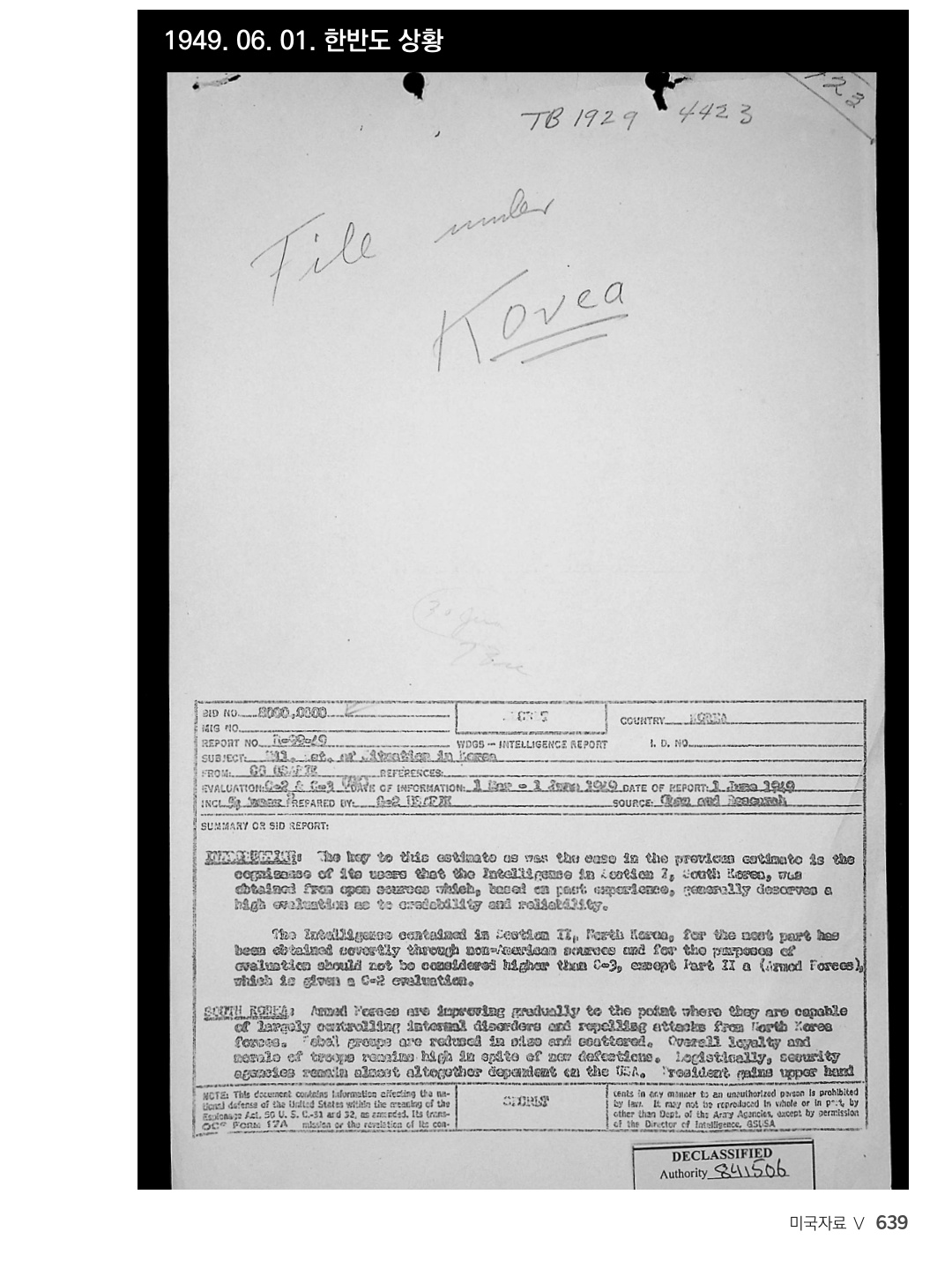
TB 1929 4423
File number
Korea
SID NO. 3000.0300 [illegible] COUNTRY KOREA
ISIS NO.
REPORT NO. Re[illegible]9 WDGS – INTELLIGENCE REPORT I. D. NO.
SUBJECT: Mil. et. at. Situation in Korea
FROM: G2 USAFIK REFERENCES:
EVALUATION: B-2 & C-3 SOURCE OF INFORMATION: 1 Sep - 1 June 1949 DATE OF REPORT: 1 June 1949
INCL. 9; [illegible] PREPARED BY: [illegible] G2 USAFIK SOURCE: G2 and Research
SUMMARY OR SID REPORT:
REMEMBER: The key to this estimate as was the case in the previous estimate is the cognizance of its users that the intelligence in Section I, South Korea, was obtained from open sources which, based on past experience, generally deserves a high evaluation as to credibility and reliability.
The Intelligence contained in Section II, North Korea, for the most part has been obtained covertly through non-American sources and for the purposes of evaluation should not be considered higher than C-3, except Part II a (Armed Forces), which is given a C-2 evaluation.
SOUTH KOREA: Armed Forces are improving gradually to the point where they are capable of largely controlling internal disorders and repelling attacks from North Korea forces. Rebel groups are reduced in size and scattered. Overall loyalty and morale of troops remain high in spite of new defections. Logistically, security agencies remain almost altogether dependent on the USA. President gains upper hand
NOTE: This document contains information affecting the national defense of the United States within the meaning of the
Espionage Act, 50 U. S. C.-31 and 32, as amended. Its trans[illegible] Bonus 17A [illegible] or the rendition of its con-
SECRET
ents in any manner to an unauthorized person is prohibited by law. It may not be reproduced in whole or in part, by other than Dept. of the Army Agencies, except by permission of the Director of Intelligence, GSUSA.
DECLASSIFIED
Authority 841506
SECRET
REPORT NO. [illegible]
PAGE NO. 2
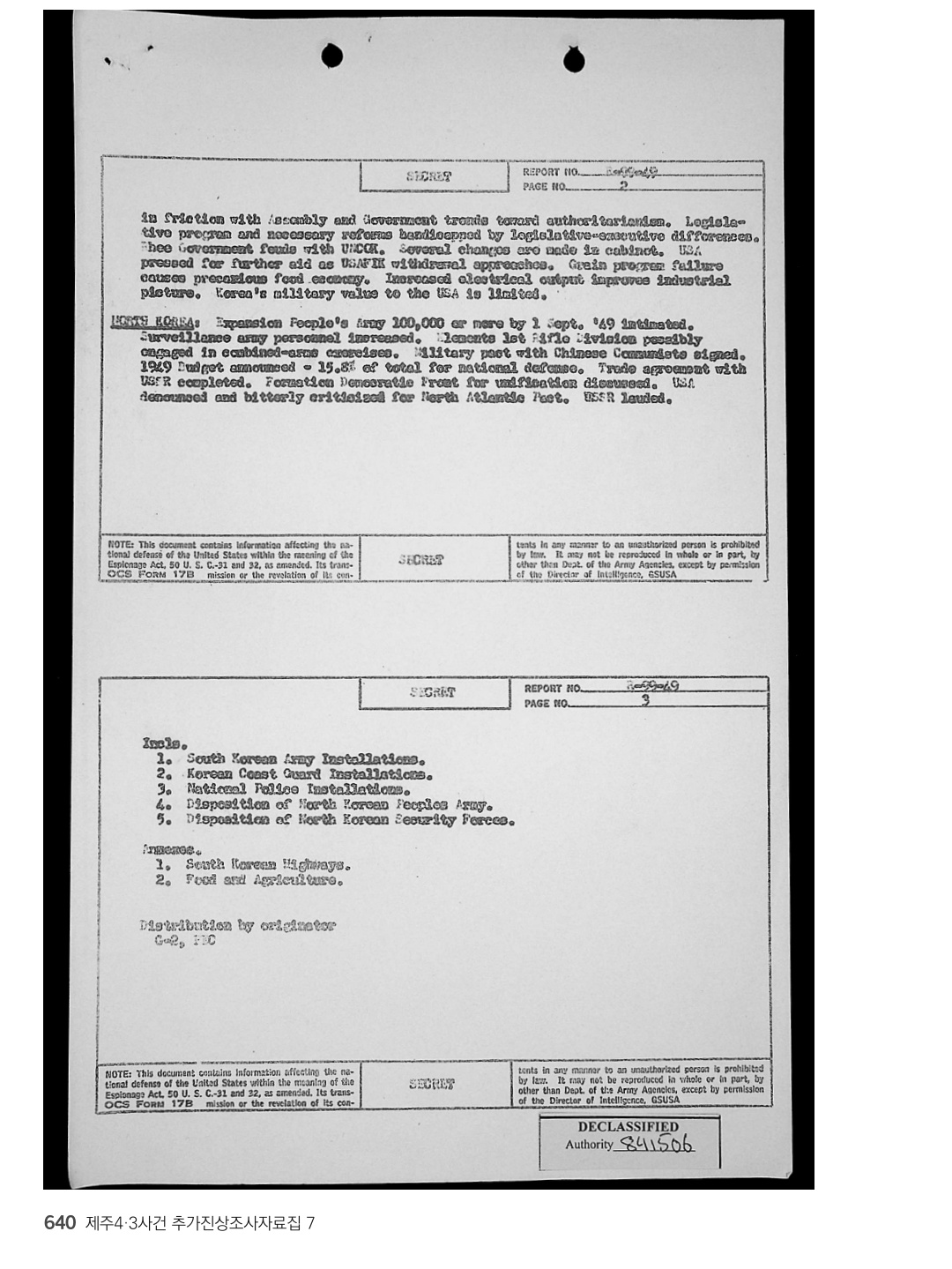
in friction with Assembly and Government trends toward authoritarianism. Legislative program and necessary reforms handicapped by legislative-executive differences. Thee Government feuds with UNCOK. Several changes are made in cabinet. USA pressed for further aid as USAFIK withdrawal approaches. Grain program failure causes precarious food economy. Increased electrical output improves industrial picture. Korea's military value to the USA is limited.
NORTH KOREA: Expansion People's Army 100,000 or more by 1 Sept. '49 intimated. Surveillance army personnel increased. Elements 1st Rifle Division possibly engaged in combined-arms exercises. Military pact with Chinese Communists signed. 1949 Budget announced - 15.8% of total for national defense. Trade agreement with USSR completed. Formation Democratic Front for unification discussed. USA denounced and bitterly criticized for North Atlantic Pact. USSR lauded.
NOTE: This document contains information affecting the national defense of the United States within the meaning of the Espionage Act, 50 U. S. C-31 and 32, as amended. Its transmission or the revelation of its con-
SECRET
tents in any manner to an unauthorized person is prohibited by law. It may not be reproduced in whole or in part, by other than Dept. of the Army Agencies, except by permission of the Director of Intelligence, GSUSA
---
SECRET
REPORT NO. [illegible]-49
PAGE NO. 3
Incls.
1. South Korean Army Installations.
2. Korean Coast Guard Installations.
3. National Police Installations.
4. Disposition of North Korean Peoples Army.
5. Disposition of North Korean Security Forces.
Images.
1. South Korean Highways.
2. Food and Agriculture.
Distribution by originator
G-2, FEC
NOTE: This document contains information affecting the national defense of the United States within the meaning of the Espionage Act, 50 U. S. C-31 and 32, as amended. Its transmission or the revelation of its con-
SECRET
tents in any manner to an unauthorized person is prohibited by law. It may not be reproduced in whole or in part, by other than Dept. of the Army Agencies, except by permission of the Director of Intelligence, GSUSA
DECLASSIFIED
Authority 841506
SECRET REPORT NO. R-99-49
PAGE NO. 4
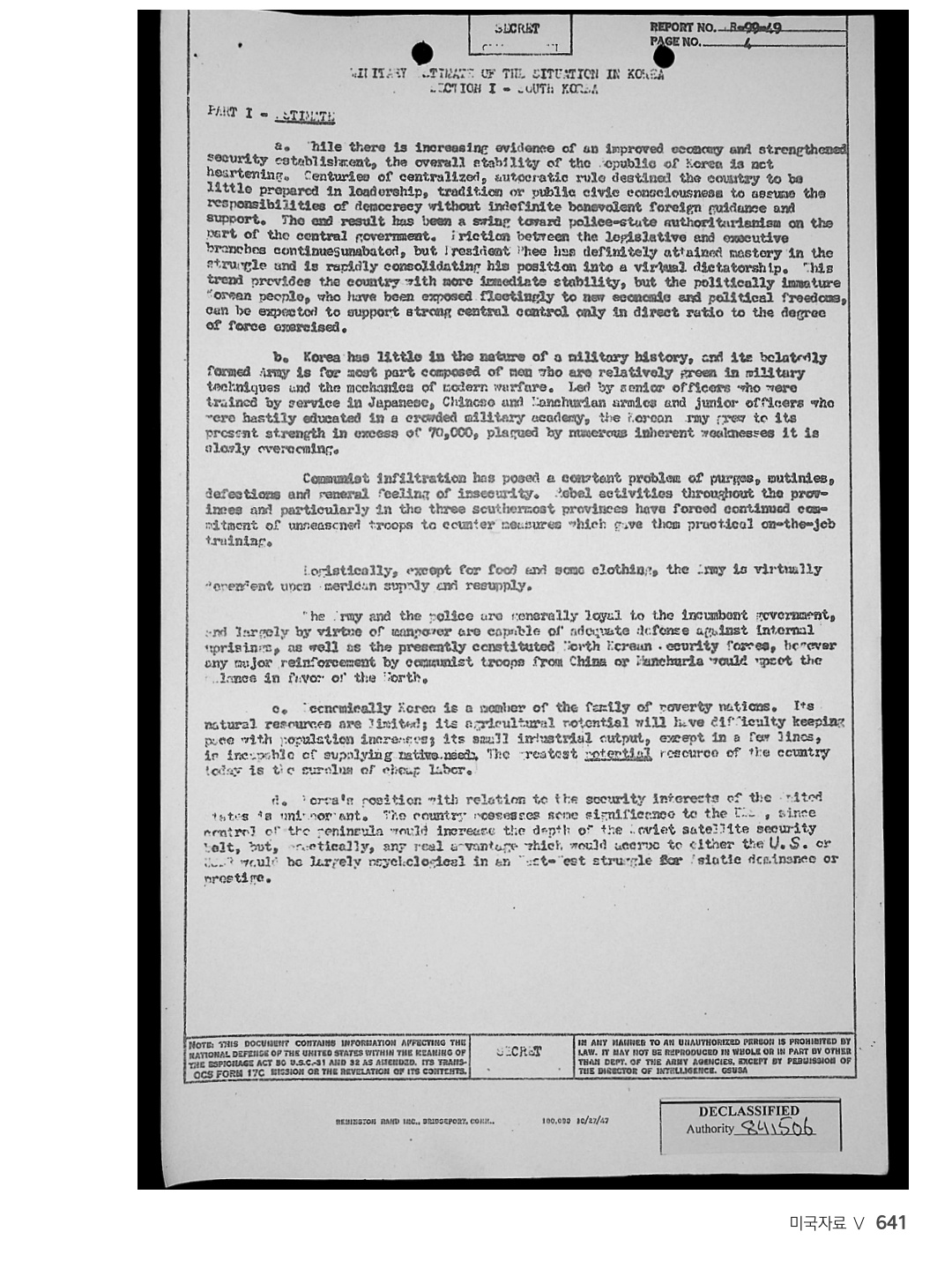
MILITARY ESTIMATE OF THE SITUATION IN KOREA
SECTION I - SOUTH KOREA
PART I - STIMITE
a. While there is increasing evidence of an improved economy and strengthened security establishment, the overall stability of the republic of Korea is not heartening. Centuries of centralized, autocratic rule destined the country to be little prepared in leadership, tradition or public civic consciousness to assume the responsibilities of democracy without indefinite benevolent foreign guidance and support. The end result has been a swing toward police-state authoritarianism on the part of the central government. Friction between the legislative and executive branches continues unabated, but President Rhee has definitely attained mastery in the struggle and is rapidly consolidating his position into a virtual dictatorship. This trend provides the country with more immediate stability, but the politically immature
Korean people, who have been exposed fleetingly to new economic and political freedoms, can be expected to support strong central control only in direct ratio to the degree of force exercised.
b. Korea has little in the nature of a military history, and its belatedly formed army is for most part composed of men who are relatively green in military techniques and the mechanics of modern warfare. Led by senior officers who were trained by service in Japanese, Chinese and Manchurian armies and junior officers who were hastily educated in a crowded military academy, the Korean army grew to its present strength in excess of 70,000, plagued by numerous inherent weaknesses it is slowly overcoming.
Communist infiltration has posed a constant problem of purges, mutinies, defections and general feeling of insecurity. Rebel activities throughout the provinces and particularly in the three southernmost provinces have forced continued commitment of unseasoned troops to counter measures which gave them practical on-the-job training.
Logistically, except for food and some clothing, the Army is virtually dependent upon American supply and resupply.
The Army and the police are generally loyal to the incumbent government, and largely by virtue of manpower are capable of adequate defense against internal uprisings, as well as the presently constituted North Korean security forces, however any major reinforcement by communist troops from China or Manchuria would upset the balance in favor of the North.
c. Economically Korea is a member of the family of poverty nations. Its natural resources are limited; its agricultural potential will have difficulty keeping pace with population increases; its small industrial output, except in a few lines, is incapable of supplying native need. The greatest potential resource of the country today is the surplus of cheap labor.
d. Korea's position with relation to the security interests of the United
States is unimportant. The country possesses some significance to the U.S., since control of the peninsula would increase the depth of the Soviet satellite security belt, but, practically, any real advantage which would accrue to either the U.S. or
U.S.S.R. would be largely psychological in an East-West struggle for Asiatic dominance or prestige.
NOTE: THIS DOCUMENT CONTAINS INFORMATION AFFECTING THE
NATIONAL DEFENSE OF THE UNITED STATES WITHIN THE MEANING OF
THE ESPIONAGE ACT 50 U.S.C.-31 AND 32 AS AMENDED. ITS TRANSOCS FORM 17C MISSION OR THE REVELATION OF ITS CONTENTS.
SECRET
IN ANY MANNER TO AN UNAUTHORIZED PERSON IS PROHIBITED BY
LAW. IT MAY NOT BE REPRODUCED IN WHOLE OR IN PART BY OTHER
THAN DEPT. OF THE ARMY AGENCIES, EXCEPT BY PERMISSION OF
THE DIRECTOR OF INTELLIGENCE. GSUSA
REMINGTON RAND INC., BRIDGEPORT, CONN... 100,000 10/22/47
DECLASSIFIED
Authority 841506
SECRET
REPORT NO. Rc99-49
GE NO. 5
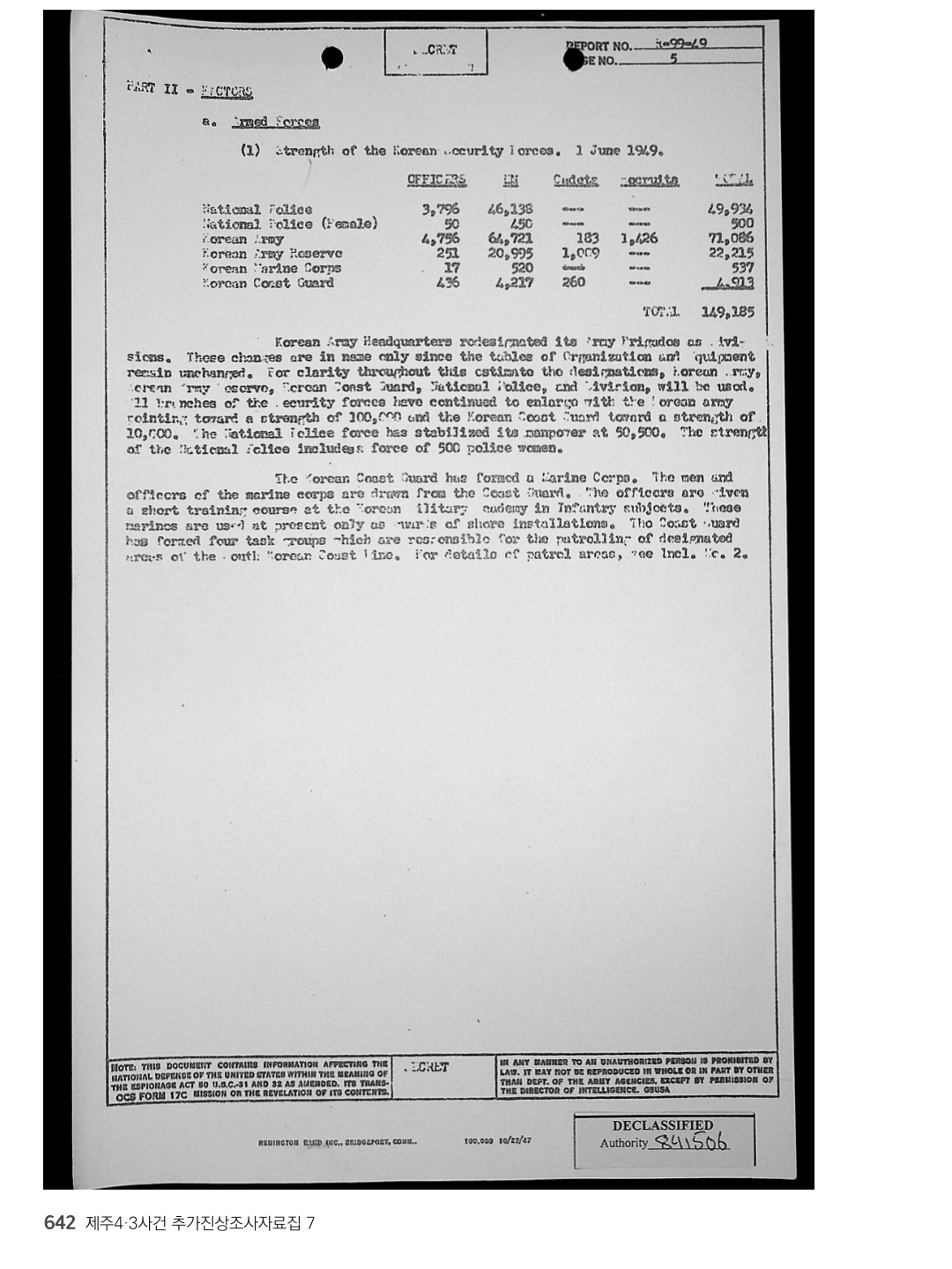
PART II - FACTORS
a. Armed Forces
(1) Strength of the Korean Security Forces. 1 June 1949.
OFFICERS EM Cadets Recruits TOTAL
National Police 3,796 46,138 ------ ------ 49,934
National Police (Female) 90 450 ------ ------ 500
Korean Army 4,755 64,721 183 1,426 71,086
Korean Army Reserve 251 20,995 1,009 ------ 22,215
Korean Marine Corps 17 520 [illegible] ------ 537
Korean Coast Guard 436 4,217 260 ------ [illegible]913
TOTAL 149,185
Korean Army Headquarters redesignated its Army Brigades as Divisions. These changes are in name only since the tables of Organization and equipment remain unchanged. For clarity throughout this estimate the designations, Korean Army, Korean Army Reserve, Korean Coast Guard, National Police, and Aviation, will be used.
All branches of the security forces have continued to enlarge with the Korean army pointing toward a strength of 100,000 and the Korean Coast Guard toward a strength of 10,000. The National Police force has stabilized its manpower at 50,500. The strength of the National Police includes: force of 500 police women.
The Korean Coast Guard has formed a Marine Corps. The men and officers of the marine corps are drawn from the Coast Guard. The officers are given a short training course at the Korean Military Academy in Infantry subjects. These marines are used at present only as guards of shore installations. The Coast Guard has formed four task groups which are responsible for the patrolling of designated areas of the south Korean Coast Line. For details of patrol areas, see Incl. No. 2.
NOTE: THIS DOCUMENT CONTAINS INFORMATION AFFECTING THE NATIONAL DEFENSE OF THE UNITED STATES WITHIN THE MEANING OF THE ESPIONAGE ACT 50 U.S.C.31 AND 32 AS AMENDED. ITS TRANSMISSION OR THE REVELATION OF ITS CONTENTS IN
SECRET
IN ANY MANNER TO AN UNAUTHORIZED PERSON IS PROHIBITED BY LAW. IT MAY NOT BE REPRODUCED IN WHOLE OR IN PART BY OTHER THAN DEPT. OF THE ARMY AGENCIES, EXCEPT BY PERMISSION OF THE DIRECTOR OF INTELLIGENCE, GSUSA
REMINGTON RAND INC., BRIDGEPORT, CONN. 100,000 10/27/47
DECLASSIFIED
Authority 841506
SECRET
REPORT NO. R-CO-49
PAGE NO. 2
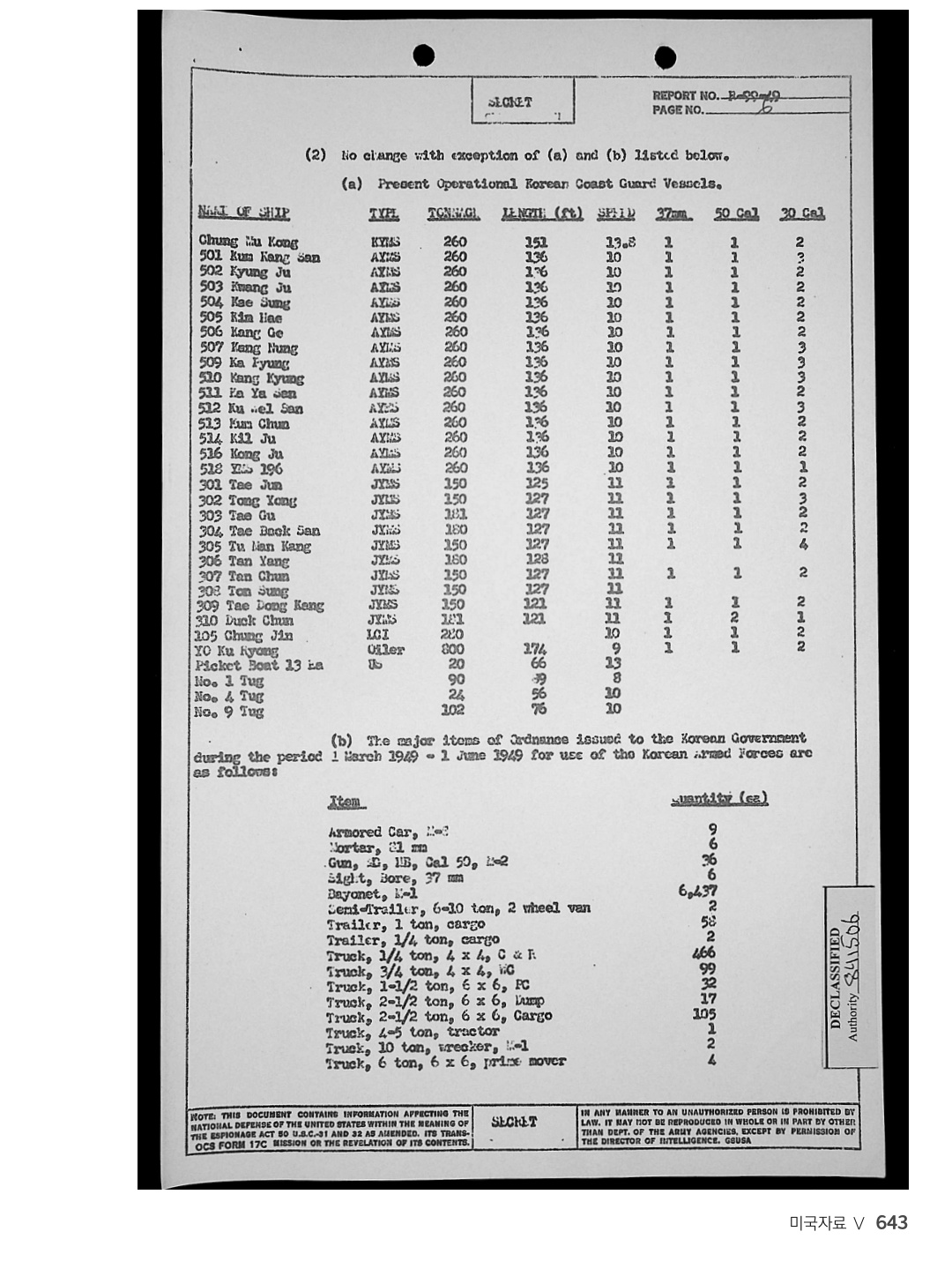
(2) No change with exception of (a) and (b) listed below.
(a) Present Operational Korean Coast Guard Vessels.
NAME OF SHIP TYPE TONNAGE LENGTH (ft) SPEED 37mm 50 Cal 30 Cal
Chung Wu Kong KYMS 260 151 13.8 1 1 2
501 Kum Kang San AYMS 260 136 10 1 1 3
502 Kyung Ju AYMS 260 136 10 1 1 2
503 Kwang Ju AYMS 260 136 10 1 1 2
504 Kae Sung AYMS 260 136 10 1 1 2
505 Kim Hae AYMS 260 136 10 1 1 2
506 Kang Ge AYMS 260 136 10 1 1 2
507 Kang Hung AYMS 260 136 10 1 1 3
509 Ka Kyung AYMS 260 136 10 1 1 3
510 Kang Kyung AYMS 260 136 10 1 1 3
511 Pa Ya San AYMS 260 136 10 1 1 2
512 Ku Wel San AYMS 260 136 10 1 1 3
513 Kum Chun AYMS 260 136 10 1 1 2
514 Kil Ju AYMS 260 136 10 1 1 2
516 Kong Ju AYMS 260 136 10 1 1 2
518 [illegible] 196 AYMS 260 136 10 1 1 1
301 Tae Jun JYMS 150 125 11 1 1 2
302 Tong Yang JYMS 150 127 11 1 1 3
303 Tae Gu JYMS 181 127 11 1 1 2
304 Tae Baek San JYMS 180 127 11 1 1 2
305 Tu Man Kang JYMS 150 127 11 1 1 4
306 Tan Yang JYMS 180 128 11
307 Tan Chun JYMS 150 127 11 1 1 2
308 Ton Sung JYMS 150 127 11
309 Tae Dong Kang JYMS 150 121 11 1 1 2
310 Duck Chun JYMS 181 121 11 1 2 1
105 Chung Jin LOI 220 10 1 1 2
YO Ku Kyong Oiler 800 274 9 1 1 2
Picket Boat 13 La US 20 66 13
No. 1 Tug 90 39 8
No. 4 Tug 24 56 10
No. 9 Tug 102 76 10
(b) The major items of Ordnance issued to the Korean Government during the period 1 March 1949 - 1 June 1949 for use of the Korean Armed Forces are
as follows:
Item Quantity (ea)
Armored Car, M-8 9
Mortar, 81 mm 6
Gun, AD, 1B, Cal 50, M-2 36
Sight, Bore, 37 mm 6
Bayonet, M-1 6,437
Semi-Trailer, 6-10 ton, 2 wheel van 2
Trailer, 1 ton, cargo 58
Trailer, 1/4 ton, cargo 2
Truck, 1/4 ton, 4 x 4, G & R 466
Truck, 3/4 ton, 4 x 4, WC 99
Truck, 1-1/2 ton, 6 x 6, FC 32
Truck, 2-1/2 ton, 6 x 6, Dump 17
Truck, 2-1/2 ton, 6 x 6, Cargo 105
Truck, 4-5 ton, tractor 1
Truck, 10 ton, wrecker, M-1 2
Truck, 6 ton, 6 x 6, prime mover 4
NOTE: THIS DOCUMENT CONTAINS INFORMATION AFFECTING THE
NATIONAL DEFENSE OF THE UNITED STATES WITHIN THE MEANING OF
THE ESPIONAGE ACT 50 U.S.C.-31 AND 32 AS AMENDED. ITS TRANSOCS FORM 17C MISSION OR THE REVELATION OF ITS CONTENTS.
SECRET
IN ANY MANNER TO AN UNAUTHORIZED PERSON IS PROHIBITED BY
LAW. IT MAY NOT BE REPRODUCED IN WHOLE OR IN PART BY OTHER
THAN DEPT. OF THE ARMY AGENCIES, EXCEPT BY PERMISSION OF
THE DIRECTOR OF INTELLIGENCE, GSUSA.
DECLASSIFIED
Authority 524\506
REPORT NO. Re90n49
PAGE NO. 7
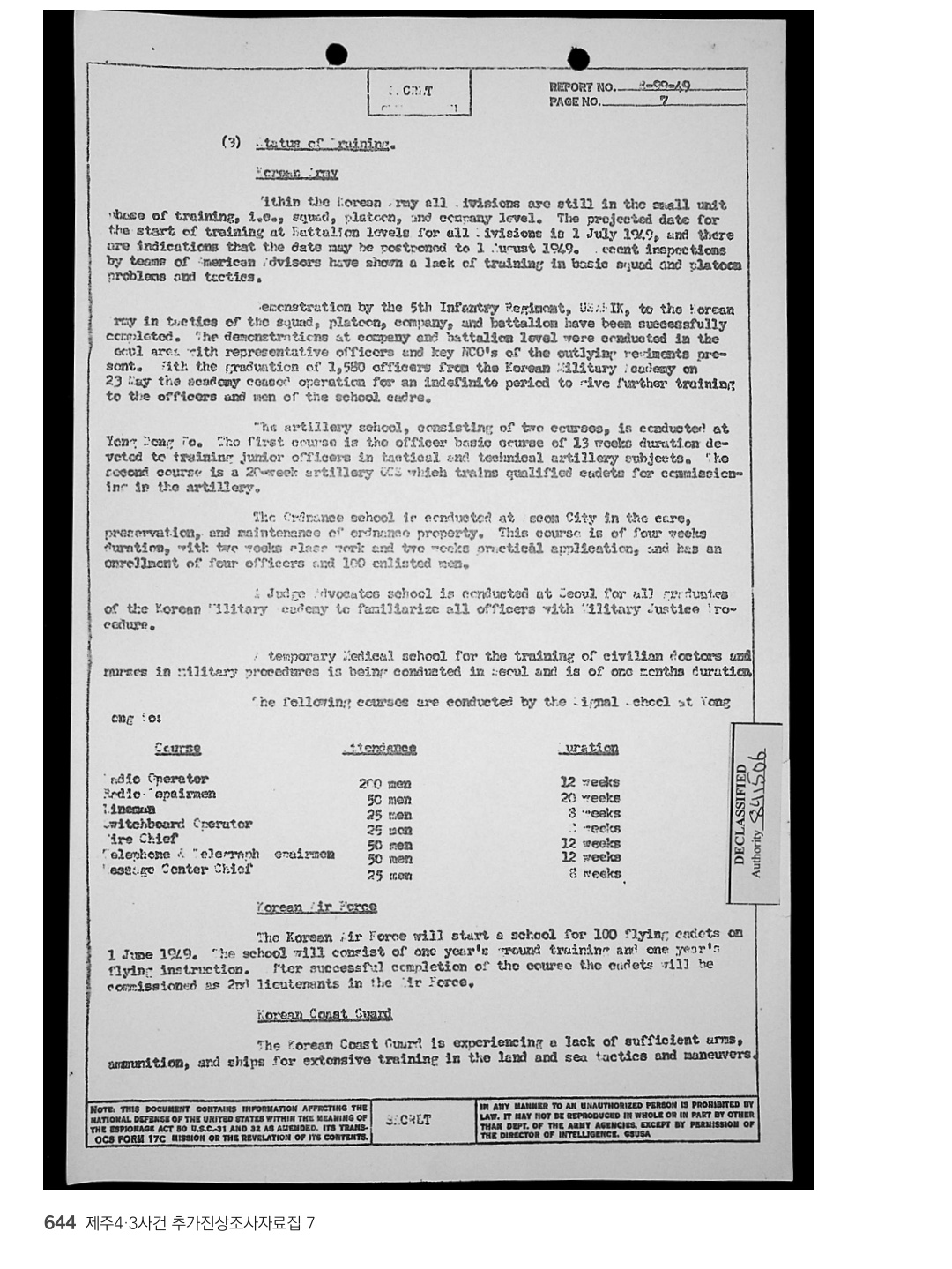
(3) Status of Training.
Korean Army
Within the Korean Army all divisions are still in the small unit phase of training, i.e., squad, platoon, company, and battalion level. The projected date for the start of training at battalion levels for all divisions is 1 July 1949, and there are indications that the date may be postponed to 1 August 1949. Recent inspections by teams of American Advisers have shown a lack of training in basic squad and platoon problems and tactics.
A demonstration by the 5th Infantry Regiment, US AIK, to the Korean
Army in tactics of the squad, platoon, company, and battalion have been successfully completed. The demonstrations at company and battalion level were conducted in the local area with representative officers and key NCO's of the outlying regiments present. With the graduation of 1,580 officers from the Korean Military Academy on
23 May the academy ceased operation for an indefinite period to give further training to the officers and men of the school cadre.
The artillery school, consisting of two courses, is conducted at
Yong Dong Po. The first course is the officer basic course of 13 weeks duration devoted to training junior officers in tactical and technical artillery subjects. The second course is a 20-week artillery OCS which trains qualified cadets for commissioning in the artillery.
The Ordnance school is conducted at Seon City in the care, preservation, and maintenance of ordnance property. This course is of four weeks duration, with two weeks class work and two weeks practical application, and has an enrollment of four officers and 100 enlisted men.
A Judge Advocates school is conducted at Seoul for all graduates of the Korean Military Academy to familiarize all officers with Military Justice Procedure.
A temporary Medical school for the training of civilian doctors and nurses in military procedures is being conducted in Seoul and is of one months duration.
The following courses are conducted by the Signal School at Yong
Dong Po:
Course Attendance Duration
Radio Operator 200 men 12 weeks
Radio Repairmen 50 men 20 weeks
Lineman 25 men 3 weeks
Switchboard Operator 25 men [illegible] weeks
Wire Chief 50 men 12 weeks
Telephone & Telegraph Repairmen 50 men 12 weeks
Message Center Chief 25 men 8 weeks
Korean Air Force
The Korean Air Force will start a school for 100 flying cadets on
1 June 1949. The school will consist of one year's ground training and one year's flying instruction. After successful completion of the course the cadets will be commissioned as 2nd lieutenants in the Air Force.
Korean Coast Guard
The Korean Coast Guard is experiencing a lack of sufficient arms, ammunition, and ships for extensive training in the land and sea tactics and maneuvers.
NOTE: THIS DOCUMENT CONTAINS INFORMATION AFFECTING THE
NATIONAL DEFENSE OF THE UNITED STATES WITHIN THE MEANING OF
THE ESPIONAGE ACT 50 U.S.C.-31 AND 32 AS AMENDED. ITS TRANSOCS FORM 17C MISSION OR THE REVELATION OF ITS CONTENTS.
SECRET
IN ANY MANNER TO AN UNAUTHORIZED PERSON IS PROHIBITED BY
LAW. IT MAY NOT BE REPRODUCED IN WHOLE OR IN PART BY OTHER
THAN DEPT. OF THE ARMY AGENCIES, EXCEPT BY PERMISSION OF
THE DIRECTOR OF INTELLIGENCE, GSUSA
DECLASSIFIED
Authority [illegible]
SECRET REPORT NO. 8-99-49
FILE NO. 8
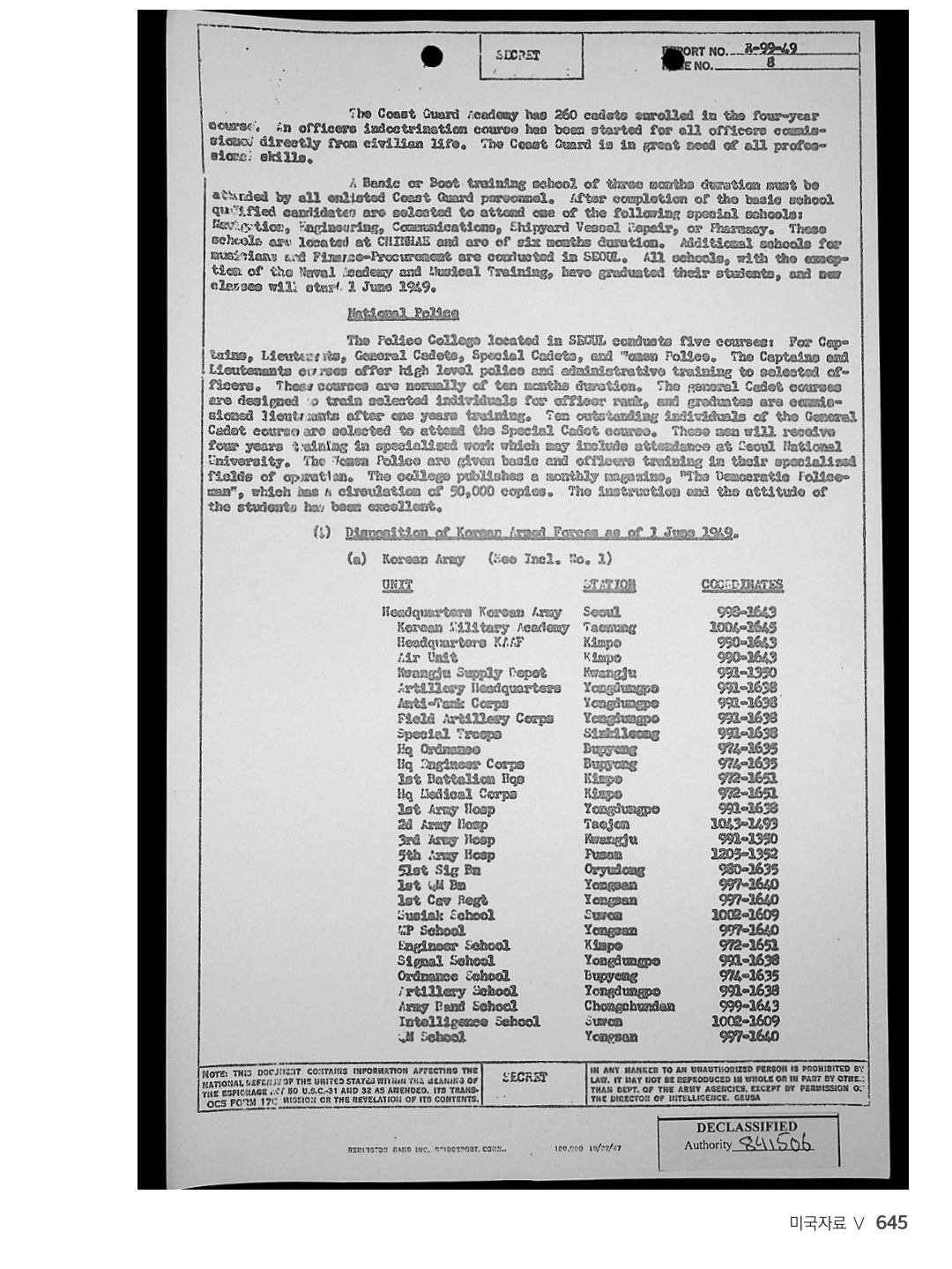
The Coast Guard Academy has 260 cadets enrolled in the four-year course. An officers indoctrination course has been started for all officers commissioned directly from civilian life. The Coast Guard is in great need of all professional skills.
A Basic or Boot training school of three months duration must be attended by all enlisted Coast Guard personnel. After completion of the basic school qualified candidates are selected to attend one of the following special schools: Navigation, Engineering, Communications, Shipyard Vessel Repair, or Pharmacy. These schools are located at CHINHAI and are of six months duration. Additional schools for musicians and Finance-Procurement are conducted in SEOUL. All schools, with the exception of the Naval Academy and Musical Training, have graduated their students, and new classes will start 1 June 1949.
National Police
The Police College located in SEOUL conducts five courses: For Captains, Lieutenants, General Cadets, Special Cadets, and Women Police. The Captains and Lieutenants courses offer high level police and administrative training to selected officers. These courses are normally of ten months duration. The general Cadet courses are designed to train selected individuals for officer rank, and graduates are commissioned lieutenants after one years training. Ten outstanding individuals of the General Cadet course are selected to attend the Special Cadet course. These men will receive four years training in specialized work which may include attendance at Seoul National University. The Women Police are given basic and officers training in their specialized fields of operation. The college publishes a monthly magazine, "The Democratic Policeman", which has a circulation of 50,000 copies. The instruction and the attitude of the students has been excellent.
(i) Disposition of Korean Armed Forces as of 1 June 1949.
(a) Korean Army (See Incl. No. 1)
UNIT STATION COORDINATES
Headquarters Korean Army Seoul 998-1643
Korean Military Academy Taesung 1004-1645
Headquarters KAF Kimpo 990-1643
Air Unit Kimpo 990-1643
Kwangju Supply Depot Kwangju 991-1390
Artillery Headquarters Yongdungpo 991-1638
Anti-Tank Corps Yongdungpo 991-1638
Field Artillery Corps Yongdungpo 991-1638
Special Troops Sinkilcong 991-1638
Hq Ordnance Bupyung 974-1635
Hq Engineer Corps Bupyung 974-1635
1st Battalion Hqs Kimpo 972-1651
Hq Medical Corps Kimpo 972-1651
1st Army Hosp Yongdungpo 991-1638
2d Army Hosp Taejon 1043-1499
3rd Army Hosp Kwangju 991-1390
4th Army Hosp Pusan 1202-1382
51st Sig Bn Oryulong 980-1635
1st 4d Bn Yongsan 997-1640
1st Cav Regt Yongsan 997-1640
Susiak School Suwon 1002-1609
MP School Yongsan 997-1640
Engineer School Kimpo 972-1651
Signal School Yongdungpo 991-1638
Ordnance School Bupyung 974-1635
Artillery School Yongdungpo 991-1638
Army Band School Chongchundan 999-1643
Intelligence School Suwon 1002-1609
JM School Yongsan 997-1640
NOTE: THIS DOCUMENT CONTAINS INFORMATION AFFECTING THE
NATIONAL DEFENSE OF THE UNITED STATES WITHIN THE MEANING OF
THE ESPIONAGE ACT 50 U.S.C.-31 AND 32 AS AMENDED. ITS TRANSOCS FORM 17C MISSION OR THE REVELATION OF ITS CONTENTS.
SECRET
IN ANY MANNER TO AN UNAUTHORIZED PERSON IS PROHIBITED BY
LAW. IT MAY NOT BE REPRODUCED IN WHOLE OR IN PART BY OTHER
THAN DEPT. OF THE ARMY AGENCIES, EXCEPT BY PERMISSION OF
THE DIRECTOR OF INTELLIGENCE, GSUSA
DECLASSIFIED
Authority 841506
REMINGTON RAND INC., BRIDGEPORT, CONN. 100,000 10/77/47
SECRET
REPORT NO. H-99-49
PAGE NO. 9
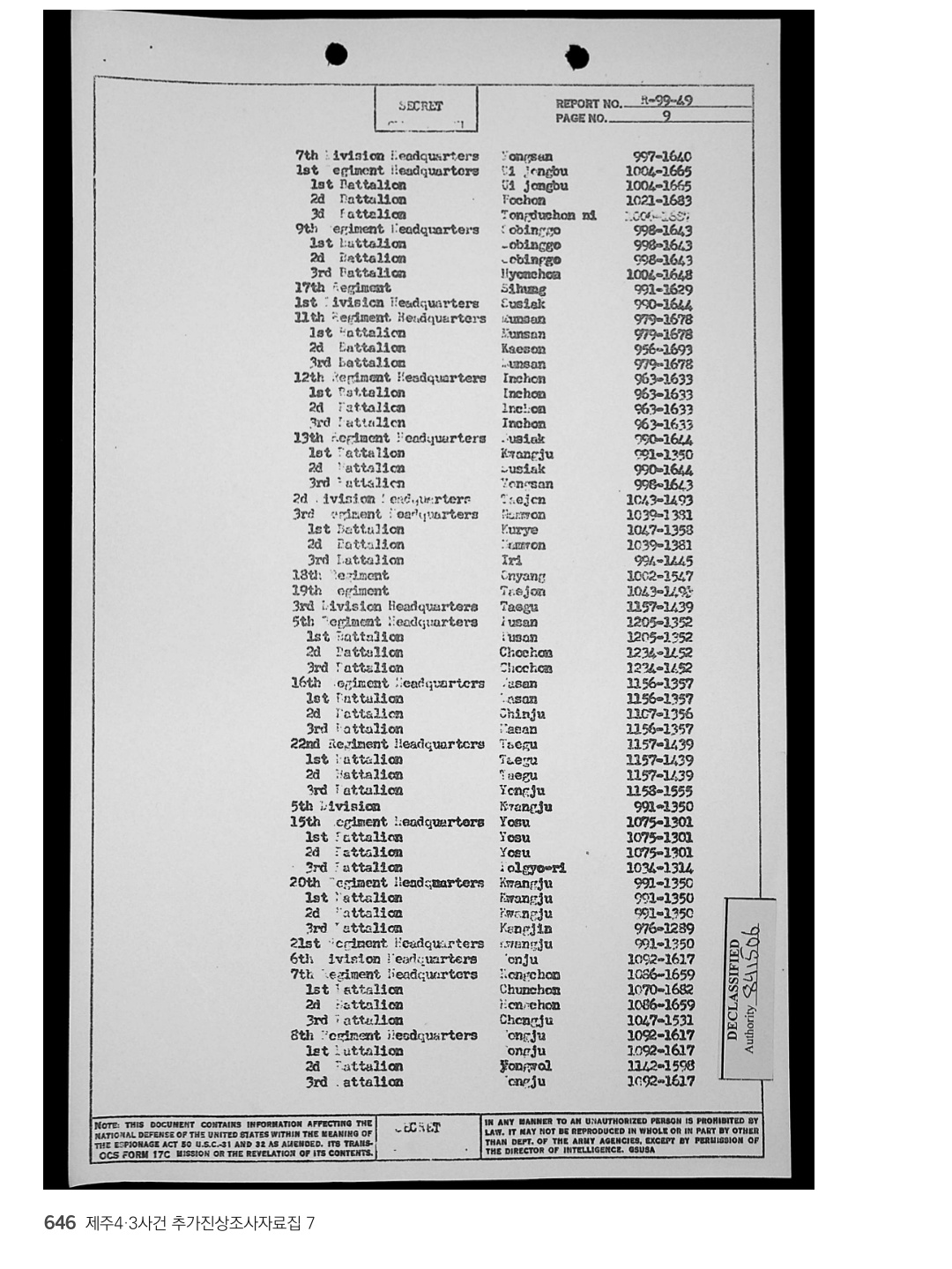
7th Division Headquarters Tongsan 997-1640
1st Regiment Headquarters Ui Tongbu 1004-1665
1st Battalion Ui Jongbu 1004-1665
2d Battalion Pochon 1021-1683
3d Battalion Tongduchon ni 1004-1655[illegible]
9th Regiment Headquarters Cobinggo 998-1643
1st Battalion Cobinggo 998-1643
2d Battalion Cobinggo 998-1643
3rd Battalion Hyomchon 1004-1648
17th Regiment Silung 991-1629
1st Division Headquarters Susiak 990-1644
11th Regiment Headquarters Kumsan 979-1678
1st Battalion Kumsan 979-1678
2d Battalion Kaeson 956-1693
3rd Battalion Kumsan 979-1678
12th Regiment Headquarters Inchon 963-1633
1st Battalion Inchon 963-1633
2d Battalion Inchon 963-1633
3rd Battalion Inchon 963-1633
13th Regiment Headquarters Susiak 990-1644
1st Battalion Kwangju 991-1350
2d Battalion Susiak 990-1644
3rd Battalion Yonman 998-1643
2d Division Headquarters Taejon 1043-1493
3rd Regiment Headquarters Kumsan 1039-1381
1st Battalion Kurye 1047-1358
2d Battalion Kumron 1039-1381
3rd Battalion Iri 994-1445
18th Regiment Onyang 1002-1547
19th Regiment Taejon 1043-1493[illegible]
3rd Division Headquarters Taegu 1157-1439
5th Regiment Headquarters Pusan 1205-1352
1st Battalion Pusan 1205-1352
2d Battalion Choehon 1234-1452
3rd Battalion Choehon 1234-1452
16th Regiment Headquarters Asan 1156-1357
1st Battalion Asan 1156-1357
2d Battalion Chinju 1107-1356
3rd Battalion Yasan 1156-1357
22nd Regiment Headquarters Taegu 1157-1439
1st Battalion Taegu 1157-1439
2d Battalion Taegu 1157-1439
3rd Battalion Yongju 1158-1555
5th Division Kwangju 991-1350
15th Regiment Headquarters Yosu 1075-1301
1st Battalion Yosu 1075-1301
2d Battalion Yosu 1075-1301
3rd Battalion Boleyeori 1034-1314
20th Regiment Headquarters Kwangju 991-1350
1st Battalion Kwangju 991-1350
2d Battalion Kwangju 991-1350
3rd Battalion Kongjin 976-1289
21st Regiment Headquarters Kwangju 991-1350
6th Division Headquarters Yonju 1092-1617
7th Regiment Headquarters Nonchon 1086-1659
1st Battalion Chunchon 1070-1659
2d Battalion Nonchon 1086-1659
3rd Battalion Chongju 1047-1531
8th Regiment Headquarters Yongju 1092-1617
1st Battalion Yongju 1092-1617
2d Battalion Yongwol 1142-1598
3rd Battalion Yongju 1092-1617
NOTE: THIS DOCUMENT CONTAINS INFORMATION AFFECTING THE
NATIONAL DEFENSE OF THE UNITED STATES WITHIN THE MEANING OF
THE ESPIONAGE ACT 50 U.S.C.-31 AND 32 AS AMENDED. ITS TRANSOCS FORM 17C MISSION OR THE REVELATION OF ITS CONTENTS.
SECRET
IN ANY MANNER TO AN UNAUTHORIZED PERSON IS PROHIBITED BY
LAW. IT MAY NOT BE REPRODUCED IN WHOLE OR IN PART BY OTHER
THAN DEPT. OF THE ARMY AGENCIES, EXCEPT BY PERMISSION OF
THE DIRECTOR OF INTELLIGENCE, GSUSA.
DECLASSIFIED
Authority [illegible]
SECRET
[illegible] I
REPORT NO. [illegible]79-49
PAGE NO. 10
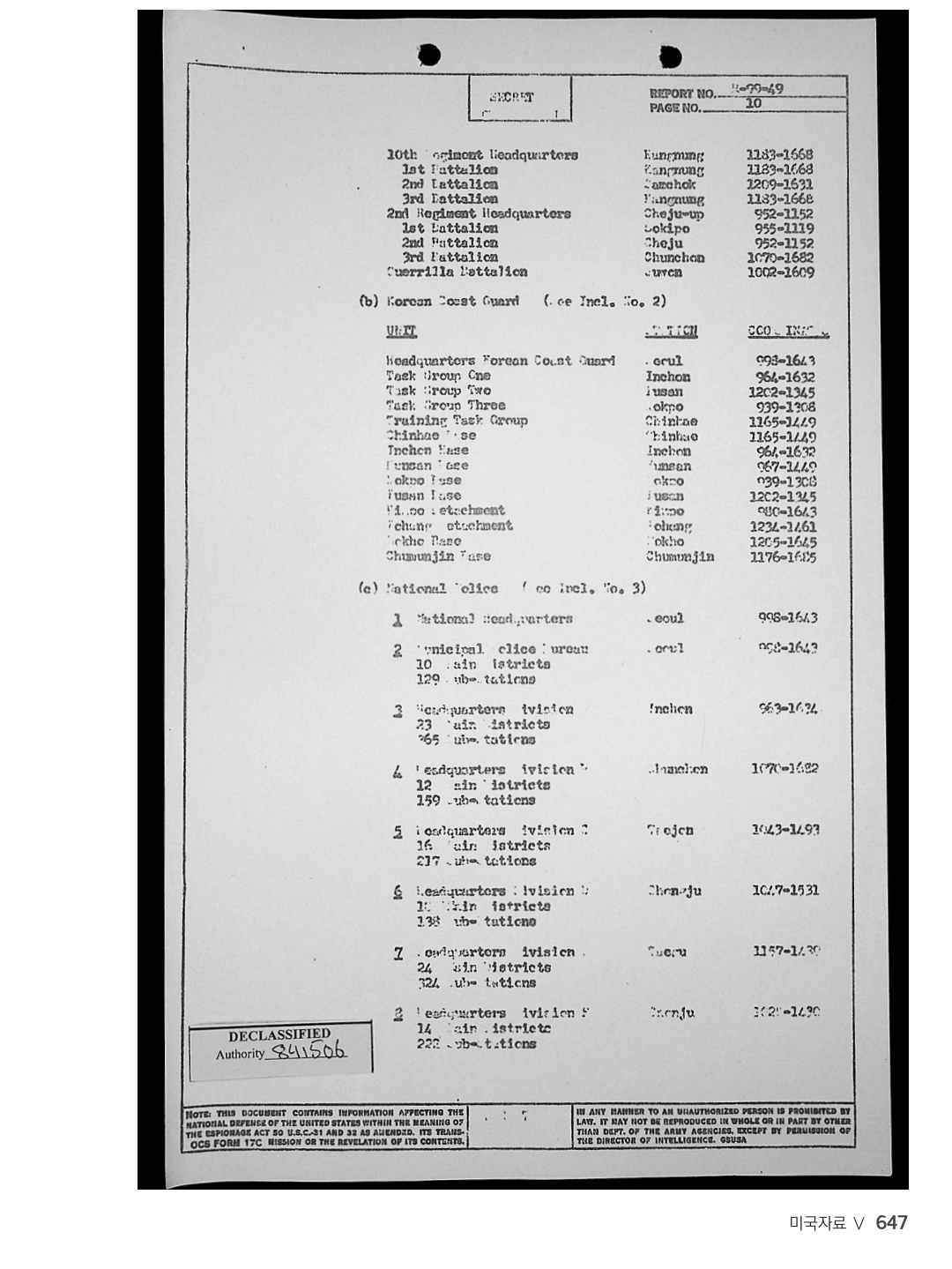
10th Regiment Headquarters Hungnung 1183-1668
1st Battalion Kangnung 1183-1668
2nd Battalion Samchok 1209-1631
3rd Battalion Hungnung 1183-1668
2nd Regiment Headquarters Cheju-up 952-1152
1st Battalion Mokipo 955-1119
2nd Battalion Cheju 952-1152
3rd Battalion Chunchon 1070-1682
Guerrilla Battalion [illegible]uren 1002-1609
(b) Korean Coast Guard (see Incl. No. 2)
UNIT LOCATION CCO. INFO.
Headquarters Korean Coast Guard Seoul 998-1643
Task Group One Inchon 964-1632
Task Group Two Pusan 1202-1345
Task Group Three Mokpo 939-1308
Training Task Group Chinhae 1165-1249
Chinhae Base Chinhae 1165-1249
Inchon Base Inchon 964-1632
Pusan Base Pusan 957-1249
Mokpo Base Mokpo 939-1308
Pusan Base Pusan 1202-1345
[illegible] Detachment [illegible]mo 980-1643
Pohang Detachment Pohang 1234-1461
Mokho Base Mokho 1205-1645
Chumunjin Base Chumunjin 1176-1695
(c) National Police (see Incl. No. 3)
1 National Headquarters Seoul 998-1643
2 Municipal Police Bureau Seoul 998-1643
10 Main Districts
129 Sub-stations
3 Headquarters Division Inchon 963-1634
23 Main Districts
365 Sub-stations
4 Headquarters Division [illegible] Junchon 1070-1682
12 Main Districts
159 Sub-stations
5 Headquarters Division C Taejon 1643-1493
16 Main Districts
217 Sub-stations
6 Headquarters Division [illegible] Chongju 1047-1531
15 Main Districts
138 Sub-stations
7 Headquarters Division [illegible] Taegu 1157-1430
24 Main Districts
324 Sub-stations
8 Headquarters Division [illegible] Chonju 1028-1490
14 Main Districts
222 Sub-stations
DECLASSIFIED
Authority 841506
NOTE: THIS DOCUMENT CONTAINS INFORMATION AFFECTING THE
NATIONAL DEFENSE OF THE UNITED STATES WITHIN THE MEANING OF
THE ESPIONAGE ACT 50 U.S.C.-31 AND 32 AS AMENDED. ITS TRANSOCS FORM 17C MISSION OR THE REVELATION OF ITS CONTENTS.
IN ANY MANNER TO AN UNAUTHORIZED PERSON IS PROHIBITED BY
LAW. IT MAY NOT BE REPRODUCED IN WHOLE OR IN PART BY OTHER
THAN DEPT. OF THE ARMY AGENCIES, EXCEPT BY PERMISSION OF
THE DIRECTOR OF INTELLIGENCE, GSUSA
SECRET
[illegible]
REPORT NO. Re99-49
PAGE NO. 11
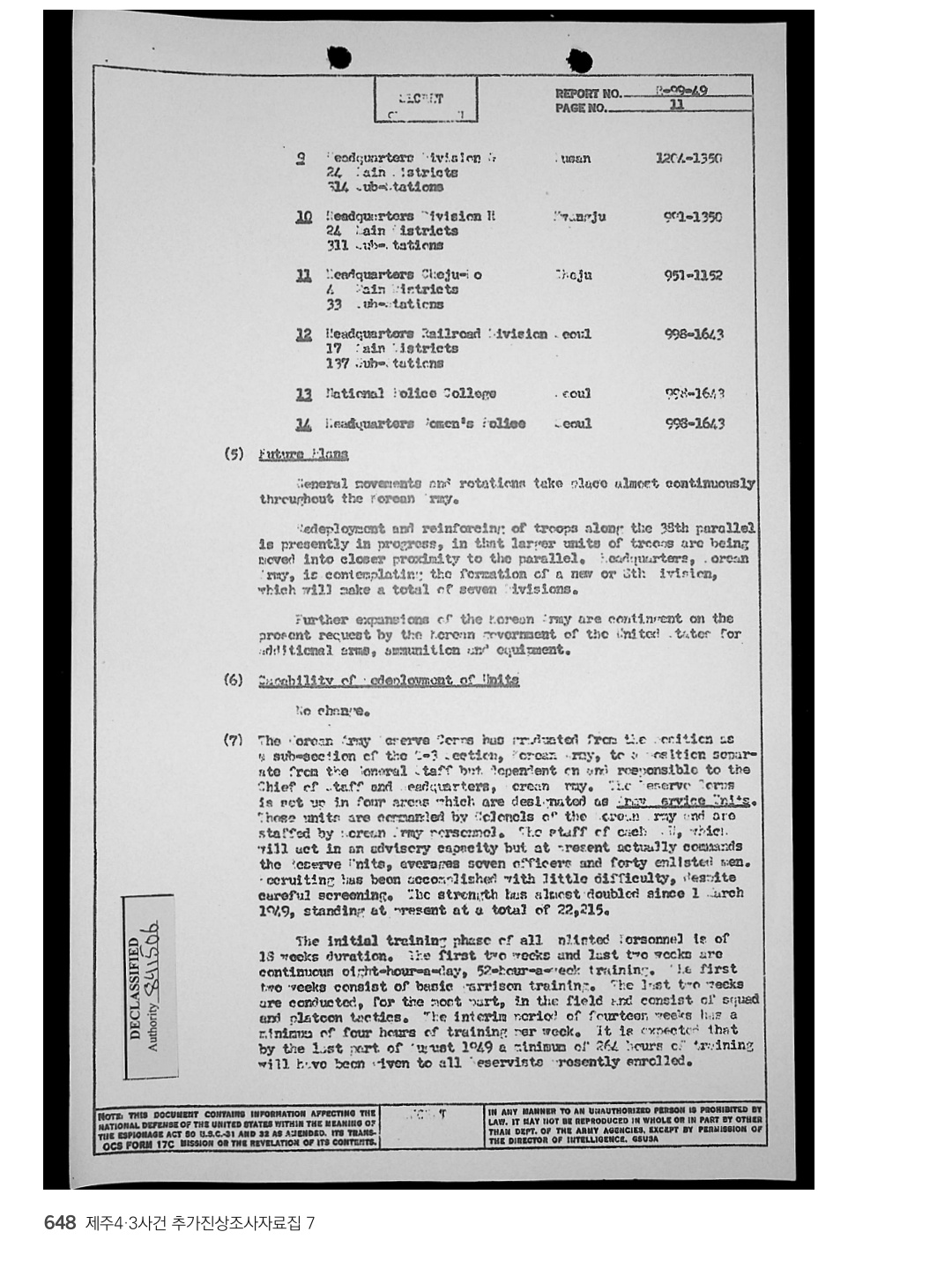
9 Headquarters Division [illegible] . usan 1204-1350
24 Main Districts
314 Substations
10 Headquarters Division II [illegible]ju 991-1350
24 Main Districts
311 Substations
11 Headquarters Cheju- o Cheju 951-1152
4 Main Districts
33 Substations
12 Headquarters Railroad Division . eoul 998-1643
17 Main Districts
137 Substations
13 National Police College . eoul 958-1643
14 Headquarters Women's Police . eoul 998-1643
(5) Future Plans
General movements and rotations take place almost continuously throughout the Korean Army.
Redeployment and reinforcing of troops along the 38th parallel is presently in progress, in that larger units of troops are being moved into closer proximity to the parallel. Headquarters, Korean
Army, is contemplating the formation of a new or 5th Division, which will make a total of seven divisions.
Further expansions of the Korean Army are contingent on the present request by the Korean government of the United States for additional arms, ammunition and equipment.
(6) Capability of redeployment of Units
No change.
(7) The Korean Army Reserve Corps has graduated from the position as a sub-section of the G-3 section, Korean Army, to a position separate from the General Staff but dependent on and responsible to the
Chief of Staff and Headquarters, Korean Army. The Reserve Corps is set up in four areas which are designated as Army Service Units.
These units are commanded by Colonels of the Korean Army and are staffed by Korean Army personnel. The staff of each unit, which will act in an advisory capacity but at present actually commands the Reserve Units, averages seven officers and forty enlisted men.
Recruiting has been accomplished with little difficulty, despite careful screening. The strength has almost doubled since 1 March
1949, standing at present at a total of 22,215.
The initial training phase of all enlisted personnel is of
13 weeks duration. The first two weeks and last two weeks are continuous eight-hour-a-day, 52-hour-a-week training. The first two weeks consist of basic garrison training. The last two weeks are conducted, for the most part, in the field and consist of squad and platoon tactics. The interim period of fourteen weeks has a minimum of four hours of training per week. It is expected that by the last part of August 1949 a minimum of 264 hours of training will have been given to all reservists presently enrolled.
DECLASSIFIED
Authority [illegible]
NOTE: THIS DOCUMENT CONTAINS INFORMATION AFFECTING THE
NATIONAL DEFENSE OF THE UNITED STATES WITHIN THE MEANING OF
THE ESPIONAGE ACT 50 U.S.C.-31 AND 32 AS AMENDED. ITS TRANSOCS FORM 17C MISSION OR THE REVELATION OF ITS CONTENTS.
SECRET
IN ANY MANNER TO AN UNAUTHORIZED PERSON IS PROHIBITED BY
LAW. IT MAY NOT BE REPRODUCED IN WHOLE OR IN PART BY OTHER
THAN DEPT. OF THE ARMY AGENCIES, EXCEPT BY PERMISSION OF
THE DIRECTOR OF INTELLIGENCE. GSUSA
648 제주4·3사건 추가진상조사자료집 7
SECRET
REPORT NO. R-[illegible]49
PAGE NO. 12
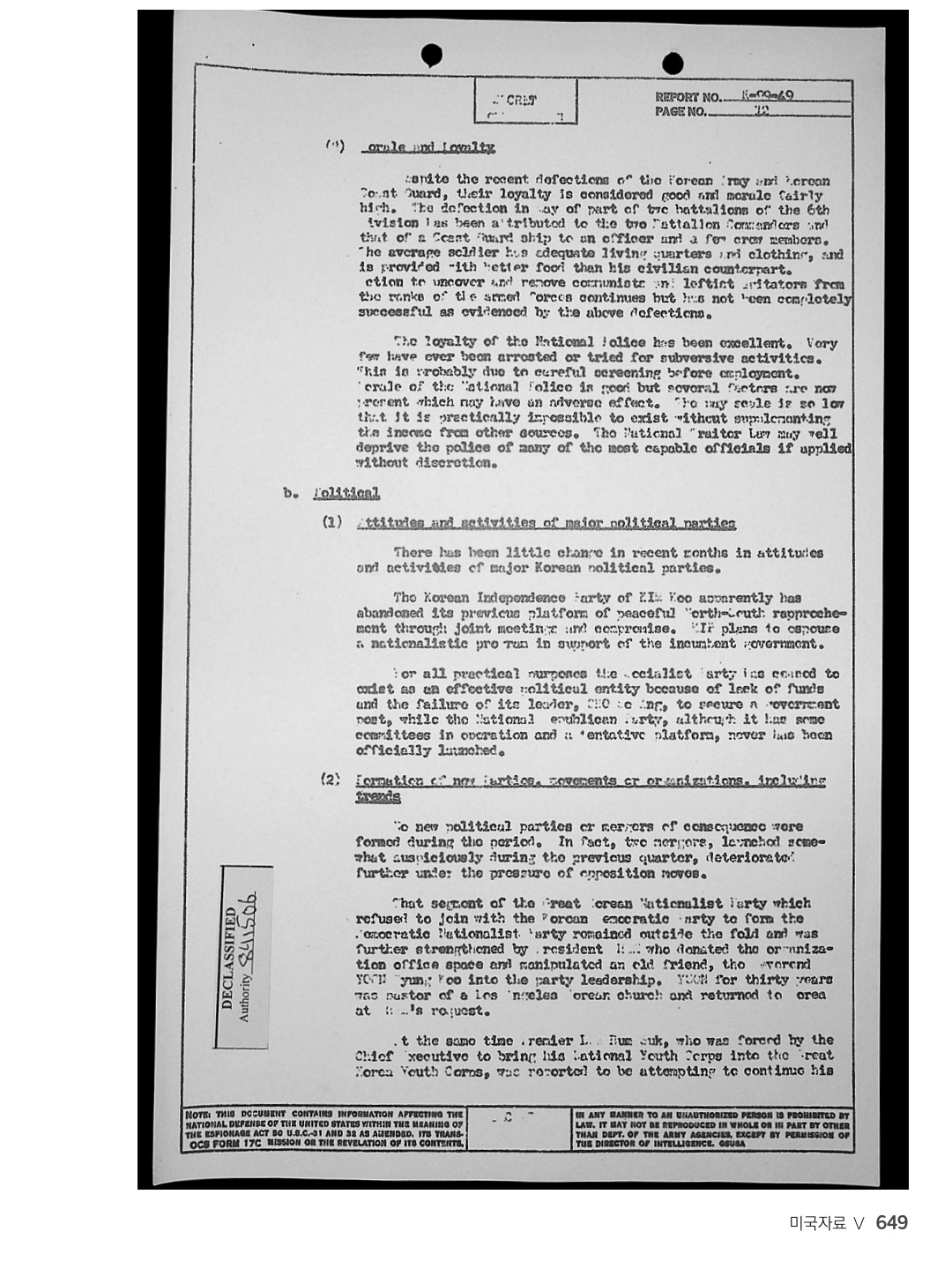
(4) Morale and Loyalty
Despite the recent defections of the Korean Army and Korean Coast Guard, their loyalty is considered good and morale fairly high. The defection in any of part of two battalions of the 6th Division has been attributed to the two Battalion Commanders and that of a Coast Guard ship to an officer and a few crew members. The average soldier has adequate living quarters and clothing, and is provided with better food than his civilian counterpart. Action to uncover and remove communists and leftist agitators from the ranks of the armed forces continues but has not been completely successful as evidenced by the above defections.
The loyalty of the National Police has been excellent. Very few have ever been arrested or tried for subversive activities. This is probably due to careful screening before employment. Morale of the National Police is good but several factors are now present which may have an adverse effect. The pay scale is so low that it is practically impossible to exist without supplementing the income from other sources. The National Traitor Law may well deprive the police of many of the most capable officials if applied without discretion.
b. Political
(1) Attitudes and activities of major political parties
There has been little change in recent months in attitudes and activities of major Korean political parties.
The Korean Independence Party of Kim Koo apparently has abandoned its previous platform of peaceful North-South rapprochement through joint meetings and compromise. It plans to sponsor a nationalistic program in support of the incumbent government.
For all practical purposes the Socialist Party has ceased to exist as an effective political entity because of lack of funds and the failure of its leader, Cho So Ang, to secure a government post, while the National Republican Party, although it has some committees in operation and a tentative platform, never has been officially launched.
(2) Formation of new parties, movements or organizations, including trends
No new political parties or mergers of consequence were formed during the period. In fact, two mergers, launched somewhat auspiciously during the previous quarter, deteriorated further under the pressure of opposition moves.
That segment of the Great Korean Nationalist Party which refused to join with the Korean Democratic Party to form the Democratic Nationalist Party remained outside the fold and was further strengthened by President [illegible] who donated the organization office space and manipulated an old friend, the Reverend YOTH [illegible] Koo into the party leadership. YOTH for thirty years was pastor of a Los Angeles Korean church and returned to Korea at [illegible]'s request.
At the same time Premier L. Bum Suk, who was forced by the Chief Executive to bring his National Youth Corps into the Great Korea Youth Corps, was reported to be attempting to continue his
DECLASSIFIED
Authority [illegible]
NOTE: THIS DOCUMENT CONTAINS INFORMATION AFFECTING THE NATIONAL DEFENSE OF THE UNITED STATES WITHIN THE MEANING OF THE ESPIONAGE ACT 50 U.S.C.-31 AND 32 AS AMENDED. ITS TRANSMISSION OR THE REVELATION OF ITS CONTENTS.
OCB FORM 17C
IN ANY MANNER TO AN UNAUTHORIZED PERSON IS PROHIBITED BY LAW. IT MAY NOT BE REPRODUCED IN WHOLE OR IN PART BY OTHER THAN DEPT. OF THE ARMY AGENCIES, EXCEPT BY PERMISSION OF THE DIRECTOR OF INTELLIGENCE. GSUSA
미국자료 V 649
SECRET
REPORT NO. R-99-49
PAGE NO. 23
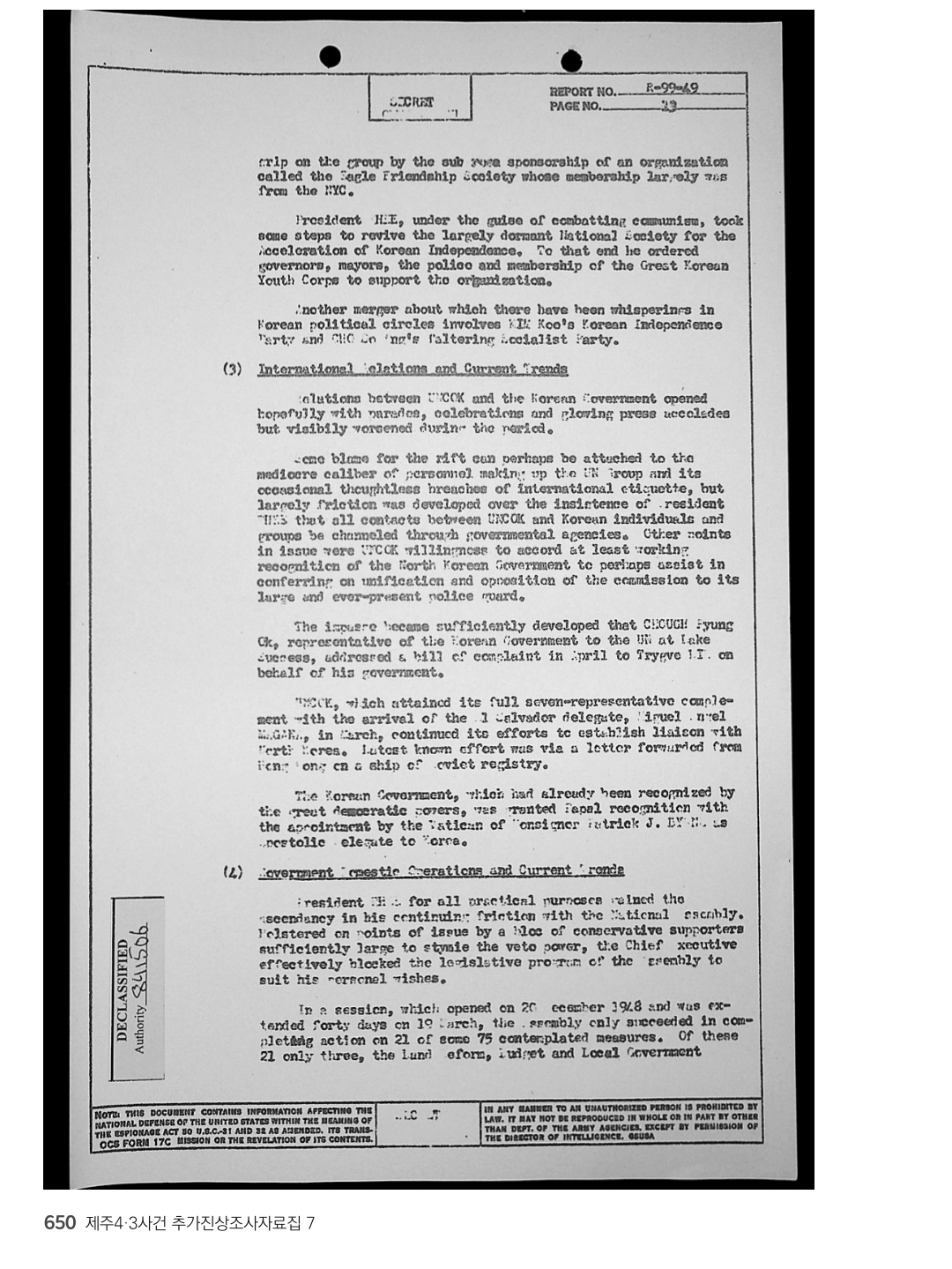
trip on the group by the sub rosa sponsorship of an organization called the Eagle Friendship Society whose membership largely was from the NYC.
President Rhee, under the guise of combatting communism, took some steps to revive the largely dormant National Society for the Acceleration of Korean Independence. To that end he ordered governors, mayors, the police and membership of the Great Korean Youth Corps to support the organization.
Another merger about which there have been whisperings in Korean political circles involves Kim Koo's Korean Independence Party and CHO [illegible]'s faltering Socialist Party.
(3) International Relations and Current Trends
Relations between UNCOK and the Korean Government opened hopefully with parades, celebrations and glowing press accolades but visibly worsened during the period.
Some blame for the rift can perhaps be attached to the mediocre caliber of personnel making up the UN Group and its occasional thoughtless breaches of international etiquette, but largely friction was developed over the insistence of President RHEE that all contacts between UNCOK and Korean individuals and groups be channeled through governmental agencies. Other points in issue were UNCOK willingness to accord at least working recognition of the North Korean Government to perhaps assist in conferring on unification and opposition of the commission to its large and ever-present police guard.
The impasse became sufficiently developed that CHEUCH Pyung Ok, representative of the Korean Government to the UN at Lake Success, addressed a bill of complaint in April to Trygve LIE on behalf of his government.
UNCOK, which attained its full seven-representative complement with the arrival of the El Salvador delegate, Miguel Angel MAGANA, in March, continued its efforts to establish liaison with North Korea. Latest known effort was via a letter forwarded from Hong Kong on a ship of Soviet registry.
The Korean Government, which had already been recognized by the great democratic powers, was granted Papal recognition with the appointment by the Vatican of Monsignor Patrick J. BY[illegible]as Apostolic delegate to Korea.
(4) Government Domestic Operations and Current Trends
President RHEE for all practical purposes retained the ascendancy in his continuing friction with the National Assembly. Bolstered on points of issue by a bloc of conservative supporters sufficiently large to stymie the veto power, the Chief Executive effectively blocked the legislative program of the Assembly to suit his personal wishes.
In a session, which opened on 20 December 1948 and was extended forty days on 19 March, the Assembly only succeeded in completing action on 21 of some 75 contemplated measures. Of these 21 only three, the Land Reform, Budget and Local Government
DECLASSIFIED
Authority [illegible]506
NOTE: THIS DOCUMENT CONTAINS INFORMATION AFFECTING THE NATIONAL DEFENSE OF THE UNITED STATES WITHIN THE MEANING OF THE ESPIONAGE ACT 50 U.S.C.-31 AND 32 AS AMENDED. ITS TRANS- OCS FORM 17C MISSION OR THE REVELATION OF ITS CONTENTS.
[illegible] 7
IN ANY MANNER TO AN UNAUTHORIZED PERSON IS PROHIBITED BY LAW. IT MAY NOT BE REPRODUCED IN WHOLE OR IN PART BY OTHER THAN DEPT. OF THE ARMY AGENCIES, EXCEPT BY PERMISSION OF THE DIRECTOR OF INTELLIGENCE, GSUSA.
SECRET REPORT NO. R-99-69
PAGE NO. 14
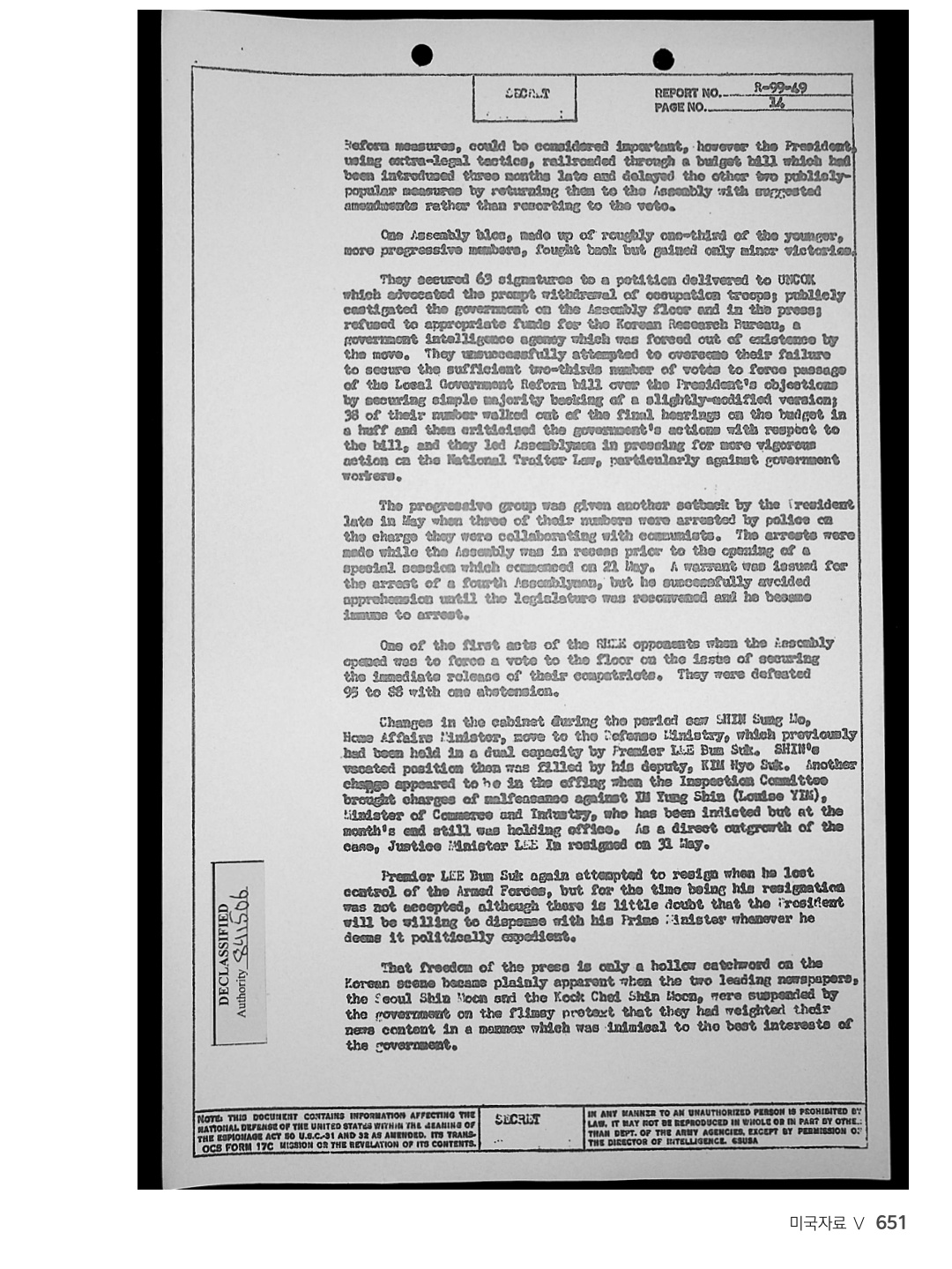
Reform measures, could be considered important, however the President, using extra-legal tactics, railroaded through a budget bill which had been introduced three months late and delayed the other two publicly-popular measures by returning them to the Assembly with suggested amendments rather than resorting to the veto.
One Assembly bloc, made up of roughly one-third of the younger, more progressive members, fought back but gained only minor victories.
They secured 69 signatures to a petition delivered to UNCOK which advocated the prompt withdrawal of occupation troops; publicly castigated the government on the Assembly floor and in the press; refused to appropriate funds for the Korean Research Bureau, a government intelligence agency which was forced out of existence by the move. They unsuccessfully attempted to overcome their failure to secure the sufficient two-thirds number of votes to force passage of the Local Government Reform Bill over the President's objections by securing simple majority backing of a slightly-modified version; 38 of their number walked out of the final hearings on the budget in a huff and then criticized the government's actions with respect to the bill, and they led Assemblymen in pressing for more vigorous action on the National Traitor Law, particularly against government workers.
The progressive group was given another setback by the President late in May when three of their members were arrested by police on the charge they were collaborating with communists. The arrests were made while the Assembly was in recess prior to the opening of a special session which commenced on 21 May. A warrant was issued for the arrest of a fourth Assemblyman, but he successfully avoided apprehension until the legislature was reconvened and he became immune to arrest.
One of the first acts of the RILE opponents when the Assembly opened was to force a vote to the floor on the issue of securing the immediate release of their compatriots. They were defeated 95 to 88 with one abstension.
Changes in the cabinet during the period saw SHIN Sung Ho, Home Affairs Minister, move to the Defense Ministry, which previously had been held in a dual capacity by Premier LEE Bum Suk. SHIN's vacated position then was filled by his deputy, KIM Hyo Suk. Another change appeared to be in the offing when the Inspection Committee brought charges of malfeasance against IM Yung Shin (Louise YIM), Minister of Commerce and Industry, who has been indicted but at the month's end still was holding office. As a direct outgrowth of the case, Justice Minister LEE Im resigned on 31 May.
Premier LEE Bum Suk again attempted to resign when he lost control of the Armed Forces, but for the time being his resignation was not accepted, although there is little doubt that the President will be willing to dispense with his Prime Minister whenever he deems it politically expedient.
That freedom of the press is only a hollow catchword on the Korean scene became plainly apparent when the two leading newspapers, the Seoul Shin Moon and the Kock Ched Shin Moon, were suspended by the government on the flimsy pretext that they had weighted their news content in a manner which was inimical to the best interests of the government.
DECLASSIFIED
Authority [illegible]
NOTE: THIS DOCUMENT CONTAINS INFORMATION AFFECTING THE NATIONAL DEFENSE OF THE UNITED STATES WITHIN THE MEANING OF THE ESPIONAGE ACT 50 U.S.C.-31 AND 32 AS AMENDED. ITS TRANS- OCS FORM 17C MISSION OR THE REVELATION OF ITS CONTENTS.
SECRET
IN ANY MANNER TO AN UNAUTHORIZED PERSON IS PROHIBITED BY LAW. IT MAY NOT BE REPRODUCED IN WHOLE OR IN PART BY OTHER THAN DEPT. OF THE ARMY AGENCIES, EXCEPT BY PERMISSION OF THE DIRECTOR OF INTELLIGENCE. GSUSA
SECRET (stamp)
REPORT NO. [illegible]-C9a/9
PAGE NO. 15
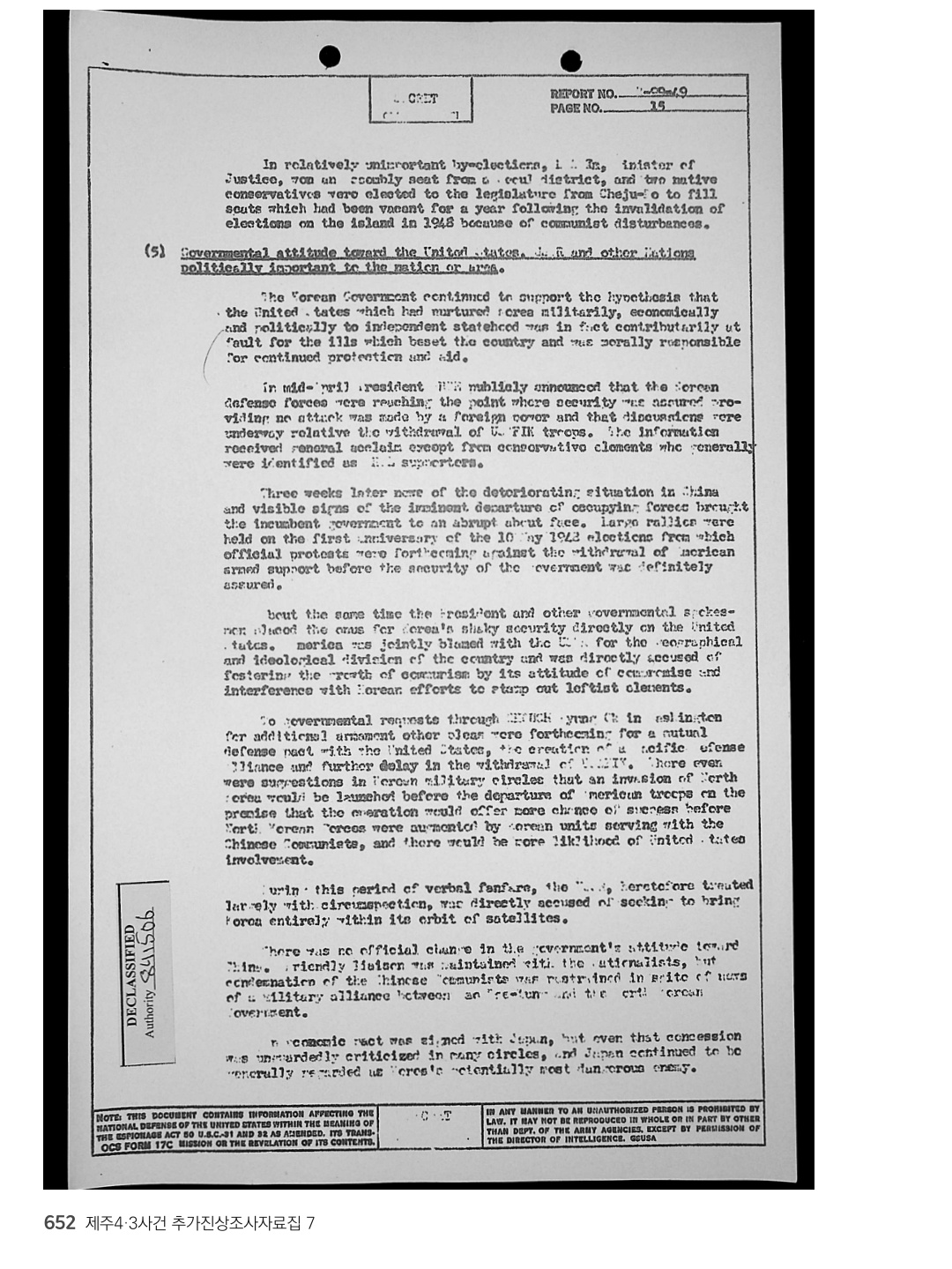
In relatively unimportant by-elections, L [illegible] Im, inister of
Justice, won an recently seat from a Seoul district, and two native conservatives were elected to the legislature from Cheju-do to fill seats which had been vacant for a year following the invalidation of elections on the island in 1948 because of communist disturbances.
(5) Governmental attitude toward the United States, S.E.R and other Nations politically important to the nation or area.
The Korean Government continued to support the hypothesis that the United States which had nurtured Korea militarily, economically and politically to independent statehood was in fact contributarily at fault for the ills which beset the country and was morally responsible for continued protection and aid.
In mid-April president [illegible] publicly announced that the Korean defense forces were reaching the point where security was assured providing no attack was made by a foreign power and that discussions were underway relative the withdrawal of U.S. FIK troops. The information received general acclaim except from conservative elements who generally were identified as U.S. supporters.
Three weeks later news of the deteriorating situation in China and visible signs of the imminent departure of occupying forces brought the incumbent government to an abrupt about face. Large rallies were held on the first anniversary of the 10 May 1948 elections from which official protests were forthcoming against the withdrawal of American armed support before the security of the government was definitely assured.
About the same time the President and other governmental spokesmen placed the onus for Korea's shaky security directly on the United
States. America was jointly blamed with the U.S. for the geographical and ideological division of the country and was directly accused of fostering the growth of communism by its attitude of compromise and interference with Korean efforts to stamp out leftist elements.
To governmental requests through KMAG young [illegible] in Washington for additional armament other pleas were forthcoming for a mutual defense pact with the United States, the creation of a Pacific Defense
Alliance and further delay in the withdrawal of [illegible]. There even were suggestions in Korean military circles that an invasion of North
Korea would be launched before the departure of American troops on the premise that the operation would offer more chance of success before
North Korean forces were augmented by Korean units serving with the
Chinese Communists, and there would be more likelihood of United States involvement.
During this period of verbal fanfare, the U.S. heretofore treated largely with circumspection, was directly accused of seeking to bring
Korea entirely within its orbit of satellites.
There was no official change in the government's attitude toward
China. Friendly liaison was maintained with the Nationalists, but condemnation of the Chinese Communists was restrained in spite of news of a military alliance between an [illegible] and the anti-Korean
Government.
An economic pact was signed with Japan, but even that concession was unguardedly criticized in many circles, and Japan continued to be generally regarded as Korea's potentially most dangerous enemy.
DECLASSIFIED
Authority [illegible]
SECRET
NOTE: THIS DOCUMENT CONTAINS INFORMATION AFFECTING THE
NATIONAL DEFENSE OF THE UNITED STATES WITHIN THE MEANING OF
THE ESPIONAGE ACT 50 U.S.C.-31 AND 32 AS AMENDED. ITS TRANSOCS FORM 17C MISSION OR THE REVELATION OF ITS CONTENTS.
IN ANY MANNER TO AN UNAUTHORIZED PERSON IS PROHIBITED BY
LAW. IT MAY NOT BE REPRODUCED IN WHOLE OR IN PART BY OTHER
THAN DEPT. OF THE ARMY AGENCIES, EXCEPT BY PERMISSION OF
THE DIRECTOR OF INTELLIGENCE, GSUSA.
SECRET
REPORT NO. R=99=49
PAGE NO. 7[illegible]7
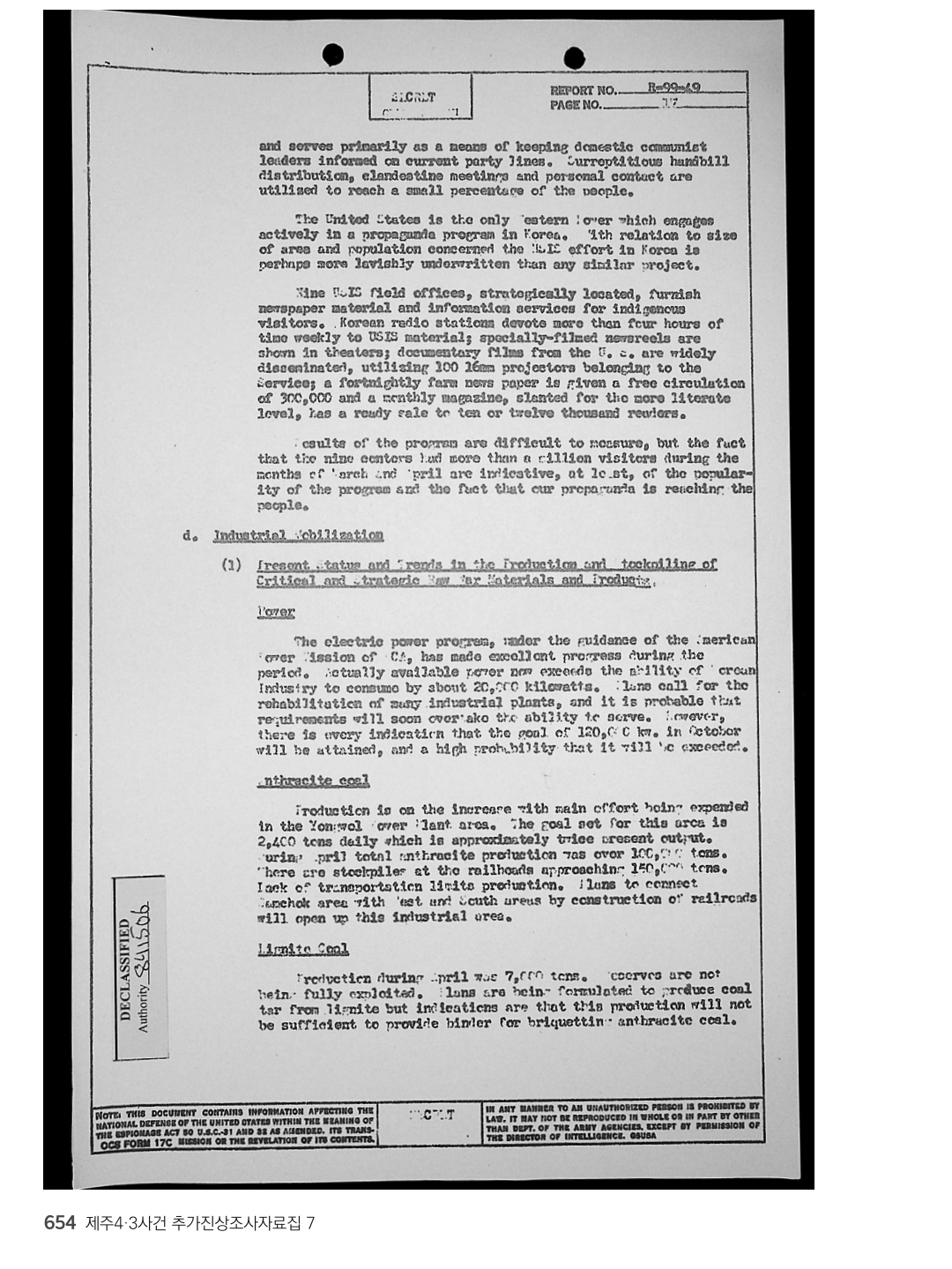
and serves primarily as a means of keeping domestic communist leaders informed on current party lines. Surreptitious handbill distribution, clandestine meetings and personal contact are utilized to reach a small percentage of the people.
The United States is the only Western Power which engages actively in a propaganda program in Korea. With relation to size of area and population concerned the USIS effort in Korea is perhaps more lavishly underwritten than any similar project.
Nine USIS field offices, strategically located, furnish newspaper material and information services for indigenous visitors. Korean radio stations devote more than four hours of time weekly to USIS material; specially-filmed newsreels are shown in theaters; documentary films from the U. S. are widely disseminated, utilizing 100 16mm projectors belonging to the
Service; a fortnightly farm news paper is given a free circulation of 300,000 and a monthly magazine, slanted for the more literate level, has a ready sale to ten or twelve thousand readers.
Results of the program are difficult to measure, but the fact that the nine centers had more than a million visitors during the months of March and April are indicative, at least, of the popularity of the program and the fact that our propaganda is reaching the people.
d. Industrial Mobilization
(1) Present Status and Trends in the Production and Stockpiling of
Critical and Strategic Raw War Materials and Products.
Power
The electric power program, under the guidance of the American
Power Mission of ECA, has made excellent progress during the period. Actually available power now exceeds the ability of Korean industry to consume by about 20,000 kilowatts. Plans call for the rehabilitation of many industrial plants, and it is probable that requirements will soon overtake the ability to serve. However, there is every indication that the goal of 120,000 kw. in October will be attained, and a high probability that it will be exceeded.
Anthracite coal
Production is on the increase with main effort being expended in the Yomwol [illegible] Plant area. The goal set for this area is
2,400 tons daily which is approximately twice present output.
During April total anthracite production was over 100,000 tons.
There are stockpiles at the railheads approaching 150,000 tons.
Lack of transportation limits production. Plans to connect
Sunchok area with East and South areas by construction of railroads will open up this industrial area.
Lignite Coal
Production during April was 7,000 tons. Reserves are not being fully exploited. Plans are being formulated to produce coal tar from lignite but indications are that this production will not be sufficient to provide binder for briquetting anthracite coal.
DECLASSIFIED
Authority [illegible]15[illegible]6
SECRET
NOTE: THIS DOCUMENT CONTAINS INFORMATION AFFECTING THE
NATIONAL DEFENSE OF THE UNITED STATES WITHIN THE MEANING OF
THE ESPIONAGE ACT 50 U.S.C.-31 AND 32 AS AMENDED. ITS TRANSOCS FORM 17C MISSION OR THE REVELATION OF ITS CONTENTS.
IN ANY MANNER TO AN UNAUTHORIZED PERSON IS PROHIBITED BY
LAW. IT MAY NOT BE REPRODUCED IN WHOLE OR IN PART BY OTHER
THAN DEPT. OF THE ARMY AGENCIES, EXCEPT BY PERMISSION OF
THE DIRECTOR OF INTELLIGENCE. GSUSA.
SECRET
REPORT NO. R-99-49
PAGE NO. 18
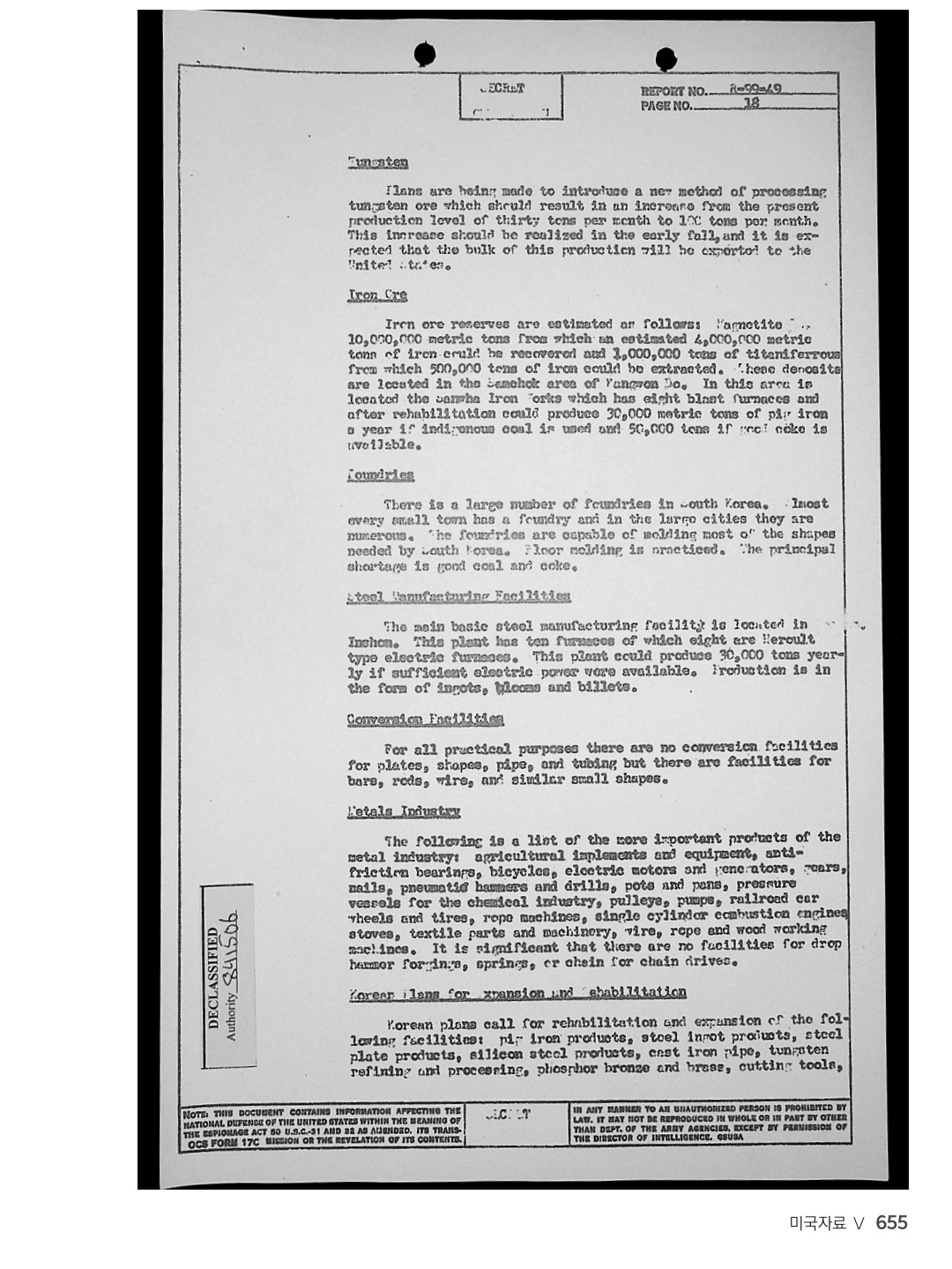
Tungsten
Plans are being made to introduce a new method of processing tungsten ore which should result in an increase from the present production level of thirty tons per month to 100 tons per month.
This increase should be realized in the early fall, and it is expected that the bulk of this production will be exported to the
United States.
Iron Ore
Iron ore reserves are estimated as follows: Magnetite [illegible]
10,000,000 metric tons from which an estimated 4,000,000 metric tons of iron could be recovered and 1,000,000 tons of titaniferous from which 500,000 tons of iron could be extracted. These deposits are located in the Samchok area of Kangwon Do. In this area is located the Samwha Iron Works which has eight blast furnaces and after rehabilitation could produce 30,000 metric tons of pig iron a year if indigenous coal is used and 50,000 tons if good coke is available.
Foundries
There is a large number of foundries in South Korea. Almost every small town has a foundry and in the large cities they are numerous. The foundries are capable of molding most of the shapes needed by South Korea. Floor molding is practiced. The principal shortage is good coal and coke.
Steel Manufacturing Facilities
The main basic steel manufacturing facility is located in
Inchon. This plant has ten furnaces of which eight are Hercult type electric furnaces. This plant could produce 30,000 tons yearly if sufficient electric power were available. Production is in the form of ingots, blooms and billets.
Conversion Facilities
For all practical purposes there are no conversion facilities for plates, shapes, pipe, and tubing but there are facilities for bars, rods, wire, and similar small shapes.
Metals Industry
The following is a list of the more important products of the metal industry: agricultural implements and equipment, antifriction bearings, bicycles, electric motors and generators, gears, nails, pneumatic hammers and drills, pots and pans, pressure vessels for the chemical industry, pulleys, pumps, railroad car wheels and tires, rope machines, single cylinder combustion engines stoves, textile parts and machinery, wire, rope and wood working machines. It is significant that there are no facilities for drop hammer forgings, springs, or chain for chain drives.
Korean Plans for Expansion and Rehabilitation
Korean plans call for rehabilitation and expansion of the following facilities: pig iron products, steel ingot products, steel plate products, silicon steel products, cast iron pipe, tungsten refining and processing, phosphor bronze and brass, cutting tools,
DECLASSIFIED
Authority [illegible]
NOTE: THIS DOCUMENT CONTAINS INFORMATION AFFECTING THE
NATIONAL DEFENSE OF THE UNITED STATES WITHIN THE MEANING OF
THE ESPIONAGE ACT 50 U.S.C.-31 AND 32 AS AMENDED. ITS TRANSOCB FORM 17C MISSION OR THE REVELATION OF ITS CONTENTS.
SECRET
IN ANY MANNER TO AN UNAUTHORIZED PERSON IS PROHIBITED BY
LAW. IT MAY NOT BE REPRODUCED IN WHOLE OR IN PART BY OTHER
THAN DEPT. OF THE ARMY EXCEPT BY PERMISSION OF
THE DIRECTOR OF INTELLIGENCE. GSUSA.
SECRET
REPORT NO. D-59-69
PAGE NO. 19
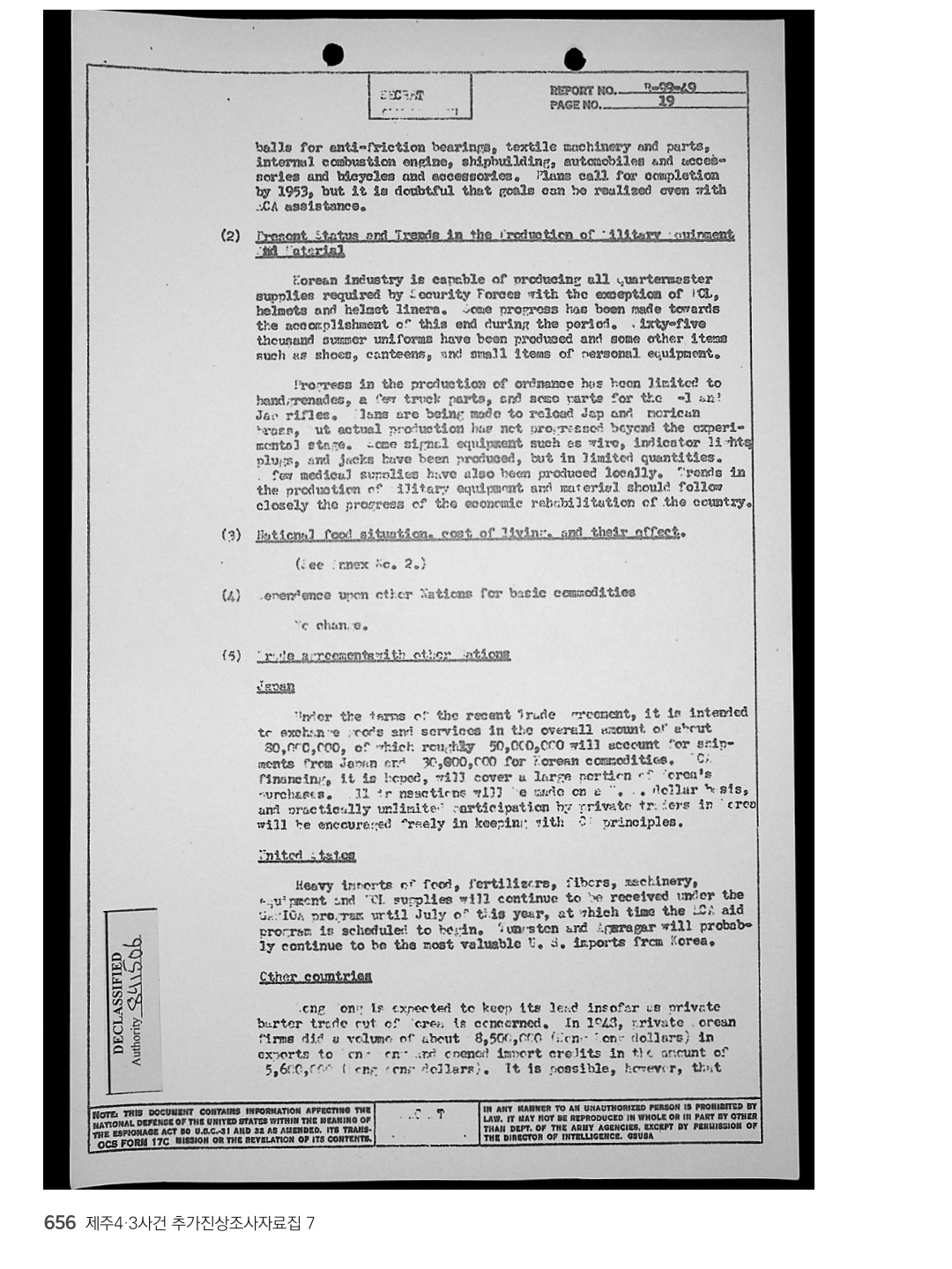
balls for anti-friction bearings, textile machinery and parts, internal combustion engine, shipbuilding, automobiles and accessories and bicycles and accessories. Plans call for completion by 1953, but it is doubtful that goals can be realized even with ECA assistance.
(2) Present Status and Trends in the Production of Military Equipment and Material
Korean industry is capable of producing all quartermaster supplies required by Security Forces with the exception of ICL, helmets and helmet liners. Some progress has been made towards the accomplishment of this end during the period. Sixty-five thousand summer uniforms have been produced and some other items such as shoes, canteens, and small items of personal equipment.
Progress in the production of ordnance has been limited to hand grenades, a few truck parts, and some parts for the M1 and Jap rifles. Plans are being made to reload Jap and American brass, but actual production has not progressed beyond the experimental stage. Some signal equipment such as wire, indicator lights plugs, and jacks have been produced, but in limited quantities. A few medical supplies have also been produced locally. Trends in the production of military equipment and material should follow closely the progress of the economic rehabilitation of the country.
(3) National food situation, cost of living, and their effect.
(See Annex No. 2.)
(4) Dependence upon other Nations for basic commodities
No change.
(5) Trade agreements with other Nations
Japan
Under the terms of the recent trade agreement, it is intended to exchange goods and services in the overall amount of about $0,000,000, of which roughly 50,000,000 will account for shipments from Japan and 30,000,000 for Korean commodities. ECA financing, it is hoped, will cover a large portion of Korea's purchases. All transactions will be made on a dollar basis, and practically unlimited participation by private traders in Korea will be encouraged freely in keeping with ECA principles.
United States
Heavy imports of food, fertilizers, fibers, machinery, equipment and ECA supplies will continue to be received under the interim program until July of this year, at which time the ECA aid program is scheduled to begin. Tungsten and [illegible] will probably continue to be the most valuable U. S. imports from Korea.
Other countries
Long one is expected to keep its lead insofar as private barter trade out of Korea is concerned. In 1943, private Korean firms did a volume of about $,500,000 (long tons dollars) in exports to [illegible] and opened import credits in the amount of 5,600,000 (long tons dollars). It is possible, however, that
DECLASSIFIED
Authority [illegible]
NOTE: THIS DOCUMENT CONTAINS INFORMATION AFFECTING THE NATIONAL DEFENSE OF THE UNITED STATES WITHIN THE MEANING OF THE ESPIONAGE ACT 50 U.S.C.-31 AND 32 AS AMENDED. ITS TRANSMISSION OR THE REVELATION OF ITS CONTENTS. IN ANY MANNER TO AN UNAUTHORIZED PERSON IS PROHIBITED BY LAW. IT MAY NOT BE REPRODUCED IN WHOLE OR IN PART BY OTHER THAN ARMY DEPT. OF THE ARMY AGENCIES, EXCEPT BY PERMISSION OF THE DIRECTOR OF INTELLIGENCE. GSUSA.
OCS FORM 17C MISSION OR THE REVELATION OF ITS CONTENTS.
SECRET REPORT NO. R-22-49
PAGE NO. 20
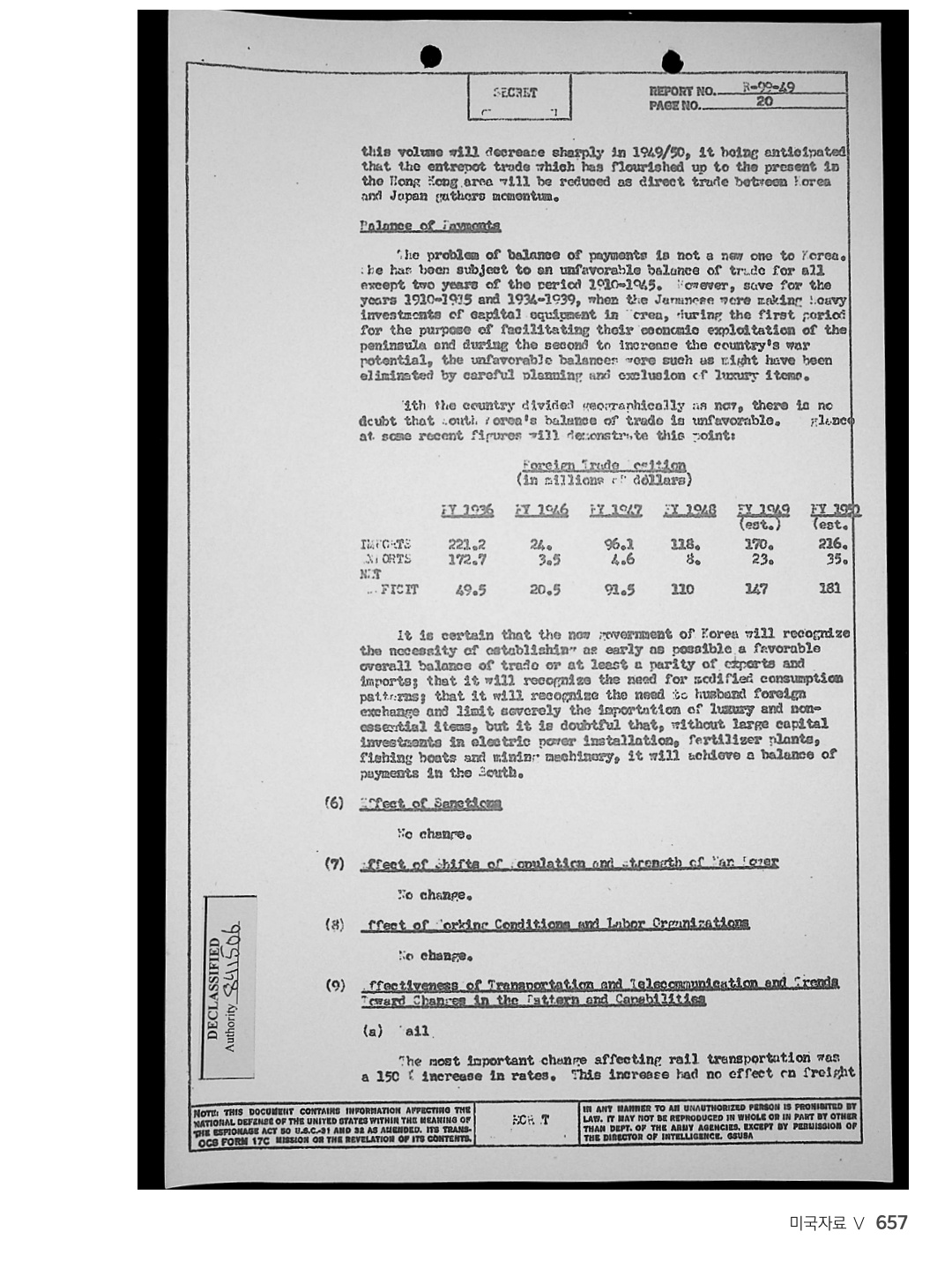
this volume will decrease sharply in 1949/50, it being anticipated that the entrepot trade which has flourished up to the present in the Hong Kong area will be reduced as direct trade between Korea and Japan gathers momentum.
Balance of Payments
The problem of balance of payments is not a new one to Korea.
She has been subject to an unfavorable balance of trade for all except two years of the period 1910-1945. However, save for the years 1910-1915 and 1934-1939, when the Japanese were making heavy investments of capital equipment in Korea, during the first period for the purpose of facilitating their economic exploitation of the peninsula and during the second to increase the country's war potential, the unfavorable balances were such as might have been eliminated by careful planning and exclusion of luxury items.
With the country divided geographically as now, there is no doubt that South Korea's balance of trade is unfavorable. Glance at some recent figures will demonstrate this point:
Foreign Trade Edition
(In millions of dollars)
FY 1936 FY 1946 FY 1947 FY 1948 FY 1949 FY 1950
(est.) (est.)
IMPORTS 221.2 26. 96.1 118. 170. 216.
EXPORTS 172.7 3.5 4.6 8. 23. 35.
NET
DEFICIT 49.5 20.5 91.5 110 147 181
It is certain that the new government of Korea will recognize the necessity of establishing as early as possible a favorable overall balance of trade or at least a parity of exports and imports; that it will recognize the need for modified consumption patterns; that it will recognize the need to husband foreign exchange and limit severely the importation of luxury and nonessential items, but it is doubtful that, without large capital investments in electric power installations, fertilizer plants, fishing boats and mining machinery, it will achieve a balance of payments in the South.
(6) Effect of Sanctions
No change.
(7) Effect of Shifts of Population and Strength of Manpower
No change.
(8) Effect of Working Conditions and Labor Organizations
No change.
(9) Effectiveness of Transportation and Telecommunication and Trends
Toward Changes in the Pattern and Capabilities
(a) Rail
The most important change affecting rail transportation was a 150 % increase in rates. This increase had no effect on freight
DECLASSIFIED
Authority [illegible]
NOTE: THIS DOCUMENT CONTAINS INFORMATION AFFECTING THE
NATIONAL DEFENSE OF THE UNITED STATES WITHIN THE MEANING OF
THE ESPIONAGE ACT 50 U.S.C.-31 AND 32 AS AMENDED. ITS TRANSOCS FORM 17C MISSION OR THE REVELATION OF ITS CONTENTS.
SECRET
IN ANY MANNER TO AN UNAUTHORIZED PERSON IS PROHIBITED BY
LAW. IT MAY NOT BE REPRODUCED IN WHOLE OR IN PART BY OTHER
THAN DEPT. OF THE ARMY AGENCIES, EXCEPT BY PERMISSION OF
THE DIRECTOR OF INTELLIGENCE. GSUSA
SECRET REPORT NO. R-99-49
PAGE NO. 21
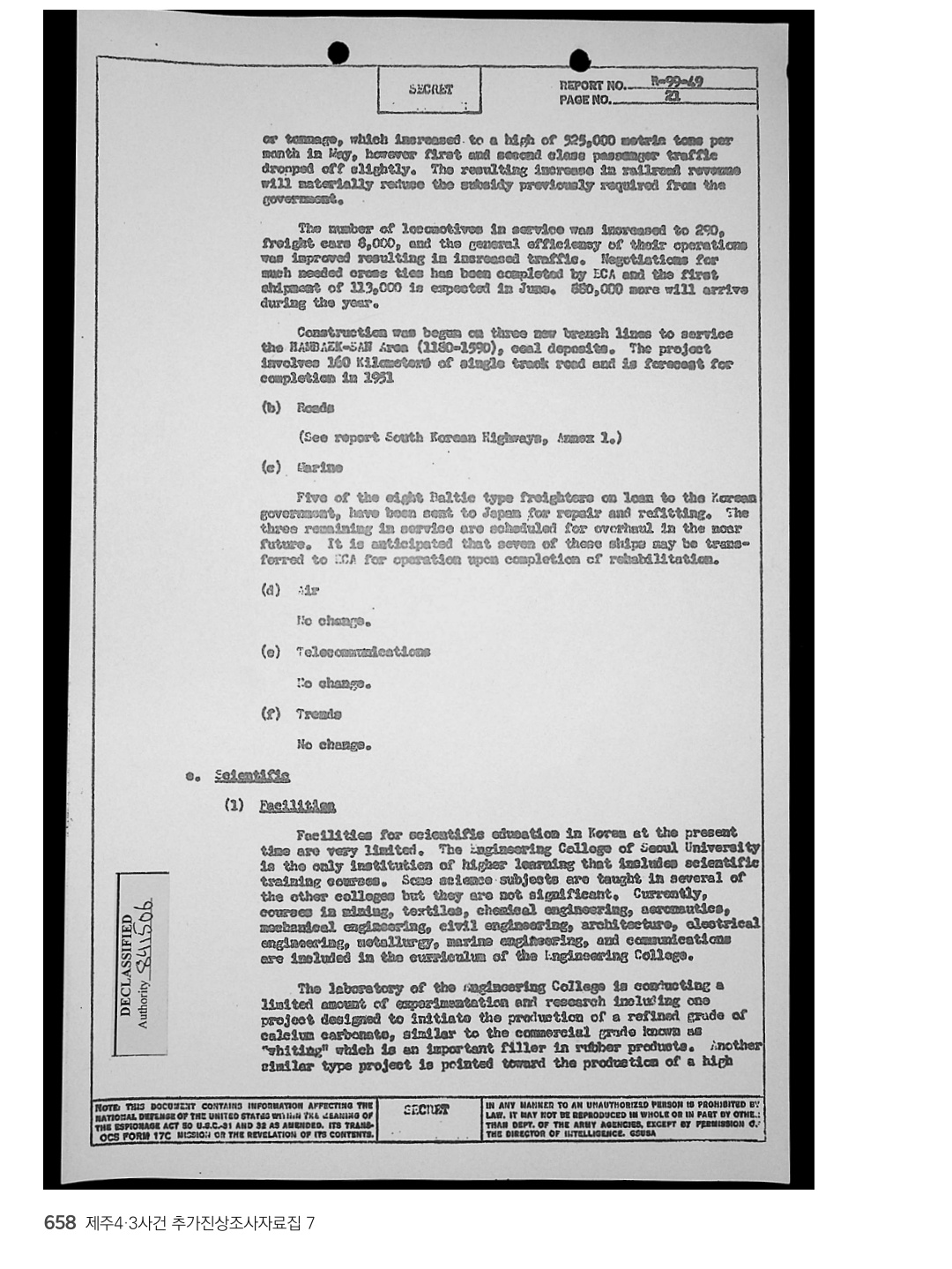
or tonnage, which increased to a high of 525,000 metric tons per month in May, however first and second class passenger traffic dropped off slightly. The resulting increase in railroad revenue will materially reduce the subsidy previously required from the government.
The number of locomotives in service was increased to 290, freight cars 8,000, and the general efficiency of their operations was improved resulting in increased traffic. Negotiations for much needed cross ties has been completed by ECA and the first shipment of 113,000 is expected in June. 880,000 more will arrive during the year.
Construction was begun on three new branch lines to service the HAMDAEK-SAM Area (1180-1990), coal deposits. The project involves 160 Kilometers of single track road and is forecast for completion in 1951
(b) Roads
(See report South Korean Highways, Annex 1.)
(c) Marine
Five of the eight Baltic type freighters on loan to the Korean government, have been sent to Japan for repair and refitting. The three remaining in service are scheduled for overhaul in the near future. It is anticipated that seven of these ships may be transferred to ECA for operation upon completion of rehabilitation.
(d) Air
No change.
(e) Telecommunications
No change.
(f) Trends
No change.
e. Scientific
(1) Facilities
Facilities for scientific education in Korea at the present time are very limited. The Engineering College of Seoul University is the only institution of higher learning that includes scientific training courses. Some science subjects are taught in several of the other colleges but they are not significant. Currently, courses in mining, textiles, chemical engineering, aeronautics, mechanical engineering, civil engineering, architecture, electrical engineering, metallurgy, marine engineering, and communications are included in the curriculum of the Engineering College.
The laboratory of the Engineering College is conducting a limited amount of experimentation and research including one project designed to initiate the production of a refined grade of calcium carbonate, similar to the commercial grade known as
"whiting" which is an important filler in rubber products. Another similar type project is pointed toward the production of a high
DECLASSIFIED
Authority 841566
NOTE: THIS DOCUMENT CONTAINS INFORMATION AFFECTING THE
NATIONAL DEFENSE OF THE UNITED STATES WITHIN THE MEANING OF
THE ESPIONAGE ACT 50 U.S.C.-31 AND 32 AS AMENDED. ITS TRANSOCS FORM 17C MISSION OR THE REVELATION OF ITS CONTENTS.
SECRET
IN ANY MANNER TO AN UNAUTHORIZED PERSON IS PROHIBITED BY
LAW. IT MAY NOT BE REPRODUCED IN WHOLE OR IN PART BY OTHE[R]
THAN DEPT. OF THE ARMY AGENCIES, EXCEPT BY PERMISSION OF
THE DIRECTOR OF INTELLIGENCE, GSUSA
SECRET REPORT NO. R-99-49
PAGE NO. 23
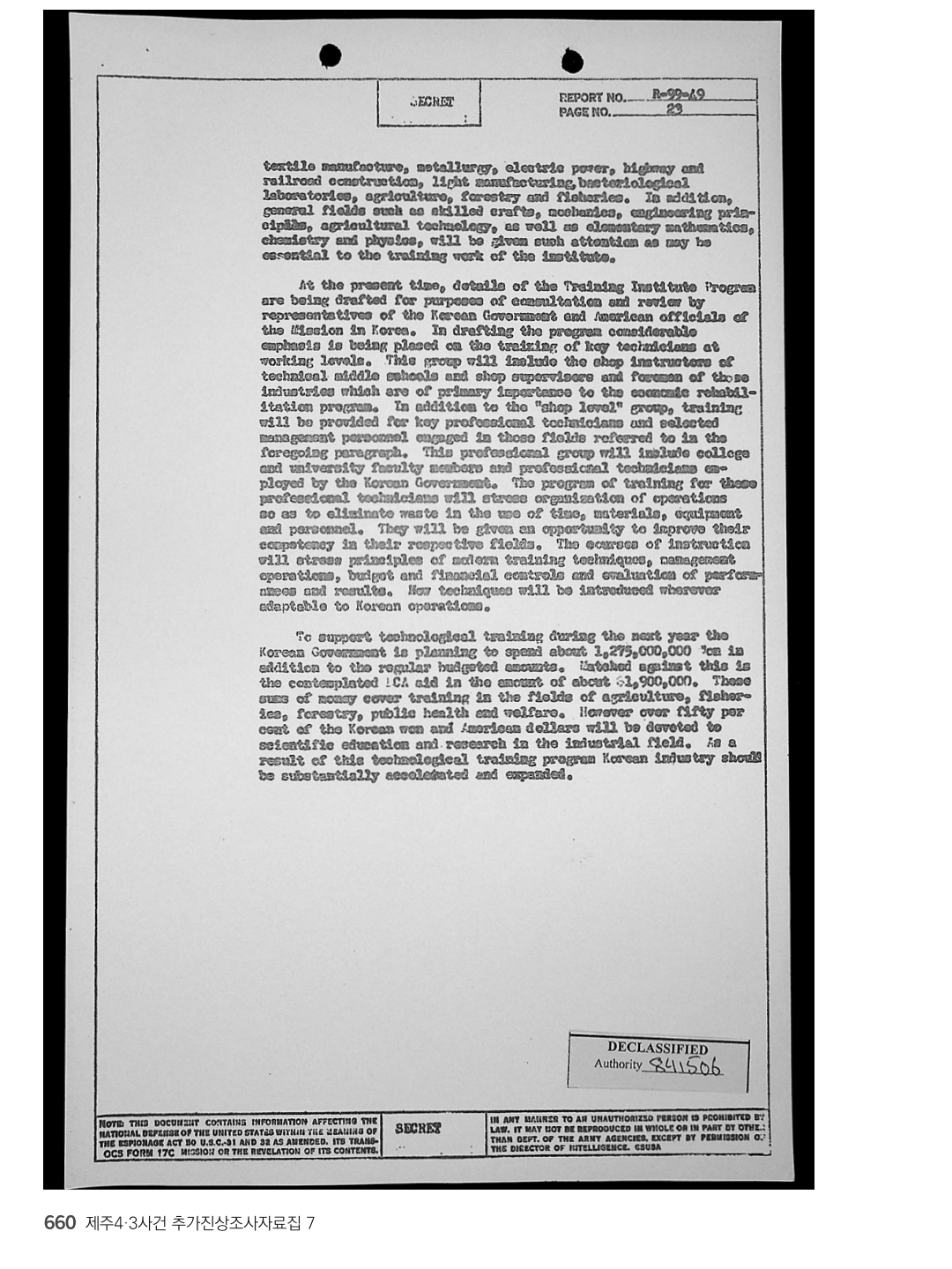
textile manufacture, metallurgy, electric power, highway and railroad construction, light manufacturing, bacteriological laboratories, agriculture, forestry and fisheries. In addition, general fields such as skilled crafts, mechanics, engineering principles, agricultural technology, as well as elementary mathematics, chemistry and physics, will be given such attention as may be essential to the training work of the institute.
At the present time, details of the Training Institute Program are being drafted for purposes of consultation and review by representatives of the Korean Government and American officials of the Mission in Korea. In drafting the program considerable emphasis is being placed on the training of key technicians at working levels. This group will include the shop instructors of technical middle schools and shop supervisors and foremen of those industries which are of primary importance to the economic rehabilitation program. In addition to the "shop level" group, training will be provided for key professional technicians and selected management personnel engaged in those fields referred to in the foregoing paragraph. This professional group will include college and university faculty members and professional technicians employed by the Korean Government. The program of training for these professional technicians will stress organization of operations so as to eliminate waste in the use of time, materials, equipment and personnel. They will be given an opportunity to improve their competency in their respective fields. The sources of instruction will stress principles of modern training techniques, management operations, budget and financial controls and evaluation of performances and results. New techniques will be introduced wherever adaptable to Korean operations.
To support technological training during the next year the
Korean Government is planning to spend about 1,275,000,000 won in addition to the regular budgeted amounts. Matched against this is the contemplated ICA aid in the amount of about $1,900,000. These sums of money cover training in the fields of agriculture, fisheries, forestry, public health and welfare. However over fifty per cent of the Korean won and American dollars will be devoted to scientific education and research in the industrial field. As a result of this technological training program Korean industry should be substantially accelerated and expanded.
DECLASSIFIED
Authority 841506
NOTE: THIS DOCUMENT CONTAINS INFORMATION AFFECTING THE
NATIONAL DEFENSE OF THE UNITED STATES WITHIN THE MEANING OF
THE ESPIONAGE ACT 50 U.S.C.-31 AND 32 AS AMENDED. ITS TRANSOCS FORM 17C MISSION OR THE REVELATION OF ITS CONTENTS. SECRET IN ANY MANNER TO AN UNAUTHORIZED PERSON IS PROHIBITED BY
LAW. IT MAY NOT BE REPRODUCED IN WHOLE OR IN PART BY OTHER
THAN DEPT. OF THE ARMY AGENCIES, EXCEPT BY PERMISSION OF
THE DIRECTOR OF INTELLIGENCE, GSUSA
출처:
제주4·3평화재단 편,
『추가진상조사자료집-미국자료5』,
p. 16–35.
— NARA (RG 554, Entry 31(A1), Box 3)
×
![]()