정보참모부 정기보고
보고 기간: 1948년 12월 1일~1948년 12월 2일
주한미육군사령부
서울, 한국
1948년 12월 2일 제1002호
2. 현용 정보
c. 학교 내 공산주의
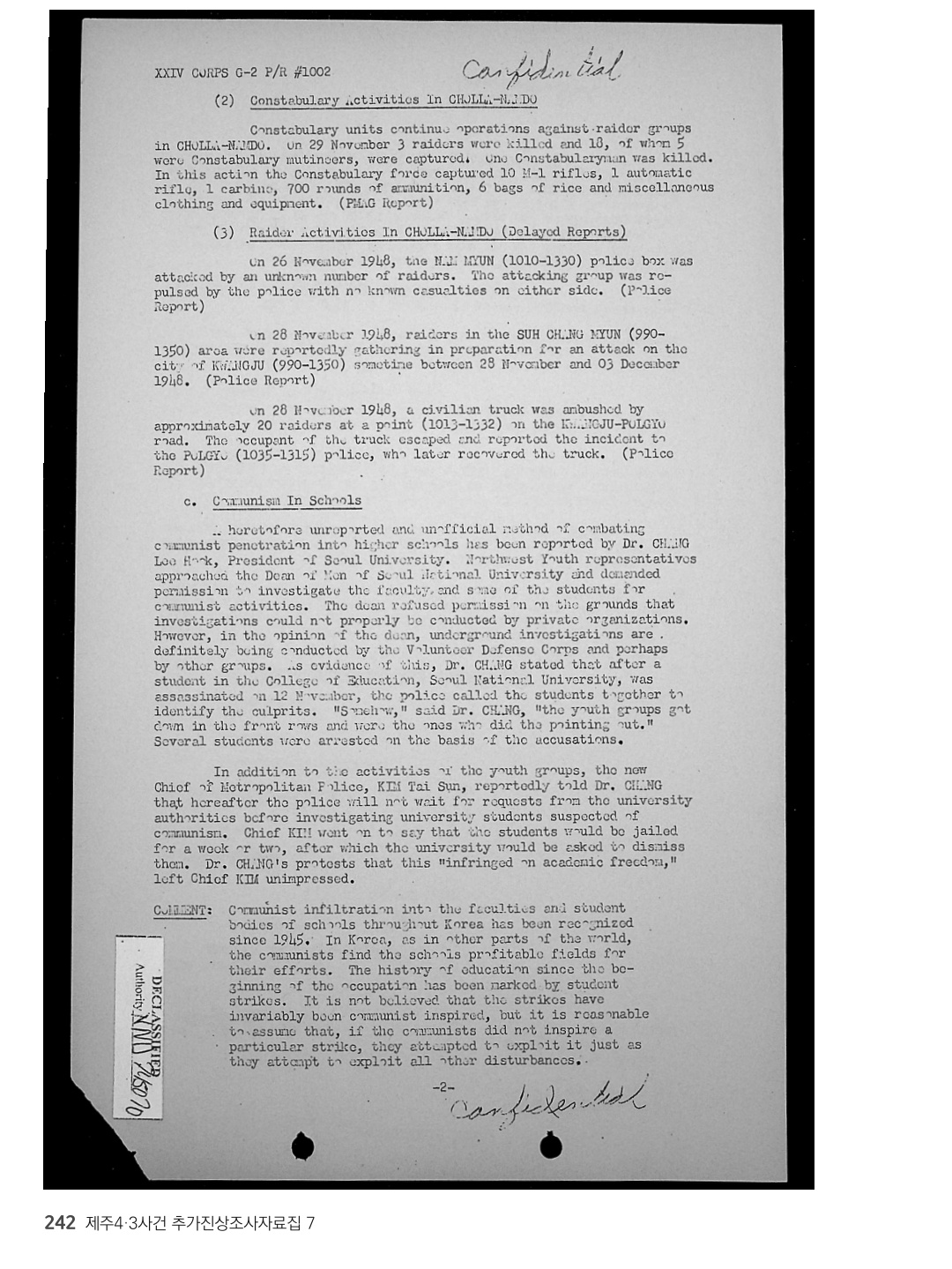
장이욱 서울대 총장이 고등교육기관에 침투한 공산주의자들과 싸울 수 있는 지금까지 보고된 적도 없고, 공식적이지도 않은 방법을 알려줬다. 서북청년단 대표가 서울대 총장(the Dean of Men of SNU)을 찾아가 공산주의 활동을 한 교직원과 학생들에 대한 조사를 허가해 달라고 요구했다. 총장은 사조직에 의한 조사는 적절치 않다며 허가를 거부했다. 그러나 총장의 생각에 따르면, 자위대와 다른 기관에 의해 비밀리에 조사가 분명히 진행되고 있다. 장 총장은 그 증거로 11월 12일 사범대 학생 1명이 암살된 이후 경찰이 범임을 찾기하기 위해 학생들을 소집했다고 한다. 장 총장은 "어떻게된 일인지", 청년단체들이 앞줄에 앉아 있었고, 그들이 사람들을 지목했다고 말했다. 몇몇 학생들이 체포됐다.
청년단체들의 활동 외에도 김태선 경찰국장이 장 총장에게 이제부터 경찰은 공산주의자 혐의를 받고 있는 학생들을 조사하기 전에 대학 당국의 요청을 기다리지 않겠다고 말한 것으로 알려졌다. 김 경찰국장은 이어 학생들은 1~2주 수감되어 있을 것이며, 이후 대학 측에 그들을 내쫓으라고 요구할 것이라고 말했다. '학문의 자유에 대한 침해'라는 장 총장의 항의는 김 국장에게 감동을 주지 못했다.
논평: 공산주의자들은 1945년 이후 학교 교직원과 학생 조직에 침투해 왔다. 세계의 다른 곳과 마찬가지로, 한국의 공산주의자들은 학교를 자신들의 활동 성과를 낼 수 있는 분야로 여기고 있다. 점령 시작부터 교육의 역사는 동맹휴교로 점철돼 있다. 그 동맹휴교가 변함없이 공산주의자에 영향을 받았다고는 생각하지 않지만, 만약 공산주의자들이 특정 동맹휴교를 부추기지 않았다면, 그들이 다른
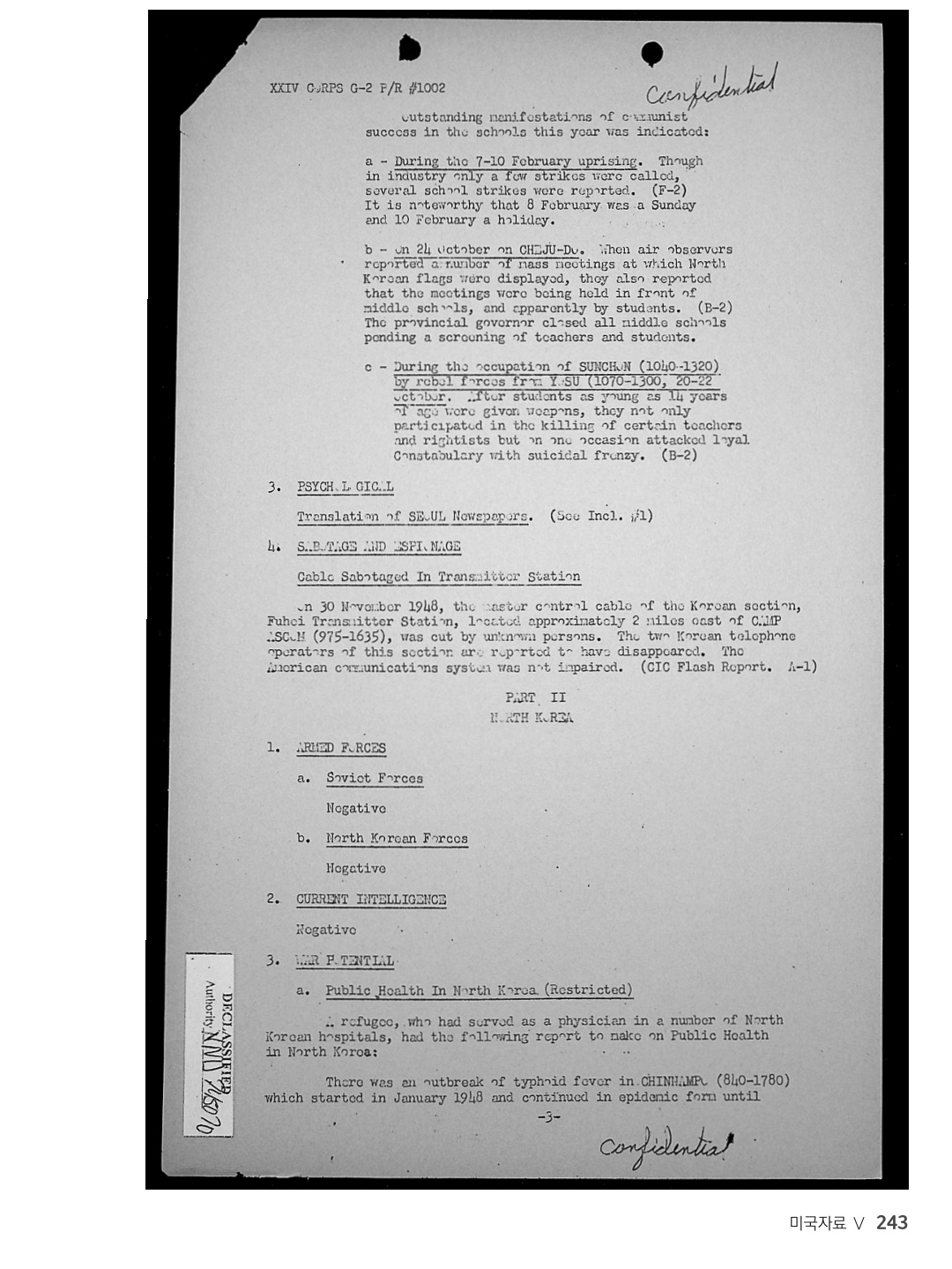
모든 소요사태를 이용하려는 것처럼 그것을 이용하려 했다고 보는 것이 타당하다. 올해 학교에서 공산주의 성공에 대한 두드러진 징후는 다음과 같다 :
a- 2월 7~10일 사이 봉기. 산업현장에서는 파업이 적었는데 몇몇 학교에서는 동맹휴교가 되풀이 됐다. (F-2) 2월 8일은 일요일이었고, 2월 10일은 공휴일이었다는 점을 주목해야 한다.
b - 10월 24일 제주도. 항공정찰자들이 북한기를 내건 군중집회를 목격했다. 정찰자의 보고에 따르면, 이 집회는 중학교 운동장에서 분명히 학생들에 의해 개최되고 있었다고 한다. (B-2) 제주도지사는 교사와 학생들의 선별작업을 마무리할 때까지 모든 중학교를 폐쇄했다.
c - 반란군이 여수(1070-1300, 20~22일 10월)에서부터 순천(1040-1320)을 점령하기 까지. 14살 학생들에게도 무기가 지급됐고 그 학생들은 교사와 우익을 살해하는 데 참여했을 뿐만 아니라 한번은 자살하려는 듯한 광기로 충직한 경비대를 공격했다.
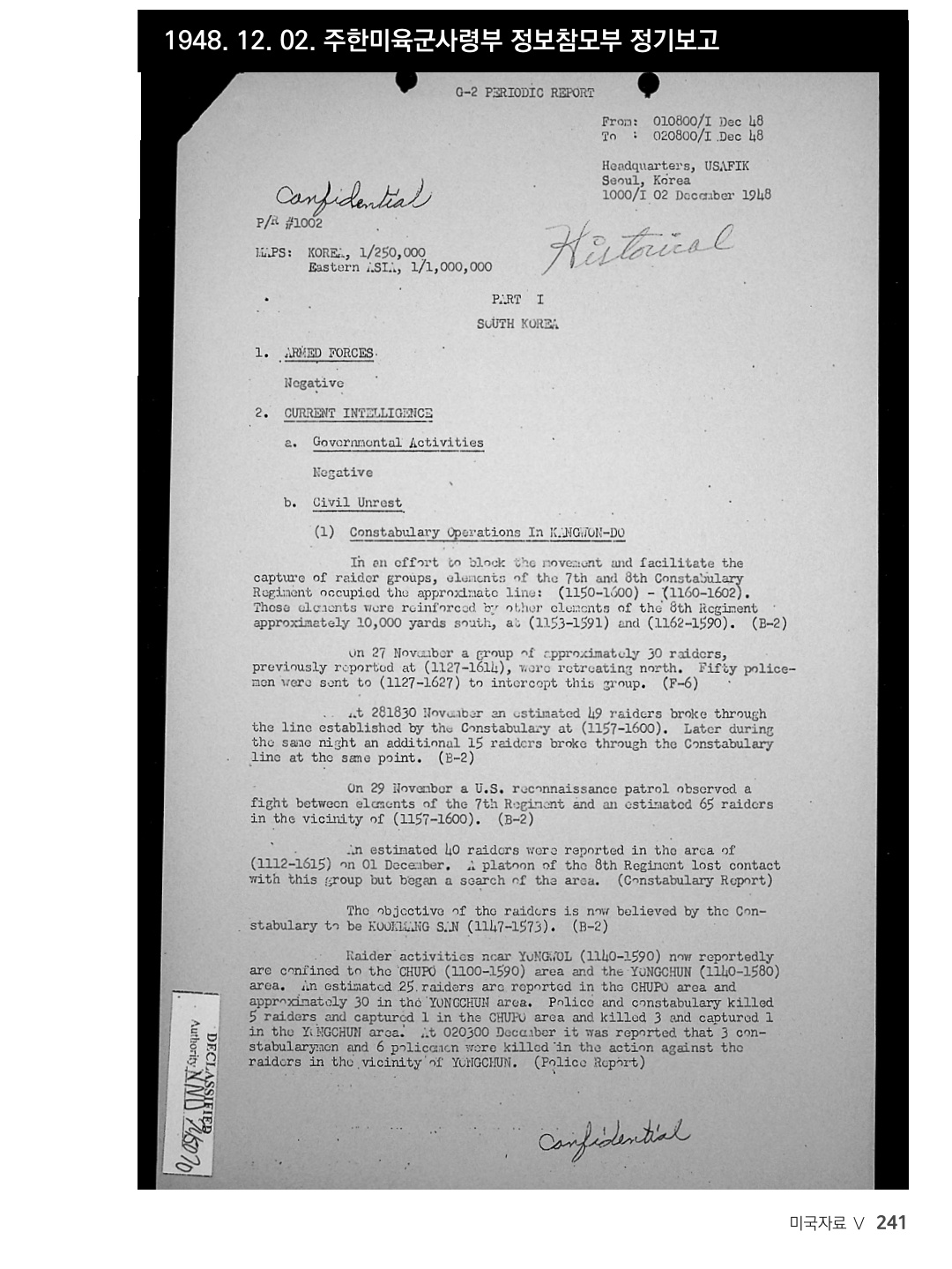
G-2 PERIODIC REPORT
From: 010800/I Dec 48
To : 020800/I Dec 48
Headquarters, USAFIK
Seoul, Korea
1000/I 02 December 1948
Confidential
P/R #1002
Historical
MAPS: KOREA, 1/250,000
Eastern ASIA, 1/1,000,000
PART I
SOUTH KOREA
1. ARMED FORCES.
Negative
2. CURRENT INTELLIGENCE
a. Governmental Activities
Negative
b. Civil Unrest
(1) Constabulary Operations In KANGWON-DO
In an effort to block the movement and facilitate the capture of raider groups, elements of the 7th and 8th Constabulary
Regiment occupied the approximate line: (1150-1600) - (1160-1602).
These elements were reinforced by other elements of the 8th Regiment approximately 10,000 yards south, at (1153-1591) and (1162-1590). (B-2)
On 27 November a group of approximately 30 raiders, previously reported at (1127-1614), were retreating north. Fifty policemen were sent to (1127-1627) to intercept this group. (F-6)
At 281830 November an estimated 49 raiders broke through the line established by the Constabulary at (1157-1600). Later during the same night an additional 15 raiders broke through the Constabulary line at the same point. (B-2)
On 29 November a U.S. reconnaissance patrol observed a fight between elements of the 7th Regiment and an estimated 65 raiders in the vicinity of (1157-1600). (B-2)
An estimated 40 raiders were reported in the area of
(1112-1615) on 01 December. A platoon of the 8th Regiment lost contact with this group but began a search of the area. (Constabulary Report)
The objective of the raiders is now believed by the Constabulary to be KWONKLING S,N (1147-1573). (B-2)
Raider activities near YONGWOL (1140-1590) now reportedly are confined to the CHUPO (1100-1590) area and the YONGCHUN (1140-1580)
area. An estimated 25 raiders are reported in the CHUPO area and approximately 30 in the YONGCHUN area. Police and constabulary killed
5 raiders and captured 1 in the CHUPO area and killed 3 and captured 1 in the YONGCHUN area. At 020300 December it was reported that 3 constabularymен and 6 policemen were killed in the action against the raiders in the vicinity of YONGCHUN. (Police Report)
Confidential
DECLASSIFIED
Authority NND 765070
XXIV CORPS G-2 P/R #1002 Confidential
(2) Constabulary Activities In CHOLLA-NAMDO
Constabulary units continue operations against raider groups in CHOLLA-NAMDO. On 29 November 3 raiders were killed and 18, of whom 5 were Constabulary mutineers, were captured. One Constabularyman was killed.
In this action the Constabulary force captured 10 M-1 rifles, 1 automatic rifle, 1 carbine, 700 rounds of ammunition, 6 bags of rice and miscellaneous clothing and equipment. (PMAG Report)
(3) Raider Activities In CHOLLA-NAMDO (Delayed Reports)
On 26 November 1948, the MAM MYUN (1010-1330) police box was attacked by an unknown number of raiders. The attacking group was repulsed by the police with no known casualties on either side. (Police
Report)
On 28 November 1948, raiders in the SUH CHANG MYUN (990-
1350) area were reportedly gathering in preparation for an attack on the city of KWANGJU (990-1350) sometime between 28 November and 05 December
1948. (Police Report)
On 28 November 1948, a civilian truck was ambushed by approximately 20 raiders at a point (1013-1332) on the KWANGJU-POLGYO road. The occupant of the truck escaped and reported the incident to the POLGYO (1035-1315) police, who later recovered the truck. (Police
Report)
c. Communism In Schools
A heretofore unreported and unofficial method of combating communist penetration into higher schools has been reported by Dr. CHANG
Loo Hak, President of Seoul University. Northwest Youth representatives approached the Dean of Men of Seoul National University and demanded permission to investigate the faculty and some of the students for communist activities. The dean refused permission on the grounds that investigations could not properly be conducted by private organizations.
However, in the opinion of the dean, underground investigations are definitely being conducted by the Volunteer Defense Corps and perhaps by other groups. As evidence of this, Dr. CHANG stated that after a student in the College of Education, Seoul National University, was assassinated on 12 November, the police called the students together to identify the culprits. "Somehow," said Dr. CHANG, "the youth groups got them in the front rows and were the ones who did the pointing out."
Several students were arrested on the basis of the accusations.
In addition to the activities of the youth groups, the new
Chief of Metropolitan Police, KIM Tai Sun, reportedly told Dr. CHANG that hereafter the police will not wait for requests from the university authorities before investigating university students suspected of communism. Chief KIM went on to say that the students would be jailed for a week or two, after which the university would be asked to dismiss them. Dr. CHANG's protests that this "infringed on academic freedom,"
left Chief KIM unimpressed.
COMMENT: Communist infiltration into the faculties and student bodies of schools throughout Korea has been recognized since 1945. In Korea, as in other parts of the world, the communists find the schools profitable fields for their efforts. The history of education since the beginning of the occupation has been marked by student strikes. It is not believed that the strikes have invariably been communist inspired, but it is reasonable to assume that, if the communists did not inspire a particular strike, they attempted to exploit it just as they attempt to exploit all other disturbances.
-2Confidential
DECLASSIFIED
Authority NND 750206
XXIV CORPS G-2 P/R #1002
Confidential
outstanding manifestations of communist success in the schools this year was indicated:
a - During the 7-10 February uprising. Though in industry only a few strikes were called, several school strikes were reported. (F-2)
It is noteworthy that 8 February was a Sunday and 10 February a holiday.
b - On 24 October on CHEJU-Do. When air observers reported a number of mass meetings at which North
Korean flags were displayed, they also reported that the meetings were being held in front of middle schools, and apparently by students. (B-2)
The provincial governor closed all middle schools pending a screening of teachers and students.
c - During the occupation of SUNCHON (1040-1320)
by rebel forces from YOSU (1070-1300, 20-22
October. After students as young as 14 years of age were given weapons, they not only participated in the killing of certain teachers and rightists but on one occasion attacked loyal
Constabulary with suicidal frenzy. (B-2)
3. PSYCHOLOGICAL
Translation of SEOUL Newspapers. (See Incl. #1)
4. SABOTAGE AND ESPIONAGE
Cable Sabotaged In Transmitter Station
On 30 November 1948, the master control cable of the Korean section, Fuhci Transmitter Station, located approximately 2 miles east of CAMP
ASCOM (975-1635), was cut by unknown persons. The two Korean telephone operators of this section are reported to have disappeared. The
American communications system was not impaired. (CIC Flash Report. A-1)
PART II
NORTH KOREA
1. ARMED FORCES
a. Soviet Forces
Negative
b. North Korean Forces
Negative
2. CURRENT INTELLIGENCE
Negative
3. WAR POTENTIAL
a. Public Health In North Korea (Restricted)
A refugee, who had served as a physician in a number of North
Korean hospitals, had the following report to make on Public Health in North Korea:
There was an outbreak of typhoid fever in CHINNAMPO (840-1780)
which started in January 1948 and continued in epidemic form until
-3-
Confidential
DECLASSIFIED
Authority NND 745270
XXIV CORPS G-2 P/R #1002 Confidential
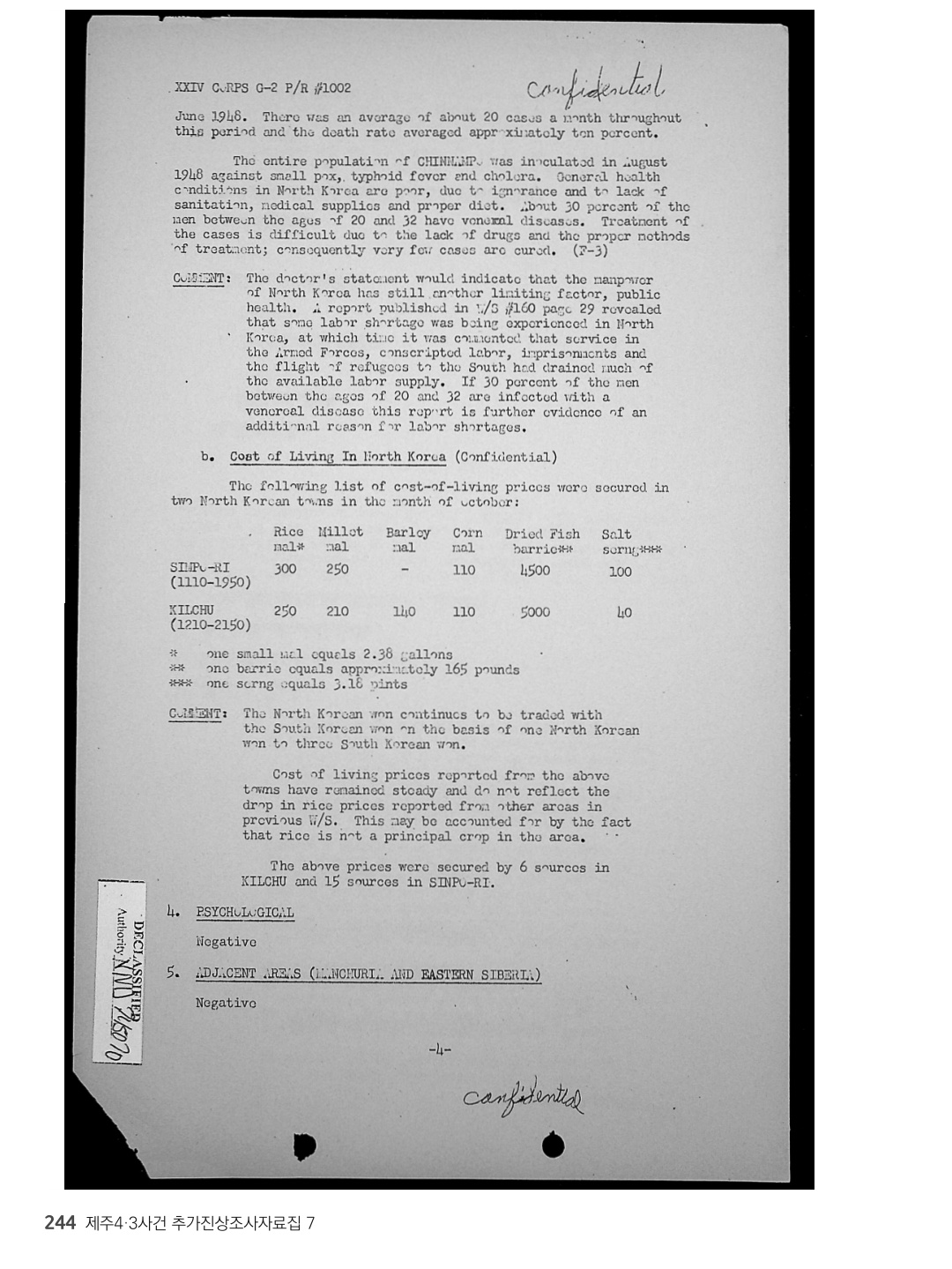
June 1948. There was an average of about 20 cases a month throughout this period and the death rate averaged approximately ten percent.
The entire population of CHINNAMPO was inoculated in August
1948 against small pox, typhoid fever and cholera. General health conditions in North Korea are poor, due to ignorance and to lack of sanitation, medical supplies and proper diet. About 30 percent of the men between the ages of 20 and 32 have venereal diseases. Treatment of the cases is difficult due to the lack of drugs and the proper methods of treatment; consequently very few cases are cured. (F-3)
COMMENT: The doctor's statement would indicate that the manpower of North Korea has still another limiting factor, public health. A report published in W/S #160 page 29 revealed that some labor shortage was being experienced in North
Korea, at which time it was commented that service in the Armed Forces, conscripted labor, imprisonments and the flight of refugees to the South had drained much of the available labor supply. If 30 percent of the men between the ages of 20 and 32 are infected with a venereal disease this report is further evidence of an additional reason for labor shortages.
b. Cost of Living In North Korea (Confidential)
The following list of cost-of-living prices were secured in two North Korean towns in the month of October:
Rice Millet Barley Corn Dried Fish Salt mal* mal mal mal barrie** sərng***
SINPO-RI 300 250 - 110 4500 100
(1110-1950)
KILCHU 250 210 140 110 5000 40
(1210-2150)
* one small mal equals 2.38 gallons
** one barrie equals approximately 165 pounds
*** one sərng equals 3.18 pints
COMMENT: The North Korean won continues to be traded with the South Korean won on the basis of one North Korean won to three South Korean won.
Cost of living prices reported from the above towns have remained steady and do not reflect the drop in rice prices reported from other areas in previous W/S. This may be accounted for by the fact that rice is not a principal crop in the area.
The above prices were secured by 6 sources in
KILCHU and 15 sources in SINPO-RI.
4. PSYCHOLOGICAL
Negative
5. ADJACENT AREAS (MANCHURIA AND EASTERN SIBERIA)
Negative
-4-
Confidential
XXIV CORPS G-2 P/R #1002
Confidential
Watlington
A.C of S/ G-2
[illegible]
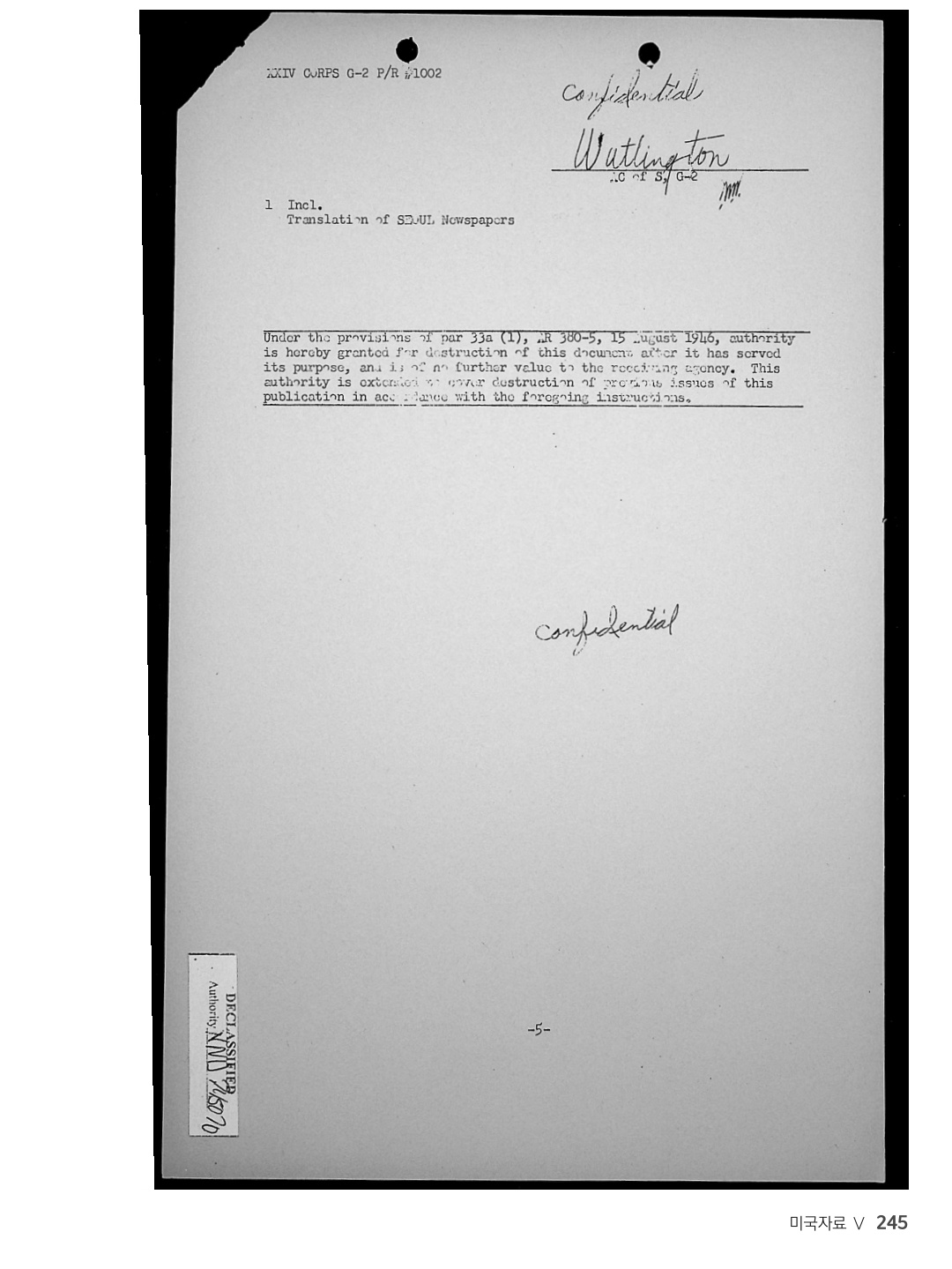
1 Incl.
Translation of SEOUL Newspapers
Under the provisions of par 33a (1), AR 380-5, 15 August 1946, authority is hereby granted for destruction of this document after it has served its purpose, and is of no further value to the receiving agency. This authority is extended to cover destruction of previous issues of this publication in accordance with the foregoing instructions.
Confidential
-5-
DECLASSIFIED
Authority NW 75850
출처:
제주4·3평화재단 편,
『추가진상조사자료집-미국자료5』,
p. 241–245.
— NARA (RG 554, Entry 1256, Box 47)
×
![]()