스캔 원본
100%
p.152
p.153
p.154
p.155
p.156
p.157
p.158
p.159
p.160
p.161
p.162
p.163
p.164
p.165
p.166
p.167
p.168
p.169
p.170
D. 심리학적
부정적
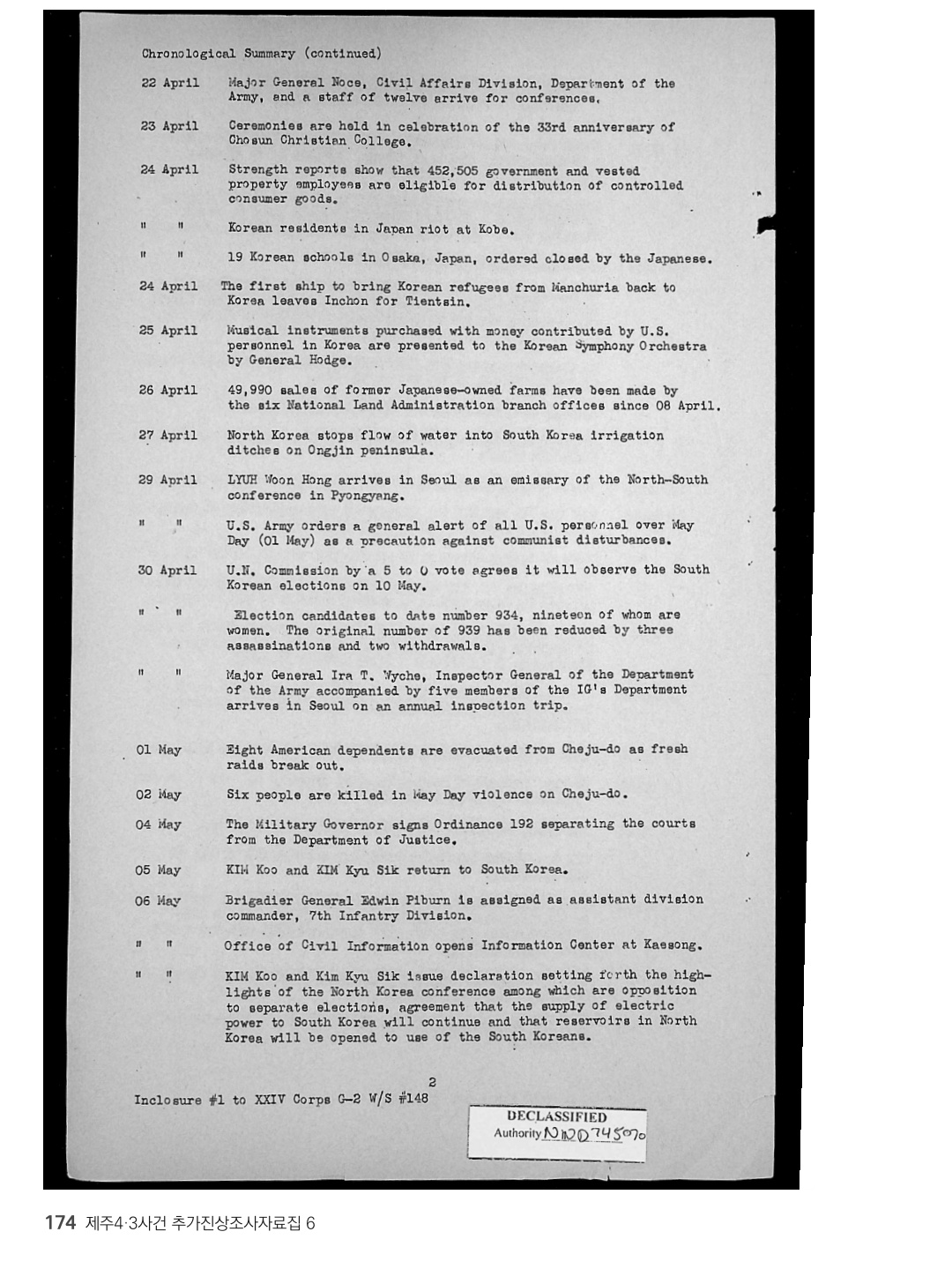
크로니클 요약: 1948년 4월, 5월, 6월
(앞의 C.S. 기간 참조 #133)
1948년 4월 1일 서울 경찰청장 CHANG Taik Sang이 서울에서 반긴급 상태를 선언하는 명령을 발령. 목적은 투표 등록을 보호하는 것.
1948년 4월 1일 살인죄로 유죄 판결을 받은 자들을 위해 6개의 사형 선고 발표. 한국민주당 지도자인 CHANO Duk Son의 살인혐의 (1947년 12월). 다른 2명은 10년 징역형 선고.
1948년 4월 3일 제주도에서 심각한 소동이 시작됨.
1948년 4월 3일 "통일독립운동회의"가 서울에서 개최됨. 회의는 중도파 및 우익 정당 초대 참여. 평양에서의 회의 참가를 위해 KIM Ko와 KIM Kyu Sik이 연설.
1948년 4월 3일 유엔 위원회는 9일의 태양 완전 일식으로 인해 5월 9일부터 10일까지의 선거를 연기함.
1948년 4월 3일 소위 "정치범" 3,000명 석방.
1948년 4월 3일 군부 총독이 새로운 5인 국방중재위원회 위원을 임명.
1948년 4월 5일 서울 투표인구의 73%가 선거에 등록함.
1948년 4월 7일 KIM Kyu Sik과 KIM Ko가 남북 회담을 준비하기 위해 평양으로 파견된 대표단을 배치.
1948년 4월 7일 조선은행 통화 순환 총액 29,330억 원.
1948년 4월 7일 MG 법령 No. 189는 일본에서 인쇄된 모든 조선은행 100원 지폐를 4월 13일에서 24일 사이에 환전하도록 지시.
1948년 4월 8일
제주도 소동 사상자: 19명 사망 (경찰 4명, 우익 민간인 13명, 공산주의자 3명), 부상자 21명 (경찰 8명, 우익 16명), 경찰 3명과 우익 4명 실종.
1948년 4월 13일
원래 4월 14일로 예정된 남북 정치 지도자 회담 개최는 무기한 연기됨.
1948년 4월 14일 조선은행 통화 순환 총액 29.2억 원.
1948년 4월 15일 남북 한국 간 우편 교환이 주간이 아닌 주간별로 진행되기 시작함.
1948년 4월 19일 남북 연합 회담이 평양에서 개최됨.
1948년 4월 19일 KIM Ko가 아들과 비서를 동반하여 서울을 떠나 평양으로 향함.
1948년 4월 21일 CHANG Duk Son 살인죄 혐의로 유죄 판결을 받은 자들의 형량 재심: 4명의 무기징역, 2명의 10년 징역, 2명의 5년 징역.
1948년 4월 21일 미국 육군 장교와 하사관이 경계선을 따라 한국 민간인들로부터 총격을 받음.
1948년 4월 21일 KIM Kyu Sik이 평양에서의 회담을 위해 서울에서 자동차로 출발.
정보참모부 주간요약보고
보고 기간: 1948년 7월 9일~1948년 7월 16일
주한미육군사령부
서울, 조선
1948년 7월 16일 제148호
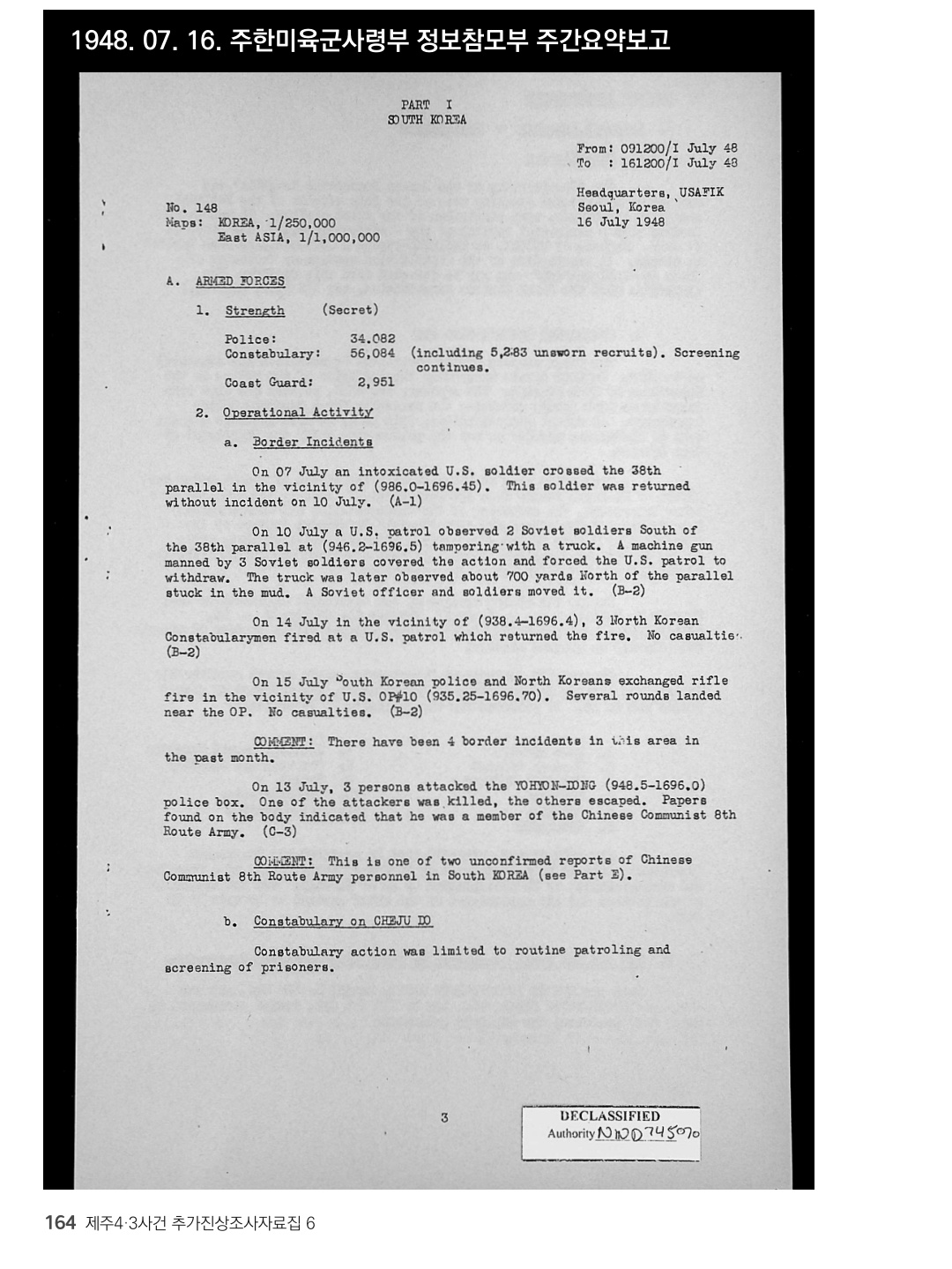
A. 군대
1. 병력 (2급 비밀)
경찰: 34,082명
경비대: 56,084명 (선서하지 않은 신병 5,283명 포함) 신원조회 중
해안경비대: 2,951명
2. 작전 활동
b. 제주도의 경비대 경비대 작전은 정규 정찰과 포로 심문으로 제한됐다.
B. 현용 정보
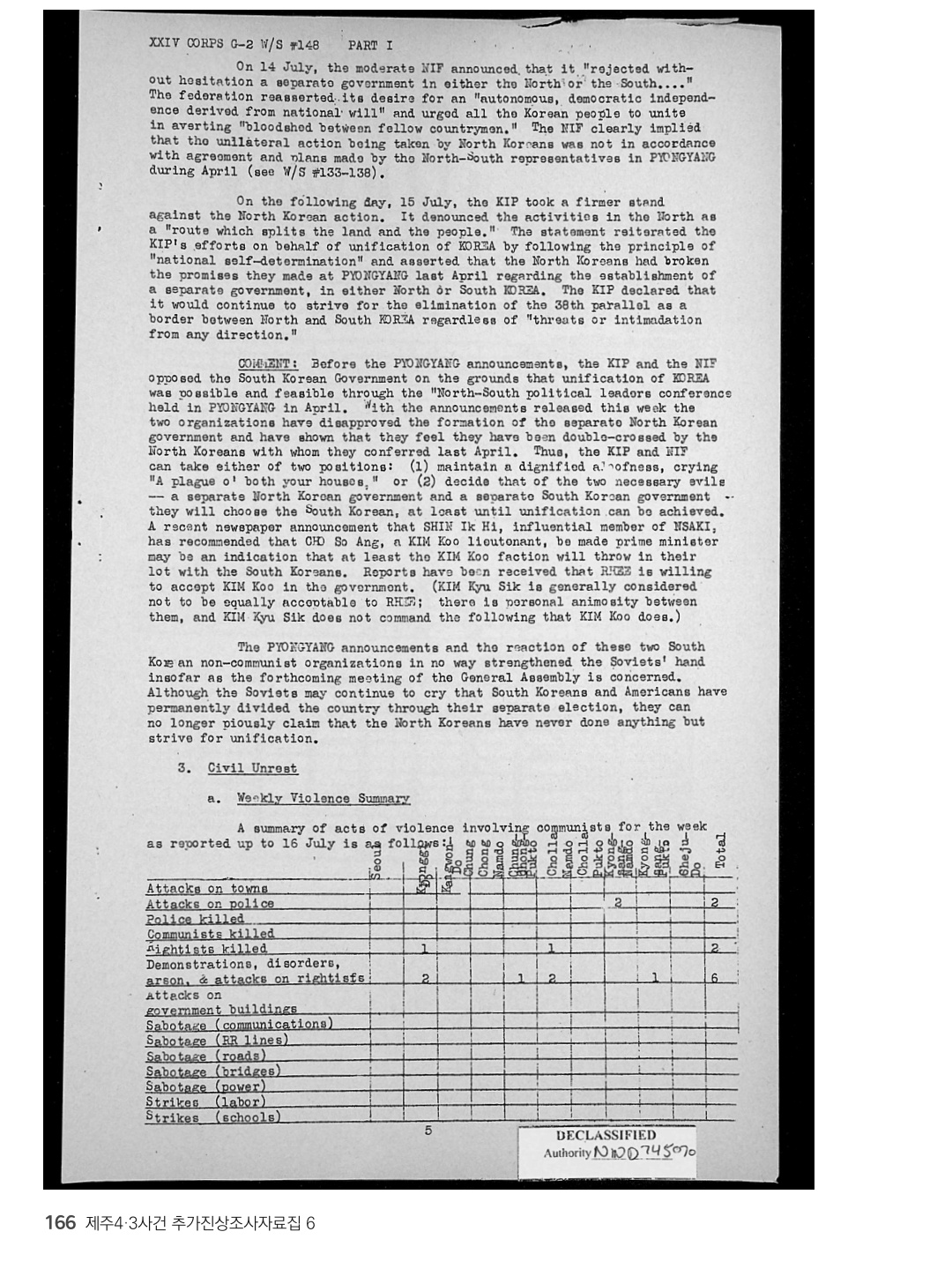
3. 민간인 소요
a. 주간 폭력 요약 이번 주 7월 16일까지 보고된 공산주의자가 연루된 폭력행위의 요약은 다음과 같다.
서울 | 경기 | 강원 | 충남 | 충북 | 전남 | 전북 | 경남 | 경북 | 제주 | 총계 마을 공격 경찰 공격 | 2 | | | | | | | | | | 2 경찰 사망 공산주의자 사망 | | | | | | | | | 1 | | 1 우파 사망 | | | | | | | | | | 2 | 2
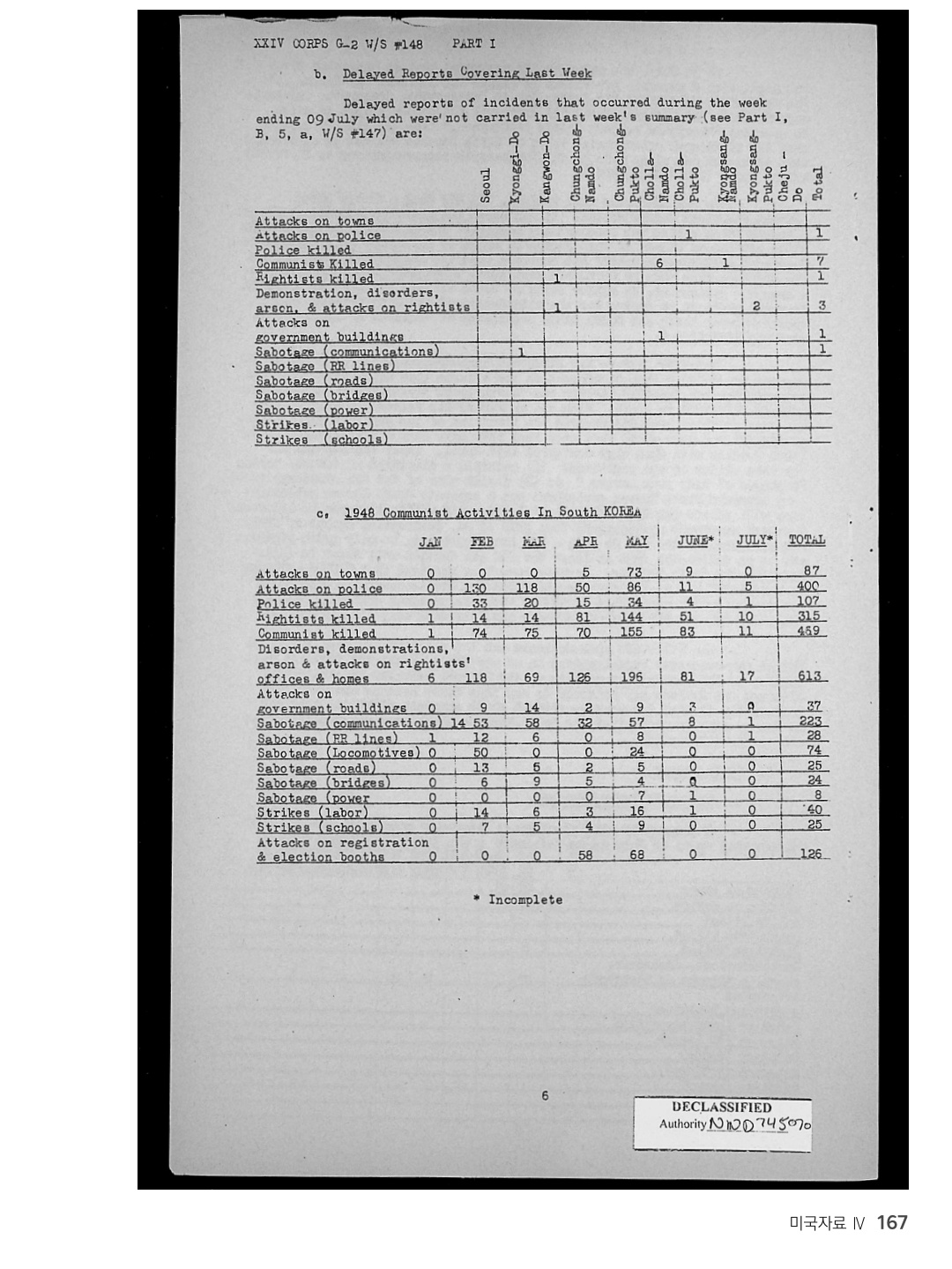
b. 지난주에 대한 추가보고 7월 9일에 마감한 주간에 발생했으나 지난주 요약보고(주간요약보고 제147호 제1부 B, 5, a 참고)에 실리지 않은 사건들에 관한 추가보고는 다음과 같다.
서울 경기 강원 충남 충북 전남 전북 경남 경북 제주 총계 시위, 소요, 방화, 우파 공격 2 1 2 1 6 관공서 공격 사보타주(통신)
사보타주(철로)
사보타주(도로)
사보타주(교량)
사보타주(전력)
노동자 파업
동맹휴교
서울 경기 강원 충남 충북 전남 전북 경남 경북 제주 총계 마을 공격 경찰 공격 1 1 경찰 사망 공산주의자 사망 6 1 7 우파 사망 1 1 시위, 소요, 방화, 우파 공격 1 1 관공서 공격 1 2 3 사보타주(통신)
1
1
사보타주(철로)
1
사보타주(도로)
사보타주(교량)
사보타주(전력)
노동자 파업
동맹휴교
c. 1948년 남조선에서의 공산주의자 활동
* 미완
C. 개전 가능성
1. 경제
b. 물가
| | 1월 | 2월 | 3월 | 4월 | 5월 | 6월* | 7월* | 총계 | |---|---|---|---|---|---|---|---|---| | 마을 공격 | 0 | 0 | 0 | 5 | 73 | 9 | 0 | 87 | | 경찰 공격 | 0 | 130 | 118 | 50 | 86 | 11 | 5 | 400 | | 경찰 사망 | 0 | 33 | 20 | 15 | 34 | 4 | 1 | 107 | | 우파 사망 | 1 | 14 | 14 | 81 | 144 | 51 | 10 | 315 | | 공산주의자 사망 | 1 | 74 | 75 | 70 | 155 | 83 | 11 | 469 | | 소요, 시위, 방화, 우파 사무실·자택 공격 | 6 | 118 | 69 | 126 | 196 | 81 | 17 | 613 | | 관공서 공격 | 0 | 9 | 14 | 2 | 9 | 3 | 0 | 37 | | 사보타주(통신) | 14 | 53 | 58 | 32 | 57 | 8 | 1 | 223 | | 사보타주(철로) | 1 | 12 | 6 | 0 | 8 | 0 | 1 | 28 | | 사보타주(기관차) | 0 | 50 | 0 | 0 | 24 | 0 | 0 | 74 | | 사보타주(도로) | 0 | 13 | 5 | 2 | 5 | 0 | 0 | 25 | | 사보타주(교량) | 0 | 6 | 9 | 5 | 4 | 0 | 0 | 24 | | 사보타주(전력) | 0 | 0 | 0 | 0 | 7 | 0 | 0 | 8 | | 노동자 파업 | 0 | 14 | 6 | 3 | 16 | 1 | 0 | 40 | | 동맹휴교 | 0 | 7 | 5 | 4 | 9 | 0 | 0 | 25 | | 선거등록사무소, 투표소 공격 | 0 | 0 | 0 | 58 | 68 | 0 | 0 | 126 |
미곡 가격 요약 - 월간 평균
단위: 1말(작은 단위) (16.67파운드)
출처 - 남조선과도정부 중앙물가행정처
1948년 4~6월 기간 일지
(이전 기간의 시간순 요약은 주간요약보고 제133호 참고)
4월 1일 - 수도경찰청장 장택상이 서울에 준비상사태를 선포하는 포고를 발표했다. 이는 투표자를 보호하기 위한 것이다.
4월 1일 - 1947년 12월 2일에 한국민주당 수석총무 장덕수를 살해한 혐의로 6명에게 사형이 선고됐다. 다른 2명에게는 10년형이 선고됐다.
4월 3일 - 제주도에서 심각한 폭동이 시작하다.
4월 3일 - 서울에서 통일독립운동자협의회가 결성됐다. 이 협의회는 평양에서 열리는 남북연석회의에 초대된 온건 우익 정당과 반체제 우익 정당으로 구성돼 있다. 김구와 김규식이 결성대회에서 축사를 했다.
4월 3일 - 유엔임시위원단이 선거를 5월 9일에서 5월 10일로 연기했다. 이는 9일에 있을 개기일식 때문이다.
지역별 미곡 가격 (원)
지역 | 1월 | 2월 | 3월 | 4월 | 5월 | 6월 | 7월 16일* 서울 | 743 | 746 | 707 | 655 | 740 | 895 | 1020 강원 | 791 | 860 | 772 | 750 | 816 | 920 | 충북 | 586 | 657 | 654 | 600 | 723 | 943 | 충남 | 630 | 662 | 613 | 576 | 660 | 860 | 경북 | 541 | 550 | 502 | 550 | 583 | 807 | 경남 | 650 | 707 | 650 | 640 | 666 | 868 | 전북 | 608 | 608 | 550 | 566 | 703 | 850 | 전남 | 558 | 575 | 508 | 541 | 728 | 875 | 제주 | 733 | 680 | 617 | 740 | 733 | 983 | 평균 | 648 | 676 | 619 | 659 | 706 | 889 |
4월 3일 - 소위 "정치범"으로 불리는 자들 3,000명이 석방됐다.
4월 3일 - 군정장관이 전국조정위원회에 새로운 위원 5명을 임명했다.
4월 5일 - 서울 인구의 73%가 투표를 위해 등록했다.
4월 7일 - 김규식과 김구는 남북연석회의를 준비하기 위해 평양에 대리인을 파견했다.
4월 7일 - 조선은행권의 유통량이 29조 3,000억 원이다.
4월 8일 - 군정법령 제182호는 일본에서 인쇄된 모든 조선은행 100원권이 4월 12일에서 24일 사이에 전환돼야 한다고 명령했다.
4월 8일 - 제주도 폭동으로 4월 3일 이후 19명이 사망하고(경찰 4명, 우파 민간인 12명, 공산주의자 3명) 12명이 부상당했다(경찰 5명, 우파 16명). 경찰 3명과 우파 4명이 실종됐다.
4월 13일 - 14일로 예정돼 있던 남북연석회의가 무기한 연기됐다.
4월 14일 - 조선은행권 유통량은 292억 원1이다.
4월 14일 - 2주일 대신 1주일 간격으로 북조선과 남조선의 우편물 교환이 이뤄지게 됐다.
4월 19일 - 평양에서 남북연석회의가 열렸다.
4월 19일 - 김구는 자신의 아들과 비서와 함께 서울에서 평양으로 떠났다.
4월 21일 - 장덕수의 살해에 참여한 자들의 형이 감해졌다. 무기징역 4명, 10년 형 2명, 5년 형 2명.
4월 21일 - 미군 장교와 병장이 38선 근처에서 총격을 당했다.
4월 21일 - 김규식이 평양연석회의에 참석하기 위해 서울에서 자동차를 타고 떠났다.
4월 22일 - 육군부 민정국 소속 노스(Noce) 소장과 12명의 참모가 회의를 위해 도착했다.
4월 23일 - 제33회 조선기독교대학교 설립기념행사가 열렸다.
4월 24일 - 전력 보고에 따르면 관리 소비자 상품의 배분을 위해 452,505명의 공무원과 정부 시설 피고용인을 동원할 수 있다.
1) [역주] 4월 7일과 수치가 너무 다름. 확인 필요. 29조 3,000억 원의 오기로 추정.
4월 24일 - 일본 고베에 거주하는 조선인들이 폭동을 일으켰다.
4월 24일 - 만주 피난민을 귀환시키기 위한 선박이 톈진에 가기 위해 인천을 떠났다.
4월 25일 - 하지 장군이 미국인 인사의 돈으로 구매한 악기들을 조선교향악단에 소개했다.
4월 26일 - 4월 8일 이후 중앙토지행정처의 6개 지부가 일본인이 소유했던 농 지를 판매했다. 판매는 49,990건이 이루어졌다.
4월 27일 - 북조선이 옹진반도에서 남조선으로 흐르는 용수로를 차단했다.
4월 29일 - 여운형이 남북연석회의의 특사 자격으로 서울에 도착했다.
4월 29일 - 미군이 5월 1일 노동절에 있을 공산주의자 소요에 대한 경고의 의 미로 미국인들에게 경보를 발령했다.
4월 30일 - 유엔위원단이 투표를 하여 5월 10일에 남조선에서의 선거를 감시 하기로 동의했다. 투표결과는 5 대 0이었다.
4월 30일 - 30일까지 후보는 934명이고 그 중 여성은 19명이다. 원래는 939 명의 후보가 있었으나 그 중 3명이 암살당했고 2명이 사퇴했다.
4월 30일 - 육군부 감찰관 아이라 T. 위치(Ira T. Whyche) 소장이 연례 감찰을 위해 감찰부 구성원 5명과 함께 서울에 도착했다.
5월 1일 - 새로운 기습이 시작되어 미국인 부양가족 8명을 대피시켰다.
5월 2일 - 노동절 폭력으로 제주도에서 6명이 사망했다.
5월 4일 - 군정장관이 법원을 사법부로부터 분리하는 군정법령 제192호에 서 명했다.
5월 5일 - 김구와 김규식이 남조선으로 귀환했다.
5월 6일 - 에드윈 피번(Edwin Piburn) 준장이 제7보병사단의 부사단장으로 임명됐다.
5월 6일 - 민간정보국이 개성에 정보센터를 개소했다.
5월 6일 - 김구와 김규식이 남북연석회의의 분리 선거에 대한 반대, 남조선에 대한 전력 공급의 지속, 남조선에서의 사용을 위한 북조선 저수지 개방 등의 내용을 담은 남북연석회의 결과를 발표했다.
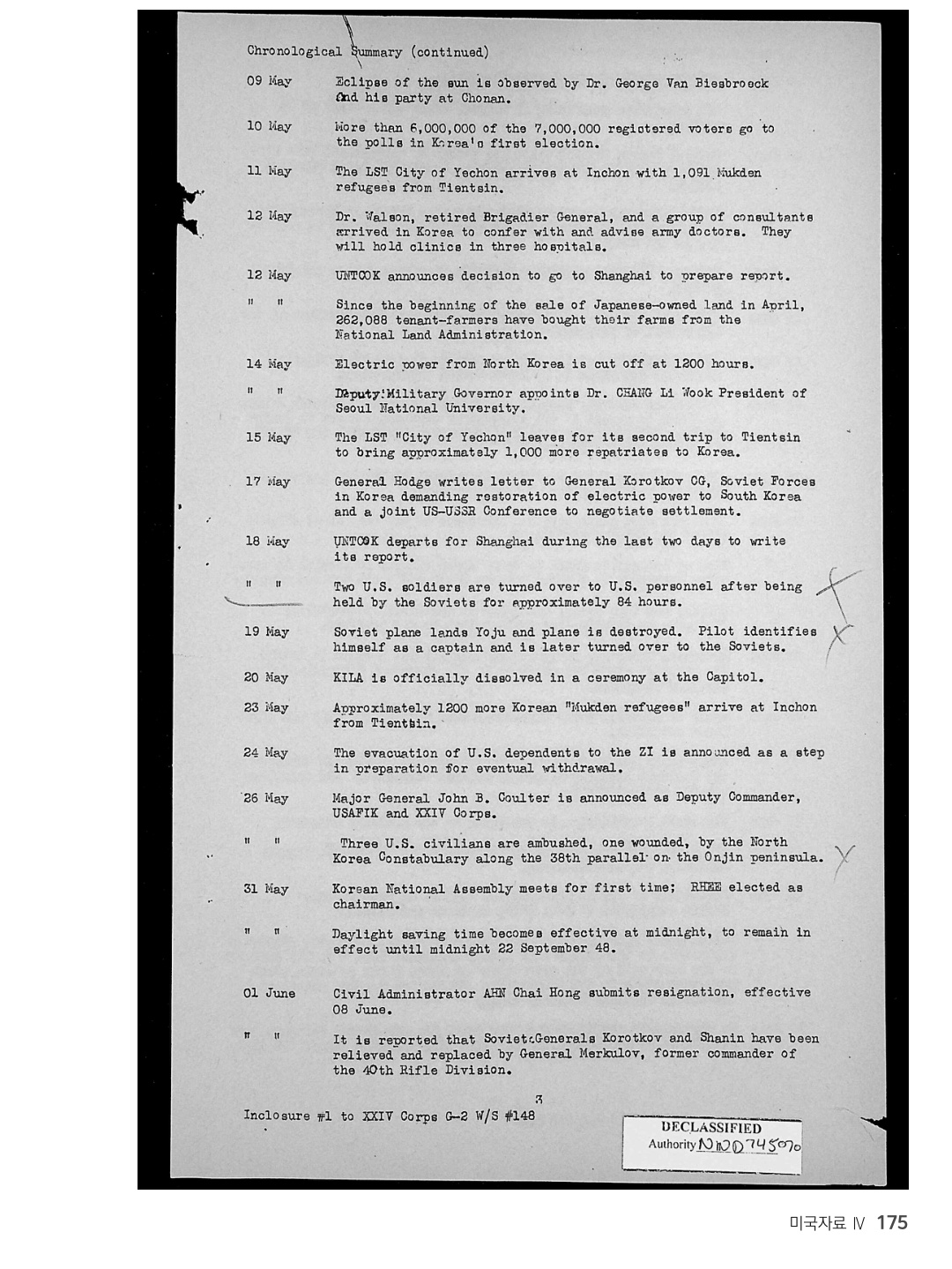
5월 9일 - 조지 반 비스브로익(George Van Biesbroeck) 박사와 그의 팀은 전
남에서 개기일식을 관찰했다.
5월 10일 - 투표자 등록을 한 7,000,000명 중 6,000,000 이상이 조선 최초의 선거에 참여했다.
5월 11일 - 전차상륙함 예천함이 선양의 피난민 1,091명을 데리고 톈진에서 인천으로 귀환으로 했다.
5월 12일 - 전역한 준장인 왈슨(Walson) 박사와 자문팀이 육군 의사들에게 조언을 주기 위해 서울에 도착했다. 그들은 병원 3곳에서 강습을 개최할 것이다.
5월 12일 - 유엔임시위원단은 보고서를 준비하기 위해 상하이로 가기로 결정했다고 발표했다.
5월 12일 - 일본인이 소유했던 토지를 판매하기 시작한 4월 이후, 262,088명의 농민이 중앙토지행정처로부터 농지를 구매했다.
5월 14일 - 정오를 기점으로 북조선에서 오는 전력이 차단됐다.
5월 14일 - 부군정장관이 장이욱 박사를 서울대 총장으로 임명했다.
5월 15일 - 전차상륙함 "예천함"이 귀환자 1,000여 명을 조선으로 데려오기 위해 톈진으로 두 번째 항해를 떠났다.
5월 17일 - 하지 장군이 소련군 사령관 코로트코프(Korotkov) 장군에게 서한을 보냈다. 해당 서한은 남조선에 전력 공급을 재개하라는 요구와 이 문제를 미소공동위원회에서 협의하자는 요구를 담고 있었다.
5월 18일 - 유엔임시위원단이 지난 2일 동안 보고서를 작성하기 위해 상하이로 떠났다.
5월 19일 - 소련의 항공기가 여주에 착륙했다가 파괴됐다. 비행사는 자신이 대위라고 했다. 이후 그는 소련에 넘겨졌다.
5월 20일 - 국회의사당에서 열린 행사에서 남조선과도입법의원이 공식적으로 해산했다.
5월 23일 - "묵덴 피난민" 1,200명 이상이 톈진을 떠나 인천에 도착했다.
5월 24일 - 미국인 부양가족의 퇴거가 발표됐다. 이는 앞으로 있을 미군 철수의 사전 준비 작업이다.
5월 26일 - 존 B. 콜터(John B. Coulter) 장군이 주한미육군과 제24군단 부사
령관에 임명됐다.
5월 26일 - 38선 근처 옹진반도에서 미국 민간인 3명이 북조선보안대에 의해 기습당했다.
5월 31일 - 국회가 처음으로 소집됐다. 이승만이 의장으로 선출됐다.
5월 31일 - 자정을 기점으로 일광 절약 시간이 실시됐다. 이는 1948년 9월 22일까지 유지된다.
6월 1일 - 안재홍 민정장관이 사직서를 제출했다. 이는 6월 8일 자로 발효된다.
6월 1일 - 코로트코프(Korotkov)와 샤닌(Shanin) 장군이 물러나고 제40소총사단의 전(前) 사령관인 메르쿨로프(Merkulov) 장군이 그 자리를 대신하게 됐다는 보고가 들어왔다.
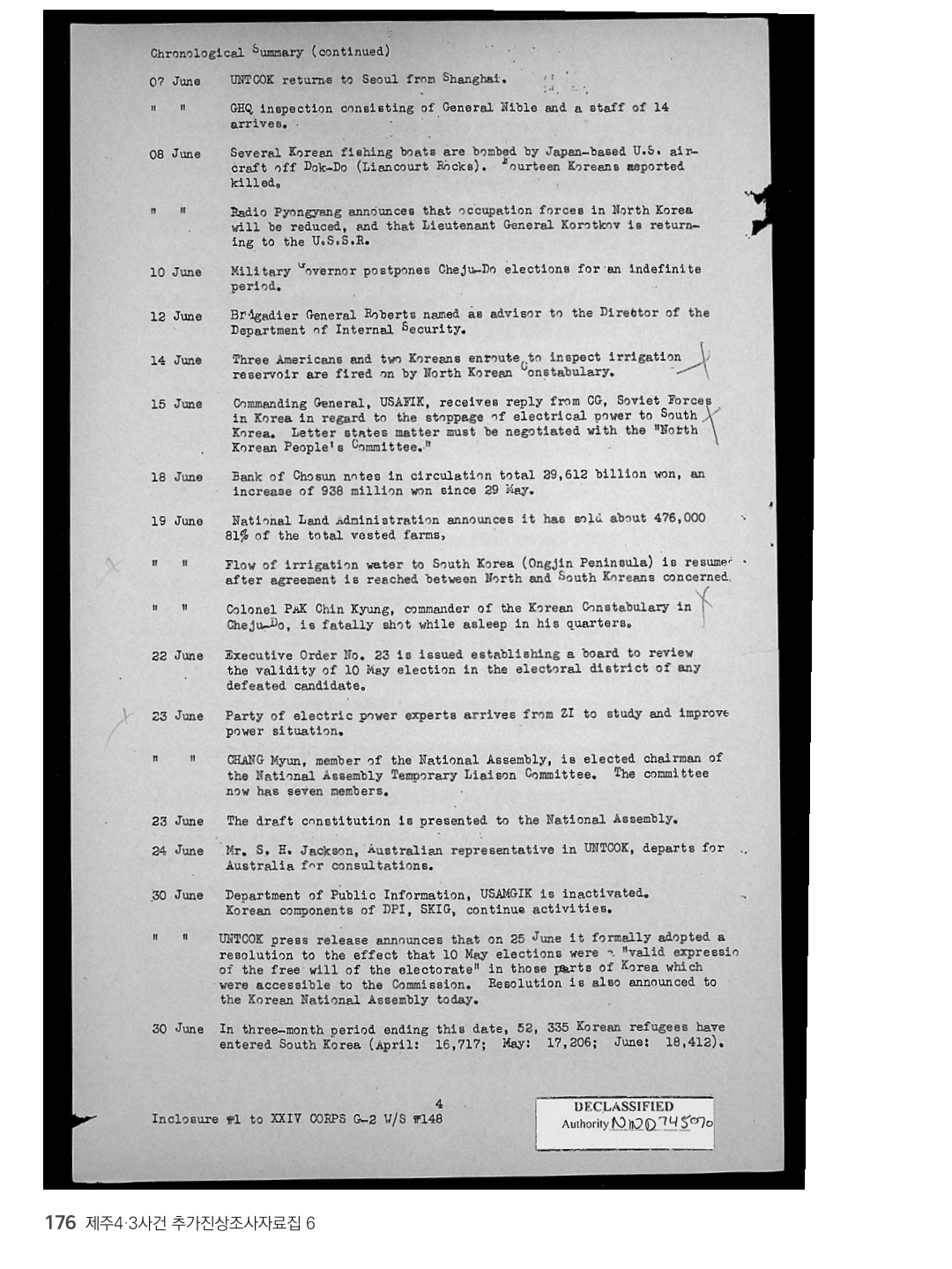
6월 7일 - 유엔임시위원단이 상하이에서 서울로 돌아왔다.
6월 8일 - 니블(Nible) 장군과 참모 14명으로 이루어진 극동사령부 감찰팀이 도착했다.
6월 8일 - 조선의 어선 몇 척이 독도 근처에서 일본에 주둔한 미군 전투기들로부터 폭격당했다. 조선인 14명이 사망한 것으로 보고됐다.
6월 8일 - 평양 라디오는 북조선에 주둔하는 소련군이 감축될 것이고, 코로트코프(Korotkov) 중장은 소련으로 귀환할 것이라고 발표했다.
6월 10일 - 군정장관은 제주도의 선거를 무기한 연기했다.
6월 12일 - 로버츠(Roberts) 준장이 통위부 고문관에 임명됐다.
6월 14일 - 관개용 저수지를 시찰하러 갔던 미국인 3명과 조선인 2명이 북조선보안대로부터 사격당했다.
6월 15일 - 재조선미육군 사령관은 남조선으로의 전기 공급 중단과 관련하여 주북소련군 사령관으로부터 답신을 받았다. 답신에는 이 문제가 "북조선인민위원회"에서 토의돼야만 한다고 쓰여 있었다.
6월 18일 - 조선은행권 유통량은 29조 6,120억 원이다. 이는 5월 29일 이후로 9억 3천 8백만 원이 증가한 것이다.
6월 19일 - 중앙토지행정처가 476,000개의 농지를 팔았다고 발표했다. 이는 보유 농지 중 81%에 해당된다.
6월 19일 - 남조선 옹진반도로 흐르는 관개용 물길이 다시 뚫렸다. 이는 관련
된 북조선인과 남조선인들이 합의 한 결과다.
6월 19일 - 제주도 경비대의 사령관인 박진경이 그의 막사에서 잠을 자던 도중 총격을 받고 사망했다.
6월 22일 - 행정명령 제23호에 따라 5월 10일 선거의 유효성을 검토하기 위한 위원회가 발족했다. 이 위원회는 후보의 패배가 있었던 선거구들의 유효성을 검토한다.
6월 23일 - 헌법 초안이 국회에서 발표됐다.
6월 24일 - 유엔임시위원단에서 호주 대표를 맡고 있는 S. H. 잭슨(S. H. Jack- son) 씨가 협의를 위해 호주로 떠났다.
6월 30일 - 미군정청 공보부가 활동을 정지했다. 남조선과도정부의 공보부는 활동을 계속한다.
6월 30일 - 유엔임시위원단은 5월 10일 선거가 위원단이 접근할 수 있었던 지 역 내에서 "유권자들의 정당한 자유의지 표현"이었다는 취지의 결의안을 공식적으로 채택했다고 언론보도를 통해 발표했다.
6월 30일 - 6월 30일 기준으로 지난 3달 동안 52,335명의 조선인 피난민이 남 조선에 들어왔다. (4월: 16,716명, 5월: 17,206명, 6월: 18,412명)
PART I
SOUTH KOREA
From: 091200/I July 48
To : 161200/I July 48
Headquarters, USAFIK
No. 148 Seoul, Korea
Maps: KOREA, 1/250,000 16 July 1948
East ASIA, 1/1,000,000
A. ARMED FORCES
1. Strength (Secret)
Police: 34,082
Constabulary: 56,084 (including 5,283 unsworn recruits). Screening continues.
Coast Guard: 2,951
2. Operational Activity
a. Border Incidents
On 07 July an intoxicated U.S. soldier crossed the 38th parallel in the vicinity of (986.0-1696.45). This soldier was returned without incident on 10 July. (A-1)
On 10 July a U.S. patrol observed 2 Soviet soldiers South of the 38th parallel at (946.2-1696.5) tampering with a truck. A machine gun manned by 3 Soviet soldiers covered the action and forced the U.S. patrol to withdraw. The truck was later observed about 700 yards North of the parallel stuck in the mud. A Soviet officer and soldiers moved it. (B-2)
On 14 July in the vicinity of (938.4-1696.4), 3 North Korean
Constabularymen fired at a U.S. patrol which returned the fire. No casualties.
(B-2)
On 15 July South Korean police and North Koreans exchanged rifle fire in the vicinity of U.S. OP#10 (935.25-1696.70). Several rounds landed near the OP. No casualties. (B-2)
COMMENT: There have been 4 border incidents in this area in the past month.
On 13 July, 3 persons attacked the YOHYON-DONG (948.5-1696.0)
police box. One of the attackers was killed, the others escaped. Papers found on the body indicated that he was a member of the Chinese Communist 8th
Route Army. (C-3)
COMMENT: This is one of two unconfirmed reports of Chinese
Communist 8th Route Army personnel in South KOREA (see Part E).
b. Constabulary on CHEJU DO
Constabulary action was limited to routine patroling and screening of prisoners.
3
DECLASSIFIED
Authority NND 745070
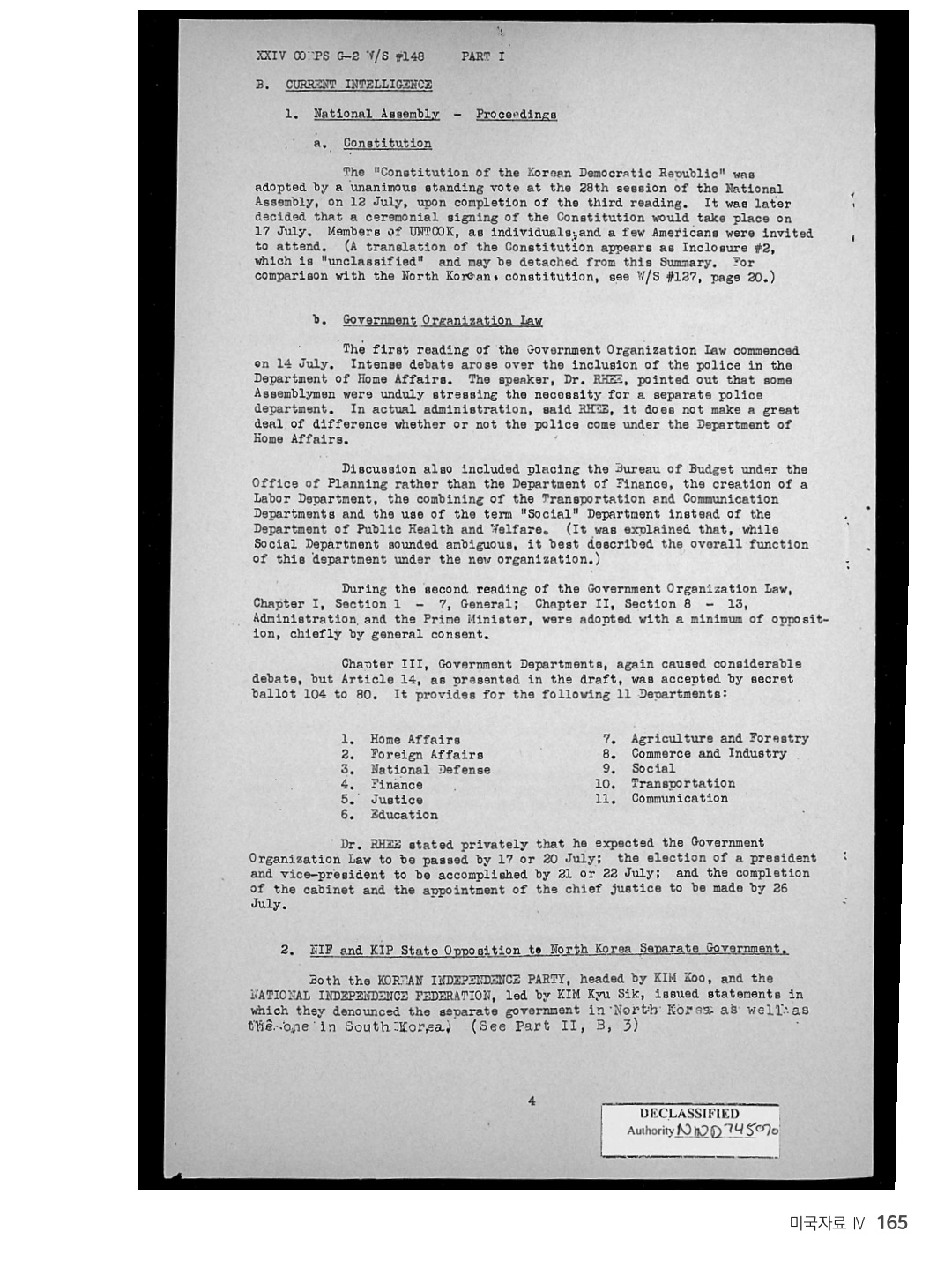
XXIV CO PS G-2 W/S #148 PART I
B. CURRENT INTELLIGENCE
1. National Assembly - Proceedings
a. Constitution
The "Constitution of the Korean Democratic Republic" was adopted by a unanimous standing vote at the 28th session of the National
Assembly, on 12 July, upon completion of the third reading. It was later decided that a ceremonial signing of the Constitution would take place on
17 July. Members of UNTCOK, as individuals, and a few Americans were invited to attend. (A translation of the Constitution appears as Inclosure #2, which is "unclassified" and may be detached from this Summary. For comparison with the North Korean constitution, see W/S #127, page 20.)
b. Government Organization Law
The first reading of the Government Organization Law commenced on 14 July. Intense debate arose over the inclusion of the police in the
Department of Home Affairs. The speaker, Dr. RHEE, pointed out that some
Assemblymen were unduly stressing the necessity for a separate police department. In actual administration, said RHEE, it does not make a great deal of difference whether or not the police come under the Department of
Home Affairs.
Discussion also included placing the Bureau of Budget under the
Office of Planning rather than the Department of Finance, the creation of a
Labor Department, the combining of the Transportation and Communication
Departments and the use of the term "Social" Department instead of the
Department of Public Health and Welfare. (It was explained that, while
Social Department sounded ambiguous, it best described the overall function of this department under the new organization.)
During the second reading of the Government Organization Law, Chapter I, Section 1 - 7, General; Chapter II, Section 8 - 13, Administration and the Prime Minister, were adopted with a minimum of oppos ition, chiefly by general consent.
Chapter III, Government Departments, again caused considerable debate, but Article 14, as presented in the draft, was accepted by secret ballot 104 to 80. It provides for the following 11 Departments:
1. Home Affairs 7. Agriculture and Forestry
2. Foreign Affairs 8. Commerce and Industry
3. National Defense 9. Social
4. Finance 10. Transportation
5. Justice 11. Communication
6. Education
Dr. RHEE stated privately that he expected the Government
Organization Law to be passed by 17 or 20 July; the election of a president and vice-president to be accomplished by 21 or 22 July; and the completion of the cabinet and the appointment of the chief justice to be made by 26
July.
2. KIF and KIP State Opposition to North Korea Separate Government.
Both the KOREAN INDEPENDENCE PARTY, headed by KIM Koo, and the
NATIONAL INDEPENDENCE FEDERATION, led by KIM Kyu Sik, issued statements in which they denounced the separate government in North Korea as well as the one in South Korea. (See Part II, B, 3)
4
DECLASSIFIED
Authority NND 745070
XXIV CORPS G-2 W/S #148 PART I
On 14 July, the moderate NIF announced that it "rejected without hesitation a separate government in either the North or the South...."
The federation reasserted its desire for an "autonomous, democratic independance derived from national will" and urged all the Korean people to unite in averting "bloodshed between fellow countrymen." The NIF clearly implied that the unilateral action being taken by North Koreans was not in accordance with agreement and plans made by the North-South representatives in PYONGYANG during April (see W/S #133-138).
On the following day, 15 July, the KIP took a firmer stand against the North Korean action. It denounced the activities in the North as a "route which splits the land and the people." The statement reiterated the
KIP's efforts on behalf of unification of KOREA by following the principle of
"national self-determination" and asserted that the North Koreans had broken the promises they made at PYONGYANG last April regarding the establishment of a separate government, in either North or South KOREA. The KIP declared that it would continue to strive for the elimination of the 38th parallel as a border between North and South KOREA regardless of "threats or intimidation from any direction."
COMMENT: Before the PYONGYANG announcements, the KIP and the NIF opposed the South Korean Government on the grounds that unification of KOREA was possible and feasible through the "North-South political leaders conference held in PYONGYANG in April. With the announcements released this week the two organizations have disapproved the formation of the separate North Korean government and have shown that they feel they have been double-crossed by the
North Koreans with whom they conferred last April. Thus, the KIP and NIF can take either of two positions: (1) maintain a dignified aloofness, crying
"A plague of both your houses," or (2) decide that of the two necessary evils
-- a separate North Korean government and a separate South Korean government they will choose the South Korean, at least until unification can be achieved.
A recent newspaper announcement that SHIN Ik Hi, influential member of NSAKI, has recommended that CHO So Ang, a KIM Koo lieutenant, be made prime minister may be an indication that at least the KIM Koo faction will throw in their lot with the South Koreans. Reports have been received that RHEE is willing to accept KIM Koo in the government. (KIM Kyu Sik is generally considered not to be equally acceptable to RHEE; there is personal animosity between them, and KIM Kyu Sik does not command the following that KIM Koo does.)
The PYONGYANG announcements and the reaction of these two South
Korean non-communist organizations in no way strengthened the Soviets' hand insofar as the forthcoming meeting of the General Assembly is concerned.
Although the Soviets may continue to cry that South Koreans and Americans have permanently divided the country through their separate election, they can no longer piously claim that the North Koreans have never done anything but strive for unification.
3. Civil Unrest
a. Weekly Violence Summary
A summary of acts of violence involving communists for the week as reported up to 16 July is as follows:
[TABLE WITH COLUMNS: Seoul, Kyong-gi, Kei-Ki, Chung-chong, Chong-Nam, Chung-Nam/Chung-Pukto, Chollanam-do, Chollo-do, Chulto-do, Kyong-sang-Namdo, Kyong-sang-Pukto, Hamgyong-do/NKCS, Sheju-do, Total]
Attacks on towns
Attacks on police
Police killed
Communists killed
Rightists killed 1 1 2
Demonstrations, disorders, arson, & attacks on rightists 2 1 2 1 6
Attacks on
government buildings
Sabotage (communications)
Sabotage (RR lines)
Sabotage (roads)
Sabotage (bridges)
Sabotage (power)
Strikes (labor)
Strikes (schools)
5
DECLASSIFIED
Authority NND745070
XXIV CORPS G-2 W/S #148 PART I
b. Delayed Reports Covering Last Week
Delayed reports of incidents that occurred during the week ending 09 July which were not carried in last week's summary (see Part I, B, 5, a, W/S #147) are:
[TABLE - column headers: Seoul, Kyonggi-Do, Kangwon-Do, Chungchong-Namdo, Chungchong-Pukto, Cholla-Namdo, Cholla-Pukto, Kyongsang-Namdo, Kyongsang-Pukto, Taeju Do, Total]
Attacks on towns
Attacks on police 1 1
Police killed
Communist Killed 6 1 7
Rightists killed 1 1
Demonstration, disorders, arson, & attacks on rightists 1 2 3
Attacks on
government buildings 1 1
Sabotage (communications) 1 1
Sabotage (RR lines)
Sabotage (roads)
Sabotage (bridges)
Sabotage (power)
Strikes (labor)
Strikes (schools)
c. 1948 Communist Activities In South KOREA
JAN FEB MAR APR MAY JUNE* JULY* TOTAL
Attacks on towns 0 0 0 5 73 9 0 87
Attacks on police 0 130 118 50 86 11 5 400
Police killed 0 33 20 15 34 4 1 107
Rightists killed 1 14 14 81 144 51 10 315
Communist killed 1 74 75 70 155 83 11 459
Disorders, demonstrations, arson & attacks on rightists'
offices & homes 5 118 69 125 196 81 17 613
Attacks on
government buildings 0 9 14 2 9 3 0 37
Sabotage (communications) 14 53 58 32 57 8 1 223
Sabotage (RR lines) 1 12 6 0 8 0 1 28
Sabotage (Locomotives) 0 50 0 0 24 0 0 74
Sabotage (roads) 0 13 5 2 5 0 0 25
Sabotage (bridges) 0 6 9 5 4 0 0 24
Sabotage (power) 0 0 0 0 7 1 0 8
Strikes (labor) 0 14 6 3 16 1 0 40
Strikes (schools) 0 7 5 4 9 0 0 25
Attacks on registration
& election booths 0 0 0 58 68 0 0 126
* Incomplete
6
DECLASSIFIED
Authority NND20745070
XXIV CORPS G-2 W/S #148 PART I
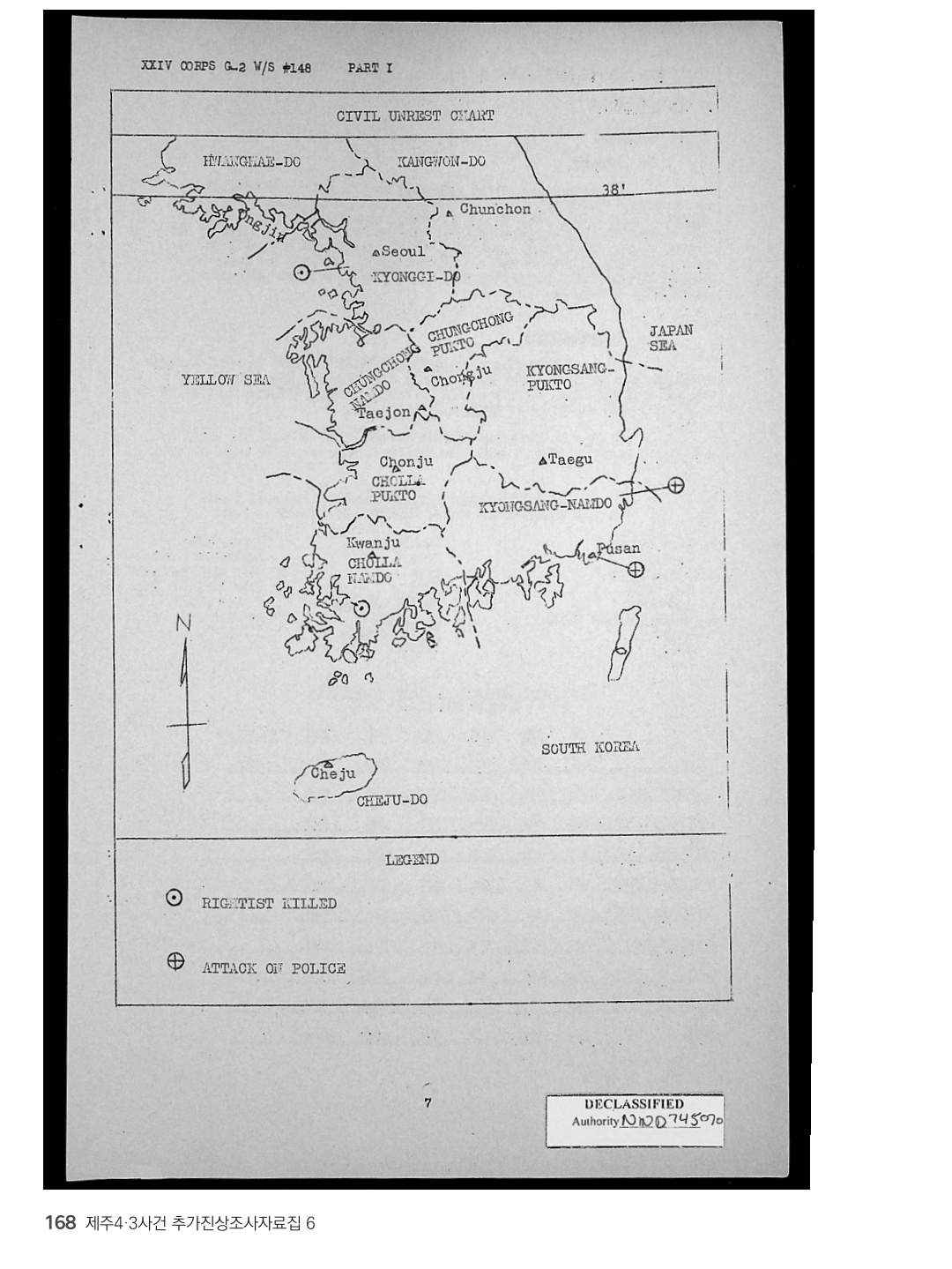
CIVIL UNREST CHART
HWANGHAE-DO KANGWON-DO
38'
△ Chunchon
⊙Seoul
KYONGGI-DO
CHUNGCHONG
PUKTO
YELLOW SEA Chongju KYONGSANGCHUNGCHONG PUKTO
NAMDO
Taejon△
Chonju △Taegu
CHOLLAPUKTO KYONGSANG-NAMDO
Kwanju
CHOLLA Pusan
NAMDO ⊕
N
SOUTH KOREA
Cheju
CHEJU-DO
LEGEND
⊙ RIGHTIST KILLED
⊕ ATTACK ON POLICE
7
DECLASSIFIED
Authority NND 745070
168 제주4·3사건 추가진상조사자료집 6
XXIV CORPS G-2 W/S #148 PART I
C. WAR POTENTIAL
1. Economic
a. General
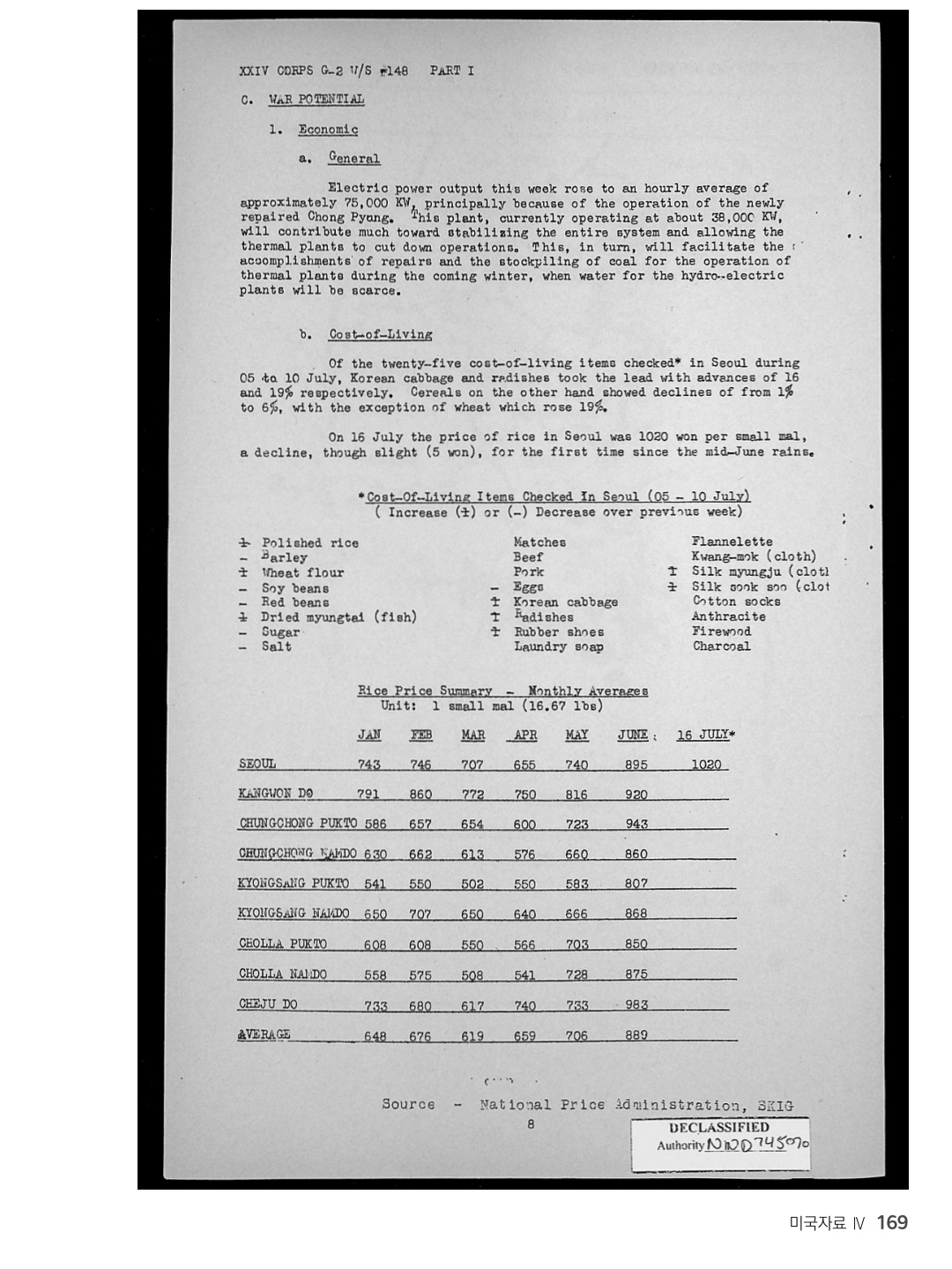
Electric power output this week rose to an hourly average of approximately 75,000 KW, principally because of the operation of the newly repaired Chong Pyang. This plant, currently operating at about 38,000 KW, will contribute much toward stabilizing the entire system and allowing the thermal plants to cut down operations. This, in turn, will facilitate the accomplishments of repairs and the stockpiling of coal for the operation of thermal plants during the coming winter, when water for the hydro-electric plants will be scarce.
b. Cost-of-Living
Of the twenty-five cost-of-living items checked* in Seoul during
05 to 10 July, Korean cabbage and radishes took the lead with advances of 16 and 19% respectively. Cereals on the other hand showed declines of from 1% to 6%, with the exception of wheat which rose 19%.
On 16 July the price of rice in Seoul was 1020 won per small mal, a decline, though slight (5 won), for the first time since the mid-June rains.
*Cost-Of-Living Items Checked In Seoul (05 - 10 July)
( Increase (±) or (-) Decrease over previous week)
± Polished rice Matches Flannelette
- Barley Beef Kwang-mok (cloth)
± Wheat flour Pork ± Silk myungju (cloth)
- Soy beans - Eggs ± Silk pook soo (cloth)
- Red beans ± Korean cabbage Cotton socks
± Dried myungtai (fish) ± Radishes Anthracite
Sugar ± Rubber shoes Firewood
- Salt ± Laundry soap Charcoal
Rice Price Summary - Monthly Averages
Unit: 1 small mal (16.67 lbs)
JAN FEB MAR APR MAY JUNE 16 JULY*
SEOUL 743 746 707 655 740 895 1020
KANGWON DO 791 860 772 750 816 920
CHUNGCHONG PUKTO 586 657 654 600 723 943
CHUNGCHONG NAMDO 630 662 613 576 660 860
KYONGSANG PUKTO 541 550 502 550 583 807
KYONGSANG NAMDO 650 707 650 640 666 868
CHOLLA PUKTO 608 608 550 566 703 850
CHOLLA NANDO 558 575 508 541 728 875
CHEJU DO 733 680 617 740 733 983
AVERAGE 648 676 619 659 706 889
Source - National Price Administration, SKIG
8
DECLASSIFIED
Authority NND 745070
XXIV CORPS G-2 W/S #148 PART I
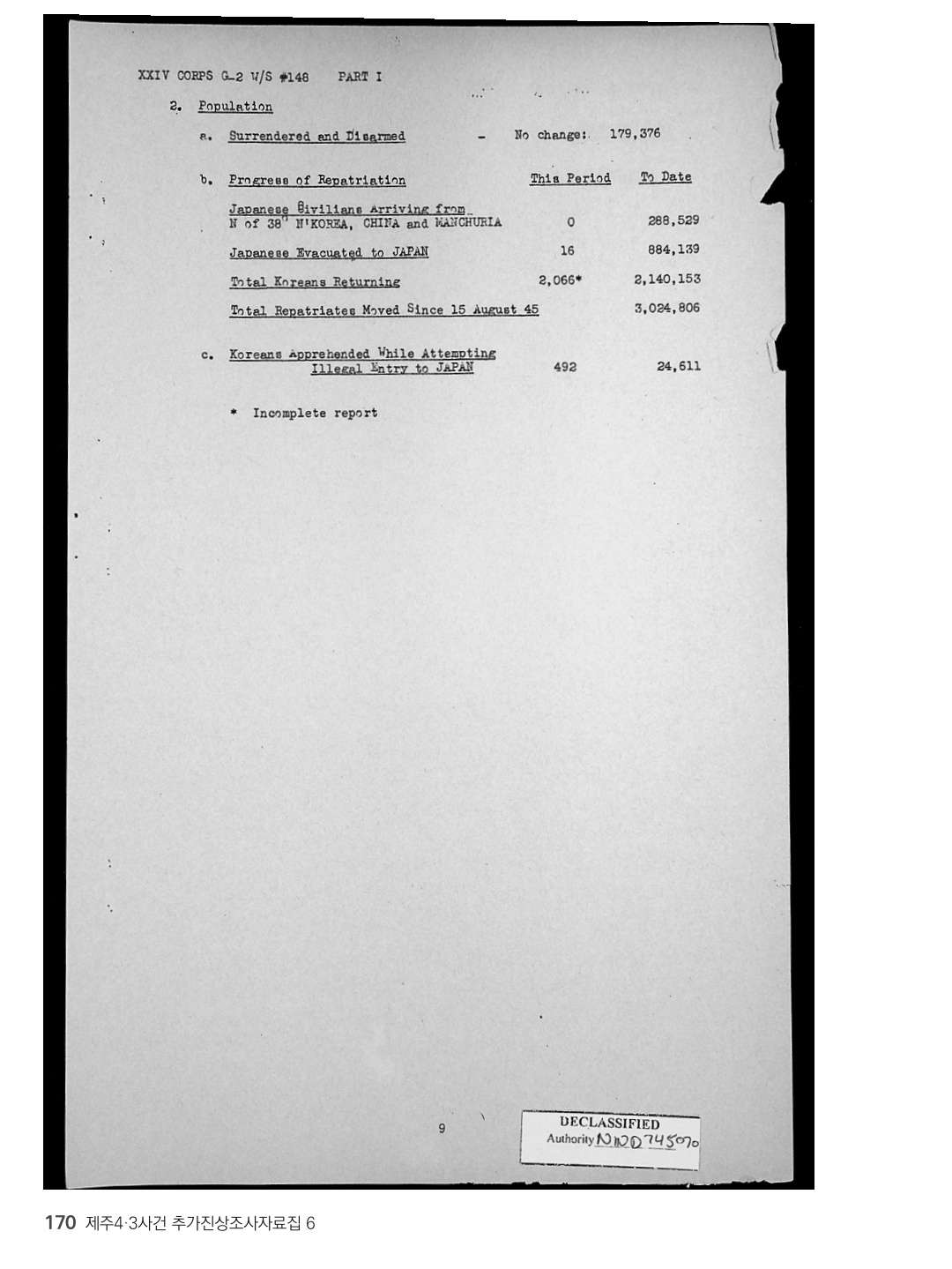
2. Population
a. Surrendered and Disarmed — No change: 179,376
b. Progress of Repatriation This Period To Date
Japanese Civilians Arriving from
N of 38° N/KOREA, CHINA and MANCHURIA 0 288,529
Japanese Evacuated to JAPAN 16 884,139
Total Koreans Returning 2,066* 2,140,153
Total Repatriates Moved Since 15 August 45 3,024,805
c. Koreans Apprehended While Attempting
Illegal Entry to JAPAN 492 24,611
* Incomplete report
9
DECLASSIFIED
Authority NND 745070
XXIV CORPS G-2 W/S #148 PART I
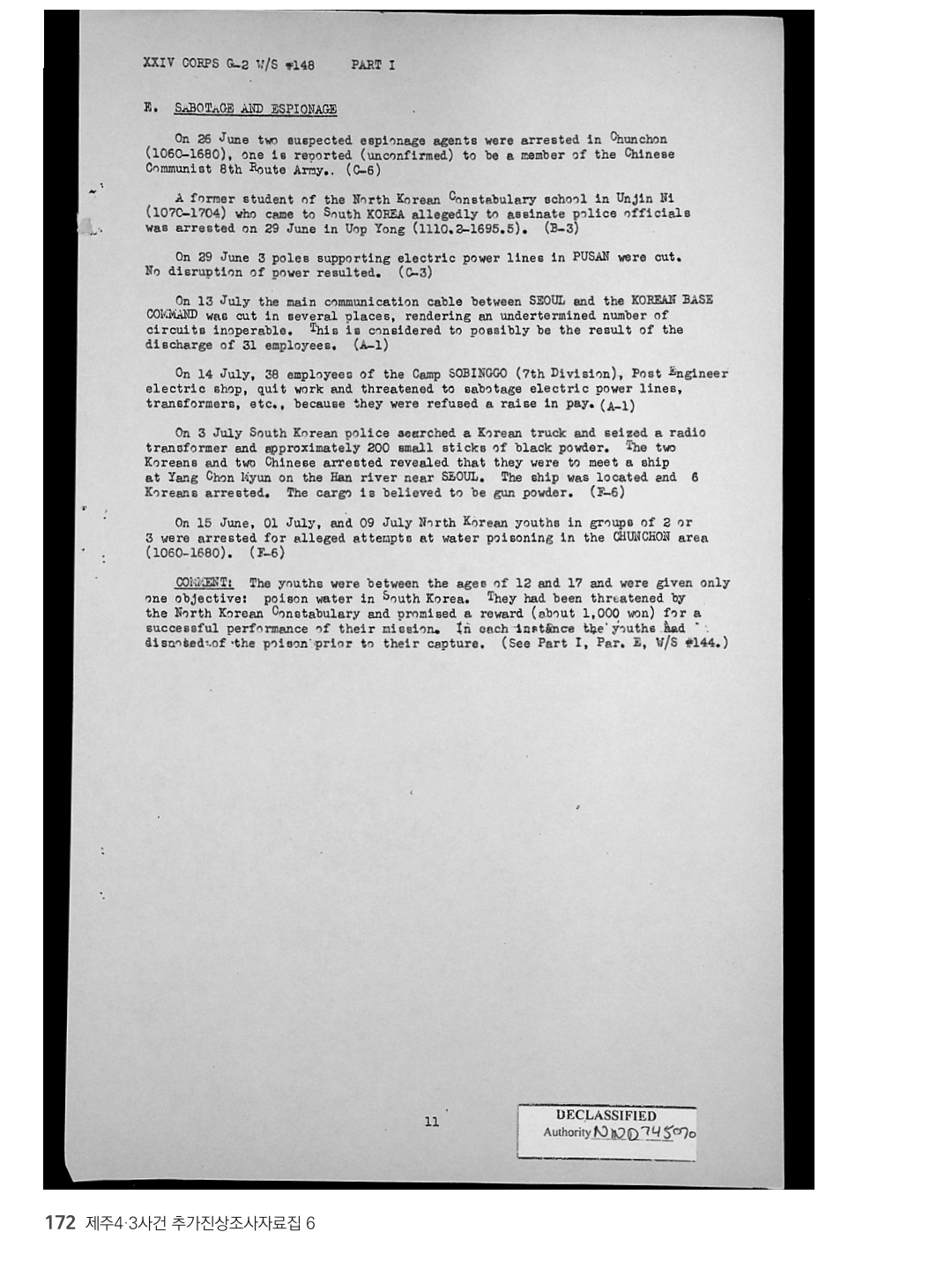
E. SABOTAGE AND ESPIONAGE
On 26 June two suspected espionage agents were arrested in Chunchon
(1060-1680), one is reported (unconfirmed) to be a member of the Chinese
Communist 8th Route Army. (C-6)
A former student of the North Korean Constabulary school in Unjin Ni
(1070-1704) who came to South KOREA allegedly to assinate police officials was arrested on 29 June in Uop Yong (1110.2-1695.5). (B-3)
On 29 June 3 poles supporting electric power lines in PUSAN were cut.
No disruption of power resulted. (C-3)
On 13 July the main communication cable between SEOUL and the KOREAN BASE
COMMAND was cut in several places, rendering an undetermined number of circuits inoperable. This is considered to possibly be the result of the discharge of 31 employees. (A-1)
On 14 July, 38 employees of the Camp SOBINGGO (7th Division), Post Engineer electric shop, quit work and threatened to sabotage electric power lines, transformers, etc., because they were refused a raise in pay. (A-1)
On 3 July South Korean police searched a Korean truck and seized a radio transformer and approximately 200 small sticks of black powder. The two
Koreans and two Chinese arrested revealed that they were to meet a ship at Yang Chon Myun on the Han river near SEOUL. The ship was located and 6
Koreans arrested. The cargo is believed to be gun powder. (F-6)
On 15 June, 01 July, and 09 July North Korean youths in groups of 2 or
3 were arrested for alleged attempts at water poisoning in the CHUNCHON area
(1060-1680). (F-6)
COMMENT: The youths were between the ages of 12 and 17 and were given only one objective: poison water in South Korea. They had been threatened by the North Korean Constabulary and promised a reward (about 1,000 won) for a successful performance of their mission. In each instance the youths had disposed of the poison prior to their capture. (See Part I, Par. E, W/S #144.)
11 DECLASSIFIED
Authority NND 745070
Chronological Summary (continued)
22 April Major General Noes, Civil Affairs Division, Department of the
Army, and a staff of twelve arrive for conferences.
23 April Ceremonies are held in celebration of the 33rd anniversary of
Chosun Christian College.
24 April Strength reports show that 452,505 government and vested property employees are eligible for distribution of controlled consumer goods.
" " Korean residents in Japan riot at Kobe.
" " 19 Korean schools in Osaka, Japan, ordered closed by the Japanese.
24 April The first ship to bring Korean refugees from Manchuria back to
Korea leaves Inchon for Tientsin.
25 April Musical instruments purchased with money contributed by U.S.
personnel in Korea are presented to the Korean Symphony Orchestra by General Hodge.
26 April 49,990 sales of former Japanese-owned farms have been made by the six National Land Administration branch offices since 08 April.
27 April North Korea stops flow of water into South Korea irrigation ditches on Ongjin peninsula.
29 April LYUH Woon Hong arrives in Seoul as an emissary of the North-South conference in Pyongyang.
" " U.S. Army orders a general alert of all U.S. personnel over May
Day (01 May) as a precaution against communist disturbances.
30 April U.N. Commission by a 5 to 0 vote agrees it will observe the South
Korean elections on 10 May.
" ` " Election candidates to date number 934, nineteen of whom are women. The original number of 939 has been reduced by three assassinations and two withdrawals.
" " Major General Ira T. Wyche, Inspector General of the Department of the Army accompanied by five members of the IG's Department arrives in Seoul on an annual inspection trip.
01 May Eight American dependents are evacuated from Cheju-do as fresh raids break out.
02 May Six people are killed in May Day violence on Cheju-do.
04 May The Military Governor signs Ordinance 192 separating the courts from the Department of Justice.
05 May KIM Koo and KIM Kyu Sik return to South Korea.
06 May Brigadier General Edwin Piburn is assigned as assistant division commander, 7th Infantry Division.
" " Office of Civil Information opens Information Center at Kaesong.
" " KIM Koo and Kim Kyu Sik issue declaration setting forth the highlights of the North Korea conference among which are opposition to separate elections, agreement that the supply of electric power to South Korea will continue and that reservoirs in North
Korea will be opened to use of the South Koreans.
2
Inclosure #1 to XXIV Corps G-2 W/S #148
DECLASSIFIED
Authority NND 745070
Chronological Summary (continued)
09 May Eclipse of the sun is observed by Dr. George Van Riesbroeck and his party at Chonan.
10 May More than 6,000,000 of the 7,000,000 registered voters go to the polls in Korea's first election.
11 May The LST City of Yechon arrives at Inchon with 1,091 Mukden refugees from Tientsin.
12 May Dr. Walson, retired Brigadier General, and a group of consultants arrived in Korea to confer with and advise army doctors. They will hold clinics in three hospitals.
12 May UNTCOK announces decision to go to Shanghai to prepare report.
" " Since the beginning of the sale of Japanese-owned land in April,
262,088 tenant-farmers have bought their farms from the
National Land Administration.
14 May Electric power from North Korea is cut off at 1200 hours.
" " Deputy Military Governor appoints Dr. CHANG Li Wook President of
Seoul National University.
15 May The LST "City of Yechon" leaves for its second trip to Tientsin to bring approximately 1,000 more repatriates to Korea.
17 May General Hodge writes letter to General Korotkov CG, Soviet Forces in Korea demanding restoration of electric power to South Korea and a joint US-USSR Conference to negotiate settlement.
18 May UNTCOK departs for Shanghai during the last two days to write its report.
" " Two U.S. soldiers are turned over to U.S. personnel after being held by the Soviets for approximately 84 hours.
19 May Soviet plane lands Yoju and plane is destroyed. Pilot identifies himself as a captain and is later turned over to the Soviets.
20 May KILA is officially dissolved in a ceremony at the Capitol.
23 May Approximately 1200 more Korean "Mukden refugees" arrive at Inchon from Tientsin.
24 May The evacuation of U.S. dependents to the ZI is announced as a step in preparation for eventual withdrawal.
26 May Major General John B. Coulter is announced as Deputy Commander, USAFIK and XXIV Corps.
" " Three U.S. civilians are ambushed, one wounded, by the North
Korea Constabulary along the 38th parallel on the Onjin peninsula.
31 May Korean National Assembly meets for first time; RHEE elected as chairman.
" " Daylight saving time becomes effective at midnight, to remain in effect until midnight 22 September 48.
01 June Civil Administrator AHN Chai Hong submits resignation, effective
08 June.
" " It is reported that Soviet Generals Korotkov and Shanin have been relieved and replaced by General Merkulov, former commander of the 40th Rifle Division.
3
Inclosure #1 to XXIV Corps G-2 W/S #148
DECLASSIFIED
Authority NND 745070
Chronological Summary (continued)
07 June UNTCOK returns to Seoul from Shanghai.
" " GHQ inspection consisting of General Nible and a staff of 14 arrives.
08 June Several Korean fishing boats are bombed by Japan-based U.S. aircraft off Dok-Do (Liancourt Rocks). Fourteen Koreans reported killed.
" " Radio Pyongyang announces that occupation forces in North Korea will be reduced, and that Lieutenant General Korotkov is returning to the U.S.S.R.
10 June Military Governor postpones Cheju-Do elections for an indefinite period.
12 June Brigadier General Roberts named as advisor to the Director of the
Department of Internal Security.
14 June Three Americans and two Koreans enroute to inspect irrigation reservoir are fired on by North Korean Constabulary.
15 June Commanding General, USAFIK, receives reply from CG, Soviet Forces in Korea in regard to the stoppage of electrical power to South
Korea. Letter states matter must be negotiated with the "North
Korean People's Committee."
18 June Bank of Chosun notes in circulation total 29,612 billion won, an increase of 938 million won since 29 May.
19 June National Land Administration announces it has sold about 476,000
81% of the total vested farms.
" " Flow of irrigation water to South Korea (Ongjin Peninsula) is resume after agreement is reached between North and South Koreans concerned.
" " Colonel PAK Chin Kyung, commander of the Korean Constabulary in
Cheju-Do, is fatally shot while asleep in his quarters.
22 June Executive Order No. 23 is issued establishing a board to review the validity of 10 May election in the electoral district of any defeated candidate.
23 June Party of electric power experts arrives from ZI to study and improve power situation.
" " CHANG Myun, member of the National Assembly, is elected chairman of the National Assembly Temporary Liaison Committee. The committee now has seven members.
23 June The draft constitution is presented to the National Assembly.
24 June Mr. S. H. Jackson, Australian representative in UNTCOK, departs for
Australia for consultations.
30 June Department of Public Information, USAMGIK is inactivated.
Korean components of DPI, SKIG, continue activities.
" " UNTCOK press release announces that on 25 June it formally adopted a resolution to the effect that 10 May elections were a "valid expression of the free will of the electorate" in those parts of Korea which were accessible to the Commission. Resolution is also announced to the Korean National Assembly today.
30 June In three-month period ending this date, 52, 335 Korean refugees have entered South Korea (April: 16,717; May: 17,206; June: 18,412).
4
Inclosure #1 to XXIV CORPS G-2 W/S #148
DECLASSIFIED
Authority NND745070
Article 39: Bills may be introduced by the members of the
National Assembly or the government.
Article 40: Bills passed by the National Assembly shall be sent to the government and the President shall, within
15 days, promulgate the law. In case of objection the President shall return the bill to the National
Assembly for reconsideration with a statement of the reasons of his objections. If, in the presence of two-thirds of the members duly elected and seated the bill is confirmed on reconsideration by twothirds of the members present, such bill shall be determined to be a law. If a bill is not returned within fifteen days after it has been presented to the government, the same shall become law. The
President shall have the duty to proclaim without delay a law which has been determined under the foregoing paragraph. A law shall be effective twenty days after the date of proclamation unless otherwise stipulated.
Article 41: The National Assembly shall consider and decide upon budgets.
Article 42: The National Assembly shall have the right to consent to treaties concerning international organizations, peace treaties, treaties pertaining to mutual aid, commercial treaties, treaties financially incumbent on the state on the people, treaties related to legislative affairs, and declare war against a foreign state.
Article 43: The National Assembly shall demand, if necessary, documents, subpoena witnesses and receive testimonies or opinions for purposes of supervision and inspection.
Article 44: The Prime Minister, ministers and their representatives shall be authorized to attend, state their opinion, and answer questions at the meetings of the National
Assembly. Whenever requested by the National Assembly, the Prime Minister, ministers and their representatives are obliged to attend a meeting of the
National Assembly and to answer questions.
Article 45: The National Assembly shall investigate the qualifications of its members, establish its own rules of procedure and decide on disciplinary punishments of its members. The concurrence of two-thirds of the members duly qualified and seated shall be necessary for the expulsion of a member of the National Assembly.
Article 46: In the event the President, Vice President, ministers, the Head of the Board of Audit, judges and other public officials as determined by law violate in the exercise of their official duties provisions of this
Constitution or other laws the National Assembly may resolve to impeach them. A motion for impeachment shall be signed by no less than 50 members of the
National Assembly. Attendance of two-thirds of the members of the National Assembly duly elected and seated and the vote of two-thirds or more of the members present shall be necessary to institute impeachment.
Article 47: An Impeachment Court shall be established by law for the purpose of hearing impeachment cases. The
Impeachment Court shall be presided over by the Vice
Inclosure #2 to XXIV Corps G-2 W/S #148
5
DECLASSIFIED
Authority N[illegible]O745070
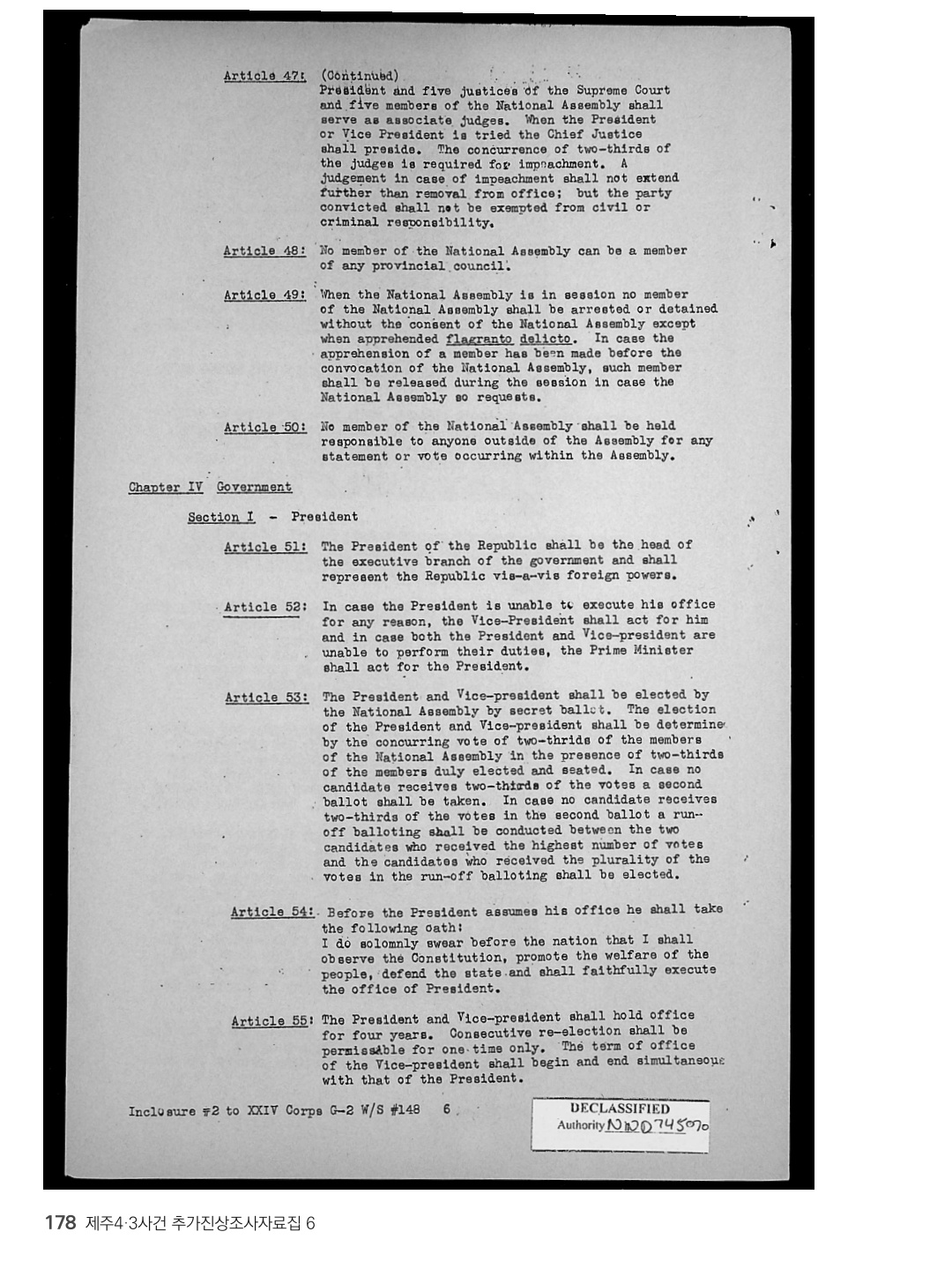
Article 47: (Continued)
President and five justices of the Supreme Court and five members of the National Assembly shall serve as associate judges. When the President or Vice President is tried the Chief Justice shall preside. The concurrence of two-thirds of the judges is required for impeachment. A judgement in case of impeachment shall not extend further than removal from office; but the party convicted shall not be exempted from civil or criminal responsibility.
Article 48: No member of the National Assembly can be a member of any provincial council.
Article 49: When the National Assembly is in session no member of the National Assembly shall be arrested or detained without the consent of the National Assembly except when apprehended flagranto delicto. In case the apprehension of a member has been made before the convocation of the National Assembly, such member shall be released during the session in case the
National Assembly so requests.
Article 50: No member of the National Assembly shall be held responsible to anyone outside of the Assembly for any statement or vote occurring within the Assembly.
Chapter IV Government
Section I - President
Article 51: The President of the Republic shall be the head of the executive branch of the government and shall represent the Republic vis-a-vis foreign powers.
Article 52: In case the President is unable to execute his office for any reason, the Vice-President shall act for him and in case both the President and Vice-president are unable to perform their duties, the Prime Minister shall act for the President.
Article 53: The President and Vice-president shall be elected by the National Assembly by secret ballot. The election of the President and Vice-president shall be determine by the concurring vote of two-thirds of the members of the National Assembly in the presence of two-thirds of the members duly elected and seated. In case no candidate receives two-thirds of the votes a second ballot shall be taken. In case no candidate receives two-thirds of the votes in the second ballot a runoff balloting shall be conducted between the two candidates who received the highest number of votes and the candidates who received the plurality of the votes in the run-off balloting shall be elected.
Article 54: Before the President assumes his office he shall take the following oath:
I do solemnly swear before the nation that I shall observe the Constitution, promote the welfare of the people, defend the state and shall faithfully execute the office of President.
Article 55: The President and Vice-president shall hold office for four years. Consecutive re-election shall be permissable for one time only. The term of office of the Vice-president shall begin and end simultaneous with that of the President.
Inclosure #2 to XXIV Corps G-2 W/S #148 6
DECLASSIFIED
Authority NND 745070
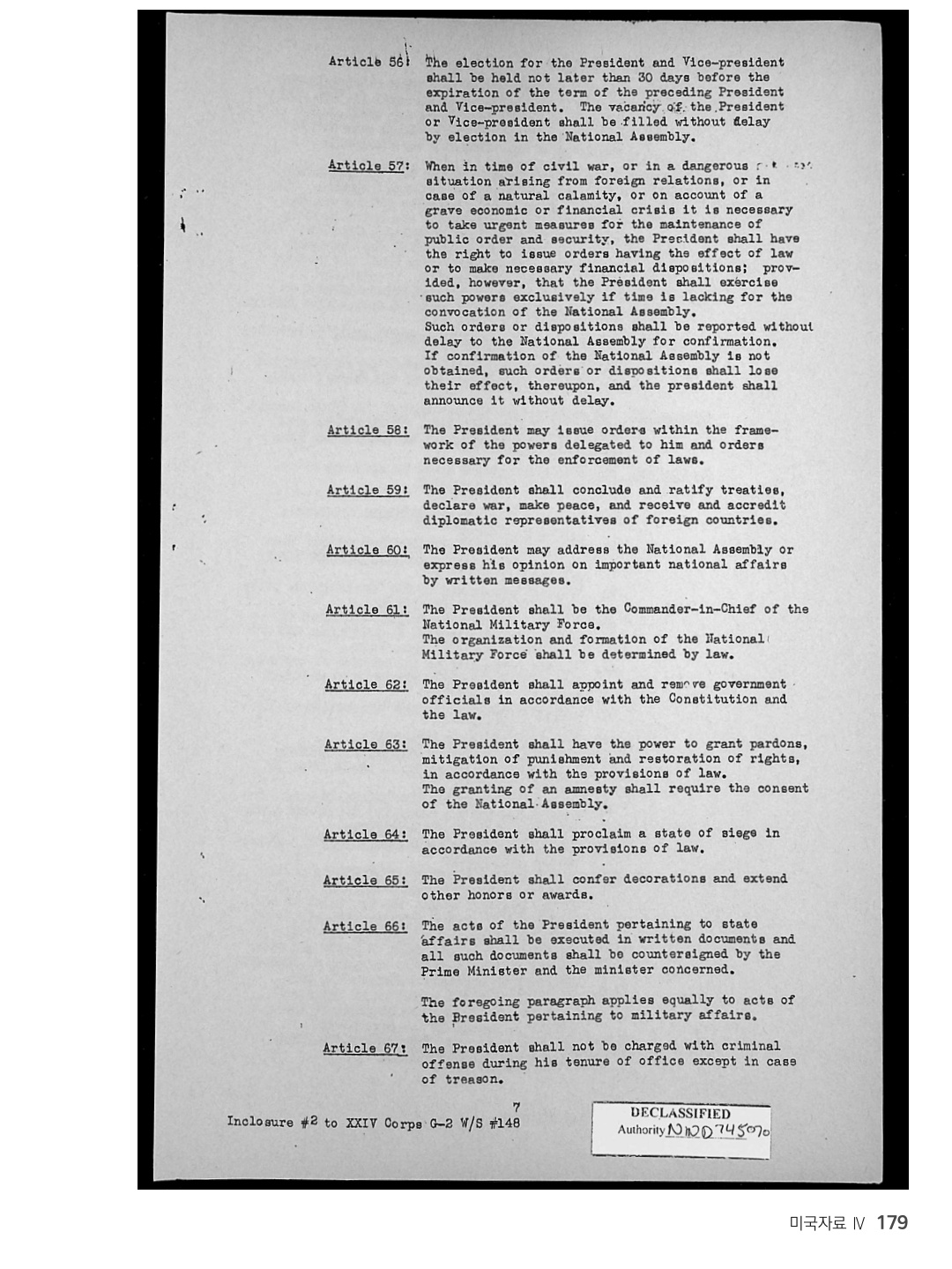
Article 56: The election for the President and Vice-president shall be held not later than 30 days before the expiration of the term of the preceding President and Vice-president. The vacancy of the President or Vice-president shall be filled without delay by election in the National Assembly.
Article 57: When in time of civil war, or in a dangerous [illegible]
situation arising from foreign relations, or in case of a natural calamity, or on account of a grave economic or financial crisis it is necessary to take urgent measures for the maintenance of public order and security, the President shall have the right to issue orders having the effect of law or to make necessary financial dispositions; provided, however, that the President shall exercise such powers exclusively if time is lacking for the convocation of the National Assembly.
Such orders or dispositions shall be reported without delay to the National Assembly for confirmation.
If confirmation of the National Assembly is not obtained, such orders or dispositions shall lose their effect, thereupon, and the president shall announce it without delay.
Article 58: The President may issue orders within the framework of the powers delegated to him and orders necessary for the enforcement of laws.
Article 59: The President shall conclude and ratify treaties, declare war, make peace, and receive and accredit diplomatic representatives of foreign countries.
Article 60: The President may address the National Assembly or express his opinion on important national affairs by written messages.
Article 61: The President shall be the Commander-in-Chief of the
National Military Force.
The organization and formation of the National
Military Force shall be determined by law.
Article 62: The President shall appoint and remove government officials in accordance with the Constitution and the law.
Article 63: The President shall have the power to grant pardons, mitigation of punishment and restoration of rights, in accordance with the provisions of law.
The granting of an amnesty shall require the consent of the National Assembly.
Article 64: The President shall proclaim a state of siege in accordance with the provisions of law.
Article 65: The President shall confer decorations and extend other honors or awards.
Article 66: The acts of the President pertaining to state affairs shall be executed in written documents and all such documents shall be countersigned by the
Prime Minister and the minister concerned.
The foregoing paragraph applies equally to acts of the President pertaining to military affairs.
Article 67: The President shall not be charged with criminal offense during his tenure of office except in case of treason.
7
Inclosure #2 to XXIV Corps G-2 W/S #148
DECLASSIFIED
Authority NND 745070
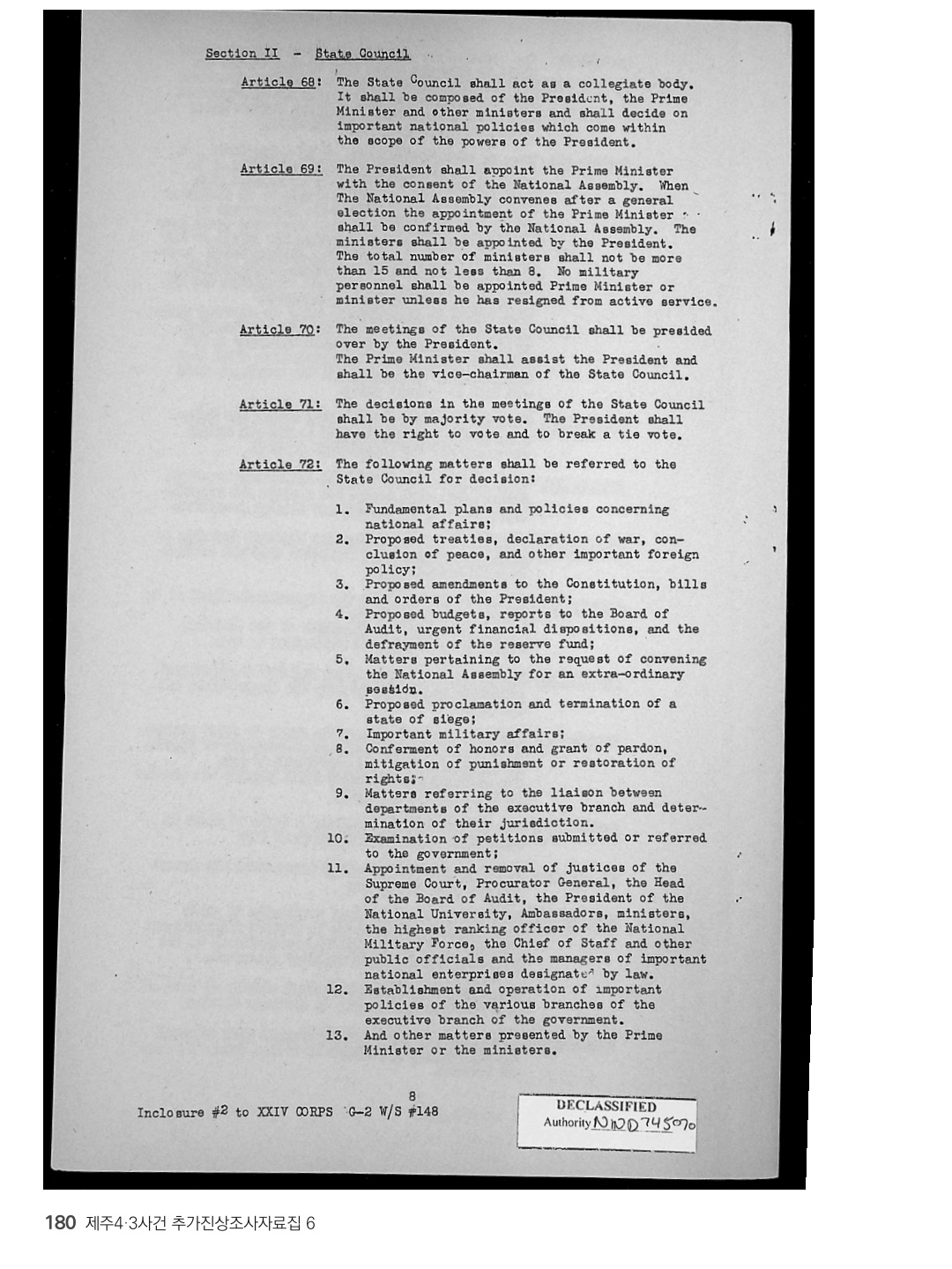
Section II – State Council
Article 68: The State Council shall act as a collegiate body.
It shall be composed of the President, the Prime
Minister and other ministers and shall decide on important national policies which come within the scope of the powers of the President.
Article 69: The President shall appoint the Prime Minister with the consent of the National Assembly. When
The National Assembly convenes after a general election the appointment of the Prime Minister shall be confirmed by the National Assembly. The ministers shall be appointed by the President.
The total number of ministers shall not be more than 15 and not less than 8. No military personnel shall be appointed Prime Minister or minister unless he has resigned from active service.
Article 70: The meetings of the State Council shall be presided over by the President.
The Prime Minister shall assist the President and shall be the vice-chairman of the State Council.
Article 71: The decisions in the meetings of the State Council shall be by majority vote. The President shall have the right to vote and to break a tie vote.
Article 72: The following matters shall be referred to the
State Council for decision:
1. Fundamental plans and policies concerning national affairs;
2. Proposed treaties, declaration of war, conclusion of peace, and other important foreign policy;
3. Proposed amendments to the Constitution, bills and orders of the President;
4. Proposed budgets, reports to the Board of
Audit, urgent financial dispositions, and the defrayment of the reserve fund;
5. Matters pertaining to the request of convening the National Assembly for an extra-ordinary session.
6. Proposed proclamation and termination of a state of siege;
7. Important military affairs;
8. Conferment of honors and grant of pardon, mitigation of punishment or restoration of rights;
9. Matters referring to the liaison between departments of the executive branch and determination of their jurisdiction.
10. Examination of petitions submitted or referred to the government;
11. Appointment and removal of justices of the
Supreme Court, Procurator General, the Head of the Board of Audit, the President of the
National University, Ambassadors, ministers, the highest ranking officer of the National
Military Force, the Chief of Staff and other public officials and the managers of important national enterprises designated by law.
12. Establishment and operation of important policies of the various branches of the executive branch of the government.
13. And other matters presented by the Prime
Minister or the ministers.
8
Inclosure #2 to XXIV CORPS G-2 W/S #148
DECLASSIFIED
Authority N[illegible]20745070
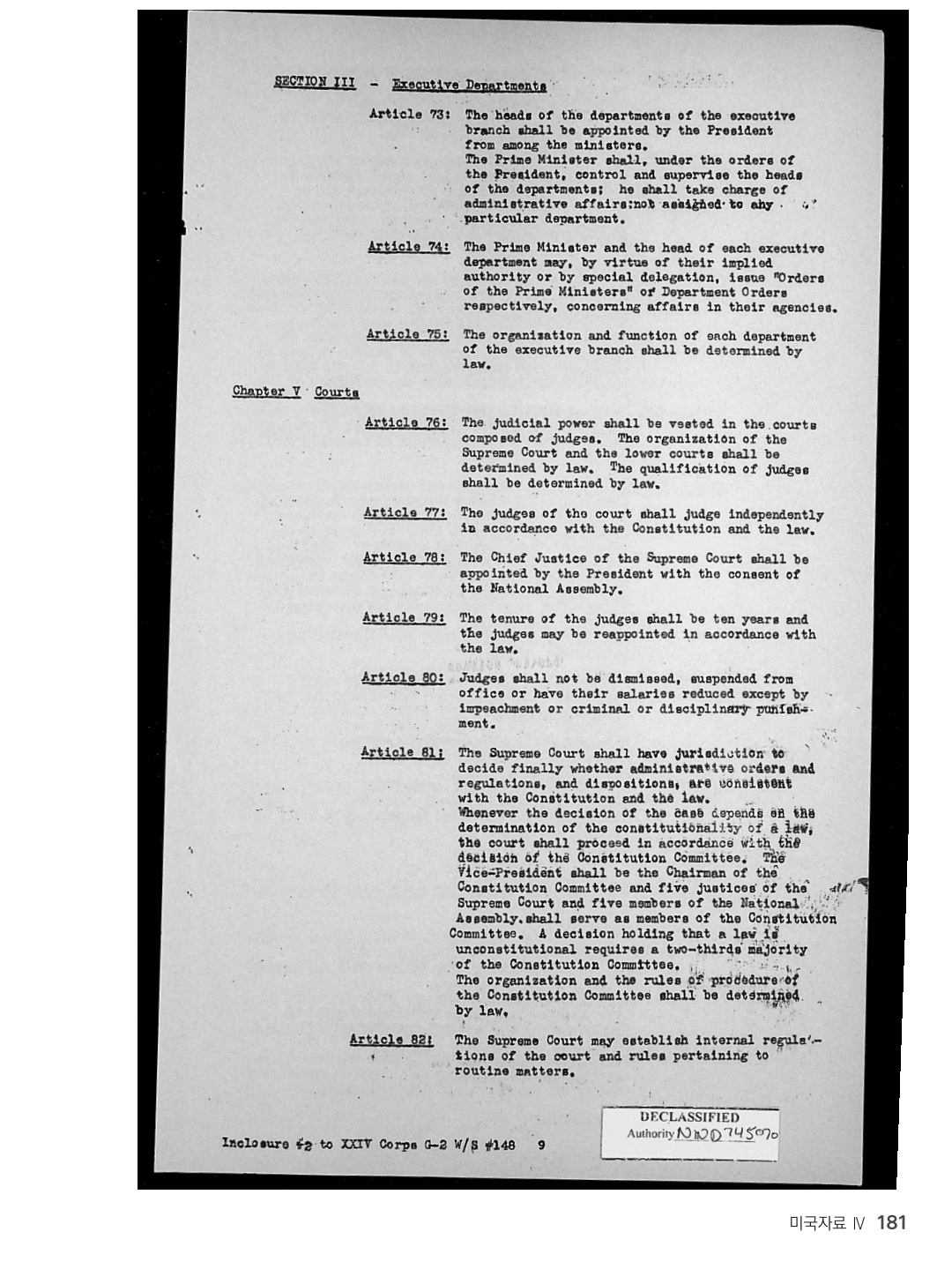
SECTION III - Executive Departments
Article 73: The heads of the departments of the executive branch shall be appointed by the President from among the ministers.
The Prime Minister shall, under the orders of the President, control and supervise the heads of the departments; he shall take charge of administrative affairs;not assigned to any particular department.
Article 74: The Prime Minister and the head of each executive department may, by virtue of their implied authority or by special delegation, issue "Orders of the Prime Ministers" of Department Orders respectively, concerning affairs in their agencies.
Article 75: The organization and function of each department of the executive branch shall be determined by law.
Chapter V Courts
Article 76: The judicial power shall be vested in the courts composed of judges. The organization of the
Supreme Court and the lower courts shall be determined by law. The qualification of judges shall be determined by law.
Article 77: The judges of the court shall judge independently in accordance with the Constitution and the law.
Article 78: The Chief Justice of the Supreme Court shall be appointed by the President with the consent of the National Assembly.
Article 79: The tenure of the judges shall be ten years and the judges may be reappointed in accordance with the law.
Article 80: Judges shall not be dismissed, suspended from office or have their salaries reduced except by impeachment or criminal or disciplinary punishment.
Article 81: The Supreme Court shall have jurisdiction to decide finally whether administrative orders and regulations, and dispositions, are consistent with the Constitution and the law.
Whenever the decision of the case depends on the determination of the constitutionality of a law, the court shall proceed in accordance with the decision of the Constitution Committee. The
Vice-President shall be the Chairman of the
Constitution Committee and five justices of the
Supreme Court and five members of the National
Assembly shall serve as members of the Constitution
Committee. A decision holding that a law is unconstitutional requires a two-thirds majority of the Constitution Committee.
The organization and the rules of procedure of the Constitution Committee shall be determined by law.
Article 82: The Supreme Court may establish internal regulations of the court and rules pertaining to routine matters.
DECLASSIFIED
Authority N[illegible]D 745070
Inclosure #2 to XXIV Corps G-2 W/S #148 9
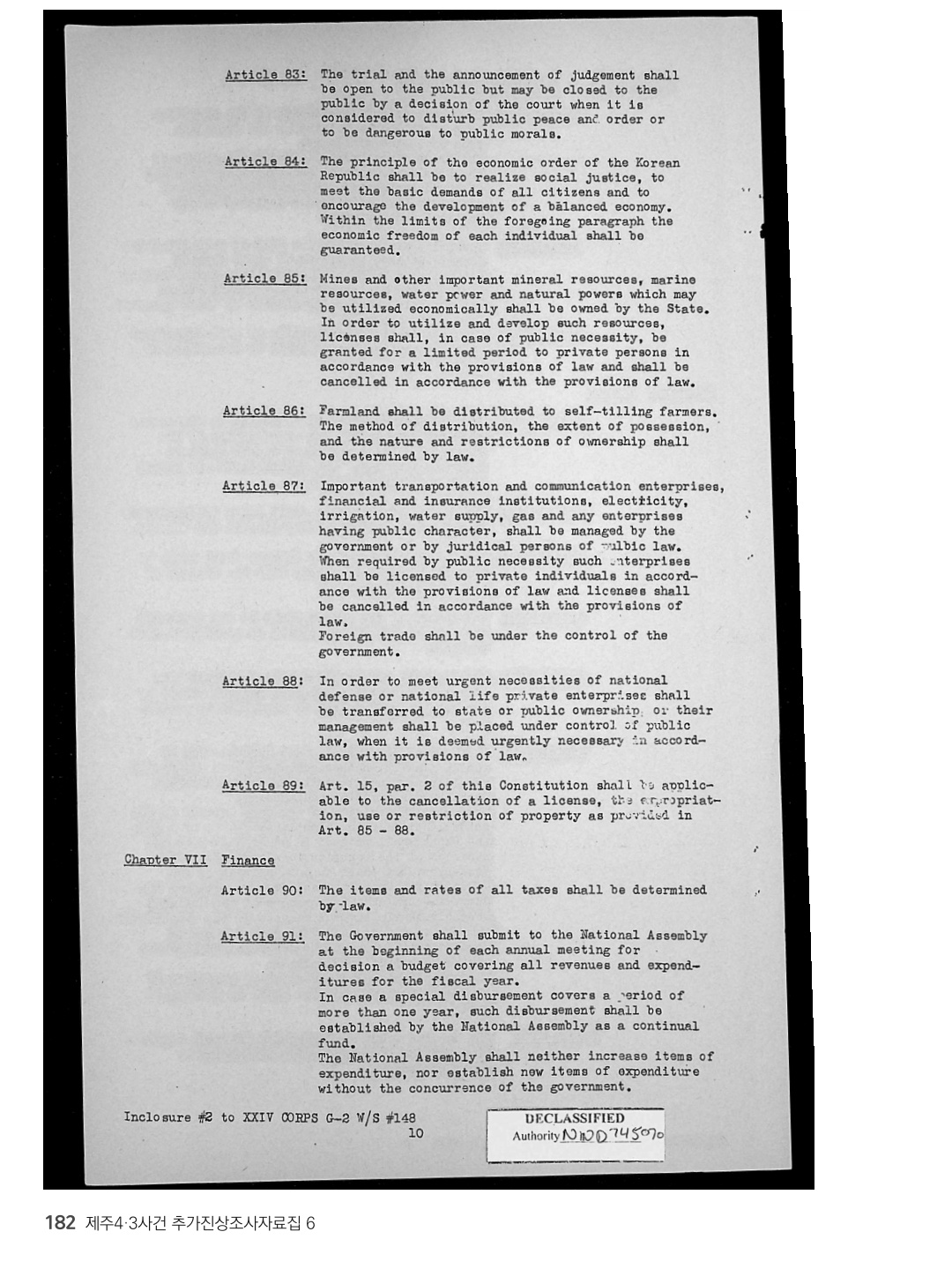
Article 83: The trial and the announcement of judgement shall be open to the public but may be closed to the public by a decision of the court when it is considered to disturb public peace and order or to be dangerous to public morals.
Article 84: The principle of the economic order of the Korean
Republic shall be to realize social justice, to meet the basic demands of all citizens and to encourage the development of a balanced economy.
Within the limits of the foregoing paragraph the economic freedom of each individual shall be guaranteed.
Article 85: Mines and other important mineral resources, marine resources, water power and natural powers which may be utilized economically shall be owned by the State.
In order to utilize and develop such resources, licenses shall, in case of public necessity, be granted for a limited period to private persons in accordance with the provisions of law and shall be cancelled in accordance with the provisions of law.
Article 86: Farmland shall be distributed to self-tilling farmers.
The method of distribution, the extent of possession, and the nature and restrictions of ownership shall be determined by law.
Article 87: Important transportation and communication enterprises, financial and insurance institutions, electricity, irrigation, water supply, gas and any enterprises having public character, shall be managed by the government or by juridical persons of public law.
When required by public necessity such enterprises shall be licensed to private individuals in accordance with the provisions of law and licenses shall be cancelled in accordance with the provisions of law.
Foreign trade shall be under the control of the government.
Article 88: In order to meet urgent necessities of national defense or national life private enterprises shall be transferred to state or public ownership, or their management shall be placed under control of public law, when it is deemed urgently necessary in accordance with provisions of law.
Article 89: Art. 15, par. 2 of this Constitution shall be applicable to the cancellation of a license, the expropriation, use or restriction of property as provided in
Art. 85 - 88.
Chapter VII Finance
Article 90: The items and rates of all taxes shall be determined by law.
Article 91: The Government shall submit to the National Assembly at the beginning of each annual meeting for decision a budget covering all revenues and expenditures for the fiscal year.
In case a special disbursement covers a period of more than one year, such disbursement shall be established by the National Assembly as a continual fund.
The National Assembly shall neither increase items of expenditure, nor establish new items of expenditure without the concurrence of the government.
Inclosure #2 to XXIV CORPS G-2 W/S #148
10
DECLASSIFIED
Authority NND 745070
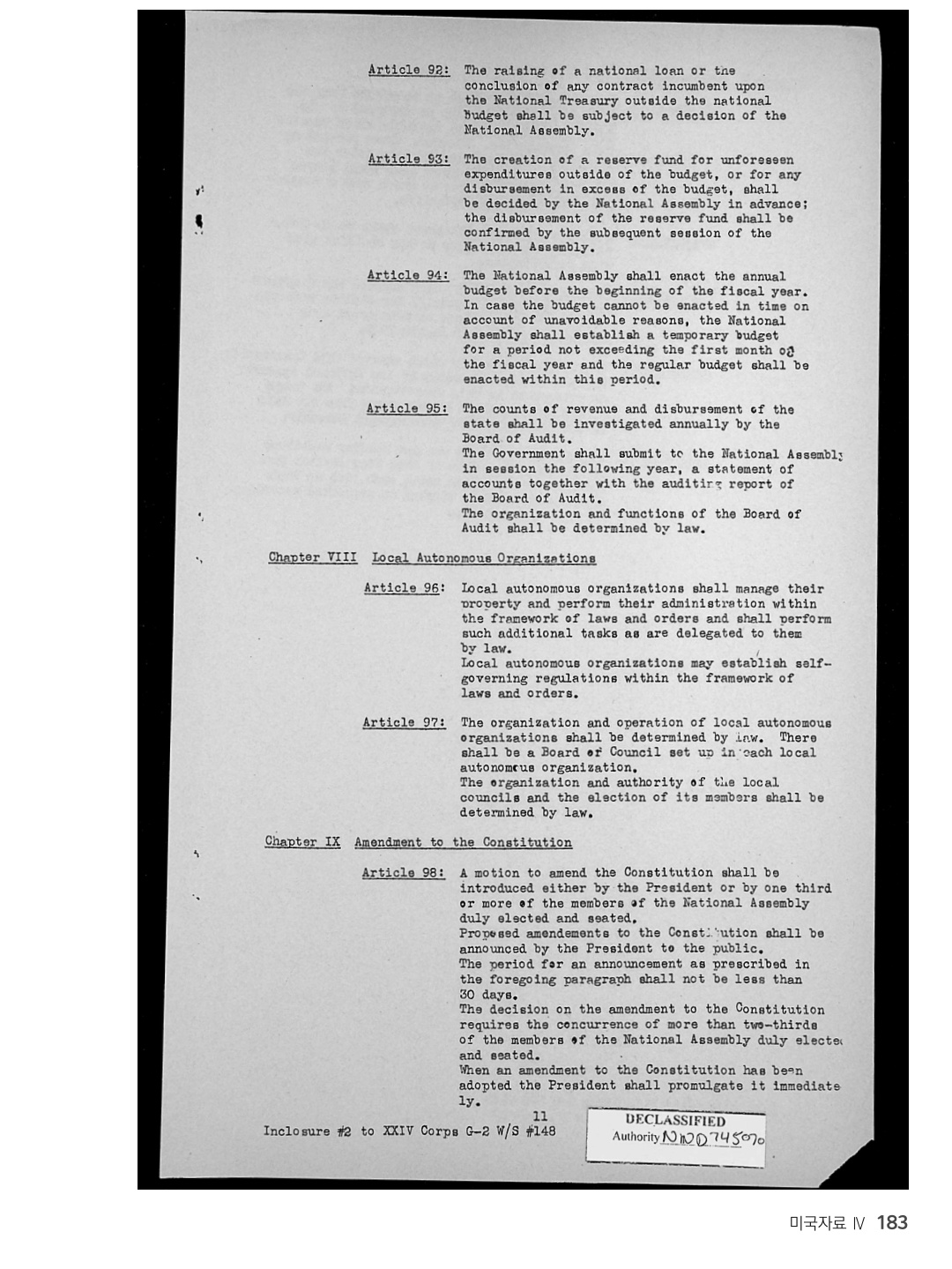
Article 92: The raising of a national loan or the conclusion of any contract incumbent upon the National Treasury outside the national budget shall be subject to a decision of the
National Assembly.
Article 93: The creation of a reserve fund for unforeseen expenditures outside of the budget, or for any disbursement in excess of the budget, shall be decided by the National Assembly in advance; the disbursement of the reserve fund shall be confirmed by the subsequent session of the
National Assembly.
Article 94: The National Assembly shall enact the annual budget before the beginning of the fiscal year.
In case the budget cannot be enacted in time on account of unavoidable reasons, the National
Assembly shall establish a temporary budget for a period not exceeding the first month of the fiscal year and the regular budget shall be enacted within this period.
Article 95: The counts of revenue and disbursement of the state shall be investigated annually by the
Board of Audit.
The Government shall submit to the National Assembly in session the following year, a statement of accounts together with the auditing report of the Board of Audit.
The organization and functions of the Board of
Audit shall be determined by law.
Chapter VIII Local Autonomous Organizations
Article 96: Local autonomous organizations shall manage their property and perform their administration within the framework of laws and orders and shall perform such additional tasks as are delegated to them by law.
Local autonomous organizations may establish selfgoverning regulations within the framework of laws and orders.
Article 97: The organization and operation of local autonomous organizations shall be determined by law. There shall be a Board of Council set up in each local autonomous organization.
The organization and authority of the local councils and the election of its members shall be determined by law.
Chapter IX Amendment to the Constitution
Article 98: A motion to amend the Constitution shall be introduced either by the President or by one third or more of the members of the National Assembly duly elected and seated.
Proposed amendments to the Constitution shall be announced by the President to the public.
The period for an announcement as prescribed in the foregoing paragraph shall not be less than
30 days.
The decision on the amendment to the Constitution requires the concurrence of more than two-thirds of the members of the National Assembly duly elected and seated.
When an amendment to the Constitution has been adopted the President shall promulgate it immediate ly.
11
Inclosure #2 to XXIV Corps G-2 W/S #148
DECLASSIFIED
Authority NND745070
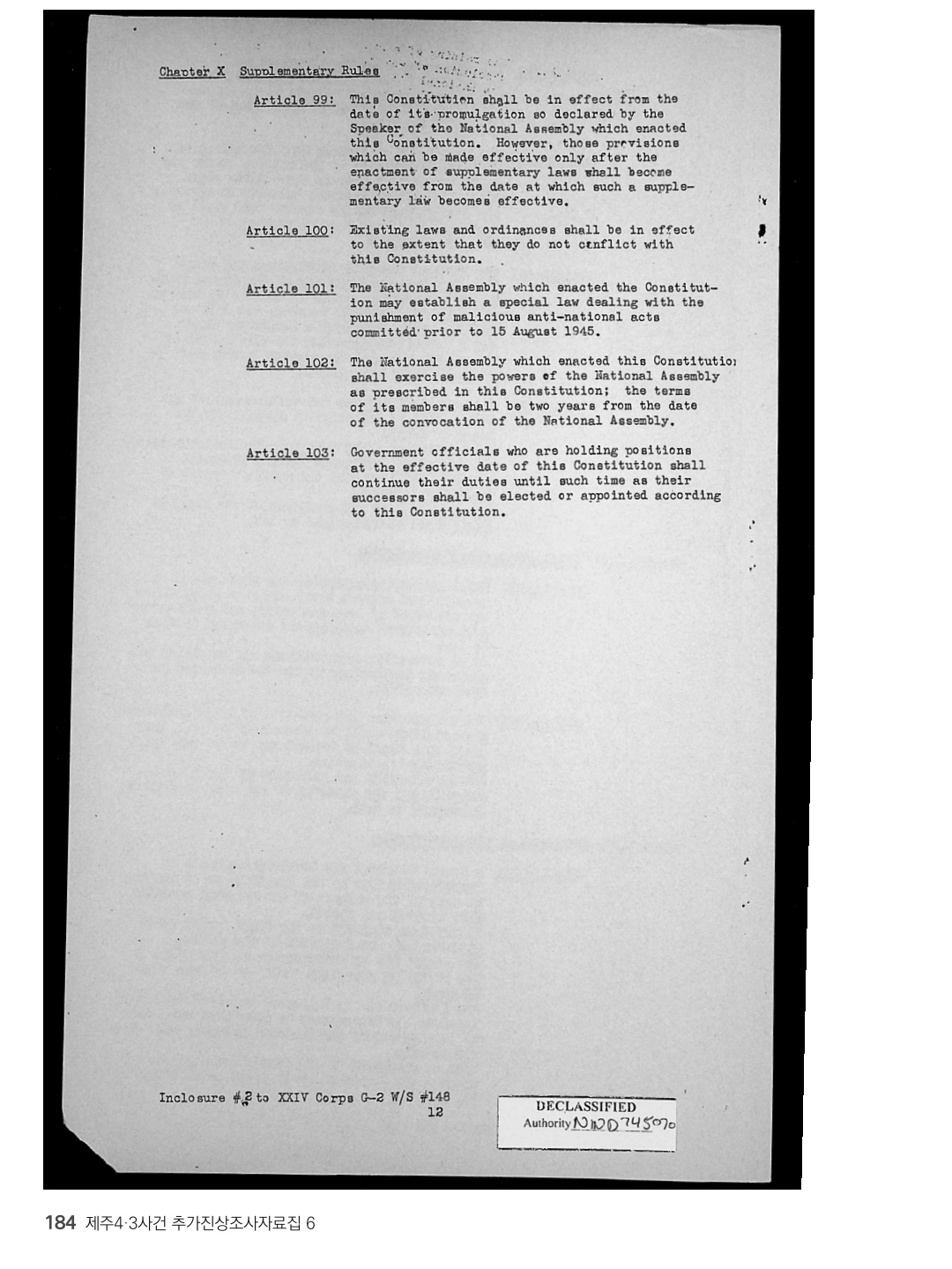
Chapter X Supplementary Rules
Article 99: This Constitution shall be in effect from the date of its promulgation as declared by the
Speaker of the National Assembly which enacted this Constitution. However, those provisions which can be made effective only after the enactment of supplementary laws shall become effective from the date at which such a supplementary law becomes effective.
Article 100: Existing laws and ordinances shall be in effect to the extent that they do not conflict with this Constitution.
Article 101: The National Assembly which enacted the Constitution may establish a special law dealing with the punishment of malicious anti-national acts committed prior to 15 August 1945.
Article 102: The National Assembly which enacted this Constitution shall exercise the powers of the National Assembly as prescribed in this Constitution; the terms of its members shall be two years from the date of the convocation of the National Assembly.
Article 103: Government officials who are holding positions at the effective date of this Constitution shall continue their duties until such time as their successors shall be elected or appointed according to this Constitution.
Inclosure #2 to XXIV Corps G-2 W/S #148
12
DECLASSIFIED
Authority NND 745070
출처:
제주4·3평화재단 편,
『추가진상조사자료집-미국자료4』,
p. 152–170.
— NARA (RG 554, Entry 1256, Box 60)
×
![]()