스캔 원본
100%
p.274
p.275
p.276
p.277
p.278
p.279
p.280
p.281
p.282
p.283
p.284
p.285
p.286
p.287
정보참모부 주간요약보고
기간: 3월 9일~3월 16일
주한미육군사령부
서울, 조선
1947년 3월 20일 제79호
4. 대민관계
a. 언론
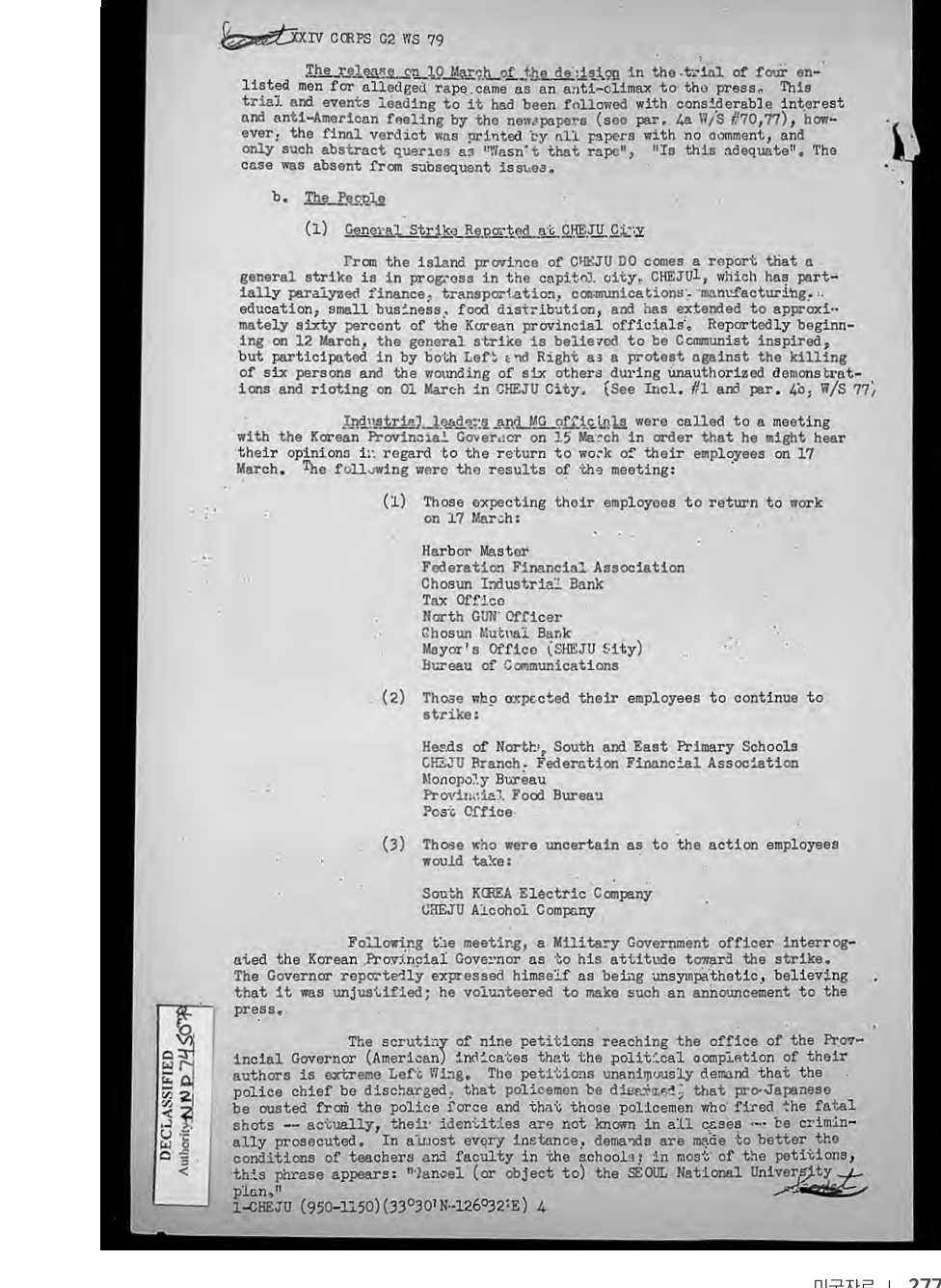
제주도의 총파업(4b항 참고)과 장택상 수도경찰청장이 서울에서 발생한 사망 사건의 책임 소재를 두고 경찰 출입 기자들과 벌인 논쟁 때문에 3월 1일의 사건 들은 언론의 새로운 관심을 끌었다. 언론은 두 사건 모두에서 경찰이 불필요한 사 망자를 냈다고 비난했다.
3월 1일의 사건들에 관한 장 청장의 언론발표는 "수도경찰 기자들"(주간요약보 고 제78호 4a항 참고)이라는 제목을 달고 보도된 목격자의 설명과 어긋나는데,이 보도에서는 경찰의 주장이 반박되었다. 이에 대해 장 청장은 "수도 경찰 출입 기자들이 3월 1일 사건에 관해 나의 견해와 어긋나는 조사 결과를 보도할 것이라 고 들었기 때문에, 그들에게 나의 견해를 밝혔다. 개인이나 신문은 내 의견과 다 른 보도를 낼 수 있지만, 수도 경찰 출입 기자들은 그렇게 해서는 안 된다. 상반되는 견해가 동시에 보도되면 마치 2개의 경찰체제가 있는 것처럼 보이게 만들 것 이다. … 그래서 나는 기자들의 경찰서 출입을 금지하고 있다"고 대답했다. 이와 관련해 언론은 "기자들의 임무는 건설적·비판적인 방식으로 여론을 전달하고 사 회발전에 관심을 두는 당국을 자극하는 것이다. … 경찰은 우리를 모욕했고 합리 적인 표현의 자유를 제한했다. 우리는 책임과 자존심 때문에 장 청장이 자신의 잘 못을 시인할 때까지 기자실을 폐쇄했다"고 응답했다.
b. 민간인
(1) 제주읍에서 보고된 총파업
제주도에서 온 보고에 따르면, 제주읍에서 진행되고 있는 총파업이 금융, 교통, 통신, 제조, 교육, 소규모 사업, 식량 배급 등의 업무를 부분적으로 마비시키고 있다. 또한 파업은 조선인 공무원의 약 60%까지 확대됐다. 3월 12일에 시작됐다고 보고된 이번 총파업은 공산주의자의 선동에서 비롯된 듯하다. 하지만 3월 1일의 불법시위와 폭동 중에 각각 6명의 사망자와 부상자가 발생한 것에 항의하여 좌파와 우파 모두가 총파업에 참여하고 있다.(주간요약보고 제77호의 첨부문서 1번과 4b항을 참고)
경제인들과 군정청 관리들이 3월 15일 조선인 도지사의 초청으로 지사를 방문해 회담을 가졌다. 이 자리에서 도지사는 3월 17일로 예상되는 피고용인의 업무복귀와 관련해 그들의 견해를 들었다. 다음은 회의의 결과다.
(1) 피고용인이 3월 17일 업무에 복귀할 것으로 예상하는 사업장: 항만 책임자 금융조합 조선식산은행 세관 북군청 관리 조선상호은행 읍장실(제주읍) 통신국
(2) 피고용인이 파업을 지속할 것으로 예상하는 사업장: 북국민학교, 남국민학교, 동국민학교 교장 금융조합 제주지회 전매국 지방식량사무소 우편국
(3) 피고용인이 취할 행동을 예상할 수 없는 사업장: 남조선전기회사 제주주정회사
회의가 끝난 뒤 군정청 장교가 파업에 대한 입장과 관련해 도지사를 심문했다.
보고에 따르면, 도지사는 파업이 정당화될 수 없다고 믿고 있으며 파업에 반대하는 의견을 피력했다고 한다. 그는 이런 내용의 성명을 언론에 내겠다고 자원했다.
(미국인) 군정 장관에게 들어가는 9건의 탄원서를 조사한 결과, 문건 작성자들은 극좌인 것으로 드러났다. 이들 탄원서 모두가 경찰 책임자의 해임, 경찰의 무장해제, 친일 경찰의 추방, 발포 경찰의 형사 기소(모든 사례에서 발포한 경찰들의 신원은 미상이다)를 요구했다. 대부분의 경우, 학교 내 교사와 교직원의 상황을 개선해달라는 요구가 제기됐다. 또한, 대부분의 탄원서에서 이런 구절이 나타난다. "국립서울대학교안을 취소하라(또는 반대하라)."
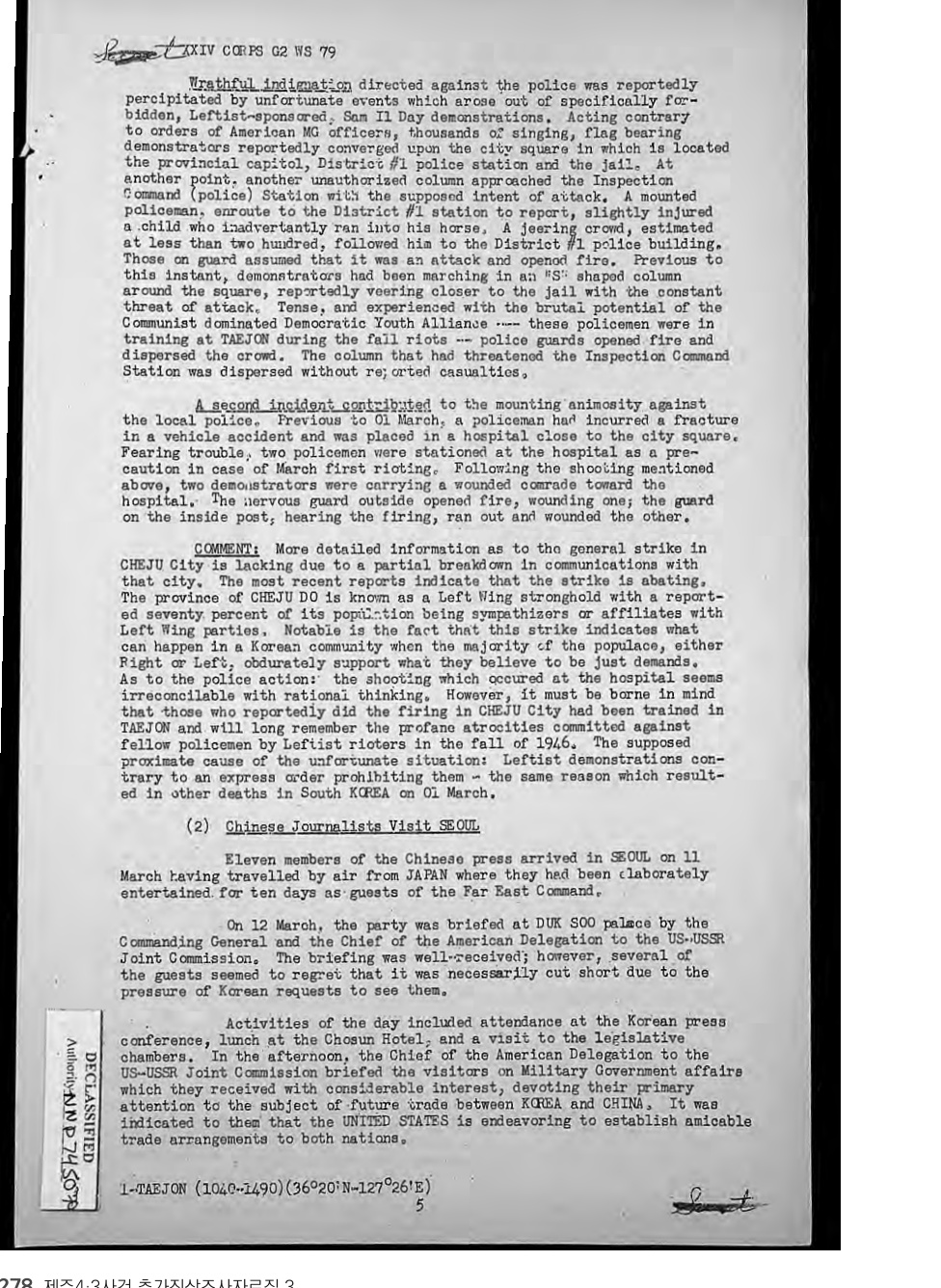
경찰을 향한 격한 분노는 좌익인사들이 주도한 불법 3·1절 시위 중 발생한 불상사에 의해 촉발됐다. 보고에 따르면, 수천 명의 시위대가 미군정 장교의 명령에 불복하여 노래를 부르고 깃발을 휘두르며 제1구 경찰서와 유치장이 있는 도청 소재지 광장에 모여들었다. 또 다른 불법 시위대도 공격 의도를 갖고 감찰청(경찰)으로 접근했다. 보고를 위해 제1구 경찰서로 향하던 기마 경찰 1명은 부주의하게 기마에 달려든 어린아이에게 경상을 입혔다. 200명 미만으로 추정되는 군중이 야유하며 제1구 경찰서 건물까지 해당 기마 경찰을 뒤따라갔으며, 경비를 서고 있던 경찰은 이를 공격으로 간주하여 발포했다. 이 사건에 앞서, 시위대는 광장 주변에서 'S'자 모양으로 열을 지어 행진하고 있었다. 보고에 따르면 이들은 계속 공격 위협을 가하며 유치장 쪽으로 방향을 틀고 있었다고 한다. 긴장감, 그리고 민주청년동맹을 장악하고 있는 공산주의자의 잠재적 난폭성에 대한 경험 때문에(이들 경찰은 가을 폭동 기간에 대전에서 훈련받았다), 경비를 서고 있던 경찰들은 발포하여 군중을 해산시켰다. 감찰청을 위협했던 시위 행렬은 보고된 사상자 없이 해산됐다.
두 번째 사건은 현지 경찰에 대한 적개심이 점증하는 데 이바지했다. 3월 1일 이전, 경찰 1명이 교통사고로 골절상을 입고 광장에서 가까운 병원에 입원하고 있었다. 충돌을 염려하여, 3·1절 폭동에 대한 예방 조치의 일환으로 경찰 2명이 병원에 배치됐다. 앞서 언급한 총격 사건 이후, 시위자 2명이 부상당한 동료 1명을 병원으로 옮기고 있었다. 병원 밖에서 경비를 서고 경찰은 긴장한 나머지 이들에게 발포하여 1명에게 부상을 입혔고, 내부에서 경비를 서고 있던 경찰도 발포 소리를 듣고 밖으로 달려나와 다른 1명에게 부상을 입혔다.
논평: 제주읍과의 통신이 부분적으로 단절됐기 때문에 제주읍의 총파업에 관한 보다 상세한 정보가 부족하다. 가장 최근의 보고는 파업이 누그러지고 있다는 것을 보여준다. 보고에 따르면 제주도 인구의 약 70%가 좌익 정당 동조자이거나 관련자이며, 제주도는 좌익의 근거지로 알려져 있다. 중요한 사실은 이번 파업이 조선인 지역사회에서 (좌파든 우파든) 주민 대부분이 자신들이 생각하기에 정당한 요구를 완고하게 지지할 때 어떤 일이 일어날 수 있는지 보여준다는 것이다.
경찰 조치에 관하여: 병원에서 발생한 발포사건은 이성적 사고와는 양립할 수 없다. 그러나 제주읍에서 총을 쐈다고 보고된 경찰들이 대전에서 훈련받았고 1946년 가을에 좌익 폭도들이 동료 경찰에게 자행한 신성모독적 잔혹 행위를 잊지 않았다는 사실을 염두에 두어야 한다.
불상사 발생의 직접적 원인 (추정): 시위 금지 명령에 대한 좌파 시위대의 불복. 동일한 이유로 3월 1일 남조선에서 다른 사망 사건들이 발생했다.
From: 091800/I Mar
To : 161800/I Mar
Headquarters, USAFIK
Seoul, Korea
1000/I 20 March 194[7]
G-2 Weekly Summary
No. 79
Maps: KOREA, 1/250,000
Eastern ASIA, 1/1,000,000
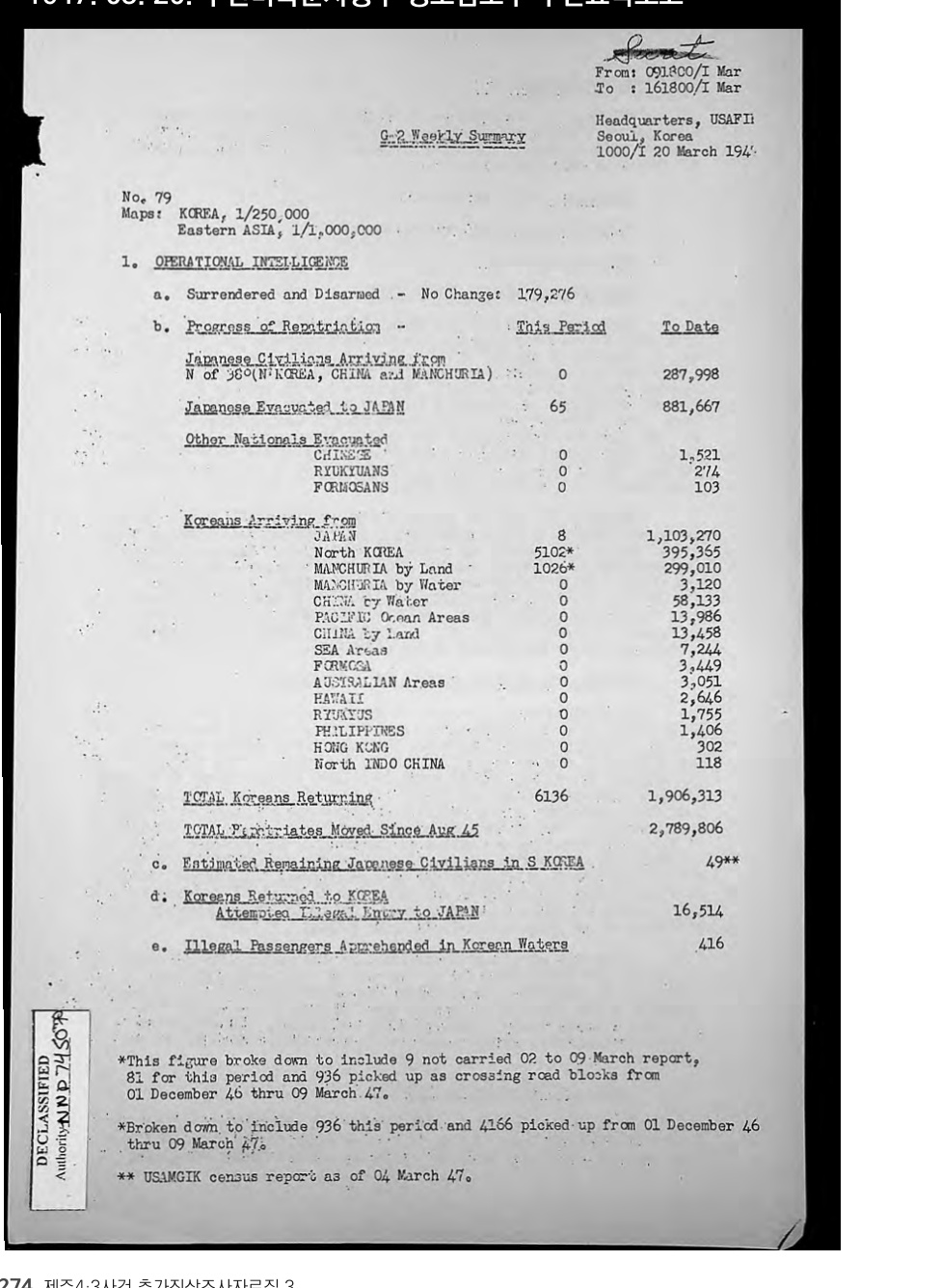
1. OPERATIONAL INTELLIGENCE
a. Surrendered and Disarmed - No Change: 179,276
b. Progress of Repatriation -- This Period To Date
Japanese Civilians Arriving from
N of 38°(N KOREA, CHINA and MANCHURIA) 0 287,998
Japanese Evacuated to JAPAN 65 881,667
Other Nationals Evacuated
CHINESE 0 1,521
RYUKYUANS 0 274
FORMOSANS 0 103
Koreans Arriving from
JAPAN 8 1,103,270
North KOREA 5102* 395,365
MANCHURIA by Land 1026* 299,010
MANCHURIA by Water 0 3,120
CHINA by Water 0 58,133
PACIFIC Ocean Areas 0 13,986
CHINA by Land 0 13,458
SEA Areas 0 7,244
FORMOSA 0 3,449
AUSTRALIAN Areas 0 3,051
HAWAII 0 2,646
RYUKYUS 0 1,755
PHILIPPINES 0 1,406
HONG KONG 0 302
North INDO CHINA 0 118
TOTAL Koreans Returning 6136 1,906,313
TOTAL Repatriates Moved Since Aug 45 2,789,806
c. Estimated Remaining Japanese Civilians in S KOREA 49**
d. Koreans Returned to KOREA
Attempting Illegal Entry to JAPAN 16,514
e. Illegal Passengers Apprehended in Korean Waters 416
*This figure broke down to include 9 not carried 02 to 09 March report,
81 for this period and 936 picked up as crossing road blocks from
01 December 46 thru 09 March 47.
*Broken down to include 936 this period and 4166 picked up from 01 December 46 thru 09 March 47.
** USAMGIK census report as of 04 March 47.
DECLASSIFIED
Authority NND 74[illegible]
SECRET XXIV CORPS G2 WS 79
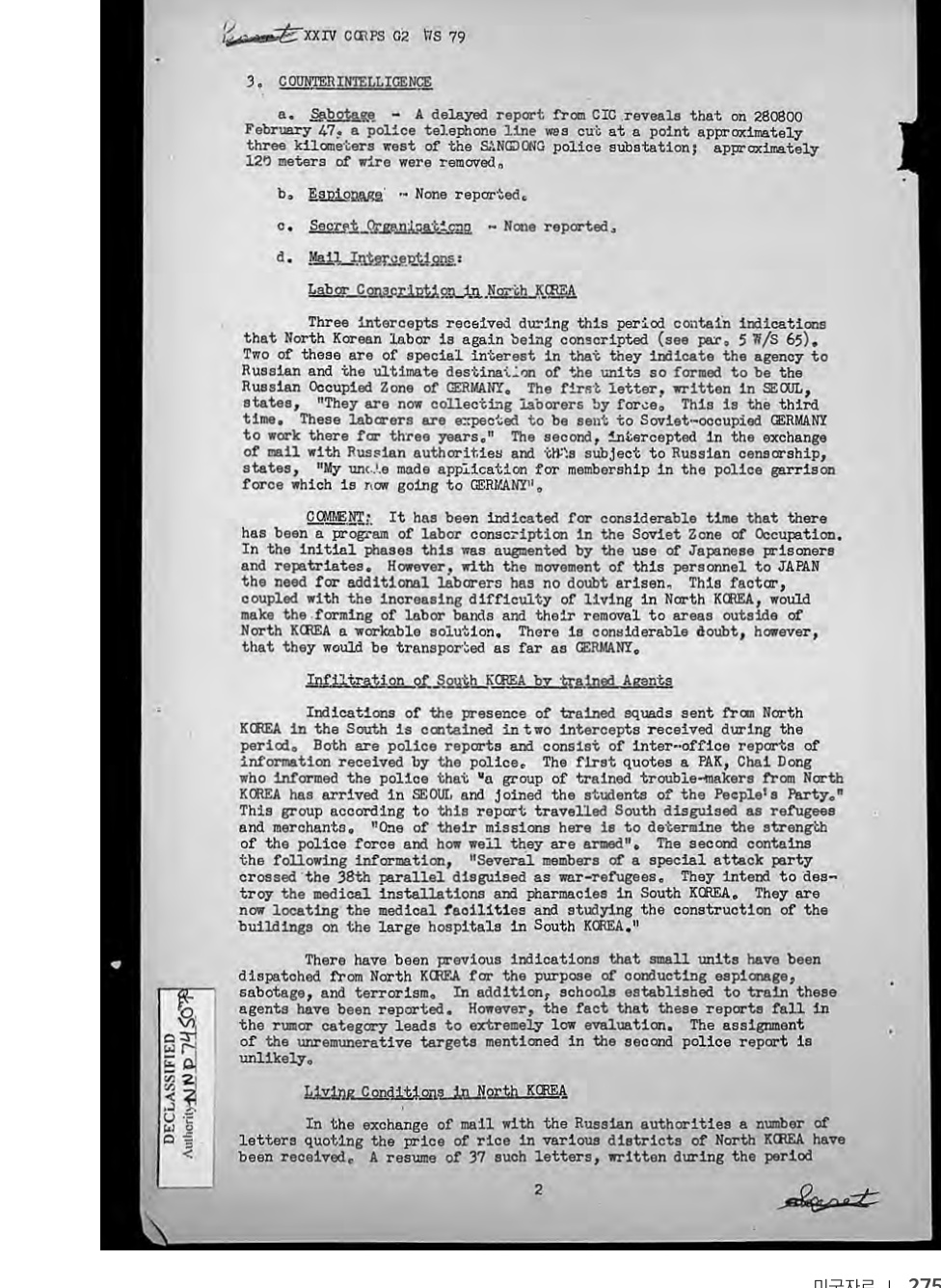
3. COUNTERINTELLIGENCE
a. Sabotage -- A delayed report from CIC reveals that on 280800 February 47, a police telephone line was cut at a point approximately three kilometers west of the SANGDONG police substation; approximately 120 meters of wire were removed.
b. Espionage -- None reported.
c. Secret Organizations -- None reported.
d. Mail Interceptions:
Labor Conscription in North KOREA
Three intercepts received during this period contain indications that North Korean labor is again being conscripted (see par. 5 W/S 65). Two of these are of special interest in that they indicate the agency to Russian and the ultimate destination of the units so formed to be the Russian Occupied Zone of GERMANY. The first letter, written in SEOUL, states, "They are now collecting laborers by force. This is the third time. These laborers are expected to be sent to Soviet-occupied GERMANY to work there for three years." The second, intercepted in the exchange of mail with Russian authorities and subject to Russian censorship, states, "My uncle made application for membership in the police garrison force which is now going to GERMANY".
COMMENT: It has been indicated for considerable time that there has been a program of labor conscription in the Soviet Zone of Occupation. In the initial phases this was augmented by the use of Japanese prisoners and repatriates. However, with the movement of this personnel to JAPAN the need for additional laborers has no doubt arisen. This factor, coupled with the increasing difficulty of living in North KOREA, would make the forming of labor bands and their removal to areas outside of North KOREA a workable solution. There is considerable doubt, however, that they would be transported as far as GERMANY.
Infiltration of South KOREA by trained Agents
Indications of the presence of trained squads sent from North KOREA in the South is contained in two intercepts received during the period. Both are police reports and consist of inter-office reports of information received by the police. The first quotes a PAK, Chai Dong who informed the police that "a group of trained trouble-makers from North KOREA has arrived in SEOUL and joined the students of the People's Party." This group according to this report travelled South disguised as refugees and merchants. "One of their missions here is to determine the strength of the police force and how well they are armed". The second contains the following information, "Several members of a special attack party crossed the 38th parallel disguised as war-refugees. They intend to destroy the medical installations and pharmacies in South KOREA. They are now locating the medical facilities and studying the construction of the buildings on the large hospitals in South KOREA."
There have been previous indications that small units have been dispatched from North KOREA for the purpose of conducting espionage, sabotage, and terrorism. In addition, schools established to train these agents have been reported. However, the fact that these reports fall in the rumor category leads to extremely low evaluation. The assignment of the unremunerative targets mentioned in the second police report is unlikely.
Living Conditions in North KOREA
In the exchange of mail with the Russian authorities a number of letters quoting the price of rice in various districts of North KOREA have been received. A resume of 37 such letters, written during the period
2
SECRET
DECLASSIFIED
Authority NND 745072
XXIV CORPS G2 WS 79
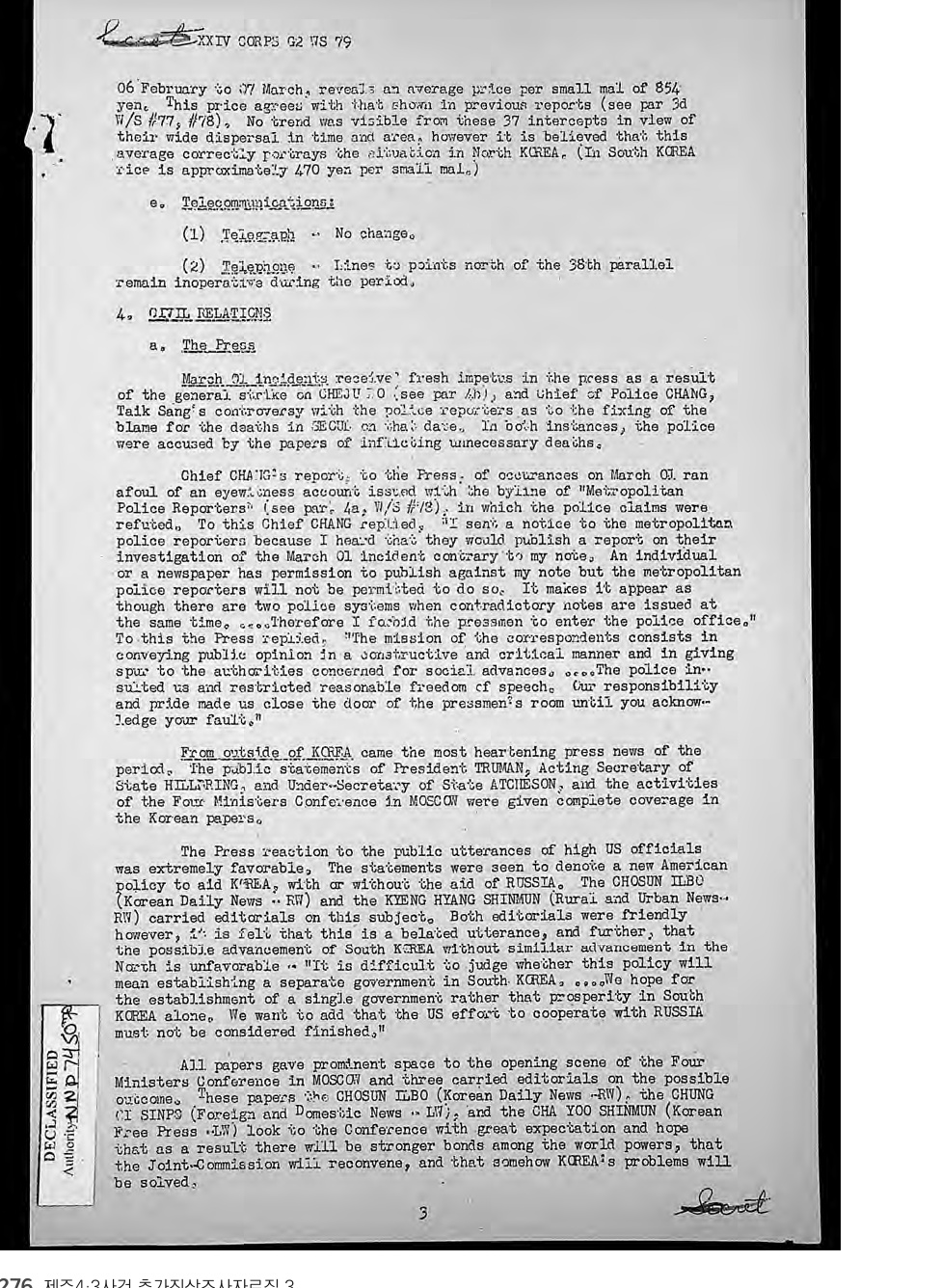
06 February to 07 March, reveals an average price per small mal of 854 yen. This price agrees with that shown in previous reports (see par 3d W/S #77, #78). No trend was visible from these 37 intercepts in view of their wide dispersal in time and area, however it is believed that this average correctly portrays the situation in North KOREA. (In South KOREA rice is approximately 470 yen per small mal.)
e. Telecommunications:
(1) Telegraph -- No change.
(2) Telephone -- Lines to points north of the 38th parallel remain inoperative during the period.
4. CIVIL RELATIONS
a. The Press
March 01 incidents receive' fresh impetus in the press as a result of the general strike on CHEJU 1.0 (see par 4b), and Chief of Police CHANG, Taik Sang's controversy with the police reporters as to the fixing of the blame for the deaths in SEOUL on that date. In both instances, the police were accused by the papers of inflicting unnecessary deaths.
Chief CHANG's report, to the Press, of occurances on March 01 ran afoul of an eyewitness account issued with the byline of "Metropolitan Police Reporters" (see par. 4a, W/S #72), in which the police claims were refuted. To this Chief CHANG replied, "I sent a notice to the metropolitan police reporters because I heard that they would publish a report on their investigation of the March 01 incident contrary to my note. An individual or a newspaper has permission to publish against my note but the metropolitan police reporters will not be permitted to do so. It makes it appear as though there are two police systems when contradictory notes are issued at the same time. ....Therefore I forbid the pressmen to enter the police office." To this the Press replied. "The mission of the correspondents consists in conveying public opinion in a constructive and critical manner and in giving spur to the authorities concerned for social advances. ....The police insulted us and restricted reasonable freedom of speech. Our responsibility and pride made us close the door of the pressmen's room until you acknowledge your fault."
From outside of KOREA came the most heartening press news of the period. The public statements of President TRUMAN, Acting Secretary of State HILLRING, and Under-Secretary of State ATCHESON, and the activities of the Four Ministers Conference in MOSCOW were given complete coverage in the Korean papers.
The Press reaction to the public utterances of high US officials was extremely favorable. The statements were seen to denote a new American policy to aid KOREA, with or without the aid of RUSSIA. The CHOSUN ILBO (Korean Daily News -- RW) and the KYENG HYANG SHINMUN (Rural and Urban News-- RW) carried editorials on this subject. Both editorials were friendly however, it is felt that this is a belated utterance, and further, that the possible advancement of South KOREA without similar advancement in the North is unfavorable -- "It is difficult to judge whether this policy will mean establishing a separate government in South KOREA. ....We hope for the establishment of a single government rather that prosperity in South KOREA alone. We want to add that the US effort to cooperate with RUSSIA must not be considered finished."
All papers gave prominent space to the opening scene of the Four Ministers Conference in MOSCOW and three carried editorials on the possible outcome. These papers the CHOSUN ILBO (Korean Daily News --RW), the CHUNG CI SINPO (Foreign and Domestic News -- LW), and the CHA YOO SHINMUN (Korean Free Press --LW) look to the Conference with great expectation and hope that as a result there will be stronger bonds among the world powers, that the Joint-Commission will reconvene, and that somehow KOREA's problems will be solved.
3
Secret
DECLASSIFIED
Authority NND 74503
XXIV CORPS G2 WS 79
The release on 10 March of the decision in the trial of four enlisted men for alledged rape came as an anti-climax to the press. This trial and events leading to it had been followed with considerable interest and anti-American feeling by the newspapers (see par. 4a W/S #70,77), however, the final verdict was printed by all papers with no comment, and only such abstract queries as "Wasn't that rape", "Is this adequate". The case was absent from subsequent issues.
b. The People
(1) General Strike Reported at CHEJU City
From the island province of CHEJU DO comes a report that a general strike is in progress in the capitol city, CHEJU, which has partially paralyzed finance, transportation, communications, manufacturing, education, small business, food distribution, and has extended to approximately sixty percent of the Korean provincial officials. Reportedly beginning on 12 March, the general strike is believed to be Communist inspired, but participated in by both Left and Right as a protest against the killing of six persons and the wounding of six others during unauthorized demonstrations and rioting on 01 March in CHEJU City. (See Incl. #1 and par. 4b, W/S 77)
Industrial leaders and MG officials were called to a meeting with the Korean Provincial Governor on 15 March in order that he might hear their opinions in regard to the return to work of their employees on 17 March. The following were the results of the meeting:
(1) Those expecting their employees to return to work on 17 March:
Harbor Master
Federation Financial Association
Chosun Industrial Bank
Tax Office
North GUN Officer
Chosun Mutual Bank
Mayor's Office (SHEJU City)
Bureau of Communications
(2) Those who expected their employees to continue to strike:
Heads of North, South and East Primary Schools
CHEJU Branch, Federation Financial Association
Monopoly Bureau
Provincial Food Bureau
Post Office
(3) Those who were uncertain as to the action employees would take:
South KOREA Electric Company
CHEJU Alcohol Company
Following the meeting, a Military Government officer interrogated the Korean Provincial Governor as to his attitude toward the strike. The Governor reportedly expressed himself as being unsympathetic, believing that it was unjustified; he volunteered to make such an announcement to the press.
The scrutiny of nine petitions reaching the office of the Provincial Governor (American) indicates that the political complexion of their authors is extreme Left Wing. The petitions unanimously demand that the police chief be discharged, that policemen be dismissed, that pro-Japanese be ousted from the police force and that those policemen who fired the fatal shots -- actually, their identities are not known in all cases -- be criminally prosecuted. In almost every instance, demands are made to better the conditions of teachers and faculty in the schools; in most of the petitions, this phrase appears: "cancel (or object to) the SEOUL National University plan."
1-CHEJU (950-1150)(33°30'N-126°32'E) 4
DECLASSIFIED
Authority NND 74507[illegible]
XXIV CORPS G2 WS 79
Wrathful indignation directed against the police was reportedly percipitated by unfortunate events which arose out of specifically forbidden, Leftist-sponsored, Sam Il Day demonstrations. Acting contrary to orders of American MG officers, thousands of singing, flag bearing demonstrators reportedly converged upon the city square in which is located the provincial capitol, District #1 police station and the jail. At another point, another unauthorized column approached the Inspection Command (police) Station with the supposed intent of attack. A mounted policeman, enroute to the District #1 station to report, slightly injured a child who inadvertantly ran into his horse. A jeering crowd, estimated at less than two hundred, followed him to the District #1 police building. Those on guard assumed that it was an attack and opened fire. Previous to this instant, demonstrators had been marching in an "S" shaped column around the square, reportedly veering closer to the jail with the constant threat of attack. Tense, and experienced with the brutal potential of the Communist dominated Democratic Youth Alliance ---- these policemen were in training at TAEJON during the fall riots -- police guards opened fire and dispersed the crowd. The column that had threatened the Inspection Command Station was dispersed without reported casualties.
A second incident contributed to the mounting animosity against the local police. Previous to 01 March, a policeman had incurred a fracture in a vehicle accident and was placed in a hospital close to the city square. Fearing trouble, two policemen were stationed at the hospital as a precaution in case of March first rioting. Following the shooting mentioned above, two demonstrators were carrying a wounded comrade toward the hospital. The nervous guard outside opened fire, wounding one; the guard on the inside post, hearing the firing, ran out and wounded the other.
COMMENT: More detailed information as to the general strike in CHEJU City is lacking due to a partial breakdown in communications with that city. The most recent reports indicate that the strike is abating. The province of CHEJU DO is known as a Left Wing stronghold with a reported seventy percent of its population being sympathizers or affiliates with Left Wing parties. Notable is the fact that this strike indicates what can happen in a Korean community when the majority of the populace, either Right or Left, obdurately support what they believe to be just demands. As to the police action: the shooting which occured at the hospital seems irreconcilable with rational thinking. However, it must be borne in mind that those who reportedly did the firing in CHEJU City had been trained in TAEJON and will long remember the profane atrocities committed against fellow policemen by Leftist rioters in the fall of 1946. The supposed proximate cause of the unfortunate situation: Leftist demonstrations contrary to an express order prohibiting them - the same reason which resulted in other deaths in South KOREA on 01 March.
(2) Chinese Journalists Visit SEOUL
Eleven members of the Chinese press arrived in SEOUL on 11 March having travelled by air from JAPAN where they had been elaborately entertained for ten days as guests of the Far East Command.
On 12 March, the party was briefed at DUK SOO palace by the Commanding General and the Chief of the American Delegation to the US-USSR Joint Commission. The briefing was well-received; however, several of the guests seemed to regret that it was necessarily cut short due to the pressure of Korean requests to see them.
Activities of the day included attendance at the Korean press conference, lunch at the Chosun Hotel, and a visit to the legislative chambers. In the afternoon, the Chief of the American Delegation to the US-USSR Joint Commission briefed the visitors on Military Government affairs which they received with considerable interest, devoting their primary attention to the subject of future trade between KOREA and CHINA. It was indicated to them that the UNITED STATES is endeavoring to establish amicable trade arrangements to both nations.
1-TAEJON (1040-1490)(36°20'N-127°26'E)
5
DECLASSIFIED
Authority NND 74509
XXIV CORPS G2 WS 79
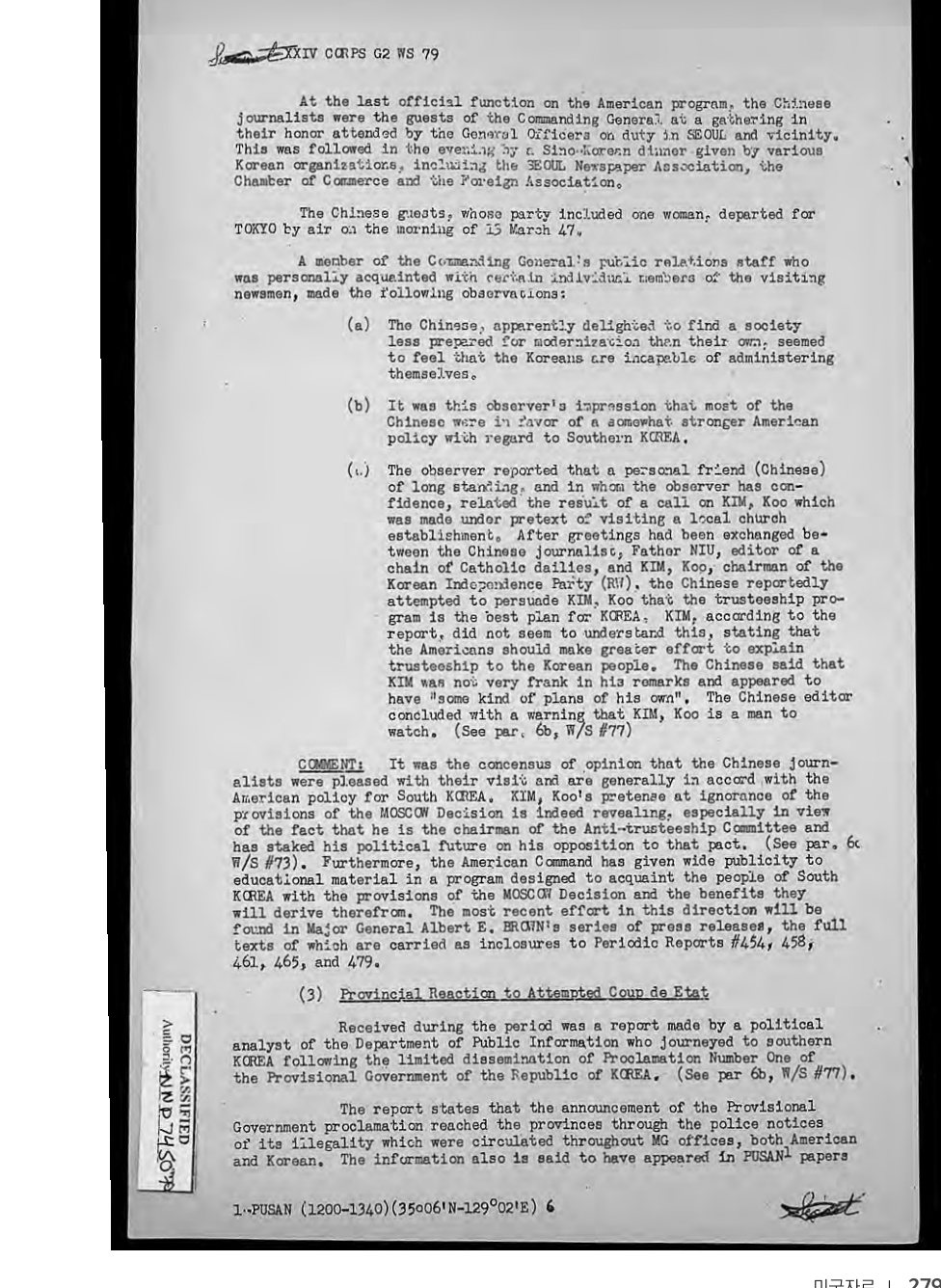
At the last official function on the American program, the Chinese journalists were the guests of the Commanding General at a gathering in their honor attended by the General Officers on duty in SEOUL and vicinity. This was followed in the evening by a Sino-Korean dinner given by various Korean organizations, including the SEOUL Newspaper Association, the Chamber of Commerce and the Foreign Association.
The Chinese guests, whose party included one woman, departed for TOKYO by air on the morning of 15 March 47.
A member of the Commanding General's public relations staff who was personally acquainted with certain individual members of the visiting newsmen, made the following observations:
(a) The Chinese, apparently delighted to find a society less prepared for modernization than their own, seemed to feel that the Koreans are incapable of administering themselves.
(b) It was this observer's impression that most of the Chinese were in favor of a somewhat stronger American policy with regard to Southern KOREA.
(c) The observer reported that a personal friend (Chinese) of long standing, and in whom the observer has confidence, related the result of a call on KIM, Koo which was made under pretext of visiting a local church establishment. After greetings had been exchanged between the Chinese journalist, Father NIU, editor of a chain of Catholic dailies, and KIM, Koo, chairman of the Korean Independence Party (RH), the Chinese reportedly attempted to persuade KIM, Koo that the trusteeship program is the best plan for KOREA. KIM, according to the report, did not seem to understand this, stating that the Americans should make greater effort to explain trusteeship to the Korean people. The Chinese said that KIM was not very frank in his remarks and appeared to have "some kind of plans of his own". The Chinese editor concluded with a warning that KIM, Koo is a man to watch. (See par. 6b, W/S #77)
COMMENT: It was the concensus of opinion that the Chinese journalists were pleased with their visit and are generally in accord with the American policy for South KOREA. KIM, Koo's pretense at ignorance of the provisions of the MOSCOW Decision is indeed revealing, especially in view of the fact that he is the chairman of the Anti-trusteeship Committee and has staked his political future on his opposition to that pact. (See par. 6c W/S #73). Furthermore, the American Command has given wide publicity to educational material in a program designed to acquaint the people of South KOREA with the provisions of the MOSCOW Decision and the benefits they will derive therefrom. The most recent effort in this direction will be found in Major General Albert E. BROWN's series of press releases, the full texts of which are carried as inclosures to Periodic Reports #454, 458, 461, 465, and 479.
(3) Provincial Reaction to Attempted Coup de Etat
Received during the period was a report made by a political analyst of the Department of Public Information who journeyed to southern KOREA following the limited dissemination of Proclamation Number One of the Provisional Government of the Republic of KOREA. (See par 6b, W/S #77).
The report states that the announcement of the Provisional Government proclamation reached the provinces through the police notices of its illegality which were circulated throughout MG offices, both American and Korean. The information also is said to have appeared in PUSAN papers
DECLASSIFIED
Authority NND 74509
1-PUSAN (1200-1340)(35006'N-129°02'E) 6
Secret XXIV CORPS G2 WS 79
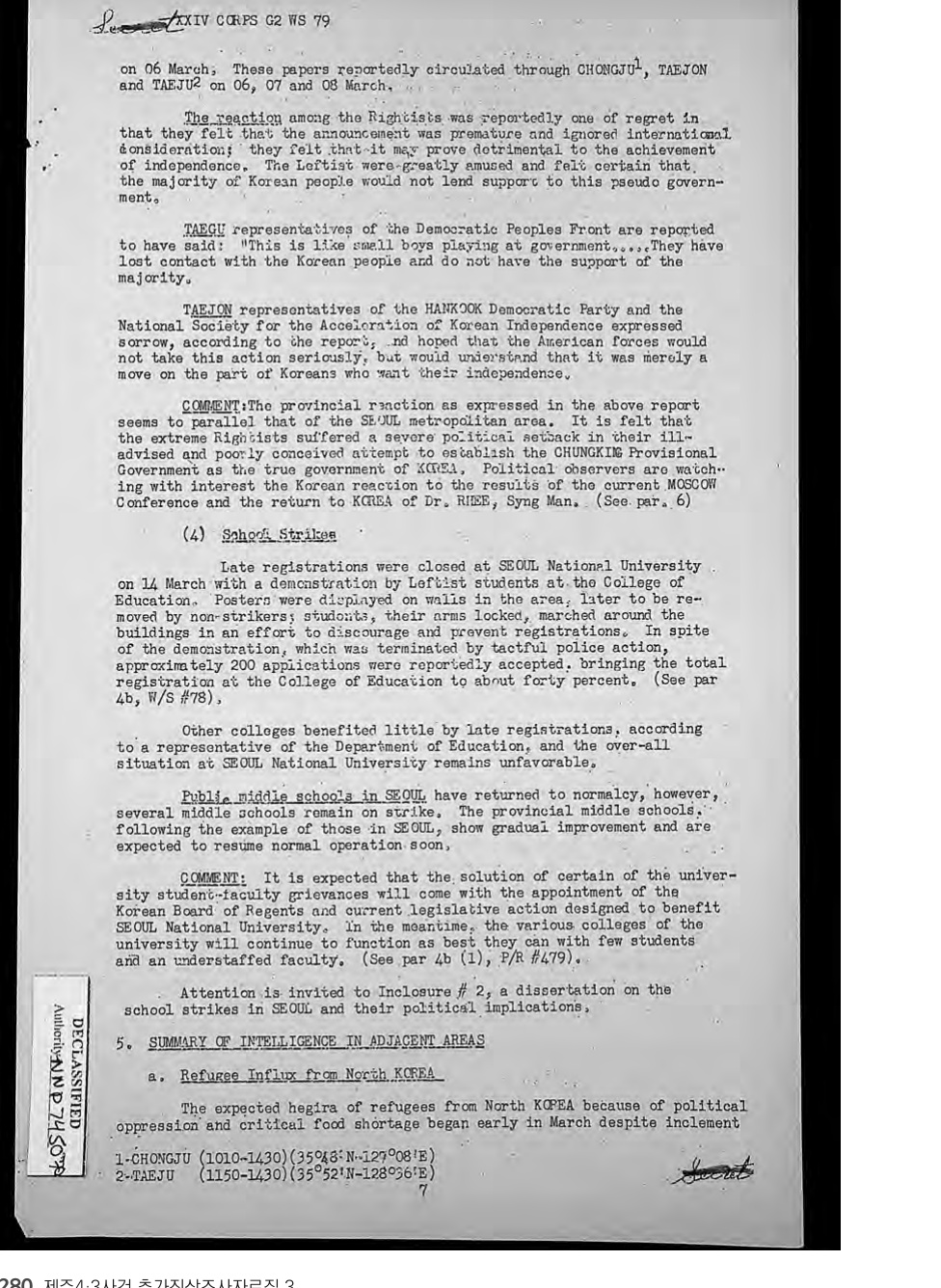
on 06 March; These papers reportedly circulated through CHONGJU¹, TAEJON and TAEJU² on 06, 07 and 08 March.
The reaction among the Rightists was reportedly one of regret in that they felt that the announcement was premature and ignored international consideration; they felt that it may prove detrimental to the achievement of independence. The Leftist were greatly amused and felt certain that the majority of Korean people would not lend support to this pseudo government.
TAEGU representatives of the Democratic Peoples Front are reported to have said: "This is like small boys playing at government.....They have lost contact with the Korean people and do not have the support of the majority.
TAEJON representatives of the HANKOOK Democratic Party and the National Society for the Acceleration of Korean Independence expressed sorrow, according to the report, and hoped that the American forces would not take this action seriously, but would understand that it was merely a move on the part of Koreans who want their independence.
COMMENT: The provincial reaction as expressed in the above report seems to parallel that of the SEOUL metropolitan area. It is felt that the extreme Rightists suffered a severe political setback in their ill-advised and poorly conceived attempt to establish the CHUNGKIM Provisional Government as the true government of KOREA. Political observers are watching with interest the Korean reaction to the results of the current MOSCOW Conference and the return to KOREA of Dr. RHEE, Syng Man. (See par. 6)
(4) School Strikes
Late registrations were closed at SEOUL National University on 14 March with a demonstration by Leftist students at the College of Education. Posters were displayed on walls in the area, later to be removed by non-strikers; students, their arms locked, marched around the buildings in an effort to discourage and prevent registrations. In spite of the demonstration, which was terminated by tactful police action, approximately 200 applications were reportedly accepted, bringing the total registration at the College of Education to about forty percent. (See par 4b, W/S #78).
Other colleges benefited little by late registrations, according to a representative of the Department of Education, and the over-all situation at SEOUL National University remains unfavorable.
Public middle schools in SEOUL have returned to normalcy, however, several middle schools remain on strike. The provincial middle schools, following the example of those in SEOUL, show gradual improvement and are expected to resume normal operation soon.
COMMENT: It is expected that the solution of certain of the university student-faculty grievances will come with the appointment of the Korean Board of Regents and current legislative action designed to benefit SEOUL National University. In the meantime, the various colleges of the university will continue to function as best they can with few students and an understaffed faculty. (See par 4b (1), P/R #479).
Attention is invited to Inclosure # 2, a dissertation on the school strikes in SEOUL and their political implications.
5. SUMMARY OF INTELLIGENCE IN ADJACENT AREAS
a. Refugee Influx from North KOREA
The expected hegira of refugees from North KOREA because of political oppression and critical food shortage began early in March despite inclement
1-CHONGJU (1010-1430)(35°43'N-127°08'E)
2-TAEJU (1150-1430)(35°52'N-128°36'E)
7
DECLASSIFIED
Authority NND 74[illegible]
Secret
SECRET XXIV CORPS G2 WS 79
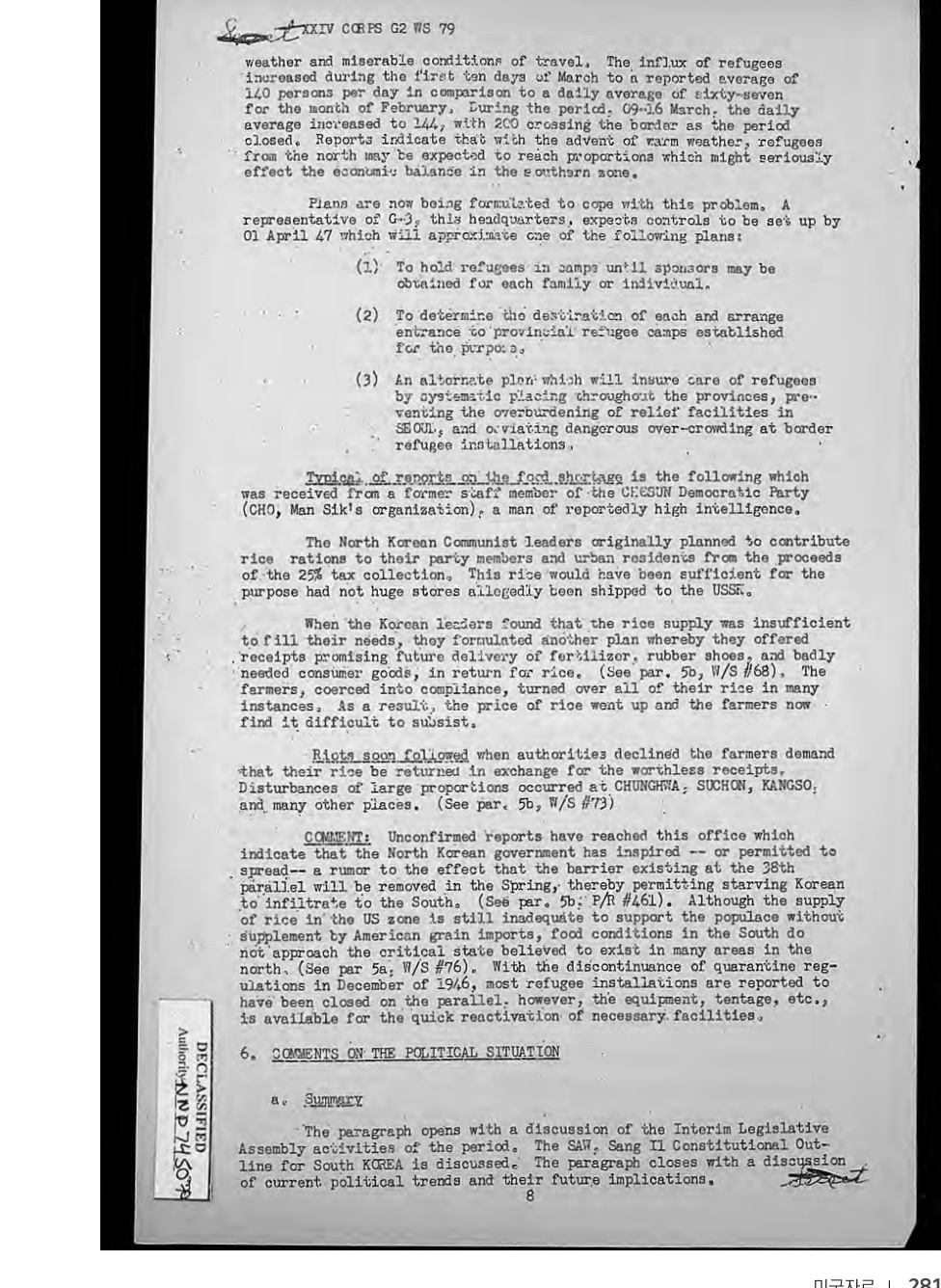
weather and miserable conditions of travel. The influx of refugees increased during the first ten days of March to a reported average of
140 persons per day in comparison to a daily average of sixty-seven for the month of February. During the period, 09-16 March, the daily average increased to 144, with 200 crossing the border as the period closed. Reports indicate that with the advent of warm weather, refugees from the north may be expected to reach proportions which might seriously effect the economic balance in the southern zone.
Plans are now being formulated to cope with this problem. A representative of G-3, this headquarters, expects controls to be set up by
01 April 47 which will approximate one of the following plans:
(1) To hold refugees in camps until sponsors may be obtained for each family or individual.
(2) To determine the destination of each and arrange entrance to provincial refugee camps established for the purpose.
(3) An alternate plan which will insure care of refugees by systematic placing throughout the provinces, preventing the overburdening of relief facilities in
SEOUL, and obviating dangerous over-crowding at border refugee installations.
Typical of reports on the food shortage is the following which was received from a former staff member of the CHOSUN Democratic Party
(CHO, Man Sik's organization), a man of reportedly high intelligence.
The North Korean Communist leaders originally planned to contribute rice rations to their party members and urban residents from the proceeds of the 25% tax collection. This rice would have been sufficient for the purpose had not huge stores allegedly been shipped to the USSR.
When the Korean leaders found that the rice supply was insufficient to fill their needs, they formulated another plan whereby they offered receipts promising future delivery of fertilizer, rubber shoes, and badly needed consumer goods, in return for rice. (See par. 5b, W/S #68). The farmers, coerced into compliance, turned over all of their rice in many instances. As a result, the price of rice went up and the farmers now find it difficult to subsist.
Riots soon followed when authorities declined the farmers demand that their rice be returned in exchange for the worthless receipts.
Disturbances of large proportions occurred at CHUNGHWA, SUCHON, KANGSO, and many other places. (See par. 5b, W/S #73)
COMMENT: Unconfirmed reports have reached this office which indicate that the North Korean government has inspired -- or permitted to spread-- a rumor to the effect that the barrier existing at the 38th parallel will be removed in the Spring, thereby permitting starving Korean to infiltrate to the South. (See par. 5b, P/R #461). Although the supply of rice in the US zone is still inadequate to support the populace without supplement by American grain imports, food conditions in the South do not approach the critical state believed to exist in many areas in the north. (See par 5a, W/S #76). With the discontinuance of quarantine regulations in December of 1946, most refugee installations are reported to have been closed on the parallel; however, the equipment, tentage, etc., is available for the quick reactivation of necessary facilities.
6. COMMENTS ON THE POLITICAL SITUATION
a. Summary
The paragraph opens with a discussion of the Interim Legislative
Assembly activities of the period. The SAW, Sang Il Constitutional Outline for South KOREA is discussed. The paragraph closes with a discussion of current political trends and their future implications.
8
DECLASSIFIED
Authority NND 74[illegible]
XXIV CORPS G2 WS 79
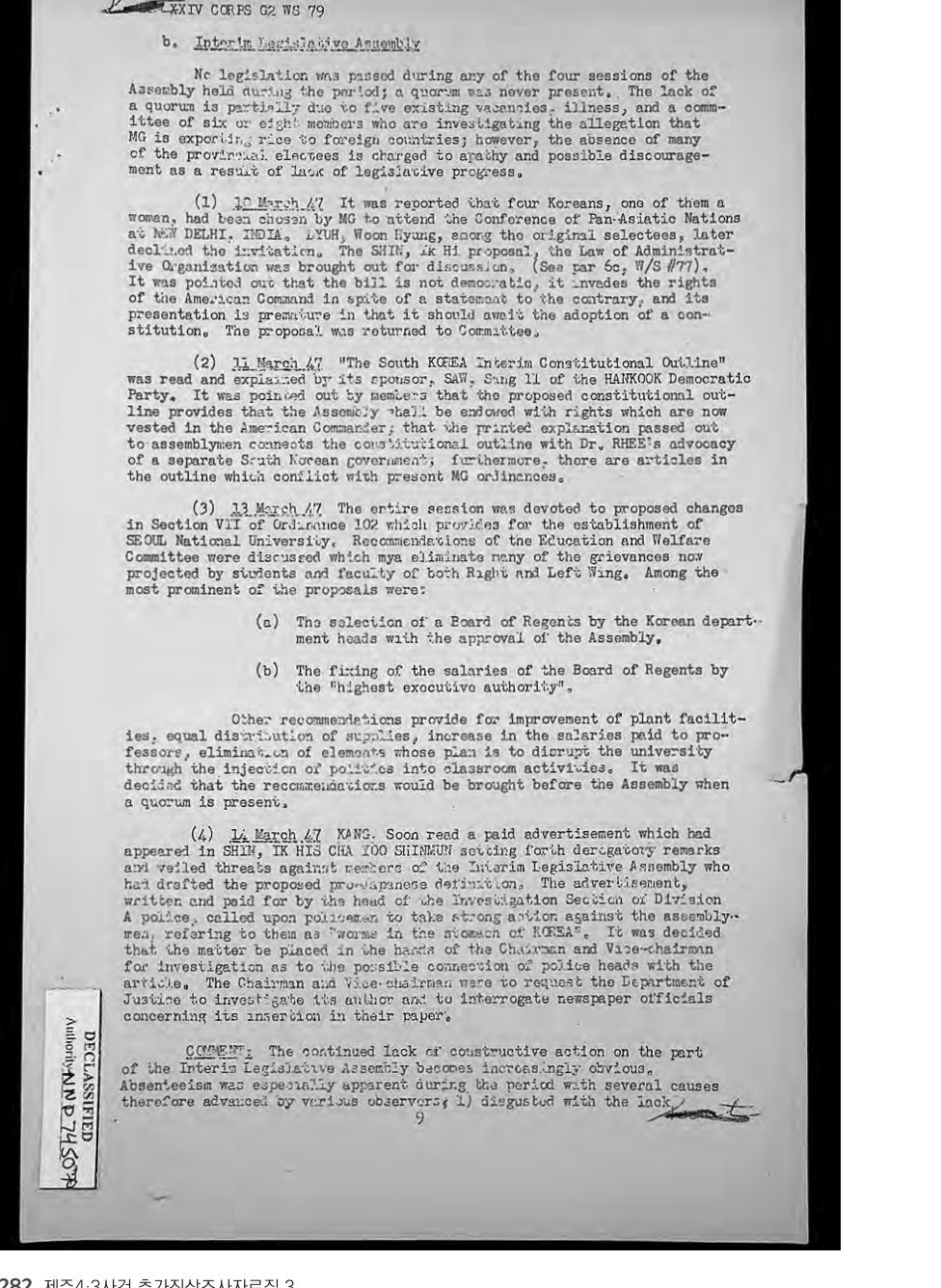
b. Interim Legislative Assembly
No legislation was passed during any of the four sessions of the Assembly held during the period; a quorum was never present. The lack of a quorum is partially due to five existing vacancies, illness, and a committee of six or eight members who are investigating the allegation that MG is exporting rice to foreign countries; however, the absence of many of the provincial electees is charged to apathy and possible discouragement as a result of lack of legislative progress.
(1) 10 March 47 It was reported that four Koreans, one of them a woman, had been chosen by MG to attend the Conference of Pan-Asiatic Nations at NEW DELHI, INDIA. LYUH, Woon Hyung, among the original selectees, later declined the invitation. The SHIN, IK HI proposal, the Law of Administrative Organization was brought out for discussion. (See par 6c, W/S #77). It was pointed out that the bill is not democratic, it invades the rights of the American Command in spite of a statement to the contrary, and its presentation is premature in that it should await the adoption of a constitution. The proposal was returned to Committee.
(2) 11 March 47 "The South KOREA Interim Constitutional Outline" was read and explained by its sponsor, SAW, Sang Il of the HANKOOK Democratic Party. It was pointed out by members that the proposed constitutional outline provides that the Assembly shall be endowed with rights which are now vested in the American Commander; that the printed explanation passed out to assemblymen connects the constitutional outline with Dr. RHEE's advocacy of a separate South Korean government; furthermore, there are articles in the outline which conflict with present MG ordinances.
(3) 13 March 47 The entire session was devoted to proposed changes in Section VII of Ordinance 102 which provides for the establishment of SEOUL National University. Recommendations of the Education and Welfare Committee were discussed which may eliminate many of the grievances now projected by students and faculty of both Right and Left Wing. Among the most prominent of the proposals were:
(a) The selection of a Board of Regents by the Korean department heads with the approval of the Assembly.
(b) The fixing of the salaries of the Board of Regents by the "highest executive authority".
Other recommendations provide for improvement of plant facilities, equal distribution of supplies, increase in the salaries paid to professors, elimination of elements whose plan is to disrupt the university through the injection of politics into classroom activities. It was decided that the recommendations would be brought before the Assembly when a quorum is present.
(4) 14 March 47 KANG, Soon read a paid advertisement which had appeared in SHIN, IK HIS CHA TOO SHINMUN setting forth derogatory remarks and veiled threats against members of the Interim Legislative Assembly who had drafted the proposed pro-Japanese definition. The advertisement, written and paid for by the head of the Investigation Section of Division A police, called upon policemen to take strong action against the assemblymen, refering to them as "worms in the stomach of KOREA". It was decided that the matter be placed in the hands of the Chairman and Vice-chairman for investigation as to the possible connection of police heads with the article. The Chairman and Vice-chairman were to request the Department of Justice to investigate its author and to interrogate newspaper officials concerning its insertion in their paper.
COMMENT: The continued lack of constructive action on the part of the Interim Legislative Assembly becomes increasingly obvious. Absenteeism was especially apparent during the period with several causes therefore advanced by various observers; 1) disgusted with the lack[illegible]
9
DECLASSIFIED
Authority NND 74[illegible]
XXIV CORPS G2 WS 79
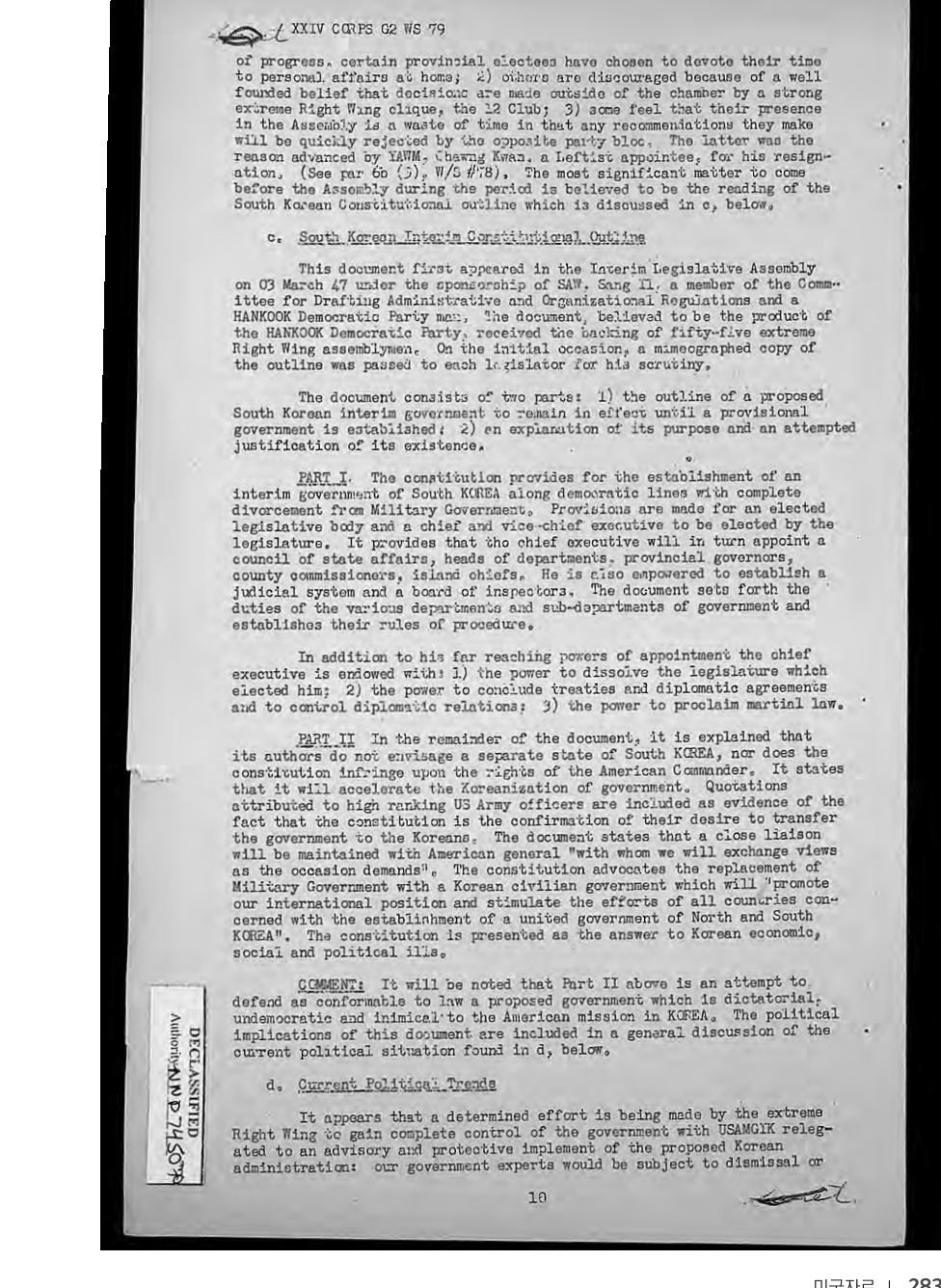
of progress, certain provincial electees have chosen to devote their time to personal affairs at home; 2) others are discouraged because of a well founded belief that decisions are made outside of the chamber by a strong extreme Right Wing clique, the 12 Club; 3) some feel that their presence in the Assembly is a waste of time in that any recommendations they make will be quickly rejected by the opposite party bloc. The latter was the reason advanced by YAWM. Chawng Kwan, a Leftist appointee, for his resignation. (See par 6b (3), W/S #78). The most significant matter to come before the Assembly during the period is believed to be the reading of the
South Korean Constitutional outline which is discussed in c, below.
c. South Korean Interim Constitutional Outline
This document first appeared in the Interim Legislative Assembly on 03 March 47 under the sponsorship of SAW. Sang Il, a member of the Committee for Drafting Administrative and Organizational Regulations and a
HANKOOK Democratic Party man. The document, believed to be the product of the HANKOOK Democratic Party, received the backing of fifty-five extreme
Right Wing assemblymen. On the initial occasion, a mimeographed copy of the outline was passed to each legislator for his scrutiny.
The document consists of two parts: 1) the outline of a proposed
South Korean interim government to remain in effect until a provisional government is established; 2) an explanation of its purpose and an attempted justification of its existence.
PART I. The constitution provides for the establishment of an interim government of South KOREA along democratic lines with complete divorcement from Military Government. Provisions are made for an elected legislative body and a chief and vice-chief executive to be elected by the legislature. It provides that the chief executive will in turn appoint a council of state affairs, heads of departments, provincial governors, county commissioners, island chiefs. He is also empowered to establish a judicial system and a board of inspectors. The document sets forth the duties of the various departments and sub-departments of government and establishes their rules of procedure.
In addition to his far reaching powers of appointment the chief executive is endowed with: 1) the power to dissolve the legislature which elected him; 2) the power to conclude treaties and diplomatic agreements and to control diplomatic relations; 3) the power to proclaim martial law.
PART II In the remainder of the document, it is explained that its authors do not envisage a separate state of South KOREA, nor does the constitution infringe upon the rights of the American Commander. It states that it will accelerate the Koreanization of government. Quotations attributed to high ranking US Army officers are included as evidence of the fact that the constitution is the confirmation of their desire to transfer the government to the Koreans. The document states that a close liaison will be maintained with American general "with whom we will exchange views as the occasion demands". The constitution advocates the replacement of
Military Government with a Korean civilian government which will "promote our international position and stimulate the efforts of all countries concerned with the establishment of a united government of North and South
KOREA". The constitution is presented as the answer to Korean economic, social and political ills.
COMMENT: It will be noted that Part II above is an attempt to defend as conformable to law a proposed government which is dictatorial, undemocratic and inimical to the American mission in KOREA. The political implications of this document are included in a general discussion of the current political situation found in d, below.
d. Current Political Trends
It appears that a determined effort is being made by the extreme
Right Wing to gain complete control of the government with USAMGIK relegated to an advisory and protective implement of the proposed Korean administration; our government experts would be subject to dismissal or
10
DECLASSIFIED
Authority NND 74539
XXIV CORPS G2 WS 79
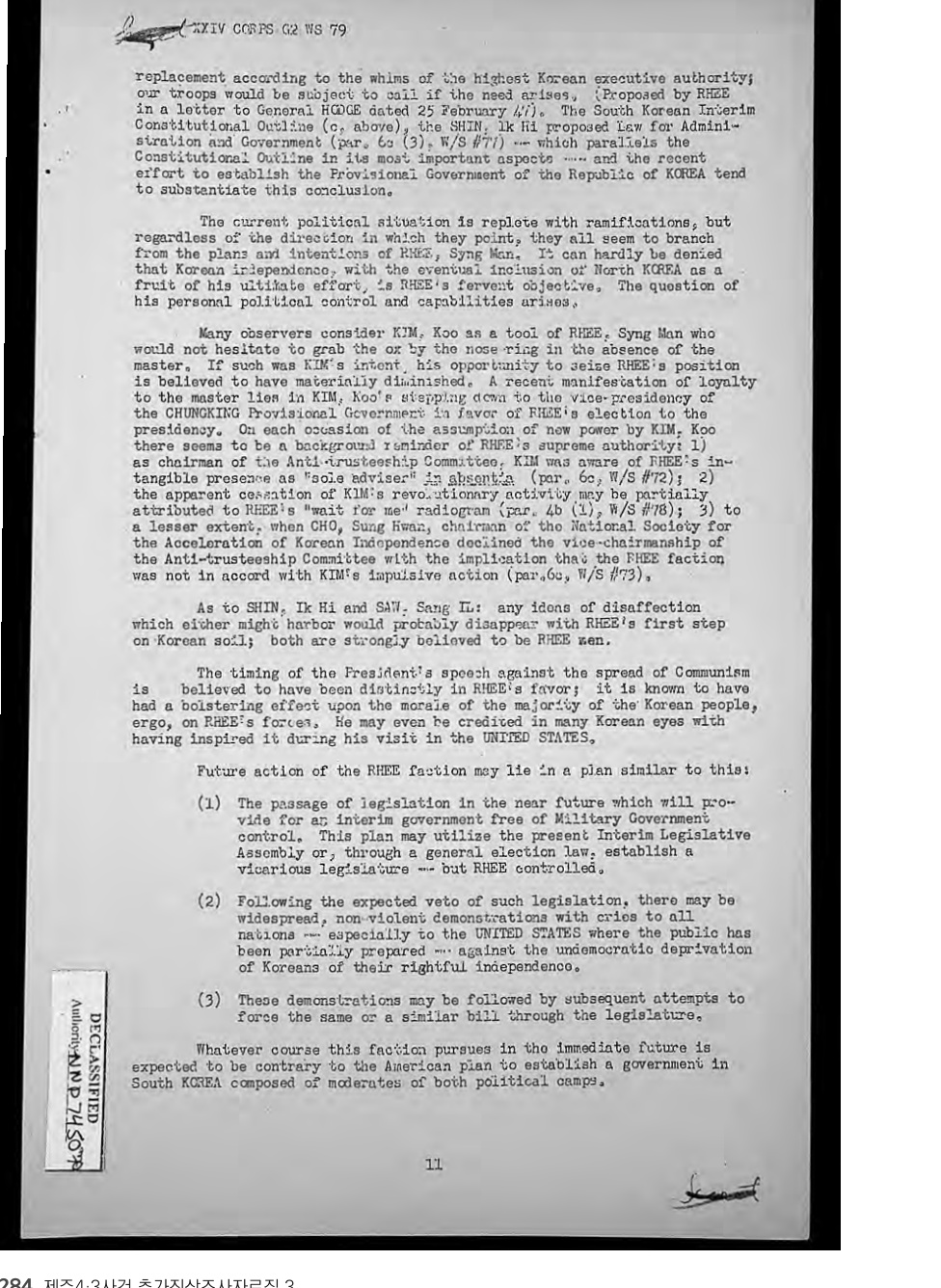
replacement according to the whims of the highest Korean executive authority; our troops would be subject to call if the need arises. (Proposed by RHEE in a letter to General HODGE dated 25 February 47). The South Korean Interim
Constitutional Outline (c, above), the SHIN, Ik Hi proposed Law for Administration and Government (par. 6a (3), W/S #77) --- which parallels the
Constitutional Outline in its most important aspects ---- and the recent effort to establish the Provisional Government of the Republic of KOREA tend to substantiate this conclusion.
The current political situation is replete with ramifications, but regardless of the direction in which they point, they all seem to branch from the plans and intentions of RHEE, Syng Man. It can hardly be denied that Korean independence, with the eventual inclusion of North KOREA as a fruit of his ultimate effort, is RHEE's fervent objective. The question of his personal political control and capabilities arises.
Many observers consider KIM, Koo as a tool of RHEE, Syng Man who would not hesitate to grab the or by the nose ring in the absence of the master. If such was KIM's intent, his opportunity to seize RHEE's position is believed to have materially diminished. A recent manifestation of loyalty to the master lies in KIM, Koo's stepping down to the vice-presidency of the CHUNGKING Provisional Government in favor of RHEE's election to the presidency. On each occasion of the assumption of new power by KIM, Koo there seems to be a background reminder of RHEE's supreme authority: 1)
as chairman of the Anti-trusteeship Committee, KIM was aware of RHEE's intangible presence as "sole adviser" in absentia (par. 6c, W/S #72); 2)
the apparent cessation of KIM's revolutionary activity may be partially attributed to RHEE's "wait for me" radiogram (par. 4b (1), W/S #78); 3) to a lesser extent, when CHO, Sung Hwan, chairman of the National Society for the Acceleration of Korean Independence declined the vice-chairmanship of the Anti-trusteeship Committee with the implication that the RHEE faction was not in accord with KIM's impulsive action (par.6c, W/S #73).
As to SHIN, Ik Hi and SAW, Sang Il: any ideas of disaffection which either might harbor would probably disappear with RHEE's first step on Korean soil; both are strongly believed to be RHEE men.
The timing of the President's speech against the spread of Communism is believed to have been distinctly in RHEE's favor; it is known to have had a bolstering effect upon the morale of the majority of the Korean people, ergo, on RHEE's forces. He may even be credited in many Korean eyes with having inspired it during his visit in the UNITED STATES.
Future action of the RHEE faction may lie in a plan similar to this:
(1) The passage of legislation in the near future which will provide for an interim government free of Military Government control. This plan may utilize the present Interim Legislative
Assembly or, through a general election law, establish a vicarious legislature --- but RHEE controlled.
(2) Following the expected veto of such legislation, there may be widespread, non-violent demonstrations with cries to all nations --- especially to the UNITED STATES where the public has been partially prepared --- against the undemocratic deprivation of Koreans of their rightful independence.
(3) These demonstrations may be followed by subsequent attempts to force the same or a similar bill through the legislature.
Whatever course this faction pursues in the immediate future is expected to be contrary to the American plan to establish a government in
South KOREA composed of moderates of both political camps.
11
DECLASSIFIED
Authority NND 74[illegible]
SECRET XXIV CORPS G2 WS 79
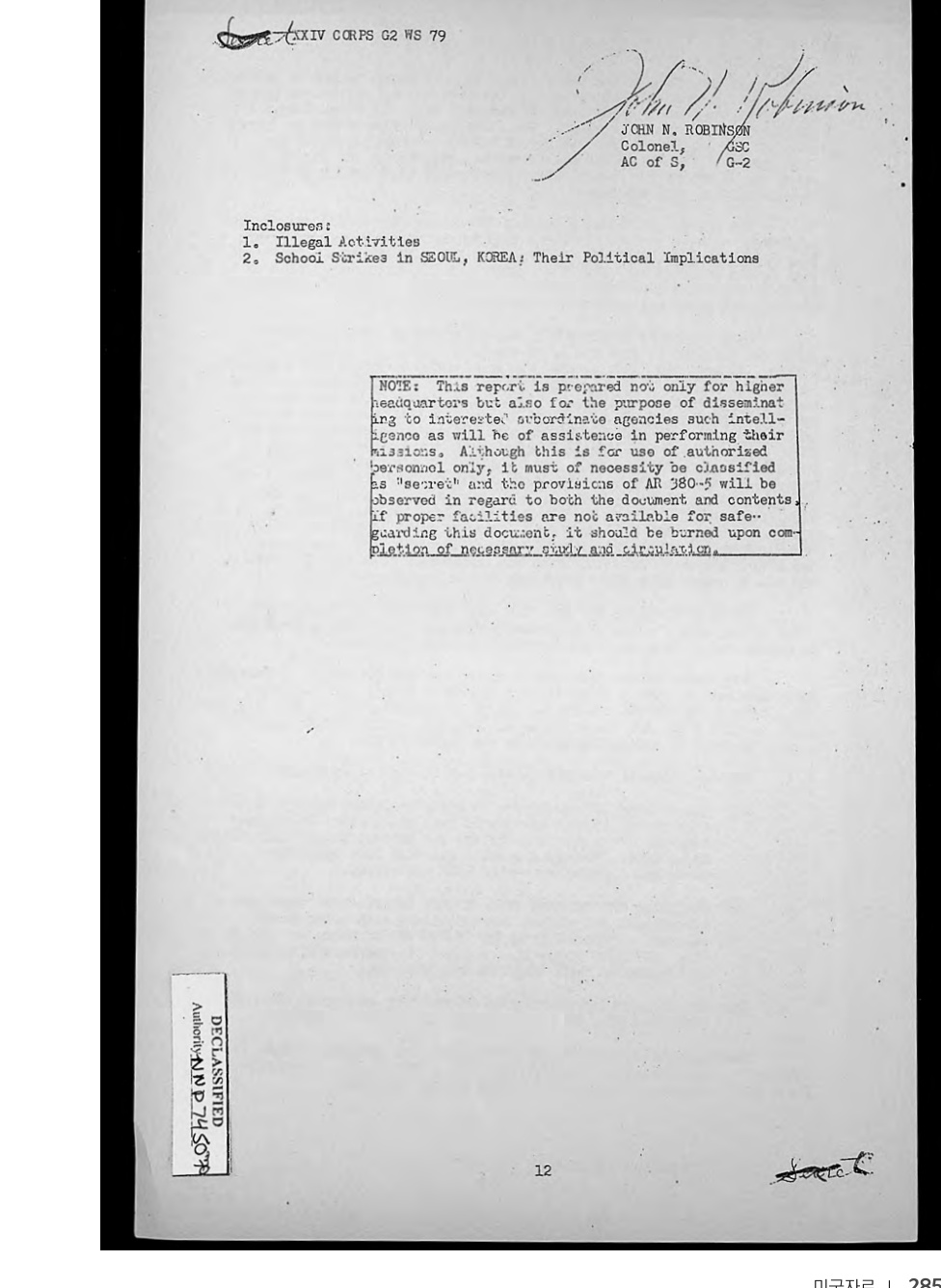
John N. Robinson
JOHN N. ROBINSON
Colonel, GSC
AC of S, G-2
Inclosures:
1. Illegal Activities
2. School Strikes in SEOUL, KOREA: Their Political Implications
NOTE: This report is prepared not only for higher headquarters but also for the purpose of disseminat ing to interested subordinate agencies such intelligence as will be of assistance in performing their missions. Although this is for use of authorized personnel only, it must of necessity be classified as "secret" and the provisions of AR 380-5 will be observed in regard to both the document and contents.
If proper facilities are not available for safeguarding this document, it should be burned upon completion of necessary study and circulation.
12
SECRET
DECLASSIFIED
Authority NND 74507A
HEADQUARTERS XXIV CORPS
Office of the G-2
20 March 1947
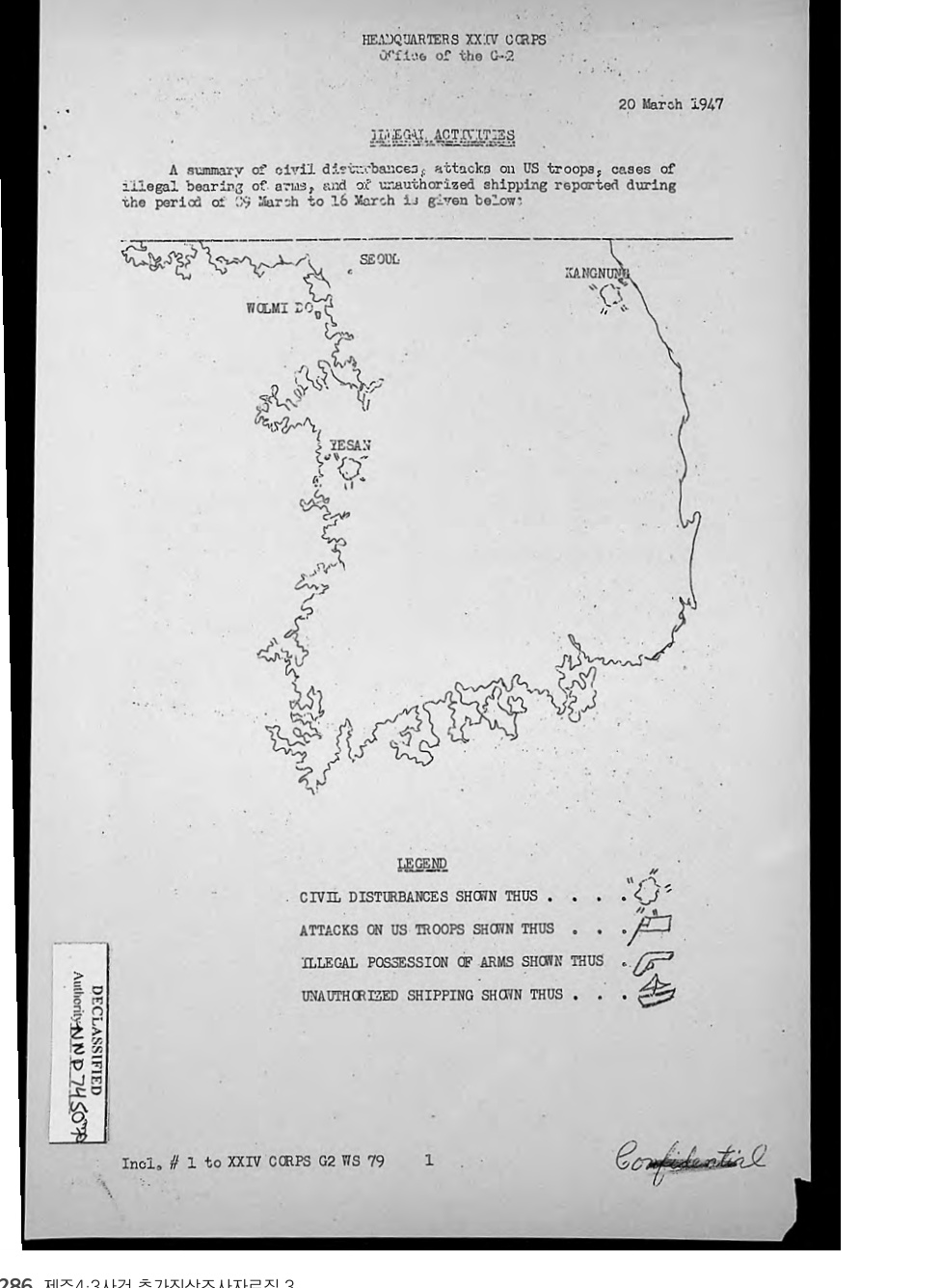
ILLEGAL ACTIVITIES
A summary of civil disturbances, attacks on US troops, cases of illegal bearing of arms, and of unauthorized shipping reported during the period of 09 March to 16 March is given below:
[MAP OF KOREA WITH FOLLOWING LABELS:]
SEOUL
KANGNUNG
WOLMI DO
YESAN
LEGEND
CIVIL DISTURBANCES SHOWN THUS . . . .
ATTACKS ON US TROOPS SHOWN THUS . . .
ILLEGAL POSSESSION OF ARMS SHOWN THUS .
UNAUTHORIZED SHIPPING SHOWN THUS . . .
DECLASSIFIED
Authority NND 74507
Incl. # 1 to XXIV CORPS G2 WS 79 1 Confidential
Confidential
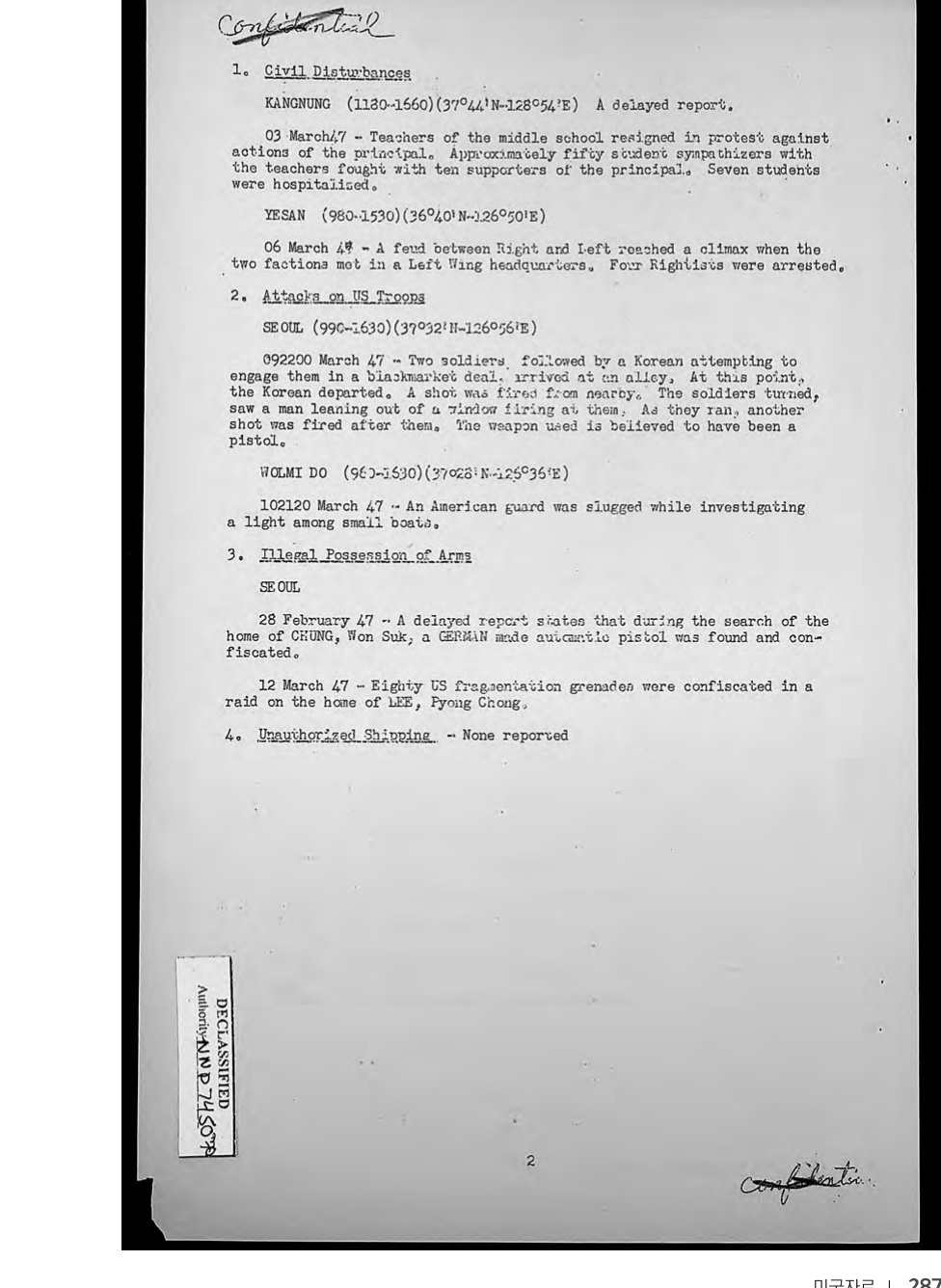
1. Civil Disturbances
KANGNUNG (1180-1660)(37°44'N-128°54'E) A delayed report.
03 March47 - Teachers of the middle school resigned in protest against actions of the principal. Approximately fifty student sympathizers with the teachers fought with ten supporters of the principal. Seven students were hospitalized.
YESAN (980-1530)(36°40'N-126°50'E)
06 March 47 - A feud between Right and Left reached a climax when the two factions met in a Left Wing headquarters. Four Rightists were arrested.
2. Attacks on US Troops
SEOUL (990-1630)(37°32'N-126°56'E)
092200 March 47 - Two soldiers, followed by a Korean attempting to engage them in a blackmarket deal, arrived at an alley. At this point, the Korean departed. A shot was fired from nearby. The soldiers turned, saw a man leaning out of a window firing at them. As they ran, another shot was fired after them. The weapon used is believed to have been a pistol.
WOLMI DO (960-1530)(27°28'N-126°36'E)
102120 March 47 - An American guard was slugged while investigating a light among small boats.
3. Illegal Possession of Arms
SEOUL
28 February 47 - A delayed report states that during the search of the home of CHUNG, Won Suk, a GERMAN made automatic pistol was found and confiscated.
12 March 47 - Eighty US fragmentation grenades were confiscated in a raid on the home of LEE, Pyong Chong.
4. Unauthorized Shipping - None reported
DECLASSIFIED
Authority NND 74[illegible]
2
Confidential
출처:
제주4·3평화재단 편,
『추가진상조사자료집-미국자료1』,
p. 274–287.
— NARA (RG 554, Entry 1256, Box 58)
×
![]()