<WEEKA> 제66호(1949. 3. 26~4. 2)
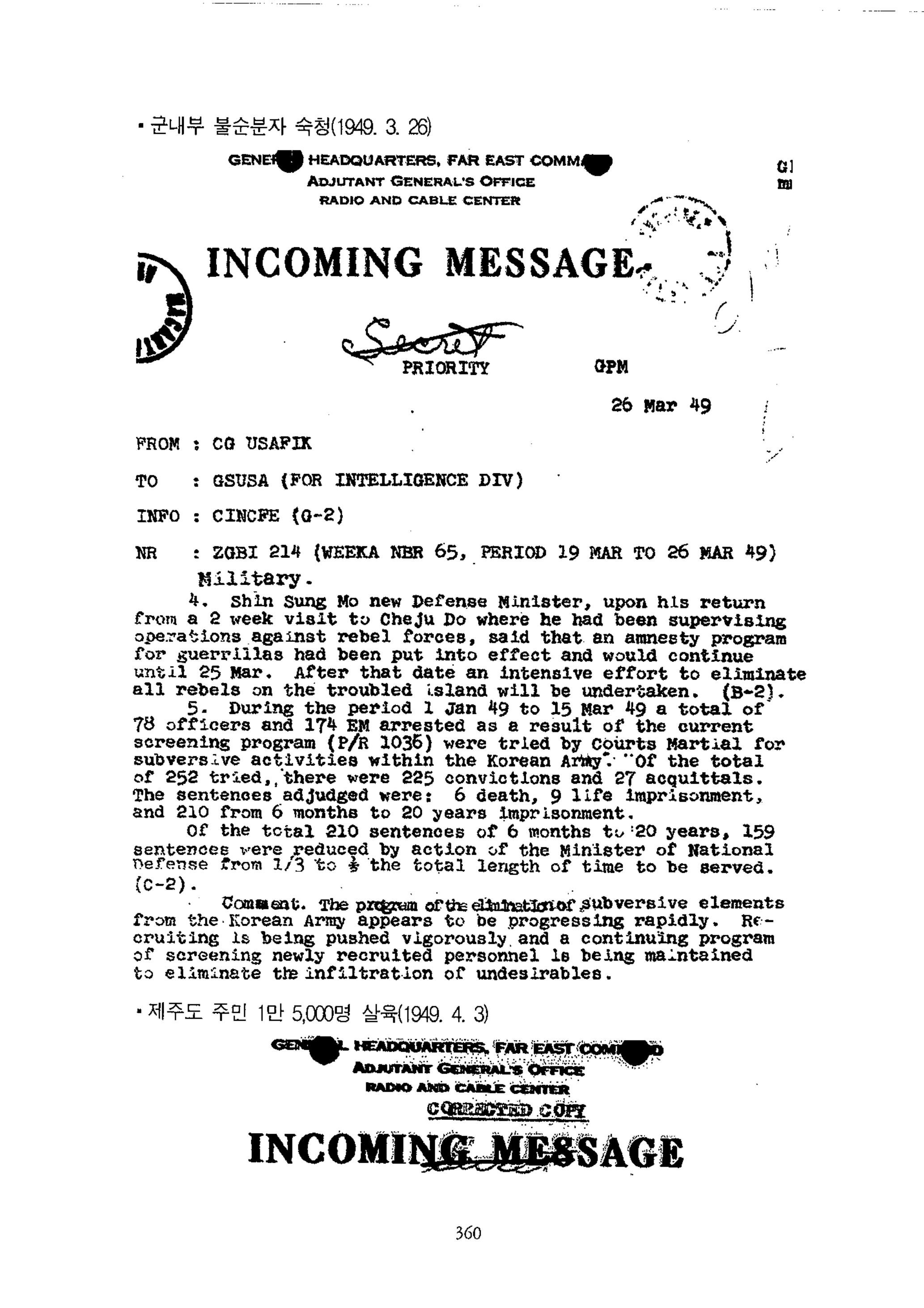
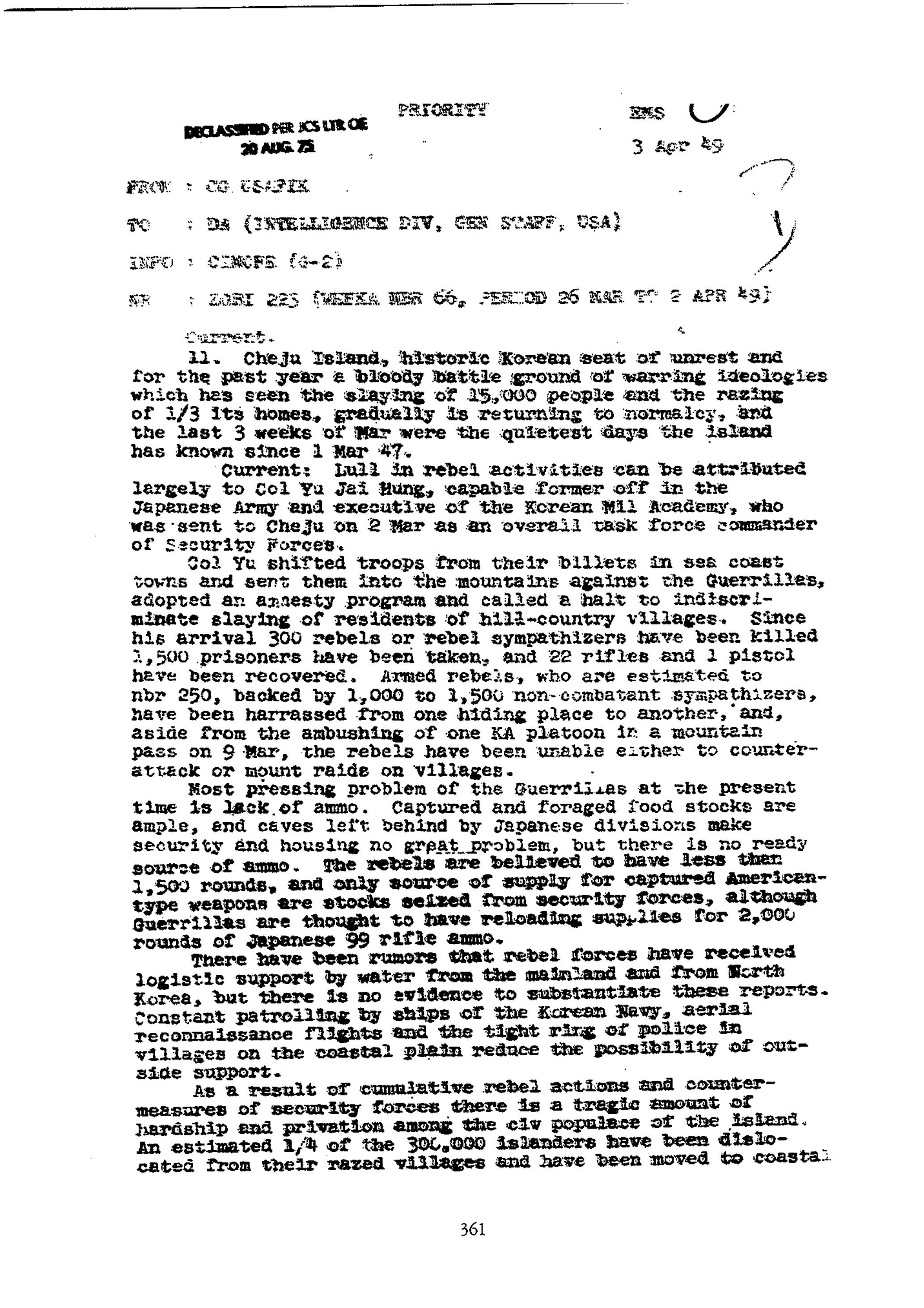
소요의 역사적 중심지이자 지난 해 동안 주민 1만 5,000명의 살육과 전체의 1/3에 해당하는 가옥의 소실을 경험했던 이념투쟁의 유혈 전쟁무대가 된 제주도는 점차 정상적인 상태로 돌아오고 있으며 3월의 지난 3주간은 1947년 3월 1일 이후에 그 섬에서 경험했던 가장 평온한 나날이었다.
현재 상황 : (제주도에서의) 반란활동의 소강상태는 이전 일본군 장교이자 한국 육군사관학교 부교장 유재흥(Yu Jai Hung) 대령의 덕택으로 돌려질 수 있다. 유대령은 3월 2일 제주도지구전투부대 사령관으로서 제주도에 파견되었다.
유재흥 대령은 해안마을에 있는 그들의 막사(숙사)로부터 부대들을 이동시켜 반군에 맞서 싸우기 위해 산악지대로 그들을 보냈다. (유재흥 대령은) 오름지역에 사는 마을 주민들에 대한 무차별적인 살육을 중지할 것을 요청했으며 사면계획을 채택했다. 정부군 부대들은 유재흥 대령이 제주도에 부임한 이후 폭도 혹은 폭도 동조자 300명을 사살했으며 1,500명을 포로로 생포했다. 또한 권총 1정과 소총 22정을 되찾았다. 1,000~1,500명의 비전투원 동조자들의 후원을 받은 약 250명으로 추정되는 무장 폭도들은 이곳 저곳의 은거지로 옮겨다니면서 괴롭힘을 당해왔다. 3월 9일 경비대 일개 소대 병사들에 대한 매복을 제외하면, 반군들은 반격을 가하거나 마을에 대한 습격을 감행할 수 없었다.
탄약의 부족은 게릴라들이 현재 지니고 있는 가장 긴급한 문제이다. 노획하고 약탈한 식량 저장량은 많았고, 일본인들이 남기고 간 동굴들은 안전을 보장해 주었으며 주거지도 큰 문제가 되지 못하였다. 그러나 준비된 탄약 자원이 없었다. 반군들은 미군 탄약 1,500발 미만을 소유하고 있다고 믿어지며 일제 99 소총 탄약 2,000발에 해당하는 비축된 충분한 공급량을 가지고 있다고 여겨지지만 그들의 미제 무기류에 대한 유일한 공급원은 대한민국의 무장된 부대들로부터 노획한 재고 탄약뿐이다.
소문은 반군부대들이 육지와 북한으로부터 바다로 병참지원을 받았다는 점을 시사해주지만 그 보고를 실증할 수 있는 증거는 없다. 한국 해군 함선에 의한 끊임없는 순찰, 공중 정찰비행, 그리고 해안마을에 대한 경찰의 빈틈없는 경계는 외부 지원의 가능성을 감소시켰다.
누적된 반군 활동과 방위군의 반격의 결과로써 제주도 민중 사이에서 대단히 비참한 고난과 상실이 있었다. 섬 거주민 30만의 1/4정도로 추정되는 인구가 그들의 파괴된 마을로부터 떠나 해안지역으로 이주했다. 식량, 의류, 그리고 의약품 재고는 적었으며 육지로부터 구제 공급을 필요로 했던 3월의 마지막 두 주간에 있어서 주목할 만한 양이 제주도에 도착하기 시작했다.
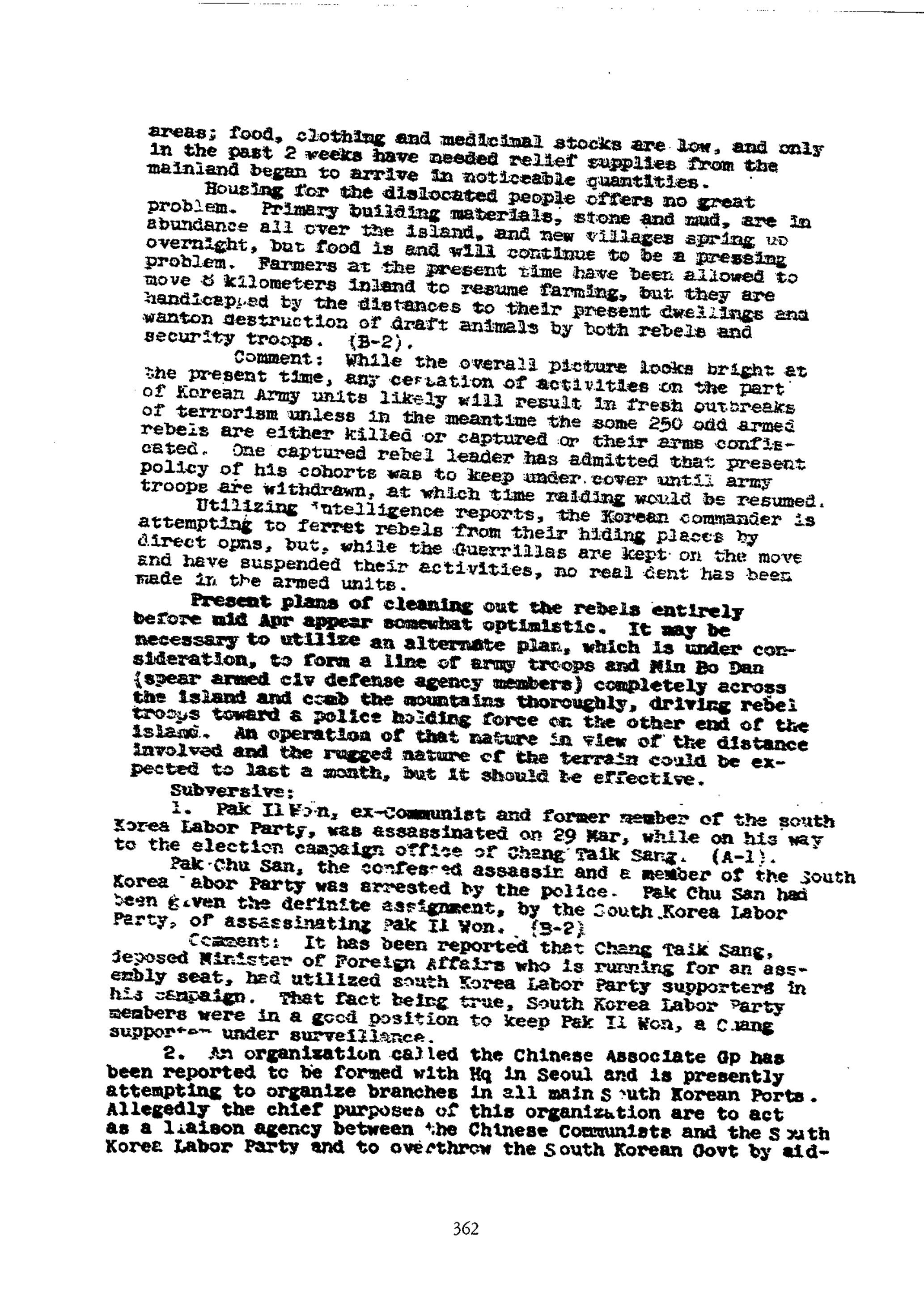
이재민들을 위한 거주문제는 큰 어려움이 없었다. 건축 재료인 돌과 진흙은 그 섬 전역에 걸쳐 풍부하게 있다. 식량 상황은 긴급한 문제이며 그러한 긴급한 식량문제는 지속될 것이다. 농부들은 농사를 다시 시작할 수 있도록 약 8킬로미터까지 내지로의 이동이 허용 받았지만, 그들은 현재 그들의 거주지까지의 거리로 인해 장애를 받았고 반군과 군대 양자에 의해 징발된 동물의 무자비한 도축에 의해서 불리한 처지에 놓여있었다. (B-2)
논평 : (제주도의)모든 면에 걸친 모습이 현재 밝게 보이지만 만일 무장한 반군 250명이 죽거나 사로잡히거나 그들의 무기가 압수되지 않은다면 한국군 부대들의 활동 중지는 아마도 새로운 테러 폭동의 결과를 낳을 것이다. 생포된 한 반군 지도자는 반군의 현재 계획은 한국군 병사들이 물러가기 전까지는 은신처에서 숨어 있다가 한국군이 물러가면 습격 활동을 재개할 것이라는 점을 인정했다.
정보 보고를 이용하여 유재흥 대령은 직접적인 작전에 의해 반군의 은신처로부터 그들을 찾으려는 시도를 계속하고 있지만 반군들은 계속 움직이고 있으며 활동을 중단해 버렸기 때문에 무장부대 내에서 실질적인 진척이 이루어지지 않고 있다.
4월 중순 이전에 반군들을 완전히 소탕하려는 현재의 계획은 다소 낙관적인 것으로 드러났다. 현재 고려중인 대체계획을 활용하는 것이 필요할 것 같은데 그 대체계획은 군대의 저지선을 형성하고 (창으로 무장한 민간인 방위 요원들인) 민보단이 완전히 섬을 가로지르면서 한라산을 철저히 수색하여 폭도들을 섬의 다른 끝에 있는 경찰점령부대 쪽으로 내모는 것이다. 작전에 포함된 거리와 그 지역(지형)의 험준한 속성의 견지에서 볼 때 그러한 종류의 작전은 한 달간 지속될 것으로 예상되지만 그 작전은 효과적일 것이다.
파괴활동:
1. 전 공산주의자이며 이전의 남로당(the South Korea Labor Party)요원이었던 박일원(Pak Il Won)이 3월 29일 장택상의 선거유세 사무소로 가는 도중에 암살되었다. (A-1)
자백한 암살자이자 남로당의 한 당원인 박주산(Pak Chu San)이 경찰에게 체포되었다. 박주산은 남로당에 의해서 박일원을 암살하라는 직접적인 지시를 받았었다. (B-2)
논평 : 국회의원에 출마하기 위해 사직한 전 외무부 장관인 장택상이 그의 선거 유세에 남로당 후원자들을 이용하였다는 사실이 보고되었다. 그러한 사실이 실제인 것으로 나타나자 남로당 요원들은 장택상의 지지자인 박일원을 계속해서 감시할 수 있는 좋은 상황에 처해 있었다.
2. 중국인 연합단체(the Chinese Associate Group)로 불렸던 한 단체가 서울에 본부를 창립하여 남한의 모든 주요 항구에 지부를 조직하는 것을 시도하고 있는 것으로 보고되었다. 전하는 바에 의하면 이 단체의 주요 목적은 중국 공산주의자들과 남로당 사이의 연락 기관으로써 행동하는 것이며 가능한 모든 방법으로 남한에 있는 반란 조직을 지원함으로써 남한 정부를 전복시키는 것이다. (C-3)
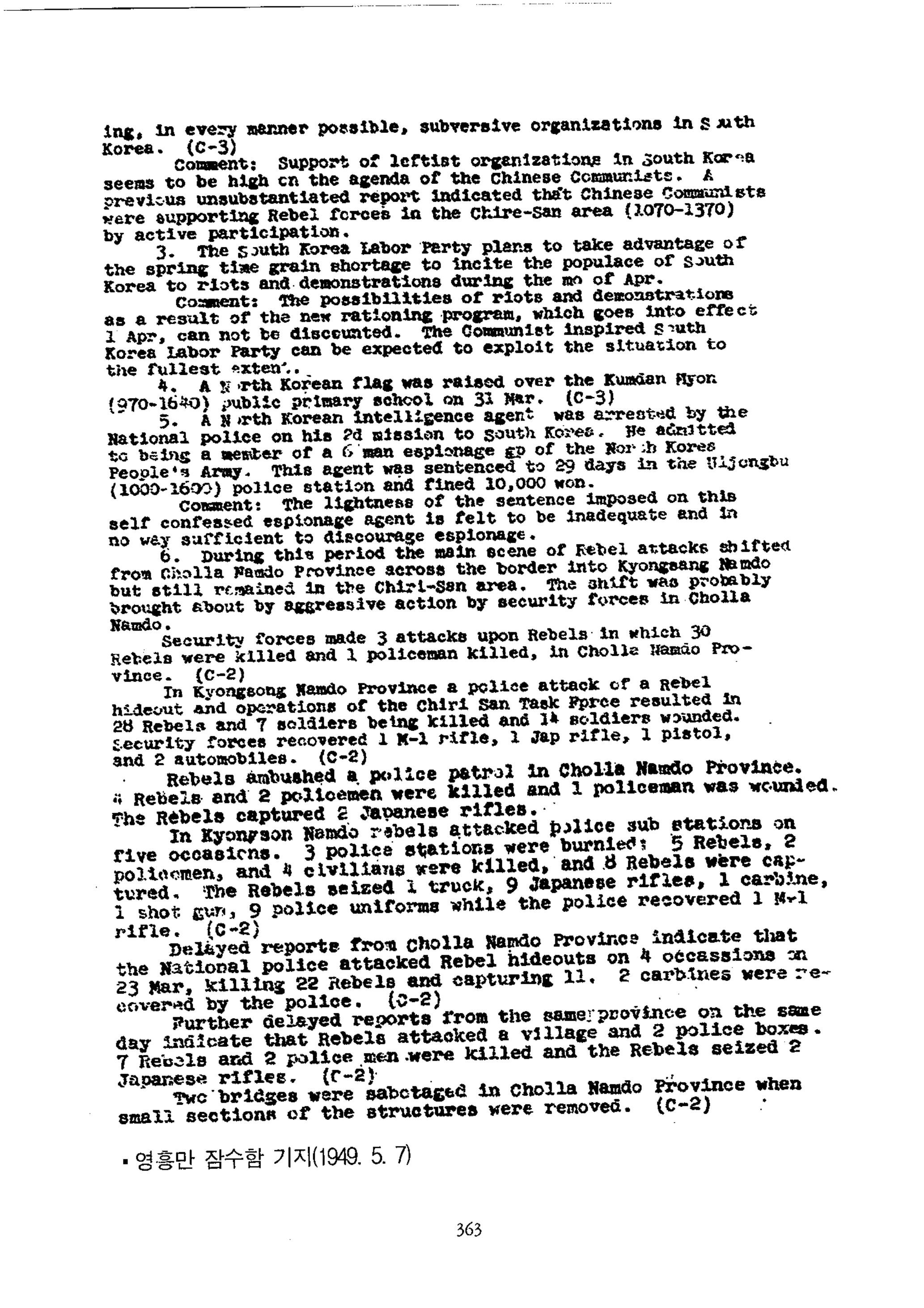
논평 : 남한에 있는 좌익 단체들에 대한 지원은 중국 공산주의자들의 회의 사항(의결 사항)에서 중요하게 나타난 것으로 보인다. 이전의 한 실증되지 않은 보고는 중국 공산주의자들이 적극적으로 동참하여 지리산(좌표 1070-1370) 지역에 있는 반군 부대들을 지원하고 있었다는 사실을 시사해준다.
3. 남로당은 4월 동안에 남한의 민중이 폭동을 일으키고 시위를 하도록 선동하기 위해 ‘보릿고개’(the spring time grain shortage)의 이점을 취할 계획을 세우고 있다.
논평 : 4월 1일에 발효될 새로운 배급계획의 결과로써 폭동과 시위의 가능성은 도외시될 수 없다. 남로당에게 사주받은 공산주의자가 최대한 그 상황을 이용할 것으로 예상해 볼 수 있다.
4. 북한 국기가 3월 31일 금단면(Kumdan Myon 970-1600)의 초등학교에서 게양되었다. (C-3)
5. 한 북한 첩보원이 남한에서 2번째 임무를 수행하던 도중 국립 경찰에게 체포되었다. 그는 북한 인민군의 6명으로 구성된 간첩단의 일원이었음을 시인했다. 이 간첩은 의정부(Uijongbu, 좌표 1000-1600) 경찰서에 29일간 감금형을 받았고 10,000원의 벌금을 물었다.
논평 : 간첩요원임을 자백했던 이 사람에 대해 부과된 경미한 형(선고)은 부적당하며 간첩행위를 무력화 시키기에는 충분한 방도가 아니라고 생각된다.
6. 이 시기 동안에 반군 습격의 주무대는 도 경계선을 가로질러 전라남도로부터 경상남도로 옮겨졌지만 아직까지도 지리산 지역에 남아 있다. 그 이동은 아마 전라남도에 있는 방위군에 의한 적극적인 공세에 의해서 초래된 것이다.
전라남도 지방에서 방위군이 반군들에게 3차례 공격을 감행하여 반군 30명이 사망했고 경찰관 1명이 사망했다. (C-2)
경상남도에서 반군 은신처에 대한 경찰의 1차례 공격과 지리산 기동부대의 작전은 반군 28명과 국군 병사 7명이 사망하고 국군 병사 14명이 부상당하는 결과를 가져왔다. 방위군은 M-1소총 1정, 일제 소총 1정, 권총 1정과 차량 2대를 회수하였다. (C-2)
반군들이 전라남도 지방에서 한 경찰 정찰대(경비대)를 매복하여 반군 4명과 경찰관 2명이 사망했고 경찰관 1명이 부상당했다.
경상남도에서 반군들이 5곳의 경찰 지서를 습격하여 3군데의 경찰 지서가 불에 탔다; 반군 5명, 경찰관 2명과 민간인 4명이 사망했으며 반군 8명이 생포되었다. 반군들은 트럭 1대, 일제 소총 9정, 칼빈 소총 1정, 엽총 1정, 경찰관 제복 9벌을 노획한 반면 경찰은 M-1소총 1정을 회수했다. (C-2)
전라남도 지방으로부터 올라온 추후보고는 국립 경찰이 3월 23일에 4곳의 반군 은신처를 습격해서 반군 22명을 죽이고 11명을 생포했다는 것을 시사해준다. 칼빈 소총 2정이 경찰에게 회수되었다. (C-2)
더욱이 같은 날에 같은 도(전라남도)에서 올라온 추후보고는 반군들이 한 마을과 2곳의 경찰 초소를 공격하여 반군 7명과 경찰관 2명이 사망했으며 반군들이 일제 소총 2정을 노획했음을 알려준다. (C-2)
다리의 작은 부분이 제거되면서 두 개의 교량이 전라남도에서 사보타지 행위에 의해 파손되었다. (C-2)
GENERAL HEADQUARTERS, FAR EAST COMMAND
ADJUTANT GENERAL'S OFFICE
RADIO AND CABLE CENTER
CORRECTED COPY
INCOMING MESSAGE
PRIORITY
DECLASSIFIED PER XCS UR CE
20 AUG 75
EMS U:
3 Apr 49
FROM : CG USAFIK
TO : D4 (INTELLIGENCE DIV, GEN STAFF, USA)
INFO : CINCFE (G-2)
NR : ZOSRI 225 [illegible] WER 66, PERIOD 26 MAR TO 2 APR 49)
Current.
11. Cheju Island, historic Korean seat of unrest and for the past year a bloody battle ground of warring ideologies which has seen the slaying of 15,000 people and the razing of 1/3 its homes, gradually is returning to normalcy, and the last 3 weeks of Mar were the quietest days the island has known since 1 Mar 47.
Current: Lull in rebel activities can be attributed largely to Col Yu Jai Hung, capable former off in the Japanese Army and executive of the Korean Mil Academy, who was sent to Cheju on 2 Mar as an overall task force commander of Security Forces.
Col Yu shifted troops from their billets in sea coast towns and sent them into the mountains against the Guerrillas, adopted an amnesty program and called a halt to indiscriminate slaying of residents of hill-country villages. Since his arrival 300 rebels or rebel sympathizers have been killed 1,500 prisoners have been taken, and 22 rifles and 1 pistol have been recovered. Armed rebels, who are estimated to nbr 250, backed by 1,000 to 1,500 non-combatant sympathizers, have been harrassed from one hiding place to another, and, aside from the ambushing of one KA platoon in a mountain pass on 9 Mar, the rebels have been unable either to counterattack or mount raids on villages.
Most pressing problem of the Guerrillas at the present time is lack of ammo. Captured and foraged food stocks are ample, and caves left behind by Japanese divisions make security and housing no great problem, but there is no ready source of ammo. The rebels are believed to have less then 1,500 rounds, and only source of supply for captured American-type weapons are stocks seized from security forces, although Guerrillas are thought to have reloading supplies for 2,000 rounds of Japanese 99 rifle ammo.
There have been rumors that rebel forces have received logistic support by water from the mainland and from North Korea, but there is no evidence to substantiate these reports. Constant patrolling by ships of the Korean Navy, aerial reconnaissance flights and the tight ring of police in villages on the coastal plain reduce the possibility of outside support.
As a result of cumulative rebel actions and countermeasures of security forces there is a tragic amount of hardship and privation among the civ populace of the island. An estimated 1/4 of the 300,000 islanders have been dislocated from their razed villages and have been moved to coastal
areas; food, clothing and medicinal stocks are low, and only in the past 2 weeks have needed relief supplies from the mainland began to arrive in noticeable quantities.
Housing for the dislocated people offers no great problem. Primary building materials, stone and mud, are in abundance all over the island, and new villages spring up overnight, but food is and will continue to be a pressing problem. Farmers at the present time have been allowed to move 6 kilometers inland to resume farming, but they are handicapped by the distances to their present dwellings and wanton destruction of draft animals by both rebels and security troops. (B-2).
Comment: While the overall picture looks bright at the present time, any certation of activities on the part of Korean Army units likely will result in fresh outbreaks of terrorism unless in the meantime the some 250 odd armed rebels are either killed or captured or their arms confiscated. One captured rebel leader has admitted that present policy of his cohorts was to keep under cover until army troops are withdrawn, at which time raiding would be resumed.
Utilizing intelligence reports, the Korean commander is attempting to ferret rebels from their hiding places by direct opns, but, while the guerrillas are kept on the move and have suspended their activities, no real dent has been made in the armed units.
**Present plans of cleaning out the rebels entirely before mid Apr appear somewhat optimistic. It may be necessary to utilize an alternate plan, which is under consideration, to form a line of army troops and Min Bo Dan (spear armed civ defense agency members) completely across the island and comb the mountains thoroughly, driving rebel troops toward a police holding force on the other end of the island. An operation of that nature in view of the distance involved and the rugged nature of the terrain could be expected to last a month, but it should be effective.**
Subversive:
1. Pak Il Won, ex-Communist and former member of the south Korea Labor Party, was assassinated on 29 Mar, while on his way to the election campaign office of Chang Talk Sang. (A-1).
Pak Chu San, the confessed assassir and a member of the South Korea Labor Party was arrested by the police. Pak Chu San had been given the definite assignment, by the South Korea Labor Party, of assassinating Pak Il Won. (B-2)
Comment: It has been reported that Chang Talk Sang, deposed Minister of Foreign Affairs who is running for an assembly seat, had utilized south Korea Labor Party supporters in his campaign. That fact being true, South Korea Labor Party members were in a good position to keep Pak Il Won, a C.ung supporter under surveillance.
2. An organization called the Chinese Associate Op has been reported to be formed with Hq in Seoul and is presently attempting to organize branches in all main S outh Korean Ports. Allegedly the chief purposes of this organization are to act as a liaison agency between the Chinese Communists and the S uth Korea Labor Party and to overthrow the South Korean Govt by aid-
ing, in every manner possible, subversive organizations in s uth Korea. (C-3)
Comment: Support of leftist organizations in South Korea seems to be high on the agenda of the Chinese Communists. A previous unsubstantiated report indicated that Chinese Communists were supporting Rebel forces in the Chire-San area (1070-1370) by active participation.
3. The South Korea Labor Party plans to take advantage of the spring time grain shortage to incite the populace of South Korea to riots and demonstrations during the mo of Apr.
Comment: The possibilities of riots and demonstrations as a result of the new rationing program, which goes into effect 1 Apr, can not be discounted. The Communist inspired South Korea Labor Party can be expected to exploit the situation to the fullest exten.
4. A N rth Korean flag was raised over the Kumdan Myon (970-1640) public primary school on 31 Mar. (C-3)
5. A N rth Korean intelligence agent was arrested by the National police on his 2d mission to South Korea. He admitted to being a member of a 6 man espionage gp of the Nor h Korea People's Army. This agent was sentenced to 29 days in the Uijongbu (1009-1690) police station and fined 10,000 won.
Comment: The lightness of the sentence imposed on this self confessed espionage agent is felt to be inadequate and in no way sufficient to discourage espionage.
6. During this period the main scene of Rebel attacks shifted from Cholla Namdo Province across the border into Kyongsang Namdo but still remained in the Chiri-San area. The shift was probably brought about by aggressive action by security forces in Cholla Namdo.
Security forces made 3 attacks upon Rebels in which 30 Rebels were killed and 1 policeman killed, in Cholla Namdo Province. (C-2)
In Kyongsong Namdo Province a police attack of a Rebel hideout and operations of the Chiri San Task Fprce resulted in 28 Rebels and 7 soldiers being killed and 14 soldiers wounded. Security forces recovered 1 M-1 rifle, 1 Jap rifle, 1 pistol, and 2 automobiles. (C-2)
Rebels ambushed a police patrol in Cholla Namdo Province. 4 Rebels and 2 policemen were killed and 1 policeman was wounded. The Rebels captured 2 Japanese rifles.
In Kyongyson Namdo rebels attacked police sub stations on five occasions. 3 police stations were burned; 5 Rebels, 2 policemen, and 4 civilians were killed, and 8 Rebels were captured. The Rebels seized 1 truck, 9 Japanese rifles, 1 carbine, 1 shot gun, 9 police uniforms while the police recovered 1 M-1 rifle. (C-2)
Delayed reports from Cholla Namdo Province indicate that the National police attacked Rebel hideouts on 4 occassions on 23 Mar, killing 22 Rebels and capturing 11. 2 carbines were recovered by the police. (C-2)
Further delayed reports from the same province on the same day indicate that Rebels attacked a village and 2 police boxes. 7 Rebels and 2 police men were killed and the Rebels seized 2 Japanese rifles. (C-2)
Two bridges were sabotaged in Cholla Namdo Province when small sections of the structures were removed. (C-2)
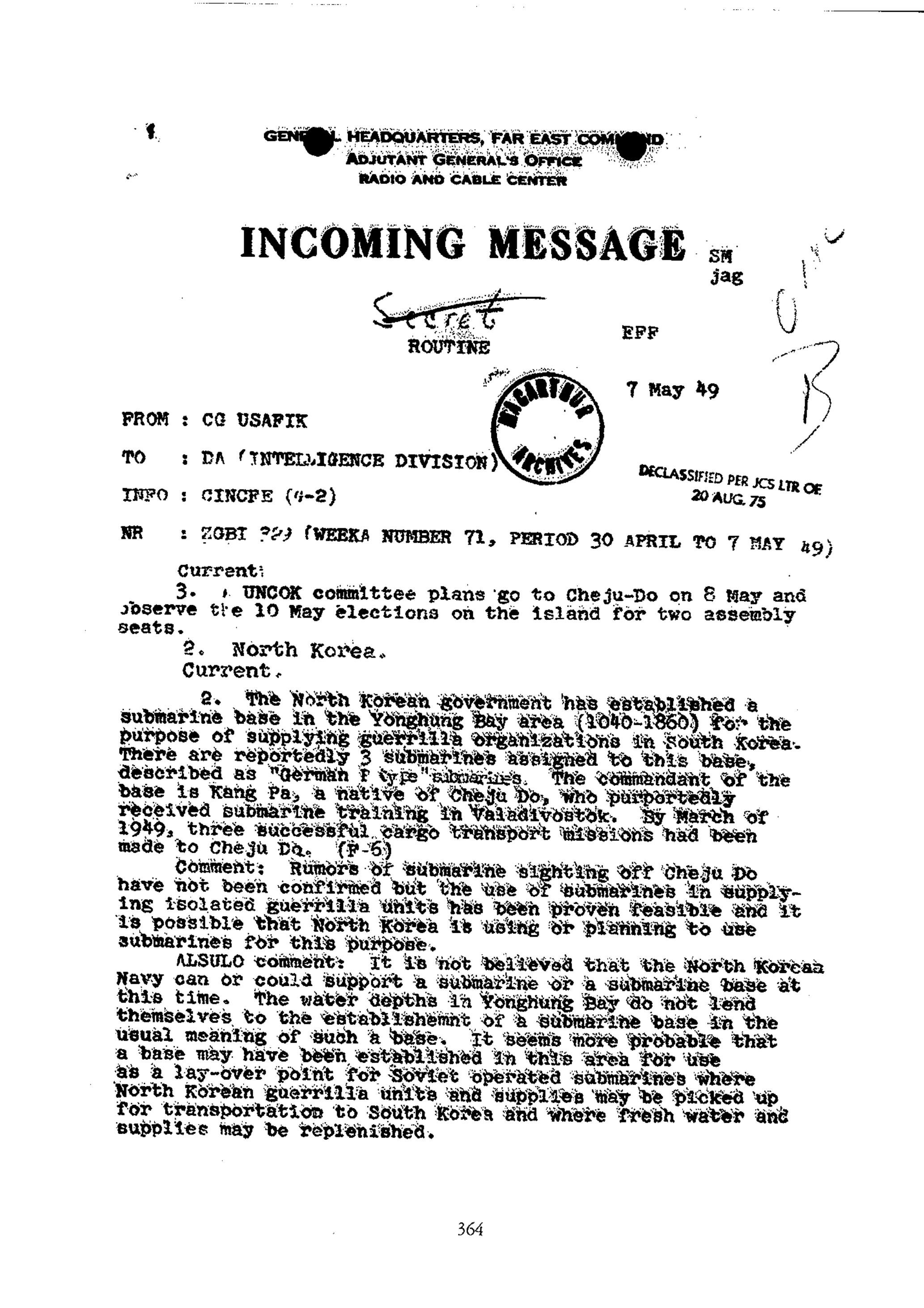
. 영홍만 잡수함 기지(1949. 5. 7)
GENERAL HEADQUARTERS, FAR EAST COMMAND
ADJUTANT GENERAL'S OFFICE
RADIO AND CABLE CENTER
INCOMING MESSAGE
SECRET
ROUTINE
SM
jag
EPF
7 May 49
FROM : CG USAFIK
TO : DA (INTELLIGENCE DIVISION)
INFO : CINCFE (G-2)
NR : ZGBI ?9) (WEEKA NUMBER 71, PERIOD 30 APRIL TO 7 MAY 49)
DECLASSIFIED PER JCS LTR OF
20 AUG. 75
Current:
3. . UNCOK committee plans go to Cheju-Do on 8 May and observe the 10 May elections on the island for two assembly seats.
2. North Korea.
Current.
2. The North Korean government has established a submarine base in the Yonghung Bay area (1040-1860) for the purpose of supplying guerrilla organizations in South Korea. There are reportedly 3 submarines assigned to this base, described as "German F type"submarines. The commandant of the base is Kang Pa, a native of Cheju Do, who purportedly received submarine training in Vladivostok. By March of 1949, three successful cargo transport missions had been made to Cheju Do. (F-6)
Comment: Rumors of submarine sighting off Cheju Do have not been confirmed but the use of submarines in supplying isolated guerrilla units has been proven feasible and it is possible that North Korea is using or planning to use submarines for this purpose.
ALSULO comment: It is not believed that the North Korean Navy can or could support a submarine or a submarine base at this time. The water depths in Yonghung Bay do not lend themselves to the establishment of a submarine base in the usual meaning of such a base. It seems more probable that a base may have been established in this area for use as a lay-over point for Soviet operated submarines where North Korean guerrilla units and supplies may be picked up for transportation to South Korea and where fresh water and supplies may be replenished.
출처:
제주4·3사건진상규명및희생자명예회복위원회 편,
『제주4·3사건자료집 10』 [미국자료편],
번역문 p.170
/ 원문 p.360–364 / No. 66.
×
![]()