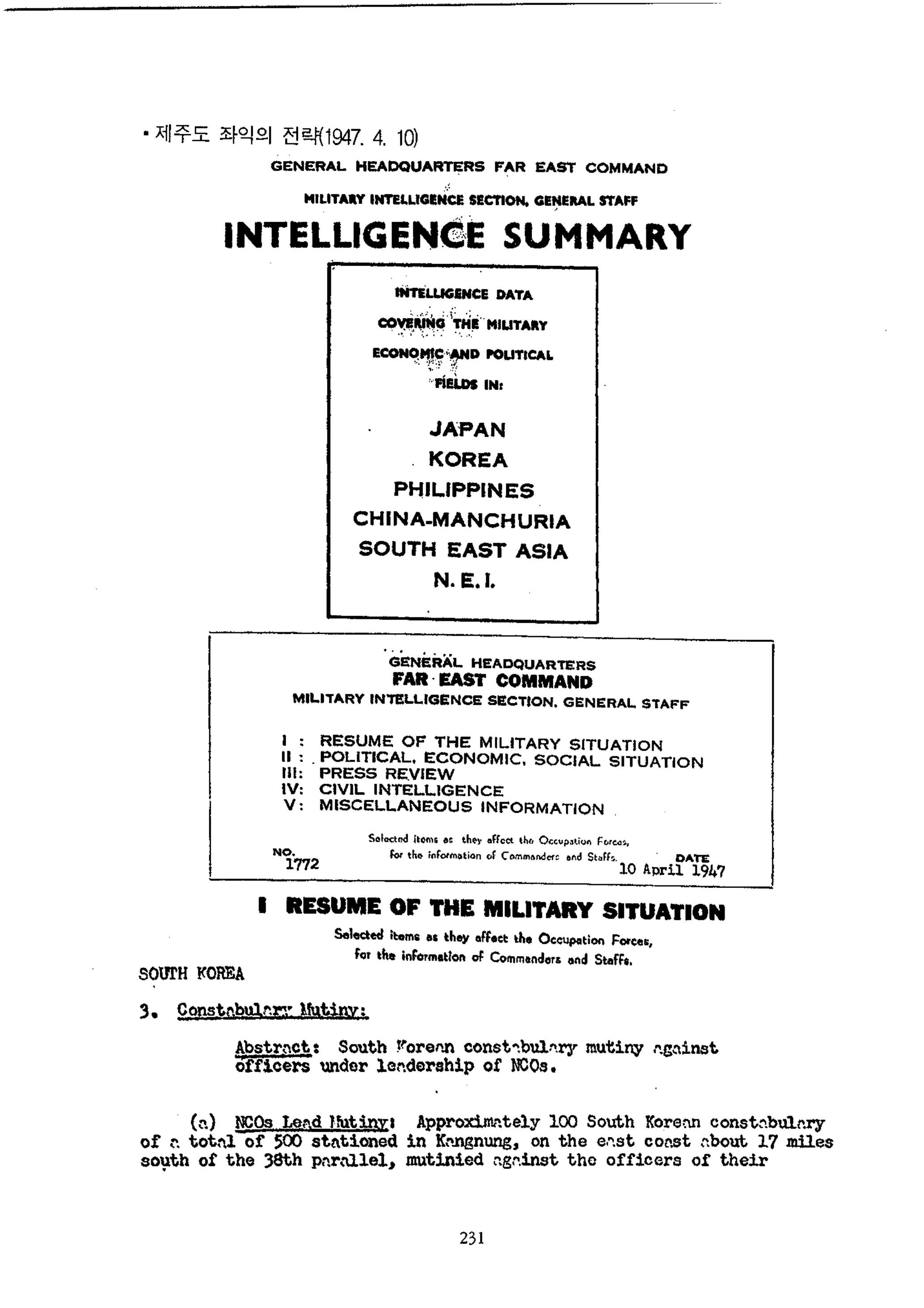
(정보요약 제1772호)
I. 군사상황 요약
남한
3. 국방경비대 반란:
요약: 남한 국방경비대 하사관들의 지도아래 장교에 대항하여 반란
(a) 하사관들이 이끈 반란: 강릉에 주둔한 500명의 국방경비대 가운데, 약 100여명이 하사관의 주도하에 1947년 4월 5일 오후 10시 30분 장교들에 대항하여 반란을 일으켰다. 미군 2개 소대와 한국 민정경찰이 6일 오후 1시 30분까지 진압했으나 반란자 중 34명은 아직도 소총과 무기를 소지한 채 활동중이다. 미군이 보호하고 있는 반란자들을 조사중이다. 진압과정에서 11명이 부상당하였으며 사상자는 아직 알려진 바 없다.
논평: 폭동의 원인은 현재 알려진 바 없다. 사건의 배경에 관한 자세한 사항은 아직 모른다. (중략)
II. 정치, 경제, 사회적 상황
남한
2. 시민소요(Civil Disturbances):
요약: 경찰에 대항하여 좌익이 사주한 군중행동이 증가 추세에 있다. 남한에서 공산주의 전술은 전복행위로 요약된다. 최근의 사건들은 폭력을 동반하고 있다.
(a) 시민소요에 있어서 좌익의 전략: 3월 후반부의 추세는 약 30만명에 이르는 인구 중 60~70%가 좌익을 지지하고 있다고 알려진 제주도에서 발생한 공산주의자들이 선동한 소요를 제외하고는 그 성격이 분명치 않다.
제주도에서 최근의 소요는 자신의 전술을 펼치기에 유리한 상황이 전개되면 좌익이 남한 본토에서 어떻게 행동할 것인지를 시사하는 바가 크다. 좌익의 술책은, (1) 지역의 불만세력을 지렛대로 이용한 대중 선동, (2) 법 집행기관을 손상시켜 혼란 조성 (3) 폭력과 테러를 결합한 광범위한 파업을 통한 경제 마비를 겨냥(제주도에서 사용된 방법) (4) 중앙의 뉴스 매체를 이용하여 이러한 활동에서 좌익의 성공을 대중에게 알려 대중들로 하여금 봉기하여 ‘반동’의 억압 굴레를 벗어 던져버릴 것을 강력히 권장하는 것 등이다. 이 마지막 술책은 제주도 소요에서 사용되었다. 이에 대해서 좌익의 기관지『독립신보』는 “제주도의 총파업은 남한에서 민주주의 운동의 역사에 깊은 의미를 지닌다. 왜냐하면, 제주도는 명백히 경찰의 행위와 경찰과 손잡고 민주주의의 성장을 억압하려는 반동 집단의 영향에 대항하였기 때문이다.”
경찰에 대항하는 좌익테러의 부활 조짐은 경찰에 대한 군중들이 일으킨 사건 수가 이 기간 동안 증가일로에 있음을 볼 때 분명하다.
(b) 소요 목록:
(1) 제주도 3월 19일: 약 천여명의 군중들이 제주도 북동(남서의 오기인 듯: 역주) 해안에 위치한 중문형무소(중문지서의 오기인 듯: 역주)로 접근하여 죄수의 석방을 요구했다. 군중들은 곤봉과 돌로 무장되어 있었다. 폭도들이 돌을 던지고 형무소(지서: 역주)로 달려들자 경찰은 이 폭도들을 향해 발포하여 부상자 4명을 발생시켰다. (후략)
GENERAL HEADQUARTERS FAR EAST COMMAND
MILITARY INTELLIGENCE SECTION, GENERAL STAFF
# INTELLIGENCE SUMMARY
INTELLIGENCE DATA
COVERING THE MILITARY
ECONOMIC AND POLITICAL
FIELDS IN:
JAPAN
KOREA
PHILIPPINES
CHINA-MANCHURIA
SOUTH EAST ASIA
N. E. I.
GENERAL HEADQUARTERS
FAR EAST COMMAND
MILITARY INTELLIGENCE SECTION, GENERAL STAFF
I : RESUME OF THE MILITARY SITUATION
II : POLITICAL, ECONOMIC, SOCIAL SITUATION
III: PRESS REVIEW
IV: CIVIL INTELLIGENCE
V : MISCELLANEOUS INFORMATION
Selected items as they affect the Occupation Forces,
for the information of Commanders and Staffs.
NO. 1772 DATE 10 April 1947
## I RESUME OF THE MILITARY SITUATION
Selected items as they affect the Occupation Forces,
for the information of Commanders and Staffs.
SOUTH KOREA
3. Constabulary Mutiny:
Abstract: South Korean constabulary mutiny against officers under leadership of NCOs.
(a) NCOs Lead Mutiny: Approximately 100 South Korean constabulary of a total of 500 stationed in Kangnung, on the east coast about 17 miles south of the 38th parallel, mutinied against the officers of their
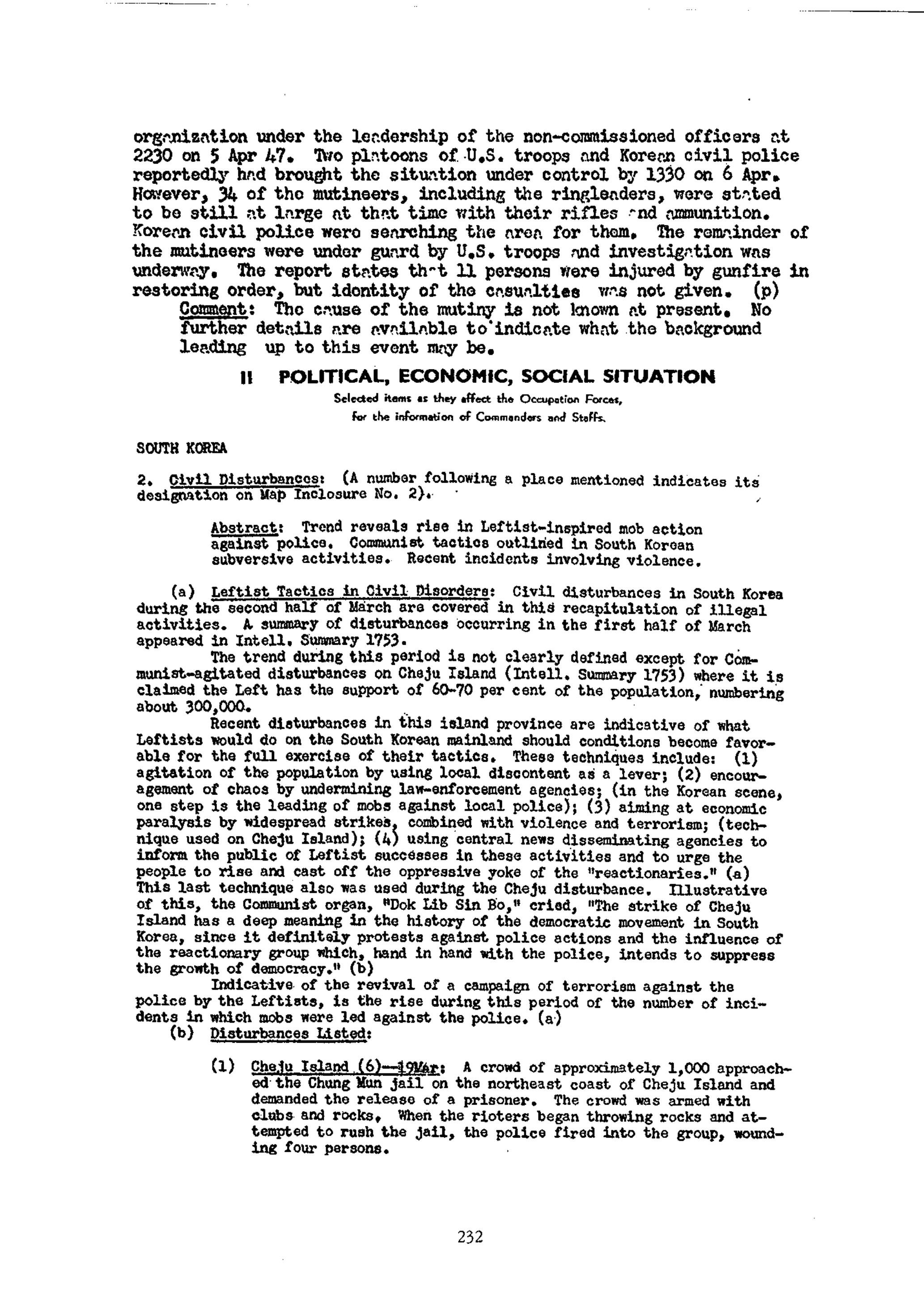
organization under the leadership of the non-commissioned officers at 2230 on 5 Apr 47. Two platoons of U.S. troops and Korean civil police reportedly had brought the situation under control by 1330 on 6 Apr. However, 34 of the mutineers, including the ringleaders, were stated to be still at large at that time with their rifles and ammunition. Korean civil police were searching the area for them. The remainder of the mutineers were under guard by U.S. troops and investigation was underway. The report states that 11 persons were injured by gunfire in restoring order, but identity of the casualties was not given. (p) Comment: The cause of the mutiny is not known at present. No further details are available to indicate what the background leading up to this event may be.
II POLITICAL, ECONOMIC, SOCIAL SITUATION
Selected Items as they affect the Occupation Forces, for the information of Commanders and Staffs.
SOUTH KOREA
2. Civil Disturbances: (A number following a place mentioned indicates its designation on Map Inclosure No. 2).
Abstract: Trend reveals rise in Leftist-inspired mob action against police. Communist tactics outlined in South Korean subversive activities. Recent incidents involving violence.
(a) Leftist Tactics in Civil Disorders: Civil disturbances in South Korea during the second half of March are covered in this recapitulation of illegal activities. A summary of disturbances occurring in the first half of March appeared in Intell. Summary 1753.
The trend during this period is not clearly defined except for Communist-agitated disturbances on Cheju Island (Intell. Summary 1753) where it is claimed the Left has the support of 60-70 per cent of the population, numbering about 300,000.
Recent disturbances in this island province are indicative of what Leftists would do on the South Korean mainland should conditions become favorable for the full exercise of their tactics. These techniques include: (1) agitation of the population by using local discontent as a lever; (2) encouragement of chaos by undermining law-enforcement agencies; (in the Korean scene, one step is the leading of mobs against local police); (3) aiming at economic paralysis by widespread strikes, combined with violence and terrorism; (technique used on Cheju Island); (4) using central news disseminating agencies to inform the public of Leftist successes in these activities and to urge the people to rise and cast off the oppressive yoke of the "reactionaries." (a) This last technique also was used during the Cheju disturbance. Illustrative of this, the Communist organ, "Dok Lib Sin Bo," cried, "The strike of Cheju Island has a deep meaning in the history of the democratic movement in South Korea, since it definitely protests against police actions and the influence of the reactionary group which, hand in hand with the police, intends to suppress the growth of democracy." (b)
Indicative of the revival of a campaign of terrorism against the police by the Leftists, is the rise during this period of the number of incidents in which mobs were led against the police. (a)
(b) Disturbances Listed:
(1) Cheju Island (6)--19Mar: A crowd of approximately 1,000 approached the Chung Mun jail on the northeast coast of Cheju Island and demanded the release of a prisoner. The crowd was armed with clubs and rocks. When the rioters began throwing rocks and attempted to rush the jail, the police fired into the group, wounding four persons.
출처:
제주4·3사건진상규명및희생자명예회복위원회 편,
『제주4·3사건자료집 10』 [미국자료편],
번역문 p.27
/ 원문 p.231–232 / No. 1772.
×
![]()