스캔 원본
100%
p.311
p.312
p.313
p.314
p.315
p.316
p.317
p.318
p.319
p.320
p.321
p.322
p.323
정보참모부 주간요약보고
기간: 3월 16일~3월 23일
주한미육군사령부
서울, 조선
1947년 3월 27일 제80호
4. 대민관계
a. 언론 이번 기간 동안 언론의 관심을 끌 만한 몇몇 소식이 있었다. 여기에는 조선인에 관한 또는 조선인의 관심을 끌 만한 국내외 언론이 모두 포함된다. 국내 언론으로 는, 경무부장 조 박사의 제주도 총파업 조사결과, 여운형의 자택에 대한 폭탄 테 러, 범아시아회의에 참석하는 조선인 대표자 3명의 출국, 3월 18일에 있었던 조 선인 경찰의 러시아 군인 총격(5항 참고)이 보도됐고, 보고 기간이 끝날 때쯤에는 철도 및 공공시설의 24시간 파업이 신문을 장식했다.
b. 인민
(1) 총파업
1947년 3월 21일 오후 9시, 부산 철도기지 기관사들의 파업과 함께 시작된 총 파업은 남조선의 산업, 통신, 철도, 정부 및 해양 사업의 몇몇 방면에서 다양한 수 준의 차질을 빚어냈다. 조선노동조합전국평의회(전평)에 의해 비밀리에 계획되고 시작된 이번 파업은 발생 후 15시간 만에 전라도의 6개 주요 도시로 확대됐다.14 이후 파업은 서울, 대구, 인천과 몇몇 소규모 지역으로 퍼져나갔다. 파업과 관련 해 소요가 없지는 않았으나, 그 규모가 크지는 않았다. 보고된 사망자는 11명이 고, 인원 미상의 사람들이 부상당했다.(소요와 관련해서는 첨부문서 1번 참고. 사건 경과표는 첨부문서 2번 참고.)
사전에 준비된 것이 명백한 최후통첩이 파업이 초기 단계를 지날 때까지 따로 남겨져 있다가, 3월 22일 아침 주한미육군 사령관에게 넘겨졌다. 전평의 조직가 겸 선동가인 현훈(허헌과는 다른 인물)이 서명한 최후통첩에는 다음과 같은 요구 사항이 제시돼 있었다.
(a) 과거에 감축되거나 해고됐던 사람들을 기존의 업무로 복귀시킬 것, 직장 폐 쇄·실업·인원 감축에 대한 반대.
(b) 물가상승에 맞춘 임금 상승.(이들은 노동자의 최저월급으로 8,000엔을 요 구하는데, 이는 터무니없이 높은 수치다.)
(c) 육체노동자와 사무직 노동자에게 날마다 쌀 4홉을 제공. "일반인"들에겐 3 홉을 제공.
(d) 대한독립촉성노동총연맹·조선건국청년회·대한민주청년동맹·대한독립촉성 전국청년총연맹의 해체. 이 단체들의 지도자 처벌.(이 단체들은 좌파들에 의해 테 러 혐의로 고발당한 상태다.)
(e) 군정과 경찰 조직 내 불량 인사들의 면직과 처벌.(여기에는 친일파, 부당이 득취득자, 압제자가 포함된다.)
(f) 파업, 시위, 포스터 게시, 집회 참석을 이유로 투옥된 사람들을 석방하고 본 업에 복귀시킬 것.
(g) 전평의 위원장 허성택, 부위원장 박세영, 서기 이면포(LEE, Myun Po)의 석 방, 박헌영에 대한 구속영장 철회.
(h) 노동조합운동의 완전한 자유 즉시 보장.
최후통첩에 따르면, 남조선 노동 인민은 직접 행동을 통해 위의 요구사항들을 관철하려고 24시간 파업을 감행했다고 한다.
최후통첩은 만약 파업 전후로 억압 조치가 취해지거나 박해가 발생한다면 폭력과 장기파업으로 대응할 것이라 위협과 함께 결론을 맺고 있다. 거만하게도 문건의 저자는 이런 대응의 결과에 대한 책임을 주한미육군 사령관에 돌리며 다음과 같이 끝난다. "… 그리고 이 비망록을 읽으며 과거에 사건을 덮을 때 그랬던 것처럼 '몇몇 부분의 선동에 의해' 또는 '… 을 고려할 여유가 없다'와 같은 말이 나오지 않길 바란다."
논평: 위의 모호한 인용은 10월 폭동 이후 주한미육군 사령관이 발표한 대언론성명을 향한 것인 듯하다. 당시 몇몇 보도자료는 정직하고 애국적인 조선인들이악랄한 선동가들에 의해 잘못된 행동으로 오도됐다고, 즉 결과를 미리 냉철하게고려했다면 연루되지 않았을 행동에 연루됐다고 기술했었다.
미군 사령부에 의해 취해진 조치는 조선인들로 하여금 자신들의 문제를 스스로처리하게 하려는 현 정책과 상통한다. 민정장관 안재홍(주간요약보고 제75호 6b항 참고)은 냉철한 결단과 함께 최대한 빨리 파업을 종결시키는 책임을 맡았다.초기 보고에서 그는 1946년 9월 총파업 이후의 비극이 반복될 수 있다는 점을 인지하고 있었다(주간요약보고 제55호 4b항 참고).
조선에서의 계획을 시행하기 위해, 군정 장관은 안재홍과의 사전 협의 없이는중대 조치를 취하지 말라고 미국인 장교들에게 지시했다. 1월에 직원들이 불만사항 목록을 제출했으나 회사로부터 아무런 응답을 받지 못한 서울전기회사의 파업 참가는 합법적 행위로 판정됐다. 그러나 다른 단계는 불법으로 판정됐으며, 전국적 갈등을 조장한 혐의로 좌파 지도자들에 대해서는 체포 명령이 떨어졌다.
3월 24일 오전 8시를 기점으로 파업은 중단된 듯하다. 이 시점에 이르러 주요좌익 정당의 혐의자들은 구속됐고, 남조선 노동자의 약 90%가 업무에 복귀했다.일상적인 업무와 생활은 대부분 재개됐다.
논평: 3월 초, 조선노동조합전국평의회의 선전과 빈번한 불법 집회에서 좌파가추동하는 파업 행위의 조짐이 나타났다(주간요약보고 제77호 4d(3)항 참고). 그러나 그 이후 느껴지기에는 좌파에게 전국적 단위로 파업을 실행할 능력이 없는듯했다(정기보고 제477호 4b(4)항 참고). 시기상조의 총파업은 향후 실행될 더폭력적인 행위의 예행연습이었을 수 있다. 이런 폭력 행위는 조선을 곧 방문할 예정인 세계노동조합연맹으로부터 동조를 얻어내기 위한 시도가 될 것이다. 총파업은 또한 우파의 공격(주간요약보고 제78호 4(b)1항과 최후통첩 (d) 참고)과 조선노동조합전국평의회의 2월 17~19일 전국대회와 이후의 불법 집회에 이은 당 지도자들의 체포에 대한 항의였을 수도 있다(최후통첩 (g) 참고). (d)와 (g) 외의 요구들은 새로울 것이 없다. 이번 총파업이 전평의 2월 전국대회 이후의 첫 움직임이라는 사실은 다소 흥미롭다. 전평 전국대회에서 군정은 일본 정부에 비유되며조롱의 대상이 됐었다. 또한, 과도입법의회에 대해서도 반대의 목소리가 나왔고,자본가 일반도 비난의 대상이 됐었다.
다음 항목들이 파업의 부차적인 이유로 여겨진다. 1) 모스크바4상회의 기간 동안 공산주의 선전기관이 사용할 뉴스거리 만들기, 2) 미국이 조선 경제를 대폭 지원할 것이라는 대통령의 연설과 암시에 대한 항의.
공산주의자의 전형적인 패턴은 한동안 협력을 단언하다가 기습적으로 파업을일으키는 것이다. 1947년 2월 20일에 있었던 허헌의 그럴싸한 선언(주간요약보고 제76호 4b(2)(a)항 참고)은, 동맹휴교에 대해 좌익은 책임이 없다는 그의 부인과 마찬가지로, 주목할 만한 가치가 있다. 이 부인 역시 전자와 같은 날에 행해졌다(주간요약보고 제76호 4b(3)항 참고). 제안된 총선에 대한 좌익의 갑작스러운관심표출에서 협력의 추가적인 징후를 볼 수 있다. 이 징후는 1947년 1월 29~30일에 열린 민주주의민족전선의 확대중앙위원회에서도 포착됐다(주간요약보고 제73호 6b항 참고). 군정과의 지속적인 협력이 공산주의자의 전체 계획의 일부분이었던 적이 없는바, 이와 같은 좌익의 발언은 의심해 봐야 한다. 좌익의 잠재적폭력과 기만을 고려한다면, 제주도의 파업 종료(주간요약보고 제79호 4b(1)항 참고)도 계획된 속임수 일 수 있다. 그러므로 지속적인 주의가 필요할 것으로 생각된다.
불법 활동
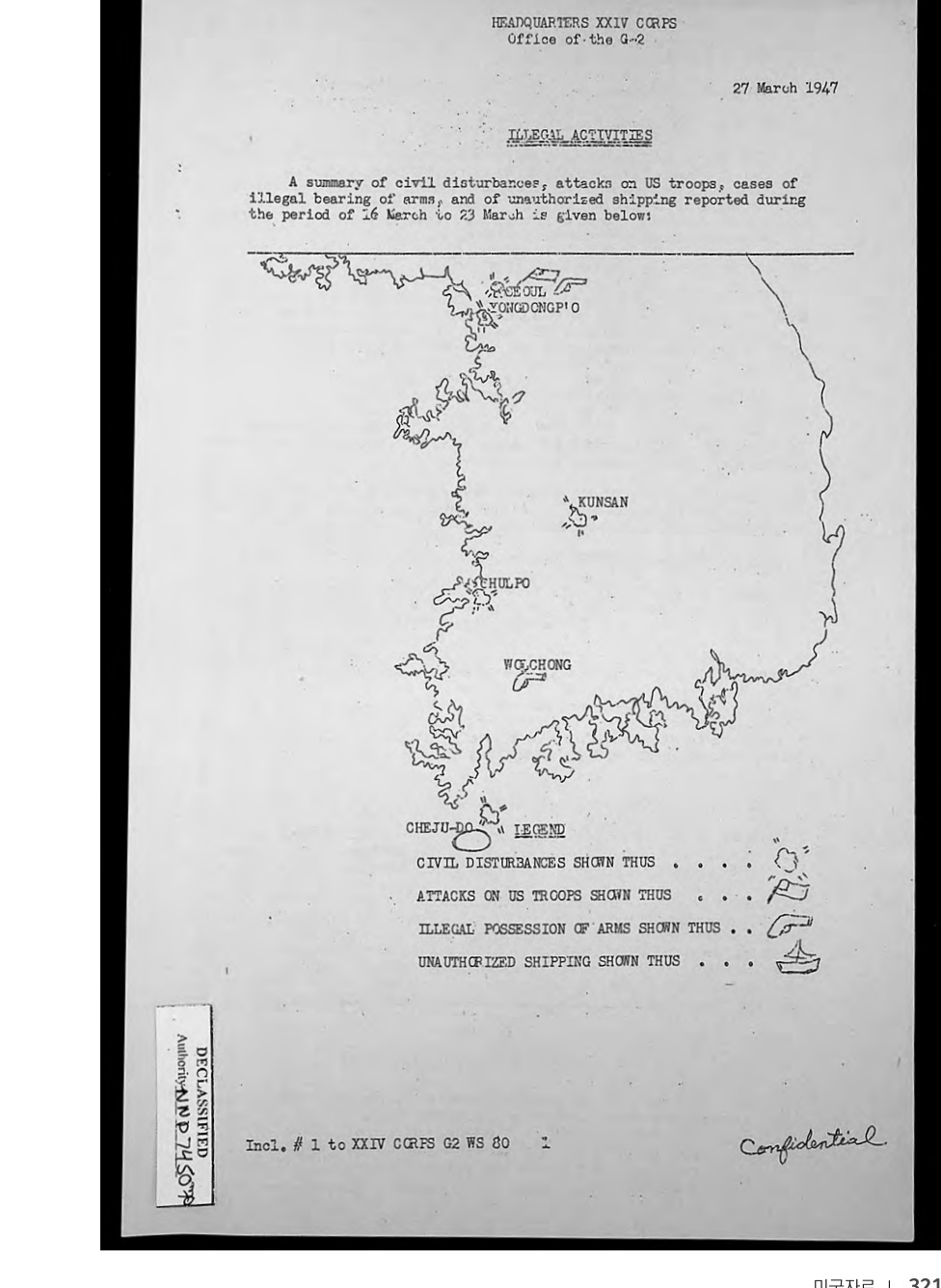
3월 16일부터 3월 23일까지 보고된 민간인 소요, 미군에 대한 공격, 불법 무기소지, 불법 해상 운송의 요약은 다음과 같다.
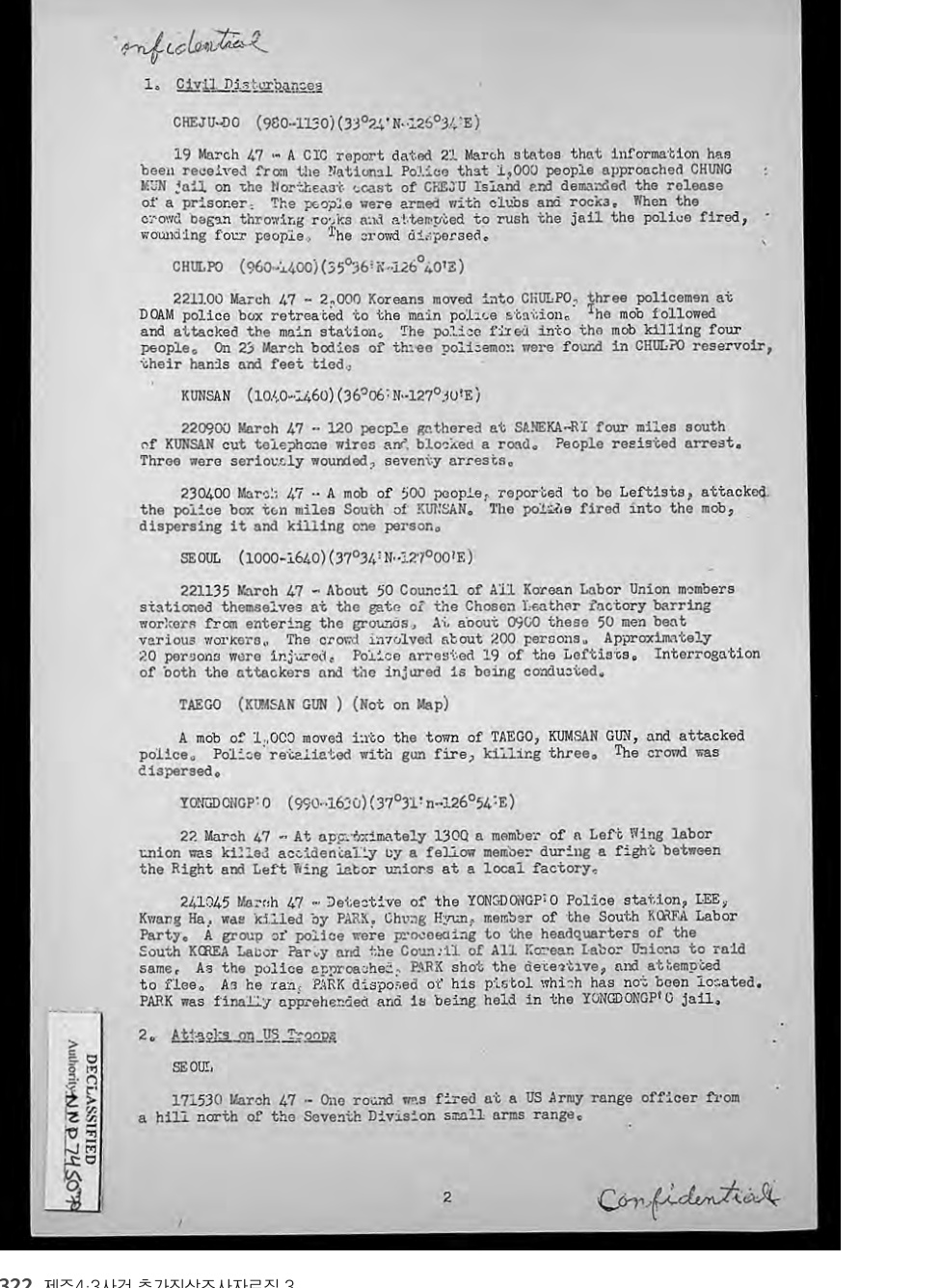
1. 민간인 소요
제주도 (980-1130)(33˚24'N-126˚34'E)
47년 3월 19일 - 3월 21일 자 방첩대 보고서는 1947년 3월 19일 주민 1,000여 명이 제주도 북동쪽 해안에 있는 중문유치장에 몰려가 한 수감자의 석방을 요구했다는 정보를 경찰로부터 받았다고 밝혔다. 이들은 몽둥이와 돌멩이를 갖고 있었다. 군중이 돌을 던지고 유치장으로 달려들려고 하자 경찰이 발포해 4명이 부상당했다. 군중은 해산됐다.
Secret
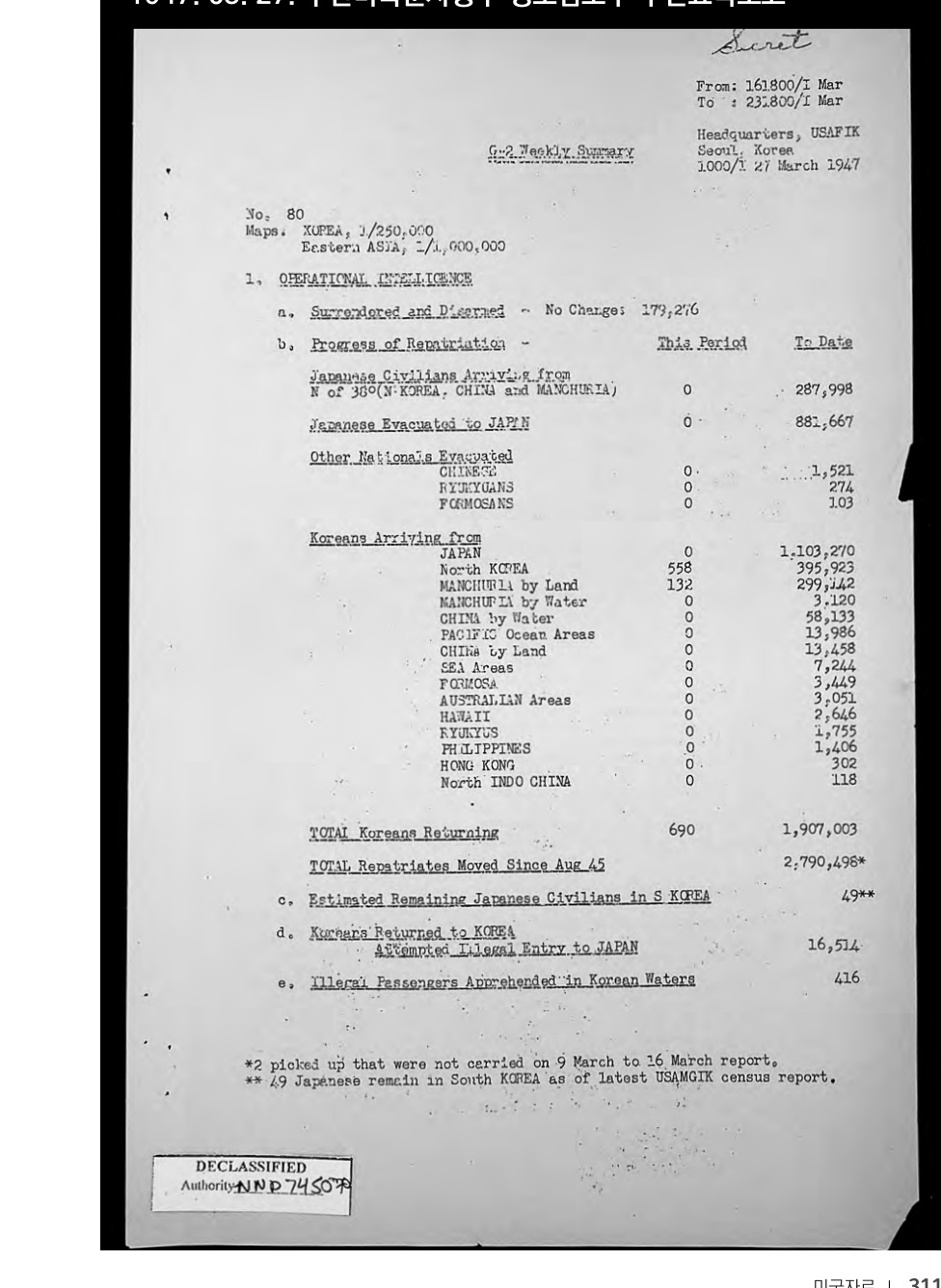
From: 161800/1 Mar
To : 231800/1 Mar
Headquarters, USAFIK
Seoul, Korea
1000/1 27 March 1947
G-2 Weekly Summary
No. 80
Maps: KOREA, 1/250,000
Eastern ASIA, 1/1,000,000
1. OPERATIONAL INTELLIGENCE
a. Surrendered and Disarmed - No Change: 179,276
b. Progress of Repatriation - This Period To Date
Japanese Civilians Arriving from
N of 38°(N KOREA, CHINA and MANCHURIA) 0 287,998
Japanese Evacuated to JAPAN 0 881,667
Other Nationals Evacuated
CHINESE 0. 1,521
RYUKYUANS 0 274
FORMOSANS 0 103
Koreans Arriving from
JAPAN 0 1,103,270
North KOREA 558 395,923
MANCHURIA by Land 132 299,142
MANCHURIA by Water 0 3,120
CHINA by Water 0 58,133
PACIFIC Ocean Areas 0 13,986
CHINA by Land 0 13,458
SEA Areas 0 7,244
FORMOSA 0 3,449
AUSTRALIAN Areas 0 3,051
HAWAII 0 2,646
RYUKYUS 0 1,755
PHILIPPINES 0 1,406
HONG KONG 0. 302
North INDO CHINA 0 118
TOTAL Koreans Returning 690 1,907,003
TOTAL Repatriates Moved Since Aug 45 2,790,498*
c. Estimated Remaining Japanese Civilians in S KOREA 49**
d. Koreans Returned to KOREA
Attempted Illegal Entry to JAPAN 16,514
e. Illegal Passengers Apprehended in Korean Waters 416
*2 picked up that were not carried on 9 March to 16 March report.
** 49 Japanese remain in South KOREA as of latest USAMGIK census report.
DECLASSIFIED
Authority: NND 74507
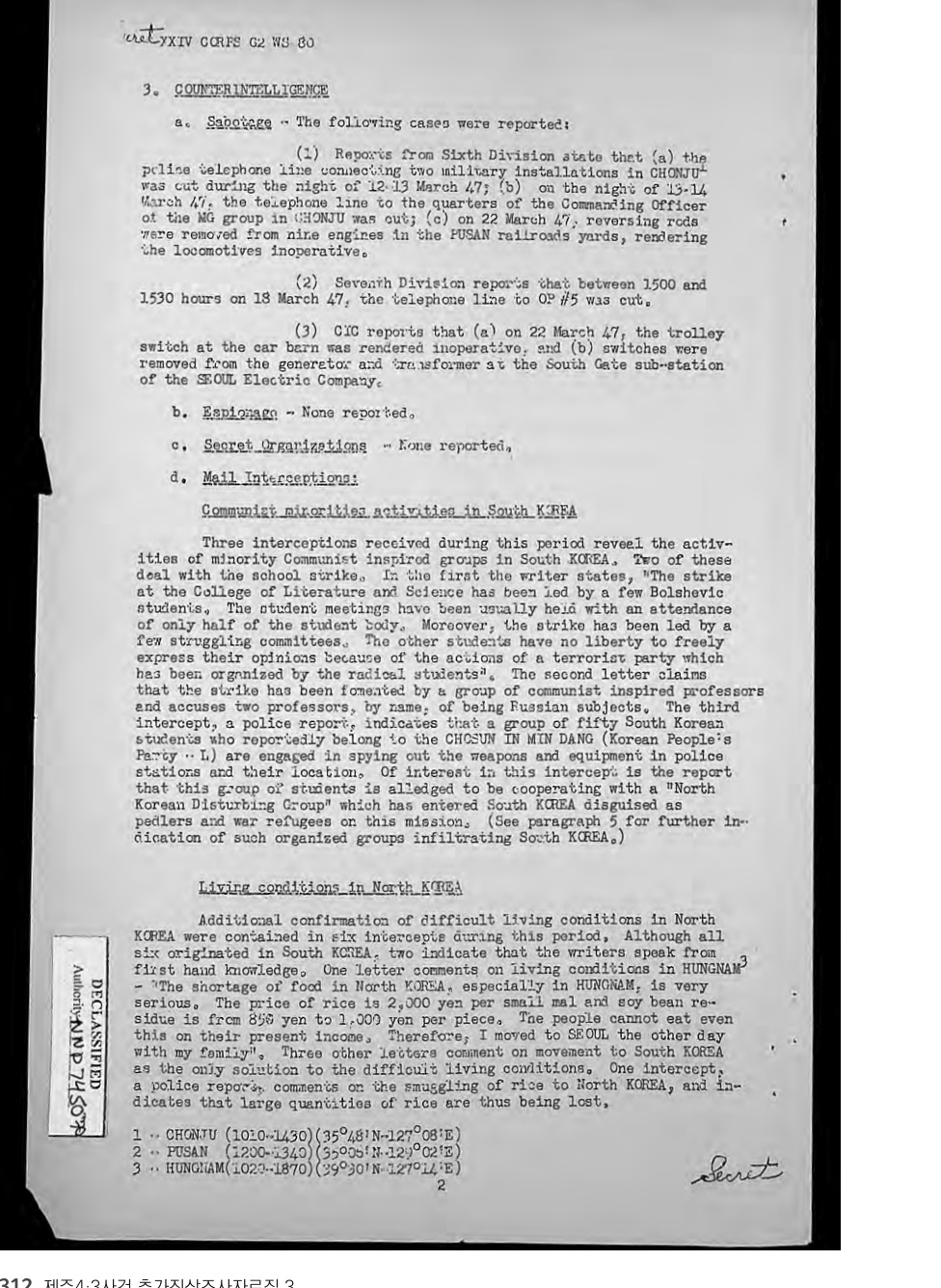
[illegible]XXIV CORPS G2 WS 80
3. COUNTERINTELLIGENCE
a. Sabotage - The following cases were reported:
(1) Reports from Sixth Division state that (a) the police telephone line connecting two military installations in CHONJU was cut during the night of 12-13 March 47; (b) on the night of 13-14 March 47, the telephone line to the quarters of the Commanding Officer of the MG group in CHONJU was cut; (c) on 22 March 47, reversing rods were removed from nine engines in the PUSAN railroads yards, rendering the locomotives inoperative.
(2) Seventh Division reports that between 1500 and 1530 hours on 18 March 47, the telephone line to OP #5 was cut.
(3) CIC reports that (a) on 22 March 47, the trolley switch at the car barn was rendered inoperative, and (b) switches were removed from the generator and transformer at the South Gate sub-station of the SEOUL Electric Company.
b. Espionage - None reported.
c. Secret Organizations - None reported.
d. Mail Interceptions:
Communist minorities activities in South KOREA
Three interceptions received during this period reveal the activities of minority Communist inspired groups in South KOREA. Two of these deal with the school strike. In the first the writer states, "The strike at the College of Literature and Science has been led by a few Bolshevic students. The student meetings have been usually held with an attendance of only half of the student body. Moreover, the strike has been led by a few struggling committees. The other students have no liberty to freely express their opinions because of the activities of a terrorist party which has been organized by the radical students". The second letter claims that the strike has been fomented by a group of communist inspired professors and accuses two professors, by name, of being Russian subjects. The third intercept, a police report, indicates that a group of fifty South Korean students who reportedly belong to the CHOSUN IN MIN DANG (Korean People's Party - L) are engaged in spying out the weapons and equipment in police stations and their location. Of interest in this intercept is the report that this group of students is alledged to be cooperating with a "North Korean Disturbing Group" which has entered South KOREA disguised as pedlers and war refugees on this mission. (See paragraph 5 for further indication of such organized groups infiltrating South KOREA.)
Living conditions in North KOREA
Additional confirmation of difficult living conditions in North KOREA were contained in six intercepts during this period. Although all six originated in South KOREA, two indicate that the writers speak from first hand knowledge. One letter comments on living conditions in HUNGNAM - "The shortage of food in North KOREA, especially in HUNGNAM, is very serious. The price of rice is 2,000 yen per small mal and soy bean residue is from 850 yen to 1,000 yen per piece. The people cannot eat even this on their present income. Therefore, I moved to SEOUL the other day with my family". Three other letters comment on movement to South KOREA as the only solution to the difficult living conditions. One intercept, a police report, comments on the smuggling of rice to North KOREA, and indicates that large quantities of rice are thus being lost.
1 - CHONJU (1010-1430)(35°48'N-127°08'E)
2 - PUSAN (1200-1340)(35°05'N-129°02'E)
3 - HUNGNAM(1023-1870)(39°30'N-127°14'E)
2
Secret
DECLASSIFIED
Authority NND 74[illegible]
Secret XXIV CORPS G2 WS 80
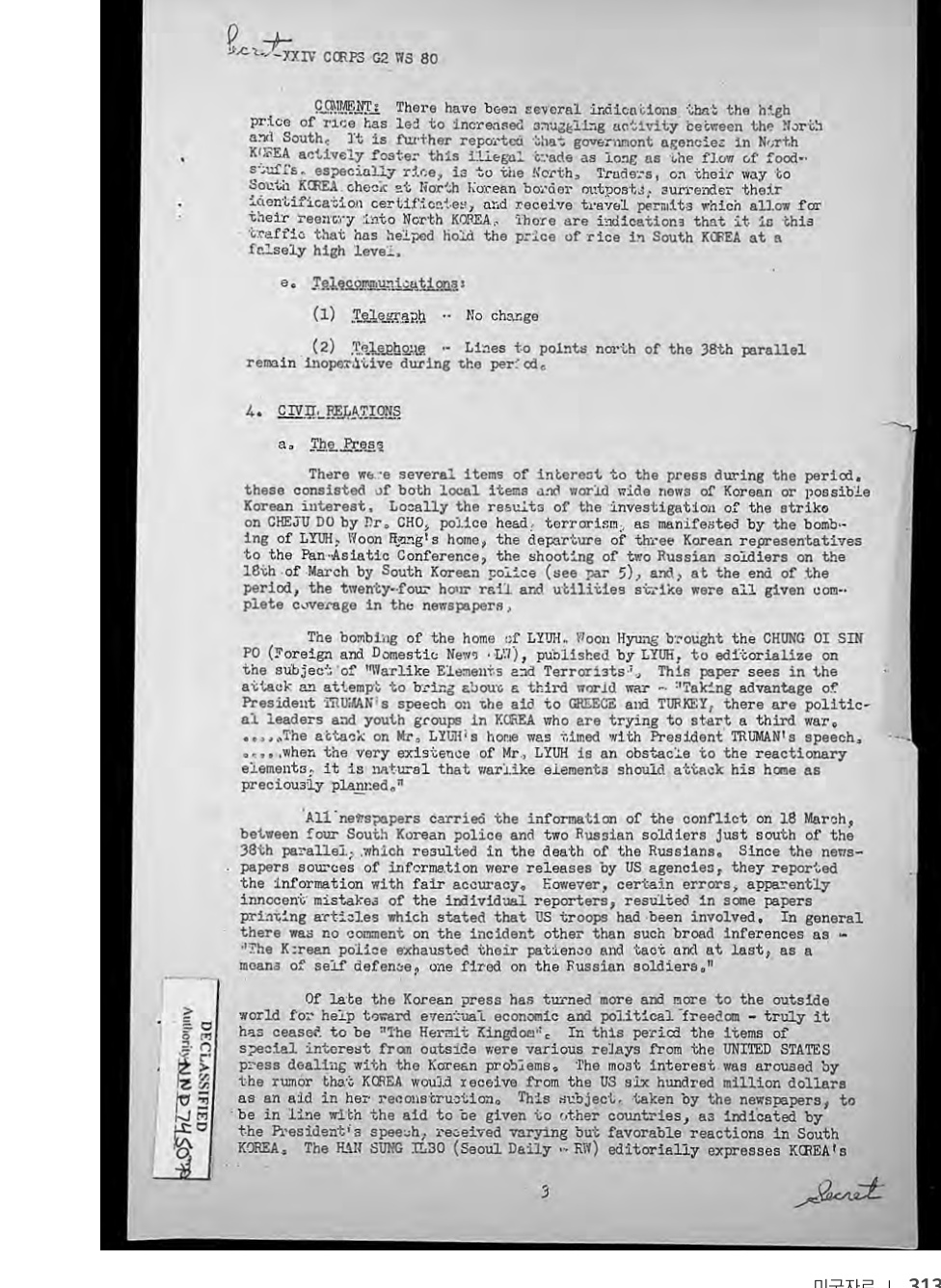
COMMENT: There have been several indications that the high price of rice has led to increased smuggling activity between the North and South. It is further reported that government agencies in North KOREA actively foster this illegal trade as long as the flow of foodstuffs, especially rice, is to the North. Traders, on their way to South KOREA check at North Korean border outposts, surrender their identification certificates, and receive travel permits which allow for their reentry into North KOREA. There are indications that it is this traffic that has helped hold the price of rice in South KOREA at a falsely high level.
o. Telecommunications:
(1) Telegraph -- No change
(2) Telephone -- Lines to points north of the 38th parallel remain inoperative during the period.
4. CIVIL RELATIONS
a. The Press
There were several items of interest to the press during the period, these consisted of both local items and world wide news of Korean or possible Korean interest. Locally the results of the investigation of the strike on CHEJU DO by Dr. CHO, police head, terrorism, as manifested by the bombing of LYUH, Woon Hyung's home, the departure of three Korean representatives to the Pan-Asiatic Conference, the shooting of two Russian soldiers on the 18th of March by South Korean police (see par 5), and, at the end of the period, the twenty-four hour rail and utilities strike were all given complete coverage in the newspapers.
The bombing of the home of LYUH, Woon Hyung brought the CHUNG OI SIN PO (Foreign and Domestic News LW), published by LYUH, to editorialize on the subject of "Warlike Elements and Terrorists". This paper sees in the attack an attempt to bring about a third world war -- "Taking advantage of President TRUMAN's speech on the aid to GREECE and TURKEY, there are political leaders and youth groups in KOREA who are trying to start a third war. .....The attack on Mr. LYUH's home was timed with President TRUMAN's speech. .....when the very existence of Mr. LYUH is an obstacle to the reactionary elements, it is natural that warlike elements should attack his home as preciously planned."
All newspapers carried the information of the conflict on 18 March, between four South Korean police and two Russian soldiers just south of the 38th parallel, which resulted in the death of the Russians. Since the newspapers sources of information were releases by US agencies, they reported the information with fair accuracy. However, certain errors, apparently innocent mistakes of the individual reporters, resulted in some papers printing articles which stated that US troops had been involved. In general there was no comment on the incident other than such broad inferences as -- "The Korean police exhausted their patience and tact and at last, as a means of self defence, one fired on the Russian soldiers."
Of late the Korean press has turned more and more to the outside world for help toward eventual economic and political freedom - truly it has ceased to be "The Hermit Kingdom". In this period the items of special interest from outside were various relays from the UNITED STATES press dealing with the Korean problems. The most interest was aroused by the rumor that KOREA would receive from the US six hundred million dollars as an aid in her reconstruction. This subject, taken by the newspapers, to be in line with the aid to be given to other countries, as indicated by the President's speech, received varying but favorable reactions in South KOREA. The HAN SUNG ILBO (Seoul Daily -- RW) editorially expresses KOREA's
3
Secret
DECLASSIFIED
Authority NND 74508
Secret XIV CORPS G2 WS 80
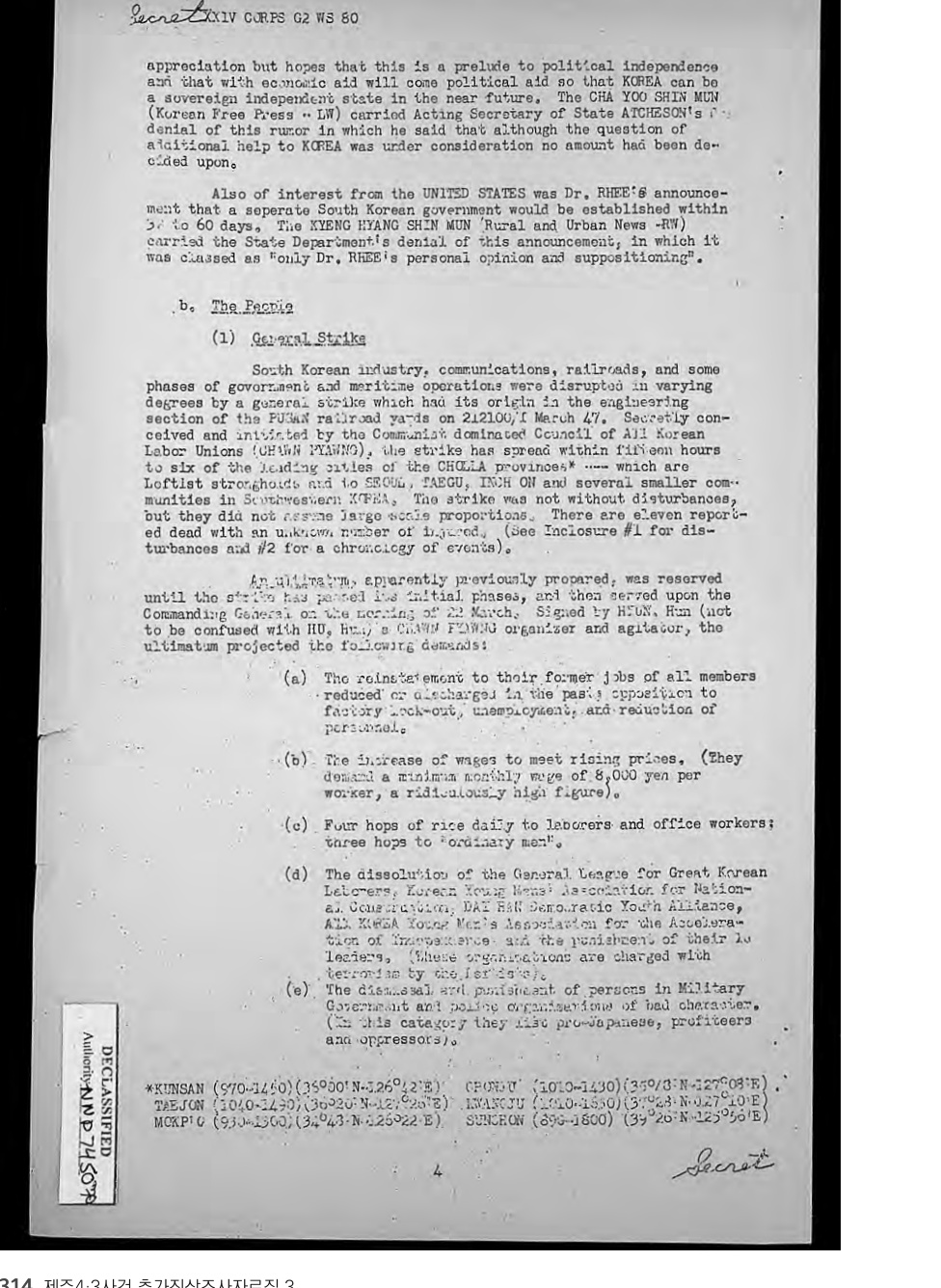
appreciation but hopes that this is a prelude to political independence and that with economic aid will come political aid so that KOREA can be a sovereign independent state in the near future. The CHA YOO SHIN MUN (Korean Free Press - LW) carried Acting Secretary of State ACHESON's denial of this rumor in which he said that although the question of additional help to KOREA was under consideration no amount had been decided upon.
Also of interest from the UNITED STATES was Dr. RHEE's announcement that a seperate South Korean government would be established within 30 to 60 days. The KYENG HYANG SHIN MUN (Rural and Urban News -RW) carried the State Department's denial of this announcement, in which it was classed as "only Dr. RHEE's personal opinion and suppositioning".
b. The People
(1) General Strike
South Korean industry, communications, railroads, and some phases of government and maritime operations were disrupted in varying degrees by a general strike which had its origin in the engineering section of the PUSAN railroad yards on 212100/I March 47. Secretly conceived and initiated by the Communist dominated Council of All Korean Labor Unions (CHUN PYUNG), the strike has spread within fifteen hours to six of the leading cities of the CHOLLA provinces* ---- which are Leftist strongholds and to SEOUL, TAEGU, INCHON and several smaller communities in Southwestern KOREA. The strike was not without disturbances, but they did not assume large scale proportions. There are eleven reported dead with an unknown number of injured. (See Inclosure #1 for disturbances and #2 for a chronology of events).
An ultimatum, apparently previously prepared, was reserved until the strike has passed its initial phases, and then served upon the Commanding General on the morning of 22 March. Signed by HTON. Hum (not to be confused with HU, HU is CHUNG PYUNG organizer and agitator, the ultimatum projected the following demands:
(a) The reinstatement to their former jobs of all members reduced or discharged in the past; opposition to factory lock-out, unemployment, and reduction of personnel.
(b) The increase of wages to meet rising prices. (They demand a minimum monthly wage of 8,000 yen per worker, a ridiculously high figure).
(c) Four hops of rice daily to laborers and office workers; three hops to "ordinary men".
(d) The dissolution of the General League for Great Korean Laborers, Korean Young News Association for National Construction, DAI HAN Democratic Youth Alliance, ALL KOREA Young Men's Association for the Acceleration of Independence and the punishment of their leaders. (These organizations are charged with terrorism by the [illegible]).
(e) The dismissal and punishment of persons in Military Government and police organizations of bad character. (In this category they list pro-Japanese, profiteers and oppressors).
*KUNSAN (970-1460)(39°50'N-126°42'E) CHONJU (1010-1430)(35°/3'N-127°08'E)
TAEJON (1040-1430)(36°20'N-127°26'E) KWANJU (1010-1550)(35°28'N-127°10'E)
MOKPO (930-1360)(34°43'N-126°22'E) SUNCHON (896-1800)(39°26'N-125°56'E)
4
Secret
DECLASSIFIED
Authority NND 74[illegible]
Secret XXIV CORPS C2 WS 80
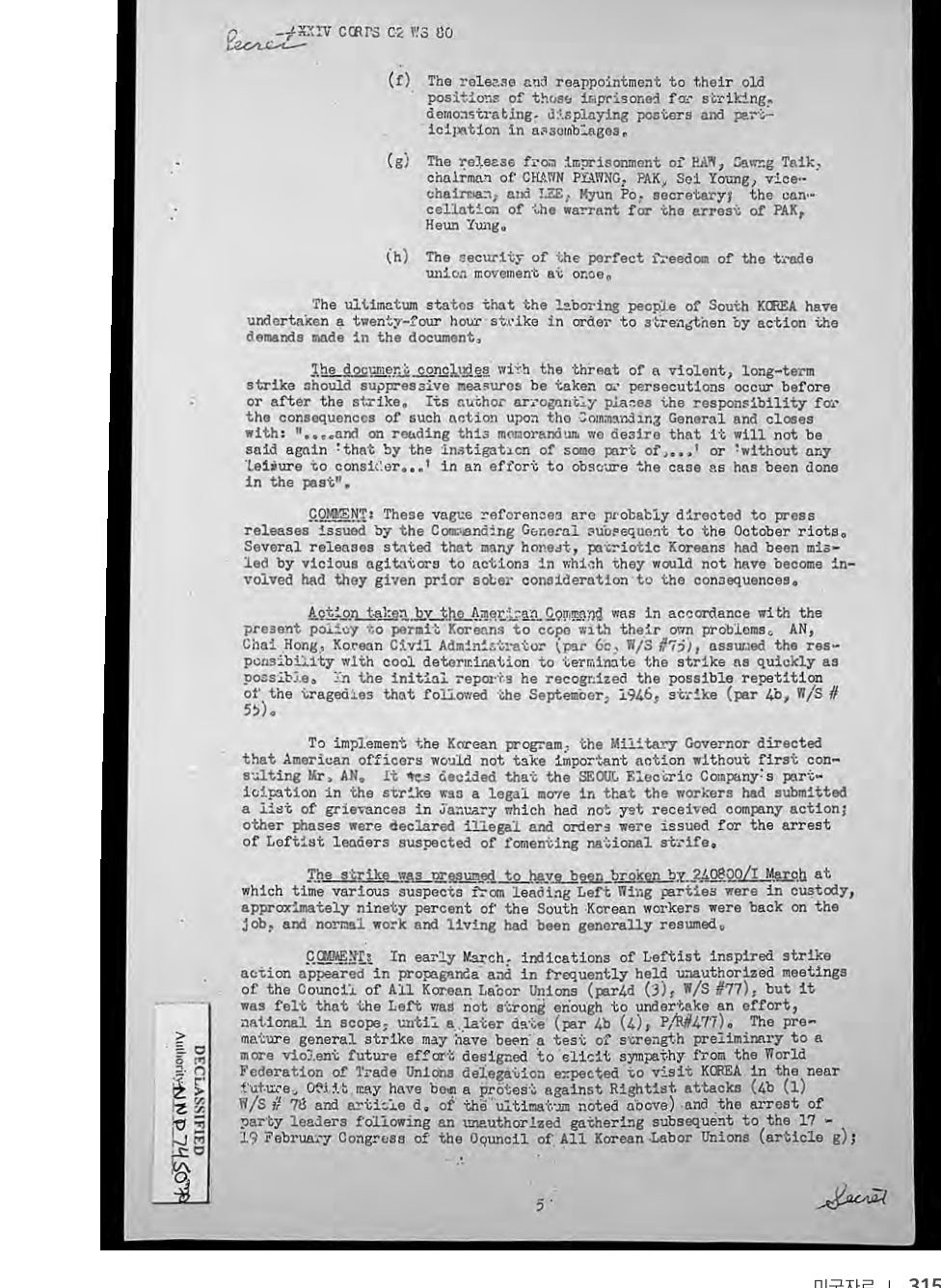
(f) The release and reappointment to their old positions of those imprisoned for striking, demonstrating, displaying posters and participation in assemblages.
(g) The release from imprisonment of HAW, Cawng Taik, chairman of CHAWN PYAWNG, PAK, Sei Young, vicechairman, and LEE, Myun Po, secretary; the cancellation of the warrant for the arrest of PAK, Heun Yung.
(h) The security of the perfect freedom of the trade union movement at once.
The ultimatum states that the laboring people of South KOREA have undertaken a twenty-four hour strike in order to strengthen by action the demands made in the document.
The document concludes with the threat of a violent, long-term strike should suppressive measures be taken or persecutions occur before or after the strike. Its author arrogantly places the responsibility for the consequences of such action upon the Commanding General and closes
with: "....and on reading this memorandum we desire that it will not be
said again 'that by the instigation of some part of ....' or 'without any leisure to consider....' in an effort to obscure the case as has been done in the past".
COMMENT: These vague references are probably directed to press releases issued by the Commanding General subsequent to the October riots.
Several releases stated that many honest, patriotic Koreans had been misled by vicious agitators to actions in which they would not have become involved had they given prior sober consideration to the consequences.
Action taken by the American Command was in accordance with the present policy to permit Koreans to cope with their own problems. AN, Chai Hong, Korean Civil Administrator (par 6c, W/S #75), assumed the responsibility with cool determination to terminate the strike as quickly as possible. In the initial reports he recognized the possible repetition of the tragedies that followed the September, 1946, strike (par 4b, W/S #
55).
To implement the Korean program, the Military Governor directed that American officers would not take important action without first consulting Mr. AN. It was decided that the SEOUL Electric Company's participation in the strike was a legal move in that the workers had submitted a list of grievances in January which had not yet received company action; other phases were declared illegal and orders were issued for the arrest of Leftist leaders suspected of fomenting national strife.
The strike was presumed to have been broken by 240800/1 March at which time various suspects from leading Left Wing parties were in custody, approximately ninety percent of the South Korean workers were back on the job, and normal work and living had been generally resumed.
COMMENT: In early March, indications of Leftist inspired strike action appeared in propaganda and in frequently held unauthorized meetings of the Council of All Korean Labor Unions (par4d (3), W/S #77), but it was felt that the Left was not strong enough to undertake an effort, national in scope, until a later date (par 4b (4), P/R#477). The premature general strike may have been a test of strength preliminary to a more violent future effort designed to elicit sympathy from the World
Federation of Trade Unions delegation expected to visit KOREA in the near future. Or it may have been a protest against Rightist attacks (4b (1)
W/S # 78 and article d. of the ultimatum noted above) and the arrest of party leaders following an unauthorized gathering subsequent to the 17 -
19 February Congress of the Council of All Korean Labor Unions (article g);
5
Secret
DECLASSIFIED
Authority NND 7[illegible]507A
SECRET XXIV CORPS G2 WS 80
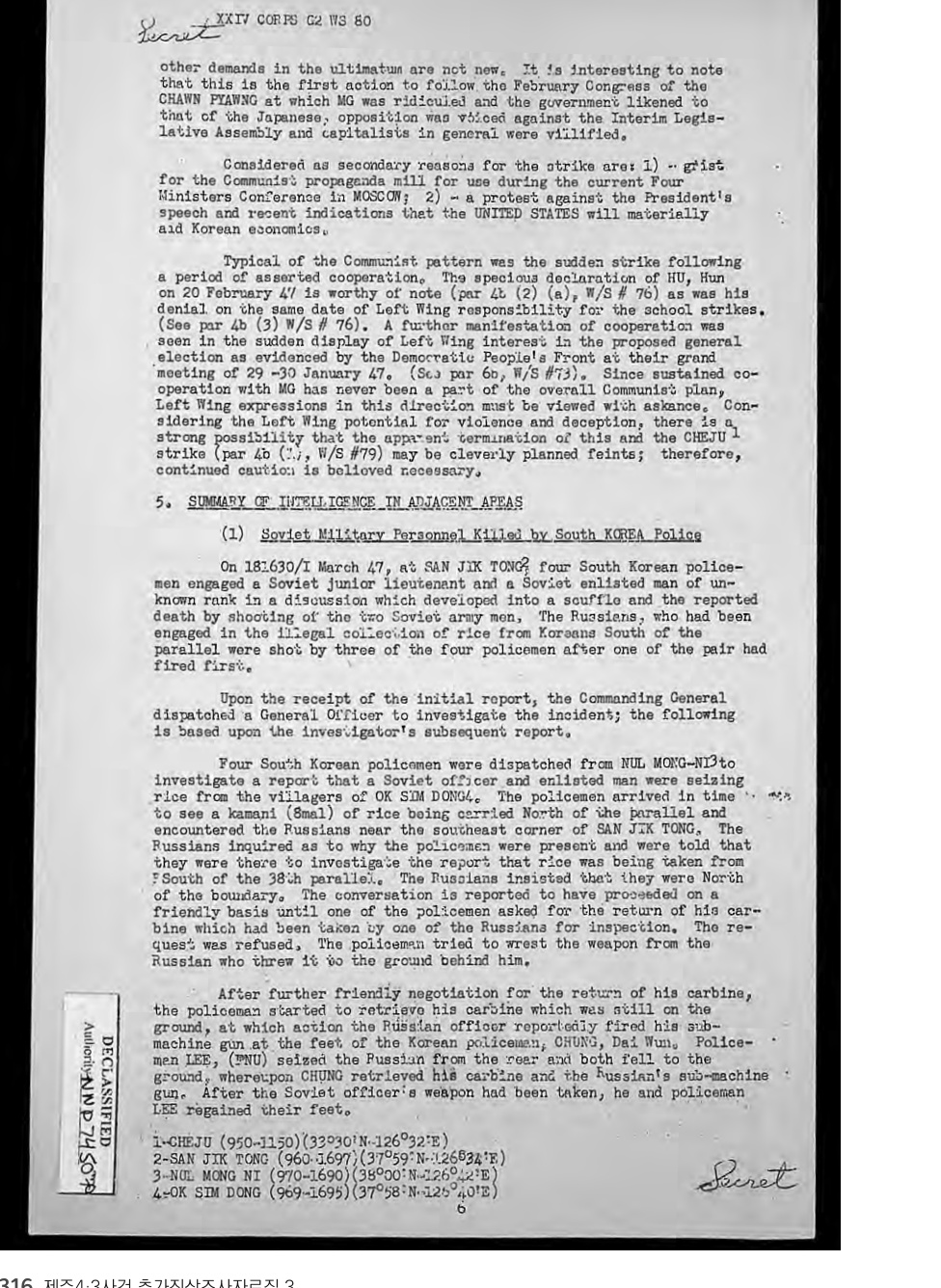
other demands in the ultimatum are not new. It is interesting to note that this is the first action to follow the February Congress of the
CHAWN PYAWNG at which MG was ridiculed and the government likened to that of the Japanese. opposition was voiced against the Interim Legislative Assembly and capitalists in general were villified.
Considered as secondary reasons for the strike are: 1) - grist for the Communist propaganda mill for use during the current Four
Ministers Conference in MOSCOW; 2) - a protest against the President's speech and recent indications that the UNITED STATES will materially aid Korean economics.
Typical of the Communist pattern was the sudden strike following a period of asserted cooperation. The specious declaration of HU, Hun on 20 February 47 is worthy of note (par 4b (2) (a), W/S # 76) as was his denial on the same date of Left Wing responsibility for the school strikes.
(See par 4b (3) W/S # 76). A further manifestation of cooperation was seen in the sudden display of Left Wing interest in the proposed general election as evidenced by the Democratic People's Front at their grand meeting of 29 -30 January 47. (See par 6b, W/S #73). Since sustained cooperation with MG has never been a part of the overall Communist plan, Left Wing expressions in this direction must be viewed with askance. Considering the Left Wing potential for violence and deception, there is a strong possibility that the apparent termination of this and the CHEJU strike (par 4b (3.), W/S #79) may be cleverly planned feints; therefore, continued caution is believed necessary.
5. SUMMARY OF INTELLIGENCE IN ADJACENT AREAS
(1) Soviet Military Personnel Killed by South KOREA Police
On 181630/I March 47, at SAN JIK TONG, four South Korean policemen engaged a Soviet junior lieutenant and a Soviet enlisted man of unknown rank in a discussion which developed into a scuffle and the reported death by shooting of the two Soviet army men. The Russians, who had been engaged in the illegal collection of rice from Koreans South of the parallel were shot by three of the four policemen after one of the pair had fired first.
Upon the receipt of the initial report, the Commanding General dispatched a General Officer to investigate the incident; the following is based upon the investigator's subsequent report.
Four South Korean policemen were dispatched from NUL MONG-NI to investigate a report that a Soviet officer and enlisted man were seizing rice from the villagers of OK SIM DONG4. The policemen arrived in time to see a kamani (8mal) of rice being carried North of the parallel and encountered the Russians near the southeast corner of SAN JIK TONG. The
Russians inquired as to why the policemen were present and were told that they were there to investigate the report that rice was being taken from
[illegible] South of the 38th parallel. The Russians insisted that they were North of the boundary. The conversation is reported to have proceeded on a friendly basis until one of the policemen asked for the return of his carbine which had been taken by one of the Russians for inspection. The request was refused. The policeman tried to wrest the weapon from the
Russian who threw it to the ground behind him.
After further friendly negotiation for the return of his carbine, the policeman started to retrieve his carbine which was still on the ground, at which action the Russian officer reportedly fired his submachine gun at the feet of the Korean policeman, CHUNG, Dai Wun. Policeman LEE, (PNU) seized the Russian from the rear and both fell to the ground, whereupon CHUNG retrieved his carbine and the Russian's sub-machine gun. After the Soviet officer's weapon had been taken, he and policeman
LEE regained their feet.
DECLASSIFIED
Authority NND 74[illegible]
1-CHEJU (950-1150)(33°30'N-126°32'E)
2-SAN JIK TONG (960-1697)(37°59'N-126°824'E)
3-NUL MONG NI (970-1690)(38°00'N-126°42'E)
4-OK SIM DONG (969-1695)(37°58'N-125°40'E)
6
Secret
Secret XXIV CORPS G2 WS 80
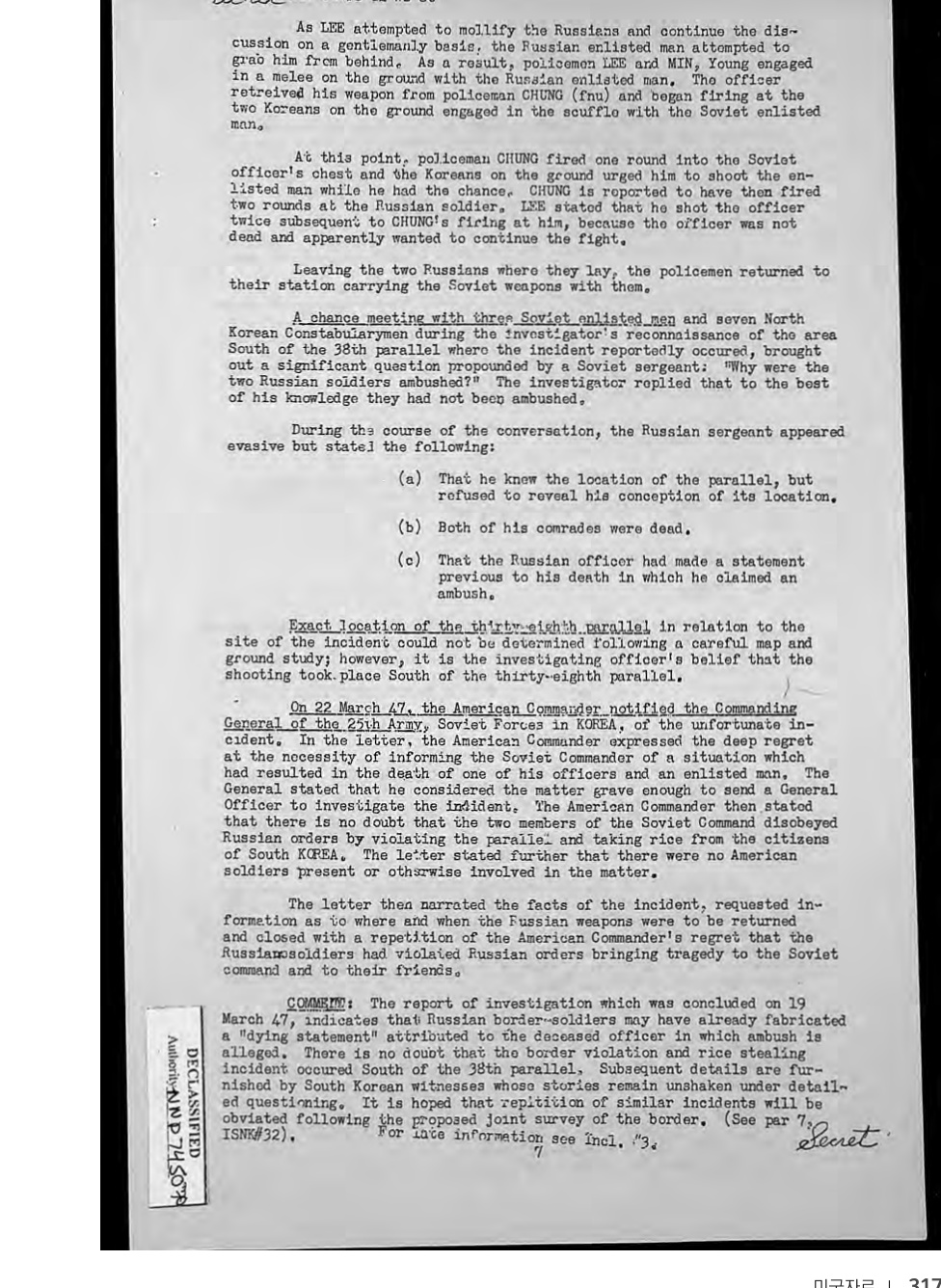
As LEE attempted to mollify the Russians and continue the discussion on a gentlemanly basis, the Russian enlisted man attempted to grab him from behind. As a result, policemen LEE and MIN, Young engaged in a melee on the ground with the Russian enlisted man. The officer retreived his weapon from policeman CHUNG (fnu) and began firing at the two Koreans on the ground engaged in the scuffle with the Soviet enlisted man.
At this point, policeman CHUNG fired one round into the Soviet officer's chest and the Koreans on the ground urged him to shoot the enlisted man while he had the chance. CHUNG is reported to have then fired two rounds at the Russian soldier. LEE stated that he shot the officer twice subsequent to CHUNG's firing at him, because the officer was not dead and apparently wanted to continue the fight.
Leaving the two Russians where they lay, the policemen returned to their station carrying the Soviet weapons with them.
A chance meeting with three Soviet enlisted men and seven North Korean Constabularymen during the investigator's reconnaissance of the area South of the 38th parallel where the incident reportedly occured, brought out a significant question propounded by a Soviet sergeant: "Why were the two Russian soldiers ambushed?" The investigator replied that to the best of his knowledge they had not been ambushed.
During the course of the conversation, the Russian sergeant appeared evasive but stated the following:
(a) That he knew the location of the parallel, but refused to reveal his conception of its location.
(b) Both of his comrades were dead.
(c) That the Russian officer had made a statement previous to his death in which he claimed an ambush.
Exact location of the thirty-eighth parallel in relation to the site of the incident could not be determined following a careful map and ground study; however, it is the investigating officer's belief that the shooting took place South of the thirty-eighth parallel.
On 22 March 47, the American Commander notified the Commanding General of the 25th Army, Soviet Forces in KOREA, of the unfortunate incident. In the letter, the American Commander expressed the deep regret at the necessity of informing the Soviet Commander of a situation which had resulted in the death of one of his officers and an enlisted man. The General stated that he considered the matter grave enough to send a General Officer to investigate the incident. The American Commander then stated that there is no doubt that the two members of the Soviet Command disobeyed Russian orders by violating the parallel and taking rice from the citizens of South KOREA. The letter stated further that there were no American soldiers present or otherwise involved in the matter.
The letter then narrated the facts of the incident, requested information as to where and when the Russian weapons were to be returned and closed with a repetition of the American Commander's regret that the Russian soldiers had violated Russian orders bringing tragedy to the Soviet command and to their friends.
COMMENT: The report of investigation which was concluded on 19 March 47, indicates that Russian border-soldiers may have already fabricated a "dying statement" attributed to the deceased officer in which ambush is alleged. There is no doubt that the border violation and rice stealing incident occured South of the 38th parallel. Subsequent details are furnished by South Korean witnesses whose stories remain unshaken under detailed questioning. It is hoped that repitition of similar incidents will be obviated following the proposed joint survey of the border. (See par 7, ISNK#32). For late information see Incl. #3.
Secret
DECLASSIFIED
Authority NND 74508
7
SECRET XXIV CORPS G2 WS 80
(2) North Korean Terrorist Groups
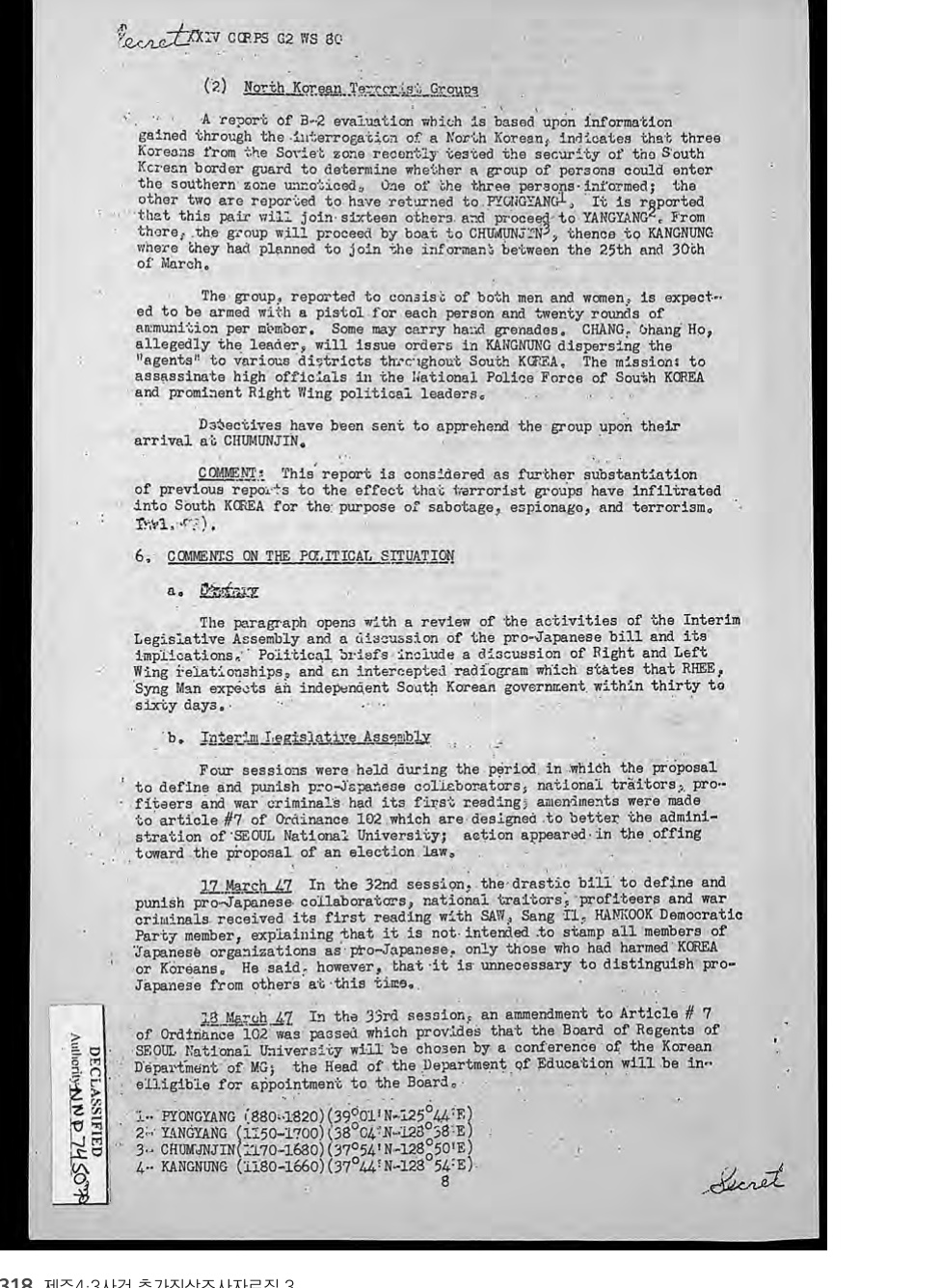
A report of B-2 evaluation which is based upon information gained through the interrogation of a North Korean, indicates that three
Koreans from the Soviet zone recently tested the security of the South
Korean border guard to determine whether a group of persons could enter the southern zone unnoticed. One of the three persons informed; the other two are reported to have returned to PYONGYANG¹. It is reported that this pair will join sixteen others and proceed to YANGYANG². From there, the group will proceed by boat to CHUMUNJIN³, thence to KANGNUNG where they had planned to join the informant between the 25th and 30th of March.
The group, reported to consist of both men and women, is expected to be armed with a pistol for each person and twenty rounds of ammunition per member. Some may carry hand grenades. CHANG, Chang Ho, allegedly the leader, will issue orders in KANGNUNG dispersing the
"agents" to various districts throughout South KOREA. The mission: to assassinate high officials in the National Police Force of South KOREA and prominent Right Wing political leaders.
Detectives have been sent to apprehend the group upon their arrival at CHUMUNJIN.
COMMENT: This report is considered as further substantiation of previous reports to the effect that terrorist groups have infiltrated into South KOREA for the purpose of sabotage, espionage, and terrorism.
[illegible].
6. COMMENTS ON THE POLITICAL SITUATION
a. [illegible]
The paragraph opens with a review of the activities of the Interim
Legislative Assembly and a discussion of the pro-Japanese bill and its implications. Political briefs include a discussion of Right and Left
Wing relationships, and an intercepted radiogram which states that RHEE, Syng Man expects an independent South Korean government within thirty to sixty days.
b. Interim Legislative Assembly
Four sessions were held during the period in which the proposal to define and punish pro-Japanese collaborators, national traitors, profiteers and war criminals had its first reading; amendments were made to article #7 of Ordinance 102 which are designed to better the administration of SEOUL National University; action appeared in the offing toward the proposal of an election law.
17 March 47 In the 32nd session, the drastic bill to define and punish pro-Japanese collaborators, national traitors, profiteers and war criminals received its first reading with SAW, Sang Il, HANKOOK Democratic
Party member, explaining that it is not intended to stamp all members of
Japanese organizations as pro-Japanese, only those who had harmed KOREA or Koreans. He said, however, that it is unnecessary to distinguish proJapanese from others at this time.
18 March 47 In the 33rd session, an ammendment to Article # 7 of Ordinance 102 was passed which provides that the Board of Regents of
SEOUL National University will be chosen by a conference of the Korean
Department of MG; the Head of the Department of Education will be inelligible for appointment to the Board.
1. PYONGYANG (880-1820)(39°01'N-125°44'E)
2. YANGYANG (1150-1700)(38°04'N-128°38'E)
3. CHUMUNJIN(1170-1680)(37°54'N-128°50'E)
4. KANGNUNG (1180-1660)(37°44'N-128°54'E)
8
DECLASSIFIED
Authority-NND 7 [illegible]
Secret
XXIV CORPS G2 WS 80
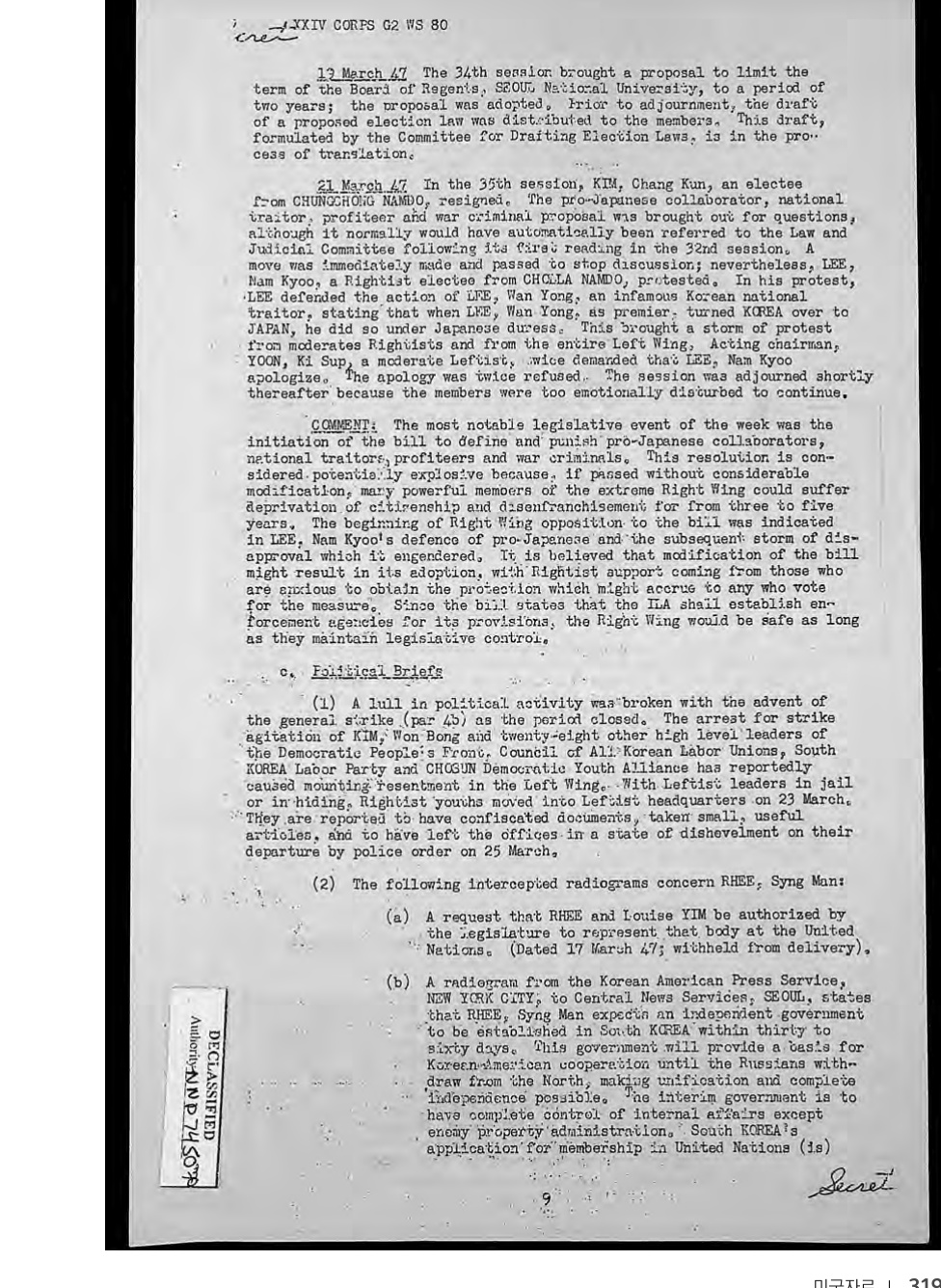
13 March 47 The 34th session brought a proposal to limit the term of the Board of Regents, SEOUL National University, to a period of two years; the proposal was adopted. Prior to adjournment, the draft of a proposed election law was distributed to the members. This draft, formulated by the Committee for Drafting Election Laws, is in the process of translation.
21 March 47 In the 35th session, KIM, Chang Kun, an electee from CHUNGCHONG NAMDO, resigned. The pro-Japanese collaborator, national traitor, profiteer and war criminal proposal was brought out for questions, although it normally would have automatically been referred to the Law and Judicial Committee following its first reading in the 32nd session. A move was immediately made and passed to stop discussion; nevertheless, LEE, Nam Kyoo, a Rightist electee from CHOLLA NAMDO, protested. In his protest, LEE defended the action of LEE, Wan Yong, an infamous Korean national traitor, stating that when LEE, Wan Yong, as premier, turned KOREA over to JAPAN, he did so under Japanese duress. This brought a storm of protest from moderates Rightists and from the entire Left Wing. Acting chairman, YOON, Ki Sup, a moderate Leftist, twice demanded that LEE, Nam Kyoo apologize. The apology was twice refused. The session was adjourned shortly thereafter because the members were too emotionally disturbed to continue.
COMMENT: The most notable legislative event of the week was the initiation of the bill to define and punish pro-Japanese collaborators, national traitors, profiteers and war criminals. This resolution is considered potentially explosive because, if passed without considerable modification, many powerful members of the extreme Right Wing could suffer deprivation of citizenship and disenfranchisement for from three to five years. The beginning of Right Wing opposition to the bill was indicated in LEE, Nam Kyoo's defence of pro-Japanese and the subsequent storm of disapproval which it engendered. It is believed that modification of the bill might result in its adoption, with Rightist support coming from those who are anxious to obtain the protection which might accrue to any who vote for the measure. Since the bill states that the ILA shall establish enforcement agencies for its provisions, the Right Wing would be safe as long as they maintain legislative control.
c. Political Briefs
(1) A lull in political activity was broken with the advent of the general strike (par 4b) as the period closed. The arrest for strike agitation of KIM, Won Bong and twenty-eight other high level leaders of the Democratic People's Front, Council of All Korean Labor Unions, South KOREA Labor Party and CHOSUN Democratic Youth Alliance has reportedly caused mounting resentment in the Left Wing. With Leftist leaders in jail or in hiding, Rightist youths moved into Leftist headquarters on 23 March. They are reported to have confiscated documents, taken small, useful articles, and to have left the offices in a state of dishevelment on their departure by police order on 25 March.
(2) The following intercepted radiograms concern RHEE, Syng Man:
(a) A request that RHEE and Louise YIM be authorized by the legislature to represent that body at the United Nations. (Dated 17 March 47; withheld from delivery).
(b) A radiogram from the Korean American Press Service, NEW YORK CITY, to Central News Services, SEOUL, states that RHEE, Syng Man expects an independent government to be established in South KOREA within thirty to sixty days. This government will provide a basis for Korean-American cooperation until the Russians withdraw from the North, making unification and complete independence possible. The interim government is to have complete control of internal affairs except enemy property administration. South KOREA's application for membership in United Nations (is)
9
Secret
DECLASSIFIED
Authority NND 74550[illegible]
SECRET XIV CORPS G2 WS 80
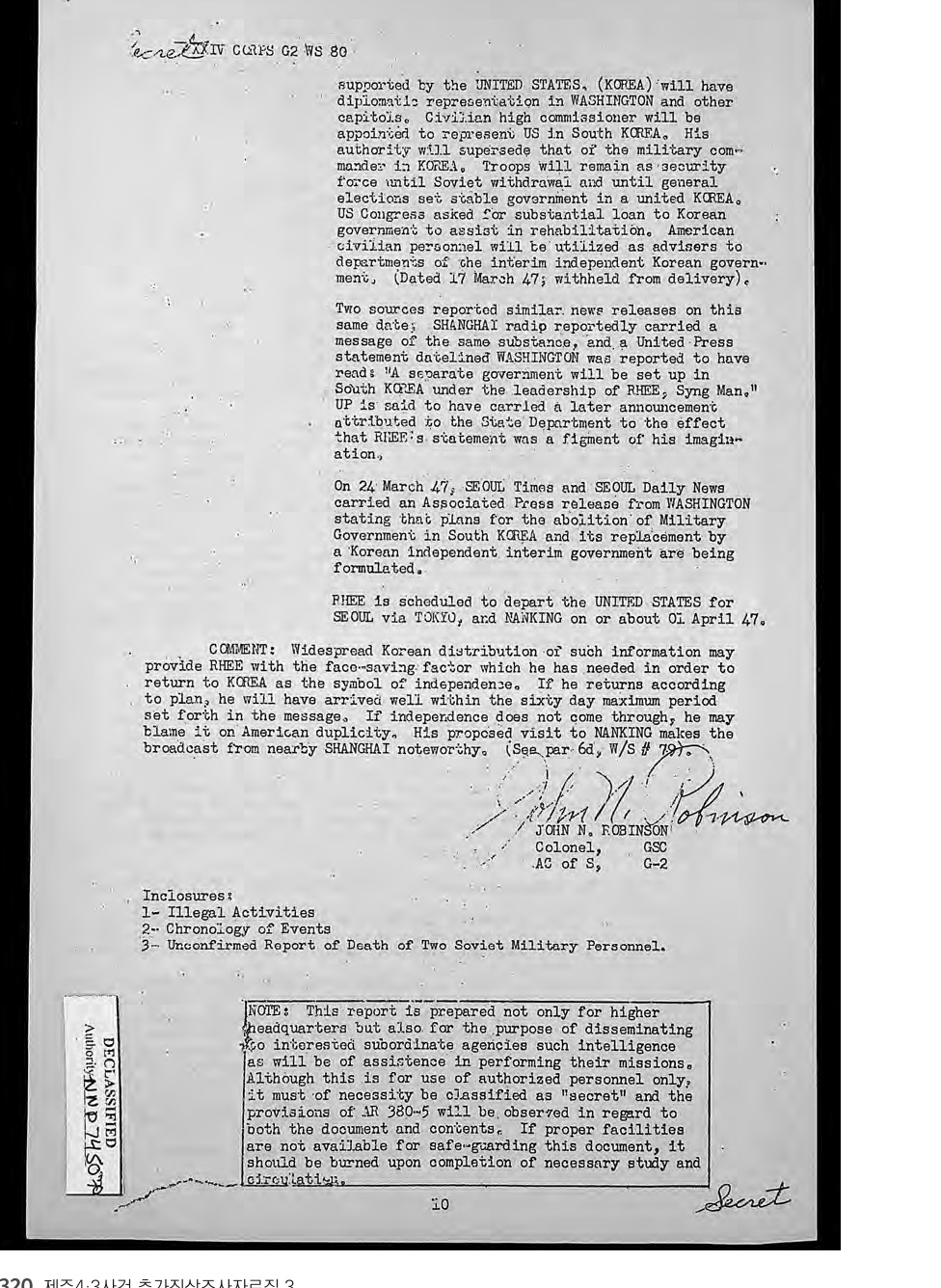
supported by the UNITED STATES, (KOREA) will have diplomatic representation in WASHINGTON and other capitols. Civilian high commissioner will be appointed to represent US in South KOREA. His authority will supersede that of the military commander in KOREA. Troops will remain as security force until Soviet withdrawal and until general elections set stable government in a united KOREA.
US Congress asked for substantial loan to Korean government to assist in rehabilitation. American civilian personnel will be utilized as advisers to departments of the interim independent Korean government. (Dated 17 March 47; withheld from delivery).
Two sources reported similar news releases on this same date; SHANGHAI radio reportedly carried a message of the same substance, and a United Press statement datelined WASHINGTON was reported to have
read: "A separate government will be set up in
South KOREA under the leadership of RHEE, Syng Man."
UP is said to have carried a later announcement attributed to the State Department to the effect that RHEE's statement was a figment of his imagination.
On 24 March 47, SEOUL Times and SEOUL Daily News carried an Associated Press release from WASHINGTON stating that plans for the abolition of Military
Government in South KOREA and its replacement by a Korean independent interim government are being formulated.
RHEE is scheduled to depart the UNITED STATES for
SEOUL via TOKYO, and NANKING on or about 01 April 47.
COMMENT: Widespread Korean distribution of such information may provide RHEE with the face-saving factor which he has needed in order to return to KOREA as the symbol of independence. If he returns according to plan, he will have arrived well within the sixty day maximum period set forth in the message. If independence does not come through, he may blame it on American duplicity. His proposed visit to NANKING makes the broadcast from nearby SHANGHAI noteworthy. (See par 6d, W/S # 79).
JOHN N. ROBINSON
Colonel, GSC
AC of S, G-2
Inclosures:
1- Illegal Activities
2- Chronology of Events
3- Unconfirmed Report of Death of Two Soviet Military Personnel.
NOTE: This report is prepared not only for higher headquarters but also for the purpose of disseminating to interested subordinate agencies such intelligence as will be of assistance in performing their missions.
Although this is for use of authorized personnel only, it must of necessity be classified as "secret" and the provisions of AR 380-5 will be observed in regard to both the document and contents. If proper facilities are not available for safe-guarding this document, it should be burned upon completion of necessary study and circulation.
10
DECLASSIFIED
Authority NND 74507
Secret
HEADQUARTERS XXIV CORPS
Office of the G-2
27 March 1947
ILLEGAL ACTIVITIES
A summary of civil disturbances, attacks on US troops, cases of illegal bearing of arms, and of unauthorized shipping reported during the period of 16 March to 23 March is given below:
[MAP OF KOREA WITH FOLLOWING LOCATION LABELS:]
SEOUL
YONGDONGP'O
KUNSAN
CHULPO
WOCHONG
CHEJU-DO
LEGEND
CIVIL DISTURBANCES SHOWN THUS . . .
ATTACKS ON US TROOPS SHOWN THUS . . .
ILLEGAL POSSESSION OF ARMS SHOWN THUS . .
UNAUTHORIZED SHIPPING SHOWN THUS . . .
DECLASSIFIED
Authority NND 74507A
Incl. # 1 to XXIV CORPS G2 WS 80 1 Confidential
Confidential
1. Civil Disturbances
CHEJU-DO (980-1130)(33°24'N-126°34'E)
19 March 47 - A CIC report dated 21 March states that information has been received from the National Police that 1,000 people approached CHUNG MUN jail on the Northeast coast of CHEJU Island and demanded the release of a prisoner. The people were armed with clubs and rocks. When the crowd began throwing rocks and attempted to rush the jail the police fired, wounding four people. The crowd dispersed.
CHULPO (960-1400)(35°36'N-126°40'E)
221100 March 47 - 2,000 Koreans moved into CHULPO, three policemen at DOAM police box retreated to the main police station. The mob followed and attacked the main station. The police fired into the mob killing four people. On 23 March bodies of three policemen were found in CHULPO reservoir, their hands and feet tied.
KUNSAN (1040-1460)(36°06'N-127°30'E)
220900 March 47 - 120 people gathered at SANEKA-RI four miles south of KUNSAN cut telephone wires and blocked a road. People resisted arrest. Three were seriously wounded, seventy arrests.
230400 March 47 - A mob of 500 people, reported to be Leftists, attacked the police box ten miles South of KUNSAN. The police fired into the mob, dispersing it and killing one person.
SEOUL (1000-1640)(37°34'N-127°00'E)
221135 March 47 - About 50 Council of All Korean Labor Union members stationed themselves at the gate of the Chosen Leather factory barring workers from entering the grounds. At about 0900 these 50 men beat various workers. The crowd involved about 200 persons. Approximately 20 persons were injured. Police arrested 19 of the Leftists. Interrogation of both the attackers and the injured is being conducted.
TAEGO (KUMSAN GUN) (Not on Map)
A mob of 1,000 moved into the town of TAEGO, KUMSAN GUN, and attacked police. Police retaliated with gun fire, killing three. The crowd was dispersed.
YONGDONGPO (990-1620)(37°31'n-126°54'E)
22 March 47 - At approximately 1300 a member of a Left Wing labor union was killed accidentally by a fellow member during a fight between the Right and Left Wing labor unions at a local factory.
241045 March 47 - Detective of the YONGDONGPO Police station, LEE, Kwang Ha, was killed by PARK, Chung Hyun, member of the South KOREA Labor Party. A group of police were proceeding to the headquarters of the South KOREA Labor Party and the Council of All Korean Labor Unions to raid same. As the police approached, PARK shot the detective, and attempted to flee. As he ran, PARK disposed of his pistol which has not been located. PARK was finally apprehended and is being held in the YONGDONGPO jail.
2. Attacks on US Troops
SEOUL
171530 March 47 - One round was fired at a US Army range officer from a hill north of the Seventh Division small arms range.
2 Confidential
DECLASSIFIED
Authority NND 74[illegible]
confidential
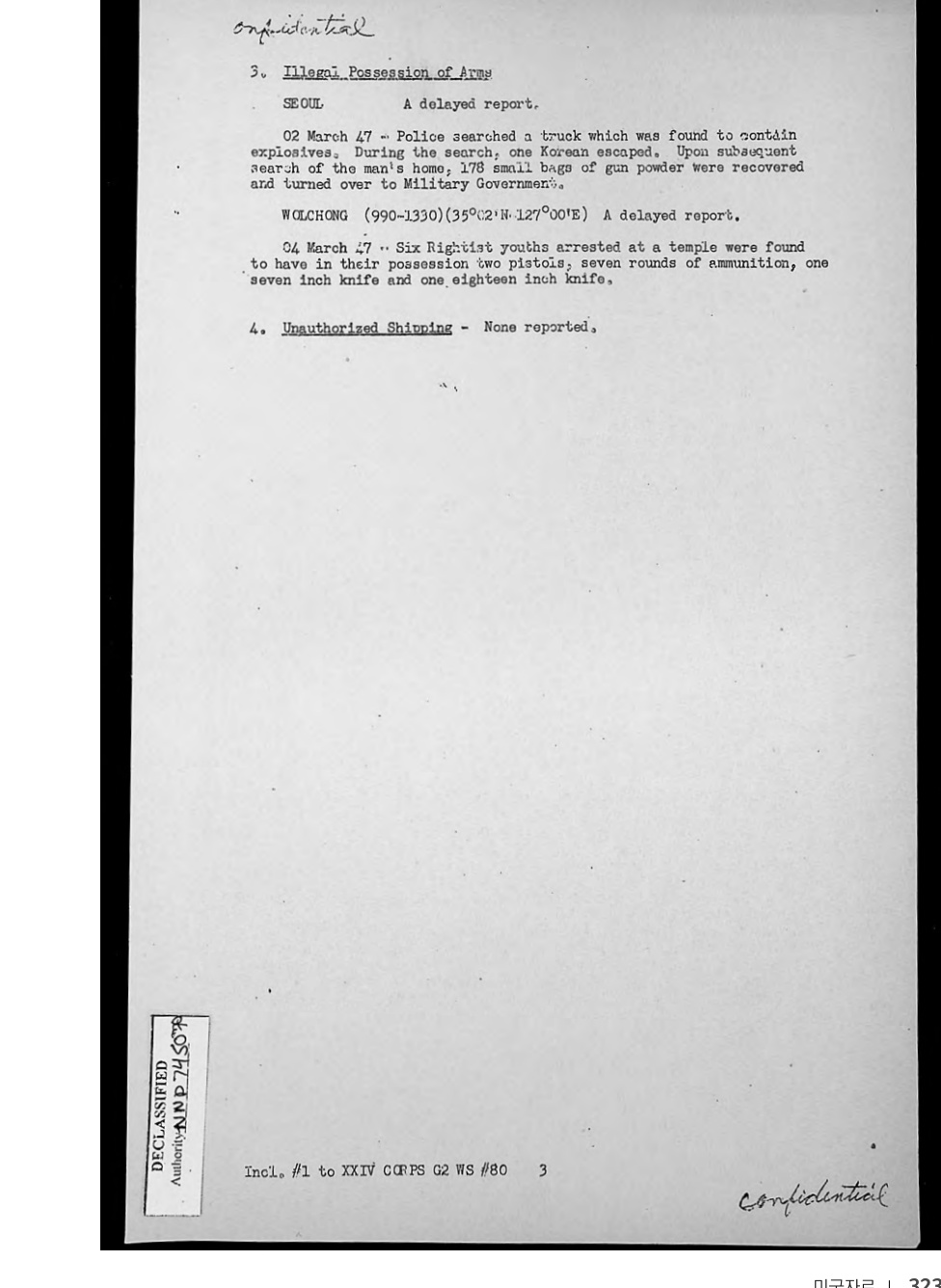
3. Illegal Possession of Arms
SEOUL A delayed report.
02 March 47 -- Police searched a truck which was found to contain explosives. During the search, one Korean escaped. Upon subsequent search of the man's home, 178 small bags of gun powder were recovered and turned over to Military Government.
WOLCHONG (990-1330)(35°02'N 127°00'E) A delayed report.
04 March 47 -- Six Rightist youths arrested at a temple were found to have in their possession two pistols, seven rounds of ammunition, one seven inch knife and one eighteen inch knife.
4. Unauthorized Shipping - None reported.
DECLASSIFIED
Authority NND 74509
Incl. #1 to XXIV CORPS G2 WS #80 3
confidential
출처:
제주4·3평화재단 편,
『추가진상조사자료집-미국자료1』,
p. 311–323.
— NARA (RG 554, Entry 1256, Box 58)
×
![]()