1949년 2월 정치요약
주한미사절단
제목: 1949년 2월 정치요약
존경하는 국무장관 귀하
1949년 1월 한국의 정치발전상황에 관해 보고한 1949년 2월 9일자 <급송문서> 제58호에 계속해 1949년 2월의 정치적 사건에 대한 개관을 보내게 돼 영광입니다.
I. 개요
언제 대한민국의 생존이 확실시 될 것인가에 관하여 <급송문서> 제58호에서 제기된 문제에 대해서는 아직도 확실한 해답을 얻을 수 없습니다.
사실 환자는 적어도 앞으로 몇 달 동안 중태에 있을 것이라는 징조들이 있습니다. 이것은 결코 중환자용 산소텐트를 가져오는 문제가 아닙니다. 오히려 일부 취약한 요소들이 과소평가 됐고 일부 회복의 징후를 너무 희망적으로 이해했다는 일반적인 인식의 문제로 보입니다.
이렇게 다시 평가하게 된 것은 초기 보고서들이 밝힌 바 있는 한국의 정체(政體)내 반란의 암에 대한 한국 방위군이 집행한 외과수술이 효과적인 수술이 아니었다는 데서 유래합니다.
제주도의 상황은 상상도 할 수 없을 정도로 이전에 비해 더욱 악화됐습니다. 전라남도에서는 공산주의자들이 겨울철 동안 성공적으로 소요를 이끌었으며 사실상 전도에서 계속 소요를 일으킨 모든 징조들을 보여줬습니다. 게릴라 활동은 조금 작은 규모로 도처에서 계속됐으며 특히 경상북도에서 심했습니다.
그 밖의 사항들은 과도하게 조성되지 않았습니다. 대통령의 반대에도 불구하고 반민족행위자처벌법을 시행하기 위한 국회의 시도와 관련해 행정부와 국회의 논쟁이 새롭게 나타났습니다.
국회 자체는 이 달에 법안을 하나도 통과시키지 못할 정도로 조사와 결의, 비난에 너무 많은 시간을 투자했습니다. 정부기관내 몇 개의 물의를 일으킨 사건들이 이번 달에 나왔으나 농무부장관을 교체한 것을 제외하고는 개인이나 행정운영방법에서의 중요한 변화가 일어나지 않았습니다.
정부는 마침내 곡물(미곡)매입 계획이 실패했다고 시인했으나 지난 봄의 식량부족 위협을 경감하기 위한 효과적인 조처를 취하는데는 실패했습니다.
마지막으로 비록 최종 판단을 하기에는 아직 너무 이르지만 유엔한국위원단이 남북한을 통일시키는 기적을 달성한다거나 가까운 장래에 그렇게 할 것이라는 증거가 없다는 것은 주목할 만합니다.
이런 상황을 기록하면서 더욱 유쾌한 진전상황을 간과할 의도는 없습니다. 대통령은 처음으로 남한의 각지에서 일어나는 게릴라 활동의 심각성을 이전에 비해 더 잘 알고 있는 것으로 보였습니다. 그는 개인적 개입을 통해 더욱 강력한 경찰, 군, 해군 작전이 더 좋은 결과를 나타낼 것이라고 일부 약속을 했습니다.
또한 경제협조처의 한국에 대한 지원 선적과 계획에 더욱 많은 관심을 집중했습니다. 사업가들과 정부관료들은 경제회복을 위한 장기계획을 생각하기 시작했습니다.
자신들의 업무를 밀어붙이는 데 있어 유엔한국위원단은 패배를 시인하지 않았으며 무엇인가 아직 성취되지 않은 한국인들의 희망을 살아있게 했습니다.
그러나 대한민국의 순수한 균형은 건전함과 거리가 있다는 것이 확실한 것으로 보입니다. 1949년 봄철의 사건들은 자신들의 실패를 결정하는데 결정적일지도 모릅니다. (중략)
II. 남한의 평온상태
국무총리가 이야기를 한 태도로 봐서 남한의 평화와 질서의 개선조짐은 거의 보이지 않습니다. 제주도의 상황이 대단히 훌륭하게 개선됐다며 1월 제주도에서 해제된 계엄령은 2월 5일 비슷한 낙관적인 전망을 갖고 전라남도에서도 해제됐습니다.
육군참모총장 채병덕 소장은 양지역의 고립된 지역에 대한 소탕작전이 곧 끝날 것이라고 언급했습니다. 언론은 남로당과 가맹단체의 당원 및 회원들에 대한 끊임없는 체포를 보도하는 한편 동시에 청년 및 학생을 포함하여 주민 대부분이 정부를 적극 지지하는 것으로 묘사했습니다.
한국군은 1,000명 이상이 석방된 ‘바람직하지 않은’ 분자들에 대한 심사를 사실상 완료했다고 덧붙였습니다. 38선 충돌은 군과 경찰이 쉽게 처리할 수 있는 단순 보복성의 습격으로서 해산됐습니다. 대통령은 언론에 ‘한국은 중국과 같지 않다’고 언급했습니다.
이런 장미빛 그림이 객관적으로 관찰하는 전망과 일치하지 않는 것은 불행한 일입니다. 사절단에 들어온 보고서에 따르면 제주도는 이전보다 혼란이 더욱 악화된 것으로 밝혀졌습니다. 게릴라 도당들은 섬의 중심부를 관통해 마음대로 날뛰고 있습니다. 단지 큰 읍면 가까운 일부 해안지역과 1마일 내륙만이 공산주의자들의 활동으로부터 안전합니다. 한국군이 방어성향의 전술을 구사하는 동안 게릴라들은 섬의 마을 가운데 70%를 파괴했습니다.
수만 명의 피난민들이 어떤 형태이든지 피난처와 식량을 구하기 위해 읍 교외에 붐비고 있습니다. 전라남도는 이런 지경까지 이르지 않았지만 희망은 없어 보입니다.
통신선은 때때로 사보타주의 대상이 되지만 대도시와 주요 국도, 철도, 통신선은 정부의 수중에 있습니다. 그러나 대다수의 농촌 주민들은 전혀 평화로운 상태가 아닙니다. 제주도에서처럼 약탈을 일삼는 무리들은 군이 하루 8시간 동안 전투를 하는 사이 도 전역에서 날뛰고 있습니다. 마을 주민들은 양쪽의 전투 사이에서 갇혔습니다.
반란군들이 주민들의 물건을 노획하면 군은 주민들을 반란자들을 도왔다는 이유로 처벌하고 있습니다. 만일 주민들이 반란군들을 거부한다면 그들은 ‘인민의 적’으로 총살당합니다. 게릴라 활동이 고난에 찬 겨울철 내내 펼쳐지면서 진압군에 의해 급격한 변화가 취해지지 않는다면, 봄과 여름에 더욱 악화될 것이라는 것은 명백했습니다.
이남규 지사는 개인적으로 사절단 장교에게 정부가 과감성 있는 조처를 취하지 않는다면 상황이 더욱 악화될 것이라며 개인적으로 상황에 대해 절망했습니다.
(중략)
사절단 영사 에버레트 드럼라이트
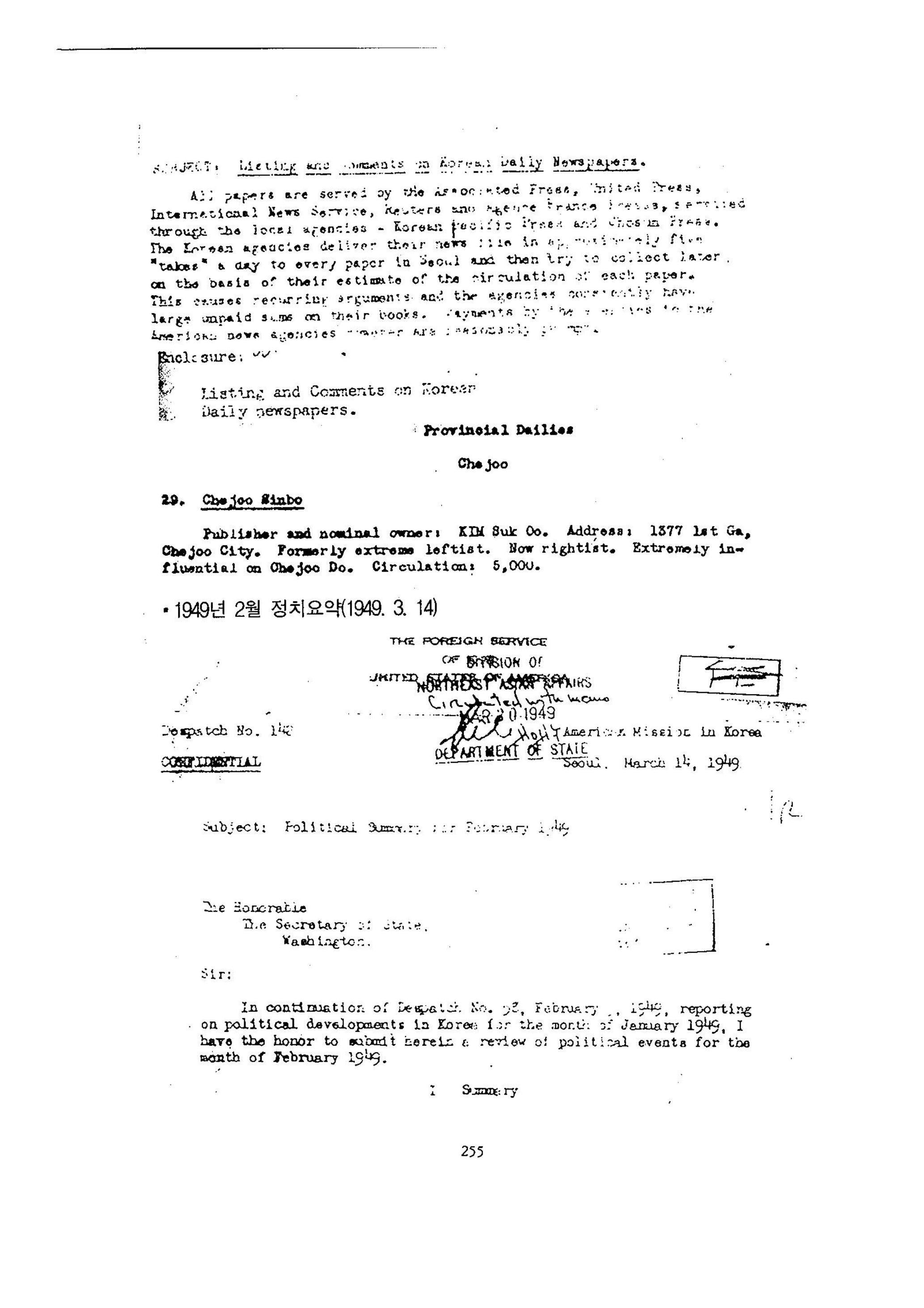
THE FOREIGN SERVICE
OF BYRSION OF
UNITED STATES OF AMERICA AFFAIRS
Circulated with the wave
0-1949
Despatch No. 146
Joint American Mission in Korea
DEPARTMENT OF STATE
CONFIDENTIAL
Seoul. March 14, 1949
Subject: Political Summary for February 1949
The Honorable
The Secretary of State,
Washington.
Sir:
In continuation of Despatch No. 52, February 1, 1949, reporting on political developments in Korea for the month of January 1949, I have the honor to submit herein a review of political events for the month of February 1949.
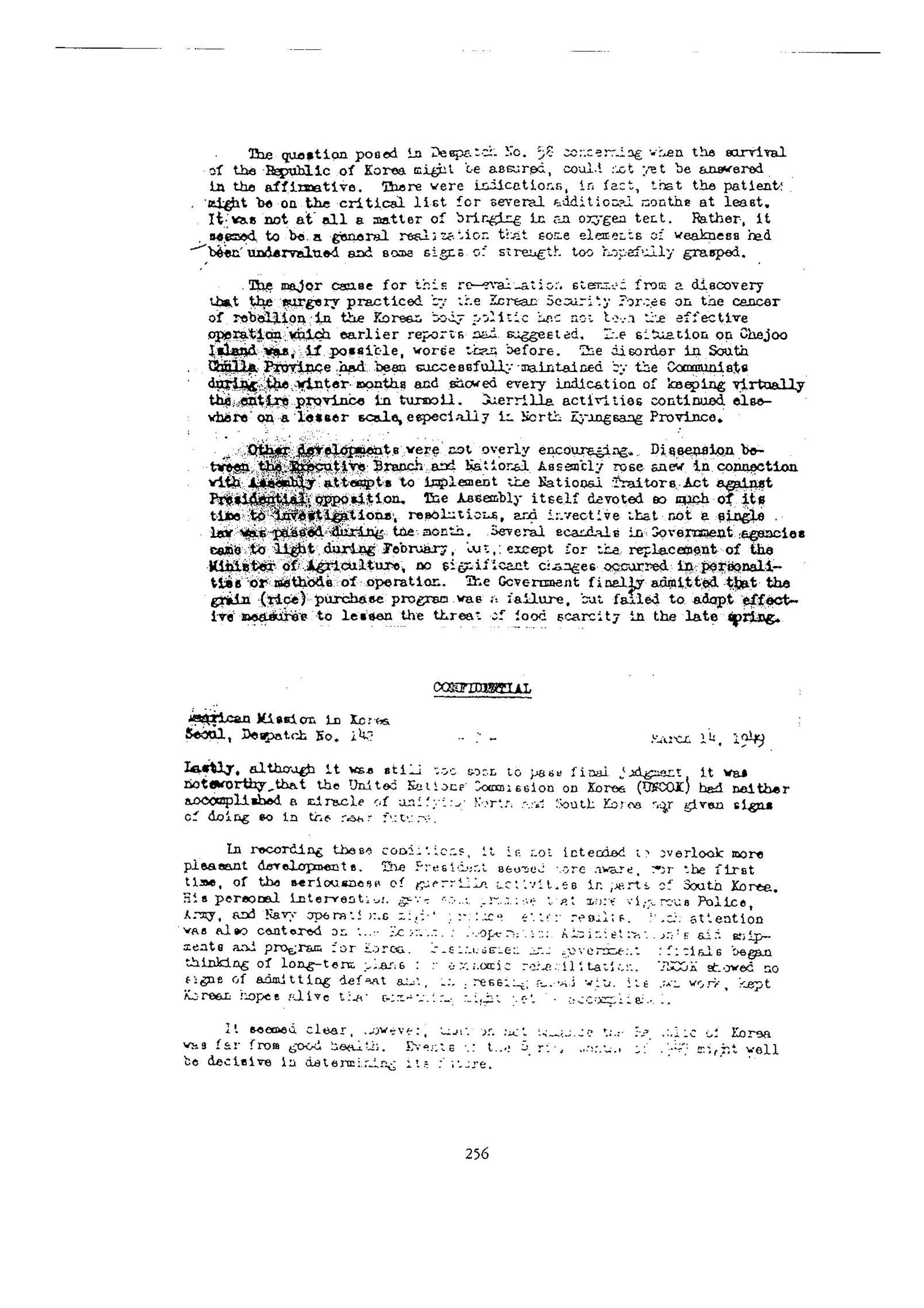
I Summary The question posed in Despatch No. 58 concerning when the survival of the Republic of Korea might be assured, could not yet be answered in the affirmative. There were indications, in fact, that the patient might be on the critical list for several additional months at least. It was not at all a matter of bringing in an oxygen tent. Rather, it seemed to be a general realization that some elements of weakness had been undervalued and some signs of strength too hopefully grasped.
The major cause for this re-evaluation stemmed from a discovery that the surgery practiced by the Korean Security Forces on the cancer of rebellion in the Korean body politic had not been the effective operation which earlier reports and suggested. The situation on Chejoo Island was, if possible, worse than before. The disorder in South Chulla Province had been successfully maintained by the Communists during the winter months and showed every indication of keeping virtually the entire province in turmoil. Guerrilla activities continued elsewhere on a lesser scale, especially in North Kyungsang Province.
Other developments were not overly encouraging. Dissension between the Executive Branch and National Assembly rose anew in connection with Assembly attempts to implement the National Traitors Act against Presidential opposition. The Assembly itself devoted so much of its time to investigations, resolutions, and invective that not a single law was passed during the month. Several scandals in Government agencies came to light during February, but, except for the replacement of the Minister of Agriculture, no significant changes occurred in personalities or methods of operation. The Government finally admitted that the grain (rice) purchase program was a failure, but failed to adopt effective measures to lessen the threat of food scarcity in the late spring.
CONFIDENTIAL
American Mission in Korea
Seoul, Despatch No. 149 .. 5 -
March 14, 1949
Lastly, although it was still too soon to pass final judgment, it was noteworthy that the United Nations Commission on Korea (UNCOK) had neither accomplished a miracle of unifying North and South Korea nor given signs of doing so in the near future.
In recording these conditions, it is not intended to overlook more pleasant developments. The President seemed more aware, for the first time, of the seriousness of guerrilla activities in parts of South Korea. His personal intervention, gave [illegible] promise of at more vigorous Police, Army, and Navy operations [illegible] [illegible] other respects. [illegible] attention was also centered on [illegible] [illegible] [illegible] [illegible] Administration. [illegible] aid shipments and program for Korea. [illegible] [illegible] government officials began thinking of long-term plans for economic rehabilitation. UNCOK showed no signs of admitting defeat and, in pressing ahead with the [illegible] work, kept Korean hopes alive that [illegible] [illegible] [illegible] [illegible] accomplished [illegible]
It seemed clear, however, that on [illegible] the [illegible] [illegible] of Korea was far from good health. Events of the 5 months [illegible] [illegible] might well be decisive in determining its future.
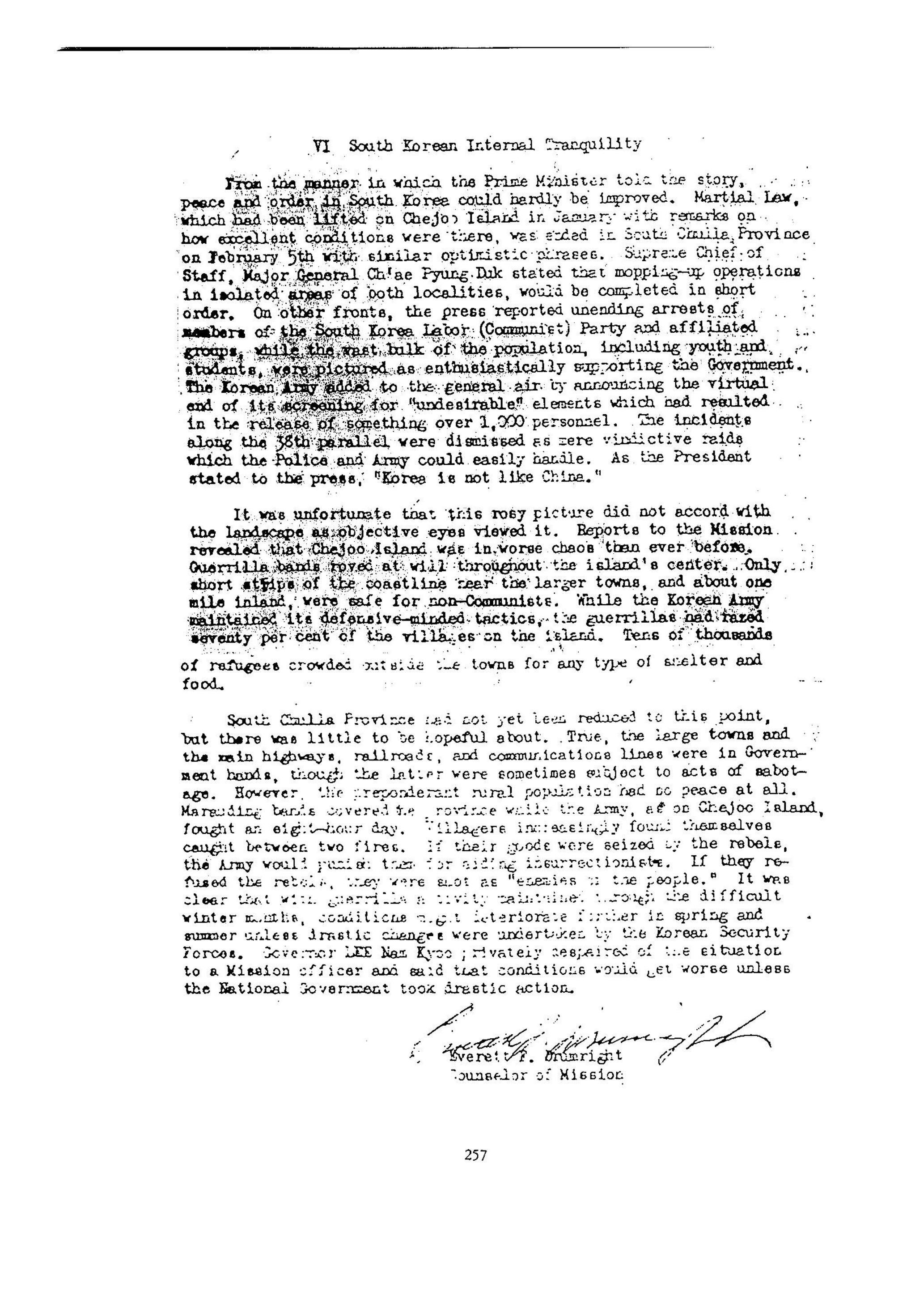
VI South Korean Internal Tranquility
From the manner in which the Prime Minister told the story, peace and order in South Korea could hardly be improved. Martial Law, which had been lifted on Chejoo Island in January with remarks on how excellent conditions were there, was sided in South Chulla Province on February 5th with similar optimistic phrases. Supreme Chief of Staff, Major General Chae Pyung Duk stated that mopping-up operations in isolated areas of both localities, would be completed in short order. On other fronts, the press reported unending arrests of members of the South Korea Labor (Communist) Party and affiliated groups, while the vast bulk of the population, including youth and students, were pictured as enthusiastically supporting the Government. The Korean Army added to the general air by announcing the virtual end of its screening for "undesirable" elements which had resulted in the release of something over 1,000 personnel. The incidents along the 38th parallel were dismissed as mere vindictive raids which the Police and Army could easily handle. As the President stated to the press, "Korea is not like China."
It was unfortunate that this rosy picture did not accord with the landscape as objective eyes viewed it. Reports to the Mission revealed that Chejoo Island was in worse chaos than ever before. Guerrilla bands royed at will throughout the island's center. Only short strips of the coastline near the larger towns, and about one mile inland, were safe for non-Communists. While the Korean Army maintained its defensive-minded tactics, the guerrillas had razed seventy per cent of the villages on the island. Tens of thousands of refugees crowded outside the towns for any type of shelter and food.
South Chulla Province had not yet been reduced to this point, but there was little to be hopeful about. True, the large towns and the main highways, railroads, and communications lines were in Government hands, though the latter were sometimes subject to acts of sabotage. However, the preponderant rural population had no peace at all. Marauding bandsovered the province while the Army, as on Chejoo Island, fought an eight-hour day. Villagers increasingly found themselves caught between two fires. If their goods were seized by the rebels, the Army would punish them for aiding insurrectionists. If they refused the rebels, they were shot as "enemies of the people." It was clear that with guerrilla activity maintaining [illegible] the difficult winter months, conditions might deteriorate further in spring and summer unless drastic changes were undertaken by the Korean Security Forces. Governor LEE Nam Kyoo privately despaired of the situation to a Mission officer and said that conditions would get worse unless the National Government took drastic action.
Everett F. Drumright
Counselor of Mission
출처:
제주4·3사건진상규명및희생자명예회복위원회 편,
『제주4·3사건자료집 11』 [미국자료편],
번역문 p.60
/ 원문 p.255–257 / No. 142.
×
![]()