미의회기록(Congressional Record), 제95권, A3093
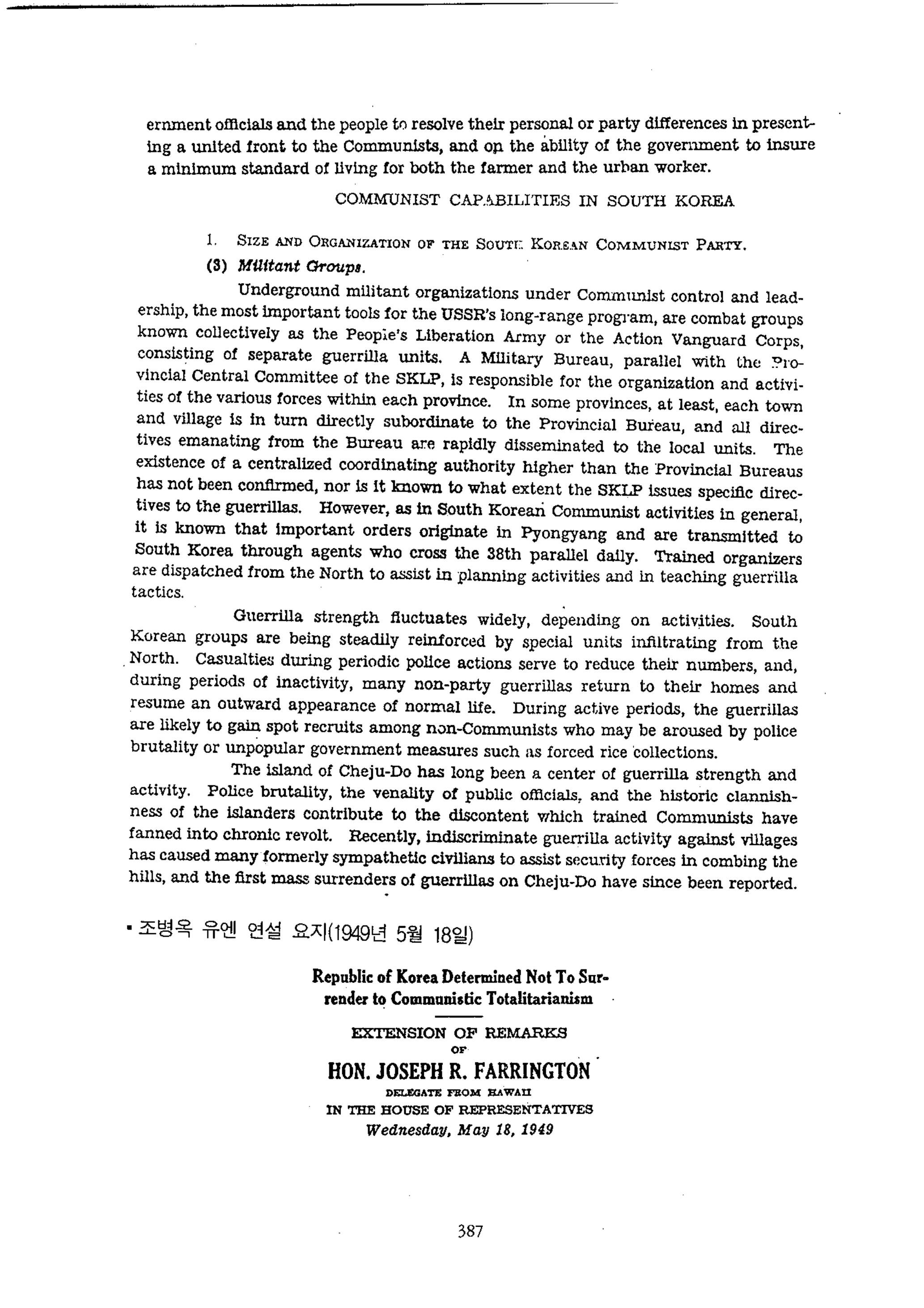
하원의원 패링턴(Farrington‧Hawaii)은 유엔 한국 수석대표이자 이승만 대통령의 특사인 조병옥의 연설내용을 채택하였다.
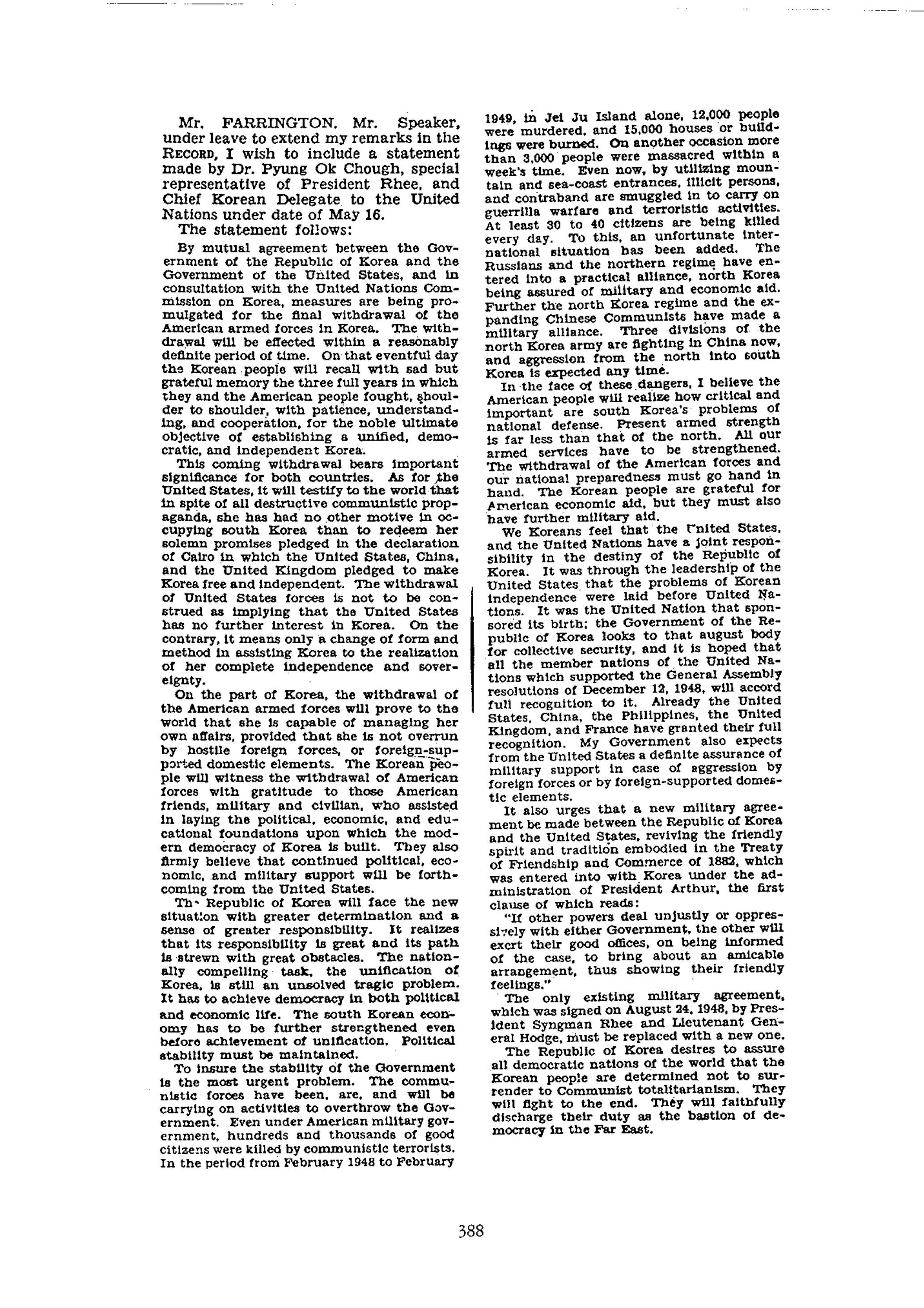
발언요지: 미군의 철수상황에서 남한의 경제적 정치적 안정은 매우 긴급한 사항이다. 이러한 목표를 달성하기 위해서는 정부의 안정이 최우선 과제이다. 공산주의 세력은 정부의 전복을 기도하기 위한 활동을 하고 있으며 앞으로도 계속될 것이다. 미군정 하에서조차도 공산폭도들에 의하여 수많은 양민이 학살당하였다. 1948년 2월과 1949년 2월 사이에 제주섬 한 군데서만 1만 2,000명의 인원이 살해당하였으며 1만 5,000채의 가옥과 빌딩이 불탔다. 다른 사건에서는 한 주일에 3,000명 이상의 인명이 살상 당했다. 폭도들은 산악과 해안선을 이용하여 게릴라전과 테러활동을 감행하고 있다. 적어도 하루에 30~40명의 시민들이 살해당하고 있다. 소련과 북한은 사실상 동맹관계로서 군사적, 경제적 원조를 통하여 맺어져 있으며 중국 공산당도 북한 정권과 군사적인 동맹을 맺었다. 이러한 상황에서 남한은 언제라도 북한으로부터 침략을 당할 수 있는 상황이다. 현재의 한미군사협약은 군사동맹관계를 위한 조약으로 발전되어야 한다.
**Republic of Korea Determined Not To Surrender to Communistic Totalitarianism**
EXTENSION OF REMARKS
OF
**HON. JOSEPH R. FARRINGTON**
DELEGATE FROM HAWAII
IN THE HOUSE OF REPRESENTATIVES
*Wednesday, May 18, 1949*
--- p401 ---
Mr. FARRINGTON. Mr. Speaker, under leave to extend my remarks in the RECORD, I wish to include a statement made by Dr. Pyung Ok Chough, special representative of President Rhee, and Chief Korean Delegate to the United Nations under date of May 16.
The statement follows:
By mutual agreement between the Government of the Republic of Korea and the Government of the United States, and in consultation with the United Nations Commission on Korea, measures are being promulgated for the final withdrawal of the American armed forces in Korea. The withdrawal will be effected within a reasonably definite period of time. On that eventful day the Korean people will recall with sad but grateful memory the three full years in which they and the American people fought, shoulder to shoulder, with patience, understanding, and cooperation, for the noble ultimate objective of establishing a unified, democratic, and independent Korea.
This coming withdrawal bears important significance for both countries. As for the United States, it will testify to the world that in spite of all destructive communistic propaganda, she has had no other motive in occupying south Korea than to redeem her solemn promises pledged in the declaration of Cairo in which the United States, China, and the United Kingdom pledged to make Korea free and independent. The withdrawal of United States forces is not to be construed as implying that the United States has no further interest in Korea. On the contrary, it means only a change of form and method in assisting Korea to the realization of her complete independence and sovereignty.
On the part of Korea, the withdrawal of the American armed forces will prove to the world that she is capable of managing her own affairs, provided that she is not overrun by hostile foreign forces, or foreign-supported domestic elements. The Korean people will witness the withdrawal of American forces with gratitude to those American friends, military and civilian, who assisted in laying the political, economic, and educational foundations upon which the modern democracy of Korea is built. They also firmly believe that continued political, economic, and military support will be forthcoming from the United States.
The Republic of Korea will face the new situation with greater determination and a sense of greater responsibility. It realizes that its responsibility is great and its path is strewn with great obstacles. The nationally compelling task, the unification of Korea, is still an unsolved tragic problem. It has to achieve democracy in both political and economic life. The south Korean economy has to be further strengthened even before achievement of unification. Political stability must be maintained.
To insure the stability of the Government is the most urgent problem. The communistic forces have been, are, and will be carrying on activities to overthrow the Government. Even under American military government, hundreds and thousands of good citizens were killed by communistic terrorists. In the period from February 1948 to February
1949, in Jei Ju Island alone, 12,000 people were murdered, and 15,000 houses or buildings were burned. On another occasion more than 3,000 people were massacred within a week's time. Even now, by utilizing mountain and sea-coast entrances, illicit persons, and contraband are smuggled in to carry on guerrilla warfare and terroristic activities. At least 30 to 40 citizens are being killed every day. To this, an unfortunate international situation has been added. The Russians and the northern regime have entered into a practical alliance, north Korea being assured of military and economic aid. Further the north Korea regime and the expanding Chinese Communists have made a military alliance. Three divisions of the north Korea army are fighting in China now, and aggression from the north into south Korea is expected any time.
In the face of these dangers, I believe the American people will realize how critical and important are south Korea's problems of national defense. Present armed strength is far less than that of the north. All our armed services have to be strengthened. The withdrawal of the American forces and our national preparedness must go hand in hand. The Korean people are grateful for American economic aid, but they must also have further military aid.
We Koreans feel that the United States, and the United Nations have a joint responsibility in the destiny of the Republic of Korea. It was through the leadership of the United States that the problems of Korean independence were laid before United Nations. It was the United Nation that sponsored its birth; the Government of the Republic of Korea looks to that august body for collective security, and it is hoped that all the member nations of the United Nations which supported the General Assembly resolutions of December 12, 1948, will accord full recognition to it. Already the United States, China, the Philippines, the United Kingdom, and France have granted their full recognition. My Government also expects from the United States a definite assurance of military support in case of aggression by foreign forces or by foreign-supported domestic elements.
It also urges that a new military agreement be made between the Republic of Korea and the United States, reviving the friendly spirit and tradition embodied in the Treaty of Friendship and Commerce of 1882, which was entered into with Korea under the administration of President Arthur, the first clause of which reads:
"If other powers deal unjustly or oppressively with either Government, the other will exert their good offices, on being informed of the case, to bring about an amicable arrangement, thus showing their friendly feelings."
The only existing military agreement, which was signed on August 24, 1948, by President Syngman Rhee and Lieutenant General Hodge, must be replaced with a new one.
The Republic of Korea desires to assure all democratic nations of the world that the Korean people are determined not to surrender to Communist totalitarianism. They will fight to the end. They will faithfully discharge their duty as the bastion of democracy in the Far East.
출처:
제주4·3사건진상규명및희생자명예회복위원회 편,
『제주4·3사건자료집 10』 [미국자료편],
번역문 p.198
/ 원문 p.387–389.
×
![]()