분석 보고서
주한미육군사령부 정보참모부 주간요약보고
Analysis of Korean Government Organization Act and Constitutional Powers
1948-07-23
· 보고일 1948-07-23
미국무부
U.S. Department of State
스캔 원본
100%
p.-8
p.-7
p.-6
p.-5
p.-4
p.-3
p.-2
p.-1
p.0
p.1
p.2
p.3
p.4
p.5
p.6
p.7
p.8
p.9
p.10
p.11
p.12
p.13
p.14
p.15
그의 정지 및 폐지권은 그러한 명령이나 처분이 부적절하거나 위법이라고 간주되는 경우에 존재한다.
"정부조직법 제2조는 국무총리 및 각 장관의 지위를 약화시킨다.
"헌법 제66조는 모든 국가사무 문서가 국무총리 또는 해당 장관에 의해 부서명으로 서명되어야 한다고 규정하고 있다. 행정부의 모든 조직의 활동이 국무총리실과 각 부처에 의해 권위 있게 서명되어야 하므로, 부서의 반대서명은 관례가 된다.
"헌법 제72조는 특정 중요 사항을 국무회의에 제출하도록 규정하고 있으며, 여기에는 '국무총리 또는 각 장관이 제시한 사항'이 포함된다. 국무회의는 다수결로 결정되며(제71조), 국무총리 및 각 장관의 활동에 대해 직접 통제 및 감시 권한을 부여하며, 대통령은 국무회의의 결정을 쉽게 무시할 수 있고 국무총리와 각 장관이 국무회의에 중요 사항을 제출하는 것을 금지할 수 있다.
"정부조직법 제2조는 지방 자치행정기관의 지위를 약화시키며 헌법 제7장에 인정된 지방자치행정의 원칙과 불일치한다. 이것은 대통령에게 위법으로 간주하는 모든 경우에 지방 자치행정기관의 조치를 정지 및 폐지할 권한을 부여한다. 자치행정기관이 제거될 수 없는 자치행정의 최소 독립성 요건을 결여하는 경우 지방자치는 불가능하다.
"정부조직법 제7조는 국회의 지위를 약화시키며 일반적으로 인정된 입법부의 예산권과 불일치한다.
"정부조직법 제7조는 대통령에게 '규정에 따라... 각 정부 기관의 정부 직원의 인원 및 급여 분류를 대통령령으로 결정'하도록 권한을 부여한다. 헌법 제91조에 따르면 회계연도의 모든 수입과 지출을 포함하는 예산은 매년 국회에 제출되어야 한다. 정부조직법이 국회가 헌법 제91조에서 제정된 5일 전에 정부조직법 제정 전에 헌법상 문구 '예산'을 '세출'이라는 의미의 광범위한 의미로 사용했다고 주장하기에는 안전하지 않다. 한국 국회는 상세한 지출 항목을 포함하는 예산을 고려할 의도가 있었으며, 각 정부 기관의 직원 고용 및 급여 결정 형태로 표현할 충분한 지출 항목이 있었다. 대통령은 입법부에 유보된 기능을 조건부로 행사하며 정부 공무원을 창설 및 폐지하고 각 정부 공무원의 급여를 고정할 권한을 부여받았으며, 대통령은 전체 한국 관료제에 대해 실질적으로 무제한의 권한을 행사한다.
"정부조직법 제19조는 법원의 지위를 약화시키며 사법부의 독립성과 거의 일치하지 않는다.
"정부조직법 제19조에 따르면 법무부장관은 '행정부 인사 문제에 대한 사법권을 가져야 한다'고 규정하고 있다.
사법부는 대통령의 지휘와 통제에 종속된다. 대통령은 사법부 판사의 임명, 승진, 재임명, 급여 및 전보에 관한 최종 결정권을 가진다. 단, 대법원장은 예외이다. 정부조직법 제19조는 실질적으로 대법원조직법과는 다르며, 대법원조직법은 사법부에 대한 자문위원회 조직을 규정한 반면, 정부조직법 제19조는 '사법행정을 위한 대법원의 최고 자문기구'인 판사회의 설치를 규정하고 있다. 정부조직법과 제19조의 주요 차이는 대법원조직법 제11조에서 대법원장이 판사 추천에 대해 국무위원회의 의견을 따를 의무가 없다는 점이고, 정부조직법에서는 대법원장이 독립적인 위원회나 기구의 추천을 따를 의무가 없으며, 사법부 장관의 임명은 대통령이 정한 정책을 집행할 책임이 있는 정치적 임명직이다.
"총리와 장관들: 정부조직법은 대법원의 관할권을 매우 상세히 규정하고 있으며, 총리, 부장관, 그리고 일반 문제의 국장을 포함한다.
"네 개의 문서 사무실이 총리에 종속된다.
"여러 부서의 장을 포함한 이들 문서 장관들이 단순히 대통령의 대리인이라는 사실을 고려할 때, 이들 사무실 장관들이 대통령과 부서장들의 '명령을 이행'하고 '각 부서에 설립된 명령과 조치들을 중단 및 폐지'함으로써 총리와 부서장들이 행사하는 권력을 조정하기 위해 대통령의 '권한을 행사할 수 없다'는 것은 오도적이다(정부조직법 제27조).
"대통령을 제외하고, 총리와 내무부 장관이 정부에서 가장 영향력 있는 직책을 차지하고 있다. 총리는 국무회의의 의장이자 국무위원회의 상급자이며, 계획 국장이자 입법부 국장으로서 정부의 일반 정책, 특히 예산 및 전반적인 경제 정책과 관련된 사항에서 상당한 영향력을 행사할 수 있다.
"내무부 장관은 정부의 핵심 행정 담당자로서 경찰의 우두머리이자, 도지사들의 상급자이며, 지방 자치 기구의 감독관이다. 정부의 모든 행정 수준에서 일상적인 행정 업무에 대한 책임을 진다. 내무부 장관은 관리 회의를 통해 상당한 정치적 영향력을 행사할 수 있다. 공무원 제도: 공무원의 규정은 극히 막연하다. 정부조직법은 특정하게 달리 규정되지 않는 한 모든 정부 직원의 임명 및 선택을 위해 공무원 위원회를 규정하고 있다(제8조). 공무원 위원회의 정치적 중요성은 공무원 규칙이 제정되기 전까지는 결정될 수 없으며, 어떤 정부 직책이 공무원 규칙에서 면제될 것인지는 아직 알 수 없다.
b. 생활비
20~25개 항목의 생활비에서 대부분 하락이 나타났다. 7월 13~17일 사이 서울에서 조사한 한국 양배추와 무에서 지난주의 상승이 이번주 하락으로 이어졌고, 각각 34%와 12% 하락했다. 단 3개 항목만 상승했다. 밀은 여전히 9% 올랐고, 보리는 6% 올랐으며, 계란은 9% 올랐다.
7월 23일 서울에서 소주 가격은 일일 소주 1010원으로 연속 2주 동안 하락했다(10원).
*서울에서 조사한 생활비 항목 (7월 13~17일)
(이전주 대비 증가(+) 또는 (-) 감소)
- 정백미 매치스 - 핀넬로떼
- 보리 소고기 - 명주천 (천)
- 콩국수 돼지고기 - 실크 스란두 (이1.)
- 팥 콩 계란 - 스틱 우육 쌍 ('t'
- 붉은 콩 야채 양배추 - 스틱 양말
- 말린 숭어(생선) 무 - 앙트라시
- 설탕 무 - 나무장작
- 소금 세탁 비누 - 목탄
쌀 가격 요약 - 월별 평균
단위: 1 소주 말 (16.67 파운드)
1월 2월 3월 4월 5월 6월 7월 16*
서울 743 746 707 655 740 895 1010
강화도도 791 850 772 750 816 920
중구초점 푸크도 586 657 654 600 738 943
중구초점 난도 630 662 613 676 660 860
경기도 푸크도 541 550 502 550 583 807
경기도 난도 650 707 650 640 666 868
초리아 푸크도 608 608 550 566 703 850
초리아 난도 558 576 508 641 798 875
대구도 733 680 617 740 733 988
평균 648 676 619 659 706 889
출처: 국가 물가 청, SKIG
정보참모부 주간요약보고
보고 기간: 1948년 7월 16일~1948년 7월 23일
주한미육군사령부
서울, 조선
1948년 7월 23일 제149호
A. 군대
1. 병력 (2급 비밀)
경찰: 변동 없음.
경비대: 56,013명 (선서하지 않은 신병 3,695명 포함) 신원조회 중.
해안경비대: 2,925명
2. 작전 활동 (3급 비밀)
c. 제주도에서의 경비대 작전 제주도에 대한 경비대 작전은 부대 재편성에 국한돼 있다. 제주도에 주둔하고 있는 제11연대는 7월 23일 수원(1102-1609) 인근 지역으로 이동할 작정이다. 제9연대에 배속될 제3여단 소속 2개 대대가 7월 21일 부산에서 제주도로 이동했다.
B. 현용 정보
4. 민간인 소요
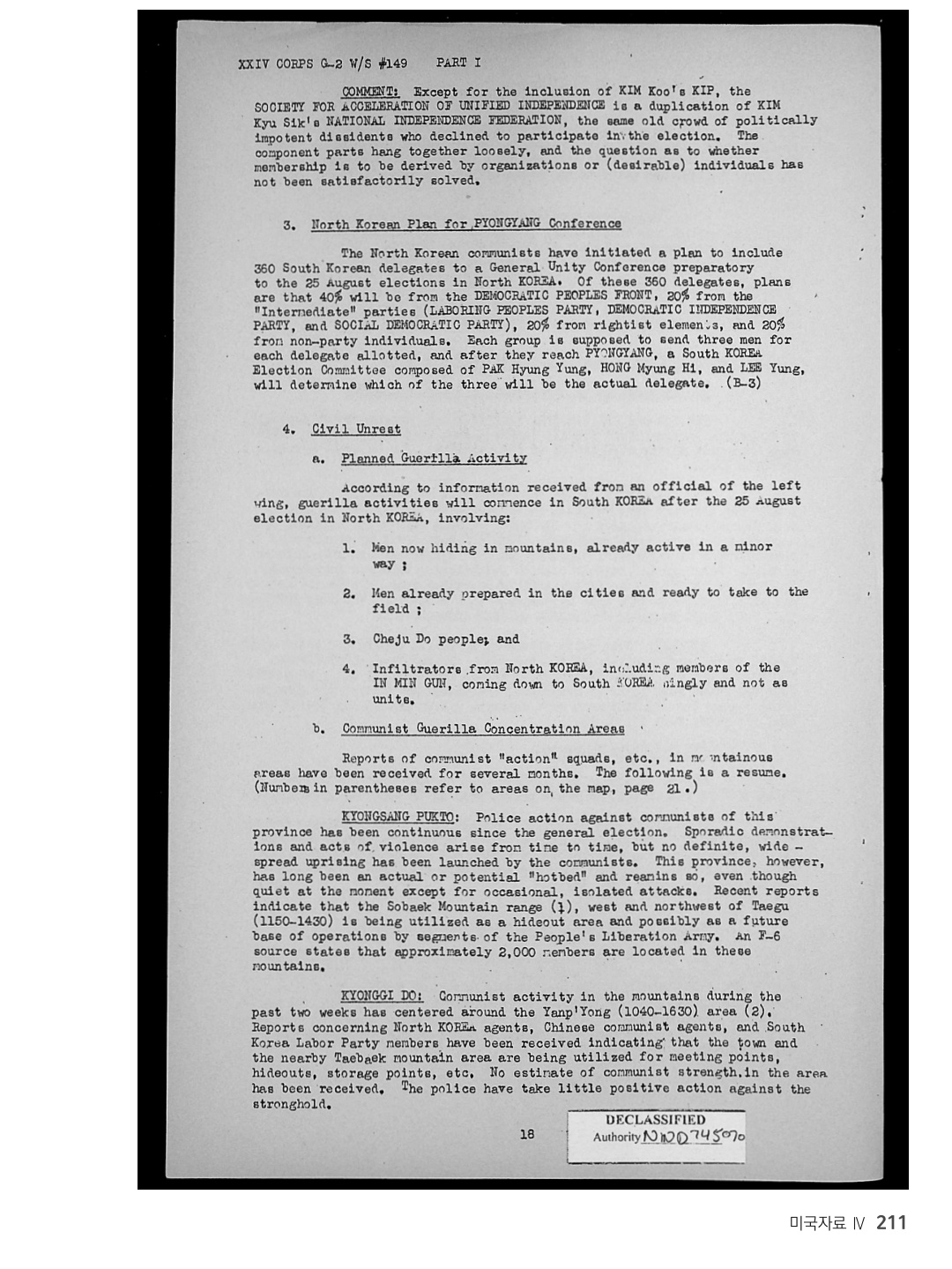
a. 계획된 게릴라 활동 좌익 관계자로부터 입수한 정보에 따르면, 북조선의 8월 25일 선거 이후 남조선에서 다음과 같은 게릴라 활동이 시작될 것이라 한다.
1. 소소한 방식으로 이미 활동 중인 산에 숨어 있는 자들
2. 도시에서 이미 준비를 마치고 전투에 나설 태세가 돼 있는 자들
3. 제주도 인민, 그리고
4. 부대 단위가 아니라 개별적으로 북조선에서 남조선으로 내려와 잠입하려는
자들. 여기에는 인민군 구성원들도 포함된다.
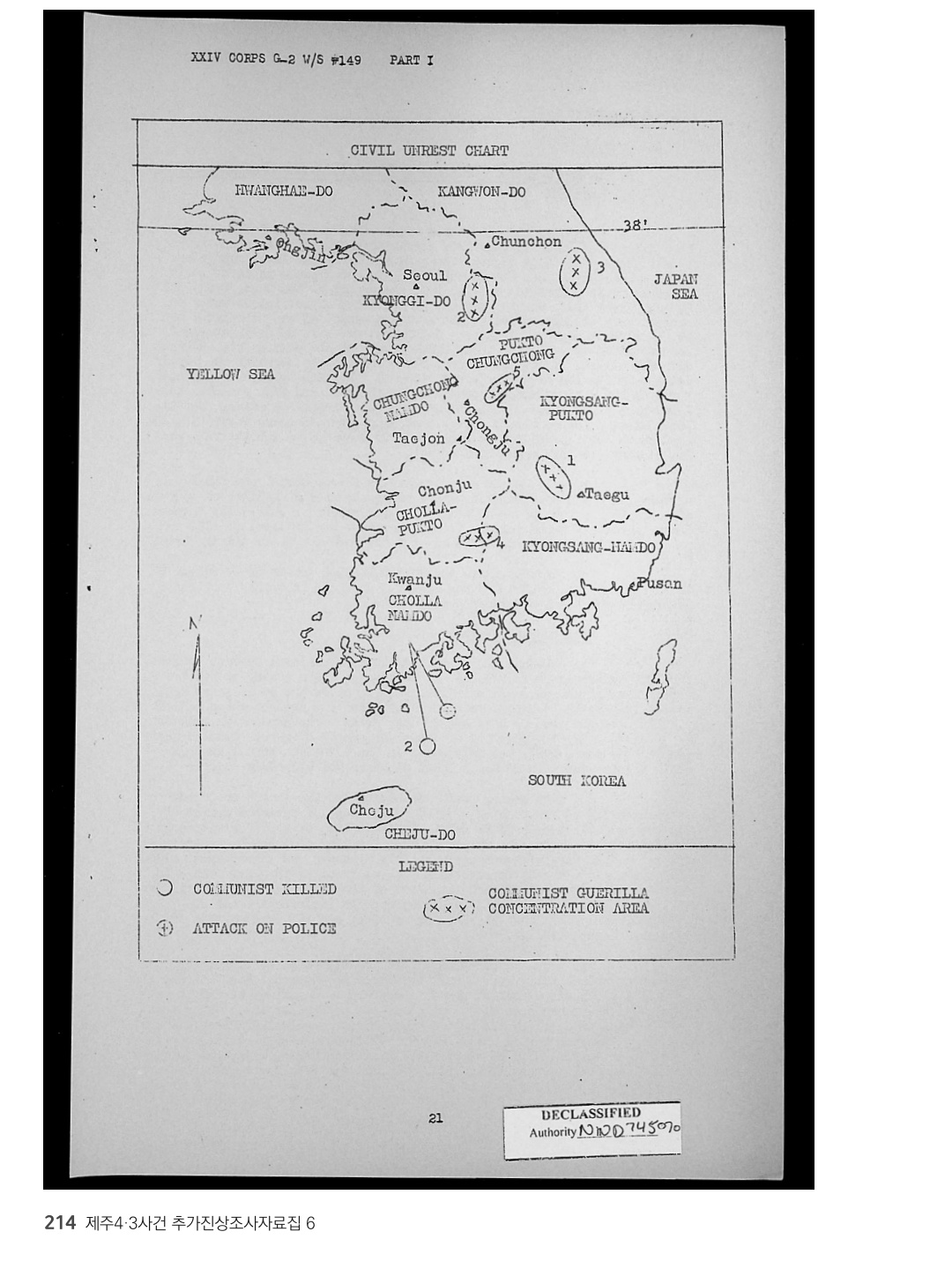
b. 공산주의 게릴라가 집중된 지역 지난 몇 달 동안 산악 지대에 있는 공산주의 "작전" 분대 등에 관한 보고들이 들어왔다. 다음은 보고를 요약한 것이다. (괄호 안의 숫자는 21쪽 지도에 있는 지역들을 가리킨다.)
경상북도: 총선 이후 공산주의자들에 대한 경찰의 작전이 계속돼 왔다. 산발적 시위와 폭력행위가 종종 일어났으나, 공산주의자에 의한 결정적이고 광범위한 폭동은 없었다. 그러나 경상북도는 오랜 시간 동안 실질적인 또는 잠정적인 "온상"이었고 지금도 그렇다. 설사 지금은 가끔 있는 산발적 공격 빼고는 잠잠하더라도 말이다. 최근 보고에 따르면, 대구(1150-1430) 북서부에 있는 소백산 지역(1)이 은신처 겸 미래에 있을 인민해방군의 작전을 위한 기지로 사용되고 있다. F-6 정보원은 2,000여 명의 구성원이 소백산 안에 있다고 말한다.
경기도: 지난 2주 동안 공산주의자의 산악 지대 활동은 양평(1040-1630) 지역(2)에서 주로 발생했다. 북조선 요원, 중국 공산주의자 요원, 남조선노동당원과 관련된 보고에 따르면, 태백산 지역 근처의 마을이 접선 장소, 은신처, 저장소 등으로 사용되고 있다. 지역에 있는 공산주의자 병력 추정치는 보고되지 않았다. 경찰은 이 근거지에 대해 적극적인 조치를 취하지 않았다.
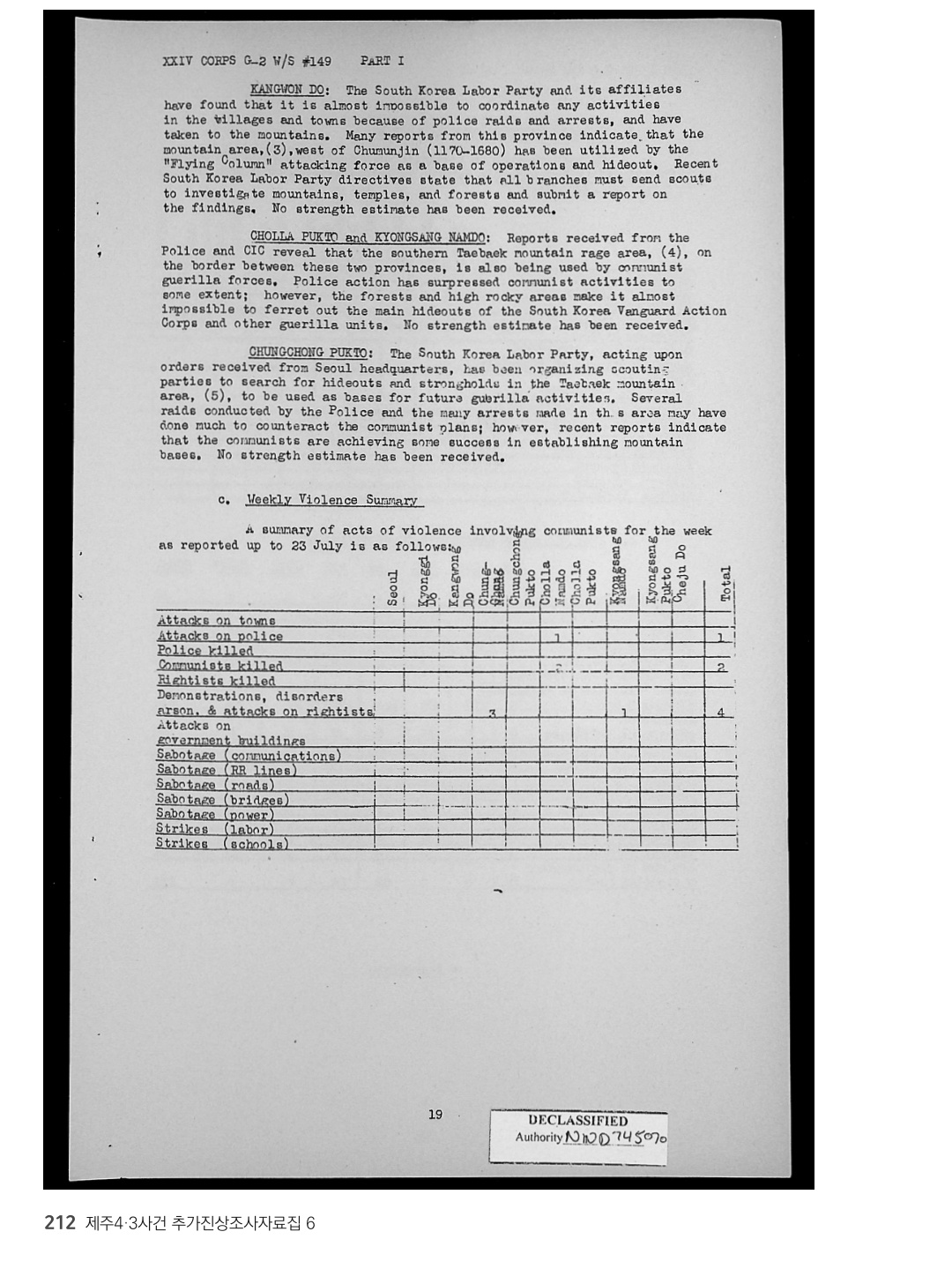
강원도: 남조선노동당과 그 당원들은 경찰의 기습과 체포 때문에 강원도의 마을과 읍에서는 그 어떤 계획도 제대로 조직할 수 없다는 사실을 깨닫고 산으로 들어갔다. 강원도에서 들어온 많은 보고들은 주문진(1170-1680) 서쪽의 산악 지대(3)가 "유격대"의 작전을 위한 기지 겸 은신처로 쓰이고 있음을 지적한다. 남조선노동당의 최근 지령은 모든 지부가 산, 절, 숲을 조사하기 위해 정찰병을 파견하고 그에 관한 보고를 올릴 것을 지시한다. 병력 추정치는 보고되지 않았다.
전라북도와 경상남도: 경찰과 방첩대로부터 받은 보고에 따르면, 전라북도와 경상남도의 경계 지역에 있는 태백산 지역(4)이 공산주의 게릴라 군대에 의해 활용되고 있다. 경찰 작전이 공산주의자 활동을 어느 정도 억누르기는 했으나, 숲과 바위들 때문에 남조선(혁명)전위부대와 다른 게릴라부대를 찾아내는 것은 거의 불가능하다. 병력 추정치는 보고되지 않았다.
충청북도: 서울 본부로부터 받은 명령에 따라 행동하던 남조선노동당이 정찰대를 조직하여 태백산 지역(5)에서 추후 게릴라 활동의 기지로 활용할 은신처와 근거지를 물색하고 있다. 경찰에 의한 몇몇 기습과 이 지역에서 이루어진 다수의 체포가 공산주의자들의 계획을 방해하는 데 많은 기여를 했다. 하지만 최근 보고에 따르면, 공산주의자들은 산악 기지를 세우는 데서 몇몇 성공을 거두고 있다. 병력 추정치는 보고되지 않았다.
c. 주간 폭력 요약
이번 주 7월 23일까지 보고된 공산주의자가 연루된 폭력행위의 요약은 다음과 같다.
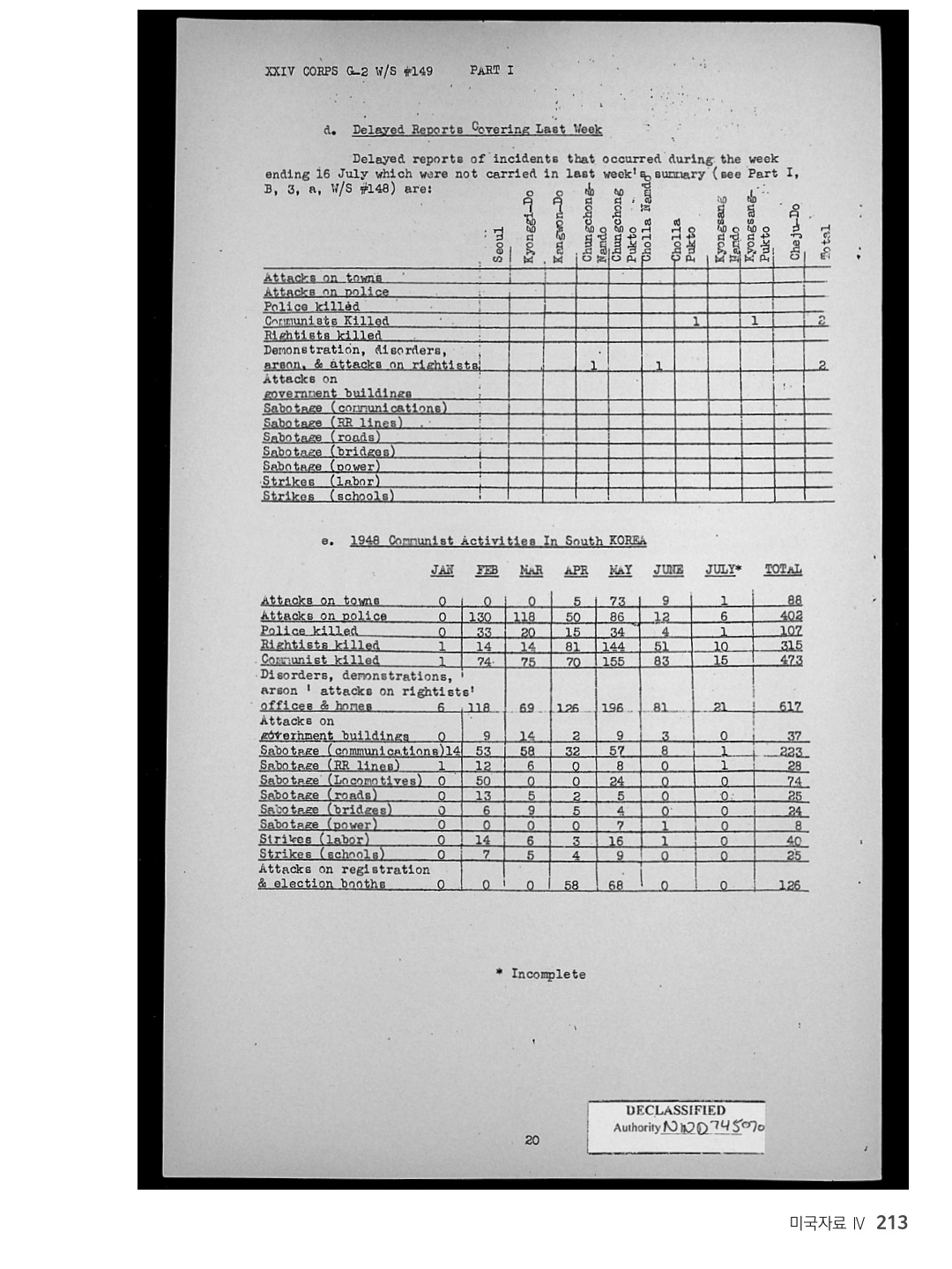
d. 지난주에 대한 추가보고 7월 16일에 마감한 주간에 발생했으나 지난주 요약보고(주간요약보고 제148호 제1부 B, 3, a 참고)에 실리지 않은 사건들에 관한 추가보고는 다음과 같다.
[표]
구분 | 서울 | 경기 | 강원 | 충남 | 충북 | 전남 | 전북 | 경남 | 경북 | 제주 | 총계 마을 공격 | | | | | | | | | | | 경찰 공격 | 1 | | | | | | | | | | 1 경찰 사망 | | | | | | | | | | | 공산주의자 사망 | | | | | | 2 | | | | | 2 우파 사망 | | | | | | | | | | | 시위, 소요, 방화, 우파 공격 | 3 | | | | 1 | | | | 4 | 관공서 공격 | | | | | | | | | | | 사보타주(통신) | | | | | | | | | | | 사보타주(철로) | | | | | | | | | | | 사보타주(도로) | | | | | | | | | | | 사보타주(교량) | | | | | | | | | | | 사보타주(전력) | | | | | | | | | | | 노동자 파업 | | | | | | | | | | | 동맹휴교 | | | | | | | | | | |
e. 1948년 남조선에서의 공산주의자 활동
* 미완
민간인 소요 지도
|항목|1월|2월|3월|4월|5월|6월*|7월*|총계| |마을 공격|0|0|0|5|73|9|1|88| |경찰 공격|0|130|118|50|86|12|6|402| |경찰 사망|0|33|20|15|34|4|1|107| |우파 사망|1|14|14|81|144|51|10|315| |공산주의자 사망|1|74|75|70|155|83|15|473| |소요, 시위, 방화, 우파 사무실·자택 공격|6|118|69|126|196|81|21|617| |관공서 공격|0|9|14|2|9|3|0|37| |사보타주(통신)|14|53|58|32|57|8|1|223| |사보타주(철로)|1|12|6|0|8|0|1|28| |사보타주(기관차)|0|50|0|0|24|0|0|74| |사보타주(도로)|0|13|5|2|5|0|0|25| |사보타주(교량)|0|6|9|5|4|0|0|24|
|지역|서울|경기|강원|충남|충북|전남|전북|경남|경북|제주|총계| |마을 공격| | | | | | | | | | | | |경찰 공격| | | | | | | | | | | | |경찰 사망| | | | | | | | | | | | |공산주의자 사망|1| |1| | | | | | |1| | |우파 사망| | | | | | | | | | | | |시위, 소요, 방화, 우파 공격|1| | | | | | | | |1|2| |관공서 공격| | | | | | | | | | | | |사보타주(통신)| | | | | | | | | | | | |사보타주(철로)| | | | | | | | | | | | |사보타주(도로)| | | | | | | | | | | | |사보타주(교량)| | | | | | | | | | | | |사보타주(전력)| | | | | | | | | | | | |노동자 파업| | | | | | | | | | | | |동맹휴교| | | | | | | | | | | |
C. 개전 가능성
1. 경제
b. 물가
미곡 가격 요약 - 월간 평균
단위: 1말(작은 단위) (16.67파운드)
출처 - 남조선과도정부 중앙물가행정처
미국자료 Ⅳ227
1월 2월 3월 4월 5월 6월* 7월* 총계 사보타주(전력) 0 0 0 0 7 1 0 8 노동자 파업 0 14 6 3 16 1 0 40 동맹휴교 0 7 5 4 9 0 0 25 선거등록사무소, 투표소 공격 0 0 0 58 68 0 0 126
지역 가격 (원)
1월 2월 3월 4월 5월 6월 7월 16일1 서울 743 746 707 655 740 895 1010 강원 791 860 772 750 816 920 충북 586 657 654 600 723 943 충남 630 662 613 576 660 860 경북 541 550 502 550 583 807 경남 650 707 650 640 666 868 전북 608 608 550 566 703 850 전남 558 575 508 541 728 875 제주 733 680 617 740 733 983 평균 648 676 619 659 706 889
1) [역주] 7월 16일은 7월 23일의 오기인 듯
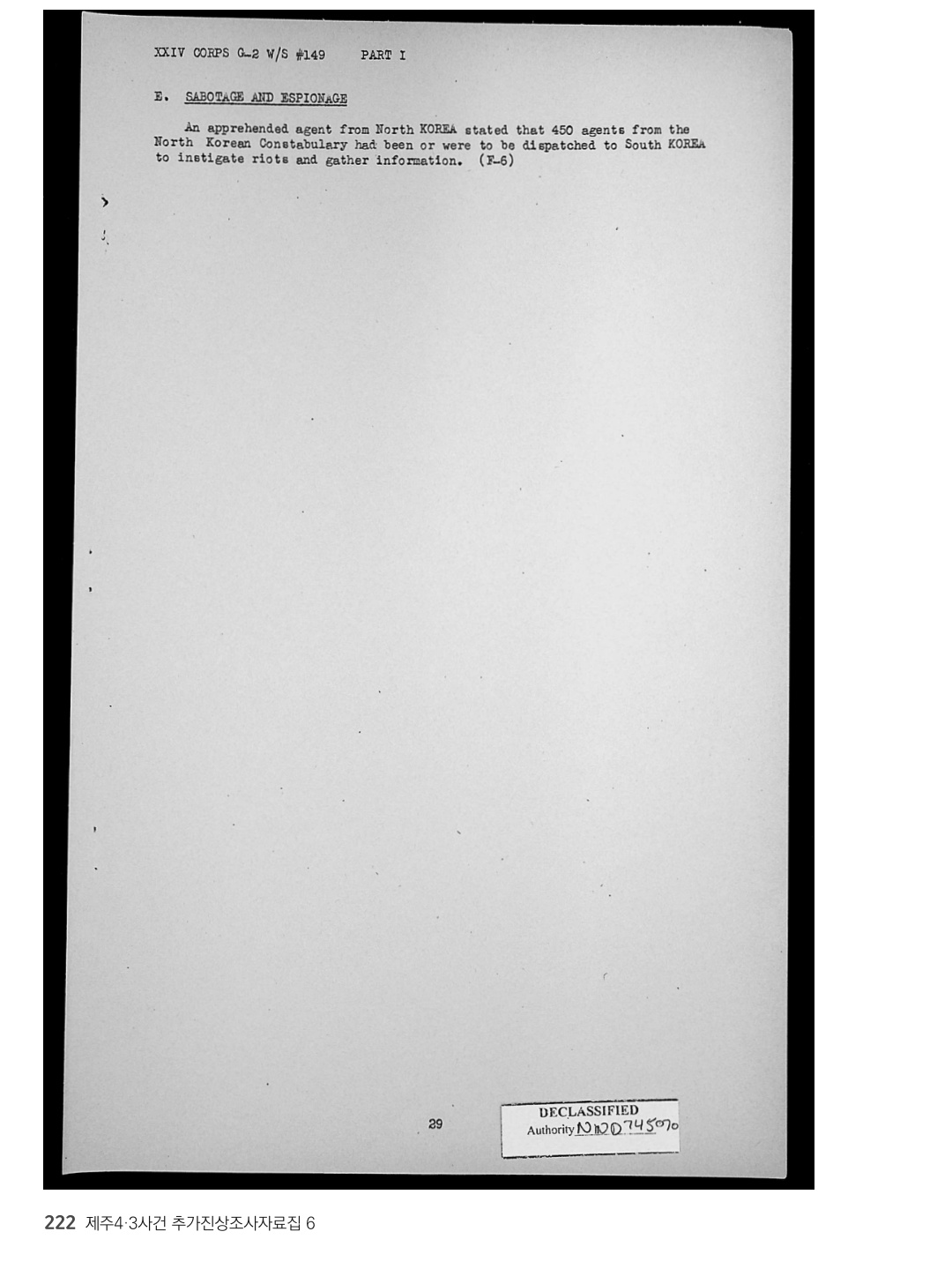
E. 사보타주와 간첩 체포된 북조선 요원의 말에 따르면, 남조선에서 폭동을 선동하고 정보를 모으 기 위해 북조선보안대에서 450명의 요원이 파견되었거나 또는 곧 파견될 예정이 라고 한다. (F-6)
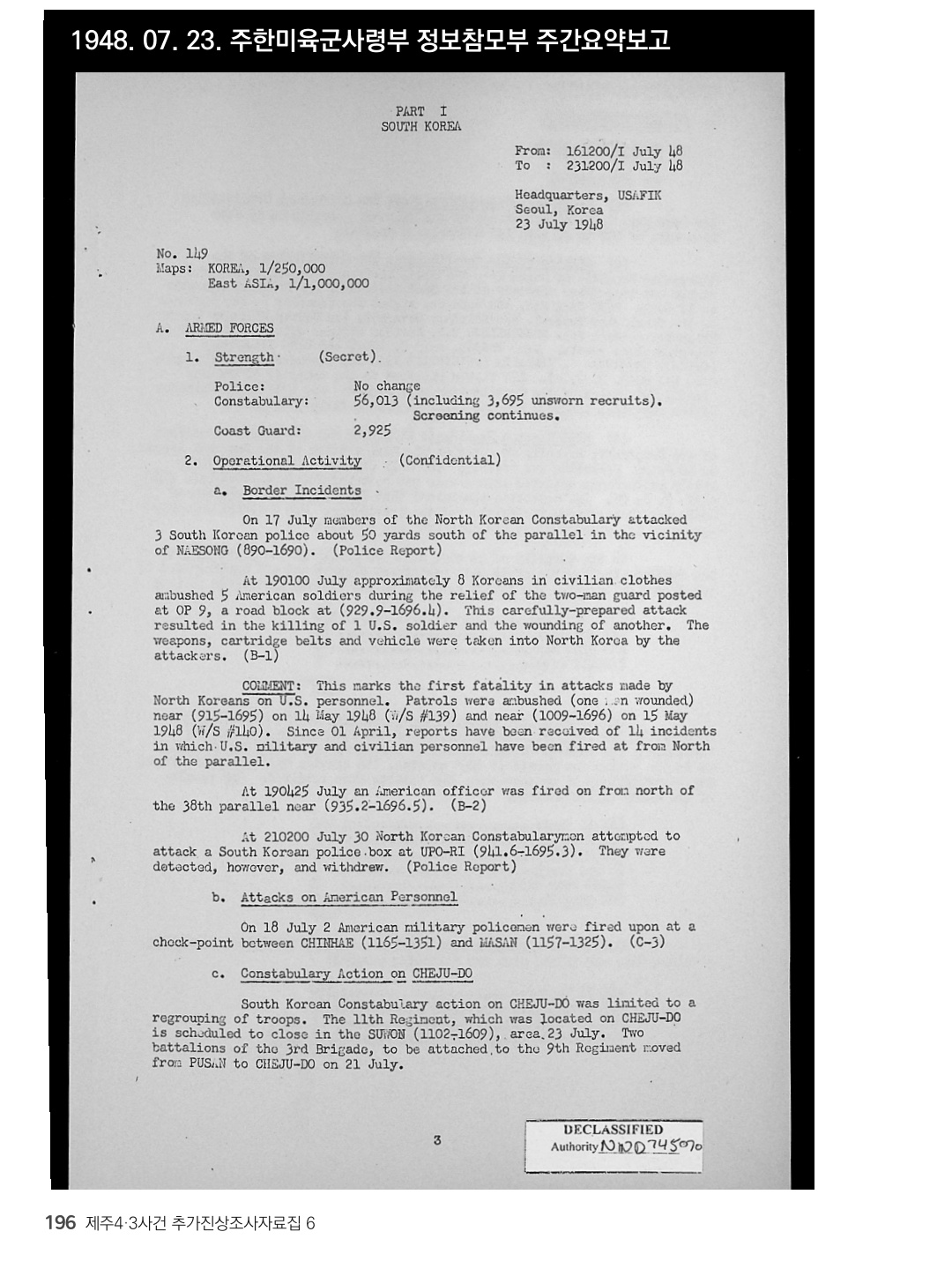
PART I
SOUTH KOREA
From: 161200/1 July 48
To : 231200/1 July 48
Headquarters, USAFIK
Seoul, Korea
23 July 1948
No. 149
Maps: KOREA, 1/250,000
East ASIA, 1/1,000,000
A. ARMED FORCES
1. Strength: (Secret)
Police: No change
Constabulary: 56,013 (including 3,695 unsworn recruits).
Screening continues.
Coast Guard: 2,925
2. Operational Activity (Confidential)
a. Border Incidents
On 17 July members of the North Korean Constabulary attacked
3 South Korean police about 50 yards south of the parallel in the vicinity of NAESONG (890-1690). (Police Report)
At 190100 July approximately 8 Koreans in civilian clothes ambushed 5 American soldiers during the relief of the two-man guard posted at OP 9, a road block at (929.9-1696.4). This carefully-prepared attack resulted in the killing of 1 U.S. soldier and the wounding of another. The weapons, cartridge belts and vehicle were taken into North Korea by the attackers. (B-1)
COMMENT: This marks the first fatality in attacks made by
North Koreans on U.S. personnel. Patrols were ambushed (one men wounded)
near (915-1695) on 14 May 1948 (W/S #139) and near (1009-1696) on 15 May
1948 (W/S #140). Since 01 April, reports have been received of 14 incidents in which U.S. military and civilian personnel have been fired at from North of the parallel.
At 190425 July an American officer was fired on from north of the 38th parallel near (935.2-1696.5). (B-2)
At 210200 July 30 North Korean Constabularymen attempted to attack a South Korean police box at UPO-RI (941.6-1695.3). They were detected, however, and withdrew. (Police Report)
b. Attacks on American Personnel
On 18 July 2 American military policemen were fired upon at a check-point between CHINHAE (1165-1351) and MASAN (1157-1325). (C-3)
c. Constabulary Action on CHEJU-DO
South Korean Constabulary action on CHEJU-DO was limited to a regrouping of troops. The 11th Regiment, which was located on CHEJU-DO is scheduled to close in the SUWON (1102-1609), area 23 July. Two battalions of the 3rd Brigade, to be attached to the 9th Regiment moved from PUSAN to CHEJU-DO on 21 July.
3
DECLASSIFIED
Authority NND 745070
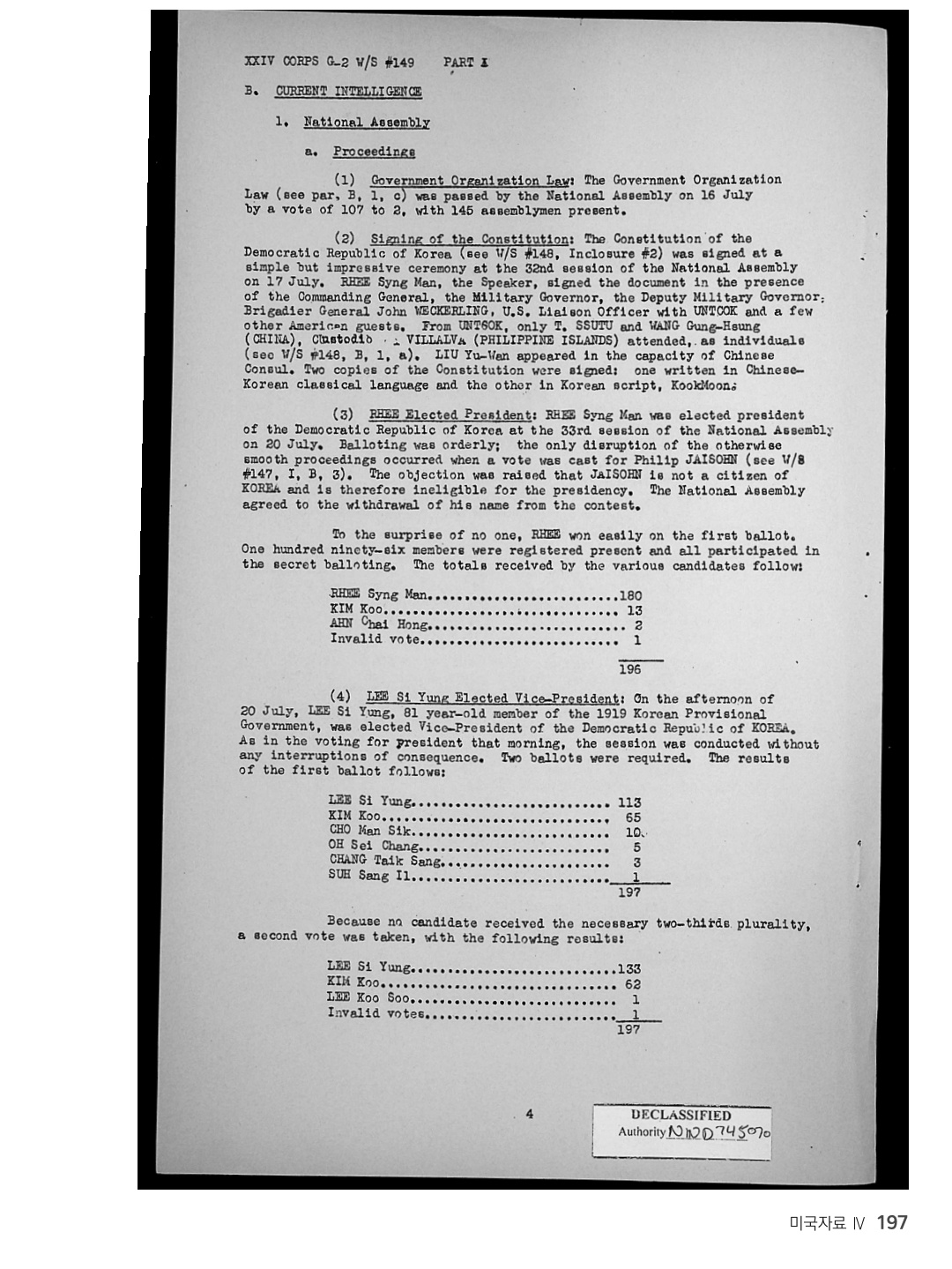
XXIV CORPS G-2 W/S #149 PART I
B. CURRENT INTELLIGENCE
1. National Assembly
a. Proceedings
(1) Government Organization Law: The Government Organization
Law (see par. B, 1, c) was passed by the National Assembly on 16 July by a vote of 107 to 2, with 145 assemblymen present.
(2) Signing of the Constitution: The Constitution of the
Democratic Republic of Korea (see W/S #148, Inclosure #2) was signed at a simple but impressive ceremony at the 32nd session of the National Assembly on 17 July. RHEE Syng Man, the Speaker, signed the document in the presence of the Commanding General, the Military Governor, the Deputy Military Governor, Brigadier General John WECKERLING, U.S. Liaison Officer with UNTOOK and a few other American guests. From UNTOOK, only T. SSUTU and WANG Gung-Haung
(CHINA), Custodib [illegible] VILLALVA (PHILLIPPINE ISLANDS) attended, as individuals
(see W/S #148, B, 1, a). LIU Yu-Wan appeared in the capacity of Chinese
Consul. Two copies of the Constitution were signed: one written in ChineseKorean classical language and the other in Korean script, KookMoon.
(3) RHEE Elected President: RHEE Syng Man was elected president of the Democratic Republic of Korea at the 33rd session of the National Assembly on 20 July. Balloting was orderly; the only disruption of the otherwise smooth proceedings occurred when a vote was cast for Philip JAISOHN (see W/S
#147, I, B, 3). The objection was raised that JAISOHN is not a citizen of
KOREA and is therefore ineligible for the presidency. The National Assembly agreed to the withdrawal of his name from the contest.
To the surprise of no one, RHEE won easily on the first ballot.
One hundred ninety-six members were registered present and all participated in the secret balloting. The totals received by the various candidates follow:
RHEE Syng Man............................180
KIM Koo.................................. 13
AHN Chai Hong............................ 2
Invalid vote............................. 1
___
196
(4) LEE Si Yung Elected Vice-President: On the afternoon of
20 July, LEE Si Yung, 81 year-old member of the 1919 Korean Provisional
Government, was elected Vice-President of the Democratic Republic of KOREA.
As in the voting for president that morning, the session was conducted without any interruptions of consequence. Two ballots were required. The results of the first ballot follows:
LEE Si Yung.............................. 113
KIM Koo.................................. 65
CHO Man Sik.............................. 10.
OH Sei Chang............................. 5
CHANG Taik Sang.......................... 3
SUH Sang Il.............................. 1
___
197
Because no candidate received the necessary two-thirds plurality, a second vote was taken, with the following results:
LEE Si Yung..............................133
KIM Koo.................................. 62
LEE Koo Soo.............................. 1
Invalid votes............................ 1
___
197
4 DECLASSIFIED
Authority N[illegible]D745070
미국자료 IV 197
XXIV CORPS G-2 W/S #149 PART I
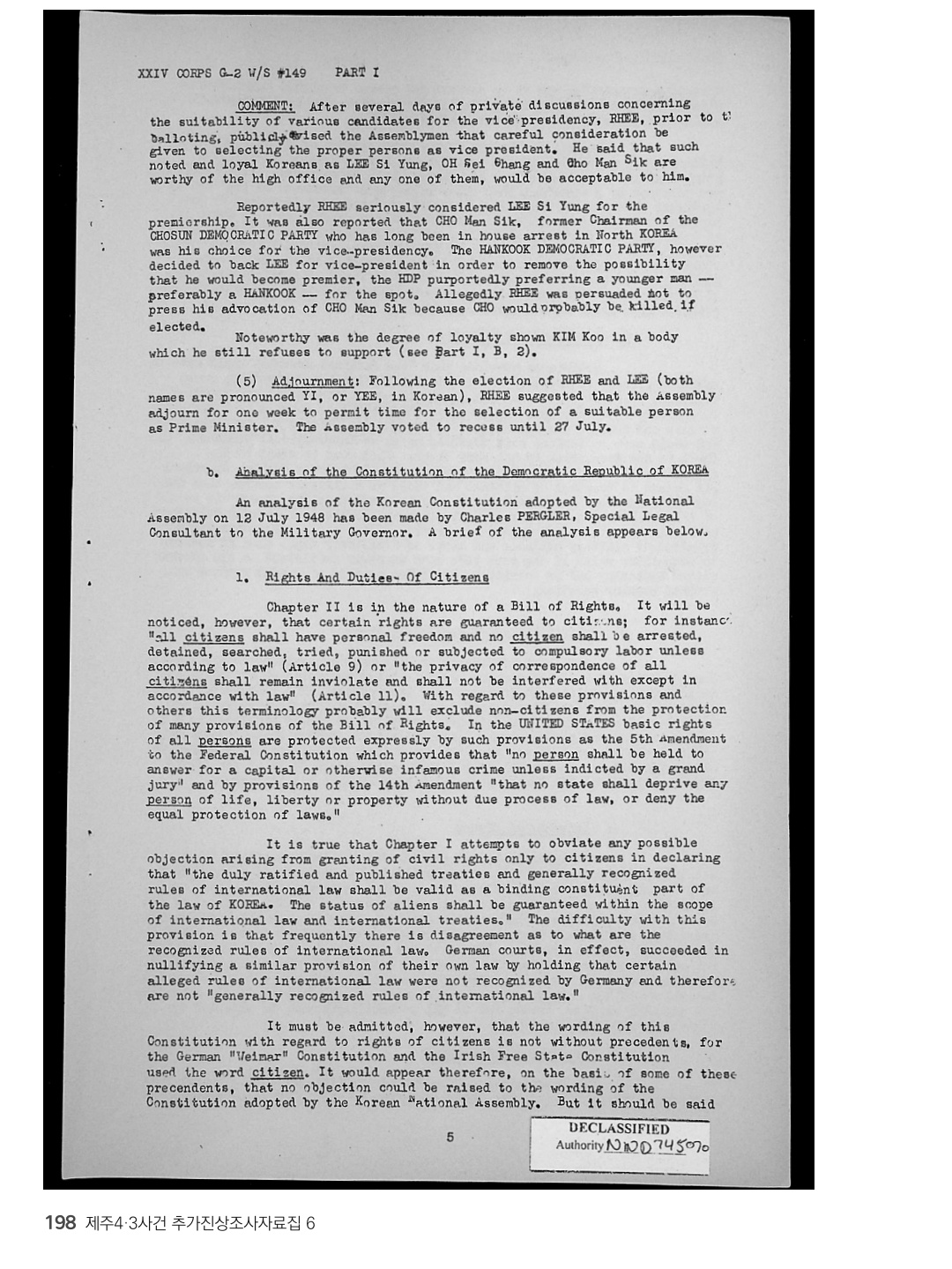
COMMENT: After several days of private discussions concerning the suitability of various candidates for the vice presidency, RHEE, prior to t'
balloting, publicly advised the Assemblymen that careful consideration be given to selecting the proper persons as vice president. He said that such noted and loyal Koreans as LEE Si Yung, OH Sei Chang and Cho Man Sik are worthy of the high office and any one of them, would be acceptable to him.
Reportedly RHEE seriously considered LEE Si Yung for the premiership. It was also reported that CHO Man Sik, former Chairman of the
CHOSUN DEMOCRATIC PARTY who has long been in house arrest in North KOREA was his choice for the vice-presidency. The HANKOOK DEMOCRATIC PARTY, however decided to back LEE for vice-president in order to remove the possibility that he would become premier, the HDP purportedly preferring a younger man -preferably a HANKOOK -- for the spot. Allegedly RHEE was persuaded not to press his advocation of CHO Man Sik because CHO would probably be killed if elected.
Noteworthy was the degree of loyalty shown KIM Koo in a body which he still refuses to support (see Part I, B, 2).
(5) Adjournment: Following the election of RHEE and LEE (both names are pronounced YI, or YEE, in Korean), RHEE suggested that the Assembly adjourn for one week to permit time for the selection of a suitable person as Prime Minister. The Assembly voted to recess until 27 July.
b. Analysis of the Constitution of the Democratic Republic of KOREA
An analysis of the Korean Constitution adopted by the National
Assembly on 12 July 1948 has been made by Charles PERGLER, Special Legal
Consultant to the Military Governor. A brief of the analysis appears below.
1. Rights And Duties- Of Citizens
Chapter II is in the nature of a Bill of Rights. It will be noticed, however, that certain rights are guaranteed to citizens; for instance
"all citizens shall have personal freedom and no citizen shall be arrested, detained, searched, tried, punished or subjected to compulsory labor unless according to law" (Article 9) or "the privacy of correspondence of all citizens shall remain inviolate and shall not be interfered with except in accordance with law" (Article 11). With regard to these provisions and others this terminology probably will exclude non-citizens from the protection of many provisions of the Bill of Rights. In the UNITED STATES basic rights of all persons are protected expressly by such provisions as the 5th Amendment to the Federal Constitution which provides that "no person shall be held to answer for a capital or otherwise infamous crime unless indicted by a grand jury" and by provisions of the 14th Amendment "that no state shall deprive any person of life, liberty or property without due process of law, or deny the equal protection of laws."
It is true that Chapter I attempts to obviate any possible objection arising from granting of civil rights only to citizens in declaring that "the duly ratified and published treaties and generally recognized rules of international law shall be valid as a binding constituent part of the law of KOREA. The status of aliens shall be guaranteed within the scope of international law and international treaties." The difficulty with this provision is that frequently there is disagreement as to what are the recognized rules of international law. German courts, in effect, succeeded in nullifying a similar provision of their own law by holding that certain alleged rules of international law were not recognized by Germany and therefore are not "generally recognized rules of international law."
It must be admitted, however, that the wording of this
Constitution with regard to rights of citizens is not without precedents, for the German "Weimar" Constitution and the Irish Free State Constitution used the word citizen. It would appear therefore, on the basis of some of these precedents, that no objection could be raised to the wording of the
Constitution adopted by the Korean National Assembly. But it should be said
5 DECLASSIFIED
Authority NND 74507o
XXIV CORPS G-2 W/S #149 PART I
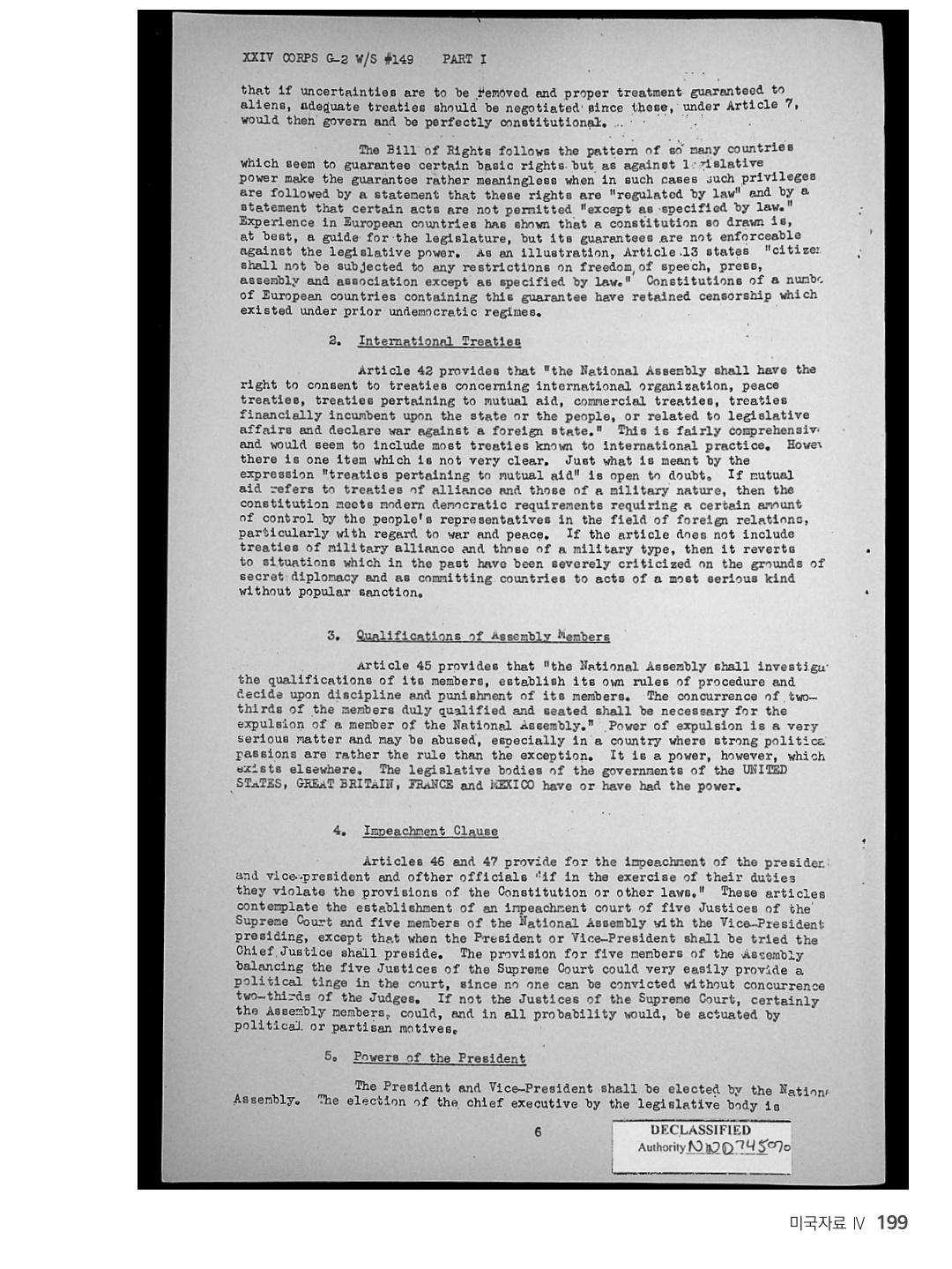
that if uncertainties are to be removed and proper treatment guaranteed to aliens, adequate treaties should be negotiated since these, under Article 7, would then govern and be perfectly constitutional.
The Bill of Rights follows the pattern of so many countries which seem to guarantee certain basic rights but as against legislative power make the guarantee rather meaningless when in such cases such privileges are followed by a statement that these rights are "regulated by law" and by a statement that certain acts are not permitted "except as specified by law."
Experience in European countries has shown that a constitution so drawn is, at best, a guide for the legislature, but its guarantees are not enforceable against the legislative power. As an illustration, Article 13 states "citizen shall not be subjected to any restrictions on freedom of speech, press, assembly and association except as specified by law." Constitutions of a numbe of European countries containing this guarantee have retained censorship which existed under prior undemocratic regimes.
2. International Treaties
Article 42 provides that "the National Assembly shall have the right to consent to treaties concerning international organization, peace treaties, treaties pertaining to mutual aid, commercial treaties, treaties financially incumbent upon the state or the people, or related to legislative affairs and declare war against a foreign state." This is fairly comprehensive and would seem to include most treaties known to international practice. Howe there is one item which is not very clear. Just what is meant by the expression "treaties pertaining to mutual aid" is open to doubt. If mutual aid refers to treaties of alliance and those of a military nature, then the constitution meets modern democratic requirements requiring a certain amount of control by the people's representatives in the field of foreign relations, particularly with regard to war and peace. If the article does not include treaties of military alliance and those of a military type, then it reverts to situations which in the past have been severely criticized on the grounds of secret diplomacy and as committing countries to acts of a most serious kind without popular sanction.
3. Qualifications of Assembly Members
Article 45 provides that "the National Assembly shall investigue the qualifications of its members, establish its own rules of procedure and decide upon discipline and punishment of its members. The concurrence of twothirds of the members duly qualified and seated shall be necessary for the expulsion of a member of the National Assembly." Power of expulsion is a very serious matter and may be abused, especially in a country where strong political passions are rather the rule than the exception. It is a power, however, which exists elsewhere. The legislative bodies of the governments of the UNITED
STATES, GREAT BRITAIN, FRANCE and MEXICO have or have had the power.
4. Impeachment Clause
Articles 46 and 47 provide for the impeachment of the presiden and vice-president and other officials "if in the exercise of their duties they violate the provisions of the Constitution or other laws." These articles contemplate the establishment of an impeachment court of five Justices of the
Supreme Court and five members of the National Assembly with the Vice-President presiding, except that when the President or Vice-President shall be tried the
Chief Justice shall preside. The provision for five members of the Assembly balancing the five Justices of the Supreme Court could very easily provide a political tinge in the court, since no one can be convicted without concurrence two-thirds of the Judges. If not the Justices of the Supreme Court, certainly the Assembly members, could, and in all probability would, be actuated by political or partisan motives.
5. Powers of the President
The President and Vice-President shall be elected by the Nation
Assembly. The election of the chief executive by the legislative body is
6
DECLASSIFIED
Authority NND 745070
XXIV CORPS G-2 W/S #149 PART I
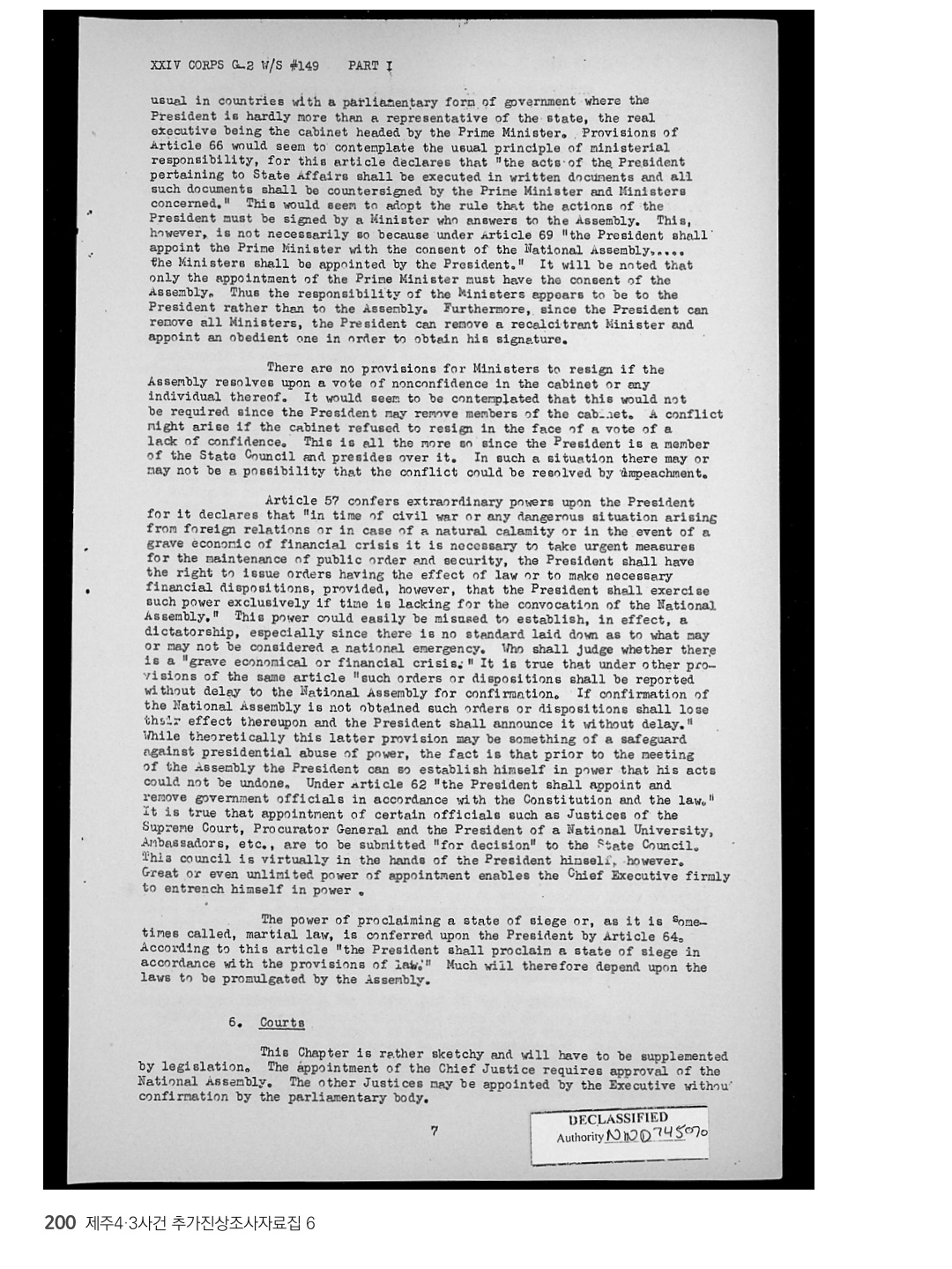
usual in countries with a parliamentary form of government where the
President is hardly more than a representative of the state, the real executive being the cabinet headed by the Prime Minister. Provisions of
Article 66 would seem to contemplate the usual principle of ministerial responsibility, for this article declares that "the acts of the President pertaining to State Affairs shall be executed in written documents and all such documents shall be countersigned by the Prime Minister and Ministers concerned." This would seem to adopt the rule that the actions of the
President must be signed by a Minister who answers to the Assembly. This, however, is not necessarily so because under Article 69 "the President shall appoint the Prime Minister with the consent of the National Assembly.....
the Ministers shall be appointed by the President." It will be noted that only the appointment of the Prime Minister must have the consent of the
Assembly. Thus the responsibility of the Ministers appears to be to the
President rather than to the Assembly. Furthermore, since the President can remove all Ministers, the President can remove a recalcitrant Minister and appoint an obedient one in order to obtain his signature.
There are no provisions for Ministers to resign if the
Assembly resolves upon a vote of nonconfidence in the cabinet or any individual thereof. It would seem to be contemplated that this would not be required since the President may remove members of the cabinet. A conflict might arise if the cabinet refused to resign in the face of a vote of a lack of confidence. This is all the more so since the President is a member of the State Council and presides over it. In such a situation there may or may not be a possibility that the conflict could be resolved by impeachment.
Article 57 confers extraordinary powers upon the President for it declares that "in time of civil war or any dangerous situation arising from foreign relations or in case of a natural calamity or in the event of a grave economic of financial crisis it is necessary to take urgent measures for the maintenance of public order and security, the President shall have the right to issue orders having the effect of law or to make necessary financial dispositions, provided, however, that the President shall exercise such power exclusively if time is lacking for the convocation of the National
Assembly." This power could easily be misused to establish, in effect, a dictatorship, especially since there is no standard laid down as to what may or may not be considered a national emergency. Who shall judge whether there is a "grave economical or financial crisis." It is true that under other provisions of the same article "such orders or dispositions shall be reported without delay to the National Assembly for confirmation. If confirmation of the National Assembly is not obtained such orders or dispositions shall lose their effect thereupon and the President shall announce it without delay."
While theoretically this latter provision may be something of a safeguard against presidential abuse of power, the fact is that prior to the meeting of the Assembly the President can so establish himself in power that his acts could not be undone. Under article 62 "the President shall appoint and remove government officials in accordance with the Constitution and the law."
It is true that appointment of certain officials such as Justices of the
Supreme Court, Procurator General and the President of a National University, Ambassadors, etc., are to be submitted "for decision" to the State Council.
This council is virtually in the hands of the President himself, however.
Great or even unlimited power of appointment enables the Chief Executive firmly to entrench himself in power .
The power of proclaiming a state of siege or, as it is sometimes called, martial law, is conferred upon the President by Article 64.
According to this article "the President shall proclaim a state of siege in accordance with the provisions of law." Much will therefore depend upon the laws to be promulgated by the Assembly.
6. Courts
This Chapter is rather sketchy and will have to be supplemented by legislation. The appointment of the Chief Justice requires approval of the
National Assembly. The other Justices may be appointed by the Executive withou confirmation by the parliamentary body.
7
DECLASSIFIED
Authority NND 745070
XXIV CORPS G-2 W/S #149 PART I
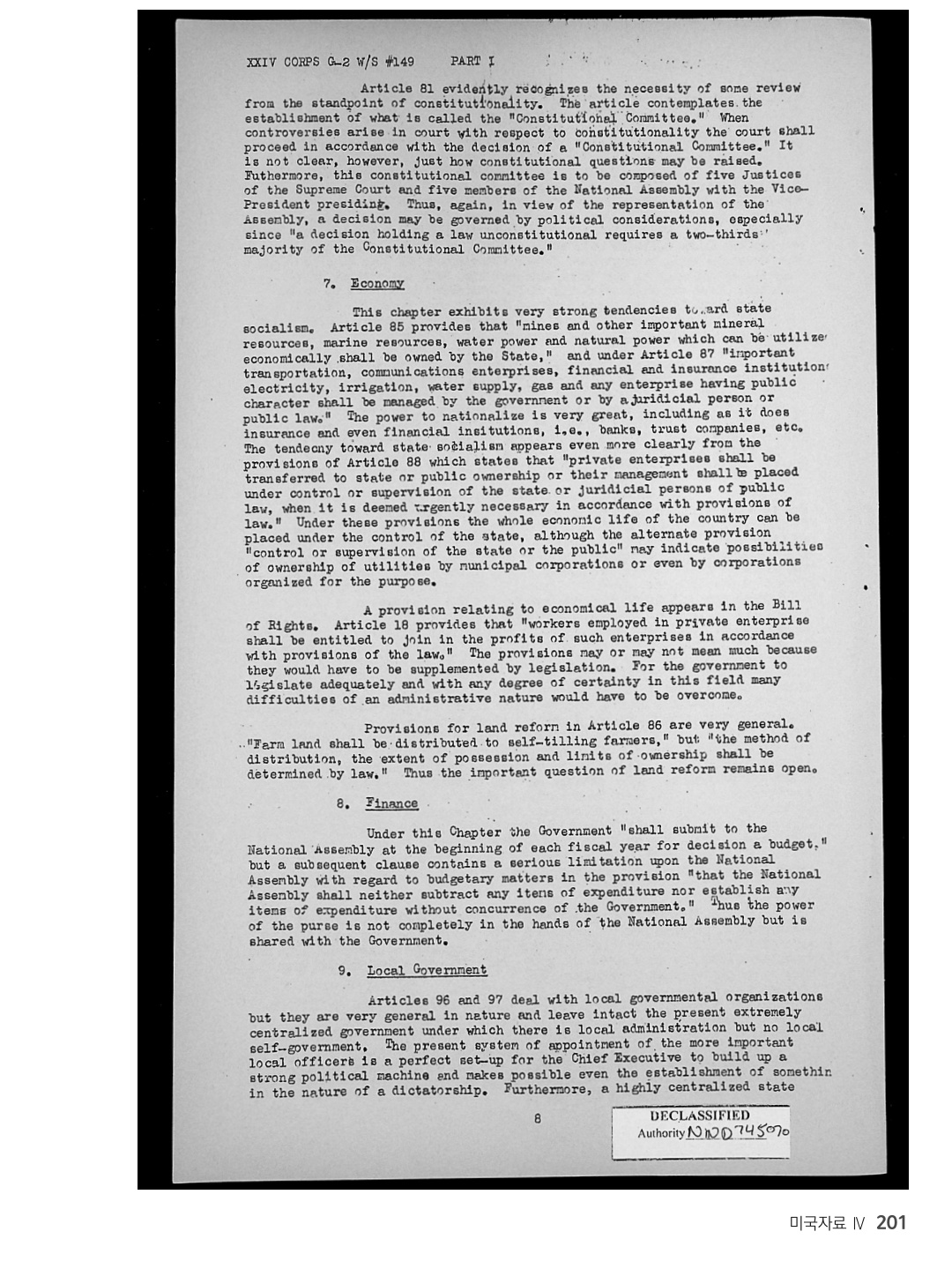
Article 81 evidently recognizes the necessity of some review from the standpoint of constitutionality. The article contemplates the establishment of what is called the "Constitutional Committee." When controversies arise in court with respect to constitutionality the court shall proceed in accordance with the decision of a "Constitutional Committee." It is not clear, however, just how constitutional questions may be raised.
Furthermore, this constitutional committee is to be composed of five Justices of the Supreme Court and five members of the National Assembly with the VicePresident presiding. Thus, again, in view of the representation of the
Assembly, a decision may be governed by political considerations, especially since "a decision holding a law unconstitutional requires a two-thirds majority of the Constitutional Committee."
7. Economy
This chapter exhibits very strong tendencies toward state socialism. Article 85 provides that "mines and other important mineral resources, marine resources, water power and natural power which can be utilize economically shall be owned by the State," and under Article 87 "important transportation, communications enterprises, financial and insurance institution electricity, irrigation, water supply, gas and any enterprise having public character shall be managed by the government or by a juridical person or public law." The power to nationalize is very great, including as it does insurance and even financial institutions, i.e., banks, trust companies, etc.
The tendency toward state socialism appears even more clearly from the provisions of Article 88 which states that "private enterprises shall be transferred to state or public ownership or their management shall be placed under control or supervision of the state or juridical persons of public law, when it is deemed urgently necessary in accordance with provisions of law." Under these provisions the whole economic life of the country can be placed under the control of the state, although the alternate provision
"control or supervision of the state or the public" may indicate possibilities of ownership of utilities by municipal corporations or even by corporations organized for the purpose.
A provision relating to economical life appears in the Bill of Rights. Article 18 provides that "workers employed in private enterprise shall be entitled to join in the profits of such enterprises in accordance with provisions of the law." The provisions may or may not mean much because they would have to be supplemented by legislation. For the government to legislate adequately and with any degree of certainty in this field many difficulties of an administrative nature would have to be overcome.
Provisions for land reform in Article 86 are very general.
"Farm land shall be distributed to self-tilling farmers," but "the method of distribution, the extent of possession and limits of ownership shall be determined by law." Thus the important question of land reform remains open.
8. Finance
Under this Chapter the Government "shall submit to the
National Assembly at the beginning of each fiscal year for decision a budget,"
but a subsequent clause contains a serious limitation upon the National
Assembly with regard to budgetary matters in the provision "that the National
Assembly shall neither subtract any items of expenditure nor establish any items of expenditure without concurrence of the Government." Thus the power of the purse is not completely in the hands of the National Assembly but is shared with the Government.
9. Local Government
Articles 96 and 97 deal with local governmental organizations but they are very general in nature and leave intact the present extremely centralized government under which there is local administration but no local self-government. The present system of appointment of the more important local officers is a perfect set-up for the Chief Executive to build up a strong political machine and makes possible even the establishment of somethin in the nature of a dictatorship. Furthermore, a highly centralized state
8
DECLASSIFIED
Authority NND 745070
XXIV CORPS G-2 W/S #149 PART I
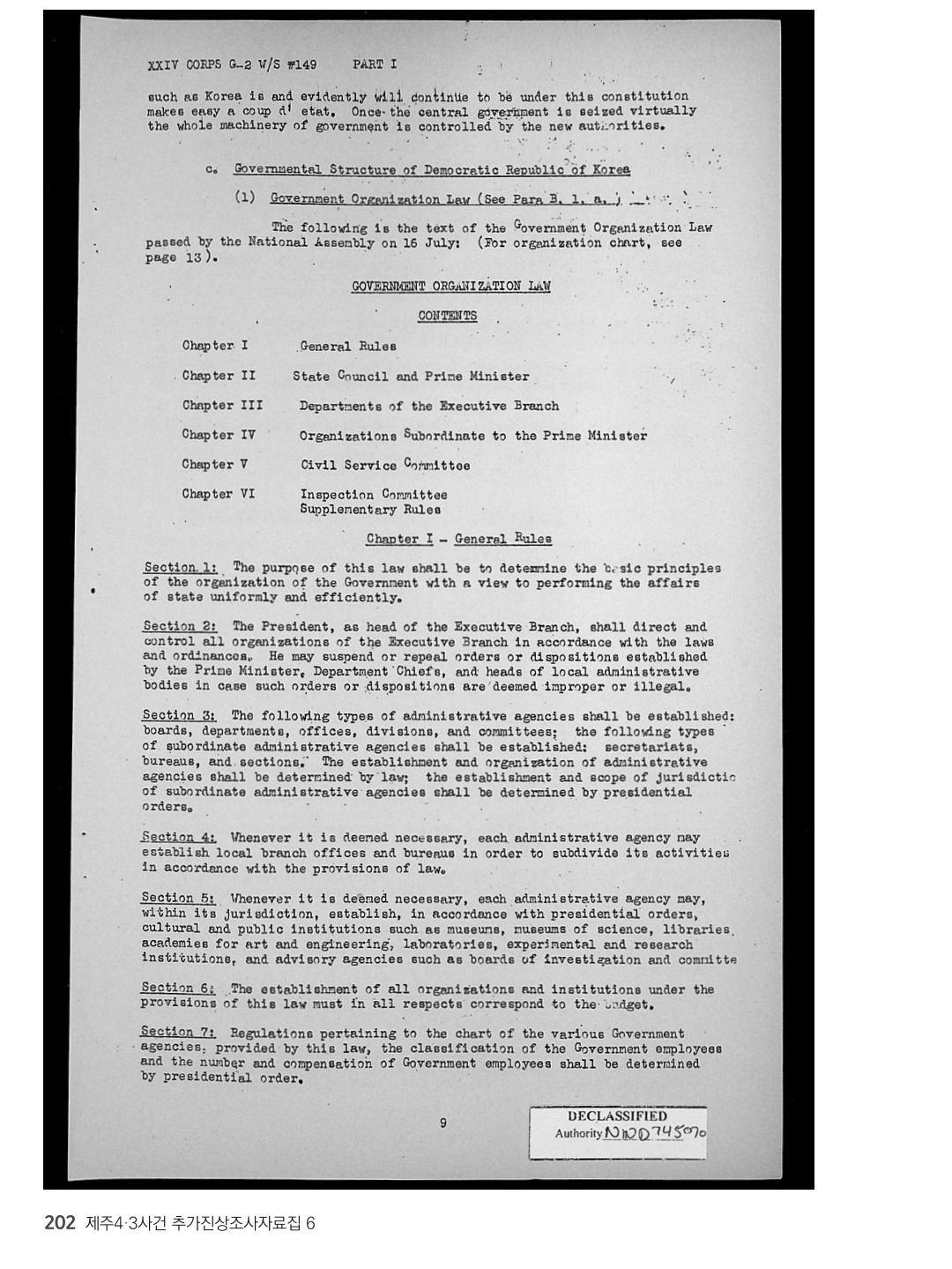
such as Korea is and evidently will continue to be under this constitution makes easy a coup d'etat. Once the central government is seized virtually the whole machinery of government is controlled by the new authorities.
c. Governmental Structure of Democratic Republic of Korea
(1) Government Organization Law (See Para B. 1. a.)
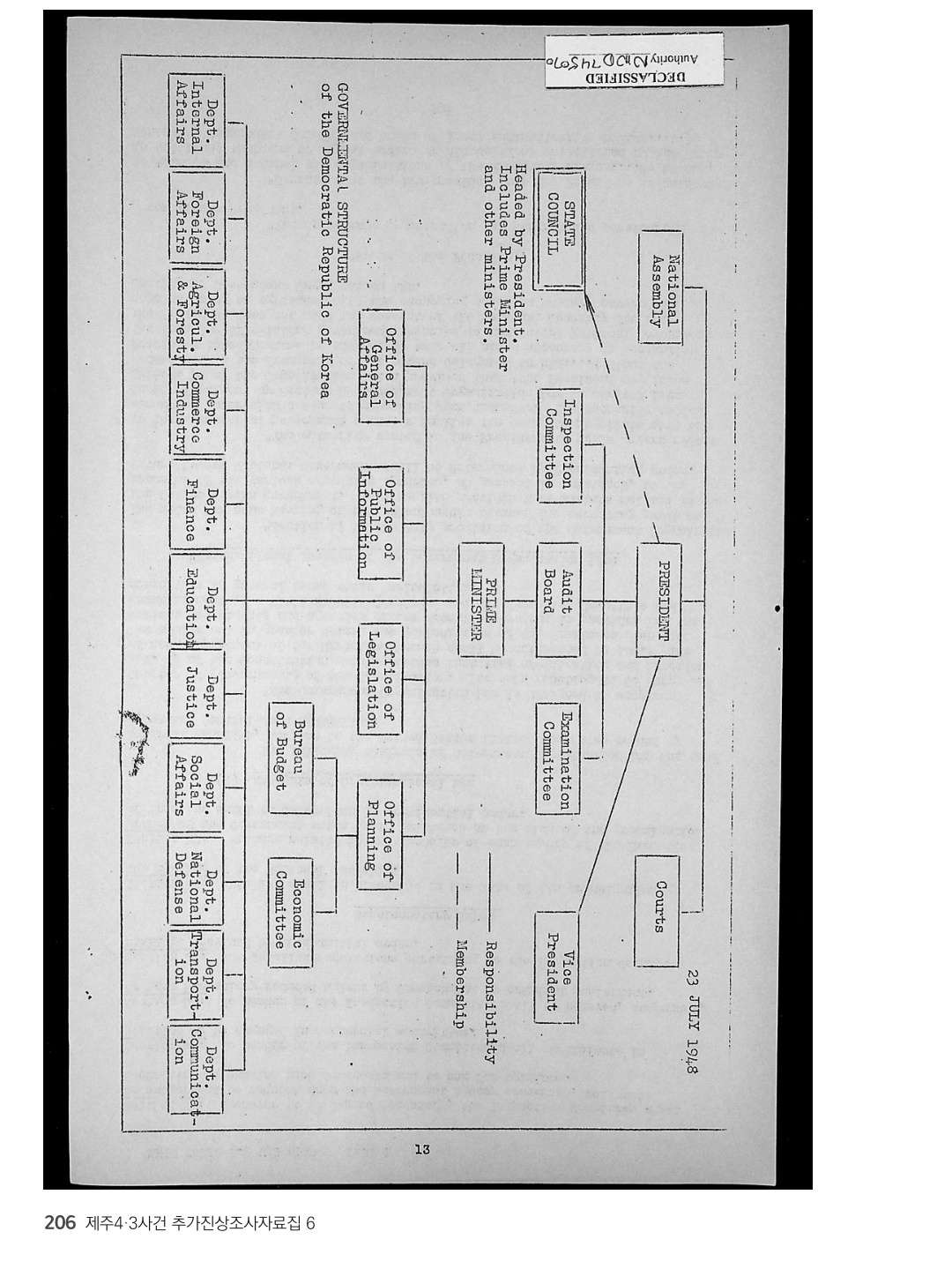
The following is the text of the Government Organization Law passed by the National Assembly on 16 July: (For organization chart, see page 13).
GOVERNMENT ORGANIZATION LAW
CONTENTS
Chapter I General Rules
Chapter II State Council and Prime Minister
Chapter III Departments of the Executive Branch
Chapter IV Organizations Subordinate to the Prime Minister
Chapter V Civil Service Committee
Chapter VI Inspection Committee
Supplementary Rules
Chapter I - General Rules
Section 1: The purpose of this law shall be to determine the basic principles of the organization of the Government with a view to performing the affairs of state uniformly and efficiently.
Section 2: The President, as head of the Executive Branch, shall direct and control all organizations of the Executive Branch in accordance with the laws and ordinances. He may suspend or repeal orders or dispositions established by the Prime Minister, Department Chiefs, and heads of local administrative bodies in case such orders or dispositions are deemed improper or illegal.
Section 3: The following types of administrative agencies shall be established:
boards, departments, offices, divisions, and committees; the following types of subordinate administrative agencies shall be established: secretariats, bureaus, and sections. The establishment and organization of administrative agencies shall be determined by law; the establishment and scope of jurisdiction of subordinate administrative agencies shall be determined by presidential orders.
Section 4: Whenever it is deemed necessary, each administrative agency may establish local branch offices and bureaus in order to subdivide its activities in accordance with the provisions of law.
Section 5: Whenever it is deemed necessary, each administrative agency may, within its jurisdiction, establish, in accordance with presidential orders, cultural and public institutions such as museums, museums of science, libraries, academies for art and engineering, laboratories, experimental and research institutions, and advisory agencies such as boards of investigation and committe
Section 6: The establishment of all organizations and institutions under the provisions of this law must in all respects correspond to the budget.
Section 7: Regulations pertaining to the chart of the various Government agencies, provided by this law, the classification of the Government employees and the number and compensation of Government employees shall be determined by presidential order.
9
DECLASSIFIED
Authority NND 745070
XXIV CORPS G-2 W/S #149 PART I
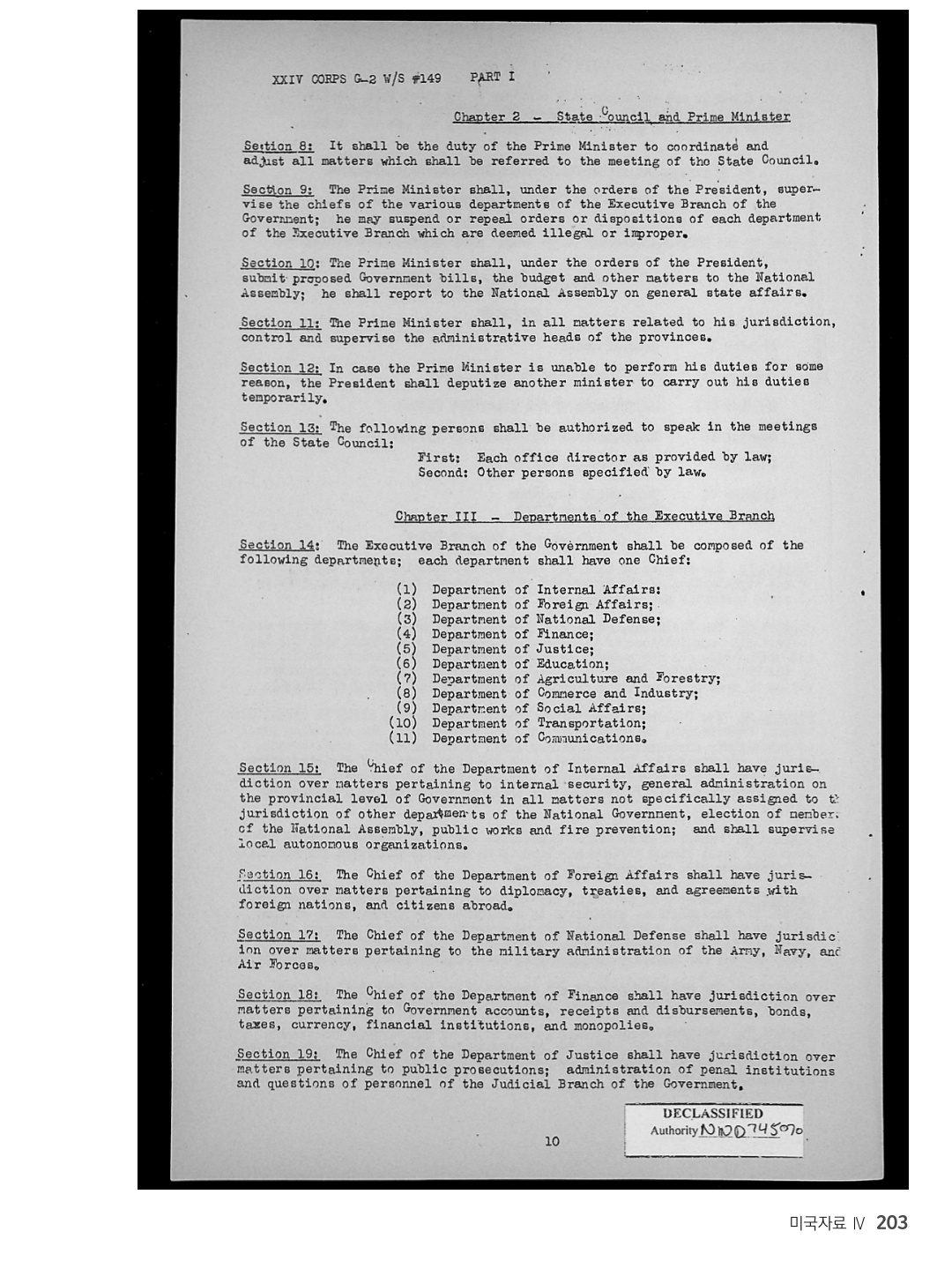
Chapter 2 - State Council and Prime Minister
Section 8: It shall be the duty of the Prime Minister to coordinate and adjust all matters which shall be referred to the meeting of the State Council.
Section 9: The Prime Minister shall, under the orders of the President, supervise the chiefs of the various departments of the Executive Branch of the Government; he may suspend or repeal orders or dispositions of each department of the Executive Branch which are deemed illegal or improper.
Section 10: The Prime Minister shall, under the orders of the President, submit proposed Government bills, the budget and other matters to the National Assembly; he shall report to the National Assembly on general state affairs.
Section 11: The Prime Minister shall, in all matters related to his jurisdiction, control and supervise the administrative heads of the provinces.
Section 12: In case the Prime Minister is unable to perform his duties for some reason, the President shall deputize another minister to carry out his duties temporarily.
Section 13: The following persons shall be authorized to speak in the meetings of the State Council:
First: Each office director as provided by law;
Second: Other persons specified by law.
Chapter III - Departments of the Executive Branch
Section 14: The Executive Branch of the Government shall be composed of the following departments; each department shall have one Chief:
(1) Department of Internal Affairs;
(2) Department of Foreign Affairs;
(3) Department of National Defense;
(4) Department of Finance;
(5) Department of Justice;
(6) Department of Education;
(7) Department of Agriculture and Forestry;
(8) Department of Commerce and Industry;
(9) Department of Social Affairs;
(10) Department of Transportation;
(11) Department of Communications.
Section 15: The Chief of the Department of Internal Affairs shall have jurisdiction over matters pertaining to internal security, general administration on the provincial level of Government in all matters not specifically assigned to the jurisdiction of other departments of the National Government, election of members of the National Assembly, public works and fire prevention; and shall supervise local autonomous organizations.
Section 16: The Chief of the Department of Foreign Affairs shall have jurisdiction over matters pertaining to diplomacy, treaties, and agreements with foreign nations, and citizens abroad.
Section 17: The Chief of the Department of National Defense shall have jurisdiction over matters pertaining to the military administration of the Army, Navy, and Air Forces.
Section 18: The Chief of the Department of Finance shall have jurisdiction over matters pertaining to Government accounts, receipts and disbursements, bonds, taxes, currency, financial institutions, and monopolies.
Section 19: The Chief of the Department of Justice shall have jurisdiction over matters pertaining to public prosecutions; administration of penal institutions and questions of personnel of the Judicial Branch of the Government.
DECLASSIFIED
Authority NND 745070
10
XXIV CORPS G-2 W/S #149 PART I
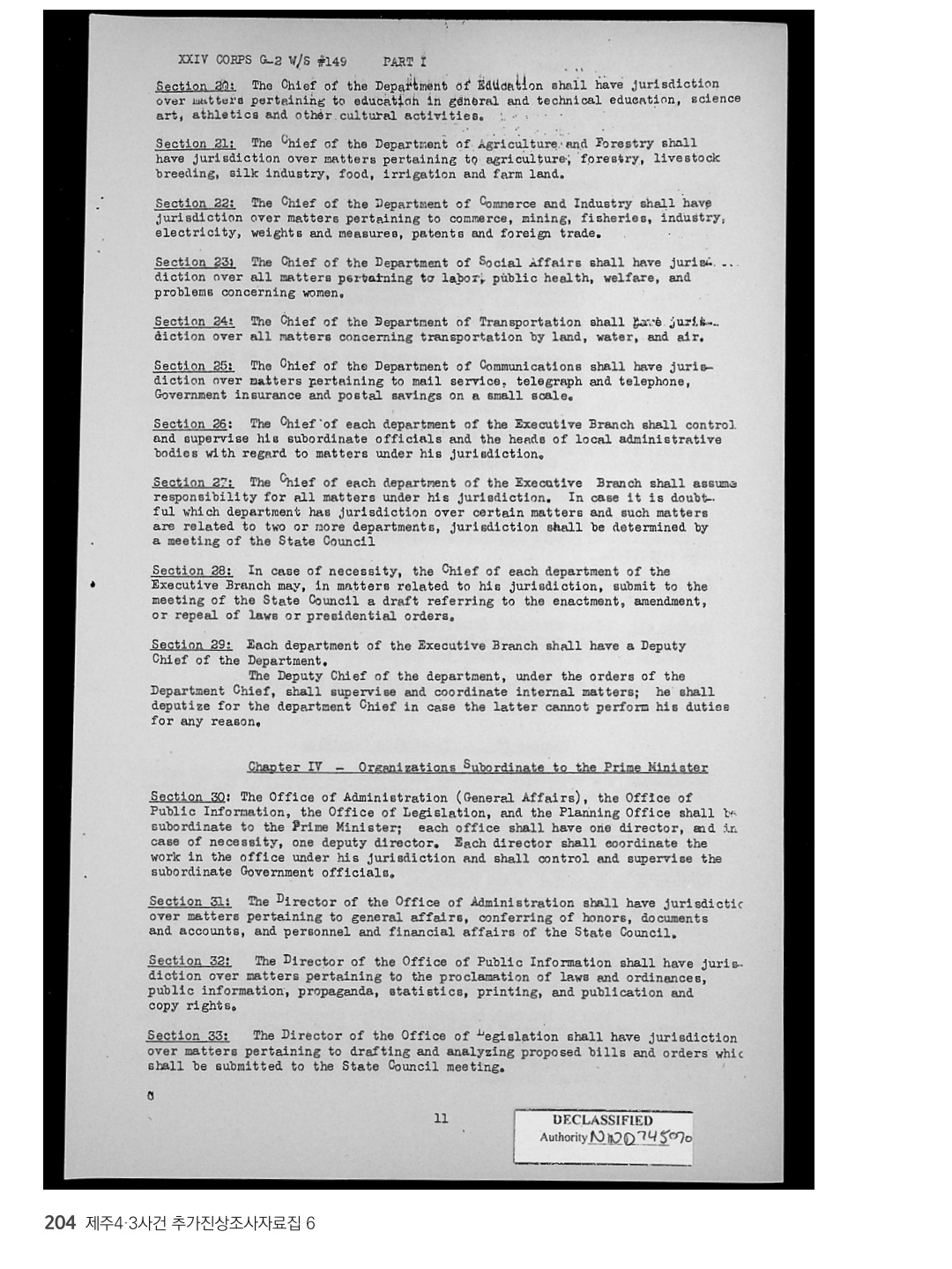
Section 20: The Chief of the Department of Education shall have jurisdiction over matters pertaining to education in general and technical education, science art, athletics and other cultural activities.
Section 21: The Chief of the Department of Agriculture and Forestry shall have jurisdiction over matters pertaining to agriculture, forestry, livestock breeding, silk industry, food, irrigation and farm land.
Section 22: The Chief of the Department of Commerce and Industry shall have jurisdiction over matters pertaining to commerce, mining, fisheries, industry, electricity, weights and measures, patents and foreign trade.
Section 23: The Chief of the Department of Social Affairs shall have jurisdiction over all matters pertaining to labor, public health, welfare, and problems concerning women.
Section 24: The Chief of the Department of Transportation shall have jurisdiction over all matters concerning transportation by land, water, and air.
Section 25: The Chief of the Department of Communications shall have jurisdiction over matters pertaining to mail service, telegraph and telephone, Government insurance and postal savings on a small scale.
Section 26: The Chief of each department of the Executive Branch shall control and supervise his subordinate officials and the heads of local administrative bodies with regard to matters under his jurisdiction.
Section 27: The Chief of each department of the Executive Branch shall assume responsibility for all matters under his jurisdiction. In case it is doubtful which department has jurisdiction over certain matters and such matters are related to two or more departments, jurisdiction shall be determined by a meeting of the State Council
Section 28: In case of necessity, the Chief of each department of the
Executive Branch may, in matters related to his jurisdiction, submit to the meeting of the State Council a draft referring to the enactment, amendment, or repeal of laws or presidential orders.
Section 29: Each department of the Executive Branch shall have a Deputy
Chief of the Department.
The Deputy Chief of the department, under the orders of the
Department Chief, shall supervise and coordinate internal matters; he shall deputize for the department Chief in case the latter cannot perform his duties for any reason.
Chapter IV - Organizations Subordinate to the Prime Minister
Section 30: The Office of Administration (General Affairs), the Office of
Public Information, the Office of Legislation, and the Planning Office shall be subordinate to the Prime Minister; each office shall have one director, and in case of necessity, one deputy director. Each director shall coordinate the work in the office under his jurisdiction and shall control and supervise the subordinate Government officials.
Section 31: The Director of the Office of Administration shall have jurisdictio over matters pertaining to general affairs, conferring of honors, documents and accounts, and personnel and financial affairs of the State Council.
Section 32: The Director of the Office of Public Information shall have jurisdiction over matters pertaining to the proclamation of laws and ordinances, public information, propaganda, statistics, printing, and publication and copy rights.
Section 33: The Director of the Office of Legislation shall have jurisdiction over matters pertaining to drafting and analyzing proposed bills and orders whic shall be submitted to the State Council meeting.
11
DECLASSIFIED
Authority NND 745070
XXIV CORPS G-2 W/S #149 PART I
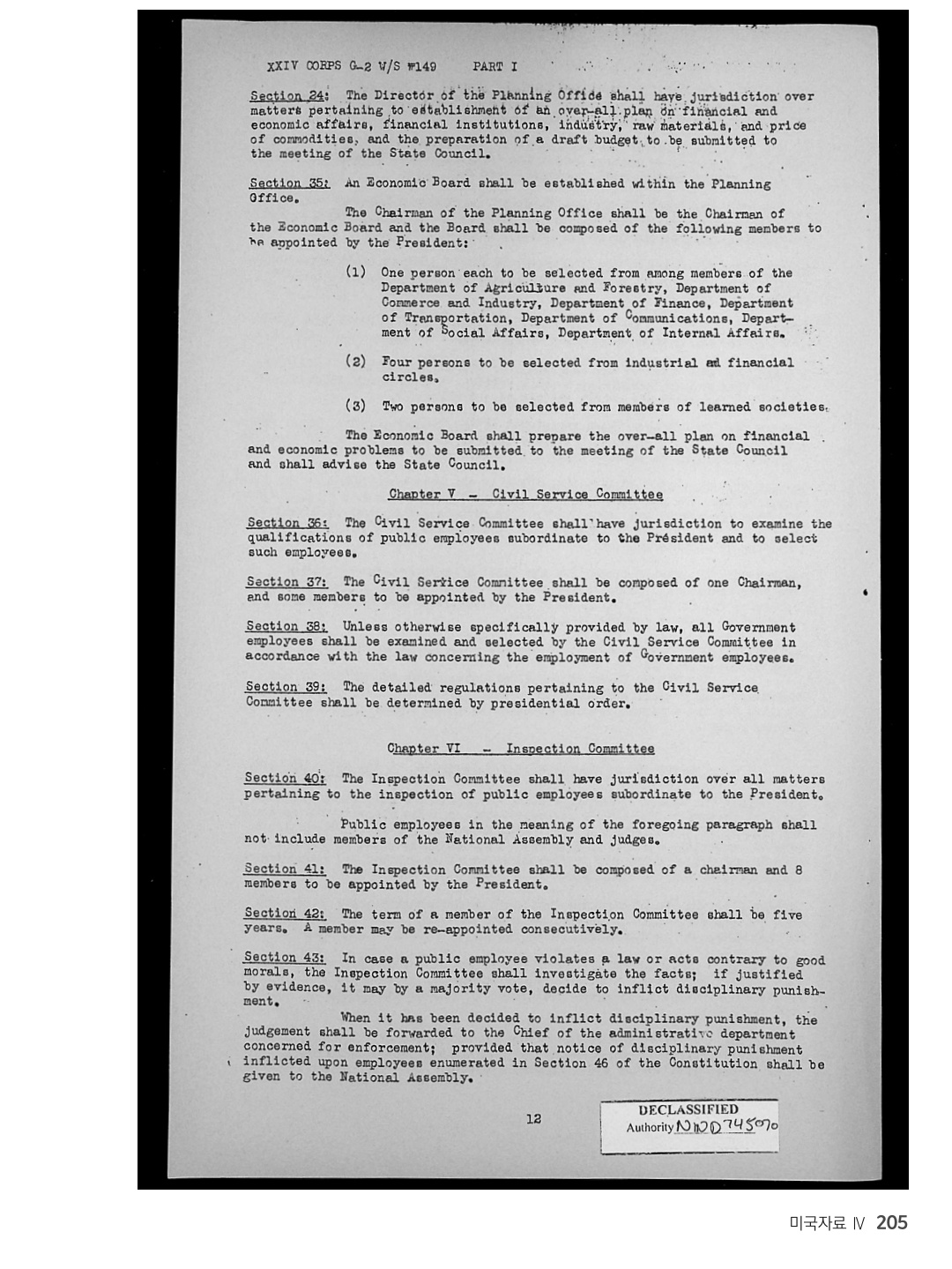
Section 24: The Director of the Planning Office shall have jurisdiction over matters pertaining to establishment of an over-all plan on financial and economic affairs, financial institutions, industry, raw materials, and price of commodities, and the preparation of a draft budget to be submitted to the meeting of the State Council.
Section 35: An Economic Board shall be established within the Planning
Office.
The Chairman of the Planning Office shall be the Chairman of the Economic Board and the Board shall be composed of the following members to be appointed by the President:
(1) One person each to be selected from among members of the
Department of Agriculture and Forestry, Department of
Commerce and Industry, Department of Finance, Department of Transportation, Department of Communications, Department of Social Affairs, Department of Internal Affairs.
(2) Four persons to be selected from industrial and financial circles.
(3) Two persons to be selected from members of learned societies.
The Economic Board shall prepare the over-all plan on financial and economic problems to be submitted to the meeting of the State Council and shall advise the State Council.
Chapter V — Civil Service Committee
Section 36: The Civil Service Committee shall have jurisdiction to examine the qualifications of public employees subordinate to the President and to select such employees.
Section 37: The Civil Service Committee shall be composed of one Chairman, and some members to be appointed by the President.
Section 38: Unless otherwise specifically provided by law, all Government employees shall be examined and selected by the Civil Service Committee in accordance with the law concerning the employment of Government employees.
Section 39: The detailed regulations pertaining to the Civil Service
Committee shall be determined by presidential order.
Chapter VI — Inspection Committee
Section 40: The Inspection Committee shall have jurisdiction over all matters pertaining to the inspection of public employees subordinate to the President.
Public employees in the meaning of the foregoing paragraph shall not include members of the National Assembly and judges.
Section 41: The Inspection Committee shall be composed of a chairman and 8 members to be appointed by the President.
Section 42: The term of a member of the Inspection Committee shall be five years. A member may be re-appointed consecutively.
Section 43: In case a public employee violates a law or acts contrary to good morals, the Inspection Committee shall investigate the facts; if justified by evidence, it may by a majority vote, decide to inflict disciplinary punishment.
When it has been decided to inflict disciplinary punishment, the judgement shall be forwarded to the Chief of the administrative department concerned for enforcement; provided that notice of disciplinary punishment inflicted upon employees enumerated in Section 46 of the Constitution shall be given to the National Assembly.
12
DECLASSIFIED
Authority NND 745070
DECLASSIFIED
Authority NND 74570
GOVERNMENTAL STRUCTURE of the Democratic Republic of Korea
STATE
COUNCIL
Headed by President, Includes Prime Minister and other ministers.
National
Assembly
Office of
General
Affairs
Inspection
Committee
Office of
Public
Information
PRIME
MINISTER
Audit
Board
PRESIDENT
Office of
Legislation
Bureau of Budget
Examination
Committee
Office of
Planning
Economic
Committee
Courts
Vice
President
Responsibility
Membership
23 JULY 1948
Dept.
Internal
Affairs
Dept.
Foreign
Affairs
Dept.
Agricul.
& Forestry
Dept.
Commerce
Industry
Dept.
Finance
Dept.
Education
Dept.
Justice
Dept.
Social
Affairs
Dept.
National
Defense
Dept.
Transport-
ion
Dept.
Communicat-
ion
13
XXIV CORPS G-2 W/S #149 PART I
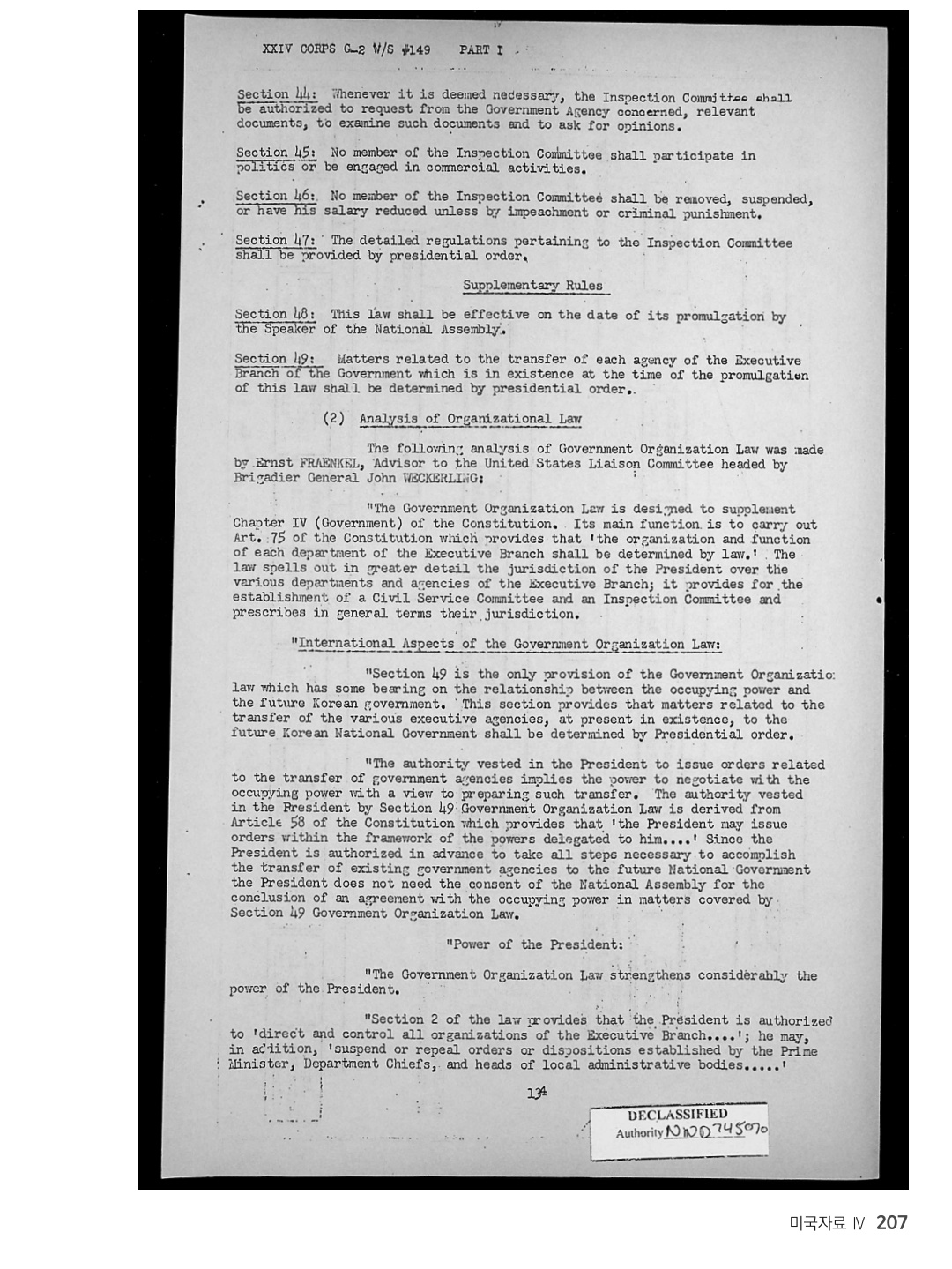
Section 44: Whenever it is deemed necessary, the Inspection Committee shall be authorized to request from the Government Agency concerned, relevant documents, to examine such documents and to ask for opinions.
Section 45: No member of the Inspection Committee shall participate in politics or be engaged in commercial activities.
Section 46: No member of the Inspection Committee shall be removed, suspended, or have his salary reduced unless by impeachment or criminal punishment.
Section 47: The detailed regulations pertaining to the Inspection Committee shall be provided by presidential order.
Supplementary Rules
Section 48: This law shall be effective on the date of its promulgation by the Speaker of the National Assembly.
Section 49: Matters related to the transfer of each agency of the Executive Branch of the Government which is in existence at the time of the promulgation of this law shall be determined by presidential order.
(2) Analysis of Organizational Law
The following analysis of Government Organization Law was made by Ernst FRAENKEL, Advisor to the United States Liaison Committee headed by Brigadier General John WECKERLING:
"The Government Organization Law is designed to supplement Chapter IV (Government) of the Constitution. Its main function is to carry out Art. 75 of the Constitution which provides that 'the organization and function of each department of the Executive Branch shall be determined by law.' The law spells out in greater detail the jurisdiction of the President over the various departments and agencies of the Executive Branch; it provides for the establishment of a Civil Service Committee and an Inspection Committee and prescribes in general terms their jurisdiction.
"International Aspects of the Government Organization Law:
"Section 49 is the only provision of the Government Organization law which has some bearing on the relationship between the occupying power and the future Korean government. This section provides that matters related to the transfer of the various executive agencies, at present in existence, to the future Korean National Government shall be determined by Presidential order.
"The authority vested in the President to issue orders related to the transfer of government agencies implies the power to negotiate with the occupying power with a view to preparing such transfer. The authority vested in the President by Section 49 Government Organization Law is derived from Article 58 of the Constitution which provides that 'the President may issue orders within the framework of the powers delegated to him....' Since the President is authorized in advance to take all steps necessary to accomplish the transfer of existing government agencies to the future National Government the President does not need the consent of the National Assembly for the conclusion of an agreement with the occupying power in matters covered by Section 49 Government Organization Law.
"Power of the President:
"The Government Organization Law strengthens considerably the power of the President.
"Section 2 of the law provides that the President is authorized to 'direct and control all organizations of the Executive Branch....'; he may, in action, 'suspend or repeal orders or dispositions established by the Prime Minister, Department Chiefs, and heads of local administrative bodies.....'
134
DECLASSIFIED
Authority NND 745070
XXIV CORPS G-2 W/S #149 PART I
"It should be noted that the Civil Service Committee is an agency subordinate to the President, subject to his direction and control. Since the
Civil Service Committee lacks independence, it would be misleading to compare the Civil Service Committee to the Civil Service Commission of the United
States.
"The Inspection Committee is a quasi-judicial board with jurisdiction to enforce the disciplinary provisions of the civil service law against all government employees of the executive branch. Although the members of the Inspection Committee enjoy a certain independence comparable to the position of judges (Section 46) the Inspection Committee is not a court in the meaning of Chapter V of the Constitution. The Inspection Committee is therefore subject to the directives and control of the President, as prescribed in Section 2 of the Government Organization Law.
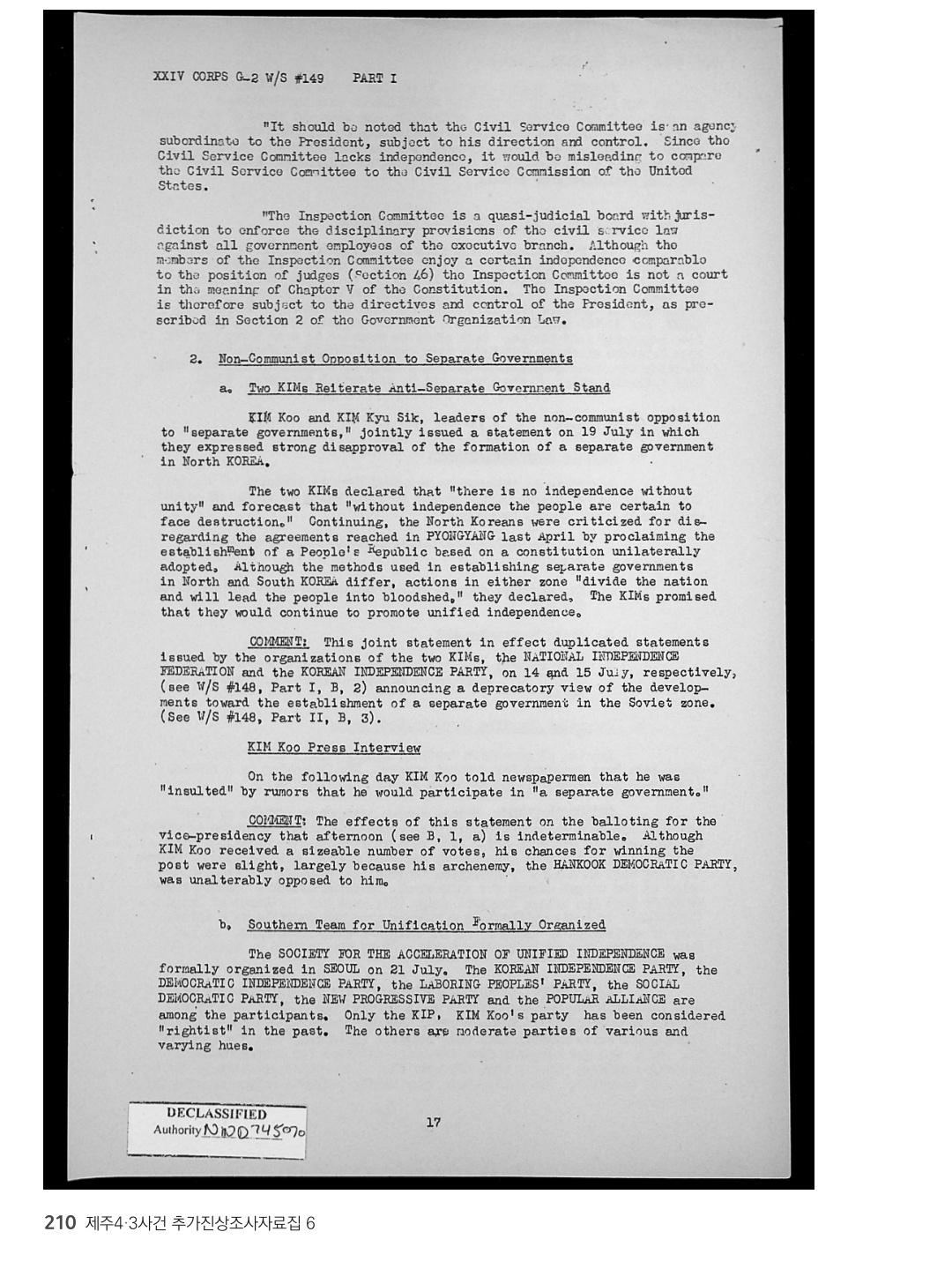
2. Non-Communist Opposition to Separate Governments
a. Two KIMs Reiterate Anti-Separate Government Stand
KIM Koo and KIM Kyu Sik, leaders of the non-communist opposition to "separate governments," jointly issued a statement on 19 July in which they expressed strong disapproval of the formation of a separate government in North KOREA.
The two KIMs declared that "there is no independence without unity" and forecast that "without independence the people are certain to face destruction." Continuing, the North Koreans were criticized for disregarding the agreements reached in PYONGYANG last April by proclaiming the establishment of a People's Republic based on a constitution unilaterally adopted. Although the methods used in establishing separate governments in North and South KOREA differ, actions in either zone "divide the nation and will lead the people into bloodshed," they declared. The KIMs promised that they would continue to promote unified independence.
COMMENT: This joint statement in effect duplicated statements issued by the organizations of the two KIMs, the NATIONAL INDEPENDENCE
FEDERATION and the KOREAN INDEPENDENCE PARTY, on 14 and 15 July, respectively,
(see W/S #148, Part I, B, 2) announcing a deprecatory view of the developments toward the establishment of a separate government in the Soviet zone.
(See W/S #148, Part II, B, 3).
KIM Koo Press Interview
On the following day KIM Koo told newspapermen that he was
"insulted" by rumors that he would participate in "a separate government."
COMMENT: The effects of this statement on the balloting for the vice-presidency that afternoon (see B, 1, a) is indeterminable. Although
KIM Koo received a sizeable number of votes, his chances for winning the post were slight, largely because his archenemy, the HANKOOK DEMOCRATIC PARTY, was unalterably opposed to him.
b. Southern Team for Unification Formally Organized
The SOCIETY FOR THE ACCELERATION OF UNIFIED INDEPENDENCE was formally organized in SEOUL on 21 July. The KOREAN INDEPENDENCE PARTY, the
DEMOCRATIC INDEPENDENCE PARTY, the LABORING PEOPLES' PARTY, the SOCIAL
DEMOCRATIC PARTY, the NEW PROGRESSIVE PARTY and the POPULAR ALLIANCE are among the participants. Only the KIP, KIM Koo's party has been considered
"rightist" in the past. The others are moderate parties of various and varying hues.
DECLASSIFIED
Authority N[illegible]O 745070
17
XXIV CORPS G-2 W/S #149 PART I
COMMENT: Except for the inclusion of KIM Koo's KIP, the
SOCIETY FOR ACCELERATION OF UNIFIED INDEPENDENCE is a duplication of KIM
Kyu Sik's NATIONAL INDEPENDENCE FEDERATION, the same old crowd of politically impotent dissidents who declined to participate in the election. The component parts hang together loosely, and the question as to whether membership is to be derived by organizations or (desirable) individuals has not been satisfactorily solved.
3. North Korean Plan for PYONGYANG Conference
The North Korean communists have initiated a plan to include
360 South Korean delegates to a General Unity Conference preparatory to the 25 August elections in North KOREA. Of these 360 delegates, plans are that 40% will be from the DEMOCRATIC PEOPLES FRONT, 20% from the
"Intermediate" parties (LABORING PEOPLES PARTY, DEMOCRATIC INDEPENDENCE
PARTY, and SOCIAL DEMOCRATIC PARTY), 20% from rightist elements, and 20% from non-party individuals. Each group is supposed to send three men for each delegate allotted, and after they reach PYONGYANG, a South KOREA
Election Committee composed of PAK Hyung Yung, HONG Myung Hi, and LEE Yung, will determine which of the three will be the actual delegate. (B-3)
4. Civil Unrest
a. Planned Guerilla Activity
According to information received from an official of the left wing, guerilla activities will commence in South KOREA after the 25 August election in North KOREA, involving:
1. Men now hiding in mountains, already active in a minor way ;
2. Men already prepared in the cities and ready to take to the field ;
3. Cheju Do people; and
4. Infiltrators from North KOREA, including members of the
IN MIN GUN, coming down to South KOREA singly and not as units.
b. Communist Guerilla Concentration Areas
Reports of communist "action" squads, etc., in mountainous areas have been received for several months. The following is a resume.
(Numbers in parentheses refer to areas on the map, page 21.)
KYONGSANG PUKTO: Police action against communists of this province has been continuous since the general election. Sporadic demonstrations and acts of violence arise from time to time, but no definite, wide spread uprising has been launched by the communists. This province, however, has long been an actual or potential "hotbed" and remains so, even though quiet at the moment except for occasional, isolated attacks. Recent reports indicate that the Sobaek Mountain range (1), west and northwest of Taegu
(1150-1430) is being utilized as a hideout area and possibly as a future base of operations by segments of the People's Liberation Army. An F-6 source states that approximately 2,000 members are located in these mountains.
KYONGGI DO: Communist activity in the mountains during the past two weeks has centered around the Yanp'Yong (1040-1630) area (2).
Reports concerning North KOREA agents, Chinese communist agents, and South
Korea Labor Party members have been received indicating that the town and the nearby Taebaek mountain area are being utilized for meeting points, hideouts, storage points, etc. No estimate of communist strength in the area has been received. The police have take little positive action against the stronghold.
18
DECLASSIFIED
Authority NND 745070
XXIV CORPS G-2 W/S #149 PART I
KANGWON DO: The South Korea Labor Party and its affiliates have found that it is almost impossible to coordinate any activities in the villages and towns because of police raids and arrests, and have taken to the mountains. Many reports from this province indicate that the mountain area,(3),west of Chumunjin (1170-1680) has been utilized by the
"Flying Column" attacking force as a base of operations and hideout. Recent
South Korea Labor Party directives state that all branches must send scouts to investigate mountains, temples, and forests and submit a report on the findings. No strength estimate has been received.
CHOLLA PUKTO and KYONGSANG NAMDO: Reports received from the
Police and CIC reveal that the southern Taebaek mountain rage area, (4), on the border between these two provinces, is also being used by communist guerilla forces. Police action has surpressed communist activities to some extent; however, the forests and high rocky areas make it almost impossible to ferret out the main hideouts of the South Korea Vanguard Action
Corps and other guerilla units. No strength estimate has been received.
CHUNGCHONG PUKTO: The South Korea Labor Party, acting upon orders received from Seoul headquarters, has been organizing scouting parties to search for hideouts and strongholds in the Taebaek mountain area, (5), to be used as bases for future guerilla activities. Several raids conducted by the Police and the many arrests made in this area may have done much to counteract the communist plans; however, recent reports indicate that the communists are achieving some success in establishing mountain bases. No strength estimate has been received.
c. Weekly Violence Summary
A summary of acts of violence involving communists for the week as reported up to 23 July is as follows:
[TABLE with columns: Seoul, Kyongg[i] Do, Kangwon Do, Chung-[chong] Namdo, Chungchon Pukto, Cholla Namdo, Cholla Pukto, Kyongsang Namdo, Kyongsang Pukto, Cheju Do, Total]
Attacks on towns
Attacks on police 1 1
Police killed
Communists killed [illegible] 1 2
Rightists killed
Demonstrations, disorders arson, & attacks on rightists 3 1 4
Attacks on
government buildings
Sabotage (communications)
Sabotage (RR lines)
Sabotage (roads)
Sabotage (bridges)
Sabotage (power)
Strikes (labor)
Strikes (schools)
19
DECLASSIFIED
Authority NND745070
XXIV CORPS G-2 W/S #149 PART I
d. Delayed Reports Covering Last Week
Delayed reports of incidents that occurred during the week ending 16 July which were not carried in last week's summary (see Part I, B, 3, a, W/S #148) are:
Seoul | Kyonggi-Do | Kangwon-Do | Chungchong Nando | Chungchong Pukto | Cholla Nando | Cholla Pukto | Kyongsang Nando | Kyongsang Pukto | Cheju-Do | Total
Attacks on towns
Attacks on police
Police killed
Communists Killed 1 1 2
Rightists killed
Demonstration, disorders, arson, & attacks on rightists 1 1 2
Attacks on
government buildings
Sabotage (communications)
Sabotage (RR lines)
Sabotage (roads)
Sabotage (bridges)
Sabotage (power)
Strikes (labor)
Strikes (schools)
e. 1948 Communist Activities In South KOREA
JAN FEB MAR APR MAY JUNE JULY* TOTAL
Attacks on towns 0 0 0 5 73 9 1 88
Attacks on police 0 130 118 50 86 12 6 402
Police killed 0 33 20 15 34 4 1 107
Rightists killed 1 14 14 81 144 51 10 315
Communist killed 1 74 75 70 155 83 15 473
Disorders, demonstrations, arson & attacks on rightists'
offices & homes 6 118 69 126 196 81 21 617
Attacks on
government buildings 0 9 14 2 9 3 0 37
Sabotage (communications)14 53 58 32 57 8 1 223
Sabotage (RR lines) 1 12 6 0 8 0 1 28
Sabotage (Locomotives) 0 50 0 0 24 0 0 74
Sabotage (roads) 0 13 5 2 5 0 0 25
Sabotage (bridges) 0 6 9 5 4 0 0 24
Sabotage (power) 0 0 0 0 7 1 0 8
Strikes (labor) 0 14 6 3 16 1 0 40
Strikes (schools) 0 7 5 4 9 0 0 25
Attacks on registration
& election booths 0 0 0 58 68 0 0 126
* Incomplete
20
DECLASSIFIED
Authority NND745070
미국자료 IV 213
4.3미국자료집 4권210716.qxp_레이아웃 1 21. 7. 20. 오후 3:33 페이지 214
XXIV CORPS G-2 W/S #149 PART I
CIVIL UNREST CHART
HWANGHAE-DO KANGWON-DO
38!
.Chunchon
Seoul x
KYONGGI-DO x 3 x JAPAN
SEA
PUNTO
CHUNGCHONG
5
YELLOW SEA CHUNGCHONG
HALIDO KYONGSANGTaejon PUNTO
Chonju 1
CHOLLA- .Taegu
PUNTO
4 KYONGSANG-NAMDO
Kwanju
CHOLLA Pusan
NAMDO
N'
So a O
2 O
SOUTH KOREA
Cheju
CHEJU-DO
LEGEND
O COMMUNIST KILLED COMMUNIST GUERILLA
(x x x) CONCENTRATION AREA
⊕ ATTACK ON POLICE
21 DECLASSIFIED
Authority NND 745070
214 제주4·3사건 추가진상조사자료집 6
XXIV CORPS G-2 W/S #149 PART I
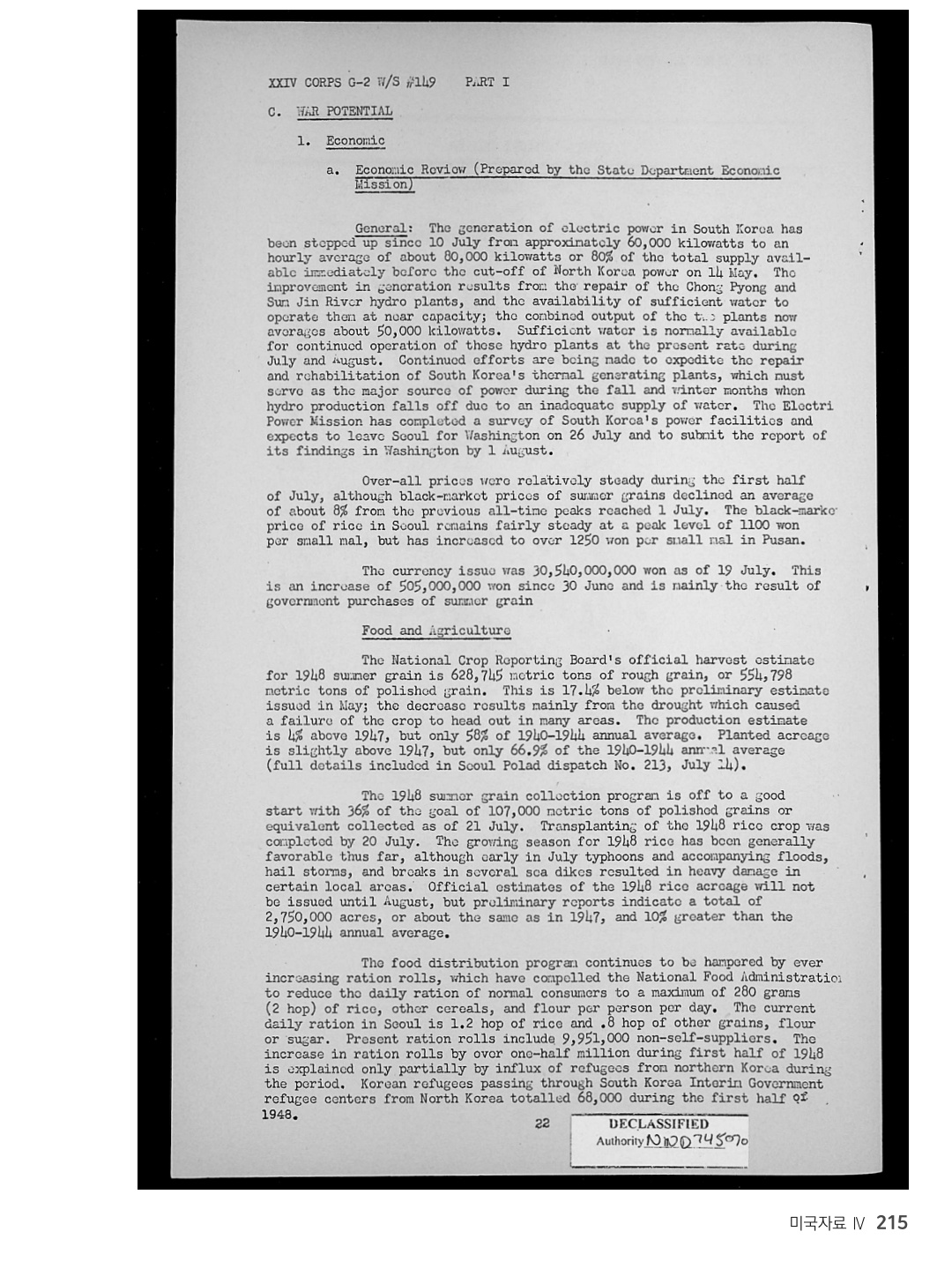
C. WAR POTENTIAL
1. Economic
a. Economic Review (Prepared by the State Department Economic
Mission)
General: The generation of electric power in South Korea has been stepped up since 10 July from approximately 60,000 kilowatts to an hourly average of about 80,000 kilowatts or 80% of the total supply available immediately before the cut-off of North Korea power on 14 May. The improvement in generation results from the repair of the Chong Pyong and
Sun Jin River hydro plants, and the availability of sufficient water to operate them at near capacity; the combined output of the two plants now averages about 50,000 kilowatts. Sufficient water is normally available for continued operation of those hydro plants at the present rate during
July and August. Continued efforts are being made to expedite the repair and rehabilitation of South Korea's thermal generating plants, which must serve as the major source of power during the fall and winter months when hydro production falls off due to an inadequate supply of water. The Electri
Power Mission has completed a survey of South Korea's power facilities and expects to leave Seoul for Washington on 26 July and to submit the report of its findings in Washington by 1 August.
Over-all prices were relatively steady during the first half of July, although black-market prices of summer grains declined an average of about 8% from the previous all-time peaks reached 1 July. The black-marke price of rice in Seoul remains fairly steady at a peak level of 1100 won per small mal, but has increased to over 1250 won per small mal in Pusan.
The currency issue was 30,540,000,000 won as of 19 July. This is an increase of 505,000,000 won since 30 June and is mainly the result of government purchases of summer grain
Food and Agriculture
The National Crop Reporting Board's official harvest estimate for 1948 summer grain is 628,745 metric tons of rough grain, or 554,798 metric tons of polished grain. This is 17.4% below the preliminary estimate issued in May; the decrease results mainly from the drought which caused a failure of the crop to head out in many areas. The production estimate is 4% above 1947, but only 58% of 1940-1944 annual average. Planted acreage is slightly above 1947, but only 66.9% of the 1940-1944 annual average
(full details included in Seoul Political dispatch No. 213, July 24).
The 1948 summer grain collection program is off to a good start with 36% of the goal of 107,000 metric tons of polished grains or equivalent collected as of 21 July. Transplanting of the 1948 rice crop was completed by 20 July. The growing season for 1948 rice has been generally favorable thus far, although early in July typhoons and accompanying floods, hail storms, and breaks in several sea dikes resulted in heavy damage in certain local areas. Official estimates of the 1948 rice acreage will not be issued until August, but preliminary reports indicate a total of
2,750,000 acres, or about the same as in 1947, and 10% greater than the
1940-1944 annual average.
The food distribution program continues to be hampered by ever increasing ration rolls, which have compelled the National Food Administration to reduce the daily ration of normal consumers to a maximum of 280 grams
(2 hop) of rice, other cereals, and flour per person per day. The current daily ration in Seoul is 1.2 hop of rice and .8 hop of other grains, flour or sugar. Present ration rolls include 9,951,000 non-self-suppliers. The increase in ration rolls by over one-half million during first half of 1948 is explained only partially by influx of refugees from northern Korea during the period. Korean refugees passing through South Korea Interim Government refugee centers from North Korea totalled 68,000 during the first half of
1948.
22
DECLASSIFIED
Authority NND 745070
XXIV CORPS G-2 W/S #149 PART I
Refugees entering South Korea clandestinely during same period probably did not exceed 68,000. Korean officials admit that the number of so-called
"ghosts" on the ration rolls has increased substantially during the past year, despite concerted efforts to eliminate fictitious registrants. There is a growing need for a national census in South Korea to determine accurately the actual population by ration categories, and for closer control over the issuance of ration cards.
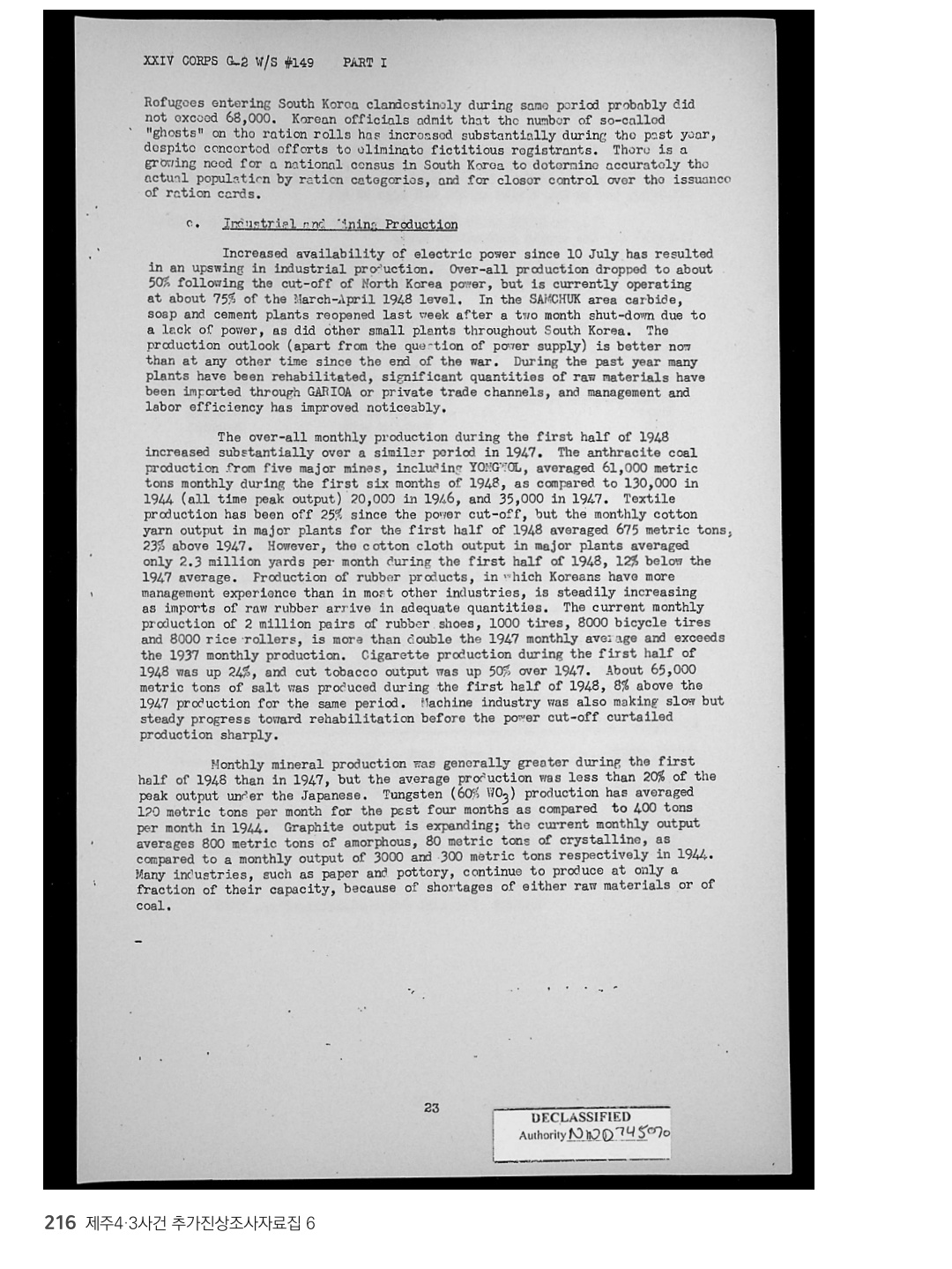
c. Industrial and Mining Production
Increased availability of electric power since 10 July has resulted in an upswing in industrial production. Over-all production dropped to about
50% following the cut-off of North Korea power, but is currently operating at about 75% of the March-April 1948 level. In the SAMCHUK area carbide, soap and cement plants reopened last week after a two month shut-down due to a lack of power, as did other small plants throughout South Korea. The production outlook (apart from the question of power supply) is better now than at any other time since the end of the war. During the past year many plants have been rehabilitated, significant quantities of raw materials have been imported through GARIOA or private trade channels, and management and labor efficiency has improved noticeably.
The over-all monthly production during the first half of 1948 increased substantially over a similar period in 1947. The anthracite coal production from five major mines, including YONGMOL, averaged 61,000 metric tons monthly during the first six months of 1948, as compared to 130,000 in
1944 (all time peak output) 20,000 in 1946, and 35,000 in 1947. Textile production has been off 25% since the power cut-off, but the monthly cotton yarn output in major plants for the first half of 1948 averaged 675 metric tons,
23% above 1947. However, the cotton cloth output in major plants averaged only 2.3 million yards per month during the first half of 1948, 12% below the
1947 average. Production of rubber products, in which Koreans have more management experience than in most other industries, is steadily increasing as imports of raw rubber arrive in adequate quantities. The current monthly production of 2 million pairs of rubber shoes, 1000 tires, 8000 bicycle tires and 8000 rice rollers, is more than double the 1947 monthly average and exceeds the 1937 monthly production. Cigarette production during the first half of
1948 was up 24%, and cut tobacco output was up 50% over 1947. About 65,000 metric tons of salt was produced during the first half of 1948, 8% above the
1947 production for the same period. Machine industry was also making slow but steady progress toward rehabilitation before the power cut-off curtailed production sharply.
Monthly mineral production was generally greater during the first half of 1948 than in 1947, but the average production was less than 20% of the peak output under the Japanese. Tungsten (60% WO3) production has averaged
120 metric tons per month for the past four months as compared to 400 tons per month in 1944. Graphite output is expanding; the current monthly output averages 800 metric tons of amorphous, 80 metric tons of crystalline, as compared to a monthly output of 3000 and 300 metric tons respectively in 1944.
Many industries, such as paper and pottery, continue to produce at only a fraction of their capacity, because of shortages of either raw materials or of coal.
23
DECLASSIFIED
Authority NND 745070
XXIV CORPS G-2 W/S #149 PART I
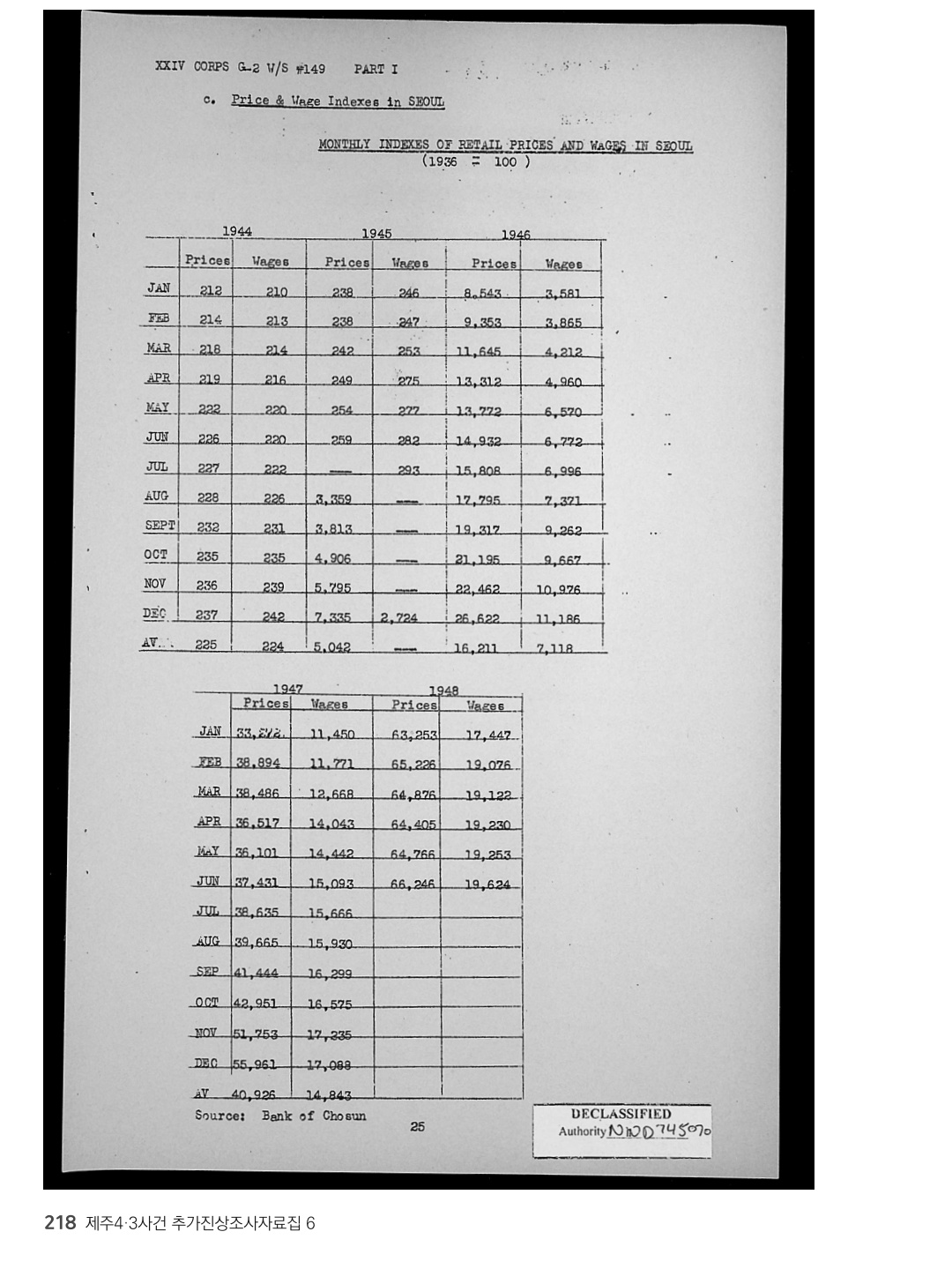
c. Price & Wage Indexes in SEOUL
MONTHLY INDEXES OF RETAIL PRICES AND WAGES IN SEOUL
(1935 = 100)
1944 1945 1946
Prices Wages Prices Wages Prices Wages
JAN 213 210 238 246 8,543 3,581
FEB 214 213 238 247 9,353 3,865
MAR 218 214 242 253 11,645 4,212
APR 219 216 249 275 13,312 4,960
MAY 222 220 254 277 13,772 6,570
JUN 226 220 259 282 14,932 6,772
JUL 227 222 ---- 293 15,808 6,996
AUG 228 226 3,359 ---- 17,795 7,371
SEPT 232 231 3,813 ---- 19,317 9,262
OCT 235 235 4,905 ---- 21,195 9,667
NOV 236 239 5,795 ---- 22,462 10,976
DEC 237 242 7,335 2,724 26,622 11,186
AV. 225 224 5,042 ---- 16,211 7,118
1947 1948
Prices Wages Prices Wages
JAN 33,272 11,450 63,253 17,447
FEB 38,894 11,771 65,226 19,076
MAR 38,486 12,568 64,876 19,122
APR 36,517 14,043 64,405 19,230
MAY 36,101 14,442 64,766 19,253
JUN 37,431 15,093 66,246 19,624
JUL 38,635 15,666
AUG 39,665 15,930
SEP 41,444 16,299
OCT 42,951 16,575
NOV 51,753 17,235
DEC 55,961 17,088
AV 40,926 14,843
Source: Bank of Chosun
25
DECLASSIFIED
Authority NND 745070
XXIV CORPS G-2 W/S #149 PART I
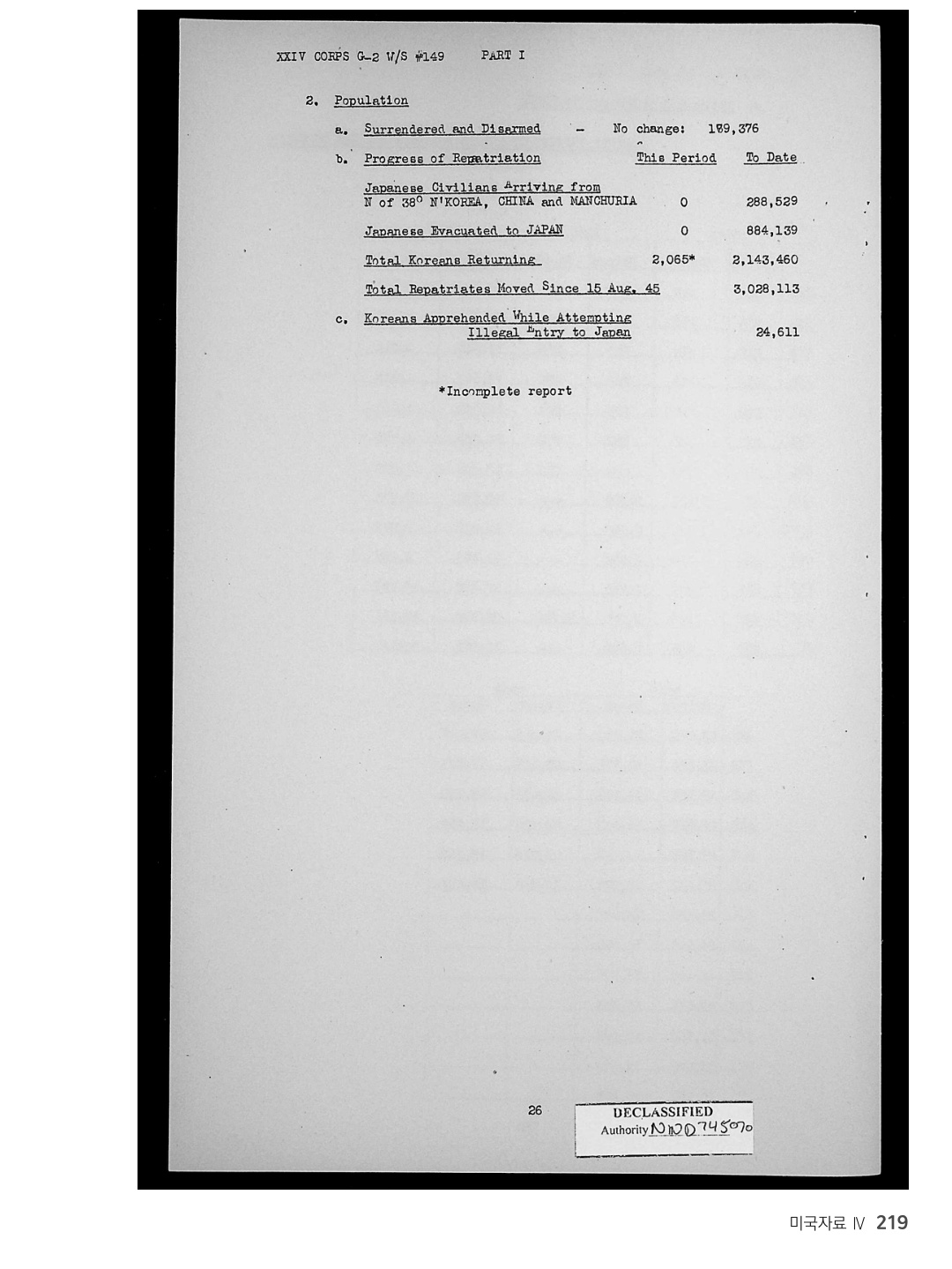
2. Population
a. Surrendered and Disarmed — No change: 189,376
b. Progress of Repatriation This Period To Date
Japanese Civilians Arriving from
N of 38° N'KOREA, CHINA and MANCHURIA 0 288,529
Japanese Evacuated to JAPAN 0 884,139
Total Koreans Returning 2,065* 2,143,460
Total Repatriates Moved Since 15 Aug. 45 3,028,113
c. Koreans Apprehended While Attempting
Illegal Entry to Japan 24,611
*Incomplete report
26 DECLASSIFIED
Authority NND 745070
XXIV CORPS G-2 W/S #149 PART I
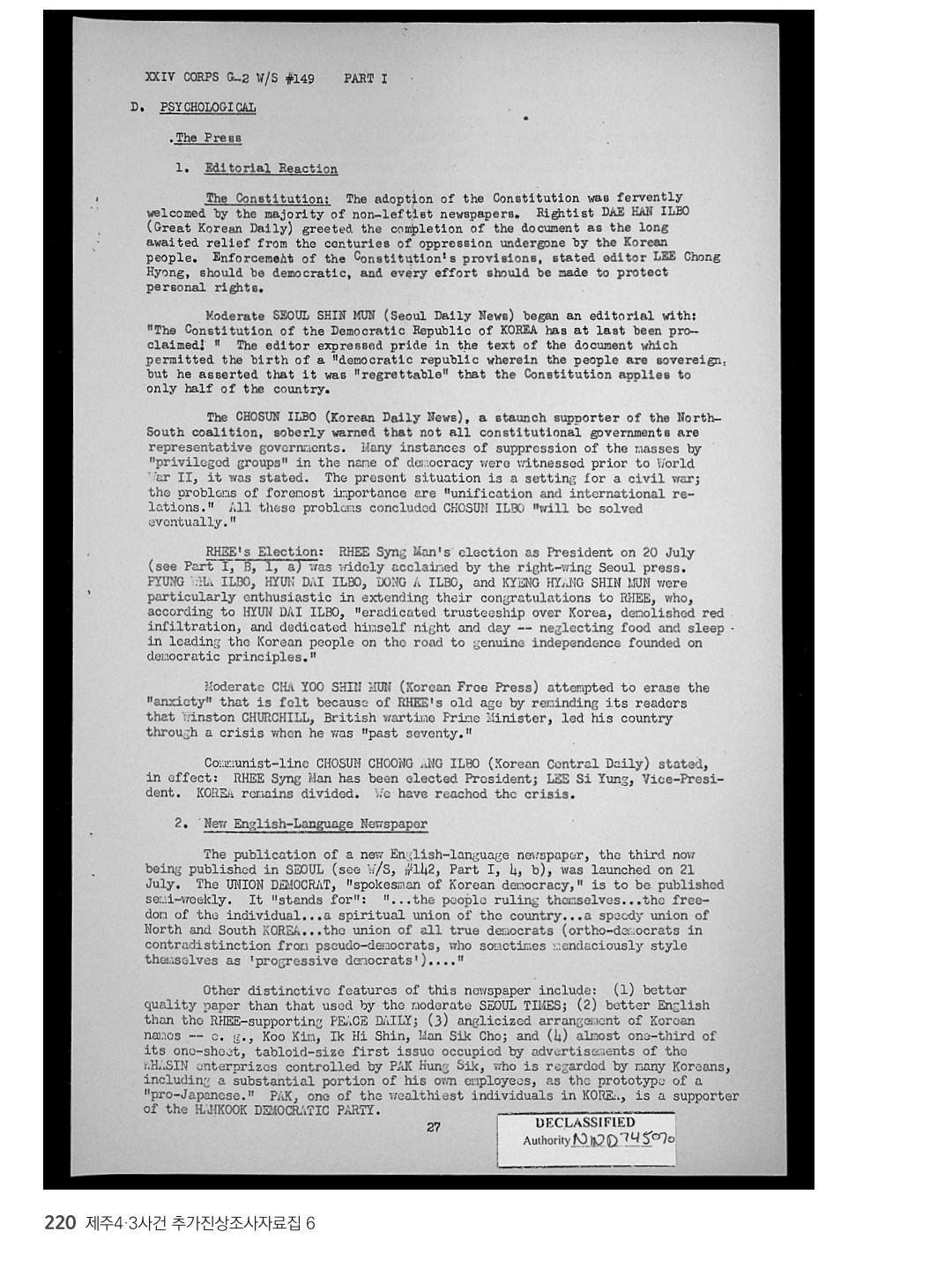
D. PSYCHOLOGICAL
.The Press
1. Editorial Reaction
The Constitution: The adoption of the Constitution was fervently welcomed by the majority of non-leftist newspapers. Rightist DAE HAN ILBO
(Great Korean Daily) greeted the completion of the document as the long awaited relief from the centuries of oppression undergone by the Korean people. Enforcement of the Constitution's provisions, stated editor LEE Chong
Hyong, should be democratic, and every effort should be made to protect personal rights.
Moderate SEOUL SHIN MUN (Seoul Daily News) began an editorial with:
"The Constitution of the Democratic Republic of KOREA has at last been proclaimed! " The editor expressed pride in the text of the document which permitted the birth of a "democratic republic wherein the people are sovereign, but he asserted that it was "regrettable" that the Constitution applies to only half of the country.
The CHOSUN ILBO (Korean Daily News), a staunch supporter of the NorthSouth coalition, soberly warned that not all constitutional governments are representative governments. Many instances of suppression of the masses by
"privileged groups" in the name of democracy were witnessed prior to World
War II, it was stated. The present situation is a setting for a civil war; the problems of foremost importance are "unification and international relations." All these problems concluded CHOSUN ILBO "will be solved eventually."
RHEE's Election: RHEE Syng Man's election as President on 20 July
(see Part I, B, 1, a) was widely acclaimed by the right-wing Seoul press.
PYUNG HWA ILBO, HYUN DAI ILBO, DONG A ILBO, and KYENG HYANG SHIN MUN were particularly enthusiastic in extending their congratulations to RHEE, who, according to HYUN DAI ILBO, "eradicated trusteeship over Korea, demolished red infiltration, and dedicated himself night and day -- neglecting food and sleep in leading the Korean people on the road to genuine independence founded on democratic principles."
Moderate CHA YOO SHIN MUN (Korean Free Press) attempted to erase the
"anxiety" that is felt because of RHEE's old age by reminding its readers that Winston CHURCHILL, British wartime Prime Minister, led his country through a crisis when he was "past seventy."
Communist-line CHOSUN CHOONG ANG ILBO (Korean Central Daily) stated,
in effect: RHEE Syng Man has been elected President; LEE Si Yung, Vice-Presi-
dent. KOREA remains divided. We have reached the crisis.
2. New English-Language Newspaper
The publication of a new English-language newspaper, the third now being published in SEOUL (see W/S, #142, Part I, 4, b), was launched on 21
July. The UNION DEMOCRAT, "spokesman of Korean democracy," is to be published semi-weekly. It "stands for": "...the people ruling themselves...the freedom of the individual...a spiritual union of the country...a speedy union of
North and South KOREA...the union of all true democrats (ortho-democrats in contradistinction from pseudo-democrats, who sometimes mendaciously style themselves as 'progressive democrats')...."
Other distinctive features of this newspaper include: (1) better quality paper than that used by the moderate SEOUL TIMES; (2) better English than the RHEE-supporting PEACE DAILY; (3) anglicized arrangement of Korean names -- e. g., Koo Kin, Ik Hi Shin, Man Sik Cho; and (4) almost one-third of its one-sheet, tabloid-size first issue occupied by advertisements of the
HWASIN enterprises controlled by PAK Hung Sik, who is regarded by many Koreans, including a substantial portion of his own employees, as the prototype of a
"pro-Japanese." PAK, one of the wealthiest individuals in KOREA, is a supporter of the HANKOOK DEMOCRATIC PARTY.
27
DECLASSIFIED
Authority NND 745070
XXIV CORPS G-2 W/S #149 PART I
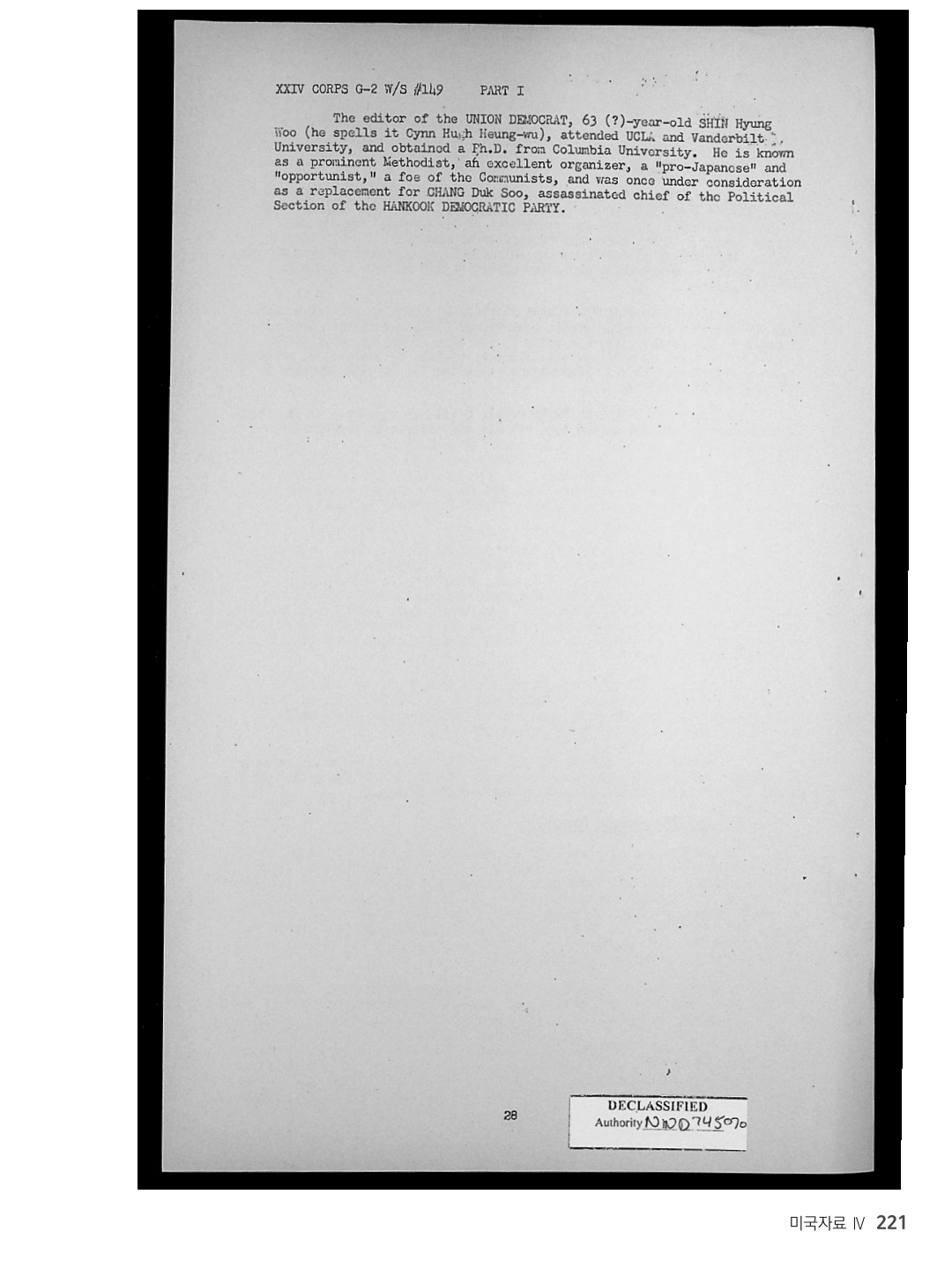
The editor of the UNION DEMOCRAT, 63 (?)-year-old SHIN Hyung
Woo (he spells it Cynn Hugh Heung-wu), attended UCLA and Vanderbilt
University, and obtained a Ph.D. from Columbia University. He is known as a prominent Methodist, an excellent organizer, a "pro-Japanese" and
"opportunist," a foe of the Communists, and was once under consideration as a replacement for CHANG Duk Soo, assassinated chief of the Political
Section of the HANKOOK DEMOCRATIC PARTY.
28
DECLASSIFIED
Authority N[illegible]D745070
XXIV CORPS G-2 W/S #149 PART I
E. SABOTAGE AND ESPIONAGE
An apprehended agent from North KOREA stated that 450 agents from the
North Korean Constabulary had been or were to be dispatched to South KOREA to instigate riots and gather information. (F-6)
29 DECLASSIFIED
Authority NND 745070
출처:
제주4·3평화재단 편,
『추가진상조사자료집-미국자료4』,
p. -8–15.
— NARA (RG 554, Entry 1256, Box 60)
×
![]()